Fatal mid-air aircraft accident – north-east of Wee Waa, NSW

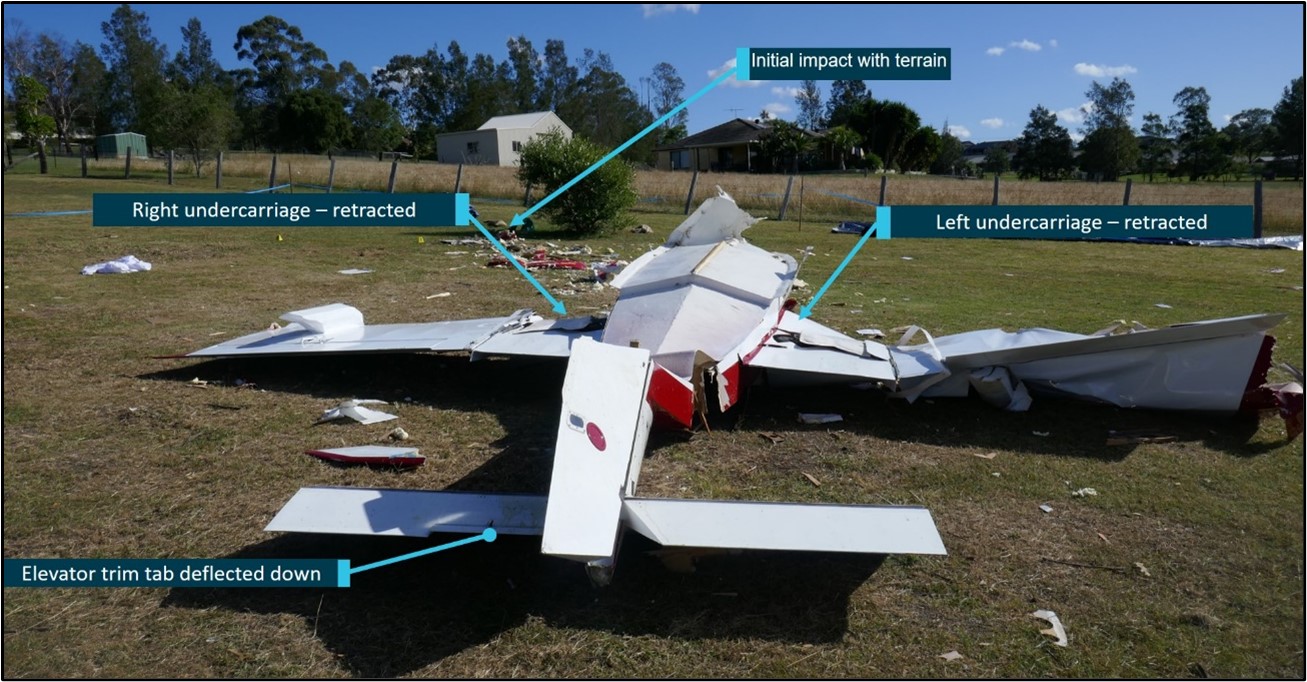
The Australian Transport Safety Bureau (ATSB) is conducting an investigation into the reported mid-air collision between two Air Tractor aircraft that occurred during the morning of 26 February 2008, 8.5 km NE Wee Waa.

A team of four Transport Safety Investigators arrived at the site late Tuesday and has commenced investigating the circumstances of the accident. The team has examined the burnt wreckage of one aircraft and interviewed witnesses. The team will finalise examination of that aircraft today and commence work on the other aircraft.

Initial information indicates that the pilot of an aircraft was transiting the area at the time the pilot of the other aircraft was climbing at the end of a spray run. The scope of the investigation will include the degree of situational awareness of both pilots under the circumstances.

Any person/witness with information about the accident is encouraged to contact the ATSB on 1800 020 616.

The ATSB expects to have a preliminary factual report available for public release in approximately thirty (30) days from the date of the accident.

ATSB releases final Pasha Bulker report

The ATSB has found that the grounding of Pasha Bulker on Nobbys Beach on 8 June 2007 occurred despite a gale warning that should have prompted the master to ballast the ship for heavy weather and take it to sea. A number of other ships also failed to take to sea.

The Australian Transport Safety Bureau investigation found that Pasha Bulker's master had an inadequate understanding of heavy weather ballast, anchor holding power and the limitations of Newcastle's weather exposed anchorage.

The investigation also found that a number of other ships attempted to ride out the gale at anchor and the majority dragged their anchors. A number of masters did not appropriately ballast their ships and many did not understand Newcastle Vessel Traffic Information Centre's purely advisory role, expecting that it would instruct or inform them to put to sea at an appropriate time. It was also found that the substantial ship queue increased the risks in the anchorage and resulted in another near grounding, a near collision and a number of close-quarters situations at the time.

On 23 May, the Panamanian registered bulk carrier Pasha Bulker anchored about two miles off the coast near Newcastle and joined the queue of 57 ships to wait its turn for loading coal. The ship was ballasted for the good weather conditions. Newcastle anchorage is suitable only in good weather and nautical publications contain warnings about the local weather conditions and recommend that masters put to sea before conditions become severe.

On the morning of 7 June, the Bureau of Meteorology issued a gale warning for the area. Winds were expected to increase to 45 knots, with gusts up to 63 knots, after 0400 on 8 June with high seas and a heavy swell. At midday, Pasha Bulker's master deployed additional anchor cable and decided to monitor the weather and the ship's anchor position.

By midnight, the southeast wind was gusting to 30 knots and ships began dragging their anchors. Newcastle Vessel Traffic Information Centre advised those ships that were dragging their anchors. Only seven ships had put to sea in the deteriorating weather while another had weighed anchor to berth in the port.

By 0600 on 8 June, the wind was gusting to nearly 50 knots and Pasha Bulker was amongst 27 ships still at anchor. At 0637, when the master was certain that the anchor was dragging, he decided to weigh anchor. At 0748, the ship got underway and for more than an hour, moved in a northeast direction parallel to the coast about one mile away with the wind on its starboard bow.

At 0906, the master decided to alter course to put the wind on the ship's port bow and clear the coast in a southerly direction. The course change in the extreme weather was poorly controlled and Pasha Bulker's heading became south-westerly instead of south-southeast as intended. The ship then rapidly approached Nobbys Beach and the master's desperate attempt to turn the ship to starboard to clear the coast inevitably led to its grounding at 0951 with both anchors in their hawse pipes.

The ATSB is pleased to report that safety actions have already been taken following the incident but has issued a number of other recommendations and safety advisory notices with the aim of preventing similar incidents in the future.

Copies of the report can be downloaded from the ATSB's internet site at www.atsb.gov.au

ATSB investigation into fatal speed boat collision with anchored barge

The ATSB has found that the speed boat Norma Jean was travelling too fast in the darkness to avoid a collision that claimed four lives.

The Australian Transport Safety Bureau's final investigation report states that the Norma Jean's probable high speed was inappropriate in the dark conditions and the use of the boat's internal lighting may have restricted the ability of the boat's skipper to see the barge until immediately before the collision.

At about 1500 on 12 March 2007, the unmanned barge Seatow 61 was anchored about three miles off Carnarvon, Western Australia, and the barge's anchor lights were set to operate automatically. The barge had been anchored in this position following advice from the harbour master.

At about 0610 on March 18, Norma Jean left the Carnarvon boat harbour and, at about 0625, it collided with Seatow 61 and sank quickly with the loss of all four of its occupants.

The ATSB investigation also found that, in 2002, another Sea-Tow barge had been involved in a similar accident in New Zealand and that Sea-Tow did not take proactive measures to prevent a recurrence. Further, the harbour master for the port, who was based in Perth, was not sufficiently aware of recreational vessel activities in Carnarvon to be able to adequately assess the risks posed to recreational vessel skippers by the presence of the anchored barge.

The ATSB reports safety action already taken and has issued four recommendations and four safety advisory notices with the aim of preventing further incidents of this type.

ATSB final investigation report on ship fire off Newcastle

The ATSB has found that the engine room fire on board the general cargo ship Baltimar Boreas off Newcastle, on 9 February 2007, started after diesel oil leaking from a failed fuel hose on one of the ship's generator engines ignited.

The Australian Transport Safety Bureau investigation found that long term wear from chafing caused the flexible fuel hose to fail. Inadequate maintenance, use of longer than specified hoses and temporary repairs contributed to the poor condition of a number of hoses on the ship's generators. The length of the fuel hoses, as designed, was also not consistent with internationally-prescribed guidelines. The condition of the hoses had not been noticed during previous surveys, audits or inspections. The investigation also found that the ship's funnel ventilator closing arrangements were not in accordance with the intent of the relevant international regulations.

At 2305 on 8 February, the Bahamas registered Baltimar Boreas sailed from Newcastle with a cargo that included 945 tonnes of the industrial explosive, ammonium nitrate.

At 0250 on 9 February, the ship's fire detection system indicated a fire the engine room. On investigation, the second engineer found a large fire on number three generator. He quickly raised the alarm and stopped the engine room ventilation fans. The crew mustered quickly, operated systems to stop the engine room oil pumps and prepared to fight the fire. All the engine room ventilators were closed, except those at the top of the funnel which were inaccessible because of thick smoke and sparks issuing from them.

At 0305, Halon gas from the engine room fixed fire extinguishing system was released and the master then sent a distress message. A rapid response to the incident ashore was coordinated by the Australian Maritime Safety Authority. Baltimar Boreas was about five miles off the coast and a passing ship stood by to assist if necessary. A tug from Newcastle, with fire-fighting capability, was also sent to assist.

At 0340, the ship's crew determined that the fire was extinguished. There were no injuries but fire damage in the engine room had disabled the ship. By 1030, the tug had taken Baltimar Boreas in tow and the ship berthed in Newcastle for repairs later that day.

The ATSB has issued a number of recommendations and safety advisory notices with the aim of preventing similar incidents in the future.

Copies of the report can be downloaded from the ATSB's internet site.

Fatal level crossing collision at Moloney Road South Australia

The ATSB has found that a fatal collision between a Patrick Portlink freight train and a small passenger van occurred when the motorist drove into the path of the train at the Moloney Road level crossing near Virginia, SA.

The Australian Transport Safety Bureau report into the collision on 16 November 2007 concluded that the motorist's familiarity with the crossing and low expectation of encountering a train were probably factors that contributed to the collision Alternatively, the motorist may simply have had a lapse of concentration and failed to stop. Both occupants of the van were fatally injured in the collision.

The investigation established that had the motorist come to a halt at the 'Stop' sign as required he would have been able to clearly see the train, remain at stop and then proceed safely over the crossing when the train had passed.

On 27 June 2008 the ATSB released its final investigation report into another collision at the Moloney Road level crossing which included safety actions relevant to the current investigation.

The City of Playford Council is closing the Moloney Road crossing to prevent similar accidents in the future. Copies of the report can be downloaded from the ATSB's internet site at www.atsb.gov.au or obtained from the ATSB by telephoning 1800 020 616.

Derailment investigation report

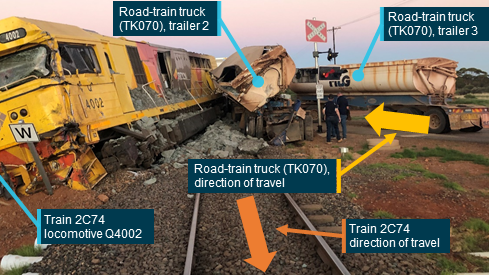
An Australian Transport Safety Bureau (ATSB) investigation has found that a fatal level crossing accident at Back Creek in central western NSW at about 1830 on 10 March 2007 occurred when the semi-trailer driver drove into the path of an empty grain train. The driver sustained fatal injuries in the collision.

The ATSB today released a report regarding the collision. The semi-trailer was trapped under the leading locomotive and dragged onto the rail bridge over a watercourse adjacent to the level crossing. During the collision sequence, the leading locomotive and semi-trailer prime mover caught fire. The fire subsequently destroyed both vehicles and the other two locomotives that were hauling the train, and the timber members of the railway bridge over the watercourse.

The ATSB's investigation found that the semi-trailer driver was probably intending to perform a rolling stop, where the vehicle is slowed but not stopped at the level crossing Stop sign, and he may have only heard the locomotive horn at the last moment, if at all. The driver lived in the area and was very familiar with the crossing and probably did not expect to see a train given the low volume of rail traffic on the line.

The investigation also found that the semi-trailer driver's ability to see the train was probably impeded by glare from the sun given the time of day and the westerly direction he was driving as he approached the crossing.

The ATSB's investigation report also notes that there were no advance level crossing warning signs on an alternate road approach to the level crossing for heavy vehicles. However, given the semi-trailer driver's extensive local knowledge, the lack of this signage was not considered to have contributed to the collision.

Copies of the report can be downloaded from the ATSB's internet site or obtained from the ATSB by telephoning (02) 6274 7687 or 1800 020 616.

Qantas Boeing 747-400 depressurisation and diversion to Manila on 25 July 2008

The ATSB was advised on Friday 25 July of an accident involving a Qantas aircraft.

The aircraft, a Boeing 747-400 was operating a scheduled passenger service from Hong Kong to Melbourne Australia. At approximately 29,000 feet, the crew were forced to conduct an emergency descent after a section of the fuselage separated and resulted in a rapid decompression of the cabin. The crew descended the aircraft to 10,000 feet in accordance with established procedures and diverted the aircraft to Manila where a safe landing was carried out. The aircraft taxied to the terminal unassisted, where the passengers and crew disembarked. There were no reported injuries.

The ATSB is leading this safety investigation with the assistance of a number of other organisations and agencies, including the Civil Aviation Authority of the Philippines, The National Transportation Safety Board and the Federal Aviation Administration of the USA, the Civil Aviation Safety Authority of Australia and Qantas and Boeing.

The ongoing investigation has confirmed that there is one unaccounted for oxygen cylinder from the bank of cylinders that are located in the area of the breach. There are 13 oxygen cylinders in the bank that are responsible for supplying oxygen to the passenger masks and cabin crew.

Also recovered are a number of parts of components including part of a valve in the vicinity of the breach. However, it is yet to be determined whether these components are part of the aircraft system.

A number of passengers have reported that some of the oxygen masks appeared not to function correctly when they deployed from the overhead modules. The ATSB intends to examine the oxygen system including the oxygen masks.

The ATSB is also intending to interview the aircraft crew including the cabin crew and make contact with all passengers on the flight. All passengers will be surveyed, while those that had reported problems with mask deployment will be interviewed.

The passenger survey should be available in about two weeks.

The ATSB would like to request that any passengers that experienced issues during the flight, or those who photographed or videoed the incident contacts us via email at atsbinfo@atsb.gov.au.

The ATSB would also like to encourage passengers to write down their recollection of events that occurred. This will aid them with the completion of the passenger survey.

The aircraft flight data recorder and the cockpit voice recorder have arrived in Australia. The ATSB will download the recorders at its Canberra facilities over the next few days.

The ATSB will also be examining maintenance records for the aircraft. This will include any airworthiness directives or alert bulletins that may have been issued by the regulators or the manufacturers.

Level crossing collision at Moloney Road South Australia

The ATSB has found that a collision between the Indian Pacific passenger train and a tip truck occurred when the driver of the truck drove into the side of the train at the Moloney Road level crossing in SA.

The Australian Transport Safety Bureau has today released its final report into the collision which occurred on 13 December 2007. At the time of the accident road traffic at the crossing was controlled by 'Stop' signs and approach warning signs.

The investigation established that the truck did not come to a halt at the 'Stop' sign and concluded that the truck driver's familiarity with the crossing, low expectation of encountering a train and his possible increased propensity to take risks were factors that may have led to him failing to stop at the crossing.

The investigation concluded that had the truck driver come to a halt at the 'Stop' sign as required he would have been able to clearly see the train and then have been able to proceed safely over the crossing when the train had passed.

In the interest of enhancing future road/rail safety the ATSB has identified a series of opportunities to improve the road/rail interface risk at this location. The City of Playford Council is currently in the process of closing the road over the crossing as alternative access with active protection is close-by and available for public use. This action will eliminate the risk of any future collision at the level crossing.

Copies of the report can be downloaded from the ATSB's internet site.

Boeing 747 diversion to Manila

The Australian Transport Safety Bureau was advised this afternoon of a serious incident involving a Qantas aircraft.

The aircraft, a Boeing 747-400 was operating a scheduled passenger service from Hong Kong to Melbourne Australia. At approximately 29,000 feet, the crew were forced to conduct an emergency descent after a section of the fuselage separated and resulted in a rapid decompression of the cabin. The crew descended the aircraft to 10,000 feet in accordance with established procedures and diverted the aircraft to Manila where a safe landing was carried out. The aircraft taxied to the terminal unassisted, where the passengers and crew disembarked. There were no reported injuries.

Initial information indicates that a section of the fuselage has separated in the area of the forward cargo compartment.

The Australian Transport Safety Bureau is dispatching a team of four investigators to Manila to assist local authorities with the investigation.

Investigation into Boeing 747- 400 depressurisation and diversion to Manila, Philippines

The ATSB is leading this safety investigation with the assistance of a number of other organisations and agencies, including the Civil Aviation Authority of the Philippines, The National Transportation Safety Board and the Federal Aviation Administration of the USA, the Civil Aviation Safety Authority of Australia and Qantas and Boeing.

Yesterday the aircraft was moved to a hangar. This will provide a safer and more optimal working environment for the investigation team.

The remainder of the freight on the aircraft has been progressively examined and removed from around the area of the rupture. This has allowed the investigation team full access to the area. The team have also been examining and clearing the area adjacent to the disrupted right cabin door.

The investigation team are in the process of examining the interior of the cabin including the onboard oxygen system, the passenger masks and portable crew oxygen cylinders. The aircraft outer panels around the ruptured area have also been removed.

A number of components and parts of components are being retained for further examination and analysis at the ATSB engineering facilities in Canberra.

Last night the aircraft cockpit voice recorder (CVR), which records crew conversations, radio traffic and cockpit ambient sounds, was downloaded by ATSB specialists in Canberra. Unfortunately, the standard two hour recording which works on an endless loop principle did not contain the event. The oldest recording commences after the descent and diversion into Manila, so the event itself appears to have been overwritten. However, the information that has been captured on the CVR may provide valuable insights into the flight crew's handling of the situation following the depressurisation.

The aircraft flight data recorder (FDR), which nominally records 25 hours of data, is being downloaded today at the ATSB Canberra facilities. The specialist team should know in the next day or two if the recording contains valid data.

The investigation team plan to continue the examination and collection of evidence from the aircraft. ATSB investigators in Australia are gathering data from the operator. Interviews with both flight crew and cabin crew are being conducted today in Melbourne.

A reminder that the ATSB requests that any passengers that experienced issues during the flight, or those who photographed or videoed the incident, contacts us via email at atsbinfo@atsb.gov.au