Flights after last light normalised, R22 accident investigation finds
One of Australia's largest beef cattle operations has amended procedures to ensure its helicopter pilots are not flying after last light, an ATSB investigation report details.

The safety action comes as a result of the ATSB’s investigation into a fatal Robinson R22 helicopter accident on a cattle station on Queensland’s Cape York Peninsula late last year, where the pilot was found to have flown at night, without the appropriate qualifications.

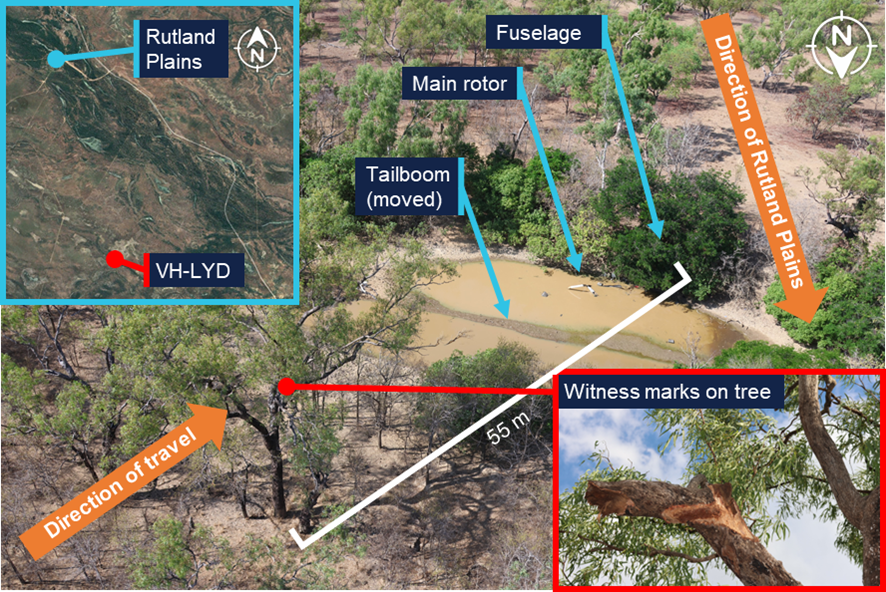
On the evening of 9 October 2025, the investigation’s final report details, the Robinson R22 Beta II was being used to guide ground vehicles tackling a bushfire on a property owned by MDH Pty Ltd, 25 km south-south-east of Kowanyama, Queensland.

At around 1920 local time, the pilot told the ground crew they would return to the station as it was getting too dark. Staff at the station lit the helipad for the R22’s arrival, but the pilot did not return.

Wreckage of the helicopter was found the next morning, and the pilot had been fatally injured.

The ATSB’s investigation concluded the helicopter’s last recorded movement was at 1929, 37 minutes after last light and 12 minutes after nautical twilight. The pilot was not qualified to fly at night, and the helicopter was not equipped for night flight.

Further, the investigation found it was normal for MDH helicopter pilots to exceed the limits of last light. An ATSB analysis of historical flight tracking data showed 39 occasions in the previous 6 months where MDH pilots flew beyond the legal minimums into night.

“Instead of observing the legal limits, pilots chose their own limits, despite none of the company’s R22 pilots being qualified for night flight, and none of its R22 helicopters being equipped for night flight,” ATSB Chief Commissioner Angus Mitchell said.

“Flying after last light was a tolerated and unmanaged risk.”

The investigation report notes MDH now requires its pilots to determine the official time of last light, and has made it a clear responsibility of the pilot and the station manager to ensure aircraft are on the ground before this time.

Mr Mitchell noted this was the fourth fatal accident of this type in Australia in the last five years.

“Flying after last light without appropriate equipment and qualifications is unsafe,” he said. 

“The acceptance and normalisation of flying after last light is leading pilots to fatal accidents.”

The requirement to operate under daylight conditions, and plan to land 10 minutes before last light, provides a reliable method for ensuring there are sufficient external visual references available to safely operate an aircraft, he said.

“Pilots and the companies or landowners they work for, or contract to, must work together to avoid flight at night by unqualified, unequipped pilots,” Mr Mitchell concluded. 

“Development of risk management practices in any organisation should be an ongoing activity. It should develop an ability across all parties to document operational risks and codify learnings from operations.”

The investigation report notes that pre-flight planning by MDH pilots now includes consideration of fatigue, including rest and duty times, and consideration of specific risk assessment criteria.

MDH has also implemented a pilot mentoring scheme to assist, mentor and supervise company pilots during aerial mustering operations.

Read the final report: Collision with terrain at night involving Robinson R22 Beta II, VH-LYD, 25 km south-south-east of Kowanyama, Queensland, on 9 October 2025
Misunderstanding led to fireground loss of separation

An operational misunderstanding and inadequate situational awareness contributed to a helicopter and a firebombing aircraft coming into close proximity over a fireground in the Victorian High Country earlier this year.

The incident occurred on 18 January 2026, when a Bell 212, callsign Helitak 368, was flown into a fireground west of Mount Hotham, Victoria, to perform rappelling operations.

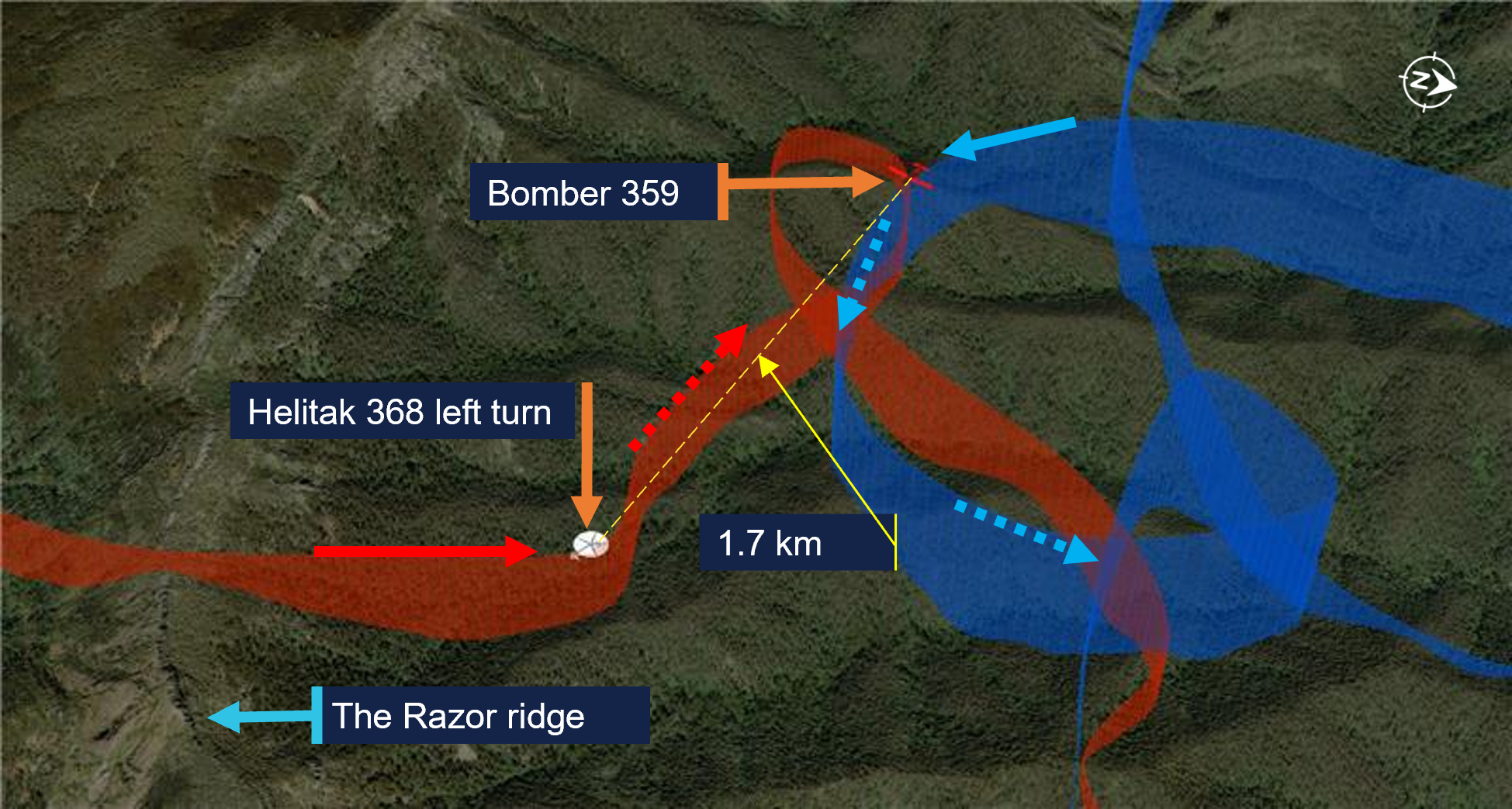
After entering the fireground, the pilot of the helicopter sighted a PZL M18B single engine air tanker, callsign Bomber 359, ahead on a conflicting track, and conducted a left descending turn to increase separation. At about the same time, Bomber 359 commenced a fire retardant drop, then climbed and departed the area.

The two aircraft passed within about 500 m horizontally and 400 ft vertically of one another. The pilot of Bomber 359 was unaware of the incident, while the pilot of Helitak 368 elected to continue tracking northwards through the fireground.

ATSB Director of Transport Safety Stuart Macleod said a misunderstanding between the Helitak pilot and the air attack supervisor, who was overseeing the fireground from another helicopter, contributed to the separation issue.

“The pilot of Helitak 368 had not yet been to the fireground on the day, and was not aware that all other aircraft were holding north of the fireground and entering from there,” Mr Macleod explained.

“When the air attack supervisor cleared Helitak 368 to enter the fireground, they expected the helicopter to first track east of the fireground, so they too could enter the fireground from the north.

“But the air attack supervisor did not specifically instruct Helitak 368 to enter the fireground this way, and the Helitak pilot instead entered the fireground from the south, believing they had separation assurance and were clear to conduct rappelling operations.”

The pilots of both Helitak 368 and Bomber 359 reported having communicated their intentions on the local fire common traffic advisory frequency, but were unaware they were on a conflicting track until the Helitak pilot sighted Bomber 359.

“While the reason for the pilots being unaware of one another could not be conclusively determined, there were several potential factors which may have limited the crew’s ability to identify each other’s presence,” Mr Macleod said.

“The effectiveness of radio communications can be limited by factors such as the number of aircraft operating on the frequency, and by terrain shielding. Ultimately, see-and-avoid was effective in ensuring separation between the aircraft was maintained.”

While it did not contribute to the occurrence itself, the ATSB noted the Helitak pilot did not alert the air attack supervisor to the conflict incident when it occurred, instead continuing to track through the fireground without assurance of positive separation with other aircraft.

Among several safety actions detailed in the final report, the Victorian Department of Energy, Environment and Climate Action has advised it will focus learnings on mandatory escalation of separation issues, and supervisory control recovery, following airspace conflicts.

“Aerial firefighting, a critical capability for the management and suppression of bushfires in Australia, often sees multiple aircraft flown at low heights above the ground at varying airspeeds in challenging environmental conditions,” Mr Macleod noted.

“As such it is vital that pilots involved in firefighting operations understand where other aircraft are operating and immediately communicate any issues so that all have a common mental model of the fireground.”

Read the final report: Separation issue involving Bell 212, VH-KHO, and PZL M18B, VH-VWF, 58 km west of Mount Hotham Airport, Victoria, on 18 January 2026(Opens in a new tab/window)

Training aided decisive response to take-off engine failure

An ATSB investigation into a Boeing 737 engine failure during take-off from Sydney has recognised the contribution that effective training and procedures made towards a safe outcome.

On 8 November 2024, the Qantas 737-800, powered by two CFM International CFM56-7B turbofan engines, was taking off for a passenger flight to Brisbane.

During the take-off roll the flight crew heard a loud bang, accompanied by a shudder, as the right engine failed.

The flight crew immediately recognised the engine failure based on caution lights and indications, but continued the take-off, as the aircraft had reached the pre-calculated V1 decision speed beyond which a take-off should not be aborted.

“This engine failure occurred at the worst possible moment during a critical phase of flight,” ATSB Chief Commissioner Angus Mitchell said.

“The flight crew responded quickly and decisively, continuing the take-off, declaring an emergency, and conducting relevant checklists while planning a return to Sydney.”

The flight and cabin crew had an off-duty pilot photograph the engine and wing from the cabin, with no visible damage to the engine exterior or wing identified. About 30 minutes after taking off from runway 34R, the flight crew performed a single-engine landing on runway 34L.

After the engine was externally assessed for fire risk by Aviation Rescue Fire Fighting Service (ARFFS) personnel, the flight crew taxied back to the gate, where passengers were disembarked safely.

ARFFS had also responded to a grass fire which ignited alongside runway 34R from hot fragments expelled from the rear of the engine when the failure occurred.

Mr Mitchell said all parties involved in the emergency – the flight and cabin crew, ARFFS, and air traffic controllers – worked together effectively to ensure a safe and uneventful return to Sydney for the aircraft, and the 181 people on board.

“This incident provides a positive example of effective training and procedures, highlighting their importance within the aviation safety framework,” Mr Mitchell said.

“In particular, faced with an emergency during a critical phase of flight, the flight crew responded decisively and appropriately in accordance with their training and procedures.”

The ATSB’s investigation notes the engine failed due to one of its high-pressure turbine blades separating from the disc due to a fatigue crack.

The failure occurred 13 days before the engine was scheduled for removal, as it was approaching the threshold recommended by the manufacturer, CFM International.

Following this incident, CFM International performed an analysis of the CFM56-7B engine fleet and found that although there had been several previous engine failures due to this kind of fatigue cracking, the specific high-pressure turbine blade configuration of this engine still met internal reliability targets and relevant regulatory guidelines.

In addition, the final report notes, newer high-pressure turbine blade configurations have been introduced with improved failure rates.

Read the final report: Engine failure involving Boeing 737, VH-VYH, at Sydney Airport, New South Wales, on 8 November 2024(Opens in a new tab/window)

Preliminary report into R44 accident near Cataract National Park

The ATSB has published a preliminary report from its ongoing investigation of an accident involving a Robinson R44 helicopter north-east of Tenterfield, in northern NSW, in March.

The helicopter collided with terrain in dense bushland west of Cataract National Park on 13 March 2026. The pilot, the sole occupant of the helicopter, was fatally injured.

The report, which details evidence gathered during the ATSB’s investigation of the accident to date, notes the wreckage was located on the southern side of a steep slope, at an elevation of about 870 m.

“All major aircraft components were accounted for at the accident site, although much of it was consumed by a post-impact fire,” ATSB Chief Commissioner Angus Mitchell said. 

“Damage to trees indicated the helicopter had struck them at a near vertical descent.”

The accident flight was planned from the Gold Coast, Queensland, to Mudgee, NSW, with an intermediate stop at Armidale, NSW, to refuel.

“The helicopter took off at 0834 local time, and an automated emergency message was triggered by the pilot’s iPhone crash alarm 72 minutes later,” Mr Mitchell said.

NSW Police commenced a search in response to this alarm, and the wreckage was located the following morning.

The preliminary report details the weather forecasts published by the Bureau of Meteorology prior to the accident flight. It also notes high resolution visible satellite imagery showed cloud extending inland to the NSW/Queensland border, including at the accident site, around the time of the accident.

“Several witnesses located near the accident site, who reported there was very low cloud and drizzle at the time, stated they saw a helicopter flying low ‘before lunchtime’ on the day of the accident,” Mr Mitchell detailed.

“Meteorological information will be subject to further review as the investigation continues.

“In addition, the investigation will also further examine the mapped accident site and helicopter wreckage, and aircraft and operational documentation.”

A final report, which will detail the ATSB’s findings and the analysis to support those findings, will be released at the conclusion of the investigation.

“However, should a critical safety issue be identified during the course of the investigation, the ATSB will immediately notify relevant parties so they can take safety action,” Mr Mitchell concluded.

Read the preliminary report: Collision with terrain involving Robinson R44 II, VH-TCF, about 46 km north-east of Tenterfield Airport, New South Wales, on 13 March 2026(Opens in a new tab/window)

Distraction identified in E190 landing gear overspeed

An E190 passenger jet’s landing gear was not retracted until the aircraft exceeded the maximum speed to safely do so, after the flight crew became distracted in the take-off sequence, an ATSB final report explains.

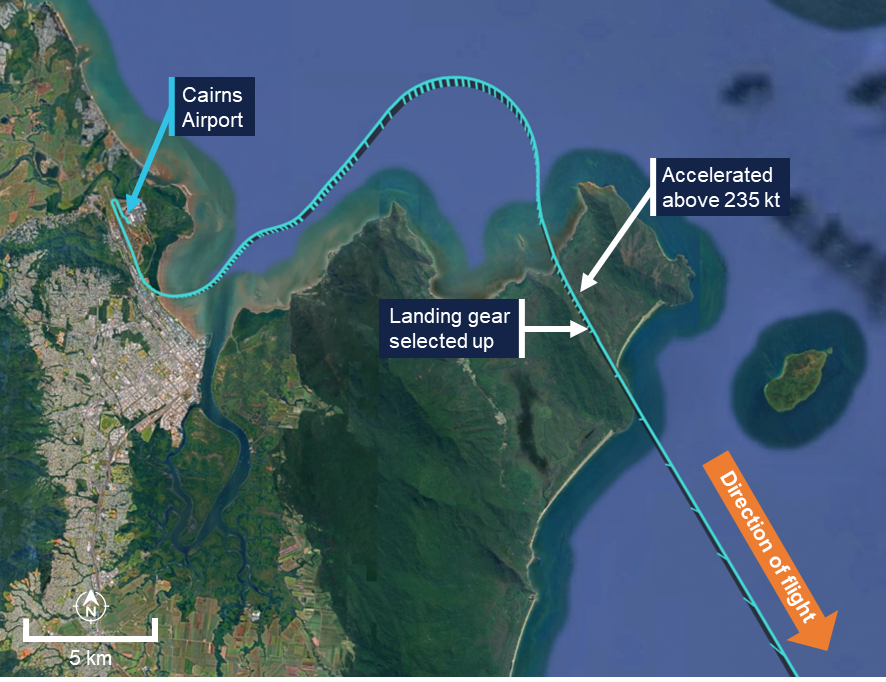
The landing gear overspeed incident occurred on the evening of 24 July 2025, when an Alliance Airlines-operated Embraer ERJ 190 was taking off from Cairns Airport’s runway 15, for a passenger flight to Brisbane.

As the aircraft passed the rotation speed of 143 kt, the first officer commenced the rotation to the target pitch attitude of about 15°.

The captain, as pilot monitoring, assessed the rotation rate slowed as the aircraft passed 10° pitch, and so announced, ‘pitch rate’.

“Both crew members then became focused on the aircraft’s flight path,” ATSB Director of Transport Safety Stuart Macleod explained.

“This likely meant the captain did not have time to verify the aircraft’s positive rate of climb before a terrain avoidance turn was needed as part of the standard instrument departure being followed.”

As the captain consequently did not announce ‘positive rate’, the first officer was not prompted to request the landing gear be retracted, the ATSB final report details.

“However, the announcement of the acoustically and semantically similar ‘pitch rate’, at about the same time as the omitted ‘positive rate’, potentially caused interference in the flight crew’s working memory, and possibly gave them a false sense that the landing gear had been retracted.”

As the aircraft accelerated with its landing gear still extended, the flight crew was presented with abnormal radio altimeter alerts and unexpected flight director indications (unrelated to the landing gear issue).

“These distractions increased the flight crew’s workload and delayed their recognising the landing gear was still extended,” Mr Macleod said.

As the crew’s workload decreased, the captain identified the landing gear was still extended, and reflexively retracted it while the aircraft was travelling at 243 kt, with retraction completed as the aircraft reached 252 kt.

Mr Macleod noted this was above the 235 kt retraction limit speed, but that the aircraft had not exceeded the 265 kt maximum airspeed with the landing gear extended.

“This incident highlights the impact a combination of omitted actions and distractions can have on aircraft operations, during what is often a high workload period,” he said.

“Such situations can create challenges in responding to the unexpected with potential for a reduction in safety when pilots act rapidly and reflexively.”

It was determined the unexpected radio altimeter alerts and unexpected flight director indications, which distracted the flight crew, had been observed on other occasions by flight crews also conducting the Cairns AKROM 1 standard instrument departure in Embraer ERJ 190 aircraft equipped with load 25 avionics.

Alliance has subsequently accelerated its program to upgrade E190 aircraft to load 27 avionics, with all of the fleet now upgraded, which should prevent recurrence of these unexpected flight management system indications.

“Crews of E190s fitted with load 25 avionics should be aware of this issue,” Mr Macleod said.

“And all pilots, when presented with unexpected indications, should use primary instruments to ensure that flight path requirements are adhered to.”

Read the final report:  Landing gear overspeed involving Embraer E190, VH-A2T, 19 km east of Cairns Airport, Queensland, on 24 July 2025(Opens in a new tab/window)

Derailment at known track defect

The investigation of a freight train derailment near Kyogle in northern NSW on 31 May 2022 highlights that rail transport operators should ensure their asset management procedures and standards are followed consistently.

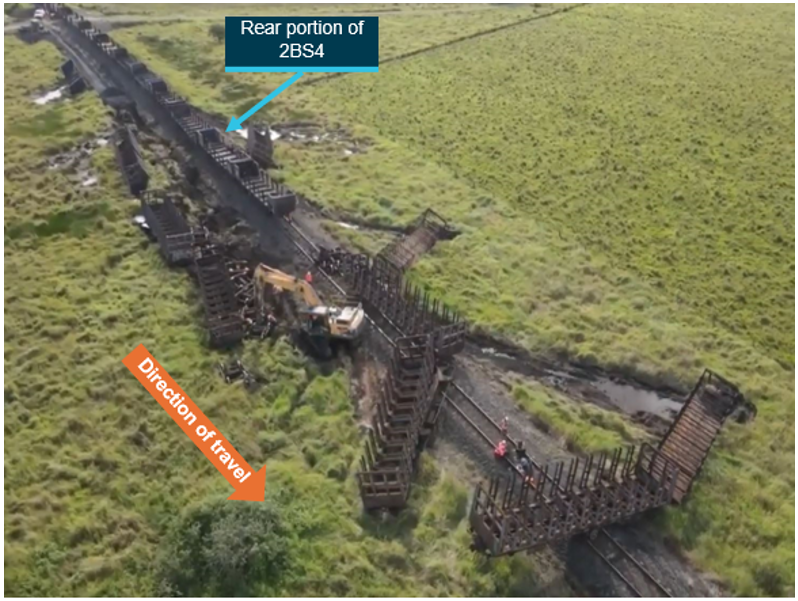
The Pacific National freight train with three locomotives and 56 wagons was travelling from Brisbane to Sydney on ARTC managed track when an empty wagon’s bogie (the undercarriage where the wheels are housed), derailed midway down the train, the investigation report details.

The derailed bogie dragged along the track as the train continued for 2.3 km, at which point the wagon separated from the train.

Eleven of the wagons then derailed and an automatic emergency brake activated, bringing the train to a stop. There were no injuries, but there was significant damage to wagons and track.

The Office of Transport Safety Investigations (OTSI), which investigates rail occurrences in NSW, investigated the accident under a collaboration agreement with the ATSB.

The investigation’s final report notes the initial derailment occurred in a location with a history of track geometry defects.

“There was a temporary speed restriction in place at the location, which the train crew followed, and a partial repair had been completed four days prior to the derailment,” OTSI Chief Investigator Jim Modrouvanos said.

“The track was only checked during routine inspections and was not inspected any more closely than usual. We found the problem had probably been getting worse since the last time it was inspected.”

Although various attempts had been made over time to repair the defect by the local team, OTSI’s investigation determined action taken to manage the defect was largely informal.

“ARTC did not use its asset management system or the measurement records taken before and after the temporary repairs to inform management that major works were needed,” Mr Modrouvanos said.  

“This data would have allowed ARTC to make informed decisions to undertake major works which could have provided for a longer-term repair.”

Following the accident, ARTC implemented a new centralised system for integrating and analysing asset condition data, imagery, and maintenance records across its entire network.

It also established a dedicated, central engineering function to provide technical support to the provisioning centres and maintainers in each section of its network.

Mr Modrouvanos welcomed these safety actions, and others detailed in the report.

“Asset management procedures and standards within a safety management system are there to ensure assets are managed effectively and safely.” he said.

“This means operators need to make sure that qualified workers doing safety critical jobs are following the required procedures and standards consistently.”

Read the final report: Derailment of freight train 2BS4, near Kyogle, New South Wales, on 31 May 2022(Opens in a new tab/window)

Cessna 310 runway excursion

A Cessna 310 ran off the runway during landing following a fast and high approach to Lake Evella Airport in the Northern Territory, an ATSB investigation has found.

On 29 May 2025 the twin-engined Cessna 310R, operated by Marthakal Yolngu Airline, was operating a passenger charter flight from Darwin to Lake Evella with a pilot and four passengers on board.

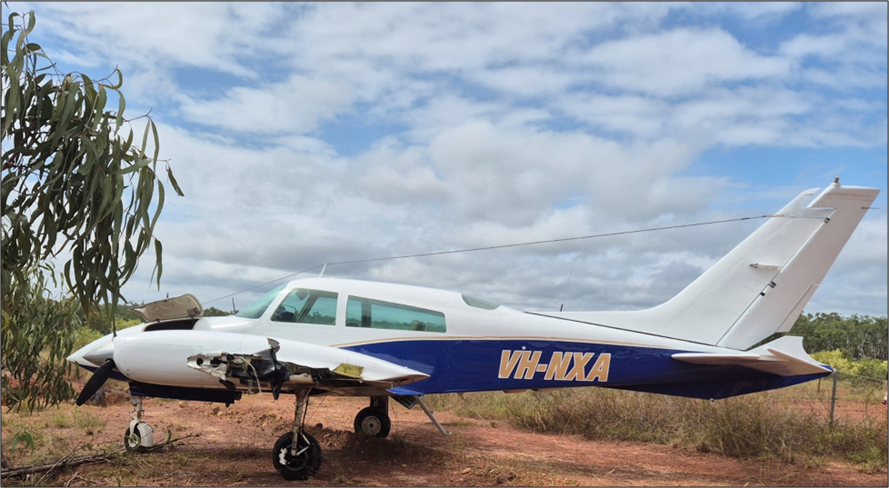
Recorded data indicated the aircraft touched down almost halfway along the runway during its landing. It then veered off the runway and collided with a perimeter fence, damaging its left wing. No injuries were reported.

“The aircraft landed about 400 metres beyond the runway threshold after floating for a prolonged period,” ATSB Director of Transport Safety Dr Stuart Godley explained.

“This occurred after the pilot conducted the approach above the standard profile and the aircraft crossed the threshold above the normal approach speed.”

Despite landing long, the remaining runway length should have provided sufficient stopping distance, the investigation found. However, the aircraft’s braking performance was degraded due to a worn right brake pad and the lack of hydraulic fluid in the right brake system.

“A post-flight inspection found the right brake pads were worn beyond limits, and the right brake fluid reservoir was empty,” Dr Godley said.

During a scheduled maintenance event prior to the accident, a licensed aircraft maintenance engineer believed an apprentice had replaced the main-wheel brake pads, but did not verify this, the investigation report details.

Separately, while not found to have contributed to the accident, the ATSB also identified that the operator’s procedures allowed the use of self-reported passenger weights without additional allowances, and that the electronic weight and balance system had been configured with higher maximum weights applicable to a modification not fitted to this aircraft. 

“In combination with calculation errors on the day, this resulted in the aircraft being operated above the maximum permitted ramp and take-off weights,” Dr Godley said.

The operator has since advised its electronic weight and balance system will be amended, and all references to the use of self-reported passenger weights for the purposes of weight and balance calculations will be removed in the next amendment of the operations manual.

This accident demonstrated how multiple factors can align to produce an undesired event, Dr Godley noted.

“For pilots, actively monitoring the flight path using instruments and external visual cues until a safe landing is assured should include identifying and nominating an appropriate touchdown point on the runway to ensure a go‑around can be executed if a touchdown beyond this point is likely to occur. 

“For maintenance organisations, effective systems to disseminate important information to all maintenance personnel helps ensure emerging defects are identified and rectified before they affect flight operations.” 

Read the final report: Runway excursion involving Cessna 310, VH-NXA, Lake Evella Aerodrome, Northern Territory, on 29 May 2025(Opens in a new tab/window)

LongRanger helicopter ditching preliminary report

The ATSB will examine fuel management, storage and quality monitoring procedures as part of its ongoing investigation into the ditching of a Bell LongRanger helicopter in the Torres Strait, off Far North Queensland, a preliminary report notes.

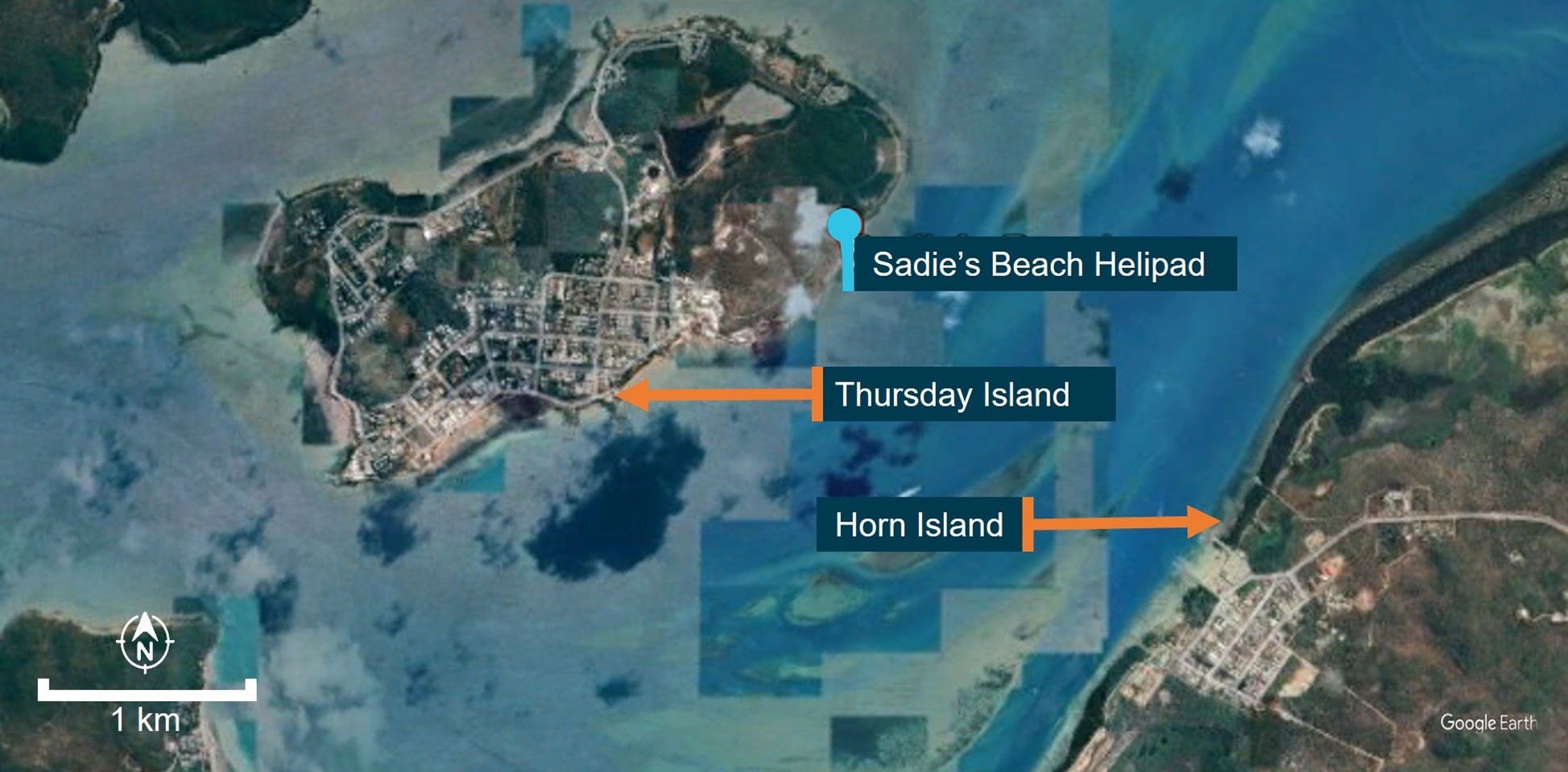
The helicopter ditched a short time after taking off from Thursday Island (Waiben), on 6 January 2026. The pilot, the helicopter’s sole occupant, was able to egress uninjured, before it sank.

The ATSB’s preliminary report into the accident summarises evidence gathered to date, but does not contain findings or analysis.

It notes the helicopter was at about 300 ft after taking off from Sadie’s Beach Helipad, when the pilot encountered several sudden and violent yawing movements, and then a reduction in both engine and rotor RPM.

The pilot partially reduced the collective in an attempt to recover rotor RPM, but it continued to decay until the low rotor RPM warning light illuminated.

The pilot commenced an autorotation landing, and was able to activate the helicopter’s pop-out floats before landing onto the water below. The helicopter landed upright, but then rolled over inverted about 15 seconds later.

ATSB Chief Commissioner Angus Mitchell said the ongoing investigation would review accident survivability, pilot training and procedures, and the results of an independent engineering investigation.

It will also examine a range of factors relating to the fuel being used, he said.

“The pilot had just dropped two passengers off at Thursday Island, having spent much of the day flying them between several outer Torres Strait islands,” Mr Mitchell explained.

“During the day’s flying, the helicopter twice visited Coconut Island (Poruma) to refuel from an intermediate bulk container (IBC) positioned there by the operator.”

The report notes the helicopter started the day loaded with fuel that was stored in static tanks on Horn Island, and that the IBC on Coconut Island was supplied via Horn Island as part of a broader distribution network.

“The ATSB is still considering the contributing factors in this investigation, and the management, storage and quality monitoring practices involved in this operation will be considered in that process,” Mr Mitchell said.

A final report detailing those contributing factors will be published at the conclusion of the investigation.

Read the preliminary report: Engine failure and ditching involving Bell 206L-3, VH-LMW, 6.5 km west of Horn Island Airport, Queensland, on 6 January 2026(Opens in a new tab/window)

Collision with terrain involving Robinson R44, VH-HYR, at Yorke Island Airport, Queensland, on 31 March 2026

Summary

The ATSB is investigating a collision with terrain involving a Robinson R44 II, VH-HYR, at Yorke Island Airport, Queensland, on 31 March 2026.

Shortly after take-off at 100 ft AGL, the low rotor RPM horn activated and the pilot conducted an emergency landing on the aerodrome. During the landing, the helicopter collided with terrain resulting in substantial damage. The pilot sustained serious injuries. The investigation is continuing.

The ATSB has commenced the examination and analysis of the initial evidence collected. To date, the ATSB investigation has included:

  • interviewing the pilot of the occurrence aircraft
  • examination of maintenance records
  • examination of independent engineering report
  • images of the wreckage
  • reviewing the common traffic advisory frequency recordings
  • examination of pilot training and records

The wreckage has been moved to an independent maintenance facility for further analysis

A final report will be released at the conclusion of the investigation. Should a critical safety issue be identified during the course of the investigation, the ATSB will immediately notify relevant parties, so that appropriate safety action can be taken.

Occurrence summary

Investigation number AO-2026-069
Occurrence date 31/03/2026
Occurrence time and timezone 14:36 Eastern Australia Standard Time
Location York Island Airport
State Queensland
Report status Pending
Anticipated completion Q3 2026
Investigation level Short
Investigation type Occurrence Investigation
Investigation phase Examination and analysis
Investigation status Active
Mode of transport Aviation
Aviation occurrence category Abnormal engine indications, Collision with terrain, Forced/precautionary landing
Occurrence class Accident
Highest injury level Serious

Aircraft details

Manufacturer Robinson Helicopter Co
Model R44 II
Registration VH-HYR
Serial number 10341
Aircraft operator Specialised Aviation Services Pty Ltd
Sector Helicopter
Operation type Part 133 Air transport operations - rotorcraft
Departure point Yorke Island Airport, Queensland
Injuries Crew - 1 (Serious)
Damage Substantial

Preliminary report from Normanton King Air accident

An ATSB preliminary report outlines the sequence of events of an accident involving a King Air twin turboprop soon after take-off from Normanton Airport, in Far North Queensland, on 6 February.

The report, which details evidence gathered in the early phases of the ATSB’s ongoing investigation, notes the pilot had ferried the Machjet International-operated King Air to Normanton from Cairns earlier on the day of the accident.

After boarding four passengers, the pilot then flew them to Doomadgee, about 240 km to the west, before returning them to Normanton about four hours later.

With the passengers disembarked, the pilot then prepared to return the aircraft back to Cairns, radioing just after 7:45 pm local time that they were taxiing for departure. The flight was being conducted under the instrument flight rules.

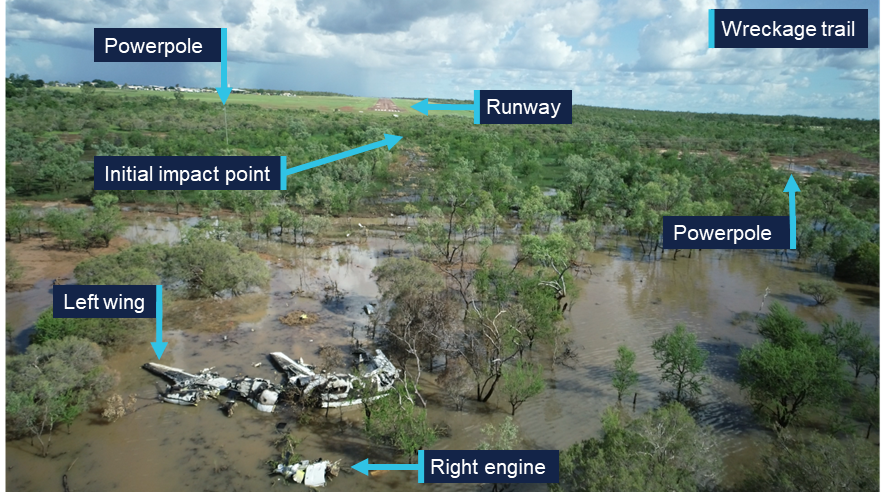
After taking off from runway 32, the aircraft climbed to a maximum of about 150 ft above ground level, before descending and then colliding with terrain. The aircraft was destroyed and the pilot was fatally injured.

ATSB Chief Commissioner Angus Mitchell said to date investigators had examined the accident site and wreckage, conducted interviews, and gathered available flight data (including ADS-B), pilot and aircraft records, and weather information.

“Examination of the accident site indicated the aircraft hit a tree about 360 m from the end of the runway, which was about 10 m before it broadcast its last ADS-B position,” Mr Mitchell said.

The aircraft’s final ADS-B datapoint reported a groundspeed of 162 kt, and that it had descended at about 1,100 feet per minute since its last datapoint.

“Evidence indicates the aircraft then impacted the ground in a wings-level attitude and slid beneath powerlines, then commenced a gradual yaw to the right, impacting trees, and breaking up in the process, before coming to rest in floodwaters about 580 m beyond the runway’s end.”

Mr Mitchell noted the preliminary report includes a summary of the available forecast and observed meteorological conditions at the aerodrome, and in the surrounding area, at the time of the accident.

“As the investigation progresses it will include an assessment of data from air traffic control, the Bureau of Meteorology, and equipment recovered from the aircraft,” Mr Mitchell said.

“Investigators will also conduct further interviews, and analyse witness videos, photographs and airport data, along with all relevant operational information.”

A final report will be released at the conclusion of the investigation.

“This preliminary report does not contain analysis or findings, which will be developed for inclusion in the investigation’s final report,” Mr Mitchell said.

“However, should a critical safety issue be identified during the course of the investigation, the ATSB will notify relevant parties immediately, so timely safety action can be taken.”

Read the preliminary report: Collision with terrain involving Beechcraft B200C, VH-PUY, near Normanton Airport, Queensland, on 6 February 2026