Occurrence Briefs are concise reports that detail the facts surrounding a transport safety occurrence, as received in the initial notification and any follow-up enquiries. They provide an opportunity to share safety messages in the absence of an investigation. Because occurrence briefs are not investigations under the Transport Safety Investigation Act 2003, the information in them is de-identified.
What happened
On 28 February 2026, a pilot was conducting a private flight from Orange, New South Wales, to a privately‑owned, unsealed airstrip near Louth, New South Wales, with one passenger on board. During approach, the pilot observed gusting winds and localised whirlwind activity in close proximity to the runway.
As the aircraft decelerated through approximately 30 to 25 kts during the landing roll, the aircraft yawed to the left with an increasing gust of wind. The pilot applied right rudder in an attempt to arrest the yaw, however a stronger second gust occurred, increasing the pressure on the rudder and pushing the aircraft further into a left yaw.
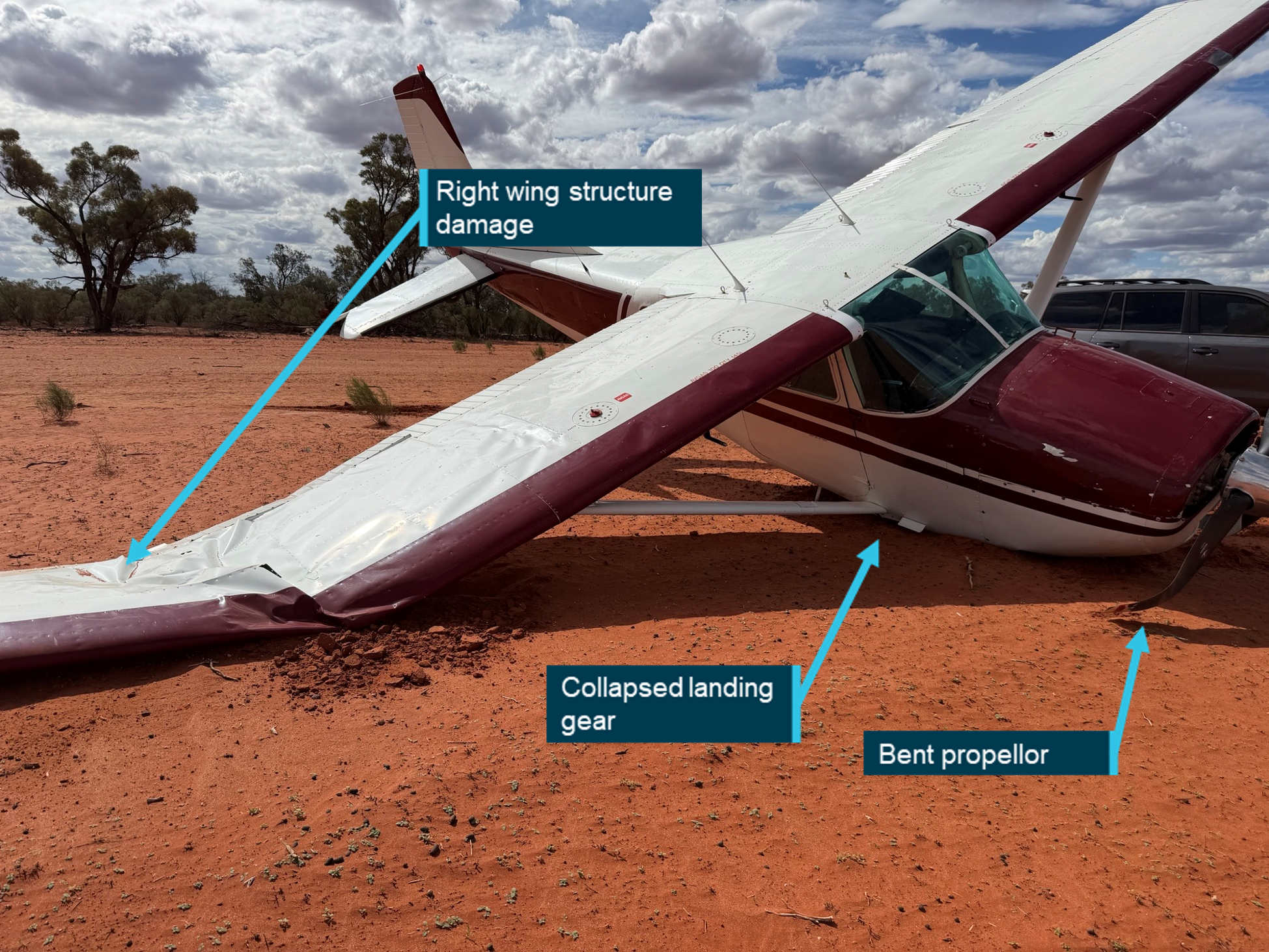
With full brakes applied and rudder authority reduced, the aircraft’s left main wheel sank into soft ground at the runway edge and the aircraft ground looped[1] to the left. The right landing gear collapsed and the right wing and propeller impacted the ground resulting in substantial damage to the wing, landing gear and propeller.
Figure 1: Aircraft wreckage
Source: Airstrip owner, annotated by the ATSB
Safety message
Pilots must ensure that the weather conditions surrounding the selected landing area are continuously assessed visually throughout the approach phase of flight. Should there be any unfavourable weather conditions that may impact the aircraft’s stability and controllability, conducting a go-around will allow time to plan for how to manage the landing conditions.
The ATSB also reminds all pilots of the importance of planning, and evaluating the local weather conditions, prior to departure. A comprehensive assessment of the weather conditions at the intended point of landing is encouraged.
About this report
Decisions regarding whether to conduct an investigation, and the scope of an investigation, are based on many factors, including the level of safety benefit likely to be obtained from an investigation. For this occurrence, no investigation has been conducted and the ATSB did not verify the accuracy of the information. A brief description has been written using information supplied in the notification and any follow-up information in order to produce a short summary report, and allow for greater industry awareness of potential safety issues and possible safety actions.
[1]A term used to describe a loss of directional control where the aircraft rotates around the yaw axis.
The ATSB is investigating a runway event involving a Beechcraft B200C King Air, registered VH‑FDI, at Brisbane West Wellcamp Airport, Queensland, on 24 February 2026.
During take-off for an aeromedical flight with 2 medical crew on board, the sole pilot misaligned the aircraft on the runway and struck a runway light. The pilot rejected the take-off and the aircraft sustained minor damage.
The draft report internal review process has been completed. The draft report has been distributed to directly involved parties (DIPs) to check factual accuracy and ensure natural justice. Any submissions from those parties will be reviewed and, where considered appropriate, the draft report will be amended accordingly.
Following the external review process, any submissions and amendments to the draft report are internally reviewed. Once approved, the final report is prepared for publication and dissemination and released to DIPs prior to its public release.
The final report will be released at the conclusion of the investigation. Should a critical safety issue be identified during the course of the investigation, the ATSB will immediately notify relevant parties, so that appropriate safety action can be taken.
Last updated:
Occurrence summary
Investigation number
AO-2026-062
Occurrence date
24/02/2026
Occurrence time and timezone
00:03 Eastern Australia Standard Time
Location
Brisbane West Wellcamp Airport
State
Queensland
Report status
Pending
Anticipated completion
Q3 2026
Investigation level
Short
Investigation type
Occurrence Investigation
Investigation phase
Final report: External review
Investigation status
Active
Mode of transport
Aviation
Aviation occurrence category
Ground strike, Rejected take-off
Occurrence class
Incident
Highest injury level
None
Aircraft details
Manufacturer
Hawker Beechcraft Corporation
Model
B200C
Registration
VH-FDI
Serial number
BL-162
Aircraft operator
Royal Flying Doctor Service of Australia (Queensland Section) Limited
Sector
Turboprop
Operation type
Part 135 Air transport operations - smaller aeroplanes
Activity
Commercial air transport-Non-scheduled-Medical transport
Occurrence Briefs are concise reports that detail the facts surrounding a transport safety occurrence, as received in the initial notification and any follow-up enquiries. They provide an opportunity to share safety messages in the absence of an investigation. Because occurrence briefs are not investigations under the Transport Safety Investigation Act 2003, the information in them is de-identified.
What happened
On the afternoon of 24 November 2025, the pilot of a Robinson R22 helicopter was conducting commercial aerial mustering at a cattle station in the Northern Territory.
The operator reported that at the time of the occurrence, there was a 10–16 kt wind from the north-east and the temperature was 36°C. Relative to the aircraft’s heading the wind direction was at the 11 o’clock position.
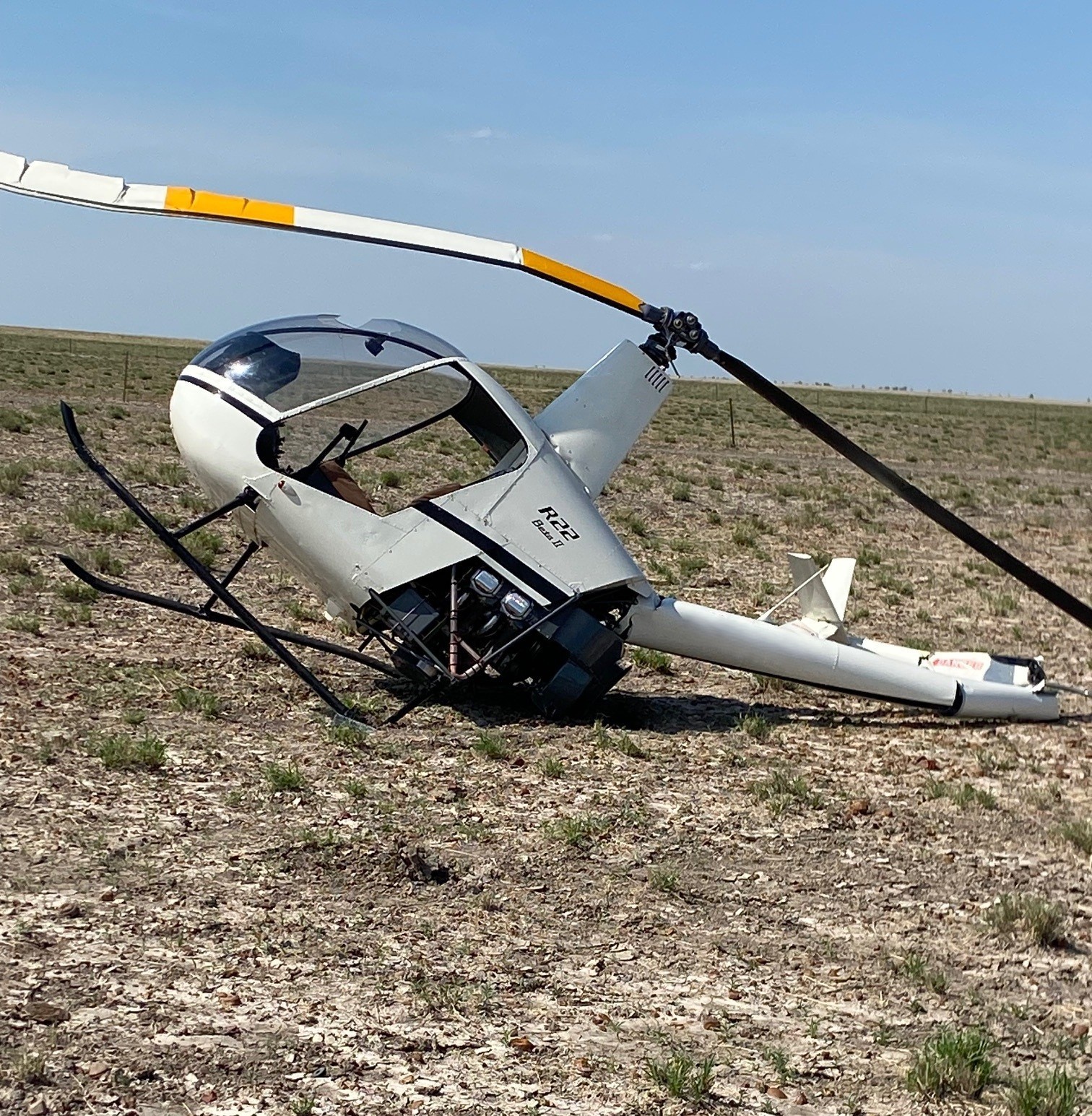
After the first herd of stock had been moved out of the laneway[1] the pilot landed the helicopter approximately 100 m from the laneway gate, to prepare for the second herd. As the second herd approached the laneway the pilot brought the helicopter into a 2–3 ft hover and slowly moved forward to gain airspeed. During this manoeuvre, the pilot reported that the helicopter encountered unexpected sink and they raised the collective[2] to counter the downward movement. Despite the increased collective, the helicopter continued to sink and the left skid contacted a grass mound. Pitching forward, one of the helicopter’s main rotor blades struck the tail boom and the helicopter lifted away from the ground and began to spin. The pilot attempted to slow the rotation by reducing the throttle and the helicopter came to a rest on the rear of its skids and the damaged tail boom (Figure 1).
The helicopter sustained substantial damage to the tail boom, skids and main rotor blades, however the pilot was uninjured. The pilot was wearing a helmet during the operation.
Figure 1: Helicopter damage
Source: Aircraft operator
Safety message
Helicopter mustering is an inherently high-risk activity involving low‑level flying which significantly reduces the safety margins usually available to pilots. It is important when transitioning from a hover to forward flight, that pilots establish and maintain appropriate ground clearance – allowing for a timely reaction to unexpected sink or other weather‑related conditions that can affect take-off.
This occurrence also highlights the importance and value of pilots wearing helmets during operations with increased risk. The ATSB safety advisory notice,
, encourages helicopter pilots conducting low-level operations to wear flight helmets that are custom fitted to the individual’s head, include a properly secured chin strap and are maintained in accordance with the manufacturer’s recommendations.
About this report
Decisions regarding whether to conduct an investigation, and the scope of an investigation, are based on many factors, including the level of safety benefit likely to be obtained from an investigation. For this occurrence, no investigation has been conducted and the ATSB did not verify the accuracy of the information. A brief description has been written using information supplied in the notification and any follow-up information in order to produce a short summary report, and allow for greater industry awareness of potential safety issues and possible safety actions.
[1]Laneway: a narrow corridor designed for livestock to be separated from the herd and to separate animals for different procedures.
[2]Collective: a primary helicopter flight control that simultaneously affects the pitch of all blades of a lifting rotor. Collective input is the main control for vertical velocity.
Occurrence Briefs are concise reports that detail the facts surrounding a transport safety occurrence, as received in the initial notification and any follow-up enquiries. They provide an opportunity to share safety messages in the absence of an investigation. Because occurrence briefs are not investigations under the Transport Safety Investigation Act 2003, the information in them is de-identified.
What happened
On 30 November 2025, a de Havilland DH82A Tiger Moth departed South Grafton Aircraft Landing Area, New South Wales, at 1100 local time,[1] for a private flight with only the pilot on board. They departed from runway 26,[2] which was a sealed runway surface. Weather conditions were reported to be CAVOK[3] with a light and variable wind.
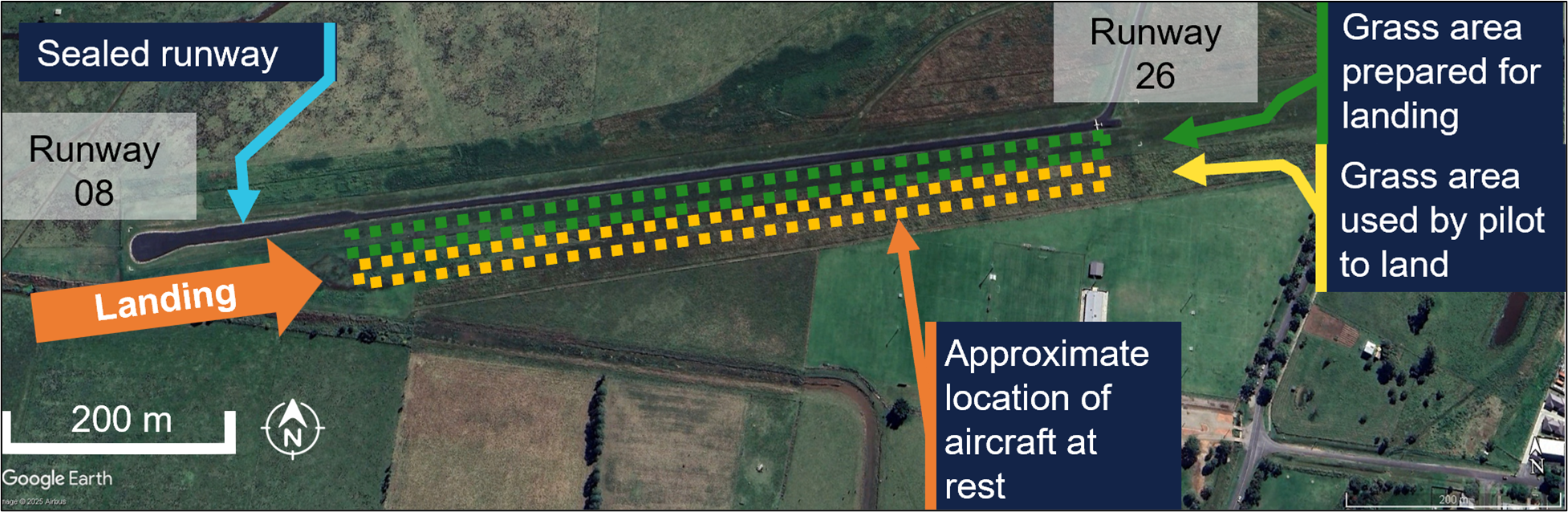
A third party suggested to the pilot that they could consider landing on the freshly mown grass area right of runway 08,[4] on their return to South Grafton. However, the pilot misunderstood the location of the prepared grass landing area.
The pilot believed that the area available was the mowed grass beside the sealed strip further to the right. However, the prepared grass area being referred to by the third party was in between the sealed runway and that understood by pilot (Figure 1).
Figure 1: South Grafton ALA – sealed and grass areas
Source: Google Earth and operator, annotated by the ATSB
A normal approach was flown, aligning the aircraft and touching down on the grass parallel to the sealed strip. However, the landing area selected by the pilot consisted of longer, slashed grass, that was not the surface that had been prepared for use.
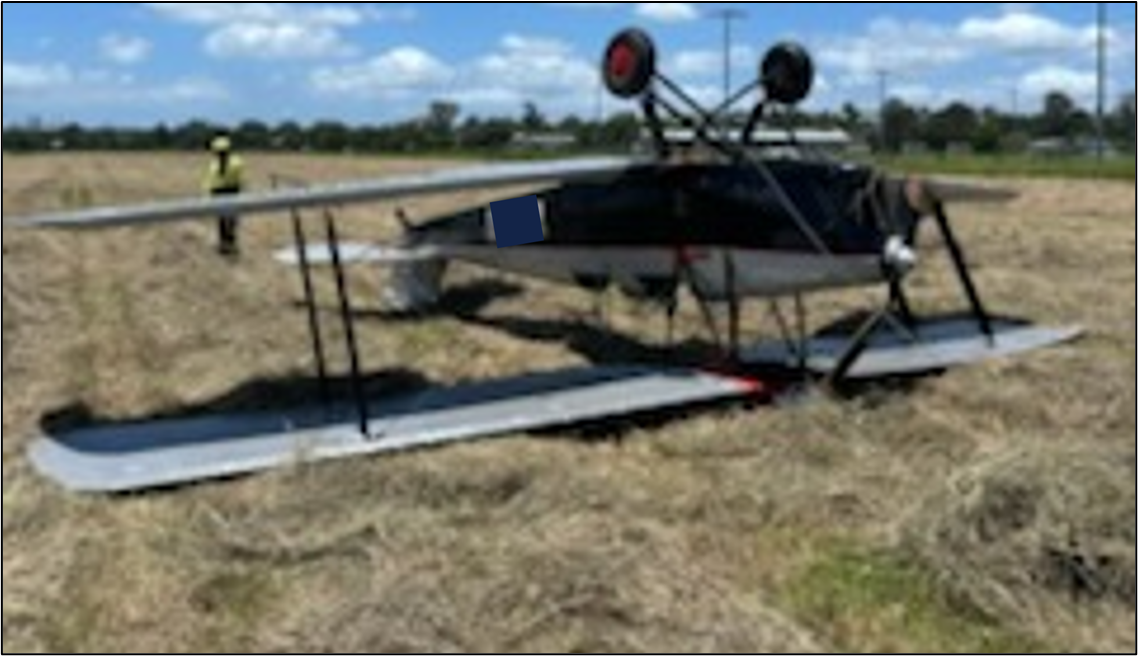
This surface caused undesirable ground handling characteristics on landing. The aircraft landed in a ‘2 point’[5] attitude, then subsequently pitched over on its nose and came to rest on its back. The aircraft sustained significant damage to its airframe and propeller (Figure 2). The pilot exited the aircraft with minor injuries.
Figure 2: The aircraft after the accident
The supplied image had low resolution. Source: Operator
Safety message
The conditions of a landing area can change, and the pilot always needs to review the risk and have a high degree of situational awareness of the conditions.
There was a missed opportunity during taxi to assess the surface conditions and location of the landing area that had not been used by the pilot before. Pilots need to take every opportunity available to prepare themselves with relevant runway conditions.
Landing tailwheel aircraft that have a high centre of gravity can result in a higher likelihood of loss of control during the ground roll, thus placing greater importance on ensuring the runway conditions and surface are appropriate.
If the pilot is not prepared for the landing, or the landing surface does not appear suitable before touchdown, the pilot should consider aborting the landing. This can be achieved by conducting a go-around and is normally the safest course of action if a pilot is not entirely comfortable.
About this report
Decisions regarding whether to conduct an investigation, and the scope of an investigation, are based on many factors, including the level of safety benefit likely to be obtained from an investigation. For this occurrence, no investigation has been conducted and the ATSB did not verify the accuracy of the information. A brief description has been written using information supplied in the notification and any follow-up information in order to produce a short summary report, and allow for greater industry awareness of potential safety issues and possible safety actions.
[1]All times referred to in this brief are local time, Coordinated Universal Time (UTC) + 11 hours.
[3]Ceiling and visibility okay (CAVOK): visibility, cloud and present weather are better than prescribed conditions. For an aerodrome weather report, those conditions are visibility 10 km or more, no significant cloud below 5,000 ft, no cumulonimbus cloud and no other significant weather.
[4]Some pilots consider landing tailwheel aircraft on grass to be preferential due to the surface being more forgiving on aircraft components, such as the tailwheel.
[5]Landing attitude with both main wheels in contact with the runway and the tail wheel in the air.
Occurrence summary
Mode of transport
Aviation
Occurrence ID
AB-2025-063
Occurrence date
30/11/2025
Location
South Grafton Aircraft Landing Area
State
New South Wales
Occurrence class
Accident
Aviation occurrence category
Collision with terrain, Depart/app/land wrong runway, Ground strike
Highest injury level
Minor
Brief release date
23/12/2025
Aircraft details
Manufacturer
de Havilland Aircraft
Model
DH-82A
Sector
Piston
Operation type
Part 91 General operating and flight rules
Departure point
South Grafton Aircraft Landing Area, New South Wales
Destination
South Grafton Aircraft Landing Area, New South Wales
Occurrence Briefs are concise reports that detail the facts surrounding a transport safety occurrence, as received in the initial notification and any follow-up enquiries. They provide an opportunity to share safety messages in the absence of an investigation. Because occurrence briefs are not investigations under the Transport Safety Investigation Act 2003, the information in them is de-identified.
What happened
On 8 November 2025, at approximately 1315 local time,[1] a Boeing A75N1 (Stearman), with one pilot on board, departed a privately-owned runway near Dochra, New South Wales.
The pilot conducted a 30-minute private flight, before returning to the 500 m-long grass runway, orientated almost north-south. The pilot reported that the shorter runway required them to use a ‘short field’ landing technique and that the wind was westerly at less than 10 kt and variable near the ground.
The pilot conducted 3 consecutive landings and take-offs on the southern facing runway. During their third approach, the pilot recognised that the aircraft was about 200 feet higher than normal on final approach, however continued the approach.
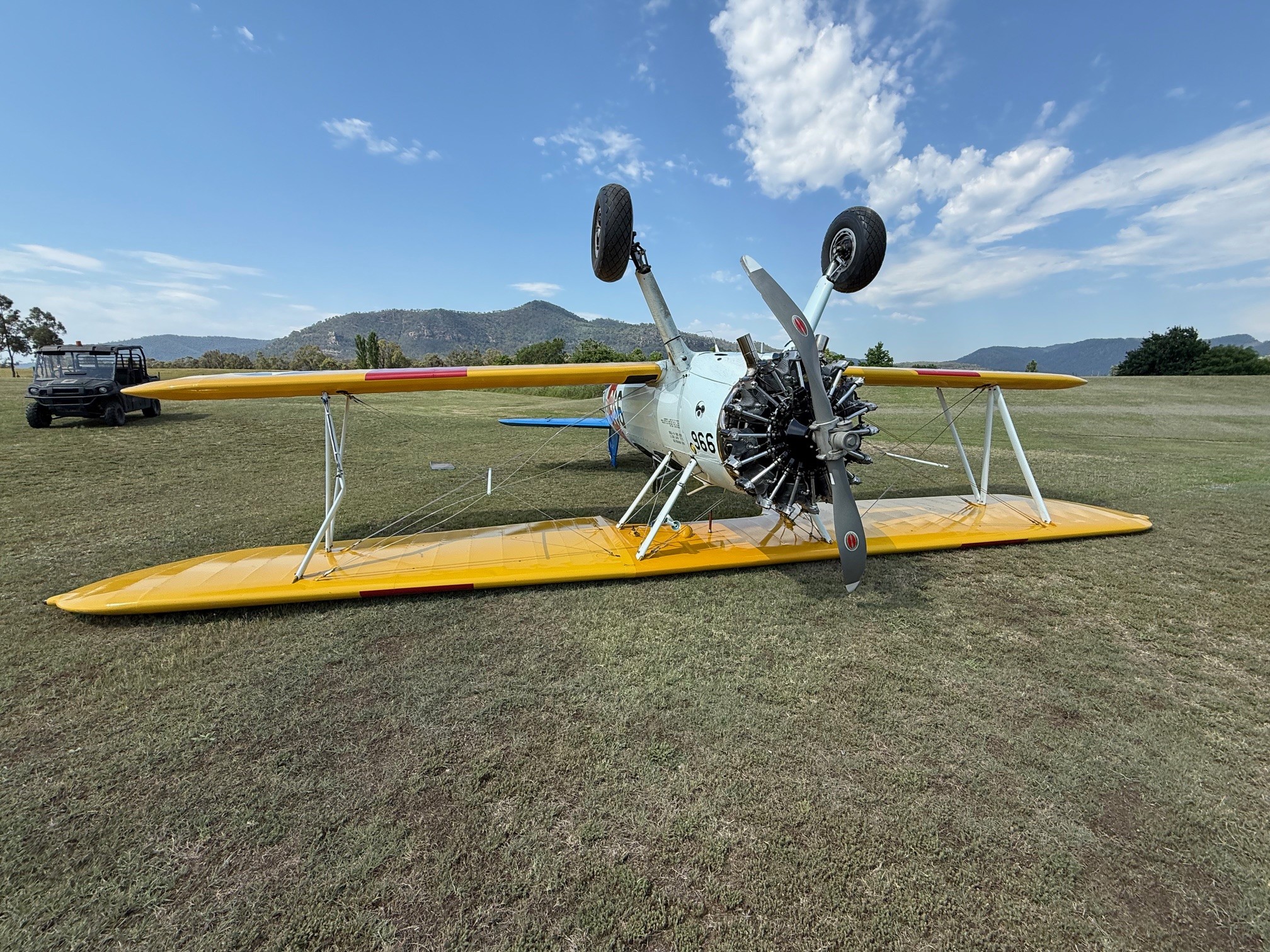
They reported touching down in a 3-point attitude, too far down the runway and applied hard braking which caused the tail to lift once elevator effectiveness reduced. This resulted in the aircraft slowly tipping forward, striking the propeller and then flipping over onto its back and rudder (Figure 1).
Figure 1: Aircraft post-occurrence
Source: Operator
The aircraft sustained damage to its rudder, propeller, wing and strut. The pilot was uninjured.
Safety message
Good landings are made from stable approaches and conducting a go-around is normally the safest course of action if a pilot is not entirely comfortable with the approach.
Pilots should also consider the required approach performance for short field landings of their aircraft when assessing their approach to land with limited runway length. Heavy braking in high centre-of-gravity, tailwheel aircraft increases the risk of loss of control on landing, which places greater importance on ensuring the approach is conducted appropriately.
About this report
Decisions regarding whether to conduct an investigation, and the scope of an investigation, are based on many factors, including the level of safety benefit likely to be obtained from an investigation. For this occurrence, no investigation has been conducted and the ATSB did not verify the accuracy of the information. A brief description has been written using information supplied in the notification and any follow-up information in order to produce a short summary report, and allow for greater industry awareness of potential safety issues and possible safety actions.
[1]All times referred to in this report are local time, Coordinated Universal Time (UTC) + 11 hours.
Occurrence summary
Mode of transport
Aviation
Occurrence ID
AB-2025-060
Occurrence date
08/11/2025
Location
near Dochra
State
New South Wales
Occurrence class
Accident
Aviation occurrence category
Collision with terrain, Control issues, Ground strike
Occurrence Briefs are concise reports that detail the facts surrounding a transport safety occurrence, as received in the initial notification and any follow-up enquiries. They provide an opportunity to share safety messages in the absence of an investigation. Because occurrence briefs are not investigations under the Transport Safety Investigation Act 2003, the information in them is de-identified.
What happened
On 30 October 2025, the owner of a De Havilland DH-82A Tiger Moth was conducting circuit operations with an instructor at an aircraft landing area in regional Victoria as part of an aircraft type familiarisation. The flight involved practice of the wheel landing technique,[1] as the owner advised their previous tailwheel aircraft experience was limited to three-point landings.[2]
The owner and instructor both reported that at the time of the occurrence, the weather conditions were clear with negligible wind.
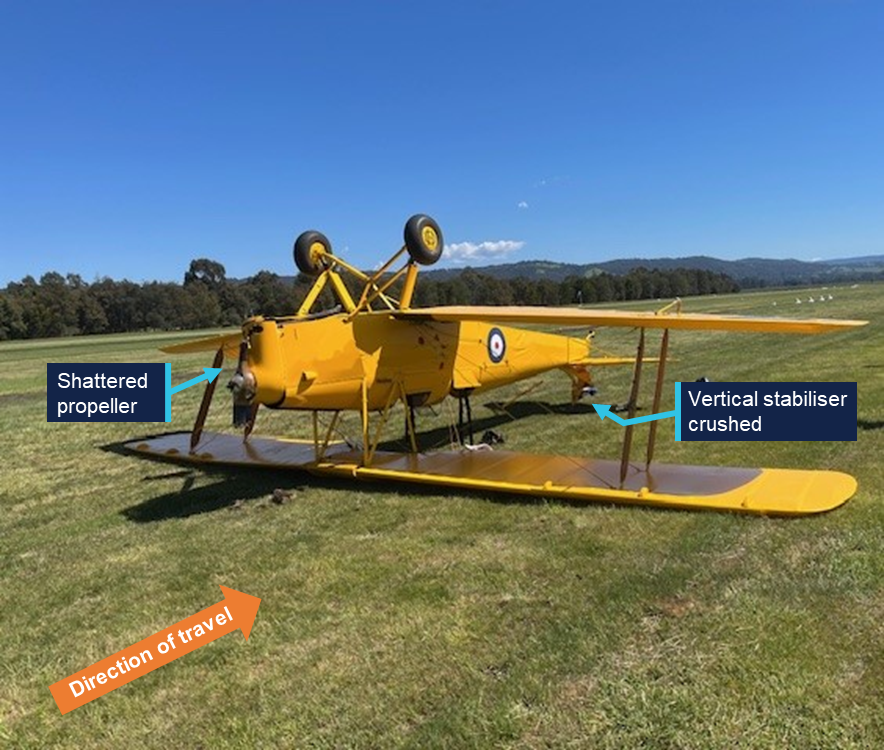
During the fourth touch-and-go, while in the ground-roll, the pilot flying (owner) abruptly applied full power and forward stick. The aircraft pitched forward, lifting the tail above the normal attitude for take-off and the propeller struck the ground. The aircraft subsequently nosed over, coming to a stop inverted. The instructor noted that they did not react quickly enough to arrest this movement as their attention was diverted to monitoring the pilot flying’s directional control during the landing and take-off sequence.
The aircraft sustained substantial damage to the vertical stabiliser, wings, fuel tank and fuselage (Figure 1), however, the occupants were uninjured.
Shortly after the occurrence, the pilot flying questioned the configuration of the DH-82A’s automatic slats at the time of the nose over. The instructor advised the ATSB that when the slats are in the unlocked position, the DH-82A can be more challenging to handle during wheel landings. Prior to the fourth touch-and-go, the slats had been configured in the locked position. However, during the final touch-and-go, the slats were unlocked, changing the handling characteristics. This change in slat configuration by the pilot flying had not been briefed prior to the flight.
Figure 1: Aircraft inverted post-occurrence
Source: Photo supplied by operator, annotated by the ATSB
Safety message
This occurrence highlights the challenges when operating tailwheel aircraft due to their unique handling characteristics. In particular, the typical placement of the main landing gear in front of the centre of gravity endows the aircraft with a sensitivity in pitch movement. This can result in pitch excursions and nose-over accidents during take-off or touch-and-go landings should pilots not remain fully cognisant of this behaviour.
These characteristics can be further exacerbated with the use of secondary flight controls such as wing flaps, slats and trim systems. Prior to training flights, pilots and instructors must brief the scope of the operation and discuss any changes that may be made, especially those that affect the flying characteristics of an aircraft.
It is also important for instructors conducting training and familiarisation flights to maintain effective awareness of the aircraft’s state and ensure they are prepared to rapidly intervene should the pilot flying experience control difficulties. This is particularly important during critical phases of flight such as the take-off.
About this report
Decisions regarding whether to conduct an investigation, and the scope of an investigation, are based on many factors, including the level of safety benefit likely to be obtained from an investigation. For this occurrence, no investigation has been conducted and the ATSB did not verify the accuracy of the information. A brief description has been written using information supplied in the notification and any follow-up information in order to produce a short summary report, and allow for greater industry awareness of potential safety issues and possible safety actions.
[1]Wheel landing: a technique where the aircraft touches down on the main landing gear first with the tail raised. It is the preferred technique in crosswind conditions as it improves the directional controllability while on the ground.
[2]Three-point landing: a technique where the aircraft touches down on the main landing gear and nose wheel simultaneously.
Occurrence Briefs are concise reports that detail the facts surrounding a transport safety occurrence, as received in the initial notification and any follow-up enquiries. They provide an opportunity to share safety messages in the absence of an investigation. Because occurrence briefs are not investigations under the Transport Safety Investigation Act 2003, the information in them is de-identified.
What happened
On 17 October 2025, at 1413 local time, an American Champion Aircraft Corp 8GCBC (Scout), with 2 pilots on board, had conducted aerial observation operations before landing at Busselton Airport, Western Australia.
The pilot reported that during the crosswind landing, after touching down with the tailwheel still clear of the ground, the aircraft left wing lifted due to a gust and the right wing struck the runway.
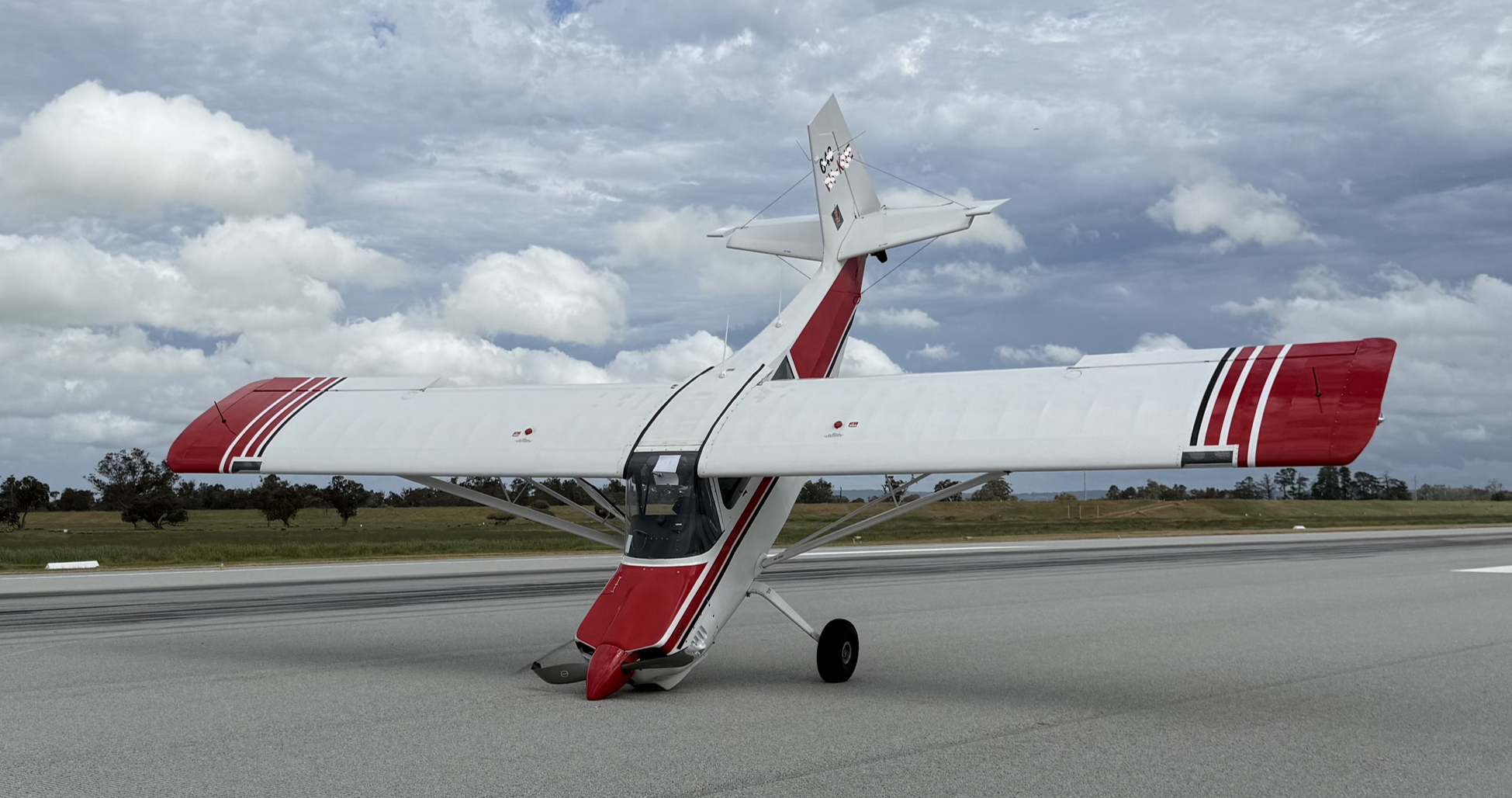
The pilot also believed that whilst they were recovering using the rudder controls, the toe brakes may have been inadvertently applied. This likely caused the aircraft to pitch forward, resulting in propellor impact with the ground and the aircraft coming to rest in a nose-over position (Figure 1).
Figure 1: Aircraft post-occurrence
Source: Photo supplied by operator
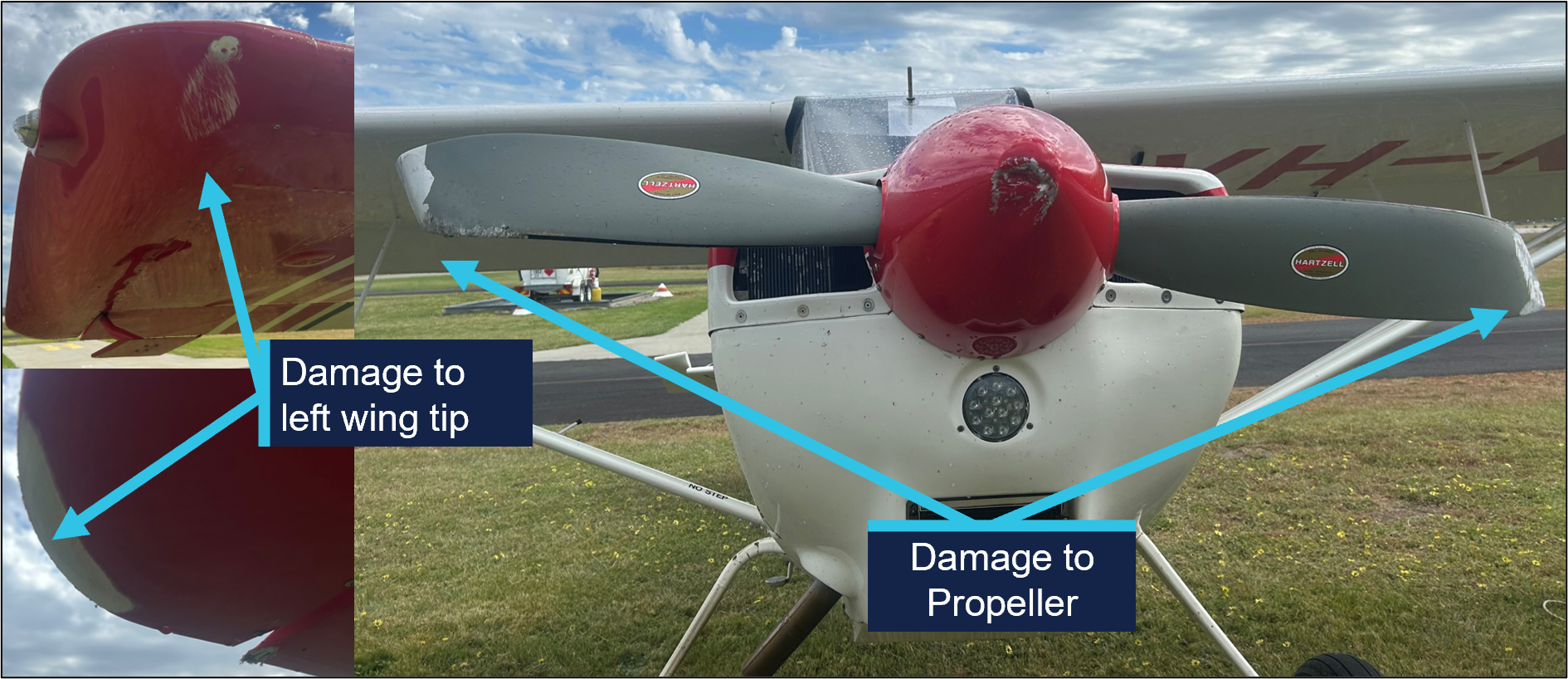
Inspection of the aircraft post‑event noted damage to the aircraft, that included the right wing and the propeller (Figure 2). One of the pilots incurred minor injuries.
Figure 2: Aircraft damage
Source: Photo supplied by operator, annotated by the ATSB
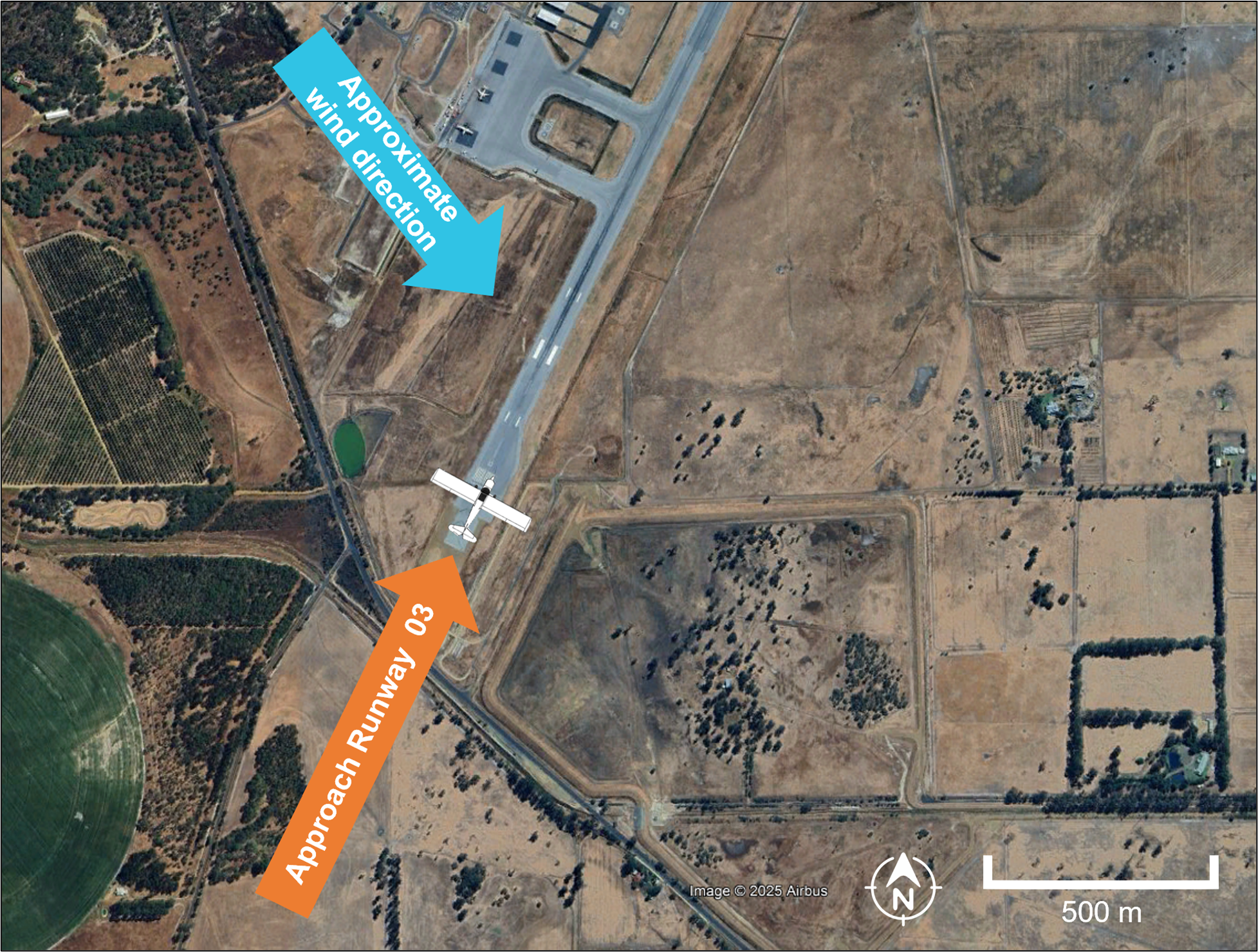
The landing was on runway 03 (Figure 3). The recorded weather conditions at the time was wind at 332° at 12 kt, gusting to 15 kt.
Figure 3: Approach orientation Busselton Airport
Note: aircraft not to scale. Source: Google Earth, annotated by the ATSB
The pilot operating manual for the Scout notes a crosswind limit of 17 kts. The variable wind strength of the gusting crosswind may have been close to the maximum demonstrated limit for the aircraft.
The operator reported that the pilot flying had previously demonstrated competency in crosswinds during landing. Furthermore, in this instance, the senior pilot in the back seat did not attempt to take over control during the landing, as they felt the conditions well within both the aircraft and the pilot flying’s capabilities.
The manual describes that the technique is to place the control stick into the wind (up‑wind aileron up) and assume a tail high attitude with the elevator to prevent drift.
Safety message
This occurrence highlights the importance of exercising caution when operating in conditions that have the potential to exceed the maximum demonstrated crosswind speed of an aircraft.
It also illustrates the need for pilots to establish a personal minimums checklist that is commensurate with the flying experience of the individual. If the conditions do not meet these criteria, or if there is any doubt, pilots should not attempt the landing, consider conducting a go-around, change runways or hand control to a more experienced pilot.
Tailwheel aircraft can be susceptible to crosswind gusts during the later stages of landing. Depending on the magnitude and direction of the gust, there may be insufficient time to apply corrective controls before the aircraft deviates from the intended path.
About this report
Decisions regarding whether to conduct an investigation, and the scope of an investigation, are based on many factors, including the level of safety benefit likely to be obtained from an investigation. For this occurrence, no investigation has been conducted and the ATSB did not verify the accuracy of the information. A brief description has been written using information supplied in the notification and any follow-up information in order to produce a short summary report, and allow for greater industry awareness of potential safety issues and possible safety actions.
Occurrence summary
Mode of transport
Aviation
Occurrence ID
AB-2025-055
Occurrence date
17/10/2025
Location
Busselton Airport
State
Western Australia
Occurrence class
Serious Incident
Aviation occurrence category
Control issues, Ground strike
Highest injury level
Minor
Brief release date
17/11/2025
Aircraft details
Manufacturer
American Champion Aircraft Corp
Model
8GCBC
Sector
Piston
Operation type
Part 138 Aerial work operations
Departure point
Margaret River Aircraft Landing Area, Western Australia
Occurrence Briefs are concise reports that detail the facts surrounding a transport safety occurrence, as received in the initial notification and any follow-up enquiries. They provide an opportunity to share safety messages in the absence of an investigation. Because occurrence briefs are not investigations under the Transport Safety Investigation Act 2003, the information in them is de-identified.
What happened
At about 1136 local time on 18 August 2025, an Aerospatiale AS 350 B2 helicopter was conducting heritage survey operations[1] with the pilot and 3 passengers on board, when it departed from a hilltop landing area, near a Port Hedland mine site in north-west Western Australia.
As the helicopter lifted off, it encountered a strong wind gust, prompting the pilot to use the collective[2] to increase the lift. This action caused the nose to pitch up, and the tail skid to pitch down, striking the ground, as well as yawing, resulting in lateral movement as the tail skid contacted the ground. The pilot felt the impact, then maintained a hover to assess the helicopter controllability and vibrations to the tail rotor. After about 15 seconds with no abnormal indications observed, the pilot proceeded to the planned destination and disembarked the passengers.
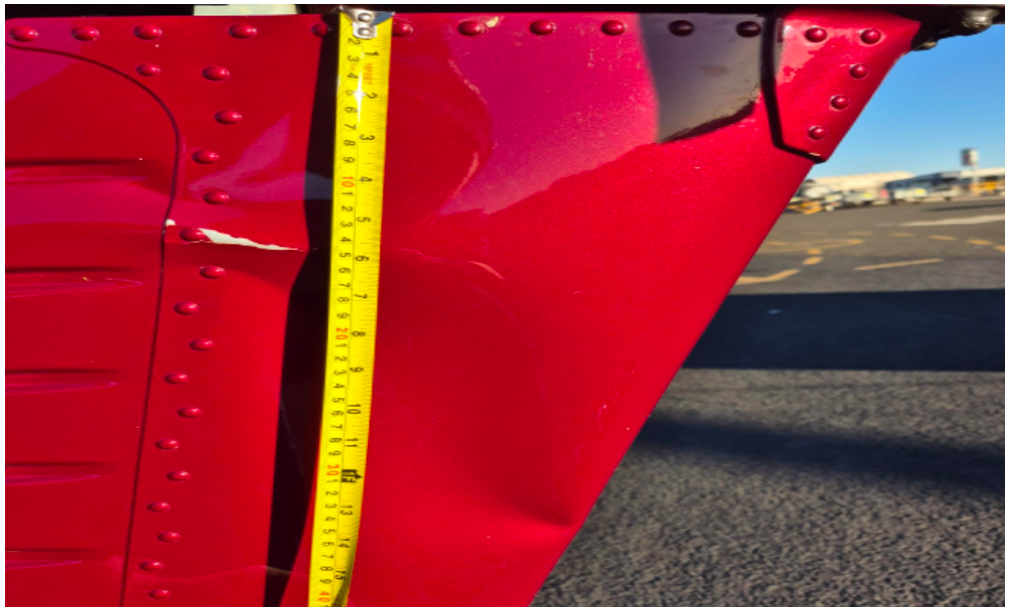
The pilot then continued to fly to a nearby airport for refuelling. The pilot completed a post-flight walk around after refuelling and identified minor damage in the lower vertical stabiliser (Figure 1) which was consistent with the earlier ground contact.
Figure 1: Photograph of crease in lower stabiliser
Source: Operator
Safety message
Following a tail strike or any suspected ground contact, the safest course of action is to land as soon as practicable and conduct an inspection before resuming further flight.
While in this instance the pilot assessed that there were no adverse controllability issues as a result of the ground contact, they continued to operate for 2 sectors with unknown structural damage to helicopter.
Operating a helicopter after such an event, without inspecting the helicopter structure, may result in potentially serious safety consequences.
About this report
Decisions regarding whether to conduct an investigation, and the scope of an investigation, are based on many factors, including the level of safety benefit likely to be obtained from an investigation. For this occurrence, no investigation has been conducted and the ATSB did not verify the accuracy of the information. A brief description has been written using information supplied in the notification and any follow-up information in order to produce a short summary report, and allow for greater industry awareness of potential safety issues and possible safety actions.
[1]A heritage survey is a technique for systematically investigating heritage resources within a defined geographic area.
[2]Collective: a primary helicopter flight control that simultaneously affects the pitch of all blades of a lifting rotor. Collective input is the main control for vertical velocity.
Occurrence Briefs are concise reports that detail the facts surrounding a transport safety occurrence, as received in the initial notification and any follow-up enquiries. They provide an opportunity to share safety messages in the absence of an investigation. Because occurrence briefs are not investigations under the Transport Safety Investigation Act 2003, the information in them is de-identified.
What happened
On 30 July 2025, at 0741 local time, an Australian-registered amphibious Air Tractor AT‑802, configured for firefighting and with 2 crew members on board, departed from Thessaloniki Airport Makedonia, Greece. The aircraft, along with 2 other company aircraft, was headed to a fire located about 40 km north of the airport. At about 20 km south of the fire location, all 3 aircraft commenced water scooping operations at Lake Koroneia.
The amphibious aircraft was designed to scoop water by lowering a retractable intake hole underneath the aircraft while skimming the surface of a body of water at high speed, using the forward motion to force water into the onboard tanks. Prior to scooping operations, pilots will conduct a visual inspection of the proposed scooping area to look for obstacles both on top of and submerged in the water.
The pilot conducted a water inspection and recalled that the water appeared murky and was difficult to see through. During water uplift, the crew of the aircraft reported hearing an impact and immediately initiated a climb to gain height.
The 2 accompanying aircraft flew alongside the Air Tractor to conduct a visual inspection and reported that the right float had dislodged from its mounts. All 3 aircraft made the decision to return to Thessaloniki Airport, with the pilot of the Air Tractor notifying air traffic control and declaring an emergency.
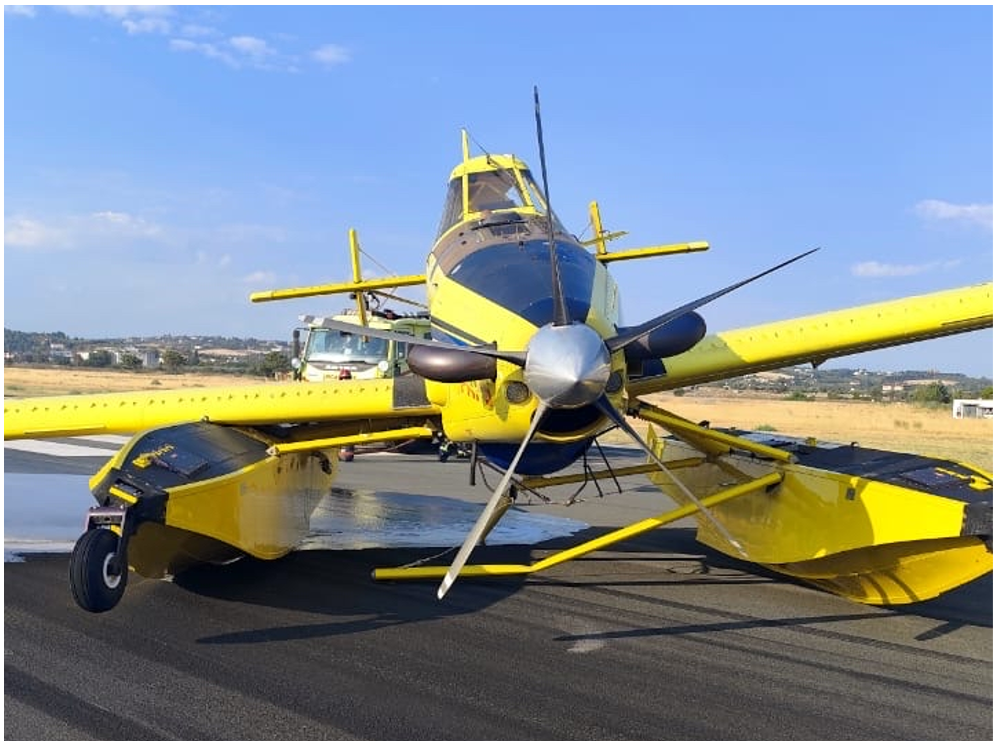
At 0817 the Air Tractor landed on runway 34, however the damaged right float struts were unable to support the weight of the aircraft, and it collapsed onto the right float after landing (Figure 1). The aircraft was subsequently stranded on the runway and emergency services attended. The crew members evacuated the aircraft without injury.
Following the accident, the pilot reported that all 3 aircraft had successfully completed water uplifts from the same location on the previous day. On this occasion, the pilot reported that the glassy water conditions[1] made it difficult to establish the aircraft's height above the water's surface, and the aircraft had hit a submerged object during the scooping run. Due to the risk of unknown hazards at this location, the operator sent a direction to all crew to suspend scooping operations from Lake Koroneia until further notice.
Figure 1: Damaged float struts led to collapse on landing
Source: Operator
Safety message
In murky water, obstructions may not always be visible and the potential for hitting submerged or partly submerged debris is an ever‑present hazard for such operations. Overflying the intended scooping area to scan for such obstacles is always good practice.
In this case, the crew’s quick actions to discontinue operations and pre‑organise emergency services at the airport for their arrival, decreased the risk of injury during their emergency landing.
The hazards that exist in conducting low‑level operations over water have long been recognised (ATSB, 2012) and include the risks of visual illusion and altered depth perception. These factors can make it difficult for pilots to accurately judge the height above water, especially over featureless or reflective surfaces. Flying over calm, glassy water is particularly dangerous, but even choppy water with a constantly varying surface interferes with normal depth perception. Regularly checking the altimeter and establishing smooth descent rates for water alighting during such operations can assist in raising safety margins.
About this report
Decisions regarding whether to conduct an investigation, and the scope of an investigation, are based on many factors, including the level of safety benefit likely to be obtained from an investigation. For this occurrence, no investigation has been conducted and the ATSB did not verify the accuracy of the information. A brief description has been written using information supplied in the notification and any follow-up information in order to produce a short summary report and allow for greater industry awareness of potential safety issues and possible safety actions.
[1]Glassy water can be present across a broad spectrum, from a mirror-like surface to rippled or wavy water, which reflects a distorted image. The reason it presents a challenge for pilots is that without texture on the surface of the water, it is more difficult to judge height.
Occurrence summary
Mode of transport
Aviation
Occurrence ID
AB-2025-036
Occurrence date
30/07/2025
Location
20 km north-north-east of Thessaloniki Airport Makedonia
State
International
Aviation occurrence category
Collision with terrain, Diversion/return, Ground strike, Landing gear/indication
At 1807 local time on the evening of 1 July 2025, a Royal Flying Doctor Service, Beechcraft King Air B200, registered VH-RFD, with 2 pilots and a paramedic on board, taxied at Hobart Airport, Tasmania, for a night flight to Launceston. As the aircraft taxied to conduct a 180° turn using the runway 30 turnaround pad, it struck a taxi light with the right propeller. The aircraft incurred damage to the propeller and a turnaround pad edge taxi light was also damaged.
After recognising the strike had occurred, the pilots reported it to air traffic control, returned to the parking apron and grounded the aircraft.
What the ATSB found
The ATSB found that the pilot flying subconsciously mistook the blue taxiway edge lights and double yellow line on the edge of the turning pad as taxi centreline guidance. This resulted in the pilot deviating from the marked taxiway centreline towards the runway edge light, resulting in the propeller strike.
The ATSB also found that the supervising pilot’s intervention did not occur in time to prompt the pilot flying to adjust the taxi route before impacting the edge light.
Safety message
All pilots are susceptible to human error. This incident highlights that pilots need to be vigilant and maintain an awareness of their location.
The airport environment contains numerous visual aids, markings, signals and signs. Pilots must remain situationally aware of their location, traffic and intended ground tracks to avoid obstacles. When the taxiway is suitable for the aircraft type, it is usually safest to follow the yellow line when taxiing at night, in reduced visibility or at an unfamiliar aerodrome.
Additionally, effective monitoring in a multi-crew environment is also paramount to aircraft safety. Bringing deviations to the early attention of the pilot flying promptly ensures the aircraft remains on a desirable track.
The investigation
The ATSB scopes its investigations based on many factors, including the level of safety benefit likely to be obtained from an investigation and the associated resources required. For this occurrence, the ATSB conducted a limited-scope investigation in order to produce a short investigation report, and allow for greater industry awareness of findings that affect safety and potential learning opportunities.
The occurrence
At 1807 local time on 1 July 2025, a Beechcraft King Air B200, registered VH-RFD, operated by the Royal Flying Doctor Service (RFDS) with 2 pilots and a paramedic on board, commenced taxiing at Hobart Airport, Tasmania. The intended destination for this flight was Launceston Airport. It was dark, with little to no moonlight, and good visibility.
The pilot flying (PF) was operating under the guidance of a supervisory pilot (SP), prior to their final line check,[1] which was scheduled in 2 shifts time. The PF occupied the left‑hand side control seat in the cockpit. The SP, who was also designated pilot in command (PIC),[2] occupied the right-hand control seat.
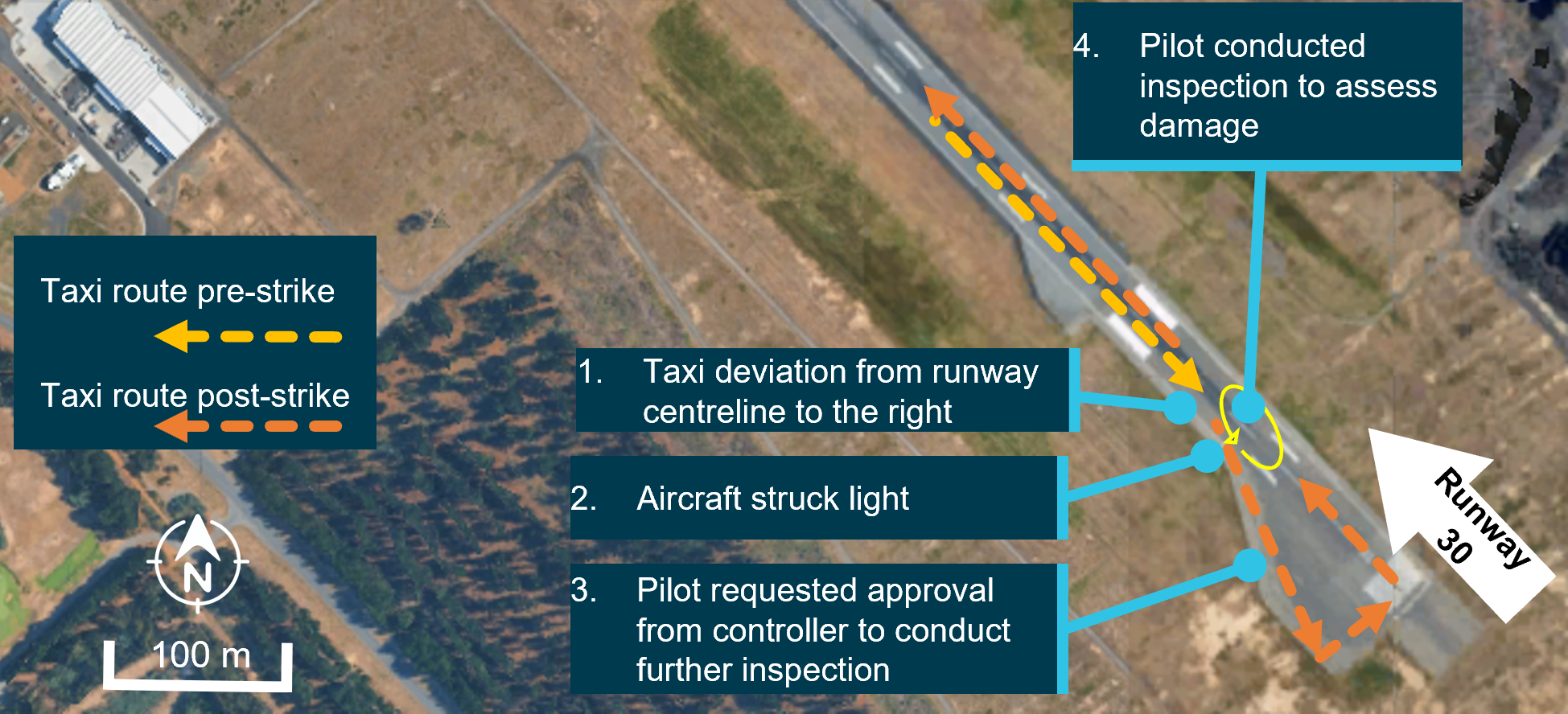
At 1810, the aircraft entered runway 30 to backtrack[3] so that the full runway length could be used for take-off (Figure 1).
Figure 1: Taxi route
Source: Google Earth, annotated by the ATSB
The pilots reported that a common technique for taxiing and turning the King Air B200 is to make a wide arc turn to reduce stress on undercarriage components.
During taxi, the PF steered the aircraft away from the centreline taxiway ground markings, toward the right runway edge, approximately 100 m prior to the runway threshold (Figure 1, label 1). This manoeuvre was to position the aircraft for a 180° turn via the runway turnaround pad (a wide, paved area that allows room for aircraft to reverse taxi direction).
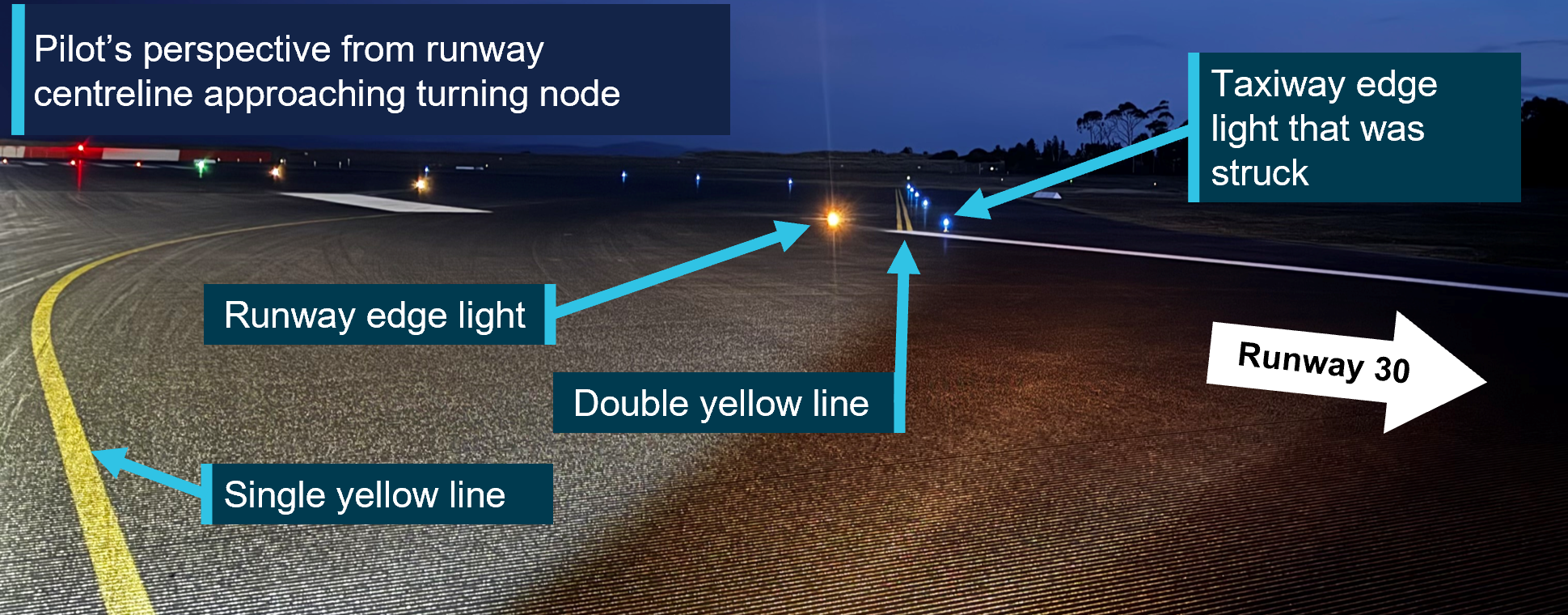
The pilot reported that they subconsciously mistook the blue taxiway edge lights and double yellow line on the edge of the turning pad as taxi centreline guidance. This subsequently resulted in positioning the aircraft to the far right of the turning pad, aligning the aircraft with the double yellow line runway edge light rather than the single yellow line. A reconstructed visual perspective, replicating what the pilot may have seen is shown in Figure 2.
Figure 2: Reconstructed pilot view, approaching and entering the turnaround pad
These images were taken post-occurrence. The height of the camera was lower than the pilot’s sightline during the incident. Source: Hobart Airport, annotated by the ATSB
The wide turn taken by the PF was consistent with what was expected by the SP. As the aircraft approached the right side of the turnaround pad, the SP recalled that they were waiting for the PF to turn the aircraft as it came into the proximity of a taxiway edge light. Once the SP identified that the aircraft was close to the edge light, the SP advised the PF. However, before the PF could steer away from the light, the right propeller struck it (Figure 1, label 2).
Suspecting the aircraft had struck the light, the PF requested from air traffic control (ATC) clearance to conduct a further ground inspection to assess for damage (Figure 1, label 3 and label 4).
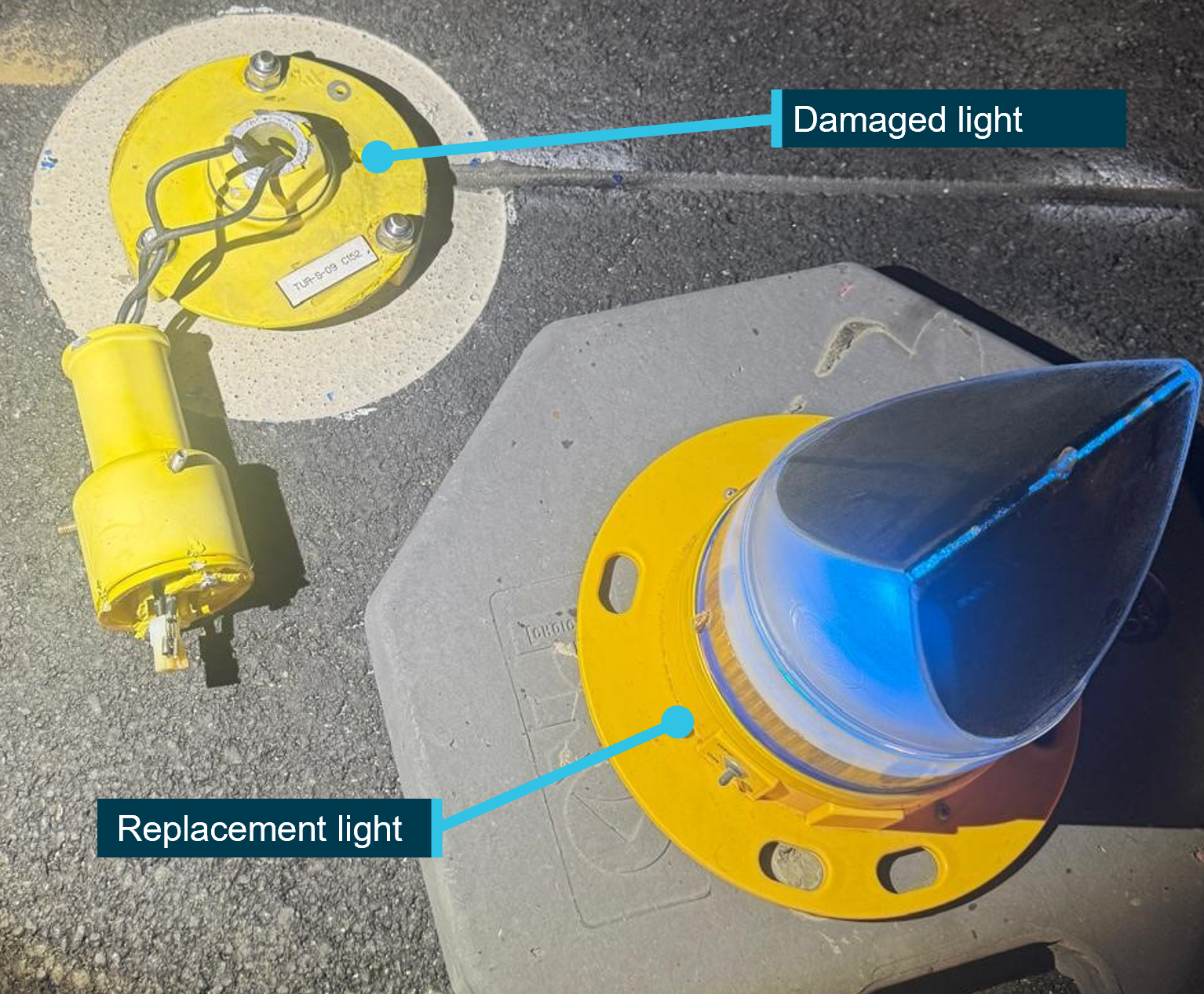
The pilot then confirmed with ATC that the aircraft had struck the light (Figure 3) and advised that they would need to return to the apron.
Figure 3: Blue pad edge light damage
Source: Hobart Airport, annotated by the ATSB
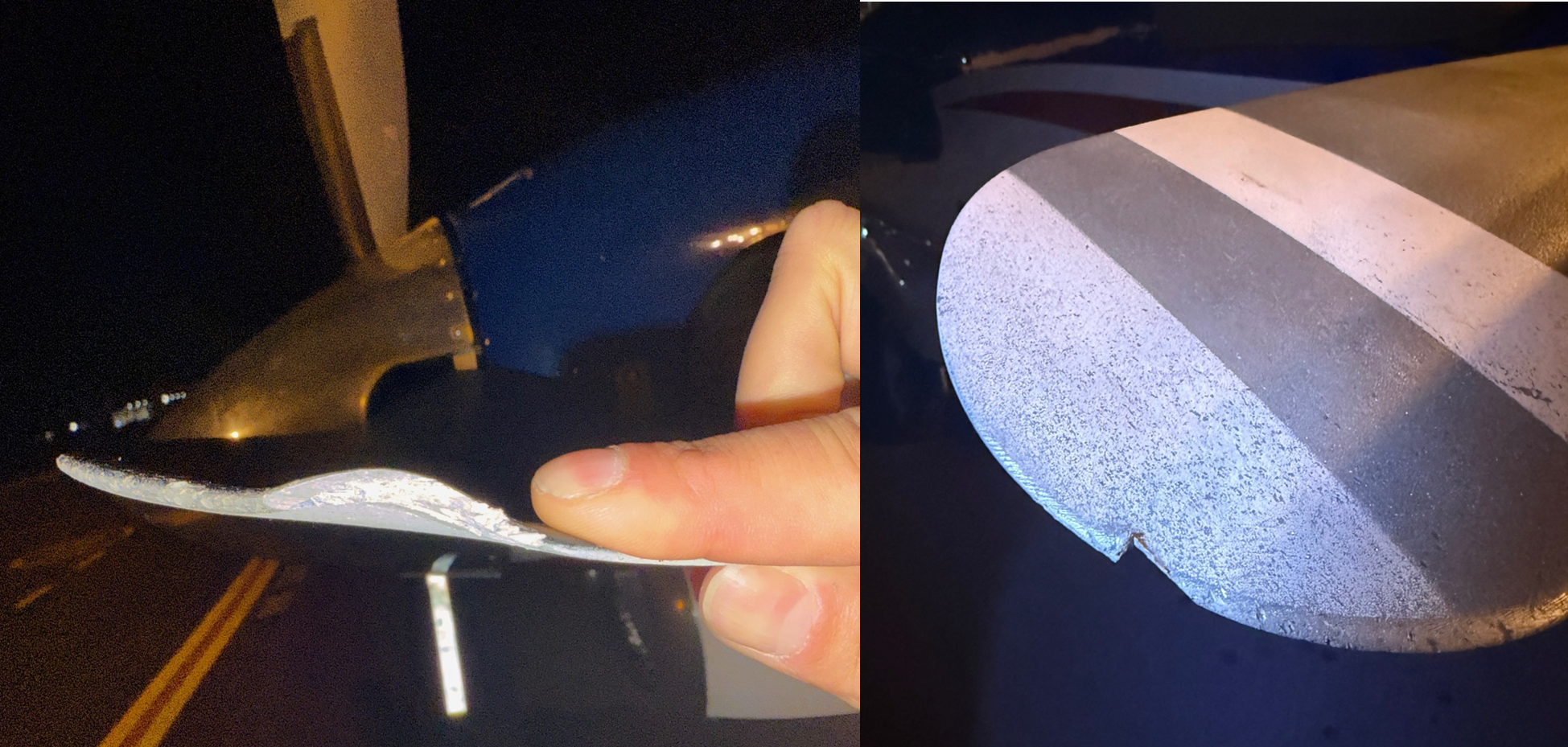
After shutting down the aircraft, the pilots inspected the aircraft and identified damage to the right-hand side propeller (Figure 4).
Figure 4: Propeller damage
Source: RFDS
Context
Pilot information
Pilot flying
The PF held a commercial pilot (aeroplane) license and a valid class 1 aviation medical certificate. They reported a total flying time of about 4,920 hours with about 76 of those being on the King Air B200, having joined the RFDS in April 2025. They reported completing 5 previous flights to Hobart prior to the occurrence, as part of their line training under supervision. All except one of those flights involved the runway 30 threshold being displaced, and they did not utilise the turnaround pad.
Prior to joining the RFDS, the pilot had held training and examining approvals as well as key management positions at another operator.
Prior to the incident, the SP had assessed the PF as capable and their flying standard was reflective of that of a candidate approaching their final check.
Supervisory pilot
The SP held an air transport pilot (aeroplane) license and a valid class 1 medical. They reported a total flying time of 11,848 hours with 4,876 of these hours being on the King Air B200. They also held a management pilot role.[4]
Aircraft information
The Beechcraft King Air B200 is a pressurised, low-wing, twin turbine-engine aircraft with retractable landing gear. The aircraft had a certified maximum take-off weight of 5,667 kg and could be flown by a single pilot. The aircraft, serial number BL-171, was manufactured in the United States in 2014 and subsequently registered in Australia on 14 August 2014. The Royal Flying Doctor Service of Australia (South Eastern Section) had been the registered operator of the aircraft since August 2014.
Airport information
Hobart Airport is a certified airport consisting of one runway. Runway 12/30 was aligned north-west to south-east and was 2,727 m long and 45 m wide. The aircraft movement areas could accommodate aircraft with a wingspan of up to 36 m (such as a Boeing 737).
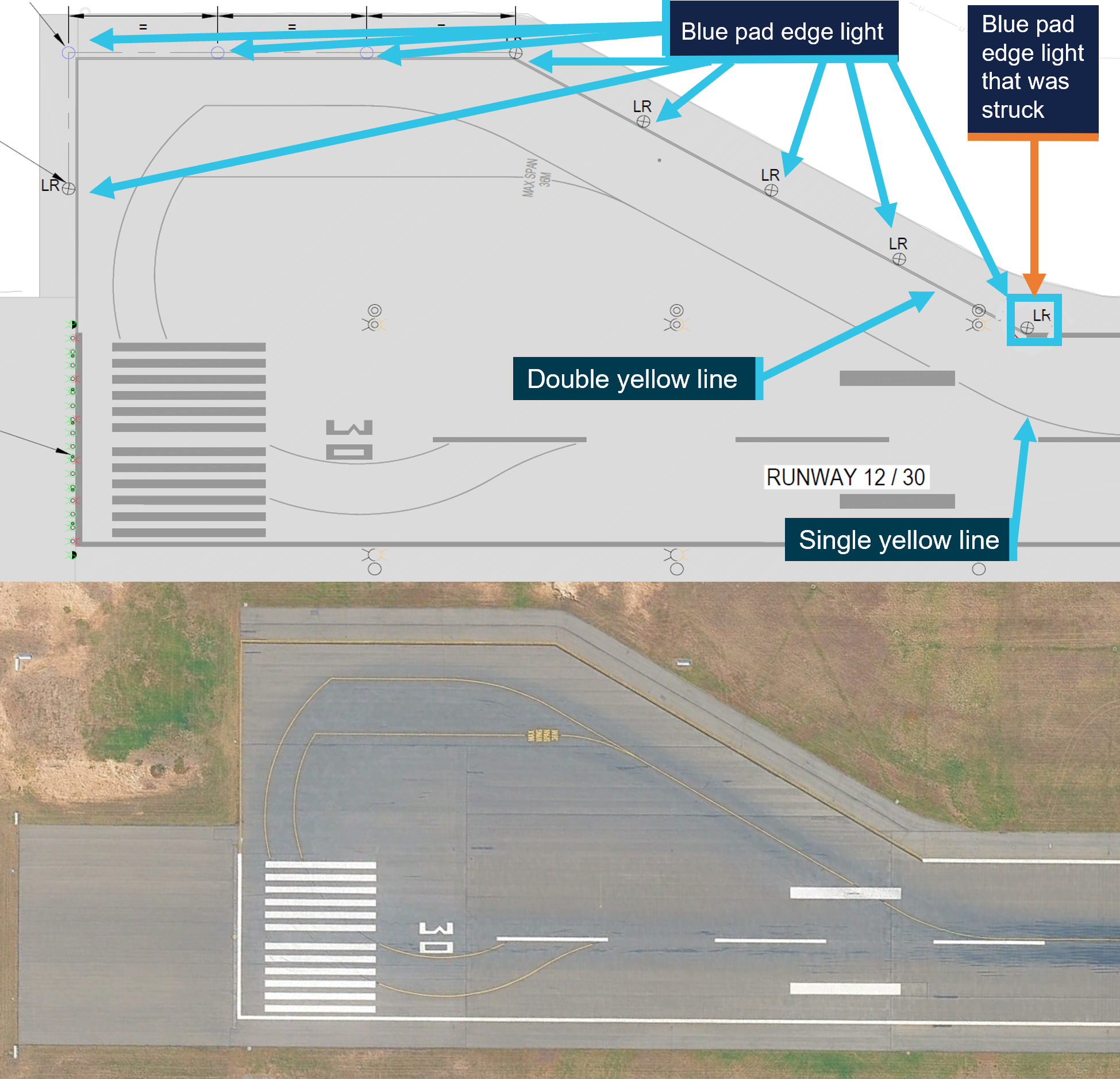
There were line markings and lights on the runway and turnaround pad to guide pilots in turning and lining up their aircraft for departure (Figure 5). The markings and design appeared to be consistent with the requirements of the Civil Aviation Safety Authority Part 139 Manual of Standards.
Figure 5: Illustrations (top) and photograph (bottom) of lights and line guidance at the turnaround pad
Source: Hobart Airport and Google Earth, annotated by the ATSB
RFDS operational induction
When a new pilot joins the RFDS, the operator carries out a structured induction and training program. Initially, a new pilot undertakes type/class training on the King Air B200 which includes an instrument proficiency check (IPC[5]). Following this training, the new pilot conducts line training flights in the presence of an RFDS supervisory pilot.
The objective of supervised line operations (line training) is to prepare the new pilot for single pilot, unsupervised line operations. The required training outcomes for the new pilot are:
obtaining the required operational experience
exposure to and gaining experience of the RFDS’s line operations
gaining knowledge of the routes and aerodromes used by the AOC.
Whenever an SP occupies one of the pilot seats, they will be the PIC. These policies and procedures are outlined within the RFDS training and checking systems manual.
Training and supervising methodology
Many training methodologies apply the principle of allowing the student to recognise an error and self-correct. This established technique allows the student a chance, and time, to correct themselves, prior to intervention by the instructor or supervisor.
The US Federal Aviation Administration (FAA) Aviation Instructor’s Handbook (2020), which is a recommended reference document for the Civil Aviation Safety Authority’s pilot instructor rating exam, also references this instructional technique. It notes:
Correction of learner errors does not include the practice of taking over from learners immediately when a mistake is made. Safety permitting, it is frequently better to let learners progress part of the way into the mistake and find a way out.
The SP commented that retrospectively, they could have been more assertive and prompter in their intervention once they recognised the proximity of the aircraft to the light.
Safety analysis
Misinterpretation of taxiway/runway visual guidance
While backtracking, the pilot flying (PF) deviated to the right of track in preparation to conduct a wide left turn using the turnaround pad. Making a wide arc turn was a common technique used by pilots for taxiing and turning the King Air B200. As they turned into the turnaround pad, the PF mistakenly manoeuvred the aircraft to align with the blue taxiway edge lights and 2 yellow (edge line) markings. A pilot would normally rely on taxiing guidance of a single yellow line (and green lights), on a taxiway.
The PF was experienced, having held numerous approvals (training and management). However, in this instance, they reported that they subconsciously mistook the taxiway edge lights and double yellow line on the edge of the turning pad as taxi guidance. Observational audit methodologies, such as the Line Operations Safety Audit (LOSA) have demonstrated that crews make on average between one and five errors per flight sector (Thomas & Petrilli, 2004).
Supervisor pilot delayed intervention
The SP monitored the PF’s taxiing path as the aircraft deviated toward the right edge of the runway. This path was initially as expected by the SP reflecting normal operations for turning around using the turnaround pad.
The SP instructed the PF to correct their track when in proximity to the pad edge light, however due to the limited time available and proximity, a strike between the right propeller and taxi light still occurred.
The SP held the belief that the PF was capable, and this assessment may have contributed to delayed intervention, affecting their level of attention when monitoring the taxi path.
The SP adhered to the recognised training techniques in the FAA Aviation Instructor’s Handbook, by allowing the PF a degree of latitude prior to their intervention. However, this action resulted in the SP delaying the intervention and advising the PF of the proximity of the pad edge light, leaving insufficient time to avoid the light.
The SP recognised, retrospectively, that if they had recognised the proximity of the aircraft to the light earlier, they would have been more assertive and more prompt in their intervention.
Findings
ATSB investigation report findings focus on safety factors (that is, events and conditions that increase risk). Safety factors include ‘contributing factors’ and ‘other factors that increased risk’ (that is, factors that did not meet the definition of a contributing factor for this occurrence but were still considered important to include in the report for the purpose of increasing awareness and enhancing safety). In addition ‘other findings’ may be included to provide important information about topics other than safety factors.
These findings should not be read as apportioning blame or liability to any particular organisation or individual.
From the evidence available, the following findings are made with respect to the propeller strike of a taxiway edge light involving Beechcraft King Air B200C, VH-RFD, at Hobart Airport, Tasmania, on 1 July 2025.
Contributing factors
The pilot flying misinterpreted the markings and lights at the turnaround pad. This resulted in the pilot taxiing too close to the taxiway edge light, resulting in a propeller striking the light.
The supervising pilot did not allow enough time to prompt the pilot flying to adjust the taxi route, for the intervention to be effective.
Sources and submissions
Sources of information
The sources of information during the investigation included:
pilot flying and pilot supervising
Royal Flying Doctor Service, South Eastern Section
Hobart Airport
Civil Aviation Safety Authority
Airservices Australia
Bureau of Meteorology
Flightradar24.
References
Federal Aviation Administration. (2020). Aviation Instructors Handbook. U.S. Department of Transport.
Thomas , M. J., & Petrilli, R. M. (2004). Error Management Training: An investigation of expert pilots’ error management strategies. Adelaide: Centre for Applied Behavioural Science.
Submissions
Under section 26 of the Transport Safety Investigation Act 2003, the ATSB may provide a draft report, on a confidential basis, to any person whom the ATSB considers appropriate. That section allows a person receiving a draft report to make submissions to the ATSB about the draft report.
A draft of this report was provided to the following directly involved parties:
pilot flying
pilot supervising
Royal Flying Doctor Service, South Eastern Section
Hobart Airport
Airservices Australia
Civil Aviation Safety Authority.
A submission was received from Hobart Airport.
The submission was reviewed and, where considered appropriate, the text of the report was amended accordingly.
Purpose of safety investigations
The objective of a safety investigation is to enhance transport safety. This is done through:
identifying safety issues and facilitating safety action to address those issues
providing information about occurrences and their associated safety factors to facilitate learning within the transport industry.
It is not a function of the ATSB to apportion blame or provide a means for determining liability. At the same time, an investigation report must include factual material of sufficient weight to support the analysis and findings. At all times the ATSB endeavours to balance the use of material that could imply adverse comment with the need to properly explain what happened, and why, in a fair and unbiased manner. The ATSB does not investigate for the purpose of taking administrative, regulatory or criminal action.
About ATSB reports
ATSB investigation reports are organised with regard to international standards or instruments, as applicable, and with ATSB procedures and guidelines.
Reports must include factual material of sufficient weight to support the analysis and findings. At all times the ATSB endeavours to balance the use of material that could imply adverse comment with the need to properly explain what happened, and why, in a fair and unbiased manner.
An explanation of terminology used in ATSB investigation reports is available here. This includes terms such as occurrence, contributing factor, other factor that increased risk, and safety issue.
Publishing information
Released in accordance with section 25 of the Transport Safety Investigation Act 2003
Ownership of intellectual property rights in this publication
Unless otherwise noted, copyright (and any other intellectual property rights, if any) in this report publication is owned by the Commonwealth of Australia.
Creative Commons licence
With the exception of the Commonwealth Coat of Arms, ATSB logo, and photos and graphics in which a third party holds copyright, this report is licensed under a Creative Commons Attribution 4.0 International licence.
The CC BY 4.0 licence enables you to distribute, remix, adapt, and build upon our material in any medium or format, so long as attribution is given to the Australian Transport Safety Bureau.
Copyright in material obtained from other agencies, private individuals or organisations, belongs to those agencies, individuals or organisations. Where you wish to use their material, you will need to contact them directly.
[1]A line check is the final pilot’s assessment after line training. After a successful final line check, the pilot is released to a normal line flying operation. See also RFDS operational induction.
[2]The pilot in command (PIC) of an aircraft is the person aboard an aircraft who is ultimately responsible for its operation and safety during flight.
[3]Backtrack. To taxi on a runway-in-use, in the opposite direction to the aircraft’s take-off or landing direction.
[4]Management Pilot means a pilot assigned to management duties
[5]An instrument proficiency check assesses flying skills and operational knowledge, ensuring the capability to exercise the privileges to conduct a flight under the IFR.
Occurrence summary
Investigation number
AO-2025-034
Occurrence date
01/07/2025
Location
Hobart Airport
State
Tasmania
Report release date
05/12/2025
Report status
Final
Investigation level
Short
Investigation type
Occurrence Investigation
Investigation status
Completed
Mode of transport
Aviation
Aviation occurrence category
Ground strike
Occurrence class
Incident
Highest injury level
None
Aircraft details
Manufacturer
Beechcraft
Model
B200C
Registration
VH-RFD
Serial number
BL-171
Aircraft operator
Royal Flying Doctor Service (South Eastern Section)
Sector
Turboprop
Operation type
Part 135 Air transport operations - smaller aeroplanes