


What happened
On the afternoon of 24 November 2025, the pilot of a Robinson R22 helicopter was conducting commercial aerial mustering at a cattle station in the Northern Territory.
The operator reported that at the time of the occurrence, there was a 10–16 kt wind from the north-east and the temperature was 36°C. Relative to the aircraft’s heading the wind direction was at the 11 o’clock position.
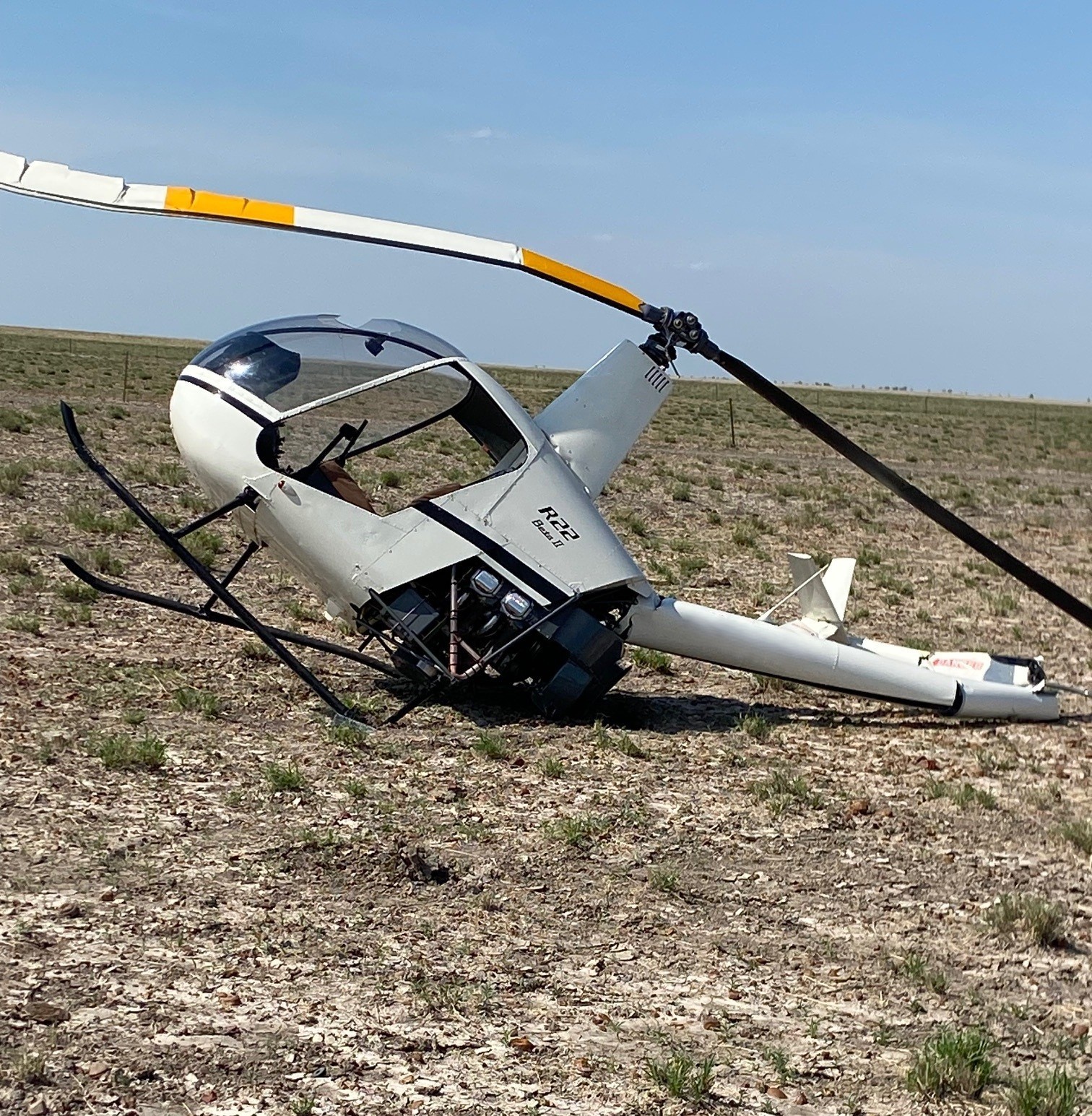
After the first herd of stock had been moved out of the laneway[1] the pilot landed the helicopter approximately 100 m from the laneway gate, to prepare for the second herd. As the second herd approached the laneway the pilot brought the helicopter into a 2–3 ft hover and slowly moved forward to gain airspeed. During this manoeuvre, the pilot reported that the helicopter encountered unexpected sink and they raised the collective[2] to counter the downward movement. Despite the increased collective, the helicopter continued to sink and the left skid contacted a grass mound. Pitching forward, one of the helicopter’s main rotor blades struck the tail boom and the helicopter lifted away from the ground and began to spin. The pilot attempted to slow the rotation by reducing the throttle and the helicopter came to a rest on the rear of its skids and the damaged tail boom (Figure 1).
The helicopter sustained substantial damage to the tail boom, skids and main rotor blades, however the pilot was uninjured. The pilot was wearing a helmet during the operation.
Figure 1: Helicopter damage
Source: Aircraft operator
Safety message
Helicopter mustering is an inherently high-risk activity involving low‑level flying which significantly reduces the safety margins usually available to pilots. It is important when transitioning from a hover to forward flight, that pilots establish and maintain appropriate ground clearance – allowing for a timely reaction to unexpected sink or other weather‑related conditions that can affect take-off.
This occurrence also highlights the importance and value of pilots wearing helmets during operations with increased risk. The ATSB safety advisory notice, AO‑2020‑040‑SAN-01, encourages helicopter pilots conducting low-level operations to wear flight helmets that are custom fitted to the individual’s head, include a properly secured chin strap and are maintained in accordance with the manufacturer’s recommendations.
About this report
Decisions regarding whether to conduct an investigation, and the scope of an investigation, are based on many factors, including the level of safety benefit likely to be obtained from an investigation. For this occurrence, no investigation has been conducted and the ATSB did not verify the accuracy of the information. A brief description has been written using information supplied in the notification and any follow-up information in order to produce a short summary report, and allow for greater industry awareness of potential safety issues and possible safety actions.
[1] Laneway: a narrow corridor designed for livestock to be separated from the herd and to separate animals for different procedures.
[2] Collective: a primary helicopter flight control that simultaneously affects the pitch of all blades of a lifting rotor. Collective input is the main control for vertical velocity.