

What happened
On 28 February 2026, a pilot was conducting a private flight from Orange, New South Wales, to a privately‑owned, unsealed airstrip near Louth, New South Wales, with one passenger on board. During approach, the pilot observed gusting winds and localised whirlwind activity in close proximity to the runway.
As the aircraft decelerated through approximately 30 to 25 kts during the landing roll, the aircraft yawed to the left with an increasing gust of wind. The pilot applied right rudder in an attempt to arrest the yaw, however a stronger second gust occurred, increasing the pressure on the rudder and pushing the aircraft further into a left yaw.
With full brakes applied and rudder authority reduced, the aircraft’s left main wheel sank into soft ground at the runway edge and the aircraft ground looped[1] to the left. The right landing gear collapsed and the right wing and propeller impacted the ground resulting in substantial damage to the wing, landing gear and propeller.
Figure 1: Aircraft wreckage
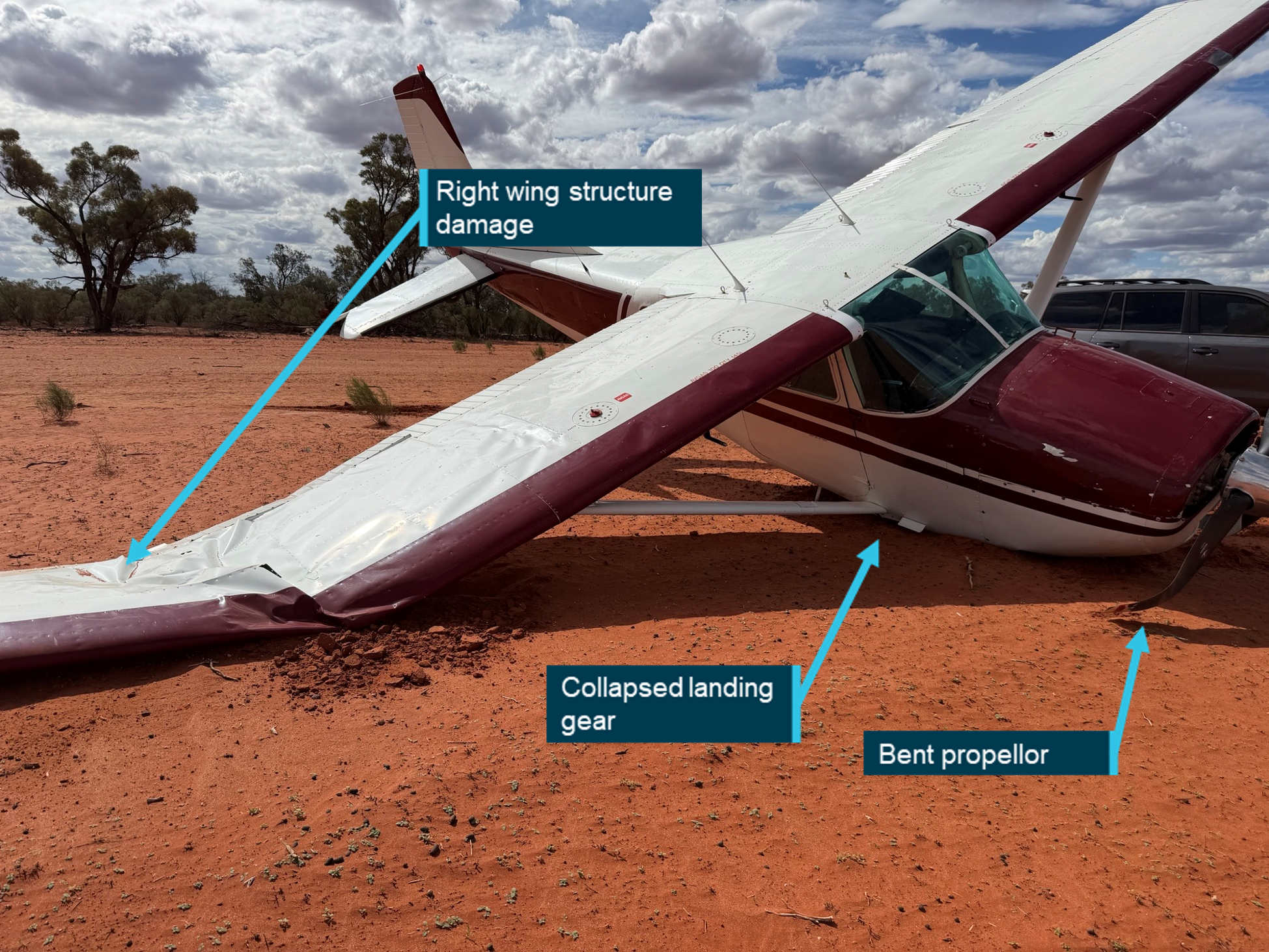
Source: Airstrip owner, annotated by the ATSB
Safety message
Pilots must ensure that the weather conditions surrounding the selected landing area are continuously assessed visually throughout the approach phase of flight. Should there be any unfavourable weather conditions that may impact the aircraft’s stability and controllability, conducting a go-around will allow time to plan for how to manage the landing conditions.
The ATSB also reminds all pilots of the importance of planning, and evaluating the local weather conditions, prior to departure. A comprehensive assessment of the weather conditions at the intended point of landing is encouraged.
About this report
Decisions regarding whether to conduct an investigation, and the scope of an investigation, are based on many factors, including the level of safety benefit likely to be obtained from an investigation. For this occurrence, no investigation has been conducted and the ATSB did not verify the accuracy of the information. A brief description has been written using information supplied in the notification and any follow-up information in order to produce a short summary report, and allow for greater industry awareness of potential safety issues and possible safety actions.
[1] A term used to describe a loss of directional control where the aircraft rotates around the yaw axis.
Occurrence summary
| Mode of transport | Aviation |
|---|---|
| Occurrence ID | AB-2026-015 |
| Occurrence date | 28/02/2026 |
| Location | Private airstrip near Louth |
| State | New South Wales |
| Occurrence class | Accident |
| Aviation occurrence category | Ground strike, Loss of control |
| Highest injury level | None |
| Brief release date | 01/04/2026 |
Aircraft details
| Manufacturer | Cessna Aircraft Company |
|---|---|
| Model | 185D |
| Sector | Piston |
| Operation type | Part 91 General operating and flight rules |
| Departure point | Orange, New South Wales |
| Destination | Private airstrip near Louth, New South Wales |
| Damage | Substantial |