

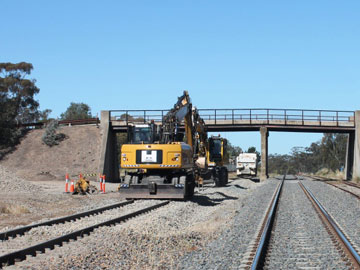
Track workers take evasive action as an oncoming train unknowingly approaches their worksite.
The issue of safe work on rail in Australia continues to be a matter of serious concern for the ATSB after a ‘safeworking irregularity’ near Glenrowan resulted in a near miss between track workers and a V/Line passenger train.
The incident occurred on 29 October 2013, when the Australian Rail Track Corporation (ARTC) was undertaking ballast remediation and drainage maintenance on the bidirectional track between Benalla and Wangaratta, Victoria. The work was being done on the west track, but worksite protection was put in place on both the west and east tracks, with flagmen and Audible Track Warning signals (ATWs) placed either side of the worksite. The west track was designated ‘Absolute Occupation’, ensuring that no trains could use it, while ‘Track Force Protection’ was put on the east track, so that the workers would be made aware of any approaching train well before it arrived.
Safe work on rail continues to be a matter of serious concern for the ATSB.
The worksite at Glenrowan used two radio channels for communications. One channel was used for safety critical communication between the flagmen and the track force coordinator, the second was used for worksite communication between the track workers, including the track force coordinator. The track workers relied on the track force coordinator for safety critical communication since they had no direct communication with the flagmen.
At approximately 0730, V/Line passenger train 8610, travelling between Albury and Melbourne on the east track, stopped at Wangaratta to pick up passengers. The track force coordinator at Glenrowan was made aware of the train and instructed the flagmen to remove the ATWs and allow the train to pass the work site unrestricted. This was done without informing the work site supervisor or any of the track workers.
At about 0744, the outer flagman observed train 8610 and contacted the inner flagman to let her know that the train was approaching. The inner flagman attempted to contact the track force coordinator multiple times, but did not get a response. The track force coordinator was in conversation with the work site supervisor and not within earshot of either of his radios. The inner flagman then tried to alert the track force coordinator by whistle, but without success.
At about the same time, the work site supervisor observed train 8610 approaching and called out ‘Train on!’ on the work site radio.
The track workers also saw the train and took action to ensure that they and their machines were clear of the east track. The driver of Train 8610 did not notice anything unusual as the train passed through the worksite (without incident) at about 0746.
After the incident, the work site supervisor took control of the site. The track force coordinator was tested for the presence of alcohol or other drugs which proved negative.
As a result of this occurrence, the ARTC held a post-incident meeting with all relevant personnel to discuss the incident and reinforce the necessity to follow procedures when providing track protection. The program manager instructed all site personnel that ATWs were to be left on track to warn of trains approaching worksites.
The ARTC has also provided follow-up training and recertification regarding the relevant network safeworking rules.
The issue of safe work on rail in Australia is a major concern for the ATSB. The ATSB has investigated several accidents that have occurred when maintenance work was being carried out on or near railway tracks. The issue forms parts of the SafetyWatch initiative, which provides warnings and strategies to help transport workers keep themselves safer.
Read the final report: Safeworking irregularity, at Glenrowan, Victoria, on 29 October 2013