


What happened
On 11 January 2026, a pilot, and sole occupant of a Van’s RV-7, was conducting a private flight from South East Queensland to Scone Airport, New South Wales, under the visual flight rules (VFR).[1]
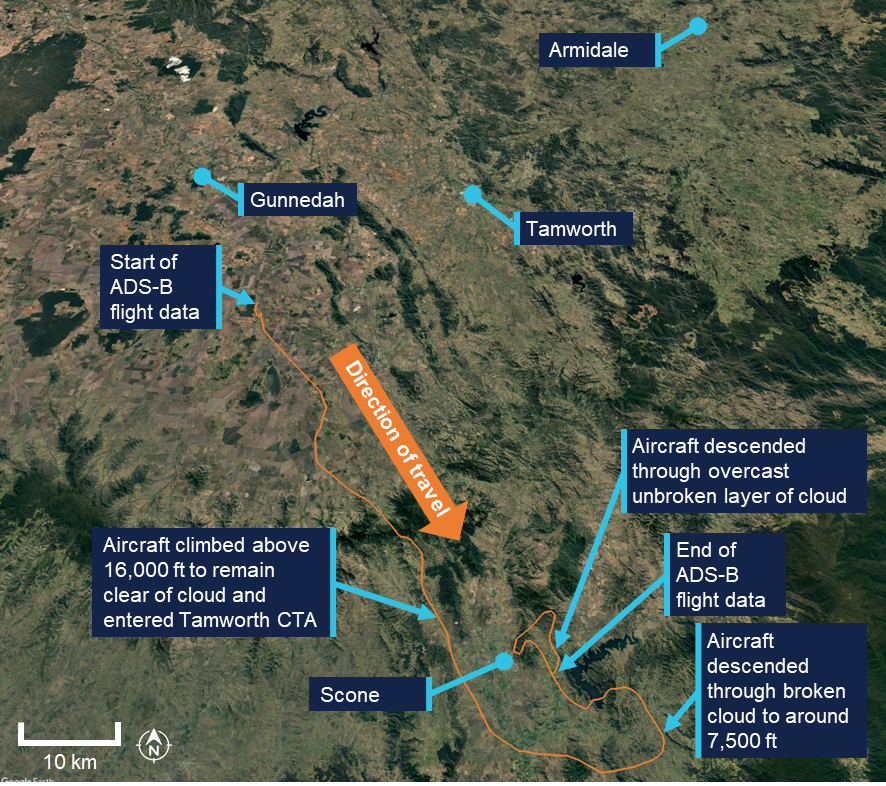
The aircraft departed in the mid-afternoon and the pilot reported that they initially landed at Armidale Airport for a break and to review the weather for the remainder of the flight. They advised that satellite imagery for the area indicated areas of cloud south of Armidale, breaking up to the west and further to the south, over Scone. As a consequence, the pilot elected to initially fly west towards Gunnedah before turning south (Figure 1).
Figure 1: Aircraft flight path
Source: Google Earth, annotated by the ATSB
After departing Armidale in the early evening, the pilot advised that the weather deteriorated behind them and so returning to the departure airport was no longer an option. As the flight progressed, after the pilot turned to fly southbound, they commenced a gradual climb to remain above the cloud layer. As they climbed above 10,000 ft, they commenced using supplemental oxygen.
Approaching Scone, the aircraft inadvertently entered the Tamworth Control Area (CTA) without a clearance. The pilot had intended to remain below the 15,500 ft CTA step, but climbed above 16,000 ft to remain clear of cloud.
At around 2008 local time, due to the aircraft’s altitude, air traffic control (ATC) questioned the pilot about their intentions. The pilot advised that they were flying above overcast cloud. As the pilot also advised ATC that they were not instrument rated[2] and did not have a night VFR rating,[3] the controller commenced an emergency response and contacted other aircraft in the area to get an appreciation of the weather. They then contacted Scone Airport to request that the runway lights be turned on. They also established that last light at Scone was 2034.
Approaching Scone, the pilot conducted a visual descent through broken cloud, however at around 7,500 ft they encountered an extensive, unbroken layer of cloud. At approximately 2025, with limited daylight remaining, the pilot elected to descend through the cloud rather than diverting to an alternate aerodrome at night in deteriorating weather. The aircraft exited cloud at approximately 3,000 ft above ground level and the pilot manoeuvred to join the downwind leg for runway 11 at Scone Airport. The aircraft landed at 2031.
The pilot later reported that there were several things that contributed to their decision‑making, including:
- complacency
- inexperience
- a desire to be at Scone in time for work the next morning
- a reluctance to leave the aircraft tied down outside at Armidale
- fatigue.
Safety message
Early decisions prevent last-minute emergencies. VFR pilots should avoid continuing flight into areas of deteriorating weather as pressing on in marginal conditions reduces available options and significantly increases the likelihood of entering IMC. Early and conservative decision‑making – such as diverting or turning back – is an effective defence.
As identified in a recent ATSB investigation concerning VFR into IMC (AO-2025-040), between 2015 and 2025 there were 116 VFR into IMC occurrences reported to the ATSB. Of these, 13 were fatal accidents resulting in 24 fatalities. Based on these figures, approximately 1 in every 9 reported VFR into IMC occurrences results in a fatality.
The ATSB booklet Accidents involving Visual Flight Rules pilots in Instrument Meteorological Conditions (AR-2011-050, revised 2019) provides guidance on avoiding adverse weather during VFR flights.
About this report
Decisions regarding whether to conduct an investigation, and the scope of an investigation, are based on many factors, including the level of safety benefit likely to be obtained from an investigation. For this occurrence, no investigation has been conducted and the ATSB did not verify the accuracy of the information. A brief description has been written using information supplied in the notification and any follow-up information in order to produce a short summary report, and allow for greater industry awareness of potential safety issues and possible safety actions.
[1] Visual flight rules (VFR): a set of regulations that permit a pilot to operate an aircraft only in weather conditions generally clear enough to allow the pilot to see where the aircraft is going.
[2] A licence endorsement that allows a pilot to legally fly under Instrument Flight Rules (IFR), a set of regulations that govern flying when outside visual meteorological conditions, relying on instruments for navigation and control.
[3] A licence endorsement that allows a pilot to fly at night without holding an IFR rating, provided the operation is conducted in visual meteorological conditions.