

What happened
On 27 December 2025 at approximately 1015 local time, an instructor and student operating a Piper PA-28 were preparing to depart Lilydale Aircraft Landing Area (ALA), Victoria, for circuit training. After completing the pre-take-off and run-up[1] checks, the crew taxied to the holding point of runway 18 behind another aircraft. The instructor reported sighting a de Havilland DH-82A Tiger Moth taxiing from the southern end of the airfield.
The DH-82A, having returned from a joy flight with a pilot and passenger on board, exited runway 18 at approximately midfield and began to taxi back to parking at the northern end of the airfield (Figure 1).
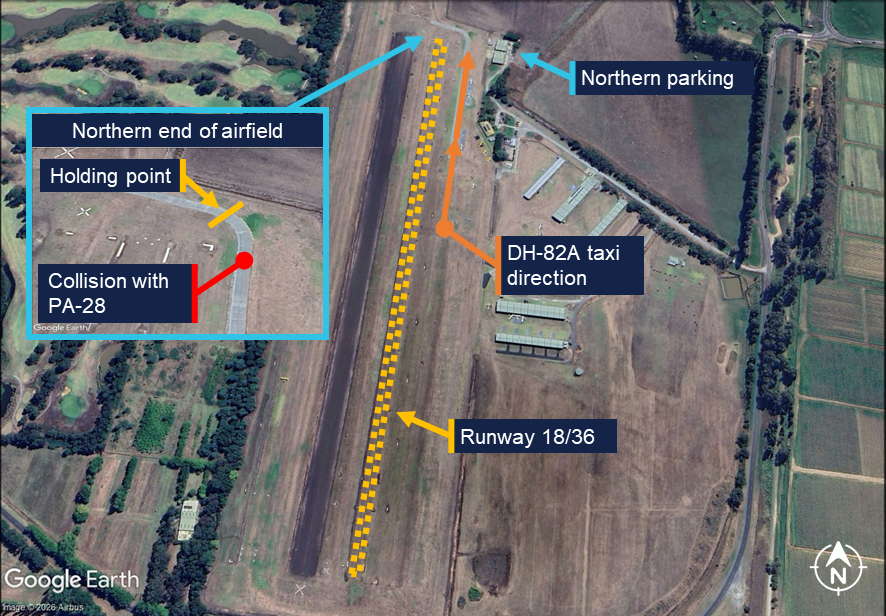
Source: Google Earth, annotated by the ATSB with information from operator
The pilot of the DH-82A reported that they did not observe the PA-28 during the taxi, with the nose-high characteristic of tailwheel aircraft likely limiting forward visibility. As the preceding aircraft entered the runway and began its take-off roll, the PA-28 crew were preparing to move forward to the holding point when the DH-82A’s left wing section collided with the rear of the PA-28. The impact resulted in damage to the PA-28’s right elevator trim tab, tail cone and beacon light (Figure 2).
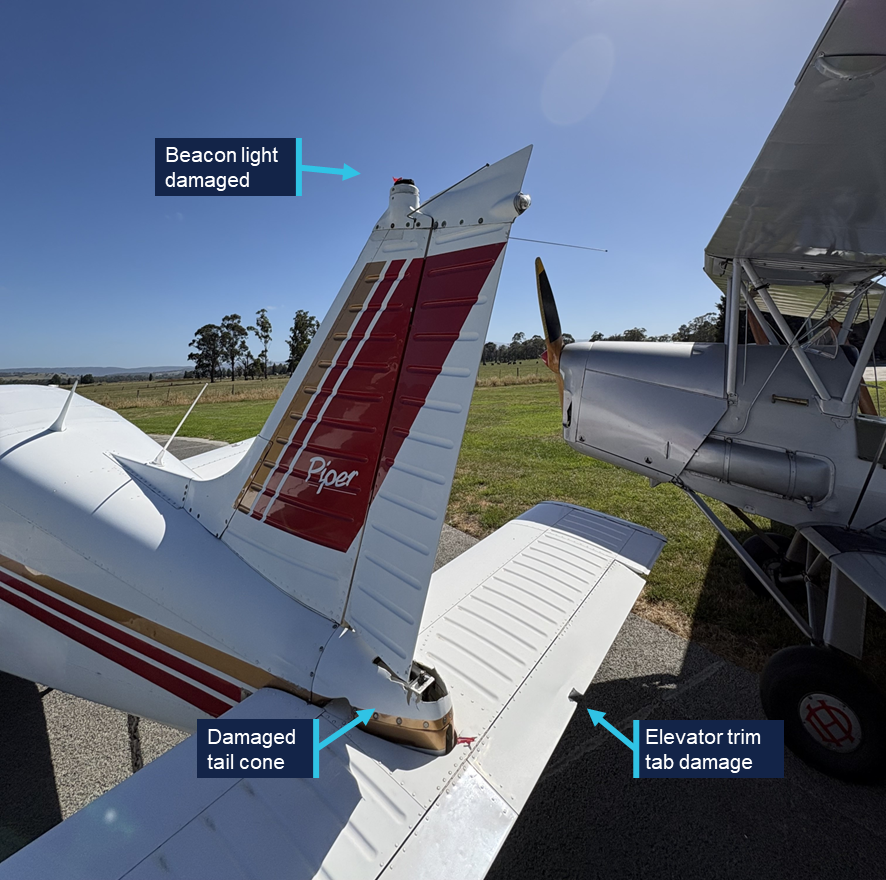
Source: Operator, annotated by the ATSB
The damage to the DH-82A was limited to the upper and lower wings (Figure 3). No injuries were sustained by the occupants of either aircraft.
Figure 3: de Havilland DH-82A damage
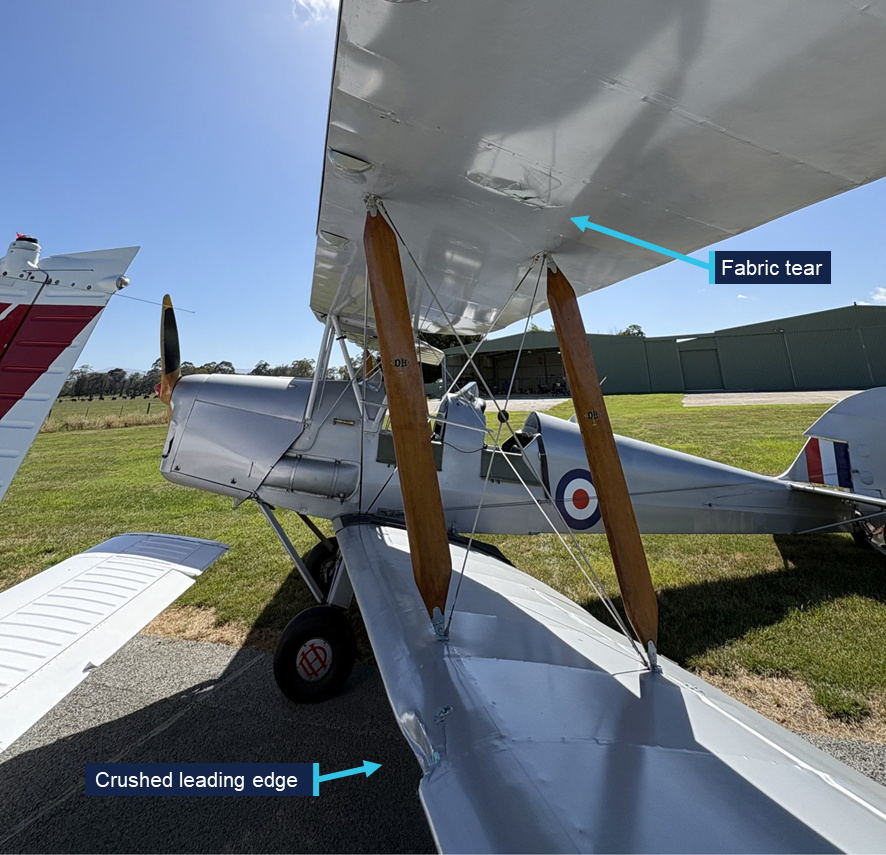
Source: Operator, annotated by the ATSB
Safety message
Maintaining situational awareness is crucial to ensure safe separation while operating in the vicinity of other aircraft and obstacles. When manoeuvring on the ground it is important that pilots maintain an effective lookout and communicate with other traffic when necessary. These risk controls help mitigate the risk of a taxi collision if a pilot is unsure of the surrounding hazards at any point. This is particularly applicable to pilots operating tailwheel aircraft due to their inherent nose-high attitude which limits forward visibility.
About this report
Decisions regarding whether to conduct an investigation, and the scope of an investigation, are based on many factors, including the level of safety benefit likely to be obtained from an investigation. For this occurrence, no investigation has been conducted and the ATSB did not verify the accuracy of the information. A brief description has been written using information supplied in the notification and any follow-up information in order to produce a short summary report, and allow for greater industry awareness of potential safety issues and possible safety actions.
[1] Run-up: a high‑power run-up check is carried out in a piston-engine aircraft to check the aircraft’s ignition and other systems before commencing an initial take‑off.
Occurrence summary
| Mode of transport | Aviation |
|---|---|
| Occurrence ID | AB-2026-003 |
| Occurrence date | 27/12/2025 |
| Location | Lilydale Aircraft Landing Area |
| State | Victoria |
| Occurrence class | Serious Incident |
| Aviation occurrence category | Taxiing collision/near collision |
| Highest injury level | None |
| Brief release date | 10/02/2026 |
Aircraft details
| Manufacturer | Piper Aircraft Corp |
|---|---|
| Model | PA-28-151 |
| Sector | Piston |
| Operation type | Part 141 Recreational, private and commercial pilot flight training |
| Damage | Minor |
Aircraft details
| Manufacturer | de Havilland Aircraft |
|---|---|
| Model | DH-82A |
| Sector | Piston |
| Operation type | Part 135 Air transport operations - smaller aeroplanes |
| Damage | Minor |