

What happened
On 4 December 2025, at 1720 local time, an Air Tractor AT-802A was preparing to conduct aerial firefighting operations from Linga Airbase, Victoria. Before departure the pilot briefly consulted electronic maps for Linga Airbase, however, did not observe that runways 17 and 19 were 2 separate runways with runway 19 commencing at the end of runway 17 rather than a single longer runway (Figure 1). After loading the aircraft with fire retardant, the pilot commenced taxi for runway 17, believing they were backtracking to use the entire length of runways 17 and 19. The pilot completed their take-off checks and commenced the take-off roll.
The pilot reported that during the take-off run, due to the upslope on runway 17, they were unable to see the threshold of runway 19 until the aircraft had crested the rise towards the end of runway 17. Unaware of the 20° right turn, on becoming visual with runway 19, the pilot assessed the turn was too sharp to navigate and the aircraft was travelling too fast to stop and not yet fast enough to become airborne.
Figure 1: Linga Airbase, Victoria
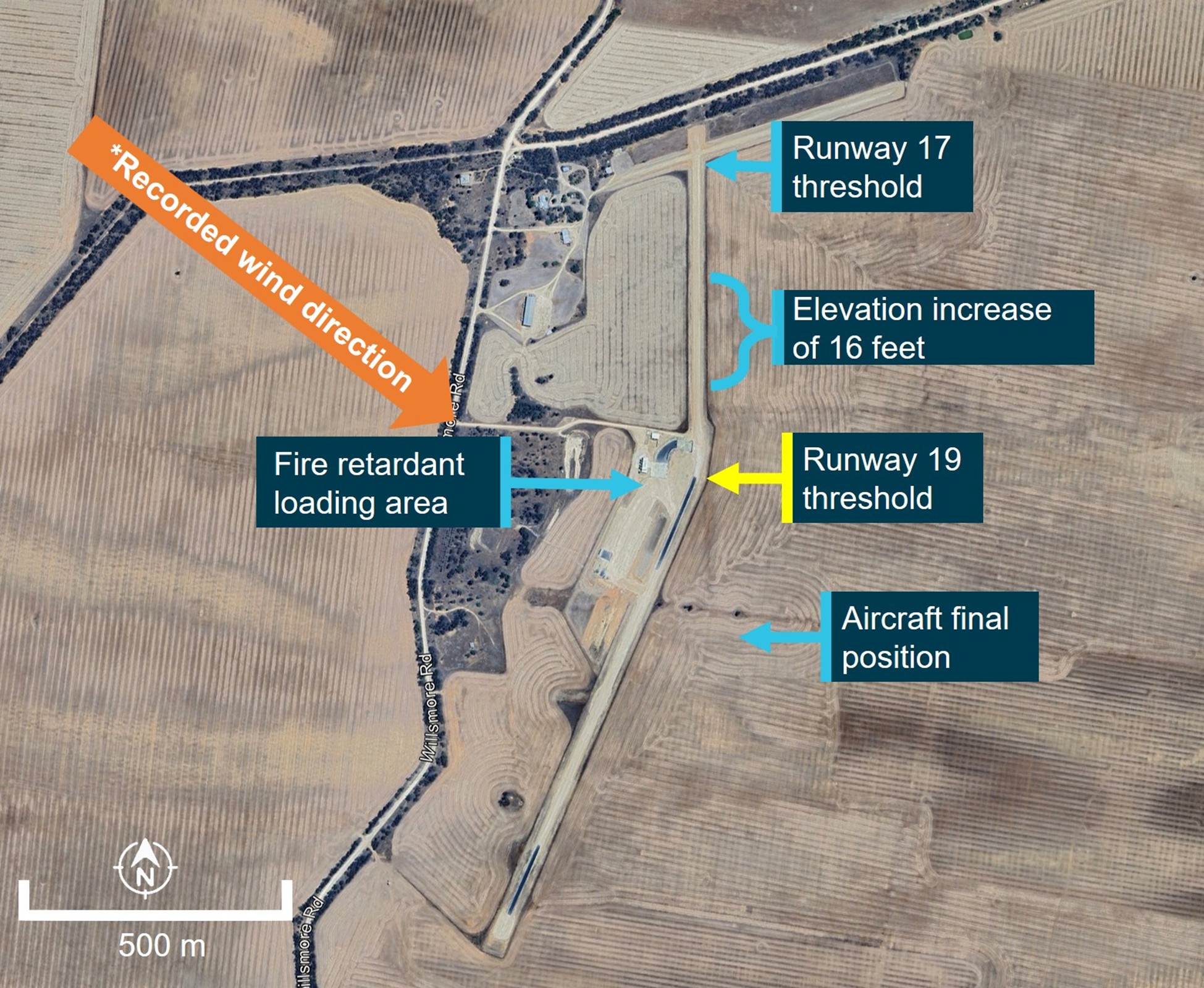
* Wind direction was recorded 82 km away at Hopetoun, Victoria. Source: Google Earth, annotated by the ATSB
The pilot maintained the runway 17 heading, and the aircraft overran the end of runway 17 into a field, impacting a fence, before becoming airborne. The pilot intended to release the load of fire retardant to reduce weight, however, due to their unfamiliarity with the location of the load release switch in that aircraft, instead activated the aircraft lights, before locating the correct switch and dumping the load. Images show the left-wing tip dragged along the surface of the field while the load was dumped. A witness reported the aircraft briefly became airborne with a nose high attitude and left wing down in a left turn before the left wing again contacted the ground and pulled the aircraft to the ground before coming to a stop (Figure 2).
Figure 2: Occurrence aircraft impact marks and final position
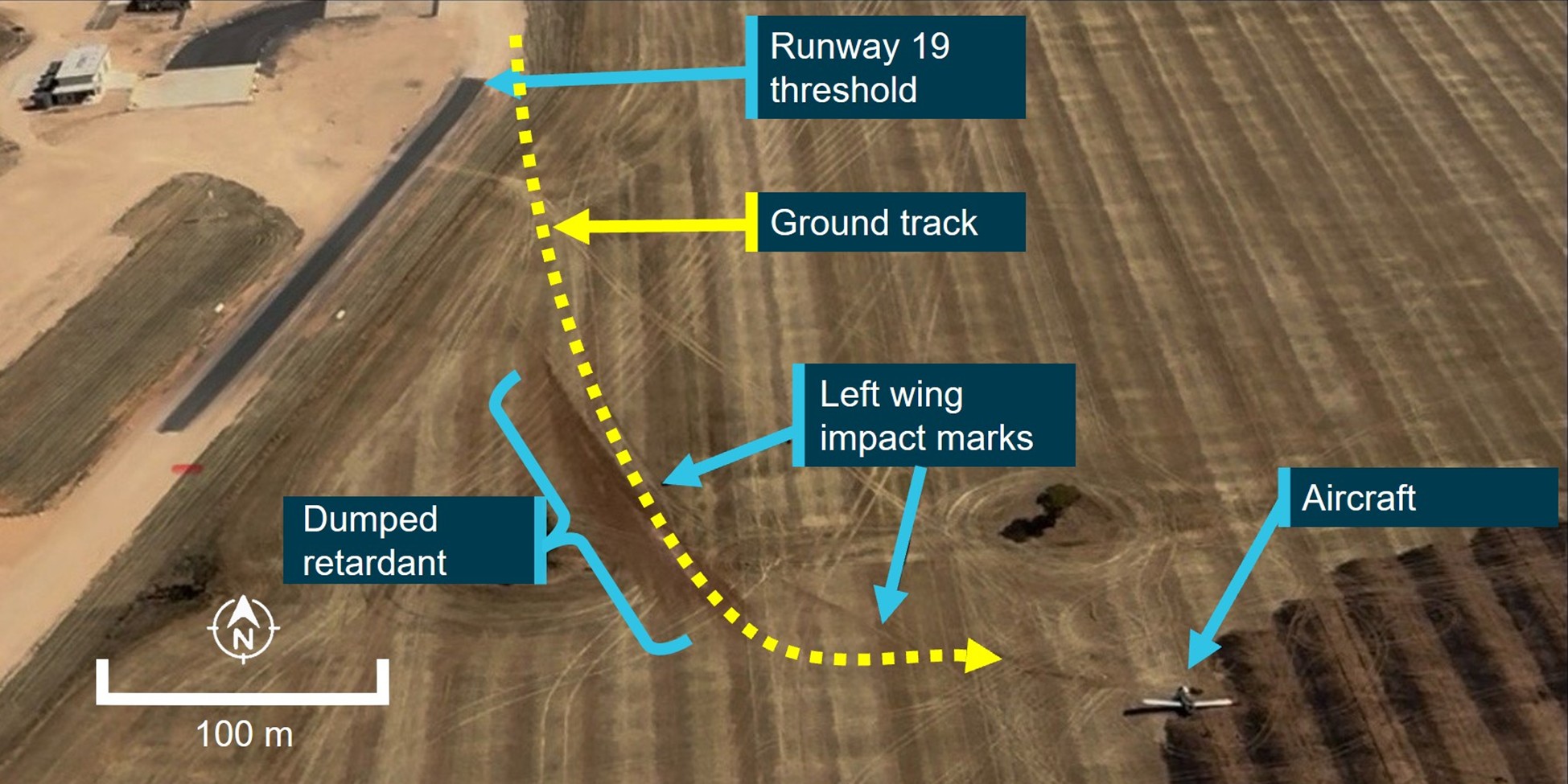
Source: Operator, annotated by the ATSB
The impact was sufficient to liberate the engine and propeller from the aircraft which subsequently set fire to the field (Figure 3). The local airbase manager and 2 other state government employees attended the scene and were able to put the fire out in the vicinity of the aircraft and were then able to assist the pilot to egress the aircraft.
The pilot sustained minor injuries and was admitted to Mildura hospital. The aircraft was substantially damaged.
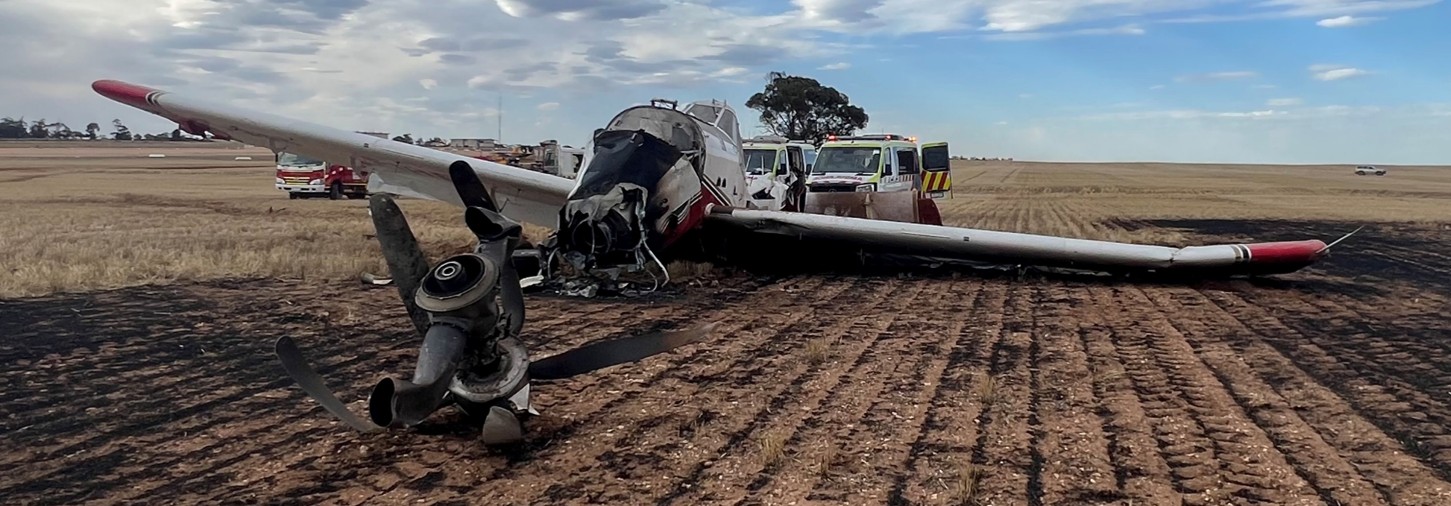
Source: Operator
The pilot reported that they had not previously operated from Linga Airbase, and earlier when arriving in the circuit they joined a midfield crosswind leg for runway 01 before landing, and had not observed the angle of the adjoining runways from the air.
The airbase manager reported other firefighting aircraft had been using runway 19 throughout the day. Linga Airbase runway 17 was about 660 m in length and joined the northern end of runway 19 which measured about 1,000 m in length. The aircraft was loaded with retardant to the western side of where runways 17 and 19 met.
The pilot reported the wind direction during the take-off roll was a crosswind. Conditions around the time of the occurrence recorded at Hopetoun, Victoria indicated temperature of 38°C with winds gusting between 16–33 kt from the north-west.
The aircraft loading log for the day of the occurrence indicated it was loaded with about 2,300 L of fire retardant. This gave the aircraft a take-off weight of about 6,900 kg, which was below the aircraft’s maximum take-off weight for the conditions. The operator reported the aircraft’s performance in the hot conditions required a take-off ground roll distance of about 1,000 m.
Although they were an experienced agricultural pilot, they had not previously operated from that airbase. Although the pilot observed other aircraft depart using runway 19 while reloading, they assumed they were not using the entire length of the runway, and by taxiing and backtracking to the threshold of runway 17 believed they were increasing their take-off roll distance. Performance calculations indicated that due to the air temperature, weight of the aircraft and wind conditions, the aircraft would have required the full length of the longer runway 19 to become airborne.
Safety message

The ATSB SafetyWatch highlights the broad safety concerns that come out of our investigation findings and from the occurrence data reported to us by industry. One of the safety concerns is reducing the severity of injuries in accidents involving small aircraft. As a result of the aircraft’s sudden stop the pilot’s flight helmet was damaged in the occurrence and they suffered a laceration to their head. Therefore, it was likely the pilot’s helmet prevented a more serious head injury.
Thorough pre-flight planning is essential to safe flight and is especially important when operating from unfamiliar airports. A clear understanding of the take-off distances available and runway configuration improves pilots’ situational awareness, reducing the possibility of the unexpected during higher risk stages of flight such as take-off and landing.
Aerial firefighting operations are often conducted in conditions of extreme heat and wind; accurate performance calculations including take-off weight and available runway distance are essential for safe operations in challenging conditions.
About this report
Decisions regarding whether to conduct an investigation, and the scope of an investigation, are based on many factors, including the level of safety benefit likely to be obtained from an investigation. For this occurrence, no investigation has been conducted and the ATSB did not verify the accuracy of the information. A brief description has been written using information supplied in the notification and any follow-up information in order to produce a short summary report, and allow for greater industry awareness of potential safety issues and possible safety actions.
Occurrence summary
| Mode of transport | Aviation |
|---|---|
| Occurrence ID | AB-2025-065 |
| Occurrence date | 04/12/2025 |
| Location | 82 km north-west of Hopetoun |
| State | Victoria |
| Occurrence class | Accident |
| Aviation occurrence category | Collision with terrain, Runway excursion |
| Highest injury level | Minor |
| Brief release date | 21/01/2026 |
Aircraft details
| Manufacturer | Air Tractor Inc |
|---|---|
| Model | AT-208 |
| Sector | Turboprop |
| Operation type | Part 138 Aerial work operations |
| Damage | Substantial |