


What happened
On the morning of 30 of March 2026, a pilot was conducting aerial agricultural spraying operations in a Thrush S2R-T34, consisting of multiple loads.
After returning to the work area to conduct the second load at approximately 0830 local time, the aircraft entered the next spray run over a tree line. While the pilot began to round-out the aircraft for the run, prior to releasing the load at approximately 5 ft above ground level, the aircraft collided with terrain. The main landing gear struck the ground first, subsequently collapsing, and the aircraft slid wings level, eventually coming to rest in the paddock.
The initial impact resulted in the main landing gear sustaining most of the damage with further minor damage to the propeller and wings reported by the operator (Figure 1). The pilot was not injured and extracted themself from the aircraft.
Figure 1: Aircraft post-accident
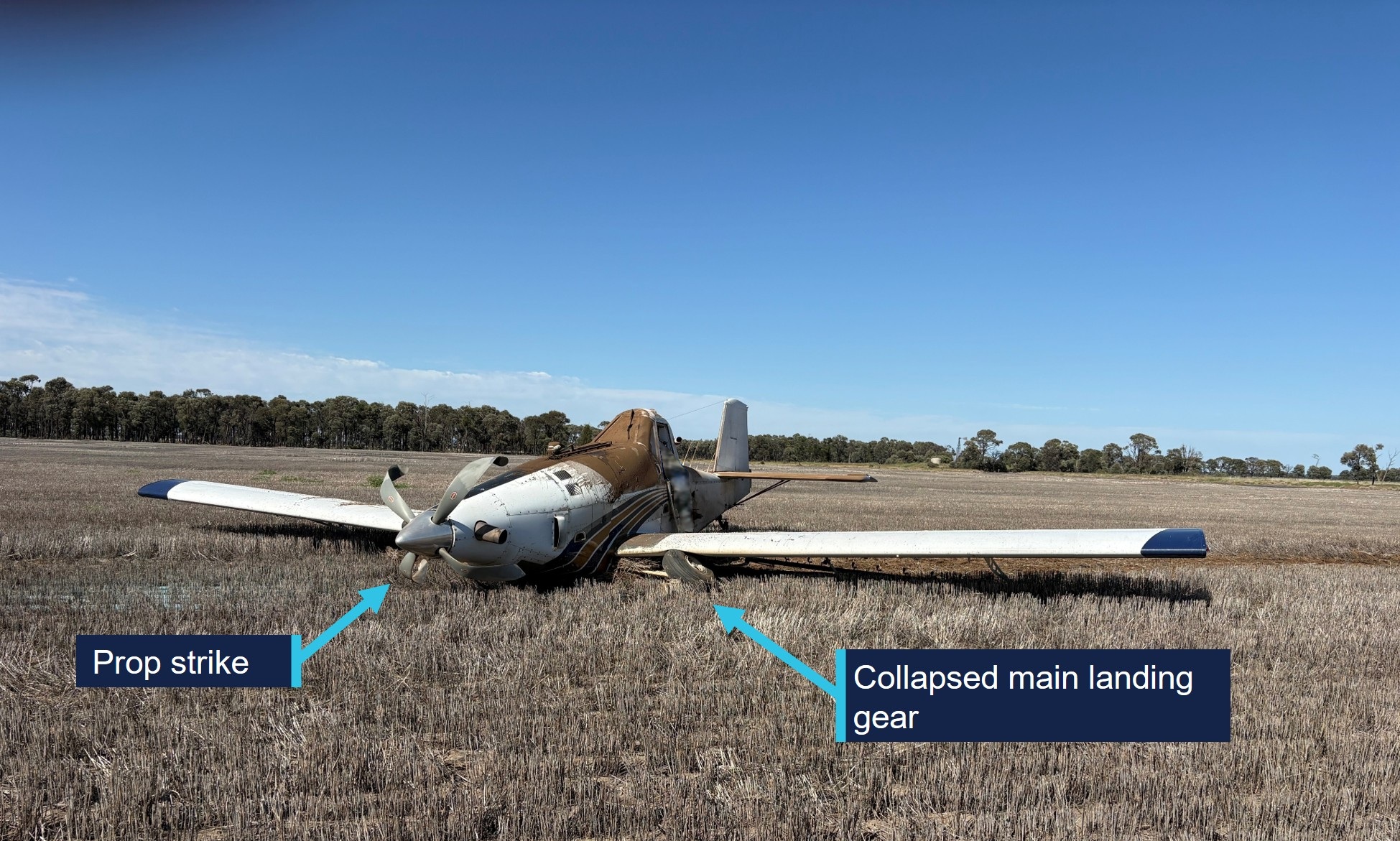
Source: Operator, annotated by the ATSB
A discussion with the operator post-accident revealed the pilot entered the spray run at a low airspeed and was unable to round-out after passing over the tree line. As the aircraft had returned to the work area for the second load of the day, the aircraft was operating close to the maximum operating weight with an approximate load of 1,800 litres on board. This combination probably affected the pilot’s ability to arrest the descending manoeuvre. The pilot reported that they felt ‘fully alert’ and had obtained 12 hours of sleep in the previous 24 hours.
Safety message
Pilots of aircraft conducting agricultural operations must ensure that they maintain continuous situational awareness of the aircraft’s state. Due to the reduced safety margins while flying at low level, effective and active information scanning is key to building an accurate mental model of the pilot’s environment, which enables timely and sound decisions to be made. If an aircraft does enter an abnormal state (such as becoming too slow), effective instrument scanning provides the pilot with information to be able to decide if a spray run or other complex manoeuvring should be aborted.
About this report
Decisions regarding whether to conduct an investigation, and the scope of an investigation, are based on many factors, including the level of safety benefit likely to be obtained from an investigation. For this occurrence, no investigation has been conducted and the ATSB did not verify the accuracy of the information. A brief description has been written using information supplied in the notification and any follow-up information in order to produce a short summary report, and allow for greater industry awareness of potential safety issues and possible safety actions.