Collision between a truck and The Ghan passenger train, The Garden Road level crossing, 48 km north of Alice Springs, Northern Territory, on 15 September 2024

Final report

Report release date: 12/02/2026

Investigation summary

What happened

On the morning of 15 September 2024, passenger train 7DA8E (also known as ‘The Ghan’) was travelling southbound on the Tarcoola–Darwin railway line toward Alice Springs, Northern Territory, with 218 passengers, 38 service staff and 4 locomotive crew on board. 

As The Ghan approached a passive level crossing where the railway line crossed with The Garden Road (about 48 km north of Alice Springs), an A-triple truck turned from the Stuart Highway onto The Garden Road and commenced driving east toward the level crossing. Advance road warnings and passive controls, including a stop sign, were installed from the highway turn‑off and along The Garden Road to alert road users of the nearby level crossing. 

When The Ghan was approximately 120 m from the crossing, travelling at 108 km/h, the locomotive drivers witnessed the truck emerge from behind roadside vegetation and approach the level crossing. The driver sounded The Ghan’s horn, however, the truck did not stop, it entered the level crossing and collided with the side of the trailing locomotive. The Ghan remained upright and the truck came to rest in the field side of the track. 

The truck driver sustained serious injuries and there were no injuries on board The Ghan. 

What the ATSB found

The ATSB found that, as the truck was being driven along The Garden Road toward where the road crossed the Tarcoola–Darwin railway line, the truck driver did not slow sufficiently to stop prior to the level crossing, resulting in a collision with The Ghan passenger train.

The ATSB also found that, while some aspects of the level crossing controls were not as per standard or were faded, there was signage and markings for road users to be aware of the crossing and bring their vehicles to a controlled stop before entering. Once stopped, there was adequate visibility for a driver to sight a train and give way.

What has been done as a result

Following the collision, the Department of Logistics and Infrastructure within the Northern Territory Government undertook a series of safety actions at The Garden Road level crossing. The approach signage was upgraded, and the faded road line markings were refreshed. However, some of the approach signage elements remained incorrectly positioned as required by the Australian Standard AS 1742.7.

The interface agreement was revised and renegotiated with the rail infrastructure manager. They further advised that the rail infrastructure manager had committed to install updated signage (R6-25 ‘Railway Crossing’) to meet the current standards at The Garden Road level crossing, and to progressively upgrade signage at other crossings when existing signs were due for replacement.

At a broader level, the department also advised that they delivered a targeted campaign during the August 2025 National Rail Safety Week to raise public awareness of level crossing risks across the Northern Territory. The strategies used during that campaign included social media advertising, learner driver education and displays at the motor vehicle registry. 

Safety message

Passive traffic controls such as signage and road markings cannot physically prevent road users from entering a level crossing. Therefore, it remains the responsibility of those users to follow these controls. When required to stop at a level crossing, drivers must stop, sight, and remain clear of all rail traffic. The maximum sighting distance along the rail corridor occurs when a vehicle is stopped at the stop line and provides road users the greatest opportunity to detect for oncoming rail traffic. This is a critical requirement to avoid a collision. 

This accident also highlights the notion of heavy vehicle drivers slowly rolling though a stop sign at a level crossing. This action is illegal as stop signs require vehicles to come to a complete stop and can place them and train crew or passengers at imminent risk of significant harm should a collision occur. 


The investigation

The ATSB scopes its investigations based on many factors, including the level of safety benefit likely to be obtained from an investigation and the associated resources required. For this occurrence, the ATSB conducted a limited-scope investigation in order to produce a short investigation report, and allow for greater industry awareness of findings that affect safety and potential learning opportunities.

The occurrence

On 14 September 2024, passenger train 7DA8E ‘The Ghan’ departed the Berrimah Passenger Terminal in Darwin, Northern Territory, on a scheduled southbound service to the Keswick Passenger Terminal in Adelaide, South Australia, using the Tarcoola‍–‍Darwin railway line. On board the train were 4 locomotive drivers, 38 service staff and 218 passengers. 

The locomotive drivers were rostered to work in 7‑hour relay shifts as 2 distinct pairs, with 1 pair driving while the other pair rested in the crew cars. After departing Darwin, the train travelled to Katherine and then overnight through to Tennant Creek, Northern Territory. On 15 September, at about 0600, the train was stopped approximately 60 km south of Tennant Creek and a crew change was completed, after which the journey continued toward Alice springs. 

At about 0800 that same morning and 300 km south of Tennant Creek, workers at Aileron Station commenced loading cattle into the wagons of an A-triple road train (truck). The cattle were to be driven along the Stuart Highway and delivered to a remote station on The Garden Road, near the Arltunga Historical Reserve, Northern Territory. The truck consisted of a prime mover and 3 trailers. The front and centre trailers were loaded with cattle while the rear trailer remained empty. At about 0900, the truck departed Aileron and travelled south on the Stuart Highway (Figure 1). 

Figure 1: Operations between Alice Springs and Tennant Creek for The Ghan and truck

Map showing Tarcoola to Darwin rail line

Source: Google Earth, annotated by the ATSB

At about 0952, the truck turned off the highway at the intersection with The Garden Road. The driver negotiated a curved S‑bend section of the road on the western approach to the level crossing with the Tarcoola‍–‍Darwin rail line, which was located about 300 m from the highway intersection (Figure 2). 

Figure 2: The Garden Road level crossing and The Ghan and truck directions of travel

Map showing Tarcoola to Darwin rail line

Source: Google Earth, annotated by the ATSB

Coincident with the arrival of the truck, The Ghan was also approaching the level crossing. At 0952:44 (about 500 m from the level crossing), a track‑side whistle board[1] was passed and at 0952:53 (about 270 m from the level crossing) the locomotive driver sounded the horn for 2 seconds. When The Ghan was approximately 120 m from the crossing, the crew observed the truck come into full view from behind roadside vegetation and progress toward the level crossing (Figure 3). 

A video camera system fitted to the front of The Ghan’s leading locomotive recorded the journey and at 0952:57 showed the truck appear from behind the vegetation. Audio from the recording identified that, at 0952:58, just prior to the level crossing, the driver briefly sounded the horn, and then at 0952:59, blasted it continuously as they travelled through. The truck did not stop and at 0953:02 the front end of the prime mover impacted the right rear bogie[2] of The Ghan’s trailing locomotive.

Figure 3: Field of view from the locomotive camera approximately 120 m from the level crossing showing the prime mover cab as it emerged 

Field of view from the locomotive camera approximately 120 m from the level crossing showing the prime mover cab as it emerged

This image was obtained from the locomotive video camera as The Ghan travelled southward. Source: Pacific National, annotated by the ATSB

Through the collision sequence, The Ghan remained upright and neither the locomotives nor carriages derailed. At 0953:05, the driver in control of The Ghan reduced the throttle and applied the brakes. Over the next 10 seconds, they initiated a full-service brake application, and the throttle was reduced to the lowest notch. The Ghan came to a controlled stop at 0954, with the lead locomotive 1,380 m beyond the level crossing. 

The prime mover of the truck came to rest on the field side of the track with engine bay components scattered along the rail corridor (Figure 4).

Figure 4: The truck at the level crossing after the collision

The truck at the level crossing after the collision

View looking north along the Tarcoola–Darwin railway line from which The Ghan was travelling. Source: Northern Territory Police

Post-collision management

On coming to a stand, both locomotive drivers exited the cab to assess the damage and secure the train. They subsequently telephoned network control, requested for emergency services, and maintained contact with service staff in the passenger compartments. 

The truck driver was able to exit their cab unassisted, however, they had sustained serious injuries. They were attended to by service staff from The Ghan until Northern Territory Police attended the scene at 1027, followed shortly after by the ambulance service at 1029. 

There were no injuries to The Ghan train crew, service staff, or passengers on board. The passengers were subsequently detrained and transferred to Alice Springs by bus service.

Context

Operation

The Ghan was a twice-weekly passenger carrying service operating from Darwin to Adelaide in both directions between April and October. The train was operated under accreditation of Great Southern Rail by Journey Beyond, which supplied and staffed the passenger cars. Pacific National supplied and staffed the locomotives. Aurizon was the rail infrastructure manager for the Tarcoola–Darwin corridor on which the train was travelling, and it owned the section of rail corridor between Alice Springs and Darwin. 

Personnel information

Train crew 

All locomotive drivers were employed by Pacific National. The driver in control was a qualified locomotive driver with 3 years of experience at Pacific National. They had completed their most recent competency verification in the first half of 2024. The driver assisting was also a qualified locomotive driver with over 11 years of experience at Pacific National.

Truck driver 

The truck driver had been driving trucks for several years. They stated that, although it was their first time driving a loaded vehicle to the destination cattle station, they were familiar with the area and traversed the level crossing at least once a month. They had not previously encountered a train at The Garden Road level crossing. 

They were unable to recall the speed they were travelling as they negotiated the S‑bend on approach to the level crossing, but indicated they would have been driving slowly as their intention was to uncouple the empty rear trailer on the other side of the level crossing. The driver had no recollection of hearing The Ghan’s horn as they approached the level crossing. On seeing the leading locomotive pass closely by the front of their cab, they recalled rapidly applying the trailer handbrake and prime mover footbrake. The truck driver reported they were aware of the stop sign at the level crossing and understood the requirement to stop behind the stop line but noted that the line was faded.

The driver did not recall any mechanical problems with the prime mover or the trailers and stated that the brakes on the truck and trailers were functional. They further stated that they would sometimes roll through level crossings as it required significantly more time and effort to stop a loaded truck and then accelerate than it did to roll through a crossing at low speed.

Vehicle information

Train 

The Ghan (train 7DA8E) consisted of 2 NR-class locomotives and 29 Commonwealth Engineering stainless steel passenger and restaurant carriages. The total length of the train was 735 m and it weighed 1,418 t. 

The train driver reported operations were normal throughout the journey prior to the collision. There were no mechanical problems with either the locomotives or the consist. Additionally, the locomotive headlights were operating throughout its journey and were illuminated while on approach to the level crossing.

The trailing locomotive sustained extensive damage to the air pipes, side ladder, and front cowling. The power van also received superficial body damage. There was no damage to the other carriages or the lead locomotive.

Truck 

The truck was an articulated heavy vehicle, consisting of a Mack Titan prime mover and 3 Haulmark semi-trailers joined to form an A-triple consist. This configuration met the conditions of a Class 2 Road Train under the national standard and was 53.5 m long with a maximum approved weight of 115.5 tonnes. 

In their examination of the truck, Northern Territory Police identified tyre skid marks from the prime mover and trailers on the road surface that each extended for approximately 2‍–‍3 m immediately leading to the crossing. Tyre defects were identified to all 3 trailers, which included several bald tyres and one shredded tyre. 

The attending police also found the driver’s seatbelt was clipped into its buckle and looped back behind the seat. From that, they concluded the belt had not been appropriately fitted around the driver at the time of the collision. It was unknown to what extent the driver’s injuries were related to not wearing their seatbelt. 

Recorded information

Data from the locomotive event logger recorded parameters such as throttle position, brake pressure, and speed. The event logger output was matched with the lead locomotive forward-facing video camera to correlate time, distance and speed information. No recorded data was obtained from the truck.

The locomotive camera recorded video at 15 frames per second and showed the journey along the Tarcoola‍–‍Darwin line and the arrival at the level crossing. Analysis of the video file identified a 2‑second period where the moving truck came into view. Sounding of The Ghan’s horn was audible within the recording along with the brake application by the train driver after the collision. 

Using the video and georeferenced data, ATSB calculation of the vehicle closure speeds and distances showed that the truck was slowing as it approached the level crossing (Table 1). When the prime mover was 34 m from the crossing, it was travelling 30‍–‍35 km/h, and when it was 23 m from the crossing it had slowed and was travelling 22‍–‍28 km/h. At 0953:02.7, the front of the lead locomotive was approximately 30 m beyond the crossing travelling at 108 km/h[3] when the prime mover collided with the trailing locomotive.

Table 1: Calculated closure distances and speeds between the truck and The Ghan

Time 
(hhmm:ss.s)
Vehicle distance from the level crossing 
(m)
Vehicle speed
(km/h)
The GhanTruckThe GhanTruck
0952:57.3- 120Not quantifiable108Not quantifiable
0952:58.0- 903410830–35
0952:59.5- 602310822–28
0953:02.7+ 300108Collision

Level crossing information

The Garden Road level crossing

The Garden Road was an approved truck route and provided a thoroughfare to the Arltunga Historical Reserve. Prior to 2016, the short section of road from the Stuart Highway turn-off and beyond the level crossing was unsealed and had crossed the railway track at acute angles. In early 2016, the road was sealed and realigned with road markings and warning signs introduced on the approach to the level crossing. The realigned road section contained a dual curve (an S‑bend) and was perpendicular where it crossed the railway line. The changes in road geometry reduced the visibility angle for road users approaching the intersection, in turn increasing the opportunity for rail traffic to be sighted.

Advance warnings and road markings

Australian Standard (AS) 1742.7 (Manual of uniform traffic control devices Part 7: Railway crossings) required the use of signs, road markings and other control devices at railway crossings. The Garden Road level crossing had been constructed with passive traffic controls to protect both the eastern and western approaches. Passive level crossing controls use signage and road markings to warn road users about an approaching level crossing, but do not activate or change when a train is approaching.

The advance warnings and markings provided along the road on the western approach to the level crossing were:

  • painted markings ‘RAIL’ and ‘X’ on the surface of the road with an accompanying advance warning ‘Railway Crossing Ahead’ (W7-7 L)
  • an advance warning ‘STOP Sign Ahead’ (W3-1).

The ‘RAIL’ and ‘X’ painted road markings were positioned approximately 225 m from the level crossing and placed at the first curve of the S‑bend. The advance warning sign ‘Rail Crossing Ahead’ (W7‑7 L) was positioned about 190 m from the crossing, and the second sign in advance of the crossing was a ‘STOP Sign Ahead’ (W3‑1) sign about 165 m from the crossing. 

The passive controls installed at the level crossing were a ‘Railway Crossing STOP’ (RX‑2) sign assembly and an accompanying white painted ‘stop line’ on the road surface (Figure 5 and Figure 6). The stop line was 5.2 m from the nearest rail, which was greater than the minimum 3.5 m required by the Australian Standard. 

Figure 5: Location of the advance warnings and road markings near the level crossing

Location of the advance warnings and road markings near the level crossing

Source: Google Earth, annotated by the ATSB

As the speed limit for The Garden Road was over 90 km/h, the Australian Standard required the W3-1 sign to be 180 m to 250 m before the stop sign at the crossing. The W7-7 ‘Rail Crossing Ahead’ sign had to precede the W3-1 ‘Stop Sign Ahead’ sign by a distance of 70 m due to the higher speed limit. The standard required the ‘RAIL’ and ‘X’ road marking to be placed between the W7-7 sign and W3-1 signs.

When the railway line was opened in 2004, the Australian Standard required RX-2 stop sign assemblies to have the following 3 components:

  • RAILWAY CROSSING (R6-24)
  • STOP (R1-1)
  • LOOK FOR TRAINS (G9-48).

In 2007, the standard was changed to allow the use of either the R6-24 crossarms or the R6-25 sign (crossarms overlaid on a red background in Figure 6). It was also added that the R6-25 sign would be the preferred design on all new and refurbished RX-2 assemblies. A further update to the standard in 2016 removed the R6-24 crossarms as an approved component for new or upgraded crossings. As indicated within the standard, the update was not intended to be retrospective and although the crossarms were outdated, they were compliant with AS1742.7 (2016). 

At the time of the collision, the stop sign assemblies on both sides of The Garden Road level crossing still had the R6-24 crossarms rather than the R6-25 sign.

Figure 6: The railway crossing STOP (RX-2) sign assembly at the level crossing (left) when compared with the current Australian Standard requirements (right)

The railway crossing STOP (RX-2) sign assembly at the level crossing (left) when compared with the current Australian Standard requirements (right)

Source: Pacific National (left) and AS 1742.7-2007 (right), annotated by the ATSB

Level crossing sighting distance

The truck driver estimated that the sighting distance when looking north from the stop line along the track was 300–400 m. The Ghan driver also identified that vegetation obscured their view of road traffic when approaching the level crossing. However, they also added that, while the vegetation obscured sightlines in advance of the crossing, the crossing itself could be seen from a considerable distance away and that the clearance of the trees away from the track was ‘quite reasonable’. 

Survey data within the Australian Level Crossing Assessment Model (ALCAM) report from May 2024 of The Garden Road level crossing identified that, when stopped at the stop line on the western side of the level crossing, the sighting distance when looking north along the rail corridor was 1,563 m. The view looking north from the level crossing stop line is shown at Figure 7. The sighting distance was 1,903 m when looking to the south. The sighting distance from the eastern side of the crossing in both directions was unlimited.

At a line speed limit of 115 km/h, the ATSB calculated that trains approaching from the north would become visible from the western stop line 49 seconds before the train reached the level crossing. This increased to 60 seconds for trains approaching from the south. For road users stopped at the stop line on the eastern side, there were no time limitations when approaching trains would become visible. Although the road speed limit for The Garden Road was 100 km/h, the ALCAM report identified that the average approach speed to the level crossing from the west was 60 km/h, which determined the placement of the advance warning signage.

Figure 7: View looking north along the rail corridor from the stop line at the level crossing 

View looking north along the rail corridor from the stop line at the level crossing

This image was captured on 15 September 2024. Source: Aurizon

Truck clearance times

The standard gauge track was 1.435 m wide, and the stop line on each side was 5.2 m from the nearest rail. As a result, the minimum safe distance for road users to cross the tracks and be clear of the rail corridor was about 12 m from either stop line. Accounting for the standard length of an A‑triple road train (53.5 m), the truck would have needed to travel at least 66 m from the western stop line to safely cross the tracks.

The National Heavy Vehicle Regulator required trucks (road trains) to meet level 4 acceleration capability. This was the highest of 4 capability standards, which tested the ability of a vehicle to accelerate from rest on a road with zero gradient.

To meet this capability, road trains would have to accelerate from a stand and travel 100 m on a zero-gradient road in 29 seconds (or less). Based on these requirements, the established road train clearance times on a level grade fit within the ALCAM sighting times at The Garden Road level crossing.

Interface agreement

The Rail Safety National Law required rail infrastructure managers and road managers of public roads to enter into an interface agreement to manage the risks to safety arising from their rail or road crossings. For The Garden Road level crossing, the local road manager (Northern Territory Government) was responsible for the interface boundary outside the rail corridor that included road condition, level crossing advance warning signage, road markings, and sighting along the road corridor. The rail infrastructure manager (Aurizon) was responsible for the interface boundary within the rail corridor that included: sighting along the rail corridor, track infrastructure, primary warning devices and signage at the level crossing, and the pavement at the road‑rail interface.

To assist with maintaining sighting distances, the road manager was responsible for vegetation outside of the rail corridor and the rail infrastructure manager was responsible for vegetation clearance within the rail corridor. 

At the time of the accident, an interface agreement was in place between Aurizon and the local road manager. Following the collision, the interface agreement was renegotiated and signed between both parties. 

Scheduled inspections

As the rail infrastructure manager, Aurizon conducted regular inspections of the Alice Springs to Tennant Creek rail corridor. This consisted of weekly visual inspections from the rail corridor to monitor track condition and known defects, and an annual ALCAM assessment from the road corridor to assess overall compliance with the Australian Standard. 

The most recent visual inspection of The Garden Road level crossing had been completed on 9 September 2024. This inspection did not identify any track misalignment, defects, or faults at the level crossing prior to the collision, and no corrective maintenance was scheduled following this inspection. The next weekly inspection was scheduled for 16 September 2024, the day after the collision.

The annual ALCAM assessment for compliance with civil engineering standards was conducted in May 2024. This inspection found that vegetation obstructed advance views of the rail corridor for road users on both sides of the crossing. However, it found that this vegetation did not impact visibility and sightlines along the rail corridor when a vehicle was stopped at the stop line.

On the western side of the crossing, which was the approach direction of the truck, the ALCAM assessment made the following observations:

Passive control required updating to current standard and maintenance

Stop bar and centre barrier lines were faded

Advance warning signs were incorrectly positioned for the road speed

Advance warning road markings were faded and incorrectly spaced for the road speed.

The faded stop line is shown at Figure 8 and this was reportedly due to the effects of road resurfacing.  

Figure 8: Faded stop line at the level crossing with skid marks evident from the emergency braking of the truck

Faded stop line at the level crossing with skid marks evident from the emergency braking of the truck

Source: Pacific National, annotated by the ATSB

ATSB safety study of level crossing collisions between heavy vehicles and trains

The ATSB safety study Review of level crossing collisions involving trains and heavy road vehicles in Australia (RS-2021-001) analysed 49 collisions between trains and heavy vehicles at Australian level crossings between July 2014 and August 2022, in which 24 rail or road users were fatally or seriously injured. Records from rollingstock operators, rail infrastructure managers, police, and other organisations were obtained for each of these accidents. The aim of the study was to improve the understanding of the risks associated with level crossing collisions involving heavy vehicles. Across the study period, several correlating observations were identified: 

  • All level crossing collisions involving heavy vehicles resulted from the heavy vehicle driver not giving way to trains. There were 3 actions associated with the collisions:
    • There were at least 24 collisions where the heavy vehicle did not stop prior to entering the crossing.
    • There were at least 11 collisions where the heavy vehicle stopped at the crossing then proceeded into the path of a train.
    • There were at least 13 collisions where the heavy vehicle entered a level crossing and stopped foul of the train line.
  • Of the 26 collisions at passive control crossings, there were at least 12 collisions where the heavy vehicle driver slowed or stopped but probably did not detect the train and entered the crossing into the path of the approaching train.
  • In at least 12 collisions the heavy vehicle driver had regularly used the level crossing prior to the collision with the train. The drivers' previous experience at the crossings may have led to a low expectancy for trains and contributed to them not detecting a requirement to stop and give way.
  • In at least 14 collisions, the heavy vehicle driver’s view of the track or level crossing protection equipment was obstructed by vegetation, the design of the heavy vehicle cab, poor crossing lighting, or sun glare.
  • Consistent with prior research showing that train horns have limited effectiveness for alerting road vehicle drivers approaching level crossings, in at least 25 accidents the horn was not effective at alerting the heavy vehicle driver to the presence of the train.

The report also described a ‘rolling stop’, which involved slowing a road vehicle until a decision was made to proceed into the crossing, without coming to a complete stop. When conducting a ‘rolling stop’ a road vehicle driver would spend less time at the stop point for a passive level crossing and therefore would probably employ less time scanning for oncoming trains. In turn, that increases the likelihood of an incorrect decision to proceed into the crossing when it was not safe. 

Safety analysis

Truck driver actions

As the truck turned off the Stuart Highway and was being driven eastward along The Garden Road, the driver was unaware of The Ghan that was approaching southbound at 108 km/h. At the level crossing, the train would have been visible to road users that had stopped at the stop line, however, it would have been difficult to identify in advance due to the presence of roadside vegetation that obscured longer distance sighting along the rail corridor. 

During its journey, the locomotive headlights of The Ghan were illuminated, and the driver had sounded the horn multiple times in close proximity to the crossing as required. The truck driver did not recall hearing the horn being sounded. This has been identified as a factor in several other accidents where a horn had limited effectiveness in alerting a heavy vehicle driver of an approaching train. 

The truck was travelling at a low speed, which increased the available time and distance for the driver to see and respond to the road markings, signage and requirement to stop their vehicle. The driver reported they had no recollection of the truck’s speed, however, they did recall initiating emergency braking on seeing the passage of The Ghan immediately in front of their cab. 

Remnant skid marks on the road surface were consistent with their recollection and actions. Calculations of the truck speed prior to the collision indicated that the driver had been slowing on their approach to the crossing. However, it was unlikely they were intending to bring the truck to a complete stop prior to passing the stop line as doing so would have required an emergency application of the brakes. Additionally, they acknowledged that they would sometimes roll through level crossings rather than come to a complete stop. That driving behaviour has been identified as a factor in previous collisions between heavy vehicles and trains.

From this, it can be concluded that the truck driver did not slow down sufficiently to stop at The Garden Road level crossing, resulting in a collision with The Ghan passenger train. The presence of the roadside vegetation may have contributed to restricted views of an approaching train, but if the driver had intended to stop, they would have seen the approaching train as the sighting distance from the stop line was clear and unobstructed, especially at truck cab height.

Passive level crossing

Passive controls were the primary risk control against vehicle collisions at The Garden Road level crossing. They do not activate, illuminate, or change state to indicate the presence of an approaching train. Neither did they physically prevent road users from crossing the track when a train was present or approaching the crossing. Consequently, the requirement to stop, sight, and remain clear of all rail traffic was a critical requirement to avoid a collision. It is the responsibility of the road user and in this circumstance the truck driver to stop for approaching rail traffic. 

The Garden Road level crossing and its associated infrastructure largely complied with the relevant standards. All signs, road markings, and the level crossing itself, were visible from the highway intersection and in place on the day of the accident. Although it was noted that the stop sign had not been updated to the current standard, some advance warning signs were at the incorrect distances, and the stop line and other markings were partly faded. However, this did not influence the truck driver’s awareness of the requirement to stop their vehicle prior to crossing the track. The truck driver had traversed the crossing on numerous occasions and was aware of the stopping requirement.

When approaching the crossing from the west, roadside vegetation obstructed the northern view of the rail corridor until shortly before the stop line. The vegetation lined both the road and rail corridors but was set back around 20 m from the railway track. Accordingly, the vegetation did not impact the ability of road users to see the advance warnings or the passive controls, or prevent them from seeing the stop sign at the crossing. Similarly, the proximity of the S‑bend from the highway reduced vehicle approach speeds to the level crossing and improved visibility to provide additional time for drivers to observe and respond to the signs and/or road markings. As such, there was sufficient sighting distance for a driver scanning for hazards along the road ahead to react and stop in time. 

While some aspects of the level crossing controls were either not as per standard, outdated or of suboptimal quality, there was signage and markings for road users to be aware of the crossing and bring their vehicles to a controlled stop before entering. Once stopped, there was adequate visibility for a driver to sight a train and give way.

Findings

ATSB investigation report findings focus on safety factors (that is, events and conditions that increase risk). Safety factors include ‘contributing factors’ and ‘other factors that increased risk’ (that is, factors that did not meet the definition of a contributing factor for this occurrence but were still considered important to include in the report for the purpose of increasing awareness and enhancing safety). In addition ‘other findings’ may be included to provide important information about topics other than safety factors. 

These findings should not be read as apportioning blame or liability to any particular organisation or individual.

From the evidence available, the following findings are made with respect to the collision between a truck and The Ghan passenger train, at The Garden Road level crossing, 48 km north of Alice Springs, Northern Territory, on 15 September 2024.

Contributing factors

  • The truck driver did not slow sufficiently to stop prior to The Garden Road level crossing, resulting in a collision with The Ghan passenger train.

Other findings

  • While some aspects of the level crossing controls were either not as per standard or were faded, there was signage and markings for road users to be aware of the crossing and bring their vehicles to a controlled stop before entering. Once stopped, there was adequate visibility for a driver to sight a train and give way.

Safety actions

Whether or not the ATSB identifies safety issues in the course of an investigation, relevant organisations may proactively initiate safety action in order to reduce their safety risk. The ATSB has been advised of the following proactive safety action in response to this occurrence

Safety action by the Northen Territory Government – Department of Logistics and Infrastructure 

The Department of Logistics and Infrastructure has advised of the following safety actions since the accident: 

  • Refreshment of the line marking and upgrading the approach signage at The Garden Road level crossing.
  • Negotiation of a revised interface agreement with the rail infrastructure manager (RIM), which included a commitment from the RIM to install updated signage (R6‑25 ‘Railway Crossing’) to meet current AS1742.7 standards at The Garden Road level crossing, and to progressively upgrade signage at other crossings when existing signs are due for replacement.
  • Continuation of the Northern Territory Level Crossing Safety Working Group with the rail industry, infrastructure managers and local government.
  • Continuation of level crossing assessments and line-of-sight improvements.
  • It also delivered a targeted campaign during the August 2025 National Rail Safety Week to raise public awareness of level crossing risks across the Northern Territory. The tactics used during that campaign included social media advertising, learner driver education and displays at the motor vehicle registry. 
ATSB comment

The ATSB acknowledges the safety action completed by the Department of Logistics and Infrastructure. The ATSB notes, however, that while all physical elements of the approach to The Garden Road level crossing (road signage and pavement markings) are present or have been substantially updated, some of the approach signage elements remain incorrectly positioned, and are not in accordance with the Australian Standard AS 1742.7. 

Sources and submissions

Sources of information

The sources of information during the investigation included:

  • Pacific National
  • Great Southern Rail
  • Aurizon Bulk Central
  • the train crew
  • the truck driver
  • Northern Territory Police
  • Australian Level Crossing Assessment Model.

References

Standards Australia. (2007 and 2016). Manual of uniform traffic control devices Part 7: Railway crossings (AS 1742.7). https://store.standards.org.au/product/as-1742-7-2016 

Australian Transport Safety Bureau. (2024). Review of level crossing collisions involving trains and heavy road vehicles in Australia (RS-2021-001). /publications/investigation_reports/2021/rair/rs-2021-001 

Submissions

Under section 26 of the Transport Safety Investigation Act 2003, the ATSB may provide a draft report, on a confidential basis, to any person whom the ATSB considers appropriate. That section allows a person receiving a draft report to make submissions to the ATSB about the draft report. 

A draft of this report was provided to the following directly involved parties:

  • Pacific National
  • Great Southern Rail
  • Aurizon Bulk Central
  • the train crew
  • the truck driver
  • Northern Territory Police
  • Office of the National Rail Safety Regulator
  • Northern Territory Government – Department of Logistics and Infrastructure.

Submissions were received from:

  • Pacific National
  • Great Southern Rail
  • Aurizon Bulk Central
  • Office of the National Rail Safety Regulator
  • Northern Territory Government – Department of Logistics and Infrastructure.

The submissions were reviewed and, where considered appropriate, the text of the report was amended accordingly.

Purpose of safety investigations

The objective of a safety investigation is to enhance transport safety. This is done through: 

  • identifying safety issues and facilitating safety action to address those issues
  • providing information about occurrences and their associated safety factors to facilitate learning within the transport industry.

It is not a function of the ATSB to apportion blame or provide a means for determining liability. At the same time, an investigation report must include factual material of sufficient weight to support the analysis and findings. At all times the ATSB endeavours to balance the use of material that could imply adverse comment with the need to properly explain what happened, and why, in a fair and unbiased manner. The ATSB does not investigate for the purpose of taking administrative, regulatory or criminal action.

About ATSB reports

ATSB investigation reports are organised with regard to international standards or instruments, as applicable, and with ATSB procedures and guidelines.

Reports must include factual material of sufficient weight to support the analysis and findings. At all times the ATSB endeavours to balance the use of material that could imply adverse comment with the need to properly explain what happened, and why, in a fair and unbiased manner.

An explanation of terminology used in ATSB investigation reports is available here. This includes terms such as occurrence, contributing factor, other factor that increased risk, and safety issue.

Publishing information

Released in accordance with section 25 of the Transport Safety Investigation Act 2003

Published by: Australian Transport Safety Bureau

© Commonwealth of Australia 2025

Title: Creative Commons BY - Description: Creative Commons BY


Ownership of intellectual property rights in this publication

Unless otherwise noted, copyright (and any other intellectual property rights, if any) in this report publication is owned by the Commonwealth of Australia.

Creative Commons licence

With the exception of the Commonwealth Coat of Arms, ATSB logo, and photos and graphics in which a third party holds copyright, this report is licensed under a Creative Commons Attribution 4.0 International licence.

The CC BY 4.0 licence enables you to distribute, remix, adapt, and build upon our material in any medium or format, so long as attribution is given to the Australian Transport Safety Bureau. 

Copyright in material obtained from other agencies, private individuals or organisations, belongs to those agencies, individuals or organisations. Where you wish to use their material, you will need to contact them directly.

[1]     Whistle board: when a train passes a whistle board, the train driver must sound the horn to warn workers and/or members of the public that rail traffic is approaching.

[2]     Bogie: a structure incorporating suspension elements and fitted with wheels and axles, used to support rail vehicles at or near the ends of the vehicle, and capable of rotation in the horizontal plane. Bogies can have one or multiple axle sets, and can also be used as a common support for adjacent units on an articulated vehicle.

[3]     The track speed limit was 115 km/h.

Occurrence summary

Investigation number RO-2024-005
Occurrence date 15/09/2024
Location The Garden Road level crossing (48 km north of Alice Springs)
State Northern Territory
Report release date 12/02/2026
Report status Final
Investigation level Short
Investigation type Occurrence Investigation
Investigation status Completed
Mode of transport Rail
Rail occurrence category Level Crossing
Highest injury level None

Train details

Train operator Pacific National (locomotives), Journey Beyond (carriages)
Train number 7DA8E
Type of operation Passenger
Departure point Darwin, Northern Territory
Destination Adelaide, South Australia
Train damage Minor

Near collision involving an American Champion 8GCBC Scout and an Eagle 150B, 2 km north-west of Jandakot Airport, Western Australia, on 25 April 2024

Occurrence Briefs are concise reports that detail the facts surrounding a transport safety occurrence, as received in the initial notification and any follow-up enquiries. They provide an opportunity to share safety messages in the absence of an investigation. Because occurrence briefs are not investigations under the Transport Safety Investigation Act 2003, the information in them is de-identified. 

What happened

On the afternoon of 25 April 2024, an Eagle 150B aircraft was approaching Jandakot Airport, Western Australia from the west on return from a recreational flight. The pilot of the Eagle 150B had checked the automatic terminal information service (ATIS) and was aware that the active runway for an approach from the west was runway 06 left (06L). Jandakot air traffic control cleared the Eagle 150B for a visual approach with instructions to join final for runway 06L and to follow preceding traffic, an American Champion 8GCBC Scout.

Upon sighting flashing white lights on early downwind, the pilot of the Eagle 150B mistakenly concluded that they were the rear lights on the aircraft they were to follow. Without identifying that turning towards this aircraft would put the Eagle 150B on downwind for runway 24 right, the pilot turned to follow the incorrect aircraft. This put the Eagle 150B on a reciprocal track with the American Champion Scout.

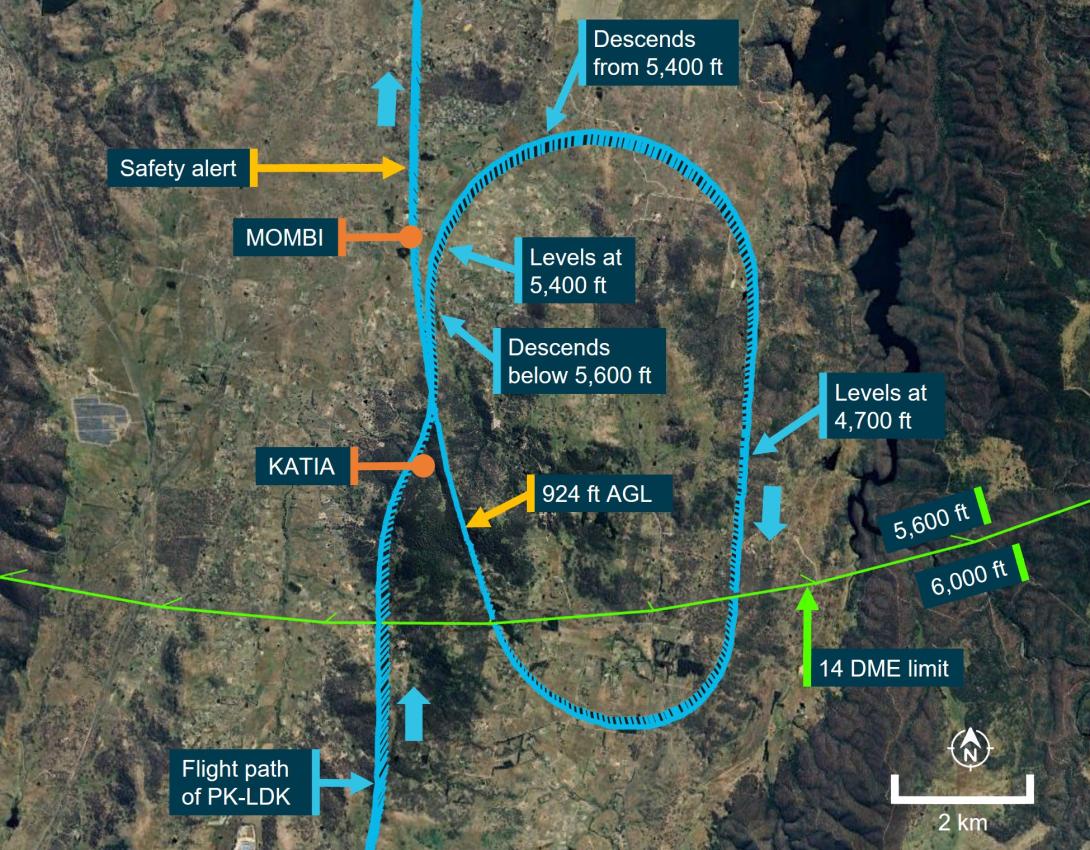
The air traffic controller was not initially able to visually locate the Eagle 150B due to environmental conditions but subsequently identified the aircraft on their tower situation air display. The controller issued the American Champion Scout a safety alert and avoiding instructions. When clear, the Eagle 150B was given instructions to rejoin the circuit. 

Safety message

This incident highlights the importance of following correct circuit procedures, complying with ATC instructions and using see and avoid procedures effectively, particularly in high traffic environments. Ensuring situational awareness, through familiarising with the aerodrome, reviewing procedures preflight and using ATIS information to anticipate the expected circuit pattern can help to ensure correct procedures are followed.

About this report

Decisions regarding whether to conduct an investigation, and the scope of an investigation, are based on many factors, including the level of safety benefit likely to be obtained from an investigation. For this occurrence, no investigation has been conducted and the ATSB did not verify the accuracy of the information. A brief description has been written using information supplied in the notification and any follow-up information in order to produce a short summary report, and allow for greater industry awareness of potential safety issues and possible safety actions.

Occurrence summary

Mode of transport Aviation
Occurrence ID AB-2024-009
Occurrence date 25/04/2024
Location 2 km north-west of Jandakot Airport
State Western Australia
Occurrence class Serious Incident
Aviation occurrence category Near collision
Highest injury level None
Brief release date 16/09/2024

Aircraft details

Manufacturer Eagle Aircraft Australia
Model 150B
Sector Piston
Operation type Part 91 General operating and flight rules
Departure point Jandakot Airport, WA
Destination Jandakot Airport, WA
Damage Nil

Aircraft details

Manufacturer American Champion Aircraft Corp
Model 8GCBC Scout
Sector Piston
Operation type Part 138 Aerial work operations
Departure point Jandakot Airport, WA
Destination Jandakot Airport, WA
Damage Nil

Flight controls involving a Eurocopter AS350 B3, 88 km south of Port Hedland, Western Australia, on 27 July 2024

What happened

On 27 July 2024, the pilot of a Eurocopter AS350 departed a mining airport in Western Australia. The helicopter flew about 10 NM to the east and landed at a pre-determined location to collect a team of surveyors. On landing, the pilot of the helicopter received a message from the surveyors who advised they required another hour at the site, the pilot then shut the helicopter down. Noting the strong and gusting wind conditions, they tied the main rotor blades down to prevent blade sailing or bouncing, they also noticed the tail rotor was “see-sawing” aggressively. The pilot then installed the tail rotor gust lock pin, which dampens the movement of the tail rotor when the aircraft is stationary and prevents any damage, and conducted their usual turnaround inspection of the helicopter.

Once the survey team had returned to the helicopter, the pilot untied the main rotor tie‑downs and stored them in the helicopter’s rear locker. From the rear locker the pilot conducted a pre-flight walk-around to the front of the aircraft, however did not inspect the tail rotor or remove the tail rotor gust lock pin. The pilot reported they had not previously installed the gust lock pin in the field and the deviation from their standard aircraft configuration contributed to the occurrence.

The pilot conducted normal pre-start and pre-departure checks, they noted an unusual, mild vibration from the main rotor and tail rotor which they presumed to be caused by the strong gusting wind from the 3 o’clock position. The pilot took off and immediately became aware that the pedals were jammed in a neutral position and determined the cause to be the tail rotor gust lock pin still being in place.

The pilot then briefed the passengers regarding the nature of the emergency and the plan to divert back to the original take-off airport. The pilot telephoned the airport reporting officer via the Bluetooth in their helmet to advise of the emergency. 

They then conducted the emergency procedure for jammed pedals and landed on the runway without incident. The pilot reported the landing was a gentle zero speed, no hover landing.

The helicopter was positioned on the runway preventing any further arrivals or departures until it could be removed. There was no operational impact to the airport whilst the helicopter was positioned on the runway.

The pilot advised the ATSB that there was no visual damage to the structure of the aircraft or to the tail rotor assembly. An engineering inspection confirmed no damage to the aircraft; however the gust lock pin was deformed in the horizontal axis. Due to this deformation, the manufacturer requested that the following parts be replaced:

  • tail rotor pitch change spider bearing
  • tail rotor control lever
  • all tail rotor control attaching hardware aft of the tail rotor control rod (long shaft) for pitch links, lever etc.

Safety action

The pilot’s awareness in determining the cause of the jammed pedals and their following actions to conduct a safe emergency landing at the airport, prevented the loss of control of the aircraft and potential injuries or fatalities to the occupants.

Safety message

This incident highlights the importance of a thorough pre-flight inspection, ensuring pilots follow a systematic procedure as per the aircrafts flight manual. If interrupted, it is best practice to start again from the beginning of the inspection to ensure nothing is missed.

As per the flight manual pilots should always check flight controls for free movement prior to engine start.

Further, anytime a pilot detects an unusual control feedback prior to take-off, it is recommended that pilots shut down the aircraft, complete a thorough inspection and contact the operators engineering provider to discuss the issue.

The operator reported that they have sought a customisation of the “remove before flight” tapes used on the tail rotor gust lock pin to increase their length and therefore visibility.

About this report

Decisions regarding whether to conduct an investigation, and the scope of an investigation, are based on many factors, including the level of safety benefit likely to be obtained from an investigation. For this occurrence, no investigation has been conducted and the ATSB did not verify the accuracy of the information. A brief description has been written using information supplied in the notification and any follow-up information in order to produce a short summary report, and allow for greater industry awareness of potential safety issues and possible safety actions.

Occurrence summary

Mode of transport Aviation
Occurrence ID AB-2024-035
Occurrence date 27/07/2024
Location 88 km south of Port Hedland
State Western Australia
Occurrence class Serious Incident
Aviation occurrence category Flight control systems
Highest injury level None
Brief release date 13/09/2024

Aircraft details

Manufacturer Eurocopter
Model AS350 B3
Sector Helicopter
Operation type Part 133 Air transport operations - rotorcraft
Damage Nil

Saab 340 engine failure due to incorrectly seated coupling

The right engine of a Saab 340 flamed out shortly after the aircraft reached cruising altitude, after the engine’s hydro-mechanical unit driveshaft decoupled from the accessory gearbox due to an incorrectly seated coupling, leading to a fuel pump failure, an ATSB investigation report details.

The aircraft, with 2 flight crew, 1 cabin crew and 32 passengers on board, was operating a scheduled Regional Express service from Perth to Albany, WA, on the evening of 21 December 2022.

After climbing to 15,000 ft and establishing a direct track to Albany, the flight crew felt 2 bumps pass through the airframe, and felt the aircraft yaw.

Identifying that the right engine had failed, they conducted the associated checklists, secured the right engine, and returned to Perth where the aircraft landed without further incident.

“The ATSB’s investigation found that the right engine’s hydro-mechanical unit was incorrectly seated, resulting in a misalignment with the engine’s accessory gearbox, leading to significant wear and the eventual decoupling of the hydro‑mechanical unit’s drive shaft from the accessory gearbox,” ATSB Director Transport Safety Stuart Macleod explained.

“As a result, the fuel pump within the hydro-mechanical unit could not function, leading to the engine flameout.”

The engine, a GE Aerospace CT7, was removed from the aircraft for inspection at an authorised CT7 maintenance facility.

“While this inspection put the ATSB investigation on hold for an extended period, it did reveal that the V-band coupling securing the flanges of the hydro-mechanical unit to the accessory gearbox had wear on its inner surface from contact with the accessory gearbox flange,” Mr Macleod noted.

“Interference wear in this area was evidence of a misalignment and non-seating of the hydro‑mechanical unit onto the accessory gearbox.”

Maintenance records showed that the last recorded maintenance that required installation of the hydro-mechanical unit onto the accessory gearbox was during an engine workshop visit at a contractor maintenance facility in February 2018.

“This incident highlights that the incorrect alignment or seating of an aircraft or engine component may not be readily apparent after the installation of a V-band coupling or clamp,” Mr Macleod said. 

“As such it serves as a reminder to maintenance personnel installing V-band couplings to ensure the correct seating and alignment of flanges and the V-band coupling prior to the fitment and torquing of attaching hardware.”

Regional Express has since commenced a fleetwide inspection of its Saab aircraft to confirm the correct fitment of the V-band coupling, while GE Aerospace intends to share the learnings of this occurrence with its customers and maintenance facilities.

Read the final report: Engine failure involving Saab 340B, VH-RXE, 141 km south of Perth, Western Australia, on 21 December 2022

Chipmunk owners urged to ensure rivets are maintained to spec

The ATSB advises DHC-1 Chipmunk maintainers and owners that crashworthiness could be significantly compromised if incorrect specification rivets are used.

The safety advisory notice has been issued as part of the ATSB’s continuing investigation into a fatal accident involving a Chipmunk at Jandakot Airport, WA, on 26 April 2024As detailed in a preliminary report in July, shortly after take-off the aircraft was observed turning to the left at a low height before colliding with the ground, fatally injuring the pilot.

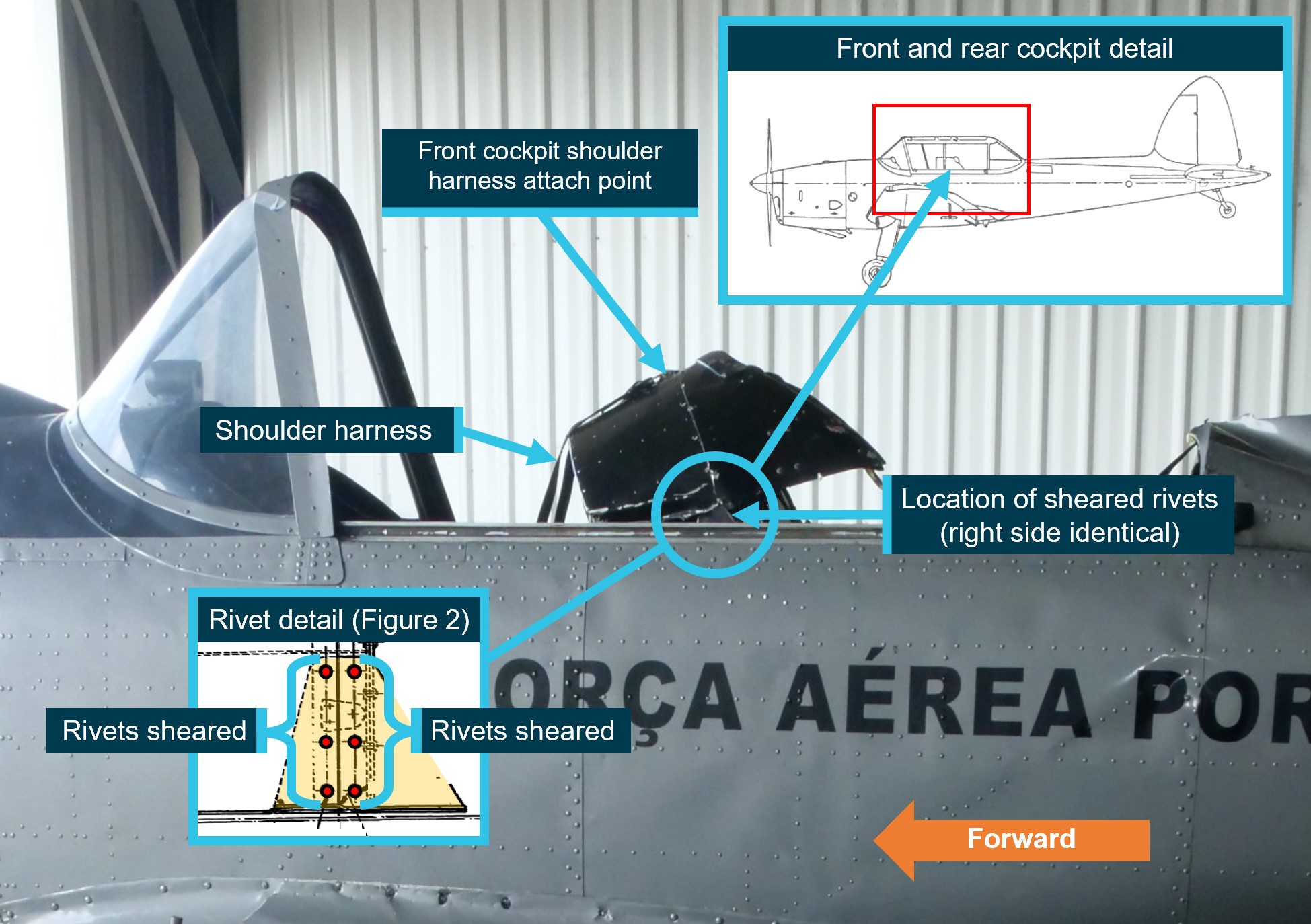
During the ongoing investigation the ATSB has identified that non-specification rivets had been installed on the aircraft, attaching the upper structure between the front and rear cockpits to the fuselage. This structure provides the attach point for the front cockpit shoulder harness.

“Two sets of rivets – 12 in total – attaching the structure to the fuselage sheared during the accident,” Director Transport Safety Dr Stuart Godley said. 

“The ATSB found that the rear row of rivets in each set – that is, three of the six rivets on each side – were pure or near-pure aluminium.”

This meant the rivets did not meet the specification of the relevant modification.

“Testing indicated a significant reduction in strength, estimated to be about one-third of the specification strength,” Dr Godley said.

The rivets would have been originally replaced during the embodiment of modification H.268, issued in 1966 by the aircraft’s type certificate holder at the time, Hawker Siddeley, to replace alloy structure elements with steel.

The aircraft may have modified in the 1960s, however the ATSB has not determined precisely when, or if, the rivets had been replaced since the modification.

It is important to note that while the crashworthiness of the aircraft had been compromised by the presence of non-specification rivets, the ATSB has yet to establish whether it contributed to the outcome of this accident.

However, as there is the potential for other Chipmunks to have incorrect rivets installed in this location, the ATSB determined it was important to bring the issue to the wider attention of Chipmunk operators.

“The ATSB’s safety advisory notice highlights the importance of maintaining aircraft crashworthiness design elements, including its restraint system, to keep the occupant within an aircraft’s ‘living space’ during an accident sequence,” Dr Godley said.

“The use of upper torso restraints such as a shoulder harness can prevent the occupant from striking the surrounding structure during an accident. It is crucial that all components forming part of that restraint system and the structures to which they are attached are maintained to defined specifications.”

The notice therefore advises DHC-1 Chipmunk maintainers and owners to be aware that fitment of incorrect specification rivets where the upper structure between the front and rear cockpits attaches to the gussets on either side could significantly compromise the crashworthiness of the aircraft.

“Those conducting work on aircraft must ensure modifications are carried out to the required specification, or during maintenance returned to that specification,” Dr Godley concluded.

The investigation is continuing, and the ATSB will issue a final report, which will detail findings and analysis, at the conclusion of the investigation.

Read the Safety Advisory Notice: DHC-1 Chipmunks may have incorrect rivets fitted

DHC-1 Chipmunks may have incorrect rivets fitted

Safety Advisory Notice

To DHC-1 Chipmunk maintainers and owners

Crashworthiness of some DHC-1 Chipmunks may be compromised by incorrect specification rivets.

What happened

On the afternoon of 26 April 2024, the pilot of a DHC‑1 Chipmunk took off from Jandakot Airport, Western Australia. The engine cowling on the left side had not been fastened prior to take-off and began to open and close in flight. The aircraft turned to the left at low height near the end of the runway, with an increasing angle of bank, before descending and colliding with terrain. The pilot was transported to hospital and later succumbed to injuries.

What increased risk

The DHC-1 Chipmunk is a low-wing aircraft designed for military flight training. It has 2 seats that are arranged in tandem (one cockpit behind the other). The front cockpit shoulder harness is attached to the upper structure between the front and rear cockpits.

The ATSB found that on impact the upper structure between the front and rear cockpits, corresponding to the attach point for the front cockpit shoulder harness, was torn away from its mountings. Most noteworthy, all 12 rivets (6 per side) that attached the structure to the mountings had sheared (Figure 1).

Figure 1: Location of sheared rivets

Figure 1: Location of sheared rivets

Image source: ATSB, de Havilland Support Ltd, annotated by the ATSB.

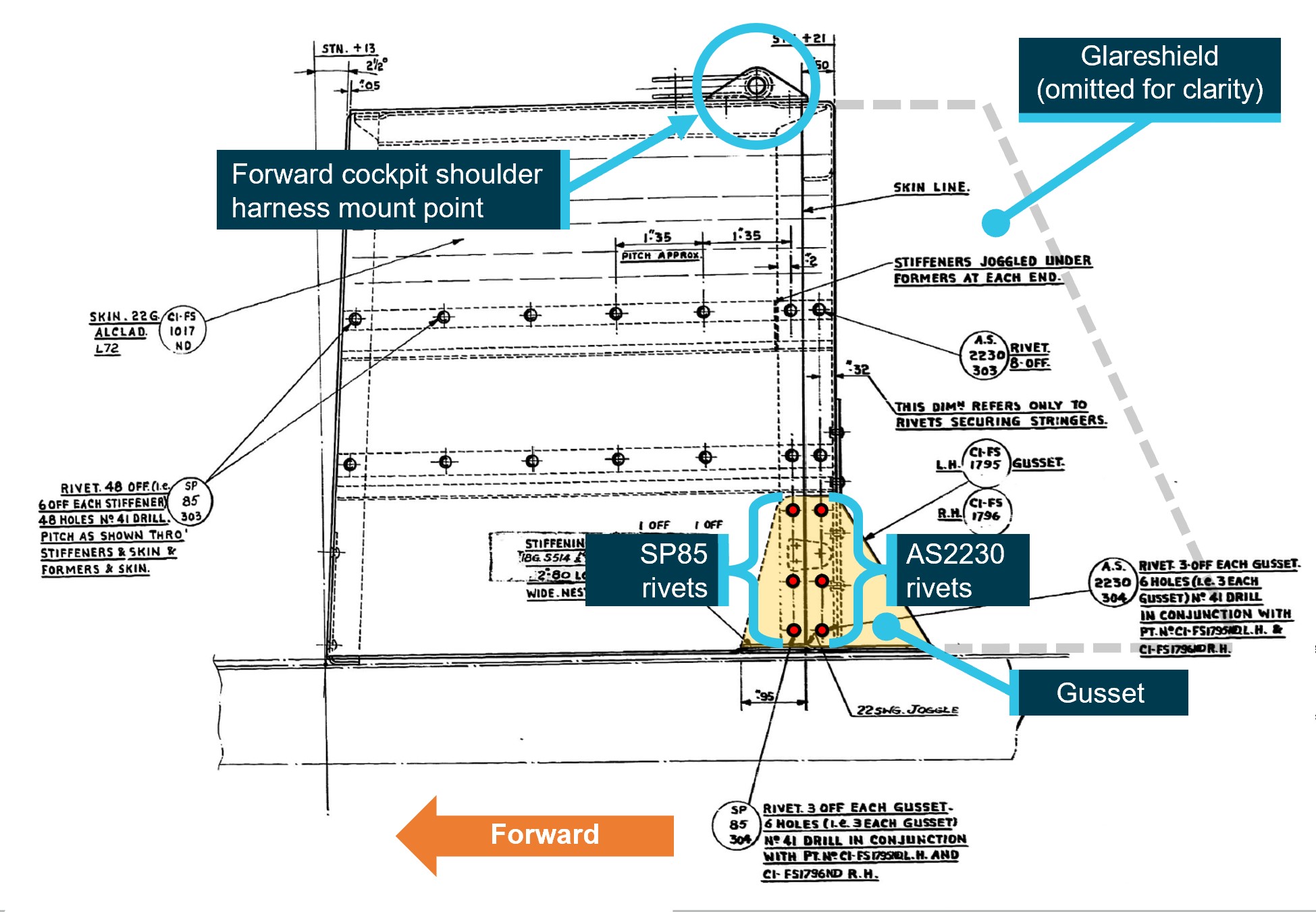
The 2 mountings, called gussets, were installed as modification H.268. This modification was issued by Hawker Siddeley in 1966 to replace the original aluminium alloy gussets with high‑tensile steel. The modification required the forward row of rivets attaching the structure to the gussets to be part number SP85 mushroom head rivets, and the rear row to be part number AS2230 countersunk rivets (Figure 2).

Figure 2: Rivet detail

Figure 2: Rivet detail

Image source: ATSB, de Havilland Support Ltd, annotated by the ATSB.

Both part number SP85 and AS2230 rivets were required to be manufactured to British standard L.86, which was an aluminium alloy that included copper and magnesium (with international equivalences of Alloy Designation 2117, US specification AMS7222, and European specification ENAW-AlCu2.5Mg). The standard also specified that the rivets were to be anodised (a surface treatment) and coloured violet.

The sheared rivets were examined by the ATSB using metallurgical equipment and it was determined that:

  • The rear row of countersunk rivets appeared to be pure or near-pure aluminium and therefore the incorrect specification. Testing indicated a significant reduction in strength (estimated to be about one-third of the specification strength). 
  • The forward row of mushroom head rivets appeared to be an alloy consistent with L.86. The rivets were coated with a gold-coloured chromate conversion coating instead of violet anodising. ATSB testing indicated that the strength of the rivets met or exceeded literature values for L.86 alloy.

The ATSB has not determined when or where modification H.268 was embodied, or whether the rivets had been replaced since the modification.

The presence of the non-conforming rivets significantly reduced the integrity of the structure retaining the front cockpit restraint, and thereby compromised the crashworthiness of the aircraft. This non-conforming modification may be present in other Chipmunk aircraft, in which case it would likely affect survivability in an accident.

Crashworthiness design

One element of aircraft crashworthiness is the ability of a restraint system to restrain the occupant within the aircraft’s ‘living space’ throughout a crash. The use of upper torso restraints such as a shoulder harness can further prevent the occupant from striking the surrounding structure during an accident. All components forming part of the restraint system (including the structures to which they are attached) need to be to defined specifications.

Safety advisory notice

AO-2024-013-SAN-01: The ATSB advises DHC‑1 Chipmunk maintainers and owners to be aware that fitment of incorrect specification rivets where the upper structure between the front and rear cockpits attaches to the gussets on either side could significantly compromise the crashworthiness of the aircraft.

Those conducting work on aircraft must ensure modifications are carried out to the required specification, or during maintenance returned to that specification.

Read more about this ATSB investigation: Collision with terrain involving Oficinas Gerais de Material Aeronautico DHC-1 MK 22 Chipmunk, VH-POR, at Jandakot Airport, Western Australia, on 26 April 2024

Publication details

Investigation number AO-2024-013
Publication type Safety Advisory Notice
Publication mode Aviation
Publication date 11/09/2024

Aircraft preparation event involving a Hawker Beechcraft Corporation B200, Gove, Northern Territory on 23 July 2024

Occurrence Briefs are concise reports that detail the facts surrounding a transport safety occurrence, as received in the initial notification and any follow-up enquiries. They provide an opportunity to share safety messages in the absence of an investigation. Because occurrence briefs are not investigations under the Transport Safety Investigation Act 2003, the information in them is de-identified. 

What happened

On the night of 23 July 2024, a Hawker Beechcraft B200 was being prepared for an aeromedical flight between Gove Airport and Numbulwar Airport in the Northern Territory. Prior to departure, the pilot conducted a pre-flight inspection of the aircraft. A critical step in this process was to remove pitot covers from the pitot tubes[1] on both the front left and right side of the aircraft’s fuselage. These covers protect the pitot tube from contamination and are designed to slide on and off the tubes. 

The pitot covers used by the operator were made of tight-fitting rubber to prevent them falling off in the wind. These covers also had a small vent hole in the front which equalised pressure in the pitot system on the ground and facilitated their easy removal. A red streamer is also attached to these covers, which provides a visual reminder to pilots and ground crew that the covers have been fitted and need to be removed prior to departure.

The pilot advised that their usual habit was to tie the pitot cover streamer to the wheel chocks[2] to provide a visual reminder that the pitot covers were to be removed. However, the previous crew had only applied the pitot covers as the aircraft was due to depart later that night and had not set the wheel chocks. Therefore, when the pilot saw that the wheel chocks were not in place, they assumed that the pitot covers had been removed. The pilot advised that due to the shadows created by the floodlights in the hangar they did not notice the pitot cover nor the red streamer during their pre-flight inspection. 

The pilot commenced the take-off run and observed normal airspeed indications until the aircraft reached a speed of around 80 KIAS.[3] At that time, the airspeed indications stopped increasing even though the aircraft’s acceleration remained normal and there were no speed warnings in the cockpit. The pilot advised that they cross-checked the indicated airspeed between the primary flight displays (PFD) and the standby instruments, and observed no discrepancy between any of these systems. As a result, the pilot continued the take-off run and the aircraft rotated[4] successfully, albeit with an indicated airspeed lower than normal.

The aircraft climbed to the circuit altitude at Gove, but the pilot noted that the airspeed indicator only showed 100 KIAS even though the aircraft should have been accelerating to 160 KIAS. When the aircraft turned downwind at circuit height, the pilot observed a speed discrepancy in the right PFD and the standby instruments, both of which showed 180 KIAS. This aligned with the standard speed for that aircraft configuration and that stage of the flight. The pilot then watched the speed discrepancy reduce until the right PFD indicated the same speed as the left PFD. At this point, the pilot suspected that the covers had been left on the pitot tubes as they did not recall removing them before departure, and that the covers had now fallen off and speed indications had returned to normal.

The pilot therefore began comparing various data sources to verify the aircraft’s climb speed and performance. The pilot cross-checked the aircraft’s groundspeed[5] and true airspeed (KTAS)[6] on the multi‑function display (MFD), as well as with the aircraft’s air data computer and GPS indications. The pilot also compared the indicated altitude with the GPS altitude from OzRunways. As the aircraft parameters were consistent with normal flight conditions, the pilot elected to continue with the flight and landed without incident at Numbulwar.

After landing in Numbulwar, the pilot conducted a detailed visual inspection of both the pitot tubes and the aircraft in general. During this inspection, they found the remnants of the pitot covers still fitted to the tubes. As the pitot heat system had been turned on during flight, the covers on both tubes had partially melted, however the pilot noted no damage or debris in the actual pitot tubes. The aircraft had flown around 40 minutes and 250 km over remote, unlit terrain in this configuration. After conducting this inspection, the pilot determined it was safe to conduct the next sector to Darwin.

Similarities to previous incidents

The pitot tube issue on 23 July 2024 was not the first such incident involving this operator on this aircraft type. In May 2024, the ATSB reported on an occurrence where an aircraft departed from Darwin Airport with the pitot covers blocking the pitot tubes.[7] On that occasion, the pilot attempted to remove the pitot covers before departure but did not realise that the right-side streamer had detached from the right-side cover.

The pilot thought that the pitot covers had been removed entirely, and proceeded to take-off with the right pitot tube cover still in place. The pilot noticed an airspeed mismatch during rotation, and subsequently climbed to circuit height and returned to land. In both the May 2024 and July 2024 incidents, an airspeed discrepancy or mismatch did not become apparent until it was too late to reject the take-off.

Safety action

In response to this incident, the operator launched an internal investigation and undertook a series of safety actions to address the risks associated with blocked pitot tubes. 

To reduce the risk of pitot covers being missed during the pre-flight inspection, the operator has purchased high visibility pitot tube cover flags, with the wording ‘remove before flight’, to be used on all fixed-wing aircraft in the operator’s fleet. Processes are also being established around the ongoing inspection and maintenance of these flags to ensure they are free from contamination and that their visibility is not compromised in low-light situations.

To mitigate the risk of errant speed indications, the operator is also sourcing leather covers for the B200 fleet that do not have a small vent hole. This addressed the potential for the small vent hole in the existing covers to allow sufficient airflow into the pitot system to provide a symmetric, albeit incorrect, speed indication during the take‑off roll. The new leather covers would prevent the generation of any airspeed indications at all, which would indicate blocked pitot tubes significantly earlier in the take‑off run and increase the likelihood of a safe rejected take‑off.

To assist pilots with managing inflight pitot tube issues, the operator is looking to introduce training on partially-blocked pitot tubes. This training will include a startle/surprise element to ensure pilots can respond appropriately to pitot blockages and errant speed indications. This is intended to be a key safety focus item in their simulator-based recurrent training and proficiency checks, and will cover all flight crew within the next six months.

Safety message

This incident highlights the importance of conducting an airspeed check early in the takeoff run. This allows the take-off to be rejected as soon as a mismatch is detected. In circumstances where a rejected take-off is not possible, pilots should follow the standard climb-out procedure then seek to land as soon as practicable. Although the B200 stall warning system operates independently of the pitot system, unreliable speed indications can increase the risk of aerodynamic stall[8] and subsequent loss of control, and several accidents internationally have been attributed to blocked pitot tubes. 

This incident also illustrates the importance of maintaining a high level of attention and awareness when doing visual inspections of critical aircraft systems pre-flight, particularly at night. It is vital that the pitot tubes and static ports are fully uncovered and free from obvious obstructions, contamination, or damage prior to departure. Pilots should also remain cognisant of the risk that pitot covers may not be sufficiently conspicuous when installed on the aircraft, and follow standard procedures when fitting or removing these items. Targeted inspections of specific aircraft components, along with secondary means of accounting for ground-based protective equipment, can provide an extra layer of assurance that these items have been removed from the aircraft and are safely stowed prior to departure. 

About this report

Decisions regarding whether to conduct an investigation, and the scope of an investigation, are based on many factors, including the level of safety benefit likely to be obtained from an investigation. For this occurrence, no investigation has been conducted and the ATSB did not verify the accuracy of the information. A brief description has been written using information supplied in the notification and any follow-up information in order to produce a short summary report, and allow for greater industry awareness of potential safety issues and possible safety actions.

[1]     Pitot tubes are part of the aircraft's pitot-static system and are used to compute the aircraft's indicated airspeed.

[2]     Aircraft wheel chocks are safety devices that prevent an aircraft from moving while it is parked. They are usually solid blocks of sturdy material and placed in front of and behind the wheels after the aircraft is parked.

[3]     KIAS: indicated airspeed expressed in knots, used by pilots as a reference for all aircraft manoeuvres.

[4]     Rotation: the positive, nose-up, movement of an aircraft about the lateral (pitch) axis immediately before becoming airborne.

[5]     Groundspeed: an aircraft’s horizontal speed relative to the ground.

[6]     KTAS: true airspeed expressed in knots, used by pilots for pre-departure flight planning and navigation purposes.

[7]     Flight preparation event involving Hawker Beechcraft Corporation B200, Darwin Airport, Northern Territory, on 8 May 2024 (AB-2024-025).

[8]     Aerodynamic stall: occurs when airflow separates from the wing’s upper surface and becomes turbulent. A stall occurs at high angles of attack, typically 16˚ to 18˚, and results in reduced lift.

Occurrence summary

Mode of transport Aviation
Occurrence ID AB-2024-034
Occurrence date 23/07/2024
Location Gove Airport
State Northern Territory
Occurrence class Incident
Aviation occurrence category Flight Preparation / Navigation
Highest injury level None
Brief release date 10/09/2024

Aircraft details

Manufacturer Hawker Beechcraft Corporation
Model B200
Sector Turboprop
Operation type Part 135 Air transport operations - smaller aeroplanes
Departure point Gove Airport, Northern Territory
Destination Numbulwar Airport, Northern Territory
Damage Nil

Brisbane River oil tanker breakaway and grounding

The breakaway and grounding of an oil tanker in the Brisbane River during a significant weather event in February 2022 illustrates the importance of clearly defined emergency and risk management arrangements, according to an ATSB investigation report.

On 27 February 2022, during a period of heavy, sustained rainfall and flooding in south-east Queensland, the 185 m Hong Kong-flagged oil products tanker CSC Friendship was berthed at the Ampol products wharf in the Port of Brisbane.

Currents in the Brisbane River increased until they exceeded the design mooring limits of both the ship and the berth, the ATSB investigation found.

“While weather conditions exceeded those initially forecast, the associated increased safety risk to shipping and the port was foreseeable,” ATSB marine investigation manager Captain Vik Chaudhri said.

“Numerous warnings from the Bureau of Meteorology provided sufficient information to identify and assess the increased likelihood of a breakaway, and the current in the river had exceeded the operational limits of the berth and the ship’s mooring arrangements more than 14 hours prior to the breakaway – yet the ship remained at the berth.”

The ship, loaded with about 32,000 tonnes of petroleum products, broke its mooring lines just prior to 11 pm.

Despite the deployment of the ship’s outboard anchor and the swift attendance of two tugs, the ship was swept across the channel, grounding 400 m downstream.

A port pilot boarded the vessel and, about six hours after the grounding, the ship was refloated.

However, during the recovery efforts, an attempt was made to retrieve the anchor, leading the ship to veer across the channel and ground again, close to Clara Rock, a charted hazard.

The anchor was then slipped and the ship was safely conducted downriver into Moreton Bay, where it anchored.

“Weather events can pose dynamic hazards to port infrastructure and ships, and their safe management requires clearly defined emergency and risk management arrangements,” Captain Chaudhri explained.

“These include accurately assessing all available information and erring on the side of safety where doubt exists – in particular considering the inherent uncertainty of weather forecasts.”

The ATSB’s investigation found Maritime Safety Queensland (MSQ), whose responsibilities include the management of an emergency in the Port of Brisbane, did not have structured or formalised risk or emergency management processes or procedures.

“Consequently, MSQ was unable to adequately assess and respond to the risk posed by the river conditions and current.”

MSQ has made significant changes to operations and systems in response to the incident and flood event, including policy and procedural updates and capital improvements.

It has also engaged with multiple investigations and analyses of the incident, engaged with multiple port stakeholders and facility owners, and established a distinct management role to lead a dedicated Maritime Emergency Management team.

However, while significant, the ATSB has assessed the safety action taken by MSQ has not fully addressed the identified safety issue concerning its risk management processes and procedures to manage any type of emergency.

“Subsequently, the ATSB has issued a safety recommendation to MSQ to further improve these processes and procedures,” Captain Chaudhri explained.

The final report also notes safety actions taken by the pilotage provider, Poseidon Sea Pilots, who the investigation identified did not have procedures to manage predictable risks associated with increased river flow or pilotage operations outside normal conditions.

In response, Poseidon Sea Pilots has taken various safety actions, including collaborating with MSQ on emergency evacuation procedures to respond to increased river flow.

Finally, the ATSB’s final report notes that Ampol had not considered the risk to the ship or the wharf due to increased river flow.

The wharf operator has subsequently conducted an incident investigation and analysis of mooring arrangements and limitations, and developed a document to specify wharf operational limits, and response actions for varying wind and river speeds.

“The extent of actions by all three of these key parties is encouraging,” Captain Chaudhri said.

“With these processes established, coordinated and timely decisions can be made when risks increase during future events like this one. Defined trigger points, priority lists, and escalation and contingency plans and procedures will help drive effective emergency responses.”

Read the final report: Breakaway and grounding of CSC Friendship, Port of Brisbane, Queensland, on 27 February 2022

FOI Disclosure 2024-25

Date of access (date decision released to applicant)

FOI reference number

Description of documents

Documents released

Access

26 June 2025FOI 24-25(18)

Regarding an accident on 7 January 2025 at Rottnest Island (investigation number AO-2025-001):

a complete copy of ATSB’s investigation file, comprising of, but not limited to; any investigation reports, file notes, photographs, witness statements, improvement notices and prosecution notices relating to the accident [non-restricted information only].

[excluding personal information of ATSB employees below SES level]

Partial
26 June 2025FOI 24-25(17)

Regarding an accident on 7 January 2025 at Rottnest Island (investigation number AO-2025-001):

a complete copy of ATSB’s investigation file, comprising of, but not limited to; any investigation reports, file notes, photographs, witness statements, improvement notices and prosecution notices relating to the accident [non-restricted information only].

[excluding personal information of ATSB employees below SES level]

Partial
23 June 2025FOI 24-25(16)

Regarding an accident on 7 January 2025 at Rottnest Island (investigation number AO-2025-001):

a complete copy of ATSB’s investigation file, comprising of, but not limited to; any investigation reports, file notes, photographs, witness statements, improvement notices and prosecution notices relating to the accident [non-restricted information only].

[excluding personal information of ATSB employees below SES level]

Partial
3 June 2025FOI 24-25(14)

Access to occurrence data capturing the following related to air crew on-board medical events or incidents involving Regular Public Transport (RPT) operators for the years 2021 and 2022 only:

• date
• injury level
• summary of incident/event

Partial
6 November 2024FOI 24-25(07)

1.Documents containing information about the number, classification levels, type of employment (e.g. full time, part time, fractional, casual) functions and position descriptions of Indigenous Liaison Officers or equivalent (e.g. First Nations Liaison Officer or Aboriginal and Torres Strait Islander Officer), if any, in your agency from 1 January 2014 until the present.

2.Documents containing information about the number of staff currently employed in your agency who identify as Aboriginal or Torres Strait Islander.

Full
20 September 2024FOI 24-25(06)Regarding occurrence number 198602325, any information you have regarding the incident and any follow-up investigations. Partial
20 September 2024FOI 24-25(05)

Regarding investigation number MO-2022-005, copies of all non-restricted documents with respect to the following documents:

1. AMSA submissions with respect to the draft ATSB draft report.

2. All other submissions with respect to the check pilot framework.

3. All documents with respect to, related or considered in the analysis of the check pilot factor, later identified in the final Rosco Poplar investigation report.

Partial
5 September 2024FOI 24-25(02)

Regarding investigation number AO-2024-001:

All non-restricted information including incident reports, statements, notices, fines, penalty notices, maintenance logs of aircraft, photographs and video footage between the period of 8 January 2024 and present [10 July 2024] relating to the incident on 8 January 2024 involving our client.

Partial

Accredited Representative to the Transport Accident Investigation Commission investigation of engine issue on approach involving ATR 72, ZK-MVL, near Wellington Airport, New Zealand, on 1 September 2024

Summary

The Transport Accident Investigation Commission (TAIC) in New Zealand has commenced an investigation into an engine issue on approach involving a GIE Avions de Transport Régional ATR 72, ZK-MVL, near Wellington Airport, New Zealand on 1 September 2024.

During final approach, at about 300 feet, there was a low oil pressure caution, then an engine fault and engine fire warning for the aircraft’s left engine. The crew declared a mayday, landed safely and stopped on the runway. Airport emergency services attended promptly, and passengers and crew were evacuated on to the runway, with no serious injuries reported.

The TAIC has requested assistance and the appointment of an accredited representative from the ATSB. 

To facilitate this support and to provide the appropriate protections for the information, the ATSB appointed an accredited representative in accordance with paragraph 5.23 of the International Civil Aviation Organization Annex 13 and commenced an investigation under the Australian Transport Safety Investigation Act 2003.

TAIC is responsible for the investigation and release of the final investigation report regarding this accident. Any enquiries regarding the investigation should be addressed to the TAIC via the contact details listed below:

Email: comms@taic.org.nz
Web: taic.org.nz(Opens in a new tab/window)

Occurrence summary

Investigation number AA-2024-009
Occurrence date 01/09/2024
Location Near Wellington Airport, New Zealand
State International
Investigation type Accredited Representative
Investigation status Active
Mode of transport Aviation