Midair collision involving Jabiru UL 450, 19-4079, and Cessna 182, VH-APN, 2.7 km west of The Oaks, New South Wales, on 26 October 2024

Summary

The ATSB is investigating a mid-air collision between 2 light aircraft, a Jabiru and a Cessna 182, south-west of Sydney on 26 October 2024.

A team of transport safety investigators from the ATSB's Canberra office, with experience in aircraft operations and maintenance, was deployed to the accident sites of both aircraft to conduct evidence-collecting activities.

The evidence collection phase of the investigation involves interviewing witnesses and involved parties, site mapping, examination of the wreckage of both aircraft, and collect relevant recorded information including any air traffic control and flight tracking data, as well as pilot and aircraft maintenance records, and weather information.

The ATSB has commenced the examination and analysis of the initial evidence collected.

To date, the ATSB has:

  • examined the wreckage
  • examined aircraft components and other items recovered from the accident site
  • collected surveillance data from Airservices Australia
  • collected OzRunways data for relevant aircraft
  • collected pilot and aircraft records
  • conducted interviews with relevant parties
  • conducted detailed analysis of video recordings and radio transmissions
  • reviewed aircraft, pilot, aerodrome and operator documentation
  • conducted detailed analysis of the aircraft flight paths
  • reviewed procedures at non-controlled aerodromes
  • liaised with the NSW Police Force.

The investigation is continuing and will include, further:

  • analysis of video recordings
  • review of similar occurrences
  • review of previous flight tests conducted by the flight test examiner
  • review of procedures and practices relating to the conduct of flight tests
  • review of communication, electronic conspicuity and surveillance equipment, and interviews with relevant parties.

Preliminary and interim reports, which detail factual information established during the course of the investigation, have been released (see below).

A final report will be released at the conclusion of the investigation and will detail analysis and findings. Should a critical safety issue be identified during the course of the investigation, the ATSB will immediately notify relevant parties, so that appropriate safety action can be taken

Interim report

Report release date: 04/12/2025

This interim report details information relating to this accident, and has been prepared to provide timely information to the industry and public. This report contains no findings, which will be detailed in the investigation’s final report. The information contained in this interim report is released in accordance with section 25 of the Transport Safety Investigation Act 2003

The occurrence

Overview

On the morning of 26 October 2024, a commercial pilot licence (Aeroplane) (CPL(A)) flight test was being conducted in a Cessna 182 aircraft, registered VH-APN (APN), departing from Shellharbour Airport, New South Wales. On board APN were a pilot under examination (the CPL candidate) and a Civil Aviation Safety Authority (CASA) approved flight test examiner (the examiner).

On the same morning, a private flight was being conducted in a Jabiru UL 450 aircraft, registered 19-4079 (4079), departing from The Oaks aerodrome (The Oaks), New South Wales. On board 4079 was a pilot (the pilot of 4079), who was the sole occupant.

Around midday, APN and 4079 collided in-flight and both aircraft impacted terrain. All occupants of both aircraft were fatally injured. The following describes the events that led up to the midair collision.

VH-APN pre-flight and departure from Shellharbour Airport

Three days earlier, on 23 October 2024, a ‘CPL task’ for the flight test and other instructions were sent by email from the examiner to the CPL candidate. The CPL task was a scenario that included instructions to plan and fly from Shellharbour Airport and land at Warnervale Airport flying via Macquarie Lighthouse for some aerial photography. The task then stipulated an onward flight from Warnervale Airport to land at Cessnock Airport, with a return leg to Shellharbour via the most direct track. A map recovered from the accident site showed a red path drawn upon it, consistent with the CPL task. This map indicated that the Cessnock to Shellharbour leg was planned via an inland route passing over Prospect Reservoir and Campbelltown.

A witness account indicated that, on 26 October 2024, the flight examiner and CPL candidate had planned to meet at a local bakery at around 0730 local time, prior to starting the ground component of the CPL flight test at Shellharbour Airport, at around 0800. National Airspace Information Planning System (NAIPS)[1] records indicated that the CPL candidate submitted a flight plan at about 1005. At 1018, a radio broadcast was recorded from APN on the Shellharbour Airport common traffic advisory frequency (CTAF),[2] indicating that APN was taxiing for runway 16 for a crosswind departure.

Flight data transmitted by the CPL candidate’s electronic flight bag (EFB)[3] device (APN flight data) indicated that at 1035, APN departed Shellharbour Airport, climbing to 1,500 ft above mean sea level.[4] At 1036, a radio call recorded on the CTAF stated that APN was departing crosswind and tracking north-east toward the sea cliff bridge, with the flight proceeding in this direction (Figure 1).

VH-APN flight along the coastline and diversion to Camden Airport

APN crossed the coastline near Wollongong beach, and subsequently descended to about 500 ft, following the coast toward Sydney and passing the sea cliff bridge at about 1047. At 1054, APN flight data showed the aircraft starting to track northbound along the visual flight rules route referred to as ‘Victor 1 South’ at about 500 ft (Figure 1). As APN approached Macquarie Lighthouse, flight data indicated that the aircraft tracked slightly further away from the coastline before conducting a large ‘S’ manoeuvre, consistent with the CPL aerial photography task planned prior to the flight. The flight continued tracking as planned until abeam Long Reef at 1106, APN started to track inland, consistent with a diversion from the planned route. The track followed published visual landmarks, intercepting and tracking in a south‑westerly direction toward Prospect Reservoir along the visual ‘lane of entry’[5] route for Bankstown Airport.

APN continued tracking in a south-westerly direction toward Bringelly township, an inbound reporting point for Camden Airport (Figure 1). At 1124, APN contacted Camden Tower air traffic control (ATC), requesting clearance for a touch-and-go and to conduct some circuits. ATC gave instructions to maintain 1,800 ft, join final for runway 24 and report when APN was 3 NM (5.6 km) from the runway threshold, with the aircraft starting to track toward this position. At 1128, APN reported being 2 NM (3.7 km) from runway 24, with Camden Tower ATC clearing APN for a visual approach. Shortly after, APN called ATC again requesting to remain at 1,800 ft for a practice glide approach to runway 24, which was approved.

At 1129, the APN flight data indicated that the aircraft had joined the crosswind leg for runway 24 at 1,800 ft, with APN being cleared for a visual approach by ATC about 1 minute later. APN descended and tracked consistent with a glide approach, with a clearance for a touch-and-go issued at 1131. The pilots of APN continued in 2-way communication with Camden Tower for another circuit, followed by a request for an upwind departure from runway 24, which was approved by ATC and acknowledged by APN. At 1141, APN touched down on runway 24 for the third time and started to climb to about 1,300 ft while maintaining the runway direction. Tracking data showed that APN continued in this direction and altitude, departing the Camden Airport control zone to the west just after 1143.

19-4079 planned flight and departure from The Oaks aerodrome

On the same morning, the pilot of 4079 was conducting a private flight departing from The Oaks. The purpose of the flight was a social event to travel to Cessnock Airport and meet with other pilots who were also flying from The Oaks. The flight was arranged using a group message that invited pilots to join. The message stated that the planned departure from The Oaks was between 1000 and 1030.

During the evening prior, a message was sent by the pilot of 4079 at 1954 confirming that they intended to join the group of pilots flying to Cessnock. The group consisted of 3 pilots, each with their own aircraft that comprised 2 Jabiru aircraft, 4079 and 55-1837 (the other Jabiru), and a Sonex Legacy aircraft registered 19-2041 (the Sonex). All 3 aircraft travelling to Cessnock in the group were registered with Recreational Aviation Australia. The 2 other pilots flying to Cessnock recalled that, prior to the flight, it was decided that the pilot of the Sonex, which was a faster aircraft, would wait about 10 minutes before departing so that all aircraft would arrive at Cessnock at about the same time. 

At 1124, around the same time that APN approached an inbound point for Camden Airport, video on board 4079 showed the aircraft rolling for take-off on runway 18 right (18R)[6] from The Oaks. The other Jabiru pilot recalled hearing a ‘rolling’ radio call from the pilot of 4079 around this time. Tracking data from the other Jabiru showed that this aircraft had departed about 30 seconds prior to 4079. At 1125, automatic dependent surveillance broadcast (ADS-B)[7] flight data showed 4079 on an initial climb from runway 18R. The flight data showed that the flight path was consistent with 4079 flying a right circuit for runway 18R or 18L and departing the aerodrome on the downwind leg in a northerly direction.

Figure 1: Flight paths of VH-APN, 19-4079 and accident location

Flight paths of VH-APN, 19-4079 and accident location

Source: Google Earth and Geoscience Australia, annotated by the ATSB

19-4079 return to The Oaks aerodrome

At interview with the ATSB, the pilot of the other Jabiru flying to Cessnock reported that they decided to turn back due to experiencing turbulence. This pilot reported broadcasting that they were turning back to The Oaks on 2 frequencies, one corresponding to The Oaks CTAF (126.70) (The Oaks radio frequency) and another frequency that was pre-arranged for en route group chatter. Neither of the other pilots flying to Cessnock recalled hearing a broadcast from the pilot of 4079 in response. At 1133, the 4079 flight data showed that the aircraft started turning back towards The Oaks in a southerly direction. Due to the other Jabiru being further north, 4079 was ahead for the return to The Oaks.

During the return, the other Jabiru pilot recalled hearing the pilot of 4079 make a 7 NM (13.0 km) inbound call on The Oaks radio frequency. While inbound, this pilot also recalled hearing another call from an aircraft that was ‘really fuzzy’ and potentially related to another aerodrome. About 6 minutes after turning back, the flight data for 4079 showed that the aircraft had started a slow right turn to the west, and then tracked directly overhead The Oaks at about 1,800 ft. The other Jabiru pilot recalled hearing the pilot of 4079 broadcast that they were joining mid-field crosswind and observed the aircraft in that position. At this time, the other Jabiru pilot estimated that they were about 3 to 4 NM (5.6 to 7.4 km) behind 4079. At 1141, the ADS-B data showed 4079 crossing directly overhead The Oaks at about 1,900 ft before turning right and starting to descend.

The Sonex pilot reported hearing the pilot of 4079 broadcast that they were ‘established downwind for runway 18’. At 1142, the 4079 flight data and onboard video showed that the aircraft descended toward runway 18 left (18L). Around this time, the pilot of the other Jabiru recalled hearing the pilot of 4079 broadcast that they were on the base leg of the circuit. The track of 4079 was in a generally south‑easterly direction toward the threshold of runway 18L, however, instead of landing, the data showed the aircraft flying along the runway at about 100 ft.

Collision between VH-APN and 19-4079

At about 1143:30, shortly after APN departed the Camden Airport control zone, the onboard video and 4079 flight data indicated that the pilot of 4079 conducted a go‑around from runway 18L at The Oaks. The onboard video showed that the pilot of 4079 was transmitting a radio communication on The Oaks radio frequency. The Sonex pilot, who was in the run-up bay for runway 36, reported that they heard the pilot of 4079 transmit they were going around and observed 4079 from their position. Around this time, APN tracking data showed that this aircraft turned slightly right onto a track of 263° (true) while continuing to maintain about 1,250–1,350 ft.

At 1144:47, the tracking data for the other Jabiru showed this aircraft had turned right base, with a spacing of about 1.1 NM (2.0 km) north of the runway 18R threshold. Neither the Sonex or other Jabiru pilot reported hearing any radio transmissions from APN that morning. At 1145:16, the 4079 flight data showed this aircraft in a right climbing turn at about 1,700 ft, and mid-way through an ovalised crosswind leg of the circuit for runway 18L or 18R. Around this time, tracking data for APN indicated that this aircraft was about 1.1 NM (2.0 km) from the runway 18R threshold, continuing to track at 263° at 1,250 ft. At 1145:34, as 4079 continued the right climbing turn, APN tracking data showed that a level left turn was conducted onto a heading of 209°. Shortly after this turn was completed, at 1145:54, APN started a straight, steady climb from 1,350 ft (Figure 2).

At 1146:00, 4079 completed the right turn onto a northerly heading. At 1146:26, the onboard video and tracking data showed 4079 leveling out at 2,200 ft, about 1.5 NM (2.8 km) from runway 18R. After this time, APN and 4079 were on relatively constant flight path trajectories for about 8 seconds, with APN captured by the onboard video of 4079 in the lower right quadrant of the windscreen. 

The onboard video and tracking data showed that the aircraft collided at 1146:34 on near reciprocal headings. Following the midair collision, the left wings of both aircraft separated, with closed-circuit television footage from a nearby residence showing both aircraft descending steeply. Both aircraft were destroyed in the subsequent collisions with terrain. All 3 pilots were fatally injured. 

Figure 2: Flight paths and vertical profiles of VH-APN and 19-4079 prior to the accident

Flight paths and vertical profiles of VH-APN and 19-4079 prior to the accident.

Source: Google Earth and Geoscience Australia, annotated by the ATSB


Context

Pilot information

CPL candidate

The CPL candidate in APN held a private pilot licence (aeroplane) issued in 2021 and was issued a multi-engine class rating in May 2024. As part of the pilot’s pre‑licence test preparation, the pilot reported having a total of 237 flight hours. The pilot held a class 1 aviation medical certificate, with no restrictions, valid until 19 March 2025. 

Flight test examiner

The flight test examiner in APN held an air transport pilot licence (aeroplane) issued in 1997 and a flight examiner rating for the commercial pilot licence (aeroplane). The examiner’s CASA record showed they had conducted a total of 868 flight examinations. Most of the examinations were multi‑engine instrument proficiency checks, with the first of these performed in June 2009. Notably, there were 14 examinations, for the issue of either commercial, private, or recreational flight crew licences. The examiner started conducting these tests in June 2018. Additionally, the examiner held a low-level rating (aeroplane) and low-level (aeroplane) training was included in their flight instructor rating.

On 16 May 2024, as part of their aviation medical examination, the pilot reported having a total of 25,214 flight hours. The pilot held a class 1 aviation medical certificate, with a requirement for reading correction to be available, valid until 16 November 2024. 

Pilot of 19-4079

The pilot of 19-4079 held a Recreational Aviation Australia (RAAus) pilot certificate,[8] with a cross‑country endorsement issued in June 2023, which also satisfied the requirements of a biennial flight review. On 4 April 2024, the pilot reported to RAAus having a total of 168 flight hours. The pilot had submitted a medical declaration to RAAus on 19 June 2022.[9]

Aircraft information

VH-APN

VH-APN (Figure 3) was a Cessna Aircraft Company 182P 4-seat, highwing (strut‑braced), single-engine aircraft equipped with a fixed tricycle landing gear. It had a Teledyne Continental Motors O-470 engine and was fitted with a McCauley 2-blade, constant‑speed propeller. APN was manufactured in the United States in 1976. It was placed on the Australian aircraft register that same year with a registration of VH‑RKC. The registration was changed to VH-APN in August 1996 and transferred to the current owner in 2021. 

APN was painted in a yellow (wings) and grey (fuselage) livery. The aircraft was fitted with a mode A/C transponder and 2 very high frequency transceiver radios. It was not fitted with ADS-B, nor was this required.

Figure 3: VH-APN

An image of VH-APN.

Source: Supplied

19-4079

19-4079 (Figure 4) was a Jabiru UL 450 amateur-built high-wing (strut-braced) light aircraft with a fixed tricycle landing gear. It had a Jabiru 2200J, 4-cylinder engine. Construction of 4079 was completed in 2004 and it was placed on the RAAus aircraft register on 23 February 2004. The registration was transferred to the current owner in 2022. 4079 was painted white. The aircraft was fitted with one very high frequency radio and a SkyEcho II portable ADS-B transceiver.[10] It was not fitted with a transponder, nor was this required. 

Figure 4: 19-4079

An image of 19-4079.

Source: Supplied

Meteorological information

The nearest available Bureau of Meteorology weather forecasts and observations to The Oaks was at Camden Airport.

At 1130, a routine report[11] of weather observations was issued for Camden Airport that reported light winds from a south-westerly direction (218° (magnetic) at 6 kt), with no cloud detected, visibility greater than 10 km, and the temperature was 18°C.

At 1154, following the accident, a special meteorological report[12] was published that showed light winds from the north-west (308° (magnetic) at 5 kt), visibility had reduced to 5 km in haze, no cloud was detected, and the temperature was 19°C.

The reported weather observations, which showed no cloud was detected, were consistent with the onboard video on 4079 (Figure 5). Additionally, at the time of the accident, the video did not show any notable reduction in visibility from any meteorological phenomena such as haze. Further, the Bureau of Meteorology weather observations at 1-minute intervals for Camden Airport showed that the visibility was greater than 10 km until shortly after the accident (at 1147) when it began slowly reducing.

The onboard video from 4079 also showed that, during the go-around on runway 18R at about 1143, the northern airport windsock was facing east indicating that there was minimal wind (Figure 5).

Figure 5: The Oaks windsock at 1143:28

A diagram showing The Oaks windsock at 1143:28. The windsock is facing east and indicating that there was minimal wind.

Source: Airservices Australia and ATSB

Aerodrome and airspace information

The Oaks aerodrome

The Oaks aerodrome was a non-controlled aeroplane landing area,[13] located 7 NM (13 km) west‑south-west of Camden Airport. It had an elevation of 880 ft above mean sea level and 2 parallel grass runways aligned in a north-south direction. Runway 18R/36L was 900 m long, while runway 18L/36R was 800 m. All circuits were conducted to the west of the aerodrome to avoid overflying the township of The Oaks. The Oaks utilised the shared CTAF designated radio frequency of 126.7. 

An icon and label for The Oaks aerodrome was published on all visual aeronautical charts. Additionally, a caution label, surrounded by a red box adjacent to The Oaks on the visual terminal chart stated: 

CAUTION YOAS CCT ALTITUDE A019 RECOMMEND OVERFLY NOT BELOW A025

The caution label indicated to pilots that the potential circuit altitude for aircraft flying at The Oaks was up to 1,900 ft above mean sea level and recommended that they overfly the aerodrome above 2,500 ft.

Figure 6 is an extract of the visual terminal chart for Sydney showing the relative locations of The Oaks aerodrome and Camden Airport, and the caution placard.

Camden Airport

Camden Airport was a certified aerodrome with an elevation of 230 ft above mean sea level. The main runway, 24/06, was paved. Camden Tower had a part time control tower providing an air traffic control service in the surrounding class D airspace during operating hours. During the accident flight, the tower was active, with communications on the radio frequency 120.1. The class D airspace extended in a 2 NM (3.7 km) radius around the airport, represented by the blue dashed circle on Figure 6.

Figure 6: Extract of Sydney visual terminal chart dated 13 June 2024 showing The Oaks aerodrome and Camden Airport

An extract of the Sydney visual terminal chart dated 13 June 2024 showing The Oaks aerodrome and Camden Airport.

Source: Airservices Australia, annotated by the ATSB

Airspace information

The accident flights were mostly conducted outside controlled airspace, designated as class G airspace. APN also operated in class D airspace while the aircraft was within 2 NM (3.7 km) of Camden Airport.

Airservices Australia’s Aeronautical Information Publication (AIP) ENR 1.6 – 7.1.4 required civil aircraft flying in class D airspace to set their transponder code to 3000. When operating in class G airspace, the AIP required pilots to set their transponder code to 1200.

The area extending beyond 2 NM (3.7 km) from Camden in the direction of The Oaks aerodrome was class G airspace below 4,500 ft above mean sea level.[14]

After leaving controlled airspace, such as when APN departed Camden class D airspace, pilots need to decide what radio frequencies will be required for future transmissions and what frequencies they should maintain a listening watch on. One of the frequencies in the area between Camden and The Oaks was the Sydney Centre area very high frequency, 124.55. This frequency was used by Airservices Australia to provide air traffic services. Additionally, pilots may broadcast their intentions on this frequency to assist with maintaining traffic separation.

Recorded information

Data sources

Neither aircraft was equipped with a flight data recorder or cockpit voice recorder, nor were they required to be. Broadcasts made on The Oaks CTAF were not recorded. The following data sources have been used for this investigation:

  • ADS-B data from 4079
  • ATC audio data for APN
  • CTAF audio data from Shellharbour Airport for APN
  • closed-circuit television footage from a nearby residence showing post‑collision dynamics
  • data transmitted/recorded from devices running electronic flight bag applications for APN, 4079 and 55-1837
  • transponder data for APN.
Transponder data

Transponder data for APN showed that the code was changed from 1200 to 3000 when the aircraft was approaching the Camden class D control zone. The transponder code continued to transmit on code 3000 until the collision.

19-4079 onboard video camera

4079 was fitted with an onboard video camera that was attached to a roof panel inside the cabin. The ATSB recovered the camera at the accident site, which was downloaded at the ATSB’s technical facility in Canberra. Initial observations from the video included:

  • the aircraft had no evident technical problems during the flight
  • the radio was selected to the frequency 126.7 at the time of the accident
  • lights on the radio, along with the push-to-talk button on the control yoke, indicated the pilot was transmitting and receiving radio calls during the flight
  • 4079 and APN were both on relatively constant trajectories, with 4079 being straight and level and APN climbing at the time of the collision, with no avoiding action evident by either pilot
  • the aircraft were travelling on a generally reciprocal heading, impacting on the left side of each aircraft, with the fuselage of 4079 passing underneath the left wing of APN. 

Wreckage and impact information

Wreckage location

The accident site was located about 2.7 km west of The Oaks aerodrome in heavily treed terrain. The 2 primary wreckage locations were approximately 520 m apart, with 4079 north of APN (018º true) (Figure 7). A debris field was located about halfway between the 2 main wreckage locations. Most wreckage items found in the central area were from the left wing of 4079, with a small number of components from APN. Most of the central wreckage was found within a radius of about 50 m.

Figure 7: Accident site location in relation to The Oaks

Accident site location in relation to The Oaks

Source: Google Earth, annotated by the ATSB

Orientation of 19-4079 and VH-APN during the collision

Yellow paint was found on portions of the left wing and left-wing strut of 4079, consistent with being transferred from APN. These areas of the left wing of 4079 also showed signs of leading‑edge penetration to about halfway through the wing chord, at about the mid‑span position.

The left-wing strut of APN was found near the main wreckage of APN, consistent with being attached to this aircraft at the time of the collision with terrain. White paint was found in 2 places of this strut, with leading edge damage observed in these areas, consistent with being transferred from the left wing and left-wing strut of 4079.

A relatively small dent with light‑coloured paint transfer was located on the leading edge of APN’s left wing, with a longitudinal light-coloured paint transfer on the underside of the wing around this location. The relative orientation of the frontal left wing and left-wing strut damage on 4079 and left-wing strut damage on APN, was consistent with 4079 being upright during the collision. Based on the geometry of 4079, the coloured paint transfer on the underside of the left wing of APN was likely from the upper vertical fin section of 4079. The fin likely separated from the aircraft after being struck by the left wing of APN in the location of the light-coloured paint. The upper vertical fin section of 4079 was not located.

In summary, the paint transfer marks, and damage observed on site was consistent with APN and 4079 colliding on the left sides of each other on near reciprocal headings. The left wing and left-wing strut of 4079 primarily impacted the left strut of APN, and the upper fin of 4079 subsequently striking the left-wing leading edge of APN.

19-4079 wreckage

Examination of the main wreckage site and surrounding broken tree branches for 4079 indicated that the aircraft had impacted the ground at a steep angle, with little forward movement, resulting in a localised wreckage field. The ATSB inspection found no evidence of pre-accident flight control damage. 

All of the aircraft was accounted for, excluding a section of the outboard left wing, and the upper vertical fin. An aileron fitting for 4079 was co-located with the left wing of APN.

VH-APN wreckage

Witness marks in surrounding trees showed that APN impacted terrain in a steep nose down attitude. There was a significant post-impact fire at the primary wreckage site, which limited the ATSB’s ability to examine the wreckage. The inspection of the available evidence did not identify any pre-accident flight control damage. The left wing of APN was located about 50 m from the main wreckage, consistent with this wing separating in‑flight during the accident sequence.

Operations around non-controlled aerodromes

See-and-avoid principles

The Oaks was a non-controlled aerodrome, where separation was maintained by ‘alerted see‑and-avoid’ principles guided by CASA advisory circulars AC 91‑10 Operations in the vicinity of non-controlled aerodromes and AC 91-14 Pilots’ responsibility for collision avoidance. These stated that pilots should broadcast position and intention information so that nearby traffic would have an awareness of the aircraft and be able to plan accordingly.

AC 91-14 also highlighted the ineffectiveness of pilots relying solely on visually detecting other aircraft that are on a conflicting flight path, referred to as ‘unalerted see-and-avoid’. It noted increased traffic density as one of the factors increasing the risk of collision, necessitating a pilot using ‘alerted see-and-avoid’ principles. Airspace in the vicinity of non-controlled aerodromes has a higher traffic density. The primary tool of alerted see‑and-avoid is radio communications that enhance pilot situational awareness.

Operations in the vicinity of non-controlled aerodromes

The AIP provided guidance for pilots flying in the vicinity of non-controlled aerodromes. The vicinity of non-controlled aerodromes was defined as a distance of 10 NM (19 km) horizontally and within a height above the aerodrome that could potentially result in conflict. It recommended that aircraft transiting in the vicinity should avoid flying over the aerodrome at an altitude that could result in conflict with operations, including the circuit area and the arrival and departure tracks.

Additionally, the CASA Civil Aviation Advisory Publication (CAAP) 166(3) outlined hazardous zones for operations near non-controlled aerodromes, including:

- The most hazardous area for collisions is within a space bounded by a cylinder of airspace 5 NM [9 km] in diameter and up to 3,000 ft above aerodrome elevation.

- Most collisions occur on downwind or on final approach. There are many distractions during this time, including configuring the aircraft, completing checklists, setting equipment and communicating...

When APN departed Camden controlled airspace, it was approximately 5 NM (9 km) from The Oaks aerodrome, already within the vicinity of the aerodrome and within the recommended 10 NM (19 km) inbound broadcast location.

Circuit pattern

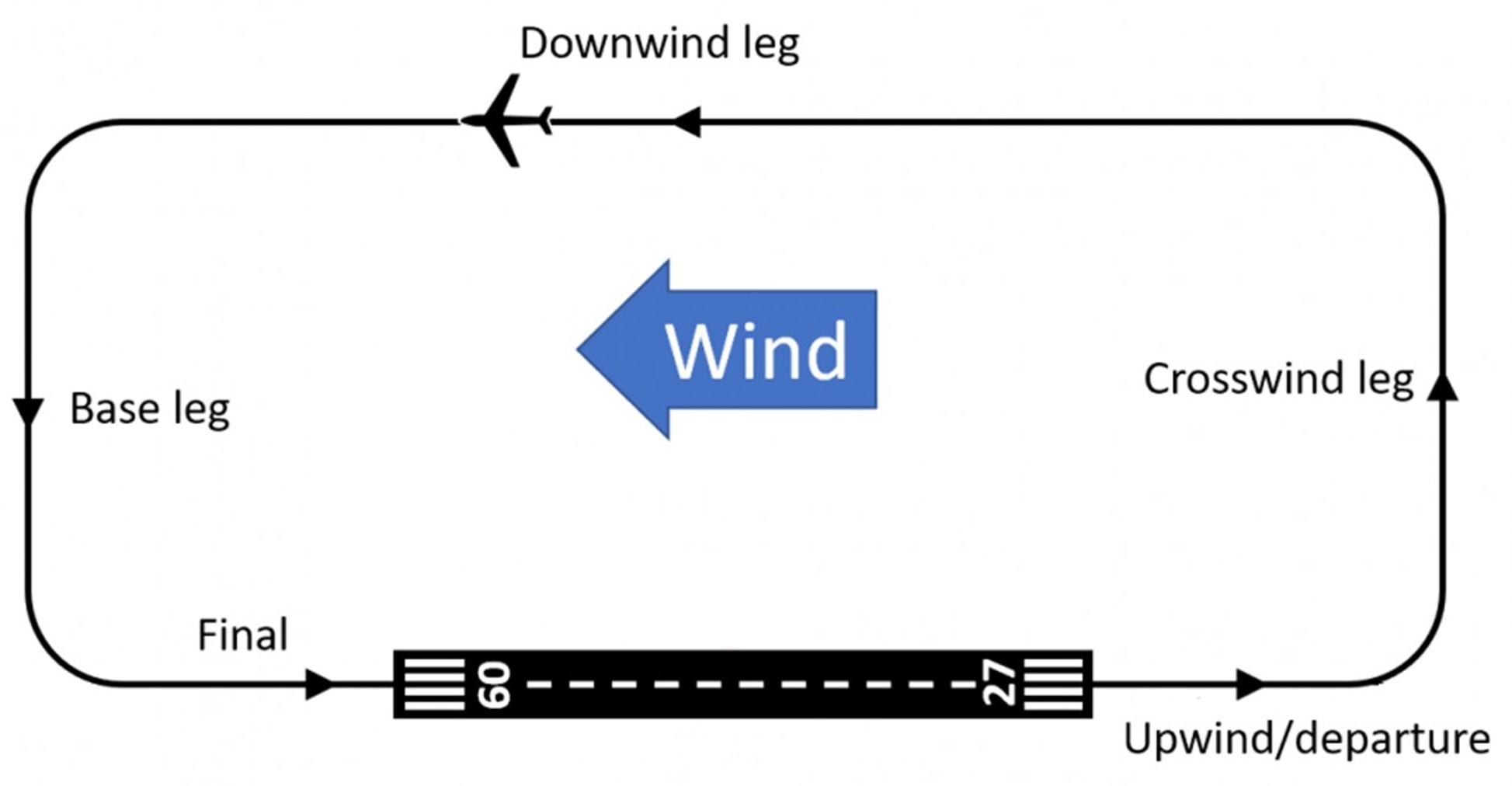
A circuit is an established procedure for arriving and departing aerodromes. They assist pilots with configuring and positioning the aircraft to make a stabilised approach to the runway in use. A circuit when flown in its entirety includes upwind, crosswind, downwind, base, and final legs. When arriving and departing a non-controlled aerodrome, CASA recommended pilots join the circuit area via the methods highlighted in blue in Figure 8.

The key recommended methods to join the circuit depicted (Figure 8):

  • Overflying the aerodrome more than 500 ft above the circuit height before descending on the side not being used and joining the circuit over the middle of the runway (midfield crosswind).
  • Joining the circuit at circuit height on the downwind leg (including joining at 45° in the middle of the downwind leg).

CASA did not recommend joining the circuit on base or a 3 NM (5.6 km) straight in approach.

Figure 8: Circuit join methods with recommended circuit joins highlighted in blue

A diagram showing circuit join methods with recommended circuit joins highlighted in blue

Source: Civil Aviation Safety Authority 

Circuit procedures are well established, and pilots learn the circuit terminology during their early training. This allows them to know where to look when they hear a broadcast, which includes a certain leg of the circuit. Pilots should broadcast their position and intentions on the local radio frequency to assist other pilots with alerted searching.[15] Additionally, pilots can use the look, talk, and turn’ strategy, which involves the pilot checking for traffic, making the broadcast and then carrying out the turn (AC 91-10). Other pilots in the area will hear the broadcast, know where to look, and will have an increased chance of visually acquiring the aircraft while it has the most surface area visible during a turn.

The CASA CAAP 166-2 Pilots’ responsibility for collision avoidance in the vicinity of non‑controlled aerodromes noted that variations in the recommended circuit join may increase the risk of collision. Additionally, climbing and descending in the circuit area was not recommended as visual acquisition of traffic could be difficult: 

An aircraft (a small one in particular) will often be rendered difficult to see by the patterns in the surface of the earth when viewed from above, and particularly when over urban areas. Conversely, an aircraft when viewed from below can potentially be much more easily seen against a uniformly overcast cloud background or blue sky. All pilots would be aware of the difficulty seeing aircraft that have the sun directly behind them.

Circuit area

The size of a circuit area was not explicitly defined in Australian legislative instruments, procedures or guidance. However, various technical publications refer to distances from and heights above runways in certain operational circumstances. The Airservices Australia AIP stated that aircraft would normally be outside the circuit area when at least 3 NM (5.6 km) from the departure end of the runway, while the United States Federal Aviation Administration’s Airplane Flying Handbook defined the downwind leg of the circuit as a track approximately 1 NM (1.9 km) parallel to the intended landing runway. 

Designated airspace in aeronautical charts showed airports with air traffic control towers had airspace reserved (control zones), to be used only by aircraft operating within the circuit. For Camden Airport, the control zone extended 2 NM (3.7 km) from the aerodrome reference point,[16] and is shown by the dashed-blue circle in Figure 6. In many other cases, control zones extended up to 3 NM (5.6 km) from the reference point.

The FAA’s Airplane Flying Handbook stated that, for a typical piston aircraft, a standard final approach would result in a 3° approach angle. Additionally, CASA required aircraft to be established on the final leg, no lower than 500 ft above ground level. To achieve a  approach angle, the aircraft would need to be positioned at 500 ft at approximately 1.5 NM (2.8 km) from the runway threshold. However, the AIP stated:

9.2.5 Pilots may vary the size of the circuit depending on:

(a) the performance of the aircraft;

(b) safety reasons; or

(c) in accordance with the Aircraft Flight Manual, Pilot’s Operating Handbook, or company Standard Operating Procedures.

The height at which the circuit legs are flown is dependent on aircraft performance. The AIP section 9.6.1 stated for medium performance aircraft, like APN and 4079, the standard circuit height was 1,000 ft above the aerodrome elevation. At The Oaks, this equated to 1,900 ft above mean sea level. As noted in the section ‘Circuit pattern’ above, aircraft may be joining the circuit at a height at least 500 ft above the circuit height. In this case, at The Oaks up to 2,400 ft above mean sea level. This is also highlighted in the caution label on the visual terminal chart for The Oaks (Figure 6), with a recommended minimum overfly height of 2,500 ft above mean sea level.

Based on this, the area where medium performance aircraft could be expected in The Oaks circuit ranged from overhead to a distance up to 3 NM (5.7 km) from the runway, and up to at least 1,500 ft above the aerodrome or 2,400 ft above mean sea level.

Circuit direction

A circuit is typically conducted to the left side of the runway in use and involves the aircraft making left turns (Figure 8), which assists the pilot who is normally sitting in the left seat to keep the runway in sight. However, some aerodromes such as The Oaks runway 18L and 18R had local procedures that required pilots to fly circuits to the right side of the runway in use and make right turns. Aerodromes where right circuits were required are listed in the En Route Supplement Australia.[17]

At non-controlled aerodromes, the runway in use was determined by pilots using the aerodrome. The runway selected should be the runway that was most closely aligned into wind and was serviceable. Pilots wishing to use a different runway for operational reasons were required to do so without conflicting with other aircraft using the most into wind runway.

At the time of the accident, the windsock at The Oaks was facing east and indicating minimal wind, so the wind direction did not favour any particular runway. Runways 18L and 18R were being used by 4079 and the other Jabiru.

Radio communications

Aircraft operating in the vicinity of a non-controlled aerodrome were required to make broadcasts on the aerodrome frequency whenever reasonably necessary to do so to avoid a collision (AIP 9.1.4). On receiving a broadcast of a potential conflict, a pilot was required to respond by transmitting their own callsign and, as appropriate, aircraft type, position, actual level and intentions. Additionally, when making a standard broadcast pilots should also address the station (location) being called.

While CASA did not require any additional broadcasts, the AIP did recommend pilots make broadcasts as detailed in Table 1.

Table 1: Recommended broadcasts at non-controlled aerodromes

Recommended calls in all circumstances

SituationBroadcast
The pilot intends to take-offImmediately before, or during taxi
The pilot is inbound to an aerodrome10 NM [18.5 km] from the aerodrome or earlier, commensurate with aeroplane performance and pilot workload, with an estimated time of arrival (ETA) for the aerodrome
The pilot intends to fly through the vicinity of, but not land at a non-controlled aerodrome10 NM [18.5 km] from the aerodrome or earlier, commensurate with aeroplane performance and pilot workload, with an estimated time of arrival

Recommended calls dependant on traffic

The pilot intends to enter a runway Immediately before entering a runway
The pilot is ready to join the circuitImmediately before joining the circuit
The pilot indents to make a straight-in approachOn final approach at not less than 3 NM [5.6 km] from the threshold
The pilot intends to join base legPrior to joining on base

Proximity between APN and the other Jabiru

APN tracked from Camden in a westerly direction towards The Oaks and entered the circuit area of The Oaks at low level. At the time there were 2 aircraft conducting circuits to land, 4079 and the other Jabiru (55-1837). 

At 1143:07, the other Jabiru passed overhead runway 18L, entering the circuit area at about 1,900 ft. At 1145:00, the other Jabiru had completed a right turn onto the base leg for runway 18R and was descending through about 1,800 ft to land, heading in an easterly direction. At the same time, tracking data showed APN at about 1,350 ft and tracking in a westerly direction, on a near-reciprocal heading to the other Jabiru. At 1145:17, tracking data indicated the other Jabiru passed 375 m in front of and about 400 ft above APN. The position of each aircraft at that time is shown in Figure 9.

The pilot of the other Jabiru stated they did not see APN nor were they aware APN was in the area until after the collision with 4079.

Figure 9: Flight tracks of VH-APN and the other Jabiru (55-1837)

Flight tracks of VH-APN and the other Jabiru (55-1837)

Source: Google Earth and ATSB

Radio communications

Radio communications from several sources were evaluated and combined to produce a detailed timeline. These included witness statements, the onboard video recording from 19-4079, flight tracking data, and available CTAF and ATC recordings. This section reviews the recorded data and interview recollections relating to radio communications by the pilots of APN, 4079, the other Jabiru and the Sonex during the accident flights.

The purpose of this section is to provide context about the effectiveness of radio communications between each aircraft involved.

Overview of radio communications during flight of 19-4079

The ATSB evaluated the recollections of the other Jabiru and Sonex pilots who were operating in the vicinity of The Oaks during the flight of 4079. The accounts were largely consistent, although there were some differences in recollection of radio call sequences. For some parts of the flight, each pilot remembered different aspects, which is considered normal. Where there were discrepancies, these were considered in relation to each other and the recorded data to determine the likely order and content of transmissions.

The onboard video showed transmissions being made and received by 4079 throughout the flight on The Oaks radio frequency (CTAF) and the pre-arranged group chatter frequency. Both pilot witnesses reported hearing radio calls from the pilot of 4079 throughout the flight. The method to identify the type, frequency, time and duration of these transmissions is documented in Appendix – Radio transmissions captured by 19‑4079.

The flight track of 4079 was synchronised with the radio transmission data from the onboard video, and this is shown in (Figure 10). The red coloured parts of the track show the position of 4079 when the pilot was transmitting and the green shows the locations of 4079 when receiving radio calls. The grey parts of the track show the locations when no radio transmissions were made or received by 4079. For context, Figure 10 also contains labels for key parts of the flight for 4079 that are cross-referenced in figures for orientation and discussed in the text below.

Figure 10: Flight track showing the position of 19-4079 when no transmission was detected (grey lines), and when radio calls were transmitted (red lines) and received (green lines) by 19-4079 during the accident flight

Flight track showing the position of 19-4079 when no transmission was detected (grey lines), and when radio calls were transmitted (red lines) and received (green lines) by 19-4079 during the accident flight

Source: Google Earth and ATSB

19-4079 departure and return to The Oaks aerodrome
Turn back call

When the decision was made to return to The Oaks, the other Jabiru pilot reported broadcasting this intention on both the CTAF and group chatter frequency. However, neither the other Jabiru or Sonex pilots heard a response, or a similar call from the pilot of 4079. As such, the ATSB evaluated the most plausible reason why both pilot witnesses did not hear the pilot of 4079 respond to the other Jabiru pilot’s decision to turn back. 

The evaluation of the video evidence showed the pilot of 4079 receiving a call on the CTAF frequency, which was likely the turn back discussion. After this, the pilot of 4079 broadcast a transmission on the group chatter frequency, which may not have been monitored by the other pilots at that time. The timing of this transmission also aligned with the turn back of 4079, as shown by the recorded data.

Inbound call

The onboard video and tracking data showed that the pilot of 4079 made a transmission when 7 NM (13 km) from The Oaks on the CTAF. This was consistent with the recollection of the other Jabiru pilot who recalled hearing 4079 make an inbound call on The Oaks frequency.

Unintelligible call

When they were about 3–4 NM (5.6–7.4 km) from The Oaks, the other Jabiru pilot reported hearing a ‘really fuzzy’ radio call on CTAF. This transmission was correlated on the video recording with a 10.6 second radio transmission that was received by 4079 on the CTAF. At the same time as this transmission, flight data indicated APN was on the base leg of a touch-and-go at Camden Airport. As APN would have been on the Camden Airport frequency, the fuzzy call on the CTAF was not likely to be APN.

Communications on The Oaks frequency prior to the collision

While the likely content of each transmission was evaluated for the entire flight of 4079, a particular focus was during the period from 4079 joining the circuit for runway 18L or runway 18R on a mid-field crosswind leg until the collision with APN. The results of this evaluation are detailed in Table 2, Figure 11, Figure 12 and Figure 13. 

Table 2 details the time and duration of all radio transmissions received by 4079 based on the examination of the video, with the reference numbers correlating with reference numbers in Table A2 of the Appendix. The likely information communicated by each pilot on The Oaks frequency were estimated based on the combined analysis of the onboard video, tracking data and accounts from the 2 witness pilots. The results of this evaluation, including the relevant aircraft location are shown in the 2 right-most columns of Table 2.

The tracks of each aircraft in the circuit area of The Oaks with radio transmissions overlaid are shown in Figure 11 for 4079, Figure 12 for the other Jabiru and Figure 13 shows APN in proximity to the other Jabiru. These figures show the same type of information as Table 2, with colours of the tracks corresponding to transmissions by the pilot of 4079 in red, transmissions received in green, and no transmissions on frequency in grey. Transmissions are numbered sequentially in the direction of flight and correspond to rows in Table 2 and Table A2 of Appendix A. All transmissions during this phase of flight were on The Oaks frequency.

Table 2: Timing and duration of radio transmissions longer than 0.1 seconds, sent and received by the radio fitted to 19-4079 from when 19-4079 tracked west for a mid-field crosswind circuit join, combined with the likely content of transmissions

Reference 
number

Time (local)

(Duration in seconds)

Transmission typeRelevant aircraft locationLikely transmission content 
 1140:1519-4079 tracks west for a mid-field crosswind circuit join
51[18]

1140:22.1

(6.9)

Transmit4079 tracking west about 1 NM (1.9 km) from The Oaks4079: Midfield crosswind join
52

1141:16.4

(5.3)

Transmit

Just prior to 4079 turning north 


4079: Downwind call
53

1141:57.5

(6.0)

TransmitJust prior to 4079 starting to turn to the east 4079: Base call
54

1142:21.3

(6.0)

ReceiveOther Jabiru turned west 1 NM (1.9 km) from The OaksOther Jabiru: Mid-field join
 1142:59VH-APN departs Camden airspace
55

1143:20.5

(4.6)

Transmit4079 track aligned to runway 18L4079: Go-around call
56

1144:09.7

(2.3)

Transmit4079 passed the end of the runway and was climbing

4079 and Sonnex pilots discuss a possible runway change.

The pilot of 4079 called them on the radio, asking if it would be okay to land on runway 36. The Sonex pilot recalled broadcasting that the very light wind would allow 36 to be used, but that others (specifically the other Jabiru pilot) were using runway 18.

57

1144:14.7

(13.3)

Receive

4079 beginning crosswind turn

(other Jabiru on downwind)

58

1144:30.4

(1.8)

Transmit

4079 crosswind

(other Jabiru on downwind)

59

1144:33.1

(4.4)

ReceiveOther Jabiru about to turn onto base

Other Jabiru: Base for a full stop landing on runway 18R.

Exchange between the Sonex and other Jabiru pilots: Sonex pilot had both 19-4079 and other Jabiru in sight and that it would be safe for other Jabiru to land.

(See section Evaluation of radio calls after go-around of 4079 for the assessment of calls references 59-64).

60

1144:43.5

(8.0)

Receive

4079 crosswind (Figure 11)

Other Jabiru on base (Figure 12)

Sonex on the ground

APN tracking west between 1-2 NM (1.9-3.7 km) from The Oaks (Figure 13)


61

1144:53.0

(2.2)

Receive
62

1144:56.2

(8.1)

Receive
63

1145:05.9

(2.2)

Receive
64

1145:08.4

(2.4)

Receive
65

1145:22.0

(4.5)

ReceiveOther Jabiru turning onto final approachOther Jabiru: Finals call for runway 18R
66

1146:15.6

(1.5)

Transmit

4079 mid-downwind 

Other Jabiru close to runway 18R threshold

4079: Lost sight of the other Jabiru
67

1146:17.8

(1.6)

Receive Other Jabiru: On short final for runway 18R
 1146:34.0Collision between VH-APN and 19-4079

Figure 11: Flight track showing the position of 19-4079 with no transmission was detected (grey lines), and when radio calls were transmitted (red lines) and received (green lines) by 19-4079 after returning to The Oaks to the collision

Flight track showing the position of 19-4079 with no transmission was detected (grey lines), and when radio calls were transmitted (red lines) and received (green lines) by 19-4079 after returning to The Oaks to the collision

Source: Google Earth and ATSB

Figure 12: Flight track of the other Jabiru, showing positions with no transmissions detected (grey lines), and when signals were transmitted (red lines) and received (green lines) by 19-4079 after returning to The Oaks to the collision

Flight track of the other Jabiru, showing positions with no transmissions detected (grey lines), and when signals were transmitted (red lines) and received (green lines) by 19-4079 after returning to The Oaks to the collision

Source: Google Earth and ATSB

Figure 13: Flight tracks of VH-APN and the other Jabiru, showing where no transmissions were detected (grey lines), and when signals were transmitted (red lines) and received (green lines) by 19-4079 after returning to The Oaks to the collision

Flight tracks of VH-APN and the other Jabiru, showing where no transmissions were detected (grey lines), and when signals were transmitted (red lines) and received (green lines) by 19-4079 after returning to The Oaks to the collision

Source: Google Earth and ATSB

Evaluation of radio calls after go-around of 4079

As 4079 was on the upwind and crosswind legs, 3 groups of transmissions occurred, with references 56–59, 60–64 and 65 in Table 2 and Table A2, and aircraft positions circled in Figure 11, Figure 12 and Figure 13. Around this time, the 2 pilot witnesses both recalled 3 communications exchanges, specifically:

  • an exchange between the pilot of 4079 and the Sonex pilot about changing the runway direction
  • a base turn call by the pilot of the other Jabiru
  • an exchange between the Sonex pilot and the other Jabiru pilot about the separation between 4079 and the other Jabiru.

As these communications occurred shortly prior to the collision, each of the 3 recalled communications exchanges, and radio calls until the final transmission by the other Jabiru pilot are discussed below.

Broadcasts about changing the runway

At 1144:04, the 4079 flight data indicated that the aircraft had passed the end of the runway and was climbing following the go-around. Five seconds later, a short 2.3 second radio call was broadcast by the pilot of 4079, followed by a 13.3 second broadcast received and another 1.8 second transmission by the pilot of 4079, with about 2‑second gaps in between transmissions (Figure 11 and Table 2 references 56-58). This was consistent with the Sonex pilot reporting that, as 4079 turned onto the crosswind leg of the circuit for runway 18R, the pilot of 4079 called them on the radio asking if it would be okay to land on runway 36. The Sonex pilot recalled broadcasting that the very light wind would allow runway 36 to be used, but that others (specifically the other Jabiru pilot) were using runway 18. The Sonex pilot noted that this was their last interaction with the pilot of 4079.

Broadcast as the other Jabiru turned onto base

At 1144:33, flight tracking data showed that the other Jabiru had just started to turn onto the base leg for runway 18R. The Sonex pilot recalled that, immediately after the previous radio exchange with the pilot of 4079, the other Jabiru pilot broadcast that they were on base for a full stop landing on runway 18R. This account aligned with the onboard video, which showed a 4.4 second radio call made at this time (Table 2, Table A2 and Figure 12 reference 59),[19] which was about one second after the broadcast by the pilot of 4079, likely regarding a potential runway change (Table 2 reference 58) . 

The pilot of the other Jabiru recalled that their call on base was prior to the discussion about changing runway, but noted that they were not ‘really paying attention’ due to them being confident that no conflict existed between them and 4079. However, flight tracking data showed that the other Jabiru was still on the downwind circuit leg during the first 3 calls in this group (references 56–58 in Figure 12). Additionally, the pilot of 4079 made the first transmission in this group (reference 56 in Table 2), very likely about the runway change. Therefore, based on the factors discussed, it was considered more likely that the base call by the other Jabiru pilot occurred after both transmissions from the pilot of 4079.

Broadcasts about separation between 19-4079 and the other Jabiru

At 1144:44, about 5 seconds after a previous transmission, another 5 radio calls were received on The Oaks frequency over the next 30 seconds, with 2 radio calls being about 8 seconds long and 3 under 2.5 seconds (Table 2 references 60-64). During this time, flight tracking data showed that 4079 was on an ovalised crosswind leg (Figure 11 references 60-64), and the other Jabiru was on the base leg (Figure 12 references 60‑64), both for runway 18L or runway 18R. 

The flight tracking and radio transmission data was consistent with the account of the Sonex pilot who reported that, after the base call by the other Jabiru pilot, they responded over the radio saying that they still had 4079 in sight and that the other Jabiru pilot would be safe to land. The Sonex pilot recalled the last time they saw 4079 was climbing to the west as 4079 was on the crosswind leg.

The other Jabiru pilot also recalled the Sonex pilot broadcasting that they could see both the other Jabiru and 4079 and that they were well separated. In contrast, the other Jabiru pilot recalled this communication occurring when they were on short final. Based on the available evidence, it was considered more likely that the exchange over the radio between the Sonex pilot and the other Jabiru were communications with reference 6064 as listed in Table 2. This was as the other Jabiru was on the base leg (Figure 12) and 4079 was still in sight of the Sonex pilot on the crosswind leg (Figure 11).

The other Jabiru turns onto final approach

Although not mentioned explicitly during interview, the other Jabiru pilot stated that at The Oaks, they mainly only make base and final calls, indicating that these calls were normally performed. This was consistent with a transmission received by 4079 as the other Jabiru started to turn onto final (Figure 12 and Table 2 reference 65).

Communication between 4079 and the other Jabiru on short final

The onboard video showed the pilot of 4079 looking outside forward and to the right while transmitting over the flight radio on The Oaks frequency (Table 2 reference 66). The pilot of the other Jabiru recalled that the pilot of 4079 broadcast that they had lost sight of the other Jabiru. Tracking data showed that the other Jabiru was close to the threshold of runway 18 and 4079 was in the mid-downwind position at this time, with the pilot recalling that they responded via radio to say that they were on short final (for runway 18) (Table 2 reference 67). The relative positions of 4079 and the other Jabiru during these radio calls (references 66 and 67) are shown in Figure 10 and Figure 11. Following this exchange, the pilot of 4079 tapped the broadcast button twice (less than 0.1 seconds), consistent with acknowledging the transmission by the other Jabiru pilot. This was the last radio communication captured by the onboard video.

Breaks in transmissions

Broadcasts on The Oaks frequency after APN departed from Camden were arranged in groups of calls when there was less than 3 seconds between transmissions. The purpose was to characterise notable periods without transmissions where there may have been an opportunity for radio calls to be made by other aircraft if they were on the CTAF. The results of this grouping are shown in Table 3.

There were 2 notable periods of more than 40 seconds where there were no recorded transmissions:

  • Between the transmission coinciding with the go-around of 4079 and the subsequent transmission, starting at 1143:25.1 and shown by the grey track between references 55 and 56 in Figure 11, Figure 12 and Figure 13.
  • Following a transmission coinciding with the other Jabiru turning onto final approach until the final transmission by 4079 when on mid-downwind (between references 65 and 66 in Figure 11, Figure 12 and Figure 13).

Table 3: Broadcast and non-broadcast periods captured by the onboard video on 4079 radio on The Oaks frequency between APN departing Camden airspace until the collision

Start time (local)Elapsed time (seconds)Reference numbersTransmissions received by 4079Transmissions sent by 4079
1142:5921.5-No transmissions (APN leaves Camden)
1143:20.54.65501
1143:25.144.6-No transmissions
1144:09.727.856-5922
1144:37.56.0-No transmissions
1144:43.527.360-6450
1145:10.811.2-No transmissions
1145:22.04.56510
1145:26.549.1-No transmissions
1146:15.63.866-6711
1146:19.414.6-No transmissions until collision
1146:34.0--Collision
Radio communication information for VH-APN

This section examines recorded radio calls broadcast by APN from the initial contact with Camden Tower through to the collision. A total of 14 calls were recorded on the radio frequency for Camden Tower (120.10). No calls by APN were recorded after the aircraft departed Camden airspace on the Sydney area frequency (124.55), noting that transmissions were not recorded on The Oaks CTAF.

The last recorded transmission for APN occurred at 1138.36 with APN reading back the clearance for a touch-and-go on runway 24 for an upwind departure from Camden Airport.

The ATSB performed a qualitative assessment of the radio transmissions recorded for APN during the accident flight. The assessment was based on the ‘Plain-Language Radio Check Procedure Words’ (prowords) described in ACP 125(G).[20] An ATSB evaluation of the recorded radio transmissions made by APN indicated the signal strength was between good and loud and the signal readability was between readable and clear. This equated to a minimum score of 4 out of 5 on the assessment scales, with every recorded message able to be determined.

The ATSB also assessed the approximate range of APN from ground-based recording stations. The largest distance between APN and a ground-based station was at 1124:42, as APN approached Camden Airport. In the following 30 seconds, APN was transmitting and receiving radio calls to and from Camden Tower. The distance between APN and Camden Tower during this time was between 6 NM (11.1 km) and 7 NM (13.0 km). For these radio calls, the time between APN receiving a message from Camden Tower and responding was less than 1 second, with the readback of all instructions being accurate and correct. Therefore, from the available evidence, the radio fitted to APN was likely to be operational leading up to the accident.

Terrain shielding considerations

The ATSB examined the potential for high terrain to prevent radio signals being transmitted between 4079 and APN. A key time identified was during the go-around, when 4079 was about 100 ft above runway 18L, at a similar height to elevated terrain to the east and toward APN. At that time, there was very likely a direct line of sight between 4079 and APN. At all other times, 4079 was higher, meaning that there was clear line of sight between 4079 and APN until the collision.

The maximum distance between APN and 4079 after APN departed Camden airspace was about 4.5 NM (8.3 km) as APN departed Camden Airspace. This distance remained between 3 NM (5.6 km) and 4 NM (7.4 km) as APN approached The Oaks and 4079 was on the crosswind legs, before reducing to the collision. Therefore, based on the evidence available, it was considered likely that any transmission by APN on The Oaks frequency would have been detected by 4079 and have been visible in the onboard video.

During the same time, the other Jabiru and APN were also within line of sight. The other Jabiru was above the height of the surrounding terrain until on final approach, when APN had started to climb after remaining at about 1,250 ft above mean sea level since departing Camden. The distance between APN and the other Jabiru after transmission 56 by the pilot of 4079 and until the collision was less than 3.5 NM (6.5 km).

The ATSB identified that terrain shielding was possible between the Sonex and APN after APN departed Camden airspace. A notable period for potential shielding was around the time that APN turned left and started to climb, after radio call with reference 65 (Figure 13 and Table 2). The line of sight between the Sonex and APN has not been fully assessed. However, at the time of the radio calls with reference 60–64 (Figure 13 and Table 2), APN was likely in line of sight of the Sonex.

In conclusion, 4079 and the other Jabiru were likely within line of sight and range of APN for the entire period after APN departed Camden.

Safety action

Whether or not the ATSB identifies safety issues in the course of an investigation, relevant organisations may proactively initiate safety action in order to reduce their safety risk. The ATSB has been advised of the following proactive safety action in response to this occurrence.

Safety action by the owner of VH-APN

The owner of VH-APN reported that they have equipped one of their aircraft with an ADS-B transceiver. They also have plans to install 2 further ADS-B out units on 2 of their 3 other aircraft.

Further investigation

To date, the ATSB has:

  • examined the wreckage
  • examined aircraft components and other items recovered from the accident site
  • collected surveillance data from Airservices Australia
  • collected OzRunways data for relevant aircraft
  • collected pilot and aircraft records
  • conducted interviews with relevant parties
  • conducted detailed analysis of video recordings and radio transmissions
  • reviewed aircraft, pilot, aerodrome and operator documentation
  • conducted detailed analysis of the aircraft flight paths
  • reviewed procedures at non-controlled aerodromes
  • liaised with the NSW Police Force.

The investigation is continuing and will include, further:

  • analysis of video recordings
  • review of similar occurrences
  • review of previous flight tests conducted by the flight test examiner
  • review of procedures and practices relating to the conduct of flight tests
  • review of communication, electronic conspicuity and surveillance equipment, and interviews with relevant parties.

A final report will be released at the conclusion of the investigation. Should a critical safety issue be identified during the course of the investigation, the ATSB will immediately notify relevant parties so appropriate and timely safety action can be taken.

Appendix – Radio transmissions captured by 19‑4079

Overview

The ATSB performed measurements of the timing of radio transmissions sent and received by 19‑4079 during the accident flight. The measurements were performed using the onboard video fitted to 19-4079 that showed the 3 different states, based on a light fitted to the radio, where:

  • a red light indicated transmissions were being sent by the pilot of 4079
  • a green light indicated transmissions were being received by 4079
  • no light indicated that no transmission was being received on the selected frequency.

An example of screen captures from the onboard video for these 3 states is shown in Figure A1.

Figure A1: Screen captures of the radio fitted to 19-4079 during send (red light), receive (green light) and no transmissions (no light)

Screen captures of the radio fitted to 19-4079 during send (red light), receive (green light) and no transmissions (no light)

Source: ATSB

The ATSB also recorded the frequency that was selected against each transmission and the timing of any frequency changes that occurred during the flight. The radio instrument fitted to 4079 is shown in Figure A2, with an exemplar image showing the active (upper) and standby (lower) frequency that can be toggled by the user.

Figure A2: Radio instrument model fitted to 19-4079

Radio instrument model fitted to 19-4079. Also showing an exemplar model with active and standby radio frequencies.

Source: ATSB (left) and Microair Avionics Pty Ltd (right)

Methods

Frame measurements

The ‘Syntheyes’ computer program[21] was used to identify the exact frame the light turned on and turned off, which was tabulated. The identified frames were converted to an elapsed time for the associated video using the video frame rate (29.97).

Frequency changes

The times when frequency changes were selected by the pilot were identified. This was achieved through the frequency change dial on the instrument or the frequency flip button on the control yolk. The frequencies identified are shown under the ‘Frequency’ columns of Table A1 and Table A2. Legible frames in these intervals were identified.

Synchronisation of onboard video with UTC[22] time

The onboard video on 4079 also showed a tablet fitted to the left side of the aircraft dashboard. An application being used by the pilot (OzRunways) showed the UTC time to the nearest minute (hh:mm) in the top information panel. Time was corrected to the nearest second using the frames in the video when the minute changes occurred.

The tablet was intermittently visible in the video due to the pilot covering it in frame. However, there were 2 instances where a change in minute occurred on the tablet that was captured between video frames on the onboard video. The elapsed time between these 2 instances was less than 0.2 seconds, indicating that the elapsed time in the onboard video and the tablet were in close agreement. The time recorded by the tablet was synchronised with the flight data at the time of collision. The video creation time was also examined, however, it was not in agreement with the flight data or the time shown on the tablet and was not used for further analysis.

Radio transmissions to and from 19-4079

Results from the measurements of the time and duration of radio calls sent and received by 19-4079 are shown for the accident flight between take-off up to the point where 4079 returned to The Oaks (Table A1), and from the return to the accident (Table A2). Measurements shorter than one-tenth of a second (0.1 seconds) were excluded. The reference number included was used in the main body of this report, with the frequency and transmission type (receive or transmit) recorded for each. The reported time was at the start of each transmission.

Table A1: Timing and duration of radio transmissions longer than 0.1 seconds, sent and received by the radio fitted to 19-4079 during the accident flight, from start of the flight to the return to The Oaks 

Reference numberTime (local)Duration (seconds)FrequencyTransmission type
11120:56.37.6126.70Receive
21121:05.02.8126.70Receive
31121:57.24.6126.70Receive
41122:35.84.2126.70Receive
51122:41.73.9126.70Receive
61123:51.34.7126.70Receive
71124:01.87.3126.70Transmit
 1124:11.019-4079 Take-off from The Oaks
81124:23.92.0126.70Receive
91124:38.31.6126.70Receive
101125:23.70.2126.70Receive
111125:30.50.2126.70Receive
121126:06.20.3126.70Receive
131126:07.30.3126.70Receive
141126:08.00.2126.70Receive
151126:44.32.0126.70Receive
161126:58.52.0126.70Receive
171127:00.611.4126.70Receive
181127:32.27.5126.70Receive
191127:40.76.5126.70Receive
201127:57.30.4126.70Receive
211127:58.02.3126.70Receive
221128:02.50.2126.70Receive
231128:03.41.4126.70Receive
241128:05.01.9126.70Receive
251128:27.715.0126.70Receive
261128:57.57.8126.70Transmit
 1129:0019-4079 Outbound
271130:28.90.7126.70Receive
281130:30.00.5126.70Receive
291130:31.90.4126.70Receive
301130:32.90.6126.70Receive
311130:33.90.6126.70Receive
321131:00.211.9126.70Receive
331131:14.55.2126.70Receive
341131:58.310.4XXX.70[23]Receive
351132:15.98.7123.45Transmit
361132:24.70.2123.45Receive
371132:31.51.3123.45Transmit
 1133:12.019-4079 Starts returning to The Oaks
381133:31.41.5126.70Receive
391133:37.33.7123.45Transmit

Table A2: Timing and duration of radio transmissions longer than 0.1 seconds, sent and received by the radio fitted to 19-4079 during the accident flight, after the return to The Oaks to the accident

Reference numberTime (local)Duration (seconds)FrequencyTransmission type
401134:43.74.4126.70Receive
411134:48.96.7126.70Receive
421134:57.46.3126.70Receive
431135:18.03.2126.70Receive
441135:23.86.6126.70Transmit
451135:31.92.0126.70Receive
461135:34.61.7126.70Transmit
471135:44.512.6126.70Receive
481136:59.97.6126.70Receive
491138:06.010.4126.70Transmit
501139:58.010.6126.70Receive
 1140:1519-4079 tracks west for mid-field crosswind circuit join
511140:22.16.9126.70Transmit
521141:16.45.3126.70Transmit
531141:57.56.0126.70Transmit
541142:21.36.0126.70Receive
 1142:59VH-APN departs Camden airspace
551143:20.54.6126.70Transmit
561144:09.72.3126.70Transmit
571144:14.713.3126.70Receive
581144:30.41.8126.70Transmit
591144:33.14.4126.70Receive
601144:43.58.0126.70Receive
611144:53.02.2126.70Receive
621144:56.28.1126.70Receive
631145:05.92.2126.70Receive
641145:08.42.4126.70Receive
651145:22.04.5126.70Receive
661146:15.61.5126.70Transmit
671146:17.81.6126.70Receive
 1146:34.0Collision between VH-APN and 19-4079

Purpose of safety investigations

The objective of a safety investigation is to enhance transport safety. This is done through: 

  • identifying safety issues and facilitating safety action to address those issues
  • providing information about occurrences and their associated safety factors to facilitate learning within the transport industry.

It is not a function of the ATSB to apportion blame or provide a means for determining liability. At the same time, an investigation report must include factual material of sufficient weight to support the analysis and findings. At all times the ATSB endeavours to balance the use of material that could imply adverse comment with the need to properly explain what happened, and why, in a fair and unbiased manner. The ATSB does not investigate for the purpose of taking administrative, regulatory or criminal action.

About ATSB reports

ATSB investigation reports are organised with regard to international standards or instruments, as applicable, and with ATSB procedures and guidelines.

Reports must include factual material of sufficient weight to support the analysis and findings. At all times the ATSB endeavours to balance the use of material that could imply adverse comment with the need to properly explain what happened, and why, in a fair and unbiased manner.

An explanation of terminology used in ATSB investigation reports is available here. This includes terms such as occurrence, contributing factor, other factor that increased risk, and safety issue.

Publishing information

Released in accordance with section 25 of the Transport Safety Investigation Act 2003

Published by: Australian Transport Safety Bureau

© Commonwealth of Australia 2025

Title: Creative Commons BY - Description: Creative Commons BY

Ownership of intellectual property rights in this publication

Unless otherwise noted, copyright (and any other intellectual property rights, if any) in this report publication is owned by the Commonwealth of Australia.

Creative Commons licence

With the exception of the Commonwealth Coat of Arms, ATSB logo, and photos and graphics in which a third party holds copyright, this report is licensed under a Creative Commons Attribution 4.0 International licence.

The CC BY 4.0 licence enables you to distribute, remix, adapt, and build upon our material in any medium or format, so long as attribution is given to the Australian Transport Safety Bureau. 

Copyright in material obtained from other agencies, private individuals or organisations, belongs to those agencies, individuals or organisations. Where you wish to use their material, you will need to contact them directly.

[1]     A multi-function, computerised, aeronautical information system that allows users, such as pilots, to obtain weather information and submit flight plans into the air traffic system.

[2]     A common traffic advisory frequency is a designated frequency on which pilots make positional broadcasts when operating in the vicinity of a non-controlled airport, or within a broadcast area.

[3]     An information system for flight crew members which allows storing, updating, delivering, displaying and/or computing digital data to support flight operations or duties.

[4]     Above mean sea level (AMSL): all altitudes presented in this report are in AMSL unless otherwise specified.

[5]     Lanes of entry are established to permit passage to and from a specific class D control zones without entering adjacent civil or military controlled airspace. The vertical limits of the lane provide separation from overflying control areas and military airspace. Class D zones are the controlled airspace that surrounds general aviation and regional airports equipped with a control tower.

[6]     The Oaks aerodrome had 2 parallel runways oriented in a north-south direction, meaning that there were 2 runways available in the direction of take-off, runway 18 right (18R) and runway 18 left (18L).

[7]     Automatic dependent surveillance-broadcast is a surveillance technology in which an aircraft determines its position via satellite navigation and periodically broadcasts it, enabling it to be tracked.

[8]     An authorisation for individuals to fly RAAus registered recreational aircraft in Australia.

[9]     Applicants for an RAAus licence are required to have a health standard equivalent to that required for the issue of a private motor vehicle driver licence in Australia and may self-declare their medical status.

[10]    A transceiver is a radio device capable of transmitting and receiving signals, in this case ADS-B in and out.

[11]    METAR: is a routine report of meteorological conditions at an aerodrome

[12]    SPECI: is a special report of meteorological conditions, issued when one or more elements meet specified criteria significant to aviation. SPECI is also used to identify reports of observations recorded 10 minutes following an improvement (in visibility, weather or cloud) to above SPECI conditions.

[13]    An aeroplane landing area is an aerodrome that has not been certified by CASA. These aerodromes are non‑controlled, unregulated facilities. It is the responsibility of pilots and operators to determine whether these aerodromes are suitable for use.

[14]    To fly above 4,500 ft, a clearance from Sydney air traffic control was required until approximately 2 NM east of The Oaks, where flights up to 7,500 ft without a clearance was permitted.

[15]    Alerted searching: an alerted search is visual scanning when air traffic information has been provided and a pilot knows where to look.

[16]    Aerodrome reference point (ARP): the designated geographical location of an aerodrome.

[17]    En Route Supplement Australia is an Airservices Australia publication, which provides information on all certified airports in Australia and limited information on some uncertified aerodromes such as The Oaks.

[18]    References numbers are a continuation from the tabulation of all radio transmissions shown in Appendix A Table A1 and Table A2.

[19]    This was also consistent with the relative position of the other Jabiru with the pilot broadcasting at the start of circuit turns during other radio broadcasts likely by them – Figure 12 reference 54 (crosswind join call) and reference 65 (finals call).

[20]    ACP 125(G): Allied Communications Publication 125:Communications Instructions Radio Telephone Procedures, published by the Combined Communications Electronics Board on 28 November 2016.

[21]    SynthEyes is a program for 3D camera tracking, also known as match-moving. 

[22]    Coordinated Universal Time (UTC): the time zone used for aviation. Local time zones around the world can be expressed as positive or negative offsets from UTC.

[23]    The frequency for this transmission could not be determined due to the incoming call being received as the frequency dial was being adjusted and the dial and display being covered.

Preliminary report

Report release date: 20/12/2024

This preliminary report details factual information established in the investigation’s early evidence collection phase and has been prepared to provide timely information to the industry and public. Preliminary reports contain no analysis or findings, which will be detailed in the investigation’s final report. The information contained in this preliminary report is released in accordance with section 25 of the Transport Safety Investigation Act 2003.

The occurrence

Overview

On the morning of 26 October 2024, a Commercial Pilot Licence (Aeroplane) (CPL(A)) flight test was being conducted in a Cessna 182 aircraft, registered VH-APN (APN), departing from Shellharbour Airport, New South Wales. On board APN were a pilot under examination (the CPL candidate) and a Civil Aviation Safety Authority (CASA) approved flight test examiner (the examiner). 

On the same morning, a private flight was being conducted in a Jabiru UL 450 aircraft, registered 19-4079 (4079), departing from The Oaks aerodrome (The Oaks), New South Wales. Onboard 4079 was a pilot (the pilot of 4079), who was the sole occupant.

Around midday, APN and 4079 collided in flight and both aircraft impacted terrain. All occupants of both aircraft were fatally injured. The following describes the events that led up to the mid-air collision.

VH-APN pre-flight and departure from Shellharbour Airport

Three days earlier, on 23 October 2024, a ‘CPL task’ for the flight test and other instructions were sent by email from the examiner to the CPL candidate. The CPL task was a scenario that included instructions to plan and fly from Shellharbour Airport and land at Warnervale Airport flying via Macquarie Lighthouse for some aerial photography. The task then stipulated an onward flight from Warnervale Airport to land at Cessnock Airport, with a return leg to Shellharbour Airport via the most direct track. A map recovered from the accident site showed a red path drawn upon it, consistent with the CPL task. This map indicated that the Cessnock to Shellharbour leg was planned via an inland route passing over Prospect Reservoir and Campbelltown.

A witness account indicated that on 26 October 2024 the flight examiner and CPL candidate had planned to meet at a local bakery at around 0730 local time, prior to starting the ground component of the CPL flight test at Shellharbour Airport, at around 0800. National Airspace Information Planning System (NAIPS)[1] records indicated that the CPL candidate submitted a flight plan at about 1005. At 1018, a radio broadcast was recorded from APN on the Shellharbour Airport common traffic advisory frequency (CTAF),[2] indicating that APN was taxiing for runway 16 for a crosswind departure. 

Flight data transmitted by the CPL candidate’s electronic flight bag (EFB)[3] device (APN flight data) indicated that at 1035, APN departed Shellharbour Airport, climbing to 1,500 ft above mean sea level.[4] At 1036, a radio call recorded on the CTAF stated that APN was departing crosswind and tracking north-east toward the sea cliff bridge, with the flight proceeding in this direction (Figure 1).

VH-APN flight along the coastline and diversion to Camden Airport

APN crossed the coastline near Wollongong beach, and subsequently descended to about 500 ft, following the coast toward Sydney and passing the sea cliff bridge at about 1047. At 1054, APN flight data showed the aircraft starting to track northbound along the visual flight rules route referred to as ‘Victor 1 South’ at about 500 ft (Figure 1). As APN approached Macquarie Lighthouse, flight data indicated that the aircraft tracked slightly further away from the coastline before conducting a large ‘S’ manoeuvre, consistent with the CPL aerial photography task planned prior to the flight. The flight continued tracking as planned until abeam Long Reef at 1106, APN started to track inland, consistent with a diversion from the planned route. The track followed published visual landmarks, intercepting and tracking in a south‑westerly direction toward Prospect Reservoir along the visual ‘lane of entry’ route for Bankstown Airport.

APN continued tracking in a south-westerly direction toward Bringelly township, an inbound reporting point for Camden Airport (Figure 1). At 1124, APN contacted Camden Tower air traffic control (ATC), requesting clearance for a touch-and-go and to conduct some circuits. ATC gave instructions to maintain 1,800 ft, join final for runway 24 and report when APN was 3 NM (5.6 km) from the runway threshold, with the aircraft starting to track toward this position. At 1128, APN reported being 2 NM (3.7 km) from runway 24 at about 1,700 ft, with Camden Tower ATC clearing APN for a visual approach. Shortly after, APN called the tower again requesting to remain at 1,800 ft for a practice glide approach to runway 24, which was approved.

At 1129, the APN flight data indicated that the aircraft had joined the crosswind leg for runway 24 at 1,800 ft, with APN being cleared for a visual approach by ATC about one minute later. APN flight data showed the aircraft descending and tracking consistent with a glide approach, with a clearance for a touch-and-go issued at 1131. The pilots of APN continued in 2-way communication with Camden Tower for another circuit, followed by a request for an upwind departure from runway 24, which was approved by ATC and acknowledged by APN. At 1141, APN touched down on runway 24 for the third time and started to climb to 1,300 ft while maintaining the runway direction. APN tracking data showed that the aircraft continued in this direction and altitude, departing the Camden Airport control zone to the west just after 1143.

Figure 1: Flight paths of VH-APN, 19-4079 and accident location

Figure 1: Flight paths of VH-APN, 19-4079 and accident location

Source: Google Earth and Geoscience Australia, annotated by the ATSB

19-4079 planned flight and departure from The Oaks aerodrome

On the same morning, the pilot of 4079 was conducting a private flight departing from The Oaks. The purpose of the flight was a social event to travel to Cessnock Airport and meet with other pilots who were also flying from The Oaks. The flight was arranged using a group message that invited pilots to join. The message stated that the planned departure from The Oaks was between 1000 and 1030.

During the evening prior, a message was sent by the pilot of 4079 at 1954 confirming that they intended to join the group of pilots flying to Cessnock. The group consisted of 3 pilots, each with their own aircraft that comprised 2 Jabiru aircraft, 4079 and another which was an LSA variant registered 55-1837 (the other Jabiru), and a Sonex Legacy aircraft (the Sonex). All 3 aircraft travelling to Cessnock in the group were registered with Recreational Aviation Australia. The 2 other pilots flying to Cessnock recalled that prior to the flight, it was decided that the pilot of the Sonex, which was a faster aircraft, would wait about 10 minutes before departing so that all aircraft would arrive at Cessnock at about the same time.

At around the same time that APN approached Camden Airport, video onboard 4079 (the onboard video) showed 4079 rolling for take-off on runway 18 right (18R) from The Oaks. The other Jabiru pilot recalled hearing a ‘rolling’ radio call from the pilot of 4079 around this time. Tracking data from the other Jabiru showed that this aircraft had departed about 30 seconds prior to 4079. At 1125, automatic dependent surveillance broadcast (ADS-B) data from 4079 (4079 flight data) showed 4079 on an initial climb from runway 18 at The Oaks. The flight data showed that the flight path was consistent with 4079 flying a right circuit for runway 18 at The Oaks, and departing the aerodrome on the downwind leg in a northerly direction.

19-4079 return to The Oaks aerodrome

At interview with the ATSB, the pilot of the other Jabiru flying to Cessnock reported that they decided to turn back due to experiencing turbulence. This pilot reported broadcasting that they were turning back to The Oaks on 2 frequencies, one corresponding to The Oaks CTAF (126.70) (The Oaks radio frequency) and another frequency that was pre-arranged for en route chatter. Neither of the other pilots flying to Cessnock recalled hearing a broadcast from the pilot of 4079 in response. At 1133, the 4079 flight data showed that the aircraft started turning back towards The Oaks in a southerly direction. Due to the other Jabiru being further north, 4079 was ahead for the return to The Oaks.

During the return, the other Jabiru pilot recalled hearing the pilot of 4079 make a 7 NM (13.0 km) inbound call on The Oaks radio frequency. While inbound, this pilot also recalled hearing another call from an aircraft that was ‘really fuzzy’ and potentially related to another aerodrome. About 6 minutes after turning back, the flight data for 4079 showed that the aircraft had started a slow turn to the right to the west, and then tracked directly overhead The Oaks at about 1,800 ft. The other Jabiru pilot recalled hearing the pilot of 4079 broadcast that they were joining mid-field crosswind and observed the aircraft in that position. At this time, the other Jabiru pilot estimated that they were about 3 to 4 NM (5.6 to 7.4 km) behind 4079. At 1141, the ADS-B data from 4079 showed the aircraft crossing directly overhead The Oaks at about 1,900 ft before turning right and starting to descend.

The Sonex pilot reported hearing the pilot of 4079 broadcast that they were ‘established downwind for runway 18’. At 1142, the 4079 flight data and onboard video showed that the pilot of the aircraft conducted a descent toward runway 18 left (18L) at The Oaks. Around this time, the pilot of the other Jabiru recalled hearing the pilot of 4079 broadcast that they were on the base leg of the circuit. The track of 4079 was in a generally south-easterly direction toward the threshold of runway 18 left, however, instead of landing, the data showed the aircraft flying along the runway at about 100 ft.

Collision between VH-APN and 19-4079

At about 1143:30, shortly after APN departed the Camden Airport control zone, the onboard video and 4079 flight data indicated that the pilot of 4079 conducted a go-around from runway 18L at The Oaks. The onboard video showed that the pilot of 4079 was transmitting a radio communication on The Oaks radio frequency. The Sonex pilot reported that they heard the pilot of 4079 transmit that they were going around and observed 4079 from their position in the run-up bay for runway 36. Around this time, APN tracking data showed that this aircraft turned slightly right onto a track of 263°T while continuing to maintain about 1,200–1,300 ft (Figure 2).

At 1144:04, the 4079 flight data indicated that the aircraft had passed the end of the runway and was climbing. The Sonex pilot reported that as 4079 turned on to the crosswind leg of the circuit for runway 18, the pilot of 4079 called them on the radio, asking if it would be okay to land on runway 36. The Sonex pilot recalled broadcasting that the very light wind would allow 36 to be used, but that others (specifically the other Jabiru pilot) were using runway 18. The Sonex pilot also recalled that immediately after this radio exchange, the other Jabiru pilot broadcast that they were on base for a full stop landing on runway 18. At 1144:47, the tracking data for the other Jabiru showed this aircraft had turned right base, with a spacing of about 1.1 NM (2.0 km) north of the runway 18 threshold. Neither the Sonex or other Jabiru pilot reported hearing any radio transmissions from APN that morning.

At 1145:16, the 4079 flight data showed this aircraft in a right climbing turn at about 1,700 ft, and mid-way through an ovalised crosswind leg of the circuit for runway 18. Around this time, tracking data for APN indicated that this aircraft was about 1.1 NM (2.0 km) from the runway 18 threshold, continuing to track at 263°T at 1,200 ft. At 1145:34, as 4079 continued the right climbing turn, APN tracking data showed that a level left turn was conducted onto a heading of 209°T. Shortly after this turn was completed, at 1145:54, APN started a straight, steady climb from 1,300 ft.

At 1146:00, 4079 completed the right turn onto a northerly heading. At 1146:26, the onboard video and tracking data for 4079 showed this aircraft leveling out at 2,200 ft, and about 1.5 NM (2.8 km) from runway 18L. Around this time, the onboard video showed the pilot of 4079 looking outside and transmitting over the flight radio on The Oaks frequency. The pilot of the other Jabiru recalled that the pilot of 4079 broadcast that they had lost sight of the other Jabiru. Tracking data for the other Jabiru showed that this aircraft was close to the threshold of runway 18 at about this time, with the pilot recalling that they responded via radio to say that they were on short final (for runway 18).

After this time, APN and 4079 were on relatively constant flight path trajectories for about 8 seconds, with APN captured by the onboard video of 4079 in the lower right quadrant of the windscreen. The onboard video and tracking data showed that the collision between the aircraft occurred at 1146:34 on near reciprocal headings. Following the mid-air collision, the left wings of both aircraft separated, with closed-circuit television footage from a nearby residence showing both aircraft descending steeply. Both aircraft were destroyed in the subsequent collisions with terrain. All 3 pilots were fatally injured. 

Figure 2: Flight paths and vertical profiles of VH-APN and 19-4079 prior to the accident

Figure 2: Flight paths and vertical profiles of VH-APN and 19-4079 prior to the accident

Source: Google Earth and Geoscience Australia, annotated by the ATSB

Context

Pilot information

The CPL candidate in APN held a Private Pilot Licence (Aeroplane). As part of the pilot’s pre‑licence test preparation, the pilot reported having a total of 237 flight hours. The pilot held a Class 1 Aviation Medical Certificate, with no restrictions, valid until 19 March 2025. 

The flight test examiner in APN held an Air Transport Pilot Licence (Aeroplane) and a flight examiner rating for the Commercial Pilot Licence (Aeroplane). On 16 May 2024, as part of their aviation medical examination the pilot reported having a total of 25,214 flight hours. The pilot held a Class 1 Aviation Medical Certificate, with a requirement for reading correction to be available, which was valid until 16 November 2024. 

The pilot of 19-4079 held a Recreational Aviation Australia (RAAus) pilot certificate,[5] with a cross‑country endorsement. On 4 April 2024, the pilot reported to RAAus having a total of 168 flight hours. The pilot had submitted a medical declaration to RAAus on 19 June 2022.[6]

Aircraft details

VH-APN

The Cessna Aircraft Company 182P is a 4-seat, highwing (strut-braced), single-engine aircraft equipped with fixed tricycle landing gear. It has a Teledyne Continental Motors O-470 engine and is fitted with a McCauley 2-blade, constant-speed propeller. APN was manufactured in the United States in 1976. It was placed on the Australian register that same year with a registration of VH‑RKC. The registration was changed to VH-APN in August 1996 and transferred to the current owner in 2021. APN was painted in a yellow (wings) and grey (fuselage) livery. Relevant surveillance and electronic conspicuity equipment:

  • ADS-B not fitted
  • mode A/C transponder.
19-4079

The Jabiru UL-450 is an amateur-built high-wing (strut-braced) light aircraft with fixed tricycle landing gear. It has a Jabiru 2200J, 4-cylinder engine. Construction of 4079 was completed in 2004 and it was placed on the RAAus aircraft register on 23 February 2004. The registration was transferred to the current owner in 2022. 4079 was painted white. Relevant surveillance and electronic conspicuity equipment:

  • portable ADS-B transceiver
  • transponder not fitted.

Wreckage and impact information

Wreckage location

The accident site was located about 2.7 km west of The Oaks aerodrome in heavily treed terrain. The 2 primary wreckage locations were approximately 520 m apart, with 4079 north of APN (018º True) (Figure 3). A debris field was located about halfway between the 2 main wreckage locations. Most wreckage items found in the central area were from the left wing of 4079, with a small number of components from APN. Most of the central wreckage was found within a radius of about 50 m.

Figure 3: Accident site location in relation to The Oaks

Figure 3: Accident site location in relation to The Oaks

Source: Google Earth, annotated by the ATSB

Orientation of 4079 and APN during the collision

Yellow paint was found on portions of the left wing and left-wing strut of 4079, consistent with being transferred from APN. These areas of the left wing of 4079 also showed signs of leading‑edge penetration to about halfway through the wing chord, at about the mid-span position along the wing. 

The left-wing strut of APN was found near the main wreckage of APN, consistent with being attached to this aircraft at the time of the collision with terrain. White paint was found in 2 places of this strut, with leading edge damage observed in these areas, consistent with being transferred from the left wing and left-wing strut of APN.

A relatively small dent with light coloured paint transfer was located on the leading edge of APN left wing, with a longitudinal light coloured paint transfer on the underside of the wing around this location. The upper vertical fin section of 4079 was not located. The relative orientation of the frontal left wing and left-wing strut damage on 4079 and left-wing strut damage on APN, was consistent with 4079 being upright during the collision. Based on the geometry of 4079, the coloured paint transfer on the underside of the left wing of APN was likely from the upper vertical fin section of 4079. This likely separated from the aircraft after being struck by the left wing of APN in the location of the light-coloured paint.

In summary, the paint transfer marks and damage observed onsite was consistent with APN and 4079 colliding on the left sides of each other on reciprocal headings. The left wing and left-wing strut of 4079 primarily impacted the left strut of APN, with the upper fin of 4079 striking the left‍‍-‍wing leading edge of APN.

19-4079 wreckage

Examination of the main wreckage site and surrounding broken tree branches for 4079 indicated that the aircraft had impacted the ground at a steep angle, with little forward movement, resulting in a localised wreckage field. The ATSB inspection found no evidence of pre-accident flight control damage. 

All of the aircraft was accounted for, excluding a section of the outboard left wing, and the upper vertical fin. An aileron fitting for 4079 was co-located with the left wing of APN.

VH-APN wreckage

Witness marks in surrounding trees showed that APN impacted terrain in a steep nose down attitude. There was a significant post-impact fire at the primary wreckage site for APN, which limited the ability to examine the wreckage. The ATSB inspection of the available evidence did not identify any pre-accident flight control damage. The left wing of APN was located about 50 m from the main wreckage, consistent with this wing separating in flight.

Recorded data

Neither aircraft was equipped with a flight data recorder or cockpit voice recorder, nor were they required to be.

Transmitted and external data sources

The following recorded data has been gathered for this investigation:

  • ADS-B data from 4079
  • ATC audio data for APN
  • CTAF audio data from Shellharbour Airport for APN
  • closed-circuit television footage from a nearby residence showing post collision dynamics
  • data transmitted/recorded from devices running electronic flight bag applications for APN, 4079 and 55-1837
  • transponder data for APN.
19-4079 onboard camera

4079 was fitted with an onboard video camera that was attached to a roof panel inside the cabin. The ATSB recovered the camera at the accident site, which was downloaded at the ATSB’s technical facility in Canberra. Initial observations from the video include:

  • 4079 had no evident technical problems during the flight
  • the radio was selected to the frequency 126.7 at the time of the accident
  • lights on the radio, along with the push-to-talk button indicated the pilot was transmitting and receiving radio calls during the flight
  • 4079 and APN were both on relatively constant trajectories, with 4079 being straight and level and APN climbing at the time of the collision, with no avoiding action evident by either aircraft
  • the aircraft were travelling on a generally reciprocal heading, impacting on the left side of each aircraft, with the fuselage of 4079 passing underneath the left wing of APN. 

Aerodrome information

The Oaks aerodrome

The Oaks aerodrome was an aeroplane landing area,[7] located 7 NM (13.0 km) west-south-west of Camden Airport, New South Wales. It has an elevation of 880 ft above mean sea level and 2 parallel grass runways aligned in a north-south direction. Runway 18R/36L was 900 m long, while runway 18L/36R was 800 m. All circuits were conducted to the west of the aerodrome to avoid overflying the township of The Oaks. The Oaks utilised the shared CTAF designated radio frequency of 126.7. 

The Oaks was a non-controlled aerodrome, where separation was maintained by ‘alerted see‑and-avoid’ principles guided by Civil Aviation Safety Authority advisory circulars AC 91‑10 Operations in the vicinity of non-controlled aerodromes and AC 91-14 Pilots’ responsibility for collision avoidance. These stated that pilots should broadcast position and intention information so that nearby traffic would have an awareness of the aircraft and be able to plan accordingly.

An icon and label for The Oaks aerodrome was published on all visual aeronautical charts.

Camden Airport

Camden Airport has an elevation of 230 ft above mean sea level. The main runway, 24/06, is paved. The airspace around Camden Airport was class D during towered hours when all aircraft were provided with an air traffic control service. During the accident flight the tower was active, with the tower communications on the radio frequency 120.1. The class D airspace extends in a 2 NM (3.7 km) radius around the airport. 

Further investigation

To date, the ATSB has:

  • examined the wreckage
  • collected surveillance data from Airservices Australia
  • collected OzRunways data for relevant aircraft
  • collected pilot and aircraft records
  • conducted interviews with relevant parties
  • liaised with the NSW Police Force.

The investigation is continuing and will include consideration of the following: 

  • examination of aircraft components and other items recovered from the accident site
  • further review of aircraft, pilot, aerodrome and operator documentation
  • further analysis of video recordings and radio transmissions
  • analysis of aircraft flight paths
  • a review of similar occurrences
  • analysis of procedures at non-controlled aerodromes
  • further review of communication, electronic conspicuity and surveillance equipment, and interviews with relevant parties.

A final report will be released at the conclusion of the investigation. Should a critical safety issue be identified during the course of the investigation, the ATSB will immediately notify relevant parties so appropriate and timely safety action can be taken. 

Safety Watch logo

The ATSB SafetyWatch highlights the broad safety concerns that come out of our investigation findings and from the occurrence data reported to us by industry. One of the safety concerns is Reducing the collision risk around non-towered airports | ATSB.

Acknowledgements

The ATSB would like to acknowledge the significant assistance provided during the initial investigation response by the NSW Police Force. 

Purpose of safety investigations

The objective of a safety investigation is to enhance transport safety. This is done through: 

  • identifying safety issues and facilitating safety action to address those issues
  • providing information about occurrences and their associated safety factors to facilitate learning within the transport industry.

It is not a function of the ATSB to apportion blame or provide a means for determining liability. At the same time, an investigation report must include factual material of sufficient weight to support the analysis and findings. At all times the ATSB endeavours to balance the use of material that could imply adverse comment with the need to properly explain what happened, and why, in a fair and unbiased manner. The ATSB does not investigate for the purpose of taking administrative, regulatory or criminal action.

Terminology

An explanation of terminology used in ATSB investigation reports is available here. This includes terms such as occurrence, contributing factor, other factor that increased risk, and safety issue.

Publishing information

Released in accordance with section 25 of the Transport Safety Investigation Act 2003

Published by: Australian Transport Safety Bureau

© Commonwealth of Australia 2024

Title: Creative Commons BY - Description: Creative Commons BY

Ownership of intellectual property rights in this publication

Unless otherwise noted, copyright (and any other intellectual property rights, if any) in this report publication is owned by the Commonwealth of Australia.

Creative Commons licence

With the exception of the Commonwealth Coat of Arms, ATSB logo, and photos and graphics in which a third party holds copyright, this report is licensed under a Creative Commons Attribution 4.0 International licence.

The CC BY 4.0 licence enables you to distribute, remix, adapt, and build upon our material in any medium or format, so long as attribution is given to the Australian Transport Safety Bureau. 

Copyright in material obtained from other agencies, private individuals or organisations, belongs to those agencies, individuals or organisations. Where you wish to use their material, you will need to contact them directly.

[1]     A multi-function, computerised, aeronautical information system that allows users, such as pilots, to obtain weather information and submit flight plans into the air traffic system.

[2]     A common traffic advisory frequency is a designated frequency on which pilots make positional broadcasts when operating in the vicinity of a non-controlled airport, or within a broadcast area.

[3]     An information system for flight crew members which allows storing, updating, delivering, displaying and/or computing digital data to support flight operations or duties.

[4]     Above mean sea level (AMSL): All altitudes presented in this report are in AMSL unless otherwise specified.

[5]     An authorisation for individuals to fly RAAus registered recreational aircraft in Australia.

[6]     Applicants for an RAAus licence are required to have a health standard equivalent to that required for the issue of a private motor vehicle driver licence in Australia and may self-declare their medical status.

[7]     An aeroplane landing area is an aerodrome that has not been certified by the Civil Aviation Safety Authority. These aerodromes are non-controlled, unregulated facilities. It is the responsibility of pilots and operators to determine whether these aerodromes are suitable for use.

Occurrence summary

Investigation number AO-2024-054
Occurrence date 26/10/2024
Occurrence time and timezone 11:46 Australian Eastern Daylight Time
Location 2.7 km west of The Oaks
State New South Wales
Report release date 04/12/2025
Report status Interim
Anticipated completion Q2 2026
Investigation level Short
Investigation type Occurrence Investigation
Investigation phase Examination and analysis
Investigation status Active
Mode of transport Aviation
Aviation occurrence category Collision
Occurrence class Accident
Highest injury level Fatal

Aircraft details

Manufacturer Cessna Aircraft Company
Model 182P
Registration VH-APN
Serial number 18264798
Sector Piston
Operation type Part 91 General operating and flight rules
Activity General aviation / Recreational-Instructional flying-Instructional flying - dual
Departure point Shellharbour Airport, New South Wales
Destination Shellharbour Airport, New South Wales
Injuries Crew - 1 (fatal)
Damage Destroyed

Aircraft details

Manufacturer Jabiru Aircraft Pty Ltd
Model UL 450
Registration 19-4079
Serial number 572
Sector Piston
Operation type Part 103 Sport and recreational aircraft
Activity General aviation / Recreational-Sport and pleasure flying
Departure point The Oaks, New South Wales
Destination Cessnock, New South Wales
Injuries Crew - 1 (fatal)
Damage Destroyed

Loss of control and collision with terrain involving Cessna 150L, VH-EYU, Bacchus Marsh aircraft landing area, Victoria, on 22 October 2024

Final report

Report release date: 10/07/2025

Investigation summary

What happened

On the morning of 22 October 2024, the pilot of a Cessna Aircraft Company 150L, registered VH‑EYU, was conducting a private flight from Bacchus Marsh aircraft landing area, Victoria. Strong and gusting winds were present. After commencing a take-off roll, the pilot rejected the take-off, before taxiing back to the same runway for a second take‑off.

On the second take-off, the aircraft became airborne and climbed to about 150 ft above the runway, before it pitched steeply nose-up, then the nose dropped suddenly, followed by the left wing dropping. The aircraft then entered a vertical descent, rotating approximately 270° before colliding with terrain. The pilot, who was the sole occupant of the aircraft, was fatally injured, and the aircraft was destroyed. 

What the ATSB found

The ATSB found that shortly after take-off, in strong and gusty wind conditions, the aircraft stalled at a height too low to recover before colliding with terrain. It is probable that the aircraft was too slow on take-off into those conditions, and that inputs made to counteract the crosswind increased the angle of attack of the left wing. These factors, combined with the wind conditions, increased the risk of a quick and unrecoverable stall.

Safety message

While an aerodynamic stall can occur at any airspeed, at any altitude, and with any engine power setting, it is most hazardous during take-off and landing when the aircraft is close to the ground. When gusting conditions are present, pilots should consider waiting for more benign conditions. Guidance advises pilots to conduct their own testing in progressively higher winds to determine both their own capability and that of the aircraft. 

Maintaining the aircraft’s attitude and correcting any change in attitude due to wind gusts during climb, is vital to ensure the critical angle of attack is not exceeded. Reducing the angle of attack by lowering the aircraft nose at the first indication of a stall is the most important immediate response for stall avoidance and recovery. 

Pilots must understand and recognise the conditions which make stall more likely and the symptoms of an approaching stall so they can act to prevent a stall before an unrecoverable condition develops. If pilots judge the weather to be suitable, they should consider climbing out at a higher airspeed to provide a buffer above their aircraft’s stall speed for detection and correction of an impending stall. 


The investigation

Decisions regarding the scope of an investigation are based on many factors, including the level of safety benefit likely to be obtained from an investigation and the associated resources required. For this occurrence, a limited-scope investigation was conducted in order to produce a short investigation report, and allow for greater industry awareness of findings that affect safety and potential learning opportunities.

The occurrence

On the morning of 22 October 2024, at the Bacchus Marsh aircraft landing area (ALA), Victoria, a Cessna Aircraft Company 150L aircraft, registered VH‑EYU, was being prepared for a private flight under visual flight rules[1] to Lethbridge ALA, Victoria, about 35 km to the southwest. The weather conditions at the time were described as having strong, variable and gusty winds with a temperature of about 27°C.

Closed circuit television (CCTV) showed the pilot arriving for their flight at about 1000. Later, at about 1047, another CCTV camera located at a flying school, recorded the aircraft taxiing to the fuel bowser. After fuelling, the pilot drained a fuel sample from the aircraft fuel tanks and checked the sample. The pilot, who was the sole occupant, climbed in, then started the aircraft and taxied to a run‑up area[2] and performed engine run-up and flight control checks. They then taxied toward runway 27[3] for take‑off (Figure 1).

At about 1110 local time, a common traffic advisory frequency[4] (CTAF) recording captured the pilot stating that they were commencing their take‑off roll. Shortly after, the pilot transmitted another radio call stating that they were rejecting the take‑off. There was no further information provided by the pilot to explain why the take‑off was rejected. 

The rejected take-off attracted the attention of witnesses who were now observing VH‑EYU. The pilot taxied the aircraft off the runway and returned to the end of runway 27. At 1114, the pilot commenced a second take‑off roll.

The witnesses included a flight instructor. They identified that the aircraft appeared unstable after take-off. The CCTV showed the right wing dipping twice during this take‑off, with the pilot levelling the aircraft each time. The flight instructor stated that at about 50 ft, the aircraft pitched up quickly, before the nose was pushed down again.

After the aircraft had passed the runway intersection and reached an altitude of about 150 ft, it pitched steeply upward, before the nose and then the left wing rapidly dropped. The aircraft entered a nose down vertical descent to the left, rotating approximately 270° before colliding heavily with terrain. After the collision, personnel from the flying school attended the accident site and found the pilot fatally injured. The aircraft was destroyed. 

Figure 1: Bacchus Marsh ALA and VH‑EYU approximate flight path (yellow) and accident site
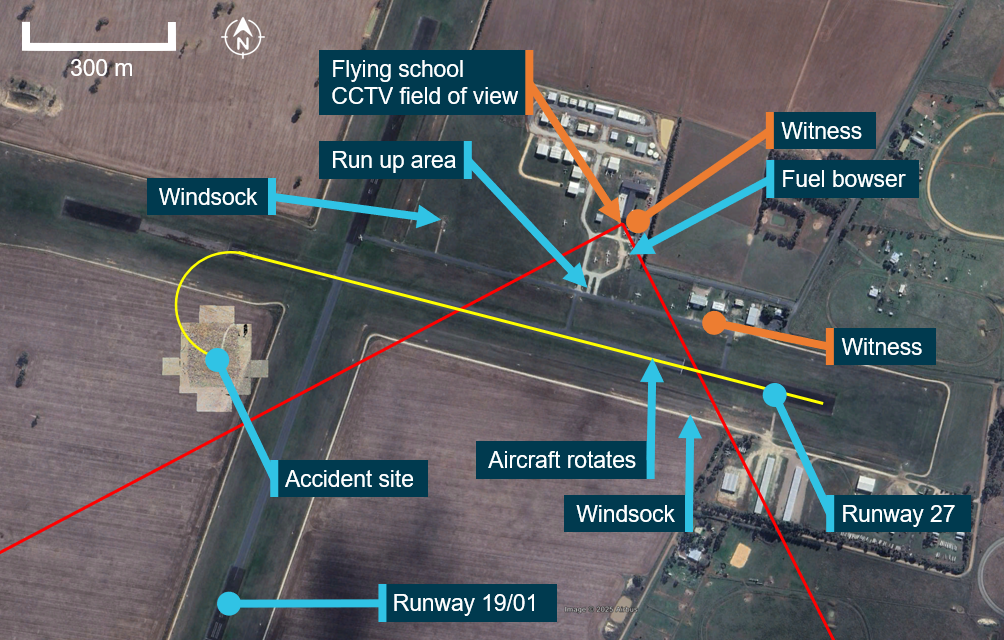
View of Bacchus Marsh ALA showing the runways and approximate flight path of VH-EYU and the accident site. Also shows the CCTV and its field of view, witness and windsock locations.

Source: Google Earth, annotated by the ATSB

Context

Pilot information

The pilot commenced their flight training in July 2019 and held a recreational pilot licence (aeroplane), which was issued on 14 November 2023. They held a single engine aeroplane class rating. The pilot also held navigation, controlled aerodrome, controlled airspace and flight radio endorsements which were issued on 19 April 2024. 

Overall, the pilot had accumulated about 184 hours total aeronautical experience, of which 71.9 hours were in the Cessna 152 and 3.8 hours in the Cessna 150.

The pilot joined Bacchus Marsh Aero Club on 19 August 2024 and had completed 3 club check flights with an independent instructor during September and October 2024. Since joining the club, the pilot had flown a total of 20.1 hours in Cessna 172, Cessna 152 and Cessna 150 aircraft. They had also flown 3.3 hours in a Cessna 152 the previous day. 

The pilot held a Class 2 aviation medical certificate issued by the Civil Aviation Safety Authority, without medical restrictions, which was valid until 19 March 2026.

Post-mortem examination 

The post-mortem and toxicology examinations did not identify any indication of incapacitation or substances that could have affected the pilot’s capacity to perform the flight.

Aircraft information

The Cessna 150L is a high wing, all-metal, 2‑place, single‑engine aircraft with a fixed tricycle landing gear. It is powered by a 4‑cylinder Teledyne‑Continental O‑200‑A engine, driving a 2‑blade fixed‑pitch propeller. VH‑EYU (Figure 2) was manufactured in the United States in 1974 and first registered in Australia in May 1974. It had been owned by the Bacchus Marsh Aero Club since December 2023. 

The aircraft was fitted with a stall warning horn on the left wing, which produces an audible signal to the pilot when the wing is approaching its critical angle of attack (AoA). The Cessna 150L’s stated stall speed in take‑off configuration with wings level was 48 kt.[5]

No crosswind limitation was published in the C150 L model owner’s manual. There was only a need for the manufacturer to demonstrate crosswind capability up to 8.5 kt (20% of the stall speed in a landing configuration). While it is possible that the aircraft may be capable of meeting the controllability standard in higher winds, this had not been established by the manufacturer.

Figure 2: VH-EYU
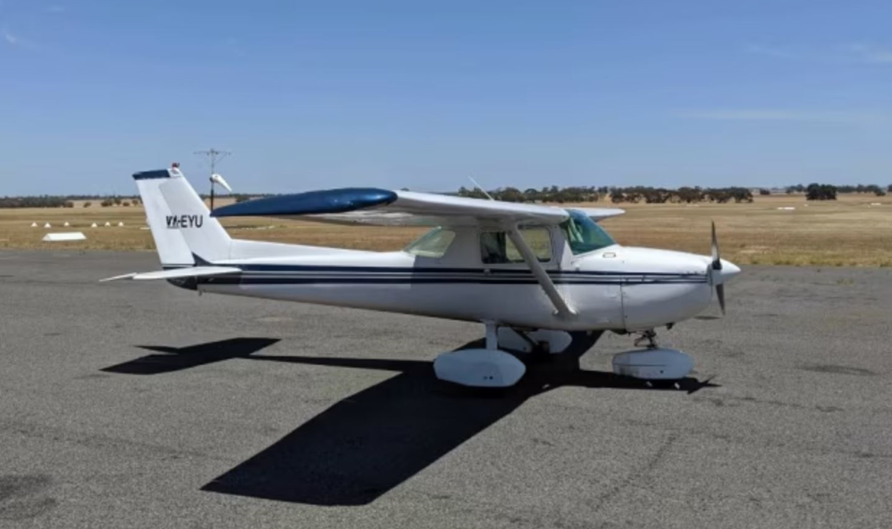
Photo of VH-EYU, provided by Bacchus Marsh Aero Club.

Source: Bacchus Marsh Aero Club

Recent maintenance history

The last 100‑hour periodic maintenance inspection was conducted on 19 January 2024. At the time of the accident, VH‑EYU had accrued a total time in service of 8,962.3 hours. Maintenance records also showed that since January, the following maintenance had been performed:

  • a 50-hour/6-month oil and filter change
  • the left brake was serviced
  • the flap position indicator spring was replaced.

The aircraft had flown about 36.3 hours since the last scheduled maintenance which was conducted on 21 April 2024. There were no open defects recorded on the maintenance release and no outstanding or overdue maintenance was noted. 

Aerodrome information

Bacchus Marsh aircraft landing area (ALA) was located about 6.5 km south of Bacchus Marsh, Victoria. It consisted of 2 sealed runways, 01/19 in a north‑south direction and 09/27 in the east‑west direction. The ALA was home to the Bacchus Marsh Aero Club, a pilot training school and several gliding clubs, as well as several privately owned aircraft. 

The ALA was in non‑controlled Class G airspace. Aircraft operating in the area did not require clearance and a common traffic advisory frequency (CTAF) was available for pilot‑to‑pilot communication. 

Bacchus Marsh Aero Club

Bacchus Marsh Aero Club operated several single-engine aircraft that were available to hire for approved club members, including the Cessna 150, 152, 172 and 182 models. Due to its status of being a private flying club and to satisfy insurance purposes, the club had a procedure in place for an independent flight instructor to conduct flight checks on new members prior to them being approved to fly club aircraft. 

Site information 

The accident site was in a barley field, 205 m south of the runway 27 centreline and to the west of runway 19/01 (Figure 1). The fuselage was orientated to the north. Ground impact marks were directly under the wreckage indicating no forward momentum. The damage signatures showed that the aircraft had impacted the field in a steep nose down attitude with the initial ground contact at the leading edge of the left wing. Severe disruption of the cockpit area, wing assembly and rear fuselage had occurred from the impact (Figure 3).

Figure 3: VH-EYU at the accident site
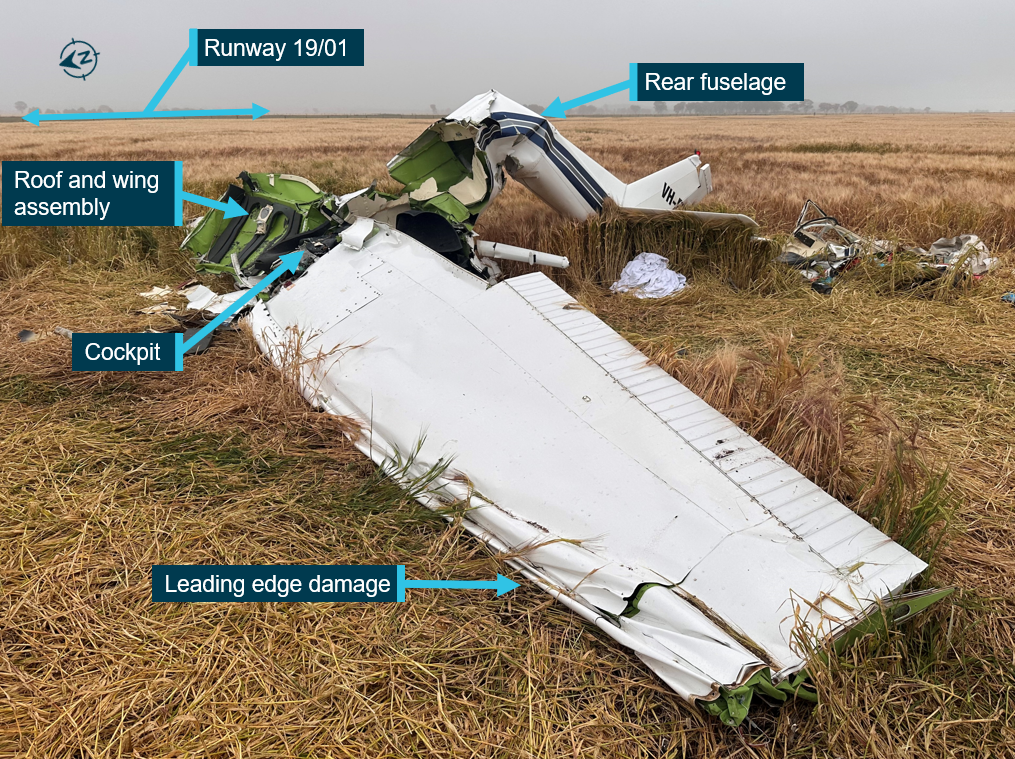
View of VH-EYU wreckage, highlighting the wing, fuselage and cockpit damage.

Source: ATSB

Wreckage examination

The ATSB’s examination of the wreckage did not identify any evidence of pre‑existing faults, flight control issues or engine issues and there was no evidence of birdstrike. 

All components were accounted for at the accident site. The right fuel tank had ruptured, while the left tank remained intact. A quantity of fuel was removed from the aircraft fuel tank for onsite testing and was found to be clean and clear of contaminants. Fuel was removed from the carburettor, which was also tested with no water or contaminants found.

The wings and centre fuselage roof section had separated and moved forwards as a result of the impact. Portions of the airframe were removed by first responders prior to ATSB examination, and these were photographed prior to removal. The stall warning horn on the left wing was damaged in the accident sequence and could not be tested for functionality. The flaps were noted to be retracted, which is the position required in the normal take‑off checklist. 

An examination of the seat rails showed that the pilot seat was locked into position and had not moved prior to the accident.

The engine and propeller displayed no pre‑existing damage. The engine was externally examined, and all components were accounted for. The engine was able to be rotated which indicated no significant internal damage had occurred. 

The propeller and flange had fractured from the engine crankshaft and there was evidence of rotation on the fracture surfaces. The propeller displayed minor rotational scoring and rearward bending which was indicative of low rotational energy at the time of impact. 

The throttle control in the cockpit was set at a low power position and had been bent upwards during the impact sequence. 

Survival aspects

The pilot had been wearing a lap/sash seat belt during the accident flight. The extent of the damage to the occupiable space of the aircraft cabin meant that the impact was not considered survivable.

Aircraft stall and spin behaviour 

Aerodynamic stalls

An aerodynamic stall is a rapid decrease in lift and increase in drag caused by the separation of airflow from the wing’s upper surface. A stall occurs when the angle of attack[6] exceeds the wing’s critical angle of attack,[7] resulting in the disruption to the smooth airflow over the wing. This can ordinarily occur at angles of around 16° (Figure 4). Due to the sudden reduction in lift from the wing and rearward movement of the centre of lift, an uncommanded nose‑down pitch ensues. 

The US Federal Aviation Administration (FAA) Airplane Flying Handbook (2021) states that:

• Impending Stall—an impending stall occurs when the AOA causes a stall warning but has not yet reached the critical AOA. Indications of an impending stall can include buffeting… or aural warning.

• Full Stall—a full stall occurs when the critical AOA is exceeded. Indications of a full stall are typically that an uncommanded nose down pitch cannot be readily arrested and may be accompanied by an uncommanded rolling motion... 

The FAA Airplane Flying Handbook (2021) also states that for an impending stall the pilot should:

…immediately reduce AOA once the stall warning device goes off, if installed, or recognizes other cues such as buffeting. The pilot should hold the nose down control input as required to eliminate the stall warning. Then level the wings maintain coordinated flight, and then apply whatever additional power is necessary to return to the desired flightpath.

Figure 4: Effect of increasing angle of attack leading to a stall condition
View of VH-EYU wreckage, highlighting the wing, fuselage and cockpit damage.

Source: CASA AvSafety, annotated by the ATSB

Aerodynamic spins

A spin can result when an aircraft simultaneously stalls and yaws.[8] The yaw can be initiated by rudder application (through manipulation of the rudder pedals) or by yaw effects from a range of factors that include aileron deflection, torque, wind and engine/propeller effects. A spin is characterised by the aircraft following a downward, corkscrew path and requires significantly more altitude for recovery compared to a wings level stall.

The spin recovery procedure stated in the Cessna 150L handbook was:

For recovery from an inadvertent or intentional spin, the following procedure should be used.

• retard the throttle to idle position

• apply full rudder opposite to the direction of rotation

• after one-fourth turn, move the control wheel forward of neutral in a brisk motion

• as rotation stops, neutralize rudder and make a smooth recovery from the resulting dive. 

Application of aileron in the direction of the spin will greatly increase the rotation rate and delay the recovery. Ailerons should be held in a neutral position throughout the spin and the recovery. Intentional spins with flaps extended are prohibited.

To recover from the spin, the pilot requires sufficient height to conduct the procedure and fly away. During the initial stages of a take‑off, there is insufficient height to perform these actions. 

Control input in a crosswind

In a crosswind, to prevent uncommanded roll, the pilot must turn the control yoke into wind. This will move the ailerons to change the relative angle of attack of each wing (Figure 5). The aileron on the into‑wind wing (right in this case) will move up, create a lower angle of attack and produce less lift. The aileron on the downwind wing (left in this case) will move down, creating a higher angle of attack and more lift. Therefore, resisting the rolling moment created by the crosswind.

Figure 5: Effect of aileron use on angle of attack
Figure shows how the camber of a wing changes with aileron deflection and the effect this has on angle of attack. The left wing shows the camber with neutral aileron. The middle wing represents the low wing in a turn and shows that as the aileron is deflected up, the camber of the wing decreases producing a lower angle of attack. The right wing represents the high wing in a turn and shows that as the aileron is deflected downwards, the camber of the wing increases producing a higher angle of attack.

Source: Flight Safety Australia

Guidance

The FAA Airplane Flying Handbook (2021) states for take‑off in gusty conditions that:

During take-offs in a strong, gusty wind, it is advisable that an extra margin of speed be obtained before the airplane is allowed to leave the ground. A take-off at the normal take-off speed may result in a lack of positive control, or a stall, when the airplane encounters a sudden lull in strong, gusty wind, or other turbulent air currents. In this case, the pilot should allow the airplane to stay on the ground longer to attain more speed, then make a smooth, positive rotation to leave the ground.

A Civil Aviation Safety Authority publication AC 91‑02 v1.2 – Suitable places to take‑off and land, and the FAA publication Personal minimums for wind both identify that is the responsibility of the pilot in command to consider the winds and determine if the aircraft can be operated safely in the prevailing conditions. The FAA publication advises pilots to conduct their own testing in progressively higher winds to determine both their own capability and that of the airframe.

Meteorological information

Forecast weather

The planned flight from Bacchus Marsh to Lethbridge was within the Victoria graphical area forecast (GAF)[9] region. The Bureau of Meteorology issued a GAF which included the Bacchus Marsh area, at 0900 on 22 October 2024, and was valid from 1000‍–‍1600. The forecast indicated visibility greater than 10 km and no cloud. A Grid Point Wind and Temperature Forecast was issued by the Bureau of Meteorology at 0525 on 22 October 2024. No wind and temperature was available in the Bacchus Marsh area below 5,000 ft. 

The Bureau of Meteorology issued aerodrome forecasts (TAF)[10] and meteorological aerodrome reports (METAR)[11] for Melbourne, Essendon, Avalon and Ballarat airports. A special meteorological report (SPECI)[12] was also issued, which highlighted that a significant wind gust had been recorded. 

There was no record that the pilot had used any personal login to access weather forecasts prior to their flight, from any official sources. It is unknown if the pilot had checked a forecast via other sources which did not require accounts for access.

Nearby airport weather

The actual weather at Bacchus Marsh ALA was not recorded and not available. However, forecasts and observation reports were available for nearby airports. Table 1 shows the recorded winds at Melbourne Airport leading up to the accident. Melbourne Airport is about 38 km on a bearing of 78° True (° T) from Bacchus Marsh. 

Table 1: Wind speed and direction recorded at Melbourne Airport

ReportTime (local)Bearing ° TWind speed (kt)Time before accident
METAR10000102274 minutes
SPECI100702021, gusting to 3267 minutes
METAR10300202044 minutes
METAR11000102014 minutes

Source: Bureau of Meteorology 

Table 2 shows the recorded winds at Ballarat Airport leading up to the accident. Ballarat Airport is about 59 km on a bearing of 293° T from Bacchus Marsh.

Table 2: Wind speed and direction recorded at Ballarat Airport

ReportTime (local)Bearing ° TWind speed (kt)Time before accident
METAR10003601374 minutes
METAR10303601344 minutes
METAR11003601014 minutes
METAR113036014-16 minutes

Source: Bureau of Meteorology 

Windsock indication

Figure 6 shows VH-EYU taxiing to the runway threshold in the opposite direction but parallel to the take‑off direction. The visible opening of the orange windsock in the background indicates headwind and crosswind components for take‑off.

Figure 6: VH-EYU taxiing prior to second take‑off
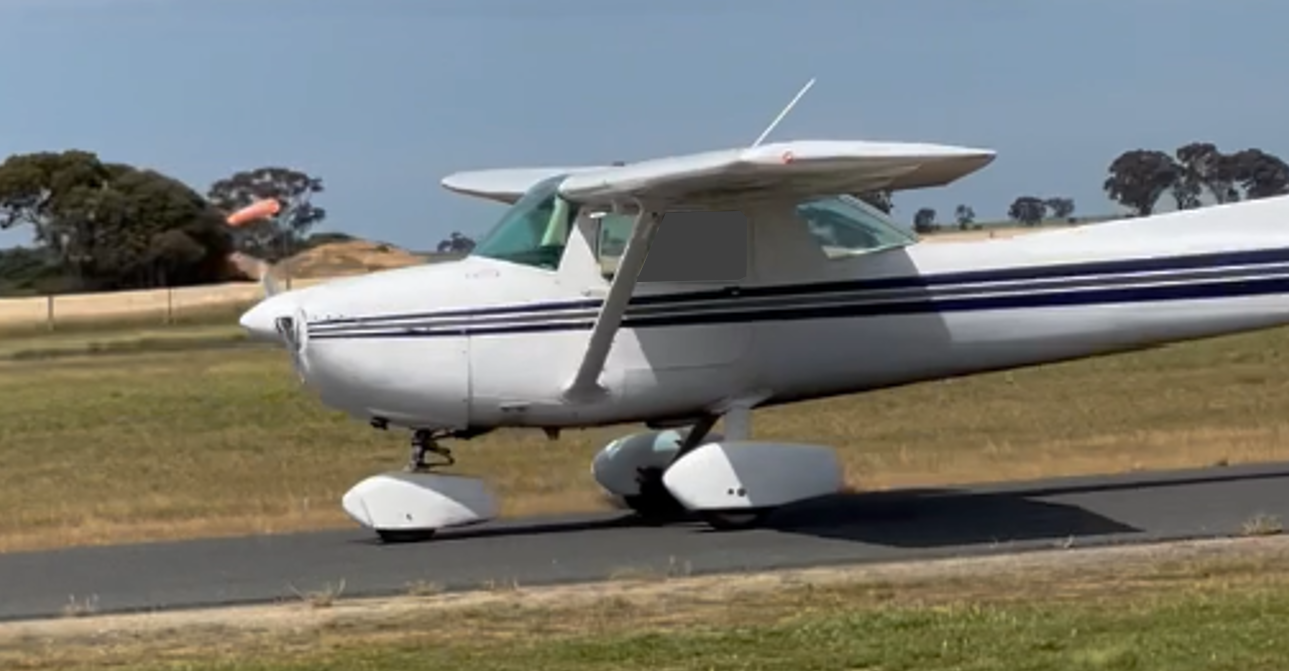
VH-EYU taxiing prior to second take-off with the gliding club windsock in the background showing the strong winds at the time.

Source: Supplied

Witness observations of the weather

A number of witnesses described the temperature to be ‘very hot’ (27°C) with strong and gusting winds at the time of the accident. The winds were changing in strength (15–30 kt) and direction (between runways 27 and 01) (Figure 7). A flight instructor, who was an eyewitness to the accident stated that they had cancelled a student’s flight which was to occur later in the day due to the gusty conditions. 

FlySto data from a Cessna 172

A Cessna 172 was flying nearby at the time of the accident and landed at Bacchus Marsh ALA 10 minutes after the accident. Data from the aircraft was uploaded to FlySto.[13] This data recorded the average wind from ground level up to 3,600 ft over a 40‑minute period. The wind direction varied between 262° T and 335° T and at speeds from 6–32 kt. At the time of the accident, this aircraft was located 14 km (8 NM) to the south of Bacchus Marsh ALA and had recorded a 27 kt wind from 290° T while on descent. The temperature recorded upon landing was 29°C.

A component of this data will be normal changes in wind speed and direction due to changes in altitude. For this reason, the average winds referenced in FlySto cannot be used to determine exact conditions at ground level at the time of the accident. 

Figure 7: Witness observation (red arc) and recorded data from FlySto (orange arc), showing approximate wind directions and speeds around time of VH‑EYU take‑off
Witness observation (red arc) and recorded data from FlySto (orange arc), showing approximate wind directions and speeds around time of VH-EYU take-off.

Source: Google Earth, annotated by the ATSB

CCTV and witness video

CCTV recorded the pilot’s arrival at the airport, refuelling, engine run‑up and control checks, and both take‑off runs. All videos showed evidence of strong and gusting winds creating movement in nearby trees and grass. Pitot cover flags on parked aircraft and clothing of people on the apron were observed flapping in the wind. The videos also captured wind noise varying with gusts.

A gliding club located to the east of the ALA had erected a small windsock, which was observed to be moving erratically with the varying wind strength and directions. The witness video provided, showed this windsock to be a smaller commercially available item. Due to its design, it did not meet the standards[14] for wind direction indicators and therefore was not able to provide any information of wind speed. 

Recorded information

CTAF recording

CTAF recordings provided the standard radio transmissions made by the pilot. The recordings also captured the engine sounds each time a transmission was made and showed that the engine sounded normal throughout the duration of the recordings. 

The pilot sounded calm during transmission and voiced no concern with the engine or aircraft after the first rejected take‑off and subsequent return for the second take‑off. 

Aircraft data

The aircraft was not equipped with either a cockpit voice recorder or a flight data recorder, nor was it required to be. Further, there was no active flight tracking equipment or other devices fitted to the aircraft to provide parameters from the accident flight. 

CCTV

The ATSB conducted frame‑by‑frame analysis of the CCTV of the second take‑off. This analysis showed that the groundspeed of the aircraft was 42 kt when the aircraft became airborne.

Related occurrences

AO-2014-023: Cessna 150G, VH-RXM, Loss of control during initial climb, 18 February 2014, Moorabbin Airport

An instructor and student pilot were conducting a trial instructional flight. The aircraft departed with a 3‍–‍4 kt tailwind. The student was operating the aileron and elevator controls, with the instructor operating the rudder. During the initial climb, the student continued to apply back pressure to the control column resulting in a reduction in optimal airspeed, and a higher‑than‑normal aircraft nose attitude. As the instructor attempted to rectify the aircraft’s profile, the right wing dropped, and the aircraft began to descend. 

The instructor’s efforts to recover the aircraft to a normal climb attitude were not successful, and the right side of the aircraft struck the ground. The aircraft bounced, then came to a halt on its left side. The instructor and student egressed through the right door, and both sustained minor injuries. The aircraft was substantially damaged.

NTSB Docket WPR21LA255 Cessna 150L, N1972L, Collision during take‑off, 30 June 2021, Mud Lake Airport (1U2), Terreton, Jefferson County, Idaho, United States

The pilot reported that, upon landing, they saw a crop duster aircraft descending for a short base for landing on the opposite runway. The pilot initiated a go around with the flaps still extended and with a high-density altitude. The aeroplane attained an altitude of about 50 to 100 ft above ground level when the aeroplane stalled, and the left wing dropped. The pilot attempted to recover but did not have enough height before the aeroplane collided with the ground. The aeroplane nosed over and came to rest inverted. The wings and fuselage were substantially damaged. The pilot and passenger sustained serious injuries.

Safety analysis

While there was no evidence that the pilot accessed official weather forecasts on the day of the accident, the pilot may have consulted informal sources, and they were able to experience the weather at Bacchus Marsh prior to departure. Through the movement of the distant windsock, vegetation, pitot covers on parked aircraft and the clothing of people in view of CCTV and video, it was evident that strong gusting winds were present. Noise on the audio track of CCTV also showed gusts were occurring. 

This supported observations of witnesses at the airfield of the conditions throughout the day and at the time of the accident. It is almost certain the wind conditions would have also been evident to the pilot at the time of take‑off. While no weather recording equipment was available at Bacchus Marsh, the evidence available allowed for an estimate of wind varying from west to north at speeds from around 10 kt gusting to 30 kt.  

There was no evidence of problems with the aircraft. The CCTV showed the pilot conducting pre‑take‑off run-up and control checks prior to the first take‑off. Witnesses and analysis of engine sound from CTAF broadcasts from VH‑EYU confirmed that the engine sounded normal. Additionally, post‑accident examination of the aircraft found no evidence of pre‑accident damage which would have affected the flight. 

There was no stated or discernible reason for the first rejected take‑off. The pilot gave no indication of an aircraft serviceability issue in their radio calls. They did not conduct any additional engine run‑up checks or stop the aircraft to perform any exterior airframe inspection. After exiting the runway, the aircraft was taxied without delay to runway 27 for the second take‑off.

On the second take‑off, CCTV analysis showed the groundspeed of the aircraft was 42 kt when the aircraft became airborne. Based on witness observation and the Cessna 150 measurements, the ATSB estimates the aircraft likely had an airspeed of over 50 kt, marginally faster than the 48 kt stall speed of the aircraft. At that time, crosswind was likely to be around 15 kt. 

Witnesses identified and CCTV footage showed that the aircraft’s attitude was unstable after becoming airborne. This indicates that the aircraft was affected by the strong, variable and gusting headwind and crosswind components as the pilot attempted the second take‑off. These uncommanded wind‑driven movements would require constant aircraft attitude adjustments by the pilot.

The flight instructor’s observation of the steep pitch‑up and controlled lowering of the nose which occurred at around 50 ft is consistent with the pilot manipulating the controls to avoid the aircraft descending back onto the runway and to maintain a suitable airspeed and take-off profile. The second uncorrected steep pitch‑up which occurred at around 150 ft, and the subsequent dropping of the left wing and nose resulting in entry into a left incipient spin, was consistent with a fully developed stall and loss of control in flight. This, in turn, was consistent with evidence of the accident site, in which the aircraft wreckage was confined to a small area, with evidence of a high vertical impact and low forward speed. 

In this accident, it is almost certain that, after take‑off and at low level, the aircraft was subjected to a strong and gusting wind. The nature of the prevailing winds increased the likelihood of a drop in airspeed during a phase of flight where the aircraft was flown at a high angle of attack, leading to an impending stall condition. 

It is possible that the impending stall period was very short due to gust strength and the pitch‑up movement created conditions for aerodynamic stall. Further, as the airspeed at take‑off was likely only a few knots higher than the stall speed, there was minimal buffer to account for any sudden drop of wind strength. The evidence indicates that the angle of attack of the wings increased beyond the critical angle, the left wing of the aircraft aerodynamically stalled, and the aircraft entered the incipient phase of a spin. The stalling of the left wing indicates that the angle of attack on the left wing was higher than that on the right. This is likely due to control inputs to counteract a crosswind from the right.

The actions that take place when the aircraft enters a spin require the pilot to retard the throttle. The throttle position in the aircraft was found in a low power setting, which was likely due to the pilot responding to the aircraft entering the incipient phase of a spin. Because the aircraft stalled at a height of about 150 ft, there was insufficient height to recover before the aircraft collided with terrain. 

Findings

ATSB investigation report findings focus on safety factors (that is, events and conditions that increase risk). Safety factors include ‘contributing factors’ and ‘other factors that increased risk’ (that is, factors that did not meet the definition of a contributing factor for this occurrence but were still considered important to include in the report for the purpose of increasing awareness and enhancing safety). In addition ‘other findings’ may be included to provide important information about topics other than safety factors. 

These findings should not be read as apportioning blame or liability to any particular organisation or individual.

From the evidence available, the following finding is made with respect to the loss of control and collision with terrain involving Cessna 150L, VH-EYU, at Bacchus Marsh aircraft landing area, Victoria, on 22 October 2024. 

Contributing factors

  • It is probable that the aircraft was too slow on take‑off for the strong and gusty wind conditions and significant crosswind, meaning there was minimal buffer to manage an impending stall.  Shortly after take‑off, the aircraft stalled at a height too low to recover, resulting in a collision with terrain. 

Sources and submissions

Sources of information

The sources of information during the investigation included:

  • Bacchus Marsh Aero Club
  • Civil Aviation Safety Authority
  • Victoria Police
  • the maintenance organisation for VH-EYU
  • Airservices Australia
  • Bureau of Meteorology
  • Peninsula Aero Club
  • Oxford Aviation Academy
  • TVSA Pilot Training
  • witnesses
  • video footage of the accident flight and other videos taken on the day of the accident
  • recorded CTAF communications. 

References

Civil Aviation Safety Authority 2019, Strong and gusty winds, Civil Aviation Safety Authority, Canberra, ACT Strong and gusty winds | Flight Safety Australia

Civil Aviation Safety Authority 2020, Advisory Circular AC 61-16v1.0, Civil Aviation Safety Authority, Canberra, ACT, https://www.casa.gov.au/spin-avoidance-and-stall-recovery-training

Civil Aviation Safety Authority 2020, Part 139 (Aerodromes) Manual of Standards 2019, Civil Aviation Safety Authority, Canberra, ACT, Part139_(Aerodrome)_MOS.pdf pp 196-198.

Civil Aviation Safety Authority 2019, Rudder, ailerons, stalls and spins, Civil Aviation Safety Authority, Canberra, ACT Rudder, ailerons, stalls and spins | Flight Safety Australia

Civil Aviation Safety Authority 2022, Stalls in the circuit, Civil Aviation Safety Authority, Canberra, ACT Stalls in the circuit | Flight Safety Australia 

Civil Aviation Safety Authority 2022, Advisory Circular AC 91-02v1.2, Civil Aviation Safety Authority, Canberra, ACT https://www.casa.gov.au/guidelines-aeroplanes-mtow-not-exceeding-5-700-kg-suitable-places-take-and-land pp21-22.

Civil Aviation Safety Authority 2024, AvSafety: Preventing a stall at low level, Civil Aviation Safety Authority, Canberra, ACT, Preventing a stall at low level

Federal Aviation Administration 2021, Airplane Flying Handbook (FAA-H-8083-3C), Federal Aviation Administration, Washington DC Airplane Flying Handbook 

National Transportation Safety Board 2015, NTSB Safety Alert 19 / Prevent Aerodynamic Stalls at Low Altitude, National Transportation Safety Board, Washington DC NTSB Safety Alert 19 / Prevent Aerodynamic Stalls at Low Altitude

Submissions

Under section 26 of the Transport Safety Investigation Act 2003, the ATSB may provide a draft report, on a confidential basis, to any person whom the ATSB considers appropriate. That section allows a person receiving a draft report to make submissions to the ATSB about the draft report. 

A draft of this report was provided to the following directly involved parties:

  • the Civil Aviation Safety Authority
  • the Bacchus Marsh Aero Club
  • the National Transportation Safety Board.

Any submissions from those parties were reviewed and, where considered appropriate, the text of the draft report was amended accordingly.

Purpose of safety investigations

The objective of a safety investigation is to enhance transport safety. This is done through: 

  • identifying safety issues and facilitating safety action to address those issues
  • providing information about occurrences and their associated safety factors to facilitate learning within the transport industry.

It is not a function of the ATSB to apportion blame or provide a means for determining liability. At the same time, an investigation report must include factual material of sufficient weight to support the analysis and findings. At all times the ATSB endeavours to balance the use of material that could imply adverse comment with the need to properly explain what happened, and why, in a fair and unbiased manner. The ATSB does not investigate for the purpose of taking administrative, regulatory or criminal action.

Terminology

An explanation of terminology used in ATSB investigation reports is available here. This includes terms such as occurrence, contributing factor, other factor that increased risk, and safety issue.

Publishing information

Released in accordance with section 25 of the Transport Safety Investigation Act 2003

Published by: Australian Transport Safety Bureau

© Commonwealth of Australia 2025

Title: Creative Commons BY - Description: Creative Commons BY

Ownership of intellectual property rights in this publication

Unless otherwise noted, copyright (and any other intellectual property rights, if any) in this report publication is owned by the Commonwealth of Australia.

Creative Commons licence

With the exception of the Commonwealth Coat of Arms, ATSB logo, and photos and graphics in which a third party holds copyright, this report is licensed under a Creative Commons Attribution 4.0 International licence.

The CC BY 4.0 licence enables you to distribute, remix, adapt, and build upon our material in any medium or format, so long as attribution is given to the Australian Transport Safety Bureau. 

Copyright in material obtained from other agencies, private individuals or organisations, belongs to those agencies, individuals or organisations. Where you wish to use their material, you will need to contact them directly.

[1]      Visual flight rules (VFR): a set of regulations that permit a pilot to operate an aircraft only in weather conditions generally clear enough to allow the pilot to see where the aircraft is going.

[2]      Run-up area: a designated area of an airfield where pilots can perform functional pre-flight checks of aircraft systems.

[3]      Runway number: the number represents the magnetic heading of the runway. In this case, ‘27’ represents a magnetic heading of 270°.

[4]      Common traffic advisory frequency (CTAF): radio frequency on which pilots monitor and use to make positional broadcasts when operating within a 10 NM radius of the airport.

[5]      The Cessna 150L Owner’s Manual lists all speeds in miles per hour. 

[6]      Angle of attack: the acute angle between the chord line of the airfoil and the direction of the relative wind.

[7]      Critical angle of attack. the angle of attack at which a wing stalls regardless of airspeed, flight attitude, or weight.

[8]      Yaw: the motion of an aircraft about its vertical or normal axis.

[9]      Graphical Area Forecast (GAF): provides information on weather, cloud, visibility, icing, turbulence and freezing level in a graphical layout with supporting text.

[10]    Aerodrome Forecast (TAF): a statement of meteorological conditions expected for the specified period of time in the airspace within 5 nautical miles (9 km) of the aerodrome reference point.

[11]    METAR (Meteorological Aerodrome Report) is a routine aerodrome weather report issued at half hourly time intervals. The report ordinarily covers an area of 8 km radius from the aerodrome reference point.

[12]    SPECI: a special report of meteorological conditions, issued when one or more elements meet specified criteria significant to aviation.

[13]    FlySto is a web-based application that allows for upload and interpretation of flight data from a range of avionics devices.

[14]    The standards for windsocks are outlined in Part 139 Aerodrome Manual of Standards, which provides information for windsocks and their interpretation.

Preliminary report

Report release date: 16/12/2024

This preliminary report details factual information established in the investigation’s early evidence collection phase and has been prepared to provide timely information to the industry and public. Preliminary reports contain no analysis or findings, which will be detailed in the investigation’s final report. The information contained in this preliminary report is released in accordance with section 25 of the Transport Safety Investigation Act 2003

The occurrence

On 22 October 2024, at about 1110 local time, the pilot of a Cessna 150L registered VH‑EYU, commenced the take-off roll on runway 27[1] at Bacchus Marsh airfield, Victoria (Figure 1). Shortly after, the pilot made a radio call stating that they were rejecting the take‑off. The aircraft was then taxied off the runway and returned to the threshold of runway 27, where at 1114 the pilot recommenced the take-off.

Several witnesses at the airfield observed the second take-off and identified that, during its initial climb, the aircraft attitude pitched steeply upward. Witnesses described that the left wing dropped rapidly. The aircraft then entered a vertical descent, rotating approximately 270° before colliding heavily with terrain. The pilot (who was the sole occupant) sustained fatal injuries and the aircraft was destroyed. There was no post-impact fire. 

Figure 1: Bacchus Marsh airfield and VH-EYU accident location
Figure 1: Bacchus Marsh airfield and VH-EYU accident location

Source: Google Earth, annotated by the ATSB

Context

Pilot information

The pilot held a Recreational Pilot Licence (Aeroplane) and a Class 2 Aviation Medical Certificate, valid until March 2026. The pilot held a single engine aeroplane rating, and navigation endorsement. At the time of the accident, the pilot had about 184 hours total aeronautical experience, of which 3.8 hours were in Cessna 150 aircraft. 

Aircraft information

The Cessna 150L is a high wing, all-metal, 2-place, single-engine aircraft with a fixed tricycle landing gear. It is powered by a 4-cylinder Teledyne-Continental O-200-A engine, driving a 2-blade fixed-pitch propeller. The aircraft was manufactured by Cessna in the United States in 1974 and first registered in Australia in May 1974. It had been owned by the Bacchus Marsh Aero Club since December 2023 (Figure 2).

The last 100-hour periodic maintenance inspection was conducted on 19 January 2024. At the time of the accident, it had accrued a total time in service of 8,962.3 hours. The aircraft had flown about 34 hours since the last scheduled maintenance which was conducted on 21 April 2024. There no known defects documented on the aircraft maintenance release.

Figure 2: VH-EYU
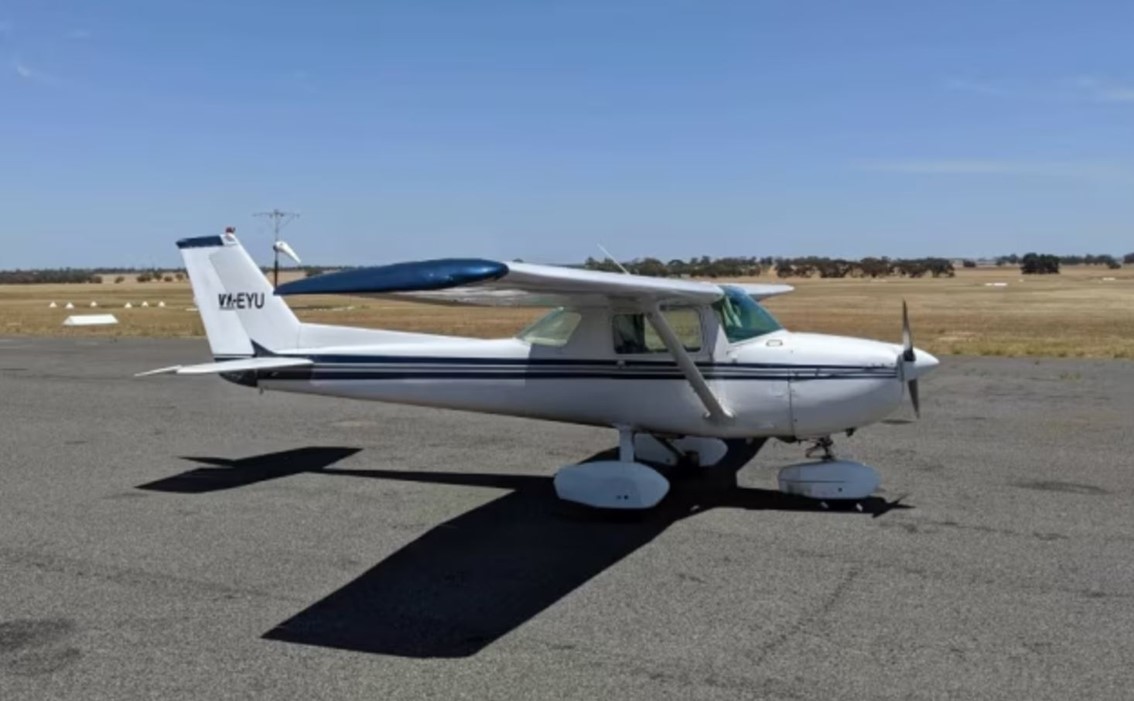
Figure 2: VH-EYU

Source: Bacchus Marsh Aero Club

Aerodrome information

Bacchus Marsh airfield is located about 6.5 km south of Bacchus Marsh, Victoria, Australia. It is an aircraft landing area (ALA) consisting of 2 sealed north/south (01/19) and east/west (09/27) runways. The airfield was primarily used by the Bacchus Marsh Aero Club, a pilot training school and several gliding clubs. 

Bacchus Marsh Aero Club

Bacchus Marsh Aero Club operates several high wing single-engine aircraft available to hire for approved club members, including the Cessna 150, 152, 172 and 182. The pilot joined the club on 19 August 2024 and subsequently completed check rides with an instructor on 13 September, 27 September and 4 October 2024.

Site information 

ATSB investigators first attended the accident site on 23 October 2024. The aircraft had impacted into a barley field 205 m south of the runway 27 centreline and was orientated toward the north. The damage signatures confirmed that it had impacted the field in a steep nose down attitude. Severe disruption of the cockpit area, the wing assembly and rear fuselage had occurred from the impact (Figure 3).

Figure 3: VH-EYU at the accident site near to the airfield runways
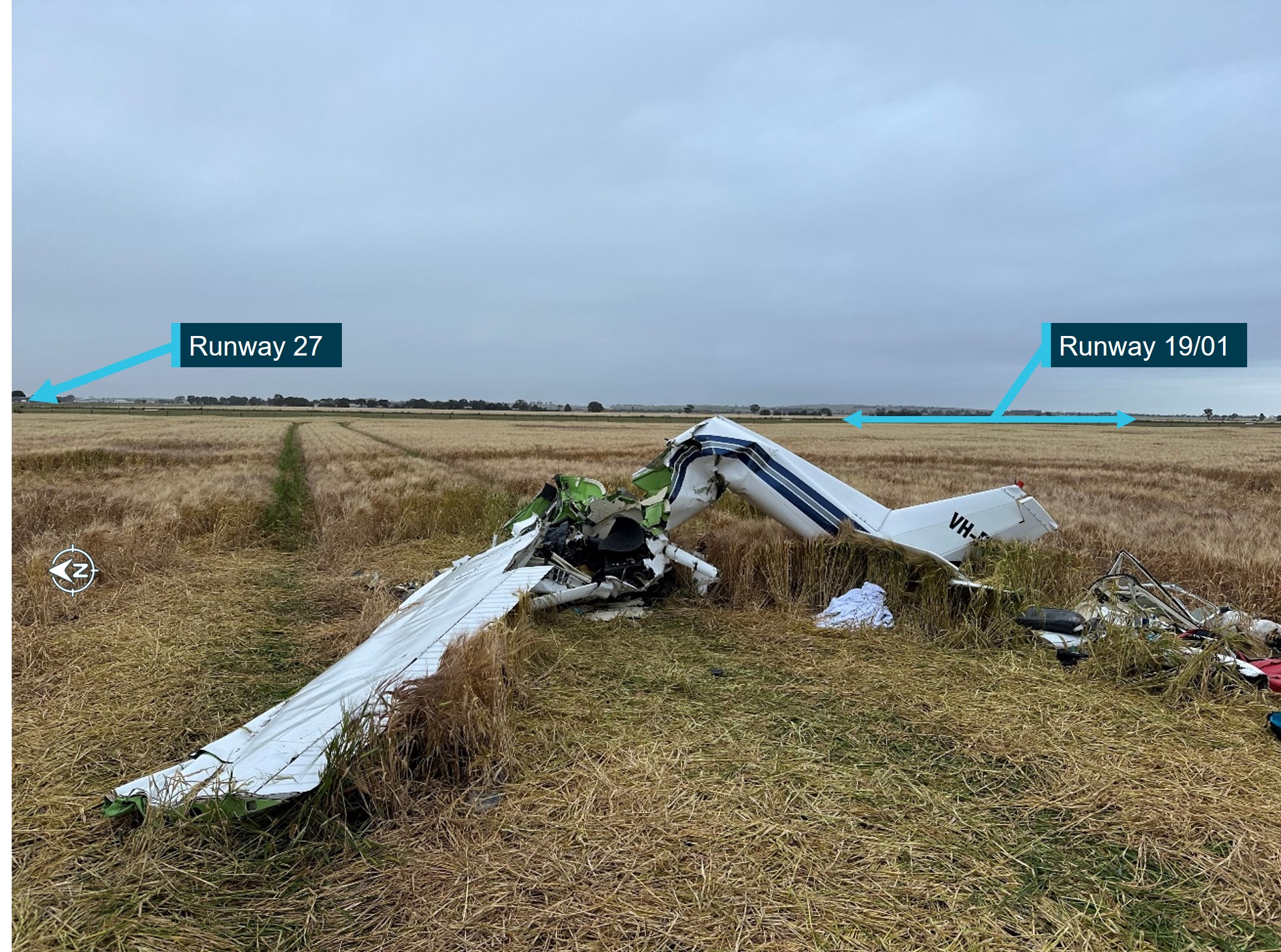
Figure 3: VH-EYU at the accident site near to the airfield runways

Source: ATSB

Wreckage examination

The ATSB conducted a preliminary examination of the aircraft wreckage in the field, then moved the wreckage to a secure hangar for detailed examination. The examinations identified:

  • no evidence of pre-impact defects with the flight controls or structure
  • all components were accounted for at the accident site
  • the engine was able to be rotated and there were no obvious defects upon external examination
  • the throttle setting was at idle position (low power)
  • rotational damage signatures to the propeller were minimal which indicated a low engine power setting at the time of the impact
  • the propeller and flange had fractured from the engine crankshaft.

A quantity of fuel was removed from the aircraft for onsite testing and was found to be clean and clear of contaminants. 

Meteorological information

Forecast

The Bureau of Meteorology (BoM) issued a graphical area forecast that included the Bacchus Marsh area, at 0900 on 22 October 2024, that was valid from 1000–1600. The forecast indicated visibility greater than 10 km and no cloud. 

Witness observations of the weather

Witnesses at Bacchus Marsh airfield described the wind at the time of the accident as strong and gusty, changing in direction and strength. A flight instructor stated that they had cancelled a student’s flight due to the increasingly gusty conditions which were present on the day. 

Meteorological observations 

There was no BoM aerodrome weather information specifically for Bacchus Marsh, but the ATSB obtained meteorological observations for the surrounding areas of Melbourne, Essendon, Avalon and Ballarat airports (Figure 4).

Figure 4: Location of Bacchus Marsh airfield relative to nearby aerodrome weather forecast locations
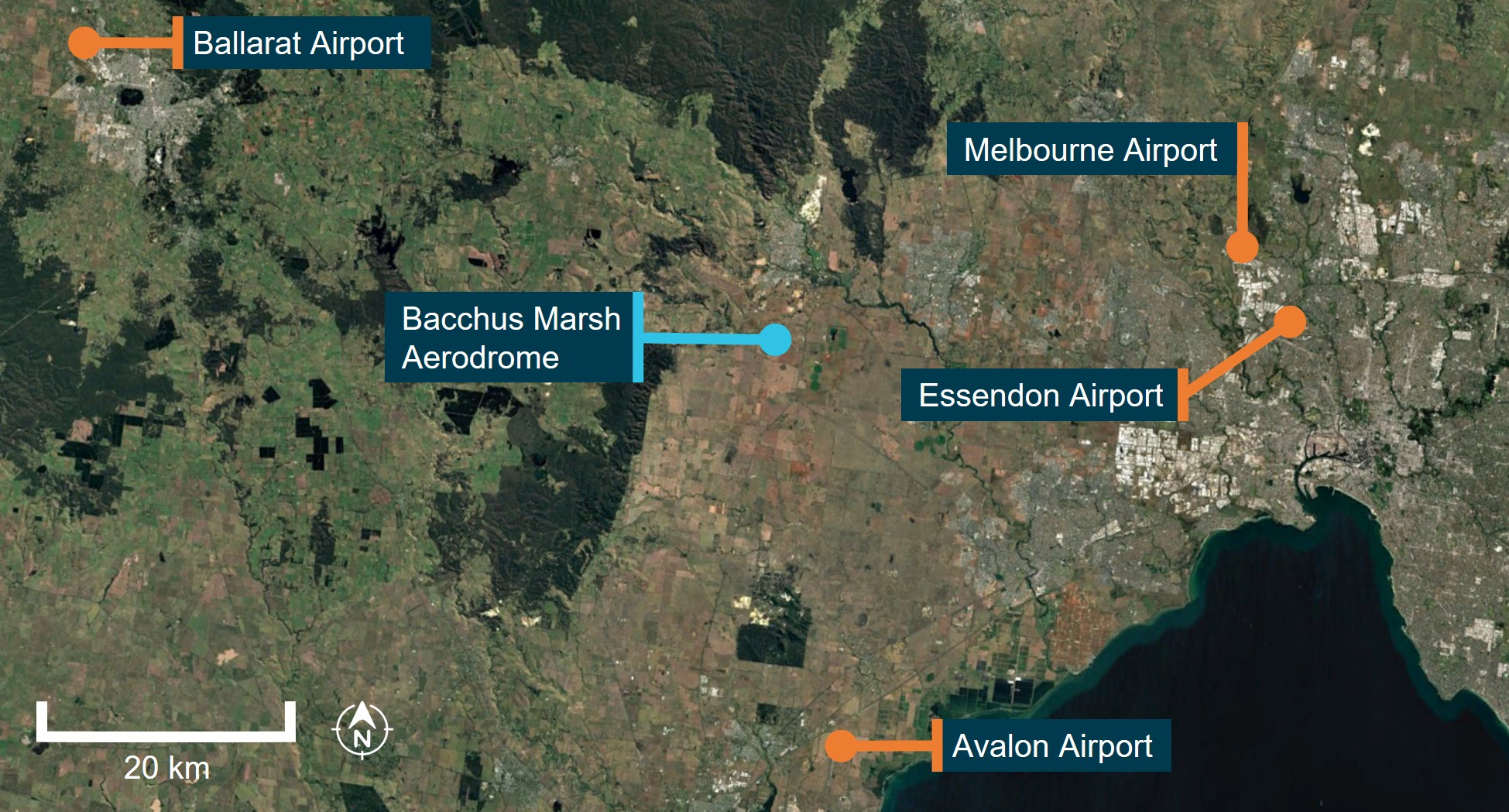
Figure 4: Location of Bacchus Marsh airfield relative to nearby aerodrome weather forecast locations

Source: Google Earth, annotated by the ATSB

Table 1 shows the recorded winds in meteorological aerodrome reports (METAR)[2] and special meteorological reports (SPECI)[3] issued between 1000 and 1200 on 22 October 2024. The wind direction is in degrees true[4] rounded to the nearest 10 degrees. The wind direction and speed are the mean values over 10 minutes, and the gust is the maximum wind speed over a 2-minute period.

Table 1: Aerodrome wind observations

TimeMelbourneEssendonAvalonBallarat
1000010° 22 kt360° 15 kt020° 8 kt360° 13 kt
1007[1]020° 21 kt gusting to 32 kt   
1020[1] 360° 17 kt gusting to 27 kt  
1030020° 20 kt360° 16 kt360° 10 kt360° 13 kt
1100010° 20 kt360° 18 kt330° 12 kt360° 10 kt
1130010° 19 kt360° 15 kt350° 12 kt360° 14 kt
1200010° 17 kt360° 15 kt350° 11 kt360° 16 kt

[1] SPECI

Further investigation

To date, the ATSB has:

  • examined the aircraft wreckage
  • conducted witness interviews
  • reviewed common traffic advisory frequency recordings
  • reviewed CCTV footage and mobile phone footage
  • obtained weather information.

The investigation is continuing and will include:

  • further review of the pilot’s experience, qualifications and training
  • further review and analysis of recorded CCTV and mobile phone footage
  • further analysis of the weather conditions
  • examination of the aircraft maintenance history.

A final report will be released at the conclusion of the investigation. Should a critical safety issue be identified during the course of the investigation, the ATSB will immediately notify relevant parties so appropriate and timely safety action can be taken. 

Purpose of safety investigations

The objective of a safety investigation is to enhance transport safety. This is done through: 

  • identifying safety issues and facilitating safety action to address those issues
  • providing information about occurrences and their associated safety factors to facilitate learning within the transport industry.

It is not a function of the ATSB to apportion blame or provide a means for determining liability. At the same time, an investigation report must include factual material of sufficient weight to support the analysis and findings. At all times the ATSB endeavours to balance the use of material that could imply adverse comment with the need to properly explain what happened, and why, in a fair and unbiased manner. The ATSB does not investigate for the purpose of taking administrative, regulatory or criminal action.

Terminology

An explanation of terminology used in ATSB investigation reports is available here. This includes terms such as occurrence, contributing factor, other factor that increased risk, and safety issue.

Publishing information

Released in accordance with section 25 of the Transport Safety Investigation Act 2003

Published by: Australian Transport Safety Bureau

© Commonwealth of Australia 2024

Title: Creative Commons BY - Description: Creative Commons BY

Ownership of intellectual property rights in this publication

Unless otherwise noted, copyright (and any other intellectual property rights, if any) in this report publication is owned by the Commonwealth of Australia.

Creative Commons licence

With the exception of the Commonwealth Coat of Arms, ATSB logo, and photos and graphics in which a third party holds copyright, this report is licensed under a Creative Commons Attribution 4.0 International licence.

The CC BY 4.0 licence enables you to distribute, remix, adapt, and build upon our material in any medium or format, so long as attribution is given to the Australian Transport Safety Bureau. 

Copyright in material obtained from other agencies, private individuals or organisations, belongs to those agencies, individuals or organisations. Where you wish to use their material, you will need to contact them directly.

[1]     Runway number: the number represents the magnetic heading of the runway. In this case, 27 represents a magnetic heading of 270°.

[2]     METAR: a routine aerodrome weather report issued at half hourly time intervals.

[3]     SPECI: a special aerodrome weather report issued only when meteorological parameters meet specific criteria.

[4]     The magnetic variation at Bacchus Marsh was 11° east.

Occurrence summary

Investigation number AO-2024-053
Occurrence date 22/10/2024
Location Bacchus Marsh aircraft landing area
State Victoria
Report release date 10/07/2025
Report status Final
Investigation level Short
Investigation type Occurrence Investigation
Investigation status Completed
Mode of transport Aviation
Aviation occurrence category Collision with terrain, Loss of control
Occurrence class Accident
Highest injury level Fatal

Aircraft details

Manufacturer Cessna Aircraft Company
Model 150L
Registration VH-EYU
Serial number 15075559
Aircraft operator Bacchus Marsh Aero Club
Sector Piston
Operation type Part 91 General operating and flight rules
Departure point Bacchus Marsh, Victoria
Destination Bacchus Marsh, Victoria
Damage Destroyed

Mid-air collision south-west Sydney

The ATSB will investigate a mid-air collision between two light aircraft, a Jabiru and a Cessna 182, south-west of Sydney on Saturday.

A team of transport safety investigators from the ATSB's Canberra office, with experience in aircraft operations and maintenance, is preparing to deploy to the accident sites of both aircraft to begin evidence-collecting activities.

Over coming days, investigators will undertake site mapping, examine the wreckage of both aircraft, and recover any relevant components for further examination at the ATSB’s technical facilities in Canberra.

Investigators will also seek to interview any witnesses and involved parties, and collect relevant recorded information including any air traffic control and flight tracking data, as well as pilot and aircraft maintenance records, and weather information.

The ATSB asks anyone who may have witnessed and has footage of the accident, or who has footage of either aircraft in any phase of their flights, to contact us via the witness form on our website at their earliest convenience.

The ATSB will release a preliminary report detailing factual information established in the investigation’s evidence-gathering phase in about two months. A final report will be released at the conclusion of the investigation and will detail analysis and findings.

However, if at any point during the investigation we uncover any critical safety issues we will immediately inform relevant parties so they can take safety actions.

Safety actions taken after Kembla Grange passenger train derailment

A range of safety actions have been taken in response to the derailment of a Sydney Trains passenger service which collided with an abandoned vehicle at Kembla Grange, south of Wollongong.

In the early hours of 20 October 2021, a four-carriage Tangara train was operating from Kiama towards Sydney’s Central Station when it collided with an abandoned motor vehicle on the tracks near the level crossing at West Dapto Road.

On impact, the first carriage derailed, but continued upright for about 125 m, before colliding with a stanchion, tipping on its side, jack-knifing, and separating from the rest of the train.

The train driver sustained serious injuries, and two passengers in the front carriage were also injured. There was significant damage to rolling stock, rail infrastructure and overhead wiring.

A transport safety investigation was undertaken by the Office of Transport Safety Investigations (OTSI), which conducts rail investigations in New South Wales on behalf of the ATSB.

Separately, an individual was charged by NSW Police with endangering passengers on a railway, and obstructing a railway.

“About 45 minutes before the collision, an individual moved CCTV cameras monitoring the West Dapto Road level crossing, and this tampering was not detected by Sydney Trains Security Control Centre,” OTSI Chief Investigator Jim Modrouvanos outlined.

“At some point over the next 40 minutes, a motor vehicle was driven onto the tracks, where it became stuck, and was subsequently abandoned.”

While incidents resulting from alleged criminal activity are not typically subject to transport safety investigations, this occurrence shed light on a number of broader safety factors.

Among them, the investigation identified Sydney Trains Security did not detect the camera tampering prior to the accident, with the CCTV tamper alarms not activated.

“Additionally, a member of public called triple zero to alert police of a vehicle on the rail line about four minutes before the accident – but this was not treated as an emergency by all parties involved,” Mr Modrouvanos said.

When Sydney Trains was alerted to the emergency, two minutes before the accident, this information was passed from the Security Control Centre Operator to the relevant Train Services Delivery Manager, then to the Wollongong Coast Panel Signaller, who then made a point to point call to the train driver, which was not answered.

“This process of reporting was not consistent with Sydney Trains’ Network Incident Management Plan, and not all parties in the process treated the call as an emergency,” Mr Modrouvanos explained.

After the incident, the investigation identified the train’s guard was unable to make an emergency call on the Digital Train Radio System, as it had gone into standby mode, likely due to the separation of carriages.

“The guard’s training and other available resources did not provide the knowledge needed to reboot the Digital Train Radio System,” Mr Modrouvanos said.

“Finally, the derailment brought down potentially live 1,500 V overhead wires. While the guard and first responders were moving around the wreckage to help passengers, this overhead wiring had not been confirmed as isolated.”

Since the accident, Sydney Trains conducted its own technical and systemic investigations, and shared its 14 internal recommendations with OTSI. These recommendations and additional safety issues raised by OTSI were addressed through safety actions, detailed in today’s final report.

Actions taken include updating initial training for Security Control Centre Operators to improve communication during emergencies, and a CCTV software upgrade to allow use of a centralised server-based analytics engine to provide alarm functionality.

At the time of publication, Sydney Trains remains in the process of developing, testing and trialling alarm functionality to enable detection of incidents, such as tampering, at the West Dapto level crossing, among others across its network.

Sydney Trains has also updated its Security Control Centre’s standard operating procedures, to eliminate a conflicting instruction which was also identified during the investigation.

Mr Modrouvanos welcomed the actions taken by the operator.

“All obstructions reported on the rail line should be treated as an emergency, and priority should be given to urgently stop trains on the network and avoid a collision by the most effective means available,” he said.

“More broadly, all rail operators should assess their risk exposure in circumstances where they have been unable to implement planned controls – and they should consider implementing alternative or short-term controls to reduce the risk exposure until the agreed controls are in place.”

Read the final report: Collision between a passenger train and a motor vehicle, near West Dapto Road level crossing, Kembla Grange, New South Wales on 20 October 2021

Collision with terrain during go-around involving Cessna U206F, VH-TDQ, 39 km south-east of Moora, Western Australia, on 1 September 2024

Final report

Report release date: 30/06/2025

Investigation summary

What happened

On the morning of 1 September 2024, the pilot of a Cessna U206F, registered VH-TDQ and operated by Fly Esperance, departed a private aircraft landing area 21 NM (39 km) southeast of Moora, Western Australia (WA) with 5 passengers onboard for a 15-minute local area flight. On return to the landing area, the aircraft bounced twice on landing before the pilot attempted a go‑around. During the go-around, the pilot incorrectly set the flap, and the aircraft lost height impacting its right wing with terrain, resulting in minor damage. The aircraft then touched down on the landing gear in a field adjacent to the runway. 

The pilot then evacuated the passengers. The front seat and middle row passengers egressed through the pilot’s forward left cabin door. The pilot then proceeded to assist the egress of 2 passengers seated in the rear seat row of the aircraft through the right-side cargo door emergency exit. The aircraft’s flaps remained extended in the 10° position which blocked the forward half of the cargo door emergency exit. The pilot was unable to retract the flaps and the passengers, an older person and child, were then forced to climb over the middle row of seats and egress through the pilot’s forward left cabin door. None of the occupants reported injuries.

What the ATSB found

On return to the aircraft landing area, the pilot conducted a non-standard approach to join the circuit. This reduced the time available for the pilot to configure the aircraft, manage the airspeed and prepare for a short field landing. 

As a result of excess speed on approach for a full flap, short field landing, the aircraft landed long and bounced twice, at which point the pilot elected to conduct a go-around. As the aircraft began to climb away, the pilot retracted the flap further than intended and as a result, the aircraft could not achieve adequate climb performance.

The rear emergency exit was the double cargo doors, which required the forward half of the door to be opened before the rear door could be opened. With the flaps extended in the 10° position when the aircraft came to rest, the full opening of the forward cargo door was not possible. The forward door could still be made ajar with the flaps extended, enough to reach and operate the rear door handle. However, the rear seat passengers were not fully aware how to do this and were unable to open the rear cargo door to enable an emergency exit.

The pilot attempted to assist the rear seat passengers’ egress from outside the aircraft, however they were unaware that the rear cargo door on the Cessna 206 could be opened from the outside when the front cargo door was blocked by the extended flaps. After the pilot unsuccessfully attempted to retract the flaps, they instructed the passengers to climb over the middle row seats to egress via the pilot’s forward left cabin door.

The ATSB found that the operator’s pre-flight passenger briefing did not include the demonstration of, and pilots were not trained how to operate, the emergency exit via the cargo door with the flaps extended. 

Similar to previous ATSB and international investigations involving Cessna 206 accidents requiring emergency egress, it was found that without the installation of optional cargo door modifications or a reduction in passenger seats, the emergency egress of rear seat passengers was impeded when the flaps are extended. The difficulty in egressing via the cargo door emergency exit (when flaps were extended) increases risk to passenger survivability in the event of a post-accident fire or water ditching. This has been formally recognised in Canada where cargo door modifications are compulsory unless middle row passenger seating is reduced. However, this is not the case in the United States, where the Cessna 206 was certified, nor in Australia. 

What has been done as a result

To advise Cessna 206 pilots and operators of the difficulties occupants have encountered egressing the rear cargo door as identified in several transport safety investigations, the ATSB issued safety advisory notice (AO-2024-049-SAN-001). The safety advisory notice encourages pilots and operators to ensure a thorough pre-flight passenger demonstration is conducted of the rear cargo emergency exit egress when the wing flap remains extended.

Fly Esperance Pty Ltd also advised that a staff training exercise had been conducted to demonstrate the process for operating the rear door in the event of post-landing flap extension and has advised that this procedure is to be emphasised on all pre-departure passenger briefings. The ATSB will monitor this safety action until the adoption of procedural changes to staff training and operational pre-flight safety briefings.

Furthermore, a second safety advisory notice was issued to strongly encourage operators and owners to review Transport Canada Airworthiness Directive CF-2020-10, and consider either the removal of a middle row seat to improve rear seat occupants’ access to the pilot’s forward left cabin door or the fitment of approved Cessna 206 emergency exit modifications to reduce the risk created by the extended flap preventing the immediate and unobstructed use of the rear cargo doors during an emergency exit.

Fly Esperance Pty Ltd advised it is in the process of investigating the various STCs mentioned in the report, to see which will be best suited to VH-TDQ in order to improve egress from the aircraft in the event of flaps being deployed.

After the occurrence, the operator conducted an internal review and has made the following amendments to the company operations manual:

  • Added pictorial for non-controlled aerodrome circuit procedure to clarify the joining procedure at non-controlled aerodromes.
  • To assist pilots to identify a stable approach an aircraft landing weight table has been added, indicating the recommended speeds for landing with aircraft flaps retracted and extended.
  • Company aircraft will now have portable GPS tracking devices improving the visibility of the aircraft when away from base.
  • The operator also reported that a greater emphasis will be placed on pilots-in-command under supervision training prior to a company line check, highlighting what can happen when standard procedures are not followed.

The operator advised that its updated operations manual had been provided to CASA for approval. 

Safety message

This occurrence further demonstrates the difficulty occupants of the Cessna 206 face during an emergency egress via the cargo door, when the wing flaps remain extended. This highlights the importance of Cessna 206 pre-flight passenger briefings incorporating a demonstration of the limitations of the cargo door as an emergency exit with the flaps extended.

Furthermore, owners and operators of Cessna 206 aircraft are encouraged to review and assess changes to the aircraft passenger configuration implemented by Transport Canada with Airworthiness Directive CF-2020-10. As an alternative, several acceptable means of compliance for the Airworthiness Directive exist, providing modifications to the emergency exits of the aircraft and thereby improving the survivability in the event of an incident or accident.

Summary video


The occurrence 

The day before the accident

On 31 August 2024, the pilot of a Cessna U206F, registered VH-TDQ and operated by Fly Esperance, departed Esperance Airport, Western Australia (WA). The aircraft was ferried to a private aircraft landing area (ALA), 50 NM (93 km) north‑west of Esperance to conduct a non‑scheduled air transport flight to a private ALA about 21 NM (39 km) south‑east of Moora. The 3 passengers and pilot would spend the night at the property with the intention of returning the following day. 

On the first arrival at the destination ALA, the pilot made an approach to the westerly runway and configured the aircraft with 20° flap[1] for landing. During the first landing attempt, the aircraft bounced and the pilot conducted a go-around.[2] On the second landing attempt, the pilot configured the aircraft in a 40° full-flap configuration and landed without incident.

Accident flight

On the morning of 1 September 2024, the customers requested two 15-minute local flights for the family members they had been visiting. The pilot consulted the operator’s chief pilot by phone who approved the flights. The pilot then collected the passenger’s weights and assigned them to each flight.

The pilot gathered the passengers of both flights together and conducted a group safety briefing before the passengers on the first flight boarded the aircraft. With 5 passengers on board, the pilot took off on the western runway and departed about 1050 local time, tracked to the north before returning to the ALA a short time later (Figure 1). About 2 NM (3.7 km) north and within sight of the ALA, the pilot assessed that the aircraft was too high and conducted a left orbit to reduce height. 

The pilot reported they were advised the previous day by the local agricultural pilots to utilise the uphill slope for landing using the easterly runway and recalled, as there were no other aircraft in the vicinity, directly joining the base leg of the circuit for the easterly runway. They observed a 75 kt airspeed on final approach before configuring the aircraft for a full flap final approach for landing.

Figure 1: VH-TDQ flight track 

Google Earth image of VH-TDQ flight path. Marked is the ALA, left hand orbit and height when the aircraft joins a base leg and speed on final approach

Source: Google Earth, annotated by the ATSB

The pilot landed the aircraft about 80 m (Figure 2) past the end of the easterly runway and bounced twice before they applied full power and commenced a go-around. The pilot was unable to recall their airspeed at the time of the flap reduction, however reported that the aircraft had probably dissipated a considerable amount of speed during the bounces prior to initiating a go‑around. As the aircraft began the initial climb the pilot reduced the flap setting, unknowingly mis-selecting the 10° setting.

Figure 2: Aircraft landing area

Airfield and flight path from the go-around of VH-TDQ. Insert within the images is a still capture of video showing the aircraft landing abeam the nearby gravel road.

Source: Google Earth, annotated by the ATSB

As the flap retracted, the aircraft lost height and the pilot was unable to maintain control. The aircraft dropped the right wing and the right wingtip grazed the ground in the adjacent field. 

The right wingtip then raised above the crop height, however the propeller and landing gear remained partially in the crop (Figure 3) increasing drag and reducing speed. Shortly after, the aircraft touched down on its landing gear with the propeller making full contact with the crop and stopping the engine. The aircraft came to a stop upright, about 250 m from the runway, with the flaps extended in the 10° position. The pilot recalled at this point they switched off the aircraft’s fuel and electrics.

Figure 3: Aircraft landing gear marks in field adjacent to the runway

Marked is the location of the right wing tip dislodged during the impact with the ground.

Source: Fly WA Group, annotated by the ATSB

The pilot then checked on the welfare of the passengers and as a precaution, instructed them to evacuate the aircraft.

The pilot successfully egressed the front seat and middle-row passengers through the forward left cabin door. They then proceeded to the right side of the aircraft to assist the 2 passengers in the rear seats egress through the right-side cargo doors. 

On approaching the rear of the aircraft, the pilot observed that the extended flap had blocked the forward half of the cargo door and therefore believed they would not be able to open the rear half of the cargo emergency exit. After an unsuccessful attempt to retract the flaps, the pilot reported they were no longer operational. They did not attempt to open the rear cargo door further and instructed the rear seat passengers, an older person and young child, to egress over the middle row seat and then through the pilot’s forward left cabin door. 

The aircraft received minor damage to the right fibreglass wingtip and aileron. No injuries were reported, and all passengers successfully evacuated the aircraft. 

Context

Pilot information

The pilot held a commercial pilot licence (aeroplane), issued in August 2016. At the time of the accident, the pilot had about 390 hours of total flying experience, with 134.4 hours as pilot in command and about 30 hours on the Cessna 206. The pilot had operated for 49.4 hours in the last 90 days and held a current class 1 medical certificate that was valid until 29 July 2025.

The pilot was employed by the operator in June 2024 and had flown scenic flights from Jandakot, Western Australia (WA), before gaining full time employment with the same operator to conduct flights from the operator’s Esperance base, where the pilot had been located since August 2024.

During their initial employment with the operator, the pilot received about 13 hours of line training. The training included: 

  • emergency procedures
  • remote airfields
  • short fields
  • maximum all-up weight flight. 

The pilot’s logbook indicated a check flight was conducted by the operator’s chief pilot on 19 July 2024. They then began commercial flights for the operator about 1 week later. 

Although they had held a commercial licence since 2016, this was the pilot’s first aviation employment, having completed training and private flying before gaining employment with the operator. The logbook also indicated that prior to the pilot’s employment with the operator, limited flying was conducted, with a total of 4.2 hours flown in the 12 months before commencing with the operator.

Aircraft information

General information

The Cessna U206F is a single piston engine, high winged, 6-seat, unpressurised aircraft with fixed landing gear. The aircraft was powered by a Teledyne Continental IO-520 engine. 

VH-TDQ was manufactured in the United States in 1975 and first registered in Australia in August 1975. Fly Esperance became the registration holder on 29 April 2023. 

Cessna 206 variants

The Cessna 206 was produced between 1963 and 1986. In 1998, Cessna restarted production of the Cessna 206 and the aircraft remains in production.

The original model, named the Cessna 206 Super Skywagon, was produced between 1963 and 1965 and featured the rear right side double cargo doors. Subsequent models (Table 1) were also manufactured with the double cargo doors and included numerous different models between 1963 and 1986. Cessna aircraft company halted production of 206 aircraft between 1987 and 1997. Production resumed in 1998 with the current model 206H.

Table 1: Cessna 206 models manufactured with the double cargo doors

YearCessna 206 model name
1963/65

206 Super Skywagon


1966*

U206A 206 Super Skywagon


1967*U206B Super Skywagon
1968*U206C Super Skywagon
1969*U206D Super Skywagon
1970/71*

U206E Skywagon 206/Stationair


1972-76*U206F Stationair
1977-86*U206G Stationair
1998-current*206H Stationair

* Indicates model was also manufactured with a turbo variation

Aircraft flaps

The Cessna 206 has an electrically‑controlled flap system. This requires the battery master[3] to be on and also requires the cargo doors to be completely closed. Closed cargo doors trigger a micro‑switch, located in the doorframe, which completes the electrical circuit and then allows flap movement. As the Cessna 206 flaps extend across the closed forward cargo door (see Cabin layout and exits), this provides a protection so the flaps cannot be inadvertantly extended into an open cargo door and damage the aircraft. 

The flap control lever in the Cessna U206F is located on the pilot’s right side (Figure 4) and is clearly visible from the pilot’s seat. The lever allows the flaps to be set in any position between 0° (flaps fully retracted) and 40° (full-flap extension) with an adjacent placard marking the flap position. 

The pilot described on numerous occasions during an interview with the ATSB ‘hitting or flicking’ the flap selector lever, identifying that the flap selection was sometimes made without the time taken to confirm the flap selection was in the correct position. 

The operator’s chief pilot reported they had not observed the pilot manipulating the lever like this during the 13 hours of in command under supervision (ICUS) flying they completed with the pilot.

Figure 4: Cessna U206F cockpit

Cessna U206 F cockpit with an insert of the flap control lever indicating the fully retracted flap position and full flap position of the lever.

Source: Pilot, annotated by the ATSB

Cabin layout and exits

VH-TDQ was operated in a 6-person configuration with 2 front row (pilot) seats, 2 middle row seats and 2 rear seats (Figure 5).

Figure 5: Cessna 206 standard cabin seating configuration 

Profile view of the standard cabin configuration for the Cessna 206

Source: TSB investigation report A18W0129, adapted by ATSB to match occurrence aircraft 

VH-TDQ included 2 emergency exits, the pilot’s forward left cabin door and a double ‘clam shell’ style cargo door located at the rear right of the aircraft cabin. Passengers seated in the middle row seats are able to access the pilot’s forward left door when the pilot’s seat is moved into a forward position. The forward part of the cargo door overlaps the rear cargo door as a preventative measure to stop the rear door (rear hinged) from opening in flight and damaging the aircraft. The rear cargo door cannot be opened independently of the front cargo door.

Wing flap extension greater than 10° results in the flap blocking the forward part of the cargo door (Figure 6) and restricts the opening to about 8 cm. When the aircraft wing flaps remain extended, the forward cargo door must be opened as far as possible to then allow the rear door to be opened. Further detail is discussed below in Cessna 206 rear passenger emergency egress.

Figure 6: Cessna 206H showing extended flap blocking forward cargo door

Cargo door with flap extended to the 40 degree position clearly blocking the forward cargo door from opening.

Source: ATSB

Meteorological information

The pilot reported that they assessed the local weather conditions via their NAIPS[4] account on the morning of the occurrence flight and recalled that the predicted wind at the aircraft landing area (ALA) was calm.

Bureau of Meteorology data from the nearest recorded locations at the time of the occurrence indicated local winds between 12–14 kt in a south-westerly direction (Figure 7).

Figure 7: Weather reporting locations in relation to the private aircraft landing area

Google Earth image marking the nearest weather reporting stations to the ALA. Insert table shows locations recorded wind from the south-west between 7 and 14 kt.

Source: Google Earth, annotated by the ATSB

Aeroplane landing area information

The ALA was on privately‑owned farming land and was regularly used by agricultural pilots to conduct spraying of crops in the local area. The elevation of the ALA was about 800 ft above mean sea level (AMSL) and the runway orientation was about 120/300°[5] and had a gradual slope that increased towards the east, rising about 40 ft over the length of the runway. It was surrounded by waist-high crops, had a gravel surface and a useable length of about 570 m. The ALA did not have a windsock, nor was there a wind indicating device located nearby.

Prior to operating at the ALA, the operator spoke with the landowners to gain understanding of the recent landing area conditions, as they had not flown to the location previously. They were put in contact with the agricultural pilots who had been recently operating from the field and received a landing area condition report. The operator assessed that the area was suitable for the Cessna 206.

Standard circuit pattern

A circuit is the specified path to be flown by aircraft operating in the vicinity of an aerodrome (Figure 8). It comprises of upwind, crosswind, downwind, base and final approach legs.

Figure 8: Standard left-hand circuit pattern

Image depicts left hand circuit pattern from runway 09

Source: SKYbrary, modified by the ATSB

The Civil Aviation Safety Authority (CASA) Advisory Circular AC 91-10v1.3 advised pilots that joining a base leg of a circuit is not a standard procedure. Stating:

CASA recommends that pilots join the circuit on either the crosswind (midfield) or downwind leg. However, pilots who choose to join on base leg should only do so if they have familiarised themselves with the weather conditions to be expected and aerodrome serviceability.

The AC advised that pilots who join the base leg of the circuit increase the risk of a downwind landing and may conflict with other traffic using the into-wind runway. It also stated that late go‑around decisions and landings on a closed runway were more common.

Recorded data

Flight Radar 24 data[6] indicated that when the pilot commenced the left-hand orbit approaching the ALA, that the aircraft was about 2,000 ft AMSL and at the conclusion of the orbit, as the aircraft joined the base leg, it remained at about 2,000 ft AMSL, about 1,200 ft above the ALA. As the aircraft became established on final approach for the easterly runway, the aircraft height was recorded as 1,500 ft AMSL, 700 ft above the ALA and 1.6 NM from the runway threshold.

Flight Radar 24 showed that the aircraft’s ground speed had slowed to around 75 kt on the base leg of the approach to landing. As the aircraft turned onto final approach the ground speed increased, reaching 92 kt and indicated about 85 kt ground speed at the last data recording on short final for the easterly runway.

Video footage from a passenger seated in the rear left seat was obtained by the ATSB. Video footage showed that the initial touchdown point (Figure 2) was about 80 m past the runway threshold, reducing the remaining runway length to about 490 m. The footage also showed that during the go-round, the aircraft began to lose height shortly after the flaps were retracted and that this was followed by a roll to the right.

Operator’s internal review

On the day of the accident, the operator’s chief pilot attended the accident site, gathered images, reviewed the aircraft damage and debriefed with the pilot.

The chief pilot advised that post‑accident aircraft testing was carried out later that day and the flaps were tested and found to be operational.

From the pilot’s report, flight data and images gathered, the operator completed a detailed internal review of the accident. A summary of the findings included:

• the aircraft’s approach became unstable due to the excess speed

• the speed was more appropriate for a 20° flap setting

• the excess speed likely resulted in the aircraft ‘floating’ and landing long on the runway

• after an initial bounce on landing the pilot continued the approach to land before a second bounce

• inadvertent incorrect flap setting reduced the aircraft climb performance.

Cessna 206 procedures

Unstable approach procedure

The Cessna 206F aircraft flight manual (AFM) advised pilots that the approach speed for a full‑flap, short field landing should be 75 mph (65 kt).

The operator’s exposition stated that the airspeed for the stabilised approach criteria below 1,000 ft is not more than VREF[7] (65 kt) + 5 kt.

Data from Flight Radar 24 showed the aircraft ground speed had slowed to 75 kt on the base leg of the circuit, before increasing to 92 kt ground speed on final approach. The pilot reported the airspeed on final was 75 kt prior to selecting full flap for the landing. 

Go-around procedure 

The Cessna 206F AFM emergency section provided the balked landing (go-around) procedure:

Power – Full throttle and 2850 RPM

Wing Flaps – Retract to 20°

Airspeed 90 MPH (78 kt)

Wing flaps – Retract slowly

Cowl flaps – Open.

Additionally, the AFM provided further detail when conducting a go-around:

In a go-around climb, the wing flap setting should be reduced to 20° immediately after full power is applied. After all obstacles are cleared and once a safe altitude and airspeed are obtained, the wing flaps should only then be retracted further.

On initiating the go-around the pilot inadvertently reduced flap to the 10° setting resulting in a reduction of lift produced by the wing.

Ditching and forced landing procedure

The Cessna 206 ditching and forced landing procedure described in the AFM instructed pilots to configure the aircraft to the full-flap position so as to impact with water or terrain at the slowest possible speed. This procedure did not mention the retraction of the flaps on completion of the ditching or forced landing

Operator’s passenger safety briefing 

The operator’s exposition stated that pilots shall brief passengers about the following matters and confirm they have an understanding:

• the pilot in command is responsible for passenger safety

• safety instructions and directions from the pilot in command must be followed

• smoking tobacco, electronic cigarettes or any other substance on the aircraft is prohibited

• when seatbelts are to be worn, and how to use them

• seat backs are to be upright during take-off and landing

• how and when to adopt the brace position

• how to approach and move away from the aircraft

• entry and egress from the aircraft, including in emergency situations

• where and how to stow baggage and personal effects

• use of survival equipment / ELT as appropriate

• use of life jackets and life rafts (if carried for the operation) and that life jackets must not be inflated inside the aircraft

• restriction on the use of PEDs (personal electronic devices) and when they can be used

• communications and headset use

• if the passenger is in a flight crew seat, the requirement to ensure controls are not manipulated or interfered with

• the location of the Safety Briefing Card located at each seat.

The pilot recalled that they conducted a group briefing of the passengers prior to the first planned local area flight, with the intention of providing the passengers for the second flight an additional briefing before they boarded. 

The pilot reported they briefed the passengers on the aircraft’s seatbelts, location of the fire extinguisher, life jackets, first-aid kit and provided instruction to the front seat passenger regarding remaining clear of the flight controls. They also explained the use of both the forward left cabin door and the double cargo emergency exit doors, highlighting the red handle to open the rear cargo door. The pilot did not indicate that the passengers were briefed on actions in the event of the emergency exit being obstructed.

The adult passenger seated in the rear seat recalled seeing the handle for the forward cargo door, however they were unsure if the rear cargo door had a handle. As discussed (see Cessna 206 rear passenger emergency egress), the emergency handle is not readily visible from the rear seats in older Cessna 206 aircraft when the cargo doors are closed.

Regulatory information on emergency egress

The Cessna 206 was first certified in 1963 by the United States (US) Federal Aviation Administration (FAA). FAA regulation 14 CFR 23.2315 stated that an aeroplane is designed to: 

(a)(2) Have means of egress (openings, exits, or emergency exits), that can be readily located and opened from the inside and outside. The means of opening must be simple and obvious and marked inside and outside the airplane.

There have been a number of revisions made to this FAA design standard over the years. However, once an aircraft has been certified, the design standard under which it was certified continues to apply.

Part 90 of Civil Aviation Safety Regulations (CASR) 1998 - Additional airworthiness requirements Subpart 90.005 sets out the airworthiness requirements for an aircraft that are in addition to the type certification basis for the aircraft.

Under regulation 90.020 of CASR 1998, the Manual of Standards (MOS) sets out the additional airworthiness standards required for CASR Part 90 including, access to emergency exits.

Part 90 of the MOS stated that the minimum opening of an emergency exit must be unobstructed at all times. 

CASR 90.135 stated that each passenger must have access to at least one exit that meets the requirements prescribed by Part 90 of the MOS.

Cessna 206 rear passenger emergency egress

Background

When configured as a 6 seat-passenger aircraft, the cargo door provided the closest emergency exit for passengers seated in the rear seats and an alternate exit if the pilot’s left front cabin door became obstructed.

As discussed above in Aircraft information, when the flaps are extended, they physically block the forward cargo door from being opened beyond about 8 cm, not enabling egress.

The internal forward cargo door handle has 3 positions:

  • when the lever is horizontal (with the lever facing forward), the door is locked
  • turned clockwise 90° to the vertical position, the door is closed
  • turned clockwise another 30°, the door is opened.

With the forward door handle in the locked position the door is unable to be opened from the outside. The pilot reported that the rear seat passengers attempted to open the forward cargo door, however due to the extended flap were unable to push the door open. As the passengers were unaware of the location of the rear door handle (see Operator’s passenger safety briefing), no attempt was made to open the rear cargo door.

For the earlier models (pre-H model), including VH-TDQ, the rear door handle is a red lever (Figure 9) located in the leading edge of the rear door, which is rotated forward (to horizontal position) to open. When the forward cargo door is blocked by the flaps and the rear door handle is in the horizontal position, the rear door can only be partly opened as the horizontal handle cannot pass the forward door. The handle must then be re-stowed in the vertical position to allow the rear cargo door to pass the obstructed forward cargo door. In an emergency situation, this can and has delayed or prevented egress from the aircraft. Once the forward cargo door is slightly opened, it is possible to access the rear door handle from outside the aircraft and open the door using this process.

The pilot advised the ATSB they were aware that the forward cargo door became blocked with the flaps in an extended position. They also advised that they were aware of the requirement to open the forward cargo door before the rear door could be opened and understood the operation of both the cargo door handles. However, the pilot believed that when the flaps remained extended and blocked the forward cargo door, that the rear cargo door was unable to be opened. 

The operator’s chief pilot also reported that if the forward cargo door was blocked by the flap that passengers would be forced to egress the aircraft via the pilot’s forward left cabin door, which would be difficult for passengers seated in the rear seats.

Figure 9: Cessna U206G Cargo door

Internal image of a Cessna U206 G facing the closed cargo doors, the seats have been removed from this aircraft. Labels indicate the forward cargo door handle and obscured rear cargo door handle.

Source: TSB investigation report A18W0129, annotated by the ATSB

Cessna 206F aircraft flight manual

The emergency section of the aircraft’s flight manual contained instructions for the operation of the cargo door emergency exit which stated:

If it is necessary to use the cargo door as an emergency exit and the wing flaps are not extended, open the forward door and exit. If the wing flaps are extended, open the door in accordance with the instructions on the placard [see Figure 10] which is located on the forward cargo door.

Cessna cargo door latch service bulletin

In 1991, to assist in operating the rear cargo door from inside the aeroplane during night operations, Cessna issued Service Bulletin SEB 91-4 Cargo door latch improvement. The service bulletin recommended the installation of a return spring in the rear cargo door handle, automatically returning the handle to the closed position after opening. This assisted the rear cargo door to move freely past the blocked forward cargo door.

The service bulletin was not mandatory and was not installed on VH-TDQ.

Placard alternative

Prior to the service bulletin, due to demonstrated difficulties opening the cargo doors when the aircraft flaps remained extended during emergency situations in both Australia and overseas, the Civil Aviation Authority (CAA)[8] issued Airworthiness Directive 206/47 in 1988 that required the improvement of existing emergency exit placards for Cessna 206 aircraft in Australia (Figure 10). The placard drew attention via bold letters to step 3, to ensure the rear door handle was returned to the original position (vertical) before attempting to open the rear door (step 4). 

In 1991, when Cessna issued Service Bulletin SEB 91-4, the CAA issued Airworthiness Directive Cessna 206/47 amendment 2, which allowed SEB 91-4 to be an alternate means of compliance to the CAA emergency exit placarding. 

In 2011, CASA subsequently issued Airworthiness Directive Cessna 206/47 amendment 3, which clarified which Cessna 206 models the airworthiness directive applied to. This was due to SEB 91‑4 being incorporated by the manufacturer in some newer models, and because other models did not have the cargo door. SEB 91-4 remained as an alternate means of compliance. 

The placard was installed on VH-TDQ.

Figure 10: Forward cargo door placard 

Revised forward cargo door placard as per CASA Airworthiness Directive AD 206/47

Source: CASA Airworthiness Directive 206/47 Amendment 3

Canadian type certificate and airworthiness directive

In 1998, Cessna resumed manufacturing the 206 model aircraft with the 206H. The H model featured larger and more visible cargo door handles and incorporated SEB 91-4 for the return spring in the rear cargo door handle into the design. The forward cargo door remained blocked with flaps extended on this variant.

The 206H was certified under the US Federal Aviation Regulations 23.807. Transport Canada (TC) disagreed with the certification, stating that:

The design of the doors did not satisfy the (FAA) certification requirements that the method of opening the doors be simple and obvious and the door be readily opened, even in darkness.

As a result, in 2000 TC issued a type certificate reducing the Cessna 206H occupancy to 5 passengers.

In 2019, the Transport Safety Board of Canada issued safety advisory A18W0129-D1-A1 that stated that between 1999 and 2003, TC, the FAA and Cessna, had worked together in an effort to come up with a design change that could be applied to the Cessna 206H, which could also be used to retrofit older models of the Cessna 206 fleet. However, the matter remained unresolved and no acceptable solution was found.

In 2020 TC issued Airworthiness Directive CF-2020-10, applicable to Cessna 206 models that featured the double cargo door, stating that:

Earlier versions of the model 206 registered in Canada that feature the cargo doors have not been subject to occupancy limits, other limitations or corrective action requirements related to the cargo doors. These earlier versions of the model 206 have continued to operate in Canada without corrective or mitigating action despite the fact that the method of opening the cargo doors is essentially the same as the method for the 206H and T206H models. There is objective evidence that difficulty opening the cargo doors has contributed to fatalities during accidents in Canada involving the model 206.

The AD CF-2020-10 limited earlier model Cessna 206 to 5 occupants and required the removal of one of the middle row seats if either rear seat was to be occupied. The removal of a middle row seat provided access for passengers seated in the rear seats to the pilot’s forward left cabin door (Figure 11) for evacuation in the event the rear cargo door could not be opened quickly enough for egress. The AD also clearly stated that the vacant space left by the removal of a middle row seat must not be used for storage of cargo or baggage. 

Figure 11: Seating configuration for Canadian Cessna 206  

Diagram of the seating configuration of the Cessna 206 with a middle row seat removed improving access to the forward cabin door for occupants of the rear seats.

Source: TSB investigation report A18W0129, adapted to indicate seat removal, annotated by the ATSB

The AD also provided an alternative means of compliance through a supplemental type certificate (STC),[9] STC SA1470GLfor the installation of an additional door, on the forward right side of the cabin and was applicable to all models of the Cessna 206. This commercially available alternative means of compliance allowed Canadian registered aircraft to remain in the original 6‑seat configuration. If installed, the additional door provided immediate egress option for the passenger in the front right seat and an additional emergency egress for passengers seated in the middle row.

Australian acceptance of type certificate and supplemental type certificates

Since 1990 CASA has provided for the automatic acceptance of foreign aircraft type certificates and STC’s issued by a national aviation authority of recognised countries[10] including European Union Aviation Safety Agency (EASA).

CASA has accepted the type certificate of the national aviation authority issuing state (United States), for the following models of the Cessna 206: 206, P206, P206A, P206B, P206C, P206E, U206, U206A, 206H, U206B, U206C, U206D, U206E, U206F, U206G, T206H, TU206A, TU206C and TU206G (P206 models are not manufactured with the double cargo door).

ATSB safety recommendation

In 2020, after ATSB investigation (

AO-2020-010 (1.37 MB)

), into an accident involving a Cessna U206G on Fraser Island, Queensland, the ATSB issued CASA with safety recommendation AO-2020-010-SR-018 recommending that CASA take safety action to address the certification basis for the design of the cabin doors in the Cessna 206, as wing extension beyond 10° will block the forward portion of the rear double cargo door, significantly hampering emergency egress.

In response CASA issued Airworthiness Bulletin 52006 in 2021, with a subsequent reissue in 2025. The bulletin advised pilots and operators of the impeded access from the cargo door emergency exit with the flaps extended and made recommendations that:

• Pilots should be aware that lowering the flaps may obstruct this exit and significantly increase the difficulty of opening the forward door section of the rear cargo door. All passenger pre-flight briefings should include a practical demonstration of how to open and egress the aircraft through a flap obstructed cargo door. This will require a demonstration with flaps lowered to at least 20 degrees to demonstrate the condition. Care should be taken to not damage the flap or door during this demonstration.

• Additionally, in the event that an emergency landing or water ditching is required, pilots should consider retracting the flaps if possible after the emergency landing or if operationally feasible, limit the amount of flap extension to a maximum of 10 degrees. This would of course be a judgement made by the pilot in command based on operational factors, severity of the emergency/damage to aircraft and if there are occupants seated in the rear of the aircraft.

• It is strongly recommended that registered operators and operators of affected Cessna 206, T206, TU206 and U206 aircraft series, review TC AD CF-2020-10 and give due consideration to compliance with the intent of this document, however compliance is not mandatory under CASR Part 39, because the AD is not from the state of design.

The ATSB investigation also issued Cessna a safety recommendation AO-2020-010-SR-017. The safety recommendation was to address the concern that although the Cessna 206 AFM ditching procedure required pilots to extend the flaps to the full-flap position, which resulted in a slower landing speed, this significantly impeded the emergency egress via the cargo door emergency exit and there was no warning in the AFM of the additional risk. In response, Cessna provided a temporary revision to only the Cessna 206H model AFM, providing a warning stating:

FLAP POSITIONS OF 10 DEGREES OR GREATER MAY IMPEDE EVACUATION FROM THE CARGO DOOR. FAILURE TO ADHERE TO ALL SAFETY INSTRUCTIONS CAN RESULT IN BODILY INJURY OR DEATH. 

Cessna advised the warning would be incorporated into the next revision of the Cessna 206H AFM and a placard, with the same warning would be produced for older Cessna 206 models that featured the double cargo doors. In November 2024, mandatory service bulletin SEB-11-05 was released for all Cessna 206, and U206 models prior to the 206H, for the installation of the placard on the cockpit instrument panel or another location directly visible to the pilot. The service bulletin had not been released at the time of the occurrence. 

Cessna 206 modifications to allow cargo door to open with flaps extended

Since the release of AD CF-2020-10, in 2020 TC also approved STC SA20-34 which allows the forward cargo door corner to be hinged (Figure 12). This allows the door to fold on a hinge and fully open with flap extended in any position and therefore creating no restriction to the rear cargo door.

Figure 12: Cessna split cargo door

Cessna 206 showing the approved modified forward cargo door with a hinged top part of the door allowing it to fold under the extended wing flap.

Source: Coast Dog Aviation, annotated by the ATSB

Additionally, on 2 May 2023, TC approved STC SA23-21 to provide an additional handle that is installed internally on the forward cargo door. The handle is accessible to the rear seat passengers, which, when activated jettisons the front cargo door from the aircraft. The removal of the door provided egress to the middle row occupants when flaps remained extended. The release of the door from the aircraft also improved visibility of the rear cargo door handle and simplified opening the rear cargo door for occupants seated in the rear seats.

Both STC SA20-34 and STC SA23-21 are approved as alternative means of compliance to TC CF-2020-10 and allowed Canadian registered aircraft to retain the 6 seat configuration.

VH-TDQ was not modified with the approved STC’s for the cargo door and a second forward right side door was not fitted (STC SA1470GL) and the aircraft remained in the original 6 seat configuration.

Related occurrences 

ATSB conducted a search of aviation investigation databases and other sources to identify accidents involving Cessna 206 aircraft (Appendix 1 – Cessna 206 occurrences). This search specifically looked at accidents where the impact was considered likely survivable, however where difficulties opening the cargo door resulted in significant delays during the emergency egress, or the cargo door had not been opened. 

The ATSB identified 10 occurrences that included 23 fatalities between 1985 and 2020 globally. Highlighted during the search were multiple occurrences of Cessna 206 accidents that involved fatalities when Cessna 206 aircraft were equipped with floats and operated on water. 

In March 1999, near Pitt Island, New Zealand, a Cessna 206 had an engine failure and ditched in the sea. The pilot was aware of the issue with the extended flap blocking the cargo doors and ditched the aircraft with the flaps retracted. Consequently, all the occupants escaped from the aircraft and swam to shore (New Zealand Transport Accident Investigation Commission, investigation report 99‑001) .

In January 2020, during a landing at a beach landing area on Fraser Island, Queensland, the Cessna U206G aircraft veered significantly to the left. Once airborne it was identified that the rudder was jammed in the full‑left position and the pilot had to apply full opposite aileron to maintain control. Shortly after, possibly due to fuel starvation the aircraft collided with water. Unable to open the pilot’s door the trainee pilot kicked the cargo door to force it open past the extended flap (ATSB investigation AO-2020-010).

Safety analysis

Introduction

On the morning of 1 September 2024, the pilot of a Cessna U206F, registered VH-TDQ, departed a private aircraft landing area (ALA), 21 NM (39 km) southeast of Moora, Western Australia (WA) with 5 passengers on board for a 15-minute local area flight. On return to the ALA the pilot conducted a full flap landing on the easterly runway and bounced twice. The pilot then commenced a go-around, however as the aircraft began the initial climb, the pilot inadvertently reduced the flap setting 10°. The aircraft lost height and the right wing dropped, making contact with terrain, removing the right wing tip and damaging the right aileron. The aircraft then lost speed and landed upright in a field adjacent to the runway. 

Unstable approach

As the pilot approached the ALA and was about 2 NM (3.7 km) north, they assessed that the aircraft was too high and elected to conduct a left orbit with the intention of reducing the aircraft’s height. However, no reduction in height was recorded during the orbit. 

The pilot conducted a non-standard approach to the easterly runway by joining the circuit on a base leg. This resulted in a reduction of available time for the pilot to assess the vertical descent profile effectively and likely contributed to the pilot mis-managing the short field landing with additional speed and height on the final approach.

Contributing factor

The pilot conducted a non-standard base leg join to the circuit for landing. This reduced the time available for the pilot to configure the aircraft, reduce the airspeed and prepare for a short field landing.

A combination of additional speed on final approach, the effects of a tailwind and the aircraft in the full-flap landing configuration, likely extended the aircraft’s flare. This resulted in the aircraft landing past the intended touchdown point. This also contributed to the aircraft bouncing on landing and further reduced the runway available to safely stop and likely resulted in the pilot‘s decision to go-around.

Contributing factor

Due to excessive speed on approach for a full flap, short field landing, the aircraft landed long and bounced twice.

Go-around

After the aircraft bounced a second time, the pilot commenced a go-around and applied full power to climb away. As the aircraft increased speed and began the climb out, the pilot intended to reduce the flap setting to 20° to reduce drag, but inadvertently reduced the flap setting to 10°. This resulted in a flap configuration below the prescribed setting for the aircraft’s balked landing (go‑around) procedure. 

The aircraft had not achieved the required airspeed for the lower than intended flap setting and this developed into a lack of sufficient lift and a loss of climb performance. This resulted in the aircraft losing height and directional control which caused right wingtip contact with the ground. 

Contributing factor

The pilot mis-selected the flap setting during the attempted go-around. As a result, the aircraft could not achieve adequate climb performance.

Passenger evacuation

After the aircraft came to a stop, the pilot instructed the passengers to evacuate. The front seat passenger and middle row passengers were able to egress through the pilot’s forward left cabin door. However, due to the flaps remaining extended in the 10° position, the forward half of the right-side cargo door (emergency exit) could not be fully opened. While the rear cargo door could have been opened (either from the inside or the outside), the blocking of the forward door increased the difficulty of opening the rear cargo door and caused confusion about how to evacuate the rear seat passengers.

From the inside, the rear door handle was not easily visible to passengers in the rear seats due to its obscured position and location relative to the middle row seats and the forward cargo door only able to be partially opened. Although the pilot reported providing a safety briefing to the passengers, and an aircraft placard provided instructions for the operation of the cargo door emergency exit when the flaps remained in an extended position, the adult rear seat passenger was not fully aware of the location of the rear cargo door handle.

Due to the forward cargo door being blocked by the extended wing flaps, and a rear door handle that was not easily accessible to the pilot outside the aircraft and not easily visible to passengers in the rear seats, the 2 rear seat passengers could not enact the opening of the rear emergency exit, and ultimately were required to climb over the middle row seats and egressed via the pilot’s forward left cabin door.

While this delayed a timely evacuation, in this case the rear passengers were an older adult and a young child but both capable of climbing over seats, and the pilot was able to assist from outside the aircraft. However, in emergency situations where the passengers may be less able-bodied or the pilot is incapacitated or unable to assist, the functioning of aircraft emergency exit systems must be quickly apparent and passengers must have enough awareness of their operation to ensure timely and unassisted evacuation.

Other factor that increased risk

With the flaps extended in the 10° position when the aircraft came to rest blocking the full opening of the forward cargo door, the rear seat passengers were unable to open the rear cargo door to enable an emergency exit.

In this case, there was an additional chance to evacuate via the rear emergency exit as the pilot could walk around to the outside of that exit.

As pilots of small passenger aircraft are responsible for the emergency egress of passengers, it is essential that the pilot has a full understanding of the operation of the emergency exits. Instructions for the operation of cargo door emergency exit when the flaps remained in an extended position were available on an aircraft placard.

The pilot understood that the operation of the rear cargo door was reliant on the forward door being open, and was also aware that extended flaps may block the forward cargo door. However, the pilot was unaware the rear cargo door could be opened after the forward cargo door had been made ajar (blocked by flaps). As a result, the pilot first tried (unsuccessfully) to retract the flaps, even though this was not required to open the rear cargo door. When that failed, likely due to the door remaining ajar preventing the micro‑switch activation of power to the flap system as designed, the pilot instructed the occupants to egress via the forward cargo doors over the middle row seats.

In this case, as the aircraft was not on fire nor floating on water, this lack of knowledge did not result in a worse consequence. However, in other circumstances, the inability to egress rear seat passengers from the rear emergency exit could have serious consequences.

Other factor that increased risk

The pilot was unaware that the rear cargo door on the Cessna 206 could be opened from the outside when the front cargo door was blocked by the extended flaps.

Previous ATSB and international investigations have highlighted the difficulty occupants of the Cessna 206 face egressing via the cargo door emergency exit when the aircraft flaps remain extended. While it is possible to open the rear cargo door from outside the aircraft when the forward door is blocked by the extended flaps, without training or demonstration the process is not simple or obvious. The pilot had limited experience on the aircraft type and was unaware of the process. 

Although CASA Airworthiness Bulletin 52-006 advised operators to brief passengers on emergency egress with flaps blocking the forward cargo emergency exit, the chief pilot also was unaware it was possible to open the rear cargo door when the forward cargo door was blocked by the flaps. This meant that they were unable to educate company pilots on the additional complexity operating the rear cargo door with flaps extended.

Although the company operations manual stated that pilots were required to brief passengers entry and egress from the aircraft, including in emergency situations, the operator did not provide further documentation to pilots that the passenger briefing should also demonstrate the cargo door operation with the flaps extended as recommended by CASA Airworthiness Bulletin 52-006.

The knowledge involved to demonstrate this would have provided the pilot with the correct understanding of the operation of those doors as was needed in this case. Further, had such a demonstration been conducted, it is likely that passengers seated in the rear of the aircraft would have also been aware of the location of the rear cargo door handle and process when the flaps remained extended. 

Passenger briefings therefore lacked in this regard, and in an emergency event where passengers were required to open the rear cargo/emergency doors quickly with the flaps extended, this increased the risk that the rear seat passengers would not be able to egress at all or quickly enough to escape injury.

Other factor that increased risk

The operator’s pre-flight passenger briefing did not include the demonstration of, and pilots were not trained how to operate, the emergency exit via the cargo door with the flaps extended.  (Safety Issue)

Safety advisory notice

The Australian Transport Safety Bureau advises Cessna 206 pilots and operators that due to the difficulties occupants have encountered egressing the rear cargo door as identified in several transport safety investigations, to ensure they are familiar with CASA‑issued Airworthiness Bulletin 52‑006, and ensure passengers are provided with a thorough safety briefing demonstrating the cargo door emergency egress when the wing flaps remain in the extended position.

Cessna 206 emergency egress

The Cessna 206 cargo door emergency exit has featured in numerous transport safety investigations across the world. To date, Transport Canada remains the only regulatory body that has made significant changes that improve the ease of use during an emergency. 

Transport Canada’s decision to issue an amended type certificate for the Cessna 206H when production was restarted, limited the aircraft to 5 occupants, with the required removal of a middle row seat if either rear seat was to be occupied. The subsequent release of the airworthiness directive CF-2020-10 mandated the same limitations and meant that occupants of older model Cessna 206 aircraft, particularly those seated in the rear seats, had improved access to the pilot’s forward left cabin door emergency exit. The removal of the middle row seat also improved the visibility and access to both cargo door handles for middle and rear seat occupants. 

The Civil Aviation Safety Authority (CASA) required that the aircraft emergency exits remain unobstructed at all times. Passengers seated in the rear seats of the Cessna 206 with the double cargo door are obstructed by either: 

  • the middle row seats, when attempting to access the pilots forward left cabin door
  • the flap blocking the forward cargo door when the flaps remain extended.

The majority of aircraft accidents happen during take-off or approach and landing phases of flight. During normal operation, these phases of flight usually require an amount of flap extension, therefore it becomes likely that, in the event of an accident or incident, the flaps would remain extended and hinder the use of the cargo door emergency exit. 

Previous investigations into the Cessna 206 that included fatalities of pilots who had a required knowledge of the use of an emergency exit, have found that the extended flaps blocking the cargo door contributed to the occupant’s inability to exit the aircraft during emergency egress.

The successful ditching of a Cessna 206 in New Zealand in 1999 indicated the increased occupant survivability potential when both emergency exits are clear of any obstruction.

Transport Canada has approved several modifications that provided an exemption to the occupancy limitations set out by the type certificate and airworthiness directive. This allowed the aircraft to maintain its intended 6 passenger configuration. The modifications are commercially available and improve the functionality of the emergency exits and provide access to an alternative or unobstructed emergency exit with the flaps extended.  

The extended flap blocking the forward cargo door has contributed to fatalities in previous accidents. The Cessna 206 ditching and forced landing procedure both prescribe a full-flap landing. However, unless the pilot is able to retract the flaps after the ditching or landing, the flaps would remain extended blocking the forward cargo door.

Transport Canada’s required restriction of the Cessna 206 occupancy, or the approved emergency exit modifications, reduces the risk created by the extended flaps preventing the immediate and unobstructed use of the rear cargo door emergency exit. This significantly improves the occupant’s likelihood of successful egress, during an emergency.

In Australia, CASA has provided warnings regarding the obstruction of the emergency exit and strongly recommended operators to comply with the changes that Transport Canada made. However, the aircraft’s certifying state (United States) has not mandated these changes. 

The ATSB and international transport safety investigations have highlighted the increased difficulty faced by occupants attempting to egress the Cessna 206 when the flaps remain extended. Existing approved emergency exit modifications are available to reduce the risk created by the extended flap preventing the immediate and unobstructed use of the rear cargo emergency exit. 

The approved modifications for the cargo door emergency exit would likely have resulted in occupants of the rear seats successfully opening the forward cargo door and therefore improving the ease of operation of the rear cargo door handle for the occupants or pilot. Alternatively, with a middle row seat removed, rear seat occupants’ path to the forward left cabin door would have been unobstructed.

Other factor that increased risk

The aircraft did not have the modifications detailed by CASA for Cessna 206 emergency exits, increasing the likelihood of impeded egress during emergency situations. (Safety Issue)

Safety advisory notice

The Australian Transport Safety Bureau strongly encourages operators and owners review Transport Canada Airworthiness DirectiveCF-2020-10, and consider either the removal of a middle row seat to improve rear seat occupants’ access to the pilot’s forward left cabin door or the fitment of approved Cessna 206 emergency exit modifications to reduce the risk created by the extended flap preventing the immediate and unobstructed use of the rear cargo doors during an emergency exit.

Findings

ATSB investigation report findings focus on safety factors (that is, events and conditions that increase risk). Safety factors include ‘contributing factors’ and ‘other factors that increased risk’ (that is, factors that did not meet the definition of a contributing factor for this occurrence but were still considered important to include in the report for the purpose of increasing awareness and enhancing safety). In addition ‘other findings’ may be included to provide important information about topics other than safety factors. 

Safety issues are highlighted in bold to emphasise their importance. A safety issue is a safety factor that (a) can reasonably be regarded as having the potential to adversely affect the safety of future operations, and (b) is a characteristic of an organisation or a system, rather than a characteristic of a specific individual, or characteristic of an operating environment at a specific point in time.

These findings should not be read as apportioning blame or liability to any particular organisation or individual.

From the evidence available, the following findings are made with respect to the collision with terrain during go‑around involving Cessna U206F, VH-TDQ, 39 km south-east of Moora, Western Australia, on 1 September 2024. 

Contributing factors

  • Due to excessive speed on approach for a full flap, short field landing, with a tail wind component, the aircraft landed long and bounced twice.
  • The pilot conducted a non-standard approach to the landing area by conducting a base leg join to the easterly runway which had a gradual upslope. This reduced the time available for the pilot to configure the aircraft, reduce airspeed and prepare for a short field landing.
  • The pilot mis-selected the flap setting during the attempted go-around. However, the aircraft could not achieve adequate climb performance.

Other factors that increased risk

  • The aircraft did not have the modifications recommended by CASA for Cessna 206 emergency exits, increasing the likelihood of impeded egress during emergency situations. (Safety issue)
  • The operator’s pre-flight passenger briefing did not include the demonstration of, and pilots were not trained how to operate, the emergency exit via the cargo door with the flaps extended. (Safety issue)
  • The pilot was unaware that the rear cargo door on the Cessna 206 could be opened from the outside when the front cargo door was blocked by the extended flaps.
  • With the flaps extended in the 10° position when the aircraft came to rest blocking the full opening of the forward cargo door, the rear seat passengers were unable to open the rear cargo door to enable an emergency exit.

Safety issues and actions

Central to the ATSB’s investigation of transport safety matters is the early identification of safety issues. The ATSB expects relevant organisations will address all safety issues an investigation identifies. 

Depending on the level of risk of a safety issue, the extent of corrective action taken by the relevant organisation(s), or the desirability of directing a broad safety message to the Aviation industry, the ATSB may issue a formal safety recommendation or safety advisory notice as part of the final report.

All of the directly involved parties are invited to provide submissions to this draft report. As part of that process, each organisation is asked to communicate what safety actions, if any, they have carried out or are planning to carry out in relation to each safety issue relevant to their organisation. 

Descriptions of each safety issue, and any associated safety recommendations, are detailed below. Click the link to read the full safety issue description, including the issue status and any safety action/s taken. Safety issues and actions are updated on this website when safety issue owners provide further information concerning the implementation of safety action.

The operator’s pre-flight passenger briefing

Safety issue number: AO-2024-049-SI-01

Safety issue description: The operator’s pre-flight passenger briefing did not include the demonstration of, and pilots were not trained how to operate, the emergency exit via the cargo door with the flaps extended.

Safety advisory notice to operators and pilots of Cessna 206
SAN number:AO-2024-049-SAN-001

The Australian Transport Safety Bureau advises Cessna 206 pilots and operators that due to the difficulties occupants have encountered egressing the rear cargo door as identified in several transport safety investigations, to ensure they are familiar with CASA issued Airworthiness Bulletin 52006, and ensure passengers are provided with a thorough safety briefing demonstrating the cargo door emergency egress when the wing flaps remain in the extended position. 

Cessna 206 emergency exit modifications

Safety issue number: AO-2024-049-SI-02

Safety issue description: The aircraft did not have the modifications recommended by CASA for Cessna 206 emergency exits, increasing the likelihood of impeded egress during emergency situations

Safety advisory notice to operators and pilots of Cessna 206
SAN number:AO-2024-049-SAN-002

The Australian Transport Safety Bureau strongly encourages operators and owners review Transport Canada Airworthiness Directive CF-2020-10, and consider either the removal of a middle row seat to improve rear seat occupants access to the pilots forward left cabin door or the fitment of approved Cessna 206 emergency exit modifications to reduce the risk created by the extended flap preventing the immediate and unobstructed use of the rear cargo doors during an emergency exit.

Safety action not associated with an identified safety issue

Whether or not the ATSB identifies safety issues in the course of an investigation, relevant organisations may proactively initiate safety action in order to reduce their safety risk. The ATSB has been advised of the following proactive safety action in response to this occurrence.
Safety action by Fly Esperance Pty Ltd

Following the occurrence Fly Esperance has made the following amendments to its operations manual: 

  • Added CASA pictorial publication ‘non-controlled aerodrome circuit procedures’ to its Circuit and landing procedures and uncontrolled aerodromes section to better clarify the process.
  • Added a table to show the recommended aircraft speed and landing weight with the flaps retracted and extended.
  • Pilots will now carry portable GPS aircraft tracking devices to improve aircraft tracking when outside ADSB coverage.
  • Greater emphasis on training including ICUS training, highlighting what can happen when standard procedures are not followed.   

The changes to the company operations manual are part of a larger amendment that will be under review by CASA in due course.

Glossary

ADAirworthiness Directive
AFMAircraft flight manual
ALAAircraft landing area
AMSLAbove mean seal level
ATSBAustralian Transport Safety Bureau
AWBAirworthiness Bulletin
CAACivil Aviation Authority (Australia)
CASACivil Aviation Safety Authority
CASRCivil Aviation Safety Regulations
FAAFederal Aviation Association
ftFeet
ktKnots
MOSManual of Standards
NAIPSNational Aeronautical Information Processing System
NMNautical miles
SEBService Bulletin
STCSupplemental type certificate
VREFLanding reference speed

Sources and submissions

Sources of information

The sources of information during the investigation included:

  • the pilot of the accident flight
  • Fly WA Group
  • the chief pilot of Fly WA Group
  • Civil Aviation Safety Authority
  • passengers of the accident flight
  • Textron Aviation
  • Bureau of Meterology
  • Flight Radar 24
  • accident witnesses
  • video footage of the accident flight and other photographs and videos taken on the day of the accident
  • United States Federal Aviation Administration
  • Transport Canada
  • Transport Safety Board of Canada

References

Australian Transport Safety Bureau. (2021). Collision with water involving Textron Aviation Inc. (Cessna) 206, VH-AEE, near Happy Valley, Fraser Island, Queensland, on 29 January 2020. Retrieved from /publications/investigation_reports/2020/aair/ao-2020-010#safetysummary0

Canada, T. (2020, April). Airworthiness Driective CF-2020-10. Retrieved from https://wwwapps.tc.gc.ca/Saf-Sec-Sur/2/cawis-swimn/AD_dl.aspx?ad=CF-202…

Canada, T. (2024, June). https://www.bst-tsb.gc.ca/eng/enquetes-investigations/aviation/2024/a24…. Retrieved from https://www.bst-tsb.gc.ca/eng/enquetes-investigations/aviation/2024/a24…

Civil Aviation Safety Authority. (2009). Advisory Circular AC21-30(2). Retrieved from https://www.casa.gov.au/sites/default/files/2021-08/advisory-circular-2…

Civil Aviation Safety Authority. (2017). Manual of Standards. Retrieved from Part 90: https://www.legislation.gov.au/F2010L03095/latest/text

Civil Aviation Safety Authority. (2024). Civil Aviation Safety Regulations. Retrieved from Part 90: https://www.legislation.gov.au/F1998B00220/latest/text/2

Civil Aviation Safety Authority. (2025, January). Advisory Circular AC 91-10 v1.3. Retrieved from Operations in the vicnity of non-controlled aerdromes: https://www.casa.gov.au/operations-vicinity-non-controlled-aerodromes

Civil Aviation Safety Authority. (2025). Airworthiness Bulletin 52-006. Retrieved from https://www.casa.gov.au/sites/default/files/2025-01/awb_52-006_issue_2_…

Civil Aviation Safey Authority. (2011). AIRWORTHINESS DIRECTIVE AD 206/47 amndt 3. Retrieved from https://services.casa.gov.au/airworth/airwd/ADfiles/under/cessna206/CES…

Federal Aviation Administration. (1990). Supplemental Type Ceretificates. Retrieved from SA1470GL: https://drs.faa.gov/browse/STC/doctypeDetails?modalOpened=true

Federal Aviation Administration. (2024). Delegated Organisations. Retrieved from https://www.faa.gov/other_visit/aviation_industry/designees_delegations…

Federal Aviation Administration. (2024, July 29). Federal Aviation Administration Current Regulations. Retrieved from Federal Aviation Administration: https://www.faa.gov/other_visit/aviation_industry/designees_delegations…

Transport Accident Investigation Commission, N. Z. (1999). Accident Investigation 99-001. Retrieved from https://www.taic.org.nz/sites/default/files/inquiry/documents/99-001.pdf

Wikipedia. (n.d.). Cessna. Retrieved from Wikipedia: https://en.wikipedia.org/wiki/Cessna

Submissions

Under section 26 of the Transport Safety Investigation Act 2003, the ATSB may provide a draft report, on a confidential basis, to any person whom the ATSB considers appropriate. That section allows a person receiving a draft report to make submissions to the ATSB about the draft report. 

A draft of this report was provided to the following directly involved parties:

  • the pilot of the accident flight
  • Fly Esperance chief pilot
  • Textron Aviation
  • Civil Aviation Safety Authority.

Submissions were received from:

  • the pilot of the accident flight
  • Fly Esperance chief pilot
  • Civil Aviation Safety Authority.

The submissions were reviewed and, where considered appropriate, the text of the report was amended accordingly.

Appendices

Appendix 1 – Cessna 206 occurrences

YearInjuriesSummaryLinkCountry of Occurrence
2020

2 Persons on board

(pob)

2 minor injuries

During a landing at a beach landing area on Fraser Island, Queensland, the Cessna U206G aircraft veered significantly to the left. Once airborne it was identified that the rudder was jammed in the full‑left position and the pilot had to apply full opposite aileron to maintain control. The engine subsequently stopped, possibly due to fuel starvation and the aircraft collided with water. Unable to open the pilots door the trainee pilot kicked the cargo door to force it open past the extended flap.AO-2020-010


ATSB

AO-2020-010

Australia
2018

5 pob

3 fatalities

During a landing on water, a float equipped U206G nosed over. The pilot and one passenger survived. The three remaining passengers, who received no injuries during the accident, were unable to escape the fuselage and drowned. The passengers were found with their seatbelts unfastened but had not opened the cargo door, which was blocked by 20˚ flap.

TSB

A180129

Canada
2012

5 pob

1 fatality


During a landing on water, the float equipped 206 nosed over. The flaps were extended blocking the cargo door. The pilot and three passengers escaped by bending the cargo door. The fourth passenger, found in her seat with the seatbelt on, likely died through injuries caused by the accident.

NTSB

ANC12FA073


United States
2010

5 pob

4 fatalities


During cruise, the engine failed, and the pilot conducted a ditching into Lake Michigan. The pilot did not lower the flap; however, the cargo door had not been opened. The pilot survived. Two passengers were found outside the aircraft however, their life jackets had failed. Of the two passengers found inside the cabin, one had removed their seatbelt.

NTSB 

CEN10FA465

United States
2003

2 pob

1 fatality


During the landing on water, the float equipped 206 flipped over. Contrary to instructions provided by the pilot, the passenger made their way to the rear of the aircraft, was unable to exit, and drowned.TSB aviation occurrence A03Q0083Canada
2001

5 pob

1 fatality


During the landing, the aircraft collided with a hole in the runway, nosed over and slid into a river. The pilot and three passengers escaped with minor injuries, however, one of the passengers drowned trying to escape the aircraft.Aviation Safety Network Wikibase Occurrence 45813Venezuela
19996 pobDuring an aerial surveillance air transport flight around Pitt Island, New Zealand the aircraft had a sudden engine failure and ditched in the sea. The pilot and four passengers escaped from the aircraft and swam to shore without the aid of life-jackets. Aircraft flaps were not extended during the ditching.Transport Accident Investigation Commission, New Zealand 99-001New Zealand
1997

3 pob

2 fatalities


During the landing on water, the float‑equipped aircraft flipped as the landing gear had not been retracted. Two passengers were unable to exit the aircraft and drowned. The door handle was found in the upright closed position.TSB Aviation investigation report A97C0090Canada
1996

6 pob

4 fatalities


During the take-off on water, the aircraft capsized. The pilot and three passengers drowned in the rear of the aircraft, when the pilot could not open the cargo door. Two passengers escaped through the pilot door. There was evidence that an adult had attempted to open the cargo door.TSB Aviation investigation report A96Q0114Canada
1989

5 pob

4 fatalities


During the landing on a dam, the float‑equipped 206 nosed over as the landing gear had not been retracted. The pilot and one passenger survived, but three passengers were fatally injured.Aircraft Accident Investigation Board – Norway 06/99Norway
1985

5 pob

3 fatalities


During the landing on a dam, the float‑equipped 206 nosed over as the landing gear had not been retracted. The pilot and one passenger survived, but three passengers were fatally injured.

ATSB 

198503550

Australia

Purpose of safety investigations

The objective of a safety investigation is to enhance transport safety. This is done through: 

  • identifying safety issues and facilitating safety action to address those issues
  • providing information about occurrences and their associated safety factors to facilitate learning within the transport industry.

It is not a function of the ATSB to apportion blame or provide a means for determining liability. At the same time, an investigation report must include factual material of sufficient weight to support the analysis and findings. At all times the ATSB endeavours to balance the use of material that could imply adverse comment with the need to properly explain what happened, and why, in a fair and unbiased manner. The ATSB does not investigate for the purpose of taking administrative, regulatory or criminal action.

Terminology

An explanation of terminology used in ATSB investigation reports is available here. This includes terms such as occurrence, contributing factor, other factor that increased risk, and safety issue.

Publishing information

Released in accordance with section 25 of the Transport Safety Investigation Act 2003

Published by: Australian Transport Safety Bureau

© Commonwealth of Australia 2025

CC BY logo

Ownership of intellectual property rights in this publication

Unless otherwise noted, copyright (and any other intellectual property rights, if any) in this report publication is owned by the Commonwealth of Australia.

Creative Commons licence

With the exception of the Commonwealth Coat of Arms, ATSB logo, and photos and graphics in which a third party holds copyright, this report is licensed under a Creative Commons Attribution 4.0 International licence.

The CC BY 4.0 licence enables you to distribute, remix, adapt, and build upon our material in any medium or format, so long as attribution is given to the Australian Transport Safety Bureau. 

Copyright in material obtained from other agencies, private individuals or organisations, belongs to those agencies, individuals or organisations. Where you wish to use their material, you will need to contact them directly.

[1]     Flap: lift devices mounted on the wing trailing edge.

[2]     Go-around: a flight path taken by an aircraft after an aborted approach to landing.

[3]     Battery master: provides electrical power from the battery to the aircraft systems.

[4]     NAIPS: National Aeronautical Information Processing System

[5]     Runway direction indicating a magnetic heading.

[6]     Flight Radar 24 height data is accurate to within 100 ft.

[7]     VREF: landing reference speed.

[8]     The CAA became CASA in 1995.

[9]     A supplementary type certificate (STC) is a form of regulatory approval of the design of a major modification, or collection of changes, to a type certificated aircraft, aircraft engine or propeller.

[10]    Recognised countries include Canada, Federal Republic of Germany, New Zealand, The French Republic, Kingdom of the Netherlands, The United Kingdom and The United States of America.

Occurrence summary

Investigation number AO-2024-049
Occurrence date 01/09/2024
Location 39 km south-east of Moora
State Western Australia
Report release date 30/06/2025
Report status Final
Investigation level Defined
Investigation type Occurrence Investigation
Investigation status Completed
Mode of transport Aviation
Aviation occurrence category Collision with terrain, Control issues, Incorrect configuration, Missed approach
Occurrence class Serious Incident
Highest injury level None

Aircraft details

Manufacturer Cessna Aircraft Company
Model U206F
Registration VH-TDQ
Serial number U20602807
Aircraft operator Fly Esperance Pty Ltd
Sector Piston
Operation type Part 135 Air transport operations - smaller aeroplanes
Departure point Private ALA, north-east of New Norcia
Destination Private ALA, north-east of New Norcia
Damage Minor

Fumes event highlights importance of supplemental oxygen

A fumes event during an aerial survey flight over Central Queensland highlights the importance of using supplemental oxygen and diverting to the nearest appropriate alternate airports, an Australian Transport Safety Bureau investigation reinforces.

On 11 April 2024, a twin-engine Cessna 404 Titan was being used for aerial surveying, with a pilot and two task specialists onboard.

After taking off from Emerald Airport, the aircraft was flown to a survey area north of Moranbah.

“About 20 minutes into the survey, all three crew detected fumes – to varying degrees – inside the cabin,” Director Transport Safety Stuart Macleod said.

“As the flight progressed, the pilot began having difficulty setting the aircraft up and aligning it correctly on each survey run.”

The pilot cancelled the survey, and opted to return to Emerald.

“During the return, the crew opened the windows, vents and cabin doors, disconnected the survey equipment, and checked several aircraft systems – however their symptoms worsened.”

At one point during the return, the pilot advised Brisbane Centre air traffic control they planned to conduct a precautionary landing in a field, and descended at a maximum rate of over 2,600 ft/minute.

After levelling off at around 2,200 ft, the pilot assessed they were feeling better, and opted to proceed to Emerald.

The aircraft landed safely at Emerald Airport about 90 minutes after the fumes were initially noticed. All three crew members were transferred to hospital for treatment.

The ATSB’s final report notes the crew did not use the supplemental oxygen available, and nor did the pilot divert to any of a number of alternate airports between the survey area and Emerald.

“The decision to cancel the survey was prudent, but flying back to Emerald, rather than diverting to closer suitable airports exposed the crew to the fumes for longer than necessary and may have worsened the impact,” Mr Macleod said.

Despite extensive ground and in-flight examination of the aircraft after the occurrence the source of the fumes could not be established.

Since the occurrence the operator has issued a mandatory requirement for pilots on all flights to secure the onboard oxygen equipment within seated reach of the pilot, and issued guidance to all pilots to use supplementary oxygen in conditions such as those encountered during this incident.

“When encountering a fumes event, don’t hesitate to use supplemental oxygen, use all available means to ventilate the cabin, and consider diverting to reduce the airborne exposure time,” Mr Macleod urged pilots.

“In addition, communicate the presence of fumes, and any symptoms, to air traffic control at the first available opportunity, this can maximise the assistance available to you both in the air and on the ground.”

Read the final report: Fumes event involving Cessna 404, VH-LAD, near Moranbah, Queensland, on 11 April 2024

Hi-rail excavator operating beyond working load limit

A hi-rail excavator that toppled and fatally injured its operator during rail maintenance work was operating beyond its working load limit, an ATSB investigation report details.

The wheeled excavator, which had been modified as a hi-rail vehicle for track work, was being used to lift an infrastructure trailer during planned maintenance work near the Evandale Road level crossing in Evandale, northern Tasmania, on 20 July 2022.

The excavator was mounted on the track in hi-rail mode when during the lift it became unstable and toppled on its side. The operator, who was the site supervisor, was fatally injured, and a spotter working with the excavator sustained minor injuries.

“The total load being lifted, in combination with the configuration of the excavator, meant the lift was overweight for the excavator in both civil and hi-rail modes,” Director Transport Safety Kerri Hughes said.

“Based on signage within the excavator, it was very likely that the excavator was regularly exceeding the working load limit for both road and hi-rail modes for the works.”

Further, a suspension oscillation lock system, which secured the excavator’s upper structure (housing the cabin, engine and hydraulic systems) in a fixed position during a lift to provide stability and prevent unintended movement, was found to be disengaged.

While the site supervisor was trained and qualified to operate the excavator, it was likely they had limited experience and familiarity with this specific excavator.

As the infrastructure manager with oversight of the principal contractor, TasRail has, since the accident, taken several safety actions relating to the use of road-rail vehicle excavators in hi-rail mode. This included an immediate embargo on their use in hi-rail mode, and a subsequent industry forum to devise a safe approach for the resumption of excavator operations.

The forum resulted in the creation of a process flow chart for using earth-moving equipment as a lifting device, accompanied by a compliance checklist. 

“This accident reiterates the critical need for equipment to be operated by qualified and experienced operators, and that working load limits are actively validated before commencing a task,” Ms Hughes stressed.

“Further, selecting appropriate equipment, fit for purpose, reduces the risk of administrative risk controls becoming a last line of defence.”

Read the final report: Fatality involving a track-mounted excavator, Evandale, Tasmania, on 20 July 2022

Bacchus Marsh light aircraft accident

The Australian Transport Safety Bureau (ATSB) has commenced a transport safety investigation into an accident involving a Cessna 150 light aircraft near Bacchus Marsh Aerodrome, Victoria, on Tuesday.

As reported to the ATSB, shortly after take-off from Bacchus Marsh, the aircraft descended and collided with terrain in a paddock adjacent to the aerodrome.

The ATSB is deploying to the accident site a team of transport safety investigators from its Melbourne, Brisbane, Canberra and Sydney offices, specialising in aircraft maintenance and operations.

Investigators will conduct a range of evidence-gathering activities on site, including wreckage examination, site mapping with a drone, and recovery of any relevant aircraft components for further examination at the ATSB’s technical facilities in Canberra.

Investigators will also seek to interview any witnesses and involved parties, and collect relevant recorded information including any flight tracking data, as well as pilot and aircraft maintenance records, and weather information.

Collision with terrain involving Extra EA 300-LT, VH-XKW, about 10 km west-south-west of Bathurst Airport, New South Wales, on 13 October 2024

Final report

Report release date: 10/04/2025

Investigation summary

What happened

On 13 October 2024, an Extra EA 300-LT aircraft, registered VH‑XKW, with a single pilot on board, departed from Bathurst Airport to conduct a trophy delivery at the annual Bathurst 1000 motor race, at the Mount Panorama circuit, about 10 km west‑south‑west of the airport. After landing on Mountain Straight (the location of the trophy handover), the aircraft collided with a concrete barrier. Following the trophy handover, the aircraft departed overhead spectator stands with a damaged tailplane.

What the ATSB found

The ATSB found that in preparing for the event, the pilot planned to land and take-off over a designated NO FLY AREA occupied by spectators, which did not comply with the Civil Aviation Safety Authority’s (CASA) required spectator safety heights and distances for an air display. The aircraft struck a barrier after landing on Mountain Straight during a reversal turn resulting in damage to the tailplane. However, following advice of the impact from a media helicopter, the pilot did not conduct an external inspection and subsequently departed overhead a spectator NO FLY AREA.

The ATSB also found that the CASA inspector approved the pilot’s application to land and take‑off from Mountain Straight, despite limited information from the applicant and the published safety constraints of the NO FLY AREAs surrounding the planned landing area.

Safety message

The CASA‑published Advisory Circular 91-21 describes the safety requirements for air displays and provides the guidance for completing air display applications. As expressed in AC 91-21, while the level of risk for air display participants may be elevated, the displays must be planned and conducted such that they do not increase the level of risk for spectators and other uninvolved parties.

All air display personnel, such as the organiser, air/ground coordinator(s) and participant(s), should ensure that air displays are not only planned to be in compliance with those requirements, but that they are also conducted in a way that is consistent with the approved arrangements. 


The investigation

Decisions regarding the scope of an investigation are based on many factors, including the level of safety benefit likely to be obtained from an investigation and the associated resources required. For this occurrence, a limited-scope investigation was conducted in order to produce a short investigation report, and allow for greater industry awareness of findings that affect safety and potential learning opportunities.

The occurrence

At 0953 local time on 13 October 2024, an Extra EA 300-LT aircraft, registered VH-XKW, with a single pilot on board, departed from Bathurst Airport to conduct a trophy delivery at the annual Bathurst 1000 car race. Recorded data indicated that after take-off, the aircraft proceeded to a holding area where it arrived at 0956. After completing a left and right orbit, the aircraft left the holding area in the company of a media helicopter filming the trophy delivery event. The aircraft then commenced a left hand circuit to line‑up for a landing in the southerly direction on the Mountain Straight section of the Mount Panorama motor racing circuit, about 10 km west‑south‑west of the airport, where the trophy was to be delivered (Figure 1).

Figure 1: Landing and take-off of incident flight between Bathurst Airport and Mount Panorama

Figure 1: Landing and take-off of incident flight between Bathurst Airport and Mount Panorama

Source: Pilot’s OzRunways data and Google Earth, annotated by the ATSB

At 1003, the aircraft lined up on a 1 NM final approach at an altitude of about 2,900 ft. At this time, Bathurst Airport recorded a wind velocity of 7 kt from 071° True (T) after a peak of 13 kt from 048° T at 0959. The pilot reported there was a crosswind from the left and a small tailwind component on final, but that they were within the aircraft limits and there were no wind gusts. The aircraft arrived overhead the start of Mountain Straight at an altitude of about 2,402 ft (50 ft above ground level) with a groundspeed of 89 kt, after passing overhead spectators on short final, before landing on the grass to the left of the bitumen. The pilot then manoeuvred the aircraft to the right from the grass onto the bitumen as it continued to slow while travelling uphill along the straight.

The racetrack barriers on either side of Mountain Straight narrowed in the southerly direction and the pilot reported that in the narrower section the aircraft would need the additional space of a driveway entrance to turn around.[1] After manoeuvring the aircraft onto the bitumen, the pilot decided to turn the aircraft around before the narrow section and attempted what they described as an ‘aggressive’ turn, which was a right turn followed by a left reversal turn.

Footage and recorded data of the landing indicated that the left wheel moved off the left edge of the bitumen at a groundspeed of about 27 kt just before the aircraft veered right and traversed the bitumen track from left to right. The aircraft slowed to about 13 kt groundspeed when the right wheel exited the bitumen onto the grass on the right side of the track. The aircraft then spun around about 90° to the left before the right rear corner of the tailplane impacted the concrete track barrier and stopped the aircraft. At the time, the aircraft was about 530 m along the straight from the 50 ft threshold height. Engine power then increased, and the aircraft moved away from the barricade, completed the left reversal turn and taxied down the straight, in the opposite direction to the landing, to the location of the trophy delivery, with damage to the right rear corner of the tailplane (Figure 2).

Figure 2: Tailplane damage after collision

Figure 2: Tailplane damage after collision

Source: YouTube, modified and annotated by the ATSB

The camera operator in the media helicopter saw the aircraft’s tail impact the barrier during the turn and immediately reported this to the media helicopter pilot. The media helicopter pilot in turn immediately informed the incident pilot of the collision over the radio and recommended the pilot check the aircraft’s tail before take-off. The pilot contacted their team member at the track via radio, but reported at interview that the team member could not observe the collision. The pilot also reported that they did not feel the contact with the barrier, and that after the trophy was delivered, a full control check was conducted on the ground as well as a visual check of the tail from their cockpit seated position, with no control problems or visible damage identified.

The pilot then taxied the aircraft back uphill along Mountain Straight, turned around to line‑up in the northerly direction (opposite to the landing direction), and departed overhead the spectators to return to Bathurst Airport. After arrival at the airport, the pilot saw the damage to the tailplane and contacted the Civil Aviation Safety Authority (CASA) in response to a request for information about the incident.

Context

Pilot information

The pilot held a recreational pilot licence (aeroplane), issued by CASA in January 2019, with the required ratings and endorsements to operate the Extra EA 300‑LT and a current class 2 aviation medical certificate. The pilot’s last flight review in May 2023 included an activity endorsement to conduct aerobatics to a lower limit of 500 ft above ground level. The pilot reported that they had accumulated about 800 hours of flying experience, which included 320 hours operating the Extra. The pilot provided a fatigue self-assessment score of ‘1 – fully alert’ for the time of the accident. 

Meteorological information

The 1000 METAR[2] for Bathurst Airport, which has an elevation of 2,435 ft, provided a wind velocity of 10 kt from 050° T, visibility greater than 10 km, cloud base broken at 2,900 ft above the airport elevation, temperature of 15°C and QNH[3] of 1026 hPa. This resulted in a pressure altitude of 2,001 ft and density altitude of 2,476 ft for the start of Mountain Straight. The 1‑minute wind data recordings for the period 0945–1015 indicated the wind direction varied from 016°–077° T, and the speed varied from 7–13 kt. At the time of the aircraft’s final approach and landing between 1003 and 1004, the recorded wind velocities at Bathurst Airport were 071° at 7 kt (1003) and 050° at 7 kt (1004).

Mountain Straight

Mountain Straight is oriented 190° T / 010° T and is about 1,111 m in length from the northern end at Hell Corner, just after Pit Straight, to the first turn at Griffins Bend.[4] It climbs in a southerly direction towards Griffins Bend, with an average gradient of about 5.4% (Figure 3). The northern (lower) half of the straight is about 20 m wide between the western edge of the bitumen track and the barriers on the eastern side of the track. The width reduces to about 8–10 m for the southern (upper) half of the straight, starting about 585 m from the northern end, where there is trackside tree coverage and co-located infrastructure leading to Griffins Bend.

Figure 3: View of Mountain Straight looking to the south with VH-XKW on approach

Figure 3: View of Mountain Straight looking to the south with VH-XKW on approach

Source: YouTube, annotated by the ATSB

Aircraft information

General information

The Extra Flugzeugproduktions – und Vertriebs EA 300-LT aircraft was a tandem, 2-seat aerobatic monoplane with the rear seat instrumented for the pilot. It was built with a steel-tube construction and composite material for the wings, empennage and landing gear, designed for unlimited acrobatics up to +/-10 G and was operated under a special certificate of airworthiness in the experimental category. 

Performance information

The pilot operating handbook indicated that the aircraft’s final approach speed in the lower weight category of 820 kg (single-pilot using centre fuel tank) was 79 kt indicated airspeed. The calculated landing distance over a 50 ft obstacle at 79 kt on a concrete runway with maximum braking was 591 m at 2,000 ft pressure altitude and a temperature of 15°C, with a 193 m landing roll. The landing roll increased by 15% on dry grass due to the reduced braking efficiency, which increased the landing distance to 620 m.

The performance tables did not provide a correction factor for an upslope landing or a tailwind and therefore, the actual landing distance required on the day could not be determined. The performance tables also did not provide a correction factor for a downslope landing. However, an increase of 5% to the landing distance for each 1% of the average slope (5.4%) would result in a downslope landing distance of 751 m with maximum braking on bitumen.[5]

Practice day

The pilot was provided a practice opportunity for the air display on 10 October, which included a practice landing and take-off from Mountain Straight. The pilot conducted the practice landing onto the bitumen, which required an approach over a tree on the western side of the track, near the northern end of the straight, and a rollout along the upper narrow section of track to a driveway for the turnaround. On 12 October, the pilot re-inspected Mountain Straight on the ground and decided to modify the approach and touchdown to land on the grass on the eastern side of the bitumen to be closer to the northern end of the straight and the location of the trophy handover.

Air display applications and approvals

Applications

Prior to conducting an air display, the organiser, who can be the pilot conducting the display, must apply to CASA with supporting attachments (CASR form 91.180) for approval to conduct the display. To assist in the preparation of the supporting attachments, CASA published advisory circular AC 91-21 Air displays in November 2022 and the circular was referenced in CASR form 91.180 wherever an attachment was required. Several sections of AC 91-21 were relevant to the pilot’s application for Bathurst including:

3.4 Events that organisers are planning for the first time

3.4.4 For an air display approval, CASA's test of safety is that the display will result in the preservation of a level of aviation safety that is at least acceptable given the circumstances. CASA acknowledges that the level of risk for some air displays, for the persons onboard the aircraft, is elevated compared to more routine private operations. However, air displays are to be planned to not increase the level of risk for uninvolved parties, such as spectators, compared to routine private operations.

5.3 Display Coordinator

5.3.1 The display coordinator is appointed by, and responsible to, the display organiser. The display coordinator controls the actual flying program and assumes overall responsibility for the airborne component and safety of the display event.

5.3.2 The documentation submitted to CASA for an air display approval must include the details of the display coordinator.

5.6 Ground Control Coordinator

5.6.1 The ground control coordinator is an essential component of a fly-in, competition or air display. The ground control coordinator should have a considerable and verifiable aviation background, commensurate with the planned event, that enables them to identify aviation ground-based hazards and their impact on persons and property during the event and are responsible to the Display Organiser.

9.3 Manoeuvring limitations

9.3.1 Aircraft used in an air display are subject to the following manoeuvring limitations:

• except where specifically requested as part of the program of events and then part of the approval, an aircraft in flight below 1 500 ft AGL must not:

     ◦ track or manoeuvre towards spectators within a horizontal distance of 500 m; or

     ◦ pass within 200 m horizontal distance from spectators. 

9.7 Weather minima

9.7.1 Minimum weather conditions must be determined by the display organiser in advance of the air display, published in the display instructions and strictly observed. This makes the decision to cancel the display in the event of bad weather less subjective and minimises pressure on the display organiser to proceed with the display in less than favourable conditions.

Approvals

The CASA air display application form CASR 91.180 (with any applicable attachments) was to be submitted to CASA Regulatory Services, who allocated assessment of the application to a CASA team in the region where the air display was planned to occur. The task was then allocated to a Flight Operations Inspector (FOI) who had completed the CASA training course for air displays. The FOI was required to assess the application guided by a CASA worksheet (OPS.25) and to communicate with the applicant to seek more information if required or to challenge the application’s compliance with the requirements of AC 91-21. The FOI was required to record the answers to the worksheet’s questions as well as their assessment decision with their reasoning. If the FOI recommended approval of the air display application, CASA subsequently sent the applicant their instrument to conduct the air display.

Pilot’s air display applications

Prior to the Bathurst event, the pilot submitted 2 air display applications in 2024 for motor racing events, with a planned landing and take-off on the racetrack for events in Perth in May (Barbagallo racetrack) and Melbourne in September (Sandown racetrack).

Perth SuperSprint – May 2024

The initial application for the Perth event was submitted by a third party on behalf of the pilot and included a landing on the Barbagallo racetrack back straight on 17 May followed by a take-off from the main (front) straight on 18 May. The application’s appended risk assessment included the landing and take-off area dimensions and a crosswind limit of 12 kt for the landing and was otherwise consistent with the sample risk assessment in appendix C of AC 91-21. However, it did not address the AC 91-21 manoeuvring limitation safety distances for spectators for the proposed landing and take-off. The risk assessment included the presence of an ‘air-boss’ who could call STOP DISPLAY, a ground observer who could call STOP DISPLAY and a display coach who would provide ‘go / no-go authority’. The initial display diagram in the application did not identify the landing and take-off areas. 

When the initial application was received, CASA assigned the assessment task to an FOI who contacted the pilot via email on 5 April, to introduce themselves and provide a list of questions and items that needed rectification. The following requests for clarification from the first review were of relevance to the Bathurst incident:

  • If the pilot is the organiser and will be flying, who will be handed control of the event when the pilot is in the air?
  • For the landing and take-off, CASA needed to see the area in person to ensure conformance with reg 91.410 of CASR 1998, AMC/GM 91.410 and AC 91-02 Guidelines for aeroplanes with MTOW not exceeding 5700kg – suitable places to take-off and land.
  • The Display Lines and AXIS diagrams needed to clearly show the requirements of section 9.3 [Manoeuvring limitations] and 9.4 [Display lines] of AC 91-21 Air Displays.
  • The identities of the personnel linked to the display, including the air boss, were required on the application.

The documents were resubmitted, and after a second review, CASA sent the pilot another email on 16 April. This reiterated a number of their initial concerns plus additional items that needed to be addressed, which included prohibiting use of the front straight for take-off and confirmation that the aircraft would not be manoeuvred towards spectators in accordance with the limits in AC 91‑21.

On 8 May, the FOI sent another email to the pilot after completing a third review of the submission and suggested a telecommunications meeting to help resolve the outstanding matters. The subsequent revisions to the display diagram identified the relevant straights for the planned landing, taxi and take-off along with the spectator areas and display box. Two CASA inspectors then attended the racetrack on 10 May to inspect the suitability of the back straight for a landing and take-off. The display application was subsequently approved on 13 May. Throughout their correspondence, the FOI repeatedly requested the pilot address the spectator safety distances in AC 91-21 in their application.

The completed OPS.25 worksheet included several restrictions that had been imposed as part of the application review process, including restricting the landing and take-off to the back straight. In their reason for recommendation, the FOI noted that the assessment took longer than usual but was treated as educational as they expected an increase in display applications from the pilot in the future.

Sandown 500 Supercars Championship – September 2024

On 21 August, the pilot applied to CASA Regulatory Services for an air display approval for the Sandown event in Melbourne. The application included a display summary attachment which indicated a proposed landing and take-off from the Sandown track main straight on 15 September for a trophy handover and noted that there would be an experienced aerobatics pilot at the track acting as the display coordinator for the event. However, the display diagram did not identify the approach and departure or spectator NO FLY AREAs. The only recorded risk in the application associated with the trophy handover was ‘Landing with people on track’ and there was no information about the suitability of the main straight for landing and take-off despite this being a source of concern for CASA during the application process for the Perth event.

On 3 September, the CASA FOI who was assigned the task sent the pilot their first round of feedback to the application. The first item listed was that CASA would not issue a display approval while it included a landing and take-off from the main straight as it did not meet the manoeuvring limitations for operations towards, and parallel to, spectators. They also highlighted the need for the display axis in the display diagram to provide adequate safety margins from spectators and populous areas.

On 4 September, the track landing was removed from the display summary and resubmitted to CASA. On 5 September, the FOI requested a copy of the pilot’s updated display diagram, to which the pilot responded with a proposed display axis that crossed the main straight and spectator stands. The FOI then sent the pilot a Google Earth image with a 500 m arc depicting the area where the pilot could not fly towards the spectator stands and a 200 m line depicting the minimum distance the display axis needed to be from the spectator stands in accordance with AC 91-21. The pilot then submitted an updated display diagram that complied with the requirements. CASA issued the pilot with the instrument to conduct the air display on 9 September.

The OPS.25 worksheet included the restriction that there was to be no landing and take-off operations at the Sandown track. Within their reason for recommending approval, the FOI reported that the plan to land on the main straight was ‘rejected as not meeting air display regulatory requirements’, that the display axis was changed to meet the ‘air display requirements in relation to spectators’ and that ‘the applicant was receptive and cooperative during the lengthy assessment process.’

Bathurst 1000 – October 2024

On 30 August, the pilot submitted an air display application for the 2024 Bathurst 1000 motor racing event. The application named the same display coordinator as for the Sandown air display event and included a landing and take-off from Mountain Straight on 13 October and aerobatic displays on 11 and 12 October. The display coordinator was also identified as the ‘ground-boss’ for the display and was:

  • responsible for clearing the pilot for the landing and take-off from the track
  • responsible for monitoring other traffic during the aerobatics displays
  • a member of the emergency response plan and had STOP DISPLAY responsibilities within the risk assessment.

Despite being assigned these responsibilities, the nominated display coordinator reported to the ATSB that, while they agreed to support the Sandown event, they were not at the Bathurst event and were unaware they had been nominated by the pilot on the Bathurst display application submitted to CASA.

The display diagram in the application included the pilot’s aerobatic display axis and the spectator NO FLY AREAs, located inside and outside of the track (Figure 4). The northern end of Mountain Straight was surrounded by NO FLY AREAs but the display diagram did not include the planned approach and departure paths over those areas. Similar to the Sandown risk assessment, the only risk associated with the trophy handover was ‘Landing with people on track’.

There was no information about the dimensions and suitability of the proposed landing area, spectator safety distances or weather limits. The pilot advised the ATSB that the race organisers had a spare trophy at the track if the landing had to be aborted and an off‑track parking location if the aircraft became unserviceable after landing. These measures were in place to mitigate the pressure to land and take-off in unfavourable circumstances but were not included in the risk assessment.

Figure 4: Pilot’s display diagram

Figure 4: Pilot’s display diagram

Source: Civil Aviation Safety Authority, annotated by the ATSB

On 5 September, CASA acknowledged receipt of the pilot’s application by email, and provided the pilot with the contact details of the FOI assigned to assess the request. The FOI reported to the ATSB that on review of the application, they assumed the pilot would comply with the NO FLY AREAs on the display diagram and that they were unaware of the topography of Mountain Straight.

The FOI did not review any of the pilot’s previous applications and therefore was not aware of the requests to conduct landings and take-offs at the Barbagallo and Sandown racetracks. On 6 September, the FOI issued the display approval without any requests for information or clarification from the pilot and without completing the required OPS.25 worksheet.

Safety analysis

The pilot submitted an air display application with a proposed landing and take-off from Mountain Straight for a trophy handover and a display diagram with NO FLY AREAs annotated surrounding the northern end of Mountain Straight. The pilot marked the display diagram with their proposed aerobatic display axis and submitted this to CASA, which indicated the pilot was aware of the NO FLY AREAs surrounding the track. However, they did not include their approach and departure flightpaths on their display diagram or display summary. The pilot subsequently reported at interview that it was their plan to land uphill and take-off downhill. This needed to be conducted at the northern end of Mountain Straight due to the obstructions alongside the southern end. However, this plan breached the spectator safety distances in AC 91-21, which CASA had brought to the pilot’s attention during interactions as part of their previous track landing applications.

After a practice flight and landing, the pilot moved the touchdown point from the bitumen to the grass, in order to shorten the backtrack for the trophy handover. However, on the day, there was a tailwind component for the landing, which resulted in the aircraft approaching the narrower upper‑half section of track before the pilot was able to reduce the groundspeed sufficiently to control their reversal turn. This contributed to the tailplane impacting the concrete barrier during the turn. While crosswind and tailwind were reportedly within the allowable aircraft limits, the pilot acknowledged the approach should not have been conducted with a tailwind component. The absence of any weather limits for the landing in the display application, or provided by the pilot at interview, indicated the decision to conduct the approach with a tailwind was likely the result of inadequate planning.

The landing and impact with the barrier were captured live by a media helicopter crew, who immediately reported the collision to the incident pilot with a recommendation to inspect the tailplane before take-off. However, the pilot elected not to shutdown the aircraft and exit for an external inspection, or request their team member conduct an inspection, and instead departed overhead the crowd with a damaged tailplane. The pilot had nominated an experienced aerobatic pilot as the display coordinator with authority to stop the display. However, this person was not at the event and was not aware they had been nominated. Therefore, they were unable to challenge the planning or exercise their authority to stop the display after the media helicopter pilot alerted the incident pilot to the collision over the radio.

Air displays are subject to CASA approval, which can include conditions on the display, and in the past CASA had modified or rejected the pilot’s applications to land on a track. This included the Perth SuperSprint event, where the pilot was prohibited from taking off from the front straight, and the Sandown Supercars event where the pilot was prohibited from conducting a track landing due to the elevated risk to those on the ground and co-located infrastructure on the main straight.

The pilot’s Bathurst display application did not include how the landing and take-off would be conducted without breaching the NO FLY AREAs. While the FOI was reportedly unaware of the topography of Mountain Straight, they assumed the pilot would comply with the NO FLY AREAs and that the nominated display coordinator would be in attendance. Consequently, the FOI did not question the pilot’s planning or check the topography, either one of which would have revealed that the spectator safety distance could not be met while landing on the proposed section of the racetrack. In addition, a check of the pilot’s previous air display applications would have revealed they had a history of difficulty applying the requirements of AC 91-21 to their display planning.

Findings

ATSB investigation report findings focus on safety factors (that is, events and conditions that increase risk). Safety factors include ‘contributing factors’ and ‘other factors that increased risk’ (that is, factors that did not meet the definition of a contributing factor for this occurrence but were still considered important to include in the report for the purpose of increasing awareness and enhancing safety). In addition, ‘other findings’ may be included to provide important information about topics other than safety factors. 

These findings should not be read as apportioning blame or liability to any particular organisation or individual.

From the evidence available, the following findings are made with respect to the collision with terrain involving Extra EA 300-LT, VH-XKW, about 10 km west-south-west of Bathurst Airport, New South Wales on 13 October 2024. 

Contributing factors

  • The pilot planned to land and take-off over a NO FLY AREA occupied by spectators, which breached the required air display spectator safety heights and distances.
  • The aircraft struck a barrier during a reversal turn after landing on Mountain Straight, resulting in damage to the tailplane. Following advice of the impact, the pilot did not conduct an external inspection and subsequently departed overhead a spectator NO FLY AREA.
  • The Civil Aviation Safety Authority’s inspector approved the pilot’s application to land and take‑off from Mountain Straight despite limited information from the applicant and the constraints of the NO FLY AREAs surrounding Mountain Straight.

Sources and submissions

Sources of information

The sources of information during the investigation included:

  • Bathurst Regional Council website
  • Civil Aviation Safety Authority
  • European Union Aviation Safety Agency website
  • Google Earth
  • OzRunways recorded data from incident pilot
  • the involved pilot
  • the pilot of the media helicopter
  • the nominated display coordinator
  • witness video footage and reports
  • YouTube.

References

Civil Aviation Safety Authority (2024) Air displays (Advisory Circular 91-21, v2.2), October 2024, Canberra.

European Union Aviation Safety Agency (2023) Easy access rules for air operations (IR & AMC/GM & CS/GM), retrieved from Easy Access Rules for Air Operations - Revision 21, September 2023 | EASA

Submissions

Under section 26 of the Transport Safety Investigation Act 2003, the ATSB may provide a draft report, on a confidential basis, to any person whom the ATSB considers appropriate. That section allows a person receiving a draft report to make submissions to the ATSB about the draft report. 

A draft of this report was provided to the following directly involved parties:

  • the involved pilot
  • Civil Aviation Safety Authority.

A submission was received from:

  • Civil Aviation Safety Authority.

The submission was reviewed and, where considered appropriate, the text of the report was amended accordingly.

Purpose of safety investigations

The objective of a safety investigation is to enhance transport safety. This is done through: 

  • identifying safety issues and facilitating safety action to address those issues
  • providing information about occurrences and their associated safety factors to facilitate learning within the transport industry.

It is not a function of the ATSB to apportion blame or provide a means for determining liability. At the same time, an investigation report must include factual material of sufficient weight to support the analysis and findings. At all times the ATSB endeavours to balance the use of material that could imply adverse comment with the need to properly explain what happened, and why, in a fair and unbiased manner. The ATSB does not investigate for the purpose of taking administrative, regulatory or criminal action.

Terminology

An explanation of terminology used in ATSB investigation reports is available here. This includes terms such as occurrence, contributing factor, other factor that increased risk, and safety issue.

Publishing information

Released in accordance with section 25 of the Transport Safety Investigation Act 2003

Published by: Australian Transport Safety Bureau

© Commonwealth of Australia 2025

Title: Creative Commons BY - Description: Creative Commons BY

Ownership of intellectual property rights in this publication

Unless otherwise noted, copyright (and any other intellectual property rights, if any) in this report publication is owned by the Commonwealth of Australia.

Creative Commons licence

With the exception of the Commonwealth Coat of Arms, ATSB logo, and photos and graphics in which a third party holds copyright, this report is licensed under a Creative Commons Attribution 4.0 International licence.

The CC BY 4.0 licence enables you to distribute, remix, adapt, and build upon our material in any medium or format, so long as attribution is given to the Australian Transport Safety Bureau. 

Copyright in material obtained from other agencies, private individuals or organisations, belongs to those agencies, individuals or organisations. Where you wish to use their material, you will need to contact them directly.

[1]      According to the Bathurst Regional Council website, the Mount Panorama circuit is a public road subject to track closures with private residences located inside and outside the track.

[2]      METAR: a routine aerodrome weather report issued at routine times, hourly or half-hourly.

[3]      QNH: the altimeter barometric pressure subscale setting used to indicate the height above mean seal level.

[4]      Naming convention according to the Bathurst Regional Council website.

[5]      European Union Aviation Safety Agency acceptable means of compliance (AMC2 CAT.POL.A.330 Landing – dry runways): Unless otherwise specified in the AFM, or other performance or operating manuals from the manufacturer, the landing distances required should be increased by 5% for each 1% of downslope.

Occurrence summary

Investigation number AO-2024-052
Occurrence date 13/10/2024
Location About 10 km west-south-west of Bathurst Airport
State New South Wales
Report release date 10/04/2025
Report status Final
Investigation level Short
Investigation type Occurrence Investigation
Investigation status Completed
Mode of transport Aviation
Aviation occurrence category Collision with terrain
Occurrence class Serious Incident
Highest injury level None

Aircraft details

Manufacturer Extra-Flugzeugbau GmbH
Model EA 300/LT
Registration VH-XKW
Serial number LT001
Aircraft operator HP Automotive Pty Ltd
Sector Piston
Operation type Part 91 General operating and flight rules
Departure point Bathurst Airport, New South Wales
Destination Bathurst Airport, New South Wales
Damage Minor

Flight into a thunderstorm involving Beech Aircraft B200, VH-ZMW, 108 km west-north-west of Toowoomba, Queensland, on 9 October 2024

Final report

Report release date: 19/03/2025

Investigation summary

What happened

On 9 October 2024, VH-ZMW, a Beech Aircraft B200, was conducting an air transport flight with 6 persons on board, from Toowoomba to Normanton, Queensland. The aircraft departed and, approximately 30 minutes into the flight, entered a thunderstorm. The pilot diverted the aircraft to Roma, Queensland, where it was assessed by an engineer. The aircraft sustained minor damage, and the passengers and pilot were uninjured.

What the ATSB found

The ATSB found that although the pilot delayed the initial departure, reviewed the available weather information, and discussed their plan with more experienced colleagues, the aircraft entered a thunderstorm resulting in minor damage to the aircraft.

The ATSB also found that as the airborne weather radar had been incorrectly installed, its effectiveness at detecting cloud was reduced and was providing misleading information, which degraded the pilot's in-flight assessing and planning.

In addition, the pilot’s fuel planning using the company software included a fixed reserve that was less than the value detailed in the company’s exposition.

Finally, prior to departure the pilot informed the passengers of possible turbulence and kept the seatbelt sign on throughout the flight. This briefing and decision‑making likely contributed to the safety of the passengers when turbulence was experienced.

What has been done as a result

The operator rectified the incorrect installation of the weather radar. While the operator already provided weather radar theory training, it was not specific to the device installed on the aircraft. A Garmin training course is now provided to company pilots.

The flight planning software has also been reviewed to ensure the correct parameters are used as per the operator’s exposition.

Additionally, even though fatigue was not considered a safety factor, the operator has introduced a new fatigue reporting tool and monitoring system for rostering. 

Safety message

This incident highlights how quickly weather conditions can change and, where possible, remaining visual can provide better identification of the weather. Using equipment such as airborne weather radar, can provide pilots with better situational awareness. However, the equipment is only useful if it is installed correctly, and the pilot has previously used and become knowledgeable with operating it before they’re required to use it to assist with navigating weather. 

Areas of known weather should be avoided by 20 NM (37 km) and weather radar should not be used for penetrating areas of known weather. Instead, it should be used at longer range to plan around the precipitation returns.

SafetyWatch logo

The ATSB SafetyWatch highlights the broad safety concerns that come out of our investigation findings and from the occurrence data reported to us by industry. 

One of the safety concerns is reducing the severity of injuries in accidents involving small aircraft. In this case, the briefed use of seatbelts assisted to reduce injuries when the aircraft encountered significant turbulence.


The investigation

Decisions regarding the scope of an investigation are based on many factors, including the level of safety benefit likely to be obtained from an investigation and the associated resources required. For this occurrence, a limited-scope investigation was conducted in order to produce a short investigation report, and allow for greater industry awareness of findings that affect safety and potential learning opportunities.

The occurrence

On 9 October 2024, a Beechcraft B200, registered VH-ZMW and operated by Austrek Aviation, was being prepared for a passenger transport flight with a pilot and 5 passengers from Toowoomba Airport to Normanton Airport, Queensland. At 1138 local time, the pilot submitted a flight plan to air traffic services for a direct route to Normanton (route A) (Figure 1), intending to depart at 1600.

During the pilot’s preparations, they identified that thunderstorm activity was likely along the intended flight path. Consequently, they reported accessing multiple weather forecasts and observations via their electronic flight bag (EFB), which was running a flight planning application. Additionally, they used the Bureau of Meteorology weather radar to obtain an indication of likely thunderstorm activity in the area. The pilot also reported discussing the weather with their more experienced colleagues. At 1517, they revised the flight plan to route B, to overfly Roma Airport and then to Normanton, which was assessed as a more suitable route around the thunderstorm activity.

Figure 1: Planned flight routes

The image shows the position of different waypoints along the different routes that the pilot had planned to fly along.

Source: Flight route submission provided by AirServices Australia, recreated and annotated by the ATSB overlaid on Google Earth

The pilot delayed departure due to a passing thunderstorm in the vicinity of Toowoomba. The pilot advised that prior to departure at 1620, they provided a briefing to the passengers, which included the possibility of encountering turbulence. Additionally, they kept the seatbelt sign on throughout the flight.

At 1624, the pilot reported to air traffic control (ATC) that they were taxiing for departure at Toowoomba. The controller advised that the pilot of another aircraft, approximately 20 NM (37 km) north‑west of Toowoomba, was currently deviating around multiple cloud build-ups[1] and asked what their intentions on departure were concerning the deteriorating weather in the area. The pilot opted to further revise their flight plan at this time and requested to fly directly to LIKTO waypoint[2] (Figure 1) rather than tracking north to the MESED waypoint as planned. Additionally, they advised that they would initially level at an altitude of 4,000 ft to remain clear of cloud until they could climb without entering it. On departure, the pilot estimated they would reach LIKTO at 1654.

At 1634, approximately 20 NM (37 km) north-west of Toowoomba, passing 10,900 ft on climb and clear of cloud, the pilot requested and received clearance to deviate 10 NM (18.5 km) right and left of the flight plan track to avoid cloud. They then turned onto a more northerly heading (Figure 2). The pilot later reported that they were able to maintain visual conditions up to the intended cruise level of FL 240.[3] Reaching FL 240 at 1645, the pilot observed a return on the weather radar to the right of the aircraft’s intended flight path, which they associated with a thunderstorm cell. Consequently, they deviated to the left toward the Toowoomba to LIKTO direct flight track. At this time another Beechcraft B200 departed Dalby Airport and climbed to an altitude of 4,000 ft, tracking for Roma Airport. This aircraft also reported an expected LIKTO arrival of 1654. 

Figure 2: VH-ZMW actual flight track

Figure 2: VH-ZMW actual flight track

Source: Google Earth, annotated by the ATSB

Expecting that FL 260 would provide smoother conditions for the passengers, the pilot obtained ATC approval to climb. At approximately 1648, as they captured the new altitude, they entered what the pilot later described as ‘wispy cloud’, which the sun could be seen through. 

With the aircraft operating at 150 kt indicated airspeed, the pilot noted that the outside air temperature at this time was −23°C and that the aircraft had begun to accumulate ice (see the section titled Icing). With the ice vanes for the air inlet on the engine cowl open (see the section titled Anti-Icing and de-icing equipment), the aircraft was operating near its altitude limit. As the pilot did not feel comfortable attempting to climb higher to exit the icing conditions, they instead requested to descend. 

At about this time, the turbulence increased and the autopilot disconnected showing multiple failure annunciations. In response, the pilot manually flew the aircraft. They also attempted to adjust the weather radar to find the best route. However, due to the turbulence, they had difficulties adjusting the settings using the equipment’s touch screen.

At 1654 on descent and passing through approximately 18,500 ft, and still experiencing turbulence, the pilot of VH-ZMW contacted the pilot of the other Beechcraft B200, who had deviated to the north of LIKTO due to the weather in that area. Based on the discussion with that pilot, the pilot of VH-ZMW elected to track north. At 1656, the pilot of VH-ZMW contacted ATC and obtained a clearance to divert to Roma Airport to land and assess if they could continue to Normanton safely. They then tracked toward the other B200 location, which they observed on their traffic display.

The pilot later reported that between entering cloud at FL 260 and becoming visual at approximately 1705 at 4,000 ft they encountered turbulence, updrafts, downdrafts, icing, and observed lightning flashes. They also stated that they remained in control of the aircraft at all times.

At 1735, after landing at Roma Airport, the pilot endorsed the maintenance release with a possible lightning strike during a severe weather event. The subsequent engineering inspection did not identify any lightning strike damage however, there was minor damage observed to the leading edges of the aircraft’s wings and radome.[4] There were no injuries to the pilot or passengers.

Context

Pilot

The pilot held a commercial pilot licence (aeroplane) and a valid class 1 aviation medical certificate. They had completed an instrument proficiency check in a multi-engine aircraft and held the required design feature endorsements for the B200 aircraft. They had also completed an operator proficiency check flight on 23 September 2024.

The pilot had a total flight experience of 1,691.3 hours, of which 609.8 were on B200 type aircraft. The pilot had also accrued 190.3 hours of instrument flight experience and had completed a theory course in weather radar principles and operations on 8 August 2023.

Prior to the incident, they reported having 9.5 hours of sleep in the previous 24 hours and described feeling fully alert and wide awake.

Aircraft

VH-ZMW was a Beech Aircraft Corporation B200, manufactured in the United States in 1993 and issued serial number BB1460. It was registered in Australia on 9 June 2010 and registered with the operator on 9 October 2019. The aircraft could be operated by a single qualified pilot and was powered by 2 Pratt & Whitney PT6A-42 turbine engines driving 4‑blade Hartzell propellers.

Weather radar

The aircraft was equipped with an airborne weather radar capable of detecting and displaying areas of precipitation along the intended flight path. The device fitted to VH-ZMW had a 12-inch antenna, allowing a maximum weather avoidance range of 320 NM (593 km).

A weather radar detects moisture by sending out a microwave pulse beam that is reflected by moisture such as precipitation, and solid objects such as terrain. The return beam is captured by the weather radar antenna and presented to the pilot. As the initial radar beam leaves the aircraft, it expands the further it is from the aircraft (Figure 3).

Figure 3: Radar beam expansion

Figure 3: Radar beam expansion

Source: Aircraft image from FlightSafety International–Super King Air 200/B200 pilot training manual 2002

The reflectivity of precipitation is dependent on the type of precipitation, which itself is affected by the outside air temperature (Figure 4). Lower air temperatures, where the precipitation has not yet frozen, results in good reflectivity and useful information presented to the pilot. However, frozen materials are less reflective and can be misrepresented or undetected. The weather radar training course stated that the least reflective areas occur below −20°C.

Figure 4: Reflectivity of precipitation types

Figure 4: Reflectivity of precipitation types

ATSB’s recreation of a similar image from the weather radar training video. Source: ATSB.

As the temperature of precipitation within a cloud decreases with altitude, the proportion of liquid water in the atmosphere will also decrease. That will generally reduce the reflectivity within the cloud. This means that a thunderstorm does not have the same reflectivity over its altitude range with the lower/middle altitudes of the cloud having much better visibility to weather radar. 

The weather radar automatically pans left and right multiple times per minute to continually refresh the information provided to the pilot. The pilot can adjust the beam position by tilting the antenna up or down, with the maximum tilt angle of 15°, both up and down. If the radar beam is tilted too low, it can return terrain which can be misinterpreted as weather, this is known as ground clutter. To reduce ground clutter, the manufacturer advised the best practise is to set the tilt angle so ground returns are visible, then slowly tilt the radar up until the ground clutter is minimised. 

Over-scanning occurs when the weather radar tilt angle is set too high, providing an inaccurate radar return (Figure 5).

Figure 5: Over-scanning

Figure 5: Over-scanning

Source: Optimum use of weather radar, Safety first | July 2016 - Airbus S.A.S, annotated by the ATSB

When the pilot in command was asked about their technique for determining the best tilt angle, they described a similar method. They could not recall the exact tilt setting used on the day however, stated that they believed it was set at a 1° up tilt.

If the radar detects a return, it is displayed to the pilot in different colours, dependent on the intensity of the return (Figure 6).

Figure 6: Garmin GTN 700 series weather radar 

The Garmin GTN 700 series dedicated weather radar screen. It shows what the pilot sees when the device is set-up correctly.

Source: Garmin GTN700 series manual, annotated by the ATSB

The weather radar has multiple options and settings to assist the pilot under different circumstances. The pilot reported that during the occurrence flight the range was set to 80‍–‍100 NM (148–185 km) and the following settings were used:

Table 1: Weather radar settings

Radar optional settingActive (ON/OFF)Description
Altitude compensation tiltONAutomatically adjusts the tilt during climb and descent to keep centre of beam at same altitude (75% of selected range). The manufacturer recommend turning this setting off once reaching desired altitude.
WATCH(default position is ON and pilot did not recall changing this setting)Weather attenuated colour highlight (WATCH), highlights areas that are likely associated with radar shadow.[5]
Weather messagesONProvides alerts when presence of heavy precipitation beyond the currently displayed range and 80 to 320 NM from aircraft present position. Messages appear when the detected weather is within 10° of current heading.
Antenna stabilisationONCorrects for pitch and roll changes, it keeps radar beam relative to horizon as aircraft attitude changes.

The pilot’s guide stated the following:

The GWX weather radar should be used to avoid severe weather, not for penetrating severe weather. The decision to fly into an area of radar targets depends on target intensity, spacing between targets, aircraft capabilities, and pilot experience.

The weather radar training video stated that intense returns should be avoided by at least 20 NM (37 km).

The aircraft flight manual made the following statement regarding the use of weather radar:

Airborne weather avoidance radar is, as its name implies, for avoiding severe weather – not for penetrating it… Thunderstorms build and dissipate rapidly. Therefore, do not attempt to plan a course between echoes[6]…Remember that while hail always gives a radar echo, it may fall several miles from the nearest visible cloud and hazardous turbulence may extend to as much as 20 miles from the echo edge, avoid intense or extreme level echoes by at least 20 miles; that is, such echoes should be separated by at least 40 miles before you fly between them…

The operator’s exposition provided similar guidance to company pilots:

To minimise the risk of exceeding aircraft structural limitations due to thunderstorm turbulence, 

the pilot in command should:

• ensure the aircraft does not take-off when thunderstorms are active within 10 NM of the aerodrome

• avoid thunderstorms enroute by diverting by a minimum of 10 NM upwind or 20 NM downwind

• the pilot in command must either hold or divert to an alternate aerodrome if a thunderstorm is within 20 NM of the destination aerodrome.

Forecast and reported areas of turbulence should be avoided whenever possible.

Weather radar installation

The operator advised that, as part of an aircraft upgrade, the weather radar was installed approximately 3 weeks prior to the occurrence. During the installation, it was inadvertently mounted into position offset from the lateral aircraft axis by approximately 1.9° right side low, rather than level (Figure 7).

Figure 7: Installation of the weather radar on VH-ZMW

Figure 7: Installation of the weather radar on VH-ZMW

Source: VH-ZMW flight manual, annotated by the ATSB

This meant that, with the aircraft level, when the radar panned to the maximum left position, it was tilted up 1.9° and at the maximum right position, it was tilted down 1.9°. This resulted in ground clutter appearing on the right side of the radar when the left side was clear (Figure 8).

Figure 8: Weather radar ground clutter on VH-ZMW

Figure 8: Weather radar ground clutter on VH-ZMW

Source: Operator, annotated by the ATSB

Effect on the weather radar returns

Using the return from 10 NM (18.5 km) in front of the aircraft as an example, for a correct installation, the beam scanned a vertical range of approximately 8,300 ft. Therefore, if the tilt was 0° approximately 4,150 ft would be scanned below the aircraft and 4,150 ft would be scanned above the aircraft. 

Based on the pilot’s recollection that the tilt angle was set at 1° up tilt, the following would be true at approximately 10 NM (18.5 km) from the aircraft’s position at FL 260:

Table 2: Minimum and maximum radar scan altitudes

Aircraft altitude = FL 260Left scan 1.9° up from centreCentre scan 1° above aircraft attituderight scan right 1.9° below centre
Maximum altitude scannedFL 330FL 310FL 290
Minimum altitude scannedFL 250FL 230FL 210

The table shows approximate values for an aircraft at FL 260, a 12-inch antenna, the radar set at a 1° up tilt and does not consider the curvature of the earth.

Autopilot

The aircraft was equipped with an autopilot that could manipulate the aircraft in pitch, roll, and yaw. The autopilot maintained lateral and vertical navigation based on the pilot’s mode selection.

The autopilot could be disconnected by pressing the autopilot ‘AP’ button on the device or by pressing the ’AP DISC / TRIM INT’ on the control yoke. Additionally, the manufacturer’s pilot’s guide stated:

Automatic disengagement may occur due to a failure within the … system, loss of both GPS and air data inputs, strong turbulence, or exceeding the engagement attitude limits.

Anti-icing and de-icing equipment

The aircraft was capable of flying into known icing conditions and was equipped with multiple anti‑icing[7] and de-icing[8] devices. The aircraft limitations required a minimum airspeed for sustained flight in icing conditions of 140 kt.

There was a pitot tube located on each side of the aircraft nose, and they were both equipped with individually‑selectable heating elements. The heated surface prevented ice from building up and blocking the pitot tube. Additionally, the stall warning vane was equipped with a heating element.

The propeller blades were equipped with electrically‑heated de-ice boots that loosened the attachment point of any ice build-up along the propeller blade. The ice was then detached due to forces associated with the rotating propeller. In the ‘AUTO’ position all electrical heating was provided to one propeller for 90 seconds and then cycled to the other propeller for 90 seconds.

De-ice boots were located on the leading edge of the wings and horizontal stabiliser. They were pneumatically inflated by bleed air[9] from the engines. The selector switch was spring loaded to the OFF position and could be selected to either single or manual. With single selected, the distributor valve opened to inflate the wing boots for approximately 6 seconds, it then deflated the wing boots and inflated the horizontal stabiliser boots for approximately 4 seconds, this completed the cycle. With manual mode selected, all boots inflated simultaneously and remained inflated until the switch was released.

There were 2 levels of windshield heat – normal and high. When normal mode was used, heat was applied to the majority of the windshield area. When high was selected, a higher level of heat was applied to a smaller area of the windshield. 

Ice vanes in the air inlet of the engine cowl were required to be extended for operations in ambient temperatures of 5°C and below, when flight free of visible moisture could not be assured. When the ice vanes were extended, it introduced a sharp turn in the engine inlet air resulting in any moisture or frozen materials continuing undeflected, due to their momentum, and being discharged overboard. This reduced the amount of moisture entering the engine. When the ice vanes were in their extended position, the aircraft’s engine performance was reduced.

The pilot reported using the available anti-icing and de-icing equipment during the flight due to the accumulation of ice, which was observed to be building rapidly. 

Turbulence

The aircraft flight manual specified a turbulence penetration speed of 170 kt. The flight manual also included the following caution for turbulent air penetration:

For turbulent air penetration, use an airspeed of 170 knots. Avoid over-action on power levers. Turn off autopilot altitude hold. Keep wings level, maintain attitude and avoid use of trim. Do not chase airspeed or altitude. Penetration should be at an altitude which provides adequate manoeuvring margins when severe turbulence is encountered.

Weather

Graphical area forecast

At 1417, a graphical area forecast (GAF) was issued for the south Queensland area. It was valid between 1500 and 2300, which included the planned and actual departure time. The GAF predicted occasional[10] cumulonimbus cloud (CB) from 4,000 ft extending above 10,000 ft. It also stated that CB implied severe icing and severe turbulence.

Icing

Ice can accumulate at temperatures below 0°C in visible moisture such as cloud and rain. According to the Bureau of Meteorology, the highest risk of ice accumulation is between 0°C and −15°C. However, ice can accumulate at temperatures as low as −40°C. The Bureau of Meteorology’s–Hazardous Weather Phenomena Airframe Icing stated:

The rate of ice accumulation is directly proportional to the amount of supercooled liquid water present. In clouds, the worst-case scenario is most likely to occur in towering cumulus and cumulonimbus because of their vertical extent, the abundant supply of moisture and the large droplet size found in them.

Severity classification

The Bureau of Meteorology classified icing into different severities, depending on the rate at which it accumulated:

• Trace is used when the rate of accumulation is slightly greater than rate of sublimation (the process of ice changing directly to vapour, bypassing the liquid phase).

• Light means the rate of accumulation may create a problem if flight is prolonged in the environment (i.e more than one hour). Occasional use of de-icing/anti-icing equipment is used.

• Moderate means the rate of accumulation is such that even short encounters become potentially hazardous, and use of de-icing/anti-icing equipment or diversion is necessary.

• Severe means the rate of accumulation is such that de-icing/anti-icing equipment fails to reduce or control the hazard, and thus an immediate diversion is necessary.

The Bureau of Meteorology classified turbulence intensity into categories dependent on perceived effect on the aircraft and occupants:

• Light is associated with momentary slight erratic changes in attitude and/or altitude. Rhythmic bumpiness. Airspeed fluctuations of 5–14 kt. G–loading of 0.15 to 0.49.

• Moderate is associated with appreciable changes in attitude and/or altitude. Pilot remains in control at all times. Rapid bumps or jolts. Airspeed fluctuations of 15­–24 kt. G-loading of 0.50 to 0.99.

• Severe is associated with large abrupt changes in attitude and/or altitude. Momentary loss of control. Airspeed fluctuations greater than 25 kt. G-loading of 1.00 to 1.99.

• Extreme is associated with a very difficult to control aircraft. May cause structural damage. Airspeed fluctuations of greater than 25 kt. G-loading of greater than 2.00.

SIGMET

SIGMET[11] E01 was issued at 1416 and was valid between 1416 and 1630. It identified frequent[12] thunderstorms with hail. The top of the storms was stated as FL 450 and the storms were moving east-north‑east at 15 kt. SIGMET E01 covered the area west of Toowoomba Airport and the intended flight path went through the affected area (Figure 9).

Figure 9: SIGMET area

Figure 9: SIGMET area

Source: Bureau of Meteorology provided SIGMET E01, ATSB annotated and re-created the SIGMET co-ordinates on Google Earth.

The SIGMET validity period for thunderstorm activity was no longer than 4 hours or the time specified. SIGMET E01 was valid for 2 hours and 14 minutes. The Bureau of Meteorology stated that the shorter validity period was an indication that the forecast weather phenomena was expected to have ceased by the end time stated. The pilot obtained and reviewed this SIGMET, which was available prior to their departure. 

A follow-up SIGMET was issued at 1641, 10 minutes after the aircraft became airborne. It also identified frequent thunderstorms with hail in the area. Air traffic control provided the new SIGMET information to the pilot at 1653 after the aircraft had already entered significant weather.

Ground‑based weather radar

The Bureau of Meteorology provided the ATSB with ground-based weather radar images at different intervals throughout the flight. The ground-based weather radar available to the pilot prior to departure, showed that, apart from the storm activity in the vicinity of Toowoomba (that the pilot delayed the departure for), moderate level precipitation could be avoided by 20 NM (37 km) along the planned departure route (Figure 10).

Figure 10: 1600 Ground‑based weather radar

Figure 10: 1600 Ground‑based weather radar

The image shows the route B flight path at 1600 which was the planned departure time. It is a combination of satellite and weather radar. Source: The Bureau of Meteorology provided weather radar and satellite image, ATSB overlaid on Google Earth and annotated.

Flight data

The ATSB obtained flight data information from the aircraft’s on-board recorder, the pilot’s EFB, and third‑party ADS-B recorded information. The ATSB used this data to determine the aircraft’s position, altitude, and speed at different times throughout the flight. This data was overlaid on the weather radar information provided by the Bureau of Meteorology (Figure 11). At 1630, there was less than 20 NM between intense weather returns. However, this was after the aircraft had departed.

Figure 11: Ground - Based weather radar at 1630 and 1700

Figure 11: Ground - Based weather radar at 1630 and 1700

The image shows the route B flight path in blue with the actual aircraft flight path in red. It is a combination of satellite and weather radar. Source: The Bureau of Meteorology provided weather radar and satellite image, ATSB overlaid on Google Earth and annotated. Flight data provided by ADS-B exchange.

Flight planning

Flight route

The En Route Supplement Australia (ERSA) outlined the flight planning requirements for flights departing from Toowoomba Airport. It stated that when departing west, flights should plan via the MESED waypoint then to LIKTO. This was consistent with the flight plan the pilot submitted to ATC prior to departure.

The pilot later reported to the ATSB that it was normal to request the next tracking point after MESED when there was no requirement for traffic avoidance and Oakey military airspace was not active. Several recent flights completed by VH-ZMW showed that the aircraft did not initially track via the MESED waypoint.

Fuel planning

The company used fuel planning software to plan company flights. The ATSB reviewed the fuel plan calculated for this flight (Table 3).

Table 3: Fuel plan

Phase of flightMinutesLitres (lbs)
Climb20150 (264)
Cruise1841158 (2038)
Alternate22188 (331)
Trip fuel2041308 (2302)
Contingency fuel20130 (230)
Final reserve30164 (289)
Additional fuel00
Holding30148 (260)
Approach 0
Taxi 51 (90)
Fuel required3071990 (3503)
Margin–8–42 (–75)
Endurance3001947 (3428)

As the aircraft planned to arrive at Normanton after last light, the aircraft was required to carry alternate fuel but was not required to carry both alternate and holding fuel. This was to ensure that if the aerodrome lighting could not be activated, there was sufficient fuel available to divert to a suitable airport.

The company exposition required that the flight plan include contingency fuel[13] and final reserve fuel.[14] The exposition stated that for the B200 aircraft, the final reserve fuel was 198.8 L (350 lbs). However, the software was using an incorrect lesser figure for the final reserve fuel of 164 L. As the pilot had added the extra holding fuel, the deficiency of 35 L was not an issue for this flight.

In addition, the pilot advised that they had planned to fly overhead Hughenden, and if their in-flight fuel replanning indicated that they required more fuel, they had planned that they would land and refuel.

Related occurrence

In-flight break-up involving Cessna 210N, VH-TFT, 237 km east-north-east of Katherine, Northern Territory, on 24 December 2022 (AO-2022-067).

Upon arrival overhead the Bulman region, the aircraft likely entered an area of strong convective activity from a rapidly developing thunderstorm, which probably resulted in exposure to a combination of severe turbulence and reduced visibility for the pilot.

It is probable that a combination of turbulence encountered from the thunderstorm, airspeed, and control inputs led to the excessive structural loading and in-flight separation of the right wing from the fuselage before the aircraft collided with terrain.

Safety analysis

Before departing, the pilot utilised multiple sources of information to assist with their decision‑making, resulting in them delaying their departure to avoid encountering a thunderstorm. The SIGMET received indicated that the forecast frequent thunderstorms were due to dissipate around the aircraft’s departure time. However, the graphical area forecast still showed occasional thunderstorms were forecast. The ground-based weather radar at 1600 showed that moderate precipitation could be avoided by 20 NM (37 km) along the planned route after the thunderstorm overhead Toowoomba had passed. As they taxied at 1620, the pilot was informed that there was significant build-up of cloud in the area they planned to fly through. 

The route flown by the pilot took them in a direction towards that developing cloud, the effects of which were also visible on the ground-based weather radar prior to departure. During climb, the pilot remained in visual conditions until FL 260. However, once they entered cloud at FL 260, they were reliant on the weather radar, which had been installed incorrectly, to identify and avoid thunderstorms.

The incorrect installation resulted in increased ground clutter on the right side of the screen. This meant that using the recommended method for setting the tilt resulted in a higher initial baseline tilt angle. This most likely resulted in the radar beam scanning the tops of the clouds rather than the most reflective areas within a storm. This would have been exacerbated on the left side due to the increased tilt on that side. 

In addition, the outside air temperature at FL 260 was −23°C, resulting in less reflective precipitation within the clouds. As it was likely that the weather radar was over-scanning and therefore, the weather radar returns presented to the pilot would not have indicated where the most active storms were. This likely resulted in the severity of the storms in the area not being visible to the pilot. 

It is likely that the pilot’s in-flight assessing and planning was influenced by the airborne weather radar information, and they did not remain clear of thunderstorms by the recommended 20 NM (37 km). The ADS-B data overlaid on the ground-based radar along with the pilot’s recollection of visible lightning, turbulence, and icing are all consistent with flying into a thunderstorm. 

Although the aircraft had sufficient fuel on board for the planned flight, the final reserve figure used during planning was less than the figure stipulated in the operator’s exposition. While it did not contribute to this incident, it did increase the risk of landing below the final reserve fuel.

Finally, the pilot’s pre-flight safety briefing to the passengers, which included the potential for encountering turbulence, and their decision to keep the seatbelt sign on, reduced the likelihood of passenger injuries when the aircraft encountered turbulence. 

Findings

ATSB investigation report findings focus on safety factors (that is, events and conditions that increase risk). Safety factors include ‘contributing factors’ and ‘other factors that increased risk’ (that is, factors that did not meet the definition of a contributing factor for this occurrence but were still considered important to include in the report for the purpose of increasing awareness and enhancing safety). In addition ‘other findings’ may be included to provide important information about topics other than safety factors. 

These findings should not be read as apportioning blame or liability to any particular organisation or individual.

From the evidence available, the following findings are made with respect to the flight into a thunderstorm involving Beech Aircraft B200, VH-ZMW, 108 km west‑north‑west of Toowoomba, Queensland on 9 October 2024.

Contributing factors

  • During the cruise the aircraft entered a thunderstorm, resulting in minor damage to the aircraft.
  • As a result of incorrect installation, the aircraft’s weather radar provided misleading information to the pilot. This reduced its effectiveness at detecting significant weather.

Other factors that increased risk

  • The pilot’s fuel planning, using the company software, included a final reserve that was less than the operator’s requirement.

Other findings

  • Prior to departure, the pilot informed the passengers of possible turbulence and kept the seatbelt sign on throughout the flight. This briefing and decision‑making likely contributed to the safety of the passengers when turbulence was experienced.

Safety actions

Whether or not the ATSB identifies safety issues in the course of an investigation, relevant organisations may proactively initiate safety action in order to reduce their safety risk. The ATSB has been advised of the following proactive safety action in response to this occurrence.

Safety action by Austrek Aviation

  • the operator identified and implemented an enhanced radar manufacturer training course for its pilots, specific to the installed GWX 70 radar
  • the incorrect antenna installation has been rectified
  • the flight planning software has been reviewed to ensure that the parameters are as specified in the company exposition
  • although fatigue was not considered to be a safety factor in the occurrence, the company has adopted the use of the Samn-Perelli Seven Point Scale fatigue reporting tool, for sign‑on and sign‑off to improve monitoring of pilot fatigue due to roster patterns.

Sources and submissions

Sources of information

The sources of information during the investigation included:

  • the pilot
  • the operator’s safety manager
  • Bureau of Meteorology
  • Garmin manuals and online weather radar training video
  • Airservices Australia
  • recorded ADS-B data from third party websites.

References

Submissions

Under section 26 of the Transport Safety Investigation Act 2003, the ATSB may provide a draft report, on a confidential basis, to any person whom the ATSB considers appropriate. That section allows a person receiving a draft report to make submissions to the ATSB about the draft report. 

A draft of this report was provided to the following directly involved parties:

  • the pilot
  • the operator
  • Civil Aviation Safety Authority
  • Textron Aviation
  • United States National Transportation Safety Board

A submission was received from:

  • the operator

The submission was reviewed and, where considered appropriate, the text of the report was amended accordingly.

Purpose of safety investigations

The objective of a safety investigation is to enhance transport safety. This is done through: 

  • identifying safety issues and facilitating safety action to address those issues
  • providing information about occurrences and their associated safety factors to facilitate learning within the transport industry.

It is not a function of the ATSB to apportion blame or provide a means for determining liability. At the same time, an investigation report must include factual material of sufficient weight to support the analysis and findings. At all times the ATSB endeavours to balance the use of material that could imply adverse comment with the need to properly explain what happened, and why, in a fair and unbiased manner. The ATSB does not investigate for the purpose of taking administrative, regulatory or criminal action.

Terminology

An explanation of terminology used in ATSB investigation reports is available here. This includes terms such as occurrence, contributing factor, other factor that increased risk, and safety issue.

Publishing information

Released in accordance with section 25 of the Transport Safety Investigation Act 2003

Published by: Australian Transport Safety Bureau

© Commonwealth of Australia 2025

Title: Creative Commons BY - Description: Creative Commons BY


Ownership of intellectual property rights in this publication

Unless otherwise noted, copyright (and any other intellectual property rights, if any) in this report publication is owned by the Commonwealth of Australia.

Creative Commons licence

With the exception of the Commonwealth Coat of Arms, ATSB logo, and photos and graphics in which a third party holds copyright, this report is licensed under a Creative Commons Attribution 4.0 International licence.

The CC BY 4.0 licence enables you to distribute, remix, adapt, and build upon our material in any medium or format, so long as attribution is given to the Australian Transport Safety Bureau. 

Copyright in material obtained from other agencies, private individuals or organisations, belongs to those agencies, individuals or organisations. Where you wish to use their material, you will need to contact them directly.

[1]      Build-ups: a general term describing convective activity and maturing clouds that are developing into thunderstorms.

[2]      Waypoint: a geographical location referenced by a 5-letter identifier used for navigating.

[3]      Flight Level: the aircraft altitude above sea level when the atmospheric pressure is equal to 1013 hPa. FL 240 equates to 24,000 ft.

[4]      Radome: protective nose area of the aircraft which houses the airborne weather radar.

[5]      Radar shadow: when the radar beam encounters precipitation, it is reflected before it can penetrate the weather fully. This leaves some areas unscanned and consequently will appear free of weather to the pilot but have the potential to be areas of heavy precipitation. 

[6]      Echoes: The radar returns that are displayed to the pilot.

[7]      Anti-icing: devices that attempt to prevent the accumulation of ice on the aircraft.

[8]      De-icing: devices that attempt to remove accumulated ice from the aircraft.

[9]      Bleed air: compressed air taken from the engine to be used for other system purposes.

[10]    Occasional: Well-separated features which affect, or are forecast to affect, greater than 50% but not more than 75% of an area.

[11]    SIGMET: Significant Meteorological information provides a concise description concerning the occurrence or expected occurrence, in areas over which meteorological watch is being maintained, of en-route weather phenomena that are potentially hazardous to aircraft.

[12]    Frequent: An area of thunderstorms with little or no separation between adjacent storms and covering more than 75% of the affected area.

[13]    Turbine-engine aircraft – 5% of the flight fuel (not less than 5 minutes at holding speed at 1,500 feet above the destination aerodrome).

[14]    Turbine-engine aircraft – fuel required to fly at 1,500 ft above aerodrome elevation for 30 minutes and must be remaining on completion of landing at the destination (or destination alternate).


Occurrence summary

Investigation number AO-2024-051
Occurrence date 09/10/2024
Location 108 km west-north-west of Toowoomba
State Queensland
Report release date 19/03/2025
Report status Final
Investigation level Short
Investigation type Occurrence Investigation
Investigation status Completed
Mode of transport Aviation
Aviation occurrence category Avionics/flight instruments, Diversion/return, Icing, Turbulence/windshear/microburst
Occurrence class Incident
Highest injury level None

Aircraft details

Manufacturer Beech Aircraft Corp
Model B200
Registration VH-ZMW
Serial number BB1460
Aircraft operator Austrek Aviation Pty Ltd
Sector Turboprop
Operation type Part 135 Air transport operations - smaller aeroplanes
Departure point Toowoomba Airport, Qld
Destination Normanton Airport, Qld
Damage Minor