

Final report
Report release date: 12/02/2026
Investigation summary
What happened
On the morning of 15 September 2024, passenger train 7DA8E (also known as ‘The Ghan’) was travelling southbound on the Tarcoola–Darwin railway line toward Alice Springs, Northern Territory, with 218 passengers, 38 service staff and 4 locomotive crew on board.
As The Ghan approached a passive level crossing where the railway line crossed with The Garden Road (about 48 km north of Alice Springs), an A-triple truck turned from the Stuart Highway onto The Garden Road and commenced driving east toward the level crossing. Advance road warnings and passive controls, including a stop sign, were installed from the highway turn‑off and along The Garden Road to alert road users of the nearby level crossing.
When The Ghan was approximately 120 m from the crossing, travelling at 108 km/h, the locomotive drivers witnessed the truck emerge from behind roadside vegetation and approach the level crossing. The driver sounded The Ghan’s horn, however, the truck did not stop, it entered the level crossing and collided with the side of the trailing locomotive. The Ghan remained upright and the truck came to rest in the field side of the track.
The truck driver sustained serious injuries and there were no injuries on board The Ghan.
What the ATSB found
The ATSB found that, as the truck was being driven along The Garden Road toward where the road crossed the Tarcoola–Darwin railway line, the truck driver did not slow sufficiently to stop prior to the level crossing, resulting in a collision with The Ghan passenger train.
The ATSB also found that, while some aspects of the level crossing controls were not as per standard or were faded, there was signage and markings for road users to be aware of the crossing and bring their vehicles to a controlled stop before entering. Once stopped, there was adequate visibility for a driver to sight a train and give way.
What has been done as a result
Following the collision, the Department of Logistics and Infrastructure within the Northern Territory Government undertook a series of safety actions at The Garden Road level crossing. The approach signage was upgraded, and the faded road line markings were refreshed. However, some of the approach signage elements remained incorrectly positioned as required by the Australian Standard AS 1742.7.
The interface agreement was revised and renegotiated with the rail infrastructure manager. They further advised that the rail infrastructure manager had committed to install updated signage (R6-25 ‘Railway Crossing’) to meet the current standards at The Garden Road level crossing, and to progressively upgrade signage at other crossings when existing signs were due for replacement.
At a broader level, the department also advised that they delivered a targeted campaign during the August 2025 National Rail Safety Week to raise public awareness of level crossing risks across the Northern Territory. The strategies used during that campaign included social media advertising, learner driver education and displays at the motor vehicle registry.
Safety message
Passive traffic controls such as signage and road markings cannot physically prevent road users from entering a level crossing. Therefore, it remains the responsibility of those users to follow these controls. When required to stop at a level crossing, drivers must stop, sight, and remain clear of all rail traffic. The maximum sighting distance along the rail corridor occurs when a vehicle is stopped at the stop line and provides road users the greatest opportunity to detect for oncoming rail traffic. This is a critical requirement to avoid a collision.
This accident also highlights the notion of heavy vehicle drivers slowly rolling though a stop sign at a level crossing. This action is illegal as stop signs require vehicles to come to a complete stop and can place them and train crew or passengers at imminent risk of significant harm should a collision occur.
The investigation
| The ATSB scopes its investigations based on many factors, including the level of safety benefit likely to be obtained from an investigation and the associated resources required. For this occurrence, the ATSB conducted a limited-scope investigation in order to produce a short investigation report, and allow for greater industry awareness of findings that affect safety and potential learning opportunities. |
The occurrence
On 14 September 2024, passenger train 7DA8E ‘The Ghan’ departed the Berrimah Passenger Terminal in Darwin, Northern Territory, on a scheduled southbound service to the Keswick Passenger Terminal in Adelaide, South Australia, using the Tarcoola–Darwin railway line. On board the train were 4 locomotive drivers, 38 service staff and 218 passengers.
The locomotive drivers were rostered to work in 7‑hour relay shifts as 2 distinct pairs, with 1 pair driving while the other pair rested in the crew cars. After departing Darwin, the train travelled to Katherine and then overnight through to Tennant Creek, Northern Territory. On 15 September, at about 0600, the train was stopped approximately 60 km south of Tennant Creek and a crew change was completed, after which the journey continued toward Alice springs.
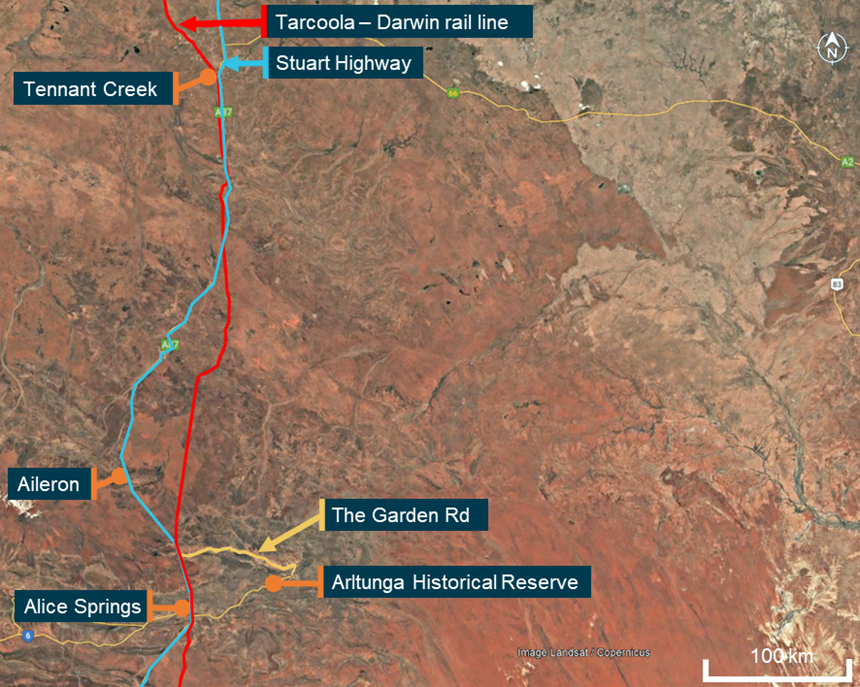
At about 0800 that same morning and 300 km south of Tennant Creek, workers at Aileron Station commenced loading cattle into the wagons of an A-triple road train (truck). The cattle were to be driven along the Stuart Highway and delivered to a remote station on The Garden Road, near the Arltunga Historical Reserve, Northern Territory. The truck consisted of a prime mover and 3 trailers. The front and centre trailers were loaded with cattle while the rear trailer remained empty. At about 0900, the truck departed Aileron and travelled south on the Stuart Highway (Figure 1).
Figure 1: Operations between Alice Springs and Tennant Creek for The Ghan and truck
Source: Google Earth, annotated by the ATSB
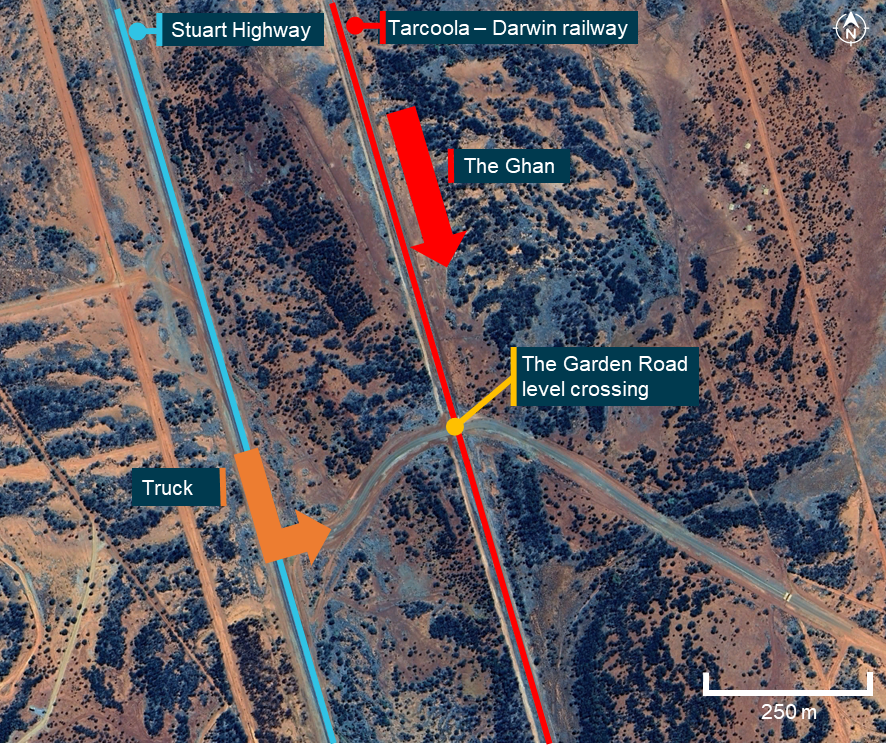
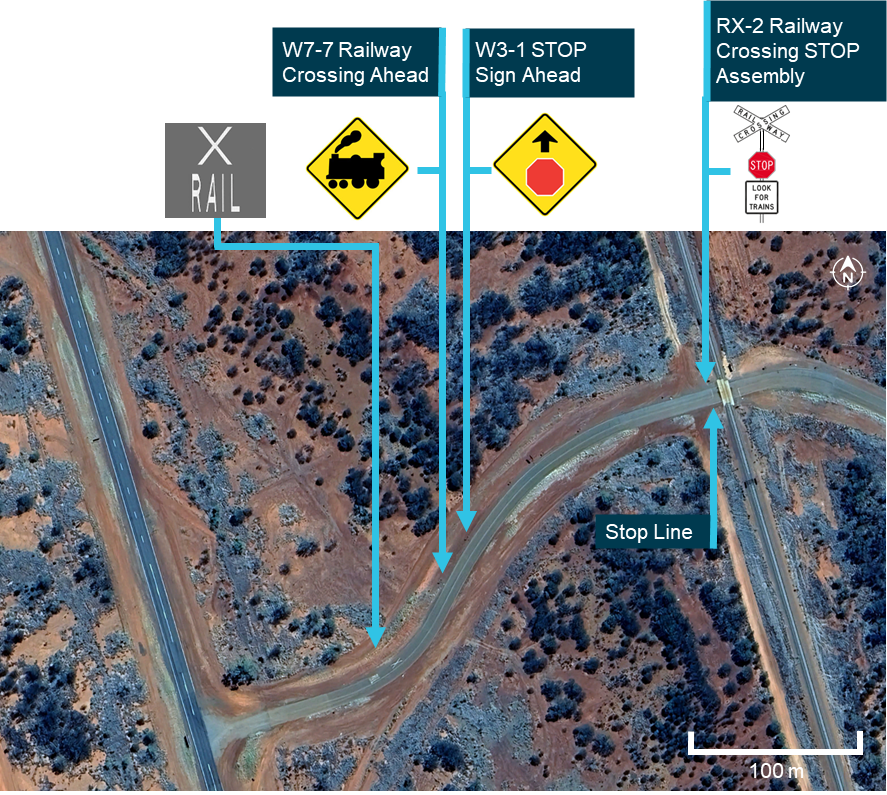
At about 0952, the truck turned off the highway at the intersection with The Garden Road. The driver negotiated a curved S‑bend section of the road on the western approach to the level crossing with the Tarcoola–Darwin rail line, which was located about 300 m from the highway intersection (Figure 2).
Figure 2: The Garden Road level crossing and The Ghan and truck directions of travel
Source: Google Earth, annotated by the ATSB
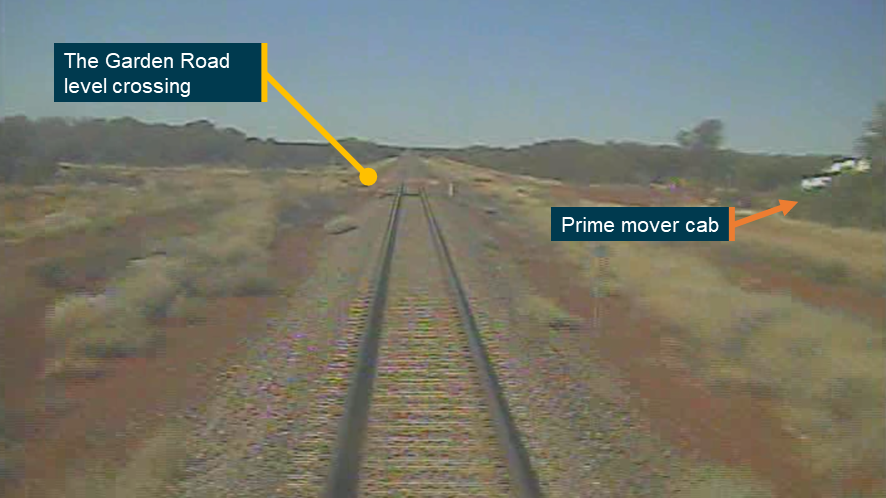
Coincident with the arrival of the truck, The Ghan was also approaching the level crossing. At 0952:44 (about 500 m from the level crossing), a track‑side whistle board[1] was passed and at 0952:53 (about 270 m from the level crossing) the locomotive driver sounded the horn for 2 seconds. When The Ghan was approximately 120 m from the crossing, the crew observed the truck come into full view from behind roadside vegetation and progress toward the level crossing (Figure 3).
A video camera system fitted to the front of The Ghan’s leading locomotive recorded the journey and at 0952:57 showed the truck appear from behind the vegetation. Audio from the recording identified that, at 0952:58, just prior to the level crossing, the driver briefly sounded the horn, and then at 0952:59, blasted it continuously as they travelled through. The truck did not stop and at 0953:02 the front end of the prime mover impacted the right rear bogie[2] of The Ghan’s trailing locomotive.
Figure 3: Field of view from the locomotive camera approximately 120 m from the level crossing showing the prime mover cab as it emerged
This image was obtained from the locomotive video camera as The Ghan travelled southward. Source: Pacific National, annotated by the ATSB
Through the collision sequence, The Ghan remained upright and neither the locomotives nor carriages derailed. At 0953:05, the driver in control of The Ghan reduced the throttle and applied the brakes. Over the next 10 seconds, they initiated a full-service brake application, and the throttle was reduced to the lowest notch. The Ghan came to a controlled stop at 0954, with the lead locomotive 1,380 m beyond the level crossing.
The prime mover of the truck came to rest on the field side of the track with engine bay components scattered along the rail corridor (Figure 4).
Figure 4: The truck at the level crossing after the collision
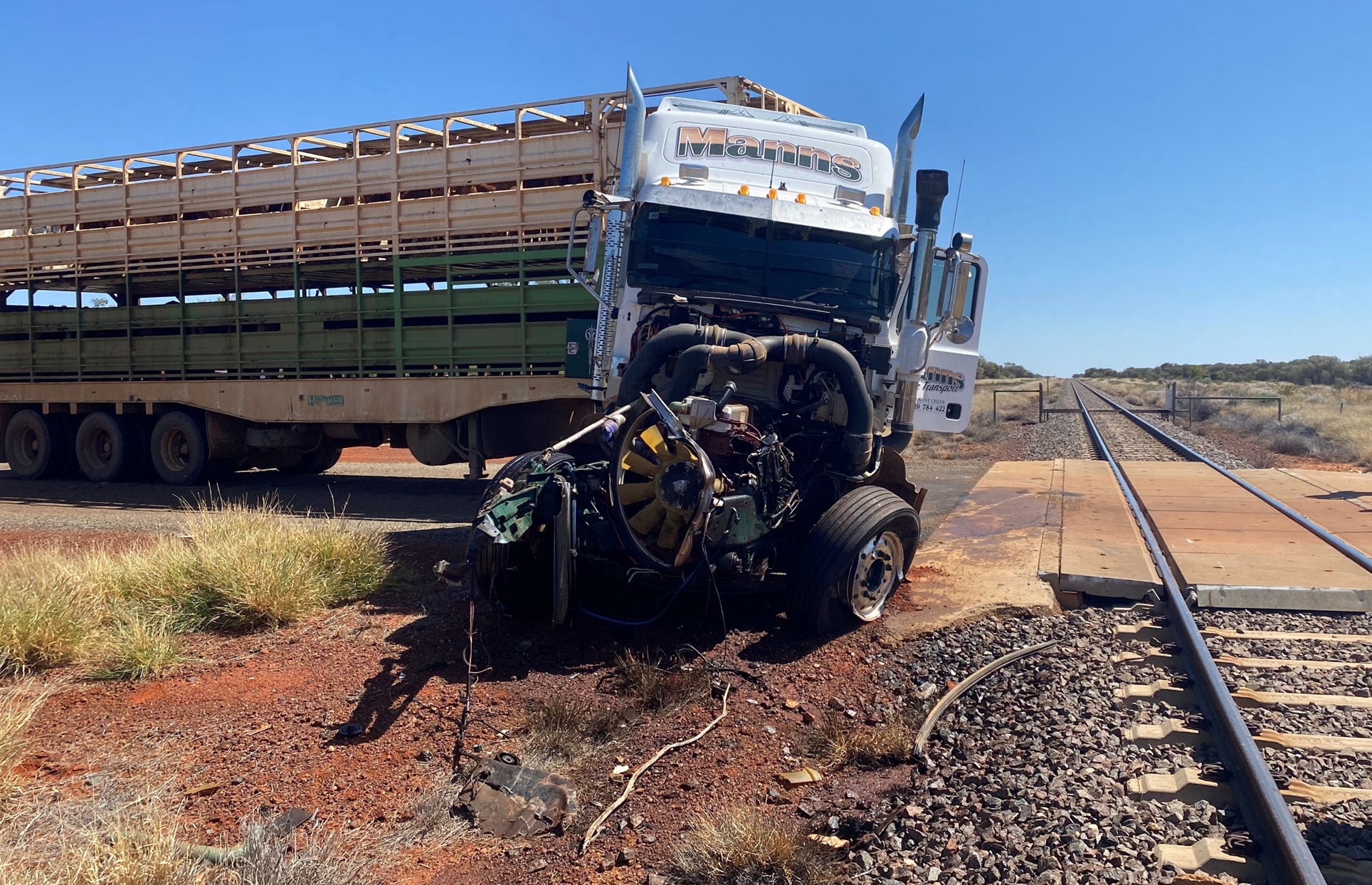
View looking north along the Tarcoola–Darwin railway line from which The Ghan was travelling. Source: Northern Territory Police
Post-collision management
On coming to a stand, both locomotive drivers exited the cab to assess the damage and secure the train. They subsequently telephoned network control, requested for emergency services, and maintained contact with service staff in the passenger compartments.
The truck driver was able to exit their cab unassisted, however, they had sustained serious injuries. They were attended to by service staff from The Ghan until Northern Territory Police attended the scene at 1027, followed shortly after by the ambulance service at 1029.
There were no injuries to The Ghan train crew, service staff, or passengers on board. The passengers were subsequently detrained and transferred to Alice Springs by bus service.
Context
Operation
The Ghan was a twice-weekly passenger carrying service operating from Darwin to Adelaide in both directions between April and October. The train was operated under accreditation of Great Southern Rail by Journey Beyond, which supplied and staffed the passenger cars. Pacific National supplied and staffed the locomotives. Aurizon was the rail infrastructure manager for the Tarcoola–Darwin corridor on which the train was travelling, and it owned the section of rail corridor between Alice Springs and Darwin.
Personnel information
Train crew
All locomotive drivers were employed by Pacific National. The driver in control was a qualified locomotive driver with 3 years of experience at Pacific National. They had completed their most recent competency verification in the first half of 2024. The driver assisting was also a qualified locomotive driver with over 11 years of experience at Pacific National.
Truck driver
The truck driver had been driving trucks for several years. They stated that, although it was their first time driving a loaded vehicle to the destination cattle station, they were familiar with the area and traversed the level crossing at least once a month. They had not previously encountered a train at The Garden Road level crossing.
They were unable to recall the speed they were travelling as they negotiated the S‑bend on approach to the level crossing, but indicated they would have been driving slowly as their intention was to uncouple the empty rear trailer on the other side of the level crossing. The driver had no recollection of hearing The Ghan’s horn as they approached the level crossing. On seeing the leading locomotive pass closely by the front of their cab, they recalled rapidly applying the trailer handbrake and prime mover footbrake. The truck driver reported they were aware of the stop sign at the level crossing and understood the requirement to stop behind the stop line but noted that the line was faded.
The driver did not recall any mechanical problems with the prime mover or the trailers and stated that the brakes on the truck and trailers were functional. They further stated that they would sometimes roll through level crossings as it required significantly more time and effort to stop a loaded truck and then accelerate than it did to roll through a crossing at low speed.
Vehicle information
Train
The Ghan (train 7DA8E) consisted of 2 NR-class locomotives and 29 Commonwealth Engineering stainless steel passenger and restaurant carriages. The total length of the train was 735 m and it weighed 1,418 t.
The train driver reported operations were normal throughout the journey prior to the collision. There were no mechanical problems with either the locomotives or the consist. Additionally, the locomotive headlights were operating throughout its journey and were illuminated while on approach to the level crossing.
The trailing locomotive sustained extensive damage to the air pipes, side ladder, and front cowling. The power van also received superficial body damage. There was no damage to the other carriages or the lead locomotive.
Truck
The truck was an articulated heavy vehicle, consisting of a Mack Titan prime mover and 3 Haulmark semi-trailers joined to form an A-triple consist. This configuration met the conditions of a Class 2 Road Train under the national standard and was 53.5 m long with a maximum approved weight of 115.5 tonnes.
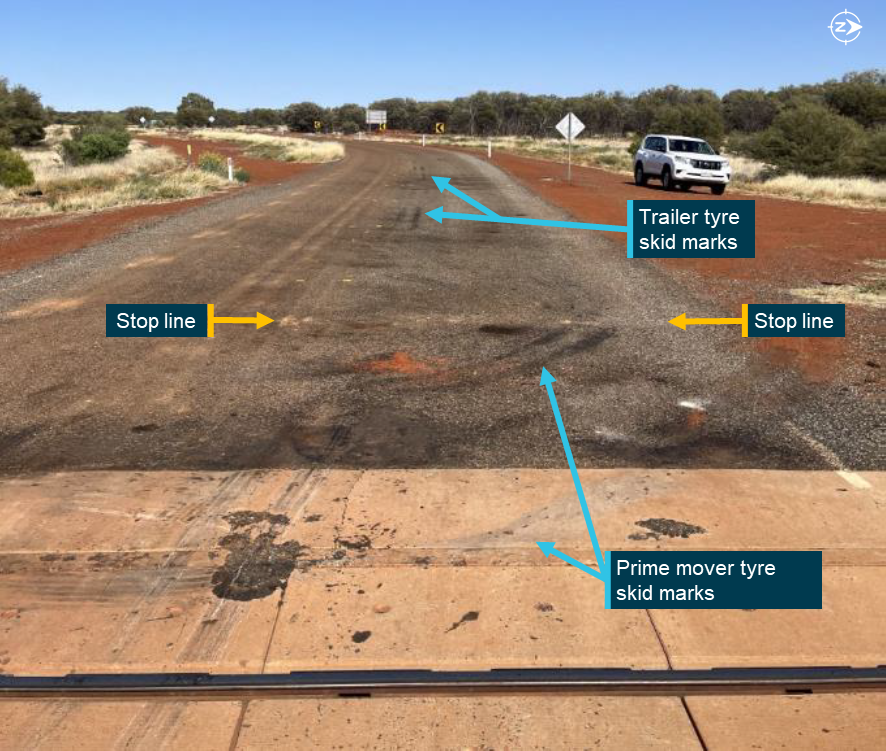
In their examination of the truck, Northern Territory Police identified tyre skid marks from the prime mover and trailers on the road surface that each extended for approximately 2–3 m immediately leading to the crossing. Tyre defects were identified to all 3 trailers, which included several bald tyres and one shredded tyre.
The attending police also found the driver’s seatbelt was clipped into its buckle and looped back behind the seat. From that, they concluded the belt had not been appropriately fitted around the driver at the time of the collision. It was unknown to what extent the driver’s injuries were related to not wearing their seatbelt.
Recorded information
Data from the locomotive event logger recorded parameters such as throttle position, brake pressure, and speed. The event logger output was matched with the lead locomotive forward-facing video camera to correlate time, distance and speed information. No recorded data was obtained from the truck.
The locomotive camera recorded video at 15 frames per second and showed the journey along the Tarcoola–Darwin line and the arrival at the level crossing. Analysis of the video file identified a 2‑second period where the moving truck came into view. Sounding of The Ghan’s horn was audible within the recording along with the brake application by the train driver after the collision.
Using the video and georeferenced data, ATSB calculation of the vehicle closure speeds and distances showed that the truck was slowing as it approached the level crossing (Table 1). When the prime mover was 34 m from the crossing, it was travelling 30–35 km/h, and when it was 23 m from the crossing it had slowed and was travelling 22–28 km/h. At 0953:02.7, the front of the lead locomotive was approximately 30 m beyond the crossing travelling at 108 km/h[3] when the prime mover collided with the trailing locomotive.
Table 1: Calculated closure distances and speeds between the truck and The Ghan
| Time (hhmm:ss.s) | Vehicle distance from the level crossing (m) | Vehicle speed (km/h) | ||
| The Ghan | Truck | The Ghan | Truck | |
| 0952:57.3 | - 120 | Not quantifiable | 108 | Not quantifiable |
| 0952:58.0 | - 90 | 34 | 108 | 30–35 |
| 0952:59.5 | - 60 | 23 | 108 | 22–28 |
| 0953:02.7 | + 30 | 0 | 108 | Collision |
Level crossing information
The Garden Road level crossing
The Garden Road was an approved truck route and provided a thoroughfare to the Arltunga Historical Reserve. Prior to 2016, the short section of road from the Stuart Highway turn-off and beyond the level crossing was unsealed and had crossed the railway track at acute angles. In early 2016, the road was sealed and realigned with road markings and warning signs introduced on the approach to the level crossing. The realigned road section contained a dual curve (an S‑bend) and was perpendicular where it crossed the railway line. The changes in road geometry reduced the visibility angle for road users approaching the intersection, in turn increasing the opportunity for rail traffic to be sighted.
Advance warnings and road markings
Australian Standard (AS) 1742.7 (Manual of uniform traffic control devices Part 7: Railway crossings) required the use of signs, road markings and other control devices at railway crossings. The Garden Road level crossing had been constructed with passive traffic controls to protect both the eastern and western approaches. Passive level crossing controls use signage and road markings to warn road users about an approaching level crossing, but do not activate or change when a train is approaching.
The advance warnings and markings provided along the road on the western approach to the level crossing were:
- painted markings ‘RAIL’ and ‘X’ on the surface of the road with an accompanying advance warning ‘Railway Crossing Ahead’ (W7-7 L)
- an advance warning ‘STOP Sign Ahead’ (W3-1).
The ‘RAIL’ and ‘X’ painted road markings were positioned approximately 225 m from the level crossing and placed at the first curve of the S‑bend. The advance warning sign ‘Rail Crossing Ahead’ (W7‑7 L) was positioned about 190 m from the crossing, and the second sign in advance of the crossing was a ‘STOP Sign Ahead’ (W3‑1) sign about 165 m from the crossing.
The passive controls installed at the level crossing were a ‘Railway Crossing STOP’ (RX‑2) sign assembly and an accompanying white painted ‘stop line’ on the road surface (Figure 5 and Figure 6). The stop line was 5.2 m from the nearest rail, which was greater than the minimum 3.5 m required by the Australian Standard.
Figure 5: Location of the advance warnings and road markings near the level crossing
Source: Google Earth, annotated by the ATSB
As the speed limit for The Garden Road was over 90 km/h, the Australian Standard required the W3-1 sign to be 180 m to 250 m before the stop sign at the crossing. The W7-7 ‘Rail Crossing Ahead’ sign had to precede the W3-1 ‘Stop Sign Ahead’ sign by a distance of 70 m due to the higher speed limit. The standard required the ‘RAIL’ and ‘X’ road marking to be placed between the W7-7 sign and W3-1 signs.
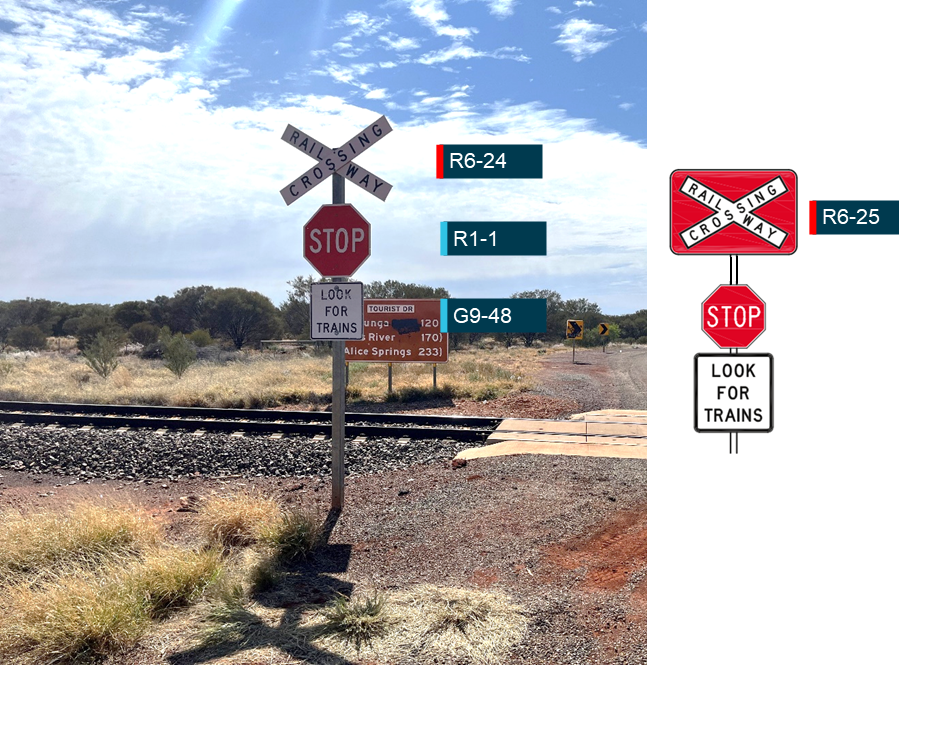
When the railway line was opened in 2004, the Australian Standard required RX-2 stop sign assemblies to have the following 3 components:
- RAILWAY CROSSING (R6-24)
- STOP (R1-1)
- LOOK FOR TRAINS (G9-48).
In 2007, the standard was changed to allow the use of either the R6-24 crossarms or the R6-25 sign (crossarms overlaid on a red background in Figure 6). It was also added that the R6-25 sign would be the preferred design on all new and refurbished RX-2 assemblies. A further update to the standard in 2016 removed the R6-24 crossarms as an approved component for new or upgraded crossings. As indicated within the standard, the update was not intended to be retrospective and although the crossarms were outdated, they were compliant with AS1742.7 (2016).
At the time of the collision, the stop sign assemblies on both sides of The Garden Road level crossing still had the R6-24 crossarms rather than the R6-25 sign.
Figure 6: The railway crossing STOP (RX-2) sign assembly at the level crossing (left) when compared with the current Australian Standard requirements (right)
Source: Pacific National (left) and AS 1742.7-2007 (right), annotated by the ATSB
Level crossing sighting distance
The truck driver estimated that the sighting distance when looking north from the stop line along the track was 300–400 m. The Ghan driver also identified that vegetation obscured their view of road traffic when approaching the level crossing. However, they also added that, while the vegetation obscured sightlines in advance of the crossing, the crossing itself could be seen from a considerable distance away and that the clearance of the trees away from the track was ‘quite reasonable’.
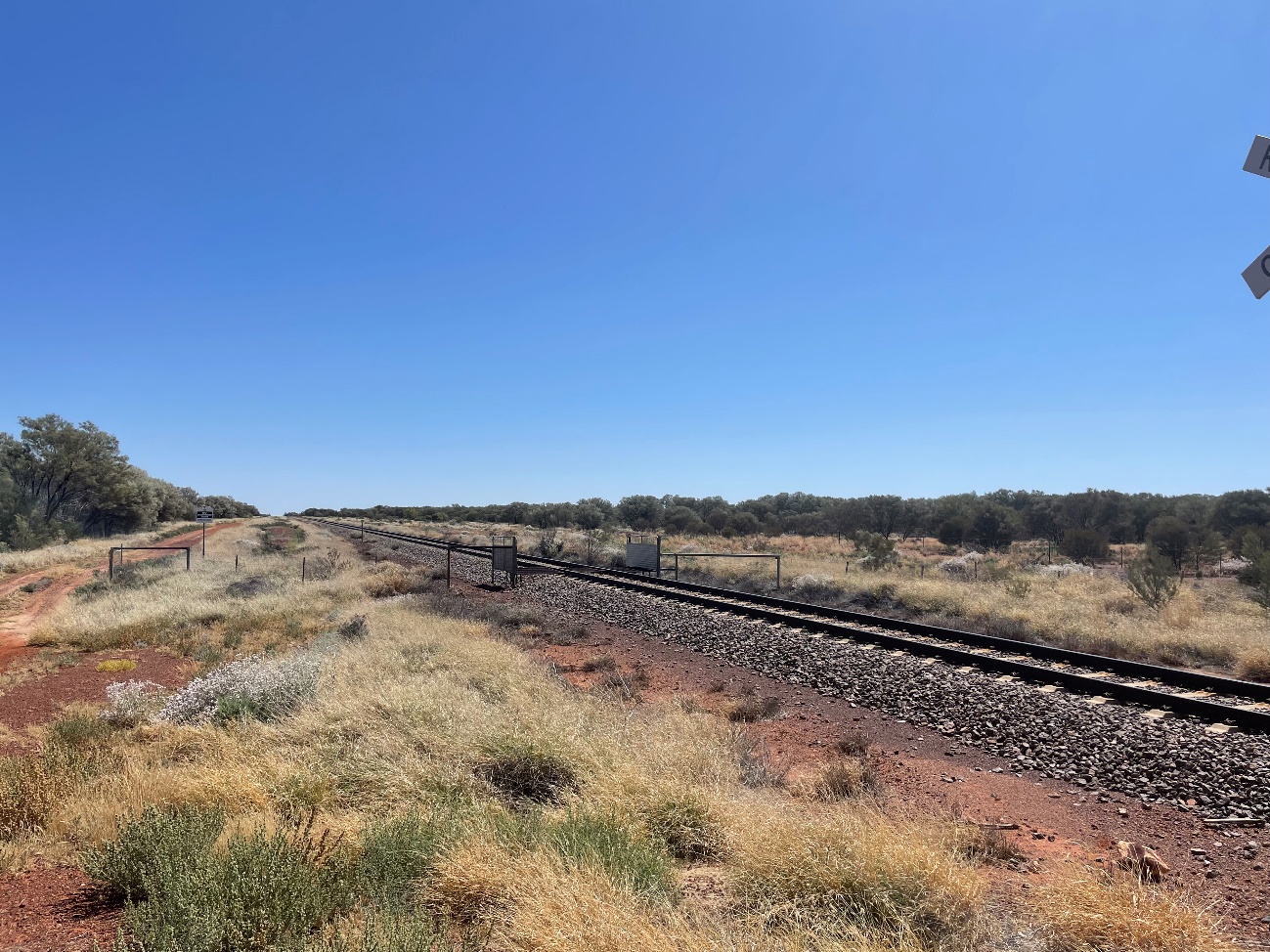
Survey data within the Australian Level Crossing Assessment Model (ALCAM) report from May 2024 of The Garden Road level crossing identified that, when stopped at the stop line on the western side of the level crossing, the sighting distance when looking north along the rail corridor was 1,563 m. The view looking north from the level crossing stop line is shown at Figure 7. The sighting distance was 1,903 m when looking to the south. The sighting distance from the eastern side of the crossing in both directions was unlimited.
At a line speed limit of 115 km/h, the ATSB calculated that trains approaching from the north would become visible from the western stop line 49 seconds before the train reached the level crossing. This increased to 60 seconds for trains approaching from the south. For road users stopped at the stop line on the eastern side, there were no time limitations when approaching trains would become visible. Although the road speed limit for The Garden Road was 100 km/h, the ALCAM report identified that the average approach speed to the level crossing from the west was 60 km/h, which determined the placement of the advance warning signage.
Figure 7: View looking north along the rail corridor from the stop line at the level crossing
This image was captured on 15 September 2024. Source: Aurizon
Truck clearance times
The standard gauge track was 1.435 m wide, and the stop line on each side was 5.2 m from the nearest rail. As a result, the minimum safe distance for road users to cross the tracks and be clear of the rail corridor was about 12 m from either stop line. Accounting for the standard length of an A‑triple road train (53.5 m), the truck would have needed to travel at least 66 m from the western stop line to safely cross the tracks.
The National Heavy Vehicle Regulator required trucks (road trains) to meet level 4 acceleration capability. This was the highest of 4 capability standards, which tested the ability of a vehicle to accelerate from rest on a road with zero gradient.
To meet this capability, road trains would have to accelerate from a stand and travel 100 m on a zero-gradient road in 29 seconds (or less). Based on these requirements, the established road train clearance times on a level grade fit within the ALCAM sighting times at The Garden Road level crossing.
Interface agreement
The Rail Safety National Law required rail infrastructure managers and road managers of public roads to enter into an interface agreement to manage the risks to safety arising from their rail or road crossings. For The Garden Road level crossing, the local road manager (Northern Territory Government) was responsible for the interface boundary outside the rail corridor that included road condition, level crossing advance warning signage, road markings, and sighting along the road corridor. The rail infrastructure manager (Aurizon) was responsible for the interface boundary within the rail corridor that included: sighting along the rail corridor, track infrastructure, primary warning devices and signage at the level crossing, and the pavement at the road‑rail interface.
To assist with maintaining sighting distances, the road manager was responsible for vegetation outside of the rail corridor and the rail infrastructure manager was responsible for vegetation clearance within the rail corridor.
At the time of the accident, an interface agreement was in place between Aurizon and the local road manager. Following the collision, the interface agreement was renegotiated and signed between both parties.
Scheduled inspections
As the rail infrastructure manager, Aurizon conducted regular inspections of the Alice Springs to Tennant Creek rail corridor. This consisted of weekly visual inspections from the rail corridor to monitor track condition and known defects, and an annual ALCAM assessment from the road corridor to assess overall compliance with the Australian Standard.
The most recent visual inspection of The Garden Road level crossing had been completed on 9 September 2024. This inspection did not identify any track misalignment, defects, or faults at the level crossing prior to the collision, and no corrective maintenance was scheduled following this inspection. The next weekly inspection was scheduled for 16 September 2024, the day after the collision.
The annual ALCAM assessment for compliance with civil engineering standards was conducted in May 2024. This inspection found that vegetation obstructed advance views of the rail corridor for road users on both sides of the crossing. However, it found that this vegetation did not impact visibility and sightlines along the rail corridor when a vehicle was stopped at the stop line.
On the western side of the crossing, which was the approach direction of the truck, the ALCAM assessment made the following observations:
• Passive control required updating to current standard and maintenance
• Stop bar and centre barrier lines were faded
• Advance warning signs were incorrectly positioned for the road speed
• Advance warning road markings were faded and incorrectly spaced for the road speed.
The faded stop line is shown at Figure 8 and this was reportedly due to the effects of road resurfacing.
Figure 8: Faded stop line at the level crossing with skid marks evident from the emergency braking of the truck
Source: Pacific National, annotated by the ATSB
ATSB safety study of level crossing collisions between heavy vehicles and trains
The ATSB safety study Review of level crossing collisions involving trains and heavy road vehicles in Australia (RS-2021-001) analysed 49 collisions between trains and heavy vehicles at Australian level crossings between July 2014 and August 2022, in which 24 rail or road users were fatally or seriously injured. Records from rollingstock operators, rail infrastructure managers, police, and other organisations were obtained for each of these accidents. The aim of the study was to improve the understanding of the risks associated with level crossing collisions involving heavy vehicles. Across the study period, several correlating observations were identified:
- All level crossing collisions involving heavy vehicles resulted from the heavy vehicle driver not giving way to trains. There were 3 actions associated with the collisions:
- There were at least 24 collisions where the heavy vehicle did not stop prior to entering the crossing.
- There were at least 11 collisions where the heavy vehicle stopped at the crossing then proceeded into the path of a train.
- There were at least 13 collisions where the heavy vehicle entered a level crossing and stopped foul of the train line.
- Of the 26 collisions at passive control crossings, there were at least 12 collisions where the heavy vehicle driver slowed or stopped but probably did not detect the train and entered the crossing into the path of the approaching train.
- In at least 12 collisions the heavy vehicle driver had regularly used the level crossing prior to the collision with the train. The drivers' previous experience at the crossings may have led to a low expectancy for trains and contributed to them not detecting a requirement to stop and give way.
- In at least 14 collisions, the heavy vehicle driver’s view of the track or level crossing protection equipment was obstructed by vegetation, the design of the heavy vehicle cab, poor crossing lighting, or sun glare.
- Consistent with prior research showing that train horns have limited effectiveness for alerting road vehicle drivers approaching level crossings, in at least 25 accidents the horn was not effective at alerting the heavy vehicle driver to the presence of the train.
The report also described a ‘rolling stop’, which involved slowing a road vehicle until a decision was made to proceed into the crossing, without coming to a complete stop. When conducting a ‘rolling stop’ a road vehicle driver would spend less time at the stop point for a passive level crossing and therefore would probably employ less time scanning for oncoming trains. In turn, that increases the likelihood of an incorrect decision to proceed into the crossing when it was not safe.
Safety analysis
Truck driver actions
As the truck turned off the Stuart Highway and was being driven eastward along The Garden Road, the driver was unaware of The Ghan that was approaching southbound at 108 km/h. At the level crossing, the train would have been visible to road users that had stopped at the stop line, however, it would have been difficult to identify in advance due to the presence of roadside vegetation that obscured longer distance sighting along the rail corridor.
During its journey, the locomotive headlights of The Ghan were illuminated, and the driver had sounded the horn multiple times in close proximity to the crossing as required. The truck driver did not recall hearing the horn being sounded. This has been identified as a factor in several other accidents where a horn had limited effectiveness in alerting a heavy vehicle driver of an approaching train.
The truck was travelling at a low speed, which increased the available time and distance for the driver to see and respond to the road markings, signage and requirement to stop their vehicle. The driver reported they had no recollection of the truck’s speed, however, they did recall initiating emergency braking on seeing the passage of The Ghan immediately in front of their cab.
Remnant skid marks on the road surface were consistent with their recollection and actions. Calculations of the truck speed prior to the collision indicated that the driver had been slowing on their approach to the crossing. However, it was unlikely they were intending to bring the truck to a complete stop prior to passing the stop line as doing so would have required an emergency application of the brakes. Additionally, they acknowledged that they would sometimes roll through level crossings rather than come to a complete stop. That driving behaviour has been identified as a factor in previous collisions between heavy vehicles and trains.
From this, it can be concluded that the truck driver did not slow down sufficiently to stop at The Garden Road level crossing, resulting in a collision with The Ghan passenger train. The presence of the roadside vegetation may have contributed to restricted views of an approaching train, but if the driver had intended to stop, they would have seen the approaching train as the sighting distance from the stop line was clear and unobstructed, especially at truck cab height.
Passive level crossing
Passive controls were the primary risk control against vehicle collisions at The Garden Road level crossing. They do not activate, illuminate, or change state to indicate the presence of an approaching train. Neither did they physically prevent road users from crossing the track when a train was present or approaching the crossing. Consequently, the requirement to stop, sight, and remain clear of all rail traffic was a critical requirement to avoid a collision. It is the responsibility of the road user and in this circumstance the truck driver to stop for approaching rail traffic.
The Garden Road level crossing and its associated infrastructure largely complied with the relevant standards. All signs, road markings, and the level crossing itself, were visible from the highway intersection and in place on the day of the accident. Although it was noted that the stop sign had not been updated to the current standard, some advance warning signs were at the incorrect distances, and the stop line and other markings were partly faded. However, this did not influence the truck driver’s awareness of the requirement to stop their vehicle prior to crossing the track. The truck driver had traversed the crossing on numerous occasions and was aware of the stopping requirement.
When approaching the crossing from the west, roadside vegetation obstructed the northern view of the rail corridor until shortly before the stop line. The vegetation lined both the road and rail corridors but was set back around 20 m from the railway track. Accordingly, the vegetation did not impact the ability of road users to see the advance warnings or the passive controls, or prevent them from seeing the stop sign at the crossing. Similarly, the proximity of the S‑bend from the highway reduced vehicle approach speeds to the level crossing and improved visibility to provide additional time for drivers to observe and respond to the signs and/or road markings. As such, there was sufficient sighting distance for a driver scanning for hazards along the road ahead to react and stop in time.
While some aspects of the level crossing controls were either not as per standard, outdated or of suboptimal quality, there was signage and markings for road users to be aware of the crossing and bring their vehicles to a controlled stop before entering. Once stopped, there was adequate visibility for a driver to sight a train and give way.
Findings
ATSB investigation report findings focus on safety factors (that is, events and conditions that increase risk). Safety factors include ‘contributing factors’ and ‘other factors that increased risk’ (that is, factors that did not meet the definition of a contributing factor for this occurrence but were still considered important to include in the report for the purpose of increasing awareness and enhancing safety). In addition ‘other findings’ may be included to provide important information about topics other than safety factors. These findings should not be read as apportioning blame or liability to any particular organisation or individual. |
From the evidence available, the following findings are made with respect to the collision between a truck and The Ghan passenger train, at The Garden Road level crossing, 48 km north of Alice Springs, Northern Territory, on 15 September 2024.
Contributing factors
- The truck driver did not slow sufficiently to stop prior to The Garden Road level crossing, resulting in a collision with The Ghan passenger train.
Other findings
- While some aspects of the level crossing controls were either not as per standard or were faded, there was signage and markings for road users to be aware of the crossing and bring their vehicles to a controlled stop before entering. Once stopped, there was adequate visibility for a driver to sight a train and give way.
Safety actions
| Whether or not the ATSB identifies safety issues in the course of an investigation, relevant organisations may proactively initiate safety action in order to reduce their safety risk. The ATSB has been advised of the following proactive safety action in response to this occurrence |
Safety action by the Northen Territory Government – Department of Logistics and Infrastructure
The Department of Logistics and Infrastructure has advised of the following safety actions since the accident:
- Refreshment of the line marking and upgrading the approach signage at The Garden Road level crossing.
- Negotiation of a revised interface agreement with the rail infrastructure manager (RIM), which included a commitment from the RIM to install updated signage (R6‑25 ‘Railway Crossing’) to meet current AS1742.7 standards at The Garden Road level crossing, and to progressively upgrade signage at other crossings when existing signs are due for replacement.
- Continuation of the Northern Territory Level Crossing Safety Working Group with the rail industry, infrastructure managers and local government.
- Continuation of level crossing assessments and line-of-sight improvements.
- It also delivered a targeted campaign during the August 2025 National Rail Safety Week to raise public awareness of level crossing risks across the Northern Territory. The tactics used during that campaign included social media advertising, learner driver education and displays at the motor vehicle registry.
ATSB comment
The ATSB acknowledges the safety action completed by the Department of Logistics and Infrastructure. The ATSB notes, however, that while all physical elements of the approach to The Garden Road level crossing (road signage and pavement markings) are present or have been substantially updated, some of the approach signage elements remain incorrectly positioned, and are not in accordance with the Australian Standard AS 1742.7.
Sources and submissions
Sources of information
The sources of information during the investigation included:
- Pacific National
- Great Southern Rail
- Aurizon Bulk Central
- the train crew
- the truck driver
- Northern Territory Police
- Australian Level Crossing Assessment Model.
References
Standards Australia. (2007 and 2016). Manual of uniform traffic control devices Part 7: Railway crossings (AS 1742.7). https://store.standards.org.au/product/as-1742-7-2016
Australian Transport Safety Bureau. (2024). Review of level crossing collisions involving trains and heavy road vehicles in Australia (RS-2021-001). /publications/investigation_reports/2021/rair/rs-2021-001
Submissions
Under section 26 of the Transport Safety Investigation Act 2003, the ATSB may provide a draft report, on a confidential basis, to any person whom the ATSB considers appropriate. That section allows a person receiving a draft report to make submissions to the ATSB about the draft report.
A draft of this report was provided to the following directly involved parties:
- Pacific National
- Great Southern Rail
- Aurizon Bulk Central
- the train crew
- the truck driver
- Northern Territory Police
- Office of the National Rail Safety Regulator
- Northern Territory Government – Department of Logistics and Infrastructure.
Submissions were received from:
- Pacific National
- Great Southern Rail
- Aurizon Bulk Central
- Office of the National Rail Safety Regulator
- Northern Territory Government – Department of Logistics and Infrastructure.
The submissions were reviewed and, where considered appropriate, the text of the report was amended accordingly.
Purpose of safety investigationsThe objective of a safety investigation is to enhance transport safety. This is done through:
It is not a function of the ATSB to apportion blame or provide a means for determining liability. At the same time, an investigation report must include factual material of sufficient weight to support the analysis and findings. At all times the ATSB endeavours to balance the use of material that could imply adverse comment with the need to properly explain what happened, and why, in a fair and unbiased manner. The ATSB does not investigate for the purpose of taking administrative, regulatory or criminal action. About ATSB reportsATSB investigation reports are organised with regard to international standards or instruments, as applicable, and with ATSB procedures and guidelines. Reports must include factual material of sufficient weight to support the analysis and findings. At all times the ATSB endeavours to balance the use of material that could imply adverse comment with the need to properly explain what happened, and why, in a fair and unbiased manner. An explanation of terminology used in ATSB investigation reports is available here. This includes terms such as occurrence, contributing factor, other factor that increased risk, and safety issue. Publishing informationReleased in accordance with section 25 of the Transport Safety Investigation Act 2003 Published by: Australian Transport Safety Bureau © Commonwealth of Australia 2026 
Ownership of intellectual property rights in this publication Unless otherwise noted, copyright (and any other intellectual property rights, if any) in this report publication is owned by the Commonwealth of Australia. Creative Commons licence With the exception of the Commonwealth Coat of Arms, ATSB logo, and photos and graphics in which a third party holds copyright, this report is licensed under a Creative Commons Attribution 4.0 International licence. The CC BY 4.0 licence enables you to distribute, remix, adapt, and build upon our material in any medium or format, so long as attribution is given to the Australian Transport Safety Bureau. Copyright in material obtained from other agencies, private individuals or organisations, belongs to those agencies, individuals or organisations. Where you wish to use their material, you will need to contact them directly. |
[1] Whistle board: when a train passes a whistle board, the train driver must sound the horn to warn workers and/or members of the public that rail traffic is approaching.
[2] Bogie: a structure incorporating suspension elements and fitted with wheels and axles, used to support rail vehicles at or near the ends of the vehicle, and capable of rotation in the horizontal plane. Bogies can have one or multiple axle sets, and can also be used as a common support for adjacent units on an articulated vehicle.
[3] The track speed limit was 115 km/h.
Occurrence summary
| Investigation number | RO-2024-005 |
|---|---|
| Occurrence date | 15/09/2024 |
| Location | The Garden Road level crossing (48 km north of Alice Springs) |
| State | Northern Territory |
| Report release date | 12/02/2026 |
| Report status | Final |
| Investigation level | Short |
| Investigation type | Occurrence Investigation |
| Investigation status | Completed |
| Mode of transport | Rail |
| Rail occurrence category | Level Crossing |
| Highest injury level | None |
Train details
| Train operator | Pacific National (locomotives), Journey Beyond (carriages) |
|---|---|
| Train number | 7DA8E |
| Type of operation | Passenger |
| Departure point | Darwin, Northern Territory |
| Destination | Adelaide, South Australia |
| Train damage | Minor |