

Grounding of Sea Pelican, Port Adelaide, South Australia, on 10 June 2025
Final report
Report release date: 20/08/2026
Investigation summary
What happened
On 10 June 2025 the tug and barge combination, Sea Pelican and Rocksea, was being manoeuvred out of the North Arm waterway, and turned to port into the Port Adelaide River, South Australia.
At about 1000 hours, while keeping clear of a fishing jetty off to port, the tug was manoeuvred wide in the turn and touched bottom on a sandbar projecting into the waterway off to starboard. The tug shell plating was holed under the engine room. About 20 minutes later, upon arrival at the destination, an engine room bilge alarm alerted the tug master to water entering the engine room. Bilge pumping was commenced to manage the water ingress and the tug returned to base.
The following day, the tug was slipped at the adjacent slipway and the holed section of the hull repaired.
What the ATSB found
The ATSB found that the tug master and pilotage exempt master were unaware of the extent to which the sandbar to the north of the channel was encroaching into and narrowing the navigable channel past the fishing jetty to the south. Consequently, while attempting to maintain adequate clearance off the fishing jetty, the tug was manoeuvred wide in the channel and touched bottom on the sand bar.
The investigation also identified that planning and preparation for the movement were inadequate for ensuring all risks were properly addressed. This included details of the task being insufficiently well defined and communicated to all parties to ensure it proceeded safely. Relevant hazards were not identified and defined, risk barriers were not put in place and roles and responsibilities were not detailed nor understood.
The investigation further identified that the vessels’ owner and operator, Maritime Constructions, had not adequately identified and controlled risks associated with the operation of tug and barge combinations within the port. In particular, the use of the pilotage exemption certificate system was not defined and included in documentation; nor was bathymetric data collected by Maritime Constructions in North Arm included in passage planning or operational documentation for use by tug masters.
What has been done as a result
Maritime Constructions updated its safety management system (SMS) to strengthen its training, watchkeeping, and passage planning procedures. Under the revised SMS, new masters must first serve as mates under an experienced master with local knowledge before taking command, and training must encompass known shallow water areas. Further, operation-specific risk assessments will be used to identify crew competency requirements and arrange any necessary additional training.
Updated watchkeeping procedures for tug and barge operations now require masters to consider factors such as tow configuration and visibility restrictions when assigning lookouts, while passage plans for every transit must evaluate current bathymetric survey data, environmental conditions and vessel manoeuvrability.
Safety message
The grounding of Sea Pelican highlights the importance of sufficient planning to ensure operational risks are identified and effectively controlled. When a vessel is navigated in pilotage waters under the guidance of a pilotage exemption holder, the responsibilities of the exemption holder in relation to the master should be defined and documented in the company’s SMS. Further, relevant information and guidance relating to operational and navigational hazards should be readily available and incorporated into planning arrangements and operational procedures.
INSERT SHOW MORE LINK
The occurrence
On the morning of 10 June 2025, the master, engineer and deckhand of the Maritime Constructions’ (MC) tug, Sea Pelican (cover), arrived at the company’s operating base in North Arm, a branch of the Port Adelaide River, South Australia. Sea Pelican was to tow the unpowered barge1 Rocksea (Figure 1) from the base to a worksite at berth 25 in the inner harbour, approximately 1.4 miles2 upstream. Following the tow, the tug was to return to base for scheduled maintenance.
Figure 1: Unpowered barge Rocksea
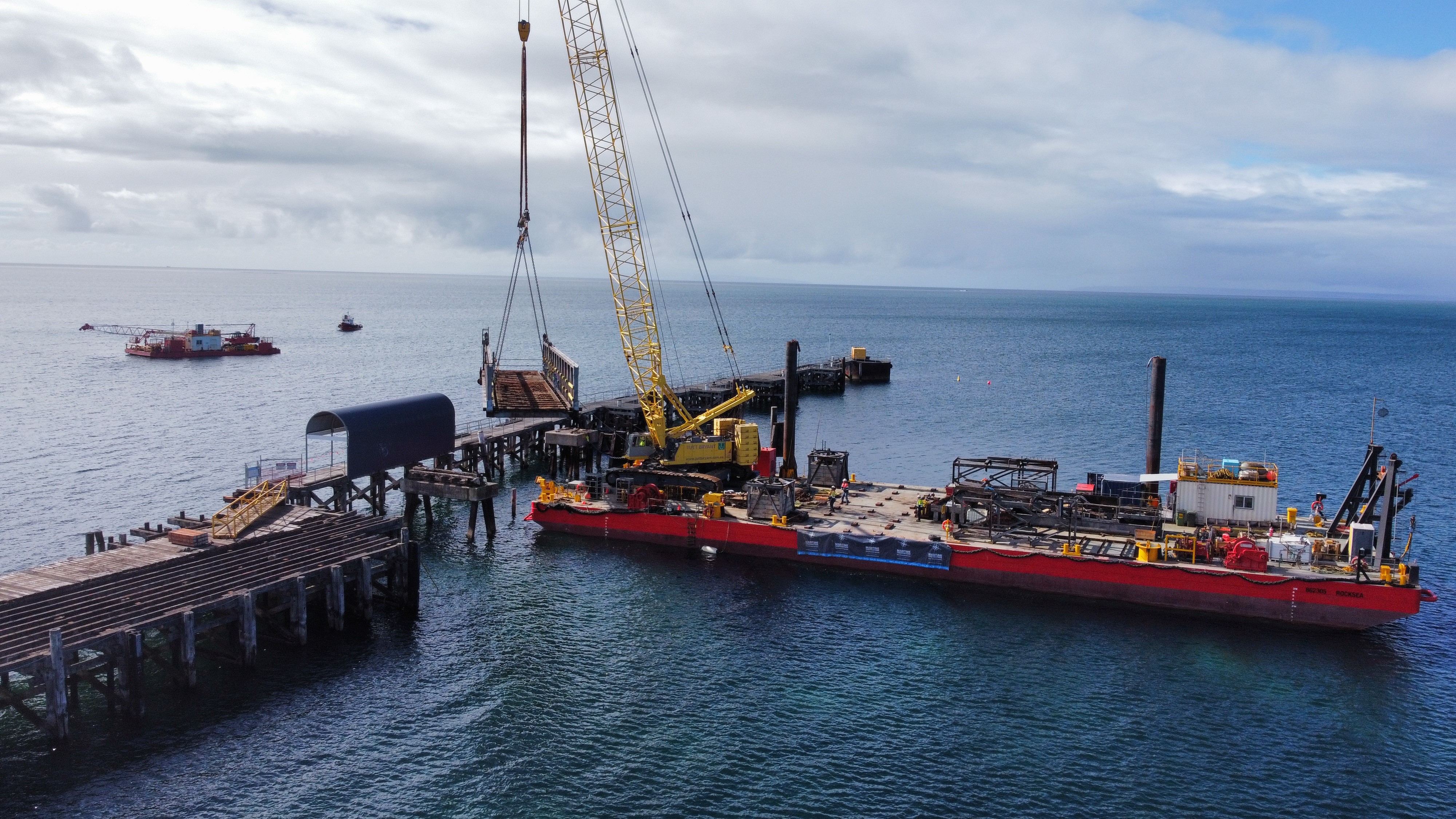
The tug and the barge were moored separately at MC’s wharf and the tug was to reposition and tie up to the barge in preparation for the movement. At about 0700, the crew boarded Sea Pelican and commenced pre‑start checks and warming through of the tug’s machinery. The main engines were started at 0745. Meanwhile, a bargemaster and deckhand boarded Rocksea and began preparing the barge.
Under port regulations, the tug and barge combination was required to carry a harbour pilot or a pilotage-exempt master (PEM). Sea Pelican’s master did not hold a pilotage exemption certificate (PEC) (see the section titled Pilotage exemption certificates) and, therefore, a PEM was to be on board the tug during the tow. The transit was also intended to serve as a qualifying voyage pursuant to the tug master’s own application for a PEC. At 0755, the PEM boarded the tug and discussed the day’s operation with the tug master.
The intended passage involved a short transit down North Arm followed by a 140° turn to port into the main channel of the Port Adelaide River. The combination was then to transit 1.3 miles upstream before turning to port into number 3 dock at berth 25 (Figure 2).
Figure 2: Port Adelaide, tracks of Sea Pelican and Rocksea
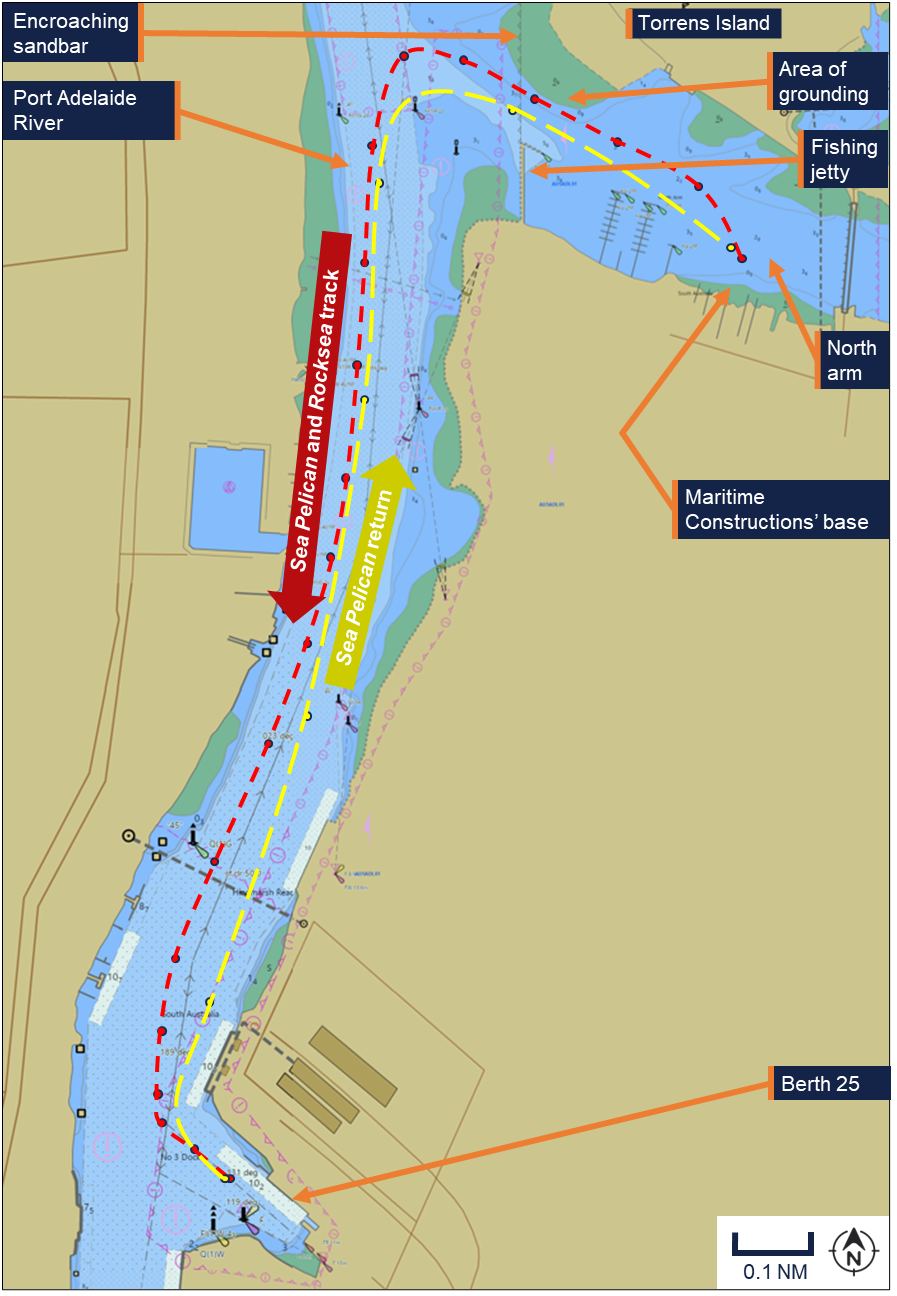
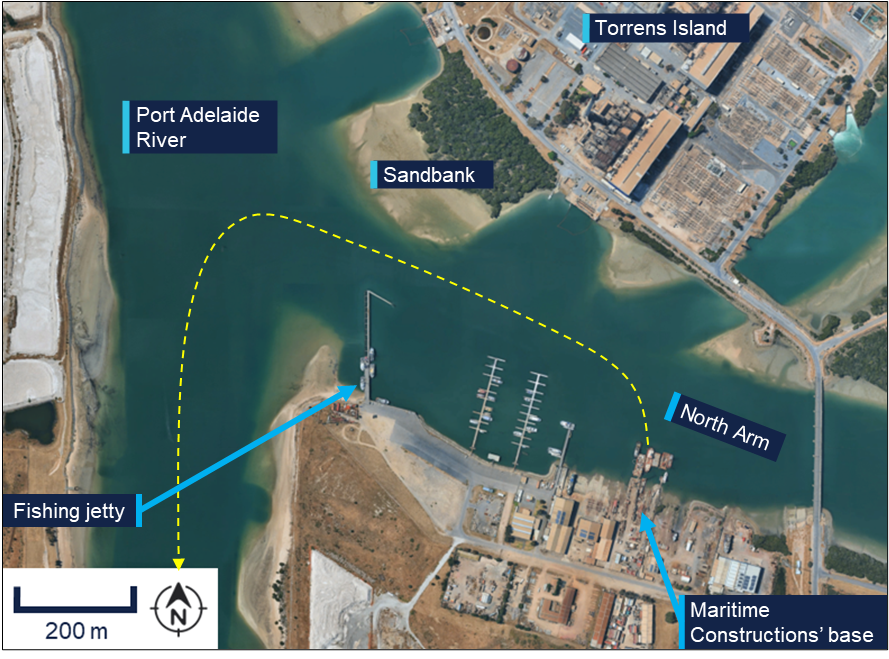
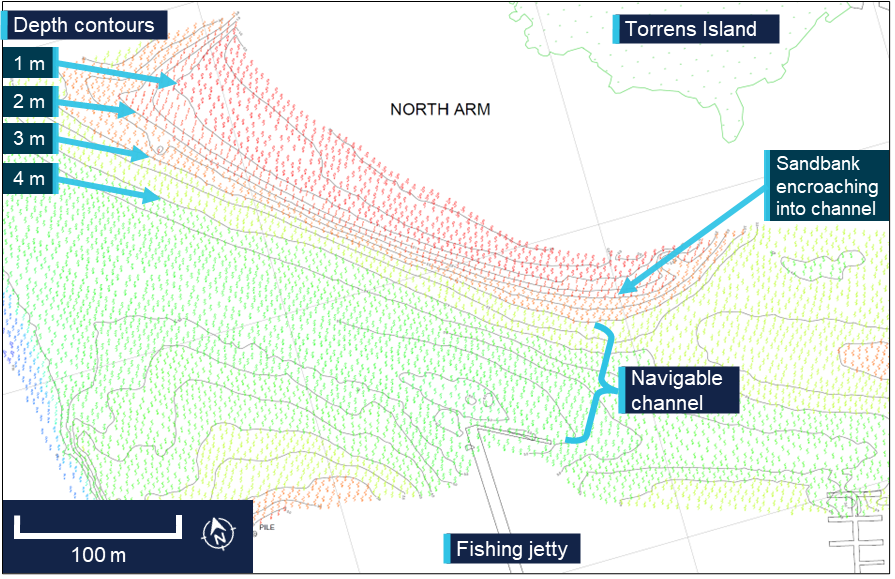
North Arm was excluded from Port Adelaide's scheduled dredging regime. Consequently, over time a sandbank had grown south from Torrens Island, encroaching on the navigable channel between the MC base and the Port Adelaide River. The waterway had narrowed near a timber fishing jetty located on North Arm’s southern bank (Figure 3).
Figure 3: North Arm and Port Adelaide River
A passage plan had been prepared for the 30-minute passage. The plan anticipated a 4.5 knot transit speed and specified an operational wind limit of 25 knots. The departure was timed to account for an ebbing tide with low water (0.91 m) predicted to occur at 0936. The tug and barge combination was expected to have a following tidal flow during the transit out of North Arm before pushing into the flow upon entering the main river channel.
At 0825, Sea Pelican’s mooring lines were cast off, and the tug repositioned to the starboard quarter of Rocksea. By 0849, it was secured alongside the barge. In this arrangement, the barge’s bow ramp and a crawler crane loaded on its deck obstructed the tug master’s line of sight to port from the tug’s wheelhouse. It was usual for MC vessels to maintain a distance of a least 10 m off the fishing jetty and the barge crew were equipped with UHF radios and tasked with maintaining a lookout. Additionally, a small, outboard-powered tender, operated by a single coxswain and fitted with an echo sounder, was to accompany the transit and provide towage assistance where possible.
At 0945, Sea Pelican’s master manoeuvred the tug and barge combination off the MC wharf and out towards the northern side of North Arm to remain clear of the public jetties along the southern bank. At 0950, the tug master informed Port Adelaide vessel traffic service (VTS) of the departure and intended passage. The PEM then exited the tug’s wheelhouse and proceeded to the bow to gain a clearer vantage point to port.
While manoeuvring clear of the fishing jetty, at a speed of 2.5 knots, the tug master noticed a slight reduction in headway and a subtle change in the tug’s handling characteristics. The PEM, having also noticed the speed decrease, performed a visual inspection over the starboard side of the tug, confirming that the seabed was clearly visible but not that the tug had grounded.
The tug master immediately moved the engine controls to neutral and began evaluating the situation to mitigate the risk of further grounding. The tug master later noted that, although there were no typical indications of a hard grounding, such as jarring or a total loss of headway, they suspected the tug had grazed the seabed. The tug master elected to re-engage ahead power to keep the combination moving toward the deeper water of the main channel. The tow then continued as planned. As the combination passed out of North Arm, it was manoeuvred to port into the main channel and completed the river passage to dock 3.
At 1020, the combination had been turned to port into the dock when the tug’s engine room high water bilge alarm sounded in the wheelhouse. The tug master directed the engineer and deckhand to investigate. They confirmed that water was entering the engine room and started the tug’s 2 bilge pumps to manage the ingress. Meanwhile, the tug master notified MC’s shore management of the incident.
After a short time, the tug’s crew and management concluded that its hull had been breached. At 1040, management advised the tug master to return to the MC base.
At 1100, after the barge had been secured in the dock, Sea Pelican was released and began making its way back to North Arm at about 8 knots. En route, the tug master advised VTS of the return to North Arm.
By 1200, Sea Pelican was secure at the MC wharf where shore staff had arranged an additional pump as a precautionary measure. At 1300, MC divers conducted a hull inspection and discovered a hole measuring 60 mm by 30 mm.
Overnight watch arrangements were put in place to monitor the bilge water levels while the tug remained alongside the wharf. The following day, the tug was slipped at the adjacent slipway and the holed section of the hull repaired.
Context
Sea Pelican
Sea Pelican was a domestic commercial vessel (DCV), certified by the Australian Maritime Safety Authority (AMSA) for operations under service category 2B.3 The tug was constructed in 1998 under Germanischer Lloyd (GL) class rules in Batam, Indonesia.
Sea Pelican had an overall length of 23.5 m, a beam of 7.5 m and a maximum draught of 2.5 m. Propulsion was provided by 2 Yanmar diesel engines, each delivering 471 kW to shaft-driven fixed pitch propellers.
The tug was equipped with a radar, depth sounder and a Simrad electronic chart system4 unit installed in the wheelhouse. When secured alongside Rocksea, the combined arrangement was estimated by the vessels’ owner and operator, Maritime Constructions (MC), to be 33 m wide.
Crew
At the time of the grounding, Sea Pelican had a crew of 3, comprising the master, a marine engine driver and a deckhand. A pilotage exempt master (PEM) was also on board.
The master held an AMSA master less than 24 m certificate of competency (CoC), issued in 2023 in recognition of the master’s equivalent New Zealand qualification. They had previous experience operating commercial work vessels in New Zealand, before joining MC in January 2024 as a deckhand. In November 2024, they completed their first trip as master, under the supervision of an MC senior master.
At the time of the grounding, the master was in the process of accruing qualifying voyages as part of the port’s requirements for a pilot exemption certificate (PEC). They had logged 5 such voyages with either a pilot or PEM on board.
The PEM held a master less than 100 m CoC and had about 27 years’ experience as a master. They commenced working for MC in 2008, performing master duties and overseeing other masters during qualifying voyages for pilot exemption certification.
Rocksea
The barge Rocksea was registered as a 2C Australian DCV and classed by the American Bureau of Shipping (ABS). It had an overall length of 52.7 m, a beam of 18 m and did not have its own means of propulsion. It was fitted with a bow ramp and, at the time of the grounding, a crawler crane was loaded on board. The barge was crewed by a bargemaster and a deckhand.
Port of Adelaide
The port of Adelaide is South Australia’s principal maritime port, located approximately 14 km north-west of Adelaide’s city centre. The port is situated on the Port Adelaide River, a tidal estuary that flows parallel to the coastline before entering the Gulf St Vincent (Figure 4).
Figure 4: Port of Adelaide
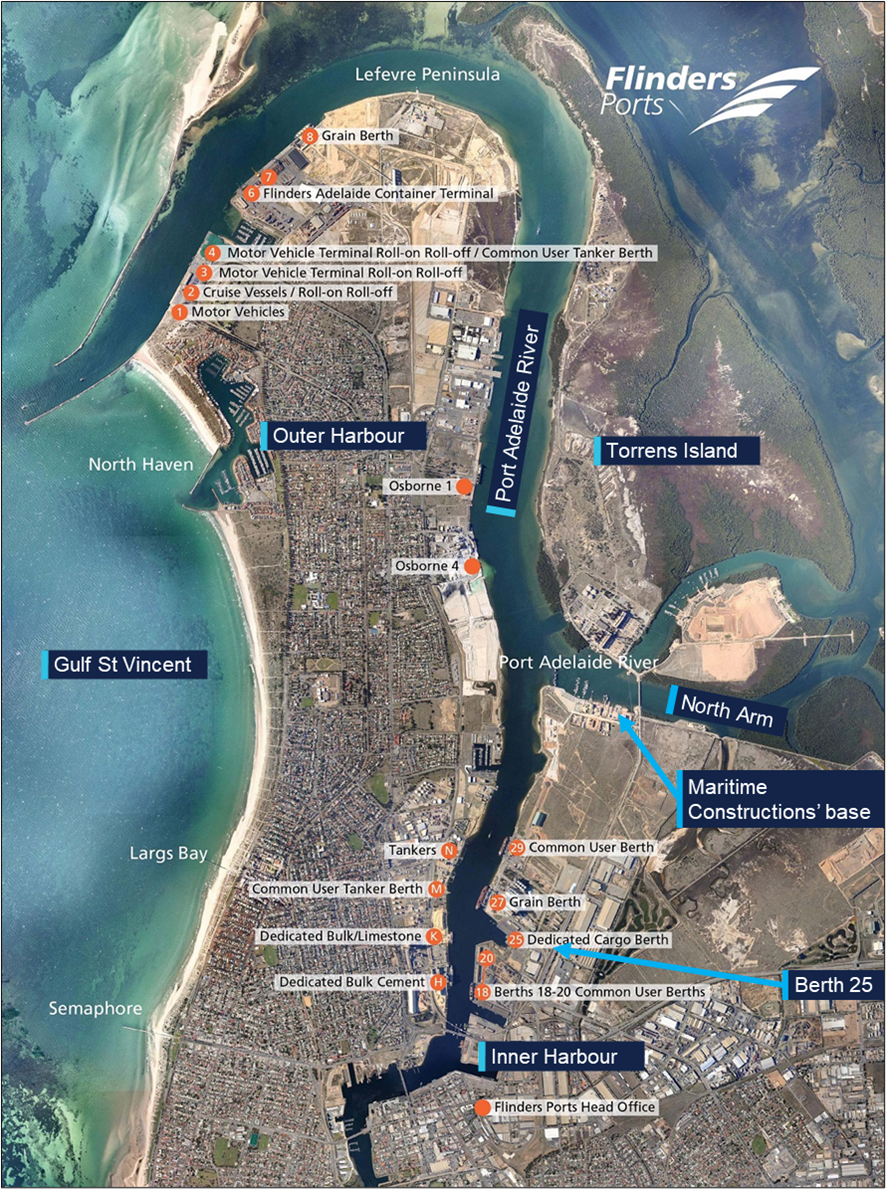
The port comprises an outer harbour at the river’s mouth, where container and cruise ship terminals are located, and an inner harbour further upstream, where bulk and general cargo operations are undertaken. The channel depth in the outer harbour was maintained at 14.2 m, while the inner harbour was maintained at about 9.3 m deep.
The port was owned and operated by Flinders Ports, which was formed in 2001, when the Flinders Ports consortium successfully acquired 7 ports that were privatised by the South Australian Government.
Flinders Ports was responsible for the safe navigation of commercial vessels in the port under a port operation agreement with the South Australian Government. It was also designated as the pilot service provider by the South Australian Department of Infrastructure and Transport (DIT).
North Arm
North Arm is a branch of the Port Adelaide River, north-east of the inner harbour and to the south of Torrens Island. It was not included within the official boundaries of the port of Adelaide. Unlike the main port, North Arm did not accommodate large-scale shipping operations, and the channel depths were not maintained through dredging activity. Between the MC operations base and the main channel of the Port Adelaide River, the navigable channel was bounded by Torrens Island and sandbanks to the north and 4 public jetties to the south.
Pilotage exemption certificates
Pilotage in the port of Adelaide was compulsory for vessels over 35 m in length, unless the vessel’s master held a valid pilotage exemption certificate (PEC). Generally, a PEC formally recognised that a master had attained the requisite local knowledge and navigational competence, through documented training and assessment, to safely conduct a specific vessel or vessels within compulsory pilotage waters without a licensed pilot.
The issuance of a PEC for the port was governed by the Harbors and Navigation Act 1993 (Act) and the Harbors and Navigation Regulations 2023 (Regulations). The DIT served as the statutory issuing authority for certificates, while responsibility for the verification of applicant competency was delegated to Flinders Ports as the port authority.
The requirements for obtaining a PEC were set out in the Regulations and Flinders Ports’ marine pilotage exemption procedure. Applicants for a PEC were required to hold an appropriate certificate of competency, undertake mandated qualifying voyages and complete practical assessment conducted by Flinders Ports. This included a check voyage with a harbour/marine pilot. Following successful evaluation, Flinders Ports provided a formal letter of recommendation for final administrative approval and issuance of the certificate by the DIT.
The Regulations required a PEC applicant to satisfactorily complete qualifying voyages as the ‘operator of a vessel’ with a licensed pilot or a current PEC holder on board. For domestic commercial vessels, the term ‘operator of a vessel’, was defined in the Act to mean the vessel’s master. Generally, qualifying voyages like those mandated by the Regulations function as a formal mechanism for the imparting of vessel-specific handling skills and local port knowledge to the PEC applicant.5 The process was intended to ensure a comprehensive understanding of environmental conditions, bathymetry, and topography as they pertain to the applicant's specific operations.
During a qualifying voyage with a harbour pilot, the pilot was responsible for overseeing the safe conduct of the voyage on behalf of the port operator in accordance with its safety management system (SMS). Conversely, voyages overseen by a PEC holder (usually a company senior master) were not considered pilotages and were conducted under the oversight of the PEC holder. For such trips, the company assumed responsibility for the safe conduct of the voyage under its own SMS.
Maritime Constructions
Maritime Constructions was an Adelaide-based marine engineering contractor established in 1996. The company undertook a range of port and coastal development projects throughout South Australia and Western Australia, including wharf construction, marine asset maintenance and dredging work. To service these projects, it owned and operated a fleet of 64 DCVs, including tugs, barges, dredgers and workboats, under a certificate of operation issued by AMSA.
A portion of Maritime Constructions’ fleet, including Sea Pelican and Rocksea, was based in the port of Adelaide to service projects within and around the port, including wharf extension works at berth 25. These vessels were required to navigate through North Arm when transiting between the company’s operating base and the various project sites.
Rocksea was the largest of 3 unpowered barges exceeding 35 m in length operated by the company in the port. Towage of these barges within port limits required a pilotage exempt tug master or the services of a pilot.
Risk management
North Arm channel monitoring
About a year prior to the grounding, Maritime Constructions identified that the sandbank extending south from Torrens Island toward the fishing jetty had begun to encroach into the North Arm navigational channel due to shoaling. In response, the company commenced bathymetric surveys of the area (Figure 5) to monitor the extent of shoaling and confirm adequate clearance for barge movements.
The survey soundings were not disseminated to masters for passage planning or navigational purposes.
Figure 5: July 2024 bathymetric survey of North Arm
Source: Maritime Constructions, annotated by the ATSB
Safety management system
Australian DCVs were governed by the Marine Safety (Domestic Commercial Vessel) National Law Act 2012 and its associated marine orders. To operate in Australian waters, these vessels were required to hold a certificate of survey and a certificate of operation. It was a condition of a certificate of operation that the vessel’s owner or operator had in place a safety management system (SMS), which complied with the requirements of Marine Order 504 (MO504). The marine order required the owner or operator to identify risks unique to the vessel and its operating environment and document how the risks would be managed.
To meet its obligations under MO504, MC maintained an SMS, which included a vessel‑specific set of operational manuals, procedures and forms for Sea Pelican. A stated purpose of the SMS was to identify potential operational hazards and document relevant procedures and control measures to provide for safe vessel operations.
A risk register for Sea Pelican, which documented various risks and controls for on board tasks was also maintained by MC. In addition to this, prior to undertaking work tasks, all MC employees were required to complete a pre-start risk assessment and safe work method statement.
Passage planning
Prior to each barge movement, tug masters were required to complete and submit a standardised passage plan document to the company’s operations manager. The passage plan submitted by the tug master for the occurrence voyage noted that the departure time would vary to avoid fast-flowing tidal flows that could impact the tug’s steerage effectiveness.
The document required no-go areas to be marked on a chart or the vessel’s electronic chart plotter. While this requirement was ticked as being completed on the passage plan, the shoaling sandbank off Torrens Island was not identified and marked as a potential navigation hazard.
Roles and responsibilities for pilotage exempt masters
To mitigate risks associated with marine pilotage exemption operations, the Australasian Marine Pilots Institute (AMPI) recommended that mitigations specific to a vessel and its operations were defined and documented in the SMS. Where required, these mitigations should include structured training programs for PEC candidates to ensure that the required skills to operate without a pilot were learned and applied.
Maritime Constructions’ use of the PEC system involved the casual engagement of masters with a valid PEC on an as-needs basis for large barge movements. These masters were engaged to either conduct the movement as master or to be present on board to satisfy the port’s pilotage exemption rules in cases where the existing master did not hold an exemption. The PEC holder was also intended to oversee qualifying voyages pursuant to the existing master’s own PEC application.
Safety analysis
Grounding
On 10 June 2025, the tug Sea Pelican was tasked with moving the 55 m long barge Rocksea from the Maritime Constructions (MC) base in North Arm, into the Port Adelaide River and upstream to berth 25. A pilotage exempt master (PEM) was on board Sea Pelican to oversee the passage and mentor the tug master.
With the tug secured to the Rocksea’s starboard quarter, the combination was to be manoeuvred off MC’s wharf and out of North Arm, avoiding 4 public jetties extending from the southern bank. It was normal practice for MC vessels to maintain a distance of a least 10 m off the fishing jetty, which extended further into North Arm than the others. To meet this requirement Sea Pelican’s master planned a course close to the northern edge of the channel.
However, to the north of this jetty, the width of the navigable channel was restricted by a sandbank extending southward from Torrens Island. North Arm was not maintained through dredging, and the sandbar had recently been shoaling and encroaching further into the channel.
Neither the tug master nor the PEM knew the exact boundaries of the encroaching sandbank nor had an accurate understanding of the available channel width. Consequently, when the master was attempting to manoeuvre the barge clear of the jetty, the tug tracked wide in the channel and briefly grounded on the sandbank.
Contributing factor While navigating between the fishing jetty and sandbank opposite, the tug master and pilotage exempt master did not have accurate knowledge of the boundaries of the encroaching sandbank and were unaware of the extent of the resulting narrowing of the navigable channel. Consequently, when attempting to manoeuvre and keep the barge clear of the jetty, the tug tracked wide in the channel and grounded on the sandbank. |
Pre-departure preparations
The master had prior experience operating company vessels from North Arm but had not conducted a tug and barge combination with the combined length or beam of Sea Pelican and Rocksea. Furthermore, the master was undertaking the movement as a qualifying voyage in accord with an application for a port pilotage exemption certificate, under the guidance and tutelage of a company PEM. With the barge crewed by 2 persons and the assisting workboat by 1, the task required coordinating 5 assisting personnel across 3 vessels. Collectively, these factors, combined with navigating a multi‑vessel unit through confined waters with changing depths and channel widths, presented a heightened risk.
Therefore, the planning and preparations for the task needed to be clearly defined and communicated to all parties to ensure it proceeded safely. Relevant hazards needed to be identified and defined, risk barriers put in place and roles and responsibilities detailed and understood.
However, the planning and preparation for the movement were inadequate for ensuring all risks were properly addressed. A formal pre-start briefing was not conducted to establish roles and responsibilities, and no risk assessment or safe work method statement was completed to identify hazards, minimum clearing distances, or account for environmental variables such as channel conditions, tidal effects and vessel positioning. Additionally, the operation lacked defined communication protocols and expectations for the personnel involved.
Contributing factor Pre-departure planning did not sufficiently evaluate the available channel width and address the sandbank as a navigational hazard. As a result, the movement proceeded without considering measures such as:
|
Risk controls
Under Australian domestic commercial vessel (DCV) regulations, operators must maintain a safety management system (SMS) addressing risks specific to the vessel and its operations. In this instance, several risks associated with moving Sea Pelican and Rocksea in the port of Adelaide were not addressed in the company’s SMS documentation.
The Sea Pelican risk register did not include shoaling within the North Arm as a grounding hazard and the safety management system (SMS) did not contain specific procedures for managing grounding risks during tug and barge movements.
Pilotage exemption certificates
Maritime Constructions’ use of the pilotage exemption certificate (PEC) system involved the casual engagement of experienced company PEMs on an as-needs basis for large barge movements. The PEM either commanded the vessel as master or provided the oversight required to satisfy port pilotage rules when the primary master lacked an exemption. They were also tasked with supervising masters during qualifying voyages toward obtaining a PEC.
A PEC formally recognised that a master had demonstrated the requisite local knowledge and navigational competence to operate a specific vessel in compulsory pilotage waters without a pilot. Because the master conducting the qualifying voyage was not yet endorsed, the PEM was required to provide the oversight necessary to manage operational risks associated with the master’s lack of experience.
Following the incident, the master, PEM, and company operations manager indicated that the PEM’s role was viewed as similar to that of a pilot. This comparison was inaccurate because the PEM’s role differed to standard pilotage. Beyond providing navigational advice, the PEM was also to proactively mentor the master through the provision of local knowledge and vessel-handling expertise specific to the operation.
However, the company’s SMS did not define the role and responsibilities of PEC holders or contain any guidance for the oversight and training of masters during qualifying voyages. As a result, the PEM remained largely passive during the transit out of North Arm and did not intervene effectively to prevent the grounding.
North Arm bathymetry
A known, evolving risk to MC operations was the changing seabed in North Arm. This section of the port was not part of the harbour dredging regime and the potential for it to become unnavigable remained a hazard. The company had identified this, and it was of a particular concern for movement of the larger barges from the MC base. Therefore, MC had commenced several strategies to mitigate the present and future risks associated with changing North Arm conditions.
One such strategy was to undertake regular bathymetric surveys of the waterway to monitor the changing water depths available and, particularly, the growth of the sandbar from Torrens Island, and the resulting narrowing of the channel between it and the fishing jetty. As a risk management tool, this bathymetric information would be most effective when incorporated into the SMS to inform operating procedures and passage planning. However, at the time of the incident, the SMS did not include this data within its procedures or planning requirements.
Contributing factor Maritime Constructions did not adequately identify and control risks associated with the operation of tug and barge combinations within the port. This included controls such as providing clear guidance and procedures associated with the use of the pilotage exemption certificate system, and using available in-house bathymetric data for improved control of grounding risk. (Safety issue) |
Findings
ATSB investigation report findings focus on safety factors (that is, events and conditions that increase risk). Safety factors include ‘contributing factors’ and ‘other factors that increased risk’ (that is, factors that did not meet the definition of a contributing factor for this occurrence but were still considered important to include in the report for the purpose of increasing awareness and enhancing safety). In addition ‘other findings’ may be included to provide important information about topics other than safety factors. Safety issues are highlighted in bold to emphasise their importance. A safety issue is a safety factor that (a) can reasonably be regarded as having the potential to adversely affect the safety of future operations, and (b) is a characteristic of an organisation or a system, rather than a characteristic of a specific individual, or characteristic of an operating environment at a specific point in time. These findings should not be read as apportioning blame or liability to any particular organisation or individual. |
From the evidence available, the following findings are made with respect to the grounding of Sea Pelican, Port Adelaide, South Australia, on 10 June 2025.
Contributing factors
- While navigating between the fishing jetty and sandbank opposite, the tug master and pilotage exempt master did not have accurate knowledge of the boundaries of the encroaching sandbank and were unaware of the extent of the resulting narrowing of the navigable channel. Consequently, when attempting to manoeuvre and keep the barge clear of the jetty, the tug tracked wide in the channel and grounded on the sandbank.
- Pre-departure planning did not sufficiently evaluate the available channel width and address the sandbank as a navigational hazard. As a result, the movement proceeded without considering measures such as:
- defined and managed clearance distances via lookouts and agreed communications
- maximising available water depth and under keel clearance by timing the movement with the tide
- positioning the tug on the barge to maximise visibility of the wharf and limit exposure of its deeper draught to the sandbank. - Maritime Constructions did not adequately identify and control risks associated with the operation of tug and barge combinations within the port. This included controls such as providing clear guidance and procedures associated with the use of the pilotage exemption certificate system, and using available in-house bathymetric data for improved control of grounding risk. (Safety issue)
Safety issues and actions
Central to the ATSB’s investigation of transport safety matters is the early identification of safety issues. The ATSB expects relevant organisations will address all safety issues an investigation identifies. Depending on the level of risk of a safety issue, the extent of corrective action taken by the relevant organisation(s), or the desirability of directing a broad safety message to the marine industry, the ATSB may issue a formal safety recommendation or safety advisory notice as part of the final report. All of the directly involved parties were provided with a draft report and invited to provide submissions. As part of that process, each organisation was asked to communicate what safety actions, if any, they had carried out or were planning to carry out in relation to each safety issue relevant to their organisation. Descriptions of each safety issue, and any associated safety recommendations, are detailed below. Click the link to read the full safety issue description, including the issue status and any safety action/s taken. Safety issues and actions are updated on this website when safety issue owners provide further information concerning the implementation of safety action. |
Risk controls
Safety issue number: MO-2025-005-SI-01
Safety issue description: Maritime Constructions did not adequately identify and control risks associated with the operation of tug and barge combinations within the port. This included controls such as providing clear guidance and procedures associated with the use of the pilotage exemption certificate system, and using available in-house bathymetric data for improved control of grounding risk.
Glossary
| ABS | American Bureau of Shipping |
| AMPI | Australasian Marine Pilots Institute |
| AMSA | Australian Maritime Safety Authority |
| CoC | Certificate of competency |
| DCV | Domestic commercial vessel |
| DIT | South Australian Department of Infrastructure and Transport |
| GL | Germanischer Lloyd |
| MC | Maritime Constructions |
| PEC | Pilotage exemption certificate |
| PEM | Pilotage exempt master |
| SMS | Safety management system. A systematic approach to organisational safety encompassing safety policy and objectives, risk management, safety assurance, safety promotion, third party interfaces, internal investigation and SMS implementation. |
| UHF | Ultra high frequency |
| VTS | Vessel traffic service |
Sources and submissions
Sources of information
The sources of information during the investigation included:
- Maritime Constructions
- the master and pilotage exempt master of Sea Pelican
- Flinders Ports
- Australian Maritime Safety Authority.
References
Australasian Marine Pilots Institute. (2025). Position statement on pilot exemption certificate training.
Australian Maritime Safety Authority. (2024). Marine Order 504 – certificates of operation – national law.
Harbors and Navigation Act 1993 (South Australia)
Harbors and Navigation Regulations 2023 (South Australia)
Marine Safety (Domestic Commercial Vessel) National Law Act 2012 (Cth)
Submissions
Under section 26 of the Transport Safety Investigation Act 2003, the ATSB may provide a draft report, on a confidential basis, to any person whom the ATSB considers appropriate. That section allows a person receiving a draft report to make submissions to the ATSB about the draft report.
A draft of this report was provided to the following directly involved parties:
- Maritime Constructions
- Flinders Ports
- the master and pilotage exempt master of Sea Pelican
- Australian Maritime Safety Authority.
Submissions were received from:
- Maritime Constructions
- Flinders Ports.
The submissions were reviewed and, where considered appropriate, the text of the report was amended accordingly.
Purpose of safety investigationsThe objective of an ATSB safety investigation is to improve transport safety through:
In accordance with the TSI Act, the ATSB does not investigate for the purpose of taking administrative, regulatory or criminal action, and cannot apportion blame, assist in determining liability, or, as a general rule, assist in court proceedings. About ATSB reportsATSB safety investigation reports are developed in accordance with ATSB procedures and guidelines, and with regard to applicable international standards and instruments. Reports must include factual material of sufficient weight to support the investigation’s analysis and findings. At all times the ATSB endeavours to balance the use of material that could imply adverse comment with the need to properly explain what happened, and why, in a fair and unbiased manner. An explanation of terminology used in ATSB investigation reports is available here. Publishing informationReleased in accordance with section 25 of the Transport Safety Investigation Act 2003 Published by: Australian Transport Safety Bureau © Commonwealth of Australia 2026 Ownership of intellectual property rights in this publication Unless otherwise noted, copyright (and any other intellectual property rights, if any) in this report publication is owned by the Commonwealth of Australia. Creative Commons licence 
With the exception of the Commonwealth Coat of Arms, ATSB logo, and photos and graphics in which a third party holds copyright, this report is licensed under a Creative Commons Attribution 4.0 International licence. The CC BY 4.0 licence enables you to distribute, remix, adapt, and build upon our material in any medium or format, so long as attribution is given to the Australian Transport Safety Bureau. Copyright in material obtained from other agencies, private individuals or organisations, belongs to those agencies, individuals or organisations. Where you wish to use their material, you will need to contact them directly. |
- ^ A freight vessel that does not have its own means of propulsion and is designed to be towed.
- ^ A nautical mile of 1,852 m.
- ^ Under Australia’s National Standard for Commercial Vessels (NSCV), a vessel classed as 2B denotes a non‑passenger vessel (with up to 12 passengers on board) which can conduct offshore operations (within 200 nautical miles from the baseline of the Australian mainland, including Tasmania and any recognised island).
- ^ An electronic chart system (ECS) is a navigation information system that displays vessel position on an electronic chart but does not meet the International Maritime Organization (IMO) requirements for an electronic chart display and information system (ECDIS).
- ^ Australasian Marine Pilots Institute (2025). Position statement on pilot exemption certificate training.
- ^ Marine order 504 - Certificates of operation - national law | Australian Maritime Safety Authority
Occurrence summary
| Investigation number | MO-2025-005 |
|---|---|
| Occurrence date | 10/06/2025 |
| Occurrence time and timezone | 0950 Australian Central Standard Time |
| Location | North Arm, Port Adelaide River, Adelaide |
| State | South Australia |
| Report release date | 20/08/2026 |
| Report status | Final |
| Investigation level | Defined |
| Investigation type | Occurrence Investigation |
| Investigation phase | Final report: Dissemination |
| Investigation status | Completed |
| Mode of transport | Marine |
| Marine occurrence category | Grounding |
| Occurrence class | Serious Incident |
| Highest injury level | None |
Ship details
| Name | Sea Pelican |
|---|---|
| IMO number | 8950873 |
| Ship type | Tug |
| Flag | Australia |
| Classification society | DNV |
| Owner | Maritime Constructions |
| Manager | Maritime Constructions |
| Departure point | North Arm, Port Adelaide |
| Destination | North Arm, Port Adelaide |
| Injuries | None |
| Damage | Minor |
Ship details
| Name | Rocksea |
|---|---|
| Ship type | Barge (non-powered) |
| Flag | Australia |
| Classification society | American Bureau of Shipping |
| Owner | Maritime Constructions |
| Manager | Maritime Constructions |
| Departure point | North Arm, Port Adelaide |
| Destination | Berth 25, Port Adelaide |
| Injuries | None |
| Damage | Nil |
ATSB acknowledges ADS-B pioneer's induction into Aviation Hall of Fame

The ATSB congratulates the latest Australian aviation pioneers to be inducted into the Australian Aviation Hall of Fame, including ‘father of ADS-B in Australia’ Greg Dunstone.
Mr Dunstone will be one of four individuals inducted into the Hall of Fame(Opens in a new tab/window) at a gala dinner on 14 March 2026, as well as Bill Bristow, founder of Angel Flight Australia; pioneering pilot and holder of Australia’s first pilot certificate, William ‘Billy’ Hart; and Sir Ivan Holyman, founder and managing director of Australian National Airways. The dinner will also recognise the Regional Aviation Association of Australia through the bestowal of the Southern Cross Award.
Greg Dunstone’s induction is particularly noteworthy for the ATSB, given his pioneering work with the development and implementation of Automatic Dependent Surveillance Broadcast (ADS-B) technology. ADS-B is not only used by Airservices Australia for air traffic management of aircraft operating under instrument flight rules, but it can also provide pilots with enhanced situational awareness of other aircraft as an aid to self-separation in non-controlled airspace.
“Greg played a pivotal role in transforming the nation's air traffic management system through his leadership in radar and surveillance technologies during his 46-year career with Airservices Australia,” ATSB A/g Chief Commissioner Colin McNamara said.
“The work by Greg, and many others, on developing and introducing ADS-B technology has added additional levels of aviation safety, and we commend the Australian Aviation Hall of Fame for its recognition of him.”
All aircraft operating in Australia under instrument flight rules must be fitted with approved ADS-B OUT equipment to broadcast the precise location of the aircraft up to twice per second.
In addition, the Australian Government is currently incentivising the voluntary uptake of ADS-B installations in Australian-registered aircraft by providing a 50 per cent rebate on the purchase cost of eligible devices, and where applicable, the installation – capped to $5,000.
The rebate, covering Australian-registered aircraft operating under both visual and instrument flight rules, funds two classes of eligible ADS-B equipment: installed ADS-B equipment that air traffic controllers can use for aircraft separation purposes; and portable ADS-B equipment for local electronic traffic information purposes (ADS-B electronic conspicuity).
“The ATSB encourages the fitment of ADS-B in all general and recreational aircraft in Australia due to its proven abilities to enhance aviation safety and assisting in life-saving search and rescue operations undertaken by AMSA,” Mr McNamara said.
The rebate offer ends on 31 May 2027, but applications may close early if funding is fully allocated before the closing date.
More information, including on how to apply for the rebate, is available here(Opens in a new tab/window).
Engine failure and forced landing involving Robinson R44, VH-OOE, 13 km south of Tindal Airport, Northern Territory, on 11 June 2025
Final report
Report release date: 30/03/2026
Investigation summary
What happened
On 11 June 2025, a Robinson R44 Raven I helicopter, registered VH-OOE, was being operated on a personal transport flight from Daly Waters Aerodrome to Wally’s Airstrip, Northern Territory, with a pilot and one passenger on board. As the helicopter neared the destination, the pilot felt the onset of severe airframe vibration. The pilot elected to conduct a precautionary landing in an area of open farmland, resulting in a hard landing. The pilot and passenger were uninjured, and the helicopter sustained minor damage.
What the ATSB found
The helicopter’s engine was found to have suffered a mechanical failure due to in-service loosening of the nuts on the connecting rod bolts, leading to separation of one of the connecting rods from the crankshaft. The reason the nuts became loose was not determined.
While there was no indication of influence on this occurrence, independent inspection of the connecting rod attaching hardware performed during the overhaul of the engine did not involve a physical torque check of the connecting rod bolts. While the inspection was not a regulatory requirement, this was a missed opportunity to verify the installation torque.
During the most recent periodic inspection the helicopter maintenance provider did not refit the spark plugs using new gaskets, as required by the spark plug manufacturer. It was also found that the Civil Aviation Safety Authority guidance on spark plug gasket fitment was inconsistent in this respect.
What has been done as a result
The Civil Aviation Safety Authority acknowledged the inconsistent information contained within the 2 airworthiness bulletins. CASA advised that Airworthiness Bulletin AWB 20‑001 is scheduled for cancellation and Airworthiness Bulletin AWB 85-023 is to be amended to reflect current recommendations.
The helicopter maintenance provider advised the ATSB it now installs new gaskets when refitting spark plugs.
Safety message
This incident highlights the importance of managing inflight anomalies through a comprehensive understanding of aircraft systems and the application of emergency procedures. The pilot’s timely actions following the onset of the vibrations ensured a safe outcome for the occupants and resulted in minimal damage to the helicopter.
The incident also emphasises the importance of adhering to manufacturer requirements when installing aircraft components, as well as the additional assurance provided by a thorough independent inspection of completed work.
The investigation
The occurrence
On 11 June 2025, a Robinson R44 Raven I helicopter, registered VH-OOE, was being operated on a personal transport flight with a pilot and one passenger on board. The flight was conducted under the visual flight rules,[1] and the planned route was from Daly Waters Aerodrome to Wally’s Airstrip, Northern Territory (NT) (Figure 1).
On the morning of the flight, the pilot completed their pre-flight inspection and refuelled the helicopter. Shortly after starting the engine, the pilot recalled sensing an unusual sound and vibration through the helicopter, but it resolved when the engine speed was increased. The pilot completed their pre-take-off checks, and the helicopter departed Daly Waters Aerodrome at about 0900 local time. The pilot did not recount any issues with the helicopter’s performance during the take-off, climb or initial cruise.
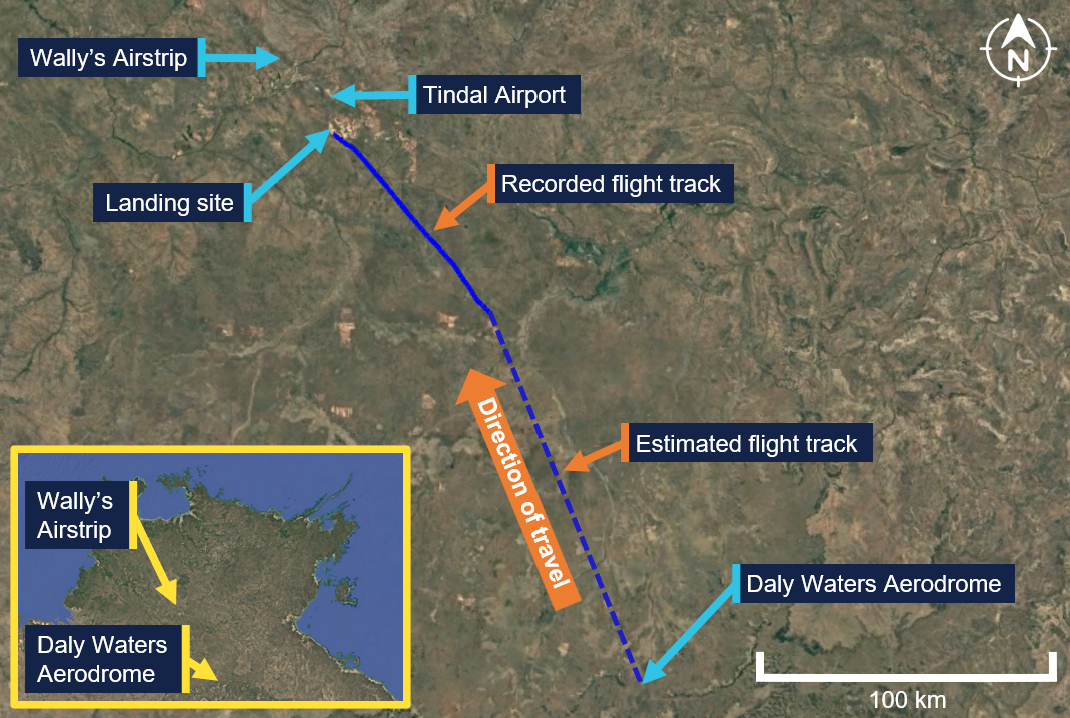
Source: Google Earth, annotated by the ATSB
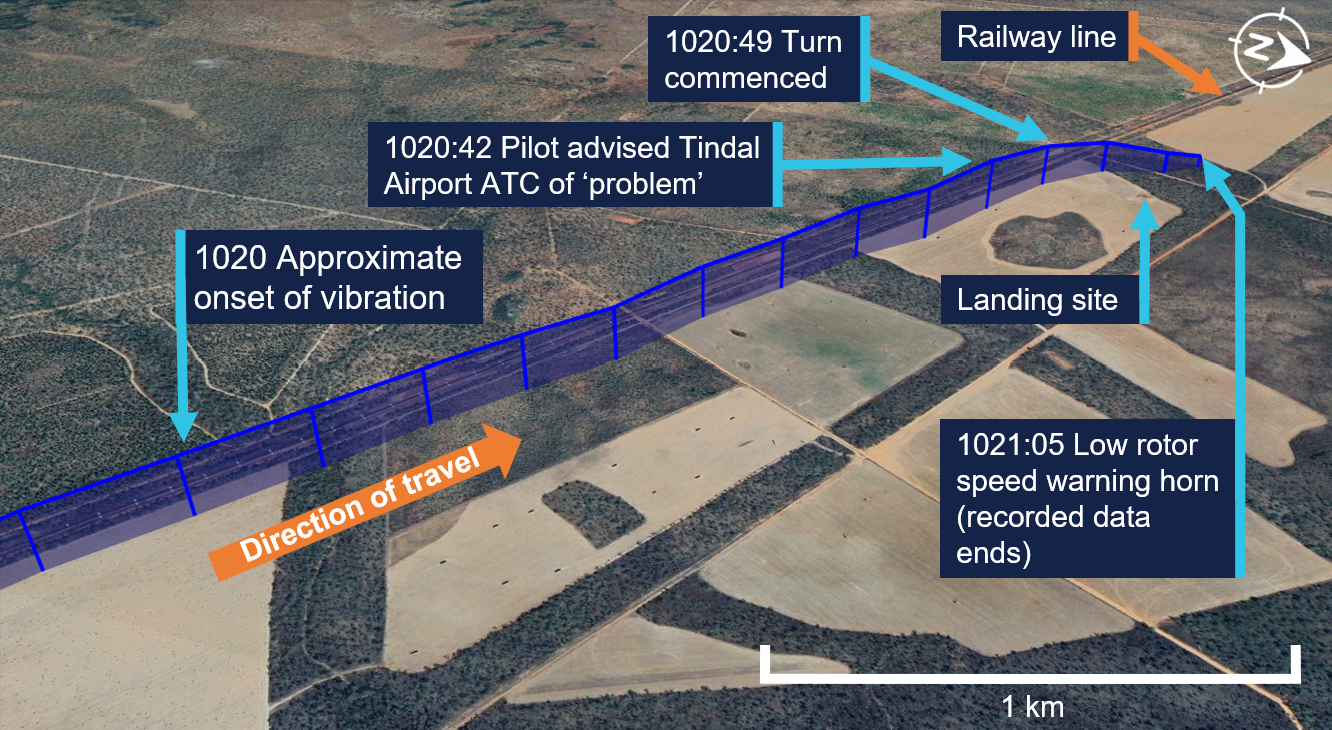
At about 1015, when the helicopter was about 46 km to the south‑east of Wally’s Airstrip, the pilot contacted Tindal Airport air traffic control (ATC). Several exchanges with Tindal Airport ATC took place, during which the pilot was instructed to follow a railway line and maintain an altitude not above 1,500 ft above mean sea level. The pilot complied with these instructions and continued towards their destination. At about 1020, when the helicopter was at an altitude of about 1,100 ft, the pilot felt the onset of severe airframe vibration. They recalled initially thinking the helicopter tail may had been struck but later discounted that possibility when they identified they still had directional control. The pilot was unable to diagnose the cause of the vibration and decided to undertake a precautionary landing.
At 1020:42, and an altitude of about 1,100 ft, the pilot alerted Tindal Airport ATC that they had a ‘problem’ (Figure 2). The pilot selected a paddock for the landing that had recently been harvested of its crop and commenced a right turn towards the landing location at 1020:49. At 1020:52, they communicated that operations were not normal, and at 1021:00 they advised Tindal Airport ATC that they would be landing immediately. The pilot recalled noting the engine gauges and the rotor and engine speed indications at that time were normal.
Figure 2: VH-OOE flight path from the onset of vibrations until landing
Source: Google Earth, annotated by the ATSB
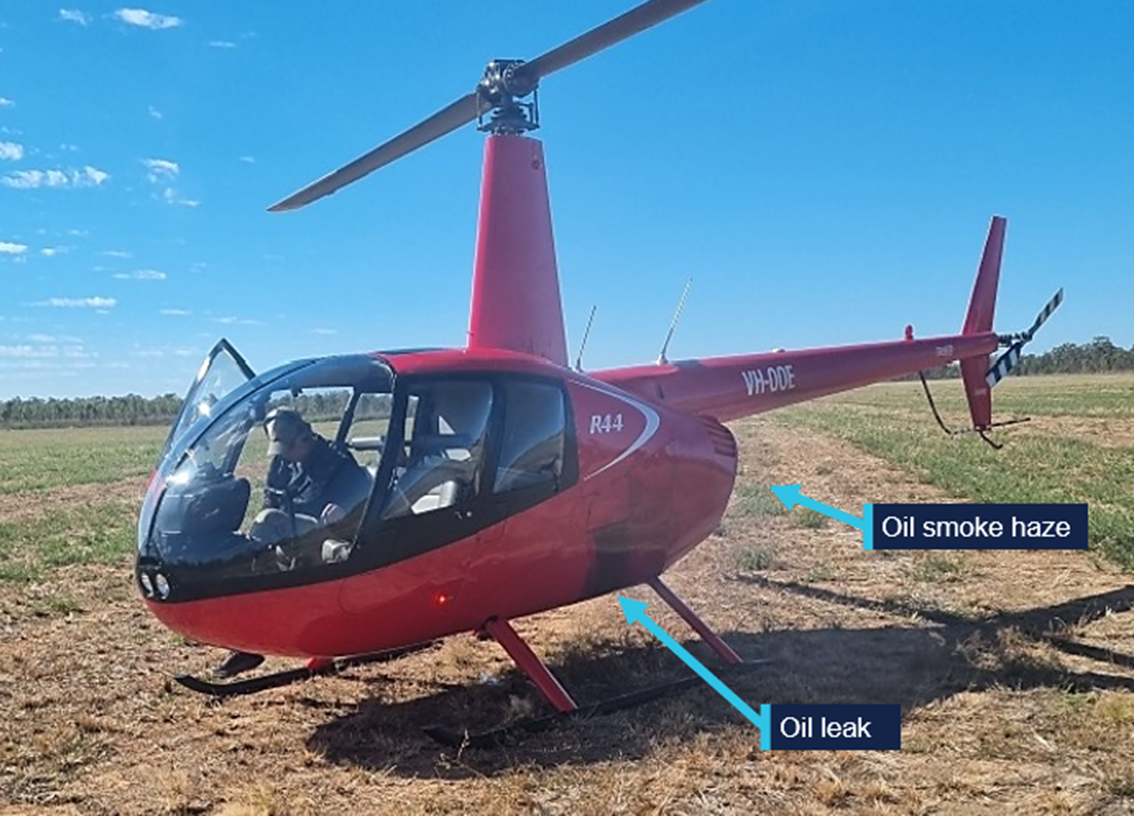
At 1021:05, and an altitude of 700 ft, the pilot made a transmission to Tindal Airport ATC during which a low speed warning horn could be heard in the background (see Low rotor speed). The pilot did not recall hearing the horn. At about 150 ft above ground level, the pilot recalled noting a low oil pressure light on the helicopter’s caution warning panel (see Oil warning caution light). They continued the approach and, as the helicopter slowed for landing, they observed smoke blowing forward from the rear and recalled having concerns about a fire.
The helicopter landed heavily in the paddock. The pilot recalled that the landing was probably completed ‘quicker’ and with a lower tail position than normal, due to their concerns about a fire. Once the helicopter had landed, the pilot instructed the passenger to exit and run forward. They then shut down the helicopter’s engine, and at 1021:41 advised Tindal Airport ATC that they had landed and were safe. The pilot then exited the helicopter. Both occupants were uninjured, and the helicopter sustained minor damage.
Context
Pilot information
The pilot held a valid Commercial Pilot Licence (Helicopter) with single engine and low‑level ratings. The licence was issued on 6 June 2025 following the successful completion of a commercial pilot licence flight test in May 2025. The pilot had held a Private Pilot Licence (Helicopter) since October 2023. They also held a current class 1 aviation medical certificate valid to 6 August 2025. At the time of the incident, they had a total flying time of 194 hours of which 118 hours were on the Robinson R44.
Helicopter information
General information
The Robinson R44 Raven I is a 4-place helicopter with a 2-bladed main rotor system and a conventional 2-bladed tail rotor. VH-OOE was manufactured in the United States in 2008 and first registered in Australia in July 2008. At the time of the incident, the helicopter had accumulated 1,995 hours total time in service.
It was powered by a Lycoming O-540-F1B5, 6-cylinder, horizontally opposed piston engine that is naturally aspirated and rated at 235 horsepower. The overhauled engine was installed in September 2022 and had operated for 291 hours at the time of the incident, with a total time of about 1,614.6 hours. The last periodic inspection was undertaken on 6 May 2025, and the helicopter had flown about 25 hours since that inspection.
Airworthiness and maintenance history
Recent maintenance
The last periodic inspection was undertaken by Platinum Helicopters on 6 May 2025. During the inspection, the Champion REM38E spark plugs fitted to the engine were removed, inspected and then refitted by the maintenance engineer. The maintenance engineer recalled that it was not their practice to fit new spark plug washers (gaskets) when refitting the spark plugs, instead electing to use annealed[2] gaskets (see Spark plug maintenance).
Engine overhaul
In September 2022, VH-OOE underwent a 12 year/2,200 hour inspection. During the inspection, the engine was removed and an overhauled engine was fitted to the helicopter. This engine had been salvaged from a Robinson R44, and was overhauled by South West Aviation, a CASA‑approved maintenance organisation.
During the overhaul of the engine, additional components were used to replace some aspects, including:
- 6 new cylinder kits
- new connecting rod hardware (bolts and nuts) with parts manufacturer approval[3]
- a crankshaft that had been salvaged from a different Robinson R44.
Records show all salvaged components were inspected and tested to assess serviceability prior to fitment. Once the engine overhaul had been completed, it underwent ground runs and checks prior to being installed in VH-OOE.
Records show that independent inspections were undertaken during the engine overhaul of the engine fitted to VH-OEE. The purpose of an independent inspection is to verify that a maintenance task has been completed correctly. The inspection is undertaken by an appropriately authorised person who did not undertake the original activity. While there was no regulatory requirement for the independent inspection of maintenance work carried out on engine systems, South West Aviation had included these inspections as part of the organisation’s worksheets for engine overhaul.
The worksheets for the engine overhaul stated that an independent inspection of the engine sub-assembly was completed during the engine rebuild. Figure 3 shows the sub‑assembly of the crankshaft and the connecting rods, which were secured to the crankshaft by 2 connecting rod bolts and nuts. The crankshaft has 2 dynamic counterweight assemblies fitted, which assist in removing torsional vibration during engine operation.
Figure 3: O-540 crankshaft and connecting rod sub-assembly
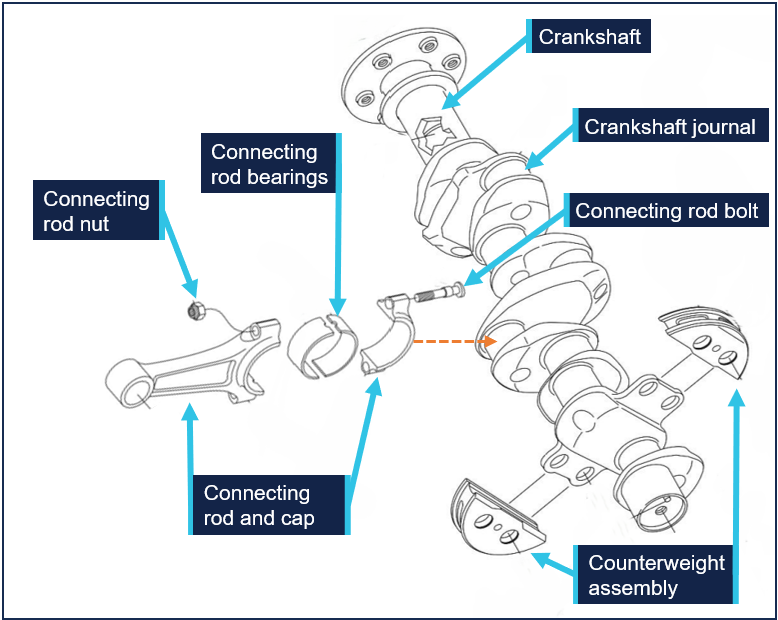
Source: Lycoming O-540-F1B5 Illustrated Parts Catalogue, annotated by the ATSB
During interview, when asked about a torque check of the connecting rod nuts, the engineer who conducted the independent inspection stated they would check the torque was set correctly on the tooling that had been used, but it was not their normal procedure to physically check the torque on each nut. South West Aviation did not have a documented procedure that detailed how the independent inspection of the connecting rod hardware should be conducted.
Helicopter systems and procedures
Vibration
The Robinson R44 pilot operating handbook (POH) contained advice for the management of vibration, and stated:
A change in the sound or vibration of the helicopter may indicate an impending failure of a critical component. If unusual sound or vibration begins in flight, make a safe landing and have the aircraft thoroughly inspected before flight is resumed.
Low rotor speed
The helicopter was fitted with a low rotor speed horn. The activation of the horn indicated that rotor speed may be below safe limits (97%). Power available from the engine is directly proportional to rotor speed. With less power the helicopter will start to sink. If the collective is raised to stop it from descending, the rotor speed will reduce even further causing the helicopter to sink faster. To restore rotor speed, the Robinson R44 POH stated that a pilot should lower the collective, roll throttle on and, in forward flight, apply aft cyclic.
Oil warning caution light
The helicopter was fitted with an oil warning caution light. The illumination of the light indicated a loss of engine power or oil pressure. The Robinson R44 POH stated the actions to take in response should be to check the engine tachometer for power loss and the oil pressure gauge. If oil pressure loss was confirmed, the POH stated the pilot should land immediately. Continued operation without oil pressure causes serious engine damage and engine failure can occur.
Spark plug maintenance
The Champion Aviation Service Manual,[4] which included recommended service, handling and reconditioning practices for Champion spark plugs stated:
Always install both new and reconditioned Champion aviation spark plugs with a new copper gasket.
Additionally, Champion Aviation Technical Bulletin 95-11[5] stated:
Gaskets that have become too hard with normal usage won’t “hold torque” correctly, and spark plugs can come loose with disastrous results. An annealed gasket will not meet new specifications.
The maintenance engineer stated they carried out the periodic inspection in accordance with the Lycoming O-540 Operator’s Manual.[6] However, this manual, which covered both the O-540 and IO-540 engines, contained no information regarding spark plug gasket fitment. The guidelines for the installation of spark plugs were contained in Lycoming service instruction 1042 Approved Spark Plugs, which stated:
Always install a spark plug with a new gasket.
The Civil Aviation Safety Authority (CASA) had produced 2 advisory airworthiness bulletins (AWBs) that included information on spark plug fitment. However, the advice within these 2 documents was not consistent.
AWB 20-001 Spark Plug Care, issued in September 2001, stated:
Most modern spark plugs have a solid copper gasket that requires annealing prior to spark plug installation to ensure a tight, gas sealed fit. The maintainer should check that the spark plug has only one washer, is of correct dimensions and is annealed. If the engine is equipped with a thermocouple probe in the form of a spark plug gasket, a normal gasket is not required.
Whereas AWB 85-023 Piston Engine Spark Plug Cracking, issued in June 2021, stated:
Always install a new spark plug gasket when servicing spark plugs or installing new spark plugs. Failure to install a new spark plug gasket may result in incomplete sealing of the combustion chamber, loss of heat transfer with spark plug overheating leading to possible pre-ignition.
Meteorological information
The weather at the time of the incident, recorded at Tindal Airport around 13 km to the north of the landing site, captured a wind of between 9–13 kt from the east, clear skies and a temperature of 23°C.
Recorded information
The helicopter was not fitted with a flight data recorder or a cockpit voice recorder, nor was it required to be. During the incident flight, data was being transmitted by the helicopter’s transponder. This data, recorded by ground-based receivers, captured the aircraft’s position, altitude, and groundspeed during the final 25 minutes of the flight. All radio communications made and received by Tindal Airport ATC throughout the flight were recorded.
Helicopter damage
The ATSB did not attend the landing site. A post-incident inspection of the helicopter was completed by a maintenance organisation located at Wally’s Airstrip, NT. This inspection identified:
- damage to the engine with scattered material within the cowling
- damaged and displaced drive belts
- impact damage to the engine oil cooler caused by engine material
- engine oil on external areas of the engine and airframe
- the skid landing gear was spread outwards (Figure 4).
The engine and a selection of components were removed for a detailed examination by the ATSB.
Figure 4: VH-OOE shortly after landing showing oil leak and smoke haze
Source: Supplied, annotated by the ATSB
Engine examination
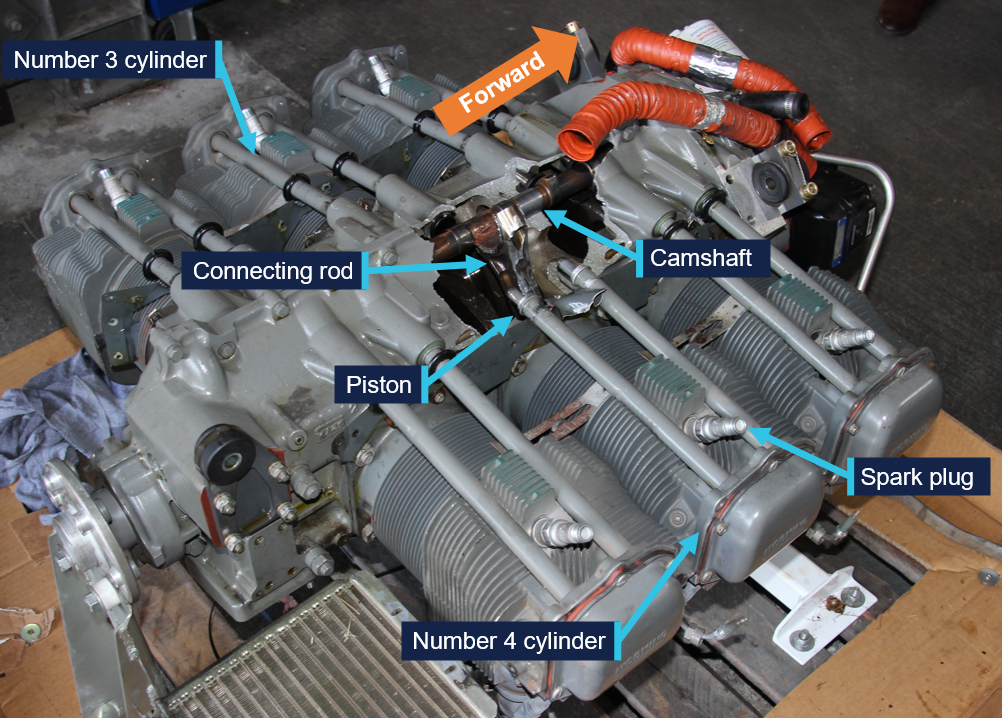
The engine was disassembled and examined at a CASA‑approved engine overhaul facility under the supervision of the ATSB. The examination found that the number 4 connecting rod had separated from the crankshaft journal, resulting in mechanical damage to the internal engine components and fracture of the adjacent crankcase. Both connecting rod bolts had been fractured, with one connecting rod nut missing and the other unwound (see Component examination). There were also witness marks from impact between the number 4 piston crown and cylinder head.
Prior to removal of the remaining connecting rods, the nuts were checked for torque. The check found that the number 3 cylinder connecting rod nuts were at 20 ft/lb, while numbers 1, 2, 5 and 6 connecting rod nuts were at the correct torque of 40 ft/lb.
The number 4 cylinder spark plugs were found loosened, but the spark plug leads were attached tightly. Subsequent testing of the spark plugs found both were serviceable. Figure 5 depicts the engine prior to disassembly.
Figure 5: Engine assembly showing damage
Source: ATSB
Component examination
Several components were retained from the engine disassembly and were examined at the ATSB’s technical facilities in Canberra, Australian Capital Territory.
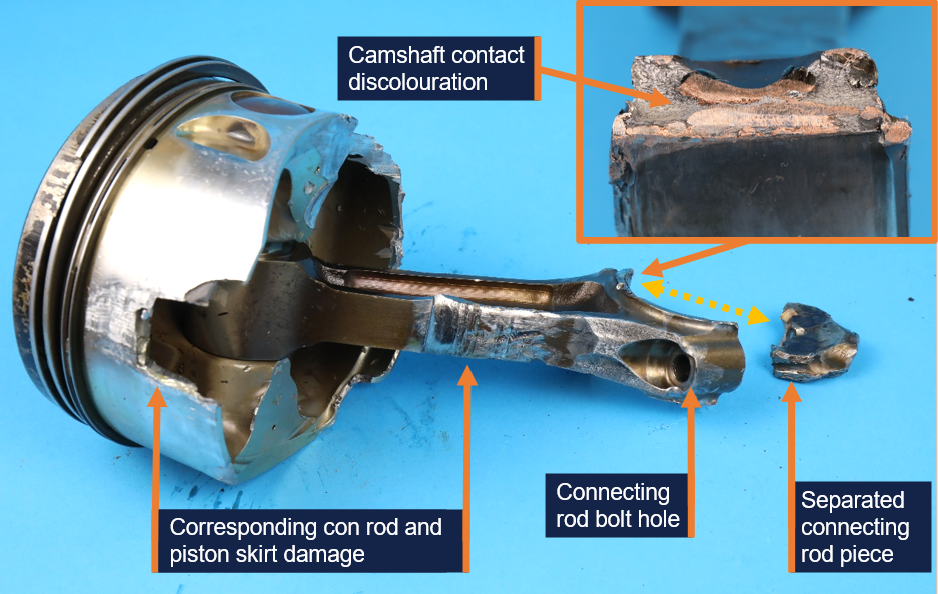
Extensive deformation and fracture of the number 4 connecting rod (Figure 6) and deformation of the crankshaft journal, was consistent with initial separation of the connecting rod, followed by repeated impacts to the connecting rod by the still-rotating crankshaft.
Figure 6: Number 4 cylinder connecting rod and piston
Source: ATSB
This resulted in significant damage to the adjacent cylinder wall, piston skirt, camshaft and the hole in the crankcase. The fractured connecting rod showed no evidence of fatigue cracking or other defect.
The number 4 connecting rod bearings were deformed due to contact with the moving internal engine components but were found to be the correct parts and did not exhibit any abnormal signs of wear. Bearings from some of the other connecting rods displayed minor surface wear, which was attributed to low engine oil volume during the final part of the flight.
There were visibly fewer combustion deposits on the number 4 piston crown, compared to the remaining pistons. However, a considerable amount of sand-like contamination was recovered from the number 4 cylinder during engine disassembly, which was found to be chemically similar to the piston deposits. There was no evidence of destructive combustion issues such as pre-ignition or significant detonation.
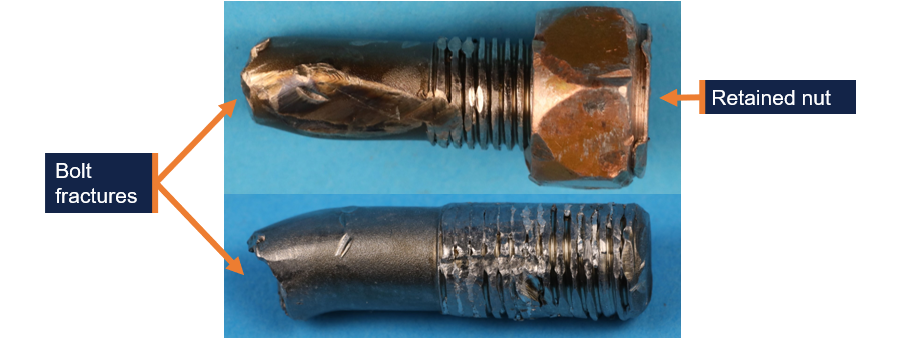
The connecting rod was secured to the crankshaft by 2 connecting rod bolts (Figure 3). Both number 4 cylinder connecting rod bolts were fractured in approximately the same location (Figure 7). The fracture surface features of both bolts and deformation of the adjacent shank were consistent with overstress failures.
Figure 7: Cylinder number 4 connecting rod bolts
Source: ATSB
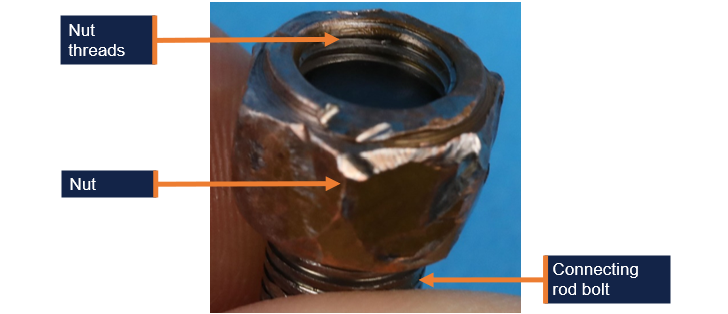
One of the cylinder 4 connecting rod bolts had no nut and heavily damaged threads. The nut was not located. The other connecting rod bolt had a partially unwound nut retained on the threads (Figure 8).[7] The exposed threads were damaged. The nut could not be further unwound by hand, likely due to impact damage. The bolts and nut material was in accordance with their specification. The extent of deformation precluded a detailed inspection of the threads; however, the threads were not stripped and the remnants of a compound consistent with thread lubricant was identified.
Figure 8: Number 4 cylinder connecting rod bolt showing position of retained nut
Source: ATSB
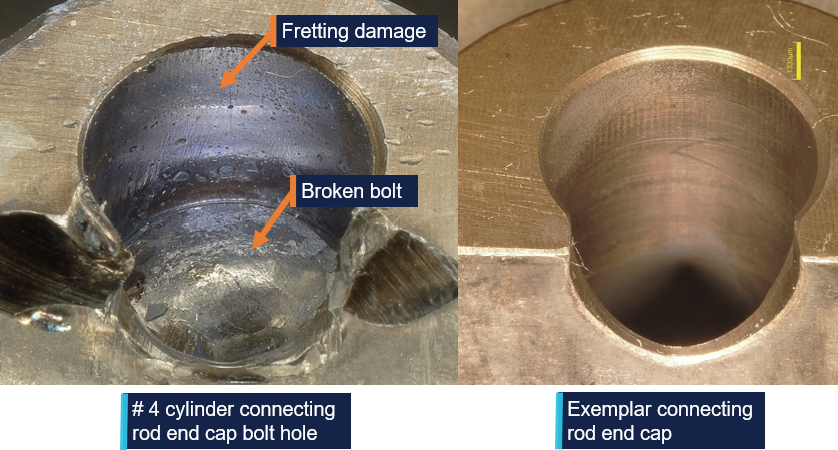
The examination also identified evidence of abnormal fretting[8] wear in the number 4 cylinder connecting rod bolt holes. A comparison between the number 4 cylinder and number 6 cylinder connecting rod bolt holes is depicted in Figure 9.
Figure 9: Number 4 cylinder connecting rod end cap bolt hole fretting wear and exemplar
Source: ATSB
The abnormal fretting wear indicated relative movement (micro-slip) between the bolted surfaces during operation, which would occur if the bolt tension was insufficient to restrain movement under normal operational loads. The missing nut from one of the bolts, and the other nut retained in an improper position on the fractured bolt, was also an indicator that the nuts had loosened in-service.
Possible mechanisms that could result in the in-service loosening of the nuts included:
- Abnormal loading or vibration from engine overspeed or abnormal combustion that could lead to bolt stretch and nut loosening.
- Variations in thread condition or installing the threads dry versus lubricated could produce a lower bolt stress than desired.
- Unintended deformation due to improper or defective parts leading to reduced bolt stress over time.
- Microscopic surface deformation and fretting at contact interfaces could reduce clamping force by a small margin over time, which could then make the nut susceptible to further loosening during service.
- Inadequate torque applied to the nuts during installation that could lead to relative movement between the clamped surfaces and nut loosening during normal operation.
Related occurrences
In 2007, the ATSB published a research and analysis report (B20070191) into aircraft reciprocating (piston) engine failures. The report examined 20 high-power[9] piston engine structural failure occurrences in Australia, between 2000 and 2005. The report focused on failures of the combustion chamber, connecting rods and crankshaft assemblies. It included several engine failure investigations, including investigation 200105866 (below).
ATSB investigation 200105866
On 14 December 2001, a Piper PA31-350 aircraft, registered VH-JCH, was in cruise flight at 8,000 ft when the flight crew noticed that the propellers went out of synchronisation. Adjustments were made to correct the problem but were unsuccessful. Following right engine speed fluctuations, the crew shut the engine down, feathered the propeller and conducted a single‑engine landing.
During the subsequent disassembly of the engine, the crankshaft was noted to have fractured at the number 6 connecting rod journal, and the number 6 connecting rod big end had separated from the crankshaft and impacted the camshaft. The separation of the number 6 big end permitted the piston to strike the top of the combustion chamber with sufficient force to deform the top of the piston.
The number 6 connecting rod disconnection from the crankshaft was due to the loosening of the nuts on the connecting rod bolts, and eventual loss of one nut. Evidence of nut loosening, leading to fretting wear damage, was observed on the bolt threads and the connecting rod cap bolt hole locations. The reason for the loosening of the number 6 connecting rod nuts could not be determined.
The damage of these components was almost identical to the damage noted in the engine from VH-OOE.
Safety analysis
The ATSB examination of the engine components determined that the engine failure resulted from mechanical damage caused by the separation of the number 4 cylinder connecting rod from the crankshaft.
The initiating factor of the separation was almost certainly the in-service loosening of the connecting rod nuts of the number 4 cylinder. This was evidenced by the fretting wear in the connecting rod bolt holes, which was illustrative of engine operation after a loss of bolt tension, allowing relative movement between the bolts and holes. The absence of one of the associated nuts, and the opposite one mostly unwound was also evidence of the nuts loosening prior to the engine failure. There was also an absence of fatigue cracking of the number 4 bolts or connecting rod that might otherwise account for the component fractures and separation of the connecting rod.
Of the possible mechanisms identified that could have led to the connecting rod nuts loosening:
- Abnormal loading or vibration: there was no evidence of engine overspeed, or of piston melting or structural damage consistent with severe abnormal combustion. There was no evidence that the spark plugs, found loose during the disassembly, had any negative impact on the engine performance.
- Variation in thread condition and lubrication: this could not be fully assessed due to thread damage and the absence of one of the nuts.
- Improper or defective parts: the connecting rod bolts and nut material was correct; however, a full assessment of their original condition was not possible.
- Embedding (microscopic deformation): it is possible that the initial bolt tension reduced by a small margin due to microscopic deformation of the clamping or thread surfaces, which would then make the nut more susceptible to further loosening during service.
- Inadequate installation torque: like the above, it was possible that the nuts were slightly under-torqued during installation and progressively loosened during the subsequent 291 hours of operation. The number 3 connecting rod nuts being found at the incorrect torque value during the engine disassembly further supports this scenario.
Given most of the possibilities above could not be definitively ruled out, the reason for the nuts loosening was ultimately not determined.
Despite this, it was identified that during the overhaul of the engine fitted to VH-OOE, the independent inspection of the engine sub-assembly did not involve a torque check of the connecting rod nuts. While there was no evidence of influence on this occurrence and while the inspection was not a regulatory requirement, the ATSB considered it a missed opportunity to positively verify the installation torque.
Additionally, during the engine examination, both spark plugs in the number 4 cylinder were found to be loose. The reason for the loose spark plugs was not determined and, as above, there was no evidence identified to indicate influence on the engine failure. However, it was identified that during the most recent periodic inspection, the helicopter maintenance provider did not refit the spark plugs using new gaskets as required by the engine and spark plug manufacturer.
On the same subject, the Civil Aviation Safety Authority guidance on spark plug gasket fitment was inconsistent. Airworthiness Bulletin AWB 20-001 stated that annealed gaskets could be used, whereas Airworthiness Bulletin AWB 85-023 stated new gaskets must be used in all circumstances.
The unusual sound and vibration noted by the pilot during engine start was possibly a precursor to the eventual failure inflight, however the vibration disappeared when engine speed was increased. In response to the onset of severe vibration inflight, the pilot assessed the controllability of the helicopter and noted there were no abnormal engine indications at that time. In accordance with the Robinson R44 POH, the pilot conducted a precautionary landing in a suitable location. They also communicated the issue to Tindal Airport ATC, which increased the likelihood of a timely emergency response had one been necessary.
During the late stages of the approach, the low rotor speed warning horn and low oil pressure caution light activated. Both indicated a reduction in power, almost certainly due to the mechanical failure, resulting in less power than normal to arrest the rate of descent in the final stages of landing. This, in combination with the pilot’s concern about a possible fire and recollection of landing ‘quicker’ than normal, likely resulted in the helicopter landing heavily which spread the landing gear skids.
Findings
ATSB investigation report findings focus on safety factors (that is, events and conditions that increase risk). Safety factors include ‘contributing factors’ and ‘other factors that increased risk’ (that is, factors that did not meet the definition of a contributing factor for this occurrence but were still considered important to include in the report for the purpose of increasing awareness and enhancing safety). In addition ‘other findings’ may be included to provide important information about topics other than safety factors. These findings should not be read as apportioning blame or liability to any particular organisation or individual. |
From the evidence available, the following findings are made with respect to the engine failure and forced landing involving Robinson R44, VH-OOE, 13 km south of Tindal Airport, Northern Territory, on 11 June 2025.
Contributing factors
- In-service loosening of the connecting rod nuts resulted in the eventual separation of the connecting rod from the crankshaft and the mechanical failure of the engine. The reason for the nuts loosening was not determined.
- During the engine overhaul, the torque on the connecting rod nuts was not physically checked as part of the independent inspection of the engine assembly. This was a missed opportunity to verify that the installation of the connecting rod nuts had been completed correctly.
Other findings that increased risk
- During the most recent periodic inspection, the helicopter maintenance provider did not refit the spark plugs using new gaskets as required by the spark plug manufacturer. This increased the risk of loosened spark plugs, insufficient heat transfer and pre-ignition.
- The Civil Aviation Safety Authority guidance on spark plug gasket fitment was inconsistent. Airworthiness Bulletin AWB 20-001 stated that annealed gaskets could be used, whereas Airworthiness Bulletin AWB 85-023 stated new gaskets must be used in all circumstances. The inconsistency in this guidance could have led to incorrect procedures being performed which were not in accordance with spark plug maintenance requirements.
Safety actions
Safety action by Civil Aviation Safety Authority
The Civil Aviation Safety Authority acknowledged the inconsistency between Airworthiness Bulletin AWB 20-001 (that stated that annealed gaskets could be used) and Airworthiness Bulletin AWB 85-023 (that stated new gaskets must be used in all circumstances) and advised the ATSB that AWB 20-001 will be cancelled and AWB 85‑023 will be amended to reflect current recommendations.
Safety action by Platinum Helicopters
Platinum Helicopters advised the ATSB that new spark plug gaskets are now fitted each time spark plugs are reinstalled.
Sources and submissions
Sources of information
The sources of information during the investigation included:
- the pilot of VH-OOE
- the engine overhaul organisation
- the maintenance provider for VH-OOE
- Civil Aviation Safety Authority
- the aircraft manufacturer
- the engine manufacturer
- the PMA parts manufacturer
- Airservices Australia
- the Bureau of Meteorology.
References
Australian Government (1988), Civil Aviation Regulations 1988 (Commonwealth), reg 42G. AustLII. https://classic.austlii.edu.au/au/legis/cth/consol_reg/car1988263/s42g.html
Australian Government (2021), Aircraft Reciprocating-Engine Failure: An Analysis of Failure in a Complex Engineered System, Australian Transport Safety Bureau, Canberra, ACT. /publications/2007/b20070191
Civil Aviation Safety Authority (2025). Airworthiness Bulletin 20-001. Retrieved from https://www.casa.gov.au/aircraft/airworthiness/airworthiness-bulletins/spark-plug-care
Civil Aviation Safety Authority (2025). Airworthiness Bulletin 85-023. Retrieved from https://www.casa.gov.au/aircraft/airworthiness/airworthiness-bulletins/piston-engine-spark-plug-insulator-cracking
Lycoming Engines Operator’s Manual 4th edition 2006, O-540, IO-540 Series
Lycoming Engines Overhaul Manual, Direct drive engines 1974
Lycoming Engines Parts Catalogue 2009, O-540-F1B5
Robinson Helicopter Company 2024, R44 Pilot’s Operating Handbook, section 10, p.10-2
Submissions
Under section 26 of the Transport Safety Investigation Act 2003, the ATSB may provide a draft report, on a confidential basis, to any person whom the ATSB considers appropriate. That section allows a person receiving a draft report to make submissions to the ATSB about the draft report.
A draft of this report was provided to the following directly involved parties:
- the pilot of VH-OOE
- Civil Aviation Safety Authority
- the maintenance provider
- the engine overhaul organisation
- Textron Lycoming
- Robinson Helicopters
- National Transportation Safety Board (NTSB).
Submissions were received from:
- the pilot of VH-OOE
- the maintenance provider
- the engine overhaul organisation
- Textron Lycoming
- Robinson Helicopters.
The submissions were reviewed and, where considered appropriate, the text of the report was amended accordingly.
Purpose of safety investigationsThe objective of a safety investigation is to enhance transport safety. This is done through:
It is not a function of the ATSB to apportion blame or provide a means for determining liability. At the same time, an investigation report must include factual material of sufficient weight to support the analysis and findings. At all times the ATSB endeavours to balance the use of material that could imply adverse comment with the need to properly explain what happened, and why, in a fair and unbiased manner. The ATSB does not investigate for the purpose of taking administrative, regulatory or criminal action. About ATSB reportsATSB investigation reports are organised with regard to international standards or instruments, as applicable, and with ATSB procedures and guidelines. Reports must include factual material of sufficient weight to support the analysis and findings. At all times the ATSB endeavours to balance the use of material that could imply adverse comment with the need to properly explain what happened, and why, in a fair and unbiased manner. An explanation of terminology used in ATSB investigation reports is available here. This includes terms such as occurrence, contributing factor, other factor that increased risk, and safety issue. Publishing informationReleased in accordance with section 25 of the Transport Safety Investigation Act 2003 Published by: Australian Transport Safety Bureau © Commonwealth of Australia 2026 
Ownership of intellectual property rights in this publication Unless otherwise noted, copyright (and any other intellectual property rights, if any) in this report publication is owned by the Commonwealth of Australia. Creative Commons licence With the exception of the Commonwealth Coat of Arms, ATSB logo, and photos and graphics in which a third party holds copyright, this report is licensed under a Creative Commons Attribution 4.0 International licence. The CC BY 4.0 licence enables you to distribute, remix, adapt, and build upon our material in any medium or format, so long as attribution is given to the Australian Transport Safety Bureau. Copyright in material obtained from other agencies, private individuals or organisations, belongs to those agencies, individuals or organisations. Where you wish to use their material, you will need to contact them directly. |
[1] Visual flight rules (VFR): a set of regulations that permit a pilot to operate an aircraft only in weather conditions generally clear enough to allow the pilot to see where the aircraft is going.
[2] Annealing: the process of heating a metal to a cherry red colour and them immersing into water to soften the material.
[3] A parts manufacturer approval (PMA) is a combined design and production approval for modification and replacement articles. It allows a manufacturer to produce and sell these articles for installation on type certificated products.
[4] Champion Service Manual AV6-R, revised August 2014.
[5] Champion Aviation Technical Bulletin 95-11, Aviation Spark Plugs – New and Reconditioned Should Always be Installed with a New Gasket, published November 1995.
[6] Lycoming Operator’s Manual O-540, IO-540 Series, 4th Edition, June 2006.
[7] When installed correctly, 2–3 bolt threads would protrude from the edge of the nut. In this case 2–3 nut threads were visible on the end of the bolt.
[8] Fretting refers to wear involving small amplitude relative movement or vibration between contact surfaces.
[9] The high-power engines analysed as part of the study were Lycoming TIO-540 and IO-540, and Continental TSIO-520 and GTSIO-520 engines.
Occurrence summary
| Investigation number | AO-2025-029 |
|---|---|
| Occurrence date | 11/06/2025 |
| Location | 13 km south of Tindal Airport |
| State | Northern Territory |
| Report release date | 30/03/2026 |
| Report status | Final |
| Investigation level | Short |
| Investigation type | Occurrence Investigation |
| Investigation phase | Final report: Dissemination |
| Investigation status | Completed |
| Mode of transport | Aviation |
| Aviation occurrence category | Engine failure or malfunction, Forced/precautionary landing, Smoke |
| Occurrence class | Serious Incident |
| Highest injury level | None |
Aircraft details
| Manufacturer | Robinson Helicopter Co |
|---|---|
| Model | R44 Raven I |
| Registration | VH-OOE |
| Serial number | 1879 |
| Aircraft operator | BBH Southern Highlands Pty Ltd |
| Sector | Helicopter |
| Operation type | Part 91 General operating and flight rules |
| Departure point | Daly Waters Aerodrome, Northern Territory |
| Destination | Wally’s Airstrip, Northern Territory |
| Damage | Minor |
Cessna 206 cargo door emergency exit
Safety advisory notice
To operators of all Cessna 206 variants
The removal of a middle row seat or approved cargo door modifications can improve the survivability for occupants of the Cessna 206.
What happened
On the morning of 1 September 2024, the pilot of a Cessna U206F took off from a private aircraft landing area, 40 km south-east of Moora, Western Australia, to conduct a local scenic flight with 5 passengers on board. On return to the landing area, after bouncing twice on landing, the pilot then attempted to conduct a go-around. However, an incorrect flap setting resulted in the aircraft not climbing, impacting the right wing with terrain before coming to a stop in an adjacent field.
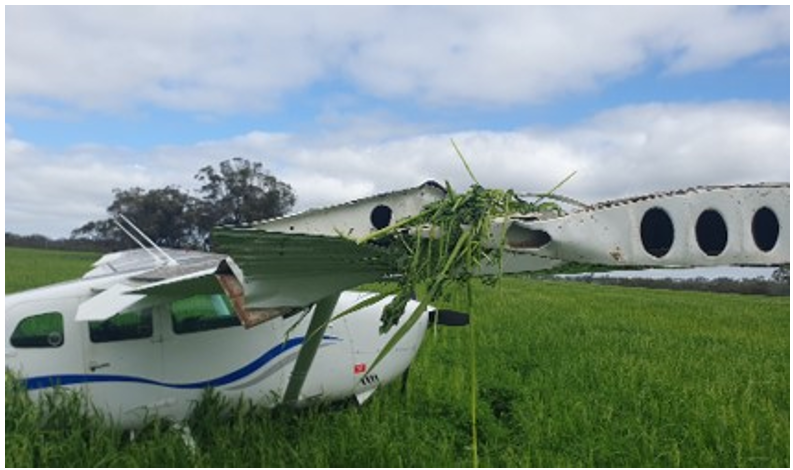
The rear seat passengers, an older person and a child, were unable to egress the aircraft via their closest emergency exit (the cargo doors). The pilot tried assisting them but found that the forward cargo door was blocked due to the flap extension and was unaware how to open the rear cargo door with the forward cargo door blocked by the flap. The pilot attempted to retract the flaps so the door could be opened, but they would not retract. The pilot then instructed the passengers in the rear seats to climb over the middle row of seats so they could exit through the left forward cabin door. This ultimately increased the time taken to evacuate the aircraft and further increased the risk of passenger injury and post-impact survivability, such as if fire or ditching had been a factor.
Why did it happen
The Cessna 206 is a 6‑seat, high wing aircraft with a forward cabin door on the pilot’s side and a double cargo ‘clam-shell’ style door on the rear right hand side of the aircraft. When the aircraft flaps are extended 10° or more, this prevents the forward, overlapping part of the cargo door from opening, requiring a multi-step process to open the rear part of the door to exit the aircraft.
In response to a fatal Canadian Cessna 206 accident in 2018, Transport Canada issued Airworthiness Directive CF-2020-10 requiring Canadian registered Cessna 206 aircraft to have one of the second row (middle row) seats removed if passengers were to be seated in the rear seats of the aircraft. The airworthiness directive was introduced due to aircraft occupants being unable to evacuate the aircraft during an emergency and allowed the rear seat passengers easier access to the forward cargo door. At the time, the Canadian airworthiness directive did provide for an alternative means of compliance to the removal of a middle row seat with a supplemental type certificate (STC) STC SA1470GL(Opens in a new tab/window), for the installation of a second forward cabin door located adjacent to the forward right seat.
In 2020, STC SA20-34(Opens in a new tab/window) was approved as an alternative means of compliance, which allowed the forward cargo door corner to be hinged so the door corner can fold and the door fully open with flap extended in any position and without any restriction to the rear cargo door.
In 2023, Transport Canada also approved STC SA23-21(Opens in a new tab/window) to provide an additional handle that is installed internally on the forward cargo door. The handle is accessible to the rear seat passengers, which, when activated, jettisons the front cargo door from the aircraft. The removal of the door provided enhanced egress to the middle row occupants when flaps remained extended. The release of the door from the aircraft also improved visibility of the rear cargo door handle and simplified opening the rear cargo door for occupants in the rear seats.
In 2021, CASA issued Airworthiness Bulletin 52‑006(Opens in a new tab/window) recommending operators consider incorporating the changes Transport Canada had enforced.
Safety advisory notice
AO-2024-049-SAN-002: The Australian Transport Safety Bureau strongly encourages operators and owners to review Transport Canada Airworthiness Directive CF-2020-10, and consider either the removal of a middle row seat to improve rear seat occupants’ access to the pilot’s forward left cabin door or the fitment of approved Cessna 206 emergency exit modifications to reduce the risk created by the extended flap preventing the immediate and unobstructed use of the rear cargo doors during an emergency exit.
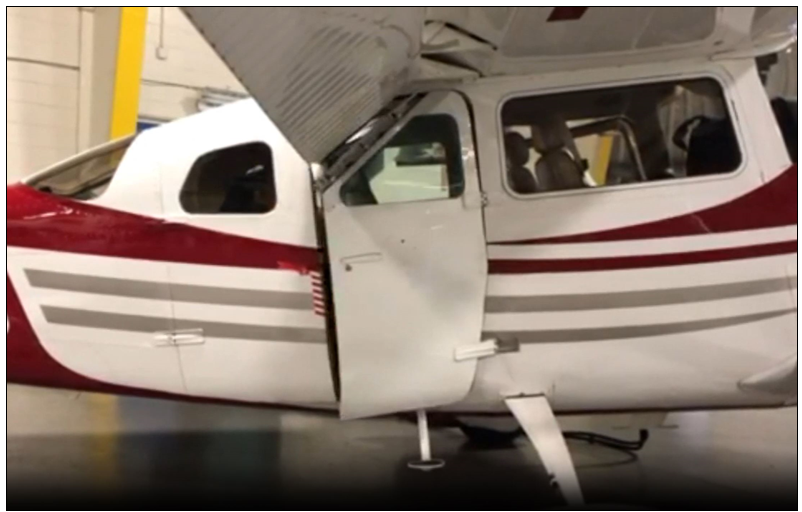
Cessna 206 emergency egress modifications
The additional complexity involved with opening the rear cargo door of the Cessna 206 when the flaps remain extended requires a multi-step process that is not intuitive or simple.
Transport Canada made significant changes to the aircraft configuration mandating the removal of a middle row seat and therefore providing access for passengers in the rear seats and improved access to the pilot’s forward left door. As an alternative to the removal of a seat, Transport Canada also approved modifications that either provided an additional exit or modification to the cargo door, so as the extended flap does not block the forward cargo door exit.
Australian operators of Cessna 206 aircraft that feature the double cargo door are strongly encouraged to review the changes Transport Canada has mandated, or the approved modifications, and consider implementing the improvements for the survivability for passengers during emergency egress in the Cessna 206.
Read more about this ATSB investigation: Collision with terrain during go-around involving Cessna U206F, VH-TDQ, 39 km south-east of Moora, Western Australia, on 1 September 2024
Publication details
| Investigation number | AO-2024-049 |
|---|---|
| Publication type | Safety Advisory Notice |
| Publication mode | Aviation |
| Publication date | 30/06/2025 |
Cessna 206 cargo door passenger pre-flight briefing
Safety advisory notice
To operators of all Cessna 206 variants
Emergency egress from the rear cargo doors becomes more complex with flaps extended.
Ensure passengers have a thorough understanding of the use of emergency exits.
What happened
On the morning of 1 September 2024, the pilot of a Cessna U206F took off from a private aircraft landing area, 40 km south‑east of Moora, Western Australia, to conduct a local scenic flight with 5 passengers on board. On return to the landing area, after bouncing twice on landing, the pilot then attempted to conduct a go‑around. However, an incorrect flap setting resulted in the aircraft not climbing, impacting the right wing with terrain before coming to a stop in an adjacent field.
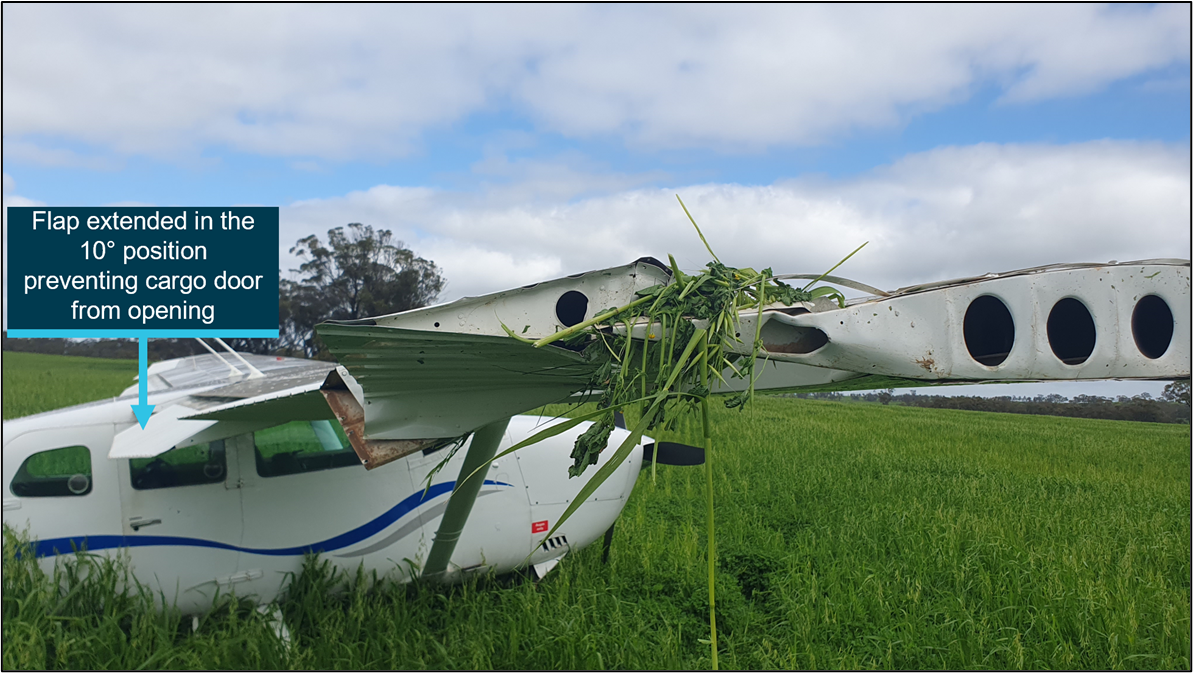
The rear seat passengers, an older person and a child, were unable to egress the aircraft via their closest emergency exit (the cargo doors). The pilot tried assisting them but found that the forward cargo door was blocked due to the flap extension and was unaware how to open the rear cargo door with the forward cargo door blocked by the flap. The pilot attempted to retract the flaps so the door could be opened, but they would not retract. The pilot then instructed the passengers in the rear seats to climb over the middle row of seats so they could exit through the left forward cabin door. This ultimately increased the time taken to evacuate the aircraft and further increased the risk of passenger injury and post-impact survivability, such as if fire or ditching had been a factor.
Why did it happen
The Cessna 206 is a 6‑seat, high wing aircraft with a forward cabin door on the pilot’s side and a double cargo ‘clam-shell’ style door on the rear right hand side of the aircraft. When the aircraft flaps are extended 10° or more, this prevented the forward, overlapping part of the cargo door from opening, requiring a multi-step process to open the rear part of the door to exit the aircraft.
The pilot reported they provided the passengers with a pre-flight briefing that included the operation of both the forward and rear cargo doors, however the briefing did not include a demonstration of the operation of the cargo door emergency exit with the flaps extended.
The emergency exit placard located on the forward cargo door states:
- Open forward cargo door as far as possible
- Rotate red lever in rear cargo door forward and unlatch/open door
- Restow red lever
- Force rear cargo door open
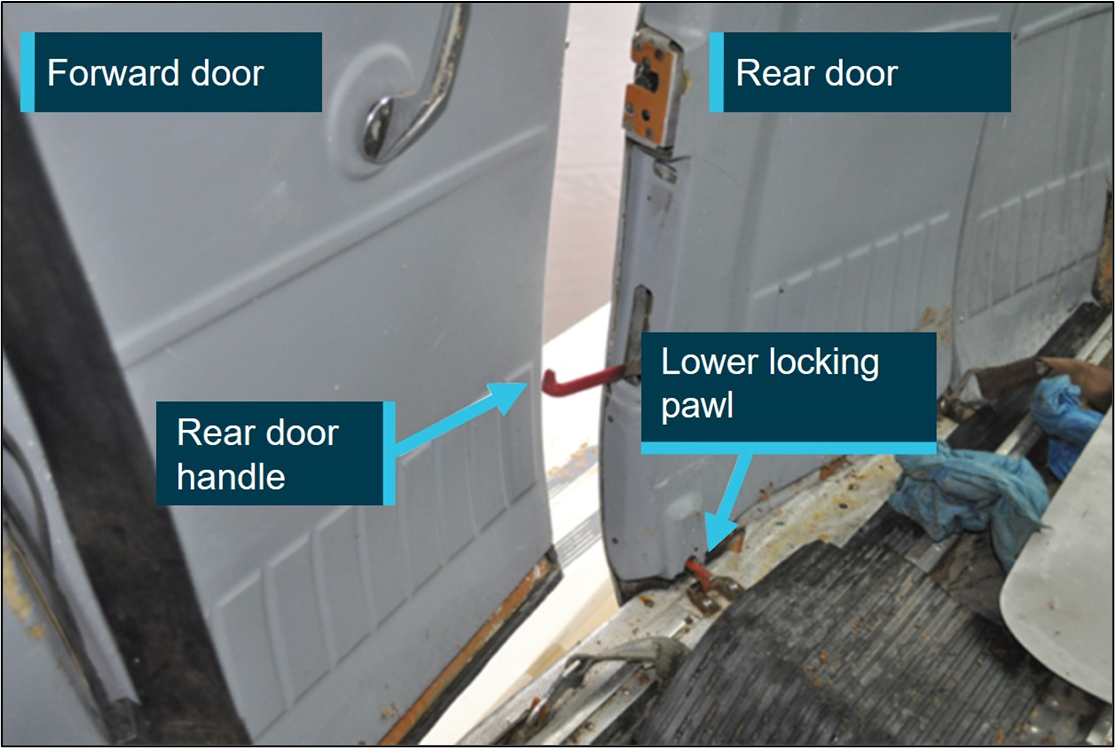
During landing and take-off, it is likely there will be flap extension and therefore also likely that the flaps would remain extended after a forced landing, ditching or accident, making the egress via the rear cargo doors more difficult for passengers.
The newer Cessna 206H model incorporates the improvements that were made with the 1991 Cessna service bulletin SEB 91-4 Cargo door latch improvement applicable to all models prior to the Cessna 206H. The service bulletin recommended modifying the rear door handle to include a spring to ensure that the handle would return to the stowed position after opening, this improved the ease of opening the rear cargo door when the flaps remained extended. The service bulletin was not a mandatory modifcation.
In 2021, the Civil Aviation Safety Authority (CASA) issued Airworthiness Bulletin 52‑006(Opens in a new tab/window) recommending that pilots demonstrate the operations of the cargo door emergency exit with the flaps in an extended position. This was further revised by CASA in January 2025 to detail advice on placarding or fitment of the ‘return spring’ on the emergency release handle.
Safety advisory notice
AO-2024-049-SAN-001: The Australian Transport Safety Bureau advises Cessna 206 pilots and operators that due to the difficulties occupants have encountered egressing the rear cargo door as identified in several transport safety investigations, to ensure they are familiar with CASA‑issued Airworthiness Bulletin 52‑006(Opens in a new tab/window), and ensure passengers are provided with a thorough safety briefing demonstrating the cargo door emergency egress when the wing flaps remain in the extended position.
Cargo door emergency egress briefing
The emergency egress via the cargo door is hampered by the extension of flaps and the process to evacuate when the flaps are extended is neither simple nor obvious. The ATSB has identified that this presents a high risk to passengers, particularly those seated in the rear of the aircraft.
Pilots and operators are encouraged to ensure passengers of Cessna 206 aircraft with the standard double cargo doors are provided a pre-flight safety briefing that demonstrates the emergency egress process required to use the cargo doors when the flaps are in the extended position. Operators are encouraged to develop safety briefing cards with imagery clearly depicting the process as well as incorporating into the passengers’ pre-flight briefing. The incident also highlights the responsibilities of pilots to ensure passengers have a thorough understanding of the use of emergency exits.
Read more about this ATSB investigation: Collision with terrain during go-around involving Cessna U206F, VH-TDQ, 39 km south-east of Moora, Western Australia, on 1 September 2024
Publication details
| Investigation number | AO-2024-049 |
|---|---|
| Publication type | Safety Advisory Notice |
| Publication mode | Aviation |
| Publication date | 30/06/2025 |
R66 in-flight break-up after turbulence-induced low-G
A Robinson R66 broke up in flight just 3.5 seconds after encountering a turbulence‑induced low‑G condition, with the helicopter rapidly rolling to the right and becoming inverted after the main rotor disc became unloaded, an ATSB investigation report details.
The helicopter, with a single pilot on board, had been flying from Cessnock to the New South Wales mid north coast on 26 October 2023 when it encountered the turbulence, likely in the form of rapidly rising air, while passing over the Yacaaba Headland, to the west of Mount Yacaaba, near Hawks Nest.
“The helicopter was flying on autopilot at an indicated airspeed of 115 kt, 45 kt above the manufacturer’s maximum recommended speed for flight in significant turbulence,” ATSB Director Transport Safety Stuart Macleod noted.
“This speed significantly increased the uncommanded right roll rate and reduced the time available for the pilot to respond by applying a gentle aft cyclic input to re‑load the main rotor disc.
“In addition, the pilot had been eating and had food in their right hand, and so they used their left hand to manipulate the cyclic, reducing their ability to slow the helicopter in a timely manner using coordinated flight control inputs.”
Footage from an on‑board video camera was instrumental in detailing the accident sequence, showing that after the helicopter began rolling to the right, the pilot did not apply aft cyclic to reload the main rotor, and the roll continued to develop.
“Instead, the pilot progressively applied increasing left cyclic during the right roll, increasing the risk of an extreme teetering event, where the spindles of the main rotor contact the main rotor shaft, precipitating a break‑up.”
The broken‑up helicopter subsequently impacted the waters of Providence Bay, near Hawks Nest, and the pilot was fatally injured.
“The investigation also found that the asymmetrical horizontal stabiliser fitted to Robinson series helicopters, comprising both the piston‑powered R22 and R44 as well as the turbine R66, significantly contributes to uncommanded right roll rates during low‑G conditions, adding to the risk of an in‑flight break‑up.”
The stabiliser is an inverted aerofoil that produces downward forces to counter the helicopter’s natural tendency to adopt a nose down attitude with increasing air speed. With the asymmetrical design on Robinson helicopters, it extends from the right side of the tail cone, and creates a right rolling moment, which is normally counteracted by a left tilt of the main rotor disc. However, in a low‑G condition where the main rotor disc is unloaded, it cannot counteract the right rolling moment.
“Pleasingly, Robinson Helicopter Company has developed a symmetrical horizontal stabiliser that is being fitted to all new Robinson helicopters, and is available as a modification for all existing Robinson helicopters,” Mr Macleod noted.
In addition, Robinson will replace the asymmetric stabiliser with the symmetrical design on all R66s and R44s returned to it for overhaul.
“Further, Robinson Helicopter is in the process of updating several safety notices to provide pilots with improved guidance specific to low‑G, turbulence, and pilot distraction.”
Mr Macleod said the ATSB strongly encourages fitment of the symmetrical stabiliser.
“The modification significantly reduces the right roll if a low‑G condition is encountered, allowing pilots more time to recognise and respond to the situation.”
Nonetheless, avoiding turbulent conditions where possible, and flying through turbulence at or below the maximum airspeed recommended by the manufacturer, remain critical safety defences for pilots of Robinson helicopters.
“In this case the pilot’s response to encountering the low‑G contributed to the development of the in‑flight break‑up, but we would caution all Robinson helicopter pilots that a low‑G condition can result from turbulence directly, and pilots must be ready to respond appropriately,” Mr Macleod explained.
“If the main rotor disc is not immediately reloaded, right roll can develop rapidly, particularly when an asymmetrical stabiliser is fitted.
“Therefore it is critical that pilots apply immediate gentle aft cyclic to reload the main rotor, before correcting the right roll.”
Read the final report: Loss of control and in-flight break-up involving Robinson R66, VH-KFT, near Hawks Nest, New South Wales on 26 October 2023
South Geelong level crossing accident
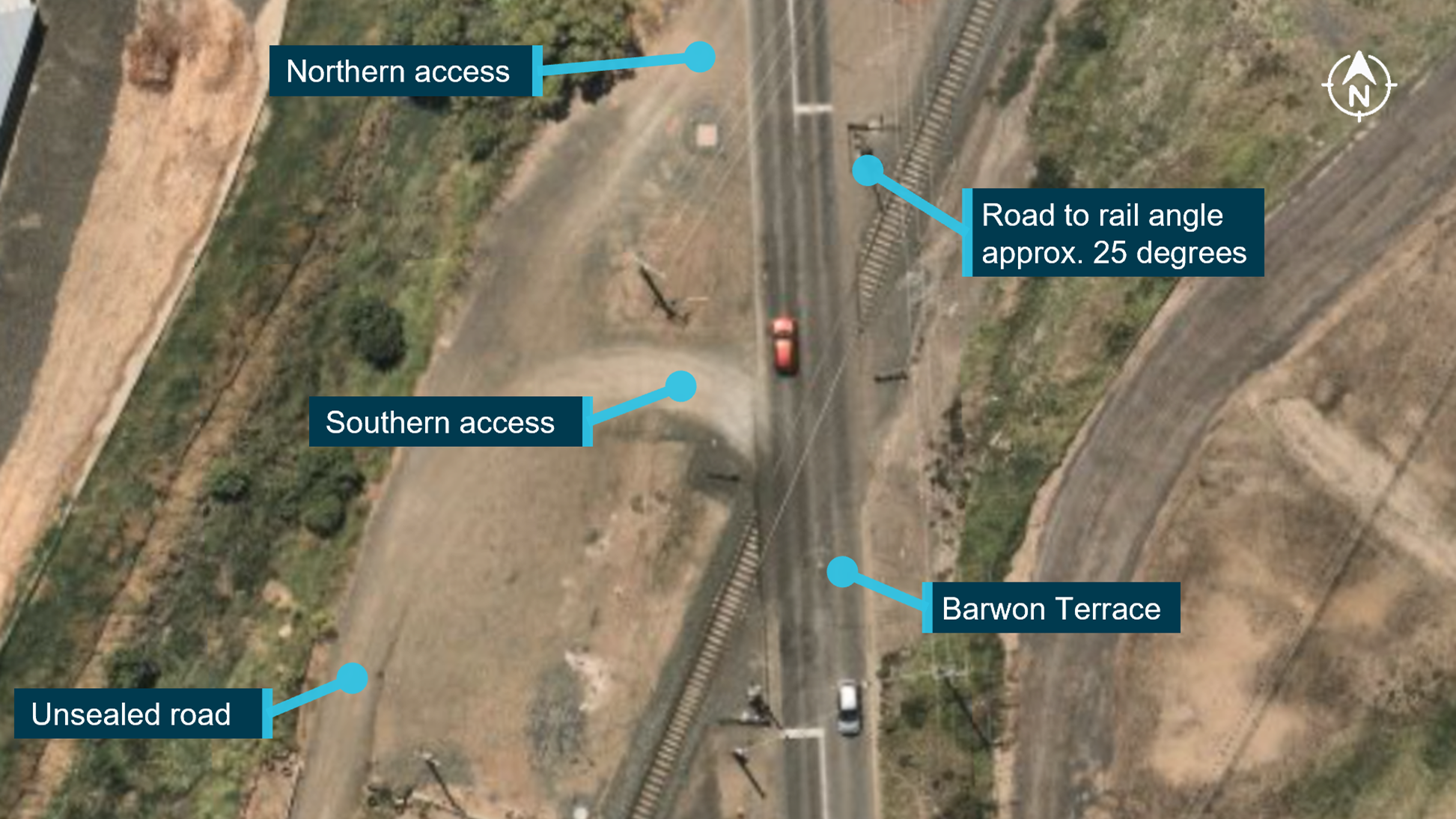
A truck that was struck by an empty passenger train at a Geelong level crossing had entered the crossing from an unsealed side road that had developed through usage over time but had not been identified as an emerging risk during regular inspections, a transport safety investigation report details.
The empty V/Line passenger train was approaching the Barwon Terrace level crossing in South Geelong on 3 April 2023 when the tip truck, having departed a nearby depot, drove onto the level crossing from the unsealed side road.
“The configuration of the side road meant vehicles could enter the level crossing even when the level crossing boom gates and flashing lights were operating,” explained Chief Investigator Mark Smallwood of the Office of the Chief Investigator, which conducts rail investigations in Victoria under a collaboration agreement with the ATSB.
“After likely becoming aware of the approaching train, the truck driver attempted to reverse their vehicle away from the track. However, the train collided with the truck before the truck was clear.”
The collision rotated the truck about 180° and the driver sustained fatal injuries. The train crew were uninjured.
CCTV footage showed that it was common practice for vehicles to turn right from the unsealed road onto Barwon Terrace between the level crossing protection and the track.
“Although the level crossing was inspected regularly by V/Line, the rail infrastructure manager, those inspections did not include a review of the emerging risks associated with the changing road usage and configuration at the level crossing,” Mr Smallwood said.
“Additionally, the safety interface agreement between rail operators and the City of Geelong, as the road manager, was also ineffective in triggering action to monitor the road to rail interface and changing usage.”
Since the accident, a V/Line maintenance alert was issued for track inspectors to identify roads or access tracks which bypass crossing controls.
In addition, changes to the Australian Level Crossing Assessment Model (ALCAM) survey program in Victoria now require contractors undertaking assessments to identify and report any road network configurations like the incident location.
“This tragic accident highlights that level crossing inspection regimes should always include checks on any changes that may introduce new hazards and associated risks,” Mr Smallwood concluded.
Read the final report: Collision between a truck and V/Line train 7727, Barwon Terrace level crossing, South Geelong, Victoria on 3 April 2023
Unstable approach involving Boeing 737, VH-YIL, near Sydney Airport, New South Wales, on 12 June 2025
Final report
Report release date: 30/09/2025
Investigation summary
What happened
On the morning of 12 June 2025, a Virgin Australia Airlines Boeing 737‑800, registered VH‑YIL, operated a passenger transport flight from Brisbane, Queensland, to Sydney, New South Wales.
As the aircraft descended towards Sydney, air traffic control provided clearance for the crew to conduct a visual approach to runway 34 left. During the approach, the speed brake was not armed, and the final flap selection was not completed until 875 ft above the airport elevation (AFE). The operator’s procedures required that both items be completed before the aircraft descend below 1,000 ft above the airport elevation.
As the aircraft later descended through about 500 ft AFE, the captain checked the aircraft configuration and identified that the speed brake was not armed. The captain then armed the speed brake as the aircraft descended below 405 ft AFE. The approach continued and the aircraft landed without further incident.
What the ATSB found
The ATSB found that after air traffic control provided clearance for the crew to conduct a visual approach, a required autopilot altitude selection was not completed. As a result, the aircraft later deviated above the desired approach path.
The crew immediately recognised the deviation and, in response, the captain disengaged the autopilot and auto thrust to manually re‑establish the approach descent profile, without informing the first officer. This led to an unexpected increase in flight crew workload. Then, in attempting to re‑establish the desired approach path, the crew did not fully complete the landing procedures and associated checklist before descending below the stabilisation criteria check altitude. Subsequently, the flight crew did not perform the required missed approach but instead continued the approach and landing.
Safety message
Unstable approaches continue to be a leading contributor to approach and landing accidents and runway excursions. This incident highlights how quickly a small oversight can disrupt an otherwise standard approach. If the disruption leads to a breach of the stabilised approach criteria, early recognition of the situation and prompt execution of a go‑around, rather than continuing the approach, will significantly reduce the risk of approach and landing accidents.
This incident also highlights that when crews are faced with the unexpected, effective crew resource management, with clear communication between the crewmembers, is essential. This ensures effective teamwork when responding to disruptions. Additionally, effective flight crew monitoring in a multi‑crew environment is paramount to aircraft safety. Bringing deviations to the attention of the pilot flying ensures that the aircraft remains on a safe flight path and is correctly configured for the relevant phase of flight.
The investigation
| The ATSB scopes its investigations based on many factors, including the level of safety benefit likely to be obtained from an investigation and the associated resources required. For this occurrence, the ATSB conducted a limited-scope investigation in order to produce a short investigation report, and allow for greater industry awareness of findings that affect safety and potential learning opportunities. |
The occurrence
On the morning of 12 June 2025, a Virgin Australia Airlines Boeing 737-800, registered VH‑YIL, operated a passenger transport flight from Brisbane, Queensland, to Sydney, New South Wales.
As the aircraft descended towards Sydney in day visual meteorological conditions and with the autopilot engaged, air traffic control provided clearance for the crew to conduct a visual approach to runway 34 left. At that time, an altitude of 2,000 ft was set in the altitude window of the autopilot mode control panel (MCP). After receiving clearance for a visual approach, operational procedures required that the pilot flying[1] select an altitude equivalent to 500 ft above the airfield elevation (in this case 500 ft, as the airport was close to sea level) in the MCP altitude window (see the section titled Approach procedures). However, the captain, acting as pilot flying, inadvertently did not make this selection and the first officer, acting as pilot monitoring, did not identify that this altitude selection had not been completed.
As the aircraft descended toward 2,000 ft above mean sea level (AMSL) (Figure 1), the aircraft intercepted the final approach track. The crew expected the descent to continue, but the aircraft began automatically levelling off to capture the 2,000 ft altitude set in the MCP altitude window, taking the aircraft above the desired approach descent profile.
The crew immediately recognised the deviation and identified that the incorrect altitude was entered into the MCP altitude window; to continue the descent, but without verbalising the action, the captain entered 500 ft in the altitude window. Shortly after, the captain recognised that this selection would not re‑establish the required approach path, so, without first alerting the first officer to their intentions, disengaged the autopilot and auto thrust to manually re‑establish the approach descent profile.
Figure 1: Overview of the approach
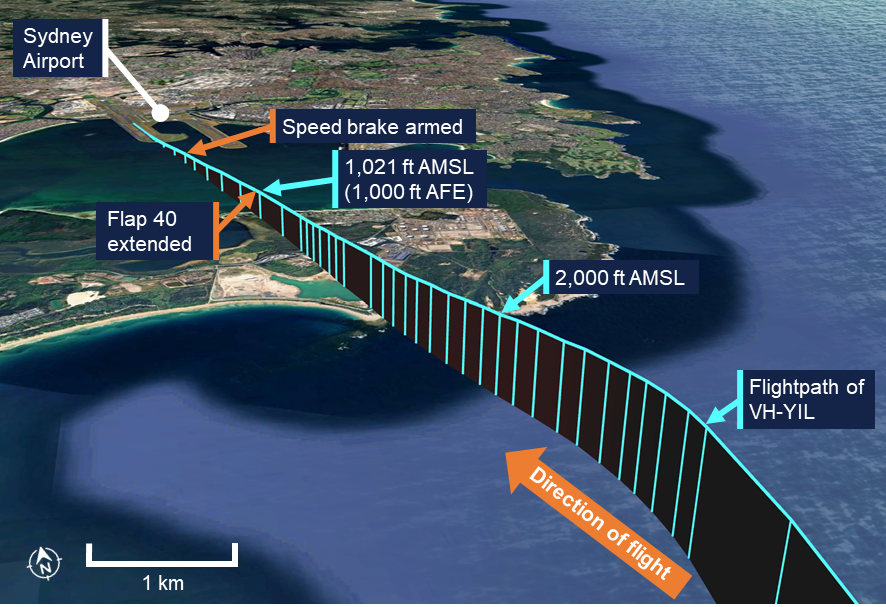
Source: Google Earth, recorded flight data and ATSB
As the crew worked to re-establish the desired approach path while completing the pre‑landing procedures, the speed brake was unintentionally not armed, and the final flap selection (flap 40) was not made until 939 ft above the airport elevation. These items, and the associated landing checklist, were required to be completed before the aircraft passed 1,000 ft as set out in the operator’s procedures (see the section titled Stabilised approach).
The captain did not recognise that the checklist was not complete and believed that the stabilised approach criteria had been met. The first officer, acting as pilot monitoring, did not identify that the speed brake was not armed, but did identify that the required final flap selection and the landing checklist had not been completed in time. However, the first officer noted that the approach path, speed and descent rate were within the criteria and announced that the approach was stable.
As the aircraft descended through about 500 ft AMSL, the captain checked the aircraft configuration and identified that the speed brake was not armed. The captain then armed the speed brake as the aircraft descended below 426 ft AMSL (405 ft above the airport elevation). The approach continued without further incident and the aircraft landed at 0905 local time.
After landing, the captain discussed the incident with the first officer and assessed that a missed approach should have been conducted.
Context
Pilot details
The captain held an air transport pilot licence (aeroplane) and class 1 aviation medical certificate. The captain had 14,975 hours of flying experience, of which 10,081 hours were on the Boeing 737 aircraft type, with 127 hours accrued in the previous 90 days.
The captain held additional non‑flying duties in the organisation with 50% of their time spent in normal flying duties. The captain also stated that in their experience of regular flying operations, visual approach clearances were unusual.
The first officer held an air transport pilot licence (aeroplane) and class 1 aviation medical certificate. The first officer had about 28,000 hours of flying experience, of which about 14,000 hours were on the Boeing 737 aircraft type, with 117 hours accrued in the previous 90 days.
The ATSB found no indicators that the flight crew were experiencing a level of fatigue known to adversely affect performance.
Approach procedures
Visual approach
The operator’s flight crew operations manual (FCOM) for the Boeing 737‑800 aircraft included the following visual approach procedure:
When cleared for a visual approach, the MCP altitude should be selected to 500 ft above field elevation, however this does not preclude setting an intermediate level‑off altitude if desired.
Stabilised approach
The operator’s policy and procedure manual provided the following stabilised approach policy that included:
All approaches must be stabilised by 1000 ft above field elevation.
An approach is stabilised when the following criteria are met:
- Briefings and normal checklists are completed
- Aircraft is in the correct landing configuration
- Aircraft is on the correct lateral and vertical flight path
- Sink rate, no greater than 1,000 feet per minute.
The policy also noted that if the stabilisation criteria were exceeded for other than momentary periods at any time below the stabilisation height, the pilot monitoring must call "NOT STABLE”, and the pilot flying must initiate a missed approach.
The FCOM also stated that a missed approach shall be executed whenever required visual reference is not obtained or maintained or when an approach is not stabilised at 1000 ft above the airport elevation.
Meteorology
The approach was conducted in visual meteorological conditions.
At 0900, 3 minutes before the incident, the Bureau of Meteorology automatic weather station at Sydney Airport recorded the temperature as 12°C and the wind as 13 kt from 247° magnetic. Cloud cover was recorded as few[2] at 3,521 ft above mean sea level (AMSL). Visibility was recorded as greater than 10 km with no recorded precipitation.
Recorded data
Virgin Australia provided the ATSB with the aircraft’s quick access recorder data which captured the incident approach.
The recorded data (Figure 2) showed that the landing flap selection (flap 40) was completed 3 seconds after the aircraft descended below 1,000 ft above the airport elevation (AFE), at 939 ft AFE (960 ft AMSL). The flaps then completed moving to that extension as the aircraft descended below 875 ft AFE (896 ft AMSL). The speed brake lever was moved to the armed position as the aircraft descended below 405 ft AFE (426 ft AMSL).
Figure 2: Graphical representation of the recorded quick access data
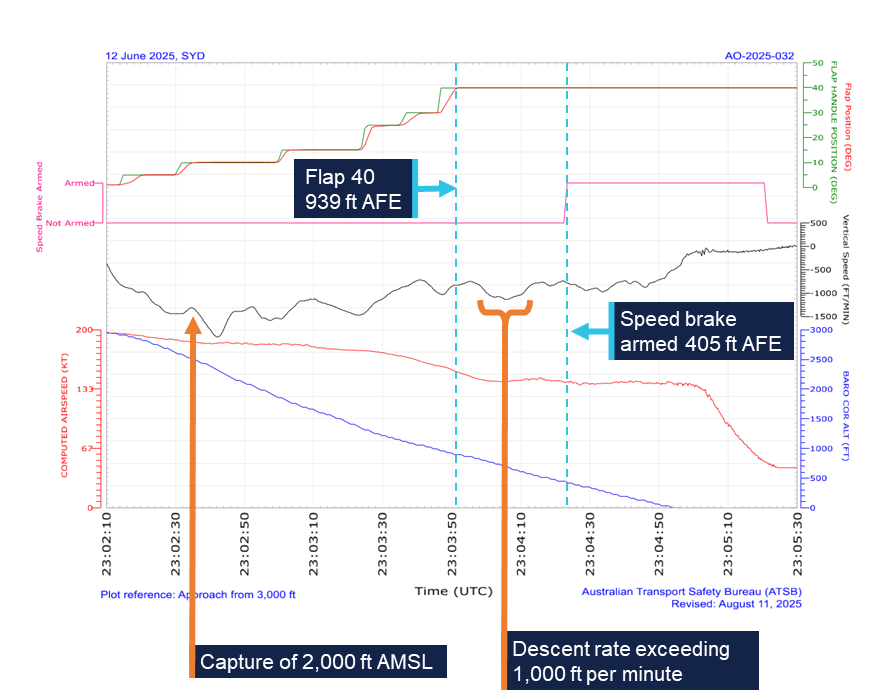
All times are coordinated universal time (UTC). Local time was Australian Eastern Standard Time (EST), which was UTC +10 hours. Source: Quick access recorder from VH-YIL, annotated by the ATSB
After descending below 1,000 ft, the aircraft maintained an appropriate speed and flightpath. The rate of descent exceeded the 1,000 ft per minute stabilised approach criteria limit for a 9 second period between 0904:02 and 0904:11. During this period, the aircraft descended from 747 ft AFE to 587 ft AFE, and the maximum recorded descent rate was 1,136 ft per minute at 0904:07.
Safety analysis
As the aircraft descended towards Sydney, the crew were provided with a visual approach clearance which the captain reported was unusual. After receiving the clearance, the captain unintentionally did not make the required 500 ft selection in the altitude window of the mode control panel. The first officer, as the pilot monitoring, did not identify that this omission had occurred. Consequently, as the aircraft descended to 2,000 ft the autopilot began to level off rather than continuing the descent to 500 ft, which took the aircraft above the desired descent profile. The captain responded with an unplanned manual intervention without alerting the first officer to their intention while the flight crew were also attempting to complete the final landing procedures. This led to an unexpected increase in flight crew workload and reduced the first officer’s situation awareness.
Workload has been defined as ‘reflecting the interaction between a specific individual and the demands imposed by a particular task. Workload represents the cost incurred by the human operator in achieving a particular level of performance’ (Orlady and Orlady, 1999). A discussion of the effect of workload on the completion of a task requires an understanding of an individual’s strategies for managing tasks.
An individual has a finite set of mental resources they can assign to a set of tasks (for example, performing an approach and landing). These resources can change given the individual’s experience and training and the level of stress being experienced at the time. An individual will seek to perform at an optimum workload by balancing the demands of their tasks. When workload is low, the individual will seek to take on tasks. When workload becomes excessive the individual must, as a result of their finite mental resources, shed tasks.
An individual can shed tasks in an efficient manner by eliminating performance on low priority tasks. Alternatively, they can shed tasks in an inefficient fashion by abandoning tasks that should be performed. Tasks make demands on an individual’s resources through the mental and physical requirements of the task, temporal demands and the wish to achieve performance goals (Hart and Staveland, 1988, and Lee and Liu, 2003).
In this case, likely in response to increased workload and the absence of crew coordination, they missed required checklist items (the final flap and speed brake selections). The stabilised approach criteria required that the aircraft be in the final landing configuration by 1,000 ft above the airport elevation. The landing flap selection was made 3 seconds after descending below this height, although the captain believed that the flap selection had been made in time to meet the stabilised approach criteria requirements. However, the flaps did not reach the required position until the aircraft descended through 875 ft above the airport elevation.
The first officer identified that the flap selection was made late and that, therefore, the stabilised approach criteria had not been met. However, as the descent rate, speed and profile were within the criteria, they announced that the approach was ‘stable’ instead of making the required ‘not stable’ announcement. Consequently, the required missed approach was not commenced, and the approach was continued. The first officer did not identify that the speed brake landing procedure action was not completed.
As the approach continued, the descent rate exceeded the stabilised approach criteria for a period of 9 seconds. This exceedance was momentary and not excessive and therefore it did not require the commencement of a missed approach.
When the unarmed speed brake was later identified by the captain, this should have acted as a further trigger for the commencement of a missed approach. Instead, this missed action was quickly rectified by the captain and the approach continued.
Findings
ATSB investigation report findings focus on safety factors (that is, events and conditions that increase risk). Safety factors include ‘contributing factors’ and ‘other factors that increased risk’ (that is, factors that did not meet the definition of a contributing factor for this occurrence but were still considered important to include in the report for the purpose of increasing awareness and enhancing safety). In addition ‘other findings’ may be included to provide important information about topics other than safety factors. These findings should not be read as apportioning blame or liability to any particular organisation or individual. |
From the evidence available, the following findings are made with respect to the unstable approach involving Boeing 737, VH-YIL, near Sydney Airport, New South Wales, on 12 June 2025.
Contributing factors
- After air traffic control provided clearance for the crew to conduct a visual approach, a required autopilot altitude selection was not completed. As a result, the aircraft later deviated above the desired approach path.
- While re-establishing the approach path, the crew did not complete required landing procedures until after the aircraft descended below the stabilisation criteria check altitude. Subsequently the flight crew did not perform the required missed approach, instead continuing the approach and landing.
Sources and submissions
Sources of information
The sources of information during the investigation included:
- Airservices Australia
- Bureau of Meteorology
- recorded data from the quick access recorder from VH-YIL
- the flight crew
- Virgin Australia Airlines.
References
Orlady, HW & Orlady, LM 1999, Human factors in multi-crew flight operations. Ashgate, Aldershot, p. 203.
Hart, SG & Staveland, LE 1988, ‘Development of NASA-TLX (Task Load Index): Results of empirical and theoretical research’, In PA Hancock & N Meshkati (Eds.), Human Mental Workload. North Holland Press, Amsterdam.
Lee, YH & Liu, BS 2003, ‘Inflight workload assessment: Comparison of subjective and physiological measurements’, Aviation, Space, and Environmental Medicine, vol.74, pp. 1078- 1084.
Submissions
Under section 26 of the Transport Safety Investigation Act 2003, the ATSB may provide a draft report, on a confidential basis, to any person whom the ATSB considers appropriate. That section allows a person receiving a draft report to make submissions to the ATSB about the draft report.
A draft of this report was provided to the following directly involved parties:
- Civil Aviation Safety Authority
- the flight crew
- Virgin Australia Airlines.
No submissions were received.
Purpose of safety investigationsThe objective of a safety investigation is to enhance transport safety. This is done through:
It is not a function of the ATSB to apportion blame or provide a means for determining liability. At the same time, an investigation report must include factual material of sufficient weight to support the analysis and findings. At all times the ATSB endeavours to balance the use of material that could imply adverse comment with the need to properly explain what happened, and why, in a fair and unbiased manner. The ATSB does not investigate for the purpose of taking administrative, regulatory or criminal action. TerminologyAn explanation of terminology used in ATSB investigation reports is available here. This includes terms such as occurrence, contributing factor, other factor that increased risk, and safety issue. Publishing informationReleased in accordance with section 25 of the Transport Safety Investigation Act 2003 Published by: Australian Transport Safety Bureau © Commonwealth of Australia 2025 
Ownership of intellectual property rights in this publication Unless otherwise noted, copyright (and any other intellectual property rights, if any) in this report publication is owned by the Commonwealth of Australia. Creative Commons licence With the exception of the Commonwealth Coat of Arms, ATSB logo, and photos and graphics in which a third party holds copyright, this report is licensed under a Creative Commons Attribution 4.0 International licence. The CC BY 4.0 licence enables you to distribute, remix, adapt, and build upon our material in any medium or format, so long as attribution is given to the Australian Transport Safety Bureau. Copyright in material obtained from other agencies, private individuals or organisations, belongs to those agencies, individuals or organisations. Where you wish to use their material, you will need to contact them directly. |
[1] Pilot flying (PF) and pilot monitoring (PM): procedurally assigned roles with specifically assigned duties at specific stages of a flight. The PF does most of the flying, except in defined circumstances such as planning for descent, approach and landing. The PM carries out support duties and monitors the PF’s actions and the aircraft’s flight path.
[2] Cloud cover: in aviation, cloud cover is reported using words that denote the extent of the cover – ‘few’ indicates that up to a quarter of the sky was covered.
Occurrence summary
| Investigation number | AO-2025-032 |
|---|---|
| Occurrence date | 12/06/2025 |
| Location | Sydney Airport |
| State | New South Wales |
| Report release date | 30/09/2025 |
| Report status | Final |
| Investigation level | Short |
| Investigation type | Occurrence Investigation |
| Investigation status | Completed |
| Mode of transport | Aviation |
| Aviation occurrence category | Aircraft preparation, Unstable approach |
| Occurrence class | Incident |
| Highest injury level | None |
Aircraft details
| Manufacturer | The Boeing Company |
|---|---|
| Model | 737-8FE |
| Registration | VH-YIL |
| Serial number | 38713 |
| Aircraft operator | Virgin Australia Airlines Pty Ltd |
| Sector | Jet |
| Operation type | Part 121 Air transport operations - larger aeroplanes |
| Departure point | Brisbane Airport, Queensland |
| Destination | Sydney Airport, New South Wales |
| Damage | Nil |