

Final report
Report release date: 20/08/2026
Investigation summary
What happened
On 10 June 2025 the tug and barge combination, Sea Pelican and Rocksea, was being manoeuvred out of the North Arm waterway, and turned to port into the Port Adelaide River, South Australia.
At about 1000 hours, while keeping clear of a fishing jetty off to port, the tug was manoeuvred wide in the turn and touched bottom on a sandbar projecting into the waterway off to starboard. The tug shell plating was holed under the engine room. About 20 minutes later, upon arrival at the destination, an engine room bilge alarm alerted the tug master to water entering the engine room. Bilge pumping was commenced to manage the water ingress and the tug returned to base.
The following day, the tug was slipped at the adjacent slipway and the holed section of the hull repaired.
What the ATSB found
The ATSB found that the tug master and pilotage exempt master were unaware of the extent to which the sandbar to the north of the channel was encroaching into and narrowing the navigable channel past the fishing jetty to the south. Consequently, while attempting to maintain adequate clearance off the fishing jetty, the tug was manoeuvred wide in the channel and touched bottom on the sand bar.
The investigation also identified that planning and preparation for the movement were inadequate for ensuring all risks were properly addressed. This included details of the task being insufficiently well defined and communicated to all parties to ensure it proceeded safely. Relevant hazards were not identified and defined, risk barriers were not put in place and roles and responsibilities were not detailed nor understood.
The investigation further identified that the vessels’ owner and operator, Maritime Constructions, had not adequately identified and controlled risks associated with the operation of tug and barge combinations within the port. In particular, the use of the pilotage exemption certificate system was not defined and included in documentation; nor was bathymetric data collected by Maritime Constructions in North Arm included in passage planning or operational documentation for use by tug masters.
What has been done as a result
Maritime Constructions updated its safety management system (SMS) to strengthen its training, watchkeeping, and passage planning procedures. Under the revised SMS, new masters must first serve as mates under an experienced master with local knowledge before taking command, and training must encompass known shallow water areas. Further, operation-specific risk assessments will be used to identify crew competency requirements and arrange any necessary additional training.
Updated watchkeeping procedures for tug and barge operations now require masters to consider factors such as tow configuration and visibility restrictions when assigning lookouts, while passage plans for every transit must evaluate current bathymetric survey data, environmental conditions and vessel manoeuvrability.
Safety message
The grounding of Sea Pelican highlights the importance of sufficient planning to ensure operational risks are identified and effectively controlled. When a vessel is navigated in pilotage waters under the guidance of a pilotage exemption holder, the responsibilities of the exemption holder in relation to the master should be defined and documented in the company’s SMS. Further, relevant information and guidance relating to operational and navigational hazards should be readily available and incorporated into planning arrangements and operational procedures.
INSERT SHOW MORE LINK
The occurrence
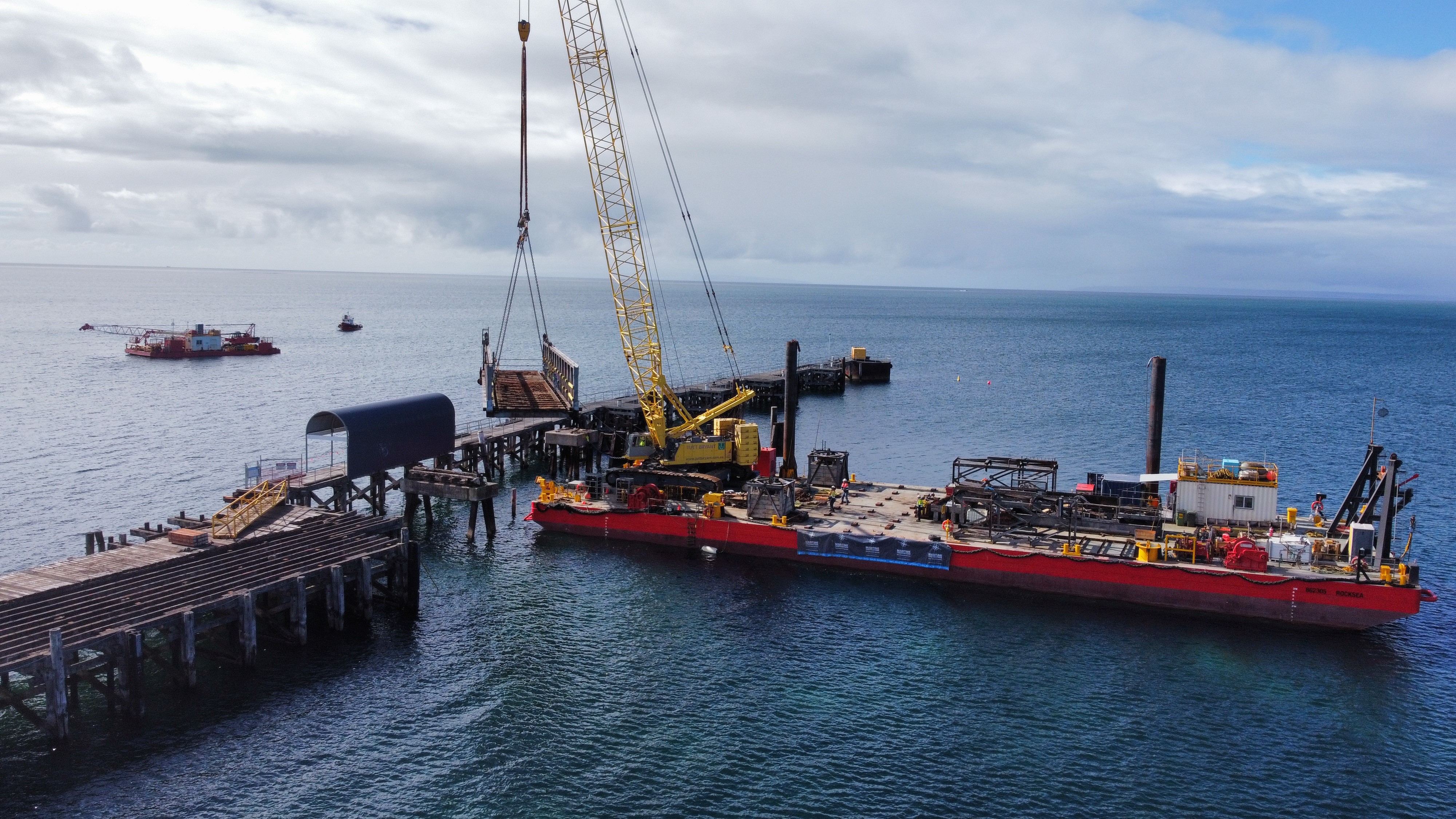
On the morning of 10 June 2025, the master, engineer and deckhand of the Maritime Constructions’ (MC) tug, Sea Pelican (cover), arrived at the company’s operating base in North Arm, a branch of the Port Adelaide River, South Australia. Sea Pelican was to tow the unpowered barge1 Rocksea (Figure 1) from the base to a worksite at berth 25 in the inner harbour, approximately 1.4 miles2 upstream. Following the tow, the tug was to return to base for scheduled maintenance.
Figure 1: Unpowered barge Rocksea
The tug and the barge were moored separately at MC’s wharf and the tug was to reposition and tie up to the barge in preparation for the movement. At about 0700, the crew boarded Sea Pelican and commenced pre‑start checks and warming through of the tug’s machinery. The main engines were started at 0745. Meanwhile, a bargemaster and deckhand boarded Rocksea and began preparing the barge.
Under port regulations, the tug and barge combination was required to carry a harbour pilot or a pilotage-exempt master (PEM). Sea Pelican’s master did not hold a pilotage exemption certificate (PEC) (see the section titled Pilotage exemption certificates) and, therefore, a PEM was to be on board the tug during the tow. The transit was also intended to serve as a qualifying voyage pursuant to the tug master’s own application for a PEC. At 0755, the PEM boarded the tug and discussed the day’s operation with the tug master.
The intended passage involved a short transit down North Arm followed by a 140° turn to port into the main channel of the Port Adelaide River. The combination was then to transit 1.3 miles upstream before turning to port into number 3 dock at berth 25 (Figure 2).
Figure 2: Port Adelaide, tracks of Sea Pelican and Rocksea
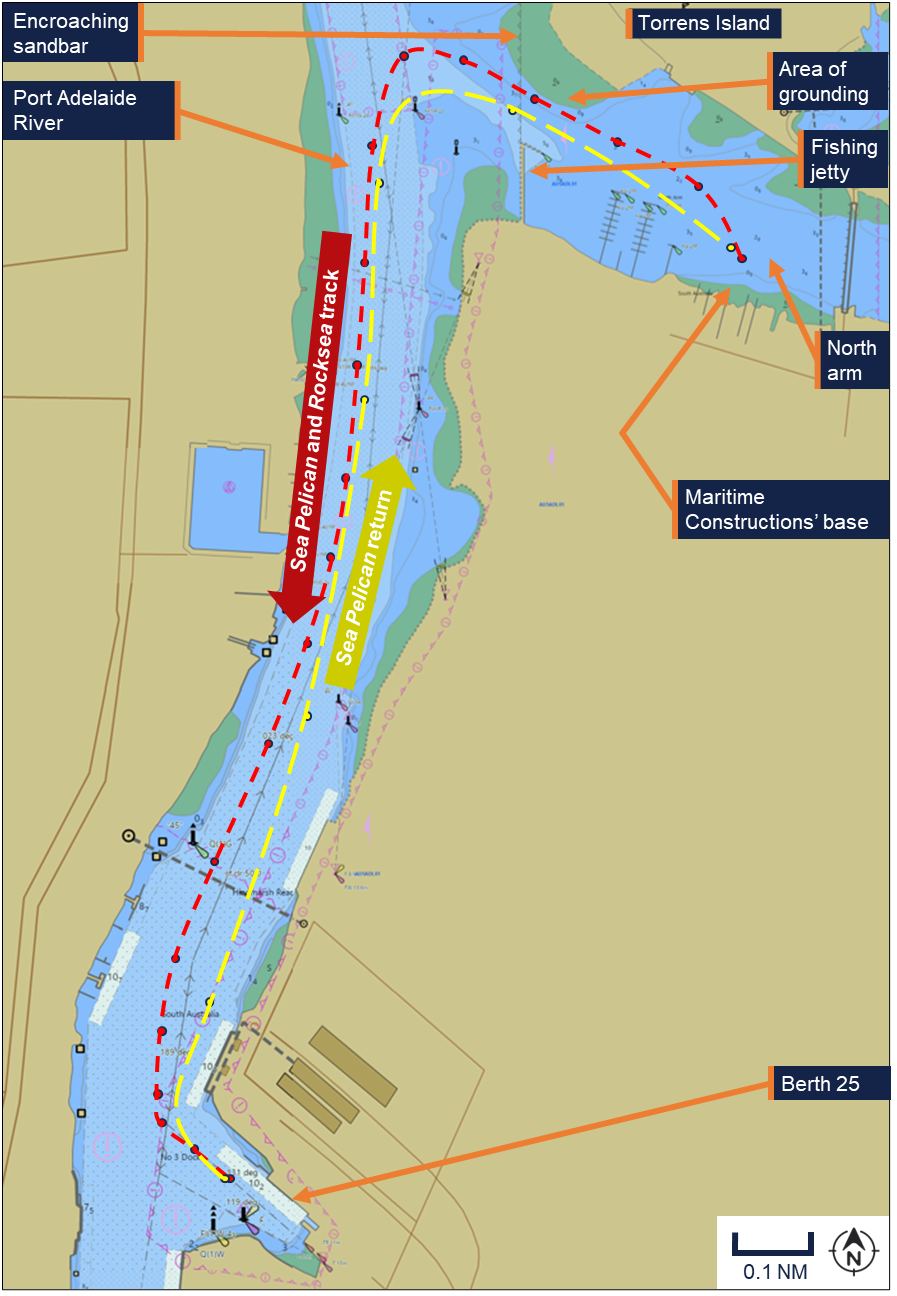
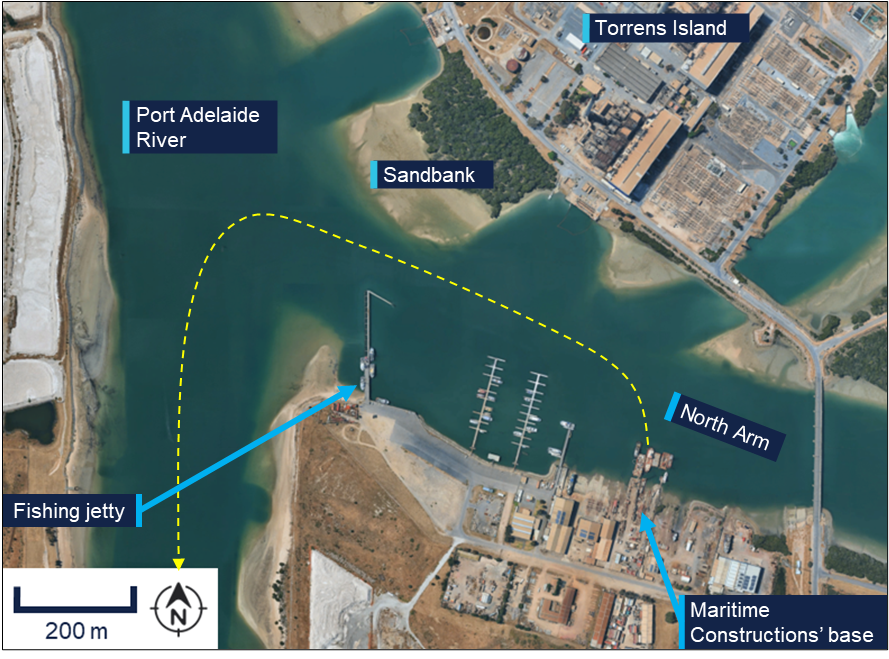
North Arm was excluded from Port Adelaide's scheduled dredging regime. Consequently, over time a sandbank had grown south from Torrens Island, encroaching on the navigable channel between the MC base and the Port Adelaide River. The waterway had narrowed near a timber fishing jetty located on North Arm’s southern bank (Figure 3).
Figure 3: North Arm and Port Adelaide River
A passage plan had been prepared for the 30-minute passage. The plan anticipated a 4.5 knot transit speed and specified an operational wind limit of 25 knots. The departure was timed to account for an ebbing tide with low water (0.91 m) predicted to occur at 0936. The tug and barge combination was expected to have a following tidal flow during the transit out of North Arm before pushing into the flow upon entering the main river channel.
At 0825, Sea Pelican’s mooring lines were cast off, and the tug repositioned to the starboard quarter of Rocksea. By 0849, it was secured alongside the barge. In this arrangement, the barge’s bow ramp and a crawler crane loaded on its deck obstructed the tug master’s line of sight to port from the tug’s wheelhouse. It was usual for MC vessels to maintain a distance of a least 10 m off the fishing jetty and the barge crew were equipped with UHF radios and tasked with maintaining a lookout. Additionally, a small, outboard-powered tender, operated by a single coxswain and fitted with an echo sounder, was to accompany the transit and provide towage assistance where possible.
At 0945, Sea Pelican’s master manoeuvred the tug and barge combination off the MC wharf and out towards the northern side of North Arm to remain clear of the public jetties along the southern bank. At 0950, the tug master informed Port Adelaide vessel traffic service (VTS) of the departure and intended passage. The PEM then exited the tug’s wheelhouse and proceeded to the bow to gain a clearer vantage point to port.
While manoeuvring clear of the fishing jetty, at a speed of 2.5 knots, the tug master noticed a slight reduction in headway and a subtle change in the tug’s handling characteristics. The PEM, having also noticed the speed decrease, performed a visual inspection over the starboard side of the tug, confirming that the seabed was clearly visible but not that the tug had grounded.
The tug master immediately moved the engine controls to neutral and began evaluating the situation to mitigate the risk of further grounding. The tug master later noted that, although there were no typical indications of a hard grounding, such as jarring or a total loss of headway, they suspected the tug had grazed the seabed. The tug master elected to re-engage ahead power to keep the combination moving toward the deeper water of the main channel. The tow then continued as planned. As the combination passed out of North Arm, it was manoeuvred to port into the main channel and completed the river passage to dock 3.
At 1020, the combination had been turned to port into the dock when the tug’s engine room high water bilge alarm sounded in the wheelhouse. The tug master directed the engineer and deckhand to investigate. They confirmed that water was entering the engine room and started the tug’s 2 bilge pumps to manage the ingress. Meanwhile, the tug master notified MC’s shore management of the incident.
After a short time, the tug’s crew and management concluded that its hull had been breached. At 1040, management advised the tug master to return to the MC base.
At 1100, after the barge had been secured in the dock, Sea Pelican was released and began making its way back to North Arm at about 8 knots. En route, the tug master advised VTS of the return to North Arm.
By 1200, Sea Pelican was secure at the MC wharf where shore staff had arranged an additional pump as a precautionary measure. At 1300, MC divers conducted a hull inspection and discovered a hole measuring 60 mm by 30 mm.
Overnight watch arrangements were put in place to monitor the bilge water levels while the tug remained alongside the wharf. The following day, the tug was slipped at the adjacent slipway and the holed section of the hull repaired.
Context
Sea Pelican
Sea Pelican was a domestic commercial vessel (DCV), certified by the Australian Maritime Safety Authority (AMSA) for operations under service category 2B.3 The tug was constructed in 1998 under Germanischer Lloyd (GL) class rules in Batam, Indonesia.
Sea Pelican had an overall length of 23.5 m, a beam of 7.5 m and a maximum draught of 2.5 m. Propulsion was provided by 2 Yanmar diesel engines, each delivering 471 kW to shaft-driven fixed pitch propellers.
The tug was equipped with a radar, depth sounder and a Simrad electronic chart system4 unit installed in the wheelhouse. When secured alongside Rocksea, the combined arrangement was estimated by the vessels’ owner and operator, Maritime Constructions (MC), to be 33 m wide.
Crew
At the time of the grounding, Sea Pelican had a crew of 3, comprising the master, a marine engine driver and a deckhand. A pilotage exempt master (PEM) was also on board.
The master held an AMSA master less than 24 m certificate of competency (CoC), issued in 2023 in recognition of the master’s equivalent New Zealand qualification. They had previous experience operating commercial work vessels in New Zealand, before joining MC in January 2024 as a deckhand. In November 2024, they completed their first trip as master, under the supervision of an MC senior master.
At the time of the grounding, the master was in the process of accruing qualifying voyages as part of the port’s requirements for a pilot exemption certificate (PEC). They had logged 5 such voyages with either a pilot or PEM on board.
The PEM held a master less than 100 m CoC and had about 27 years’ experience as a master. They commenced working for MC in 2008, performing master duties and overseeing other masters during qualifying voyages for pilot exemption certification.
Rocksea
The barge Rocksea was registered as a 2C Australian DCV and classed by the American Bureau of Shipping (ABS). It had an overall length of 52.7 m, a beam of 18 m and did not have its own means of propulsion. It was fitted with a bow ramp and, at the time of the grounding, a crawler crane was loaded on board. The barge was crewed by a bargemaster and a deckhand.
Port of Adelaide
The port of Adelaide is South Australia’s principal maritime port, located approximately 14 km north-west of Adelaide’s city centre. The port is situated on the Port Adelaide River, a tidal estuary that flows parallel to the coastline before entering the Gulf St Vincent (Figure 4).
Figure 4: Port of Adelaide
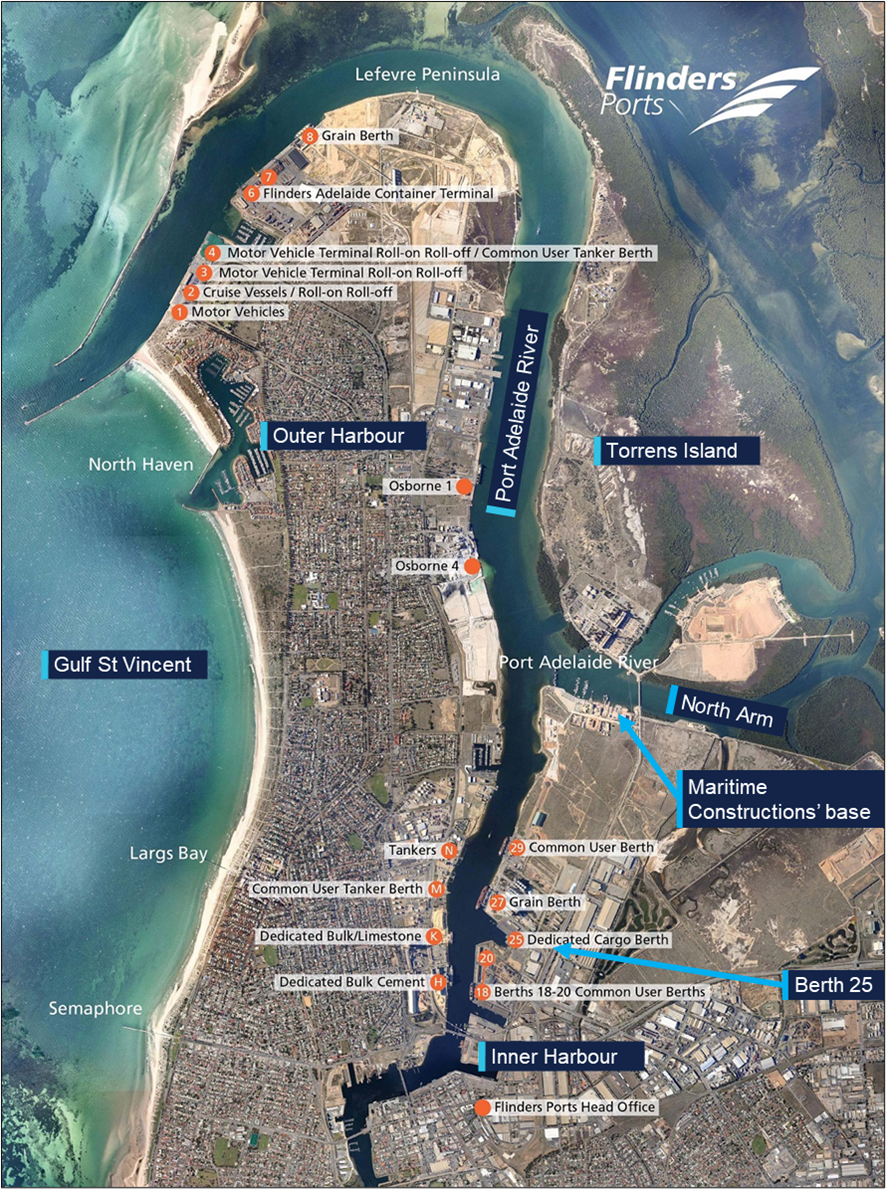
The port comprises an outer harbour at the river’s mouth, where container and cruise ship terminals are located, and an inner harbour further upstream, where bulk and general cargo operations are undertaken. The channel depth in the outer harbour was maintained at 14.2 m, while the inner harbour was maintained at about 9.3 m deep.
The port was owned and operated by Flinders Ports, which was formed in 2001, when the Flinders Ports consortium successfully acquired 7 ports that were privatised by the South Australian Government.
Flinders Ports was responsible for the safe navigation of commercial vessels in the port under a port operation agreement with the South Australian Government. It was also designated as the pilot service provider by the South Australian Department of Infrastructure and Transport (DIT).
North Arm
North Arm is a branch of the Port Adelaide River, north-east of the inner harbour and to the south of Torrens Island. It was not included within the official boundaries of the port of Adelaide. Unlike the main port, North Arm did not accommodate large-scale shipping operations, and the channel depths were not maintained through dredging activity. Between the MC operations base and the main channel of the Port Adelaide River, the navigable channel was bounded by Torrens Island and sandbanks to the north and 4 public jetties to the south.
Pilotage exemption certificates
Pilotage in the port of Adelaide was compulsory for vessels over 35 m in length, unless the vessel’s master held a valid pilotage exemption certificate (PEC). Generally, a PEC formally recognised that a master had attained the requisite local knowledge and navigational competence, through documented training and assessment, to safely conduct a specific vessel or vessels within compulsory pilotage waters without a licensed pilot.
The issuance of a PEC for the port was governed by the Harbors and Navigation Act 1993 (Act) and the Harbors and Navigation Regulations 2023 (Regulations). The DIT served as the statutory issuing authority for certificates, while responsibility for the verification of applicant competency was delegated to Flinders Ports as the port authority.
The requirements for obtaining a PEC were set out in the Regulations and Flinders Ports’ marine pilotage exemption procedure. Applicants for a PEC were required to hold an appropriate certificate of competency, undertake mandated qualifying voyages and complete practical assessment conducted by Flinders Ports. This included a check voyage with a harbour/marine pilot. Following successful evaluation, Flinders Ports provided a formal letter of recommendation for final administrative approval and issuance of the certificate by the DIT.
The Regulations required a PEC applicant to satisfactorily complete qualifying voyages as the ‘operator of a vessel’ with a licensed pilot or a current PEC holder on board. For domestic commercial vessels, the term ‘operator of a vessel’, was defined in the Act to mean the vessel’s master. Generally, qualifying voyages like those mandated by the Regulations function as a formal mechanism for the imparting of vessel-specific handling skills and local port knowledge to the PEC applicant.5 The process was intended to ensure a comprehensive understanding of environmental conditions, bathymetry, and topography as they pertain to the applicant's specific operations.
During a qualifying voyage with a harbour pilot, the pilot was responsible for overseeing the safe conduct of the voyage on behalf of the port operator in accordance with its safety management system (SMS). Conversely, voyages overseen by a PEC holder (usually a company senior master) were not considered pilotages and were conducted under the oversight of the PEC holder. For such trips, the company assumed responsibility for the safe conduct of the voyage under its own SMS.
Maritime Constructions
Maritime Constructions was an Adelaide-based marine engineering contractor established in 1996. The company undertook a range of port and coastal development projects throughout South Australia and Western Australia, including wharf construction, marine asset maintenance and dredging work. To service these projects, it owned and operated a fleet of 64 DCVs, including tugs, barges, dredgers and workboats, under a certificate of operation issued by AMSA.
A portion of Maritime Constructions’ fleet, including Sea Pelican and Rocksea, was based in the port of Adelaide to service projects within and around the port, including wharf extension works at berth 25. These vessels were required to navigate through North Arm when transiting between the company’s operating base and the various project sites.
Rocksea was the largest of 3 unpowered barges exceeding 35 m in length operated by the company in the port. Towage of these barges within port limits required a pilotage exempt tug master or the services of a pilot.
Risk management
North Arm channel monitoring
About a year prior to the grounding, Maritime Constructions identified that the sandbank extending south from Torrens Island toward the fishing jetty had begun to encroach into the North Arm navigational channel due to shoaling. In response, the company commenced bathymetric surveys of the area (Figure 5) to monitor the extent of shoaling and confirm adequate clearance for barge movements.
The survey soundings were not disseminated to masters for passage planning or navigational purposes.
Figure 5: July 2024 bathymetric survey of North Arm
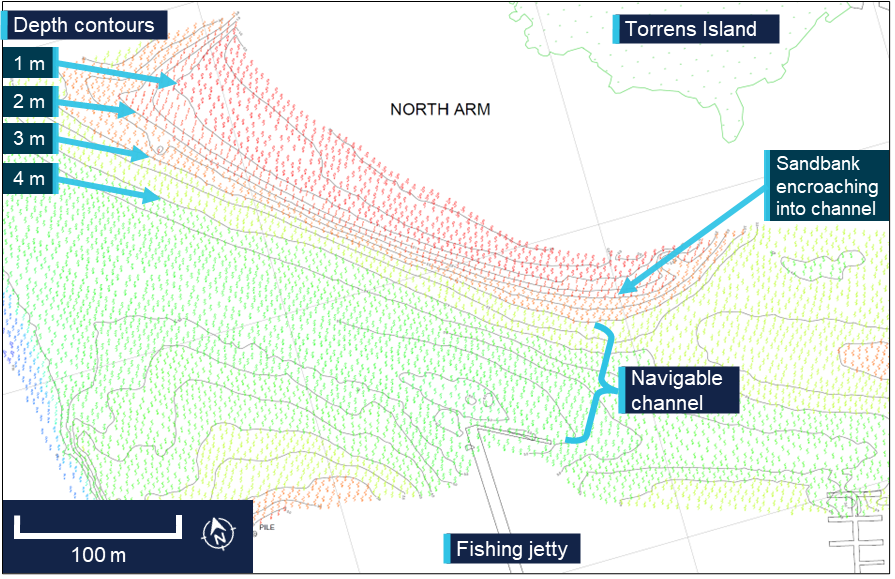
Source: Maritime Constructions, annotated by the ATSB
Safety management system
Australian DCVs were governed by the Marine Safety (Domestic Commercial Vessel) National Law Act 2012 and its associated marine orders. To operate in Australian waters, these vessels were required to hold a certificate of survey and a certificate of operation. It was a condition of a certificate of operation that the vessel’s owner or operator had in place a safety management system (SMS), which complied with the requirements of Marine Order 504 (MO504). The marine order required the owner or operator to identify risks unique to the vessel and its operating environment and document how the risks would be managed.
To meet its obligations under MO504, MC maintained an SMS, which included a vessel‑specific set of operational manuals, procedures and forms for Sea Pelican. A stated purpose of the SMS was to identify potential operational hazards and document relevant procedures and control measures to provide for safe vessel operations.
A risk register for Sea Pelican, which documented various risks and controls for on board tasks was also maintained by MC. In addition to this, prior to undertaking work tasks, all MC employees were required to complete a pre-start risk assessment and safe work method statement.
Passage planning
Prior to each barge movement, tug masters were required to complete and submit a standardised passage plan document to the company’s operations manager. The passage plan submitted by the tug master for the occurrence voyage noted that the departure time would vary to avoid fast-flowing tidal flows that could impact the tug’s steerage effectiveness.
The document required no-go areas to be marked on a chart or the vessel’s electronic chart plotter. While this requirement was ticked as being completed on the passage plan, the shoaling sandbank off Torrens Island was not identified and marked as a potential navigation hazard.
Roles and responsibilities for pilotage exempt masters
To mitigate risks associated with marine pilotage exemption operations, the Australasian Marine Pilots Institute (AMPI) recommended that mitigations specific to a vessel and its operations were defined and documented in the SMS. Where required, these mitigations should include structured training programs for PEC candidates to ensure that the required skills to operate without a pilot were learned and applied.
Maritime Constructions’ use of the PEC system involved the casual engagement of masters with a valid PEC on an as-needs basis for large barge movements. These masters were engaged to either conduct the movement as master or to be present on board to satisfy the port’s pilotage exemption rules in cases where the existing master did not hold an exemption. The PEC holder was also intended to oversee qualifying voyages pursuant to the existing master’s own PEC application.
Safety analysis
Grounding
On 10 June 2025, the tug Sea Pelican was tasked with moving the 55 m long barge Rocksea from the Maritime Constructions (MC) base in North Arm, into the Port Adelaide River and upstream to berth 25. A pilotage exempt master (PEM) was on board Sea Pelican to oversee the passage and mentor the tug master.
With the tug secured to the Rocksea’s starboard quarter, the combination was to be manoeuvred off MC’s wharf and out of North Arm, avoiding 4 public jetties extending from the southern bank. It was normal practice for MC vessels to maintain a distance of a least 10 m off the fishing jetty, which extended further into North Arm than the others. To meet this requirement Sea Pelican’s master planned a course close to the northern edge of the channel.
However, to the north of this jetty, the width of the navigable channel was restricted by a sandbank extending southward from Torrens Island. North Arm was not maintained through dredging, and the sandbar had recently been shoaling and encroaching further into the channel.
Neither the tug master nor the PEM knew the exact boundaries of the encroaching sandbank nor had an accurate understanding of the available channel width. Consequently, when the master was attempting to manoeuvre the barge clear of the jetty, the tug tracked wide in the channel and briefly grounded on the sandbank.
Contributing factor While navigating between the fishing jetty and sandbank opposite, the tug master and pilotage exempt master did not have accurate knowledge of the boundaries of the encroaching sandbank and were unaware of the extent of the resulting narrowing of the navigable channel. Consequently, when attempting to manoeuvre and keep the barge clear of the jetty, the tug tracked wide in the channel and grounded on the sandbank. |
Pre-departure preparations
The master had prior experience operating company vessels from North Arm but had not conducted a tug and barge combination with the combined length or beam of Sea Pelican and Rocksea. Furthermore, the master was undertaking the movement as a qualifying voyage in accord with an application for a port pilotage exemption certificate, under the guidance and tutelage of a company PEM. With the barge crewed by 2 persons and the assisting workboat by 1, the task required coordinating 5 assisting personnel across 3 vessels. Collectively, these factors, combined with navigating a multi‑vessel unit through confined waters with changing depths and channel widths, presented a heightened risk.
Therefore, the planning and preparations for the task needed to be clearly defined and communicated to all parties to ensure it proceeded safely. Relevant hazards needed to be identified and defined, risk barriers put in place and roles and responsibilities detailed and understood.
However, the planning and preparation for the movement were inadequate for ensuring all risks were properly addressed. A formal pre-start briefing was not conducted to establish roles and responsibilities, and no risk assessment or safe work method statement was completed to identify hazards, minimum clearing distances, or account for environmental variables such as channel conditions, tidal effects and vessel positioning. Additionally, the operation lacked defined communication protocols and expectations for the personnel involved.
Contributing factor Pre-departure planning did not sufficiently evaluate the available channel width and address the sandbank as a navigational hazard. As a result, the movement proceeded without considering measures such as:
|
Risk controls
Under Australian domestic commercial vessel (DCV) regulations, operators must maintain a safety management system (SMS) addressing risks specific to the vessel and its operations. In this instance, several risks associated with moving Sea Pelican and Rocksea in the port of Adelaide were not addressed in the company’s SMS documentation.
The Sea Pelican risk register did not include shoaling within the North Arm as a grounding hazard and the safety management system (SMS) did not contain specific procedures for managing grounding risks during tug and barge movements.
Pilotage exemption certificates
Maritime Constructions’ use of the pilotage exemption certificate (PEC) system involved the casual engagement of experienced company PEMs on an as-needs basis for large barge movements. The PEM either commanded the vessel as master or provided the oversight required to satisfy port pilotage rules when the primary master lacked an exemption. They were also tasked with supervising masters during qualifying voyages toward obtaining a PEC.
A PEC formally recognised that a master had demonstrated the requisite local knowledge and navigational competence to operate a specific vessel in compulsory pilotage waters without a pilot. Because the master conducting the qualifying voyage was not yet endorsed, the PEM was required to provide the oversight necessary to manage operational risks associated with the master’s lack of experience.
Following the incident, the master, PEM, and company operations manager indicated that the PEM’s role was viewed as similar to that of a pilot. This comparison was inaccurate because the PEM’s role differed to standard pilotage. Beyond providing navigational advice, the PEM was also to proactively mentor the master through the provision of local knowledge and vessel-handling expertise specific to the operation.
However, the company’s SMS did not define the role and responsibilities of PEC holders or contain any guidance for the oversight and training of masters during qualifying voyages. As a result, the PEM remained largely passive during the transit out of North Arm and did not intervene effectively to prevent the grounding.
North Arm bathymetry
A known, evolving risk to MC operations was the changing seabed in North Arm. This section of the port was not part of the harbour dredging regime and the potential for it to become unnavigable remained a hazard. The company had identified this, and it was of a particular concern for movement of the larger barges from the MC base. Therefore, MC had commenced several strategies to mitigate the present and future risks associated with changing North Arm conditions.
One such strategy was to undertake regular bathymetric surveys of the waterway to monitor the changing water depths available and, particularly, the growth of the sandbar from Torrens Island, and the resulting narrowing of the channel between it and the fishing jetty. As a risk management tool, this bathymetric information would be most effective when incorporated into the SMS to inform operating procedures and passage planning. However, at the time of the incident, the SMS did not include this data within its procedures or planning requirements.
Contributing factor Maritime Constructions did not adequately identify and control risks associated with the operation of tug and barge combinations within the port. This included controls such as providing clear guidance and procedures associated with the use of the pilotage exemption certificate system, and using available in-house bathymetric data for improved control of grounding risk. (Safety issue) |
Findings
ATSB investigation report findings focus on safety factors (that is, events and conditions that increase risk). Safety factors include ‘contributing factors’ and ‘other factors that increased risk’ (that is, factors that did not meet the definition of a contributing factor for this occurrence but were still considered important to include in the report for the purpose of increasing awareness and enhancing safety). In addition ‘other findings’ may be included to provide important information about topics other than safety factors. Safety issues are highlighted in bold to emphasise their importance. A safety issue is a safety factor that (a) can reasonably be regarded as having the potential to adversely affect the safety of future operations, and (b) is a characteristic of an organisation or a system, rather than a characteristic of a specific individual, or characteristic of an operating environment at a specific point in time. These findings should not be read as apportioning blame or liability to any particular organisation or individual. |
From the evidence available, the following findings are made with respect to the grounding of Sea Pelican, Port Adelaide, South Australia, on 10 June 2025.
Contributing factors
- While navigating between the fishing jetty and sandbank opposite, the tug master and pilotage exempt master did not have accurate knowledge of the boundaries of the encroaching sandbank and were unaware of the extent of the resulting narrowing of the navigable channel. Consequently, when attempting to manoeuvre and keep the barge clear of the jetty, the tug tracked wide in the channel and grounded on the sandbank.
- Pre-departure planning did not sufficiently evaluate the available channel width and address the sandbank as a navigational hazard. As a result, the movement proceeded without considering measures such as:
- defined and managed clearance distances via lookouts and agreed communications
- maximising available water depth and under keel clearance by timing the movement with the tide
- positioning the tug on the barge to maximise visibility of the wharf and limit exposure of its deeper draught to the sandbank. - Maritime Constructions did not adequately identify and control risks associated with the operation of tug and barge combinations within the port. This included controls such as providing clear guidance and procedures associated with the use of the pilotage exemption certificate system, and using available in-house bathymetric data for improved control of grounding risk. (Safety issue)
Safety issues and actions
Central to the ATSB’s investigation of transport safety matters is the early identification of safety issues. The ATSB expects relevant organisations will address all safety issues an investigation identifies. Depending on the level of risk of a safety issue, the extent of corrective action taken by the relevant organisation(s), or the desirability of directing a broad safety message to the marine industry, the ATSB may issue a formal safety recommendation or safety advisory notice as part of the final report. All of the directly involved parties were provided with a draft report and invited to provide submissions. As part of that process, each organisation was asked to communicate what safety actions, if any, they had carried out or were planning to carry out in relation to each safety issue relevant to their organisation. Descriptions of each safety issue, and any associated safety recommendations, are detailed below. Click the link to read the full safety issue description, including the issue status and any safety action/s taken. Safety issues and actions are updated on this website when safety issue owners provide further information concerning the implementation of safety action. |
Risk controls
Safety issue number: MO-2025-005-SI-01
Safety issue description: Maritime Constructions did not adequately identify and control risks associated with the operation of tug and barge combinations within the port. This included controls such as providing clear guidance and procedures associated with the use of the pilotage exemption certificate system, and using available in-house bathymetric data for improved control of grounding risk.
Glossary
| ABS | American Bureau of Shipping |
| AMPI | Australasian Marine Pilots Institute |
| AMSA | Australian Maritime Safety Authority |
| CoC | Certificate of competency |
| DCV | Domestic commercial vessel |
| DIT | South Australian Department of Infrastructure and Transport |
| GL | Germanischer Lloyd |
| MC | Maritime Constructions |
| PEC | Pilotage exemption certificate |
| PEM | Pilotage exempt master |
| SMS | Safety management system. A systematic approach to organisational safety encompassing safety policy and objectives, risk management, safety assurance, safety promotion, third party interfaces, internal investigation and SMS implementation. |
| UHF | Ultra high frequency |
| VTS | Vessel traffic service |
Sources and submissions
Sources of information
The sources of information during the investigation included:
- Maritime Constructions
- the master and pilotage exempt master of Sea Pelican
- Flinders Ports
- Australian Maritime Safety Authority.
References
Australasian Marine Pilots Institute. (2025). Position statement on pilot exemption certificate training.
Australian Maritime Safety Authority. (2024). Marine Order 504 – certificates of operation – national law.
Harbors and Navigation Act 1993 (South Australia)
Harbors and Navigation Regulations 2023 (South Australia)
Marine Safety (Domestic Commercial Vessel) National Law Act 2012 (Cth)
Submissions
Under section 26 of the Transport Safety Investigation Act 2003, the ATSB may provide a draft report, on a confidential basis, to any person whom the ATSB considers appropriate. That section allows a person receiving a draft report to make submissions to the ATSB about the draft report.
A draft of this report was provided to the following directly involved parties:
- Maritime Constructions
- Flinders Ports
- the master and pilotage exempt master of Sea Pelican
- Australian Maritime Safety Authority.
Submissions were received from:
- Maritime Constructions
- Flinders Ports.
The submissions were reviewed and, where considered appropriate, the text of the report was amended accordingly.
Purpose of safety investigationsThe objective of an ATSB safety investigation is to improve transport safety through:
In accordance with the TSI Act, the ATSB does not investigate for the purpose of taking administrative, regulatory or criminal action, and cannot apportion blame, assist in determining liability, or, as a general rule, assist in court proceedings. About ATSB reportsATSB safety investigation reports are developed in accordance with ATSB procedures and guidelines, and with regard to applicable international standards and instruments. Reports must include factual material of sufficient weight to support the investigation’s analysis and findings. At all times the ATSB endeavours to balance the use of material that could imply adverse comment with the need to properly explain what happened, and why, in a fair and unbiased manner. An explanation of terminology used in ATSB investigation reports is available here. Publishing informationReleased in accordance with section 25 of the Transport Safety Investigation Act 2003 Published by: Australian Transport Safety Bureau © Commonwealth of Australia 2026 Ownership of intellectual property rights in this publication Unless otherwise noted, copyright (and any other intellectual property rights, if any) in this report publication is owned by the Commonwealth of Australia. Creative Commons licence 
With the exception of the Commonwealth Coat of Arms, ATSB logo, and photos and graphics in which a third party holds copyright, this report is licensed under a Creative Commons Attribution 4.0 International licence. The CC BY 4.0 licence enables you to distribute, remix, adapt, and build upon our material in any medium or format, so long as attribution is given to the Australian Transport Safety Bureau. Copyright in material obtained from other agencies, private individuals or organisations, belongs to those agencies, individuals or organisations. Where you wish to use their material, you will need to contact them directly. |
- ^ A freight vessel that does not have its own means of propulsion and is designed to be towed.
- ^ A nautical mile of 1,852 m.
- ^ Under Australia’s National Standard for Commercial Vessels (NSCV), a vessel classed as 2B denotes a non‑passenger vessel (with up to 12 passengers on board) which can conduct offshore operations (within 200 nautical miles from the baseline of the Australian mainland, including Tasmania and any recognised island).
- ^ An electronic chart system (ECS) is a navigation information system that displays vessel position on an electronic chart but does not meet the International Maritime Organization (IMO) requirements for an electronic chart display and information system (ECDIS).
- ^ Australasian Marine Pilots Institute (2025). Position statement on pilot exemption certificate training.
- ^ Marine order 504 - Certificates of operation - national law | Australian Maritime Safety Authority
Occurrence summary
| Investigation number | MO-2025-005 |
|---|---|
| Occurrence date | 10/06/2025 |
| Occurrence time and timezone | 0950 Australian Central Standard Time |
| Location | North Arm, Port Adelaide River, Adelaide |
| State | South Australia |
| Report release date | 20/08/2026 |
| Report status | Final |
| Investigation level | Defined |
| Investigation type | Occurrence Investigation |
| Investigation phase | Final report: Dissemination |
| Investigation status | Completed |
| Mode of transport | Marine |
| Marine occurrence category | Grounding |
| Occurrence class | Serious Incident |
| Highest injury level | None |
Ship details
| Name | Sea Pelican |
|---|---|
| IMO number | 8950873 |
| Ship type | Tug |
| Flag | Australia |
| Classification society | DNV |
| Owner | Maritime Constructions |
| Manager | Maritime Constructions |
| Departure point | North Arm, Port Adelaide |
| Destination | North Arm, Port Adelaide |
| Injuries | None |
| Damage | Minor |
Ship details
| Name | Rocksea |
|---|---|
| Ship type | Barge (non-powered) |
| Flag | Australia |
| Classification society | American Bureau of Shipping |
| Owner | Maritime Constructions |
| Manager | Maritime Constructions |
| Departure point | North Arm, Port Adelaide |
| Destination | Berth 25, Port Adelaide |
| Injuries | None |
| Damage | Nil |