First Nations art at the ATSB

As part of our Reflect Reconciliation Action Plan, the ATSB's collection of indigenous art is once again on display in the ATSB head office in Canberra. 

By having the works on display with explanatory panels in prominent areas of our head office space, the ATSB aims to begin a conversation to increase the understanding, value and recognition of Aboriginal and Torres Strait Islander cultures, histories, knowledge, and rights through cultural learnings for staff, and our domestic and international visitors. 

Wirritpi (Rockhole) by Patrick Olodoodi Tjungurrayi c.1935

Patrick Olodoodi Tjungurrayi c.1935
Wirritpi (Rockhole), 1987
Acrylic on canvas 
1130 cm x 830 cm

Patrick Olodoodi Tjungurrayi, a Kukatja and Pintupi painter, was born near Puntujarrpa in the Gibson Desert in Northern Western Australia. A senior law man, he began painting in the 1980s. 

In 2008, Patrick Tjungurrayi won the Western Australian Indigenous Art Award sponsored by the Art Gallery of Western Australia. His work is described as having a powerful presence – masterful and monumental. 

This work depicts a large rockhole called Wirritpi surrounded by smaller rockholes as well as the location of native vegetation including bush tomatoes (kumpupatja).
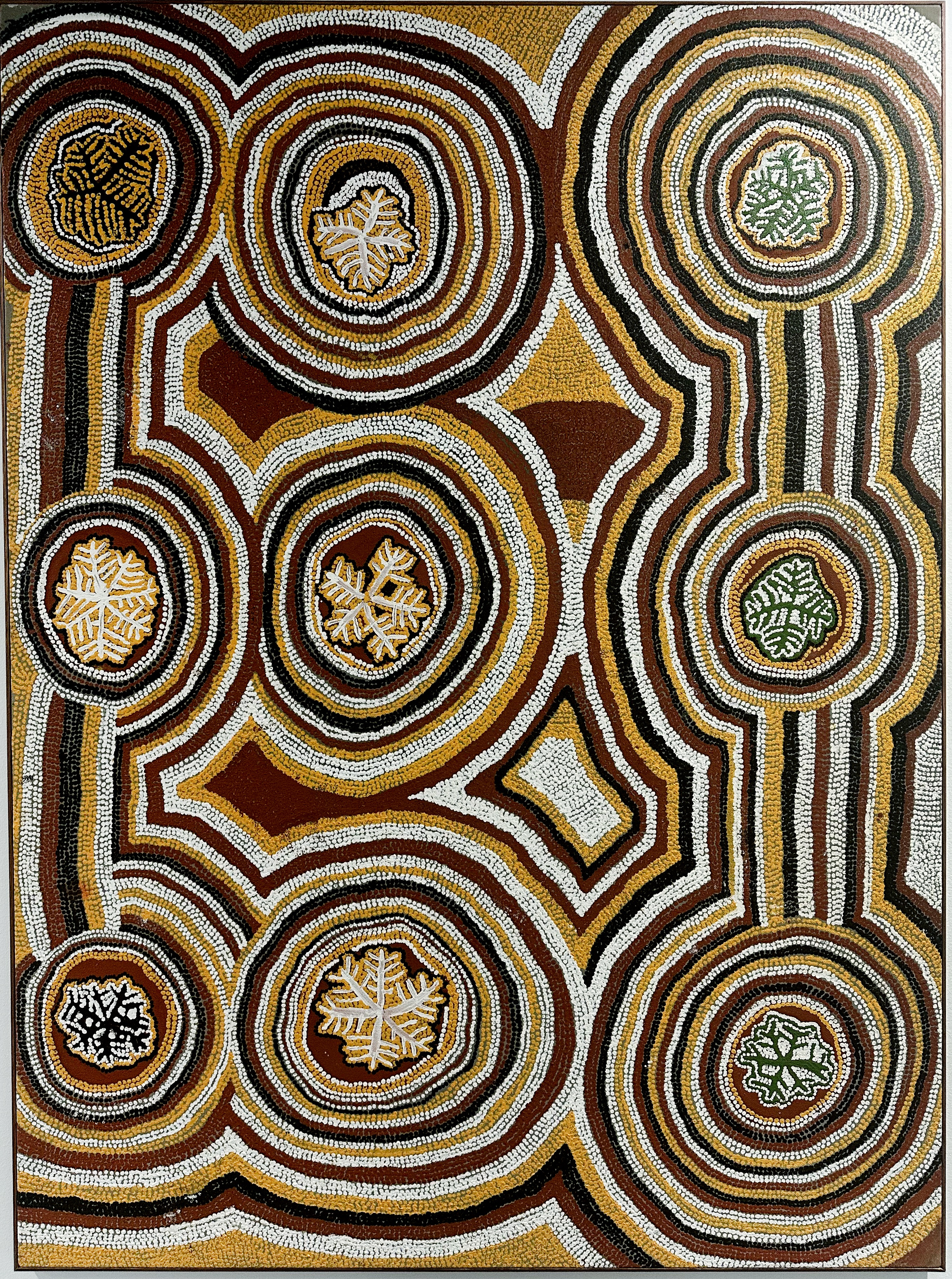
Artist’s Country (Kutukutu, near Lappi Lappi), 1989, by Albert Tjakamarra Nagomara c. 1925

Albert Tjakamarra Nagomara c. 1925
Artist’s Country (Kutukutu, near Lappi Lappi), 1989
Acrylic on canvas
1130 cm x 830 cm

A Kukatja speaker, Albert Tjakamarra Nagomara was one of several Tjakamarra men in the Balgo community whose work primarily concerned Water Dreaming and rituals associated with rainmaking. His works generally use strong, simple motifs, such as roundels and watercourses, but beneath their simplicity lies a great reservoir of Law matters.

The work depicts the artist’s country, Kutukutu, near Lappi Lappi (Lake Hazlett in the Tanami Desert in Central Western Australia). The work shows a network of soaks and waterholes, with their connecting creeks and large shade giving trees.

Fire Dreaming by Jean Nampijinpa Hudson b. 1960

Jean Nampijinpa Hudson was born in the remote community of Yuelamu (Mount Allen in the Northern Territory), three hours from Alice Springs. Brought up by her family in the traditional Law, her country is Kerrinyerra or Mount Wedge which is in the Yuelamu/Yuendumu region. 

Jean began painting in 1979 using traditional motifs. Over time, her work took on a more impressionistic look. A highly sought after artist, Jean has participated in many solo and group exhibitions, both in Australia and internationally. 

These two works depict the Warlu (Fire) Dreamings inherited from her father. 
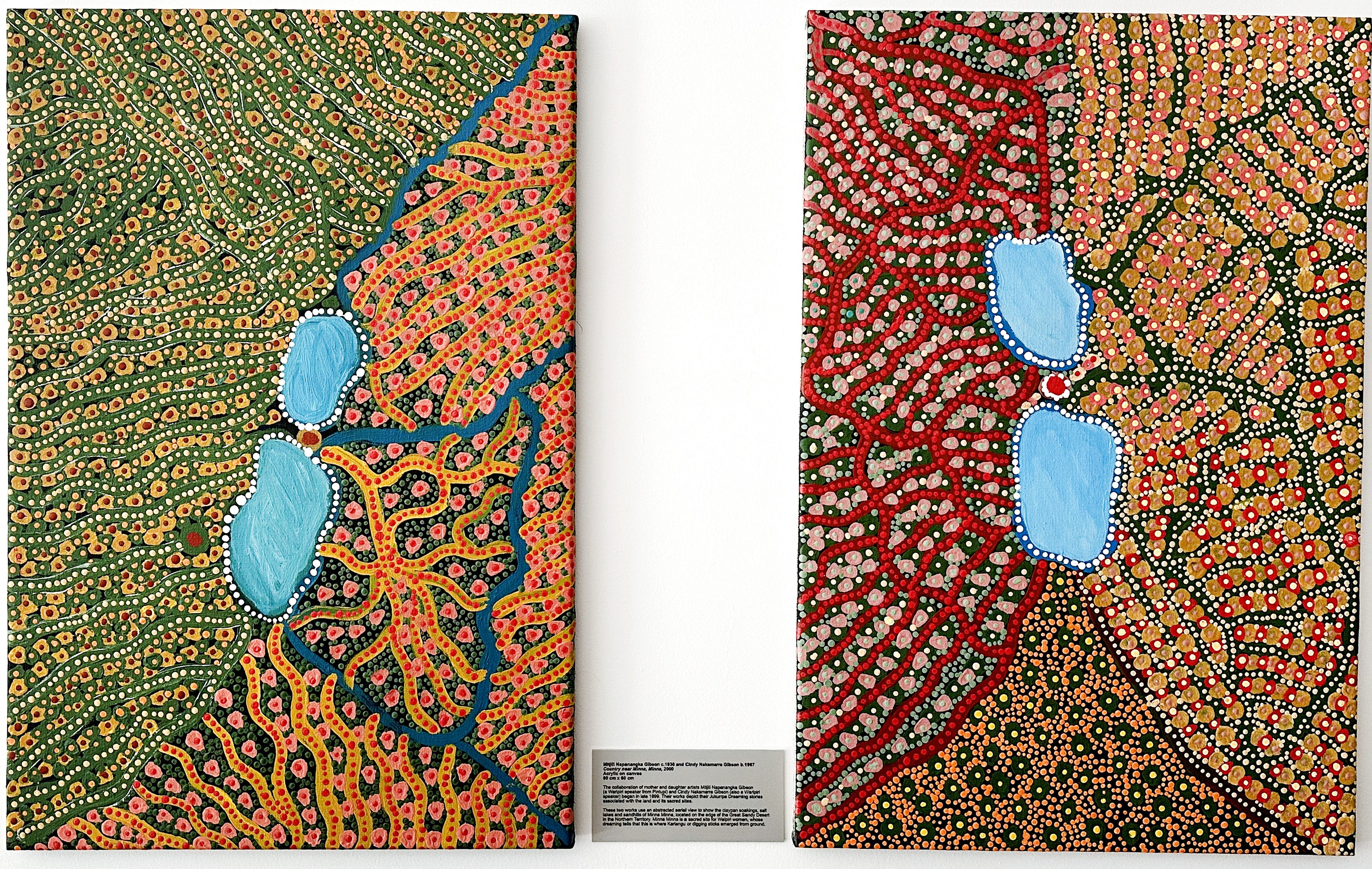
Country near Minna, Minna, 2000 by Mitjili Napanangka Gibson c.1930 and Cindy Nakamarra Gibson b.1967

Mitjili Napanangka Gibson c.1930 and Cindy Nakamarra Gibson b.1967
Country near Minna, Minna, 2000
Acrylic on canvas
90 cm x 60 cm

The collaboration of mother and daughter artists Mitjili Napanangka Gibson (a Warlpiri speaker from Pintupi) and Cindy Nakamarra Gibson (also a Warlpiri speaker) began in late 1999. Their works depict their Jukurrpa Dreaming stories associated with the land and its sacred sites. 

These two works use an abstracted aerial view to show the claypan soakings, salt lakes and sandhills of Minna Minna, located on the edge of the Great Sandy Desert in the Northern Territory. Minna Minna is a sacred site for Walpiri women, whose dreaming tells that this is where Karlangu or digging sticks emerged from ground.

Awelye – women’s ceremonial body paint design, 1998 by Audrey Morton Kngwarreye c. 1952

Audrey Morton Kngwarreye c. 1952 
Awelye – women’s ceremonial body paint design, 1998
Synthetic polymer paint on canvass
91 cm x 61.5 cm

Audrey Morton Kngwarreye was born into the Alyawarre language group in the Urapuntja and Amengernterneah region (also known as Utopia) in the Central Dessert in the Northern Territory. Audrey is the daughter of fellow Utopia artist Mary Morton Kemarre.

Audrey paints a variety of stories unique to the Antarrengeny region (her mother’s country), including the Awelye ceremonial body paint designs. Performed by Antarrengeny women, Awelye ceremonies recall their ancestors, show respect for country and demonstrate their responsibility for the wellbeing of their community and is a celebration of the food provided by their country. 
Birdstrike involving an Airbus A320, Newman Airport, Western Australia, on 14 May 2025

Occurrence Briefs are concise reports that detail the facts surrounding a transport safety occurrence, as received in the initial notification and any follow-up enquiries. They provide an opportunity to share safety messages in the absence of an investigation. Because occurrence briefs are not investigations under the Transport Safety Investigation Act 2003, the information in them is de-identified. 

What happened

At about 0920 local time, an Airbus A320-232 was departing from Newman Airport, Western Australia carrying 93 passengers and 6 crew on a scheduled passenger transport flight to Perth. During take-off, as the aircraft reached rotation speed,[1] the flight crew observed a large flock of galahs at the lower edge of the windshield and subsequently heard multiple impacts on the airframe. The crew observed a pitch change to the engine sound and identified increased vibration on the number 1 engine compared to engine number 2. No alert was presented on the electronic centralised aircraft monitor (ECAM) and the crew continued to climb to 6,000 ft. They then performed the after take‑off checks and noticed a reduction in the high-pitched noise and engine vibration when the reduction to climb thrust was selected. When the aircraft levelled at 6,000 ft the pitch returned to normal. 

After discussion and suspecting engine damage from the birdstrike, the crew decided to return to Newman Airport as a precaution. Notification of the intended change in plan was communicated to the passengers, the operator and air traffic control (ATC). The crew conducted a briefing and acknowledged that if the ECAM system displayed any alerts during the approach they would ensure that all actions were completed by 1,000 ft. After discussion with ATC, a decision was made not to declare a PAN or request additional services and the aircraft landed safely.

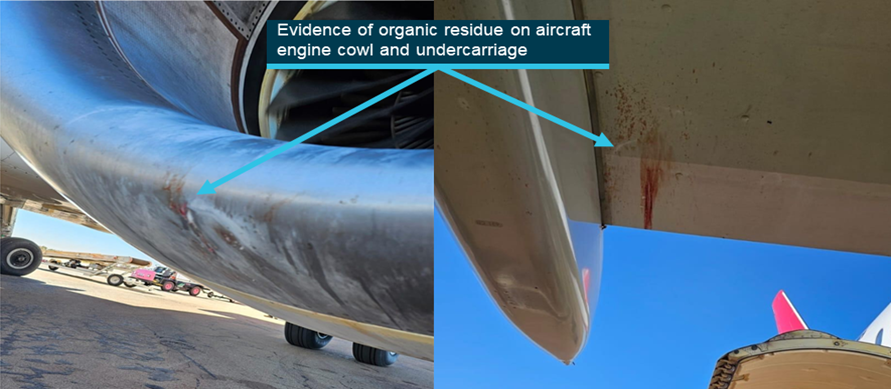
Figure 1: Photographs of aircraft with evidence of a birdstrike

Photograph of evidence of birdstrike on undercarriage of aircraft

Source: Operator

A post-flight inspection of the aircraft found evidence of multiple strikes to the engine cowl and flap (Figure 1) but no damage to the airframe. The operator’s engineer identified that numerous birds had been ingested into both engines and had visibly caused minor damage resulting in the need for a more detailed inspection.

Safety message

Occurrences involving aircraft striking wildlife, particularly birds, continue to be the most common aviation occurrence reported to the ATSB. Birdstrikes are a potential safety risk to aircraft and aerodrome operators. 

The ATSB has recently launched a new dedicated aviation wildlife strike occurrence dashboard, which aims to provide valuable information to pilots, aerodrome and aircraft operators, aviation regulators and other industry participants, to assist with understanding and managing the hazards associated with wildlife strikes. Importantly, the dashboard does not include any identifying information about pilots or aircraft. 

Birdstrikes typically result in nil to minor damage to aircraft, and nil to minor injuries to occupants, however, severe and fatal accidents as a result of birdstrikes in small aircraft have occurred. Birdstrikes can occur during any phase of flight but are more common during the take-off and landing phases, due partly to the increased numbers of birds at lower heights. Aerodrome operators employ various measures to mitigate these occurrences and to control bird numbers. However, when a birdstrike does happen, pilots are ultimately required to deal with the consequences. By following established procedures and prioritising effective communication, the outcomes associated with birdstrikes can be mitigated by pilots.

About this report

Decisions regarding whether to conduct an investigation, and the scope of an investigation, are based on many factors, including the level of safety benefit likely to be obtained from an investigation. For this occurrence, no investigation has been conducted and the ATSB did not verify the accuracy of the information. A brief description has been written using information supplied in the notification and any follow-up information in order to produce a short summary report and allow for greater industry awareness of potential safety issues and possible safety actions.

[1] Rotation speed: the speed at which the rotation of the aircraft is initiated to take-off attitude.

Occurrence summary

Mode of transport Aviation
Occurrence ID AB-2025-019
Occurrence date 14/05/2025
Location Newman Airport
State Western Australia
Occurrence class Incident
Aviation occurrence category Birdstrike, Diversion/return
Highest injury level None
Brief release date 16/06/2025

Aircraft details

Manufacturer Airbus
Model A320-232
Sector Jet
Operation type Part 121 Air transport operations - larger aeroplanes
Departure point Perth Airport, WA
Destination Newman Airport, WA
Damage Minor

Attempt of untrained manoeuvre led to airframe overspeed

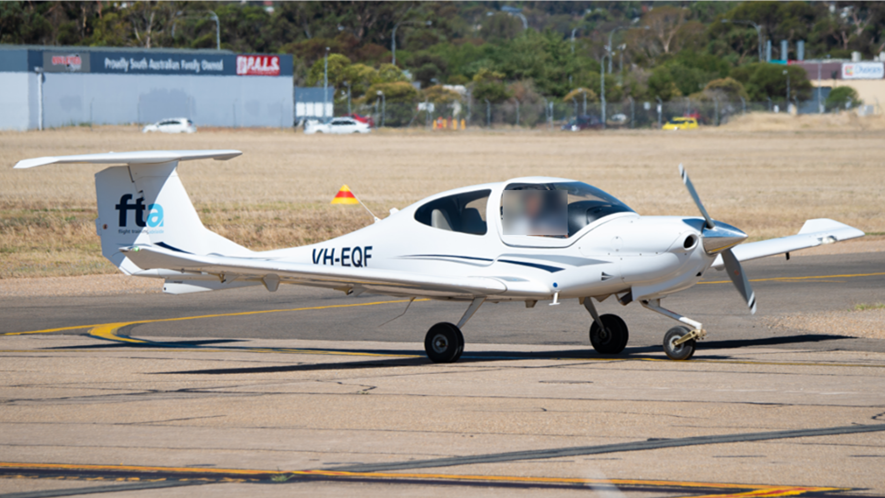
A Diamond DA40 exceeded airspeed, bank angle and pitch limits after an instructor attempted to demonstrate a wingover, a manoeuvre they had not been trained in, an ATSB investigation has found.

The Flight Training Adelaide instructor and student pilot had taken off from Wellcamp Airport, near Toowoomba in southern Queensland on 12 February 2025, for a navigation training flight that also included stall and upset recovery training, the investigation report details.

About 90 minutes into the flight, when at an altitude of about 6,300 ft near Jimna, the instructor pilot took control and, acting on impulse and without briefing the student, attempted a wingover.

During the manoeuvre, the bank angle quickly exceeded the aircraft’s 60° bank angle limitation before continuing beyond inverted and the aircraft’s pitch became steeply nose down.

“The instructor responded to the nose down attitude by reducing power to idle, but then prioritised minimising G load during the recovery from the dive,” ATSB Director Transport Safety Stuart Macleod said.

“While this kept G load well below the airframe maximum, by not increasing pitch more positively, the pilot allowed the aircraft’s speed to increase rapidly, exceeding the airframe limit.”

Flight data showed the aircraft reached a maximum indicated airspeed of 198 kt, above the aircraft’s 178 kt VNE ‘never exceed’ speed.

Over approximately 36 seconds from initiation of the manoeuvre to recovery, the aircraft descended over 2,000 ft to an altitude of 4,159 ft above mean sea level, about 2,600 ft above ground level.

“Wingovers are permitted in the DA40, but it was a manoeuvre the instructor had not been trained to perform,” Mr Macleod said.

“As such, this incident underlines to pilots the importance of not attempting unfamiliar manoeuvres without the appropriate training, so as to reduce the likelihood of mishandling and to be prepared to respond appropriately if things do not go as planned.”

After landing, while the instructor was aware the aircraft had exceeded its maximum airframe speed and they confirmed the aircraft had no further bookings for the rest of the day, they did not mark the aircraft as unavailable or endorse its maintenance release at that time.

After subsequently recognising the incident needed to be reported, the instructor marked the aircraft as unserviceable early the following morning.

“In this case an inspection determined that the aircraft was not damaged from the overspeed, but it is important that all exceeded limitations are entered onto the maintenance release and reported quickly to ensure other pilots are not exposed to the risk of operating a damaged aircraft,” Mr Macleod concluded.

Read the final report: Airframe overspeed involving Diamond DA40, VH-EQF, 63 km east of Kingaroy Airport, Queensland, on 12 February 2025

Caboolture midair highlights risks of aircraft using different runways

A midair collision overhead Caboolture airfield highlights the risks of aircraft using multiple runways at non-towered aerodromes, an ATSB investigation report details.

On the morning of 28 July 2023 a Piper Pawnee being used by the local glider club as a tug aircraft was returning to land from the south-west on Caboolture’s runway 06, while a Jabiru J430 with a pilot and passenger on board was preparing to depart to the east from the intersecting runway 11.

“Caboolture has two intersecting runways and is a non-controlled aerodrome where pilots rely on making radio calls and visual scans to maintain separation from other aircraft – a principle known as ‘alerted see-and-avoid’,” explained ATSB Chief Commissioner Angus Mitchell.

Just prior to the Pawnee touching down, a Cessna 172 being taxied by a solo student pilot, who was unaware of an aircraft on approach, crossed runway 06. 

In response, the Pawnee pilot initiated a go-around, a routine procedure when an aircraft encounters an issue on approach and landing.

“The Pawnee pilot applied power and initiated a climb, maintaining the runway heading as they made a go-around radio call,” Mr Mitchell said.

“At the same time, the Jabiru lifted off from runway 11.”

The two aircraft converged, and shortly before impact the Jabiru commenced a left turn, likely in an attempt to avoid the Pawnee.

However, they collided above runway 06, just beyond the runway intersection, at a height of about 130 feet.

The collision separated the Jabiru’s right wing-tip and aileron, and it pitched downward and rolled to the right before impacting the ground, fatally injuring both on board and destroying the aircraft.

The Pawnee remained flyable despite damage to its left wing and landed safely with no injuries to the pilot.

“While in the circuit, the Pawnee pilot had made positional radio calls, and a call stating their intention to land and hold short of the runway intersection, but did not hear an entering runway or rolling call from the Jabiru,” Mr Mitchell said.

“Based on the Jabiru pilot's apparent unawareness of the Pawnee until just before the collision, and most witnesses not recalling hearing any calls from the Jabiru throughout the event, it is likely that the Jabiru pilot could not transmit or hear radio calls.

“Because of this, and a stand of trees between the intersecting runways that blocked visibility between them, neither pilot was aware of the other aircraft.”

While both the Jabiru and Pawnee pilots were familiar with the aerodrome and its line-of-sight limitations, the ATSB found that the aerodrome operator did not effectively manage or inform pilots of the risk of trees and buildings preventing pilots from seeing other aircraft on intersecting runways and approach paths.

“The local gliding club regularly chose to operate on runway 06 when winds and traffic were light, including during periods when other traffic was generally using the intersecting runway.” 

Since the accident, the aerodrome operator has prohibited simultaneous runway operations, and has mandated take-off radio calls.

“The investigation also found that the regulatory guidance pilots relied on when using non‑controlled aerodromes like Caboolture was not clear in defining what was considered an ‘active runway’, leaving room for different interpretations,” Mr Mitchell noted.

Further, this guidance did not provide practical advice to pilots using a secondary runway, and in some situations, it was contrary to existing regulations.

Following the ATSB investigation, CASA is removing all references to the term 'active runway' to better align guidance with the regulations and avoid confusion, and will also expand the guidance to assist industry understanding of this issue.

“This tragic accident highlights that relying on alerted see-and-avoid principles for separation at non controlled aerodromes is not infallible,” Mr Mitchell concluded.

“Pilots can help mitigate this by establishing two-way communication with other traffic, being mindful of the potential for radio communications to be missed or misinterpreted, and never to assume a runway is safe to use simply because no other aircraft are visible.”

Read the final report: Midair collision involving Jabiru J430, VH-EDJ, and Piper PA-25-235, VH-SPA, Caboolture Airfield, Queensland, on 28 July 2023

Safety advisory issued to Dash 8 operators after Mildura take-off incident

A Dash 8 airliner began its take-off roll while its flight crew was unaware of another aircraft about to depart from a cross runway, highlighting limitations with the use of Dash 8 radio systems for ground‑based traffic communication at non-controlled airports.

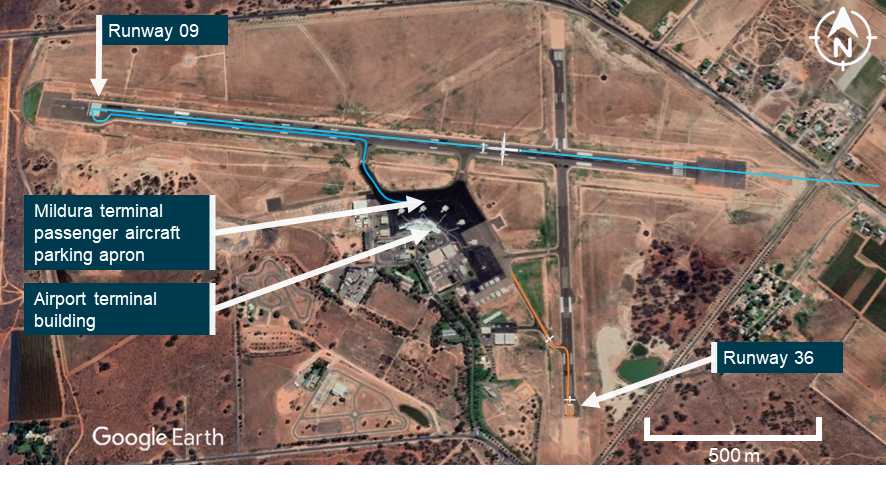
The ATSB has released a final report from its investigation into the 29 September 2023 incident, in which a QantasLink Dash 8 taxied to the threshold of runway 09 at Mildura Airport, in Victoria, for a passenger flight to Melbourne.

At about the same time, a four-seat Lancair light aircraft was taxiing to the threshold of the intersecting runway 36 for an intended take‑off.

Overview of airport showing Dash 8 (blue) and Lancair (orange) ground tracks

Both aircraft had made taxiing, entering, and backtracking calls on the Mildura common traffic advisory frequency, but neither was aware of the other until the Lancair broadcast a rolling (take‑off) call after the Dash 8 had made a rolling call and had begun its take‑off.

The Dash 8 had already passed the take‑off decision point when its crew heard the Lancair’s rolling call, and in response the Dash 8 first officer immediately responded with ‘aircraft rolling 36, hold’.

Believing that the Dash 8 crew’s call may not have been heard by the Lancair, the pilot of a third aircraft relayed to the Lancair that there was another aircraft rolling on runway 09. Having not yet begun to roll, the Lancair pilot acknowledged and aborted their take‑off. The Lancair remained at the threshold about 730 m from the runway intersection as the Dash 8, taking off on runway 09, crossed runway 36.

“The ATSB’s investigation sought to determine why the pilots of both aircraft had not heard radio calls from the other aircraft,” ATSB Chief Commissioner Angus Mitchell explained.

“One call was partially over‑transmitted, and the Dash 8 crew was actively arranging separation with other aircraft in the air at the time of their departure. But more significantly the investigation identified limitations in the strength and readability of the Dash 8’s VHF radios on the ground.”

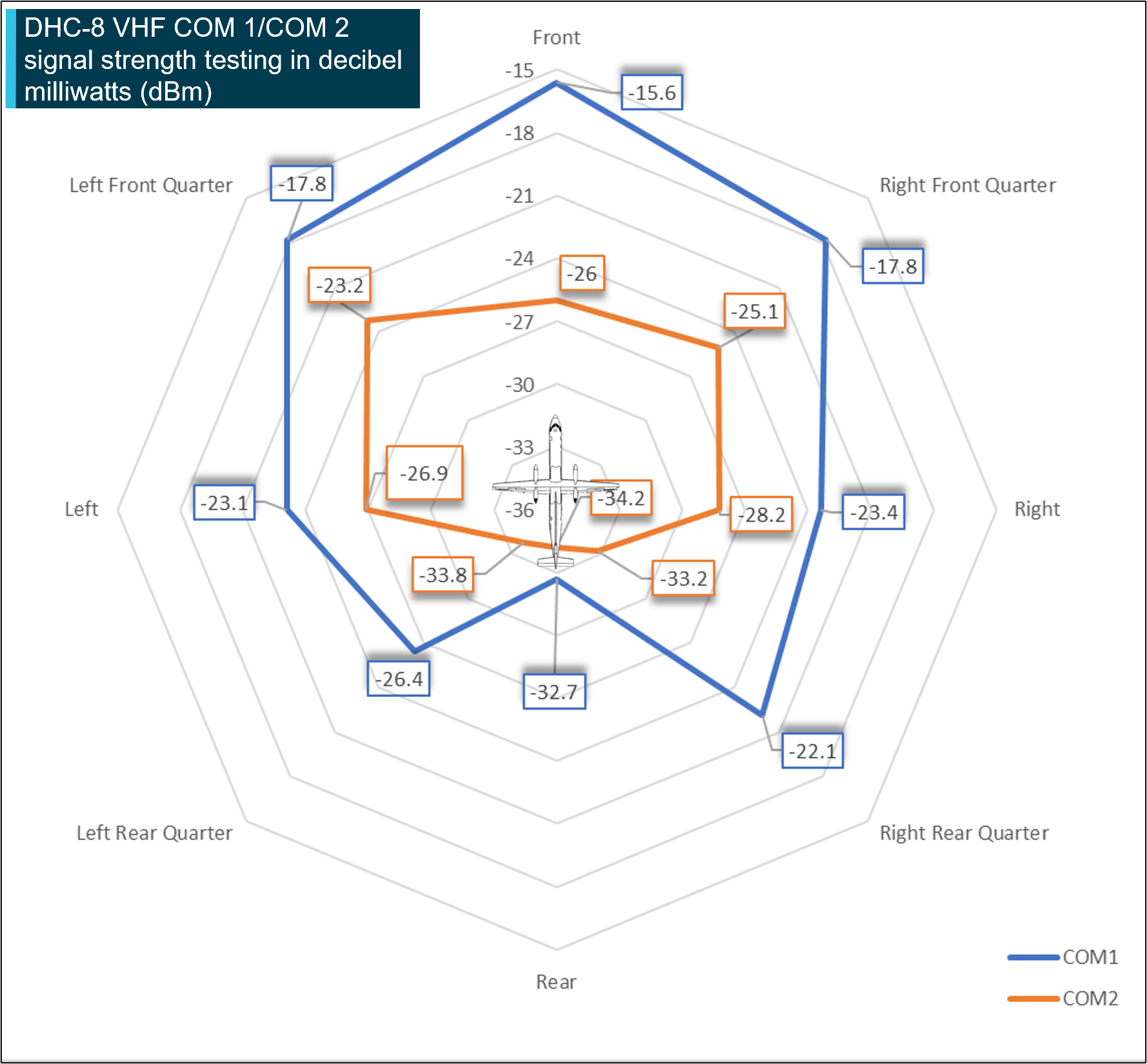
The investigation established that there was reduced radio reception and transmission strength towards the rear of the Dash 8 when on the ground, affecting radio call readability to and from other ground‑based airfield users.

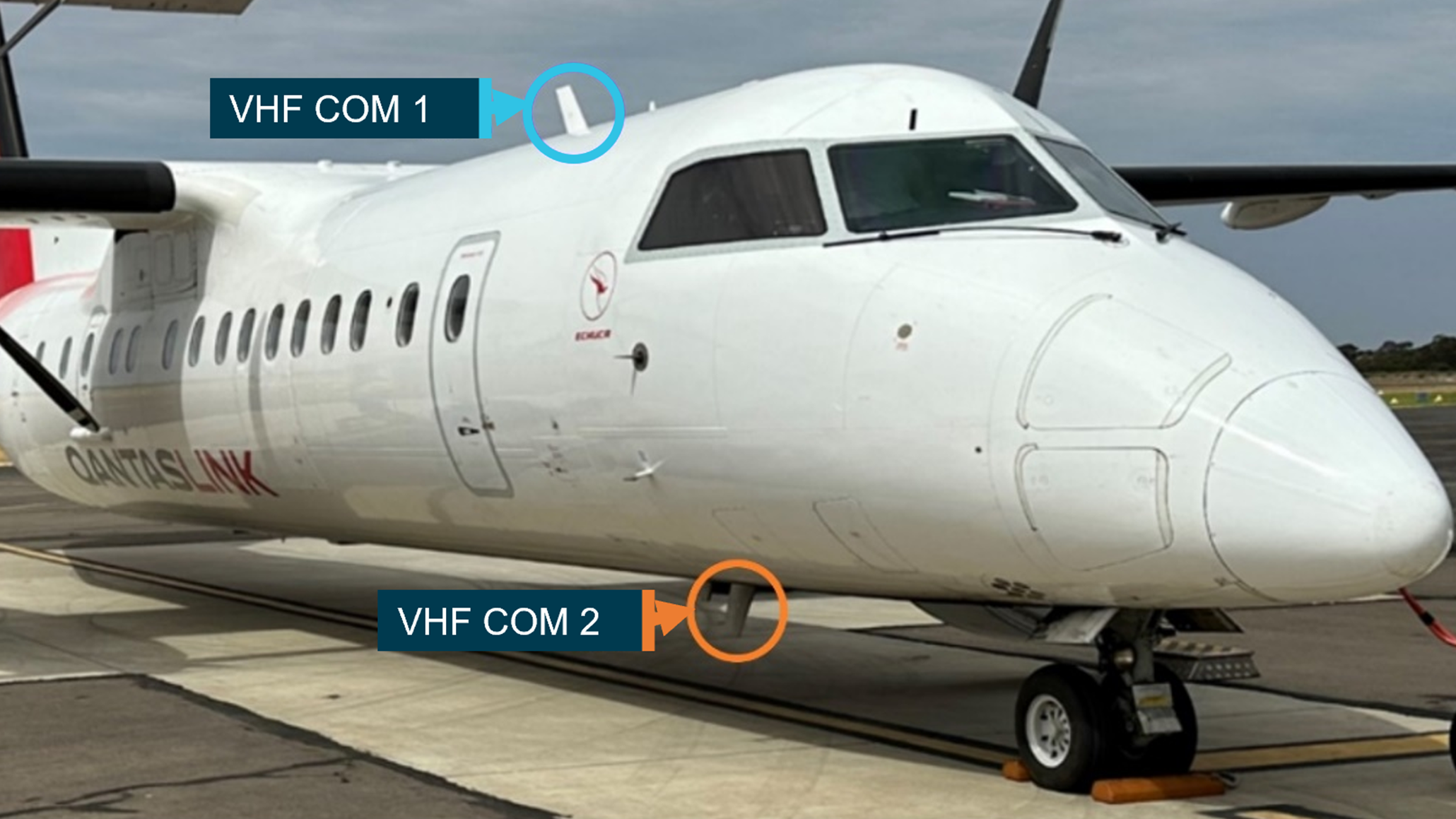
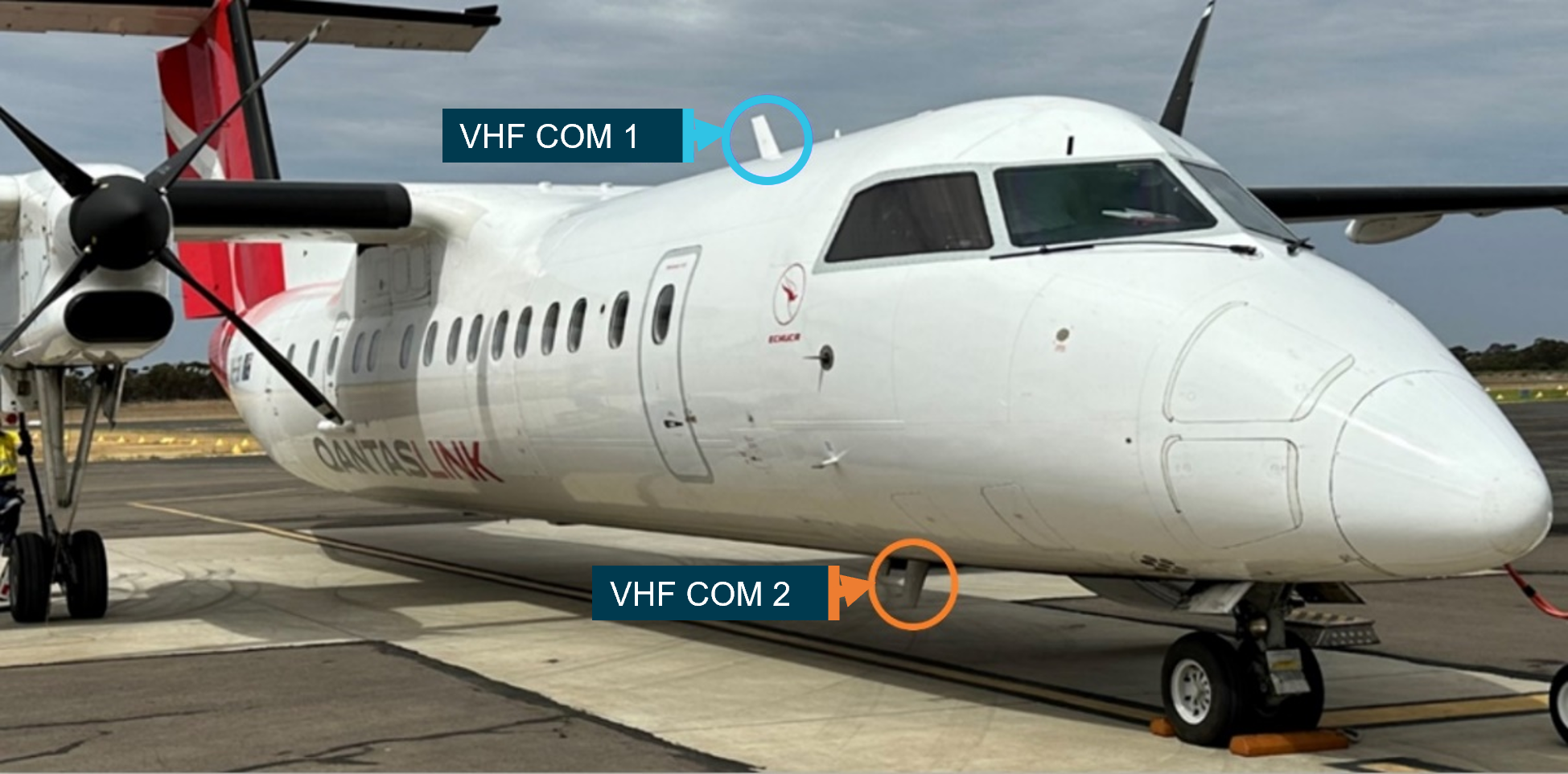
Additionally, the ATSB found that ground‑based transmission and reception on the aircraft’s VHF COM 2, which has an antenna on the aircraft’s underbelly, had reduced strength and clarity. Dash 8 series aircraft have two VHF radio systems: VHF COM 1, which has its antenna on the roof, and VHF COM 2.

“The ATSB conducted rigorous testing at Mildura, in conjunction with the Australian Communications and Media Authority, Mildura Airport, and QantasLink, which provided a Dash 8 for testing,” Mr Mitchell said.

“This allowed investigators to conclude that ground‑based transmissions on VHF COM 2 had reduced strength and clarity.”

As per procedures, QantasLink Dash 8 flight crews used VHF COM 2 for ground calls at non‑controlled aerodromes such as Mildura.

“This likely led to the Lancair having difficulty receiving and understanding radio transmissions from the Dash 8, and the Dash 8 not receiving other transmissions,” Mr Mitchell said. 

The investigation also established that De Havilland Aircraft of Canada Limited – the type certificate holder for the Dash 8 – had not published guidance to operators on transmission and reception limitations of VHF COM 2 radios for ground‑based communications.

De Havilland Aircraft of Canada Limited has subsequently issued two flight operations service letters to all Dash 8 operators relating to the transmission and reception performance limitations of VHF COM 2 radios for ground‑based communications.

The ATSB is also releasing a safety advisory notice to Dash 8 operators to highlight this issue.

“We’re asking all Dash 8 operators and crews to consider the use of VHF COM 1 radios, which uses the roof antenna, for ground‑based communication while operating at non‑controlled aerodromes, to improve radio transmission and reception with other nearby stations,” Mr Mitchell said.

At Mildura Airport, aircraft are not directly visible to each other on the thresholds of runways 09, 27 and 36 due to topography and buildings. The ATSB found that, although not a factor on this occasion, the lack of a requirement for mandatory rolling calls increased the risk of aircraft not being aware of each other immediately prior to take‑off.

In response to this incident, and a related earlier incident in 2023 investigated by the ATSB, Mildura Airport now requires that radio calls be made by pilots commencing take‑off at Mildura.

QantasLink now requires crews to use VHF COM 1 radio for ground‑based departure communications at Mildura, improving ground‑to‑ground radio communication, mitigating collision risks presented by the cross‑runway layout and communication difficulties between runways.

“The ATSB welcomes changes made to the radio procedures at Mildura, but also notes that other aerodromes in the country may be subject to similar interference issues and consideration of expanding the Mildura Dash 8 operational procedures may be warranted,” Mr Mitchell concluded.

Read the final report: Aircraft separation issue during take-off involving Lancair, VH-VKP, and De Havilland Aircraft of Canada Limited DHC-8-315, VH-TQZ, Mildura Airport, Victoria, on 29 September 2023

Read the Safety Advisory Notice: Dash 8 reduced ground-based communications quality on VHF COM 2

Dash 8 reduced ground-based communications quality on VHF COM 2

Safety advisory notice

To operators of De Havilland Aircraft of Canada Limited DHC-8 aircraft 

Reduced quality of radio signal reception and transmission on De Havilland Aircraft of Canada Limited DHC-8 (Dash 8) aircraft during ground-based communication

What happened

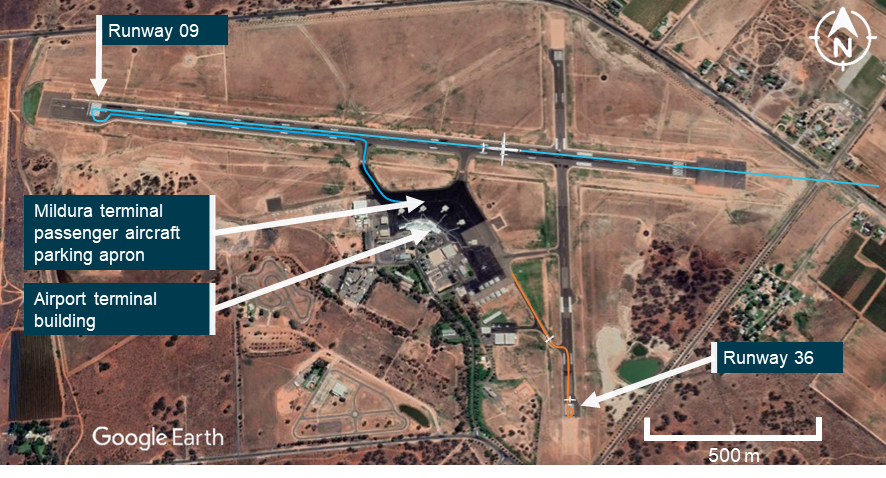
Overview of airport showing Dash 8 (blue) and Lancair (orange) ground tracks

On 29 September 2023, a Lancair Super ES taxied for runway 36 at Mildura, Victoria at about the same time a Dash 8 began to taxi for runway 09. 

Both aircraft gave taxi, entering and backtracking calls on the local common traffic advisory frequency. The Dash 8 crew did not hear the calls from the Lancair, nor did the Lancair pilot hear the calls from the Dash 8. The crew of the Dash 8 gave a rolling call and had commenced their take-off on runway 09. Shortly after, the pilot of the Lancair gave a rolling call on runway 36. This call was received by the Dash 8 just prior to rotating for take-off, with the crew responding for the Lancair to hold on the runway. Another aircraft taxiing behind the Lancair for runway 36, advised the Lancair to hold position while the Dash 8 departed. The Dash 8 crossed the runway 09/36 intersection while the Lancair remained on the threshold of runway 36.

Why did it happen

The Dash 8 series of aircraft has a VHF antenna for the COM 1 radio on the upper fuselage, and a VHF antenna for the COM 2 radio on the lower fuselage. 

Figure 4: Dash 8 antenna position

Radio frequency interference testing at Mildura Airport was completed by the ATSB, the Australian Communications and Media Authority (ACMA), Mildura Airport management, Airservices and QantasLink in March 2024. Testing identified reduced radio signal transmission and reception quality on a Dash 8 300 aircraft while using VHF COM 2 for ground-based very high frequency (VHF) communications.

Reduced signal strength reception and transmission was identified during ground-based communications on VHF COM 2 when compared to VHF COM 1. This was identified as a factor leading to incomplete, unintelligible or non‑receipt of VHF positional radio broadcast information at non‑towered aerodromes. These broadcasts are normally used to enhance the alerted see‑and‑avoid situational awareness of flight crew and other pilots in the vicinity.

Figure 9: Dash 8 airframe signal strength and shielding testing

This was of particular importance at Mildura Airport as aircraft positioned on runway thresholds may not be visible to the pilots from each respective aircraft.

Aircraft radio shielding on all Dash 8 aircraft variants can occur during ground operations due to the close proximity of the VHF COM 2 antenna to the ground and airframe shielding which is likely to affect communications resulting in reduced signal strength, reduced clarity of transmissions and impair reception of other radio calls. This can be further exacerbated by physical obstacles, such as hangars and terrain. Furthermore, negative effects on ground‑to‑ground based communications are exacerbated by increased distance between the aircraft.

De Havilland Aircraft of Canada Limited reviewed the testing and on 6 December 2024, issued two flight operations service letters relating to radio communications, with one covering Dash 8 100‑300 series aircraft and the other covering the Dash 8 400 series aircraft. The service letters remind operators that ground based VHF communications are affected by line of sight and can be impacted by buildings, terrain or aircraft structures and that use of VHF COM 1 is more effective for ground‑based communications with other aircraft.

Communications at non‑towered aerodromes

Pilots are responsible for making themselves aware of nearby aircraft and maintaining separation at non‑towered aerodromes. Traditionally, VHF radio broadcasts are made at non‑controlled aerodromes to provide situational awareness, traffic separation and deconfliction to other traffic in the vicinity of the aerodrome. 

Broadcasting to other traffic in the vicinity of a non‑controlled aerodrome is known as radio‑alerted see‑and‑avoid and assists by supporting the pilot’s situational awareness. Positional broadcasts rely on the ability of other traffic receiving, comprehending and reacting to this information.

In some aircraft, using an antenna that is positioned underneath the aircraft may not have optimal ground‑based transmission or reception strength and clarity due to airframe shielding. Positional broadcasts are a one‑way communication, so they do not imply receipt of information by other parties unless direct radio contact is made between stations. As a result, in some circumstances, broadcasts may be missed without either pilot realising it, and this affects their shared understanding of the traffic in the vicinity.

Safety advisory notice

AO-2023-050-SAN-01: The Australian Transport Safety Bureau advises all operators and crew of De Havilland Aircraft of Canada Limited DHC-8 (Dash 8) aircraft to consider the use of VHF COM 1 radios for ground‑based communication while operating at non‑controlled aerodromes, to improve radio transmission and reception with other stations.

Read more about this ATSB investigation: Runway incursion involving Lancair, VH-VKP and Bombardier DHC-8-315, VH-TQZ, at Mildura Airport, Victoria, on 29 September 2023

Publication details

Investigation number AO-2023-050
Publication type Safety Advisory Notice
Publication mode Aviation
Publication date 30/05/2025