Unstable approach involving a Pilatus PC-12/47E, Adelaide Airport, South Australia, on 21 February 2025

Occurrence Briefs are concise reports that detail the facts surrounding a transport safety occurrence, as received in the initial notification and any follow-up enquiries. They provide an opportunity to share safety messages in the absence of an investigation. Because occurrence briefs are not investigations under the Transport Safety Investigation Act 2003, the information in them is de-identified. 

What happened

On 21 February 2025 at approximately 1500 Central Standard Time, the pilot of a Pilatus PC-12/47E was operating a medical transport flight from Bordertown to Adelaide, South Australia, with a patient and medical crew member on board. As the aircraft approached Adelaide Airport from the east and was cleared by ATC for a close-base left turn, the pilot observed the aircraft to be high and fast on the approach, outside of the operator’s published stable approach criteria by 30 kt. During the turn onto final approach, the pilot received enhanced ground proximity warning system (EGPWS) ‘sink rate’ and ‘pull up’ alerts, however the approach was continued.

The pilot reported considering a go-around but decided to continue with the approach to maintain their position in the arrival sequence. They reported the landing was fast, at 120 kt, outside of the manufacturer’s approach speed guidance by 20 kt.

After the occurrence, the pilot noted the operational pressure associated with having a patient on board, as well as being late into their shift and the general desire to get home. 

Safety message

This incident highlights the importance of managing operational and perceived time pressures which can lead to human error. 

Effective ways to manage external pressures and distractions is discussed in the ATSB report Dangerous distraction: An examination of accidents and incidents involving pilot distraction in Australia between 1997 and 2004 (B2004/0324).

This incident also serves as a reminder for pilots to be prepared to conduct a go-around to avoid an undesirable aircraft state.

About this report

Decisions regarding whether to conduct an investigation, and the scope of an investigation, are based on many factors, including the level of safety benefit likely to be obtained from an investigation. For this occurrence, no investigation has been conducted and the ATSB did not verify the accuracy of the information. A brief description has been written using information supplied in the notification and any follow-up information in order to produce a short summary report, and allow for greater industry awareness of potential safety issues and possible safety actions.

Occurrence summary

Mode of transport Aviation
Occurrence ID AB-2025-013
Occurrence date 21/02/2025
Location Adelaide Airport
State South Australia
Occurrence class Incident
Aviation occurrence category E/GPWS warning, Unstable approach
Highest injury level None
Brief release date 03/06/2025

Aircraft details

Manufacturer Pilatus Aircraft Ltd
Model PC-12/47E
Sector Turboprop
Operation type Part 135 Air transport operations - smaller aeroplanes
Departure point Mount Gambier, South Australia
Destination Adelaide, South Australia
Damage Nil

Preliminary report into safeworking incident at Gisborne

A preliminary report details information gathered during an ongoing transport safety investigation into a safeworking incident involving a maintenance team and a V/Line passenger train on Victoria’s Bendigo-Melbourne line in March.

The incident is being investigated by the Office of the Chief Investigator, which conducts rail investigations in Victoria under a collaboration agreement with the ATSB.

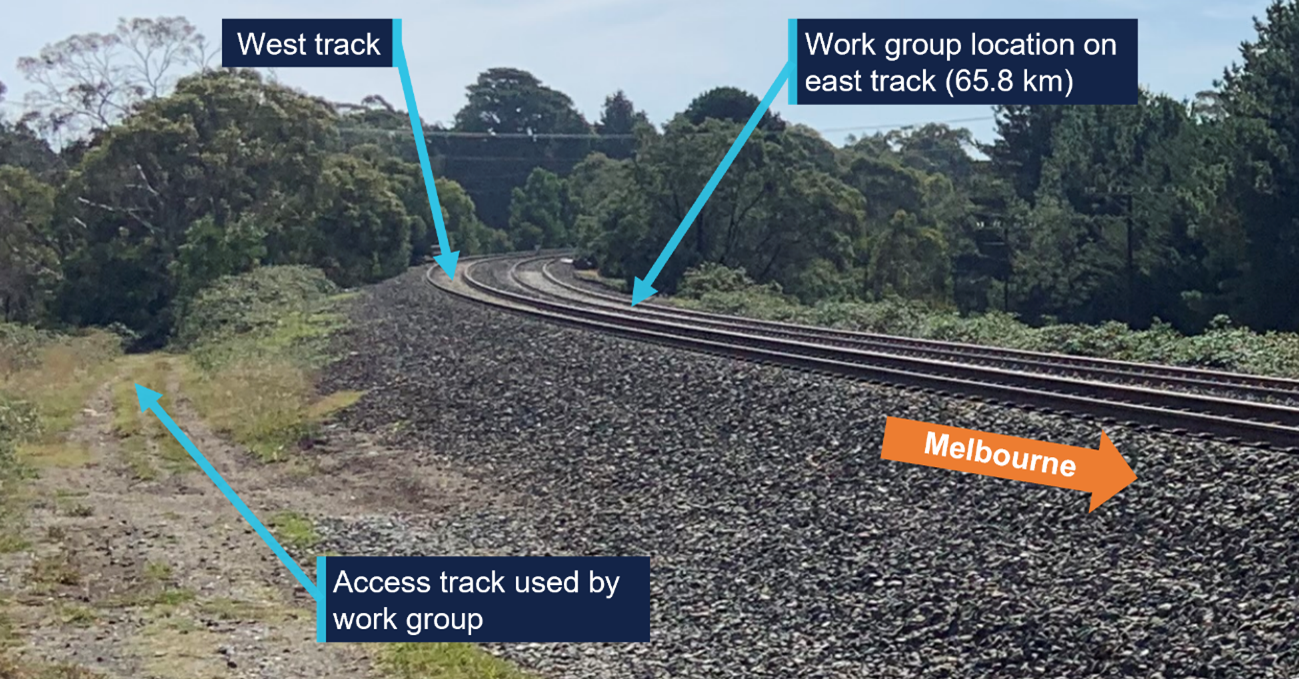
On the afternoon of 11 March 2025, the preliminary report notes, a train driver reported a rough ride on a section of track at Gisborne, about 60 km north-west of Melbourne’s CBD.

V/Line train control implemented a 90 km/h speed restriction at the location and reported the issue to the maintenance centre.

A maintenance workgroup arrived at the location and its supervisor requested a track warrant to access the track. A track warrant was provided and the workgroup entered the track at about 1745.

“At about 1749, the driver of the VLocity train heading towards Melbourne sighted the workgroup about 240 m ahead, performing maintenance on the track,” Chief Investigator Mark Smallwood explained. “The driver sounded the horn and applied the emergency brake.”

The workgroup was able to clear the track as the train approached, but the train impacted a track jack the workgroup was using, resulting in minor damage to the underside of the train.

The train came to a stand about 70 m past the worksite, remaining on the rails. There were no injuries reported.

To date investigators have inspected the occurrence location, examined train operational information, interviewed several parties, and collected other relevant information.

“As the investigation continues, it will include review and examination of safeworking systems, communications procedures and risk management practices relevant to this occurrence,” Mr Smallwood said.

“A final report, containing safety analysis and findings, will be released at the conclusion of the investigation.

“If a critical safety issue is identified in the course of the investigation, relevant parties will be notified immediately so appropriate safety action can be taken.”

Read the preliminary report: Safeworking irregularity involving V/Line passenger train 8076, Gisborne, Victoria, on 11 March 2025

ATSB releases preliminary report into Ogilvie aircraft accident

The ATSB has published a preliminary report detailing evidence gathered so far in its investigation of a fatal accident involving a Cessna 150 light aircraft near Ogilvie, in mid-west WA.

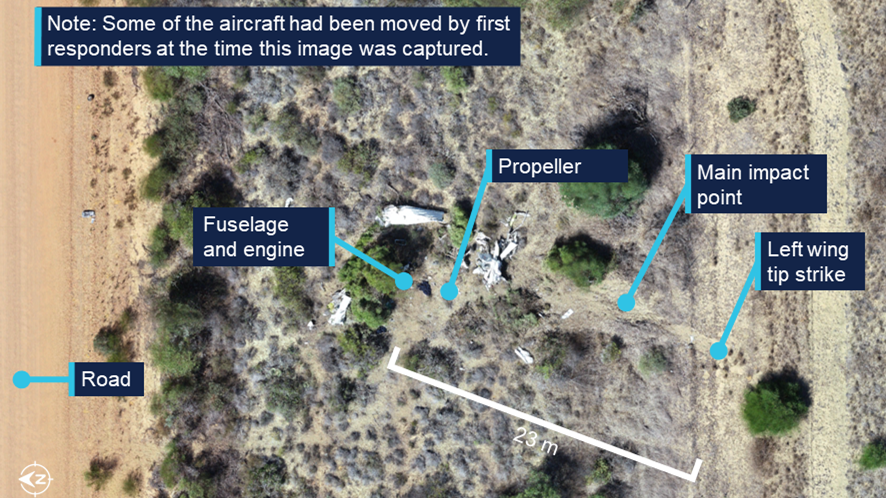
The wreckage of a Cessna 150M single-engine aircraft was discovered by a motorist next to Ogilvie Road, about 84 km north-west of Geraldton, WA, at around 1115 on 21 March 2025.

The pilot, the aircraft’s sole occupant, was fatally injured.

The aircraft had departed Geraldton Airport for a planned ferry flight 340 km up the coast to Shark Bay, taking off about 75 minutes before the wreckage was found.

About 18 minutes into the flight, the pilot texted a photo to a staff member at the maintenance organisation at Geraldton, which had just released the aircraft.

“In the text, the pilot was positive about the aircraft’s performance, but noted a slightly higher than usual oil temperature,” ATSB Chief Commissioner Angus Mitchell said.

“The temperature shown in the photo was towards the upper end of the normal range, but below the 240°F maximum oil temperature limit.”

In a reply text, the maintainer acknowledged the slightly higher temperature and that they could look into fitting coolers onto the aircraft to resolve the issue.

“While there were no radar or ADS-B recordings available, this reply text was recorded as being delivered at 1018, indicating the pilot’s phone was still functional at that time,” Mr Mitchell observed.

“A damaged GPS receiver was recovered from the accident site, and the ATSB is in the process of recovering data from that device.”

The investigation’s preliminary report notes witnesses at Geraldton Airport reported the pilot appeared unwell prior to the accident flight and had mentioned having severe gastroenteritis in the preceding days. Witnesses did not report any apparent speech or physical impairment.

“The ATSB’s ongoing investigation will include the collection and review of all available medical history and post-mortem information for the pilot,” Mr Mitchell said.

“It will also include examination and review of all the other evidence gathered, including CCTV and CTAF recordings, aircraft, pilot and operator documentation, witness reports, the aircraft’s maintenance history, and the evidence gathered at the accident site itself.”

The preliminary report notes the wreckage trail extended about 23 m in a north-easterly direction, with initial impact marks indicating the aircraft impacted terrain in a left wing-low, steep nose-down attitude, at a high speed.

There was no post-impact fire, and fuel could be smelt in the area.

“No pre-impact defects were identified and bending and damage to the propeller was consistent with the engine running at the time of impact,” Mr Mitchell said.

Weather forecasts and observations for Geraldton during the accident flight indicated clear skies, with 5 kt of wind, and a temperature of 34°C.

A final report, including safety analysis and findings, will be released at the conclusion of the investigation.

“Should a critical safety issue be identified during the course of the investigation, the ATSB will notify relevant parties immediately, so timely safety action can be taken,” Mr Mitchell concluded.

Read the preliminary report: Collision with terrain involving Cessna 150M, VH-WWU, 40 km north-west of Northampton, Western Australia, on 21 March 2025

Cabin crew injury after severe turbulence event

A Qantas 737 landed with four people out of their seats assisting a cabin crew member injured after the aircraft encountered severe unexpected turbulence, an ATSB investigation report details.

The 737 passenger service from Sydney to Brisbane on 4 May 2024 encountered the severe turbulence as the aircraft descended in cloud through about 11,400 ft, in the minute after the flight crew had turned on the seatbelt signs.

While anticipating some mild turbulence, the captain did not communicate to the cabin crew about expected turbulence during descent, likely as a result of not knowing its severity.

“After the seatbelt signs were illuminated, per operator procedures, the cabin crew were performing various duties such as checking lavatories were empty and ensuring all passengers were seated when the severe turbulence was encountered,” ATSB Director Transport Safety Dr Stuart Godley said. 

During the event, two of the four cabin crew sustained minor injuries, while a third sustained a fractured ankle and was unable to move from the rear galley floor.

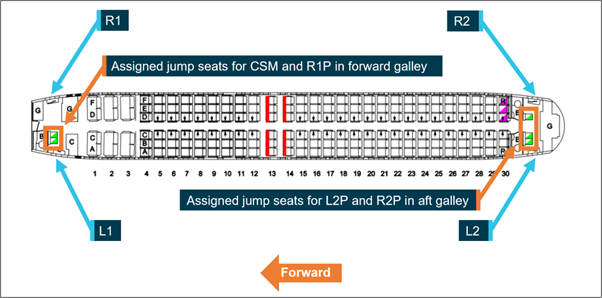
Two cabin crew (including the customer service manager) and two passengers (one of whom was an off-duty cabin crew employee, the other a travelling doctor) remained with the injured cabin crew member in the rear galley, unrestrained, during the landing. 

“Qantas 737 standard operating procedures rely on the customer service manager – the senior member of the cabin crew – informing the flight crew if the cabin is not secured for landing,” Dr Godley explained. 

While the CSM contacted the captain to inform them about the injured cabin crew member and that some passengers were standing, the captain did not recall receiving any requests for more time to prepare the cabin for landing, and twice directed all uninjured cabin crew and passengers to return to their seats.

“Landing is a critical phase of flight, and the unrestrained cabin crew and passengers were exposed to a higher risk of injury in a landing-based emergency, which in turn would have compromised the cabin crew’s ability to manage any such emergency situation,” Dr Godley said.

“Data shows that almost 80% of serious turbulence-related injuries in airline operations are sustained by cabin crew, and the most common time for these to occur is when preparing the cabin for landing.” 

Collaboration between pilots and cabin crew helps ensure the timely completion of service-related tasks while minimising the risk of injury during known or anticipated encounters with turbulence, Dr Godley noted.

“Differing understandings of the state of the cabin increases the risk of delayed responses or misaligned decision‑making, which may lead to safety being compromised.”

Shortly after the aircraft’s arrival at the gate at Brisbane, the seriously injured cabin crew member was attended to by ambulance personnel.

However, the report notes, the other two injured cabin crew members did not receive any immediate follow up medical assessments or treatment. 

While one of the injured crew self-diagnosed their facial injury the next day, the other was unaware they had sustained a concussion and operated on multiple flights while experiencing concussion symptoms before being treated.

Qantas has subsequently updated its post-event incident notification protocol to include contact with the Qantas on-call doctor in the event of significant cabin crew injury or illness.

Additionally, the airline has implemented additional controls to adequately assess the fitness of crew members after a turbulence event or other unplanned aircraft movement.

Read the final report: Turbulence event and cabin crew injury involving Boeing 737, VH-VYK, 36 km south-east of Brisbane Airport, Queensland, on 4 May 2024