

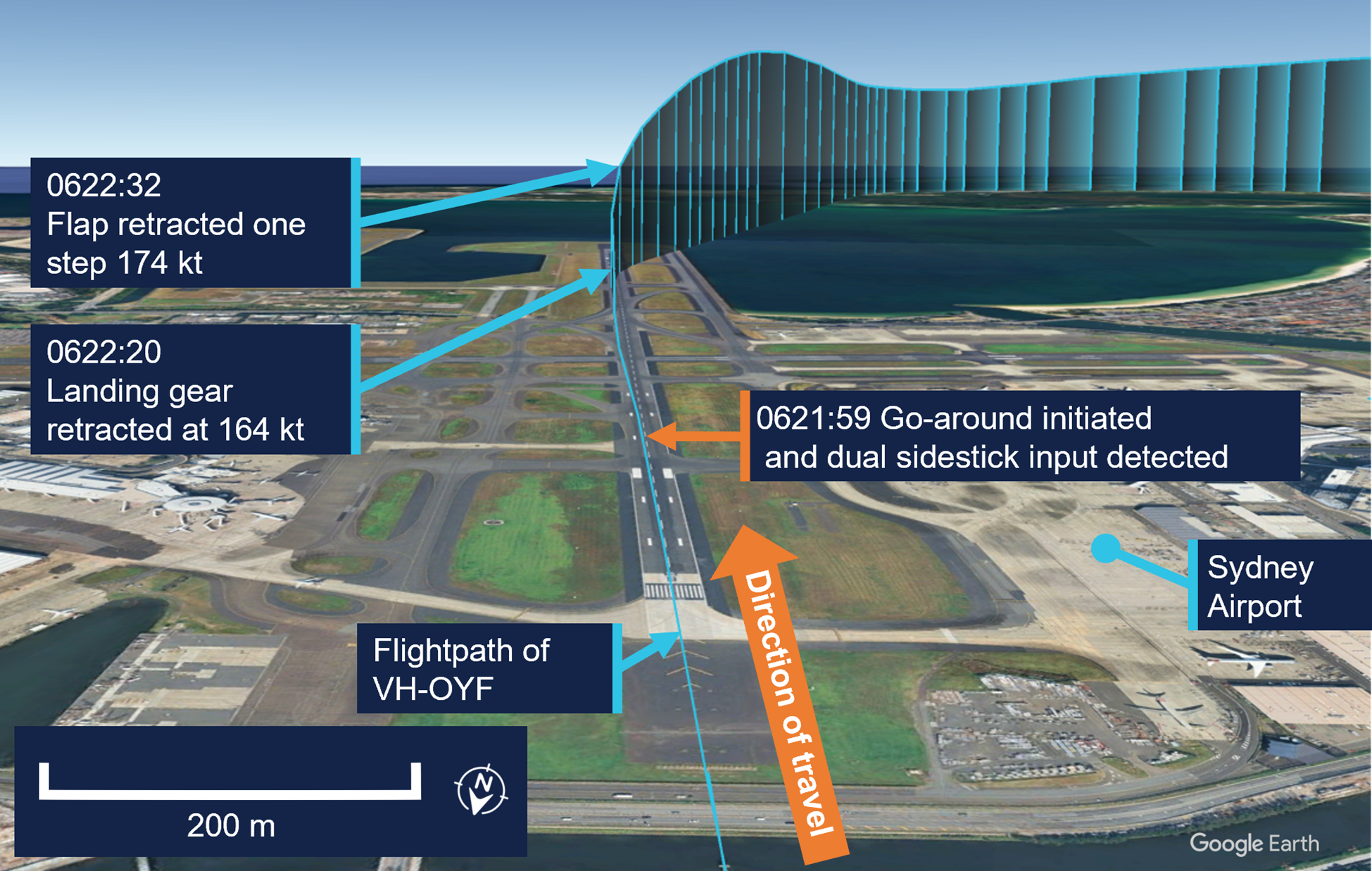
A go-around after a lateral deviation and long flare to land at Sydney Airport resulted in the crew of an Airbus A321 making an inadvertent dual control input and conducting some procedures out of sequence, an ATSB final report details.
The Jetstar A321 was on an approach to land on Sydney’s runway 16R on the morning of 26 June 2025 at the end of an overnight flight from Denpasar. As conditions were turbulent, the first officer, as pilot flying, had configured the aircraft for a ‘flap 3’ landing, consistent with landing in ‘rough’ conditions.
Passing 500 ft, the captain, as pilot monitoring, confirmed the approach was stable, and air traffic control advised of an expected right crosswind component of 8 kt for landing.
The first officer initiated the flare at 50 ft and later recalled they ‘over flared,’ with the captain observing that the first officer’s flare technique was consistent with landing with flap full.
“The aircraft floated for a prolonged period above the runway, and, subject to a right crosswind, drifted left of the runway centreline,” ATSB Director of Transport Safety Dr Stuart Godley explained.
Observing this deviation, the captain commanded the first officer to conduct a go-around.
“While this decision was a consistent response to the aircraft’s lateral deviation, it took place right when the flight crew was focused on landing,” Dr Godley noted.
“In response to the rapid increase in pitch attitude, engine thrust and airspeed that followed the go-around initiation, the captain instinctively and inadvertently manipulated their sidestick controller while the first officer was flying, resulting in a dual input alert.”
The captain then took full control by engaging their sidestick push-button, and announcing “I have control”, at which point the first officer assumed the role of pilot monitoring.
“A consequence of the control handover during the initial stages of the go-around was the momentary interruption of sequential crew actions during the go-around procedures and, as a result, some of the procedural items were completed out of sequence,” Dr Godley said.
The report details that the first stage of flap was retracted out of sequence, after gear retraction, but there were no associated flight envelope exceedances or negative effects on aircraft performance.
The crew then continued the missed approach, and landed soon afterwards without further incident.
“Sound go-around decisions are an effective defence against the hazards associated with low‑level manoeuvring during landing,” Dr Godley noted.
“Being ‘go-around minded’ improves flight crew readiness, supporting timely, coordinated actions once a go-around, a period of high workload, has been commanded.
“This should involve crew members reviewing potential go-around scenarios, procedures and responses prior to conducting an approach.”
Read the final report: Control issues during landing and go-around involving Airbus A321, VH‑OYF, Sydney Airport, New South Wales, on 26 June 2025