


What happened
On 3 December 2025, a near collision occurred between a glider towing combination and a recreational aircraft after departing from Benalla Airport, Victoria.
The glider, an Alexander Schleicher ASW 28 (ASW 28) was being towed by a Piper PA‑25 Pawnee (tug). The recreational aircraft was an ICP Savannah. All aircraft were operating under visual flight rules (VFR) in uncontrolled airspace (Class G).
At uncontrolled aerodromes, the use of predictable flight patterns allows pilots operating under VFR to anticipate where other aircraft are likely to be, supporting effective see‑and‑avoid in the absence of air traffic control. AIP and ERSA[1] requirements for operating at Benalla Airport state tug and glider operations should use circuits to the north or east and other powered aircraft to operate south or west, with no dead side[2] available due to the contra circuits. Non-glider aircraft must remain clear of the glider circuit below 2,000 ft. Gliding operations also used runway strips parallel to the 2 runways at Benalla (Figure 1).
The pilot of the tug conducted a normal start and line up sequence for the towing operation followed by a CTAF[3] broadcast of their intentions. No other broadcasts indicating imminent departures were heard by the tug pilot. During the initial climb after take-off from the glider operations strip 26, both the tug pilot and the glider pilot noticed the Savannah rising ahead of them from the parallel aircraft runway 26.
The pilot of the Savannah was conducting a private flight to Ovens Valley, Victoria, with a planned flight path north‑east of the aerodrome. The pilot reported that they intended to turn to the north after clearing the glider circuits. However, after climbing out of runway 26 they misjudged the distance and commenced the turn to the north earlier than intended.
At about 1240 local time and at 300 ft above ground level (AGL), the tug pilot noticed the Savannah commence a right turn above them in close proximity. The tug pilot initiated avoiding action by levelling the climbing turn, followed by the ASW 28 glider still attached. The sudden change in flight path resulted in a bow forming in the tow rope which caused a severe jolt affecting the stability of the tug and ASW 28 combination. The pilot of the tug recovered the towing combination and continued without further incident.
Based on the tug and glider pilot estimations, the separation from the Savannah at the closest point was about 100 ft vertical distance and less than a 100 m lateral distance.
Figure 1: Benalla Airport runway and glider strips
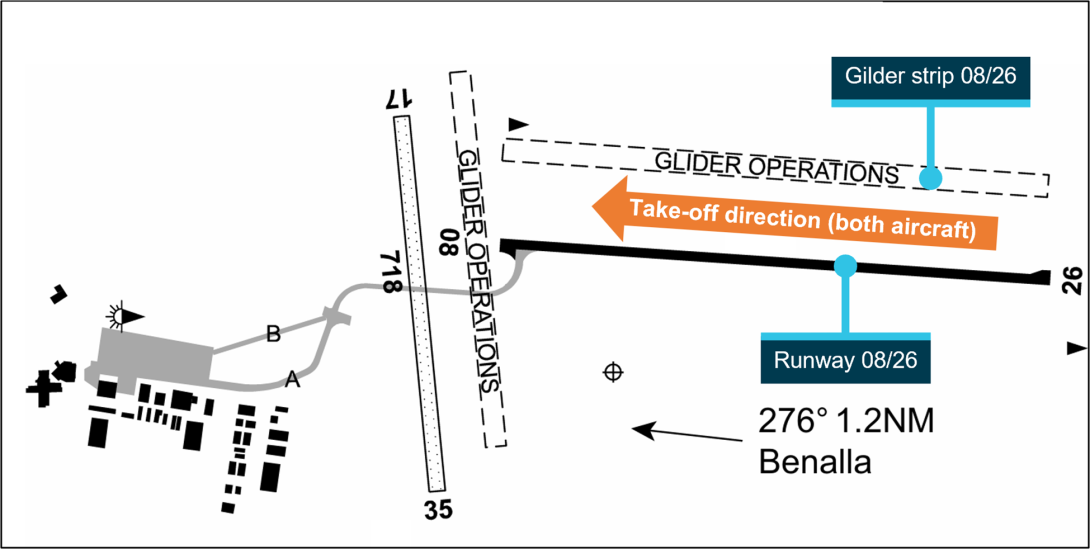
Source: Airservices Australia, annotated by the ATSB
The pilot of the Savannah reported that they broadcast a CTAF take-off call but did not hear the take-off call by the tug pilot and were not aware of the tug and glider position. No further radio calls were made by the Savannah pilot in the vicinity of the aerodrome.
All 3 aircraft continued their journeys without further incident.
Safety message
Glider towing operations have limited manoeuvrability and it is imperative for other aircraft to remain clear of a glider circuit area.
Pilots operating at aerodromes with gliding activity should be familiar with local aerodrome procedures as traffic may be operating on both sides of the runway at circuit height.
Additionally, effective radio broadcasts and active listening are crucial for awareness of other aircraft movements.

The ATSB SafetyWatch highlights the broad safety concerns that come out of our investigation findings and from the occurrence data reported to us by industry. One of the safety concerns is Reducing the collision risk around non-towered airports.
About this report
Decisions regarding whether to conduct an investigation, and the scope of an investigation, are based on many factors, including the level of safety benefit likely to be obtained from an investigation. For this occurrence, no investigation has been conducted and the ATSB did not verify the accuracy of the information. A brief description has been written using information supplied in the notification and any follow-up information in order to produce a short summary report, and allow for greater industry awareness of potential safety issues and possible safety actions.
[1] AIP and ERSA (aeronautical information publication and en route supplement Australia) are directories for Australian aerodromes that include details of an aerodrome and details of available air traffic and ground services, navigation aids and public facilities and any special procedures.
[2] The non-active side of a traffic circuit is referred to as the ‘dead side.’
[3] CTAF: Common traffic advisory frequency – in the vicinity of non-towered aerodromes. CTAF refers to the designated frequency on which pilots make positional broadcasts.