


What happened
On the afternoon of 10 March 2026, following completion of a routine 100-hourly maintenance inspection, a commercially licensed and instructor-rated pilot was operating a Cessna 182 on a test flight from Caboolture Aircraft Landing Area, Queensland. The pilot reported that after pre-flight inspections and engine operational checks (‘run ups’), they took off from Caboolture runway 11 before tracking towards Bribie Island to the east and climbing to 2,500 ft AMSL. After conducting a series of steep turns overhead the island, the pilot turned south-west, back towards the airfield. During the return leg, the pilot reported an uncommanded loss of engine power and commenced troubleshooting checks as the aircraft began to descend, which included moving the fuel selector from the ‘Both’ to ‘Right’ tank selection. Regaining engine power after this action, the pilot climbed back to 1,500 ft and continued tracking toward the airport. An estimated 2 minutes later, the engine again lost power and the pilot configured the aircraft for best glide while continuing troubleshooting attempts.
When engine power could not be restored and the pilot determined the aircraft would not reach Caboolture, they elected to conduct a forced landing into a grassed paddock north of the airfield. After a successful touchdown, the aircraft travelled around 15–20 metres in the landing roll before the nosewheel, then under the full weight of the aircraft, sunk into soft terrain. The aircraft subsequently flipped forward, coming to rest inverted (Figure 1). The pilot was able to climb free from the aircraft, which had sustained substantial damage, and was later conveyed to hospital with minor injuries.
Operator’s investigation
The aircraft operator undertook a detailed investigation into the circumstances of the accident and provided a summary of findings to the ATSB.
Significantly, when interviewed, the pilot indicated that during the pre-flight inspection, they had not used a dipstick to visually verify the amount of fuel remaining in the aircraft’s wing tanks – choosing to rely on the fuel gauges and the aircraft’s fuel log. Further, it was found that the fuel log had not been updated following the last flight prior to the maintenance activities.
In summary, the operator concluded that the engine power loss resulted from fuel exhaustion.
Figure 1: Aircraft after the forced landing
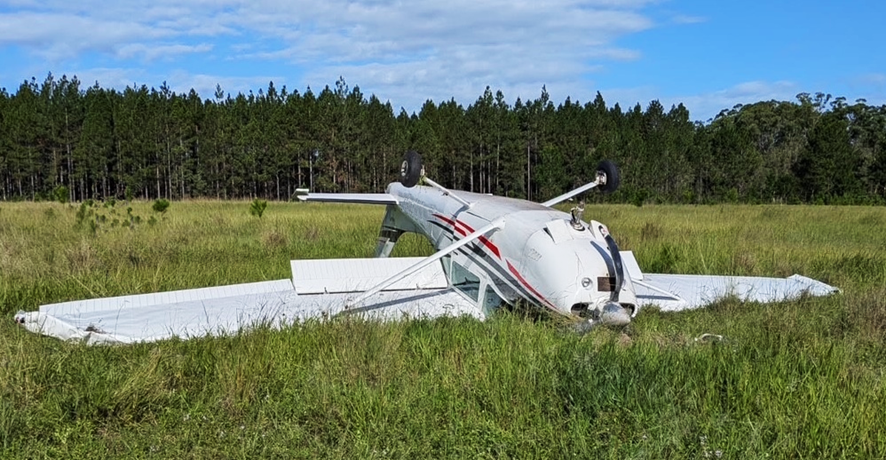
Source: Operator, edited by the ATSB
Safety action
The operator has advised that, following this occurrence and its subsequent internal investigation, a written directive will be issued to all company pilots requiring them to conduct a visual fuel dip before commencement of flight, and to ensure that aircraft fuel quantity gauges are crosschecked against indications from 2 other independent quantity assessment methods.
Safety message
The circumstances of this fuel exhaustion and forced landing occurrence reinforces the critical importance of all pilots – regardless of experience level – verifying available fuel on board the aircraft using multiple, independent methods before flight. Reliance on unverified documentation or uncalibrated instrumentation without independent assurance (through the fuel dip process required by the manufacturer’s operating handbook and CASA Advisory Circular AC 91-15, section 5.2), exposes the pilot to increased risk of inadvertent fuel exhaustion and subsequent forced landing.
About this report
Decisions regarding whether to conduct an investigation, and the scope of an investigation, are based on many factors, including the level of safety benefit likely to be obtained from an investigation. For this occurrence, no investigation has been conducted and the ATSB did not verify the accuracy of the information. A brief description has been written using information supplied in the notification and any follow-up information in order to produce a short summary report, and allow for greater industry awareness of potential safety issues and possible safety actions.