On 21 May 2014, a Grob G115, registered VH-BBJ (BBJ) and a Grob G115, registered VH-ZIM (ZIM) were both conducting dual flight training, in the northern training area, near Merredin aeroplane landing area (ALA), Western Australia.
The student pilot of ZIM was conducting a pre license general flying progress test. After completion of the training area component of the test, in the northern training area, the student pilot navigated to the inbound reporting point near Burracoppin, at an altitude of about 3,500 feet above mean sea level (AMSL). During the flight, the student became disorientated and tracked toward the town of Merredin, instead of Merredin ALA. The student was not able to locate Merredin ALA and the instructor provided assistance by pointing out land features.
At about the same time, the instructor of BBJ had just completed basic instrument flying with the student in the northern training area. The student tracked to the south-east, toward Burracoppin at 3,500 feet AMSL. The aircraft remained clear of the inbound track from Burracoppin to Merredin ALA. The instructor broadcast their intentions on the common traffic advisory frequency (CTAF).
As ZIM turned to navigate toward Merredin ALA, the instructor observed BBJ, which appeared to take up almost the entire windscreen. The instructor took over control of the aircraft, and took evasive action, pushing the control column forward and descending. At about the same time, the instructor of BBJ observed ZIM straight ahead, at or just below the horizon coming towards them. The instructor also took over control of the aircraft, to take evasive action, pulling the control column rearward and climbing.
Both aircraft returned to Merredin without further incident. The pilots of both aircraft were uninjured and neither aircraft was damaged.
The serious incident highlights that it is difficult for pilots to spot another aircraft through visual observation alone.
On 6 June 2014, a Grob G-115CD aircraft, registered VH-ZYM departed Merredin for Jandakot, Western Australia, on a dual navigation exercise.
After arriving at Jandakot, and having a lunch break, another instructor briefed the student on circuit procedures at Jandakot. A third instructor then conducted a session of circuits with the student. The student then taxied back to the apron where the instructor egressed. The student then conducted 3-4 solo circuits prior to returning to the southern apron for parking.
As the aircraft arrived at the company parking area, the student saw the fuel truck operator refuelling an aircraft on the left side of the taxiway. He assessed that there was sufficient room to taxi past the vehicle, and entered the taxiway with the vehicle on his left.
Shortly after, the aircraft’s left wing struck the vehicle and it then swung rapidly around facing the diesel fuel tank. The student applied the brakes, and the aircraft propeller stopped within centimetres of the tank.
The fuel vehicle operator had seen the aircraft taxi in and had hit the emergency stop button as the aircraft struck the vehicle.
The student was not injured, however the aircraft and fuel truck sustained minor damage.
As a Safety Action the flying college have temporarily ceased to use the taxiways into the parking lines. Operational staff have been briefed and trained on safe aircraft manoeuvring in this area.
Also, as agreed with the fuel company, all new students will participate in a Fuel Hazards training course conducted by the fuel company. Students will have to complete all relevant training modules before commencing flying training.
The fuel company are considering the use of cone markers around the vehicle during refuelling operations.
A collaborative Safety Action between the flying college, the refuelling company and the airport operator have changed refuelling and taxying procedures on the southern apron.
On 2 June 2014, at about 1200 Central Standard Time (CST), the approach controller at Darwin Airport, Northern Territory was processing the arrival of a Qantas Boeing 737 aircraft, registered VH-XZA (XZA), and an Airnorth Fairchild SA227, registered VH-ANW (ANW). When about 34 NM south-east of Darwin on a standard arrival route, XZA was cleared by the approach controller to descend to 3,000 ft for an approach to runway 11.
About 3 minutes later, when about 34 NM SE of Darwin, ANW was cleared by the approach controller to descend to 3,000 ft. This resulted in a loss of separation assurance as both aircraft were at a similar distance, tracking for runway 11, assigned the same altitude, with no assurance that vertical or radar separation would be maintained.
The approach controller then handed over to another approach controller, explained that both aircraft were on descent to 3,000 ft, and advised the incoming controller to monitor the situation.
When ANW was about 19 NM from the airfield, the controller instructed the pilot to turn left onto a heading of 360° and about 20 seconds later advised the pilot of ANW that relevant traffic was a Qantas 737, about 6 NM ahead, and to report sighting that aircraft.
The controller then received a ‘predicted conflict alert’ (PCA) on their situation data display. The pilot of ANW then reported having the 737 in sight and the controller instructed the pilot of ANW to follow the 737 and cleared ANW for a visual approach to runway 11.
When the PCA sounded, about 1,300 ft of vertical separation and 4.5 NM laterally existed between the two aircraft. As the radar separation standard of 3 NM laterally and 1,000 ft vertically applied at the time, a loss of separation between the aircraft did not occur.
This incident highlights the importance of having tactical separation assurance in place at all times.
At about 0900 Eastern Standard Time (EST), a Beech BE76 aircraft, registered VH-SRO (SRO), departed Archerfield Airport, Queensland, for a local flight to the training area south of the airport, with an instructor and a pilot in command under supervision (ICUS) on board. At about 0920, the student pilot of a Cessna 172 aircraft, registered VH-EEM (EEM), departed Archerfield for a solo local area flight. The student’s planned route was to track south-east outbound from Archerfield at 1,000 ft above mean sea level (AMSL), and when overhead the Logan Motorway, climb to 2,500 ft AMSL and track towards Logan Village. There the aircraft climbed to 3,000 ft AMSL and the student practiced turns before tracking towards Jimboomba.
After completing training exercises at 3,000 ft AMSL in the vicinity of Beaudesert, SRO commenced tracking north towards Park Ridge to return to Archerfield. At about 0940 EST, 6 km south of Park Ridge and 3,000 ft AMSL, the instructor sighted EEM on a converging heading in his 1 o’clock position, and immediately took control of the aircraft from the pilot ICUS. He conducted a descent and estimated that EEM passed about 50 ft above SRO and about 100 m away horizontally. The student pilot of EEM observed SRO pass below and to the right.
Radar data provided to the ATSB by Airservices Australia indicated that EEM passed about 100 ft over SRO, with aircraft altitudes unverified.
This incident highlights the importance of communication and the limitations of unalerted see-and-avoid principles.
Prior to departing for Atherton the pilot had submitted a flight plan, indicating that the expected flight time was 3 hours 7 minutes. The weather forecasts were satisfactory for flight under visual flight rules, but there were areas of reduced visibility because of smoke associated with bush fires on the latter part of the route. The pilot elected fo fly on the direct track from Mount Isa to Atherton, although the terrain over this route is relatively featureless, making visual navigation difficult.
The aircraft departed Mount Isa at 1500 hours EST, giving an expected arrival time at Atherton (about 740km to the northeast) of 1807 hours. At 1727, the pilot amended his arrival time to 1830 hours, but gave no indication of the reason for this delay. At 1810 he advised Cairns Flight Service Unit (FSU) that he intended descending from the cruising altitude of 9500 feet to "about 6000" because of smoke haze. At 1817 hours he advised that he was approximately 20 miles from Atherton and expressed doubts about being able to land there because of extremely thick smoke. In response to queries from the FSU he indicated that the radio navigation aid fitted to the aircraft was not operating properly; and that he had undergone some training, but was not qualified, for night cross-country operations.
The published end of daylight at Atherton was 1836 hours, however the smoke in the area would have effectively brought this time forward. The aerodrome was not equipped with any runway lighting, and Cairns FSU relayed a suggestion to the pilot from the Townsville Senior Operations Controller (SOC) that the aircraft proceed to Cairns (50km north north east of Atherton), the nearest aerodrome with runway lighting and an aerodrome beacon. The pilot accepted the suggestion and proceeded on a heading calculated by the SOC.
Efforts by the SOC to determine the position of the aircraft were hampered because the pilot apparently had not maintained an in-flight record of positions, times and headings flown. However, at 1834 hours the pilot reported that he was passing between two towns, and advised three minutes later that he thought the towns could have been Atherton and Mareeba. Unfortunately, neither he nor the SOC appeared to consider the desirability of diverting the aircraft and circling over one of the towns in order to positively establish the position of the aircraft. Had the towns been Atherton and Mareeba the pilot should have been able to sight the lights of Cairns in less than 10 minutes, however no alteration to the assigned heading was given until 1859, at which time the pilot was told to orbit.
Discussion took place between the FSU operator and the SOC on the possibility that the aircraft had crossed the coast and was over the sea. The SOC instituted the Distress Phase of Search and Rescue procedures at 1900 hours and at 1905 he gave instructions for the pilot to take up a westerly heading. Shortly afterwards the pilot established communications with Cairns Tower.
During the following 90 minutes the SOC relayed numerous messages to the aircraft through Cairns Tower; other aircraft conducted an airborne search and the Cairns meteorological station radar was activated in efforts to locate the aircraft. At 1945 hours the pilot confirmed that the aircraft was over water and the aircraft apparently remained over water for the remainder of the flight. The engine subsequently failed from fuel exhaustion and the pilot advised he was descending over a "fairly smooth sea".
The final transmission from the aircraft was made shortly before 2037 hours, at which time it was passing through 400 feet. An intensive search was commenced the following morning and continued for several days, however no trace of the aircraft or its occupants has been found.
Significant Factors: 1. Adverse weather conditions (smoke), increasing difficulties with visual navigation. 2. Radio navigation equipment not functioning correctly. 3. The pilot did not maintain an accurate navigation log. 4. The pilot became uncertain of his position. 5. Inadequate navigation assistance was provided to the pilot by the responsible operational control facility.
The aircraft was engaged in a flight from Proserpine to Bankstown with an intermediate stop at Coolangatta. On arrival at Coolangatta the aircraft was refuelled and the pilot attended the Briefing Office, where he was provided with copies of the relevant weather forecasts for the remaining part of the flight. These forecasts indicated a strong west-south-westerly airflow over northern New South Wales, with considerable low level cloud to the west of the mountains but only scattered stratocumulus or cumulus up to 6,000 feet to the east and over the coast. The freezing level was expected to be between 4,000 and 7,000 feet above mean sea level, and moderate icing was forecast in cloud above that level. A SIGMET (forecast of significant weather which may affect aircraft safety) was current, indicating occasional severe turbulence existed below 12,000 feet to the east of the mountains.
The pilot held a current Class 3 Instrument Rating, which entitled him to make the flight under the Instrument Flight Rules (IFR). The aircraft was also approved for IFR operations, but not for flight in known or forecast icing conditions, as it was not equipped with suitable airframe de-icing equipment.The pilot elected to conduct the flight in accordance with the visual meteorological conditions at night (Night VMC) procedures.He submitted a flight plan which indicated he intended to track along the coast to Taree, then inland via Craven, Singleton and Mt. McQuaid in order to avoid controlled and military restricted areas surrounding Williamtown.
After departing Coolangatta the flight proceeded without recorded incident to Taree. At this point the pilot reported to Sydney Flight Service Centre that he was cruising at 8000 feet and estimating overhead Singleton at 1930 hours EST. At the suggestion of Flight Service and with the agreement of the pilot, Flight Service and Sydney Air Traffic Control then began to co-ordinate a clearance to allow the aircraft to continue to track, more directly, via the coast and transit the Williamtown military areas, however this clearance was delayed because of uncertainty regarding the amount of cloud and general weather conditions to the south of Williamtown. Some 8 minutes after passing Taree the pilot advised that he would continue on his planned track rather than hold to the north of Williamtown pending the issuing of a clearance. He subsequently reported when passing the Craven position, and advised that the aircraft was experiencing "considerable turbulence now and quite a lot of downdraught". Five minutes later, at 1924 hours EST, the pilot reported that the aircraft had entered cloud. He requested a clearance to climb to 10,000 feet and shortly afterwards advised that the primary flight instruments, i.e. the artificial horizon and the gyroscopically controlled direction indicator had failed.
Search and Rescue procedures were initiated and at 1928 hours the aircraft was identified by radar. At this time the aircraft was near the Barrington Tops, some 58 km north of Singleton, and about 40 km northwest of the planned track. This information was relayed to the pilot, who advised that he was having difficulty in climbing to 8,500 feet. At 1934 hours he indicated that the aircraft was no longer in cloud, however it had accumulated "a fair amount of ice". He continued to report strong turbulence and further ice accretion, and indicated that the aircraft was descending rapidly. The last recorded transmission from the aircraft was at 1939 hours, when the pilot advised the aircraft was at five thousand feet. Radar contact with the aircraft was also lost at this time.
An extensive air and ground search was immediately commenced and continued for 10 days without success. Subsequently the search has been reactivated on a number of occasions in response to reports of wreckage being sighted. However, no trace of the aircraft or its occupants has been found.
On 27 March 2014 the No. 3 engine failed on a Qantas Airbus 380 aircraft, registered VH-OQL, as it passed 2,000 ft on climb following take-off from Dubai Airport, United Arab Emirates (UAE). In response, the crew dumped fuel to reduce the aircraft’s landing weight and returned to Dubai. No injuries were reported.
As the incident occurred in the UAE, the UAE General Civil Aviation Authority (GCAA) is responsible for investigating this occurrence. As part of its investigation, the GCAA requested assistance from the Australian Transport Safety Bureau (ATSB), representing the State of Registry and the State of the Operator of the aircraft. This included accessing the operator and supporting the GCAA investigation. In accordance with clause 5.18 of Annex 13 to the Convention on International Civil Aviation Aircraft Accident and Incident Investigation, the ATSB appointed an accredited representative to the GCAA investigation. In addition, an external investigation was initiated under the provisions of the Australian Transport Safety Investigation Act 2003.
The ATSB has finalised its support of this investigation. The GCAA is responsible for, and will administer the release of the final investigation report into this occurrence. Any enquiries regarding the GCAA investigation and report should, in the first instance, be directed to the:
Director GCAA AAIS PO Box 6558 Abu Dhabi United Arab Emirates Telephone: +971 2 444 7666 Facsimile: +971 2 449 1599 Email: accid@gcaa.gov.ae Web: www.gcaa.gov.ae
At 1503 Eastern Standard Time on 27 May 2014, mutual traffic information was not passed to the flight crews of a Department of Defence (Defence) Boeing CH‑47 Chinook helicopter (CH‑47), and a Cessna 172S, registered VH‑PFU (PFU), operating in the circuit area at Townsville Airport, Queensland. At the time, the Defence air traffic controller with jurisdiction over the circuit area (the tower controller), had six other aircraft on frequency. All of the aircraft were operating under visual flight rules in visual meteorological conditions.
The complexity of aircraft operations, and a high level of radio frequency use, resulted in high workload for the tower controller and the tower supervisor.
The flight crew of the CH‑47 had been issued with a clearance limit of a point on the coast north‑east of the airport. At the same time, the flight crew of PFU were tracking on the centreline of runway 07 as instructed by the tower controller. As the flight crew of the CH‑47 turned left to commence an orbit at the clearance limit, they sighted PFU in close proximity. The flight crew reversed the turn, tracking away from PFU.
Seeing that the CH‑47 had commenced a turn away from the track of PFU, the tower controller did not provide traffic on PFU, but instead provided traffic on another aircraft that the CH‑47 was to track behind. Additionally, traffic on the CH‑47 was not passed to the flight crew of PFU. When the flight crew of the CH‑47 first reported sighting PFU, surveillance data indicated that the aircraft were at the same altitude and separated by about 0.5 NM (1 km).
What the ATSB found
The ATSB found that mutual traffic information was not passed to the flight crews of the CH‑47 and PFU prior to them coming into proximity. Then, when the flight crew of the CH‑47 reported PFU in sight, the tower controller did not pass traffic on that aircraft as they believed that the proximity risk had been resolved by the CH‑47 turning away. At the time of the occurrence, compromised separation recovery training deficiencies existed within Defence.
What's been done as a result
Actions by Defence in relation to compromised separation recovery training have adequately addressed the identified training deficiencies. In addition, Defence has reinforced to controllers, via briefings, the importance of workload and traffic management.
Safety message
The impact of workload can be insidious, the affected person(s) not realising an increase until it has reached a high level. The ATSB suggests that consciously self-monitoring and actively monitoring the workload of colleagues can assist a work group to better manage workload. Holding aircraft on the ground or outside the airspace are valuable tools for an air traffic controller. The ATSB also notes that flight crew operating under visual flight rules in Class C airspace should remain aware that the provision of an air traffic service does not negate their responsibility to see and avoid.
The occurrence
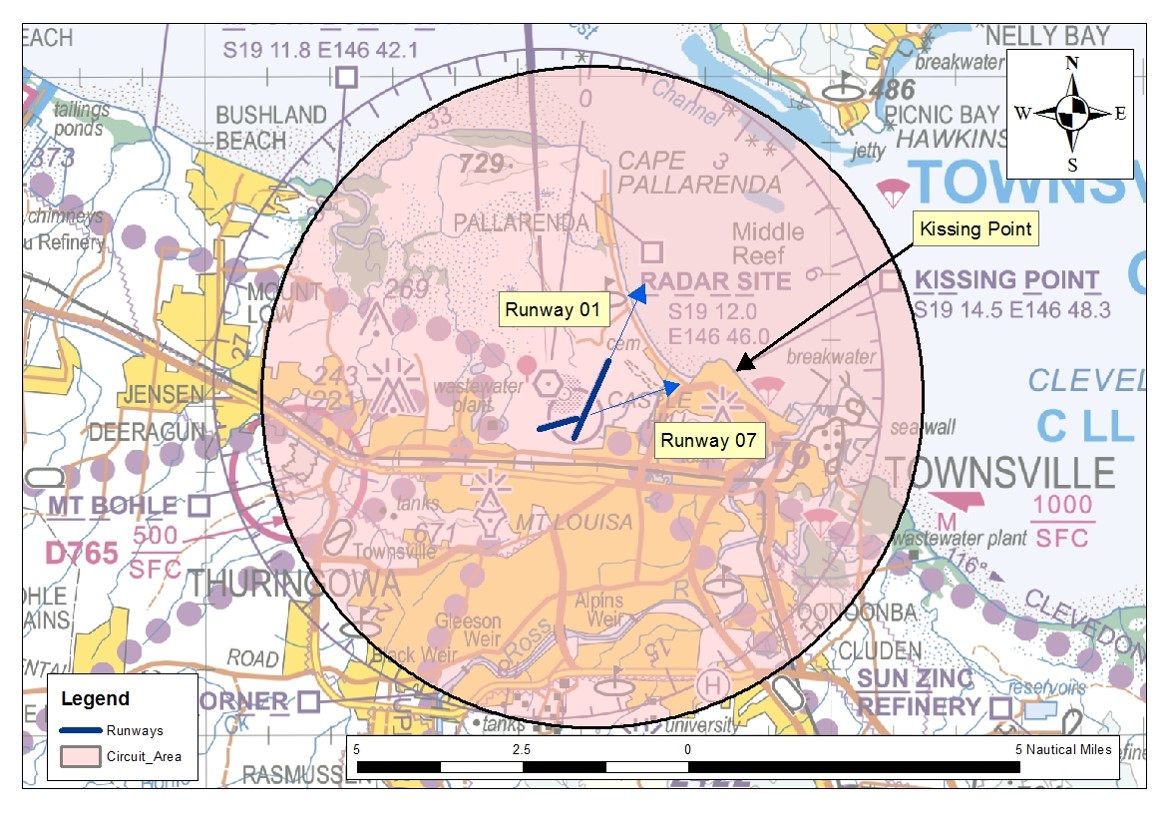
At 1503 Eastern Standard Time[1] on 24 May 2014, mutual traffic information (see the section titled Traffic information) was not passed to the flight crews of a Department of Defence (Defence) Boeing CH‑47 Chinook helicopter (the occurrence CH‑47) and a Cessna Aircraft Company 172S, registered VH‑PFU (PFU). Both aircraft were operating in the circuit area at Townsville Airport, Queensland (Figure 1). As neither flight crew were advised of the other aircraft, and aircraft proximity became a concern, the flight crew of the occurrence CH‑47 reversed the direction of their turn to remain clear.
At the time, the Defence air traffic controller with jurisdiction over the circuit area (the tower controller) had the following aircraft on frequency:
a Defence CH‑47 operating circuits from and to a helipad 1 NM (2 km) to the west of the airfield
a Defence Beechcraft King Air 350 (King Air) conducting circuits on runway 01[2]
a Robinson Helicopter Co R22 (R22) operating to the south
a McDonnell Douglas Helicopter Company 369E (MD500) inbound from the south-west
PFU conducting circuits on runway 07
two Defence Sikorsky Black Hawk helicopters (Black Hawks) tracking from the south to a location 2 NM (4 km) to the south-east of the airport
the occurrence CH‑47 tracking along the coast from the east south-east to a clearance limit of Kissing Point (see the section titled Clearance limits)
an aircraft holding on the ground for departure from runway 01.
Figure 1: Townsville circuit area (shaded), showing the runways in use and Kissing Point
All of the aircraft were operating under visual flight rules (VFR)[3] in visual meteorological conditions[4] below 1,500 ft above mean sea level within the 5 NM (9 km) circuit area. The Townsville Control Tower was staffed by a tower supervisor, the tower controller and the surface movement controller.
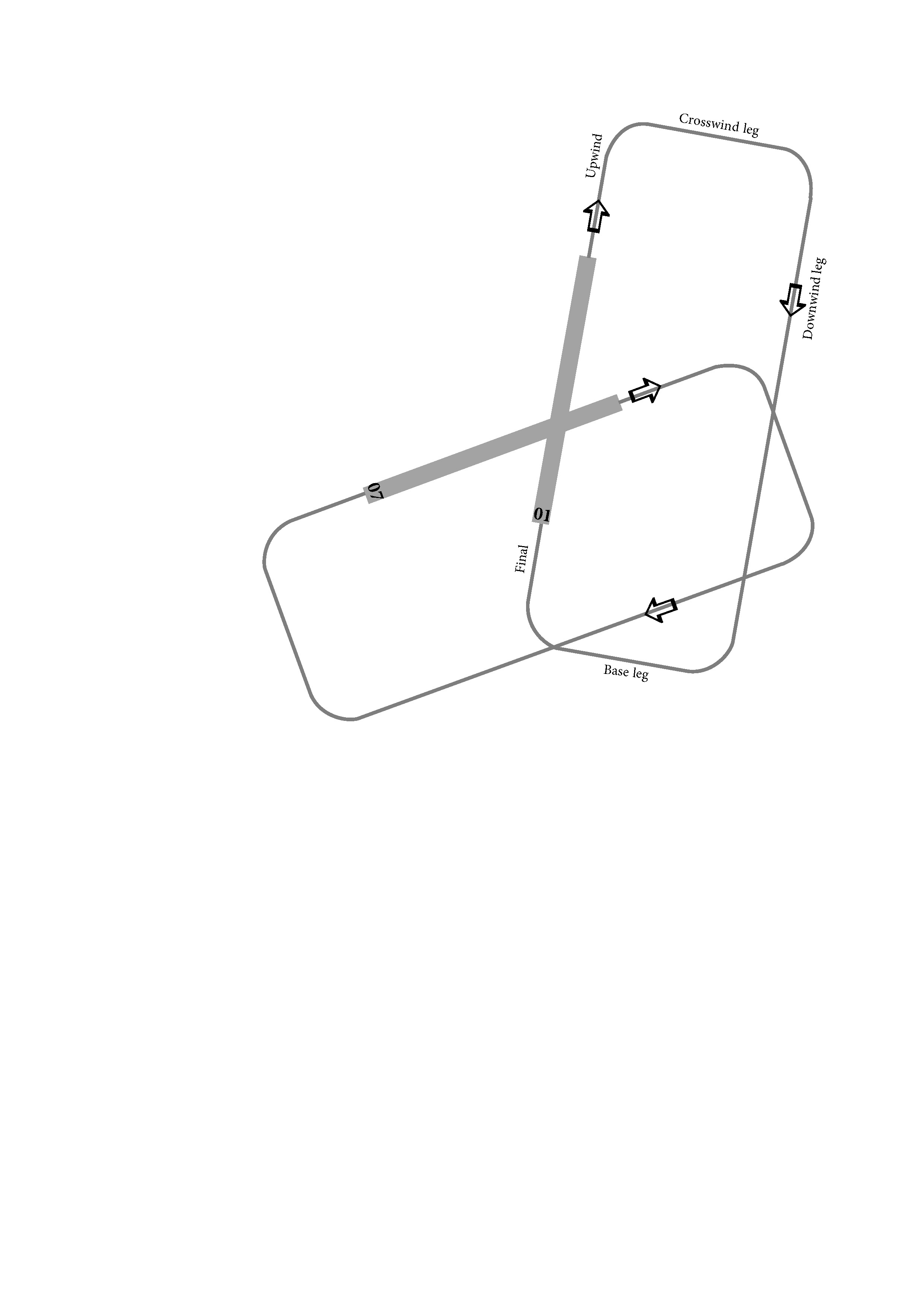
As the crosswind on runway 01 was up to 15 kt, PFU was conducting circuits on runway 07. The pilot of the King Air was conducting circuits on runway 01 (Figure 2). Both aircraft were conducting right-hand circuits, which maintained them to the east and south of Townsville Airport. To manage the sequence between the two aircraft, and to facilitate the other traffic operating within the area, the tower controller issued instructions at different times to extend various legs of the circuit. The mix of traffic under the tower controller’s jurisdiction resulted in a high workload and a high level of radio transmissions on the tower frequency.
Figure 2: Diagram showing the legs of a circuit
Source: ATSB
The CH‑47, which was operating in the circuit to the helipad to the west of the airfield, had earlier entered the circuit area via Kissing Point. The pilot of that CH-47 was advised of PFU by the tower controller on two occasions; at 1447 and at 1452. The call signs of that CH-47, which was operating to the west of the airfield, and the occurrence CH‑47 that was tracking for Kissing Point, contained the same root word with numbers that differed by one digit – Brahman 104 and Brahman 106 respectively.
At 1500, the tower controller acknowledged the first call by the flight crew of the occurrence CH‑47, when the aircraft was about 7.5 NM (14 km) to the east. No information on the traffic in the circuit area was provided to the flight crew of the occurrence CH‑47, or to any aircraft in the circuit on the occurrence CH‑47. At that time:
PFU was on final for runway 07
the King Air was late downwind for runway 01
the R22 was at the southern circuit boundary
the CH‑47 operating to the helipad to the west of the airport was on the ground awaiting clearance to become airborne
the MD500 was about to land at Townsville
the two Black Hawk helicopters were about 8 NM (15 km) to the south-east.
Between then and the next transmission from the flight crew of the occurrence CH‑47 to the tower controller at about 1503, there were 21 separate radio transmissions involving the tower controller and other aircraft. The second transmission from the flight crew, advising that the occurrence CH‑47 was approaching Kissing Point (Figure 1), was not acknowledged by the tower controller who then cleared the King Air to conduct a touch-and-go landing,[5] and provided tracking instructions to the crew of the R22. At this time:
the occurrence CH‑47 was about 4.5 NM (8 km) to the east
PFU was about 1.5 NM (3 km) upwind for runway 07
the King Air was about 1.5 NM (3 km) final for runway 01
the R22 was about 4 NM (7 km) to the south
the CH‑47 operating to helipad to the west of the airfield was still on the ground awaiting clearance to become airborne
the MD500 had landed
the two Black Hawk helicopters were about 4.5 NM (8 km) to the south-east.
Forty-nine seconds later, the flight crew of the occurrence CH‑47 reported at Kissing Point and advised the tower controller that there was another aircraft in their vicinity. Surveillance data shows that, at that time, the occurrence CH‑47 entered a left turn towards the coastline, before reversing to the right and away from the coast and PFU.
Seeing that the occurrence CH‑47 had commenced a turn away from the PFU’s track, the tower controller did not provide traffic on PFU to the crew of the occurrence CH-47 but, instead provided traffic on the King Air, as the crew of the occurrence CH‑47 had to sight and pass behind that aircraft before it could track towards the airfield. Traffic on the occurrence CH‑47 was also not passed to the flight crew of PFU.
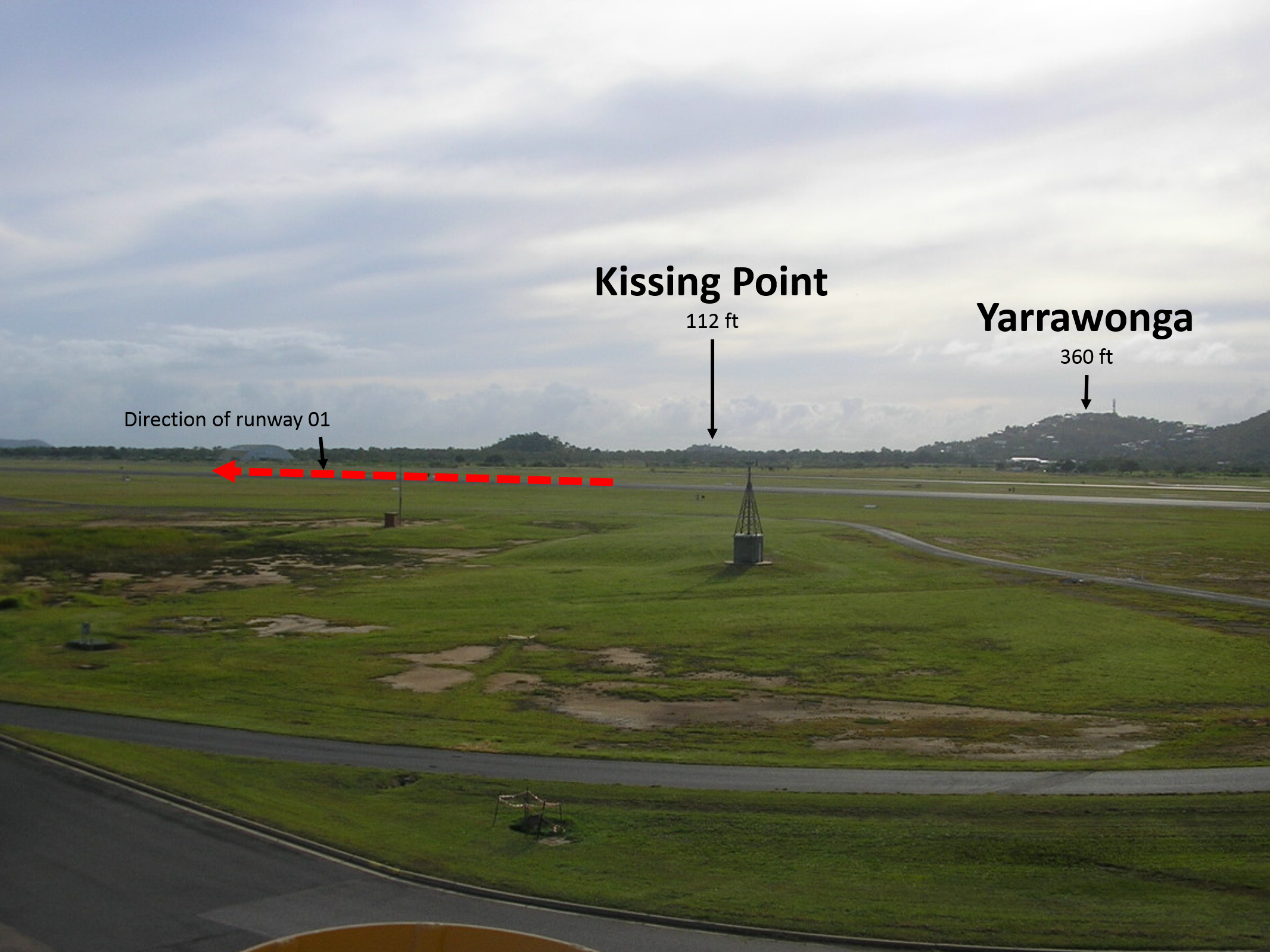
Of note, due to the topography to the east and north-east of the airport (Figure 3), and the operating height of the helicopter, the tower controller was unable to see the occurrence CH‑47 until just prior to its arrival at Kissing Point. This was the first time the tower controller was aware that the occurrence CH‑47 had an external load, requiring the controller to amend their traffic plan. The plan had been for the aircraft to track south of the airfield and fly over the city of Townsville, then to cross the upwind centreline of runway 01. With an external load, the aircraft was required to track to the west of the airport to a helipad just to the north of runway 07. This kept the occurrence CH‑47 away from built-up areas.
Figure 3: The tower controller’s view east-north-east towards Kissing Point, including relevant terrain height and the direction of runway 01
Source: Defence, modified by the ATSB
The crew of the occurrence CH‑47 subsequently sighted the King Air and tracked behind that aircraft, then to the west of the airfield for the helipad. The flight crew of PFU continued tracking upwind until advised by the tower controller to make a right circuit for runway 07.
When the flight crew of the occurrence CH‑47 first reported sighting PFU, surveillance data indicated that their aircraft and PFU were at the same altitude and separated by about 0.5 NM (1 km). However, the flight crew of the occurrence CH‑47 later reported that separation reduced to about 300 m and that, until they commenced the right turn, a collision risk had existed. The flight crew of PFU later reported that they saw the occurrence CH‑47 shortly after becoming airborne from runway 07, at a distance of 2 or 3 NM (4 or 6 km). They believed that:
at no stage did the occurrence CH‑47 come close enough to warrant anything but monitoring
Townsville Tower was staffed by three Department of Defence (Defence) air traffic controllers, the:
supervisor
tower controller
surface movement controller.
Each controller was correctly endorsed and no fatigue‑related issues were identified. The supervisor was also endorsed in all tower and approach positions. The tower controller and supervisor had completed the then Defence compromised separation recovery training as part of Townsville’s overall air traffic control training package, not as a stand-alone training element.
Airspace information
Defence was the controlling authority for the Class C airspace[6] around Townsville Airport and, with the circuit active, the tower controller was responsible for separating and sequencing aircraft within 5 NM (9 km) of the airport at and below 1,500 ft. The Class C airspace outside the circuit area was the responsibility of the Defence-employed approach controller. Defence controllers use the same control techniques as Airservices Australia controllers when controlling civil, or a combination of civil and military aircraft.
Procedures at Townsville permitted standard transfers of responsibility between approach and tower controllers when the circuit was active. One of these standard transfers was the use of Kissing Point as a clearance limit for helicopters tracking inbound from the east. Once the pilot of the occurrence CH-47 contacted the tower controller, irrespective of distance from Townsville Airport, the approach controller would generally have no tracking restrictions on the helicopter’s arrival. This was not the case when the helicopter was carrying an external load.
Clearance limits
A clearance limit is issued to the flight crew of an aircraft when the controller is unable to authorise an aircraft to proceed beyond a certain point or place. When a clearance limit is imposed by a controller, the flight crew must hold at that point until issued with an onwards clearance. Holding involves either a holding pattern or an orbit, which may be documented or the controller may stipulate the type and direction. Often, holding at a clearance limit is not required, as the controller is able to provide an onwards clearance prior to the aircraft reaching the limit. In these cases, the clearance limit would have been imposed to assure separation as the aircraft progressed along its track.
Separation assurance can be either strategic or tactical. Strategic separation assurance includes the development of air traffic practices to reduce the likelihood of aircraft coming into conflict, particularly where traffic frequency congestion may impair control actions. Tactical separation assurance is an activity conducted by the controller that includes traffic planning and conflict avoidance.
The Defence operational documentation for air traffic control stipulated that all military helicopters arriving at Townsville Airport from the east, when the circuit was active, would be tracked via Kissing Point. In this case, Kissing Point was stipulated as the clearance limit. The approach controller, when first contacted by the flight crew of the inbound military helicopter, would issue this clearance and clearance limit. The tower controller would then be responsible for cancelling the clearance limit and providing separation between the helicopter and all other aircraft within 5 NM (9 km) of Townsville. The documentation did not include the direction of turn for a helicopter holding at Kissing Point.
Traffic information
Traffic information is issued by an air traffic controller, to alert a pilot to other known or observed air traffic. This traffic may be in proximity to their position or intended route, and the issued traffic information helps the pilot avoid a collision. When aircraft are operating under visual flight rules (VFR) in Class C airspace, separation is not required. However, mutual traffic information is required when, in the controller’s judgement, one aircraft may observe another aircraft and could be uncertain of their intention.
Traffic information should be concise and, to assist flight crew in identifying other aircraft, may include the following information if deemed relevant by the controller:
aircraft identification
type and description, if unusual
position information
direction of flight or route of the aircraft
level
intentions of the pilot.
The provision of traffic information, and the content of that information, is reliant on the controller’s assessment of the underlying need. The initial provision of traffic information to the flight crew of an aircraft tracking to join the circuit could be general in nature; for example ‘the circuit is active on runway 01 and 07’. The information would then become more specific as the aircraft tracked closer to the circuit; for example, providing the type and location of those aircraft that the flight crew of the joining aircraft would encounter.
Compromised separation recovery training
Compromised separation recovery actions are important emergency response actions. They need to be implemented by controllers promptly and accurately when determined that separation standards have been, or will shortly be compromised. To ensure emergency response actions are conducted effectively, they need to be regularly practiced. Skill decay is more likely to occur when tasks are rarely performed (Arthur and others 1998), as is the case for compromised separation recovery actions during actual controlling.
Controllers are required to issue safety alerts to pilots of aircraft as a priority when the controller becomes aware that aircraft are considered to be in unsafe proximity to other aircraft. This is the case unless a pilot advises that action is being taken to resolve the situation, or that the other aircraft is in sight.
At the time of this occurrence, Defence controllers were not provided with stand-alone, regular practical refresher training in identifying and responding to compromised separation scenarios. An ATSB investigation into a loss of separation (LOS) at Williamtown (Newcastle Airport), New South Wales in 2011[7] found that Defence had not provided compromised separation recovery training as part of initial or ongoing controller training. In addition, an ATSB research report into LOS between aircraft in Australian airspace, which was released in October 2013,[8] found that controller actions to manage a compromised separation occurrence were not effective for Defence-employed controllers and those employed by Airservices Australia. Finally, after this occurrence at Townsville, in October 2014 the ATSB released a report into a LOS at Darwin, Northern Territory[9] that identified a safety issue in relation to the provision of compromised separation recovery training for Defence-employed controllers.
Related occurrences
The ATSB research report AR-2012-034 Loss of separation between aircraft in Australian airspace – January 2008 to June 2012 found that ‘assessing and planning’ or ‘monitoring and checking’ errors were involved in most individual controller actions that contributed to LOS occurrences. Ineffective management of compromised separation before it became a LOS was categorised as an assessing and planning error. Monitoring and checking errors included controller actions associated with maintaining awareness of traffic disposition.
In addition, the ATSB research report found that of the LOS occurrences in which ATC actions were contributory, about one quarter involved communication errors. These included not passing traffic information to pilots once separation was compromised. The research report found that task demands were the most common type of local condition identified in LOS occurrences where controllers were involved – in particular, high workload and distractions. Common in all ATC environments, these local conditions were more common in the tower environment.
Though this occurrence at Townsville did not involve a LOS, as no separation was required in Class C airspace between VFR aircraft, the error types are relevant. However, a review of the ATSB occurrence database did not identify any similar occurrences where mutual traffic was not provided to VFR aircraft in Class C airspace.
An air traffic control information error at Townsville Airport, Queensland, on 27 May 2014 involved a Department of Defence (Defence) Boeing CH-47 Chinook (the occurrence CH-47), and a Cessna 172 registered VH-PFU (PFU). The information error positioned the two aircraft in close proximity in the circuit area, without the provision of relevant traffic information.
This analysis discusses the relevant controller actions, local conditions and relevant risk controls in place at Townsville Airport at the time of the occurrence.
Traffic not passed
The number of aircraft on the tower controller’s frequency, the mix of operation types and the locations of those operations resulted in a high workload for the tower controller and tower supervisor. The tower controller reported that their workload was more than they could handle and that they asked the supervisor for assistance. The supervisor provided assistance by conducting the necessary coordination and assisting with sequencing. However, the efforts to reduce the workload, including holding aircraft on the ground and not accepting additional inbound aircraft, were not sufficient and workload remained high.
The occurrence CH‑47 was about 7.5 NM (14 km) to the east when the flight crew first contacted the tower controller. PFU was on final for runway 07. As a result, neither flight crew would have been able to sight the other. However, both flight crew were familiar with the circuit traffic pattern on runway 07, and how helicopters tracked coastal via Kissing Point. Therefore, the provision of traffic at that time would have alerted both flight crew to the presence of the other aircraft in the circuit area, and of their intentions. Of note, during this period the tower controller’s workload was high, providing tracking instructions to numerous aircraft.
The provision of traffic when the occurrence CH‑47 contacted the tower controller a second time when approaching Kissing Point, with the occurrence CH‑47 about 4.5 NM (8 km) to the east of the airfield and about 3 NM (6 km) east of PFU at that time, would have increased the likelihood of the flight crews sighting each other. The flight crew of PFU later reported that they saw the occurrence CH‑47 shortly after becoming airborne from runway 07, though they did not advise the tower controller as they were aware of the controller’s high workload at the time.
The tower controller had passed traffic to flight crews in the lead-up to this occurrence, demonstrating that they were aware of the requirement to pass traffic and of the content of traffic information. More relevant in this instance, the controller had passed mutual traffic to the flight crew of PFU and the previous CH‑47 tracking via Kissing Point. The Defence investigation into this occurrence found that the tower controller did not realise that mutual traffic had not been passed to the flight crews of the occurrence CH‑47 and PFU. The similarity in the call signs of the previous CH‑47 and the occurrence CH‑47 may have influenced the tower controller into thinking that they had passed the required traffic information.
A controller’s first priority is to separate aircraft, and then to provide traffic information. At the time the flight crew of the occurrence CH‑47 reported approaching Kissing Point, the Defence Beechcraft King Air 350 (King Air) was on about 1.5 NM (3 km) final for runway 01, awaiting a clearance for a touch-and-go landing. Also, the tower controller needed to provide tracking instructions to the flight crew of a Robinson Helicopter Co R22 that was about 4 NM (7 km) south of the airport. Additionally, a transmission from the flight crew of one of the two Defence Sikorsky Black Hawk helicopters (Black Hawk) to the south of the airport may have been sufficient to interrupt the tower controller’s activities. This would explain the controller responding to the flight crew of the Black Hawk, instead of passing traffic to the flight crews of the occurrence CH‑47 and PFU. This likely resulted in the tower controller losing awareness of the need to pass traffic to these aircraft.
If the tower controller had passed mutual traffic to the flight crews of the occurrence CH‑47 and PFU prior to the occurrence CH‑47 arriving at Kissing Point, both flight crew would have been better able to manage their flight paths in relation to the other. Additionally, had the traffic information been passed earlier, the King Air would have been the only 'relevant' traffic for the flight crew of the occurrence CH‑47 when at Kissing Point.
In this occurrence, it is likely that the tower controller’s high workload resulted in a need for increased monitoring. This would likely have further added to their workload and, in combination with the large number of radio calls during this time, impacted on their ability to manage the traffic.
Management of the proximity event
The report by the flight crew of the occurrence CH‑47 that there was an aircraft in proximity when they arrived at Kissing Point should have been a sufficient trigger to the tower controller that traffic on PFU had not been provided. However, as the controller was now aware that the flight crew of the occurrence CH‑47 had PFU in sight, and the controller could see that the occurrence CH‑47 had commenced a right turn away from the flight path of PFU, the controller deemed that traffic information was not required and that the proximity risk had been resolved. But, the flight crew of the occurrence CH‑47 were not aware of the intentions of the flight crew of PFU. Equally, the tower controller did not know if the flight crew of PFU had seen, and were monitoring the occurrence CH‑47. The flight crew of the two aircraft determined their own actions based solely on what they could observe of the other aircraft.
Compromised separation recovery training
A conflict occurs when the distance between aircraft, as well as their relative positions and speed, may compromise the safety of the aircraft. On recognising such a situation, the controller is required to issue a safety alert, unless the pilot of one aircraft advises that action is being taken to resolve the situation, or that the other aircraft is in sight. The tower controller reported that in this case, both aircraft were in sight and the controller and supervisor both assessed that, as the flight crew of the occurrence CH‑47 had reported PFU in sight and turned away, the safety of neither aircraft was compromised.
At the time of the occurrence, compromised separation recovery training deficiencies had been identified and were being addressed within Defence. Though there is insufficient evidence that these deficiencies played a part in this occurrence, such training is an important defence against loss of separation and near-collision situations.
Advance knowledge of external load operations
Defence helicopter documentation for operations at Townsville Airport stipulated that, when operating with external loads, the helicopter should be flown clear of built-up or populated areas. Specifically, flight over people, buildings, vehicles or items of value must only occur if totally unavoidable. These precautions mitigated the risk of injury or damage in the event of accidental or emergency load release. In the context of the Townsville circuit area, these operating requirements meant that Defence helicopters carrying out external load operations were to track coastal until north-west of the extended centreline of runway 01, then along the western side of the airport to one of a number of helipads.
Though the tower controller and tower supervisor were aware of these requirements, until the tower controller sighted the occurrence CH‑47 approaching Kissing Point, they were not aware that it had an external load. The intended traffic sequence required the occurrence CH‑47 to track from Kissing Point south to right base for runway 01, then across runway 01 to land on the helipad just north of runway 07. On sighting the occurrence CH‑47 carrying an external load, the tower controller’s traffic plan had to be amended to track the helicopter away from built-up areas.
A documented procedure that required helicopter crews to advise air traffic control that they were carrying an external load, which could restrict manoeuvring, would result in better situation awareness for tower controllers and better inform their traffic management planning. In this occurrence, such additional information would likely have precluded the need for the tower controller to rapidly re-assess the disposition of the circuit traffic and to require the occurrence CH‑47 to sight and pass behind the King Air.
Kissing Point as a clearance limit
The Defence Townsville documentation that stipulated Kissing Point as a clearance limit was a form of strategic separation assurance. However, Kissing Point is located within the 5 NM (9 km) circuit area on the extended centreline of runway 07 (see Figure 1), 3 NM (6 km) east of Townsville. A standard clearance limit located further from Townsville would have provided better separation assurance between joining aircraft and those in the circuit area.
Though there was no evidence that a clearance limit further from Townsville would have avoided this proximity event, the controller is only part of a wider system designed to provide for safe aviation operations. A well-designed system should include strategic separation assurance that supports the controller. This could include holding aircraft in locations away from known high traffic areas, where the absence of one component (in this case the provision of mutual traffic) does not result in a compromised safety system.
Findings
From the evidence available, the following findings are made with respect to the air traffic control information error involving a Department of Defence Boeing CH‑47 Chinook helicopter and a Cessna Aircraft Company 172S, registered VH‑PFU, near Townsville Airport, Queensland on 27 May 2014. These findings should not be read as apportioning blame or liability to any particular organisation or individual.
Safety issues, or system problems, are highlighted in bold to emphasise their importance. A safety issue is an event or condition that increases safety risk and (a) can reasonably be regarded as having the potential to adversely affect the safety of future operations, and (b) is a characteristic of an organisation or a system, rather than a characteristic of a specific individual, or characteristic of an operating environment at a specific point in time.
Contributing factors
Due to the busy environment, and possibly the similarity between two Boeing CH‑47 Chinook helicopter call signs, the controller did not pass mutual traffic and was not monitoring the occurrence helicopter and the Cessna Aircraft Company 172S in case of a proximity event.
The tower controller and tower supervisor assessed that, as the occurrence Boeing CH‑47 Chinook helicopter flight crew had identified the Cessna Aircraft Company 172S in proximity and had initiated a turn away, the proximity event was resolved. This meant that the flight crew of the two aircraft had to determine their own actions based solely on their observation of the other aircraft.
Other factors that increased risk
Compromised separation recovery training deficiencies existed within the Department of Defence at the time of the occurrence, increasing the risk of inappropriate management of aircraft in close proximity. [Safety issue]
Helicopter flight crews were not required to advise the tower controllers of the carriage of external loads that prevented them flying over built-up areas. This reduced the controller’s situation awareness and reduced the time available to develop an appropriate traffic management plan.
The location of the Kissing Point clearance limit within the Townsville circuit area increased the risk of an aircraft holding at that position coming into proximity with aircraft operating in the circuit.
Safety issues and actions
The safety issues identified during this investigation are listed in the Findings and Safety issues and actions sections of this report. The ATSB expects that all safety issues identified by the investigation should be addressed by the relevant organisation(s). In addressing those issues, the ATSB prefers to encourage relevant organisation(s) to proactively initiate safety action, rather than to issue formal safety recommendations or safety advisory notices.
All of the directly involved parties were provided with a draft report and invited to provide submissions. As part of that process, each organisation was asked to communicate what safety actions, if any, they had carried out or were planning to carry out in relation to each safety issue relevant to their organisation.
The initial public version of these safety issues and actions are repeated separately on the ATSB website to facilitate monitoring by interested parties. Where relevant the safety issues and actions will be updated on the ATSB website as information comes to hand.
Compromised separation recovery training
Compromised separation recovery training deficiencies existed within the Department of Defence at the time of the occurrence, increasing the risk of inappropriate management of aircraft in close proximity.
Note: This safety issue was identified as part of ATSB investigation AO-2012-131 as safety issue AO-2012-131-SI-05 and resulted in the ATSB issuing safety recommendation AO‑2012‑131‑SR‑042 on 2 October 2014 (after the date of this occurrence at Townsville). The information below is a summary of the action taken by the Department of Defence (Defence) at that time. That action resulted in the ATSB determining that, overall, the safety action by Defence adequately addressed safety issue AO-2012-131-SI-05.
The sources of information during the investigation included the:
Department of Defence
air traffic controllers involved in the incident
flight crew of VH-PFU
flight crew of the occurrence Boeing CH‑47 Chinook helicopter.
References
Arthur, W Bennett, W Stanush, PL & McNelly, TL 1998, Factors that influence skill decay and retention: A quantitative review and analysis, Human Performance, vol. 11, pp. 57–101.
Submissions
Under Part 4, Division 2 (Investigation Reports), Section 26 of the Transport Safety Investigation Act 2003 (the Act), the ATSB may provide a draft report, on a confidential basis, to any person whom the ATSB considers appropriate. Section 26 (1) (a) of the Act allows a person receiving a draft report to make submissions to the ATSB about the draft report.
A draft of this report was provided to the Department of Defence, the Civil Aviation Safety Authority, the air traffic controllers involved in the occurrence, the operator of VH-PFU and the flight crews of the occurrence Boeing CH‑47 Chinook helicopter and of VH‑PFU.
Submissions were received from the Department of Defence and the Civil Aviation Safety Authority. The submissions were reviewed and, where considered appropriate, the text of the report was amended accordingly.
Purpose of safety investigations
The objective of a safety investigation is to enhance transport safety. This is done through:
identifying safety issues and facilitating safety action to address those issues
providing information about occurrences and their associated safety factors to facilitate learning within the transport industry.
It is not a function of the ATSB to apportion blame or provide a means for determining liability. At the same time, an investigation report must include factual material of sufficient weight to support the analysis and findings. At all times the ATSB endeavours to balance the use of material that could imply adverse comment with the need to properly explain what happened, and why, in a fair and unbiased manner. The ATSB does not investigate for the purpose of taking administrative, regulatory or criminal action.
Terminology
An explanation of terminology used in ATSB investigation reports is available here. This includes terms such as occurrence, contributing factor, other factor that increased risk, and safety issue.
Publishing information
Released in accordance with section 25 of the Transport Safety Investigation Act 2003
Ownership of intellectual property rights in this publication
Unless otherwise noted, copyright (and any other intellectual property rights, if any) in this report publication is owned by the Commonwealth of Australia.
Creative Commons licence
With the exception of the Coat of Arms, ATSB logo, and photos and graphics in which a third party holds copyright, this publication is licensed under a Creative Commons Attribution 3.0 Australia licence.
Creative Commons Attribution 3.0 Australia Licence is a standard form licence agreement that allows you to copy, distribute, transmit and adapt this publication provided that you attribute the work.
The ATSB’s preference is that you attribute this publication (and any material sourced from it) using the following wording: Source: Australian Transport Safety Bureau
Copyright in material obtained from other agencies, private individuals or organisations, belongs to those agencies, individuals or organisations. Where you wish to use their material, you will need to contact them directly.
At 1137 on 22 May 2014, NSW Trains XPT passenger service NT33 departed Paterson towards Kilbride when the driver observed a bus at the Mirari road level crossing and people walking on the track ahead. The driver immediately made an emergency brake application and brought the train to a stand approximately 80 m short of the people.
There were no reported injuries as a result of the incident.
What the ATSB found
A disabled coal train SF630 had initially delayed NSW Trains’ passenger service V938. A decision was made to evacuate V938 and provide the passengers with alternative road transport.
The train crew of V938 did not comply with the Australian Rail Track Corporation (ARTC) network rules when detraining passengers from their train and unknowingly placed the passengers in the path of NT33.
The NSW Trains procedure for detrainment did not preference the option of moving to a designated platform when available and would have required approval from the network owner ARTC. This option was also absent from ARTC’s Network Rules and Procedures.
Key operational staff in NSW Trains and Sydney Trains continued to operate under RailCorp legacy systems, even though documented transitional arrangements had re-established lines of responsibility and authority. This misunderstanding of roles, responsibilities and limits of authority by operational employees likely contributed to inadequate communication between critical safe working positions.
What's been done as a result
NSW Trains has informed the ATSB they had commenced an immediate review of procedures for detraining passengers when a train is not at a designated station. It has also informed the ATSB that the procedures had also been amended to clarify how passenger safety, their wellbeing and track protection will be managed when detraining.
Safety message
This incident illustrates the importance for train crews to strictly adhere to recognised detraining and track protection procedures when transferring passengers from a stranded train to a safe place.
It is essential that train crew and network control implement an appropriate level of protection and confirm that the protection is in place before detraining passengers.
When the option is available, preference should be given to detraining at a recognised platform before electing to detrain passengers into the rail corridor.
Operators must confirm and ensure roles, responsibilities and limits of authority are clearly understood during organisational change.
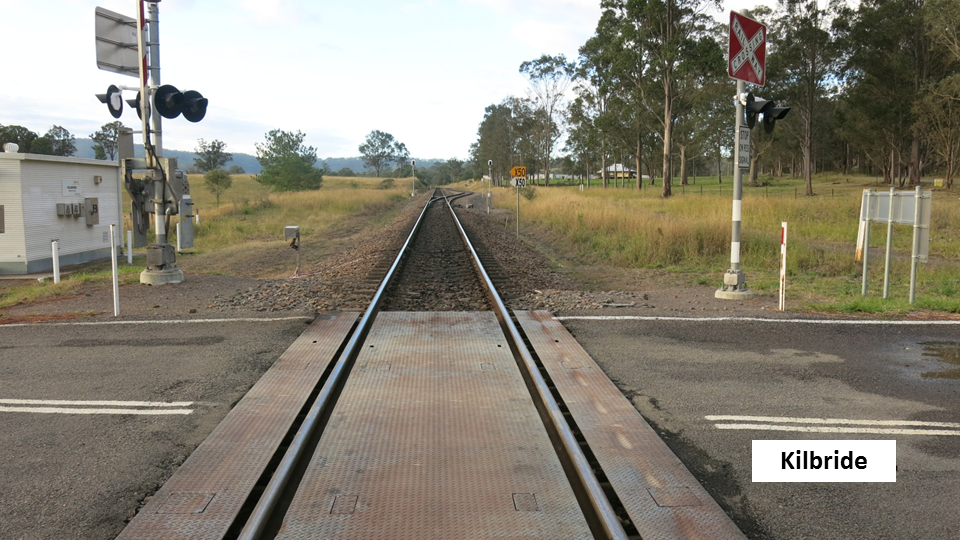
Mirari Road level crossing Kilbride
The occurrence
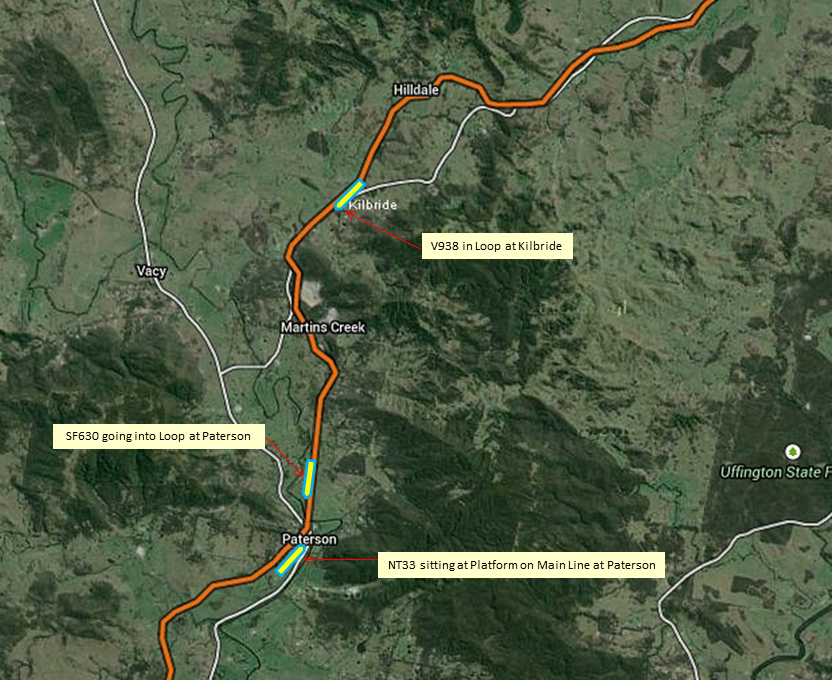
At 1010 on Thursday 22 May 2014, a south bound (Up[1]) loaded Pacific National coal train (SF630) and a north bound (Down) NSW Trains’ XPT passenger service (NT33) were approaching Paterson, in the Hunter region of New South Wales. ARTC train control planned for SF630 to enter the Paterson loop to allow NT33 to pass on the single line. NT33 was scheduled to stop at Paterson station to pick-up passengers as required and then depart at 1020.
At 1013 SF630 was entering Paterson crossing loop (see Figure1). As it entered the crossing loop its lead locomotive 8215 suffered a mechanical problem. This forced the train to come to a stand with a portion of the train still standing foul of the main line. As a result, NT33’s departure path from Paterson station platform was blocked.
Figure 1: Position of trains SF630 and NT33 at Paterson, and train V938 at Kilbride
Source: Google Earth, annotated by ATSB
Meanwhile, a two-car Hunter passenger service operated by NSW Trains (V938), had departed Dungog and was also travelling south behind SF630. At 1022 V938 entered the loop at Kilbride as scheduled and waited for NT33 to pass. V938 was scheduled to depart Kilbride at 1029 towards Newcastle.
At 1024 the Broadmeadow (Newcastle) based ARTC Train Transit Manager (TTM) called the NSW Trains’ Daily Operations Continuity Centre Shift Supervisor (DOCC SS) to advise of the failure of SF630. The ARTC TTM also discussed the delays to XPT NT33 and Hunter service V938 and asked to clarify which service to give preference to, once the line was clear.
At 1028 the DOCC SS passed the delay information onto the Sydney Trains’ Rail Management Centre Shift Manager (RMC SM).
Being aware of the potential delay to V938, the RMC SM started to action, with his Train Crew Liaison Officer (TCLO), alternative road transport for the passengers on train V938.
At 1057 the TCLO contacted the Guard of V938 on his work issued mobile phone enquiring about passenger numbers and a discussion took place on the possible organisation of a mini bus or changing ends and returning to a platform. The Guard advised the TCLO that there were six passengers.
By 1100 the RMC SM advised the TCLO that a bus will be ordered and to advise the crew of V938.
At 1111 the RMC SM contacted ARTC TTM and advised a bus had been ordered to pick up passengers on V938.
Meanwhile, the crew of SF630 had identified the source of the mechanical problem and found a temporary solution that allowed the train to be moved clear of the main line.
At 1120 the ARTC TTM advised the RMC SM that SF630 was moving into the loop at Paterson and XPT NT33 will proceed north.
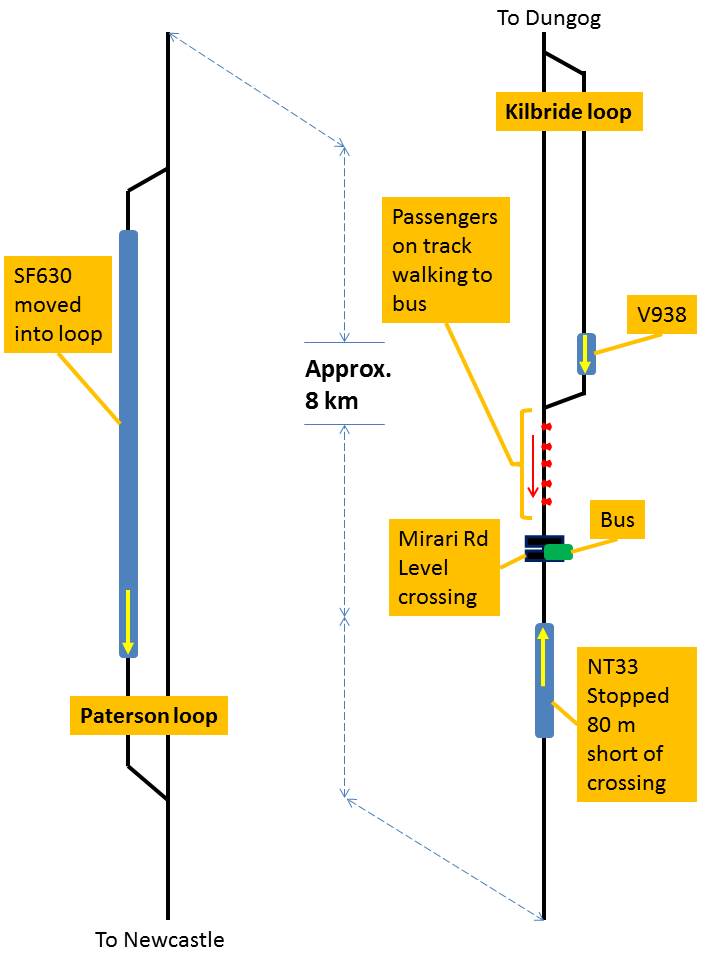
At approximately 1125, the bus arrived at Kilbride and accessed the rail corridor via a maintenance access road. Once in the rail corridor, the bus parked alongside V938. Despite the close proximity of pedestrian access between the train and the bus, it was deemed unsuitable. The guard instructed the bus driver to move to the Mirari road level crossing located approximately 110 m south of the Kilbride crossing loop.
At 1127 SF630 had moved into the Paterson crossing loop. This cleared the track for NT33 to continue its journey north towards Kilbride.
At Kilbride, the crew of V938 had informed the passengers that a bus had arrived and that they would be required to walk along the track to the Mirari road level crossing. The guard and driver assisted five passengers to disembark the train via the crew compartment door of the front car. The passengers were instructed to walk in single file within the four foot[2] of the track.
NT33 was approaching Kilbride at 118 km/h.[3] As NT33 approached the Mirari road level crossing, the driver observed a bus at the level crossing and people walking on the track approximately 300 m ahead of the train. The driver of NT33 immediately made an emergency brake application and sounded the horn continuously as he brought the train to a stand approximately 80 m short of the bus and people.
The crew of V938 had completed assisting five of their six passengers off the train when the guard observed the level crossing activate and looked up the track to see NT33 coming towards them. The guard gave a verbal warning to the passengers to get off the track before noticing NT33 had already stopped (see Figure 2).
Figure 2: Position of trains, bus and people at time of incident
Source: ATSB
Post-occurrence
The driver of NT33 reported the incident to the DOCC SS. The driver advised of nearly hitting a number of people walking on the track and the presence of a bus at the Mirari road level crossing.
The guard on V938 rang the TCLO and reported the incident. The TCLO advised the RMC SM and the DOCC SS.
The RMC SM conferred with the ARTC TTM about the passengers detraining. The TTM checked with the ARTC Network Controller (NC) and confirmed that no authorisation or track protection for the detrainment had been given.
The RMC SM later advised the ARTC TTM that five passengers of V938 had walked up to the level crossing and boarded the bus while one passenger remained on the train to disembark at Maitland Station.
NSW Trains conducted drug and alcohol testing on the crew of V938 on arrival at Newcastle station, both driver and guard returned negative results. NSW Trains revoked their rail safety worker cards pending internal investigation.
The driver of NT33 continued in service to Taree where a crew change occurred as planned.
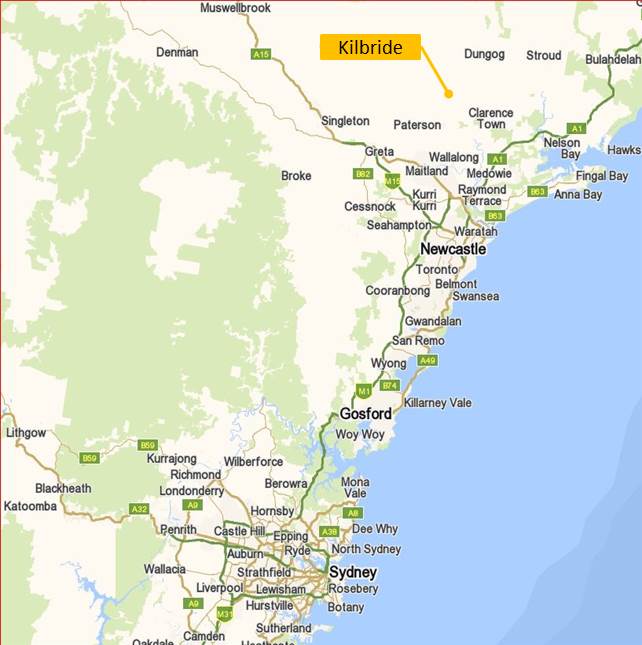
The incident occurred at Kilbride in the Hunter Valley, NSW. Kilbride is a crossing loop located at 223.468 kms by rail north from Central railway station, Sydney[4] (see Figure 3).
Figure 3: Location of Kilbride
Source: Whereis (Annotated by ATSB)
Kilbride is situated 10 km from the township of Paterson. The rail infrastructure at Kilbride consists of a crossing loop that is used to allow trains to pass on the single line. The track is a single standard gauge line that predominantly carries a mix of passenger and freight trains. The posted track speed for the main line between Paterson and Kilbride was 120 km/h for XPT services.
Environmental conditions
The Bureau of Meteorology records for Paterson, indicated a maximum temperature of 24.9 degrees and a minimum of 9.2 degrees, approximately 10 km from Kilbride. The ATSB determined that the environmental conditions were not a factor in the incident.
Organisational change and transition
At the time of the incident Sydney Trains and NSW Trains were in a transitional period.
From 1 January 2004 until 30 June 2013, Rail Corporation New South Wales (RailCorp) provided metropolitan and intercity passenger rail services via CityRail and regional and interstate services via CountryLink. RailCorp also owned and maintained the Metropolitan Rail Network (MRN) and provided access to freight and third-party operators in the metropolitan area.
From July 2013 RailCorp’s operation and maintenance functions were transferred to Sydney Trains and NSW Trains, leaving RailCorp as an asset owner.[5]
In the transition from RailCorp to Sydney Trains and NSW Trains a Services Contract[6] and an Operational Interface Protocol (OIP)[7] were developed to identify the roles, responsibilities and limits of authority of key operational personnel throughout the change.
Parties involved in the incident
At the time of the incident, there were three main rail network infrastructure managers (RIM) in NSW. Each RIM was responsible for controlling train operations and maintaining track within their respective networks. They each imposed a strict set of network rules and procedures to provide safe working on their network. Each RIM was also responsible for ensuring competent people were in place to execute their safe working rules and procedures. Rolling stock operators (RSO) were required to follow the network rules and procedures for the relevant network they were operating on.
The three RIM’s in NSW were:
The Australian Rail Track Corporation (ARTC) – responsible for the NSW Interstate, Hunter Valley and Metropolitan Freight Network.
Sydney Trains – assumed responsibility for the MRN from RailCorp.
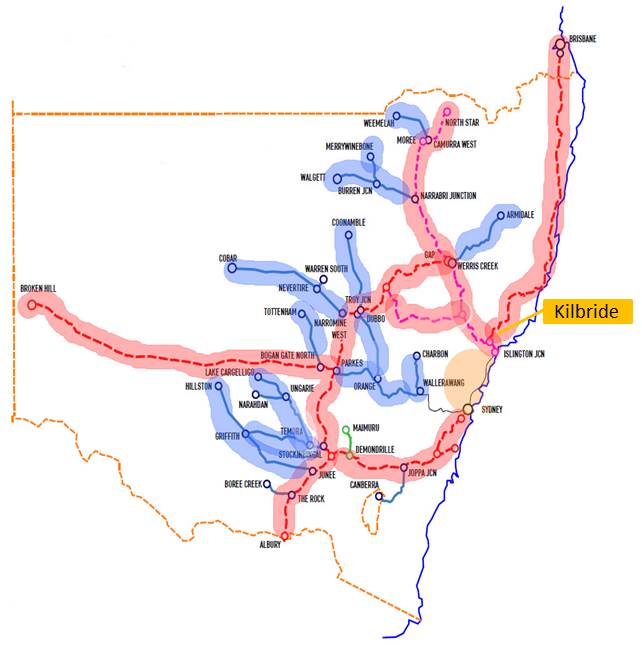
John Holland Rail – responsible for the Country Regional Network (CRN) (see Figure 4).
John Holland CRN was not involved in this incident.
Figure 4: Rail infrastructure networks within NSW
Source: John Holland CRN Rail Network Map
ARTC
Since 2004, ARTC has provided access for above rail operators to its rail network. Their network spans five states in Australia[8]. It manages and maintains approximately 8,500 km of rail network. ARTC developed Network Rules and Procedures that all users must abide by when accessing the ARTC network.
The main line and crossing loops between Kilbride and Paterson are part of the ARTC network. ARTC is responsible for track maintenance, signalling, train control and incident management functions in this corridor.
ARTC Train Transit Manager (TTM)
The TTM manages the transit of trains across an area of the ARTC network they are responsible for, in accordance with RSO’s access contracts. While the TTM is concerned with safe working across the network, they are also concerned with service delivery and ensuring access is granted in line with RSO’s requirements.
The TTM supervises a number of Network Controllers.
ARTC Network Controller (NC)
The NC implements plans and manages the movement of trains over the NC’s allotted portion of the ARTC network. This includes recording of train performance and carrying out communication with above rail operators on the network. This position is primarily concerned with ensuring safe working across the ARTC network.
ARTC’s NC (Coast A board) was in charge of train control and safe working in the Kilbride area at the time of the incident.
Sydney Trains
Sydney Trains is a NSW State Government Agency. It has responsibility and authority for all suburban rail infrastructure management and train control in the Sydney Metropolitan area bounded by Islington Junction, Lithgow, Macarthur and Bomaderry.
Sydney Trains is also the rollingstock operator for the Suburban Fleet.[9]
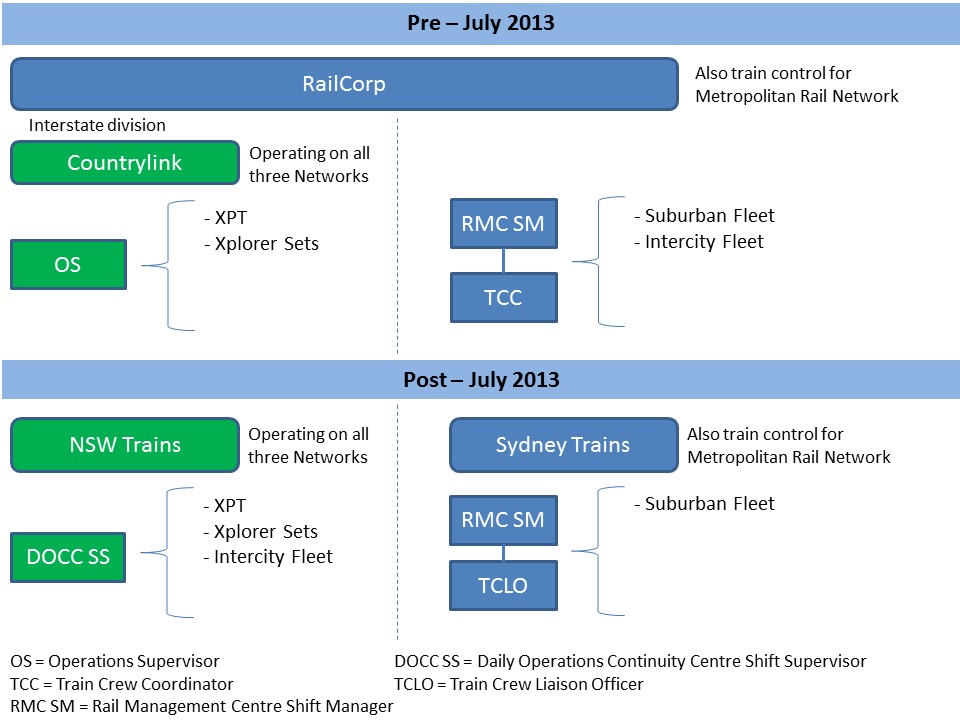
Prior to July 2013, RailCorp was responsible for service delivery of the suburban and intercity fleets and operational management of the MRN. Post 2013, Sydney Trains’ responsibility and authority was limited to service delivery for the suburban fleet and operational management of the MRN.
Sydney Trains’ control centre for train movements through their network is located at Central Station. It is called the Rail Management Centre (RMC). A number of service delivery and network control functions reside within this complex.
Sydney Trains Rail Management Centre Shift Manager (RMC SM)
Prior to July 2013, the RMC SM had responsibility and authority for service delivery of the suburban, interstate and intercity (intrastate) fleets and the operational management of the MRN. The RMC SM supervised a number of TCLO’s as well as staff primarily concerned with network control and security on the MRN.
Post July 2013, as the service delivery of intercity and interstate passenger services had transferred to NSW Trains, the RMC SM’s responsibilities and authorities were focused on service delivery of the suburban fleet only and the operational management of the MRN.
Sydney Trains Train Crew Liaison Officer (TCLO)
The TCLO was responsible for supporting Sydney Trains’ train crew. Primarily, the TCLO managed such issues as crew relief, rostering and support for business continuity. Their activities also included organising support buses for passenger detrainments from Sydney Trains and NSW Trains passenger services on the MRN.
NSW Trains
Prior to July 2013, RailCorp’s division CountryLink was responsible for above rail operations of the XPT and Xplorer fleets. Post July 2013, NSW Trains became the accredited RSO for the XPT, Xplorer, and Intercity Fleets.
Within NSW, NSW Trains operates over the MRN, CRN and ARTC networks. NSW Trains are required to apply the rules and procedures for the relevant network they are operating on. NSW Trains was the RSO for NT33 and V938.
NSW Trains Daily Operations Continuity Centre Shift Supervisor (DOCC SS)
At the time of the incident the DOCC SS was responsible for business continuity of regional (interstate) passenger train services across NSW. The passenger train services included; XPT, Xplorer and Intercity Fleets. The DOCC SS was also responsible for organising alternative travel arrangements for NSW Train services operating outside the MRN. The DOCC SS was seated in the RMC along with the RMC SM and TCLO.
NT33
NT33 consisted of two XPT power cars and seven trailer cars with a length of 155 m. NT33 was timetabled to depart Paterson at 1020. However, NT33 departed 76 minutes late due to the failure of SF630.
V938
V938 was a diesel multiple unit (DMU) consisting of two Hunter rail cars. It measured 51 m in length. At the time of the incident V938 was carrying six passengers, a driver and a guard.
V938 was being held in the Kilbride passing loop at starting signal 05 12 L (222.779 km) waiting for NT33 to pass on the main line. V938 had been delayed over 60 minutes before the bus arrived.
Driver of V938
Training and competency records show the driver had been driving passenger services for NSW Trains and their predecessor CountryLink since 2008. The driver held appropriate competencies and qualifications for the relevant rolling stock and systems of safe working. The driver also had the required route knowledge for the north coast line.
On the day of the incident, the driver had signed on for duty at 0810.
Guard of V938
Training and competency records show he commenced training as a freight train guard in 1982. The guard had worked intercity services, as a guard, in the Newcastle area since 1987. The guard was qualified in safe working systems for passenger service operations. The guard also had the required route knowledge for the north coast rail line.
On the day of the incident, the guard had signed on for duty at 0449.
Pacific National (PN)
PN is a national rail freight RSO. PN was the operator of SF630 at the time of the incident.
Coal train SF630
SF630 comprised of three locomotives hauling 72 loaded wagons. Its total length was approximately 1700 m.
At 1024 on the day of the incident, just prior to Paterson, the lead locomotive suffered an air compressor problem. This resulted in the train losing its air and the brakes automatically[10] applying. As a result, SF630 was stranded partially on the main line blocking all other traffic.
By 1118, the crew had temporarily fixed the problem and advised the ARTC NC they had gained sufficient air to release the brakes. Consequently, SF630 was permitted to move into the Paterson loop clear of the main line.
Although SF630 delayed train operations approaching Kilbride, the ATSB deemed its loss of air did not directly contribute to the safe working incident.
The ARTC NC authorises track and train protection in accordance with Network Rules on the ARTC network, when requested by the driver. The ARTC NC, in consultation with the driver, assesses then selects the appropriate level of protection required for the task.
The network rules take precedence over operator specific procedures and foremost, operators must comply with the network rules.
The applicable rule that should have been followed in this incident was ANGE 206 – Reporting and Responding to a Condition Affecting the Network (CAN). With regards to reporting, ANGE 206 states:
‘Conditions that can or do affect the safety of operations in the ARTC NSW Network must be reported promptly to the Network Control Officer responsible for the affected portions of line.’
As an operator using the ARTC network, the moment the decision was made to put people into the rail corridor, an appropriately qualified worker, from NSW trains needed to follow this rule and report the CAN to the ARTC NC.
At the time of this incident, NSW Trains had in place RailCorp’s Operator Specific Procedure OSP 11 – Train evacuation and detraining passengers when not at stations, version 6.0 Effective date 27 May 2012.
OSP 11 states the following:
‘Detraining passengers when not at a station in non-life-threatening situations
Driver,Guard/PSS
1. Tell the Network Control Officer: - your location - about the situation - how many passengers - whether there is good access to the train - about any passengers who cannot detrain by themselves
2. Find out how long it will take for help to arrive.
3. Agree with the Network Control Officer on: - the protection required for the train - whether alternative transport is required, and when it will arrive - how to manage passengers who cannot detrain by themselves
4. Place the required protection…’
Review of voice recordings indicated that the ARTC NC and the driver of V938 did not discuss the matter of train protection during their conversations. Instead their discussions focussed on the effects to service delivery issues.
At interview, the driver of V938 said he did not contact the ARTC NC as he was of the belief that all safe working requirements were being attended to by the guard and the TCLO. The driver stated:
‘I could hear the guard discussing the matter with someone and assumed that the protection was being provided.’
At no time did the driver request an assurance from the guard nor confirm in any other way that appropriate track protection had been implemented.
The guard said during interview that he thought the TCLO was arranging train protection. The guard said he had relied on the information and knowledge of the TCLO for guidance. The guard was of the opinion the TCLO held a higher and more qualified position, and the guard made the assumption that train protection had been provided by the TCLO. However, the voice recordings of conversations between the guard and the TCLO have no mention of train protection by the guard or by the TCLO. Their conversation instead focussed on transfer of passengers to alternative transport.
ARTC had in place ANRF004 and ANGE206, the rules and procedures for reporting and responding to a condition affecting the network. These were the rules and procedures that the crew of V938 needed to be aware of and follow.
Management of change
It is evident there was confusion among the involved parties about their individual roles, level of responsibility and limits of authority with regards to ensuring passengers were detrained only when it was safe to do so.
Prior to transitioning from RailCorp to Sydney Trains and NSW Trains, the organisation completed a Services Contract and OIP to clearly define the roles, responsibilities and limits of authority for key operational staff from 1 July 2013.
Some of these changes included the following, from the Services Contract, regarding alternative travel arrangements, 6.3 (d):
‘NSW Trains will organise alternative transport required outside of the RailCorp Network.’
and from the OIP, regarding protocols for incident response and recovery, 4.2.1.2:
‘The NSW Trains Operations Shift Supervisor will be responsible for the coordination of incidents involving NSW Trains’ services in ARTC, JHR, Victorian and Queensland networks.’
Post July 2013, the RMC SM and TCLO had responsibilities for suburban fleet services on the MRN and some responsibilities for the intercity fleet services but only when they were operating on the MRN.
Responsibility for intercity service V938 resided with the NSW Trains’ DOCC SS (see Figure 5).
Figure 5: Operational responsibility – pre and post July 2013
Source: ATSB
In contrast, the TCLO at interview indicated the transition from RailCorp and CountryLink to Sydney Trains and NSW Trains resulted in very little change to operational staff responsibilities. Whilst position titles had changed, TCC became TCLO, the tasks associated with the position had not. The TCLO was still expected, in the interim, to provide operational support for NSW Trains’ intercity services.
Additionally, the discrepancy in understanding of roles and responsibilities between senior management and frontline staff was highlighted in the timeline account from the NSW Trains’ investigation, where;
‘(11:59) The Director of NSWT Customer Service Division and Manager Operations Planning and Coordination contacted the DOCC SS. The details of the incident were discussed. The Director asked why the crew were conversing with the RMC and not the DOCC? The DOCC SS explained that the TCLO contacts the old CityRail crew and CountryLink information comes through me.’
Further, the DOCC SS’s understanding of the transitional arrangements are reflected in his interview comments,
‘The agreement is that for CountryLink the DOCC has full operational control. RMC looks after operations for all bar CountryLink. The DOCC is not fully staffed or resourced, people are seconded out.’
The change in entities post July 2013 is a contributing factor to the confusion of associated responsibilities and limits of authority in the operations staff. As witnessed in this incident, the Sydney Trains’ RMC SM and TCLO were still intricately involved in dealing with service delivery issues on intercity fleet services (including V938).
Further evidence of the on-going legacy arrangements was apparent in the communications between the ARTC TTM and the RMC SM about potential delays to intercity services due to the breakdown of SF630.
It is likely, the changes in responsibilities had not been effectively communicated to operational staff of relevant stakeholders, such as ARTC. This resulted in a continuance of communication between parties that existed before the change.
Purpose of communication
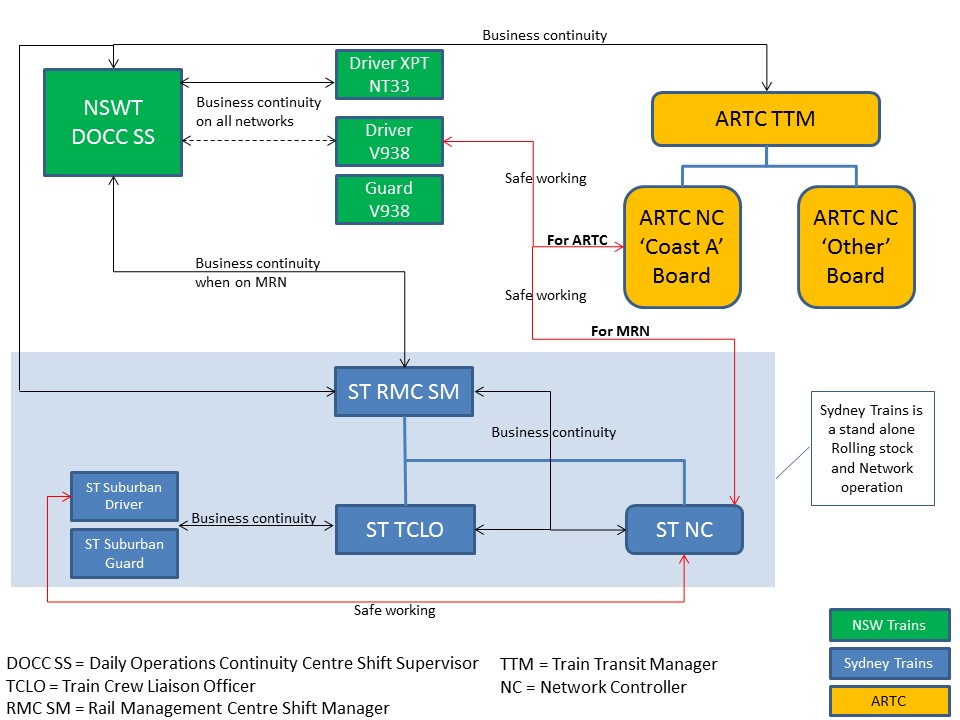
The communication pathways between the organisations and people involved is dependent on the purpose. Particular roles have responsibilities for managing service delivery and business continuity, while others have responsibility for managing operations and safe working.
The investigation found that all safe working communications should have occurred between the ARTC NC and the driver of V938. The only evidence of a conversation between the ARTC NC and driver of V938 was when the driver called to find out how long V938 would be delayed in the Kilbride Loop. The business continuity communication, arranging alternative transport, should have taken place between the DOCC SS and the guard of V938.
At interview, the driver and the guard of V938 said they assumed the RMC were arranging protection for passengers to detrain. They made this assumption because RMC’s communications gave them the perception that train protection was also being arranged. Despite these assumptions, the train crew of V938 remained responsible for critical safe working duties (ensuring adequate protection was in place) before detraining their passengers into the rail corridor (see Figure 6).
Figure 6: Communication between relevant parties
Source: ATSB
Priorities when detraining passengers
OSP 11 also highlights a number of safety factors that a train crew should consider when detraining passengers. Listing these safety factors in a procedure can be useful if the train crew have the procedure with them and they are trained to act in a manner that ensures the procedure is strictly adhered to. TWP 100 – Responsibilities of Train Crews stipulates drivers must carry OSP 11, amongst other OSP’s. On the day of the incident, the train crew drew upon their experience and training to manage the detrainment, they did not refer to a copy of OSP 11 which they should have had with them for reference.
In situations where detrainment is deemed necessary, priority should be given to moving the train to a station platform. There was a train platform at Hilldale approximately 2.9 km north of Kilbride that would have enabled the passengers to safely alight and wait for either another train or transfer from the platform to a bus.
This option was considered by the guard of V938 as evidenced in the record of phone conversation between the guard and the TCLO. The option was discounted by the guard and TCLO due to the remoteness of Hilldale station and potential difficulties for the bus driver locating the station. The station was also in the opposite direction to V938’s intended journey to Newcastle.
Had the guard and TCLO agreed to moving the train to Hilldale for detrainment, the process of obtaining a path would have involved communication with the ARTC NC, who would then be aware of V938’s intentions. Importantly, choosing to detrain at a designated station removes the safety risks associated with walking in the rail corridor. Any procedure for detrainment should preference alighting passengers at designated station platforms. The decision to detrain when not at a platform should only be considered once all other options have been exhausted or no other option exists, such as in the case of a disabled or stranded train.
Findings
At 1137, NSW Trains XPT passenger service NT33 departed Paterson towards Kilbride when the driver observed five people walking on the track ahead. The driver immediately made an emergency brake application while continuously sounding the horn and brought the train to a stand approximately 80 m from the people. There were no injuries or damage.
From the evidence available, the following findings are made with respect to the incident. These findings should not be read as apportioning blame or liability to any particular organisation or individual.
Safety issues, or system problems, are highlighted in bold to emphasise their importance. A safety issue is an event or condition that increases safety risk and (a) can reasonably be regarded as having the potential to adversely affect the safety of future operations, and (b) is a characteristic of an organisation or a system, rather than a characteristic of a specific individual, or characteristic of an operating environment at a specific point in time.
Contributing factors
The crew of V938 detrained passengers onto the track near Kilbride without having arranged the required train protection with the ARTC Network Controller in accordance with the ARTC Network rules and procedures.
Key operational staff in Sydney Trains and NSW Trains continued to operate under RailCorp legacy systems, even though documented transitional arrangements had re-established lines of responsibility and authority.
The purpose of communication between key operational people was not always clearly stated nor understood leading to misunderstandings between people.
Other factors that increased risk
Rules and procedures for detrainment do not consider the priority option of moving the train to a station or platform.
Safety issues and actions
The safety issues identified during this investigation are listed in the Findings and Safety issues and actions sections of this report. The Australian Transport Safety Bureau (ATSB) expects that all safety issues identified by the investigation should be addressed by the relevant organisation(s). In addressing those issues, the ATSB prefers to encourage relevant organisation(s) to proactively initiate safety action, rather than to issue formal safety recommendations or safety advisory notices.
All of the directly involved parties were provided with a draft report and invited to provide submissions. As part of that process, each organisation was asked to communicate what safety actions, if any, they had carried out or were planning to carry out in relation to each safety issue relevant to their organisation.
The initial public version of these safety issues and actions are repeated separately on the ATSB website to facilitate monitoring by interested parties. Where relevant the safety issues and actions will be updated on the ATSB website as information comes to hand.
The crew of V938 detrained passengers onto the track near Kilbride without having arranged the required train protection with the ARTC Network Controller in accordance with the ARTC Network rules and procedures.
Key operational staff in NSW Trains and Sydney Trains continued to operate under RailCorp legacy systems, even though documented transitional arrangements had re-established lines of responsibility and authority.
Operational Interface Protocols Sydney Trains and NSW Trains version 1.0, issue date 1 July 2013
Pacific National SF630 data recording
Rail Industry Safety and Standards Board (RISSB, Dec 2010). National GuidelineGlossary of Rail Terminology
Rail Safety National Law (NSW) (2012 No 82a)
Rail Safety National Law National Regulations (2012)
RailCorp 2011 standard operating instruction ‘Decision for Customer Detrainment’
RailCorp Engineering Standard − NSW Signalling SGS 01 Infrastructure Engineering Manual – Glossary of Signalling Terms
RailCorp Operator Specific Procedure OSP 11 Train evacuation and detraining passengers when not at stations − May 2012
RailCorp Procedure TWP 168 Securing a train on the network – July 2014
Sydney Trains General Rule NGE 200 Walking in the Danger Zone − July 2014
Sydney Trains Train Crew Liaison Officer (ST TCLO) voice logs
Sydney Trains Rail Management Centre Shift Supervisor (RMC SM) voice logs
TfNSW Services Contract Sydney Trains and NSW Trains Final – 7 June 2013.
Submissions
Under Part 4, Division 2 (Investigation Reports), Section 26 of the Transport Safety Investigation Act 2003 (the Act), the Australian Transport Safety Bureau (ATSB) may provide a draft report, on a confidential basis, to any person whom the ATSB considers appropriate. Section 26 (1) (a) of the Act allows a person receiving a draft report to make submissions to the ATSB about the draft report.
A draft of this report was provided to:
NSW Trains (NT)
NSW Trains Daily Operations Continuity Centre (NT DOCC)
NSW Trains driver of NT33
NSW Trains driver of V938
NSW Trains Passenger Services Supervisor of NT33
NSW Trains guard of V938
Office of the National Rail Safety Regulator (ONRSR)
Pacific National driver of SF630
Australian Rail Track Corporation (ARTC)
Sydney Trains (ST)
Sydney Trains Rail Management Centre Shift Supervisor (RMC SM)
Sydney Trains Train Crew Liaison Officer (ST TCLO)
Transport for NSW (TfNSW).
Any submissions from those parties will be reviewed and where considered appropriate, the text of the draft report will be amended accordingly.
Purpose of safety investigations
The objective of a safety investigation is to enhance transport safety. This is done through:
identifying safety issues and facilitating safety action to address those issues
providing information about occurrences and their associated safety factors to facilitate learning within the transport industry.
It is not a function of the ATSB to apportion blame or provide a means for determining liability. At the same time, an investigation report must include factual material of sufficient weight to support the analysis and findings. At all times the ATSB endeavours to balance the use of material that could imply adverse comment with the need to properly explain what happened, and why, in a fair and unbiased manner. The ATSB does not investigate for the purpose of taking administrative, regulatory or criminal action.
Terminology
An explanation of terminology used in ATSB investigation reports is available here. This includes terms such as occurrence, contributing factor, other factor that increased risk, and safety issue.
Publishing information
Released in accordance with section 25 of the Transport Safety Investigation Act 2003
Ownership of intellectual property rights in this publication
Unless otherwise noted, copyright (and any other intellectual property rights, if any) in this report publication is owned by the Commonwealth of Australia.
Creative Commons licence
With the exception of the Coat of Arms, ATSB logo, and photos and graphics in which a third party holds copyright, this publication is licensed under a Creative Commons Attribution 3.0 Australia licence.
Creative Commons Attribution 3.0 Australia Licence is a standard form licence agreement that allows you to copy, distribute, transmit and adapt this publication provided that you attribute the work.
The ATSB’s preference is that you attribute this publication (and any material sourced from it) using the following wording: Source: Australian Transport Safety Bureau
Copyright in material obtained from other agencies, private individuals or organisations, belongs to those agencies, individuals or organisations. Where you wish to use their material, you will need to contact them directly.
On 18 May 2014, the pilot of a Piper PA-25, registered VH-SSO, took off from Bacchus Marsh aeroplane landing area (ALA) with a glider in tow. During climb the pilot noticed a momentary engine power loss, following which the glider pilot released the tow rope. The pilot of the PA-25 immediately re-joined the circuit via the downwind leg. The engine responded normally to throttle inputs following the momentary power loss, but after the pilot turned onto the base leg of the circuit, the engine surged briefly then stopped. The pilot conducted a forced landing but the aircraft landed heavily and was substantially damaged. The pilot was uninjured. Subsequent inspection found that the aircraft fuel supply was exhausted.
The gliding club that operated the PA-25 used aircraft flight time to determine when a refuel was required. According to this system of fuel management, a refuel was required at 1284.1 hours flight time, but the flight time following the accident was almost 1284.9 hours. The pilot was familiar with this system, but it was ineffective in alerting the pilot of the need to refuel on this occasion. The aircraft was fitted with a warning light to alert pilots to a low fuel level condition, but the light did not illuminate during flight on this occasion.
The pilot was not expecting to fly on the day of the accident and did not follow his usual pre-flight routine, which normally included a physical check of the aircraft fuel state. The pilot may have been suffering from an elevated level of fatigue having had very little sleep during the evening prior to the accident.
In response to this accident, the Gliding Federation of Australia planned to remind all glider towing pilots of the importance of fuel management and fatigue awareness. This accident highlights the importance of careful attention to the fuel state of an aircraft, and the need for caution when usual pre-flight preparation is interrupted or abnormal. This accident also serves to remind pilots to carefully consider the possible effects of fatigue before engaging in flying operations.