On 3 July 2014, at about 1940 Eastern Standard Time an instructor and student pilot of a Bell 206 helicopter, registered VH-XJA (XJA), approached Sunshine Coast Airport, Queensland to conduct night circuits. An Airbus A320 aircraft, registered VH-VGJ (VGJ), was inbound to Sunshine Coast from Melbourne, Victoria via the area navigation (RNAV) required navigation performance approach to runway 18. When about 30 NM from Sunshine Coast, the first officer of VGJ broadcast on the common traffic advisory frequency (CTAF), inbound and did not receive a response.
When about 10 NM from the runway, on a downwind leg and approaching a base turn for runway 18, the first officer broadcast on the CTAF that VGJ had left 3,800 ft and was conducting an instrument approach to runway 18, expecting to land at time 2001, and did not receive a reply.
The instructor of XJA heard the call from VGJ and assumed that the aircraft was then about 15 NM away. He expected the crew of VGJ would subsequently broadcast when 10 and 5 NM from the runway, and he elected to continue the circuit and monitor the CTAF for those calls.
The instructor of XJA broadcast when on a 3 NM final, but the crew of VGJ did not hear this call. About 70 seconds later, the first officer of VGJ broadcast on a 2 NM final. Hearing this call, the instructor of XJA turned and sighted the landing lights of VGJ close behind, diverged to the right and commenced a climb. Radar data indicated that the two aircraft passed at an altitude of about 200-300 ft with a lateral separation of about 370 m.
This incident highlights the importance of using both unalerted and alerted see-and-avoid principles and maintaining a vigilant lookout at all times.
On 9 July 2014, the pilot of a Cessna 210 aircraft, registered VH-SKQ, conducted a scenic charter flight from Broome, Western Australia, to Windjana Gorge, Silent Grove, Mt Hart Station, Cape Leveque and return to Broome, with five passengers on board.
When approaching Broome Airport, the aircraft was cleared by air traffic control (ATC) to turn onto a left base leg for runway 10. Due to another aircraft backtracking on the runway, the pilot was directed by ATC to extend the base leg. The pilot then selected 10° of flap and the landing gear lever to the extended position, and reported that he had observed the green light indicating the landing gear was extended.
When on the final leg of the approach, the pilot reported that he performed the final checks however omitted to look outside and visually confirm by sighting the left main landing gear, whether the gear was in the extended position. As the pilot flared the aircraft for landing, he realised that the aircraft was lower to the ground than normal on touchdown, and heard what he believed were the main tyres contacting the runway, followed by the aircraft belly and propeller. The aircraft sustained substantial damage.
A witness observed the aircraft on the base leg, with the nose landing gear extended and the main landing gear retracted.
An engineering inspection found that a faulty nose gear up lock switch resulted in the nose gear extending during flight. This resulted in the main landing gear failing to extend. The pilot was unaware that the main landing gear had not extended prior to landing as the visual check was omitted.
On 7 July 2014, Genesee & Wyoming Australia train 24KW departed from Iron Duke, a mine site near Whyalla, South Australia. The train was loaded with iron ore destined for the port of Whyalla. Shortly after the train entered the Iron Baron to 21km Junction section, the driver felt a slight ‘bump’ and noticed a loss in brake pipe pressure, before observing a large cloud of dust toward the rear of the train. Once the train had come to a stand the driver walked back along the consist and saw several wagons had derailed, resulting in significant track damage.
What the ATSB found
The ATSB found that two mechanical fishplate joints located at the 108.100 km mark had failed under the passage of the train. The joints failed due to a combination of pre-existing fatigue cracks in the fishplates, and at least one joint being in a condition of weakened structural integrity due to inadequate fastening. As the rollingstock passed over the incomplete and ineffective rail joints, joint instability and movement produced increasing impact forces, lateral pressure and subsequent joint separation. This was followed by the progressive failure and misalignment of the track until the wagons of train 24KW inevitably derailed.
Other fishplated joints within the immediate vicinity of the 108.100 km mark were also examined. While some bolts were missing, examination of the bolt holes suggested that four fasteners had been used to secure the joints. Based on the evidence available, the ATSB concluded that the deficient permanent mechanical rail joint installed at the 108.100 km mark was an isolated anomaly and not indicative of the assembled condition of other plated joints.
What's been done as a result
Shortly after the derailment, Genesse & Wyoming Australia, through a welding program, removed all the mechanical joints within the Whyalla Narrow Gauge mainline network.
In addition to the welding program, GWA and Transfield Services Australia completed an audit of maintenance standards and processes - focussed on improving instructions relating to joint inspection, maintenance and risk reporting. In November 2014, Transfield Services Australia, in cooperation with GWA, disseminated the document Mechanical Joint Rectification to all track maintenance staff.
Following an internal investigation and an incident cause analysis study into the derailment of train 24KW, GWA identified corrective actions associated with installation, inspection and maintenance of mechanical rail joints. GWA have made significant progress implementing those recommendations.
Safety message
To ensure fishplate joints are correctly installed and joints are not compromised during operation, track infrastructure owners and operators should ensure that track maintenance staff are provided with sufficient guidance and instruction for all works requested.
Track managers should ensure the effective application of policy and procedures relating to the assurance of the structural integrity of track joints - before returning the joints to service.
On 3 July 2014, a Piper Aircraft Corp PA-28-161, registered VH-TEK, was returning from the training area via the 2RN reporting point to Bankstown Airport, New South Wales. The student pilot was the only person on board. The flight was conducted in visual meteorological conditions.
The student tracked from the 2RN reporting point and joined downwind for a touch-and-go landing on runway 29L. The student turned onto base and then final and the Bankstown tower gave the student a clearance to conduct a touch-and-go clearance. The student reported that the approach and landing were normal. As soon as the student felt the aircraft wheels were on the ground, he reached down to the flap lever and selected the flaps to the retracted position.
The aircraft veered slightly to the right and then quickly to the left, departing the runway and onto the grass strip. The student regained control of the aircraft and informed the tower of what happened, reporting that he did not require assistance. The student then taxied onto taxiway B, between taxiway B4 and B3, passing about 20 metres in front of a taxiing Cessna 150. TEK taxied to the flying school without further incident. The student pilot was uninjured, and the aircraft was not damaged.
At about noon on 3 July 2014, an instructor and student were conducting training in the circuit at Roma Airport, Queensland, in a Skyfox Aviation CA25N aircraft, registered 24-3265. At the same time, a PA-28R, registered VH-WJO, was inbound to Roma Airport for a landing. The conditions were fine and clear.
As the PA-28R approached the airport, the CA25N instructor and the pilot of the PA-28R exchanged information regarding their respective positions and intentions on the Roma Airport Common Traffic Advisory Frequency (CTAF). During this exchange of information, the pilot of the PA-28R inadvertently miscommunicated his position, which left the CA25N instructor with an inaccurate perception of the position of the PA-28R and a misunderstanding with respect to the intentions of the PA-28R pilot. Similarly, based upon his interpretation of the information exchanged on the CTAF, the PA-28R pilot believed that he would be clear of the CA25N as he joined the circuit.
Despite their efforts, the CA25N crew and the PA-28R pilot were unable to sight the other aircraft until the downwind leg of the circuit when the CA25N instructor saw the PA-28R pass from left to right, about 100 metres ahead and about 200 ft above the CA25N. The CA25N instructor was then able to inform the pilot of the PA-28R of the relative position of the CA25N, allowing the pilot of the PA-28R to then sight the CA25N over his left shoulder. Both aircraft then continued for an uneventful landing, the CA25N landing ahead of the PA-28R which flew a wider circuit.
Although the CA25N instructor and PA-28R pilot were communicating on the CTAF and attempting to establish visual contact, separation seems to have been compromised on this occasion due to the limited effectiveness of the CTAF communications and the limitations of each pilot’s lookout. Lookout effectiveness was probably compromised by a combination of CTAF miscommunication, the geometry of the event and sun glare.
This incident highlights the importance of an effective lookout, and accurate and timely communication. These are fundamental pillars supporting the principles of alerted see-and-avoid.
On 4 July 2014, the pilot/owner of a Cessna Aircraft Company T210N aircraft, registered VH-ZFW, and two passengers were conducting a private flight from Inverell Airport to Bankstown Airport, New South Wales.
Shortly after take-off, oil appeared on the windscreen and the pilot rejected the take-off with the intent of landing back on the runway. As the oil temporarily obscured the pilot’s forward visibility, they looked to the left to assess their position along the runway. The pilot realised that they were a lot further along the runway than expected and that there was insufficient runway distance remaining to land safely. A go-around was commenced but the pilot reported that the engine did not respond. During the subsequent forced landing, the aircraft impacted a shrub beyond the end of the runway overrun and flipped, before coming to rest inverted.
The pilot and a passenger were hospitalised with serious injuries and the second passenger received minor injuries. The seriously-injured passenger later succumbed to their injuries. The aircraft was destroyed by the impact forces and a post-impact fuel-fed fire.
What the ATSB found
Examination of the aircraft found the engine oil filler cap detached from the oil filler tube but hanging by its chain. Further examination of the tube and cap determined that it was most likely the cap was not secure before the flight commenced. The Cessna T210N pilot’s operating handbook advised pilots to check the engine oil level during a pre-flight inspection but not the security of the separate oil filler cap. The ATSB could not establish the extent to which a specific checklist item about oil filler cap security would have assisted in identifying the unsecured cap in this case, although it would probably have increased the likelihood of detection.
Witness observations and the pilot’s assessment of the aircraft’s position along the runway during the rejected take-off indicated that the take-off was longer than normal. The reason for this could not be determined.
Examination of the engine and turbocharger found no mechanical defect or failure that would have precluded normal operation. While it was possible that a temporary issue occurred, resulting in the reported lack of engine response during the go-around, this could not be established.
The ATSB also determined that the engine manufacturer’s oil change interval had been exceeded by 3 months but it was very unlikely that this had any effect on the operation of the engine.
Safety message
This accident highlights that, prior to take-off, pilots should have in mind a go/no-go decision point along the runway by which time the aircraft should become airborne. If at that point the aircraft is not airborne, the pilot should reject the take-off. Having such a point assists pilot decision making during a critical phase of flight. This is particularly important when operating in conditions that may affect aircraft performance, such as tailwind conditions.
In addition, the ATSB highlights the importance of being aware of the daily inspection requirements when operating aircraft under a CASA maintenance schedule. In particular, how this may differ from the aircraft manufacturer’s pre-flight inspection procedure.
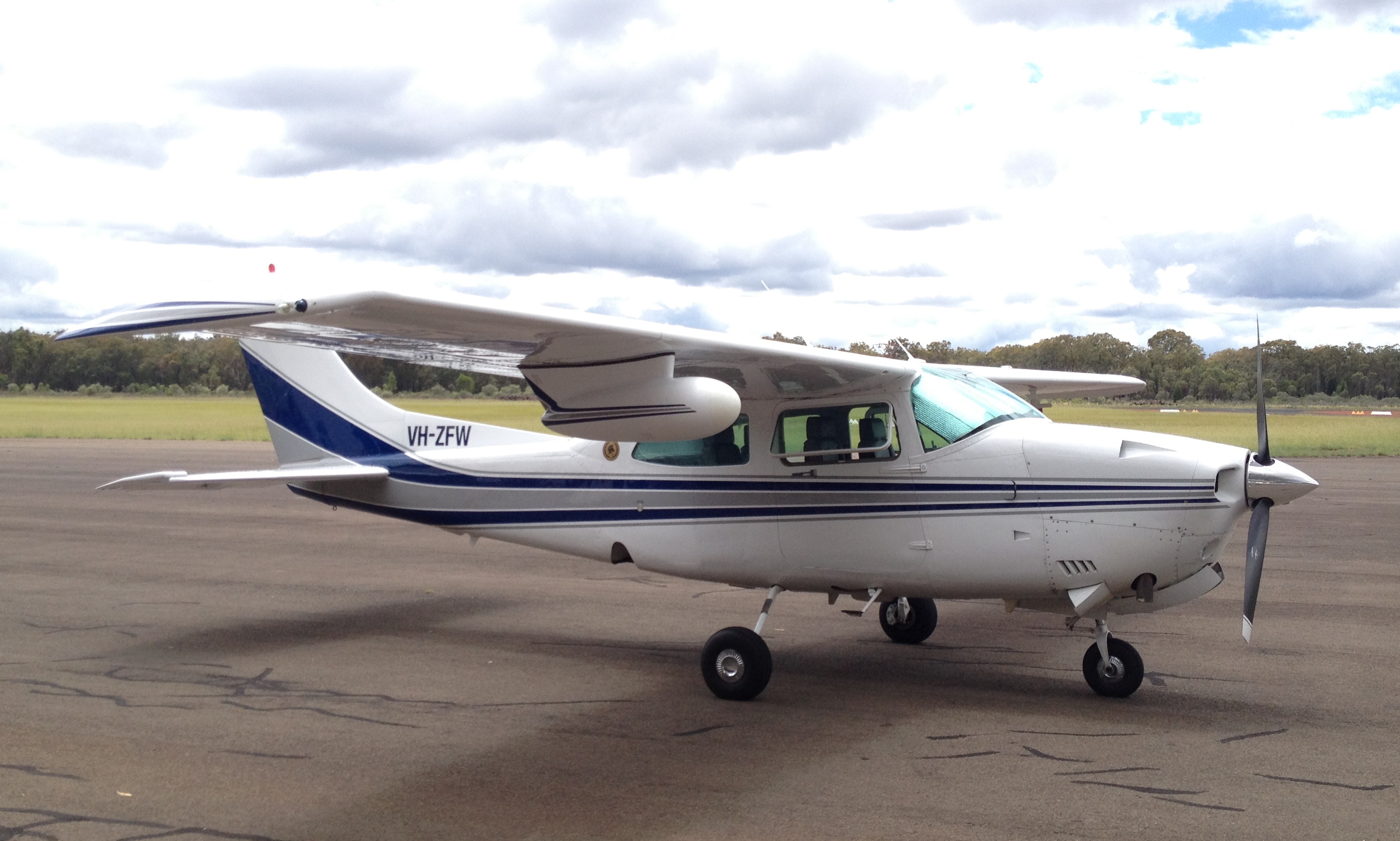
Photograph of VH-ZFW
Source: John Newby
The occurrence
On 4 July 2014, at about 1230 Eastern Standard Time,[1] the pilot/owner of Cessna Aircraft Company T210N aircraft, registered VH-ZFW (ZFW), and two passengers arrived at Inverell Airport to conduct a private flight to Bankstown Airport, New South Wales.
In preparation for the flight, the pilot removed the aircraft from the hangar and conducted a pre-flight inspection. The pilot could not initially recall adding engine oil to the engine during the inspection but later believed that was the case. Witnesses reported being aware of the pilot carrying out the pre-flight inspection but none observed the entire pre-flight, including whether the pilot added any engine oil. The two passengers remained some distance from the aircraft until the pilot completed the inspection. The pilot and passengers boarded the aircraft. The pilot started the engine and completed the pre-take-off checks, which were reported as normal.
The pilot recalled that there was a tailwind of less than 5 kt on runway 16.[2] Therefore, to allow for an immediate departure to the south, the take-off was planned from that runway. The pilot was aware that the minimal tailwind might prolong the take-off roll.
Just prior to taxiing, the pilot of ZFW conversed with the pilot of an inbound aircraft who was intending to land on runway 34. The pilot of ZFW then taxied to the threshold of runway 16 and waited for the other aircraft to land. After that aircraft vacated the runway, the pilot of ZFW commenced the take-off at about 1309. Ten degrees of wing flap was reported set for the take-off.
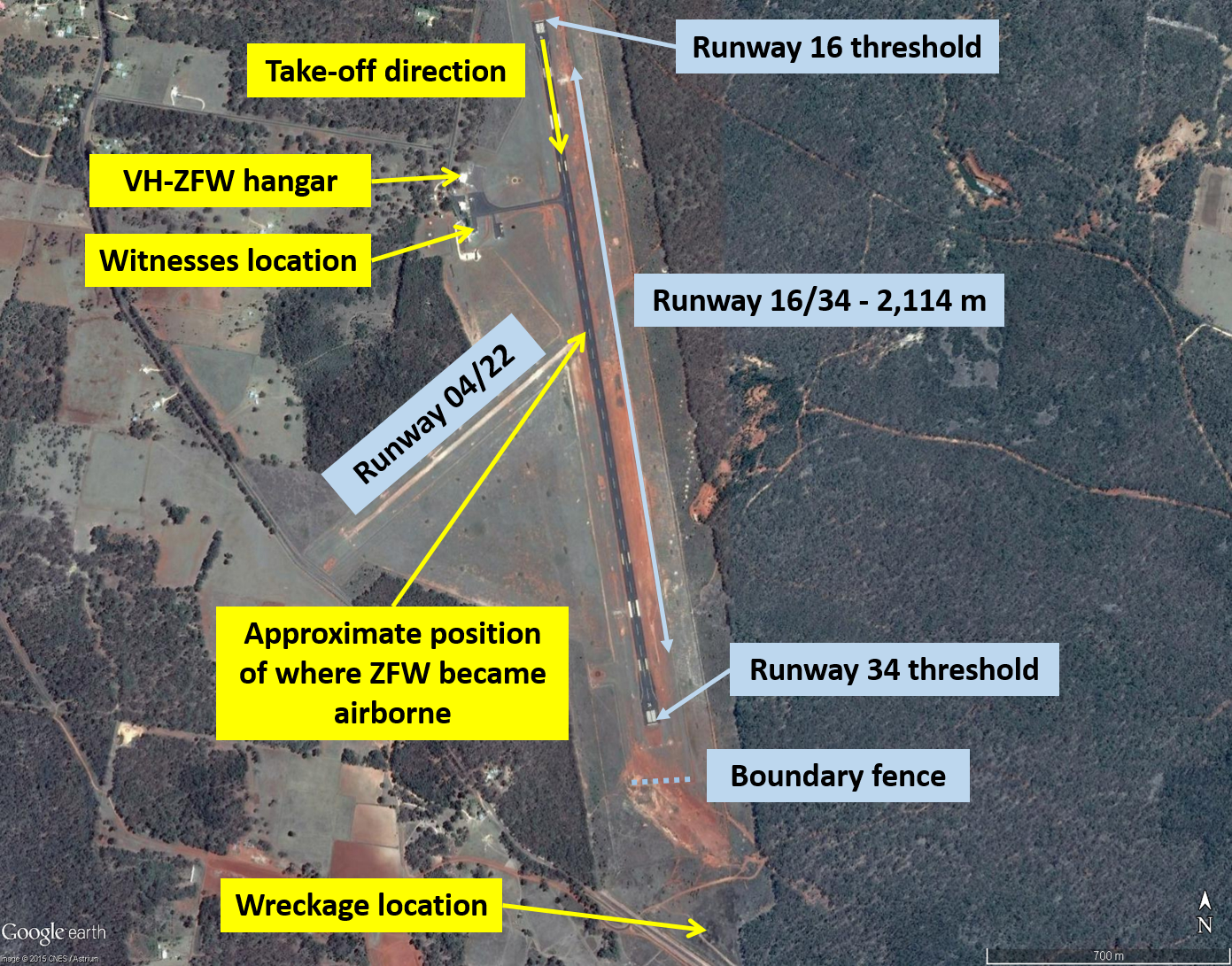
The pilot indicated that initially the take-off proceeded normally. However, shortly after becoming airborne, when at an estimated 200–300 ft above the ground, engine oil appeared on the windscreen, predominantly on the left. The pilot initiated a rejected take-off by reducing engine power to idle and lowering the nose of the aircraft. In response to the temporarily-obscured forward vision, the pilot looked out to the left of the aircraft to assess their position. Shortly after, the pilot realised that they were a lot further along the runway than expected as they[3] could see the threshold of the reciprocal runway 34 ahead (Figure 1). The pilot determined that there was insufficient distance remaining to land safely and commenced a go-around. The intent was to return to the airport for an immediate landing. However, the pilot reported that when full power was applied, the engine did not respond. The pilot initiated a forced landing.
The pilot was aware of the need to clear the boundary fence and ensure that the aircraft’s airspeed remained above the stall[4] speed. The pilot identified a cleared area to the right and turned the aircraft toward that area. The pilot reported having no further recollection of the forced landing until after the impact when the aircraft was on fire.
The pilot exited the aircraft and assisted the passengers. Shortly after, a number of people arrived and found the occupants clear of the burning wreckage. They moved the occupants further away and provided assistance until emergency services personnel arrived.
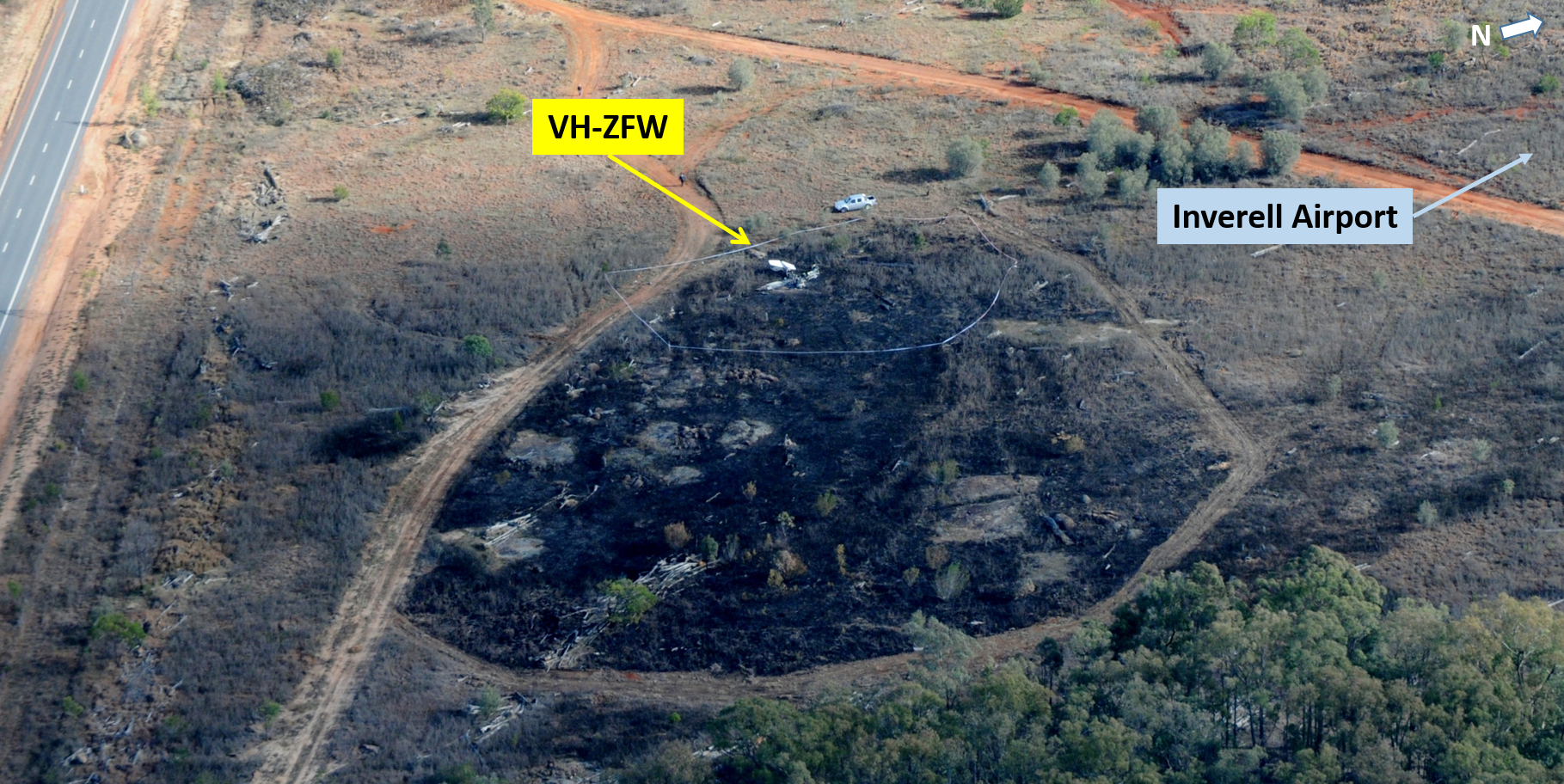
The pilot and front seat passenger were hospitalised with serious injuries. The second passenger, who was sitting in the middle row of seats, received minor injuries. The front seat passenger later succumbed to their injuries. The combined effects of the impact forces and post-impact fuel-fed fire destroyed the aircraft (Figure 2).
Figure 1: Runways at Inverell Airport, showing the location of the witnesses, approximate position that VHZFW became airborne and wreckage location
Source: Google earth, modified by the ATSB
Passenger observations
The passenger seated in the middle row reported that the engine sounded normal until some way down the runway when they started to notice something was wrong. The passenger reported removing their headset and noting that the engine sounded ‘weak’. At that time, the aircraft’s wheels were slightly above the ground and the aircraft about 10 m from the airport boundary fence. Shortly after, the passenger observed the pilot applying rearward pressure on the control column. The passenger felt the aircraft bounce before going over the fence. The aircraft then went to the right and flipped before coming to rest inverted. A fire commenced shortly thereafter. The passenger exited the aircraft and went to the main road to seek assistance.
The passenger did not observe any oil on the windscreen.
Witness observations
Witness 1
A witness who was familiar with ZFW and had observed the aircraft take-off from Inverell Airport on numerous occasions was positioned near a hangar overlooking runway 16/34 (Figure 1). The witness reported hearing ZFW start up and observed it taxi to the runway end and, soon after, commence the take-off. The witness indicated that during the initial stages of the take-off, the aircraft’s acceleration along the runway and engine sound appeared normal.
When in-line with their position, the witness was expecting the nose of the aircraft to lift but instead the aircraft continued along the runway. The witness indicated that if the nose did in fact lift from the runway, it would have only been centimetres above the ground. The witness became concerned and notified his colleagues.
As the aircraft passed runway 04/22, which is about 1,000 m along runway 16 and just before the depression in this runway (see the section titled Operational information - Airport information), it became airborne to about 10–13 ft (3–4 m). The witness reported that it looked like there was a slight crosswind as the aircraft’s tail moved to the right. The witness believed the pilot then rejected the take-off, as the aircraft appeared to settle back onto the runway. However, due to the depression in the runway, the witness could only see the aircraft’s wings. By this time, a second witness came of out of the hangar.
Witness 2
The second witness, who was also familiar with the aircraft, heard ZFW start up and the engine and other sounds associated with the pre-take-off checks. All were reported as sounding normal. The witness further indicated that, dependent on a number of conditions, ZFW would normally become airborne when about 500–800 m along the runway. By the upwind end of the runway, it would typically be about 200–300 ft above the ground.
Approaching the upwind end of the runway
Shortly after, as the aircraft neared the upwind end of the runway, both witnesses observed the aircraft suddenly climb to about 100–150 ft. Both commented that the aircraft appeared to be ‘labouring’. Neither witness could recall hearing the engine operating at that time, but the second witness believed that they should normally have been able to hear the engine from their position. The aircraft then turned right and descended below the rising terrain. Shortly after, the witnesses observed smoke in the area of the descent and went to assist.
The ATSB could not reconcile the discrepancy between the pilot’s recollection of the height gained after becoming airborne to that observed by the witnesses. However, it was possible that the accident and/or subsequent medical treatment affected the pilot’s recall.
Figure 2: Aerial view of the accident site showing VH-ZFW (looking west-north-west)
Source: New South Wales Police Force, modified by the ATSB
The pilot held a Private Pilot (Aeroplane) Licence that was issued on 10 June 2011 and a valid Class 2 Aviation Medical Certificate. The pilot’s logbook showed a total flying experience of 231.1 hours to the last entry dated 25 May 2014. Of these, about 118 hours were in ZFW. The pilot reported that, in the intervening period, they carried out a return flight to Archerfield Airport, Queensland and a local flight in ZFW in the weeks prior to the occurrence.
The pilot last completed a flight review on 8 November 2012.
Aircraft information
General
The Cessna T210N is a high-wing, single-engine aircraft with a retractable landing gear. The aircraft was manufactured in the United States (US) in 1980 and imported into Australia by the current owner/pilot. The aircraft was registered as VH-ZFW on 26 September 2012.
The aircraft was fitted with a six-cylinder, horizontally-opposed Teledyne Continental Motors TSIO-520-R9B engine. The engine drove a three-bladed McCauley Propeller Systems constant-speed propeller.
A review of the aircraft’s records indicated that ZFW was maintained in accordance with the approved Civil Aviation Safety Authority (CASA) maintenance schedule. The last periodic inspection was on 11 October 2013, at a total time in service of 3,973.6 hours. This included the last recorded engine oil change. Since that time, the aircraft accumulated about 40 hours. The maintenance records did not identify any defects or unserviceability with the aircraft prior to the occurrence.
Engine oil system
Oil for engine lubrication, propeller governor operation and turbocharger system control was supplied from a sump located on the bottom of the engine. The engine sump capacity was 10 quarts (about 10 L). Looking from the rear of the aircraft, the oil dipstick was located at the rear-left of the engine. The oil filler tube and cap was on top of the crankcase, near the front of the engine. Both the oil dipstick and filler tube were accessible through separate doors on the engine cowling.
The engine manufacturer advised that the oil filler cap fitted to the engine had been used on a large range of their engines since 1973. They further advised that the design of the cap was simple but effective and that they did not foresee a need to change the design.
The engine manufacturer’s recommended interval between oil changes was 50 hours or 6 months, whichever occurred first. The Cessna T210N pilot’s operating handbook (POH) also recommended changing the oil at least every 6 months, even though this may be less than the 50 hours accumulated. The POH further advised to reduce the interval when conducting short flights and during operations that involve long periods at idle revolutions per minute to avoid oil ‘sludging’. The term oil sludge refers to viscous deposits or gelling of the oil, which can lower the effectiveness of the lubrication system.
Turbocharger system
The aircraft was fitted with a Kelly Aerospace 400 series turbocharger. The function of the turbocharger was to maintain a desired manifold pressure at a given throttle setting, regardless of the ambient air temperature and pressure. A butterfly-type waste gate regulated the amount of exhaust gas fed to the turbocharger turbine wheel. The waste gate actuator and controller used engine oil pressure to operate. In the event of a turbocharger failure, the waste gate would move to the open position to prevent an overboost situation (excessive manifold pressure). The engine manufacturer stated that:
Rapid throttle movements may cause undershooting or overshooting of the desired manifold pressure, necessitating a subsequent adjustment once the turbocharger has stabilized. Gradual throttle movement will permit the turbocharger to keep pace with the change in power.
Speedbrakes
Precise Flight speedbrakes were installed on the aircraft to reduce shock engine cooling and allow for accelerated descents without decreasing engine power. The speedbrakes were located on the upper surface of each wing and were electrically actuated by an electric clutch. If the aircraft experienced a loss of electrical power, the clutch would automatically retract the speedbrakes. The speedbrakes took between 1.8–2.3 seconds to deploy.
Operational information
Meteorological information
The aerodrome forecast[5] for Inverell Airport indicated the wind would be from 300° (west-north-west) at 10 kt (19 km/h) with a temperature at the time of 15 °C. The pilot reported that, at the time of take-off, there was a tailwind of less than 5 kt on runway 16. This was consistent with witness observations of conditions including light and variable winds, with about a 5 kt tailwind on runway 16.
Airport information
Inverell Airport had two runways aligned 16/34 and 04/22. Runway 16/34 was the main runway and was 2,114 m long, with a 1 per cent upslope on runway 16. Runway 04/22 was to the west of and about 1,000 m along the main runway (Figure 1). Just beyond that point, there was a distinct depression in the main runway. Due to this variation in runway level, aircraft may not be sighted on opposite ends of the runway. The Airservices Australia Aerodrome Chart for the airport included a caution to this effect.
There was a 2 m high airport boundary fence about 160 m beyond the end of runway 16. Outside this fence was a semi-cleared area covered in low-lying shrubs and tall grasses.
Estimation of take-off and landing distances
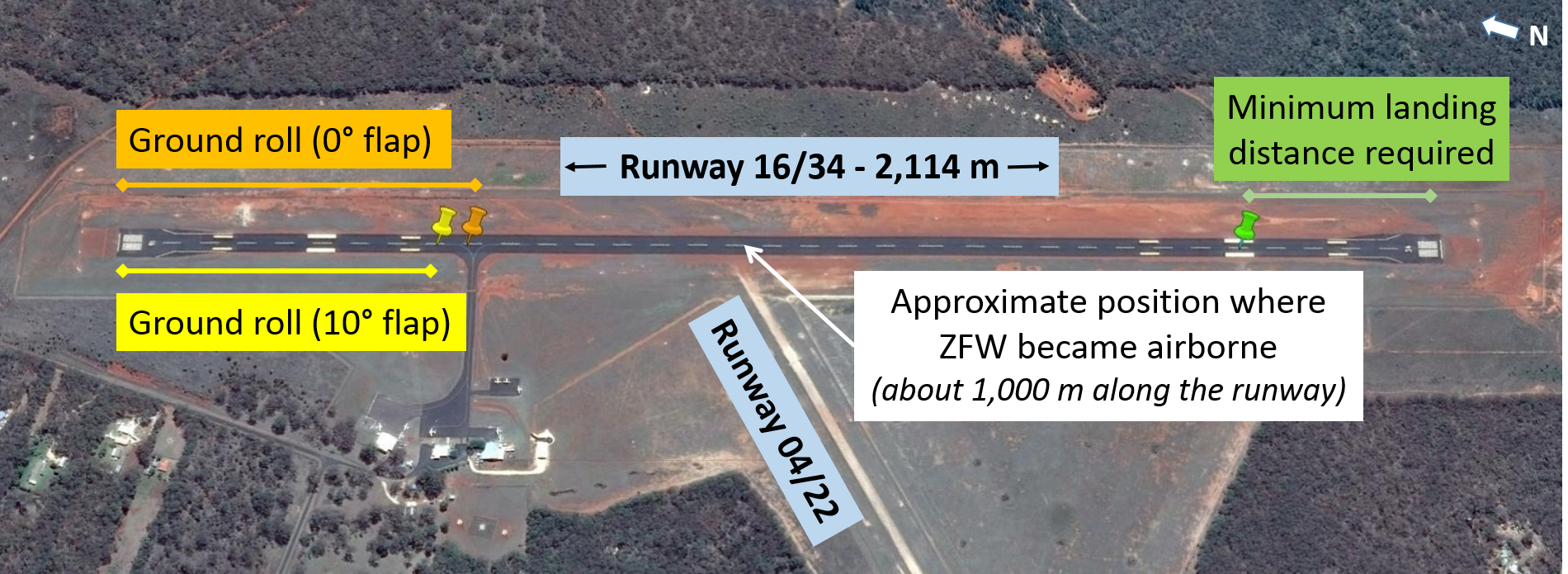
An estimation of the aircraft’s expected take-off and landing distance (ground roll) that day was undertaken using the Cessna T210N POH. Taking into account the runway characteristics, the calculations were based on information from the aerodrome forecast and the pilot’s and witness recollections (Figure 3).
The POH indicated that a normal take-off was possible using a 0°–10° wing flap setting. However, 10° wing flap was preferred as it resulted in an earlier nose wheel lift-off and a 10 per cent reduction in ground run compared with 0° flaps. Based on the manufacturer’s preferred configuration, the take-off ground roll distance for the occurrence flight with a 10° flap setting and 5 kt tailwind was estimated to have been about 485 m. With a 0° flap setting, the estimated distance was about 535 m. The pilot reported that they would normally select 10° flap for take-off and be airborne well before passing runway 04/22.
The landing distance was also estimated from information in the POH and was based on a flap setting of 30°, engine power at idle and the application of maximum braking. Given these conditions, depending on the aircraft’s actual configuration at the time, the minimum distance required for landing and braking to a complete stop would have been at least 320 m (Figure 3). However, the actual runway distance remaining when the pilot rejected the take-off was unable to be determined.
Figure 3: Estimated take-off distances with 10° (in yellow) and 0° (in orange) of wing flap set, the observed lift-off position along runway 16 and the minimum estimated landing distance (in green)
Source: Google earth, modified by the ATSB
Take-off considerations
The pilot could not recall when the aircraft became airborne but reported that the take-off was normal until the oil appeared on the windscreen. However, after initiating the rejected take-off, the pilot realised that they were a lot further along the runway than expected. The pilot indicated that the aircraft would normally be about 500 ft above the ground by the runway end (runway 34 threshold). The pilot did not know why the aircraft was lower than normal at that time.
The pilot reported that they did not have a specific go/no-go decision point along the runway. In respect of the application of such decision points, the US Federal Aviation Administration (FAA) Airplane Flying Handbook stated that:
Prior to take-off, the pilot should have in mind a point along the runway at which the airplane should be airborne. If that point is reached and the airplane is not airborne, immediate action should be taken to discontinue the take-off.
Pre-flight inspection procedure
The Cessna T210N POH advised pilots to check the engine oil quantity during a pre-flight inspection walk-around but did not require a check of the security of the oil filler cap. In contrast, the Cessna service manual, which provided the recommended procedures and instruction for ground handling, servicing and maintaining the aircraft, included a requirement to check that the filler cap was tight and the oil filler cap was secure. A review of other handbooks for a range of aircraft types found that inclusion of that check in the pre-flight inspection process was inconsistent.
The daily inspection requirements, under the CASA maintenance schedule to which the aircraft was maintained, included a check of the oil level and that the oil dipstick and cap were secure and locked. The CASA Maintenance guide for pilots stressed the importance of the daily inspection in terms of it being:
…the only thorough inspection between periodic inspections and is the last opportunity to inspect the aircraft to ensure that it is airworthy and fit to fly…and must be carried out prior to the first flight of each day the aircraft is flown.
and the purpose of the pre-flight inspection being:
…to inspect the aircraft to ensure that it is safe, that nothing untoward has occurred since the daily inspection, and to determine if flight requirements can be met.
The pilot reported that they used the memorised flow pattern for each pre-flight inspection based on the checklist published in the POH. Consistent with this checklist, they checked the oil quantity on every pre-flight inspection. The pilot indicated that they were not aware of the CASA maintenance schedule daily inspection requirements, and would only check the security of oil filler cap after adding engine oil.
The pilot reported that on one previous occasion they had double-checked the oil filler cap and found it unsecured.
Wreckage and impact information
An examination of the wreckage found that the aircraft approached terrain in a relatively level attitude, with the nose and left wing slightly down. The nose wheel contacted the ground first and detached from the aircraft. The right wing then impacted a shrub, sustaining significant impact damage and the aircraft flipped, before coming to rest inverted. A post-impact, fuel-fed fire destroyed most of the fuselage (Figure 4).
The wreckage examination also found:
That the damage to the propeller blades and strike marks on the ground were consistent with the engine producing some power at impact, but not full power.
That the left side of the engine sustained more fire and heat damage then the right. After placing the engine in an upright position, the oil filler cap was found detached from the oil filler tube but hanging by its chain. There was evidence of oil around the oil filler tube and on the ground. The separate oil dipstick remained secured in position.
Small amounts of oil spotting on the rear of the left empennage and on the underside of the left horizontal stabiliser. There were also oil droplets on several windscreen fragments around the accident site.
A small amount of oil sludge inside the propeller hub shaft.
The propeller governor control was in a low pitch, high revolutions per minute position, consistent with the propeller pitch setting required for take-off.
The wing flaps were in the fully-retracted position (0°).
The speedbrake on the left wing was partially-deployed, while the speedbrake on the right wing was in the retracted position.
The engine was recovered from the wreckage and transported to an approved overhaul facility for technical inspection under the supervision of the ATSB. The speedbrake assembly from each wing was also removed for further examination at the ATSB’s technical facilities in Canberra, Australian Capital Territory.
Figure 4: Aircraft wreckage showing the tail empennage inverted to the right and the propeller visible on the left (looking south-south-west)
Source: ATSB
Test and research
Engine examination
The engine examination found that, while less than 2 L of oil was collected from the engine, there was no damage consistent with oil starvation. Overall, there was no evidence of internal mechanical failure that would have prevented normal operation of the engine prior to the occurrence. Externally, the engine was impact- and fire-damaged.
The turbocharger waste gate was in the open position and the turbine wheel assembly could not be rotated within its housing. The turbocharger assembly and the engine oil filler cap and tube were removed from the engine for further examination.
Engine oil filler cap and tube examination
The engine oil filler cap and gasket, which was located at the underside of the cap rim, showed evidence of significant fire damage. However, the cap did not appear distorted or damaged. The locking tangs used to secure the cap into the oil filler tube showed no contact marks to indicate the forcible removal of the cap from the filler tube during the impact sequence. There was evidence of oil on the outer surface of the oil filler tube. The physical appearance of the interacting cap and filler tube surfaces showed no deformation or mechanical damage. Therefore, it was considered very unlikely that the cap came off during the impact sequence.
Turbocharger examination
The turbocharger assembly sustained extensive heat damage from the post-impact fire. Examination of the waste gate determined that the valve was fixed in the open position, consistent with fire damage and the build-up of debris from exposure to water during the firefighting activities. There was evidence of oil residue on the bearings, which were in good condition and showed no signs of damage or distortion. Examination of the turbocharger assembly found no evidence to suggest that it was not operational prior to the occurrence.
Speedbrake examination
Both speedbrakes showed signs of post-impact fire damage and their spring mechanisms and wiring were compromised. Heat markings on the right speedbrake indicated that it was not in the open position during the fire. Discolouration from heat damage to the left speedbrake showed that it was extended to an angle of 30° during the fire. However, it was determined that the left speedbrake was released by the impact and there was no evidence to suggest that it deployed inflight.
Pilot reaction times
In 1999, the United Kingdom Civil Aviation Authority commissioned a simulator-based study into helicopter pilot reaction times in response to an emergency. The study determined that the mean total reaction time (time taken to detect and respond) generally ranged between 2–4 seconds, with 4–6 seconds typical of a longer but acceptable reaction time. The US FAA Airplane Flying Handbook also stated that the typical time for a pilot to react to an emergency situation was about 4 seconds.
Related occurrences
A review of the ATSB occurrence database identified eight occurrences in the period 2005 to 2014 where pilots reported oil on the windscreen or engine cowl in flight. Specifically, these involved single-engine aircraft and occurred because of an unsecured engine oil filler cap or dipstick. Below is a selection of these occurrences:
During the take-off, at about 30 ft above the runway, the pilot observed oil leaking from the engine cowl. The pilot rejected the take-off. After shutdown, the pilot found that the oil filler cap was not secured correctly (ATSB occurrence 201311271).
During the initial climb, the airspeed indicator failed and a large quantity of oil flowed onto the windscreen. The pilot returned for landing and inadvertently landed with the landing gear retracted. An inspection revealed that the oil filler cap was not secured prior to departure (ATSB occurrence 201106695).
At about 300 ft after take-off, the flight instructor noticed oil splatter on the windscreen. After shutdown, the student pilot realised that they replaced the oil cap but did not lock it in place (ATSB occurrence 201103050).
At about 1,500 ft after take-off the pilot noticed a small amount of oil on the windscreen. The aircraft was returned for an immediate landing. The pilot realised that the oil filler cap was not secured after adding oil during the pre-flight inspection (ATSB occurrence 201102652).
The following is a selection of similar international occurrences:
During the pre-flight inspection, the pilot added engine oil and placed the oil filler cap on top of the battery box. Subsequently, the pilot became distracted by the flight instructor. After departure, the pilot noticed oil on the windscreen and realised that they did not secure the cap. After landing, the filler cap was found still resting on top of the battery box (US Aviation Safety Report System occurrence 581462).
During the climb, the pilot noticed oil droplets that shortly after covered the left side of the windscreen. The pilot had not secured the oil filler cap after adding engine oil during the preflight inspection. The pilot reported that the aircraft manufacturer’s pre-flight inspection procedure as detailed in the POH called for a check of the oil level, but not the fitment of the oil filler cap (US Aviation Safety Report System occurrence 784956).
After take-off, the aircraft was climbed to about 100–200 ft before the pilot turned back toward the runway. The pilot reported obscuration of the windscreen by a layer of oil as the oil filler cap was mistakenly left off. The aircraft descended into terrain about 274 m beyond the runway in a wings level, 20° nose-down attitude. The pilot reported no pre-impact mechanical issues (US National Transportation Safety Board (NTSB) investigation LAX04LA225).
The pilot reported oil on the windscreen shortly after take-off and returned to the airport. Witnesses observed the aircraft level off at 300 ft, slow down and turn toward the airport. During the turn, the right wing dropped and the aircraft subsequently impacted terrain. The oil filler tube was found without the cap. The cap was attached to the neck by a chain and was found between cylinders No. 4 and 6. No preimpact anomalies were found with the aircraft that would have affected its performance (US NTSB investigation SEA04F165).
Shortly after becoming airborne, the pilot observed oil streaming from the engine compartment, severely impairing their visibility. The pilot had inadvertently left the oil filler cap off (United Kingdom Air Accidents Investigation Branch investigation EW/G2012/07/02).
Shortly after take-off, oil appeared on the windscreen, temporarily obscuring the pilot’s visibility. The pilot initiated a rejected take-off but then assessed that there was insufficient landing distance remaining to continue the rejected take-off safely. The pilot reported commencing a go-around by applying full power; however, the engine did not respond. The pilot then initiated a forced landing into a semi-cleared area beyond the airport boundary. During the landing, the aircraft impacted a shrub and flipped before coming to rest inverted. A post-impact, fuel-fed fire injured the occupants and destroyed most of the aircraft fuselage.
This analysis will examine the security of the oil filler cap, the longer-than-normal take-off distance and the oil change interval requirements and their potential influence on the development of the occurrence. It will also consider the pre-flight inspection checklist with regard to the security of the oil filler cap and the reported lack of engine response during the go-around.
Oil filler cap security
The pilot could not initially recall adding engine oil during the pre-flight inspection, nor did any of the witnesses observe this action. However, the pilot reported later that they believed they replenished the engine oil. The pilot’s injuries and medical treatment may have affected their memory during the ATSB’s initial interview. Subsequently, increased understanding of the circumstances of the occurrence, including potentially from media or other reports, friends and so on may have enhanced or otherwise affected the pilot’s recollection.
Following the occurrence, the oil filler cap, which was located on the left or pilot’s side of the engine, was found unsecured. This was consistent with the pilot’s recollection of oil appearing on the left side of the windscreen and oil spotting on that side of the aircraft wreckage. The oil temporarily obscured the pilot’s visibility during the take-off and climb.
Technical examination of the oil filler cap and tube determined that it was very unlikely that the cap came off during the impact sequence. Therefore, it was most likely that the cap was not secure before the flight commenced.
Prolonged take-off
A witness who was familiar with the aircraft’s operation at Inverell Airport saw it become airborne about 1,000 m along runway 16. This roughly aligned with being abeam the threshold of runway 22 at lift-off. ATSB estimations of the take-off ground roll distance that day indicated that the aircraft should have become airborne at about 500 m, which was consistent with the witness’s previous observations.
The pilot could not recall where the aircraft became airborne but believed that the take-off was normal until the oil appeared on the windscreen. The pilot further indicated that the aircraft would normally be airborne well before passing runway 04/22. A longer-than-normal take-off roll was consistent with the unexpected position of the aircraft as observed by the pilot after initiating the rejected take-off.
The ATSB considered a number of factors that may have prolonged the take-off roll. This included the aircraft’s configuration, meteorological conditions, runway characteristics, possible effect of any mechanical issues and pilot distraction. However, none of these factors was identified as contributory and the reason for the longer-than-normal take-off was not established. Despite this, pilots should be aware of such factors and how they degrade aircraft performance during a critical phase of flight, including the effect of tailwind conditions.
Discontinuation of the take-off at the position the aircraft was observed getting airborne should have allowed sufficient distance remaining to safely reject the take-off. However, the time taken for the oil to appear and the pilot to react to the loss of forward visibility compounded the already longer-than-normal take-off. In combination with the estimated minimum landing distance needed of 320 m, by the time the oil leak appeared, and the pilot reacted to the associated loss of forward visibility, it was very likely that there was insufficient runway remaining for the pilot to continue the rejected take-off. This was consistent with the pilot and passenger’s assessment of the aircraft’s position at that time.
Emergency or abnormal situations during take-off may require a pilot to reject the take-off. The decision to reject a take-off may appear simple but becomes critical under certain conditions. Further, the decision may be more complex when compared to the conditions under which the procedure was trained (Kaempf and Orasanu 2014). Therefore, prior to take-off, pilots should have in mind a go/no-go decision point along the runway by which time the aircraft should become airborne. The decision point should provide for sufficient runway distance remaining to allow the pilot to safely stop the aircraft by the end of the runway. If the aircraft is not airborne by the decision point, the pilot should reject the take-off.
It could not be determined if having a decision point would have changed the outcome of the flight. However, the occurrence emphasises the benefit of having such a point to assist pilot decision making during a critical phase of flight.
Oil change interval
The engine manufacturer’s oil change interval was 6 months. This was exceeded in ZFW by 3 months. However, there was insufficient evidence to determine if this contributed to the small amount of oil sludge found in the propeller hub. Despite this sludge, given the results of the examination of the engine and associated components, the overdue oil change had no effect on the operation of the engine.
Pre-flight inspection checklist
The pilot’s previous identification of an unsecured oil filler cap was the result of self-checking, not from following a checklist. Therefore, it could not be established if a specific checklist item would have resulted in the pilot identifying the unsecured cap prior to the occurrence flight. However, as documented in the United States Federal Aviation Administration Airplane Flying Handbook:
Checklists have been the foundation of pilot standardization and cockpit safety for years. The checklist is an aid to the memory and helps to ensure that critical items necessary for the safe operation of aircraft are not overlooked or forgotten.
The pilot’s pre-flight inspection, carried out from memory based on the checklist in the pilot’s operating handbook (POH), was a daily inspection as it was the first flight of the day. In this respect, the pilot was not aware of the CASA daily inspection requirements for the aircraft. The POH checklist required pilots to check the engine oil level during their pre-flight inspection. However, unlike the CASA daily inspection requirements for the aircraft, it did not require a check of the security of the separate oil filler cap. In the absence of any other safety mechanisms, the inclusion of this check in the POH pre-flight checklist may have increased the likelihood of the pilot identifying the insecure cap.
This occurrence highlights the importance of being aware of the daily inspection requirements when operating aircraft under a CASA maintenance schedule and how these requirements may differ from the aircraft manufacturer’s pre-flight inspection procedure. Had the pilot carried out the CASA daily inspection they likely would have identified the insecure engine oil cap.
Reported lack of engine response
Examination of the engine and turbocharger found no mechanical defect or failure that would have precluded normal operation prior to the occurrence. However, it was possible that the reported lack of engine response during the go-around was the result of a temporary issue. For example, the turbocharger may not have had sufficient time to stabilise because of a rapid sequence of throttle movements in this case. These included setting full power for the take-off, idle power for the rejected take-off and then full power again for the go-around. However, there was insufficient evidence to establish if a temporary issue occurred and the reason for the reported lack of engine response was not established.
In addition, a search of various aviation occurrence databases found only one occurrence where rapid throttle movement led to a temporary turbocharger issue. In that occurrence, the pilot of a Piper PA-31 aircraft advanced the throttle rapidly during the take-off, which resulted in the turbocharger surging. The pilot successfully rejected the take-off (ATSB occurrence 197504806). Of note, pilots may not report temporary issues if they are resolved without further concern.
Similar occurrences of oil dipstick or filler cap insecurity and oil being expelled onto the aircraft have led to varying outcomes but mostly resulted in a safe landing. However, the longer-than-normal take-off roll, the time taken for the oil to appear and the pilot to react, and the reported lack of engine response limited the options available to the pilot. From a low height, the pilot conducted a forced landing into unfavourable terrain, resulting in a collision with terrain and a post-impact fire.
Findings
From the evidence available, the following findings are made with respect to the collision with terrain and subsequent post-impact fuel-fed fire involving a Cessna Aircraft Company T210N, registered VH-ZFW, which occurred near Inverell Airport, New South Wales on 4 July 2014. These findings should not be read as apportioning blame or liability to any particular organisation or individual.
Contributing factors
In response to oil on the windscreen, the pilot initially rejected the take-off, but deemed the remaining available runway insufficient to land safely and commenced a go-around. During the go-around, the engine did not respond as expected, resulting in a forced landing off the airport.
The oil filler cap was not secured, which resulted in oil being expelled onto the windscreen and temporarily obscuring the pilot's visibility during a critical phase of flight.
For reasons undetermined, the take-off was longer than normal, which reduced the distance available for the pilot to reject the take-off after detecting and responding to engine oil on the windscreen.
Other factors that increased risk
The aircraft manufacturer's pilot operating handbook advised pilots to check the engine oil level during a pre-flight inspection, but not the security of the oil filler cap.
The oil change interval exceeded the engine manufacturer's recommended period of 6 months.
Other findings
The reason for the reported lack of engine response during the go-around could not be established.
Sources and submissions
Sources of information
The sources of information during the investigation included:
the pilot of VH-ZFW
the Licenced Aircraft Maintenance Engineer for VH-ZFW
a number of witnesses
the Civil Aviation Safety Authority.
References
Federal Aviation Administration 2004, Airplane Flying Handbook, United States Department of Transportation.
Flight Safety Foundation 1999, ‘Simulator-based study of emergencies yields insights into pilots’ reaction times’, Helicopter Safety, March-April 1999, vol. 25, no. 2.
Under Part 4, Division 2 (Investigation Reports), Section 26 of the Transport Safety Investigation Act 2003 (the Act), the ATSB may provide a draft report, on a confidential basis, to any person whom the ATSB considers appropriate. Section 26 (1) (a) of the Act allows a person receiving a draft report to make submissions to the ATSB about the draft report.
A draft of this report was provided to the pilot of VH-ZFW, the Licenced Aircraft Maintenance Engineer for VH-ZFW, witnesses, the aircraft manufacturer, the Civil Aviation Safety Authority and the United States National Transportation Safety Board.
Submissions were received from the aircraft manufacturer and a witness. The submissions were reviewed and where considered appropriate, the text of the report was amended accordingly.
Purpose of safety investigations
The objective of a safety investigation is to enhance transport safety. This is done through:
identifying safety issues and facilitating safety action to address those issues
providing information about occurrences and their associated safety factors to facilitate learning within the transport industry.
It is not a function of the ATSB to apportion blame or provide a means for determining liability. At the same time, an investigation report must include factual material of sufficient weight to support the analysis and findings. At all times the ATSB endeavours to balance the use of material that could imply adverse comment with the need to properly explain what happened, and why, in a fair and unbiased manner. The ATSB does not investigate for the purpose of taking administrative, regulatory or criminal action.
Terminology
An explanation of terminology used in ATSB investigation reports is available here. This includes terms such as occurrence, contributing factor, other factor that increased risk, and safety issue.
Publishing information
Released in accordance with section 25 of the Transport Safety Investigation Act 2003
Ownership of intellectual property rights in this publication
Unless otherwise noted, copyright (and any other intellectual property rights, if any) in this report publication is owned by the Commonwealth of Australia.
Creative Commons licence
With the exception of the Coat of Arms, ATSB logo, and photos and graphics in which a third party holds copyright, this publication is licensed under a Creative Commons Attribution 3.0 Australia licence.
Creative Commons Attribution 3.0 Australia Licence is a standard form licence agreement that allows you to copy, distribute, transmit and adapt this publication provided that you attribute the work.
The ATSB’s preference is that you attribute this publication (and any material sourced from it) using the following wording: Source: Australian Transport Safety Bureau
Copyright in material obtained from other agencies, private individuals or organisations, belongs to those agencies, individuals or organisations. Where you wish to use their material, you will need to contact them directly.
On 2 July 2014, a Qantas Airbus A380 aircraft, registered VH-OQD, departed Los Angeles, USA, for Melbourne, Victoria. During the climb, the captain switched off the seatbelt sign. A few minutes later, a cabin attendant entered the business class galley and, as she switched the hot water on, observed water leaking out from under the meal carts. A cabin supervisor then pulled the carts forward to access and switch off the water shut off valve, but that did not stem the flow of water.
A second officer went into the cabin to determine how much water had leaked and confirmed that the valve was switched off. The flight crew contacted maintenance watch ground staff. They advised the crew that there was a main switch to the potable water on the flight attendants’ panel and the cabin crew located the switch and selected it to ‘OFF’, which then stopped the water flow.
As a precaution, the cabin crew switched off the in-flight entertainment system and the power to all controls in the seats. With the potable water supply switched off, there was no water available for the toilets or basins for the duration of the flight. The crew elected to return to Los Angeles.
Initial engineering inspection found that the coupling that joins the water pipe at the floor level where the water supply enters the galley was unlatched. There was evidence that the rope-style mops used by cleaners may have contributed to the coupling coming undone. A fleet wide inspection of the aircraft was carried out and temporary preventative action taken on all similar galley installations.
This incident provides an excellent example of effective crew resource management techniques.
On 9 June 2013, an Australian-registered Cessna 206 aircraft, registration VH-JIA, was extensively damaged in an accident while attempting to land on a beach strip near Bukaua River, Papua New Guinea. The pilot reported that during the landing roll, the nose landing gear fork had failed, allowing the aircraft to dig into the soft sand and flip over.
The Accident Investigation Commission (AIC) of Papua New Guinea was responsible for investigating this accident. As part of its investigation, the AIC requested technical assistance from the Australian Transport Safety Bureau (ATSB), in the metallurgical examination of the failed landing nose fork and the download and analysis of the pilot's navigational GPS unit that was recovered from the accident site. To provide the necessary protections for the GPS information and the findings of the landing gear analysis, the ATSB appointed an Accredited Representative to the investigation in accordance with clause 5.23 of Annex 13 to the Convention on International Civil Aviation (ICAO Annex 13), and initiated an investigation under the Australian Transport Safety Investigation Act 2003.
Landing gear analysis
The characteristics of the nose landing gear fork failure revealed during the ATSB laboratory examination were consistent with fracture occurring from a pre-existing manufacturing condition that predisposed the fork to brittle fracture along the forging seam (parting) lines during conditions of elevated lateral stress (such as sustained during beach or other soft-surface landings). The fracture surfaces showed no evidence of fatigue cracking, stress-corrosion cracking or other progressive failure mechanisms. Cracking and failure of Cessna nose forks has been an isolated but recurrent problem for Cessna 100- and 200-series aircraft, and a supplemental inspection ('32-20-01 Nose Landing Gear Inspection') has been promulgated by the manufacturer to address the issue. In light of the history of related failures contained on the Australian record, the Australian Civil Aviation Safety Authority (CASA) is considering a review of their existing Airworthiness Bulletin, AWB 32-016 Cessna Single Engine Nose Landing Gear Forks, with respect to this issue.
GPS download
Following recovery and preliminary examination of the GPS track data, it was evident that the most recent information stored on the device was recorded approximately twelve months prior to the accident. As such, the ATSB concluded that the unit had not been in use during or immediately prior to the accident flight, or the track recording functionality had been switched off.
Provision of information to the AIC:
The findings of the ATSB's examination of the nose landing gear and GPS examination were provided to the PNG-AIC on 7 January 2014, and the components were subsequently returned to the AIC investigator in-charge. The AIC is responsible for releasing a final investigation report into this occurrence.
On the afternoon of 28 June 2014, the 327 m long bulk carrier Julia N entered the port of Port Headland, Western Australia, and was manoeuvred alongside Anderson Point number two berth by the pilot with the assistance of four tugs.
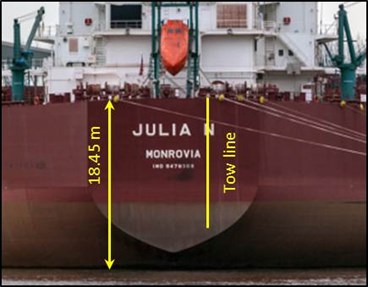
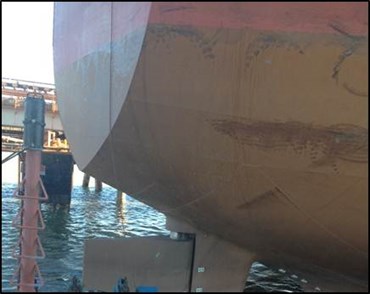
At 1521[1], when it had been confirmed that the ship was in position, the pilot called the master of the tug at the stern of the ship to come in and retrieve its tow line (Figure 1 and Figure 2). When the tug was in position, the pilot asked Julia N’s master to instruct the aft mooring team (second mate and two seamen) to let go the tug’s tow line.
Figure 1: Approximate position of the tow line during retrieval[2]
Source: Jens Boldt – Shipspotting with annotations by ATSB.
Figure 2: View of Julia N from the tug’s bridge window
Source: Teekay Australia.
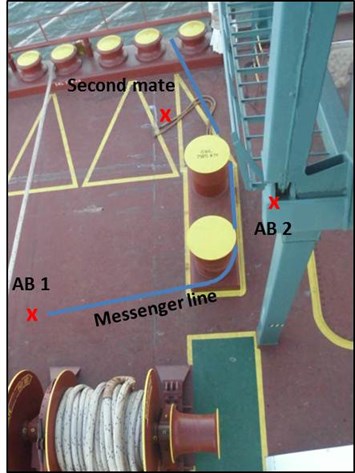
Figure 3: Crew and messenger line positions
Source: Julia N with annotations by ATSB
Seaman 1 (Figure 3) ran the messenger line[3] over the drum end of the mooring winch, while seaman 2 operated the winch to pull about 2 m of tow line inboard. The second mate wrapped the rope stopper around the main tow line while the messenger line was taken off the drum end and the eye of the tow line off the mooring bits. The messenger line was then put around the forward post of the mooring bits to assist with the controlled lowering of the tow line.
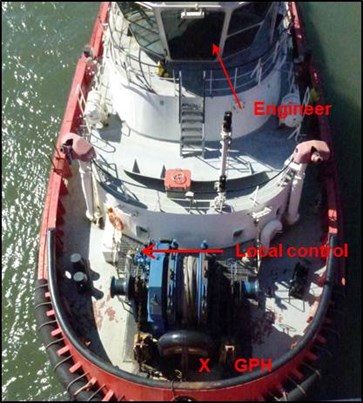
On board the tug, the general purpose hand was standing forward of the winch (Figure 4) ready to guide the tow line onto the winch drum and the engineer was at the remote winch controls inside the bridge.
The general purpose hand signalled to the engineer that he could begin heaving in the tow line but the engineer waited until he saw the tow line being lowered.
Figure 4: Position of the general purpose hand and the engineer.
Source: ATSB.
As the tow line was retrieved, seaman 2’s right leg somehow became entangled in the messenger line. He was then dragged about 4 m across the deck and into the rollers of the fairlead. When his legs entered the fairlead the messenger line came under tension and it severed the seaman’s right foot.
As the eye splice of the tow line reached the fendering on the bow of the tug, both the general purpose hand and the engineer saw the line go tight. The general purpose hand signalled to the engineer but he had already stopped heaving.
Julia N’s second mate ran to the ship’s rail and signalled to the general purpose hand to slacken the line. Then, on the general purpose hand’s signal, the engineer paid out about 2 m of line.
At 1524, the pilot advised Port Hedland Vessel Traffic Service (VTS) that there was a medical problem on board the ship and instructed the tug’s master to hold position with a slack line as there had been a problem on the aft mooring deck with the line. A short time later, after receiving more information, the pilot advised VTS what had happened. He also requested medical assistance from the terminal operator.
Between 1545 and 1555, two launches arrived with first aid personnel and, at 1601, a helicopter with two paramedics landed on board Julia N.
At 1644, the helicopter departed with the injured seaman. He was taken to the Port Hedland Hospital, where he was provided with medical treatment.
At 1750, the pilot reported to VTS that Julia N was all fast alongside the berth and he was departing the ship.
The injured seaman continued to receive treatment in the Port Hedland Hospital until he was repatriated on 12 July.
ATSB comment
From his position at the port bridge console, the tug’s engineer could see the tow line, the winch and the general purpose hand. However, due to the freeboard of the ship, no one on board the tug could see past the ship’s main deck hand rails. As is usual, the tug’s crew had no direct radio communications with the ship’s aft mooring team, and were therefore reliant on visual contact with the mooring team for all communications.
There were three crew members (second mate and two seamen) on the aft deck for mooring operations and it is likely that the second mate felt that he needed to assist the two seamen when releasing the tugs line from the bits. However, when doing so, he was not at the ship’s side where he had a clear line of sight of the tug, and as such had relinquished his supervisory role. Then, when the seaman became entangled in the messenger line, there was no one on the aft deck of the ship in a position to signal to the tug’s crew to stop retrieving the line.
The investigation was not able to interview the injured seaman, and from the evidence provided, was not able to ascertain how the seaman’s leg became entangled in the messenger line while it was being retrieved on board the tug.
There is no clear evidence to determine the actions of the second mate and how they were interpreted by the tug’s crew as a positive signal to retrieve the tow line.
Safety action
Whether or not the ATSB identifies safety issues in the course of an investigation, relevant organisations may proactively initiate safety action in order to reduce their safety risk. The ATSB has been advised of the following safety action in response to this occurrence.
Teekay Australia
A Safety Alert was sent to all of its managed ships advising of the accident, the safety message and safety actions to be taken.
Neu Seeschiffahrt
Each managed ship received a Corrective and Preventative Action Report which contained the company’s internal investigation report, references to various procedures related to mooring and tug operations as well as corrective actions and long term preventative actions.
Safety message
Mooring operations are often seen as a routine task but contain dangers that are often not realised until it is too late. As they cannot be directly observed, the forces that can be exerted on mooring and towing lines, even by their own weight, are often underestimated by those working around them.
Serious injury is likely when there is an incident during tug and mooring operations, but the likelihood of such an occurrence can be managed through effective risk assessment, training, supervision, communications and good housekeeping – both prior to and during berthing operations.
The ATSB’s SafetyWatch highlights the broad safety concerns that come from its investigation findings, and from the occurrence data reported by industry. One of the ATSB’s current SafetyWatch concerns relates to marine work practices. Readers are encouraged to examine the information and experiences presented at the web link below, and relate those to the context of their own duties.
About this report
Decisions regarding whether to conduct an investigation, and the scope of an investigation, are based on many factors, including the level of safety benefit likely to be obtained from an investigation. For this occurrence, a limited-scope, fact-gathering investigation was conducted in order to produce a short summary report, and allow for greater industry awareness of potential safety issues and possible safety actions.
Publishing information
Released in accordance with section 25 of the Transport Safety Investigation Act 2003
Ownership of intellectual property rights in this publication
Unless otherwise noted, copyright (and any other intellectual property rights, if any) in this report publication is owned by the Commonwealth of Australia.
Creative Commons licence
With the exception of the Coat of Arms, ATSB logo, and photos and graphics in which a third party holds copyright, this publication is licensed under a Creative Commons Attribution 3.0 Australia licence.
Creative Commons Attribution 3.0 Australia Licence is a standard form licence agreement that allows you to copy, distribute, transmit and adapt this publication provided that you attribute the work.
The ATSB’s preference is that you attribute this publication (and any material sourced from it) using the following wording: Source: Australian Transport Safety Bureau
Copyright in material obtained from other agencies, private individuals or organisations, belongs to those agencies, individuals or organisations. Where you wish to use their material, you will need to contact them directly.
[1] All times referred to in this report are local time, Coordinated Universal Time (UTC) + 8 hours.
[2] Photo is for illustrative purposes. At the time of the incident, Julia N’s draft was less than shown in the photograph.
[3] The messenger line was a 25 mm diameter rope attached to the eye of the main tow line by a short flat webbing sling. It was measured at 21.7 m long after the incident.
On 13 December 2013, a Hughes 500D helicopter, registration ZK-HNA, was flying from Rat Point on Lake Wakatipu, 16 km South West of Queenstown, New Zealand, to Dumpling Hut on the Milford Sound walking track. When the helicopter did not arrive at its destination, the alarm was raised, and after a short search, the wreckage of the helicopter was found near the top of the Glade Burn Valley. The pilot, who was the sole occupant of the helicopter, had been fatally injured.
The Civil Aviation Authority of New Zealand (CAANZ) is undertaking a formal investigation into this accident. As part of that work, the CAANZ requested technical assistance from the Australian Transport Safety Bureau (ATSB), in the recovery of data from a damaged navigational GPS unit recovered from the accident site. To protect the information supplied by the CAANZ, and any data recovered from the GPS unit, the ATSB initiated an investigation under the provisions of the Transport Safety Investigation Act 2003.
Following examination and disassembly, it was evident that the GPS unit had sustained circuitry damage sufficient to prevent its download by conventional means. Subsequently, the discrete device (chip) containing the track memory was identified, removed, and a raw data file downloaded using specialised techniques. Decoding of the raw information showed that the entire track memory had been recovered, including the accident flight and several previous flights. The data and a report detailing the download procedure was provided to the CAANZ on 26 June 2014 for use in their investigation.