Loss of control and collision with terrain involving DHC-1 Chipmunk, VH-UPD, Coffs Harbour, New South Wales, on 29 June 2014
Final report
Report release date: 04/02/2016
Safety Summary
What happened
On the morning of 29 June 2014, the pilot of a de Havilland Canada DHC-1 T Mk 10 Chipmunk aircraft, registered VH-UPD, was taking a passenger for a brief, private flight over Coffs Harbour Regional Airport, New South Wales.
According to pilot and passenger reports, after conducting a series of aerobatic manoeuvres, the pilot climbed to about 3,800 ft and accelerated to about 85 kt. The pilot then made a short dive to build up speed to about 120 kt before commencing a loop.
At the top of the loop, the aircraft stalled while inverted, most likely as the result of excessive elevator input. The aircraft rolled and entered an upright spin, which became flatter as it developed. Later, the pilot reported that attempts to recover were unsuccessful. The spin continued until the aircraft impacted terrain. The pilot and passenger sustained serious injuries and the aircraft was seriously damaged. There was no fire.
What the ATSB found
The pilot reported undertaking training to conduct loops, but there was no record of an endorsement and the instructor did not recall approving the pilot to conduct loops. As a result, at the time of the accident, the pilot likely did not possess the necessary skills and judgement to conduct the manoeuvre safely and consistently.
The pilot probably did not apply and maintain the spin recovery control inputs appropriate for a fully-developed spin in a Chipmunk aircraft. Furthermore, the pilot was taught a spin recovery method that was not effective for recovering from such spins in the aircraft.
In addition, the accident aircraft’s flight manual had not been approved by the Civil Aviation Safety Authority and did not include advice on spin recovery. The mandatory, Civil Aviation Safety Authority-approved flight manual contained spin recovery advice.
What's been done as a result
The flying school that provided the pilot’s aerobatic training reported that a briefing process was undertaken with all current aerobatic instructors to ensure that consistent terminology is used to describe and teach aerobatic manoeuvres. It also reported that a programme of standardisation flights for all current aerobatic instructors will include the training of spin and unusual attitude recovery for aerobatic students.
Safety message
Pilots and instructors, particularly those intending to conduct or teach aerobatic manoeuvres, should be familiar with any special handling requirements for a particular aircraft type as well as recovery from both incipient and developed spins. Furthermore, they should ensure that they hold the appropriate aerobatic endorsement before attempting a manoeuvre.
VH-UPD accident site
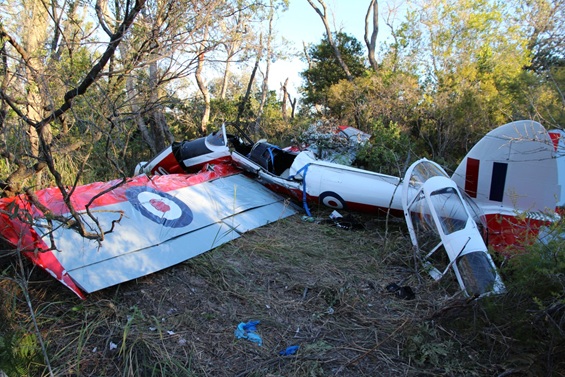
Source: ATSB
The occurrence
On the morning of 29 June 2014, the pilot of a two-seat de Havilland Canada DHC1 T Mk 10 Chipmunk aircraft, registered VH-UPD (UPD), was making a series of short, private flights in the vicinity of Coffs Harbour Regional Airport, New South Wales. The pilot carried a different passenger on each flight, and flew the aircraft from the front seat.
After about three or four flights, and with a new passenger on board, the pilot requested and received air traffic control clearance to conduct ‘airwork’ over the airport, not above 4,000 ft above mean sea level.[1] The pilot took off at about 1127 Eastern Standard Time[2] on what was the first flight of the day that was intended to include aerobatic manoeuvres.
After climbing to about 3,800 ft, the pilot conducted a series of manoeuvres. The aerobatic sequence usually flown by the pilot consisted of a shallow dive to accelerate to about 120 kt, followed by a loop, an aileron roll and two wingovers (the latter manoeuvres were each commenced at 100 kt). The pilot reported that the sequence usually finished about 1,000 ft lower than the initial height.
The pilot reported that he subsequently climbed back to 3,800 ft and accelerated to about 85 kt. The pilot then made a short dive to again build up speed to about 120 kt before commencing a second loop. The aircraft’s height during the manoeuvres could not be confirmed with any accuracy but, based on the pilot’s report and calculations derived from witness reports, the entry height for the second loop was probably higher than 3,000 ft.
Witnesses reported that while inverted at the top of the manoeuvre, the aircraft stalled and rolled to the right. The aircraft then entered an upright spin to the right which became flatter as it developed. The pilot reported being aware of the spin and feeling ‘panicked’, finding that his attempts to recover from the spin were unsuccessful. The pilot tried different control inputs in an attempt to recover, including right and left rudder and applying left and right aileron, but did not recall moving the control stick forward. The passenger later reported that during the descent, the pilot was manipulating the controls and talking, but the passenger could not recall how the controls moved.
Video footage taken by witnesses showed the last 15 seconds of the flight with the aircraft established in a slow, upright spin to the right from about 1,200 ft. The aircraft’s pitch attitude was about 30° nose-down during the spin. The spin continued until the aircraft impacted terrain at about 1136, in a narrow strip of forested land between the airport and the beach. The airport’s air traffic controller observed the spin and immediately initiated emergency and rescue procedures.
The pilot and passenger sustained serious injuries and the aircraft was seriously damaged. There was no fire.
__________
- The airport elevation is 18 ft above sea level.
- Eastern Standard Time (EST) was Coordinated Universal Time (UTC) + 10 hours.
Context
Pilot information
General
The pilot held a Private Pilot (Aeroplane) Licence that was issued in 2004, and a valid Class 2 Medical Certificate with a condition to have reading correction available when exercising the privileges of the licence. The medical certificate was valid until May 2016.
The pilot’s logbook indicated a total aeronautical experience of 155.7 hours, not including the four or five brief flights on the day of the accident. The pilot last completed an aeroplane biennial flight review on 24 May 2014.
The pilot later reported feeling well rested, healthy and in a good mood on the day of the accident. He had no significant medical conditions and had not taken any medications or consumed any alcohol.
Aerobatic training and flying history
To be authorised to conduct aerobatics as pilot-in-command, a pilot must hold a logbook endorsement for spin recovery and a logbook endorsement for the aerobatic manoeuvres to be conducted.
The pilot’s aerobatic and spin recovery endorsement training was conducted in another de Havilland Canada DHC-1 T Mk 10 Chipmunk operated by a flying school. The flying school’s syllabus estimated 1.0 hour’s instruction each for unusual attitude recovery, aileron rolls, wingovers and loops, and 1.5 hours for spin recovery. According to the syllabus, unusual attitude recovery and spin recovery competency were prerequisites for aerobatic endorsements. All of the pilot’s spin training was to the left.
According to the pilot’s logbook, endorsements for wingovers, aileron rolls and spin recovery were approved on 7 July 2013, after 3.5 hours of aerobatic instruction. There was no recorded endorsement for loops and the flying school instructor later reported that he had probably demonstrated a loop but that he did not formally endorse the pilot to conduct them as pilot in command. The pilot thought he held the appropriate endorsement to conduct loops.
The pilot’s logbook recorded an instructional flight on 1 February 2014 that was labelled ‘aerobatic sequence’. This brought the pilot’s total dual aerobatic instruction time to 4.4 hours.
The combined total dual and solo time recorded in the pilot’s logbook for aerobatic flights in the Chipmunk was 10.2 hours, all of which was in UPD and the flying school’s Chipmunk. Of those flights, two also included circuits.
The most recent recorded aerobatic flight in a Chipmunk was on 22 March 2014.
Prior to their Chipmunk training, the pilot had conducted spin recovery training in a DH-82 Tiger Moth and an American Champion Citabria. The pilot reported that those aircraft were more responsive to spin recovery control inputs when compared with the Chipmunk.
An instructor who had flown with the pilot reported that the pilot’s flying was ‘hard to fault’ and ‘diligent’.
Spin recovery training
The pilot reported that his actions for spin recovery were normally to apply full opposite rudder and a small amount of opposite aileron, and to centralise the elevators. The method did not vary between any of the aircraft types flown by the pilot.
Two instructors were recorded in the pilot’s logbook as having taught the pilot aerobatics in the Chipmunk. Both instructors were suitably qualified and approved to conduct aerobatic training. The flying instructor who endorsed the pilot for spin recovery reported using and teaching the following method for spin recovery in the Chipmunk:
- throttle closed
- full opposite rudder
- neutral aileron
- move the elevators about two thirds of the way from full back towards the central stick position but not all the way.
- The instructor stated that the aim was to place the flight controls in a position that produces maximum lift, and that this helped stop the stall that would otherwise sustain the spin. The instructor stated the elevator control should not be put fully-forward to prevent entering an inverted spin.
The second instructor could not specifically recall teaching the pilot, but described a similar spin recovery method with the exception that the pilot should continue pushing the control stick forwards (elevators down) until the rotation ceases. The flying school’s chief flying instructor reported that forward stick should be applied during spin recovery.
The pilot and first instructor reported that during instruction and evaluation in the Chipmunk, spin recovery action would commence after about one or one and a half turns (that is, 360°–540° from the original heading). They reported that the spin would cease after a further one or one and a half turns. The flying school’s operations manual did not include instructions on the appropriate number of turns in a spin before recovery should be attempted, and the chief flying instructor advised that spin recovery would normally be initiated within about two turns.
The flying school did not maintain records of aerobatic and spin recovery training and approvals unless a student had already obtained a licence through the school. The instructor who signed the pilot’s logbook endorsements for wingovers, aileron rolls, and spin recovery held the appropriate Civil Aviation Safety Authority (CASA) qualifications to do so.
Aircraft information
General
The aircraft, a de Havilland Canada DHC-1 T Mk 10 Chipmunk, was built in the United Kingdom (UK) in 1950 with the constructor’s number C1/0111. It was first registered as a civilian aircraft in Australia in 1956 (Figure 1).
The Chipmunk was designed for ab initio military flight training. It is a two-seat, low-wing, single engine aircraft with a mainly light aluminium alloy sheet airframe and fabric covered wings and control surfaces. The aircraft was powered by a de Havilland Gipsy Major 10 Mk 2 four cylinder piston engine driving a two-blade wooden Hoffman H0.21198B/140L fixed-pitch propeller.
The ATSB assessed that the aircraft was within its weight and centre of gravity limits at the time of the accident, with the centre of gravity towards the rear limit.
Figure 1: DHC-1 Chipmunk, registered VH-UPD, in 2009
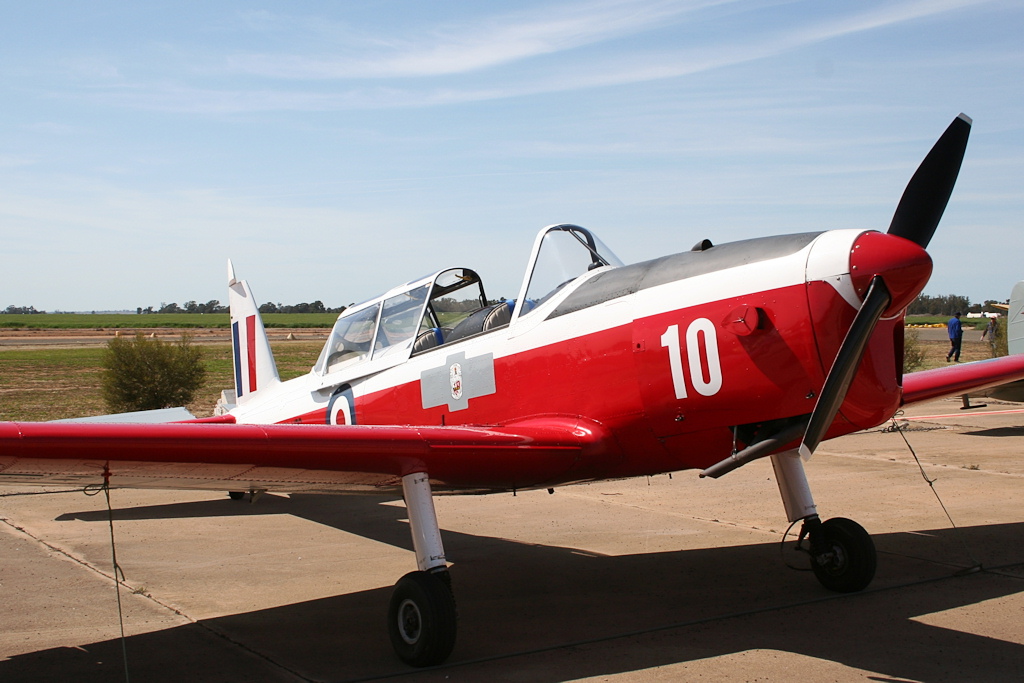
Source: Recreational Pilots
Maintenance
A current maintenance release was not carried in the aircraft and was later provided to the ATSB by the owner. It recorded that the aircraft’s most recent inspection was completed on 26 June 2014 at 5,129.25 hours time in service, with no outstanding defects.
Wreckage and impact information
The accident site was located about 400 m east of the Coffs Harbour Regional Airport runway 03[3] threshold (Figure 2).
The main wreckage was in an upright position, oriented towards the east (Figure 3). The damage to the aircraft and impact marks on the surrounding foliage and the ground indicated that the aircraft impacted terrain in a near vertical descent while yawing from left to right and in a slightly nose-low attitude. The fuselage and undercarriage absorbed much of the ground impact forces, as did the foliage and relatively soft, sandy ground.
All of the aircraft components were accounted for in the immediate area of the accident site. There was no evidence of any pre-impact failure.
Flight control continuity was established. The flaps appeared to be retracted at the time of impact. The elevator trim position could not be accurately determined due to the structural deformation of the fuselage.
A loose washer was found in an area behind the rear control box. Visual examination of the washer revealed no damage that would indicate that it had been jammed in the controls.
Both fuel tanks were compromised and there was a strong smell of fuel in the area underneath the tanks, indicating that fuel had drained from the tanks into the ground. The carburettor bowl was drained of about 80 mL of fuel, which was free from water and visible debris and had the appearance and smell of aviation gasoline.
Propeller damage was indicative of rotation without significant power. A limited on-site examination found that the engine rotated freely with good compression on the two undamaged rear cylinders and spark plugs indicating normal combustion. There was no evidence of oil contamination or oil leaks.
Figure 2: VH-UPD accident site location
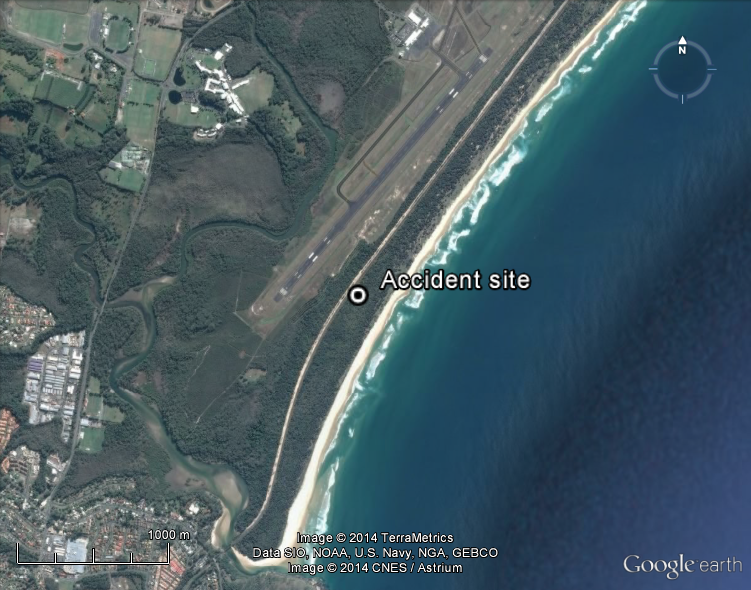
Source: Google earth, modified by the ATSB
Figure 3: VH-UPD accident site
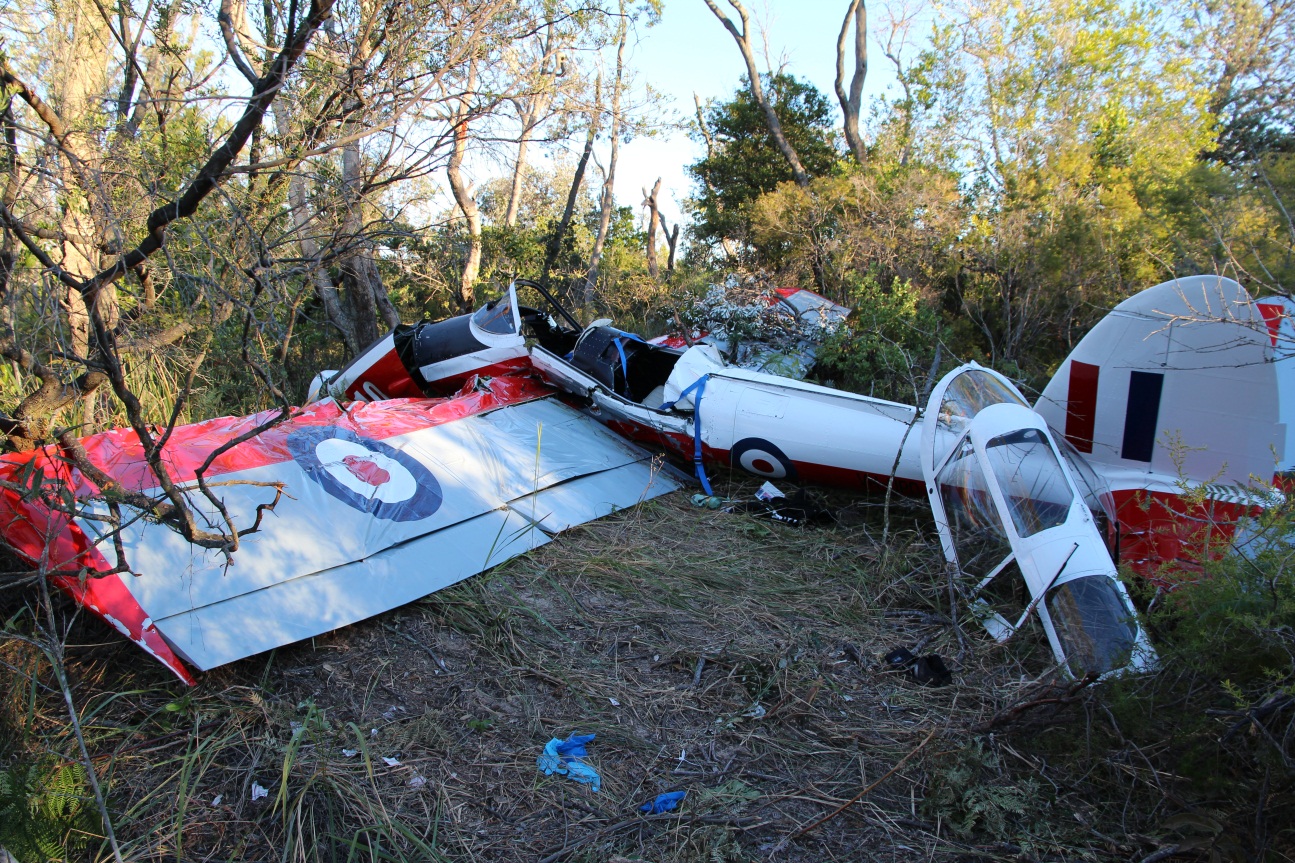
Source: ATSB
Survivability
The pilot sustained serious head, pelvic and leg injuries requiring hospitalisation. The passenger had a compressive back injury requiring hospitalisation. Both occupants were wearing four-point harnesses, which were reported to be fastened securely. Neither occupant was wearing a helmet.
ATSB analysis based on estimates of aircraft speed and rate of descent, impact angle, and energy absorption indicated that the impact forces imparted to the occupants would normally be expected to result in moderate to serious injuries.
Weather information
An automatic terminal information system (ATIS)[4] report for Coffs Harbour Airport at 1039 indicated a north-easterly wind at 5 kt, more than 10km visibility and few[5] cloud at 5,000 ft. At 1116, as part of normal air traffic communications, the air traffic controller informed the pilot that the surface wind was 8 kt from 100 °M.
Spins and spin recovery
Overview
An aerodynamic spin is a sustained spiral descent in which an aircraft’s wings are in a stalled condition,[6] with the outer wing producing more lift and less drag than the other wing. The associated forces sustain the rotation and keep the aircraft in the spin. A spinning aircraft will descend more slowly than one in a vertical dive and it will have a low airspeed, which may oscillate. The pitch angle can also vary considerably.
Intentional spins are normally entered from a stall in straight and level flight, and the application of full back elevator and full rudder in the intended direction of rotation at the moment of stall. The circumstances of a spin entry near the top of a loop may be very different. If a loop is not carried out correctly, the aeroplane can flick-roll[7] or stall at the top of the loop and, if not in balanced flight, may enter an upright spin.
When entering a spin, an aircraft’s motion through the air is irregular at first. This is known as the incipient phase of the spin. Though the nature of the incipient spin is heavily dependent on the aircraft type and the manner of entry, recovery may be more rapid and require less control input in this stage compared with recovery from a developed spin.
After a number of rotations and depending on the aircraft type, loading, and control inputs, an aircraft in an incipient spin may then settle into a regular rotating descent, known as a developed spin. A spin may steepen (nose down) or flatten (nose more horizontal) as it continues, potentially requiring different recovery techniques. Flight test reports indicate that a Chipmunk that enters a spin from a straight and level stall normally takes about three full rotations to enter a fully developed spin.
CASA Civil Aviation Advisory Publication (CAAP) 155-1(0) outlines the following standard spin recovery method, which ‘should be applicable in most situations and aircraft, but the procedure specified in the aircraft's flight manual is the ultimate authority’:
- Close throttle;
- Centralise ailerons;
- Identify if the aircraft is spinning, the direction, and whether upright or inverted;
- Full rudder opposite to rotation (opposite to yaw);
- Pause;
- Elevator forward [nose down] for upright and back for inverted as required to unstall;
- When rotation stops - centralise rudder;
- Roll wings level and recover to level flight.
With regard to elevator input in an upright spin, Stowell (2007) recommends pushing the elevator control forward using whatever force is necessary until either the spin stops (which may occur with the control stick between fully aft and neutral in aerobatic designs) or the forward control limit is reached.[8] Some publications recommend letting go of the control column, especially if the pilot is unsure whether the spin is upright or inverted, but in some aircraft types this may not result in recovery.
Chipmunk spins and recovery
The UK Civil Aviation Authority (UK CAA), Civil Aircraft Airworthiness Information and Procedures CAP 562 dated 29 November 2013, Leaflet B-250, Chipmunk Spinning and Aerobatics[9] gave the following instructions to recover from a spin in a Chipmunk:
Spin Recovery must be started at least 3,500 feet above ground level, in order to retain level flight by 1,500 feet, consistent with a height loss during recovery of up to 2,000 feet.
a) check throttle CLOSED;
b) check ailerons CENTRAL;
c) apply full OPPOSITE RUDDER;
d) PAUSE;
e) move the stick firmly FORWARD against the increasing stick force and stick buffet, IF NECESSARY TO THE FRONT STOP and hold it there until rotation ceases;
f) when rotation ceases CENTRALISE the rudder control and ease out of the ensuing dive.
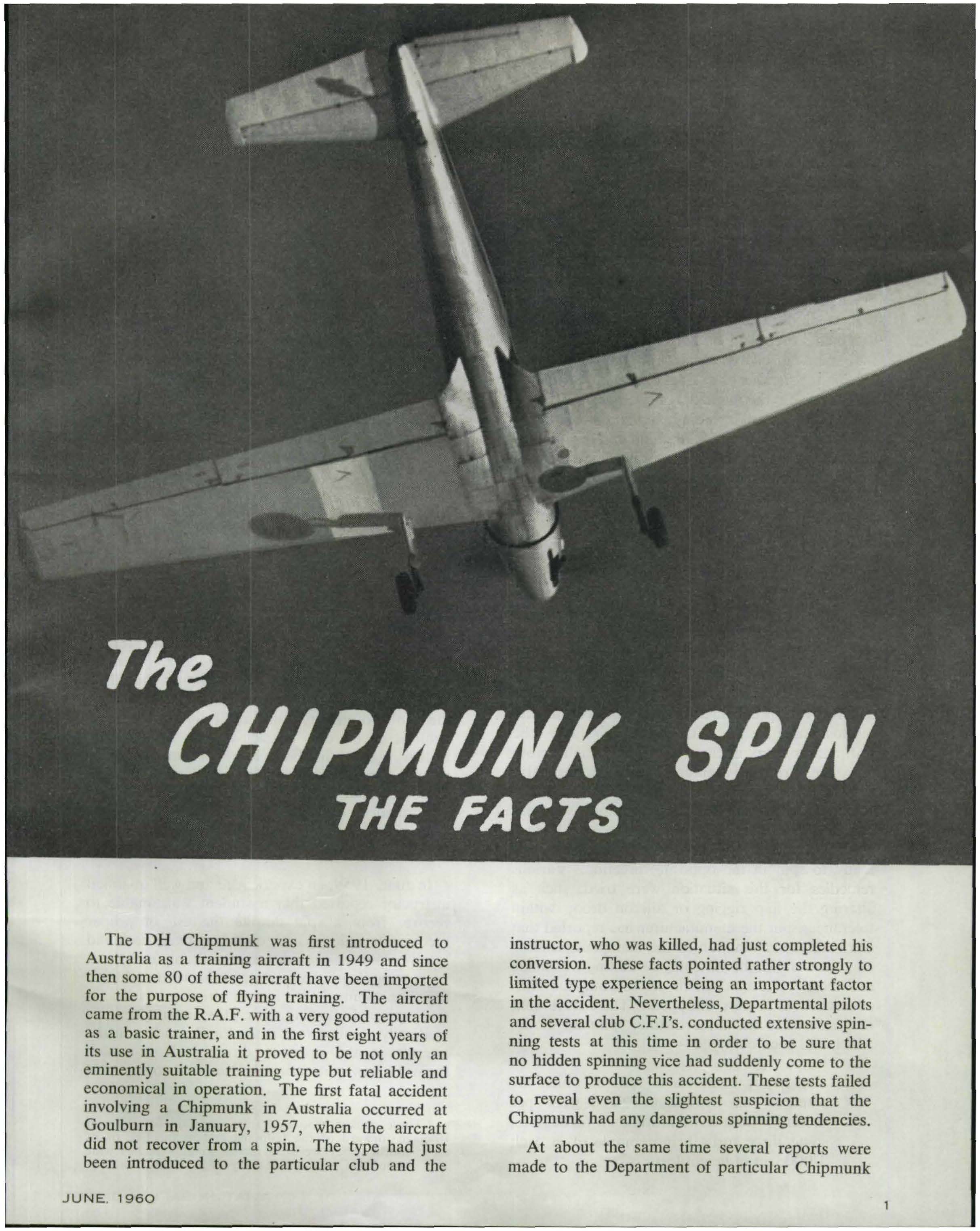
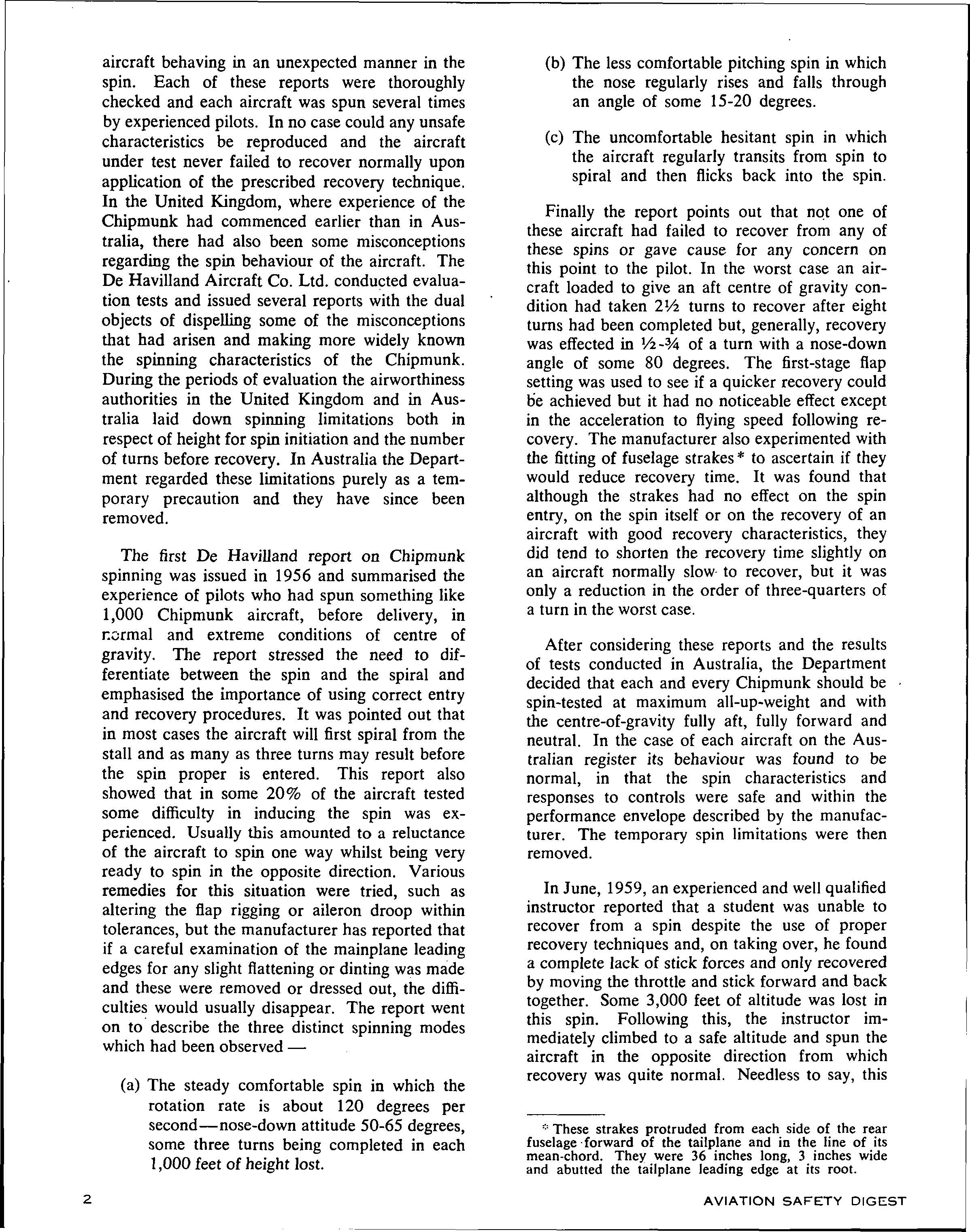
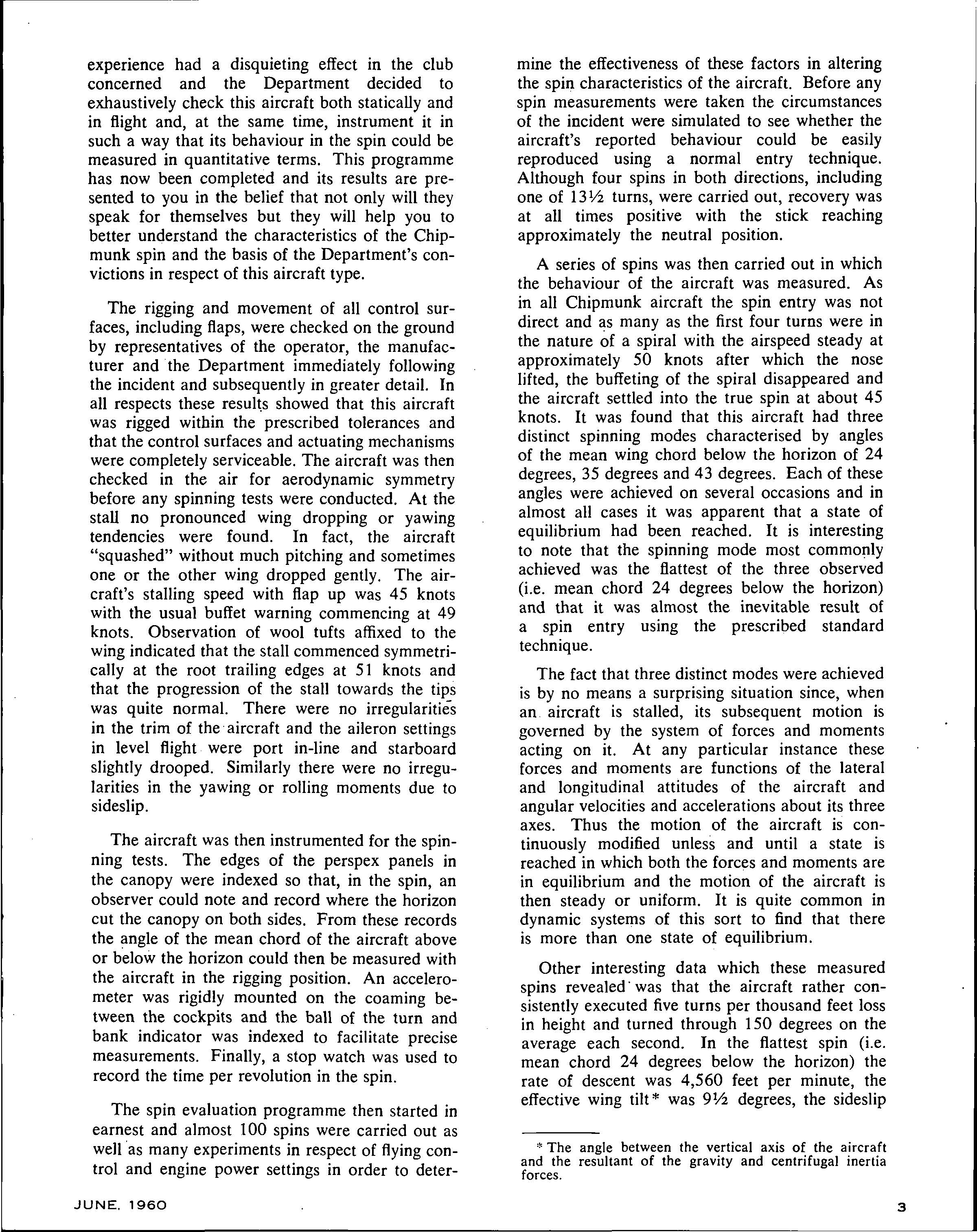
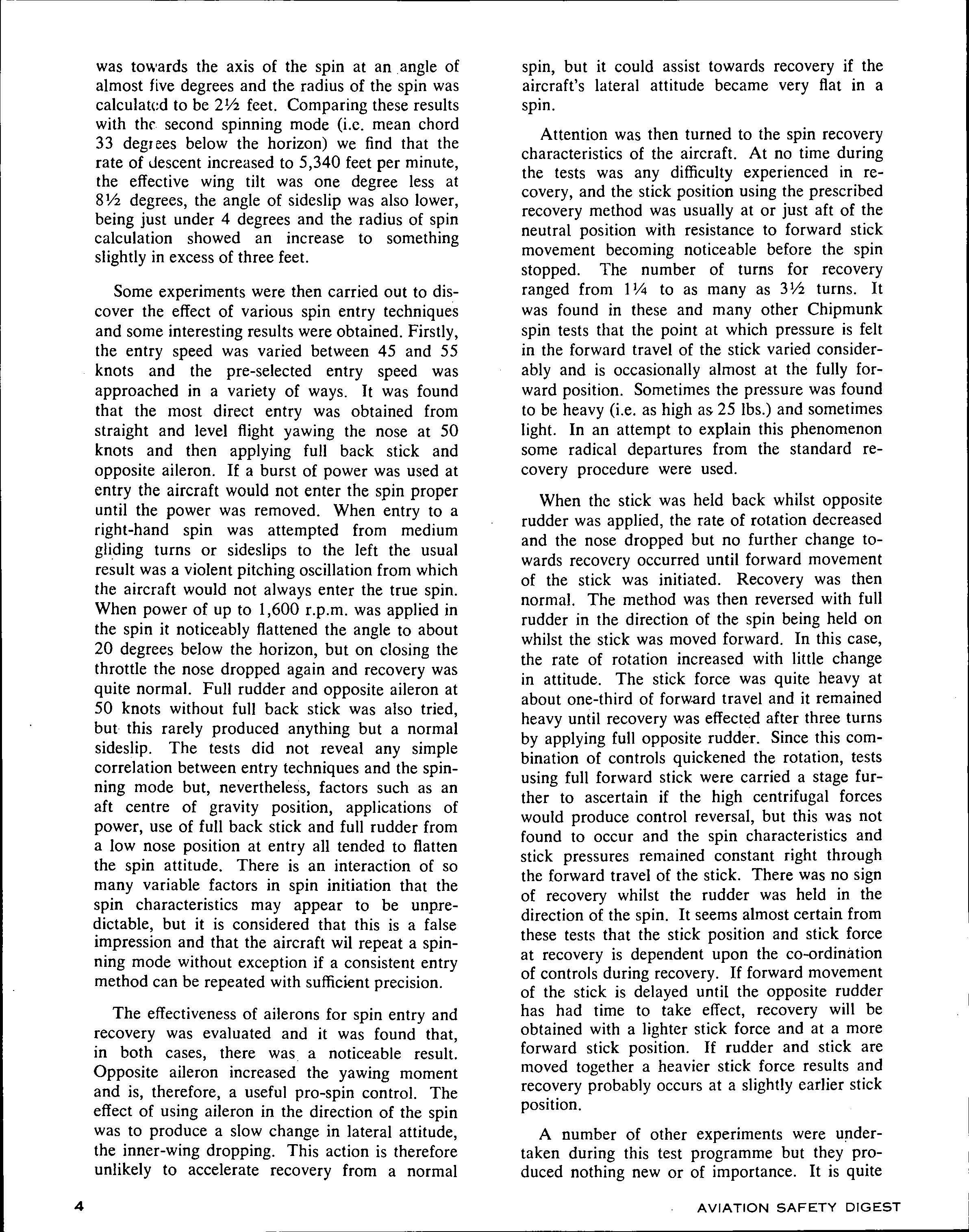
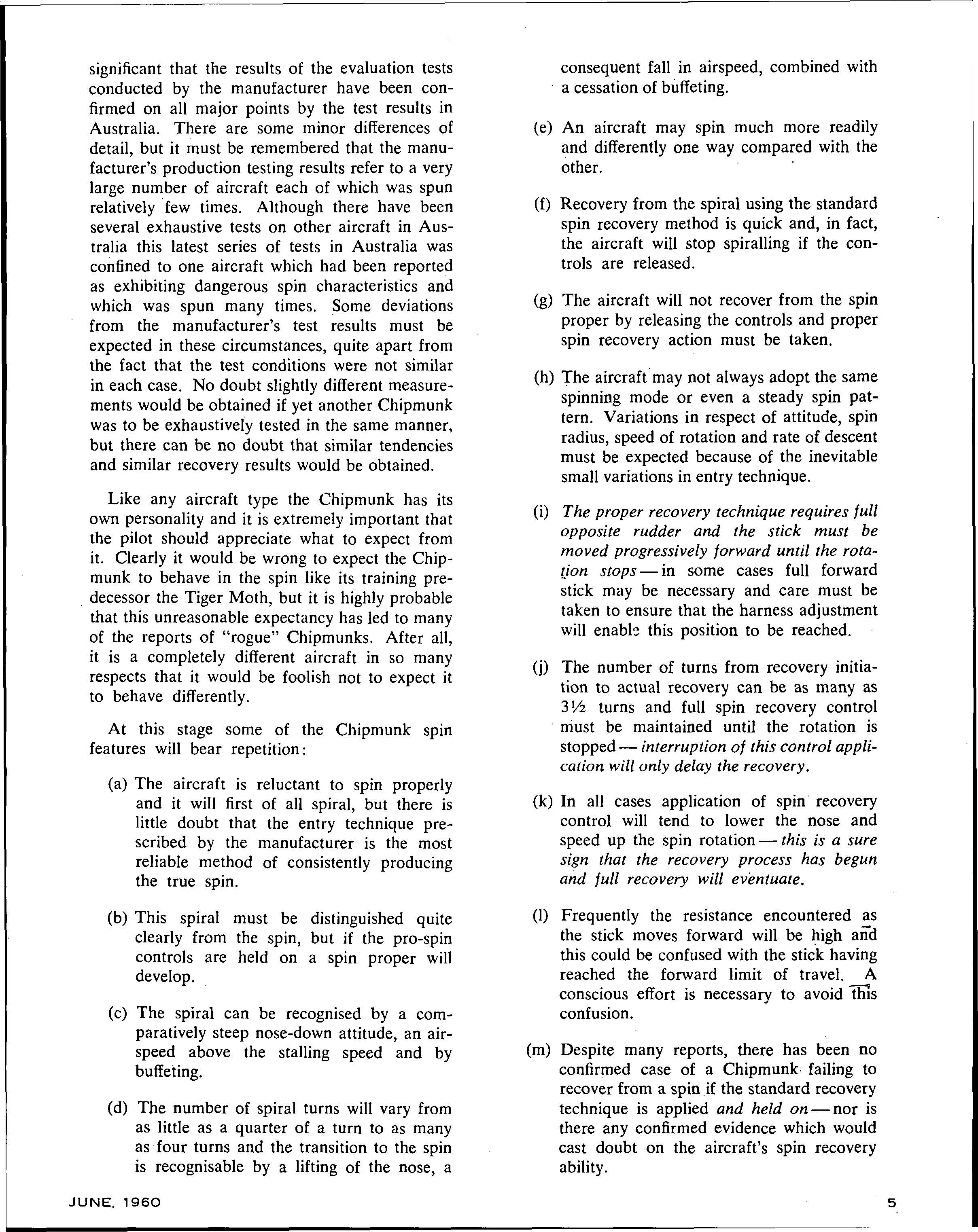
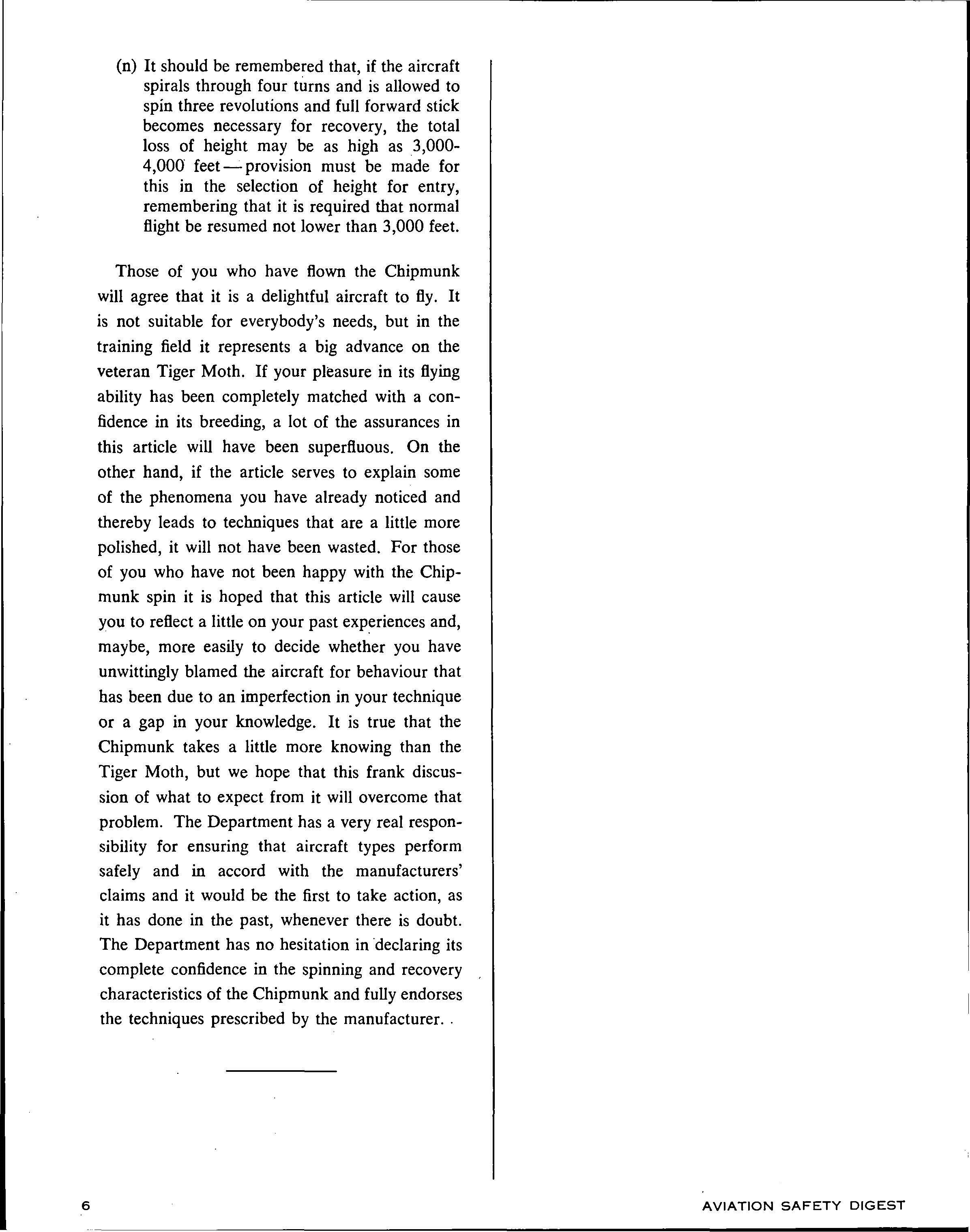
In June 1960 the Australian Department of Civil Aviation (DCA)[10] published a report that addressed contemporary concerns about the behaviour of the Chipmunk during spin recovery (refer Appendix A – Aviation Safety Digest No.22 extract – The CHIPMUNK SPIN THE FACTS). The report stated that ‘the point at which pressure is felt in the forward travel of the stick varied considerably and is occasionally almost at the fully forward position’ and could be heavy or light.
The ATSB reviewed several documents dating from 1958 onwards, including flight test reports and correspondence between UK authorities and the aircraft manufacturer and type design organisation. These documents addressed the spin and spin recovery behaviour of the Chipmunk. Collectively, the evidence indicated that Chipmunks always recovered from spins using the UK CAA-suggested recovery method described above.
The documents reviewed by the ATSB were consistent in their emphasis on the importance of forward stick movement, with more force than is normally used, and in maintaining full opposite rudder and increasing forward stick (up to the stop if necessary) until rotation ceases. This could take between one and four and a half turns after the application of correct control inputs. Stowell (2007) stated that ‘it is vital, therefore, to maintain spin recovery inputs for as long as is needed throughout the entire recovery process; otherwise, recovery could be delayed even longer.’
The training material used by the flying school did not contain spin recovery advice specific to the Chipmunk aircraft type. With regard to elevator control position, the ‘standard’ spin recovery method provided by the flying school’s training material did not emphasise the need for forward control stick movement against the control force (as opposed to neutrally forward from the rearward position).
Chipmunk semi-stalled spiral dive
A Chipmunk may enter a state known as the ‘semi-stalled spiral dive’ that may be confused with the spin. In this case, the aircraft’s attitude is steeply nose-down, with higher airspeed and, according to UK CAA Leaflet B-250, ‘upon releasing the controls the aeroplane will recover by itself, or with some opposite rudder, after rotating through one quarter to one half [of] a turn.’
The Australian DCA 1960 report stated that, in most cases, the aircraft will first spiral from the stall and that two or three turns may result before the spin proper is entered. The report stressed the need to differentiate between the semi-stalled spiral dive and the spin and emphasised the importance of using correct recovery procedures in each case.
A 1958 flight test report by the aircraft manufacturer stated that:
Recovery from the spiral dive is easy and quick whereas recovery from a spin requires deliberate and positive control for a longer time. Anti-spiral dive control will not result in recovery from a spin. When pilots, who have been used to spiral dives, find themselves in a spin they tend either not to apply adequate anti spin control or not to persist with the correct control movements for long enough.
Anti-spin strakes
The Chipmunk could be fitted with strakes on the rear fuselage that were intended to aid the recovery of the spin. According to the 1958 report, the strakes produce a ‘small but definite improvement in spin recovery’ but do not affect the aircraft’s ability to enter a spin. Despite this, they were commonly referred to as ‘anti-spin strakes.’
For UK-registered aircraft, an airworthiness directive[11] mandated fitment of strakes for aircraft approved for aerobatic manoeuvres and spins, along with a placard advising that ‘SPIN RECOVERY MAY NEED FULL FORWARD STICK UNTIL ROTATION STOPS’. Aircraft without strakes were required to display a placard stating ‘AEROBATICS AND SPINS PROHIBITED’.
In Australia, neither strakes nor related placards were mandated through an airworthiness directive; however, the strakes and placards were a requirement in accordance with the appropriate Australian flight manual (see Aircraft flight manuals for the DHC-1 Chipmunk). UPD and the other Chipmunk aircraft that the pilot flew were not fitted with anti-spin strakes.
Aircraft flight manuals for the DHC-1 Chipmunk
Aircraft flight manual for VH-UPD
The accident aircraft was a DHC-1 T Mk 10, a military variant, which was not issued with a civil type certificate[12] and, originally, had no civil aircraft flight manual (AFM).[13]
In Australia prior to 2002, CASA and its predecessors prepared, approved and issued AFMs for light civil aircraft. The flight manual in use for UPD was one such manual, approved specifically for that aircraft by CASA’s predecessor in 1988. It did not include guidance on spin recovery. It permitted any combination of various manoeuvres including spins and inside loops.
In 2002, changes to Australian regulations meant that aircraft owners needed to replace any flight manuals prepared by CASA, or its predecessors, with a type design organisation-approved flight manual. Until that date, the Chipmunk type design organisation had not produced, and had not been required to produce, a flight manual for civil operation of the military T Mk 10 variant. The type design organisation satisfied the CASA requirement and produced a flight manual for that aircraft type for use in Australia only. It included specific precautions for the operation of ‘Aircraft NOT Fitted with Anti-spin Strakes’. CASA advised that operators of civil T Mk 10 aircraft were required to use the 2002 flight manual.
According to the aircraft type design organisation, the owner of UPD did not purchase the newer flight manual. CASA records indicated that the aircraft’s owner made an application for approval of the 1988 flight manual in 2002. A subsequent letter from CASA advised the owner of ‘approval of the aircraft manufacturer’s flight manual for VH-UPD’; the accompanying approval form gave the reference number of a 2002 flight manual (see the next section), not the older flight manual. Records held by CASA did not contain evidence that the Civil Aviation Authority (Australian CAA)[14] produced AFM, dated 1988, had been approved as the aircraft’s AFM in 2002.
Aircraft type design organisation’s flight manual
The type design organisation’s 2002 generic[15] aircraft flight manual produced specifically for Australian-registered T Mk10 Chipmunks contained more information than the 1988 flight manual, including type-specific handling techniques that were not required under the CASA regulations. On spin recovery, it provided similar advice to the Leaflet B250 (see the section titled Spins and spin recovery).
The flight manual also stated that all civil Chipmunks cleared for aerobatics must display a cockpit placard with the following information: ‘SPIN RECOVERY MAY NEED FULL FORWARD STICK UNTIL ROTATION STOPS (also see Flight Manual)’. Aircraft not cleared for spins and aerobatics were required by the type design organisation’s flight manual to display a placard prohibiting aerobatics and spins.
Training aircraft
A flight manual for the Chipmunk used by the pilot’s flying school was a reprint of a 1966 UK military flight manual and was not specifically approved for, or tailored to, the flying school’s Chipmunk. On spin recovery, it gave similar advice to the Leaflet B-250 (see the section titled Spins and spin recovery).
An ‘aircraft information booklet’ (not an approved flight manual) for the Chipmunk that was used by the flying school recommended a loop entry speed of 130 kt.
Prior to publication of this ATSB report, the flying school ceased using the Chipmunk for flying training.
Related occurrences
The first fatal spin accident in a Chipmunk in Australia occurred on 19 January 1957 near Goulburn, New South Wales, and the reasons for the accident were not determined. After this accident and three other fatal Chipmunk spin accidents (in 1959 and 1960) for which the reasons were not determined, the Australian DCA conducted a detailed set of test flights to determine whether the Australian Chipmunk had suitable spin recovery handling characteristics. The results were disseminated in the 1960 DCA report discussed previously (see the section titled Chipmunk spins and recovery).
There were four other spin-related accidents involving Chipmunk aircraft in Australia between 1961 and 1968. While the last accident in January 1968 involved spin training, this accident was due a coin obstructing the elevator control system, which deprived the pilot of the elevator movement necessary to recover from the spin.
There were no other reported spin-related accidents involving Chipmunk aircraft in Australia between 1969 and 2014.
__________
- Runways are named with a number representing the magnetic direction of the runway. Runway 03 is approximately aligned to 030 °M.
- An automated pre-recorded transmission indicating the prevailing weather conditions at the aerodrome and other relevant operational information for arriving and departing aircraft.
- Cloud cover is normally reported using expressions that denote the extent of the cover. The expression few indicates that cloud was covering about a quarter of the sky.
- A stall occurs when the airflow separates from the wing’s upper surface and becomes turbulent. It occurs at high angles of attack, typically 16°–18°, and results in reduced lift.
- A flick-roll is a very rapid roll, the speed of which is promoted by stalling one wing only.
- See also Stowell, R. (2012). Guidelines for Pilots Seeking All-Attitude Training, available through www.safepilots.org.
- Available through www.caa.co.uk.
- The Australian Department of Civil Aviation was the national aviation authority until 1973.
- UK Civil Aviation Authority AD No. 2799 PRE 80.
- A type certificate is a document issued by an airworthiness authority to indicate approval of the type design of a particular model of aircraft.
- An AFM is a book containing the limitations, procedures, performance and other information and instructions required to operate a particular aircraft safely.
- CASA was formerly known as the Civil Aviation Authority (CAA).
- The AFM issue viewed by the ATSB did not contain data that was unique to an aircraft (such as weight and balance information) that needed to be included when approved for a particular aircraft.
Safety analysis
Stall and spin entry
Based on the pilot, passenger, and witness reports, the aircraft stalled at or near the top of an attempted loop, rolled upright and entered an upright spin that then became flatter. The pilot’s control inputs are not known with certainty, but the stall was most likely initiated by too much elevator (stick back) control input for the aircraft’s relatively low speed at the top of the loop.
If an aircraft’s speed is too low when approaching the top of a loop, a pilot can mistakenly apply too much elevator (stick back) control when trying to correct for the low speed. The subsequent increased angle of attack could then produce a stall. There can be several reasons for a low airspeed at the top of a loop, such as:
- low entry speed
- insufficient throttle increase during the first part of the loop
- too little g[16] throughout the loop, increasing the loop circumference and resulting in excessive altitude gain
- too much g load throughout the loop, producing increased induced drag.
A single-propeller aircraft in a powered stall would be expected to roll. The direction of UPD’s roll and spin was consistent with its natural tendency to roll and spin to the right (opposite to the direction of propeller rotation) in a positive-g, inverted stall. Control authority would have been greatly reduced by the low airspeed and any excessive application of aileron or rudder would have increased the risk of the roll developing into a spin.
The pilot reported receiving training to conduct loops and thought that he held the appropriate endorsement to do so as pilot-in-command, but did not have documentary evidence of it. The pilot’s instructors reported that the pilot had not yet demonstrated the required skills to be endorsed to conduct loops as pilot-in-command. This indicated that the pilot had not demonstrated the necessary competence required to perform a loop consistently or execute a recovery from an unsuccessful loop.
Unsuccessful spin recovery
According to the results of numerous flight tests, a Chipmunk can be recovered from a spin if there is sufficient recovery height available, and the ATSB estimated that the aircraft had enough height for a successful recovery in this case. Both UPD and the flying school’s Chipmunk were used for aerobatic flight without being fitted with anti-spin strakes. According to most reports, a Chipmunk without strakes will recover from a spin but somewhat more slowly than one fitted with that capability. If anti-spin strakes had been installed on UPD, they may have assisted a recovery if the correct flight control inputs were made and held for a sufficient length of time. Additionally, the Chipmunk T Mk 10 (Australia Only) flight manual specifies greater heights above ground level for spinning manoeuvres.
The pilot later reported that, at the time, he recognised that the aircraft was in a spin but did not have a complete recollection of how he attempted to recover from the spin. It was not possible to conclusively determine why the recovery attempts were unsuccessful but it is likely that correct control inputs (particularly opposite rudder and progressively forward control stick) were not made, or not held for long enough to be effective. However, there are a number of factors which probably had an influence.
The method of spin recovery taught by the pilot’s flight instructor, and practised by the pilot during training, was to apply opposite rudder and approximately central control stick. The application of central control stick allows recovery in some Chipmunks, particularly from an incipient spin or semi-stalled spiral dive. It also works for some newer aircraft types that are designed to exhibit more benign spin behaviour. However, it does not work for all Chipmunks, especially once a spin has fully developed. The method of spin recovery described by the pilot would probably have been ineffective once the spin was fully developed. The aircraft also might have entered a fully-developed spin more rapidly than during the pilot’s training because of the unusual manner of entry, or as the result of weight and aerodynamic differences between it and the training aircraft.
To recover from a fully-developed spin in a Chipmunk, it is important to push the control stick forward – fully forward if necessary – after applying full opposite rudder. The pilot’s training apparently did not emphasise full forward movement of the stick against any resistive control force, a degree of movement that was recommended by the aircraft type design organisation for this particular aircraft type. It is also possible that, in attempting to apply central control stick, the pilot unwittingly held a more rearward stick position than intended due to the control forces. This is a hazard highlighted by the 1960 Australian Department of Civil Aviation flight test report, which stated:
Frequently the resistance encountered as the stick moves forward will be high and this could be confused with the stick having reached the forward limit of travel. A conscious effort is necessary to avoid this confusion.
Finally, it is uncertain whether the pilot actually applied positive spin recovery control properly, or for long enough for it to be effective. The pilot learned about spin recovery under controlled and relatively predictable conditions, as well as receiving a pre-flight briefing and discussion regarding the spin training flight. In these circumstances, the spin entry is relatively smooth, consistent and expected. In contrast, about a year after having learned and practised how to manage spins (only to the left), the pilot encountered an unexpected spin to the right from an attempted loop. This can be disorienting and slow the identification of the problem and application of the correct control inputs, especially if the responses were not recently practiced. Infrequently used knowledge and infrequently practiced skills degrade over time, and in an emergency the ability to recall them rapidly and accurately is generally impeded further. Regularly reviewing important knowledge and skills, particularly as part of self-briefing prior to a flight, may facilitate a more rapid and accurate recall ‘in the heat of the moment’.
Instructor training
The pilot’s flight instructor taught and used a method for Chipmunk spin recovery that was reasonably effective in the early stages of a spin, but would become less effective as the spin developed. It was different to the standard method of spin recovery recommended by the Civil Aviation Safety Authority, and to the Chipmunk-specific method recommended by the type design organisation. The flying school’s training materials did not include Chipmunk-specific spin recovery methods, and did not clearly emphasise the forward control stick movement necessary for some aircraft.
Civil Aviation Order 40.0 stated that a flight instructor must be ‘…satisfied that the holder can safely recover an aeroplane from a fully developed upright spin’ (emphasis added), but the pilot was taught to recover from an early-stage and possibly incipient spin rather than when fully developed. Although modern aircraft may recover from a spin using less than optimal control inputs, it is important to teach and demonstrate competence in recovering from spins in the manner most appropriate to the aircraft type that the student pilot intends to fly, especially if aerobatic manoeuvres are planned.
The instructor’s objective of using a more central elevator position was to put the control stick in a position that would allow a stalled aircraft to un-stall, as described in Civil Aviation Advisory Publication 155-1(0). That is:
The fore and aft position of the control column determines the angle of the aircraft's wings to the airflow. For example, the stick positions for cruise, glide and the stall move progressively aft. Once the stick position for the stall has been determined (and remembered), it can be used as a measure of whether an aircraft's wing is stalled or not. If the stick is forward of the 'stalled stick position', the aircraft will always be in unstalled flight, regardless of aircraft attitude or airspeed.
While this concept may be correct under most conditions, it is not generally the case in situations such as a spin, where elevator authority is reduced and rotational forces become significant. As stated elsewhere in the advisory publication, it is important to use the aircraft’s approved documentation as the primary and most reliable source of information.
Aircraft documentation
The Civil Aviation Safety Authority advised that the flight manual originally produced by the aircraft type design organisation in 2002 was the only currently approved manual for the T Mk 10 Chipmunk in Australia. Records show that the aircraft’s flight manual approval lapsed in 2002 and that the newer flight manual was not obtained by the owner. Consequently, pilots of UPD were using information that was out of date. Although there was no requirement for spin recovery guidance to be included, the approved flight manual provided by the aircraft type design organisation did include such guidance and would have provided a reliable source of valuable information for the pilots of UPD to follow.
The flying school had a different flight manual for its Chipmunk aircraft, which was also not approved. Although that flight manual contained generally appropriate spin recovery advice, it did not incorporate the latest approved information. There are variations between aircraft of the same type, often due to modifications and repairs, and using an unapproved flight manual increases the risk that the information within it is not appropriate for that particular aircraft.
__________
- G Load is the nominal value for acceleration. In flight, g load values represent the combined effects of flight manoeuvring loads and turbulence. This can be a positive or negative value.
Findings
From the evidence available, the following findings are made with respect to the collision with terrain involving de Havilland Canada DHC-1 Chipmunk, registered VH-UPD, that occurred at Coffs Harbour, New South Wales, on 29 June 2014. These findings should not be read as apportioning blame or liability to any particular organisation or individual.
Safety issues, or system problems, are highlighted in bold to emphasise their importance. A safety issue is an event or condition that increases safety risk and (a) can reasonably be regarded as having the potential to adversely affect the safety of future operations, and (b) is a characteristic of an organisation or a system, rather than a characteristic of a specific individual, or characteristic of an operating environment at a specific point in time.
Contributing factors
- The pilot attempted to conduct a loop without the required qualification.
- The aircraft entered an upright spin after a stall or flick-roll at the top of an attempted loop.
- The pilot probably did not apply and maintain the spin recovery control inputs appropriate for a fully developed spin in a Chipmunk, and the spin continued until impact with terrain.
Other factors that increased risk
- The flight instructor who taught the pilot spin recovery did not teach the method to recover from a developed spin that was appropriate for the aircraft type.
- The spin recovery methods taught by the flying school were inconsistent across instructors and training material, and were not always appropriate for the Chipmunk aircraft type used by the school. [Safety Issue]
- The approval for the accident aircraft’s flight manual had been revoked, and the flight manual in use lacked the spin recovery instructions that would have been present in a flight manual issued by the aircraft type design organisation.
- The flying school’s Chipmunk aircraft was used for aerobatic instruction and endorsement without having a current, approved flight manual that contained spin recovery instructions.
Safety issues and actions
The safety issues identified during this investigation are listed in the Findings and Safety issues and actions sections of this report. The ATSB expects that all safety issues identified by the investigation should be addressed by the relevant organisation(s). In addressing those issues, the ATSB prefers to encourage relevant organisation(s) to proactively initiate safety action, rather than to issue formal safety recommendations or safety advisory notices.
All of the directly involved parties were provided with a draft report and invited to provide submissions. As part of that process, each organisation was asked to communicate what safety actions, if any, they had carried out or were planning to carry out in relation to each safety issue relevant to their organisation.
The initial public version of these safety issues and actions are repeated separately on the ATSB website to facilitate monitoring by interested parties. Where relevant the safety issues and actions will be updated on the ATSB website as information comes to hand.
Flying school spin recovery training
The spin recovery methods taught by the flying school were inconsistent across instructors and training material, and were not always appropriate for the Chipmunk aircraft type used by the school.
ATSB Safety Issue AO-2014-114-SI-01
Sources and submissions
Sources of information
The sources of information during the investigation included:
- the pilot and passenger
- the flying school and instructors
- the aircraft owner
- the air traffic controller
- air traffic recordings
- a number of witnesses
- de Havilland Support Limited (type design organisation)
- Civil Aviation Safety Authority (CASA)
- the Bureau of Meteorology.
References
United Kingdom Civil Aviation Authority. (2013) CAP 562 Civil Aircraft Airworthiness Information and Procedures, Leaflet B-250, Chipmunk Spinning and Aerobatics.
Stowell, R (2007). The Light Airplane Pilot's Guide to Stall/spin Awareness: Featuring the PARE Spin Recovery Checklist. Rich Stowell Consulting Ventura.
Stowell, R. (2012). Guidelines for Pilots Seeking All-Attitude Training.
Submissions
Under Part 4, Division 2 (Investigation Reports), Section 26 of the Transport Safety Investigation Act 2003 (the Act), the ATSB may provide a draft report, on a confidential basis, to any person whom the ATSB considers appropriate. Section 26 (1) (a) of the Act allows a person receiving a draft report to make submissions to the ATSB about the draft report.
A draft of this report was provided to the pilot, aircraft owner, United Kingdom Air Accidents Investigation Branch, type design organisation, flying school and CASA.
Submissions were received from the United Kingdom Air Accidents Investigation Branch, type design organisation and CASA. The submissions were reviewed and where considered appropriate, the text of the report was amended accordingly.
Appendices
Appendix A – Aviation Safety Digest No.22 extract
Purpose of safety investigationsThe objective of a safety investigation is to enhance transport safety. This is done through:
It is not a function of the ATSB to apportion blame or provide a means for determining liability. At the same time, an investigation report must include factual material of sufficient weight to support the analysis and findings. At all times the ATSB endeavours to balance the use of material that could imply adverse comment with the need to properly explain what happened, and why, in a fair and unbiased manner. The ATSB does not investigate for the purpose of taking administrative, regulatory or criminal action. TerminologyAn explanation of terminology used in ATSB investigation reports is available here. This includes terms such as occurrence, contributing factor, other factor that increased risk, and safety issue. Publishing informationReleased in accordance with section 25 of the Transport Safety Investigation Act 2003 Published by: Australian Transport Safety Bureau © Commonwealth of Australia 2016 
Ownership of intellectual property rights in this publication Unless otherwise noted, copyright (and any other intellectual property rights, if any) in this report publication is owned by the Commonwealth of Australia. Creative Commons licence With the exception of the Coat of Arms, ATSB logo, and photos and graphics in which a third party holds copyright, this publication is licensed under a Creative Commons Attribution 3.0 Australia licence. Creative Commons Attribution 3.0 Australia Licence is a standard form licence agreement that allows you to copy, distribute, transmit and adapt this publication provided that you attribute the work. The ATSB’s preference is that you attribute this publication (and any material sourced from it) using the following wording: Source: Australian Transport Safety Bureau Copyright in material obtained from other agencies, private individuals or organisations, belongs to those agencies, individuals or organisations. Where you wish to use their material, you will need to contact them directly. |
Occurrence summary
| Investigation number | AO-2014-114 |
|---|---|
| Occurrence date | 29/06/2014 |
| Location | Coffs Harbour Airport, SE 1 km |
| State | New South Wales |
| Report release date | 04/02/2016 |
| Report status | Final |
| Investigation level | Defined |
| Investigation type | Occurrence Investigation |
| Investigation status | Completed |
| Mode of transport | Aviation |
| Aviation occurrence category | Collision with terrain |
| Occurrence class | Accident |
| Highest injury level | Serious |
Aircraft details
| Manufacturer | De Havilland Canada/De Havilland Aircraft of Canada |
|---|---|
| Model | DHC-1 T MK 10 |
| Registration | VH-UPD |
| Serial number | C1/0111 |
| Sector | Piston |
| Operation type | Private |
| Departure point | Coffs Harbour, New South Wales |
| Destination | Coffs Harbour, New South Wales |
| Damage | Substantial |