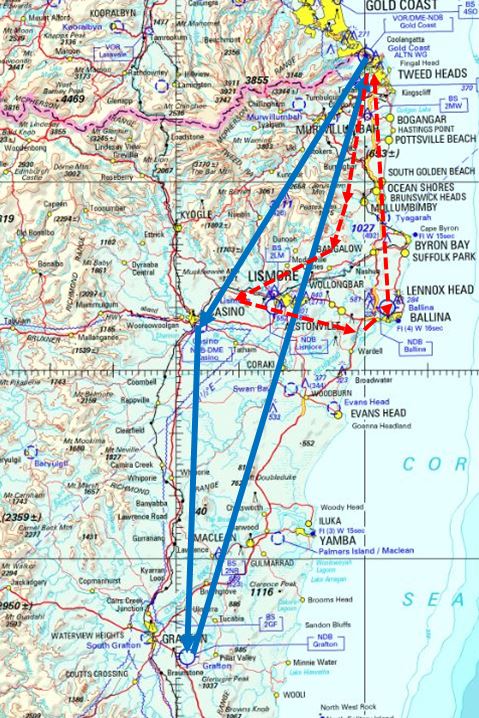
On 19 March 2016, a student pilot prepared for their first solo navigation training exercise in Cessna 172, registered VH-EOV (EOV). The flight was planned from the Gold Coast Airport, Queensland (Qld), overhead Casino, and onto Grafton Airport, New South Wales (NSW). The return leg plan was from Grafton Airport direct to the Gold Coast Airport (Figure 1 blue lines).
Prior to departure, the pilot and their instructor checked the flight plan and discussed the weather forecast. They both then checked the live weathercam[1] at Lismore Airport, NSW, as Lismore is close to Casino. The weathercam showed some fog and low cloud, with clear skies above. As a final assessment, the pilot and instructor walked outside and visually assessed the conditions.
Source: Airservices Australia Armidale World Aeronautical Chart annotated by ATSB
The instructor was satisfied that the low cloud at Lismore would soon burn off and the pilot would be able to complete the visual flight rules (VFR)[2] navigation exercise at the planned level of 6,500 ft above mean sea level. The instructor then prepared to depart on another flight. About thirty minutes later, the instructor taxied past EOV in another aircraft and noted that the pilot was still preparing EOV for the flight.
At about 1012 Eastern Standard Time (EST), EOV departed on runway 14, about 1.5 hours after they were approved by the instructor to depart. Due to jet traffic, the Gold Coast Tower controller instructed the pilot to make a right turn after take-off (on to their planned track) and climb to 2,500 ft. About two minutes later, the Tower controller cleared EOV to climb to 3,000 ft. As the pilot initiated the right turn, they assessed that the weather conditions on their intended track were worse than they had expected, with the visibility ahead reduced by haze and cloud.
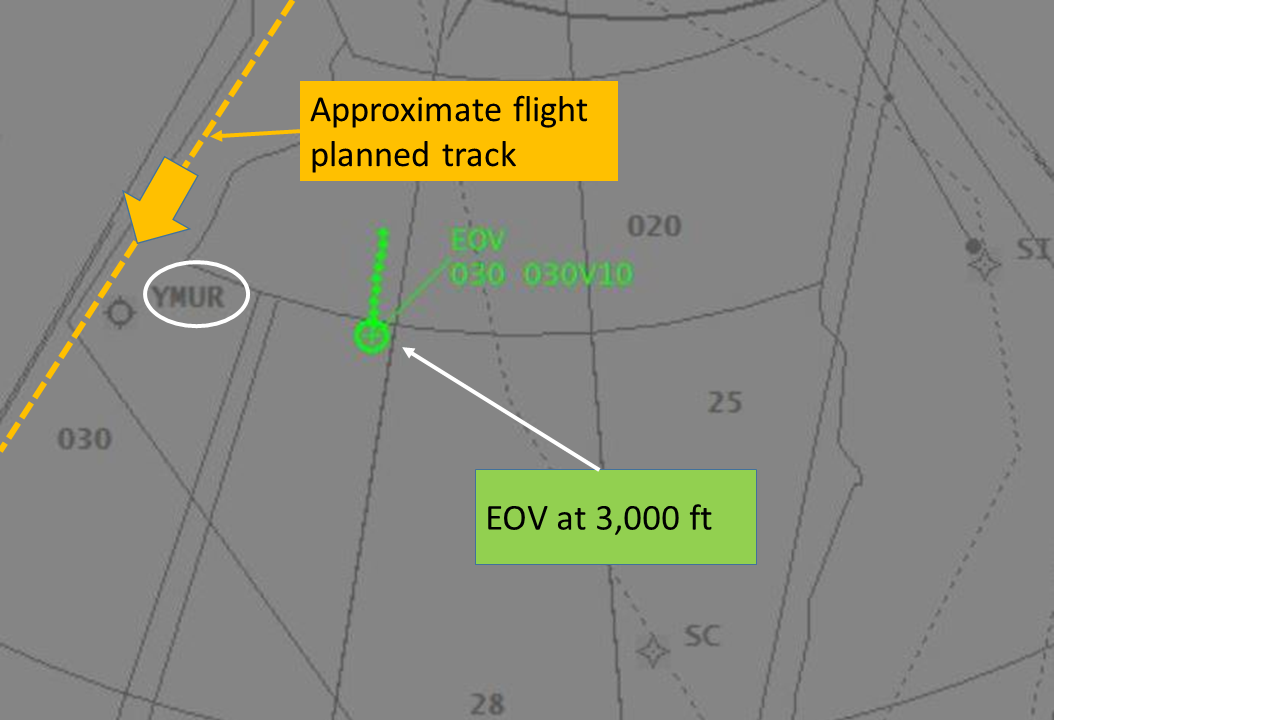
Part way through the right turn, the pilot unintentionally stopped the turn and started to track in a southerly direction, instead of south-westerly toward Casino. Noting that the aircraft was not tracking as expected, the Tower controller asked the pilot to confirm their current heading. The pilot asked the controller to ‘standby’. With no further response from the pilot, the controller then instructed them to turn right onto a heading of 250°. However, the pilot continued to track about 40° left of track (Figure 2). To assist the pilot, the controller advised them of their current position, cleared the aircraft from that position direct to Casino, and as per normal procedure, and instructed the pilot to change frequency to contact Brisbane Approach.
Figure 2: Flight planned track to Casino in yellow. EOV (green) tracking to the east of Murwillumbah Airport (YMUR, white circle) in a southerly direction
Source: Airservices Australia – annotated by ATSB
The aircraft was now very close to cloud and the pilot had turned all their attention to this threat. At 1020, the pilot contacted the Approach controller to request a climb to not above 5,500 ft, as this would give them flexibility to climb or descend as required to avoid entering cloud. The Approach controller advised the pilot there would be a short delay prior to this request being approved. During this period, EOV entered cloud.
The pilot spent the next few minutes focussed solely on the flight instruments but did not inform the controller that they were in cloud. The Approach controller then approved the pilot to climb to 5,000 ft. While still in cloud, the pilot began the climb, and inadvertently started to turn left. The Approach controller questioned what heading the pilot was on and when the pilot could not answer correctly, they suggested a heading for Casino. The pilot turned on to the suggested heading. The pilot then observed a break in the cloud below them and requested a descent. The Approach controller approved the descent and asked the pilot to confirm that operations were normal. The pilot replied that all their instruments were working correctly. The pilot then descended to 1,500 ft and exited the cloud. The pilot later estimated that they were in cloud for approximately three minutes.
The pilot had a brief radio discussion with their instructor, who was flying in a different aircraft in the vicinity. Their instructor advised them that Casino Airport was closed. Making the decision to discontinue the navigation exercise and to return to the Gold Coast along the coast, the pilot turned EOV to the east. At 1100, the pilot advised Brisbane Centre (Centre) air traffic control (ATC) that they were about 3 NM east of Lismore, and were now tracking to the coast. At 1105, Centre ATC identified EOV on radar 4 NM south of Ballina, NSW.
The pilot of EOV did not change the radio frequency to the common traffic area frequency (CTAF) as required when transiting within 10 NM of Ballina. At 1108, as a regular public transport jet aircraft was inbound to Ballina, the Centre controller attempted to call the pilot of EOV to advise them of the conflicting traffic. However, the pilot did not respond. The Centre controller then issued a safety alert to the pilot of EOV advising the jet traffic was now at 1,100 ft (the same level as EOV). The pilot in EOV acknowledged this alert advising that they had the jet traffic sighted. The two aircraft passed within 1.7 NM of each other at a similar level.
As EOV tracked north along the coast toward the Gold Coast (red line in Figure 1), the Centre controller advised the pilot of a conflicting aircraft tracking southbound. The pilot acknowledged this call and advised they were looking for this traffic. The two aircraft passed without incident. The pilot then continued to the Gold Coast and landed without incident.
Pilot experience and comments
At the time of the incident, the pilot had logged about 46 flying hours. Three hours of this was instrument[3] flight training.
The pilot provided the following comments:
The weather had changed very quickly, and that it was different to that expected.
They felt no pressure to conduct the flight. They had been briefed to ‘turn back’ to the Gold Coast if at any time they felt uncomfortable with the weather.
They did not specifically alert ATC that they had entered cloud. They had however, advised ATC that they were uncertain of the aircraft’s position, and accepted assistance in that regard.
They had attempted to program the “Direct To” function on the KLN89B GPS installed in the aircraft, but had not been able to get this to work. They were not confident in the use of the navigation aids (VOR and ADF).
The pilot reported that the level of stress they were under after entering cloud had added to the normal stress level of conducting a first solo navigation exercise. This had made processing information much more difficult, but they remained focussed on keeping the aircraft level using their limited experience relying solely on the flight instruments.
The pilot had sat the Private Pilot Licence theory test the day prior to the flight, and therefore the week before the flight had been busy.
The pilot advised the best safety message to convey to other pilots with limited experience was to stay aware of the terrain around you. If the weather is not as expected, make an early decision to turn back.
Instructor experience and comments
The instructor held a Commercial Pilot’s Licence with a grade 2 training endorsement.
This instructor had been the pilot’s regular instructor and had conducted all the previous dual navigation exercises with them. The instructor reported that the student had previously experienced some difficulty with departures from the Gold Coast, but this had been addressed with training.
The instructor provided the following comments:
They were surprised when the pilot had not departed until about 1.5 hours after being authorised to depart.
They also found the weather worse than forecast and were surprised how much cloud was still around.
By the time the pilot did depart, a safer cruising level would have been about 2,500 ft.
All students at the flying school are exposed to basic use of the navigation aids at this stage of their training. Loading a flight plan into the GPS is demonstrated, but it is not expected that the student would be proficient in the use of these aids at this stage.
While on another flight in the Casino area, they had advised the pilot by radio that Casino Airport was unserviceable.
The student had done well in the instrument flight component of their training.
They felt comfortable with the decision to let the pilot depart on the solo exercise that day.
Flying School comments
The flying school reported that the student departed with the intention of reaching the planned altitude of 6,500 ft with broken cloud at 3,500 ft without carefully considering alternative altitudes.
The school also advised that the student incorrectly used the VHF Omnidirectional Radio Range (VOR) for establishing the departure track and did not identify the cloud ahead in a timely manner.
The student did not clarify with ATC that a climb was required in order to remain in VMC and when they entered cloud, they did not follow the procedure to ensure they returned to VMC as quickly as possible.
Weather
Initial weather reports indicated that the conditions would be suitable for the solo flight. The Gold Coast Airport Aerodrome Forecast was for scattered cloud at 2,000 ft above ground level, with broken cloud at 3,500 ft. The Area Forecast pertinent to the planned flight indicated that the broken low cloud would lift by 0900.
ATSB comment
Pilots are encouraged to make conservative decisions when considering how forecast weather may affect their flight. If poor weather is encountered enroute, timely and conservative decision making may be critical to a safe outcome. It is advisable to make a positive decision to turn back if the weather is not as planned and outside the capability of their experience level.
The ATSB also encourages pilots to seek assistance from ATC as soon as they find themselves in difficulty, or preferably, before the situation escalates to that point, so that ATC can provide timely assistance.
Safety action
Whether or not the ATSB identifies safety issues in the course of an investigation, relevant organisations may proactively initiate safety action in order to reduce their safety risk. The ATSB has been advised of the following proactive safety action in response to this occurrence.
Operator – flying school
As a result of this occurrence, flying school has advised the ATSB that they are taking the following safety actions:
A formalised brief will be given to all students prior to their first training area solo flight.
This brief will have an emphasis on:
maintaining situational awareness when weather conditions are less than optimal
the importance of maintaining VMC at all times will be re-addressed
the importance of conducting a 180° turn on instruments if a pilot does inadvertently find themselves in cloud
when encountering cloud, to include the phrase ‘due cloud’ in transmissions with ATC
the importance of seeking early assistance from ATC, rather than letting the situation deteriorate
when to use ‘request’ and when to use ‘require’ when seeking a clearance from ATC
be clear on phraseology like ‘not above’ when requesting altitudes from ATC.
Safety message
The ATSB SafetyWatch highlights the broad safety concerns that come out of our investigation findings and from the occurrence data reported to us by industry.
Number 4 in the Avoidable Accident series published by the ATSB titled ‘Accidents involving pilots in Instrument Meteorological Conditions’ lists three key messages for pilots:
Avoiding deteriorating weather or IMC requires thorough pre-flight planning, having alternate plans in case of an unexpected deterioration in the weather, and making timely decisions to turn back or divert.
Pressing on into IMC conditions with no instrument rating carries a significant risk of severe spatial disorientation due to powerful and misleading orientation sensations in the absence of visual cues. Disorientation can affect any pilot, no matter what their level of experience.
VFR pilots are encourage to use a ‘personal minimums’ checklist to help control and manage flight risks through identifying risk factors that include marginal weather conditions.
Available from CASA’s online store are:
Weather to Fly – This DVD highlights the dangers of flying in cloud, and how to avoid inadvertent VFR into IMC.
Flight Planning – always thinking ahead. A flight-planning guide designed to help you in planning and conducting your flight. This guide includes a ‘personal minimums checklist.
SKYbrary have published an informative article looking at pre-flight risk management / and practical measures to maintain control for a limited period if a pilot had inadvertently flown VFR into IMC.
Decisions regarding whether to conduct an investigation, and the scope of an investigation, are based on many factors, including the level of safety benefit likely to be obtained from an investigation. For this occurrence, a limited-scope, fact-gathering investigation was conducted in order to produce a short summary report, and allow for greater industry awareness of potential safety issues and possible safety actions.
Publishing information
Released in accordance with section 25 of the Transport Safety Investigation Act 2003
Ownership of intellectual property rights in this publication
Unless otherwise noted, copyright (and any other intellectual property rights, if any) in this report publication is owned by the Commonwealth of Australia.
Creative Commons licence
With the exception of the Coat of Arms, ATSB logo, and photos and graphics in which a third party holds copyright, this publication is licensed under a Creative Commons Attribution 3.0 Australia licence.
Creative Commons Attribution 3.0 Australia Licence is a standard form licence agreement that allows you to copy, distribute, transmit and adapt this publication provided that you attribute the work.
The ATSB’s preference is that you attribute this publication (and any material sourced from it) using the following wording: Source: Australian Transport Safety Bureau
Copyright in material obtained from other agencies, private individuals or organisations, belongs to those agencies, individuals or organisations. Where you wish to use their material, you will need to contact them directly.
On 15 March, shortly after 2300, Navios Northern Star was transiting the Prince of Wales Channel, Torres Strait, on an easterly heading towards the waypoint north of OG Rock. The coastal pilot’s cue for altering course for the waypoint was to use a radar range from Alert Patches buoy. Shortly after 2314, the pilot ordered starboard rudder for the course alteration.
At about 2316, with the buoy directly ahead, the ship’s master asked the pilot if they were going to collide with it. The pilot then ordered progressive starboard rudder movements in quick succession.
At 2317, as the ship was swinging to starboard, the ship’s port quarter contacted the Alert Patches buoy. Damage to the buoy and ship was limited to paintwork.
What the ATSB found
The ATSB investigation found Navios Northern Star’s planned course alteration to pass Alert Patches buoy was not made in time nor was the alteration properly executed and monitored to avoid contacting the buoy.
The pilot was using Alert Patches buoy’s radar distance as his primary means to carry out the course alteration, so he remained focused on regaining its lost echo for more than 2 minutes during the critical period before the incident. Further, the master’s challenge to the pilot as the ship closed on the buoy was too late.
Bridge resource management techniques were not effectively followed by the ship’s bridge team. They did not have the same mental model of the course alteration as the pilot and they did not actively monitor the pilot’s execution of the alteration.
The ship’s voyage plan contained only basic passage information and its bridge team did not know or fully understand the pilot’s planned operational parameters and limits, including wheel over points and safety margins.
Safety message
Safe and efficient pilotage requires the active and continual participation of everyone involved. Pilots and ship’s bridge teams, in particular, need to use the range of available resources and bridge resource management techniques to navigate/conduct the ship. This method significantly increases the opportunity of capturing and managing any errors that may occur.
The occurrence
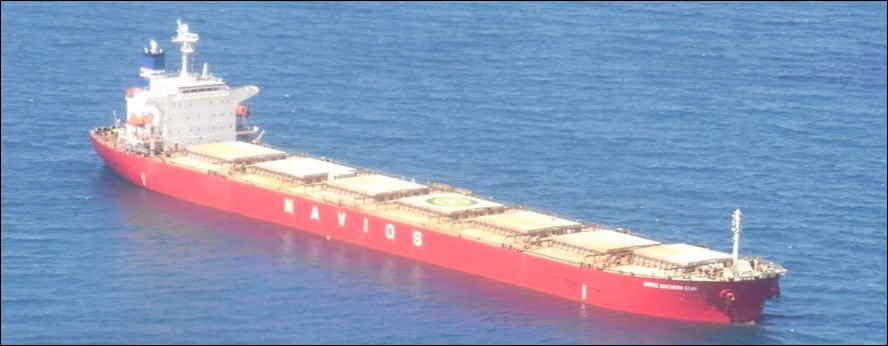
On the evening of 14 March 2016, the 225 m bulk carrier, Navios Northern Star (Figure 1) sailed from Gove (Northern Territory) bound for Gladstone (Queensland) via the Torres Strait. The ship was nearly fully laden with a cargo of bauxite and would transit the Torres Strait at the maximum permitted draught of 12.2 m. After transiting the Prince of Wales Channel (PoWC) in the Torres Strait, the deep draught ship would turn south and sail through the Inner Route of the Great Barrier Reef (GBR) to its destination.
Figure 1: Navios Northern Star
Source: ATSB
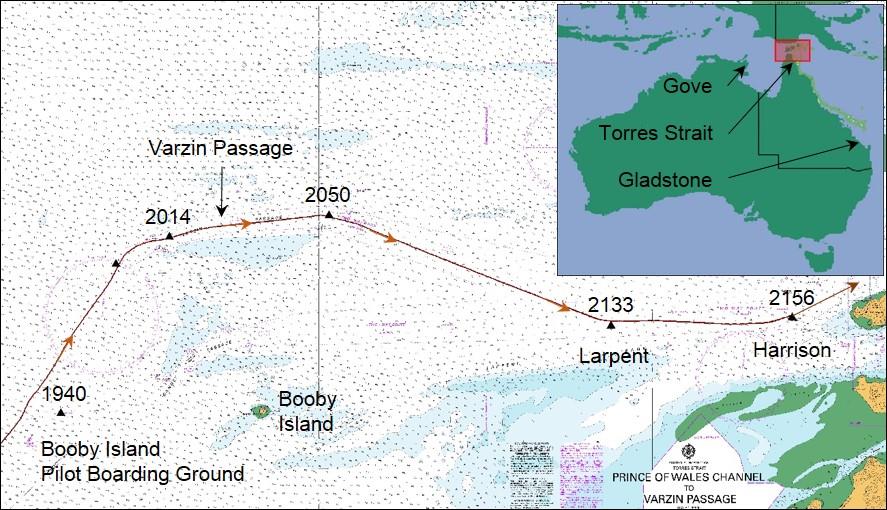
At 1800[1] on 15 March, the ship started its approach to the Booby Island pilot boarding ground (Figure 2) to board a coastal pilot (pilot) for its GBR transit. The master took over the conduct[2] (con) of the ship and the chief mate, the officer of the watch (OOW) remained on the navigation bridge (bridge) to assist the master. The ship was in hand steering with a seaman at the wheel.
At 1940, the pilot and a trainee pilot (trainee) boarded Navios Northern Star near the Booby Island pilot boarding ground. The third mate escorted them up to the bridge, where the pilot started the master-pilot information exchange (MPX) with the master. After asking about the status of the ship’s anchors, the pilot took over the con and reported to REEFVTS,[3] the coastal vessel traffic service. He then configured the s-band[4] radar display for the transit of Varzin Passage (Figure 2).
The pilot then focused on the transit of Varzin Passage while the trainee completed the remaining items of the MPX with the master. The MPX included information for calling the pilot when the ship was 7 cables[5] from each course alteration position (waypoint) and the pilot’s plan for the deep draught transit as per the Under Keel Clearance Management (UKCM)[6] system.
Navios Northern Star proceeded through Varzin Passage at about 8 knots[7] as planned to maintain the required under keel clearance (UKC). The ship’s UKC and the electronic navigational chart (ENC) were continuously displayed on the pilot’s portable pilotage unit (PPU) that had been set up near the bridge front windows on the port side.
Figure 2: Section of ENC Aus 296 showing Navios Northern Star’s actual track
Source: Australian Hydrographic Service (annotated by ATSB)
At 2000, the third mate took over the watch from the chief mate after reading the information form provided by the pilot during the MPX. He started plotting Navios Northern Star’s position on the ship’s paper navigational chart (chart) at 5-minute intervals. He also followed the pilot’s standing instruction by informing him when the ship was 7 cables from the next waypoint.
At 2133, the ship approached Larpent waypoint and the pilot instructed the seaman to steer a heading[8] of 088° towards the Harrison waypoint. Shortly thereafter, he asked for the ship’s speed to be increased to 10 knots as planned.
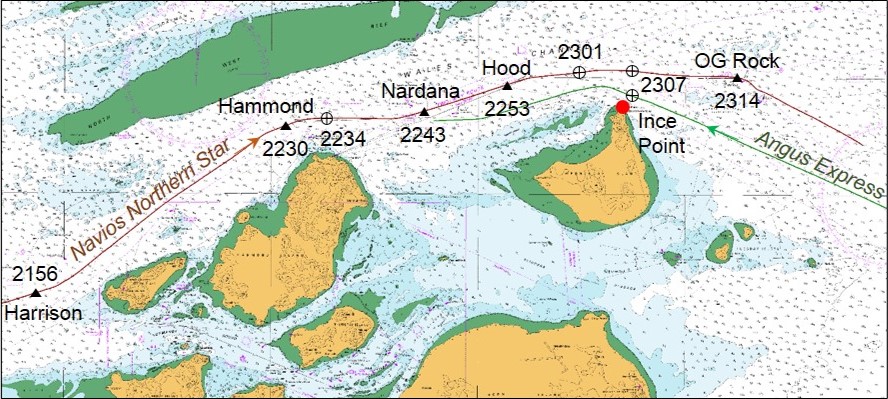
Shortly after 2156, the ship entered the PoWC and was turned onto a north-easterly course. The transit through the channel (Figure 3) continued as intended by the pilot, with him conning the ship and the other bridge team members attending other tasks.
Figure 3: Section of navigational chart Aus 293 Prince of Wales Channel
Source: Australian Hydrographic Service (annotated by ATSB)
At 2234, Navios Northern Star’s pilot contacted Angus Express, a west-bound livestock carrier in the two-way route[9] south of Herald Patches by VHF radio. Angus Express’s pilot informed him that his ship would keep close to Ince Point so that the ships could pass ‘green to green’ (pass each other on their starboard side). Navios Northern Star’s pilot agreed and stated he would keep north of track as he wanted to keep north of OG Rock.[10]
At 2243, when the ship was 7 cables from Nardana waypoint, the pilot used 10° of starboard rudder to bring the ship onto a heading of 068°. At about 2250, the pilot and trainee discussed the characteristics of the lights on the buoys in the channel, and the course alteration at OG Rock.
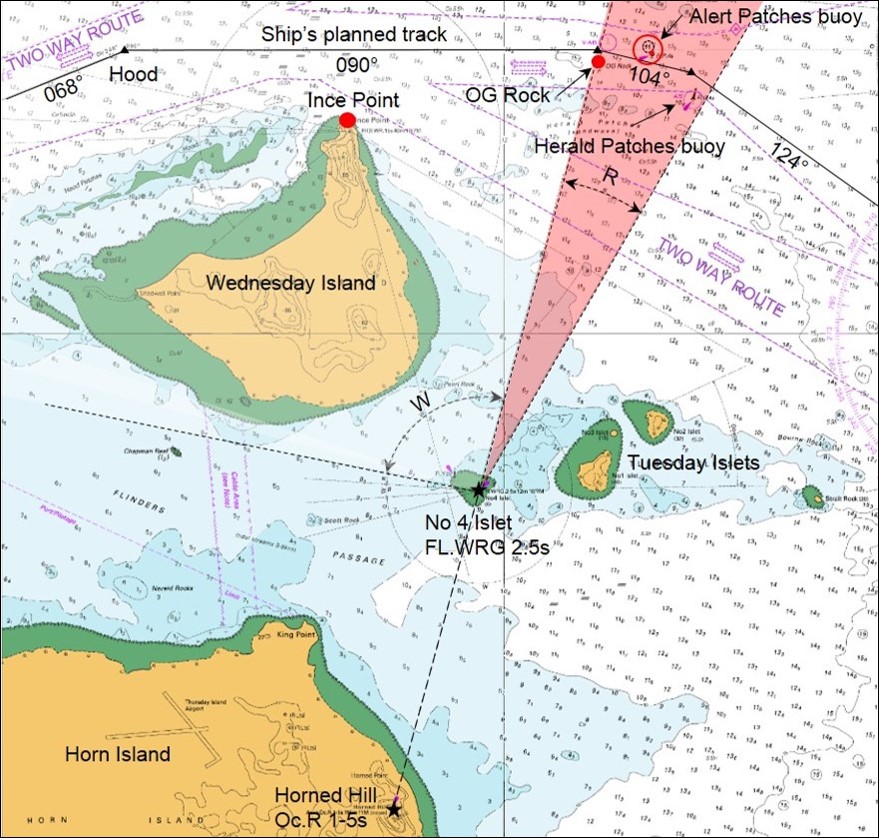
At about 2251, as the pilot and trainee continued their conversation, the third mate gave the pilot 7 cables notice to the next waypoint, Hood. The trainee then stated that when the Horned Hill light was in transit with Islet No 4 (Figure 4), the ship should be turning. The pilot agreed as the ship would then be in the red sector of Islet No 4.
Figure 4: Section of navigational chart Aus 293
Source: Australian Hydrographic Service (annotated by ATSB)
At 2253, the pilot ordered ‘starboard 10’ and then ‘ease to 5’ and ‘steer 085°’. The conversation between the pilots continued and included some social topics, and at 2259, the pilot ordered 082° to be steered. The wind was from the north-west at force[11] 5 (17 to 21 knots) throughout the transit.
At 2301, the ship was 2 cables north of track and the pilot ordered a succession of heading alterations to bring the ship onto a heading of 090°. The master then queried the pilot regarding the ship to starboard (Angus Express). The pilot advised it was a 6 m draught ship and would go through the two-way route south of Herald Patches.
The conversation on the bridge resumed in a social vein and at 2305, the pilot ordered a heading of 095°. At 2307, Navios Northern Star and Angus Express passed green to green, 0.5 miles apart. The ship’s speed was then increased to full ahead. The pilot and trainee then talked about the ship being north of the planned track and how it would make it easier to clear OG Rock.
At about 2308, the pilot ordered a heading of 090° and asked the master where the pilot cabins were. The master informed him they were aft of the bridge.
At 2310, when the pilot asked the third mate if the next course was 104°, he got no response. The master told the third mate to concentrate and confirm the course. After confirming the course, the third mate plotted the ship’s position. The ship was 1.5 cables north of the charted track. Shortly after, the pilot asked if the cabin phones were operational but neither the master nor third mate could confirm this. The master then left the bridge to check if the phones worked.
At 2311, the pilot ordered a heading of 088°. He was positioned by the s-band radar, near the ship’s centreline and was using the radar to determine the distance to Alert Patches buoy. Shortly after, the master returned to the bridge and advised the pilot that the phones were working.
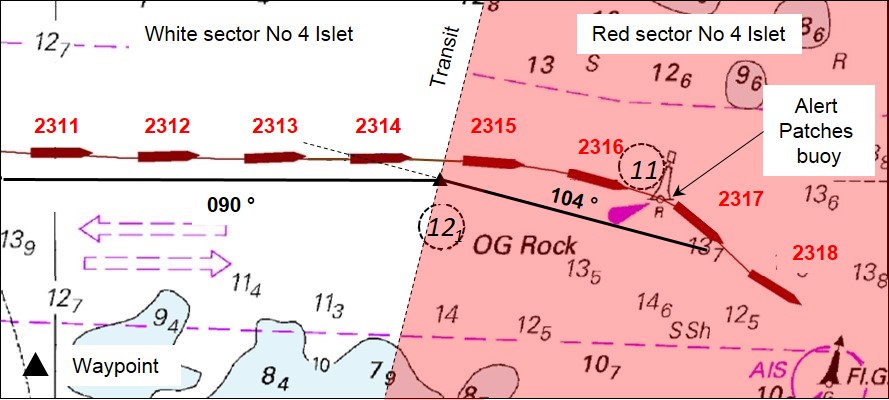
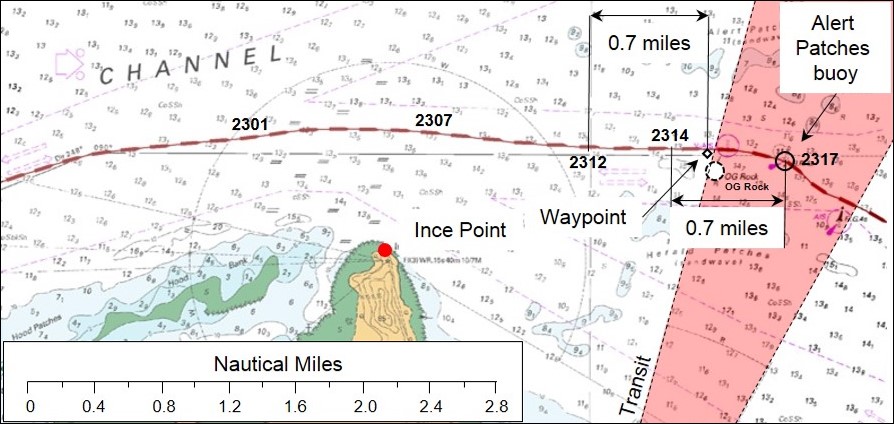
At about 2312, the third mate advised 7 cables to go to waypoint north of OG Rock (OG Rock waypoint) and the pilot acknowledged the information (Figure 5). The tidal stream at that time was about 1.2 knots x 098° and the wind was from the north-west at force 5 (17 to 21 knots). The ships speed was now steady about 12.5 knots.
Figure 5: Navios Northern Star’s track to the OG Rock waypoint and Alert Patches buoy
Source: Navios Northern Star’s VDR ((annotated by ATSB)
Shortly before 2314, the pilot asked the trainee ‘how’s the light going’ (No 4 Islet). The trainee replied, ‘still open’ and 9 seconds later, he informed the pilot ‘this is the place, going red’.
About 25 seconds later, at 2314, the pilot ordered 10° starboard rudder. The ship (that is, its bridge) was now about 2 cables from the OG Rock waypoint and 6½ cables from the Alert Patches buoy. Shortly after, the pilot ordered 5° starboard rudder and, at about the same time, he was unable to find the echo return of the buoy on the radar’s display.
At 2315, the trainee informed the pilot that the ship was now in the red sector of No 4 Islet and the ship was on the transit. While trying to locate Alert Patches buoy’s radar echo, the pilot acknowledged the trainee but continued to focus on the radar and regaining the echo of the buoy. The position plotted on the chart indicated that ship was about half a cable (100 m) north of the charted track.
At 2316, the master observed aloud that the Alert Patches buoy was right ahead. Hearing the master’s observation, the pilot said to the third mate ‘my friend, the captain, is very worried’. About 10 seconds later, the master asked how the buoy was, followed 11 seconds later with ‘will we touch the buoy’. The pilot said ‘no’ and shortly after ordered starboard 10°, followed 16 seconds later by starboard 20° and then ‘hard a starboard’.
By then the trainee had moved to the port side of the bridge and informed the pilot that he could see the buoy close to the ship’s port side. The pilot immediately ordered ‘midships’ and then ‘hard to port’ to swing the ship’s stern away from the Alert Patches buoy.
At 2317, the ship’s hull in the area of its port quarter contacted the buoy. At 2318, the trainee confirmed that the ship had contacted the buoy. The pilot then ordered ‘midships’ followed by ‘hard to starboard’ to stop the swing. At 2319, he ordered ‘midships’ and for the ship to be steadied on 122°. Shortly after the ship was steadied on the new heading the pilot asked the third mate to change the steering into automatic.
At about 0051 on 16 March, the pilot reported the incident to REEFVTS.
The ship continued its passage through the Inner Route. On 17 March at 1320, the pilot and trainee disembarked off Cairns, the limit of the compulsory pilotage area.
On 19 March, Navios Northern Star arrived off Gladstone and anchored to wait for a berth.
Subsequent inspections/survey of the ship and the Alert Patches buoy did not indicate any significant damage to the ship or the buoy. The damage was limited to some removal of paint from the ship’s side.
At the time of the incident, the 2005-built Navios Northern Star was registered in Malta and classed with Class NK. The ship was owned and managed by Kleimar, Belgium. The ship was trading between China and several ports in the Northern Territory and Queensland, Australia.
Navios Northern Star was fitted with navigational equipment required for a ship of its size in accordance with SOLAS.[12] The navigation equipment included paper navigational charts and publications. The two radars, an x-band[13] and an s-band had automatic radar plotting aid (ARPA) and other target tracking functions. Both radars also had data input from the ship’s automatic identification system (AIS) transceiver and global positioning system (GPS) receiver unit. The ship was also fitted with an electronic chart system (ECS).[14]
The ship had a multi-national crew of 20, including the master and three mates.
The master had 34 years seagoing experience and held a Ukrainian master’s certificate of competency. He had sailed as master for 19 years and sailed on Kleimar-managed ships for the last 5 years. He had joined about 4 months before the incident.
The third mate had 3 years of seagoing experience and held a Ukrainian watchkeeping deck officer’s certificate of competency. He had sailed as third mate for 1 month and had been with Kleimar for 3 years. It was his first time on Navios Northern Star and he had joined about 1 month before the incident.
The helmsman at the time of the incident was an able seaman with 3 years of seagoing experience, all of which had been on bulk carriers. He had been with Kleimar for 3 years and had joined 1 month before the incident.
Queensland coastal pilotage
Under the Great Barrier Reef Marine ParkAct (GBRMPA) 1975, pilotage was made compulsory for areas of the GBR prescribed by safety regulations.
Consequently, Australia introduced compulsory coastal pilotage to the Inner Route, Whitsunday Islands and Hydrographers Passage. The particularly sensitive sea area (PSSA)[15] was subsequently extended to include the Torres Strait. Compulsory pilotage in the Torres Strait and Great North Eastern Channel for all vessels over 70 m in length followed.
The Australian Maritime Safety Authority (AMSA) is responsible for the safety regulation of coastal pilotage, pilotage providers and pilots.
Legislation and regulations
Safety regulations for coastal pilotage are made by AMSA under the provisions of the Navigation Act 2012. The regulatory instrument is known as Marine Order[16] 54 (Coastal pilotage) (MO54).
The provisions of MO54 relate to various safety aspects of pilotage, including the operations of pilotage providers and pilots, pilot licensing and the duties of pilots. Under MO54, the following are compulsory pilotage areas:
Great North East Channel
Hydrographers Passage
Inner Route
Torres Strait
Whitsundays.
Queensland Coastal Passage Plan
In December 2011, AMSA and the coastal pilot working group developed the Industry Passage Plan (IPP). In May 2013, the IPP was updated and became the Queensland Coastal Passage Plan (QCPP), the current revision of the QCPP is July 2014. This document was produced to improve pre-pilotage communications between pilotage providers, the ships they service and the pilots conducting the pilotages.
The QCPP is the approved plan used by pilots and ship masters to prepare their voyage plans. The waypoints and courses detailed in the QCPP are to be plotted on charts and/or in electronic navigation systems before embarking the pilot.
The QCPP provides detailed guidance for:
routes (a set of relevant waypoints) and draught restrictions
REEFVTS
preparations before the pilot boards
master/pilot exchange and passage monitoring
under keel clearance
bridge resource management
passage planning chartlets.
Pre-arrival information
The pilotage provider servicing Navios Northern Star, Australian Reef Pilots’ (ARP), contacted the ship’s master 7 days prior to its scheduled pilotage to provide, request and confirm information.
The pre-arrival information comprised two parts (Parts A and B).
Part A detailed ARP’s advice to the master for:
ETA management
manning
environmental discharges
REEFVTS
QCPP route.
Part B requested specific ship information and detailed the dynamic UKCM information, transit windows and the information required to complete the safe transit plan in accordance with AMSA UKC regulations.
Shipping routes
The western entry to the Torres Strait is through either Gannet Passage or Varzin Passage (the deeper of the two), leading into the Prince of Wales Channel (PoWC), the main shipping route through Torres Strait.
The maximum allowable draught through the Torres Strait is 12.2 m and all ships must maintain UKC requirements as detailed in the QCPP.
The Torres Strait is an interface between the diurnal tidal[17] regime of the Indian Ocean and the semi-diurnal[18] tidal regime of the Pacific Ocean. All tides are composed of both diurnal (once a day) and semi-diurnal (twice a day) components. This creates a highly variable and complex tidal regime with fast flowing tidal streams of up to 8 knots at Hammond Rock within the POWC.
Under Keel Clearance Management (UKCM) system
Since December 2011, AMSA has provided the UKCM system as an additional aid to navigation for deep draught ships transiting Torres Strait. The system is used to assist coastal pilots to plan and manage the ship’s UKC.
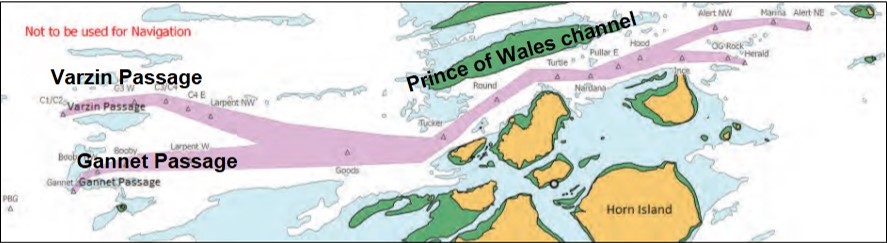
It is an internet-based system that estimates a vessel’s UKC in real time. By using a defined set of operational parameters, the UKCM system calculates tidal windows to meet AMSA’s UKC requirements. The system monitors the ship’s UKC margin throughout the transit. All coastal pilots transiting ships with a draught of 8 m or more, through the Prince of Wales Channel, the Varzin or Gannet Passages (Figure 6), are required to use the UKCM system.
Figure 6: Area of operation of UKCM system in Torres Strait
Source: AMSA Queensland Coastal Passage Plan July 2014
Australian Reef Pilots
Australian Reef Pilots is one of the two private companies that provide pilotage services in all coastal pilotage areas. Navios Northern Star’s pilot had worked for ARP since 2007. He had held an unrestricted coastal pilot licence since 2008 and an Australian master’s certificate of competency. He had been a licensed check pilot and an assessing pilot. He had 39 years of industry experience, including 17 years of sea going experience, with 2 as master.
The trainee had worked for ARP since early 2016 and held a trainee pilot license. This was his fourth time through the Torres Strait as a trainee. He held an Australian master’s certificate of competency issued by the AMSA in 2004. He had 30 years of sea going experience, including 10 as master. Several of these ships transited the Torres Strait.
Master pilot exchange
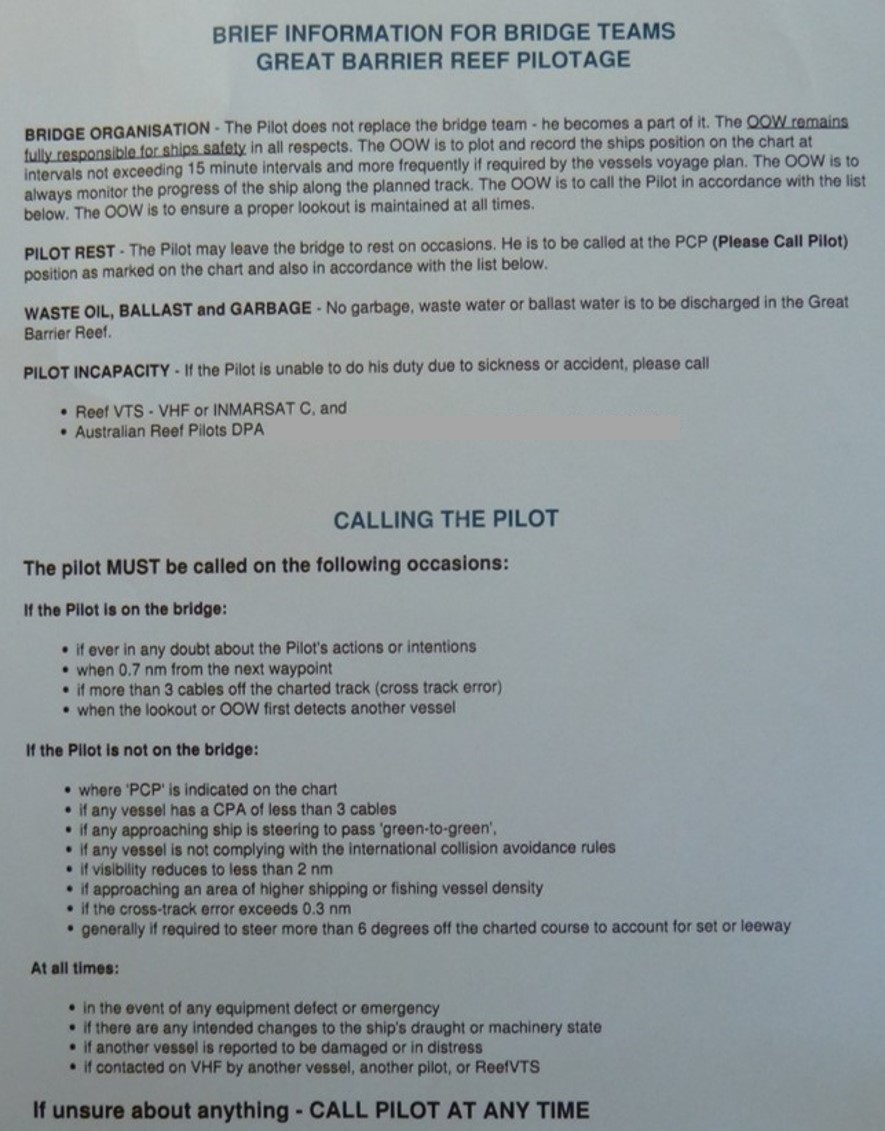
Australian Reef Pilots’ bridge information for bridge teams details amongst others the bridge organisation and when to call the pilot (Appendix A). The form is given to the master during the MPX and is to be available for the watchkeeping officers to reference throughout the transit. The form details the pilot (when on the bridge) must be called on the following occasions:
if ever in doubt about the pilot’s actions or intentions
when 7 cables from the next waypoint
if the ship is more than 3 cables off the charted track (cross track error) [19]
when the lookout or OOW first detects another vessel.
Portable pilotage unit
All ARP pilots are issued with a portable pilotage unit (PPU). The PPU is plugged into the ship’s AIS output plug and has an independent GPS unit providing its position, course and speed information. It can provide an active monitoring display allowing the observation of critical parameters for safe navigation. A PPU also provides other information such as electronic navigation charts, pilotage plans, AIS information and the UKCM system. All pilots are trained in the use of the equipment and they are to be used for all pilotages through Torres Strait.
Bridge resource management
Bridge resource management (BRM) is defined as the use and coordination of all the skills and resources (people, procedures and equipment) available to the entire bridge team to achieve the established goal of optimum safety and efficiency.[20] All individuals make errors, and BRM aims to minimise the occurrence and outcome of errors through the best possible use of resources.
All ship’s navigators must have training, and demonstrate competence in BRM techniques.[21] All coastal pilots must attend approved trainee pilot training courses.[22] The courses are required under MO54 for pilot’s to obtain and maintain their pilotage licenses.
The aim of compulsory pilotage is to reduce navigational risk in those areas. A pilot’s local knowledge and practised piloting techniques are an important element in reducing risk to an acceptable level. Since a pilot is not a replacement for any of ship’s bridge team members, it is necessary that the ship’s bridge team works with the pilot. This can be achieved by observing good BRM practice in executing the agreed voyage plan.
Bridge resource management is a broad topic which covers many inter-related subjects, including but not limited to shared mental model, situational awareness, challenge and response and distractions. The ship’s master and the pilot are responsible for taking steps to actively engage and include other members of the ship’s bridge team in the pilotage. Effective BRM should result in all personnel involved in the ship’s navigation having a clear understanding of, and expectations for, the pilotage.
Voyage planning
A passage plan and pilotage plan are necessary to allow the ship’s bridge team and pilot to arrive at a shared understanding of what ‘should’ happen during the voyage. Careful planning is used to make the passage and pilotage safer, for example, by setting limits that make unsafe deviations from the plan readily apparent.
The ship is to be safely navigated in the normal range (the corridor in which a ship should navigate) and in the comfort zone of the operator conducting the ship. Outside of the comfort zone is the safety margin (distance between the corridor boundary and no-go area) and this is used when there is a reason to use it.[23] Comfort zones and safety margins can be critical when navigating in restricted areas of coastal waters, as there is limited time available to take corrective action when required. The ship’s master is required to develop a berth to berth plan for its safe and efficient passage.[24] Detailed plans are needed to ensure appropriate margins of safety are maintained at all times.
The International Maritime Organization (IMO) provides guidelines[25] for voyage planning, which comprises four distinct stages:
appraisal (when all information relevant to the voyage is considered)
planning (when a detailed plan for the voyage from berth to berth is prepared)
execution (of the plan, including suitable alterations to it when required by circumstances)
monitoring (execution of the plan, including ensuring all navigators know and understand it).
Section 2.6 of the Bridge Procedures Guide,[26] states:
Of particular importance is the need to monitor the position of the ship approaching the wheel over position at the end of the track, and checking that the ship is safely on the new track after alteration of course.
On 15 March, shortly after 2300, Navios Northern Star was transiting the Prince of Wales Channel, Torres Strait, on an easterly heading towards the waypoint north of OG Rock.
The pilot’s usual practice was to use a distance of 7 cables from the Alert Patches buoy as a wheel over point (WoP) and the s-band radar to obtain the distance from the buoy. Shortly before 2314, the pilot asked the trainee a question regarding No 4 Islet light. This was intended to be educational as opposed to a trigger for his own WoP.
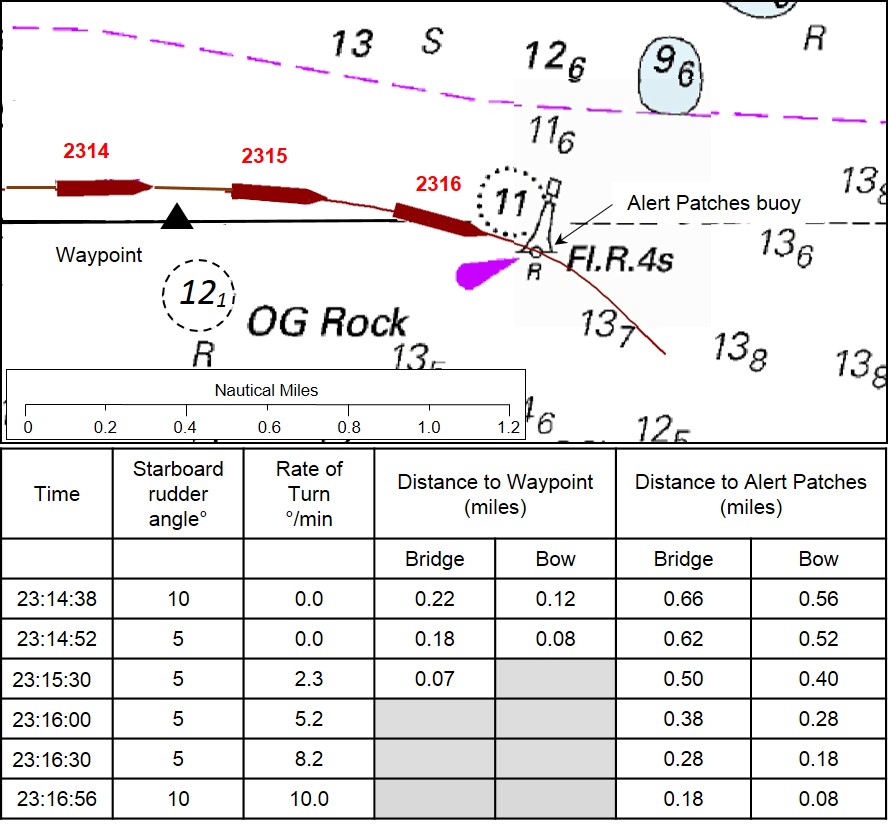
About 25 seconds later, with ship’s bridge about 2 cables from the waypoint and 6½ cables from the Alert Patches buoy, the pilot started altering course. He used 10° of starboard rudder to initiate the turn and 14 seconds later, ordered ‘starboard 5’ (Figure 7).
However, about the same time the pilot ordered starboard 5°, he was unable to find to the echo return of the buoy on the radar’s display. For the next 2 minutes, he was focused on regaining it. Consequently, during those 2 minutes, the turn was not properly controlled to pass the buoy at a safe distance.
Figure 7: Rudder angles and distances before contact with Alert Patches buoy
Shortly before 2317, when the ship’s bow was 1 cable from the buoy, the ship’s master asked the pilot if the ship would ‘touch the buoy’. The pilot then ordered starboard 10°, 20° and then hard starboard in quick succession. However, this action was too late to allow the ship to swing clear of the buoy and at 2317, its port quarter contacted the Alert Patches buoy.
Bridge resource management
Execution of the course alteration at OG Rock
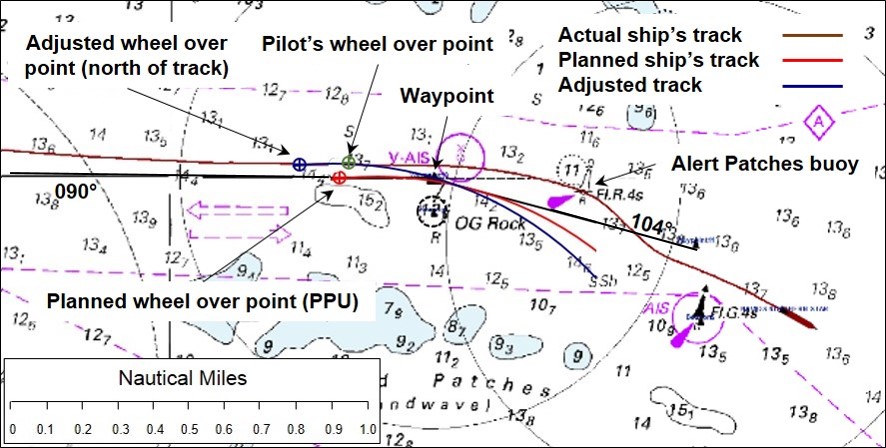
The course alteration at the OG Rock waypoint was from 090° to 104°, a 14° course alteration. With the ship’s planned speed at 12.2 knots, the pilot’s PPU had a default 1 mile radius of turn[27] used to calculate the WoP with a required 11.7°/min rate of turn (RoT). This WoP (Figure 8) in the PPU was about 2½ cables from the OG Rock waypoint (7 cables from the Alert Patches buoy).
Figure 8: Wheel over point from OG Rock waypoint
Source: ATSB
There were various cues and monitoring tools available to the pilot to use for the course alteration, including:
electronic bearing lines (EBL)[28] between the Alert Patches buoy and Herald Patches buoy
the radar’s variable range markers (VRM)[29] to determine the distance from the Alert Patches buoy
parallel indexes (PI)[30] set up on Ince Point and Tuesday Islets
visual transit of No 4 Islet and the changing light sectors
visual reference of the forward masthead light on the foremast between the buoys
the intended track, WoPs and rate of turn displayed in real time on the PPU
distance to waypoint displayed on the ship’s radar (the ship’s track could not be displayed)
The pilot’s usual practice was to use a radar to determine the distance of 7 cables from the buoy as his cue to start altering. However, from his position behind the s-band radar, the pilot could not sight his PPU nor did he use any other cue to alter or monitor the course alteration.
On March 15, as the ship approached the waypoint north of OG Rock, it was north of the charted track, hence the WoP was further west. For the same turn radius and rate of turn, the adjusted WoP was 3½ cables from the waypoint or 8 cables from the buoy. However, it was not until the ship was 6½ cables from the buoy that the pilot gave the first helm order. Additionally, with the ship’s actual speed of 12.5 knots, a RoT of 11.9°/min was required but not achieved throughout the turn (Figure 7).
Had the pilot altered course at the adjusted wheel over point, or maintained the initial starboard rudder angle at the planned wheel over point, or applied more rudder (increasing the rate of turn), the ship would not have collided with the buoy.
Distractions
Interruptions or distractions during the completion of a task increase the likelihood of error. When one of the competing tasks is strong enough to interfere with or divert attention away from the original focus of attention, the individual becomes distracted.
Distractions can be related to the task or from some external, unrelated source or event. An individual, or team, can also become completely focused (fixated) with one event or task and therefore distracted from the overall objective. This task fixation can be interrupted by internal or external cues and attention can then be returned to the primary task.
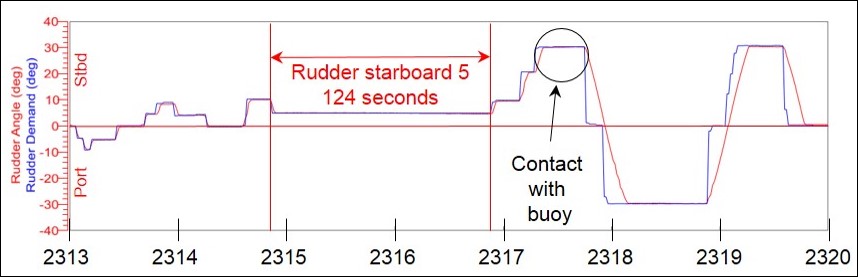
As the ship approached the OG Rock waypoint, the pilot was using the s-band radar to determine the distance from Alert Patches buoy. His usual practice was to use a 7 cable distance from the buoy as his WOP. About the same time he ordered starboard 5° for the course alteration, he was unable to find to the echo return on the radar’s display. The pilot became fixated on regaining the lost echo. For the next 2 minutes (Figure 9) the rudder angle remained at starboard 5°.
Figure 9: Rudder demand and angle from 2313 to 2320
Source: ATSB
The pilot did not monitor the ship’s progress by any of the multiple cues or monitoring tools that were available and he was unaware that the ship was not swinging fast enough to safely make the turn.
At 2316¾, the master eventually interrupted the pilot’s focus and his attention was brought back to the task of navigating the ship, but by then it was too late.
Shared mental model
Each individual member of a group performing a common task will develop a mental model of what they think will occur during the task being completed. Each person’s mental model is based upon the information available to them at the time. Ensuring that each member involved in a pilotage (pilot and ship’s bridge team) shares the same mental model of the voyage (passage and pilotage plan) is central to effective BRM.
Shared mental models serve three critical purposes: they help people to describe, explain and predict events in a common environment. A pilot and ship’s bridge team which must adapt quickly to changing tasks might draw on shared or common mental models for those tasks. In order to adapt effectively, they must be able to predict what the operator conducting the ship is going to do, and what they are going to need, to be able to do it.
At the start of the pilotage, the pilot and trainee conducted the MPX with the ship’s master and they discussed how the ship manoeuvred. At that time the pilots and ship’s bridge team shared a common mental model of how the pilotage would progress. The ship would follow the QCPP route within a 0.3 mile cross track error (XTE) and the OOW would give the pilot 7 cables notice before each waypoint. The OOW stated that after he gave 7 cables’ notice, ‘he expected that the pilot would alter course and it would just happen’.
However, as the ship progressed, the ship’s bridge team did not seek clarification nor question the pilot regarding further details of the pilotage plan or his subsequent actions. These included deviations from the planned track such as navigating north to pass Angus Express and to alter course at OG Rock. Further, there was little communication about the WoPs and the parameters and limits the pilot had set in the PPU and used throughout the transit.
Hence, as the ship approached the waypoint at OG Rock, north of track, the pilot and ship’s bridge team did not share the same mental model.
Situational awareness
Situational awareness for a group performing a common task is closely associated with the concept of shared mental model. In relation to a ship’s voyage, it includes knowing what has recently happened (perception), what is happening (comprehension) and, based on where the ship is, what is about to happen (projection).
Careful observation and understanding of the situation around you should achieve one of two things: it should reinforce your understanding and confidence in the mental model of the voyage, or it should highlight a misunderstanding or an error and trigger actions to clarify or correct the situation.
Situational awareness is dependent on working memory and is, therefore, affected by distraction, interruption and stimulus overload. Collective situational awareness can be enhanced by:
monitoring the progress of the agreed plan
communicating with each other about the situation to share individual awareness and discuss differences
anticipating next conditions
checking one another.
On board Navios Northern Star there were many resources available in addition to the pilot and ship’s bridge team to assist in establishing and maintaining situational awareness. These included the ship’s electronic navigational equipment such as the radars, GPS and the pilot’s PPU which could be used to gather or verify information. However, these resources were not routinely used to monitor or predict the ship’s position.
The third mate plotted the ship’s position on the chart. However, because of the inherent delay in completing the plot, this was not real time monitoring but more of a record of the ship’s past position. Further, neither he nor the ship’s master were actively monitoring or engaged in the pilotage or the course alterations. On approach to the OG Rock waypoint (Figure 10), after the third mate gave the pilot 7 cables notice, the ship’s bridge team expected the pilot would alter the ship’s course.
The trainee had expected the ship to be turning when Horned Hill light came into transit with No 4 Islet, just before it was in the red sector. However, the ship’s RoT had only just started to increase from 0.0°/min to 2.3°/min.
When interviewed, the pilot stated that ‘if you wait for the light to change (light sector on No 4 Islet white to red), there is only 4 cables to Alert Patches buoy - pilots do alter when the light goes pinky, but I use 7 cables from Alert Patches buoy’. The only cue he used for altering course was the distance from the Alert Patches buoy as his WoP. However, this distance did not allow for any XTE, hence, altering course earlier if north of track or applying more rudder.
Further, the pilot did not inform the ship’s bridge team, nor the trainee, about not using light sectors or when on a transit at OG Rock nor his plan for altering course. Therefore, the ship’s bridge team and the trainee’s expectations were different to the pilot’s intentions in that situation. As the ship progressed, their comprehension of the situation did not trigger any actions for clarification or correction of the situation.
Figure 10 – Navigational chart Aus 293 showing Navios Northern Star’s track to OG Rock
Source: Australian Hydrographic Service (annotated by ATSB)
Monitoring the ship’s progress
Monitoring of the voyage required observation of the pre-determined navigational parameters. Observation of the decisions made and actions taken would determine if the desired results were within comfort zones and safety margins. Importantly, to know where the ship will be.
The QCPP includes specific guidance for the OOW to follow when voyage monitoring.
The OOW is expected to apply appropriate navigational techniques and principles including placing fixes on the chart, using parallel indexing and clearing indexing[31] on radars, and monitoring electronic systems for alarms and warnings.
Figure 11: Pilots and ship’s bridge team positions between 2312 and 2316
Source: ATSB
At the chart table (Figure 11), the ship’s OOW plotted the ship’s position every 5 minutes on the chart. He primarily used the ship’s GPS and, on several occasions, radar ranges and bearings.
The GPS unit also indicated the bearing and distance to the next waypoint along with the XTE. The OOW used this information to advise the pilot when the ship was 7 cables from each waypoint. However, this was the limit of his real time route monitoring.
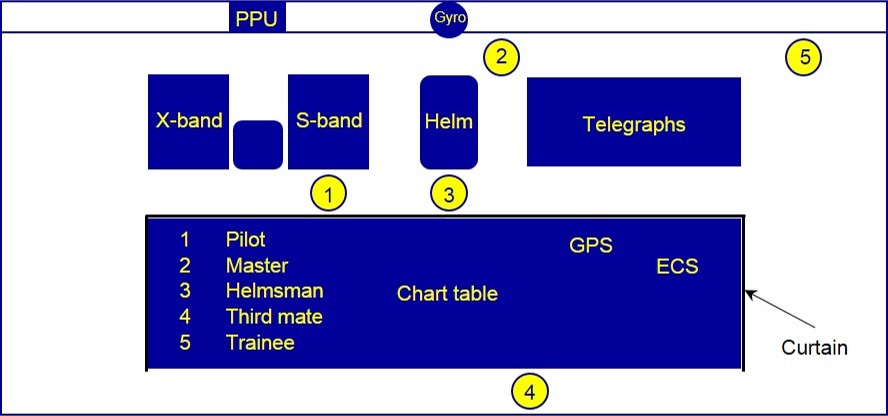
As it was night, curtains were drawn around the chart table to prevent backlight from the table lights affecting the pilot’s and helmsman’s night vision. Hence, when at the chart table, the OOW’s night vision was affected. Further, he could not look out the bridge windows, sight the radars or PPU, nor monitor the rudder angle indicator.
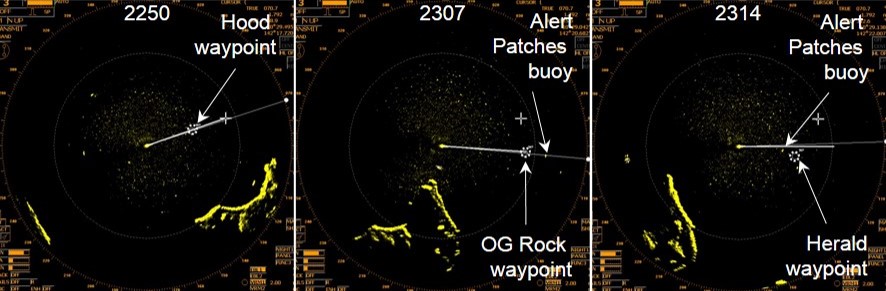
The OOW stated he frequently moved from the chart table to use the ship’s x-band radar (the pilot used the s-band radar). However, in the 27 minutes before the contact (2250 to 2317), none of the radar’s tools or features including EBLs, VRMs, PIs nor clearing indexes (Figure 12) were used. Further, there was no other indication the x-band radar had been used, including a reduction in range as the ship approached the OG Rock waypoint.
Figure 12: Navios Northern Star’s X-band radar display from 2250 to 2314
Source: Navios Northern Star’s voyage data recorder (annotated by ATSB)
Additionally, after the master had returned to the ship’s bridge from checking the pilot cabin phones he assumed a position starboard of the centreline and had to establish his night vision. Also from this position he was unable to monitor any electronic navigational equipment and could only observe visually.
When interviewed, the pilot indicated that he thought the ship’s bridge team were just following the ARP bridge information form by giving 7 cables notice and after that he was operating alone. The crew confirmed this, as they assumed that the pilot would execute and monitor the passage himself, and only needed input from them when he requested it, other than calling out 7 cables before a waypoint.
Hence, as the ship approached the waypoint at OG Rock, the ship’s bridge team were not effectively monitoring the ship’s progress.
Voyage planning
Planning of voyage routes should contain operational limits for normal, abnormal and emergency conditions for each track. The operational limits are determined by:
a range of values that represents the normality of operations
extreme values, which should not be exceeded unless forced to do so in cases of emergency.
All values inside the normal range make up the comfort zone and the values outside the normal range that are still within the extreme ones of an emergency situation, make up the safety margin. Further, other voyage information such as ship’s speed, UKC, XTEs, PIs, WoPs, turn radii and RoTs, amongst others, should also be included in the voyage plan. The pilot’s pilotage plan (incorporating the QCPP route and above information) was loaded in his PPU. The pilot had used a 1 mile turn radius to calculate the WOPs and the ship’s rate of turn for all course alterations throughout the transit.
The track and RoT were displayed in real time on the PPU, along with the dynamic UKCM system. Further, the XTE had a default setting of 0.3 miles, but the pilot had reduced this distance in narrow areas of the transit.
Navios Northern Star’s master had received the QCPP route plan from ARP, as a list of waypoints, 7 days before the pilotage. The waypoints were input into the GPS unit and plotted on the ship’s navigational chart and the ship’s track marked.
However, other information such as WoPs, turn radii, RoT, no-go areas or PIs were not marked on the charts nor were they discussed as part of the MPX or at any other times during the pilotage. The ship’s GPS unit displayed XTE, but route information related to the voyage such as comfort zones and safety margins were not discussed (such as reducing the XTE from 0.3 miles).
Hence, the ship’s bridge team’s voyage plan only contained basic information and the operational parameters used by the pilot for his pilotage plan were not fully understood or known.
Challenge and response
Effective communication is central to bridge resource management (BRM). It is essential to prevent errors leading to undesirable outcomes. Challenge and response is a BRM technique in which a person’s perception of an event, in the execution of the plan, is confirmed or denied by asking and/or responding to questions. That is, if unsure of exactly what is occurring, a person should ask others to clarify the situation, and a response is required.
Following the MPX, the pilot advised course alterations would be started with rudder angles of 5° to 10°. However, the actual WoP distances were not discussed. The pilot stated that, if the ship’s bridge team were engaged, they should be aware of when he would alter course.
The master stated he expected the pilot would alter course once the third mate had given him the 7 cables notice from each waypoint. Table 13 shows the pilot had altered about 7 cables from the waypoint, until OG Rock.
Table 13: Distance from waypoints when the course alteration started and rudder applied
Waypoint
Next course
Distance from waypoint when alteration started
Rudder order (degrees)
Time when alteration started
Port
Stbd
Larpent
088°
7 cables
15
21:33:15
Harrison
055°
8 cables
10
21:56:01
Hammond
088°
5 cables
10
22:28:30
Nardana
068°
7 cables
10
22:41:00
Hood
090°
5 cables
10
22:53:18
OG Rock
104°
2 cables
10
23:14:38
Source: Navios Northern Star’s VDR
The third mate stated that he believed that the pilot would start altering course at 4 cables from waypoints. He assumed this, as he thought the pilot knew the turning circle of the ship. However, his assumptions were not consistent with the pilot’s helm orders throughout the pilotage.
At 2314, when the ship’s bridge was 2 cables from the waypoint at OG Rock, the pilot started altering course. It was not until the Alert Patches buoy was directly ahead and 1 cable from ship’s bow that the master murmured quietly in Ukrainian.
Hearing this, the pilot told the third mate that the master was ‘very worried’ about the Alert Patches buoy. Shortly after, the master asked the pilot ‘how the buoy was doing’ and 11 seconds later ‘will we touch the buoy’.
The pilot replied ‘no’ but did increase the rudder angle by ordering ‘starboard 10’. Sixteen seconds later, the pilot ordered ‘starboard 20’ and another 7 seconds later ‘hard starboard’.
Considering the pilot’s focus was regaining lost radar Alert Patches buoy echo, the master’s challenge as the ship closed on the buoy was too late to be effective.
Visual perception during the hours of darkness
When monitoring a ship’s progress visually, a ship’s bridge team and pilot should be aware of visual perception issues during the hours of darkness.
In the dark, vital elements of vision are impaired, including depth perception, colour recognition, and peripheral vision. As light passes through the human eye’s cornea[32] it is filtered by the pupil[33] inside the eye. It is then refracted by the crystalline[34] and travels to the centre of the eye and arrives at the retina.[35] The pupil’s dimension depends on the amount of light present and dilates at night or when we are concentrating or stressed.[36]
Depth perception is based on experience and knowledge of distance and size of objects.[37] Hence, if we know two objects are the same size, the smaller one will appear further away and the larger one will appear to be closer. Similarly, for lights of a similar intensity they will appear closer and dim lights will appear further away. Therefore, familiarity with the size of an object can be an effective cue for distance perception.
However, visual cues can also be misleading and human vision and perception has its limitations. The judgement of distance deteriorates in darkness. Multiple studies[38] have shown that people are better at estimating objects nearby than further away. People generally overestimate the distance to near targets and underestimate the distance of far objects.
Therefore, it is important to understand that a person’s visual perception during the hours of darkness is different to that during the daylight hours, as objects may appear closer than they actually are. Hence, because of the difficulty of accurate depth perception, especially at night, it is important that human abilities are always supplemented by the use of all other navigational and electronic aids.
The bridge team member’s differing depth perceptions was evident when ATSB investigators interviewed them. The pilot and trainee both stated that when navigating visually, things look closer than they are. However, on approach to waypoint at OG Rock, the pilot and trainee, who had experience and were familiar with the buoy were occupied with other tasks and only the master was observing visually. .
Had the pilot, trainee and ship’s bridge team used the range of resources available (sight, radar, PPU) they could have had an accurate appreciation of the distance from the buoy and a common understanding of the situation.
Approaching waypoints
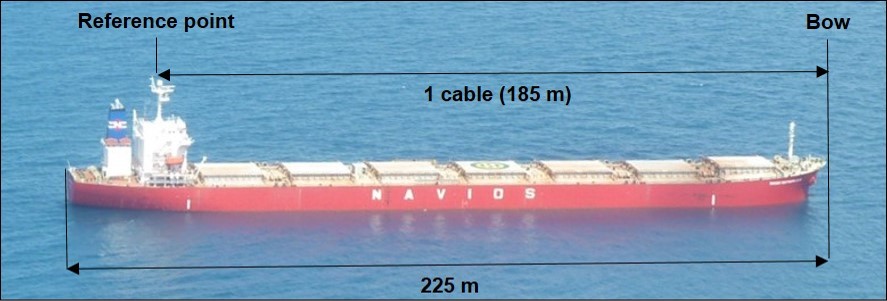
The radar and GPS distances used during the pilotage were calculated between the ship’s reference points (above the bridge) and the waypoints and objects. Navios Northern Star’s bridge was one cable aft of its bow (Figure 14).
Figure 14: Navios Northern Star’s bridge to bow distance
Source: ATSB
Hence, when the third mate gave 7 cables notice to the pilot, the bow was actually 6 cables from the waypoint and was always nearer to waypoints and objects than appeared on the ship’s radar. Therefore, when a ship’s bridge is aft, this needs to be taken into consideration when giving ranges from electronic navigational equipment.
A distance of 1 cable is significant when navigating in close proximity to navigational aids. In this case, the planned passing distance from the buoy is less than a cable. However, at interview, the pilot, master and third mate showed little appreciation for the fact they had not allowed for radar distances being 1 cable more than the distance from the buoy.
From the evidence available, the following findings are made with respect to the contact with Alert Patches buoy by Navios Northern Star in the Torres Strait, Queensland, on 15 March 2016. These findings should not be read as apportioning blame or liability to any particular organisation or individual.
Safety issues, or system problems, are highlighted in bold to emphasise their importance. A safety issue is an event or condition that increases safety risk and (a) can reasonably be regarded as having the potential to adversely affect the safety of future operations, and (b) is a characteristic of an organisation or a system, rather than a characteristic of a specific individual, or characteristic of an operating environment at a specific point in time.
Contributing factors
Navios Northern Star’s planned course alteration to pass Alert Patches buoy was not made in time nor was the alteration properly executed and monitored to avoid contacting the buoy.
As the ship was approaching the course alteration position, the pilot became focused on trying to regain the Alert Patches buoy’s radar echo after it was lost on the radar display that he was using.
The pilot was using the buoy’s radar distance as his primary means to carry out the course alteration, so he remained focused on regaining its lost echo for more than 2 minutes during the critical period before the incident.
The ship’s bridge team did not have the same mental model of the course alteration as the pilot and they did not actively monitor the pilot’s execution of the alteration.
The ship’s voyage plan contained only basic passage information and its bridge team did not know or fully understand the pilot’s planned operational parameters and limits, including wheel over points and safety margins.
The master’s challenge to the pilot as the ship closed on Alert Patches buoy was too late to be effective given the pilot’s focus on regaining the buoy’s radar echo.
The use of bridge resource management (BRM) techniques was not adequately established during the master-pilot exchange and therefore, BRM was not effective during the pilotage.
Other factors that increased risk
When approaching the Alert Patches buoy, bridge team members were not using the range of available resources (both visual and electronic means) to monitor the ship’s progress. This was particularly significant in the night-time conditions as human perception of distance or depth in darkness can be unreliable and depends on a number of factors. As a consequence, they had differing perceptions of its proximity.
The radar and GPS distances used for course alterations were being calculated from the ship’s bridge, about 1 cable aft of its bow. Taking the lesser distance from the bow into account would have increased margins for error and may have prevented contact with the buoy.
Sources and submissions
Sources of information
On 20 March 2016, investigators from the Australian Transport Safety Bureau (ATSB) attended Navios Northern Star after the ship had anchored in Gladstone, Queensland. The master and directly involved crewmembers were interviewed and each provided their account of the incident. Photographs of the ship and copies of relevant documents were obtained including log books, statutory certificates, reports, manuals and procedures. A copy of the data stored on the ship’s voyage data recorder was taken for examination in the ATSB technical analysis laboratory.
The reef pilots on board the ship at the time were interviewed and copies of relevant information was obtained.
Further information was obtained from the Australian Maritime Safety Authority (AMSA), Australian Reef Pilots and Kleimar NV.
References
Australian Maritime Safety Authority 2009, Marine Notice 07/2009 Bridge Resource Management (BRM) and Torres Strait Pilotage, AMSA, Canberra. Note that this marine notice has been cancelled and may contain information which is no longer applicable.
Australian Maritime Safety Authority 2012, Marine Order 21 (Safety of navigation and emergency procedures) 2012, AMSA, Canberra.
Australian Maritime Safety Authority 2013, Marine Notice 15/2013 Vessel Traffic Services – Responsibilities of Authorities, AMSA, Canberra.
Di Lieto, A 2015, Bridge Resource Management, Hydeas, Brisbane, Australia.
International Chamber of Shipping (ICS) 2007, Bridge Procedures Guide, 4th Ed, ICS, London.
International Maritime Organisation (IMO) 2004, Resolution A.893(21) Guidelines for voyage planning, IMO, London.
International Maritime Organisation (IMO) 2004, Resolution A.960(23) Recommendations on training and certification and operational procedures for maritime pilots other than deep-sea pilots, IMO, London.
International Maritime Organisation (IMO), 1974, The International Convention for the Safety of Life at Sea, 1974, as amended (SOLAS 1974), IMO, London
International Maritime Organisation (IMO), 1974, The International Convention for the Safety of Life at Sea, 1974, as amended (SOLAS 1974), Chapter V, regulation 19.2Shipborne navigational equipment and systems, IMO, London
International Maritime Organisation (IMO) 1978, International Convention on Standards of Training Certification and Watchkeeping for Seafarers, 1978, as amended (STCW Code), IMO, London.
International Maritime Organisation (IMO)1978, International Convention on Standards of Training Certification and Watchkeeping for Seafarers, 1978, as amended (STCW Code), Section A-VIII/2, Part 2 Voyage Planning, IMO, London.
Reason, J 2008, The Human Contribution, Ashgate, Farnham, England.
Submissions
Under Part 4, Division 2 (Investigation Reports), Section 26 of the Transport Safety Investigation Act 2003 (the Act), the Australian Transport Safety Bureau (ATSB) may provide a draft report, on a confidential basis, to any person whom the ATSB considers appropriate. Section 26 (1) (a) of the Act allows a person receiving a draft report to make submissions to the ATSB about the draft report.
A draft of this report was provided to the Australian Maritime Safety Authority (AMSA), the Maltese Accident Investigation Board, Kleimar NV, Australian Reef Pilots, the pilots on board at the time, and Navios Northern Star’s master and third mate.
Submissions were received from Australian Maritime Safety Authority (AMSA), the Maltese Accident Investigation Board and the pilot on board at the time. The submissions were reviewed and where considered appropriate, the text of the report was amended accordingly.
Appendices
Appendix A – Australian Reef Pilot’s briefing form
Purpose of safety investigations
The objective of a safety investigation is to enhance transport safety. This is done through:
identifying safety issues and facilitating safety action to address those issues
providing information about occurrences and their associated safety factors to facilitate learning within the transport industry.
It is not a function of the ATSB to apportion blame or provide a means for determining liability. At the same time, an investigation report must include factual material of sufficient weight to support the analysis and findings. At all times the ATSB endeavours to balance the use of material that could imply adverse comment with the need to properly explain what happened, and why, in a fair and unbiased manner. The ATSB does not investigate for the purpose of taking administrative, regulatory or criminal action.
Terminology
An explanation of terminology used in ATSB investigation reports is available here. This includes terms such as occurrence, contributing factor, other factor that increased risk, and safety issue.
Publishing information
Released in accordance with section 25 of the Transport Safety Investigation Act 2003
Ownership of intellectual property rights in this publication
Unless otherwise noted, copyright (and any other intellectual property rights, if any) in this report publication is owned by the Commonwealth of Australia.
Creative Commons licence
With the exception of the Coat of Arms, ATSB logo, and photos and graphics in which a third party holds copyright, this publication is licensed under a Creative Commons Attribution 3.0 Australia licence.
Creative Commons Attribution 3.0 Australia Licence is a standard form licence agreement that allows you to copy, distribute, transmit and adapt this publication provided that you attribute the work.
The ATSB’s preference is that you attribute this publication (and any material sourced from it) using the following wording: Source: Australian Transport Safety Bureau
Copyright in material obtained from other agencies, private individuals or organisations, belongs to those agencies, individuals or organisations. Where you wish to use their material, you will need to contact them directly.
On the night of 28 February 2016, at about 0230 Eastern Standard Time (EST), a Hawker Beechcraft Corporation B200 aircraft, registered VH-FDG (FDG), was on descent to Blackall Airport, Queensland. The pilot, a doctor and a nurse were on board the aeromedical flight.
Earlier at about 0220, an ambulance driver was dispatched to Blackall Airport by the ambulance coordination centre to meet FDG and facilitate the transportation of a patient. The ambulance driver was the only occupant of the vehicle.
The pilot conducted a RNAV instrument approach to runway 24 at Blackall Airport. On descent, the pilot tried to contact the ambulance driver on the UHF channel but was unsuccessful. The ambulance driver arrived at the airport at about 0231 and noticed that the runway 24 lights were on (the pilot activated the runway lights at about 25 NM using the pilot activated lighting system),[1] and looked to see if the aircraft could be seen or heard, looking for the aircraft in both directions of the runway.
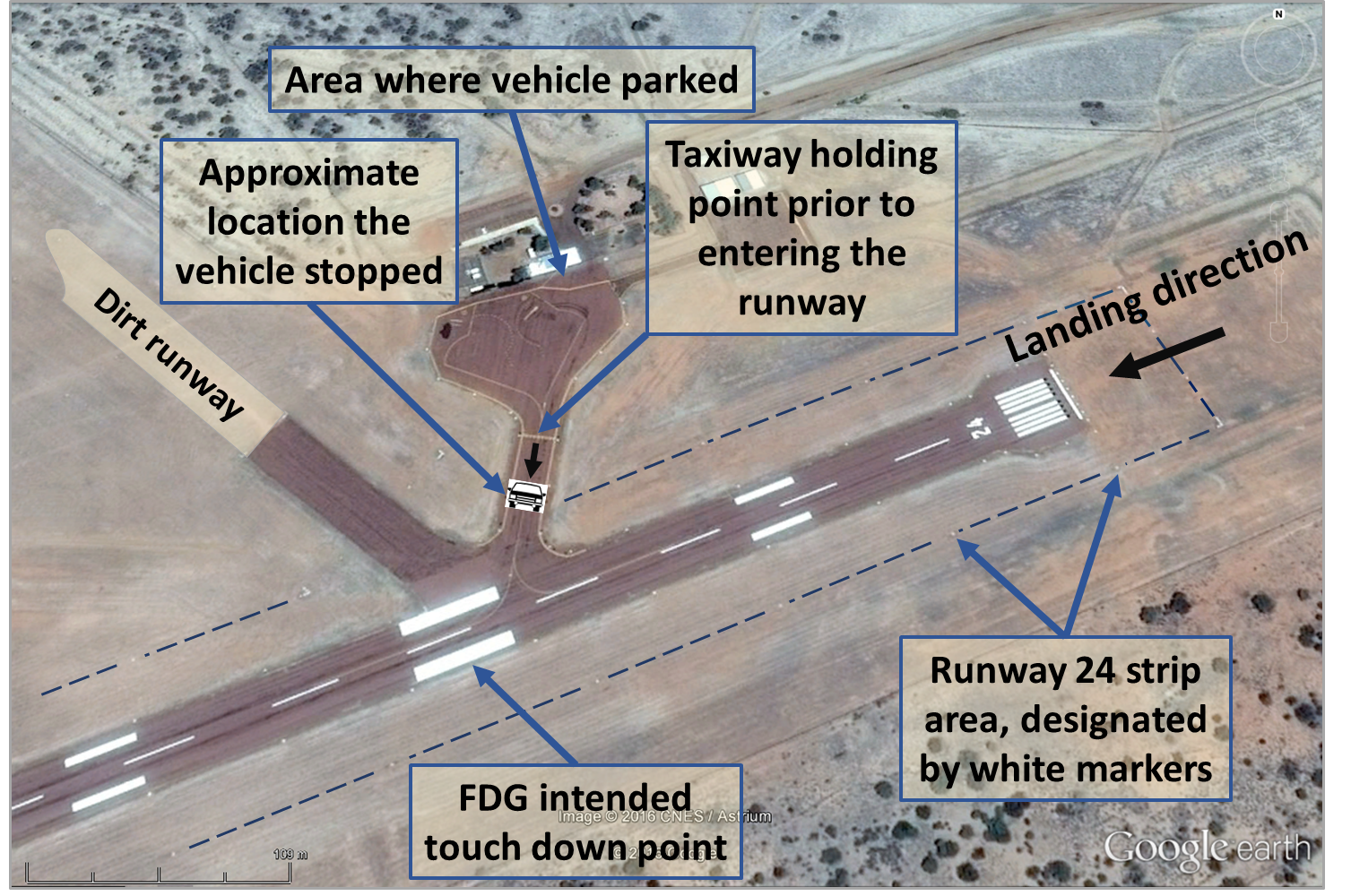
At about 4.5 NM from Blackall, the pilot noticed the stationary ambulance flashing lights close to the terminal building. The terminal building was located about 90 meters from the runway holding point and about 190 m to the runway centre line (Figure 1).
Figure 1: Blackall airport runway 24
Source: Google earth, modified by the ATSB
As the ambulance driver did not see or hear the aircraft, and was of the understanding that a runway inspection for animals was required to be completed before the aircraft arrived, they drove quickly down the taxiway towards the runway.
As FDG passed over the threshold of runway 24, and the pilot noticed the flashing lights of the ambulance on the taxiway passing through the holding point, and traveling at speed toward the anticipated touch down point of the aircraft. The pilot initiated a missed approach[2] and climbed out at about 20 ft above the runway.
At about the same time as the pilot initiated a missed approach, the ambulance driver saw the aircraft and stopped the ambulance near the runway white gable markers for runway 24 (Figure 1). The ambulance driver returned the vehicle back to the terminal and parked near the terminal building under the terminal floodlights with the vehicles flashing lights on.
The pilot climbed the aircraft to circuit height and was unable to contact the ambulance driver on the UHF channel, so contacted the ambulance coordination centre using the aircraft’s SAT phone. On the downwind leg of the circuit, the pilot was unable to see the ambulance, so elected to climb and enter a hold pattern about 5,000 ft above the airport to extend the SARTIME[3] on the HF radio.
The coordination centre contacted the ambulance driver and instructed them to contact the pilot on a VHF channel[4] (the vehicle VHF radio was not capable of being set to the common traffic advisory frequency (CTAF)). After about 10 minutes, the driver determined that they needed to contact the pilot on the UHF radio, and then was able to communicate with the pilot.
After the ambulance driver conducted the runway strip inspection, as requested by the pilot, the pilot descended the aircraft, and landed without incident.
Pilot comment
The pilot reported that there was a low moon and a clear night with good visibility and turbulence below 5,000 ft. There was about 25 knots crosswind from the left of runway 24. As the wind was coming from the left, the right wing of the aircraft obscured the vehicle traveling toward the runway until the pilot levelled the aircraft for a landing. The last time the pilot saw the vehicle it was stationary at the terminal.
The pilot indicated that it is not normal to request a strip run at Blackall Airport, as a high fence around the perimeter of the airport seems to keep the kangaroos out.
Ambulance driver comment
The driver indicated that some of the airport buildings may have obscured the approaching aircraft and as the airport lights are very bright, they may have made it more difficult to see the aircraft from where the ambulance was located.
The ambulance driver reported that all the external lights of the ambulance were on including the red and blue flashing lights, red rotating beacon and vehicle headlights. The ambulance may have been difficult to see by the pilot after the missed approach, as the driver parked the vehicle close to the terminal under the bright terminal lights, where the driver believed (at the time) the vehicle would be easy to see.
The vehicle was equipped with a UHF and a VHF radio, a SAT phone, and a portable handset. The ambulance driver commented that in some placements the UHF radio is not needed or rarely used so it was easy to forget that there was a UHF radio fitted to the vehicle.
The driver was informed during a one-day induction course, three days prior to the incident, that a strip run was needed to be performed before the aircraft could land at night.
Aircraft operator comment
The aircraft operator conducted an investigation into the occurrence and noted the following:
Blackall is a security-controlled airport. All persons wishing to access the airport ‘airside’ are required to undertake an airport induction program prior to access.
Blackall airport has standard low intensity runway lighting for runway 06/24, spaced at 60 m intervals each side of the runway. The pilot had activated the lights remotely using the pilot activated lighting system. Blue sideline lights are provided for the taxiway and the apron has floodlighting.
The instrument approach to runway 24 was being carried out not due to poor weather, but to facilitate a stable arrival and a runway aligned approach. The approach ensures terrain clearance and provides slope guidance during the approach to the runway.
Blackall is a certified airport. All vehicles entering the flight strip are required to both listen out for air traffic, and broadcast intentions, on the CTAF prior to entering the flight strip, and again once clear of the flight strip.
The ability to communicate with a vehicle operating ‘airside’ enables the pilot to confirm that the vehicle will be clear of the runway prior to landing, and to pass any specific instructions as required, for example an instruction to douse vehicle headlights and flashing hazard lights. Other information may be exchanged, for example confirmation that an airstrip has been inspected and is clear of animals.
Night operations at regional, rural, and remote airstrips present a significant animal strike hazard. To mitigate the risk, the operator prefers that all aerodromes that present an animal hazard are inspected prior to the aircraft landing. A request by the pilot for a driver to conduct a strip check is communicated through the coordination centre and not directly to the driver. This removes the opportunity for the pilot to brief the driver directly.
There is an internal publication listing details of many unregistered aerodromes and private airstrips in Queensland. The publication contains some entries warning of animal hazards, but does not specify the appropriate person or organisation to carry out an inspection at each location.
Ambulance operator comment
The ambulance operator conducted an investigation into the occurrence and noted the following:
A company induction was conducted on the driver’s day off prior to commencing work for the first time at Blackall. There was a lot of information to cover during the allocated one-day induction schedule.
An airport operator induction program existed that should be completed by anyone accessing the Blackall Airport. The program had not been made available to the driver at the time of the incident. The person who the driver had replaced had been based at Blackall for about 13 years and had indicated that they had not conducted an airport induction course.
The driver was not informed, or aware, that when the runway lights were on at night that the arrival of the aircraft was imminent.
The conduct of strip inspections for animals at Blackall was not based on a written agreement.
Blackall Airport is a certified airport and required that vehicles accessing the taxiway, runway, and/or runway strip have a VHF radio suitable for use on the CTAF. The ambulance had a UHF and VHF radio but the VHF radio was not capable of accessing the CTAF. At the time of the incident, the UHF radio was not turned on.
Safety action
Whether or not the ATSB identifies safety issues in the course of an investigation, relevant organisations may proactively initiate safety action in order to reduce their safety risk. The ATSB has been advised of the following proactive safety action in response to this occurrence.
Aircraft operator
As a result of this occurrence, the aircraft operator has advised the ATSB that they are taking the following safety actions:
Runway strip inspections will continue for night operations at aerodromes with known or suspected animal hazard, where appropriate ground personnel can safely conduct the inspections.
Formal procedures will be developed in conjunction with the ambulance operator detailing safety procedures for those rural/regional stations where a request for a runway inspection is likely.
Appropriate procedures will be developed for requesting airstrip inspections, including advice on the different requirements for CTAF and non-CTAF aerodromes, for incorporation in the airstrip data manual.
Closer safety liaison between the respective ambulance and operator safety departments.
Ambulance operator
As a result of this occurrence, the ambulance operator has advised the ATSB that they are taking the following safety actions:
Staff that undertake work at the Blackall Airport will attend the airport operator induction program.
Establish consultative arrangements with key stakeholders.
Review the local UHF/VHF radio communications procedures between the operation centre, aircraft operator, airport operator, and ambulance attending the airport.
Review of induction programs for staff in consultation with the aircraft operator and the airport operators to ensure that the induction consists of specific guidance material that covers all aviation safety requirements for staff who may undertake work at the airport. All new and existing staff will participate in the revised induction program.
Review induction workbooks to ensure that the workbook reflects all aviation safety requirements for staff who may undertake work at an airport or aerodrome. Once the workbook has been reviewed, all new and existing staff will be provided with a copy of the workbook.
Conduct a review of the Blackall standard operating procedures to ensure that the procedures cover all aviation safety requirements.
Safety message
The International Civil Aviation Organization (ICAO) has identified runway safety as one of its priorities and has been working with countries and aviation organisations globally to reduce runway safety accidents. ICAO has developed a runway safety website, which offers a range of information and products to assist the aviation community to improve runway safety.
In addition, ICAO has published a Manual on the prevention of runway incursions (Doc 9870 AN/463), available from the ICAO website. The manual includes information on the prevention of runway incursions. The manual discusses that deficiencies in design, training, technology, procedures, regulations and human performance can result in a system breakdown and safety being compromised.
Additional information on runway safety is also available from the Airservices Australia webpage Runway safety.
In addition, Airservices Australia has published a guide for airside drivers, The airside drivers guide to runway safety, which focuses on four aspects of operating safely on an aerodrome:
Decisions regarding whether to conduct an investigation, and the scope of an investigation, are based on many factors, including the level of safety benefit likely to be obtained from an investigation. For this occurrence, a limited-scope, fact-gathering investigation was conducted in order to produce a short summary report, and allow for greater industry awareness of potential safety issues and possible safety actions.
Publishing information
Released in accordance with section 25 of the Transport Safety Investigation Act 2003
Ownership of intellectual property rights in this publication
Unless otherwise noted, copyright (and any other intellectual property rights, if any) in this report publication is owned by the Commonwealth of Australia.
Creative Commons licence
With the exception of the Coat of Arms, ATSB logo, and photos and graphics in which a third party holds copyright, this publication is licensed under a Creative Commons Attribution 3.0 Australia licence.
Creative Commons Attribution 3.0 Australia Licence is a standard form licence agreement that allows you to copy, distribute, transmit and adapt this publication provided that you attribute the work.
The ATSB’s preference is that you attribute this publication (and any material sourced from it) using the following wording: Source: Australian Transport Safety Bureau
Copyright in material obtained from other agencies, private individuals or organisations, belongs to those agencies, individuals or organisations. Where you wish to use their material, you will need to contact them directly.
Through routine trend monitoring of safety occurrence reporting, the ATSB became aware of a potential issue surrounding the frequency of light aircraft engine failures and malfunctions (both Australian VH and recreationally-registered). To formally and more fully examine the contributing factors behind these statistical observations, the ATSB initiated this Aviation Research investigation (under the provisions of the Transport Safety Investigation Act 2003).
What the ATSB found
Over the 6-year study period between 2009 and 2014, 322 engine failures or malfunctions involving light aircraft were reported to the Australian Transport Safety Bureau (ATSB) and/or Recreational Aviation Australia (RA-Aus). These reports involved single-engine piston aeroplanes up to 800 kg maximum take-off weight. Aircraft powered by Jabiru engines were involved in the most engine failures or malfunctions with 130 reported over the 6 years. This represents about one in ten aircraft powered by Jabiru engines in the study set having reported an engine failure or malfunction. Reports from Rotax powered aircraft were the next most common with 87 (one in 36), followed by aircraft with Lycoming (58 – one in 35) and Continental (28 – one in 35) engines. When factoring in the hours flown for each of these engine manufacturers, aircraft with Jabiru engines had more than double the rate of engine failure or malfunction than any other of the manufacturers in the study set with 3.21 failures per 10,000 hours flown.
Unlike the engines of other engine manufacturers in this study, nearly half of the Jabiru engine failures or malfunctions related to a fractured component. Engine through-bolt failures were the most commonly reported failure mechanism in Jabiru powered aircraft with 21 through-bolt fractures reported between 2009 and 2014. Taking into account the number of aircraft registered in the study period, through-bolt failures occurred in about one in 55 Jabiru powered aircraft. Although originally designed to be replaced after 1,000 hours, 19 through-bolts failed before the 1,000 hour mark, with seven failing before 500 hours. At least four failures involved engines with upgraded 3/8 inch diameter through-bolt nuts. There were no failures reported involving the newer 7/16 inch diameter through-bolts which are used in currently manufactured engines (present in about 20 per cent of Jabiru engines).
What's been done as a result
Jabiru Aircraft Pty Ltd have designed and tested a modified 3/8 inch diameter through-bolt which incorporates aspects to alleviate the effects of thermal expansion and damp resonant vibrations.
The ATSB has issued recommendations to Jabiru Aircraft Pty Ltd and the Civil Aviation Safety Authority to reduce the risk of engine failure or malfunction in aircraft fitted with Jabiru engines and to assure future reliability of these engines.
Safety message
Owners and operators of light aircraft with Jabiru engines that have 3/8 inch diameter through-bolt configurations need to be aware of the continued elevated risk of a through-bolt failure leading to an engine failure or malfunction in flight. It appears that Jabiru engine service bulletins, requiring upgraded through-bolts of the same thickness and upgraded nuts to the 12-side ARP nuts, may not have fully addressed this issue. Thicker 7/16 inch through-bolts (installed in newly manufactured engines and recommended as a retro-fit for aircraft conducting flight training), appear to have improved the reliability of Jabiru engines, although future monitoring will provide more definite evidence.
Findings
From the evidence available, the following findings are made with respect to the analysis of the reliability of engines in light aircraft. These findings should not be read as apportioning blame or liability to any particular organisation or individual.
Safety issues, or system problems, are highlighted in bold to emphasise their importance. A safety issue is an event or condition that increases safety risk and (a) can reasonably be regarded as having the potential to adversely affect the safety of future operations, and (b) is a characteristic of an organisation or a system, rather than a characteristic of a specific individual, or characteristic of an operating environment at a specific point in time.
Other factors that increased risk
There was a disproportionate rate of engine failure and malfunction occurrences relating to light aeroplanes fitted with Jabiru engines.
Fractured engine components were the most common technical failure mechanism in Jabiru engines, particularly involving engine through-bolts. Most reported through-bolt failures in Jabiru engines occurred before the 1,000 hour overhaul limit and some before 500 hours.
Thicker 7/16 inch diameter through-bolts, fitted to newer Jabiru engines and some retro-fitted engines, have had limited service to date to confirm early indications that they reduce this risk. Retro-fitting engines with thicker through-bolts has only been recommended for aircraft involved in flight training by JSB031 issue 3. Most light aircraft in service with Jabiru engines continue to use 3/8 inch diameter engine through-bolts which, even after upgrades in accordance with Jabiru service bulletins JSB031 issues 1 and 2, remain at an elevated risk of fracturing within the service life of the bolt, leading to an engine failure or malfunction in flight. [Safety issue]
Appendix
Summary of Jabiru service bulletins regarding changes to through-bolts and nuts
The first of the Jabiru service bulletins regarding through-bolt upgrades (JSB 031-1) was released on 14 April 2011. This bulletin applied to the following Jabiru 2200 and 3300 engines:
2200A with serial numbers between 1707 and 3483
2200B with serial numbers 001 onwards
2200C with serial numbers 001 onwards
2200J depending on configuration
3300A with serial numbers between 637 and 2391
3300L with serial numbers 001 onwards.
The bulletin required the upgrading of the through-bolt nuts (see Figure 11) from 3/8 inch six sided nuts (MS21042 style) to 3/8 inch 12-point nuts. New oversize crankcase dowels were also required to be fitted. The changes were required for any engine (in the above list) at the next overhaul or major maintenance. Additionally, for any engine that had previously suffered a through-bolt failure, new through-bolts, 12-point through-bolt nuts and crankcase dowels were required to be installed within the next 100 hours (TIS) or 12 months, which ever came sooner. There were similar requirements for engine with less than 500 hours TTIS or less than 200 hours TSO, as well as engines with 500 – 1000 hours TTIS or more than 200 hours TSO. See JSB 0311 for further details.
In addition to the above requirements, a number of recommended ‘corrective or preventative measures’ were also included. These related to fuel use (JSL007), operating techniques (increasing climb speed to improve engine cooling), the release of a new overhaul manual, shims to reduce compression ratio, crankcase locating dowels and new thicker (7/16”) engine through-bolts.
Figure 11: Jabiru 6-sided and 12-sided through-bolt nuts.
Source: Jabiru Aircraft PTY LTD service bulletin JSB031-1
JSB 031-1 was superseded on 10 October 2013 with the release of JSB 031-2. This bulletin applied to the following engines:
2200A with serial numbers between 1707 and 3483
2200B with serial numbers between 001 and 282
2200C with serial numbers between 001 and 018
2200J any built or overhauled between 2004 and 2011
3300A with serial numbers between 637 and 2391
3300L with serial numbers between 001 and 096.
Of the engines above, requirements pertained to any engine meeting the JSB031-1 requirements, any engine at overhaul or major service, and any engine still equipped with the six sided MS21042 style nuts. In Issue 2 of JSB031, any applicable engines that had not complied with Issue 1 were required to be updated and their cylinders inspected. The upgrades related to maintenance practices outlined in the Jabiru engine overhaul manual document JEM0001.
The most recent of these service bulletins, JSB031-3 became effective on 31 January 2015. This bulletin affected the following engines, but only for aircraft involved in flight training operations:
2200 engines in the serial number range:
22A2068 to 22A2102
22A2143 to 22A3483
(including 22B01 to 22B254)
(including 22C001 to 22C018)
3300 engines in the serial number range:
33A961 to 33A2574
Required action for engines with 3/8 inch through-bolts (excluding roller cam upgraded engines) included replacing all 3/8 inch through-bolts and studs before reaching 500 hours in service. Or, for aircraft where through-bolts have already exceeded 500 hours in service, they were to be changed at the next 25-hourly service interval.
Additionally, JSB031-3 recommended that all engines to which this service bulletin is applicable and other engines are upgraded to the most current through-bolt configuration, which at the time of writing was the following:
7/16” Through-bolts (P/No 4A596A0D)
7/16” Stud Bolts (P/No 4A595A0D)
7/16” Short Stud Bolts (P/No 4A594A0D)
12 point ARP nuts (P/No PH4A062N and PH4A056N)
Hardened steel washers (P/No 4A625A0D)
Washers for front stud nuts (P/No AN960716)
All the above must be fitted as per JSB031-3 and the latest Engine Overhaul Manual, JEM0001.
Safety issues and actions
The safety issues identified during this investigation are listed in the Findings and Safety issues and actions sections of this report. The Australian Transport Safety Bureau (ATSB) expects that all safety issues identified by the investigation should be addressed by the relevant organisation(s). In addressing those issues, the ATSB prefers to encourage relevant organisation(s) to proactively initiate safety action, rather than to issue formal safety recommendations or safety advisory notices.
All of the directly involved parties were provided with a draft report and invited to provide submissions. As part of that process, each organisation was asked to communicate what safety actions, if any, they had carried out or were planning to carry out in relation to each safety issue relevant to their organisation.
Descriptions of each safety issue, and any associated safety recommendations, are detailed below. Click the link to read the full safety issue description, including the issue status and any safety action/s taken. Safety issues and actions are updated on this website when safety issue owners provide further information concerning the implementation of safety action.
Safety issue description: Thicker 7/16 inch diameter through-bolts, fitted to newer Jabiru engines and some retro-fitted engines, have had limited service to date to confirm early indications that they reduce this risk. Retro-fitting engines with thicker through-bolts has only been recommended for aircraft involved in flight training by JSB031 issue 3. Most light aircraft in service with Jabiru engines continue to use 3/8 inch diameter engine through-bolts which, even after upgrades in accordance with Jabiru service bulletins JSB031 issues 1 and 2, remain at an elevated risk of fracturing within the service life of the bolt, leading to an engine failure or malfunction in flight.
Safety recommendation description: The Australian Transport Safety Bureau recommends that the Civil Aviation Safety Authority continue to monitor the through-bolt failure rate of Jabiru engines to satisfy themselves of the reliability of the:
7/16 inch diameter bolts, and
any other alternative produced to replace the existing 3/8 inch diameter through-bolt
configuration (including newly developed through-bolts incorporating aspects to alleviate the effects of thermal expansion and damp resonant vibrations) to determine if these modifications have sufficiently reduced the risk of an engine failure or malfunction in Jabiru-powered aircraft.
Safety recommendation description: The Australian Transport Safety Bureau recommends that Jabiru Aircraft Australia takes further safety action to ensure that all owners of Jabiru engines that have not been manufactured with new configuration 7/16 inch diameter through-bolts, or modified in accordance with Jabiru Service Bulletin JSB031-3 have access to, and are encouraged to upgrade to:
the 7/16 inch diameter through-bolt configuration, or
any other alternative produced to replace the existing 3/8 inch diameter through-bolt configuration (including newly developed through-bolts incorporating aspects to alleviate the effects of thermal expansion and damp resonant vibrations).
Context
When aviation safety incidents and accidents happen, they are reported to the ATSB. The most serious of these are investigated, but most reports are used to help the ATSB build a picture of how prevalent certain types of occurrences are in different types of aviation operations. The ATSB uses this data to proactively look for emerging safety trends. By monitoring trends, issues of concern can be communicated to industry and action taken to prevent accidents.
In 2012, this trend monitoring process identified a significant increase in the number of light aircraft engine failures or malfunctions. This trend was twice communicated to the Civil Aviation Safety Authority and an engine manufacturer. The ATSB also received two REPCONs (confidential safety concern reports) in 2012-2013 about the reliability of light aircraft engines. To formally and more fully examine both the extent of and the contributing factors behind these observations, the ATSB initiated this Aviation Research investigation (under the provisions of the Transport Safety Investigation (TSI) Act 2003).
This research investigation aims to assess and compare engine failures and malfunctions in light aircraft. This involves single-engine aeroplanes up to 800 kg maximum take-off weight (MTOW). The weight cut-off of 800 kg encompasses the Light Sport Aircraft (LSA) group of aircraft, which are typically under 600 kg MTOW. Although some of these aeroplanes are registered with the Civil Aviation Safety Authority (CASA) (VH-registered), the majority of these types of aeroplanes are registered with Recreational Aviation Australia (RAAus). Aircraft registered with either body could have either a certified or uncertified aircraft engine, and could be either factory-built or amateur-built. As such, the ATSB has examined occurrences of both VH-registered and RAAus registered aeroplanes reported to the ATSB and/or RAAus between 2009 and 2014 that the ATSB has classified as engine failures or malfunctions. Engine failures or malfunctions are only reportable matters (to the ATSB) under the TSI Act when they happened while the aircraft was boarded for flight. Engine failures or malfunctions found during maintenance would instead be reported as either a defect report to RAAus or a Service Difficulty Report (SDR) to CASA. Neither RAAus defect reports nor CASA SDRs were considered for analysis in this study.
Reporting of engine failures or malfunctions
The TSI Act requires aircraft accidents and incidents to be reported to the ATSB. Under the TSI Regulations, for aircraft that are not involved in air transport operations, this includes all engine failures or malfunctions (when boarded for flight):
2.4 (2)(e) the use of any procedure for overcoming an emergency, and/or
2.4 (2)(f)(i) an occurrence the results in difficulty controlling the aircraft including an aircraft system failure.
In addition, any engine failure or malfunction resulting in a fatal or serious injury or serious damage to the aircraft, is immediately reportable to the ATSB.
These reporting requirements apply to all Australian registered aircraft, including those registered with RAAus, and all internationally registered aircraft operating in Australia, and supersede any other organisation’s reporting requirements.
All occurrences reported to the ATSB are entered into the ATSB occurrence database. During this process, occurrences are classified by the ATSB occurrence type taxonomy. This taxonomy classifies an engine failure or malfunction as being an engine malfunction that results in a total engine failure, a loss of engine power or is rough running. Technical faults that results in an engine failure or malfunction include:
reports of total power loss of an engine
a loss of power that limits aircraft performance
a rough running engine (coughing, spluttering, etc)
observations of abnormal sights, sounds or vibrations by a crew member
any mechanical issue that results in an engine shutdown (excluding engine shutdowns based solely on abnormal engine indications).
A loss of engine power due to fuel exhaustion or starvation is not coded an engine failure or malfunction.
Case Study: Collision with terrain involving Rand Robinson KR-2, near Tumut, NSW on 5 October 2013.
At about 0900 on Saturday 5 October 2013, the pilot of an amateur-built Rand Robinson KR-2, two-seat aeroplane operated in the ‘Experimental’ category, took off from an airstrip on private property 14 km west of Tumut Airport, New South Wales (NSW). The pilot was reported to have intended to fly the 48 NM (89 km) to Holbrook, NSW, for the weekend.
The ATSB investigation found that shortly after take-off, the number three cylinder upper sparkplug was ejected from the cylinder head hole, resulting in a significant loss of engine power. This failure was the result of an incorrectly installed spark plug thread insert. While positioning the aircraft for a return landing onto the departure airstrip after the power loss, the aircraft probably entered an aerodynamic stall from which the pilot was unable to recover before the aircraft impacted terrain. The pilot was fatally injured, and the aircraft destroyed.
Wreckage of the Rand Robinson KR-2 Source: ATSB
Safety analysis
Occurrence notifications associated with engine failure or malfunctions reported to either Recreational Aviation Australia (RAAus) or the ATSB between 2009 and 2014 were examined.[1] Engine failures or malfunctions were only considered to be occurrences when they happened while the aircraft was boarded for flight. Fuel starvation and fuel exhaustion occurrences were not classified as engine failures or malfunction. Only occurrences involving single (piston) engine aeroplanes were included (helicopters, motorised gliders, gyroplanes, remotely piloted aircraft and weight-shift aircraft were excluded). Although light sport aircraft (LSA) are typically less than 600 kg maximum take-off weight (MTOW), this study was expanded to include single engine aeroplanes up to 800 kg. Doing so facilitated a comparison between engines commonly found in RAAus registered aircraft with comparable engines from VH-registered aircraft. Both RAAus and VH-registered aircraft were considered for analysis.
Between 2009 and 2014 there were 322 engine failure or malfunction occurrences reported to either the ATSB or RAAus involving the set of aircraft described above.
Higher risk engine failures or malfunctions
An engine failure or malfunction in a single-engine aeroplane can have a variety of safety consequences depending on the extent of the failure or malfunction, phase of flight, pilot response, and availability of suitable landing areas.[2]
The ATSB assesses the probable level of safety risk associated with each reported safety occurrence using the Aviation Risk Management Solutions Event Risk Classification ERC framework.[3] This framework bases the safety risk on the most credible potential accident outcome that could have eventuated, and the effectiveness of the remaining defences that stood between the occurrence and that outcome. The intention of this assessment is to determine if there was a credible risk of injury to aircraft occupants and damage to the aircraft (and does not consider financial loss of the aircraft or engine).
In the set of 322 engine failures or malfunctions described in this report, 80 (25%) were classified as being a low risk rating with a low or no accident outcome. The majority (224 or 69%) were classified as medium risk and 18 (6%) as high risk.
Figure 1 shows the distribution of ERC risk ratings for the 322 engine failures or malfunctions in this study.
Figure 1: The number of low, medium, and high risk engine failure or malfunction occurrences between 2009 and 2014.The majority of engine failure or malfunction occurrences in light aircraft were medium risk, followed by low risk.
Between 2009 and 2014 there were 18 high risk engine failure or malfunction occurrences, four of which resulted in fatalities.
During the initial climb from Bankstown NSW on a dual instructional flight, the engine of the Piper PA-38 failed and smoke was observed in the cockpit. The pilot conducted a forced landing at Prospect Reservoir (200903291).
On a private flight near Julia Creek Aerodrome Qld, the engine of the Tecnam P2004 failed. The aircraft stalled and collided with bushes before coming to rest on the ground. The pilot and passenger sustained no injuries but the aircraft was destroyed (200903356).
During the initial climb from Bathurst Aerodrome NSW the engine of the amateur-built Lancair lost power. The aircraft subsequently collided with terrain. The aircraft was seriously damaged (200907303).
While on descent to Serpentine WA, the engine of amateur-built Jabiru failed. During the subsequent forced landing, the aircraft struck trees and collided with terrain. The aircraft was seriously damaged and the pilot suffered serious injuries (201001282).
An amateur-built Jabiru J400 aircraft with the pilot and three passengers departed Busselton Aerodrome, WA. After the aircraft climbed to about 500 feet and the flaps were raised, the engine then lost power, showing a low RPM reading. The pilot turned back to the aerodrome and conducted a glide approach, landing about two-thirds of the distance down the runway. As the brakes were applied, there was no brake pressure, so the pilot pumped the brakes. The left brake subsequently caught on fire. The aircraft ran off the end of the runway and subsequently impacted a small ditch before rolling into a fence. No one was injured but the aircraft was substantially damaged (201002472).
During cruise near Goolwa SA, the engine of the amateur-built Pulsar aircraft lost power and subsequently failed. During the forced landing approach onto a nearby paddock, the left wing and nose dropped and the aircraft impacted the ground (201003405).
During the initial climb from Busselton Aerodrome WA, the Rans S-7 experienced a partial power loss. The aircraft veered right, just cleared a fence and landed in a paddock. The aircraft sustained serious damage and the passenger received a minor injury (201007831).
On approach to Dubbo NSW, the engine in the amateur-built Van’s Aircraft RV-6 failed. The aircraft collided with terrain about 300 m short of the runway threshold. The pilot and passenger were fatally injured and the aeroplane was substantially damaged (AO-2014-149).
On the approach to Maryborough aerodrome, Vic, the engine of the Vision 600N aircraft failed at 250 ft. While attempting to land, the aircraft stalled at 20 ft and impacted the ground. The sole occupant was not injured, however, the aircraft sustained substantial damage (201101063).
During cruise near Whyalla Aerodrome SA, the engine of the amateur-built Murphy aircraft failed. During the forced landing into scrub, the main landing gear contacted a tree stump causing the aircraft to cartwheel. The pilot exited the aircraft uninjured but the aircraft was subsequently destroyed by the ensuing fire (201200151)
During approach at George Town Tas, the engine in the Howard Hughes GR-912 aircraft malfunctioned and the aircraft collided with terrain. The pilot was fatally injured (201300135).
During cruise near Taree Aerodrome NSW, the engine in the Amateur-built Super Diamond failed and the aircraft collided with terrain. The pilot sustained fatal injuries and the aircraft was destroyed (201303863).
During the cruise near Wonthaggi Township Vic, the engine in the Skyranger Vmax ran roughly and lost power. The pilot conducted a forced landing and struck a ditch resulting in substantial damage (201306332).
Shortly after take-off from Tumut NSW the amateur-built Rand aircraft had a significant loss of engine power. While positioning the aircraft for a return landing, the aircraft probably entered an aerodynamic stall and the aircraft collided with terrain. The pilot was fatally injured (AO-2013-174). See case study on page 3.
During initial climb from The Oaks ALA NSW, the engine of the Jabiru LSA[4] did not develop full power and subsequently failed during the circuit. The pilot attempted to land back on the runway but collided with trees resulting in substantial damage. The pilot received minor injuries and the passenger was seriously injured (201309076).
During initial climb from Balonne ALA Qld, the engine in the Tecnam P92 lost power and the pilot conducted a forced landing into a cotton field. The nose wheel sank into the soft ground and the aircraft flipped, resulting in substantial damage (201310128).
The pilot of an amateur-built Pitts S1S conducted an aerobatic flight near Lethbridge ALA, Vic. After successfully completing 987 rolls to the left, at about 2,000 ft above ground level, the pilot elected to return to Lethbridge. About 2 minutes later, when in the cruise, the engine spluttered and lost power. Although the pilot aimed to return to Lethbridge, which was about 1 NM away, the aircraft was rapidly losing altitude and the pilot conducted a forced landing in a field. During the landing roll, the aircraft collided with a rock and nosed over, coming to rest inverted. The aircraft was substantially damaged (AO-2014-036). See case study on page 25.
During take-off near Montrose Qld, the Aeroprakt A22 did not climb as expected. The aircraft veered left and struck an earth bank resulting in substantial damage (201407244).
Engine manufacturers
Engines used by light aircraft are:
mostly horizontally opposed in their cylinder configuration
typically air cooled (although some have water cooled cylinder heads)
mostly either four or six cylinder (although some have two cylinders, e.g. Rotax 500 series)
mostly four stroke (with the exception of the Rotax 500 series of engines)
typically less than 200 hp engine output.
Most aircraft in this set use factory-built engines designed specifically for use in aircraft, however, a small number of aircraft use modified automobile engines.
Thirteen engine manufacturers were represented in the 322 engine failure or malfunction occurrences (see Figure 2). However, just four manufacturers made up 94.1 per cent of the entire set. These were:
Jabiru (40.4%, 130 occurrences)
Rotax (27.0%, 87 occurrences)
Textron Lycoming (18.0%, 58 occurrences)
Continental Motors (8.7%, 28 occurrences).
The remaining 5.9 per cent (19 occurrences) were made up of nine different engine manufacturers (and one unknown engine manufacturer). The remainder of the analysis will focus on the four aforementioned engine manufacturers.
Figure 2: The distribution of engine manufacturers represented in the set of light aircraft that had an engine failure or malfunction between 2009 and 2014. Although thirteen engine manufacturers are represented, just four make up the vast majority (94.1 %) of the set.
Taking into account the number of aircraft on both the CASA and RAAus registers and the number of aircraft involved in the above data, this represents an engine failure or malfunction occurrence in the study period in about:
one in 10 aircraft with Jabiru engines
one in 36 aircraft with Rotax engines
one in 35 aircraft with Continental engines, and
one in 33 aircraft Lycoming engines.
Case Study: Engine failure near Amberley Aerodrome, Qld, on 28 October 2013.
ATSB occurrence reference number 201312960
Wreckage of the Skyfox Source: Reporter
Engine failure or malfunction rates by engine manufacturer
Figure 2 above shows the number of engine failures or malfunctions for each engine manufacturer. To normalise these data, hours flown information was provided by the Bureau of Infrastructure, Transport and Regional Economics (BITRE) for the VH-registered aircraft and RAAus for the RAAus registered aircraft. Registration records were examined to account for engine changes in any given year. In cases where an aircraft had an engine change during the year, hours flown data were assigned to engine manufacturers on a pro-rata basis based on the date of the engine change. The number of engine failures or malfunctions presented in Figure 2, for the four main engine manufacturers, were divided by the total hours flown for each engine manufacturer in the 6-year study period between 2009 and 2014 to produce a rate. (Note that neither RAAus nor BITRE had access to 2014 hours at the time of writing this report. To make use of the 2014 occurrence data, the hours flown for each manufacturer in the preceding 2 years was averaged to obtain an estimate of 2014 hours flown.)
Rates of engine failures or malfunctions per 10,000 hours flown can be seen in Figure 3 for the four major engine manufacturers. Over the 6 years between 2009 and 2014, Jabiru powered aircraft had the highest rate of engine failure or malfunction with 3.21 per 10,000 hours flown, more than double that of any other manufacturer. This was followed by Rotax powered aircraft with 1.56 per 10,000 hours flown. The engine failure or malfunction rates for Textron Lycoming and Continental engines were quite similar with rates of 1.27 and 1.21 per 10,000 hours flown respectively.
Figure 3: The rates of engine failure or malfunctions for the four primary engine manufacturers in the light aeroplane set of aircraft between 2009 and 2014. This set includes RAAus and VH-registered aeroplanes under 800 kg. During the study period Jabiru engines had more than double the rate of engine failure or malfunction than any other manufacturer.
The engine failure or malfunction rates from Figure 3 are displayed in Figure 4 on a per year basis. Figure 4 shows that the total yearly engine failure or malfunction rates for the four primary engine manufacturers in the set has increased from 36 in 2009 to 65 in 2014. In 2009, reports of engine failures or malfunctions involving Lycoming engines were the most common with 15. However since then, reports from Jabiru powered aircraft have consistently shown the highest yearly rates. The hours flown estimates for 2014 (previously discussed) have to be considered when comparing 2014 rates. Additionally, changes in reporting culture over the 6 years have the potential to influence such data.[5]
Figure 4: The rates of engine failure or malfunction per year for the four primary engine manufacturers in the light aeroplane set between 2009 and 2014. This set includes RAAus and VH-registered aeroplanes under 800 kg. The column height shows the rate given by the left-hand axis scale. The numbers above each column are the occurrence counts. During the study period Jabiru engines had the highest rate of failure or malfunction for 5 of the past 6 years.
The rates from Figure 3 were further divided into registration type (VH or RAAus), shown in Figure 5. As can be seen in Figure 5, the rates of engine failure or malfunction showed a very similar pattern across the four main engine manufacturers as with Figure 3, with Jabiru powered aircraft having the highest rates for all VH-registered and most RAAus registered aircraft.
For the RAAus registered aircraft, Figure 5 shows Lycoming engines with a relatively high rate of engine failure or malfunction from five occurrences. Further examination shows that four of these five were the same aircraft, experiencing the same failure (magneto failure) in the same year. In addition, RAAus registered aircraft with Lycoming engines had relatively very few hours flown so rate data should be viewed as a less reliable indication, as low hours flown makes the rate very sensitive to small changes in occurrence numbers. It should be noted that when comparing the VH and RAAus occurrences in Figure 5, there is always the possibility that reporting rates for engine failure or malfunction occurrences may differ between VH and RAAus communities. However, it seems unlikely that this would bias any manufacturer in particular.
Figure 5: The rates (and numbers shown in data labels) of engine failure or malfunction for the four primary engine manufacturers in the light aeroplane set, separated into registration type, between 2009 and 2014. (The transparent column reflects a rate with low hours flown making it very sensitive to small changes in occurrence numbers, and should be treated as a less reliable rate.) Note that the column height shows the rate given by the left-hand axis scale. The numbers above each column are the occurrence counts.
Case Study: Engine failure Gloucester, NSW 28 Aug 2013
ATSB Occurrence reference number 201308291
Following a complete loss of engine power, and a subsequent restart that only produced marginal power, the pilot of the Hornet STOL aircraft conducted a forced landed to a paddock east of Gloucester NSW. The aircraft sustained substantial damage from both the impact and post-impact fire. The sole occupant received minor injuries. Although fuel availability, flow and contamination were ruled out from initial investigation, the cause of the engine failure remains unknown.
Source: Reporter
Comparative engine failure or malfunction occurrence rates cannot be calculated for certified and uncertified engines due to unknown hours flown for the two groups. A comparison between engine failure or malfunction occurrence rates for factory-built and amateur-built aircraft can be achieved.
Another potential contributor to the likelihood of engine failures or malfunctions is the personnel conducting the maintenance. Maintenance requirements specific to each engine are provided by the manufacturer and would be applicable regardless of whether the engine was in a VH or RAAus registered aircraft. However, there would be differences in who is undertaking this maintenance. For VH-registered aircraft, there are different requirements concerning who can conduct maintenance on aircraft, depending on whether it was factory-built or amateur-built. Factory-built aircraft must be maintained by a licenced aircraft maintenance engineer (LAME). In contrast, amateur-built aircraft that are owned by the builder can be maintained by the owner. Owner-pilots of RAAus registered aircraft can also maintain their own aircraft, provided the aircraft is not used for hire-and-reward (for example flight training). To undertake maintenance on their own aircraft, owners must obtain the Level 1 Maintenance Authority from RAAus. For RAAus aircraft used for hire or reward, persons with Level 2 Maintenance Authority must carry out the maintenance. [6] Engine failure or malfunction occurrence rates, however, can also not be calculated for different maintenance regimes due to the unknown hours flown (and in many cases occurrences) for RAAus aircraft maintained via Level 1 or Level 2 maintenance authority, nor VHregistered amateur-built aircraft maintained by the owner or a LAME.
An examination of aircraft build-type was conducted for engine manufacturers with sufficient numbers of aircraft hours for each build type within each registration type. For VH-registered aircraft, amateur-built aircraft consistently had a slightly higher rate of occurrences than factory-built (5.84 to 5.18 per 10,000 hours respectively for Jabiru, 3.06 to 2.90 for Rotax, and 1.56 to 1.11 for Textron Lycoming). For RAAus registered aircraft, this was also the case for Rotax powered aircraft (1.61 to 1.42 per 10,000 hours), but the difference was reversed for Jabiru powered aircraft, with a lower rate of occurrences for amateur-built (2.47) than for factory-built (3.20). However, as discussed above, it is difficult to determine whether qualifications of the maintainer contribute to these differences.
Safety factors associated with engine failures or malfunctions
The ATSB assigns safety factors to occurrences to describe factors that contributed to the occurrence. The ability of the ATSB to assign safety factors to an occurrence is dependent on the information that is reported by the owner or operator, and whether the occurrence was investigated by either RAAus or the ASTB. Information reported to the ATSB varies considerably from one occurrence to another and can depend on:
the individual reporting the occurrence
the type of failure mechanism
whether an engineering inspection was carried out.
Figure 6 shows, by engine manufacturer, the proportion of engine failure or malfunction occurrences where insufficient information was available to the ATSB to determine a contributing safety factor(s) relating to the engine failure or malfunction.[7] The proportions of occurrence without sufficient information to code safety factors relating to the engine failure or malfunctions ranged from 25 per cent for occurrences involving aircraft with Jabiru engines, to 51 per cent for occurrences involving Rotax powered aircraft.[8] The proportions for other manufacturers lay between these values. The average proportion of occurrences across all manufacturers where a safety factor could not be assigned to the engine failure or malfunction was 44 per cent.
Despite being reasonably consistent, there is up to a 26 per cent difference in the proportion of occurrences with safety factors between the manufacturers. These differences in the proportions of safety factors introduce inherent errors in any further comparison and analysis of safety factors. Accordingly, when comparing rates of safety factors, such as in Figure 7, the proportion of occurrences with unknown safety factors are used to generate error bars.
Figure 6: Proportion of engine failure or malfunction occurrences between 2009 and 2014 that had sufficient information provided to assign safety factors regarding the engine failure or malfunction.
For safety factors relating to engine failure or malfunctions, technical failure mechanisms can include:
fracture - physical separation of parts of a component. Action of stress created by a single load application or the action of repeated stressing created by alternating loading
wear - surface interactions involving the removal of material from the surface of a component or transfer of material from one surface to another
corrosion - loss of material through a chemical action between a component and its environment. May be a localised reaction or a general surface reaction at low or high temperatures
deformation - physical distortion. Plastic deformation (permanent), elastic deformation (recoverable after force removed)
electrical discontinuity - disruption of an electrical connection at wiring level, circuit level, integrated circuit level
mechanical discontinuity - disruption of a physical connection in a mechanical, hydraulic or pneumatic system
software/firmware anomaly - computer or microprocessor program malfunction
other technical failure mechanism - any other type of failure mechanism.
Other non-technical issues relating to engine failures or malfunctions (shown in Figure 7 as the non-technical set) include suspected carburettor icing, aircraft maintenance actions (incorrect replacing, repairing or installing), and pre-flight inspecting (such as water in fuel not identified).
Figure 7 shows the rates of technical failure mechanisms safety factors per 10,000 hours flown for the four major engine manufacturers. (Note that this figure is using safety factors, not occurrences, and some occurrences have multiple safety factors.)
Jabiru
Nearly half (45%) of the safety factors associated with Jabiru engine failure or malfunctions (where the safety factor was known) were classified as fractures, leading to a rate of 1.11 fractures per 10,000 hours flown.
Mechanical discontinuities were the next most common failure mechanism for Jabiru engines (38%, rate 0.94/10,000 hours).
These were followed by electrical discontinuities (5%, rate 0.12/10,000 hours) and wear (2%, 0.05/10,000 hours).
Non-technical issues accounted for 11%.
Rotax
Safety factors relating to Rotax engine failure or malfunctions were predominantly due to mechanical discontinuities (46%, rate 0.39/10,000 hours).
Fractures then made up 13 per cent (0.11/10,000 hours) followed by electrical discontinuities (6%, rate 0.05/10,000 hours) and corrosion issues (4%, rate 0.04/10,000 hours).
Non-technical issues accounted for 19 per cent of the known Rotax safety factors.
Lycoming
Electrical discontinuities where the most common technical failure mechanism for Lycoming engines with 33 per cent of the known safety factors, leading to a rate of 0.29 per 10,000 hours.
Continental
At a rate of 0.17 per 10,000 hours and accounting for 20 per cent of known safety factors, fractures where the most common technical failure mechanism for Continental engines.
However, engine failure or malfunction occurrences with Continental engines had by far the highest proportion of non-technical contributing factors (65%, rate 0.56/10,000 hours).
Figure 7: Technical failure mechanism safety factors for engine failure or malfunctions, as a rate per 10,000 hours flown, for the four primary engine manufacturers in the light aeroplane set, between 2009 and 2014. Error bars show rates extrapolated to occurrences without safety factor information.[9] Jabiru had by far the highest rate of fractures, which also exceed all other rates considerably. Jabiru also had the highest rate of mechanical discontinuities, while Lycoming had the highest rate of electrical discontinuities.
The most striking observation to be made from Figure 7 is the rate of Jabiru fractures in comparison to both other Jabiru failure mechanisms as well as fractures involving other manufacturers. With a rate of 1.11 per 10,000 flight hours, components in Jabiru engines appear to be fracturing at a rate significantly higher (more than six times) than any other engine manufacturer in the study.
Case Study: Engine failure near Ballina/Byron Gateway Aerodrome, NSW 30 April 2014
ATSB occurrence reference number 201402746
Wreckage of the Brumby aircraft Source: Reporter
Fractures
Occurrence records from the 58 engine failure or malfunctions involving a fractured component from the four major manufacturers were examined to determine what engine components had failed. The distribution of components that failed for each of the manufacturers are shown in Figure 9.
For Rotax, Lycoming and Continental engines, no single component has been reported to have fractured in more than two occurrences in the 6-year study period.
In contrast, for Jabiru engines, about half (47%) of the all Jabiru fractures reported related to engine through-bolt failures, with 21 through-bolt failures reported between 2009 and 2014.There were an additional two occurrences involving engine studs (see figure 8 for details). The combination of stud and through-bolt fractures accounts for 51 per cent of all fractures. However, for the rest of the analysis in this report, they are counted as separate components.
The 21 through-bolt occurrences made up a fifth of all the known Jabiru failure mechanisms and equates to a rate of 0.52 through-bolt failures per 10,000 hours flown. Taking into account the number of aircraft on both the VH and RAAus aircraft registers from this set with Jabiru engines, through-bolt failures occurred in approximately 2 per cent of the Jabiru powered aircraft, or roughly one in 55 aircraft. Given that this analysis relates to the sub-set of engine failure or malfunctions (75%) where the failure mechanism was reported, the actual figure could be higher.
For the set of engines analysed in this investigation, Jabiru engines are somewhat unique in their design. Conventionally, the crankcase is bolted together with separate bolts to those that are used to bolt the cylinders to the crankcase. In contrast, in Jabiru engines the same through-bolts that hold the crankcase together also fasten the cylinders to the block. Figure 8 shows the typical layout of a Jabiru four cylinder engine showing the location of the engine through-bolts.
Figure 8: Schematic showing the general layout of a Jabiru four cylinder engine
Source: Jabiru Aircraft PTY LTD service bulletin JSB031-3
Fractures relating to valves were the next most common in Jabiru engines, with 13 reported over the 6 years. It should be noted that there were another 15 valve failures coded as mechanical discontinuities. However, the category of valve failures describes failures of one of a number of components in the valve train, not just the valve itself. In the occurrences reported here, these included the valve stem fracturing, the valve head separating for the stem, as well as failures of the valve spring, the valve spring cup, the top spring washer, the tappet adjusting screws, and the valve keepers. Also included were reports of valves ‘dropping’, ‘seizing’ well as general reports of ‘valve failing’. Valve failures are coded as fractures when the reporters specifically mention a component fracturing, breaking or snapping, whereas if the reporter stated the components ‘failed’, ‘seized’, or ‘dropped’, they are coded as a mechanical discontinuity. Conversely, all 21 reports of through-bolts related to the one individual component fracturing.
Through-bolt and valve failures were followed by failures of flywheel bolts (3), studs (2), and one each of crank shaft gear, cracked cylinder, cylinder base nut, propeller bolts, propeller blade, and rivets.
There was a more even distribution of components that failed for the other three manufacturers with the greatest number of fractures for any single components being two.
Figure 9: The distribution of components that failed within the fracture set of technical failure mechanisms. Nearly half of the Jabiru fractures related to through-bolt failures, and nearly a third relating to fractures of a component in the valve train. There was a more even distribution of components that failed for the other three manufacturers.
Jabiru valve failures
In May 2015, Jabiru Aircraft Pty Ltd conducted a root cause analysis of valve train failures from 2013 to 2015.[10] The report identified 25 valve train failures in Jabiru engines between 2013 and 2015. Of these 25 occurrences, 3 were in 2015 (outside the scope of this ATSB investigation). A number were occurrences also reported to the ATSB and are part of the analysis presented here, while others may have been faults found during maintenance and hence not reportable to the ATSB.
The report states that ‘valve failures in Jabiru engines are virtually always exhaust valves’. This is consistent with what has been reported to the ATSB, with ten of the 13 valve fractures identified as being exhaust valve failures. In the other three occurrences it was not reported. The Jabiru report states also that the valve failures fell within three functional groups: the valves, the valve spring top retaining washer, and the valve springs. This is also consistent with what has been reported to the ASTB. Of the 13 fractures, five were described as a fracture of the stem, one fracture of the valve spring cup, one valve spring, while six were simply described as a failed/ broken valve.
Jabiru Aircraft Pty Ltd have already taken a number of actions to address these valve train failures, including a complete redesign of the valve train in 2005 to use hydraulic lifters (rather than solid lifters). The engineering report (AVDALSR106-3) states that this design change ‘eliminates valve clearance maintenance requirements’. Other design changes included modifying the valve guide tolerance and the implementation of valve relief pocketed pistons. Additionally, Jabiru Pty Ltd have published a number of service letters and service bulletins to increase awareness of the issues and prescribe correct maintenance practices. These included JSL007 (current issue 6 released August 5 2015), JSL002, which was replaced by JSB018 (issue 3 release October 15 2014), JSL014 (issue 2 released 5 August 2015), and JSL008 (issue 1 released 21 December 2012).
Jabiru through-bolt fractures
For 20 of the 21 Jabiru through-bolt failures, the total engine hours was reported at the time of the failure. For these 20 occurrences, the average total engine hours was reported to be 672 hours (median 710 hours).[11] The distribution of total engine hours at the time of the through-bolt failure is shown in Figure 10. The two reported failures of studs (data not shown in Figure 10) were reported at 1,183 and 438 hours in service. Jabiru overhaul manuals currently require a top end overhaul after 1,000 hours and a full overhaul after 2,000 hours, with the engine through-bolts and studs being replaced at both overhauls. It can be seen from Figure 10, however, that most of the failed through-bolts (19 of 21) did not make it to the 1,000-hour mark.[12] Furthermore, seven through-bolts (and one stud) failed before 500 hours.
Figure 10: Histogram showing the frequency distribution of total engine hours11 at the time of the through-bolt failure on aircraft with Jabiru engines. The red dotted line indicates the 1,000 hour mark at which point at which through-bolts were originally required to be replaced
Throughout the life of the Jabiru 2200 and 3300 engine series, Jabiru has released a number of service bulletins[13] outlining a number of required and recommended upgrades to components and practices. Three of these bulletins pertain specifically to engine through-bolts and nuts. The first of these bulletins, JSB031-1 released on 14 April 2011, required the upgrading of the through-bolt nuts from six sided nuts to 12-point ARP[14] nuts (see Figure 11 in the Appendix). Other changes included new oversized crankcase dowels and the (non-compulsory) availability of new thicker (7/16 inch) through-bolts. JSB031-1 was superseded on 10 October 2013 with the release of JSB031-2. The second issue required that any engines still fitted with the older style (six sided) nuts have its through-bolts, studs and nuts changed before further flight and the cylinders inspected for cracks. Issue two was in turn superseded by the most current version,
, on 31 January 2015. It should be noted that the requirement was to replace the 3/8 inch bolts with new 3/8 inch bolts that were slightly longer to accommodate the new 12-point nuts (not with thicker 7/16 inch bolts). Engines made for 3/8 inch through-bolts require modifications to the crankcase to accept the 7/16 inch bolts. Hence the optional upgrade from 3/8 inch to 7/16 inch bolts requires the engine to be sent back to the manufacturer for modifications. A summary of the changes made and engines affected is contained in the Appendix. For further details the links to the original documents are provided throughout this report.
Of the 21 through-bolt failure occurrences, four reports detailed which through-bolts and/or nuts were in use. All four stated that the 12-point ARP through-bolt nuts (as per JSB031-1) were installed before the failure. The four failures that occurred with the new nuts installed were at 820, 390, 300 and 840 total engine hours. As it was reported that nuts were changed it is likely that the time in service for the nuts was less than the total engine hours. The report of the failure at 840 hours stated that the through-bolts were also replaced at the same time as the nuts, however, it was unclear what size through-bolts had been installed at the time of the occurrence.
Additionally, in 2014 there were another three through-bolt failures reported on engines that should have been upgraded to the newer 12-point nuts and had their through-bolts and studs replaced in accordance with JSB031-2. These three failures were reported to have occurred at 827, 370, and 376 total engine hours. This gives a total of seven through-bolt failures involving the newer 12-point nuts.
During the course of this investigation a voluntary survey was sent to owners and operators of Jabiru powered aircraft that had reported a through-bolt or valve failure between 2009 and 2014. The aim of the survey was to determine engine hours, and the types of through-bolts and nuts that were in use at the time of the failure. One owner with a through-bolt failure indicated that the original through-bolts and six-sided nuts were in place at the time of the engine failure or malfunction occurrence. Unfortunately, due to low numbers of responses, no further information could be added to the analysis.
The most recent Jabiru service bulletin was released in January 2015, following the publication of preliminary data from this ATSB investigation in December 2014. This service bulletin was published after the data period (2009 to 2014) used for the analysis in this investigation. This through-bolt service bulletin
[15] only applied to aircraft involved in flight training, and recommended changes to 3/8 inch through-bolt replacement time to 500 hours (from 1,000 hours). However, as Figure 10 shows, eight of the through-bolt failures occurred at less than 500 hours’ time in service, three of which were reported as being involved in flight training operations.
In the set of 21 through-bolt failures reported to the ASTB between 2009 and 2014 the following operation types were reported as being conducted at the time of the through-bolt failure:
Flight training – 10 occurrences
Private – 5 occurrences
Unknown – 6 occurrences.
Not including the unknown operation types, five of the through-bolt failures occurred when the aircraft was not involved in flight training. Engine hours data is known for four of the five. For these four aircraft the total engine hours before the through-bolt failures were 675.8, 1,600, 390.8 and 782.5.
In addition to these service bulletins, Jabiru Aircraft Pty Ltd have undertaken a recent engineering study into the causes of through-bolt failures.[16] The report was released is February 2015 and notes this is ‘a problem noted to occur in some but not all Jabiru 2200 & 3300 engine configurations.’
Specifically, the report states that:
Through bolt failures did not occur in the early engine configurations which featured sold-lifters in the valve train and 3/8” bolts. [However], the report notes that through bolt failures do occur on engine configurations which feature hydraulic lifters in the valve train.
Although the ATSB through-bolt failure data is not inconsistent with this assertion, engines with hydraulic lifters were only identified (from the follow-up survey) in four occurrences. The remaining 18 reported through-bolt related engine failures or malfunctions in the dataset did not identify the type of lifter in use.
The report also states:
Jabiru initially considered the failure as a ‘classical’ bolted joint failure where operating stress levels in the bolts were high. To address this Jabiru intuitively increased the diameter of the through bolts to 7/16” to address the problem by reducing the stress levels.
…..
[However, after subsequent testing Jabiru Aircraft determined that] because the [3/8 inch] bolts are failing and direct tension on the bolts, which is intuitively the primary factor in fatigue, does not predict a failure, the failures must be occurring because of the influence of secondary effects.
This engineering report identified that vibrations in the crankcase could be a plausible ‘further effect’. More specifically:
This survey have [sic] identified distinct differences in the vibration signatures of the ‘solid lifter’ and the ‘hydraulic lifter’ engines, and have been able to create plausible links between bolt & crankcase resonances to the crankshaft resonance. The vibration survey results show that in the ‘solid lifter’ engine with the 3/8 through-bolts, individual component resonances were spaced sufficiently that they would not couple together. The survey found individual component resonances in ‘hydraulic lifter’ engines with some through-bolt configurations were closely spaced and could couple together.
Coupling of resonances is hypothesized to produce a dynamic effect, which would lead to surface movement and fretting, and also to high frequency loading of the through bolts. The high frequency loading is not adequately addressed in the classical fatigue life estimation analysis.
The February 2015 report also states that:
Production records show that 272 production engines have been released into service with the 7/16” diameter through bolts. There have been no reported through bolt failures with these engines. Nine of these engines completed over 1000 hours’ time-in-service with flight training schools ……….. [However,] failures continued to occur in engines that are in service with the hydraulic lifters and 3/8” diameter bolts.
The ATSB through-bolt failure set is not inconsistent with this in that there were no through-bolt failures reported with 7/16 inch through-bolts. However, most notifications did not identify the type of through-bolt involved. The approximate Jabiru fleet of 1,300 engines, only about 20 per cent have been produced with 7/16 inch through-bolts (and some engines have been retro-fitted). As the use of thicker bolts is relatively recent, it is probable that all through-bolt failures reported to the ATSB also involved 3/8 inch bolts.
However, the lack of reported failures in 7/16 inch through-bolts may be related to the small proportion of the fleet that have the thicker through-bolts and that most of these engines have relatively low time-in-service (compared to aircraft with engines with 3/8 inch through-bolts). Therefore, it will be important that monitoring of 7/16 inch through-bolt performance is continued into the future.
As for the existing fleet of Jabiru engines, most still have 3/8 inch through-bolt configurations. Although newly manufactured engines use the 7/16 inch configuration, it is likely that most existing engines will continue to use the 3/8 inch bolts into the future. This is because retro-fitting thicker bolts involves modifications to the crank case by the manufacturer, and that the recommendation in January 2015 Service Bulletin JSB031-3 to upgrade to 7/16 inch bolts is only directed at aircraft used for flight-training. As such, given the above results of this ATSB investigation and that the February 2015 Jabiru Aircraft engineering report found that ‘engines which are in service with the older configurations are still at risk’, a long-term solution for the existing fleet using 3/8 inch through-bolts is required.
Actions by CASA
The aviation regulator, the Civil Aviation Safety Authority (CASA), has independently conducted its own investigation and analysis of engine failures in Jabiru powered aircraft between 2012 and 2014. As a result of their own research, in December 2014 CASA imposed a number of operating limitations on Jabiru powered aircraft. These limitations were imposed by a direction issued by CASA on 22 December 2014 (Instrument Number CASA 292/14), which expired at the end of 30 June 2015. The limitations included:
Restriction of flights to daytime use under the visual flight rules, or in accordance with an approval by CASA.
Restrictions to the use of Jabiru-powered aircraft over populated areas such that they are at a height from which they can glide clear of the populated areas to a suitable forced-landing area. Additionally that they are at least 1,000 ft about the ground, except to the minimum extent necessary for take-off and landing.
Require passengers and trainee pilots flying solo to sign a statement saying they are aware of and accept the risk of an engine failure.
Require trainee pilots to have recently and successfully completed engine failure exercises before solo flights.
CASA has since re-issued the direction with effect from 1 July 2015 (Instrument number CASA 102/15), pending the identification and implementation of effective remedial actions. The operational limitations described above continue to apply under the new instrument with the exception of the relaxing of one the directives as follows:
As from 1 July 2015, the previous requirement that the pilot-in-command of a Jabiru-powered aircraft may only permit a passenger to be carried in the aircraft if a statement (in a form described in the direction) had been signed by a passenger not more than 28 days before a flight, was amended to permit such statements to be signed not more than 3 calendar months before a flight. This change reduces an administrative burden inherent in the previous arrangements, without diminishing the precautionary safety benefits provided by the continuing operational limitations. For the time being, the other terms and conditions of the direction will remain the same.
Further details on CASA’s limitations (Instrument number CASA 102/15) can be download from the ComLaw website.
Case Study: Engine failure involving an amateur-built Pitts S1S
On 1 March 2014, the pilot of an amateur-built Pitts S1S completed preparations for a world record attempt for the number of continuous rolls, to raise funds for medical research.
Due to low cloud in the area, the pilot elected to delay the initial departure time and to conduct the aerobatic flight in the local training area about 3 NM from Lethbridge approved landing area (ALA), Victoria.
After successfully completing 987 rolls to the left, at about 2,000 ft above ground level (AGL), the pilot elected to return to Lethbridge. About 2 minutes later, when in the cruise, the engine spluttered and lost power. The pilot assumed the aircraft had a partial engine failure, and aimed to return to Lethbridge which was about 1 NM away. He completed the ‘trouble’ checklist, with no success in restoring engine power.
The aircraft was rapidly losing altitude and the pilot selected a paddock for a forced landing. After turning into wind, the aircraft was sinking quickly and the pilot realised it was unlikely to reach the selected paddock. He revised the aiming point for the landing to a closer field.
During the landing roll, the aircraft collided with a rock and nosed over, coming to rest inverted. The aircraft was substantially damaged.
Damage to VH-URP Source: ATSB
Summary
A review of engine failure or malfunction occurrences reported to the ATSB and/or RAAus showed that there were 322 engine failures or malfunctions (occurring whilst the aircraft was boarded for flight) involving light aircraft (single engine piston aeroplanes up to 800 kg) between 2009 and 2014 (54 per year on average). With a combined total of approximately 1.6 million flight hours for light aeroplanes in this timeframe, this equated to approximately one engine failure or malfunction every 5,000 flight hours.
Aircraft powered by Jabiru engines were involved in the most engine failure or malfunction occurrences with 130 reported over the 6 years. This represents about one in ten aircraft powered by Jabiru engines in the study set having reported an engine failure or malfunction, and equates to about 1 engine failure or malfunction every 3,000 flight hours. Aircraft powered by Jabiru engines had double the rate of reported engine failure or malfunction of aircraft powered by any other engine.
Unlike the engine failures or malfunctions of other engine manufacturers in this study, most Jabiru engine failures or malfunctions (occurring whilst the aircraft was boarded for flight) related to a fractured component. Engine through-bolt fractures were the most common Jabiru failure mechanism, with 21 reported in the study period. Taking into account the number of aircraft registered in Australia, through-bolt failures occurred in about one in 55 Jabiru powered aircraft.
Jabiru has required owners to replace 3/8 inch thick through-bolts with longer bolts and replace nuts with 12-point ARP nuts. Additionally, Jabiru has recommended owners to upgrade to the newer and thicker 7/16 inch through-bolts, and produce new engines with the thick 7/16 inch bolts. Therefore, it is possible that the through-bolt fracture rate may be improved into the future relative to the six years 2009 to 2014. However, there were at least four failures with the upgraded nuts.
Although initially certified to last 1,000 hours, most of the through-bolt failures occurred after less time in service, with the average being about 700 hours. The ATSB acknowledges that Jabiru attempted to address this issue in January 2015 by recommending the replacement of engine through-bolts at 500 hours in service for aircraft involved in flight training operations. However, through-bolt failures were also seen in aircraft not conducting flight training with less than 1,000 hours in service, and seven through-bolt failures occurred under 500 hours.
Jabiru Aircraft engineering analysis suggests that the coupling of resonate frequencies of the crankcase and through-bolt in certain engine configurations is plausibly contributing to the failures. Jabiru engines with older through-bolt combinations (that involve the 3/8 inch through-bolt) continue to be at risk of failure. Jabiru Aircraft state that there have been no through-bolt failures involving 7/16 inch bolts (installed in at least 20 per cent of the engine fleet, mostly more recently manufactured engines). The ATSB is unaware of any failures of 7/16 inch through-bolts, although it should be noted that this is a relatively recent modification. It will therefore be important that the engine failure or malfunction rate of Jabiru engines is closely monitored in the coming years to determine whether these actions by Jabiru sufficiently improves the reliability of Jabiru engines in flight. Moreover, given the results of this ATSB investigation and that the February 2015 Jabiru Aircraft engineering report found that ‘engines which are in service with the older configurations are still at risk’, a long-term solution for the existing fleet using 3/8 inch through-bolts is required.
Individual reporting practices influence both the scope and effectiveness of occurrence data analysis. With this in mind, the ATSB encourages all operators to continue vigilantly reporting engine failures and malfunctions to the ATSB with, were possible, follow-up engineering inspection reports.
Jabiru Aircraft (19 November 2015). Through bolt strain gauge test. (Jabiru engineering report AVDALSR109-1).
Submissions
Under Part 4, Division 2 (Investigation Reports), Section 26 of the Transport Safety Investigation Act 2003 (the Act), the Australian Transport Safety Bureau (ATSB) may provide a draft report, on a confidential basis, to any person whom the ATSB considers appropriate. Section 26 (1) (a) of the Act allows a person receiving a draft report to make submissions to the ATSB about the draft report.
A draft of this report was provided to the Civil Aviation Safety Authority, Recreational Aviation Australia, Jabiru Aircraft Pty Ltd, Rotax engines, Textron Lycoming, and Continental Motors.
Submissions were received from the Civil Aviation Safety Authority, Recreational Aviation Australia, Jabiru Aircraft Pty Ltd, and Continental Motors. The submissions were reviewed and where considered appropriate, the text of the report was amended accordingly.
The owner and maintainer of a Piper PA-23 aeroplane, registered VH-BIQ, who was also a pilot, had received a special flight permit (from a person authorised by the Civil Aviation Safety Authority to issue such permits) to ferry the aircraft from Mareeba, Queensland, to Darwin, Northern Territory, for a 100-hourly inspection.
On the morning of 5 March 2016, the pilot conducted a local flight from Mareeba Airport, to check everything was functioning normally on the aircraft, in preparation for the planned flight to Darwin. The pilot reported that the aircraft performed normally during the take-off and climb to about 2,500 ft above mean sea level (AMSL). However, witnesses reported that at least one engine was running roughly during taxi and take-off, and that the aircraft appeared to climb poorly after take-off. After departing the airport, the pilot reported performing a number of in-flight checks of the aircraft, including retracting and extending the landing gear.
At about 1200 Eastern Standard Time (EST), the aircraft was returning to the airport when the pilot observed the left engine revolutions per minute (RPM) decrease from about 2,300 RPM to 2,000 RPM, which was still above idle power. The pilot conducted a series of actions to try to rectify the power loss, including checking the fuel mixture and full range of the throttle, but the aircraft descended rapidly. As the aircraft continued to descend, the pilot set the aircraft attitude to maintain an airspeed of 70 kt, which was the nominated glide speed for the aircraft.
As the aircraft descended to about 200 ft above ground level, the pilot realised that the landing gear was extended. The pilot reduced the power to idle and conducted a forced landing. The aircraft collided with cane fields, crossed a road and collided with a tree, resulting in substantial damage (Figure 1). The pilot, who was the only occupant of the aircraft, initially exited the aircraft without injury. A small quantity of fuel in the cross-feed line ignited briefly, but the flame quickly extinguished. After assessing that there was then minimal risk of a fire, the pilot returned to the aircraft and in the process sustained a minor injury.
Pilot comments
The pilot provided the following comments:
The temperature was 33 °C, with light rain falling, and the aerodrome was at an elevation of 1,560 ft AMSL. These conditions may have contributed to the aircraft being unable to maintain altitude even while the right engine continued to produce normal power. The pilot also elected not to feather the left propeller as the engine was still producing some power. The extended landing gear created substantial drag and further reduced the aircraft’s ability to maintain altitude.
Some debris may have been present in the fuel that blocked the injectors, resulting in partial loss of power. It was possible that fuel had dried out in the distributor valve, creating a gum, which was then loosened and picked up in the fuel.
Figure 1: Accident site showing damage to VH-BIQ
Source: Aircraft owner
Safety message
The partial or complete failure of one engine in a light twin-engine aircraft can present a number of issues for a pilot to manage. Immediate actions include maintaining control of the aircraft, while assessing the aircraft’s ability to climb or maintain altitude, and configuring the aircraft for maximum available performance.
Reducing the drag by retracting landing gear and flaps, and by feathering the propeller of the failed engine, need to be considered as they may assist in maintaining altitude, but may be extended for approach and landing.
The aircraft’s ability to maintain altitude depends on the pilot’s timely and correct actions, as well as factors that affect aircraft performance such as heat, high humidity and altitude. The local conditions and aircraft configuration may reduce the capability of the aircraft such that a forced landing is the only option available. In this situation, good decision making such as selecting a suitable landing site as soon as possible, which way to turn and avoiding manoeuvring at low level, is essential.
Pilots need to be situationally aware at all times, and be able to impose good judgement and well developed skills to accomplish the flight objectives. Pilot actions or inactions may reduce perceived safety margins and increase the probability of adverse operational events. The CASA training resource Safety Behaviours: Human Factors for Pilots includes guidance for pilots in situational awareness, decision making, threat and error management and airmanship.
Decisions regarding whether to conduct an investigation, and the scope of an investigation, are based on many factors, including the level of safety benefit likely to be obtained from an investigation. For this occurrence, a limited-scope, fact-gathering investigation was conducted in order to produce a short summary report, and allow for greater industry awareness of potential safety issues and possible safety actions.
Publishing information
Released in accordance with section 25 of the Transport Safety Investigation Act 2003
Ownership of intellectual property rights in this publication
Unless otherwise noted, copyright (and any other intellectual property rights, if any) in this report publication is owned by the Commonwealth of Australia.
Creative Commons licence
With the exception of the Coat of Arms, ATSB logo, and photos and graphics in which a third party holds copyright, this publication is licensed under a Creative Commons Attribution 3.0 Australia licence.
Creative Commons Attribution 3.0 Australia Licence is a standard form licence agreement that allows you to copy, distribute, transmit and adapt this publication provided that you attribute the work.
The ATSB’s preference is that you attribute this publication (and any material sourced from it) using the following wording: Source: Australian Transport Safety Bureau
Copyright in material obtained from other agencies, private individuals or organisations, belongs to those agencies, individuals or organisations. Where you wish to use their material, you will need to contact them directly.
On 27 February 2016, a Jabiru Aircraft, recreational registration 55-3692, collided with terrain at Medlow Bath, New South Wales. The pilot, the sole occupant, died as a result of the accident.
NSW police is the organisation responsible for investigating this accident. As part of their investigation, they had requested that Recreational Aviation Australia (RA-Aus) provide some technical assistance related to the aircraft and engine. As part of their involvement, RA-Aus requested that the Australian Transport Safety Bureau (ATSB) assist with the examination of the engine.
To protect the information supplied by RA-Aus to the ATSB and the ATSB's investigative work to assist them, the ATSB initiated an investigation under the Transport Safety Investigation Act 2003.
The Jabiru 2200J engine was disassembled and examined at a facility at Bankstown Airport on 8 April 2016 in the presence of a number of interested parties, including the Australian Transport Safety Bureau, NSW Police, the Civil Aviation Safety Authority, and the manufacturer. The examination did not identify any anomalies that may have contributed to the development of the accident. No further assistance was provided to RA-Aus, and further enquiries should be directed to the NSW police as the investigating agency.
On 28 February 2016 at about 1642 Eastern Daylight-saving Time (EDT), a Cessna 150 aircraft, registered VH-RZP (RZP), departed from King Island Airport, Tasmania, for a flight to Barwon Heads Airport, Victoria (Figure 1). On board were a pilot and passenger.
The pilot had elected not to submit a flight plan for the visual flight rules[1] private flight. They planned to remain outside controlled airspace but make scheduled reports[2] to air traffic control (ATC) on the Melbourne Centre frequency during the overwater component of the flight.
At 1645, when passing through 1,600 ft above mean sea level, the pilot broadcast a departure call on the King Island common traffic advisory frequency (CTAF) using the only radio in the aircraft.
Figure 1: Approximate flight paths of Cessna 150 VH-RZP and SA227 VH-MYI
Source: Google earth annotated by the ATSB
About two minutes later, the crew of a regular public transport (RPT) aircraft (’Aircraft 2’) also broadcast on the CTAF. The crew advised that they were at 30 NM inbound to King Island and on descent through FL 115.[3] The pilot of RZP responded to this broadcast, and reported RZP’s position and their intentions. After a brief radio discussion, the pilot of RZP agreed to advise the crew of Aircraft 2 when RZP was close to the northern coast of the island (Figure 1). The crew of Aircraft 2 had temporarily stopped their descent at 6,500 ft until they could confirm that they had safely passed RZP.
At 1650 the crew of a RPT Sharp Airlines Fairchild SA227 aircraft, VH-MYI (MYI), also made a 30 NM inbound broadcast on the CTAF. The pilot in command (PIC) was the pilot monitoring[4] for this sector, and handling the radio calls using two radios, one on the CTAF, and one on the Melbourne Centre frequency. At the time, MYI was on descent from FL 110. The crew of Aircraft 2 responded to this broadcast, with an update of their position and current intentions.
At the same time as the pilot in MYI was broadcasting on the CTAF, the pilot in RZP contacted ATC to arrange the overwater component of their flight. RZP was now about 17 NM from the King Island Airport and had selected the Melbourne Centre frequency on their radio. Therefore, the pilot of RZP did not hear the inbound broadcast by the pilot of MYI. The call to ATC included details of RZP’s current position, the current passing altitude of 4,400 ft, and the intention to continue the climb to 5,500 ft. As they were still in the climb, the aircraft had a relatively high nose attitude, which restricted the pilot’s forward vision.
Air traffic control (on Melbourne Centre frequency) confirmed with the crew of both inbound RPT aircraft (still monitoring both frequencies) that they had heard RZP’s radio call. The crew of Aircraft 2 responded that they had, and when ATC asked again, the crew of MYI (who at the time had been broadcasting on the CTAF) advised that they had also heard the broadcast.
Air traffic control then confirmed with the pilot of RZP that they had heard both inbound RPT aircraft’s broadcasts. The pilot of RZP (still in the climb) advised ATC that they were aware of both aircraft and that Aircraft 2 had just passed above them.
Almost concurrently, the flight crew in both Aircraft 2 and MYI were calling the pilot of RZP on the CTAF, attempting to establish RZP’s current position. The pilot in RZP then momentarily switched back to the CTAF and contacted Aircraft 2 to inform them that they had just passed above RZP.
The crew of MYI unsuccessfully tried again, on the CTAF, to establish the position and altitude of RZP. MYI did not have a traffic alert and collision avoidance system[5] (TCAS) installed so although RZP was transponder equipped, the crew in MYI had to rely on radio transmissions to ascertain the other aircraft’s position.
Not obtaining a response from RZP (as the pilot of RZP had switched the radio frequency back to Melbourne Centre) and unable to determine RZP’s exact position, the crew of MYI elected to temporarily stop their descent at 5,300 ft.
Shortly after, as RZP had reached the top of climb and the pilot was reconfiguring the aircraft, the passenger alerted the pilot to the approaching aircraft (MYI) on a reciprocal heading. About the same time, the crew of MYI reported seeing RZP ‘on a reciprocal heading and within a 100 ft of their altitude and about 200–300 m away’. The pilot of RZP quickly manoeuvred to the right, but the aircraft had passed MYI before the crew of MYI were able to react. There was a further radio exchange between the two crews after the pilot of RZP momentarily switched back to the CTAF.
Both RZP and MYI continued to their respective destinations and landed safely. Aircraft 2 had already landed some minutes earlier.
Table 1 below provides a summary of the radio calls made on both the King Island CTAF and the Melbourne Centre frequency.
Table 1: Summary of radio calls made on CTAF and Melbourne Centre
Calls made on King Island CTAF
Time
Calls made on Melbourne Centre
RZP makes a departure call advising traffic on their current altitude, the altitude they were climbing to and tracking intentions
1644:58
MYI contacts Melbourne Centre with altitude
1645:47
ATC contacts MYI to pass IFR traffic to them
Aircraft 2 makes an inbound call at 30 NM and then arranges with RZP to report when they cross the northern end of King Island
1646:41
1648:38
MYI advises they have begun their descent
MYI makes an inbound call at 30 NM
1650:07
RZP contacts Melbourne Centre to arrange their overwater sector. They advise that they are on climb to 5,500 ft.
1650.35
ATC contact both MYI and Aircraft 2 to ensure they have heard RZP’s call
1650:49
Aircraft 2 confirms they have
Aircraft 2 makes a broadcast advising of their distance from King Island Airport and requesting a distance from King Island Airport from RZP
1650 .56
1651:04
ATC contacts MYI to confirm they are aware of RZP
1651:07
MYI has to be contacted a second time and then confirms they have heard RZP
MYI requests that RZP broadcast their altitude
1651:10
ATC contacts RZP to ensure they are aware of both Aircraft 2 and MYI on descent to King Island with an indication of where each aircraft is in relation to the coast of King Island
1651.26
RZP confirms they have heard all traffic and that Aircraft 2 has just passed above them
RZP contacts Aircraft 2 Aircraft 2 requests that RZP advise them of their distance from King Island AirportRZP advises Aircraft 2 has just passed above their aircraft
1651.53
MYI attempts to contact RZP advising their position and requesting their altitude
1652.14
1652:49
ATC contacts Aircraft 2 to advise them they are no longer being monitored on frequency
MYI attempts to contact RZP again
1652.32
1652:50
Aircraft 2 responds
1652:52
ATC attempts to contact MYI to advise them they are no longer being monitored on frequency
1652:57
ATC again contacts MYI to cancel contact
1653:00
MYI responds
MYI attempts to contact RZP again
1653.08
RZP contacts MYI advising them that they have just passed them
1653.38
Weather
The King Island Terminal Aerodrome Forecast (TAF) valid from 1300 to 0100 the next day included a south-westerly wind of 15 kts, visibility of 10 km or greater, and showers of light rain with 6–7 okta[6] of cloud at 3,000 ft.
One of the King Island automated weather station reports (METAR) released during this period, reported a wind from the south-west at 14 kts, greater than 10 km of visibility and overcast[7] cloud at 1,900 ft.
Cessna 150, VH-RZP - Pilot experience and comments
The pilot held a Private Pilot Licence and had about 640 hours of total aeronautical experience.
The pilot reported the following:
They were familiar with King Island and regularly flew from Barwon Heads to King Island and return in this aircraft.
The pilot’s recollection of the flight was that they had made all the appropriate radio calls both on the CTAF and on the Melbourne Centre frequency.
The pilot recalled being advised by ATC that there were two inbound RPT aircraft, but did not have a full understanding of the position of MYI in relation to RZP.
The pilot was unaware of MYI until they had switched to Melbourne Centre frequency to commence the overwater reporting segment.
The pilot advised that although there was cloud around the King Island Airport, they were able to remain clear of cloud during the climb to 5,500 ft, and that it was clear blue sky above the cloud from about 3,000 ft.
RZP was fitted with one radio, therefore could only be tuned to one frequency at a time (in this case, either Melbourne Centre or the CTAF). The pilot felt that this had probably contributed to the communication breakdown.
The transponder in RZP was on and working. The pilot was under the impression that an RPT aircraft would be able to ‘see’ RZP on TCAS, or similar equipment.
They used an iPad with a popular navigation application, and were able to maintain the flight-planned track far more accurately than relying on navigating using a map. There was no traffic awareness facility on this software application.
The pilot commented that in future they would not fly an almost reciprocal track to the inbound IFR aircraft. Instead, they intend to track a coastal route once departing King Island and then track to a position west of Barwon Heads in order to provide sufficient separation.
Fairchild SA227, VH-MYI – Pilot experience and comments
The pilot in command (PIC) had almost 4,000 hours total aeronautical experience with just over 1,700 hours on SA227 aircraft. The PIC advised the following:
Due to the forecast and in flight conditions of overcast layers of cloud for the descent, the crew had elected to conduct a Global Navigation Satellite System (GNSS) arrival, with a circling approach on to runway 28.
As per the company standard operating procedures, all communication with company ground personnel at King Island was completed prior to the top of descent.
The crew had incorrectly assumed that because RZP was a VFR aircraft, they would therefore be staying below the extensive layers of cloud and commencing the overwater segment well below MYI’s descent profile. The crew reported that the inflight conditions they were experiencing of layers of overcast cloud had only re-enforced the belief that RZP, being VFR, would be under the layers of cloud and therefore not a conflict.
This particular SA227 had yet to be fitted with ADS-B.[8] The pilot advised that much of the operator’s fleet had already been fitted with this technology, but MYI was scheduled for fitment in the near future. This aircraft was also not fitted with TCAS.
The pilot commented that King Island is a very busy airport, with an increasing number of commercial flights operating there. To date, the pilot had not had an issue operating there as the self-separation required was predominantly between other IFR commercial aircraft, and the system had worked well.
ATSB comment
This serious incident highlights the issues with different performance aircraft operating in the vicinity of non-controlled airports. Although the crew in all three aircraft were making all the required broadcasts, in this occurrence, the broadcasts were being made within seconds of each other on different frequencies. This meant that the crew of both RZP and MYI had missed the opportunity to gain a full appreciation of the other’s position, resulting in a near collision.
In the last five years, the ATSB has received almost 100 reports of near collisions, where the pilots have reported that they were in the vicinity of a non-controlled airport. The ATSB is currently working on an update of the research report into safety in the vicinity of non-controlled aerodromes (previously published in 2010). A revised iteration is expected to be released in the 2016/17 financial year.
The ATSB is also compiling a special aviation short investigation bulletin involving several recent near collisions in the vicinity of non-controlled aerodromes.
Much of the information the ATSB has gathered through the reporting process and through related investigations points to a lack of understanding between pilots of different operation types operating to and from non-controlled aerodromes. Although broadcasting and reporting on the radio often occurs, the situational appreciation of the other aircraft’s performance and positions has not occurred.
Situational awareness around high traffic routes in Class G airspace and non-controlled airports remains the responsibility of the pilot in command. The ATSB encourages pilots to consider other operations in a shared facility such as non-controlled aerodromes. The use of all available resources to confirm the intent of other aircraft by questioning transmissions which had not been fully heard or understood, as in this case, may avert a serious incident such as this.
Safety action
Whether or not the ATSB identifies safety issues in the course of an investigation, relevant organisations may proactively initiate safety action in order to reduce their safety risk. The ATSB has been advised of the following proactive safety action in response to this occurrence, bearing in mind the VH-RZP was a private operations aircraft.
Sharp Airlines
As a result of this occurrence, Sharp Airlines has advised the ATSB that they are taking the following safety actions:
To highlight human factors issues and the risks associated with operating into and out of King Island Airport, the details of the incident will be included in the company’s quarterly newsletter.
Future flight crew human factors training courses will include the human factors associated with this occurrence.
Section 4 of CASA’s Civil Aviation Advisory Publication (CAAP 166-1(3)) encourages pilots to consider issues surrounding the traffic mix in the vicinity of non-controlled aerodromes. Although the definition used for CTAF in this publication indicates a lateral dimension of 10 NM, Table 2 notes that higher performance aircraft will be making broadcasts earlier than this 10NM boundary. It is therefore important for all CTAF users, particularly pilots of those aircraft in the lower performance category, to understand this information.
The Airservices Australia Aeronautical Information Package (AIP) GEN 2.2-6, defines a CTAF as:
‘A designated frequency on which pilots make positional broadcasts when operating in the vicinity of a non-controlled aerodrome.’
This definition may provide a more useful way for pilots to understand operations in and around non-controlled aerodromes.
Decisions regarding whether to conduct an investigation, and the scope of an investigation, are based on many factors, including the level of safety benefit likely to be obtained from an investigation. For this occurrence, a limited-scope, fact-gathering investigation was conducted in order to produce a short summary report, and allow for greater industry awareness of potential safety issues and possible safety actions.
Publishing information
Released in accordance with section 25 of the Transport Safety Investigation Act 2003
Ownership of intellectual property rights in this publication
Unless otherwise noted, copyright (and any other intellectual property rights, if any) in this report publication is owned by the Commonwealth of Australia.
Creative Commons licence
With the exception of the Coat of Arms, ATSB logo, and photos and graphics in which a third party holds copyright, this publication is licensed under a Creative Commons Attribution 3.0 Australia licence.
Creative Commons Attribution 3.0 Australia Licence is a standard form licence agreement that allows you to copy, distribute, transmit and adapt this publication provided that you attribute the work.
The ATSB’s preference is that you attribute this publication (and any material sourced from it) using the following wording: Source: Australian Transport Safety Bureau
Copyright in material obtained from other agencies, private individuals or organisations, belongs to those agencies, individuals or organisations. Where you wish to use their material, you will need to contact them directly.
On the morning of 20 February 2016, the pilot of a Robinson R22 helicopter, registered VH-LYW, was conducting aerial cattle mustering operations on a property about 88 km northeast of Roma, Queensland.
The pilot had mustered in that paddock several times previously, and was aware of a set of high voltage transmission wires that had been erected across the property in the previous 12 months.
Prior to commencing mustering, the pilot overflew the paddock, sighted the powerlines and formed a plan to muster the cattle from north to south, giving due consideration to the wires running east-west. The pilot then mustered the mob from north to south, and the helicopter remained above the wires during that time.
The pilot then saw two bullocks hidden in scrub, near a dam that was situated near to and just south of the powerlines, and returned to muster them up. The helicopter then descended below the level of the wires. The cattle would not turn back, so the pilot radioed a musterer on horseback to assist. The pilot turned the helicopter to leave the area as the horse and rider arrived. The pilot then saw another vegetated area near the dam, where cattle may be hidden from view, and flew the helicopter towards it.
While the pilot’s focus was on searching for cattle in the scrub below, the helicopter neared the powerlines. The pilot’s attention suddenly returned to the wires, and sighting them close in front at the same level, immediately commenced a near-vertical climb to try to avoid them. As the helicopter climbed, the pilot assessed that it was not going to clear the earth wire, and lowered the nose of the helicopter in an attempt to pass below the earth wire and above the other wires. The tail rotor blade struck the earth wire.
The helicopter was vibrating and the pilot turned it away from the wires. The tail rotor then failed and the helicopter yawed around. The helicopter descended rapidly and continued to rotate. The pilot entered an autorotation, and closed the throttle, overriding the governor. As the helicopter neared the ground, the low rotor revolutions per minute warning horn sounded, and the pilot raised collective[1] to try to cushion the landing. The helicopter collided with the ground nearly upright, and sustained substantial damage (Figure 1). The pilot was seriously injured.
Marking of overhead cables
The Australian Standard (AS) 3891.2-2008 Air navigation – Cables and their supporting structures – Marking and safety requirements, specified requirements for permanent and temporary marking of overhead cables and their supporting structure for visual warnings to pilots of aircraft involved in intentional and legal low-flying operations. The AS included examples such as powerlines in areas where aerial agricultural activities took place. An Appendix to the AS stated that markers should be installed where regular low-level flying operations take place, and that the responsibility for requesting their installation rests with the person requesting the planned low-level flying operations.
Additionally, other than for low-level flying, Part 1 of the AS 3891.1Permanent marking of overhead cables and their supporting structures for other than planned low level flying,stipulated that any section of cable that had a height in excess of 90 m above a road, railway or navigable waterway should be marked. Cables above 90 m located in other places should be marked if they had a continuous span greater than 50 m.
Pilot comment
The pilot reported feeling substantial operational pressure to ensure no cattle were missed. They commented that this may have increased focus and attention on looking for cattle, and therefore momentarily lost awareness of the powerlines.
Figure 1: Accident site showing damage to VH-LYW
Source: Queensland Police
Safety message
Pilots and operators are reminded that they can ask the property owner and power company to have a wire marked if it presents a hazard to low-level operations, even if it is not required to be marked according to the Australian Standard due to its height and span.
ATSB research indicates that in 63 per cent of reported wirestrike incidents, pilots were aware of the position of the wire before they struck it. In this instance, the pilot was aware of the powerline, however, the pilot’s attention was diverted to looking for cattle, and they did not maintain awareness of the wires.
The Aerial Agricultural Association of Australia suggests a way to keep focus is to ask yourself:
Where is the wire now?
What do I do about it?
Where am I in the paddock?
For further risk management strategies for agricultural operations, refer to the Aerial Application Pilots Manual.
Decisions regarding whether to conduct an investigation, and the scope of an investigation, are based on many factors, including the level of safety benefit likely to be obtained from an investigation. For this occurrence, a limited-scope, fact-gathering investigation was conducted in order to produce a short summary report, and allow for greater industry awareness of potential safety issues and possible safety actions.
Publishing information
Released in accordance with section 25 of the Transport Safety Investigation Act 2003
Ownership of intellectual property rights in this publication
Unless otherwise noted, copyright (and any other intellectual property rights, if any) in this report publication is owned by the Commonwealth of Australia.
Creative Commons licence
With the exception of the Coat of Arms, ATSB logo, and photos and graphics in which a third party holds copyright, this publication is licensed under a Creative Commons Attribution 3.0 Australia licence.
Creative Commons Attribution 3.0 Australia Licence is a standard form licence agreement that allows you to copy, distribute, transmit and adapt this publication provided that you attribute the work.
The ATSB’s preference is that you attribute this publication (and any material sourced from it) using the following wording: Source: Australian Transport Safety Bureau
Copyright in material obtained from other agencies, private individuals or organisations, belongs to those agencies, individuals or organisations. Where you wish to use their material, you will need to contact them directly.
On 21 February 2016, the pilot of a Glaser-Dirks DG-800B glider, registered VH-IGC (IGC), was participating in a coaching flight with a second glider and pilot from Pipers Field aerodrome, New South Wales (NSW) (Figure 1). The glider pilots planned to track towards Cowra, and to remain outside a 10 NM radius of Orange Airport, both also in NSW. The gliders climbed to about 8,000 ft above mean sea level (AMSL) as they departed Pipers Field, descended to about 7,100 ft at 9 NM south-west of Pipers Field, climbed to 9,100 ft and then descended again. Not long after they departed Pipers Field, the glider pilots both selected their radio (each glider was fitted with one VHF radio) to a discrete glider frequency 122.9. The pilot of the following glider reported being at the same level and about 1,000 m behind IGC.
At about 1420 Eastern Daylight-saving Time (EDT), a Regional Express SAAB 340B aircraft, registered VH-ZLA (ZLA), taxied at Orange Airport, for a scheduled passenger service to Sydney, NSW. The flight crew consisted of a first officer, who was the pilot flying for the sector, and a captain, who was the pilot monitoring.[1] The flight crew broadcast on the Orange common traffic advisory frequency (CTAF) when taxiing and again when rolling on runway 11.
As the aircraft climbed through 2,000 ft above ground level, the first officer initiated a slight right turn onto the departure track of 123° to track towards the waypoint ‘MEEGA’. The captain broadcast a departure call on the CTAF and then contacted air traffic control (ATC) on Melbourne Centre frequency, and in response received a clearance to enter controlled airspace. The lower limit of Class E airspace in this area was 8,500 ft AMSL.
Figure 1: Approximate aircraft tracks and relevant locations
Source: Google earth – annotated by ATSB
When climbing through about 6,000 ft AMSL, the first officer saw a build-up of cumulus cloud ahead and asked the captain to request a clearance to track 5 NM right of track to remain clear of it. As the captain started to read back the amended clearance from ATC, the aircraft was climbing through about 7,500 ft. The captain sighted the glider (IGC) ahead, just below the cloud base, and assessed there was a risk of collision. The captain immediately took control of the aircraft from the first officer, disconnected the autopilot and lowered the nose of the aircraft to ensure it passed below the glider. The flight crew estimated that the glider passed within about 100 m of the aircraft.
The glider IGC was descending through 8,560 ft AMSL, and 11 NM from Orange Airport, when the pilot of IGC sighted ZLA in their 3 o’clock position and climbing towards them. The pilot of the following glider also alerted the pilot of IGC to the aircraft on their discrete glider frequency. The pilot of IGC assessed that while ZLA was on a direct track towards IGC, due to its climb rate there was no risk of collision and elected to continue on their current track. The pilot of IGC estimated that ZLA passed about 200 m below the glider.
The pilot of the glider following IGC reported that ZLA passed between the two gliders, below IGC but at about the same altitude as the following glider. The flight crew of ZLA did not see the second glider at any stage, nor did either glider appear on the aircraft’s traffic alert and collision avoidance system (TCAS).
The flight crew of ZLA had reviewed the NOTAMs prior to commencing the first sector of the day from Sydney to Orange. NOTAM C0002/16 referred to increased glider activity due to gliding championships at Narromine, NSW, from 14 to 21 February 2016. The NOTAM advised that glider pilots would be on the CTAF 126.7 within 10 NM of the aerodrome (Narromine), otherwise on either frequency 122.7 or 122.9.
The Gliding Federation of Australia had also issued a Significant Gliding Activity Advisory Note, which included a significant gliding event from 6 to 12 February 2016, with 20 gliders within a 500 km radius of Narromine (which includes the Orange area), and that the associated gliding frequencies were 122.025 and the CTAF 126.7. The advisory note was sent by email to ‘regular airspace users’, which included Regional Express.
The gliders involved in the incident were not operating in association with the championships.
The Gliding Federation of Australia commented that the Advisory Note was intended to alert flight crews to gliders operating in the vicinity of the Orange CTAF (as Orange was within the 500 km radius). On the day of the incident, the gliders operating as part of the championships were north-west of the Orange CTAF.
Company procedures for Regional Express
Regional Express had special procedures to assist in maintaining separation with gliders for aircraft operating in the vicinity of Bathurst, NSW, and Narromine, but at the time of the incident, not for Orange. Orange had not been identified as a gliding location, unlike Bathurst and Narromine. These were published in the company’s route manual, which detailed normal and special requirements of every aerodrome they operate into. The waypoints and tracks used for approaches to Bathurst, the location of Pipers Field aerodrome, and tracks to be avoided were published in the En Route Supplement Australia entry for Bathurst under Flight procedures.
The special procedures for Bathurst advised of a large amount of glider activity in the Pipers Field area. It stated that the VHF frequency the gliders use was 122.7. It included a map depicting preferred tracking from Bathurst to avoid Pipers Field, and which tracks to be avoided.
These also included a recommendation that on departure from Bathurst to Parkes, flight crew broadcast on the glider frequency 122.7 prior to taxiing at Bathurst, which was the frequency most commonly used by glider pilots in the area.
There was no mention of glider frequency 122.9, which the glider pilots had selected on the incident flight.
Flight data
The aircraft operator provided the ATSB with the flight data for the incident flight. The flight data showed that as ZLA climbed through about 8,000 ft, the autopilot was disengaged, and the captain applied a nose-down elevator control deflection and the aircraft pitched down about 3 to 4°.
Pilot comments
Captain of ZLA
Due to workload, it was not always possible to broadcast on the specified glider frequency – they were required to monitor CTAF and ATC frequencies, and the aircraft was fitted with two VHF radios. In several years of broadcasting the recommended calls, the captain could not recall ever having received a response from any glider pilot to a call broadcast on the glider frequency. Due to terrain shielding, the glider pilots may not hear a broadcast from the ground at either Bathurst or Parkes.
Fundamental to the incident was a lack of communication between ZLA and the glider/s. There was no situational awareness between the aircraft. If the glider pilot had broadcast on the CTAF, they could have avoided the near collision.
Later in the day of the incident flight, the flight crew broadcast on the Narromine glider frequency when on descent into Dubbo. The responses received from glider pilots on the frequency were unhelpful and potentially distracting.
First officer of ZLA
The first officer reported that they had never encountered a glider in the vicinity of Orange before, particularly through the centreline of an active runway. The climb is a busy stage of flight – they were configuring the aircraft, and making radio calls on Melbourne Centre ATC. If they had been on descent, they would have descended through the cloud straight on top of the gliders, and the glider pilots were not on the same radio frequency as they were.
If there is a specified glider frequency active, they select that prior to broadcasting a taxi call on the CTAF and ask whether there are any gliders in the area. Once they have selected the CTAF, they remain on it (with Melbourne Centre ATC selected on the other radio).
Pilot of IGC
The pilot of IGC provided the following comments:
The gliding club had a procedure for pilots to assist in maintaining separation with Regional Express flights out of Bathurst, but not for Orange. The procedure was documented and circulated via email to members of the gliding club. Associated maps and information were also prominently displayed in the gliding clubhouse and reiterated to pilots at pre-flight briefings.
As they were not going to enter the Orange CTAF, the two glider pilots switched to the gliding frequency 122.9 departing Pipers Field. They normally broadcast when entering a CTAF and then monitor the frequency, but they were not going into the Orange CTAF, so did not select that frequency at any stage of the flight.
If they heard a broadcast from a Regional Express crew, they would only respond if they anticipated a risk of collision.
The proximity between the aircraft and glider was closer than was comfortable but they did not think there was a risk of collision.
It was a common route for the gliders tracking from Pipers Field to Cowra via Blayney as they had identified a number of sites suitable for an outlanding[3] if required.
When outside the CTAF but within the identified zones of increased collision conflict, it would be good to be on a common frequency.
Class E Airspace
Class E Airspace is controlled for IFR flights, and uncontrolled for VFR flights. The Gliding Federation of Australia Airways and Radio Procedures for Glider Pilots stated that ‘Gliders are encouraged, but not required, to monitor the area frequency when operating in Class E Airspace’.
Pipers Airfield Airspace Procedures
Following the incident, an email was sent to members of the Bathurst Soaring Club to advise them of the incident, and it contained a copy of the existing procedures for members to read. The procedures included the following instructions.
Keep a good lookout at all times.
Study and understand the map of the Regional Express flight paths and the radio frequency you should be on.
Monitor 119.0 MHz (which was the Orange CTAF) in the vicinity of the Regional Express flight paths to/from Orange as shown on the map.
Monitor 119.0 MHz in the vicinity of Orange Airport and keep a good lookout especially for traffic from/to Bathurst, Sydney, Parkes and Dubbo.
Make sensible calls on the CTAF when within 10 NM of the aerodrome to alert traffic in those areas where you are and what your intentions are.
When operating outside the normal 10 NM but on the likely track to or from Sydney, act as if in the vicinity (i.e. within 10 NM). Recent incidents have shown that operational profiles for Regional Express flights have them much higher than we would normally expect. Do not assume that you should not respond because you believe you are too high.
ATSB comment
The separation issue in this case may have been avoided if the glider pilot had been monitoring and broadcasting on the CTAF. The crew of ZLA were monitoring and broadcasting on the Melbourne Centre ATC frequency and CTAF, and the glider pilot was monitoring a discrete glider frequency. Even if the flight crew of ZLA had broadcast on, or had been monitoring, the nominated glider frequency of 122.7, neither of the glider pilots were monitoring, or broadcasting on, that frequency, so this would have been an ineffective means of alerting the glider pilots of their intentions.
The advisory for Regional Express pilots to make an additional broadcast on a glider frequency will not necessarily reach the glider pilots targeted.
Operating under the visual flight rules, and the exemption to CAO 95.4 Instrument 2011, there was no specific requirement for the glider pilot to monitor or broadcast on the area frequency. Regional Express commented to the effect that in accordance with this exemption, separation between a glider and other aircraft is dependent on see-and-avoid only. Regional Express aircraft are fitted with VHF radios and TCAS. However, these are not capable of alerting the crew to a glider that is not fitted with a transponder and where the glider pilot is not listening or broadcasting on the same frequency as the Regional Express crew.
The crew of ZLA broadcast their position and intentions on the CTAF, but the pilot of IGC was not monitoring that frequency.
The requirement to monitor a CTAF is subject to a level of interpretation, particularly with respect to the altitude above an airfield at which the requirement applies. The Aeronautical Information Package requires a pilot to broadcast on the CTAF when they enter the vicinity of a non-controlled aerodrome. The AIP goes on to describe the vicinity of a non-controlled aerodrome as being:
…within 10 nm of the aerodrome and at a height above the aerodrome that could result in conflict with operations at the aerodrome.
The glider pilots were not monitoring the CTAF because they did not believe they were ‘in the vicinity’ of Orange Airport, or of inbound or outbound aircraft.
Existing forums and processes (managed by the Civil Aviation Safety Authority (CASA) and Airservices Australia) allow airspace users to influence the manner in which airspace is managed and propose changes to relevant documents (such as the En Route Supplement Australia). Where changes have the potential to improve safety, operators are encouraged to present proposals for consideration, using those forums and processes. One relevant forum for proposing airspace-related safety improvements is the CASA Regional Airspace and Procedures Advisory Committee.
Aircraft proximity events review
At the Regional Aviation Safety Forum in March 2012, a representative from Regional Express expressed their concerns about close proximity encounters with gliders. Along with the use of radios, avoiding known departure tracks, and the use of see-and-avoid principles, the compulsory fitment and operations of transponders to gliders was discussed. CASA’s Safety Systems Office advised that it would undertake an analysis of aircraft proximity (airprox) events.[4]
In 2012, the Civil Aviation Safety Authority (CASA) commenced a safety review into the level of risk from gliders in aircraft proximity events in uncontrolled airspace. In response to discussions at a Regional Aviation Safety Forum in 2013, and following advice from the ATSB of an increase in the number of airprox events across all categories of operations, CASA established an Industry Airprox Working group to examine ways to reduce airprox events and enhance safety. Regional Express and industry groups including the Gliding Federation of Australia, were members of this group.
The working group concept was subsequently dropped, and CASA has since developed a process to assess the risk of complex safety issues. The ATSB was provided with a draft of CASA’s Safety Risk Profile – Aircraft Separation (Airprox) report. Note that these have not yet been finalised and may change when the final version is published.
The stated objectives of the Safety Risk Profile, were:
to identify the current controls for managing the threat of aircraft on a collision course
to identify and, if appropriate, recommend additional treatments, and assign accountabilities, to control risk.
The risk profile analysed Australian data from the ATSB aviation safety incident reports, and from the UK Airprox Board.
The findings of CASA’s safety risk profile included:
That the limitations of see-and-avoid are well documented and only through continued education and training will this be an effective risk control measure.
On-board communications i.e. the use of radios will assist in pilot awareness and upgrade see-and-avoid to alert-and-avoid, this being a more effective risk control. Treatments have been identified in the areas of carriage and use of radios, English language standards, human factors training.
Hardware was identified as an effective recovery measure. Since its introduction, airborne collision avoidance systems (such as TCAS) have been a proven risk control in the prevention of mid-air collision. Other hardware technologies are used and emerging which offer varying degrees of protection depending on design and intended application.
The report quoted a European Aviation Safety Agency research project, Scoping Improvements to ‘See and Avoid’ for General Aviation (SISA), which reviewed initiatives taken (in Europe) to mitigate the limitations of see-and-avoid. The project assessed currently available systems to augment pilots’ visual observation including anti-collision devices. They classified and compared the systems, and assessed their relative suitability for general aviation aircraft including gliders. The use of anti-collision devices was not mandatory in Europe, but several systems were already widely used that help the pilot to identify other traffic.
Proposal for the adoption of amended standards for aircraft dependent surveillance – broadcast (ADS-B) fitment in visual flight rules (VFR) aircraft
At its 21st Surveillance Technologies Working Group Meeting in February 2016, the Australian Strategic Air Traffic Management Group drafted a proposal to CASA recommending the adoption of amended standards for ADS-B fitment in VFR aircraft. The Gliding Federation of Australia has a representative in the working group. Fitment of ADS-B technology in VFR aircraft enables awareness of other aircraft traffic, thereby improving aviation safety. The working group suggested that adopting appropriate standards and simplifying the installation process would encourage (voluntary) fitment of ADS-B technology in general aviation aircraft.
The proposal stated that if VFR aircraft were equipped with ADS-B OUT equipment, to the nominated standards, safety and efficiency would be significantly improved, because these aircraft would be visible to:
aircraft with TCAS or other traffic advisory system;
all aircraft with ADS-B IN; and
air traffic control, when within line-of-sight coverage of ADS-B ground station.
Safety action
Whether or not the ATSB identifies safety issues in the course of an investigation, relevant organisations may proactively initiate safety action in order to reduce their safety risk. The ATSB has been advised of the following safety action in response to this occurrence.
Bathurst Soaring Club
Bathurst Soaring Club amended its airspace procedure so that glider pilots are to use 122.7 or the CTAF frequencies and not any other frequency within a 40 NM radius of Pipers Field.
Regional Express – operator of VH-ZLA
As a result of this occurrence, Regional Express has advised the ATSB that they have taken the following safety actions:
Notice to flight crew
Regional Express distributed the following notice to flight crew:
Due to increased glider traffic to the East of Orange it is recommended that if operationally possible a broadcast on 122.7 be made prior to top of descent and/or prior to taxi at Orange.
Communications between Regional Express and Bathurst Soaring Club
Regional Express produced a number of charts showing approach and departure routes from Bathurst and Orange, including Figure 2, and made the following comments to the Bathurst Soaring Club:
On arrival at Orange our flight crew would typically call on the CTAF frequency at around 30 miles from the airport or at top of descent or around 6.5 minutes from the field. In most cases where they are able to use Runway 29 to land they will track to join a straight-in final at 5 miles.
On departure from Orange they would be making all the necessary calls on the CTAF frequency i.e. taxiing, entering the runway, etc.
It would be very helpful if the gliders could maintain a listening watch on the Orange CTAF frequency when in the vicinity of the possible areas of conflict, so that we could have ‘alerted see and avoid’ separation.
Figure 2: Regional Express Orange and Bathurst tracks relative to Pipers Field
Source: Regional Express
The Gliding Federation of Australia
The Gliding Federation of Australia is conducting a series of National Safety Seminars for glider pilots, which will include:
highlighting the importance of alerted see-and-avoid in improving situational awareness
flight planning including awareness of the airlines’ operational routes
the importance of monitoring and broadcasting on CTAF frequencies.
In response to this incident, the Federation included an article titled ‘Conflicts with non-glider traffic’ in the Gliding Australia magazine, which depicted the Regional Express track to Orange.
Safety message
Pilots are encouraged to ‘err on the side of caution’ when considering when to make broadcasts and whether specific frequencies should be monitored, particularly noting the fundamental importance of communication in the effective application of the principles of see-and-avoid. The ATSB report Limitations of the See-and-Avoid Principle outlines the major factors that limit the effectiveness of un-alerted see-and-avoid.
Insufficient communication between pilots operating in the same area is the most common cause of safety incidents near non-controlled aerodromes.
A search for other traffic is eight times more effective when a radio is used in combination with a visual lookout than when no radio is used.
In areas outside controlled airspace, it is the pilot’s responsibility to maintain separation with other aircraft. For this, it is important that pilots use both alerted and un-alerted see-and-avoid principles. Pilots should never assume that an absence of traffic broadcasts means an absence of traffic.
The use of transponders greatly enhances safety in non-controlled airspace. The AIP states that pilots of aircraft fitted with a transponder must activate it at all times during flight. Transponders can be detected by aircraft equipped with TCAS, allowing them to detect other aircraft and initiate avoidance action. The use of ADS-B provides additional information to equipped aircraft.
Alerting technologies can be used as a ‘last line of defence’ to warn pilots of aircraft in their vicinity. The available technologies include:
Portable TCAS, which can be plugged into a cigarette lighter or hardwired, however, these are not suitable for gliders due to their high-power draw.
Power FLARM is low power and short range so suited to gliders but does not appear on an aircraft TCAS such as that fitted to ZLA.
Cheaper ADS-B solutions which must have TSO approval. CASA currently does not mandate ADS-B for gliders but is examining the possibility of encouraging the voluntary use of ADS-B for all VFR aircraft if a low-cost solution is available.
The following publications provide information that may assist pilots avoid airprox events:
Decisions regarding whether to conduct an investigation, and the scope of an investigation, are based on many factors, including the level of safety benefit likely to be obtained from an investigation. For this occurrence, a limited-scope, fact-gathering investigation was conducted in order to produce a short summary report, and allow for greater industry awareness of potential safety issues and possible safety actions.
Publishing information
Released in accordance with section 25 of the Transport Safety Investigation Act 2003
Ownership of intellectual property rights in this publication
Unless otherwise noted, copyright (and any other intellectual property rights, if any) in this report publication is owned by the Commonwealth of Australia.
Creative Commons licence
With the exception of the Coat of Arms, ATSB logo, and photos and graphics in which a third party holds copyright, this publication is licensed under a Creative Commons Attribution 3.0 Australia licence.
Creative Commons Attribution 3.0 Australia Licence is a standard form licence agreement that allows you to copy, distribute, transmit and adapt this publication provided that you attribute the work.
The ATSB’s preference is that you attribute this publication (and any material sourced from it) using the following wording: Source: Australian Transport Safety Bureau
Copyright in material obtained from other agencies, private individuals or organisations, belongs to those agencies, individuals or organisations. Where you wish to use their material, you will need to contact them directly.
On 1 March 2016, at 0640 Eastern Standard Time, a Tiger Airways Airbus A320 aircraft, registered VH-VNO (Figure 1), departed Brisbane, Queensland, on a scheduled passenger service to Melbourne, Victoria. On board were the captain, the first officer, four cabin crew members, and 63 passengers.
Figure 1: Tiger Airways Airbus A320, VH-VNO
Source: Victor Pody
At about 0900 Eastern Daylight-saving Time (EDT), when the aircraft was abeam Parkes, New South Wales, the cabin crew detected a strong odour in the rear of the cabin, and notified the captain. The cabin crew were unsure what the smell was, but they later described it as being like that of an extinguished cigarette. The odour dissipated soon after. About 10 minutes later, it returned and the cabin crew again advised the flight crew.
The cabin crew conducted their normal procedures in response to fumes in the cabin. This included filling bins with water to quench any possible fire, and checking lavatories, galley and the rear of the cabin in an attempt to find the source of the fumes. They also assessed whether there was any evidence of heat or fire.
As the cabin crew were unable to locate the source of the fumes or to find any heat source, the captain further asked them to check the overhead lockers and the floor above the cargo hold. They were still unable to find the source.
In accordance with standard operations with fewer than 115 passengers on board, the flight crew had the cabin air on the low flow setting. In the absence of smoke, they elected to set the airflow to high and see if that removed the odour from the aircraft. The fumes subsequently subsided.
At 0933 EDT, the aircraft was about 211 km north of Melbourne, at flight level 320.[1] The flight crew had been cleared by air traffic control (ATC) to commence their descent for Melbourne. At that time, the cabin manager advised the captain that the fumes had returned and the odour was very strong. They also advised that three cabin crew members were feeling unwell, and that one had vomited.
The captain and first officer then reviewed the situation. They assessed that due to the cabin crew becoming ill, and the source of the fumes still unknown, they would contact ATC, declare a PAN,[2] and request direct tracking to Melbourne. The crew also requested radar vectoring to reduce the workload required to reprogram the flight management system from the previously cleared route already entered into the system.
The cabin manager then advised the captain that the odour was still very strong. The captain recommended that all passengers be moved forwards away from the odour, which was at the rear of the cabin. The captain advised the cabin manager that they had declared an emergency and requested a direct track to Melbourne, and switched the seatbelt sign on.
The air traffic controller asked how many people were unwell and would require ambulance on arrival. The captain discussed with the cabin manager before responding that three cabin crew members and no passengers were unwell. The captain advised the passengers that fire vehicles and ambulance would be present for their arrival at Melbourne Airport.
During the approach, the captain advised ATC that they expected to conduct a normal landing and taxi clear of the runway via a high-speed taxiway. They would then stop and evaluate whether they would continue to taxi to the bay or whether an evacuation of the aircraft would be necessary.
To allow ease of access by emergency vehicles, the control of all runways had been handed from the tower controller to the surface movement controller. Aircraft movements were temporarily suspended, therefore no other aircraft were cleared to take-off or land at the airport. The aircraft landed at 0958 EDT.
The captain had directed the cabin manager to check the rear of the cabin after the aircraft taxied clear of the runway, and advise whether the odour was still there. The cabin manager reported that it was not. The captain then spoke to the commander of the aviation rescue and firefighting service, advised that they would continue to taxi to the bay, and requested that they follow the aircraft. The captain then requested a clearance from ATC to taxi to the bay. The captain also advised the passengers of the situation.
Once parked at the bay, the flight crew elected not to start the auxiliary power unit because they had been unable to determine the source of the fumes or to exclude any potential fire hazard. The captain advised the cabin crew and passengers that the cabin would go dark and the emergency lighting would come on. After shutting the engines down, the captain advised the fire commander that other than sick members of the cabin crew, everything was normal. The captain then left the cockpit to address the passengers, who disembarked normally. The fire crew did not find any source of fumes or fire, nor did a subsequent engineering inspection reveal the source.
Safety message
This incident demonstrates effective crew resource management techniques to deal with an abnormal and evolving situation.
In the event of smoke or fire, the emergency procedures are clear, time is of the essence, and a MAYDAY[3] call is required. In this incident, however, the seriousness of the situation, the source of the fumes, and the potential risk of the situation, was difficult to assess. The crew’s decision to declare a PAN enabled air traffic control to provide assistance, without the immediacy that would have been required in the case of smoke or fire. As the situation unfolded, the flight crew continued to assess their options based on the information available. They made contingency plans in case things escalated or worsened, such as identifying the nearest airport for an emergency landing if required.
The third time the cabin crew reported the odour, and also became unwell, the flight crew had commenced descent, and the workload was very high. The flight crew demonstrated effective decision making and prioritisation based on the information available and the situation at hand. Throughout the approach to Melbourne, the flight crew communicated with each other, the cabin crew, the passengers, and air traffic control, which kept all parties informed and allowed appropriate assistance to be given.
Decisions regarding whether to conduct an investigation, and the scope of an investigation, are based on many factors, including the level of safety benefit likely to be obtained from an investigation. For this occurrence, a limited-scope, fact-gathering investigation was conducted in order to produce a short summary report, and allow for greater industry awareness of potential safety issues and possible safety actions.
Publishing information
Released in accordance with section 25 of the Transport Safety Investigation Act 2003
Ownership of intellectual property rights in this publication
Unless otherwise noted, copyright (and any other intellectual property rights, if any) in this report publication is owned by the Commonwealth of Australia.
Creative Commons licence
With the exception of the Coat of Arms, ATSB logo, and photos and graphics in which a third party holds copyright, this publication is licensed under a Creative Commons Attribution 3.0 Australia licence.
Creative Commons Attribution 3.0 Australia Licence is a standard form licence agreement that allows you to copy, distribute, transmit and adapt this publication provided that you attribute the work.
The ATSB’s preference is that you attribute this publication (and any material sourced from it) using the following wording: Source: Australian Transport Safety Bureau
Copyright in material obtained from other agencies, private individuals or organisations, belongs to those agencies, individuals or organisations. Where you wish to use their material, you will need to contact them directly.