

Final report
Report release date: 28/01/2016
What happened
On 6 November 2015, the pilot of a Robinson R22 helicopter, registered VH-NCL, prepared to conduct a private flight with one passenger on board, from Newman Airport in Western Australia.
At about 0830 Western Standard Time (WST), the helicopter lifted off to about 10 ft above ground level, and the pilot commenced hover-taxiing. As the helicopter started to move forwards, it encountered a gust of wind from behind and sank rapidly. The helicopter landed heavily, then bounced and rotated rapidly to the right. During the accident sequence, the main rotor blade severed the tail, and the helicopter sustained substantial damage (Figure 1). The pilot and passenger were not injured.
Figure 1: Accident site showing damage to VH-NCL
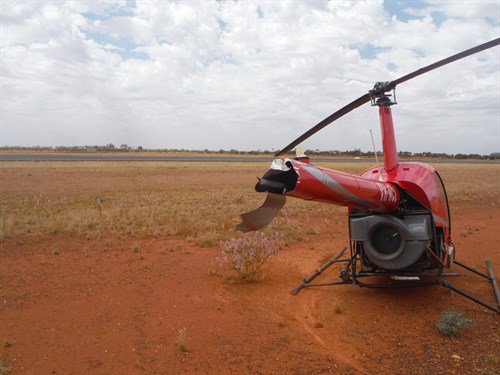
Source: Airservices Australia - Aviation Rescue Fire Fighting
Loss of tail rotor effectiveness
Loss of tail rotor effectiveness (LTE) causes a yaw to the right in helicopters with a counter-clockwise rotating main rotor. When operating at airspeeds below 30 kt, a tailwind may result in an uncommanded turn, if the tail rotor is unable to provide adequate thrust to maintain directional control. To reduce the onset of LTE, the United States Federal Aviation Administration (FAA) Helicopter Flying Handbook, advises pilots to:
Avoid tailwinds below an airspeed of 30 knots. If loss of translational lift occurs, it results in an increased power demand and additional anti-torque pressures.
To recover from LTE:
If the rotation cannot be stopped and ground contact is imminent, an autorotation may be the best course of action. Maintain full left pedal until the rotation stops, then adjust to maintain heading.
Aviation Short Investigations Bulletin Issue 46
About this reportDecisions regarding whether to conduct an investigation, and the scope of an investigation, are based on many factors, including the level of safety benefit likely to be obtained from an investigation. For this occurrence, a limited-scope, fact-gathering investigation was conducted in order to produce a short summary report, and allow for greater industry awareness of potential safety issues and possible safety actions. Publishing informationReleased in accordance with section 25 of the Transport Safety Investigation Act 2003 Published by: Australian Transport Safety Bureau © Commonwealth of Australia 2016 
Ownership of intellectual property rights in this publication Unless otherwise noted, copyright (and any other intellectual property rights, if any) in this report publication is owned by the Commonwealth of Australia. Creative Commons licence With the exception of the Coat of Arms, ATSB logo, and photos and graphics in which a third party holds copyright, this publication is licensed under a Creative Commons Attribution 3.0 Australia licence. Creative Commons Attribution 3.0 Australia Licence is a standard form licence agreement that allows you to copy, distribute, transmit and adapt this publication provided that you attribute the work. The ATSB’s preference is that you attribute this publication (and any material sourced from it) using the following wording: Source: Australian Transport Safety Bureau Copyright in material obtained from other agencies, private individuals or organisations, belongs to those agencies, individuals or organisations. Where you wish to use their material, you will need to contact them directly. |
Occurrence summary
| Investigation number | AO-2015-128 |
|---|---|
| Occurrence date | 06/11/2015 |
| Location | Newman Airport |
| State | Western Australia |
| Report release date | 28/01/2016 |
| Report status | Final |
| Investigation level | Short |
| Investigation type | Occurrence Investigation |
| Investigation status | Completed |
| Mode of transport | Aviation |
| Aviation occurrence category | Collision with terrain |
| Occurrence class | Accident |
| Highest injury level | Minor |
Aircraft details
| Manufacturer | Robinson Helicopter Co |
|---|---|
| Model | R22 Beta |
| Registration | VH-NCL |
| Serial number | 4430 |
| Sector | Helicopter |
| Operation type | Private |
| Departure point | Newman, Western Australia |
| Damage | Substantial |