Gated level crossing

Preliminary report into truck, train collision north of Bendigo

A preliminary report has been released from an ongoing transport safety investigation into a collision between a passenger train and a truck at a level crossing near Bendigo, Victoria.

On the morning of 13 July 2022, a farmer unlocked and opened the gates of a passive level crossing (which was not available for public access), to allow a truck onto their property to collect hay.

A short time later, the truck arrived at the crossing, and proceeded onto it.

The driver of an approaching V/Line passenger train reported seeing the truck approach the crossing, and sounding the train’s horn.

When the truck did not stop, the train driver made an emergency brake application, and was in the process of turning their seat away when the collision occurred.

The truck driver was seriously injured in the collision, and the train driver sustained minor injuries. Fortunately, none of the passengers on-board the train were injured.

The leading car of the train was substantially damaged, with both of its bogies derailed. The accident also resulted in substantial damage to the track infrastructure and the truck.

An investigation by the Office of Chief Investigator, Transport Safety, which investigates rail occurrences in Victoria on behalf of the Australian Transport Safety Bureau, is ongoing.

“This preliminary report has been released to provide the public and industry with the factual information established in the early evidence collection phase of our investigation,” Chief Investigator, Transport Safety Mark Smallwood said.

“The investigation is continuing and will include review and examination of the arrangements for the use of this level crossing, the operation of the truck and the train involved, and the configuration of the level crossing.”

A final report will be released at the conclusion of the investigation.

“However, should a critical safety issue be identified during the course of the investigation, the ATSB will immediately notify relevant parties so appropriate and timely safety action can be taken,” Mr Smallwood said.

Read the preliminary report: Collision between passenger train and truck, at Goornong, Victoria, on 13 July 2022

Engine power loss

Forced landing and collision with terrain following engine power loss

Key points:

  • Significant fuel flow reduction resulted in engine power loss
  • During the forced landing, aircraft clipped trees and collided with terrain
  • Accident highlights the challenge of managing a power loss at low level

A Piper Cherokee Six light aircraft’s forced landing and collision with terrain following engine power loss soon after take-off from Moorabbin Airport highlights the challenges pilots face when they experience an engine failure or power loss at low level, an ATSB investigation notes.

On 22 June 2021, the pilot of the PA-32-200 Cherokee Six was conducting circuits at Moorabbin Airport, in Melbourne’s south-east.

As the aircraft was climbing after take-off at about 500 ft above ground level, fuel flow to the engine significantly reduced. Within 12 seconds, the engine lost power and the aircraft commenced descending.

In response, the pilot targeted a glide speed of 90 kt and searched for a site to make a forced landing within a 30° arc either side of the aircraft’s nose. They then identified one of few clear areas available for a landing within gliding range and manoeuvred the aircraft towards that area.

As the aircraft approached the selected area, the pilot recognised that insufficient height remained to clear trees, but contact was unavoidable.

The aircraft impacted the trees before colliding with rising ground. The pilot sustained serious injuries in the accident, and the aircraft was destroyed.

“This accident highlights the challenges pilots face when confronted with a loss of engine power at low level and with few suitable forced landing areas within the glide capability of the aircraft,” said ATSB Director Transport Safety Stuart Macleod.

“It reaffirms to pilots that they can best mitigate the effects of a loss of power through forward planning, which reduces mental workload under stress, and always maintaining control of the aircraft.”

Maintaining glide speed and using no more than a moderate bank angle avoids entering a stall and/or spin, Mr Macleod noted.

“During a forced landing, aim to arrive at the ground with wings level and the aircraft level with the ground, as this improves your prospects of survivability,” he said.

The ATSB’s investigation determined that a significant reduction in fuel flow, for reasons that could not be determined despite extensive examination, resulted in the engine’s loss of power

Analysis of the engine’s data management system showed that after the power loss, fuel flow did not reduce to zero, but varied between 20 and 16 litres/hour (in conjunction with RPM changes), indicating that fuel starvation did not lead to the power loss.

Further, wreckage examination, flight records and witness reports indicated that there was sufficient fuel on board, and in any tank, to power the engine.

While damage limited examination of the fuel system, no defect was identified that could have led to the fuel flow reduction. The engine was dismantled, examined and all fuel system components were tested and found to function correctly.

The investigation also found that the aircraft was inadvertently fitted with an incorrect engine variant, however, this did not affect the operation of the aircraft or contribute to the power loss.

“This inadvertent fitment, while not contributing to the accident, does underline to maintenance organisations the importance of the correct interpretation of the manufacturer’s type certificate documentation.”

Read the final report: Engine power loss and collision with terrain involving Piper PA 32 300, VH-CWK, near Moorabbin Airport, Victoria, on 22 June 2021

Temporary speed restriction

Preliminary report released into passenger train’s exceedance of temporary speed restriction

A preliminary report has been released from an ongoing transport safety investigation into the exceedance of a temporary speed restriction by a XPT passenger train in Melbourne.

On the morning of 24 May 2022, a Sydney to Melbourne XPT service travelled over the Moonee Ponds Creek Bridge, in Melbourne’s inner-north, at about 100 km/h.

This was above a 40 km/h temporary speed restriction, placed on the 400 m section, after rough track was reported there the night before.

An investigation is being conducted by the Office of Chief Investigator, Transport Safety, which investigates rail occurrences in Victoria on behalf of the Australian Transport Safety Bureau.

The preliminary report details factual information from the early evidence collection phase of the investigation.

“Travelling south towards Southern Cross Station, the standard gauge and broad gauge tracks run parallel up until Jacana,” Chief Investigator, Transport Safety Mark Smallwood explained.

“However, at Jacana, the standard gauge track, used by interstate trains, diverges from the more direct (16 km) broad gauge route, and takes a longer 27 km route to Southern Cross. To accommodate this longer route, the standard gauge track included a step change in its kilometrage at this point, from 16 km back up to 27 km.”

This effectively meant that trains on the standard gauge line went through two sets of kilometrage markers from 27 km to 16 km, on their way into Melbourne.

“The driver in this incident was told of a speed restriction between 24.4 km and 24.0 km,” Mr Smallwood said.

The driver slowed to below 40 km/h at the first 24.4 km–24.0 km section encountered, but not the second, where the restriction was actually in place.

The investigation will include further review of the track condition that led to the temporary speed restriction, the operation of the train, and the processes and risk controls associated with the establishment of a temporary speed restriction and its communication to drivers.

A final report will be released at the conclusion of the investigation.

“However, should a critical safety issue be identified during the course of the investigation, the ATSB will immediately notify relevant parties so appropriate and timely safety action can be taken,” Mr Smallwood said.

Read the preliminary report: Exceedance of temporary speed restriction by XPT train ST21, at Moreland, Victoria, on 24 May 2022

Large air tanker accident

C-130 large air tanker accident investigation highlights the importance of risk mitigation

Key points

  • Aircraft likely stalled following a retardant drop when flying in hazardous conditions that included windshear and an increasing tailwind;
  • Crew very likely did not know that other smaller firefighting aircraft had ceased flying in the area, and the assigned birddog aircraft had turned down the tasking, due to the hazardous conditions;
  • Aerial firefighting operations necessarily take place in a high-risk environment, which requires a continued focus on risk mitigation, a responsibility that is shared between the tasking agency and the aircraft operator.

A Lockheed C-130 large air tanker that impacted the ground following an aerial firefighting retardant drop likely aerodynamically stalled when flying in hazardous conditions that included windshear and an increasing tailwind, an Australian Transport Safety Bureau investigation has found.

All three crew on board were fatally injured when the aircraft impacted slightly rising terrain while conducting a climbing left turn away from the drop site at the Good Good fire-ground near Peak View, north of Cooma, in the NSW Snowy Mountains region, on 23 January 2020.

Strong gusting winds and mountain wave activity, producing turbulence, were both forecast and present at the drop site. The fire and local terrain at the fire-ground likely exacerbated these hazardous conditions, the investigation report notes.

“The ATSB recognises the critical importance of aerial firefighting, where aircraft are flown at low altitudes and low airspeeds, often in challenging conditions, in the management and suppression of bushfires in Australia,” said ATSB Chief Commissioner Angus Mitchell.

“These operations necessarily take place in a high-risk environment, which requires a continued focus on risk mitigation, a responsibility that, in the Australian operating context, is shared between the tasking agency and the aircraft operator.

“As part of this investigation we have sought to understand the risk mitigations in place at the time of the accident, and have identified a number of safety issues that if resolved through actions will further mitigate risks for large air tanker aerial firefighting in the future.”

The investigation details that the C-130 was being operated by Coulson Aviation under contract to the New South Wales Rural Fire Service (RFS).

On the morning of the accident, the RFS State Operations Centre had tasked two large air tankers operating from RAAF Base Richmond, a Boeing 737 and the C-130, to conduct retardant drops at Adaminaby. The 737 departed first, and after conducting a drop at Adaminaby its crew reported that conditions precluded them from returning to the fire-ground.

The investigation notes that the RFS continued the C-130’s tasking to Adaminaby despite an awareness of the extreme environmental conditions and that all other fire‑control aircraft were not operating in the area at the time. (All smaller fire-control aircraft had ceased flying, a ‘birddog’ lead aircraft initially assigned to support the 737 and C-130 had declined the tasking, and the 737 was returning to Richmond, having declined further tasking to Adaminaby.)

This information was not communicated by the RFS to the C-130’s crew.

Instead, the ATSB notes that the RFS relied on the pilot in command to assess the appropriateness of the tasking to Adaminaby without providing them all the available information to make an informed decision on flight safety.

When the C-130 arrived overhead Adaminaby, the crew assessed the conditions were unsuitable and instead accepted an alternate tasking to the Good Good fire at Peak View, about 58 km to the east, which was subject to the same conditions.

Shortly after conducting a partial drop at Peak View, the aircraft commenced a climbing left turn. Following this, climb performance degraded and while at a low height and airspeed, it was likely the aircraft aerodynamically stalled, resulting in the collision with the ground.

The investigation notes that acceptance of the taskings was consistent with the operator’s practices to depart and assess the conditions to find a workable solution rather than rely solely on a weather forecast, which may not necessarily reflect the actual conditions at the fire-ground.

“The investigation found that Coulson Aviation's safety risk management processes did not adequately manage the risks associated with large air tanker operations, in that there were no operational risk assessments conducted or a risk register maintained,” Mr Mitchell said.

“In addition, the operator did not provide a pre-flight risk assessment tool for their firefighting large air tanker crews. This would provide predefined criteria to ensure consistent and objective decision-making with accepting or rejecting tasks, and would take into account elements such as crew status, the operating environment, aircraft condition, and external pressures and factors.”

Separately, the RFS had limited large air tanker policies and procedures for aerial supervision requirements and no procedures for deployment without aerial supervision, the investigation found.

The RFS also did not have a policy or procedures in place to manage task rejections, nor to communicate this information internally or to other pilots working in the same area of operation.

“The responsibility for the safety of aerial firefighting operations has to be shared between the tasking agency and the aircraft operator,” Mr Mitchell said.

“This accident highlights the importance of having effective risk management processes, supported by robust operating procedures and training to support that shared responsibility.”

Mr Mitchell noted Coulson Aviation has taken proactive safety actions in response to the accident, including the introduction of a pre-flight risk assessment tool, a new three-tiered risk management approach, and windshear procedures and training.

Separately, the RFS has committed to undertake a comprehensive review of RFS aviation doctrine and undertake detailed research to identify best practice (nationally and internationally) relating to task rejection and aerial supervision policies and procedures as well as initial attack training and certification.

Mr Mitchell welcomed that commitment but noted the ATSB has issued three safety recommendations to the RFS to take further action to reduce the risk associated with three safety issues identified in the investigation. These concern managing and communicating task rejections, aerial supervision requirements, and initial attack certification.

The ATSB has also issued two safety recommendations to Coulson Aviation. These are to further consider the fitment of a windshear detection system to their C-130 aircraft, and to incorporate foreseeable external factors into their pre-flight assessment tool.

Read the report: Collision with terrain involving Lockheed Martin EC130Q, N134CG, 50 km north-east of Cooma-Snowy Mountains Airport (near Peak View), New South Wales, on 23 January 2020

ADS-B rebate program opens for general and recreational aircraft owners

The Australian Government has launched a $30 million ADS-B rebate program

The Australian Government has launched a new $30 million Automatic Dependent Surveillance Broadcast (ADS-B) rebate program to support more general and recreational visual flight rules (VFR) aircraft owners to install the technology into their aircraft.

ADS-B transmits GPS-derived position data, aircraft identification and other aircraft performance parameters, which can provide pilots near real-time locational data to enhance their situational awareness of other ADS-B equipped aircraft near-by. This can aid self-separation from other aircraft, particularly in non-controlled airspace, helping to reduce the risk of collisions.

In Australia, all aircraft operating under instrument flight rules (IFR) are required to be fitted with ADS-B, with its fitment to aircraft operating under VFR voluntary.

To increase the uptake of ADS-B in VFR aircraft, the government is now providing a 50% rebate of the purchase cost of eligible ADS-B devices and, where applicable, the installation, capped to $5,000. Low-cost portable ADS-B devices will also be eligible for the grant.

“Ensuring the safety of our pilots, other aviation workers, passengers and those on the ground is of the utmost importance each and every time a plane takes off, which is why the funding of this technology will make a huge positive impact,” Infrastructure, Transport, Regional Development and Local Government Minister Catherine King said in announcing the scheme.

The rebate program, which opened on 12 August 2022, directly responds to calls from industry to encourage the uptake of ADS-B technology to realise its many benefits.

“The ‘see and avoid’ principle has known limitations, and the use of ADS-B with a cockpit display or an electronic flight bag application showing traffic information greatly improves a pilot’s situational awareness and enhances the safety of their flight,” Australian Transport Safety Bureau Chief Commissioner Angus Mitchell said.

“ATSB transport safety investigators can also use ADS-B data to help build a detailed picture and better understanding of an aircraft’s flight path* and performance in the lead up to an incident or accident, which can lead to better safety outcomes for the aviation community.”

The precise positional data available from ADS-B can also assist in managing life-saving search and rescue (SAR) operations undertaken by the Australian Maritime Safety Authority (AMSA).

“ADS-B data is another valuable tool used for SAR operations in Australia which helps to improve our ability to save lives,” AMSA’s Chief Executive Officer Mick Kinley said.

“For aircraft in distress, that are equipped with ADS-B, AMSA’s Joint Rescue Coordination Centre Australia will use the aircraft’s ADS-B data to refine a distress location and provide enhanced traffic conflict data in a search area that may involve multiple SAR aircraft.”

The ADS-B rebate program will be open until 31 May 2023 or until funding is exhausted, whichever occurs first.

For more information, including on how to apply, visit https://business.gov.au/grants-and-programs/automatic-dependent-surveillance-broadcast-rebate-program(Opens in a new tab/window).

* The above Google Earth image was generated by ATSB transport safety investigators using ADS-B data to show the flight path of Bell UH-1H helicopter, registered VH-UVC, which lost of control and collided with water 5 km south-west of Anna Bay, New South Wales, on 6 September 2019 (AO-2019-050).

Balloon hard landing

Hard landing shows the importance of pre-flight briefings being completed and understood by all passengers 

Key points:

  • Two passengers sustained serious injuries during the hard landing of a hot-air balloon during a Yarra Valley scenic flight;
  • The passengers had received an incomplete pre-flight briefing, probably resulting in them adopting a deep squat position during the hard landing, contributing to their injuries;
  • Despite deteriorating wind conditions, the pilot rejected several suitable landing fields to avoid possible post landing logistical and operational difficulties, and eventually conducted a hard landing in a field to avoid contact with powerlines.

An ATSB investigation into a hard landing of a commercial hot air balloon in which two passengers sustained serious injuries highlights the importance of pre-flight briefings being completed and understood by all passengers.

On 31 December 2021, a Kavanagh B-350 balloon with 16 passengers and a pilot on board took off from near Glenburn, just north of Victoria’s Yarra Valley, for a planned one-hour scenic charter flight.

About 42 minutes later, the balloon pilot learned via a radio call that the wind was increasing near the intended landing area at Yarra Glen. Over the next 17 minutes, with the wind increasing, the pilot assessed multiple landing options before making an approach to land in a field.

During the approach the pilot manoeuvred the balloon to clear a fence before descending rapidly to avoid contact with nearby powerlines, and then landing hard. The basket then tipped onto its side and dragged for 30-40 metres. Two passengers sustained serious leg injuries.

The ATSB’s investigation found that, just prior to the landing, three passengers adopted a deep squat position.

“This was not in accordance with the prescribed pre-flight passenger safety briefing,” ATSB Director Transport Safety Stuart Macleod said.

“However, not all required actions were completed during the pre-flight briefing, probably due to time pressure and the pilot’s assumption that all passengers would understand an abbreviated briefing.”

“This incomplete briefing probably resulted in these three passengers adopting an inappropriate deep squat position prior to the hard landing, causing two of them to be seriously injured.”

Mr Macleod said the hard landing is a clear reminder for balloon pilots and operators of the importance of the pre-flight briefing being thorough and clearly understood.

“The pre-flight briefing is critical in ensuring passenger preparation, particularly as opportunities to reinforce that information during the flight may be limited.”

The investigation found that although wind conditions were deteriorating, the pilot rejected several suitable landing fields to avoid post-landing logistical and operational difficulties.

“While some landing options may not be ideal due to the impact on landowner relations, or the ease of access to the site after landing, pilots are reminded to prioritise occupant safety over such considerations, when faced with deteriorating wind conditions,” Mr Macleod said.

With safe landing sites progressively reduced as the flight continued, the balloon was landed in a field which presented high risks in the prevailing windy conditions.

The field contained fences, had powerlines downwind, and was the last landing field known to the pilot along the balloon’s track.

“The landing was complicated by the balloon descending faster than intended, bouncing off the ground back into the air, and then due to manoeuvres to clear fences,” Mr Macleod noted.

“These factors, in combination with the prevailing winds and nearby powerlines, led to the pilot descending the balloon rapidly from an excessive height, resulting in the hard landing.

“While undesirable, the hard landing was the safer option instead of risking contact with the power lines. However, hard landings still increase the risk of pilot and passenger injury.”

Although not contributing to the passenger injuries, the investigation also found that the maximum number of passengers that the balloon operator allowed to be carried on the balloon meant that there was insufficient room in the basket for passengers to adopt the backwards-facing landing position specified in the operator's procedures.

Read the final report: Hard landing involving Kavanagh Balloons B-350, VH-BSW 2 km south of Lilydale Airport, Victoria, on 31 December 2021

Pitot probe covers

A350 passenger aircraft’s pitot probe covers not removed until just prior to pushback

An Australian Transport Safety Bureau investigation preliminary report has detailed that an Airbus A350 passenger aircraft was about to be pushed back for departure from Brisbane Airport before it was observed that covers were still in place on its pitot probes.

Aircraft are fitted with pitot probe covers when parked at Brisbane Airport to prevent mud wasps building nests within and blocking their pitot probes, which are used to measure air pressure to calculate airspeed.

The preliminary report on the 27 May 2022 occurrence, released to provide timely information to industry to highlight the importance of pitot probe covers being removed, notes that an aircraft refueller on an adjacent bay observed the pitot probe covers were still in place when the aircraft appeared ready for pushback.

“A known hazard at Brisbane Airport, mud wasps can rapidly build nests in aircraft pitot probes,” noted ATSB Director Transport Safety Dr Michael Walker.

“An aircraft being cleared to commence taxiing and then commence take-off with all pitot probe covers still fitted is a serious event.”

Two maintenance contractor ground crew engineers – a licensed aircraft maintenance engineer (LAME) supervising an inexperienced aircraft maintenance engineer (AME) – had been assigned to conduct scheduled receipt, dispatch, certification, and maintenance duties for the Singapore Airlines A350 aircraft during a two-hour turnaround at Brisbane.

As pushback approached, the covers remained in place until an aircraft refueller, working at an adjacent bay, observed them and alerted the supervising LAME.

The pitot covers were then removed two minutes before expected departure, and pushback occurred shortly afterwards.

As part of its investigation, to date the ATSB has interviewed the LAME, AME and the refueller, and reviewed airport security video, which did not show that the required final walk-around of the aircraft was conducted by either the LAME or the AME prior to dispatch.

“From here, the investigation will include examination of flight crew pre-flight inspection procedures, engineering final walk-around procedures, and induction training procedures,” Dr Walker said.

“It will also examine the engineers’ training records, policies and procedures around fatigue and change management, and more security video recordings.”

The ATSB has previously highlighted the risks of pitot probe covers not being removed prior to departure with its investigation into a March 2018 incident where an Airbus A330 took off from Brisbane with covers still in place, meaning the flight crew were faced with unreliable airspeed indications.

That ATSB investigation (AO-2018-053) identified safety factors across a range of subjects including flight deck and ground operations, aircraft warning systems, air traffic control, aerodrome charts, and risk and change management.

“The loss of airspeed data due to mud wasp ingress can occur even after brief periods, and the use of pitot probe covers for aircraft turnarounds at Brisbane is largely an effective defence,” Dr Walker said.

“However, as that earlier ATSB investigation identified, their use introduces another risk, which is the potential for aircraft to commence a take-off with pitot probe covers still fitted.”

Read the preliminary report: Flight preparation event involving Airbus A350-941, 9V-SHH, Brisbane Airport, Queensland, on 27 May 2022

Read the final report: Airspeed indication failure on take-off involving Airbus A330, 9M-MTK Brisbane Airport, Queensland, 18 July 2018

Rail Safety Week 2022

This Rail Safety Week, remember that a moment of distraction can change your life forever

The Australian Transport Safety Bureau is joining over 100 rail industry groups to support the key messages of Rail Safety Week 2022, from 8-14 August.  

A community awareness initiative of the TrackSAFE Foundation, this year Rail Safety Week is stressing to passengers, workers and road users the need to play an active role in rail safety, to be aware of their surroundings, and to avoid distractions.   

Viewing and listening to mobile devices may contribute to distraction and complacency in and around trains and rail infrastructure, and Rail Safety Week is asking rail workers and users to turn down distractions, take off your headphones and look up from your phone.  

“It’s a simple and straight forward message that can be applied across the rail network,” said ATSB Chief Commissioner Mr Angus Mitchell.  

“A moment of distraction in or around trains, level crossings and other rail infrastructure can change the life of a passenger, road user, or rail worker forever,” said Mr Mitchell.  

As an example, Mr Mitchell pointed to an investigation the ATSB finalised earlier this year into a collision between a road-train and a freight train at a level crossing north-east of Kalgoorlie, WA, on 22 February 2021.  
 
That investigation found the driver of the road-train had been distracted by reaffixing their mobile phone mount to their vehicle’s windscreen before the truck entered an active level crossing. Unable to stop, the train collided with the road train, derailing the train and seriously injuring the two train drivers. 

“Given the size and weight of most trains, the onus to take action to avoid a level crossing collision rests almost entirely on the road vehicle user,” Mr Mitchell said. 

“Distraction can significantly impair driving safety.” 

Mr Mitchell noted that between July 2020 and June 2021 there were 11 collisions between heavy road vehicles and trains at level crossings across Australia.  

In response last year, the ATSB commenced a safety study into level crossing collisions involving trains and heavy road vehicles in Australia

“The study, which is on-going, includes a review of previous collisions to determine their characteristics and circumstances, and will also determine any unidentified systemic safety issues or learning opportunities that could enhance safety,” said Mr Mitchell.  

The ATSB is the nation’s independent ‘no-blame’ rail safety investigator.  

ATSB investigations aim to determine how and why an accident happened, identify ongoing safety risks, and influence safety actions to address those risks. 

For more information on how you can stay rail safe, visit the Rail Safety Week 2022 website.(Opens in a new tab/window) 

Kosciuszko helicopter accident prelim

Preliminary report into Bell LongRanger helicopter accident in Kosciuszko National Park released 


The Australian Transport Safety Bureau has released a preliminary report from its ongoing investigation into a Bell LongRanger helicopter accident in Kosciuszko National Park on 3 April.

The report, which details factual information from the investigation’s evidence collection phase to date, notes the helicopter collided with terrain at Kiandra Flats, 4,501 ft above sea level, after a steep left descending turn from 7,400 ft, fatally injuring the pilot and passenger.

Earlier on the day of the accident, the helicopter had departed from Majura, north of Canberra Airport, operating under visual flight rules (VFR). It was one of seven helicopters on a flying tour, following a common itinerary but operating independently of one another.

The six other helicopters landed on a property near Wee Jasper after encountering deteriorating weather, while the pilot of the accident helicopter continued further south before landing alongside Long Plain Road in the Brindabella region.

When the LongRanger didn’t arrive at Wee Jasper, the other pilots contacted authorities, who launched a search.

“With the help of a passing motorist, the pilot of the LongRanger was able to reach mobile reception and contact other members of the tour group, and the search was called off,” ATSB Director Transport Safety Stuart Macleod said.

Almost three and a half hours after landing beside Long Plain Road, recorded flight tracking data showed the LongRanger took off again at 1453 local time.

“Police officers dispatched to locate the helicopter as part of the earlier search arrived at the site just after it took off, and observed the helicopter depart to the south at low level, in overcast conditions with low cloud and light rain,” Mr Macleod said.

The forecast for the area at the time of this second flight indicated broken cloud between 2,500 ft and 10,000 ft above sea level.

Tracking data, reviewed by the ATSB, showed the helicopter progressed below 500 ft above ground level, following geographical features along lower lying terrain.

“About 10 minutes into this second flight, the pilot turned north-west and took up a track towards Tumut, which they had indicated to the tour group as their intended refuelling destination,” Mr Macleod said.

“They then encountered higher terrain and turned around to head southward, again following lower lying terrain for another 10 minutes, before reaching Anglers Reach, at which point they turned back on a track towards Tumut.”

The helicopter climbed to 7,000 ft above sea level – about 2,500 ft above ground level – and continued for about six minutes, before descending to 6,800 ft, and almost immediately climbing again.

“After climbing to 7,400 ft, the helicopter commenced the steep turn, its ground speed increased to 134 kt, and its descent rate exceeded 3,800 ft per minute.”

The helicopter impacted terrain at 1526 in an area of tussock grass, interspersed by bare protruding rock.

The following morning, in response to the LongRanger not meeting the tour group as planned at Mangalore, Victoria, a second search was initiated. Assisted by aircraft tracking data, a ground team located the accident site that evening.

The ATSB’s subsequent examination of the site indicated the helicopter’s engine was providing power at impact, and there was no evidence of an in-flight break-up or a pre-existing defect with the drive train or flight controls.

“As the investigation progresses, the ATSB will further review and analyse pilot and maintenance records, recovered wreckage components, the flight tracking data, witness information and meteorological data,” Mr Macleod said.

A final report, which will detail analysis and findings, will be released at the conclusion of the investigation.

“However, should a critical safety issue be identified at any time as the investigation progresses, the ATSB will immediately notify relevant parties so appropriate and timely safety action can be taken.”

Read the preliminary report: Collision with terrain involving Bell Helicopter 206L-4, VH-PRW 33 km north west of Adaminaby, New South Wales on 3 April 2022

Spin recovery

Limitations of the Meuller/Beggs spin recovery method for some aircraft types

Key points:

  • Instructor and student were conducting an aerobatic training flight in a Cessna A150 Aerobat to introduce and practice spin entry and recovery;
  • Instructor likely intended to practice two spin recovery techniques, one of which has been shown to not recover a Cessna A150 Aerobat established in a spin to the left;
  • While experienced in other aerobatic aircraft, the instructor likely had no experience conducting spinning and/or spin instruction in the accident aircraft type or similar variants;
  • ATSB has issued a Safety Advisory Notice alerting aerobatic pilots and instructors of the limitations of the Meuller/Beggs spin recovery method for some aircraft types.

he Australian Transport Safety Bureau is advising aerobatic pilots and instructors of the limitations of the Meuller/Beggs spin recovery method for some aircraft types, after an investigation into an aerobatics training flight accident on Queensland’s Sunshine Coast.

During the accident flight on 23 June 2021, an instructor and student were likely intending to practice two methods of spin recovery. One of those techniques, broadly known as the Meuller/Beggs method, has been shown to not recover a Cessna A150 Aerobat established in a spin to the left.

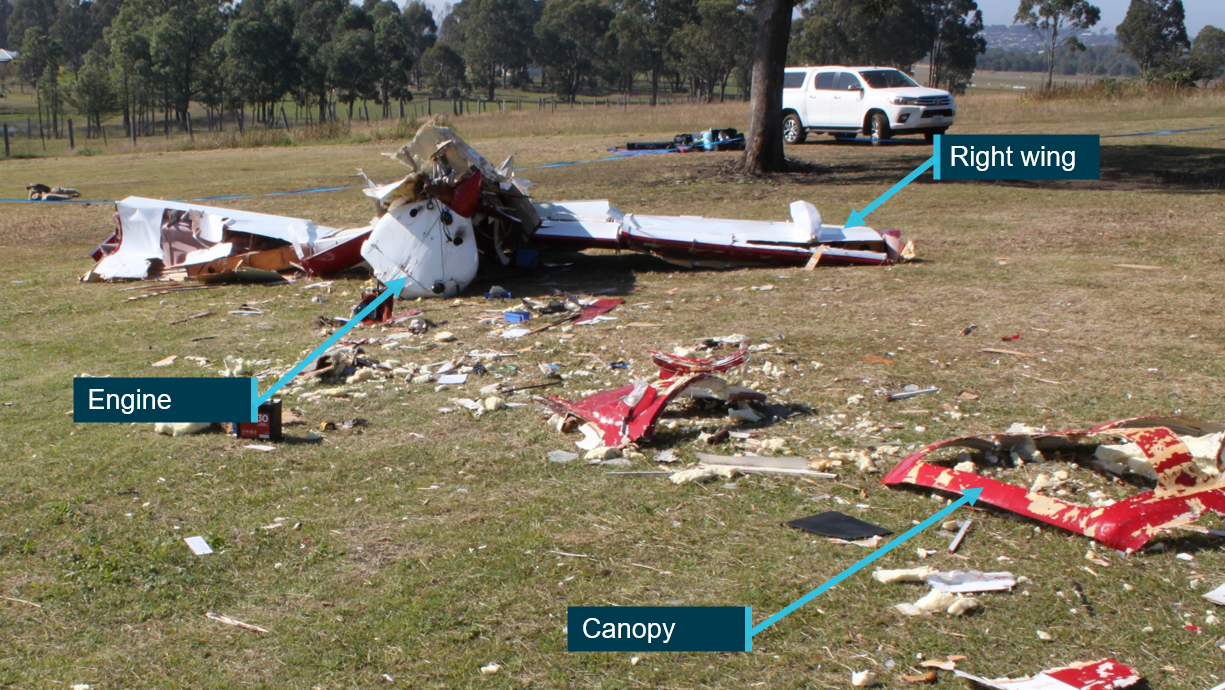
Both occupants were fatally injured when the aircraft collided with bushland near Peachester.

Air traffic control radar data showed that about 20 minutes after take-off the aircraft entered a spin to the left 5,800 ft above ground level, and then impacted the ground 55 seconds later.

The ATSB’s analysis of the accident site established that the aircraft’s forward movement and low angle of entry indicated it was most likely in the process of recovering from the spin when it impacted with terrain.

The aerobatics instructor was experienced in conducting spins, primarily in the Pitts Special aircraft type, for which the Mueller/Beggs method is effective. However, it was likely that they had no experience in spinning a Cessna A150 Aerobat or any similar variant.

“The instructor likely intended to practice two spin recovery techniques, including the Mueller/Beggs recovery method, which has been shown to not recover a Cessna A150 Aerobat established in a spin to the left,” ATSB Director Transport Safety Dr Michael Walker said.

The other method planned to be demonstrated, the generic PARE method typical of most small single-engine aeroplane types, aligned closely with the aircraft’s pilot’s operating handbook (POH) and, if utilised, would recover the aircraft from a spin.

“A second student, who was also to fly the same training flight with the instructor in the Aerobat aircraft later that day, told the ATSB they believed they would be conducting both methods of spin recovery,” Dr Walker said.

“The ATSB therefore concluded it was likely the instructor was either not aware, or did not recall, that the Aerobat would not recover using this method in a spin to the left.”

Dr Walker noted that, based on the available evidence, the ATSB was unable to ascertain which recovery technique or techniques were being utilised at the various stages of the spin recovery preceding the accident. For this reason, the ATSB could not conclude if the use of an inappropriate recovery technique contributed to the accident.

“Nevertheless, this investigation presents a timely reminder that pilots should review the POH of the aircraft type that they intend to operate, and obtain instruction and/or advice in spins and recovery techniques from an instructor who is fully qualified and current in spinning that model,” Dr Walker said.

To highlight this message, the ATSB has issued a Safety Advisory Notice to aerobatic pilots and instructors, flying training organisations and aerobatic aircraft owners to raise awareness of the limitations of the Mueller/Beggs spin recovery method.

“Prior to intentionally spinning an aircraft, pilots should obtain instruction and/or advice in spins and recovery techniques from an instructor who is fully qualified and current in spinning that model,” Dr Walker said.

“All aircraft types do not spin and recover in the same way. Know your aircraft type, what recovery techniques will work and what recovery techniques will not work.”

Read the final report: Collision with terrain involving Cessna A150M, VH-CYO 5 km west-south-west of Peachester, Queensland, on 23 June 2021