ATSB signs renewed rail funding agreement with Queensland
The Australian Transport Safety Bureau and Queensland’s Department of Transport and Main Roads have renewed their agreement that sees the ATSB conduct no blame transport safety investigations into rail accidents and incidents in Australia’s second largest state.
ATSB Chief Commissioner Angus Mitchell and TMR Director-General Neil Scales signed a new two-year funding agreement at TMR’s Brisbane headquarters recently, extending the partnership between Queensland and the national rail transport safety investigator through to 30 June 2024.
“ATSB investigations of accidents and incidents on state rail networks is funded by state governments,” Mr Mitchell said.
“The extension of this agreement means the ATSB can continue performing its vital work, which improves safety for Queensland’s rail transport workers and travelling public.”
“The safety of rail safety workers, rail passengers and the general public is paramount. The ongoing relationship with the ATSB demonstrates the importance placed on rail safety in Queensland,” agreed Mr Scales.
Under the current agreement, which began in 2017, the ATSB has conducted over two dozen investigations into rail incidents in Queensland, many of which have identified safety issues for consideration.
ATSB investigations are purely aimed at determining factors which led to an accident or incident so that safety lessons can be learned, and do not lay blame, which encourages the free flow of information during the investigation process, Mr Mitchell explained.
“The identification of safety issues as part of ATSB investigations allows operators and relevant parties to take safety action to address them to help prevent similar accidents and incidents in the future,” Mr Mitchell said.
“I am confident, thanks to this on-going funding arrangement with the State Government, that ATSB investigations will continue to lead to improved rail transport safety for Queenslanders.”
R22 engine intake valve damage occurred without indication prior to sudden loss of engine power
Key points:
|
A Robinson R22 helicopter pilot had to conduct a forced landing after a sudden loss of engine power due to damage to an engine cylinder intake valve, an Australian Transport Safety Bureau investigation has found.
On 11 January 2022, R22 VH-VHE was being used to conduct mustering operations south-west of Mitchell, in Queensland’s central south.
“During the second mustering flight of the day, the pilot reported hearing a pop and a crack, and experiencing significant uncommanded yaw, and abnormal vibration, resulting in a forced landing,” ATSB Director Transport Safety Stuart Macleod said.
Examination of the engine by a maintenance organisation, and further examination at the ATSB’s technical facilities in Canberra, confirmed that damage to the engine’s number-four cylinder intake valve had allowed the fuel and air mixture, and exhaust gases, into the air induction system.
“This resulted in the degraded engine performance and forced landing of the helicopter,” Mr Macleod said.
Notably, prior to the incident, neither the pilot nor the maintenance organisation observed any indications of the progressing damage to the intake valve, including during a successful compression test 17.6 flight hours prior to the incident.
“While not required, a borescope inspection may increase the likelihood of detecting valve damage that can lead to degraded engine performance,” Mr Macleod noted.
VH-VHE’s engine had been overhauled in August 2021 – six months prior to the incident – and the pilot stated that the engine seemed underpowered following the overhaul.
“In piston engine helicopters, unexpected yaw and reduced engine performance may be symptomatic of developing engine intake valve damage,” Mr Macleod said.
“If this condition remains unattended, it can lead to an increased risk of induction backfire events and significant loss of engine power.”
Mr Macleod added there is an opportunity to improve understanding of engine issues with better quality data.
“Maintenance organisations are therefore encouraged to follow the Civil Aviation Safety Authority recommendation for borescope inspections of valves and report any defects, or nil-defect findings.”
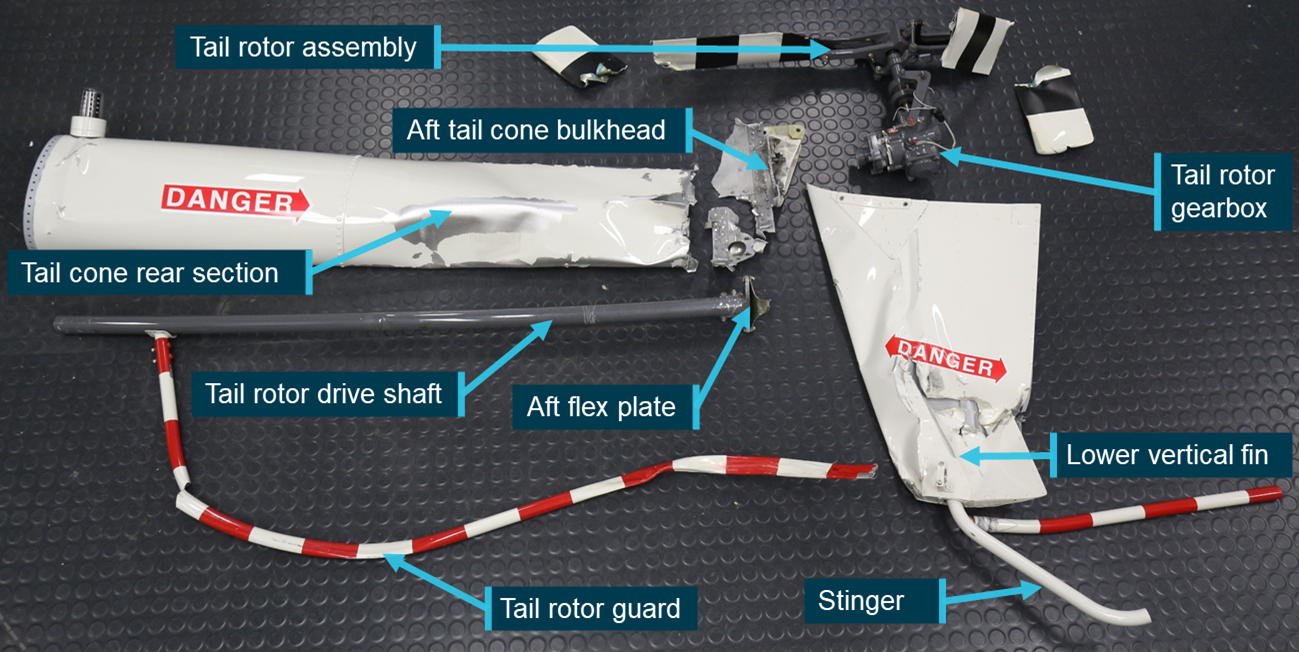
The ATSB’s report also notes that, for reasons that could not be determined, the tail rotor drive shaft fractured as a result of torsional overstress during the incident.
In addition, an unapproved modification was present on the leading edge of the tail rotor blades, although this probably had no influence on the occurrence.
Read the final report: Engine power loss and forced landing involving Robinson R22 Beta, VH-VHE, 130 km south-west of Mitchell, Queensland, on 11 January 2022
Bird carcass located near LongRanger helicopter accident site
Key points:
|
A wedge-tailed eagle bird carcass was located near the accident site of Bell LongRanger helicopter which experienced an in-flight break-up near Maroota, New South Wales on 9 July 2022, according to an Australian Transport Safety Bureau preliminary report.
The report details factual information from the early evidence collection phase of the investigation into the accident, and does not contain analysis or findings, which will be detailed in the investigation’s final report.
The Bell 206L1 LongRanger, registered VH-ZMF, had departed a private helipad in Cattai. The helicopter then climbed to about 700 ft above mean sea level and tracked north towards the planned destination in St Albans.
A witness to the south of Dargle Ridge recalled seeing a helicopter moments before the accident, flying straight and level towards the north, and that weather conditions were good, with clear skies and light winds.
“Several witnesses described then seeing the helicopter enter a rapid banking turn to the right while pitching up,” ATSB Chief Commissioner Angus Mitchell said.
“They heard several rotor beats change tone before a final louder noise.”
Witnesses then recalled the helicopter pitching and rolling while descending, with one witness describing separation of the main rotor blades from the helicopter.
Smoke was then observed rising from the area where the helicopter descended. The helicopter was subsequently found to have been destroyed by a post-impact fire, with the pilot sustaining fatal injuries.
“Site and wreckage examination undertaken by the ATSB determined that the vertical stabiliser, aft section of the tail boom, tail rotor and tail rotor gearbox were severed in flight and found separate to the main wreckage,” Mr Mitchell explained.
“No pre-accident defects were identified with flight controls, aircraft structure or the engine.”
A bird carcass was found to the south-west of the main wreckage site, near a section of rotor tip.
The carcass, the main rotor blade tip and a section of impacted tail boom were recovered from the site for further analysis.
“Testing on the bird carcass and biological residue found on external helicopter surfaces at the main wreckage site identified both as Aquila audax – commonly known as a wedge-tailed eagle,” Mr Mitchell said.
The ATSB’s investigation into the accident is continuing.
“With this evidence indicating a bird strike occurred prior to an in-flight break-up, the investigation moving forward will aim to determine the full sequence of events, and potential safety learnings from this accident,” Mr Mitchell said.
A final report, which will include analysis and findings, will be released at the conclusion of the investigation.
“However, should a critical safety issue be identified during the course of the investigation, the ATSB will immediately notify relevant parties so appropriate and timely safety action can be taken,” Mr Mitchell said.
Read the preliminary report: In-flight break-up involving a Bell 206L-1 LongRanger, registered VH-ZMF, near Maroota, NSW, on 9 July 2022
ATSB streamlines accident and incident reporting requirements
Amendments to the Transport Safety Investigations Regulations (TSI Regulations), which detail the requirements for reporting transport accidents and incidents to the ATSB, will take effect on 1 January 2023.
“The TSI Regulations set out the ATSB’s safety occurrence reporting scheme and prescribes what occurrences must be reported to the ATSB, the ‘responsible persons’ who are required to make a report, and the particulars to be included in a report,” said ATSB Chief Commissioner Angus Mitchell.
The changes predominantly relate to the aviation industry.
“For aviation there are two key changes being introduced in the amended regulations – the creation of four categories of aircraft operations, each with different reporting requirements, and new requirements for sport aviation bodies to report accidents and incidents to the ATSB,” Mr Mitchell explained.
The four categories comprise Category A (passenger transport), Category B (commercial non-passenger, including medium to large RPA), Category C (non-commercial) aircraft operation, and Category D (small non-excluded RPA and certain uncrewed balloons) aircraft operation.
“Higher categories, in particular passenger-carrying and commercial operations, will have a greater reporting focus due to the greater public safety benefit that could be derived,” said Mr Mitchell.
“Non-commercial aircraft operations and uncrewed RPA and balloons will have lower reporting requirements.”
The Regulations define occurrences that must be reported to the ATSB as “immediately reportable”, which must be reported by telephone as soon as reasonably practical, and “routine reportable” matters, which can be notified to the ATSB by a written report within 72 hours.
“Changes to the regulations ensure immediately reportable matters are those more likely to be considered for investigation by the ATSB, while reducing the reporting requirements on industry for those matters the ATSB is less likely to consider for investigation,” Mr Mitchell explained.
Other changes to the Regulations include aligning aircraft operation categories and definitions with CASA flight operations rules introduced in December 2021, and aligning definitions of aircraft accident, serious aircraft incident, aircraft incident, fatal injury and serious injury with International Civil Aviation Organization definitions
“Changes to the regulations also simplify reporting requirements for industry by removing prescriptive lists of individual kinds of occurrences and defining these concepts more broadly.”
Reporting will be based on more general concepts including accidents, serious incidents, incidents, loss of separation and declaration of emergency. Guidance on the ATSB website and to be provided in the Aeronautical Information Publication details comprehensive examples of type of occurrences that fit into each.
The ATSB consulted extensively with industry on the proposed changes over a five-week timeframe between January and March 2022. Feedback received during that process was largely positive, and helped shape the final Regulations package.
The amended Regulations and new reporting requirements will take effect from 1 January 2023.
“Reporting to the ATSB is a simple and quick process,” Mr Mitchell concluded.
The ATSB is also updating the reporting forms on the ATSB website to make reporting even easier.
“Nonetheless we do recognise the aviation industry has been through a period of considerable change and disruption in recent years and do stress that our approach to implementing these amended regulations is focusing on education and encouraging better reporting practices over an extended period, with less emphasis placed on compliance particularly for industry participants who may not be fully across the new requirements.”
Aside from being the basis for starting safety investigations, all occurrences reported to the ATSB are maintained in Australia’s official aviation occurrence database and used for safety research and analysis.
“Ultimately all of aviation benefits from an open and trusted aviation occurrence reporting framework.”
Click here for more information.
Safe and effective container stowage planning to prevent container loss at sea
A United Nations Day of Significance, World Maritime Day 2022 is calling on the maritime community to have a conversation about the transition of the sector to a greener and more sustainable future.
This World Maritime Day(Opens in a new tab/window), the Australian Transport Safety Bureau (ATSB) is highlighting the importance of safe and effective container stowage planning to prevent container loss at sea and ocean pollution.
“The ATSB is an advocate for the safe carriage of containers and for the prevention of their loss at sea through operator compliance of their ship’s Cargo Securing Manual,” ATSB Chief Commissioner Angus Mitchell said.
“In addition to posing a navigational hazard, lost shipping containers are a significant environmental hazard in the marine environment.”
A single empty container lost at sea can release iron oxide as it rusts, as well as synthetic polymers and heavy metals from the breakdown of its insulation foam and protective paints.
The ATSB conducts ‘no blame’ safety investigations into selected maritime incidents and accidents in Australian waters, carried out in conformity with international treaties and instruments to improve maritime safety for all seafarers.
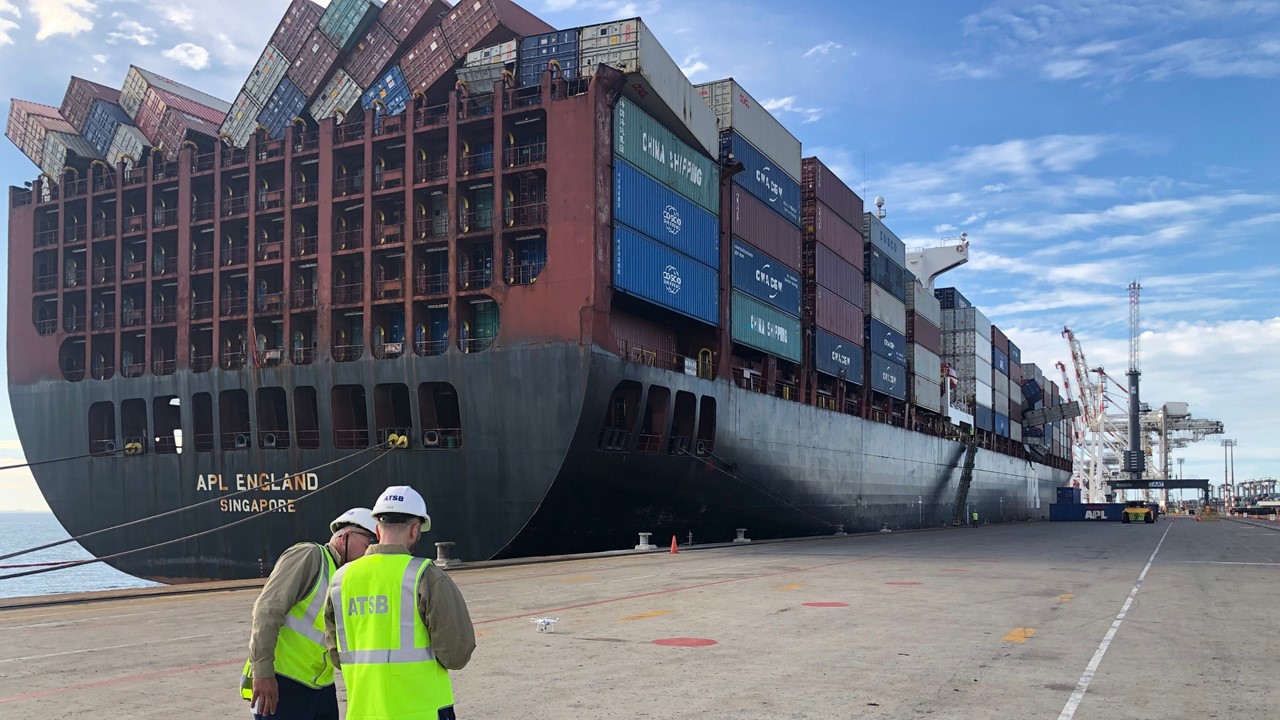
In 2018, the ATSB conducted an investigation into the loss of containers overboard involving the Liberian-flagged cargo ship YM Efficiency, which occurred 16 NM east-south-east of Newcastle, New South Wales.
YM Efficiency was en route to Sydney, steaming slowly into strong gale force winds and very rough seas off Newcastle when it rolled suddenly. The ship lost 81 containers overboard and sustained structural damage to its lashing bridges, superstructure, and accommodation ladder.
Over 1,000 tonnes of pollution, including plastics, furniture, tyres, and paper products washed up along 400 kilometres of shoreline with more than 720 tonnes of waste recovered from the waters off the Hunter Coast as a result of the incident.
The investigation found that the forces generated during the sudden, heavy rolling placed excessive stresses on containers stowed aft of the ship’s accommodation resulting in the structural failure of containers and components of the lashing system, leading to the loss of the containers.
The investigation also found the weights and distribution of containers in the affected bays meant that the calculated forces exceeded the allowable force limits as defined in the ship’s Cargo Securing Manual (CSM).
“The ship’s cargo-planning process ashore did not allow for the checking of the proposed container stowage plan’s compliance with the stowage and lashing forces requirements of the ship's CMS,” Mr Mitchell said.
“This left limited time for the ship’s crew to make amendments without unduly impacting commercial operations and created a reliance on shipboard checks during a late stage of the loading operation.”
Mr Mitchell noted that despite the checking of stowage plans for compliance with a ship's CMS – now often achieved with loading computer systems that provide some process efficiencies – the scale and pace of modern container ship operations often means ships officers are asked to check, amend or approve proposed stowage plans at late stages in a loading operation.
“This operational reality reinforces that the planning process ashore is the best opportunity to take all practical measures to ensure that the proposed stowage plan presented to ships officers complies with the CSM and is as safe as reasonably practicable.
“Weather forecasting, routing and good navigational practices in adverse weather all play a part in minimising the risk of injuries to crew and damage to ship, cargo and environment.
“However, safe and effective container stowage planning remains the primary control measure in managing the risks involved in carrying containers by sea.”
Read the ATSB investigation report: MO-2018-008 Loss of containers overboard involving YM Efficiency, 16 NM east-south-east of Newcastle, New South Wales, on 1 June 2018
Read more about World Maritime Day(Opens in a new tab/window)
ATSB streamlines marine accident and incident reporting requirements
The Australian Transport Safety Bureau anticipates amendments to the Transport Safety Investigations Regulations (TSI Regulations), which detail the requirements for reporting transport accidents and incidents to the ATSB, will take effect on 1 January 2023.
“The TSI Regulations set out the ATSB’s safety occurrence reporting scheme and prescribes what occurrences must be reported to the ATSB, the ‘responsible persons’ who are required to make a report, and the particulars to be included in a report,” said ATSB Chief Commissioner Angus Mitchell.
For the marine industry, changes to the Regulations primarily relate to the new requirement that marine pilotage providers and vessel traffic service authorities are prescribed as “responsible persons” who will now be required to report transport safety occurrences.
“This is to cover occurrences which would otherwise not be reported because a ship leaves port and no other relevant entity with knowledge of the occurrence would be in a position to report to the ATSB,” Mr Mitchell explained.
For the marine industry – AMSA is a nominated official to receive occurrence reports from responsible persons, which are then transmitted to the ATSB.
“Capturing additional reporting from pilotage providers and vessel traffic service authorities will establish a more accurate dataset for safety analysis conducted by the ATSB.”
In consultations with industry and AMSA, some pilotage providers and vessel traffic service authorities already voluntarily submit reporting to AMSA.
The amendments have now been approved by the Minister for Infrastructure, Transport, Regional Development & Local Government, and have been proposed to the Executive Council for endorsement in coming weeks. The amended Regulations and new reporting requirements would take effect from 1 January 2023.
“Reporting is a simple and quick process,” Mr Mitchell concluded.
“Nonetheless we do recognise the marine industry has been through a period of considerable change and disruption in recent years and do stress that our approach to implementing these amended regulations is to focus on education and encouraging better reporting practices over an extended period, with less emphasis placed on compliance particularly for industry participants who may not be fully across the new requirements.
“Ultimately all of industry benefits from an open and trusted and marine occurrence reporting framework.”
Click here for more information.
Recommendations made to shipping operator after tenth fire in 14 years
Key points
|
The Australian Transport Safety Bureau has issued safety recommendations to the managers and parent company of the cargo ship BBC Rhonetal, following an investigation into a fire in the hold of the vessel at Port Hedland, Western Australia.
The ship was alongside at Port Hedland on the morning of 25 March 2021 when a fire broke out in the lower cargo hold during hot work using a plasma torch to cut welded sea fastenings for cargo units in preparation for unloading them. The fire was not declared extinguished until three days later.
The ATSB’s transport safety investigation into the incident found this to be the tenth such fire on a ship managed under the same parent company in the past 14 years, and the fourth investigated by the ATSB, identifying similar contributing factors.
“The ATSB’s investigation found the risk of fire had not been adequately assessed by the crew prior to the commencement of the hot work,” ATSB Chief Commissioner Angus Mitchell said.
“As a result, a continuous fire watch was not maintained, and proper precautions were not taken to sufficiently protect vulnerable cargo from catching alight.”
The ATSB found BBC Rhonetal’s managers had not effectively implemented the shipboard safety management system procedures to prevent the fire.
“The continuing incidence of fires on the cargo holds of ships while performing hot work highlights the importance of adhering to shipboard procedures and recognised safe work guidelines for hot work,” Mr Mitchell said.
BBC Rhonetal’s managers have advised the ATSB that procedures for hot work will be amended to better describe the role of the fire watch, emphasising its importance in fire prevention. Fire watch requirements will also be integrated into the hot work permit procedure and additional equipment for the fire watch is to be distributed across the fleet.
The company also intends to undertake measures to educate shipboard crew on the amended procedures and the additional equipment, including through implementation of a training video.
“While the ATSB considers the safety action proposed by the ship’s managers in this case has the potential to address the hot work safety issue, no timeline has been provided for their implementation, and the ATSB has therefore issued a formal recommendation to the ship’s managers, and the parent company,” Mr Mitchell noted.
An ATSB safety recommendation remains open until it is satisfied the responsible organisation has addressed the safety issue identified.
“The ATSB is recommending the ship’s managers, Briese Heavylift, and its parent company Briese Schiffahrts, take safety action to ensure safety management system procedures are effectively implemented on BBC Rhonetal and all other relevant ships across their fleets,” Mr Mitchell said.
“Ship operators and managers must ensure that their safety management system protocols for hot work are suitable and properly implemented on board their ships,” he concluded.
“This requires regular verification that ships’ crew understand and follow prescribed safe work practices for hot work.”
Read the final report: Fire on board BBC Rhonetal, Port Hedland, Western Australia, on 25 March 2021
ATSB urges inspection of Beech Baron aircraft’s heater fuel supply line
Key points:
|
The Australian Transport Safety Bureau has issued a Safety Advisory Notice to operators of the Beechcraft Baron, urging them to inspect the aircraft’s heater fuel line to ensure electrical wiring is not rubbing and chafing against it.
The Safety Advisory Notice has been released in conjunction with a preliminary report from the ATSB’s on-going investigation into an accident involving a Baron aircraft which experienced an in-flight fire on approach to land at Kununurra Airport, Western Australia, on 16 April 2022. The aircraft was operating a charter flight from Broome with a pilot and one passenger on board.
The report, which details factual information from the investigation’s early evidence collection phase, outlines that while conducting a straight-in approach to Kununurra’s runway 12, soon after selecting the landing gear lever to the down position, the pilot received unusual indications and then detected an electrical burning smell and smoke emerging from below the left side of the aircraft’s instrument panel.
“Continuing the approach, the pilot made a ‘PAN PAN’ urgency radio broadcast, activated the SOS alert on the aircraft’s Spidertracks flight tracking unit, and switched off electrical power, by which stage flames were present,” ATSB Director Transport Safety Stuart Macleod explained.
“The pilot then discharged the on-board fire extinguisher at the flames, however the fire almost immediately returned, filling the cabin with smoke and obscuring the pilot’s view of the instrument panel and outside environment.”
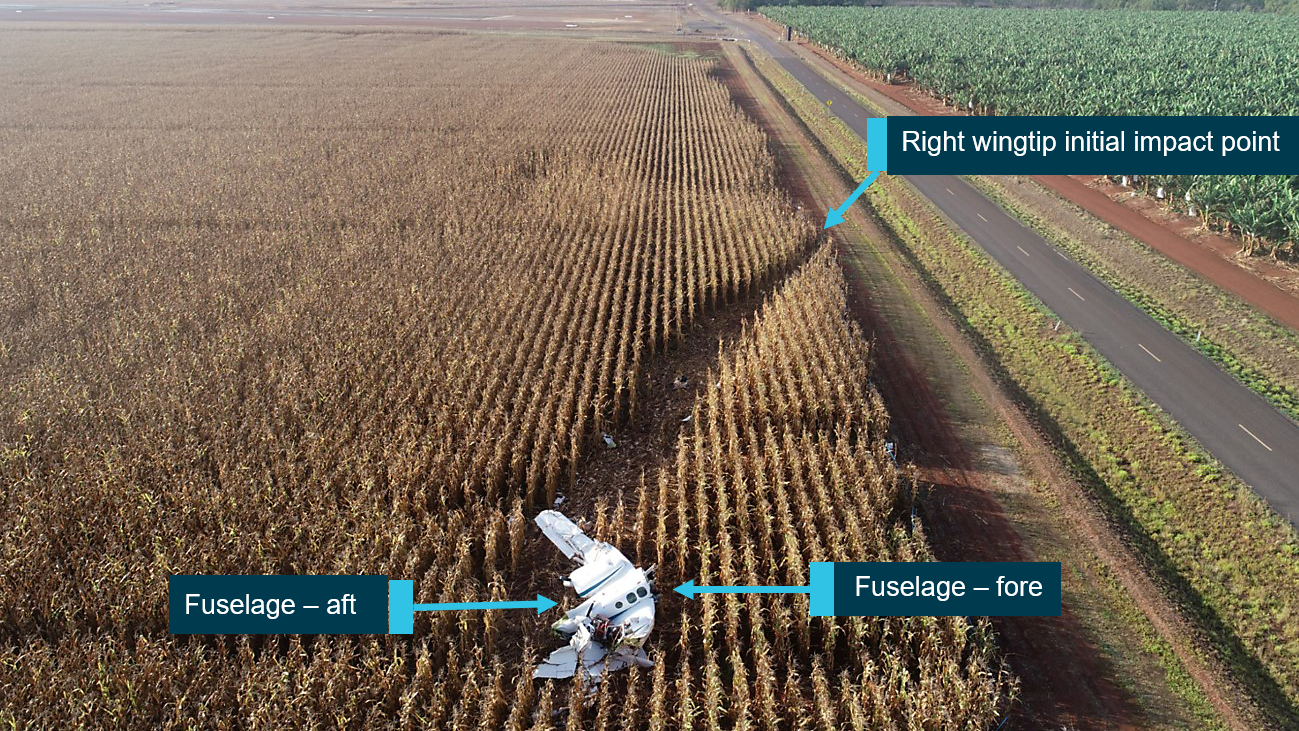
Shortly after, recorded data showed that the aircraft diverged significantly to the left of the runway centre line and crossed the Ord River at low level. The aircraft then collided with the ground about 600 m beyond the river and about 800 m from the runway threshold, and was consumed by fire.
The pilot, despite sustaining serious injuries, was able to extricate themselves and the passenger from the wreckage. Sadly, the passenger later succumbed to their injuries.
“Due to the severity of the post impact fire ATSB investigators were not able to conduct a complete wreckage examination,” explained Mr Macleod.
“However, investigators were able to establish evidence of engine rotation prior to impact, while finding no evidence of pre-existing defects to the engines or flight controls that could have contributed to the accident.”
Further, the aircraft’s landing gear was observed to be stowed.
Mr Macleod said that given the extent of fire damage to the aircraft wreckage, determining the circumstances of the fire initiation and development is challenging and remains under investigation.
However, the ATSB previously investigated an in-flight fire involving a Beech 58 in February 2014.
“Two pilots were conducting a ferry flight from Darwin to Gove, when the pilot in the left seat observed smoke and flames by their left leg adjacent to the circuit breaker panel,” said Mr Macleod.
The left-hand seat pilot immediately switched off the electrical master switch and discharged the fire extinguisher at the flames, while the right-hand seat pilot took control of the aircraft and conducted an emergency descent and landing.
“A post-incident engineering inspection found that wiring had penetrated the heater supply fuel line, causing it to arc out and burn a hole in the fuel line.”
Given the similarity of some of the circumstances of the 2014 incident to the April 2022 Kununurra accident, the ATSB is advising Beech Baron operators to conduct a detailed inspection of the aircraft’s heater fuel supply line and nearby wiring.
“It is important to stress that the ATSB’s investigation into the Kununurra accident is on-going, and we are yet to make formal findings as to the accident’s contributing factors,” Mr Macleod said.
“However, given what we do understand of this accident, we believe it is prudent for Baron operators to examine the area below the pilot’s circuit breaker panel and areas forward of this under the instrument panel.
“The ATSB also encourages operators to report any identified issues to the Civil Aviation Safety Authority and the aircraft manufacturer.”
Mr Macleod said a final report, which will detail safety analysis and findings, will be released at the conclusion of the investigation.
“However, as we have with the release of this preliminary report and Safety Advisory Notice, if at any time as the investigation continues, we are made aware of safety critical information, the ATSB will immediately share that with relevant stakeholders so that they may take appropriate safety action.”
Read the preliminary report: In-flight fire and collision with terrain involving Beechcraft B58 Baron, VH-NPT, near East Kimberley Regional Airport, Kununurra, Western Australia, on 16 April 2022
Read the SAN: Beechcraft Baron heater fuel supply line inspection