

Discontinuation notice
Report release date: 22/12/2025
| Section 21 (2) of the Transport Safety Investigation Act 2003 (TSI Act) empowers the ATSB to discontinue an investigation into a transport safety matter at any time. Section 21 (3) of the TSI Act requires the ATSB to publish a statement setting out the reasons for discontinuing an investigation. |
Overview of the investigation
The occurrence
On 13 July 2022 at about 0716 local time, V/Line passenger train 8070 departed Echuca on a scheduled service to Southern Cross Station, Melbourne, via Bendigo in Victoria (Figure 1). The 3-car VLocity DMU was operating on the V/Line regional broad gauge network. On board were the driver, conductor and about 40 passengers. The train was scheduled to arrive at Goornong station at 0808. By rail, Goornong was about 28 km before the stop at Bendigo.
Figure 1: Broad gauge rail route from Echuca to Bendigo
Source: Nearmap, annotated by the Office of the Chief Investigator (OCI)
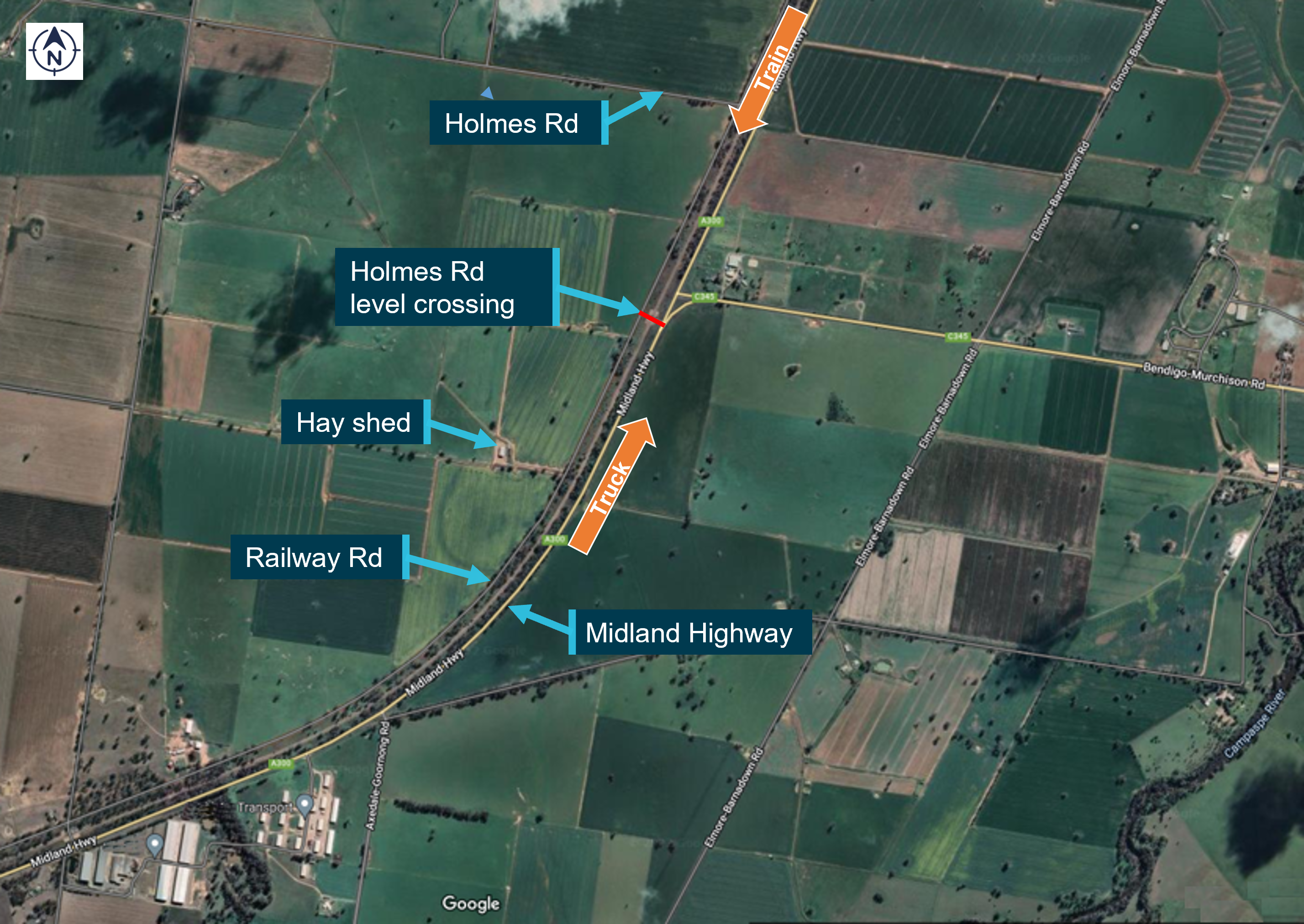
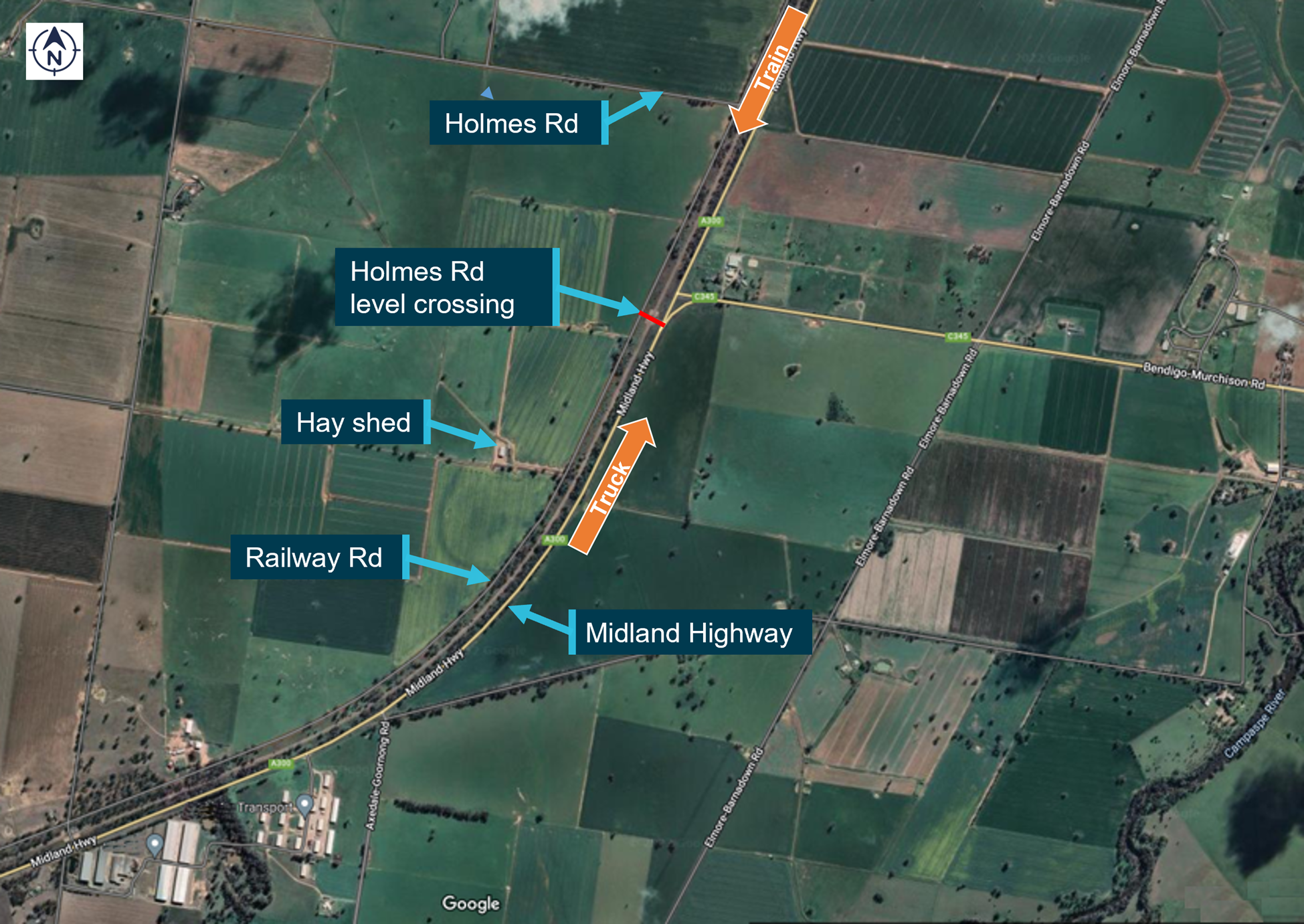
On the morning of the incident, a farmer whose property was located near Goornong was expecting a truck to collect and transport a load of hay to Mansfield. Arrangements had been made for a truck from a local truck depot to use a gated level crossing which provided a route between the Midland Highway and the unsealed Railway Road on the other side of the railway (Figure 2). This level crossing was referred to as the Holmes Road level crossing, although it was not on Holmes Road, which was further north.
Figure 2: Holmes Road level crossing and local area
Source: Google maps, annotated by OCI
The Holmes Road level crossing was about 700 m from the farmhouse and hay shed. In preparation for the truck’s arrival, a farm worker attended the crossing. They opened the gates then returned to the farm leaving the level crossing unattended.
Travelling north along the Midland Highway, the truck arrived at the left turn for the side road to the level crossing at about 0804. The truck’s driver had not previously used this crossing. As the truck commenced the turn, train 8070 was approaching from the north on the single bi-direction track and was about 400 m from the crossing. The truck driver recalled monitoring road traffic approaching from behind as they made the turn and did not observe the approaching train at this point. The driver of train 8070 saw the truck turn and travel towards the level crossing.
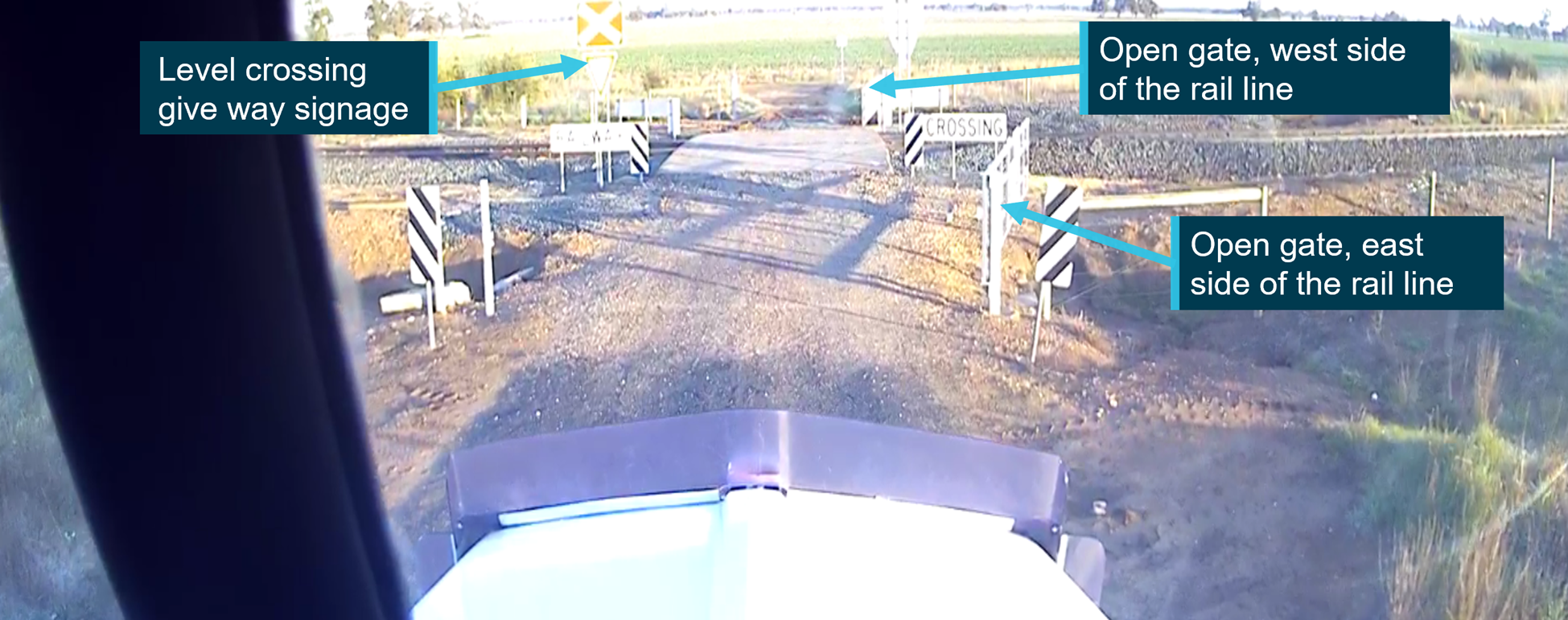
After turning their truck onto the short, unsealed road which joined the Midland Highway to Railway Road, the truck driver observed that the gates on either side of the crossing were open, and they had clear access across the crossing (Figure 3). The truck driver recalled that they had been told to expect closed gates on their way to the farm and was surprised to find open gates. The truck then proceeded towards and onto the level crossing. Its driver recalled not seeing the train until the last moment before the collision.
Figure 3: View from truck as it approached the Holmes Road level crossing
Source: Still image from the truck’s video camera, annotated by OCI
The train approached the crossing travelling at about 74 km/h which was below the permitted speed of 80 km/h. The train’s event recorder indicated that the train’s horn was sounded when the train was about 230 m from the crossing and again when about 70 m from the crossing. The truck driver did not recall hearing the train horn.
On seeing the truck drive onto the crossing, the train driver made an emergency brake application. This slowed the train to about 63 km/h before the train collided with the side of the truck. It then travelled a further 90 m before coming to a stop (Figure 4).
Figure 4: The front of train 8070 following impact, looking back towards the crossing

Source: OCI
The collision resulted in significant damage to the front of the train and the derailment of its leading car. Its driver sustained minor injuries. There were no reported injuries to passengers or the conductor.
The truck’s prime mover and trailer were separated and damaged in the collision, and the driver of the truck was seriously injured.
The Holmes Road level crossing
The level crossing was at the intersection of a 6 m wide unsealed road and a single bi‑directional track, about 50 m from the Midland Highway. The approach to the turn‑off from the highway (as taken by the truck) was equipped with standard road signage identifying the presence of the crossing on the side road ahead.
On the truck’s approach to the crossing (from the east), the truck driver’s view of the approaching train was largely unobstructed although a small number of self-seeded trees restricted some views on the approach. Near the crossing, the view of an approaching train was not impeded (Figure 5).
Figure 5: View from eastern gate towards the approach direction of train 8070

Source: OCI
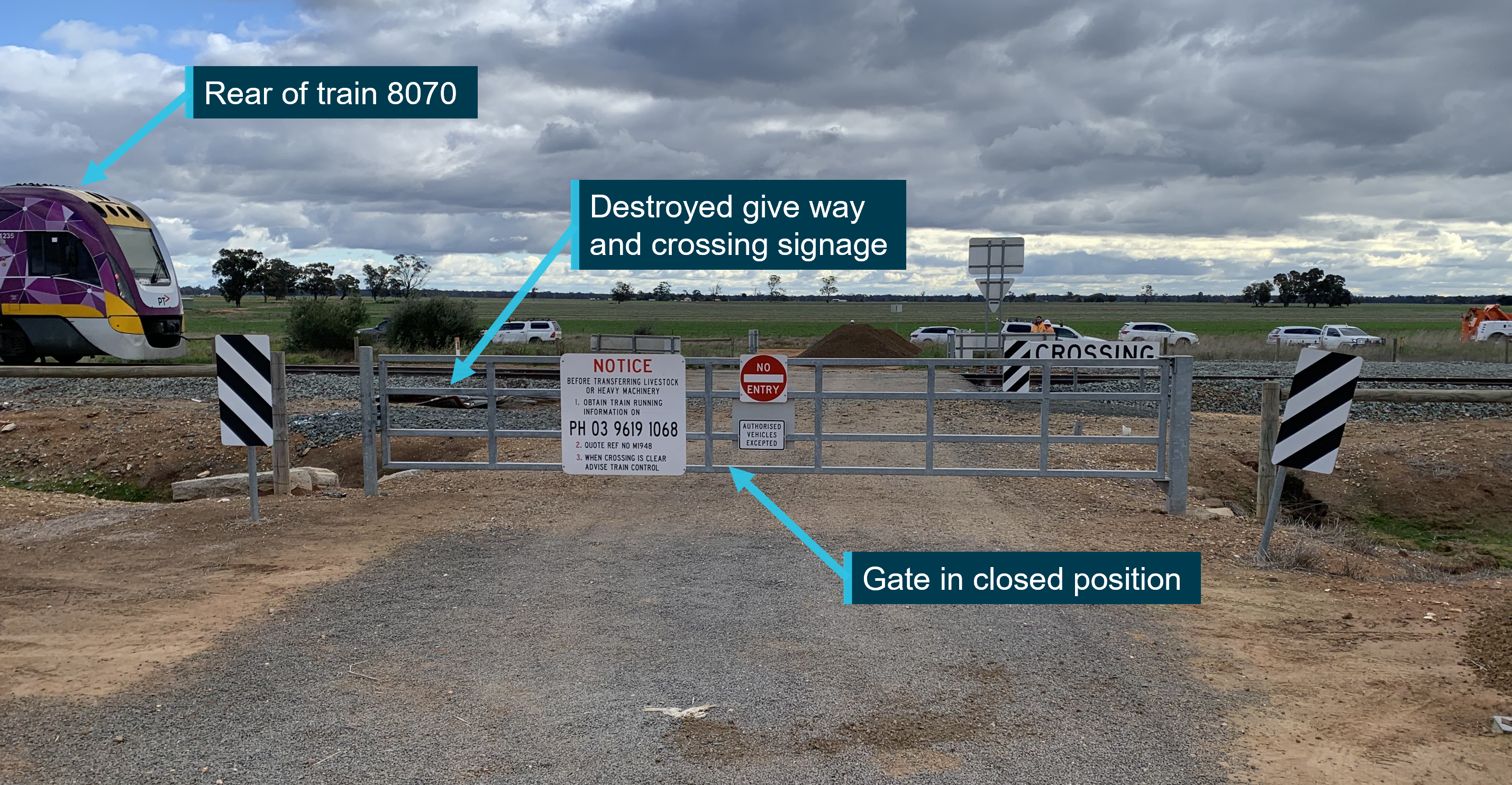
Protection at the crossing included railway crossing identification signage, give way signs and a lockable single swing gate on each side of the crossing to restrict access. Railway crossing and give way signage was located between each gate and the track, with some signage on the east side being knocked over in the incident (Figures 6 and 7).
Figure 6: The crossing when approached from the east, with some signage knocked over
Source: OCI
Figure 7: The undamaged crossing signage on the west side of crossing

This image shows the signage between the gate and track on the western side of the crossing, with the closed eastern gate on the other side of the track in the background. Prior to the collision, the same signage was present on the east side, facing the truck as it approached. Source: OCI
The lockable swing gates were installed at the crossing in 2013 and were a frangible design.[1] Frangible gates allow vehicles to push through the gates in the case of an emergency such as bushfire. Signage on the gates indicated train running information should be sought for transferring livestock or heavy machinery. V/Line advised that this instruction was not intended to apply to normal vehicle traffic including trucks.
The installation of lockable gates followed V/Line consultation with the local shire council and community on the potential for closing the crossing. The gated solution was adopted to restrict access following community opposition to proposed crossing closure. The installed gates were in addition to pre-existing passive give way signage.
To manage use of the crossing, licence agreements were established between V/Line and several farmers in the area.[2] Each agreement nominated authorised users which allowed use of the crossing under conditions set out in the agreement. Keys to the gate’s locks were provided to each of the authorised users.
The agreement described that an authorised user was expected to unlock and open each gate, drive their vehicle across the rail line clear of the track, and return to close and lock both gates. V/Line advised that training in the use of the gates was also provided at the time the licence agreements were established.
Frangible gate level crossings at other locations
There were 6 other level crossings on the V/Line network identified as having frangible gate arrangements. Two of these were located on the Ballarat to Ararat rail line and 4 were located on the Ballarat to Maryborough line. Their local environment, infrastructure configuration and usage arrangements varied.
Restricted-access crossings
The V/Line regional network contained about 450 level crossings which had some form of restricted access or private usage. A large subset of these crossings were occupation crossings which provided access between 2 parcels of land.[3] The Holmes Road level crossing was not an occupation crossing. However, its restricted access and user arrangements placed it within this broad group of restricted-access crossings.
Summary of observations
The review of evidence identified that:
- Lockable gates were added to the Holmes Road level crossing in 2013 to restrict its usage. The gates supplemented pre-existing passive level crossing signage.
- On the day of the collision, the gates at the Holmes Road level crossing were opened in preparation for the arrival of a truck. The crossing was then left unattended.
- The truck subsequently entered the level crossing into the path of train 8070. The driver of the truck did not see the train and was possibly distracted by their lack of familiarity with the gated arrangement and surprise at finding the gates open.
- The train was observable from the truck during its turn from the Midland Highway and nearer the crossing. Self-seeded trees restricted the view to the track on part of the truck’s approach.
- The V/Line network had about 450 restricted-access crossings including occupation crossings and other private crossings.
Safety actions taken since the event
Following the collision at the Holmes Road level crossing, several safety actions associated with frangible gate crossings have been taken by V/Line. The Holmes Road level crossing has been permanently closed, and a V/Line review identified that 4 of the 6 other frangible gate crossings should be considered for closure. One of these 4 has subsequently received funding to progress its closure.
V/Line has also developed a new level crossing management strategy and associated plan to enhance level crossing safety across regional Victoria.[4] The strategy contains 11 objectives across 3 strategic themes, with several objectives relevant to safety at restricted-access crossings. The plan identifies the further inspection and review of all occupation and private crossings over a 5-year period. The plan also describes the potential use of new technologies for warning systems at such crossings and identifying opportunities for crossing closures.
Reasons for the discontinuation
Based on a review of investigation evidence and the subsequent safety actions taken by V/Line, further investigation is unlikely to yield additional important safety lessons. Consequently, the ATSB has discontinued this investigation.
The evidence collected during this investigation remains available to be used in future investigations or safety studies. The ATSB will also monitor for any similar occurrences that may indicate a need to undertake a further safety investigation.
[1] A frangible gate is equipped with fusible link hinges which break to allow emergency escape or access.
[2] The licence agreement between V/Line and the farmer involved in the incident was dated 27 November 2013.
[3] Occupation crossings were historically granted to a landowner under Section 36 of the Lands Compensation Statute 1869 Vic. Rights also exist under subsequent legislation.
[4] The V/Line strategy developed in 2025 considers the Code of Practice – Train Visibility at Level Crossings, released by the Office of the National Rail Safety Regulator (ONRSR) in December 2024.
Preliminary report
Report release date: 19/09/2022
| This preliminary report details factual information established in the investigation’s early evidence collection phase, and has been prepared to provide timely information to the industry and public. Preliminary reports contain no analysis or findings, which will be detailed in the investigation’s final report. The information contained in this preliminary report is released in accordance with section 25 of the Transport Safety Investigation Act 2003. |
The occurrence
Prior to the incident
On 13 July 2022 at about 0716, V/Line passenger train 8070 departed Echuca on a scheduled service to Southern Cross Station in Melbourne via Bendigo (Figure 1). The three-car VLocity Diesel Multiple Unit (DMU) was operating on the regional broad gauge line. Onboard were the driver, conductor and 40 passengers.
Figure 1: Broad gauge rail route from Echuca to Bendigo

Source: e-way street directory, Melway 2017, annotated by Chief Investigator, Transport Safety (Victoria)
That same morning, a property owner (farmer) north of Bendigo and near Goornong was expecting a truck to collect and transport a load of hay. The farmer had engaged a local transport company and arrangements were made for the truck to use the Holmes Road level crossing that was near the farm. Use of this crossing provided a route between the Midland Highway and Railway Road on which the farm was located.
The Holmes Road level crossing was a gated, passive level crossing that was not available for normal public access. The gates on both sides of the crossing were fitted with locks, and keys had been provided to authorised property owners.
The farmer reported attending the Holmes Road level crossing shortly before the expected arrival of the truck, unlocking and opening the gates and then returning to the hay shed on their property.
The incident
The truck driver had been instructed to proceed to the farm to load hay for delivery to Mansfield. They travelled north along the Midland Highway from a nearby transport depot and turned left at the access road to the Holmes Road level crossing. Arriving at the level crossing, they found the gates open, and proceeded onto the crossing.
Train 8070 was scheduled to arrive at Goornong Railway Station at 0808. The train driver reported that, on approaching the level crossing, they could see the truck turning off the Midland Highway towards the crossing. With the train travelling at about 70 km/h, the train driver sounded the horn and expected the truck to stop. When it did not, the train driver made an emergency brake application and was in the process of turning their seat away, when the train impacted the truck.
The impact resulted in the derailment of both bogies on the leading car of the train. The lead rail car and the track infrastructure were extensively damaged. The train driver sustained minor injuries. There were no injuries to the passengers on the train.
The truck driver was seriously injured in the collision. The truck was severely damaged, with the semi-trailer separating from the prime mover (Figure 2).
Figure 2: Rear of train, prime mover and semi-trailer of truck after collision

Source: Chief Investigator, Transport Safety (Victoria)
Context
Location
Goornong is about 28 km north of the city of Bendigo in Victoria and the Holmes Road level crossing is about 5 rail-km north of the Goornong Railway Station (Figure 1).
Level crossing
The Holmes Road level crossing connected the Midland Highway and an unsealed local road named Railway Road that ran parallel to the rail track on its western side. Although Holmes Road was about 950 metres north of the level crossing and did not intersect the rail track or the Midland Highway, the crossing was designated the Holmes Road level crossing for V/Line identification purposes.
The Holmes Road level crossing was located about 2.4 km from the transport depot and about 700 m from the hay shed access road that was on the opposite side of the railway (Figure 3).
Figure 3: Location of Holmes Road level crossing

Source: Google maps, annotated by Chief Investigator, Transport Safety (Victoria)
Crossing protection
In 2013, V/Line equipped the level crossing with lockable gates. To provide limited access to the level crossing, V/Line had a formal agreement with local property owners. The agreement provided authorised users access to the level crossing under conditions set out in the agreement, and keys to the gates of the crossing were provided to those authorised users.
The crossing road was about 6 m wide and a single swing gate was installed across the road on either side of the railway. The gates were fitted with signage that included a notice with a telephone number to call before transferring livestock or heavy machinery, a reference number for the level crossing and to advise train control when the crossing was clear.
The level crossing was also fitted with signage typical of a passive (give way) level crossing. The Australian Standard 1742.7[1] specified the signage requirements. W7-12[2] and RX-8[3] signs were located on the Midland Highway before the turn-off to the level crossing (Figure 4).
Figure 4: Signage on approach to and at the level crossing

Source: AS1742.7:2016, annotated by Chief Investigator, Transport Safety (Victoria)
On either side of the crossing, R6-25,[4] R1-2[5] and RX-9[6] signs were installed (Figures 5 and 6).
Figure 5: Holmes Road level crossing access from east of the rail track

Holmes Road level crossing shown from the east side, the approach side of the truck. At the time of incident, the gate was open.
R6-25, R1-2 and RX-9 assemblies to the left of the road were knocked to the ground during the collision.
Source: Chief Investigator, Transport Safety (Victoria)
19 September 2022

Holmes Road level crossing shown from the west side with all signage intact.
Source: Chief Investigator, Transport Safety (Victoria)
Train 8070
Train 8070 was a three-car VLocity set numbered 3VL35, consisting of car 1135 (DMD), 1335 (TM), and 1235 (DM).[7]
In addition to its derailment, the impact with the truck caused damage to the front of the leading car. The laminated safety glass of the windscreen and side windows were shattered, but all windows remained within their frames (Figure 7). The driver’s cab floor was pushed up and the underside of the control desk was deformed.
Figure 7: Damage to the front of the train

Source: Chief Investigator, Transport Safety (Victoria)
The truck
The truck consisted of a 2013 Kenworth T909 prime mover, coupled to a 45-ft drop-deck semi-trailer (Figure 8).
Figure 8: Drop-deck semi-trailer

Source: Chief Investigator, Transport Safety (Victoria)
Further investigation
To date, the ATSB has:
- inspected the location of the occurrence
- examined train operational information
- examined truck operational information
- interviewed a number of parties
- commenced collection of other relevant information
The investigation is continuing and will include review and examination of:
- the arrangements for the use of the Holmes Road level crossing
- the use of the level crossing by property owners
- the operation of the truck and train
- the configuration of the level crossing
Should a critical safety issue be identified during the course of the investigation, the ATSB will immediately notify relevant parties so appropriate and timely safety action can be taken.
A final report will be released at the conclusion of the investigation.
Australian Transport Safety BureauAbout the ATSBThe ATSB is an independent Commonwealth Government statutory agency. It is governed by a Commission and is entirely separate from transport regulators, policy makers and service providers. The ATSB’s purpose is to improve the safety of, and public confidence in, aviation, rail and marine transport through:
The ATSB is responsible for investigating accidents and other transport safety matters involving civil aviation, marine and rail operations in Australia, as well as participating in overseas investigations involving Australian-registered aircraft and ships. It prioritises investigations that have the potential to deliver the greatest public benefit through improvements to transport safety. The ATSB performs its functions in accordance with the provisions of the Transport Safety Investigation Act 2003 and Regulations and, where applicable, international agreements. Rail safety investigations in VictoriaMost transport safety investigations into rail accidents and incidents in Victoria and New South Wales (NSW) are conducted in accordance with the Collaboration Agreement for Rail Safety Investigations and Other Matters between the Commonwealth Government of Australia, the State Government of Victoria, and the State Government of New South Wales. Under the Collaboration Agreement, rail safety investigations are conducted and resourced in Victoria by the Chief Investigator, Transport Safety (CITS) and in New South Wales by the Office of Transport Safety Investigations (OTSI), on behalf of the ATSB, under the provisions of the Transport Safety Investigation Act 2003. The Chief Investigator, Transport Safety (CITS) is a statutory position established in 2006 to conduct independent, no-blame investigation of transport safety matters in Victoria. CITS has a broad safety remit that includes the investigation of rail (including tram), marine and bus incidents. Purpose of safety investigationsThe objective of a safety investigation is to enhance transport safety. This is done through:
It is not a function of the ATSB to apportion blame or provide a means for determining liability. At the same time, an investigation report must include factual material of sufficient weight to support the analysis and findings. At all times the ATSB endeavours to balance the use of material that could imply adverse comment with the need to properly explain what happened, and why, in a fair and unbiased manner. The ATSB does not investigate for the purpose of taking administrative, regulatory or criminal action. TerminologyAn explanation of terminology used in ATSB investigation reports is available on the ATSB website. This includes terms such as occurrence, contributing factor, other factor that increased risk, and safety issue. |
__________
Occurrence summary
| Investigation number | RO-2022-007 |
|---|---|
| Occurrence date | 13/07/2022 |
| Location | Goornong |
| State | Victoria |
| Report release date | 22/12/2025 |
| Report status | Discontinued |
| Investigation level | Defined |
| Investigation type | Occurrence Investigation |
| Investigation status | Discontinued |
| Mode of transport | Rail |
| Rail occurrence category | Collision |
| Occurrence class | Accident |
| Highest injury level | Minor |
Train details
| Train operator | V/Line Corporation |
|---|---|
| Train number | 8070 |
| Type of operation | Passenger |
| Departure point | Echuca, Victoria |
| Destination | Melbourne, Victoria |
| Train damage | Substantial |