Wet runway overrun
Guidance updated after airliner overruns wet Newman runway
Key points:
- Aircraft was conducting a higher than normal speed approach due to winds and turbulence;
- Runway was wet with active rain, reducing braking effectiveness;
- Aircraft came to a stop beyond the runway threshold, but inside the runway end safety area.
Operator and regulator guidance has been updated after a Fokker 100 airliner overran a wet runway at Newman Airport last year, an Australian Transport Safety Bureau investigation notes.
The ATSB investigation into the 9 January 2020 incident found the combination of the higher than normal approach speed required due to the prevailing winds and poor braking effectiveness on a wet runway resulted in the aircraft overrunning runway 05 at Newman Airport, in Western Australia’s Pilbara region.
The aircraft, with five crew and 88 passengers on board, was conducting a regular public transport service from Perth. It was operated by Network Aviation, a subsidiary of the Qantas Group.
The weather forecast for Newman Airport on the morning of the incident included heavy rain, moderate to severe turbulence below 5,000 feet, and a 25 knot crosswind. The airport had received about 88 mm of rainfall since 0900 the previous day.
“Despite assessing the weather as a threat, during their approach briefing the flight crew did not identify the potential effect of the rainfall on the stopping distance,” ATSB Director Transport Safety Stuart Macleod said.
Instead, their discussions were focussed on the cloud base and the visibility required to conduct the approach, the expectation of windshear, turbulence and the strong crosswind.
The flight crew followed guidance for the expected turbulence, selecting a flaps 25 approach, and maintained a faster than normal approach speed.
The aircraft touched down at or before the touchdown zone at an airspeed of 154 knots.
“The aircraft did not slow after crossing the runway threshold, or during the flare, and a higher groundspeed than airspeed was recorded, indicating a possible unforecast tailwind component,” Mr Macleod noted.
During the landing roll, the aircraft then did not decelerate as expected. Recorded flight data showed this low deceleration, along with directional oscillations, was consistent with aquaplaning.
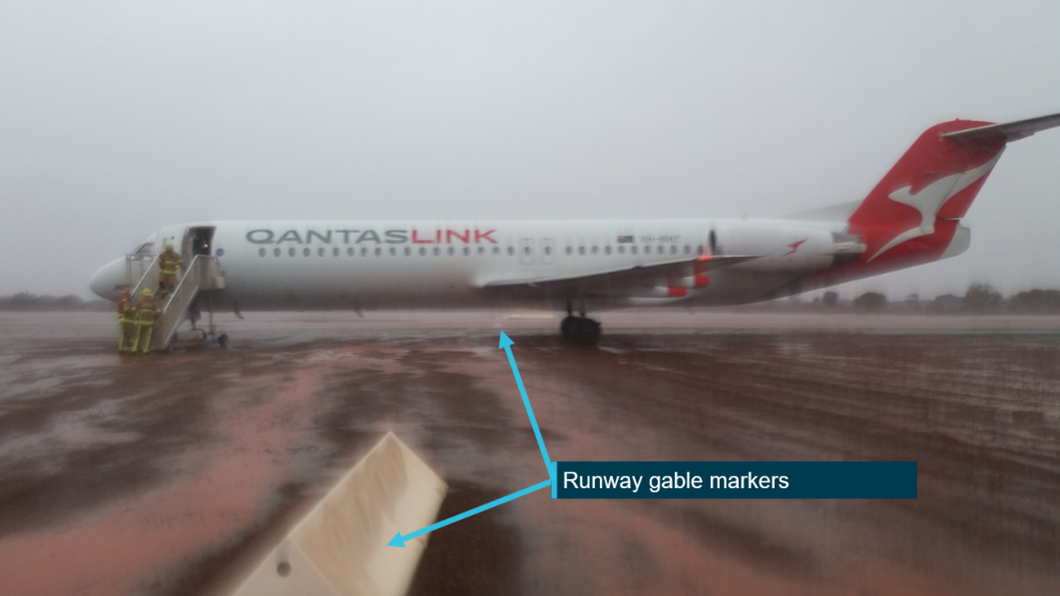
The captain, sensing the aircraft aquaplane, applied the aquaplaning response technique to maintain directional control and subsequently commanded maximum reverse thrust. The aircraft came to a stop 70 metres beyond the runway threshold, but inside the runway end safety area.
There were no injuries to crew or passengers, while an inspection of the aircraft found that some components of the landing gear sustained minor damage from loose gravel.
“Given the magnitude of this overrun it is highly likely that had the landing speed been reduced, or the braking effectiveness had been normal, or there had been less crosswind, the overrun would not have occurred,” Mr Macleod said.
The ATSB found at the time of the incident neither the operator nor the regulator had guidance to allow flight crews to recognise the conditions at the time as a hazard to the operation.
“While Network Aviation policy did not approve operations on contaminated runways, there was limited documented guidance on how to determine if the runway was contaminated, and moderate or heavy rain were not identified as possible runway contaminants,” Mr Macleod explained.
The ATSB also found that prior to the occurrence, the runway had been examined and found to be requiring maintenance to ensure an adequate level of surface friction, however no maintenance was performed.
Following the overrun, the operator circulated additional guidance and procedures to flight crew for identifying runway water contamination and to ensure appropriate speed control on approach and landing.
The Civil Aviation Safety Authority has also since published guidance, reflecting research from the US Federal Aviation Authority, that found landing on ungrooved runways in moderate rain has the potential to significantly affect braking performance.
“Moderate to heavy rainfall is one of many factors that can influence the stopping distance of an aircraft,” Mr Macleod said.
“Water on an ungrooved runway can significantly reduce the ability of an aircraft to slow down.”
Operators and pilots are encouraged to review the latest guidance and tools available in relation to maintaining safety on runways and the factors that cause runway overruns, Mr Macleod continued.
“In wet weather, additional conservatism is encouraged when calculating the required landing distances.”
Read the final report: Runway overrun involving Fokker F100, VH-NHY, Newman Airport, Western Australia, on 9 January 2020