

Final report
Report release date: 24/09/2026
Investigation summary
What happened
At 0834 Australian Eastern Standard Time on 13 March 2026, a Robinson R44 II helicopter, registered VH-TCF, departed from Gold Coast, Queensland, for a private flight to Mudgee, New South Wales (NSW), with an intermediate stop at Armidale, NSW, to refuel.
The pilot’s iPhone crash alarm activated, 72 minutes after the aircraft departed, and the wreckage was located the following day in dense bushland, 46 km north-east of Tenterfield, NSW. The pilot sustained fatal injuries and the helicopter was destroyed.
What the ATSB found
The ATSB found that it was very likely the pilot entered weather conditions unsuitable for visual flight, resulting in a loss of control and subsequent collision with terrain.
Safety message
The ATSB encourages all pilots, no matter what their experience levels, to develop the knowledge and skills required to avoid unintentional operations in instrument meteorological conditions (IMC). This includes having alternate plans in case of unexpected changes in weather, and making timely decisions to land, turn back, divert or hold in an area of clear weather. The use of a ‘personal minimums’ checklist can also be a strong mitigator against the risk of flying into bad weather.
The Vertical Aviation Safety Team, formally known as the International Helicopter Safety Team, has published several fact sheets about inadvertent IMC (IIMC) that are available from their website. Their fact sheet, Inadvertent entry into instrument meteorological conditions (IIMC), acknowledges that these encounters are the ‘most demanding, disorienting, and dangerous conditions a pilot can experience’ and result in the highest percentage of fatal injuries from helicopter accidents.
The fact sheet explained the immediate actions required by pilots in IIMC stating that:
A pilot’s immediate actions after encountering inadvertent IMC will determine the outcome of the entire event. Pilots who possess a plan of action prior to encountering it are more likely to experience a successful outcome (staying alive) than those who are less trained and proficient in the recognition and recovery procedures.
In addition, their fact sheet stated that:
Comprehensive training on IIMC is necessary for all rotorcraft helicopter training. This training should include, but not limited to:
• Determination of enroute weather
• Avoidance of inadvertent flight into instrument meteorological conditions
• In-flight weather abort procedures
• Recovery from inadvertent flight into instrument meteorological conditions.
The ATSB booklet Accidents involving visual flight rules pilots in instrument meteorological conditions (AR-2011-050) provides guidance on avoiding flight into adverse weather. Further information specific to helicopter pilots is also available on the ATSB website.
The investigation
| The ATSB scopes its investigations based on many factors, including the level of safety benefit likely to be obtained from an investigation and the associated resources required. For this occurrence, the ATSB conducted a limited-scope investigation in order to produce a short investigation report, and allow for greater industry awareness of findings that affect safety and potential learning opportunities. |
The occurrence
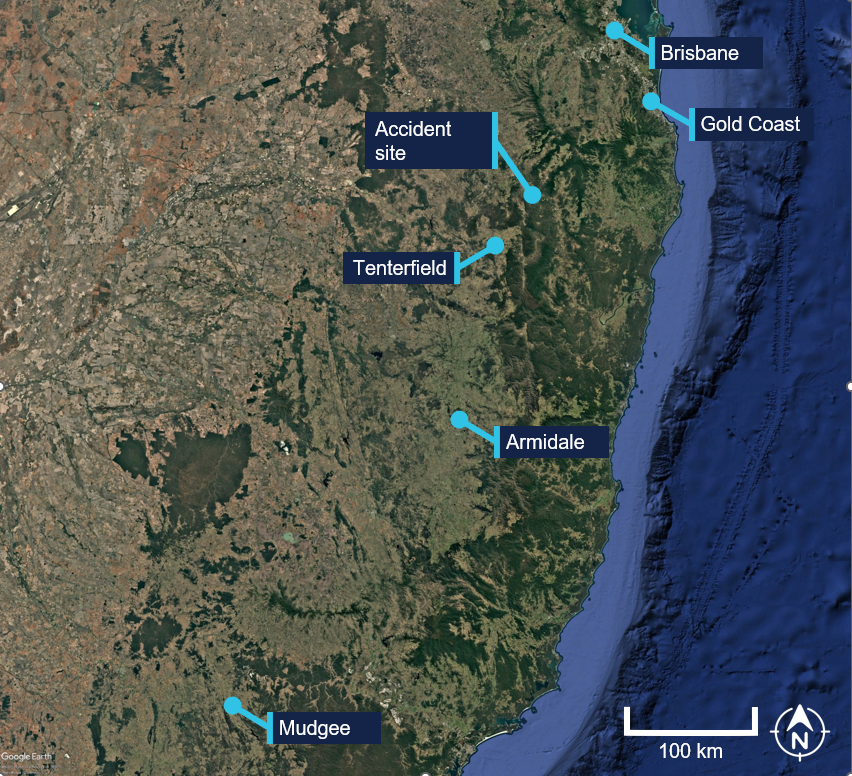
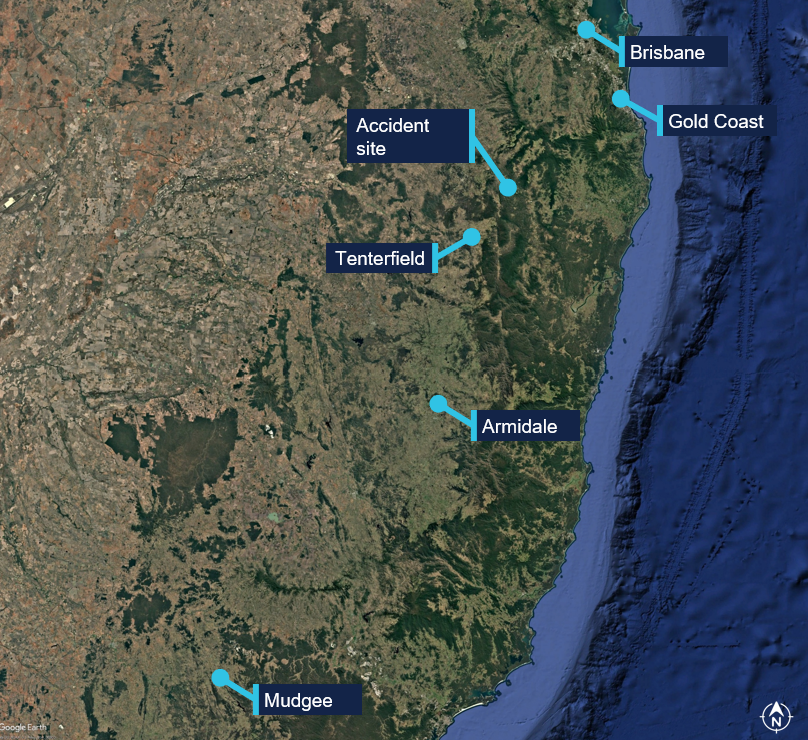
On 13 March 2026, the pilot and sole occupant of a Robinson R44 II helicopter, registered VH-TCF, planned to conduct a private flight under the visual flight rules (VFR),1 from Gold Coast, Queensland, to Mudgee, New South Wales (NSW), with an intermediate stop at Armidale, NSW, to refuel (Figure 1).
Figure 1: Map showing accident site and key locations
The pilot was intending to travel over 3 days, to join a helicopter safari in southern Victoria with the intention of flying around Tasmania. A relative of the pilot reported that the pilot was ‘very excited about the trip’. They further advised that the pilot had been monitoring the weather in the days leading up to the departure and was expecting clear conditions for the flight.
At about 0834 Australian Eastern Standard Time (AEST),2 the helicopter departed from a private helipad, around 35 km from the Gold Coast Airport.
NSW Police advised that an automated emergency message associated with activation of the pilot’s iPhone crash alarm3 was received at 1046 Australian Eastern Daylight saving Time (AEDT),4 72 minutes after the aircraft departed. In response, a formal search was commenced by NSW Police.
The wreckage was located at 1113 AEDT on 14 March 2026, in dense bushland, 46 km north-east of Tenterfield, NSW. The pilot sustained fatal injuries and the helicopter was destroyed.
Context
Pilot information
Flight experience
The pilot held a Private Pilot Licence (Helicopter) and a single‑engine helicopter class rating. The pilot did not hold an instrument rating and had not logged any instrument flight time. As of 7 March 2026, the pilot’s logbook showed they had accrued about 1,262 hours total flight time, 84 of which were accrued on an R22. The remaining hours were obtained operating R44 helicopters, with all but 11.5 in VH-TCF. The pilot completed their last flight review on 21 September 2025. The instructor who conducted the review reported that it included ground theory training followed by a 1‑hour flight, and a second 1-hour flight the following day, consistent with entries in the pilot’s logbook. The instructor reported discussing interpretation of a weather forecast with the pilot, but did not require, or observe the pilot demonstrate, planning a flight based on the weather forecast. The instructor described the pilot as a ‘confident and comfortable’ pilot.
Medical information
At the time of the accident, the pilot was 77 years old. Their class 2 aviation medical certificate application was completed by a designated aviation medical examiner on 5 September 2025 and was valid to 5 September 2026. The certificate had the following limitations:
Must use [continuous positive airway pressure] CPAP in sleep period prior to exercising privileges of medical certificate.
Reading correction to be available whilst exercising the privileges of this licence.
Records obtained from the CPAP provider showed that the pilot was regularly using the CPAP machine as required.
The ATSB reviewed the pilot’s CASA aviation medical history since 2017. While the pilot had multiple conditions that increased the risk of medical incapacitation, these had been disclosed to CASA and were assessed as being adequately controlled.
The pilot was reported to have slept normally the night before the accident and had eaten breakfast before departing. There was no evidence to indicate the pilot was unwell, nor experiencing a level of fatigue known to affect performance.
The post-mortem did not identify any evidence of incapacitation, however, toxicology results were not available at the time of report writing.
Aircraft information
General information
The Robinson R44 II is a 4-seat helicopter, powered by a single Textron Lycoming IO‑540‑AE1A5 piston engine, driving a 2‑blade semi-rigid main rotor system and 2‑blade tail rotor system. VH-TCF, serial number 11912, was manufactured in the United States in 2007 and first registered in Australia in October 2007.
The helicopter was being maintained in accordance with the Robinson Helicopter R44 maintenance manual, the Lycoming IO-540 operator’s manual, supplemental type certificates and engineering orders. Its last periodic inspection was conducted on 13 February 2026 at 2,103.4 hours. Prior to the commencement of the accident flight, VH-TCF had accumulated 2,104.7 hours total time in service. It was equipped and maintained to a day visual flight rules standard, with the maintenance release reflecting this limitation.
The helicopter was equipped with lap sash seat belts and was being operated with the doors fitted.
Rotor system
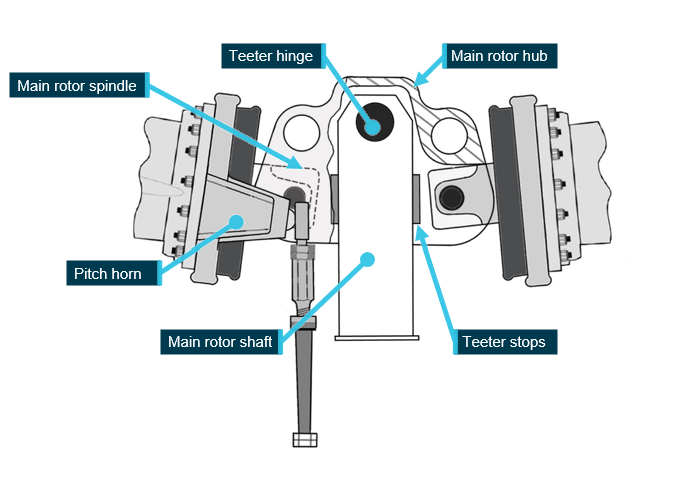
The Robinson R44 main rotor hub assembly is a semi-rigid rotor head, otherwise known as a teetering rotor head (Figure 2). Bolts secure the blades to the hub at the coning hinges. During stopping and starting of the main rotor, when RPM is low, blade tusks rest against droop stops, restricting teetering and preventing the blades from drooping. As the main rotor RPM increases, the blades straighten and become rigid due to rotational forces, and the tusks shift off the droop stops. During normal flight, the rotor is free to teeter and flap around its designed flight axis via the teeter hinge, while polyurethane teeter stops limit the degree of teetering.
Under certain flight conditions, semi-rigid rotor systems are susceptible to extreme teetering where the blades teeter beyond their normal operational range, resulting in what is commonly known as ‘mast bumping’ (see the following section titled Mast bumping).
Figure 2: Robinson main rotor hub assembly
Mast bumping
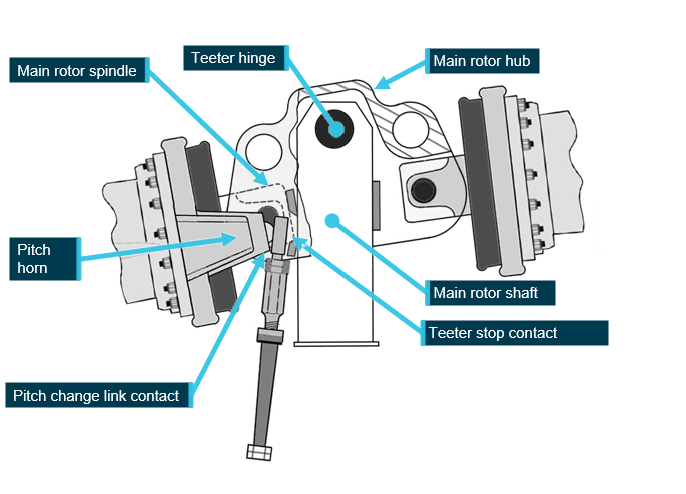
Mast bumping is the common term used to describe contact of the main rotor shaft, by the inboard main rotor spindle (Figure 3).
Mast bumping severity can generally be identified by extensive damage to, including destruction of, the teeter stops and varying degrees of damage to the main rotor shaft from direct impact.
Extreme teetering can also result in the pitch change links exceeding their maximum displacement and often results in failure of one or both pitch links, typically at the upper rod end thread. Failure of a pitch link will allow uncontrolled rotation of the blade about its pitch axis and at this point, control of the helicopter is no longer possible. As documented in many investigation reports worldwide, scenarios involving mast bumping have been attributed to inappropriate flight control inputs that permit the development of, and/or inappropriate response to, low g5 flight conditions.
Figure 3: Extreme mast bump
Site and wreckage information
Accident site
The accident site was located about 46 km north-east of Tenterfield Airport in a densely vegetated area. It was situated on the southern side of a steep slope, at an elevation of about 900 m (2,950 ft).
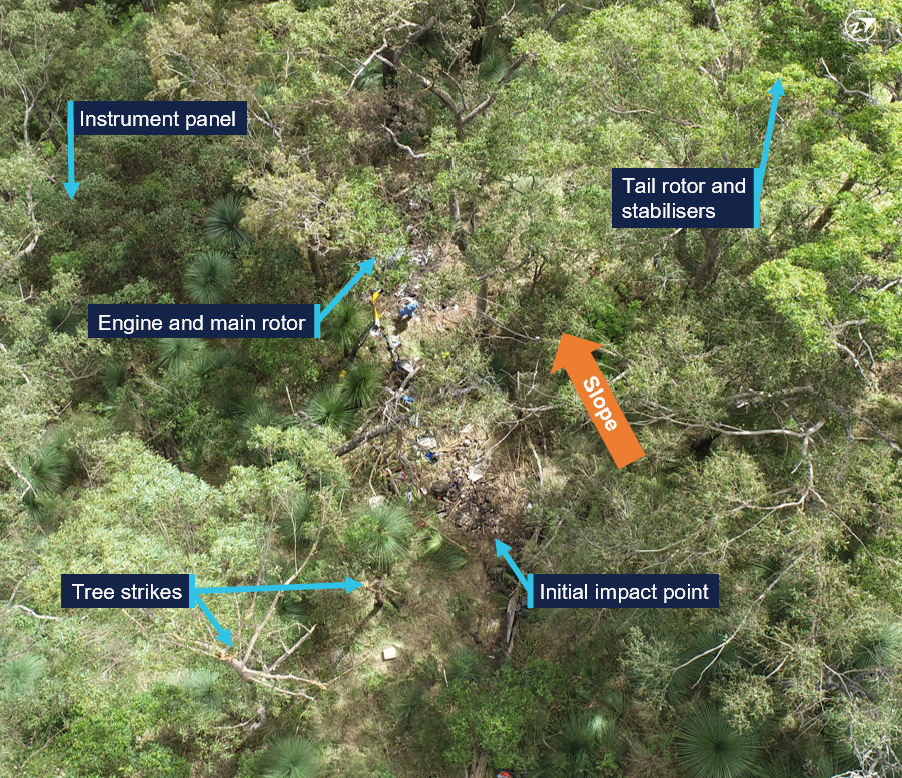
The wreckage trail was approximately 12 m long in a westerly direction (Figure 4). It consisted of an initial impact point, followed by a trail of debris down the slope leading to the fuselage, engine and main rotor, much of which were consumed by a post-impact fire. Damage was evident on 2 trees located near the initial impact point, indicating the helicopter had struck these trees in a near vertical descent.
Figure 4: Accident site
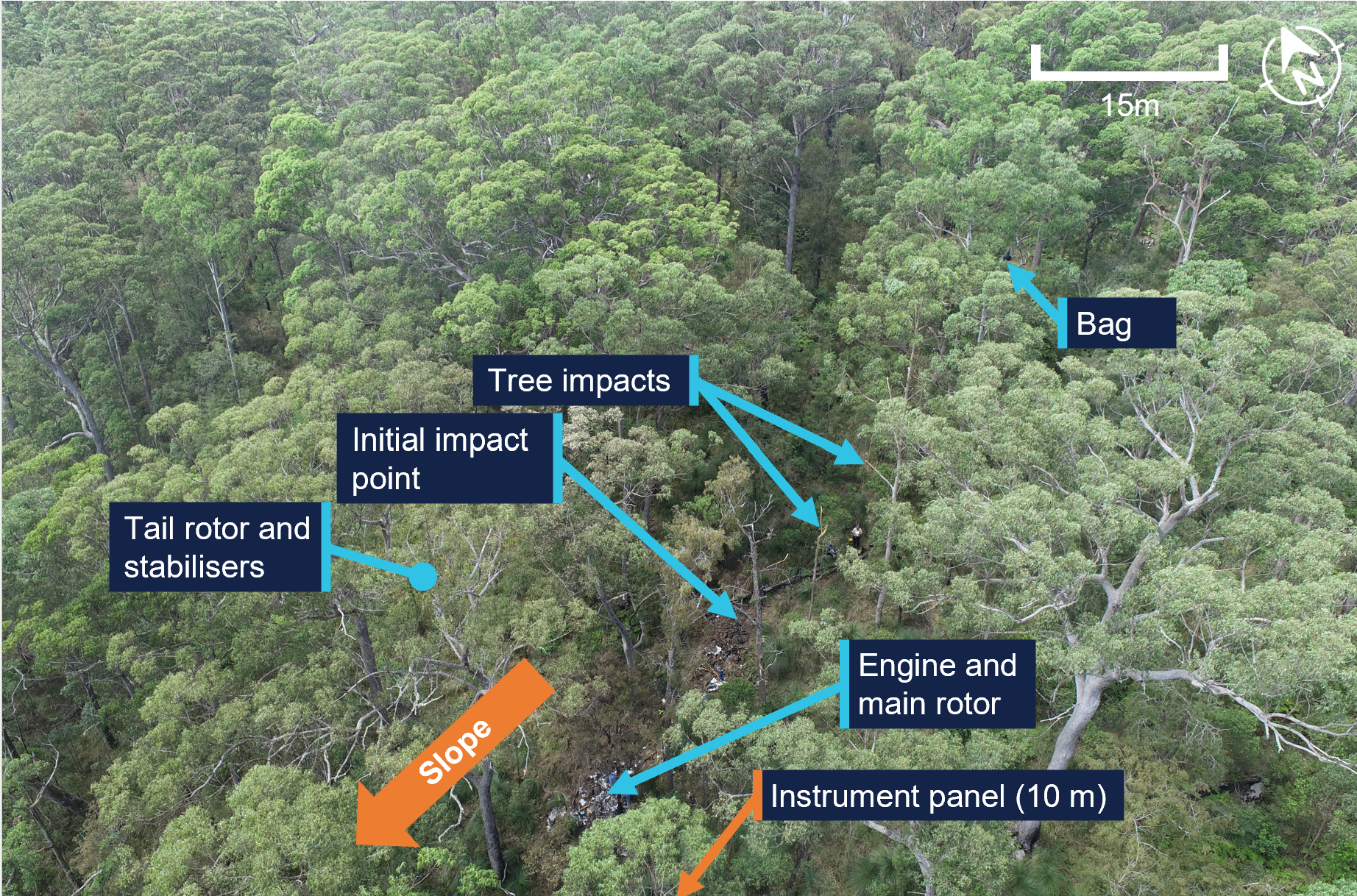
The aft section of the tailcone assembly, including the tail rotor and stabilisers, had separated from the fuselage and was located approximately 20 m from the fuselage across the slope through dense vegetation (Figure 4). A large, soft shell travel bag was located in the tree canopy (Figure 4), around 12 m upslope from the initial impact with the trees. Various other items from within the helicopter, such as a headset, were located between the bag and the initial impact site, indicating they had been liberated from the helicopter above the tree line, prior to the initial impact point.
The main instrument panel was located a further 10 m down the slope away from the fuselage.
Wreckage examination
Disruption to the helicopter and post-impact fire damage precluded a detailed examination of a significant proportion of the helicopter. This included testing of electrical and fuel system components and the determination of engine controls and instrument panel switch selections.
The intensity of the post-impact fire was indicative of a considerable amount of fuel on board the helicopter. A fuel jerry can, which had been filled at the helicopter’s departure location, was found on site. The contents were consistent with avgas, and testing showed no presence of water in the fuel.
Main rotor assembly
Examination of the main rotor components identified:
- the main rotor hub was secure to the main rotor shaft, which was secure to the main rotor transmission
- both main rotor blade tips were located within the accident site
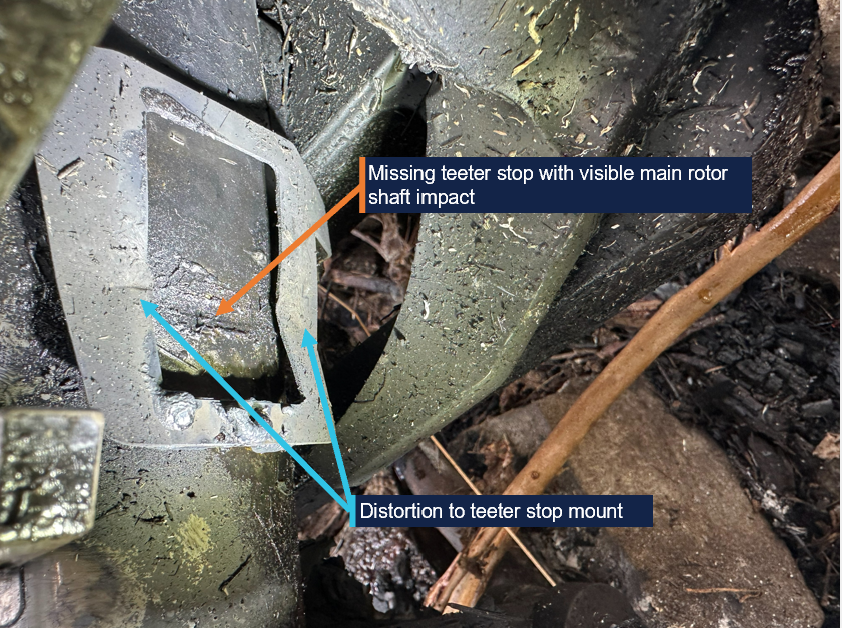
- one teeter stop had fractured in the centre due to severe impact forces from the spindle, with the upper half liberated
- the other teeter stop was not present (Figure 5)
- both teeter stop stainless steel mounts exhibited distortion from spindle impact (Figure 5)
- impact damage to the main rotor shaft at both teeter stop locations (Figure 5).
Figure 5: Example of damage to teeter stop and main rotor shaft on one side
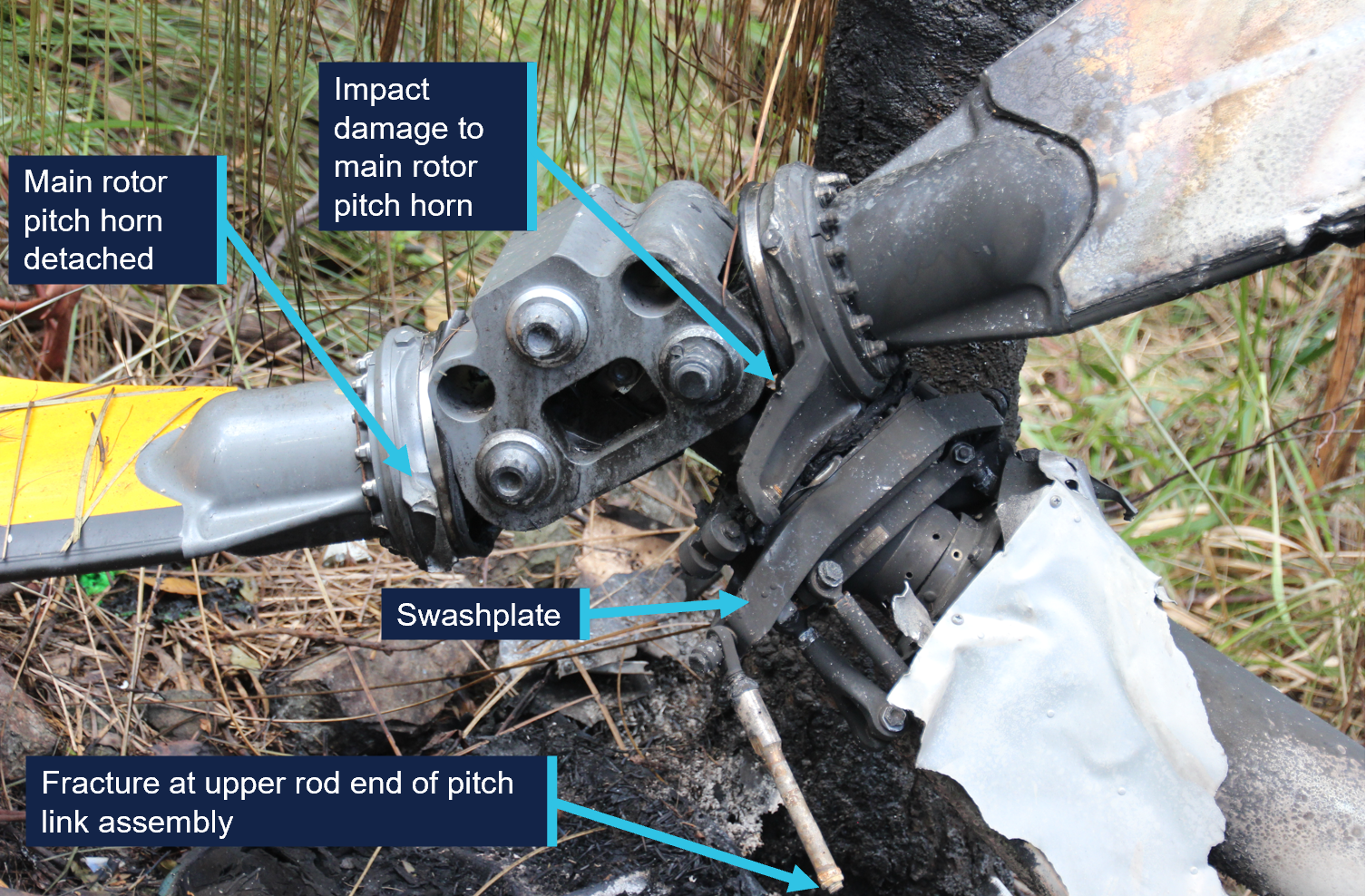
- both main rotor pitch change links had fractured in overstress, at the upper rod end thread (Figure 6)
- one pitch horn had detached, with the fracture surface consistent with overstress (Figure 6)
- the other pitch horn was secured to the spindle and exhibited damage consistent with contact with the main rotor hub (Figure 6).
Figure 6: Main rotor hub
Tailcone separation
The aft section of the tailcone was located around 20 m to the right of the wreckage trail with limited damage to the structure. Signature marks where it had separated from the tail boom, the lack of structural damage and its location, were consistent with the tailcone likely separating above the trees during the accident sequence, rather than it being a precursor to the accident.
Other systems
Where flight control tubes had been destroyed by impact or fire, the integrity of the control system was limited to confirming the connection at their respective attachment points and for the presence of securing hardware. In that context, no defects were identified. Further, fracture surfaces of rod ends, and other flight control components were consistent with overstress failure.
The examination also identified the following:
- all major components were identified at the site
- damage to the cooling fan was indicative of the engine rotating at the time of impact
- damage to, and location of, the instrument panel (Figure 4) was consistent with a high energy liberation event, possibly from a main rotor strike.
Recorded data
Although the pilot was reportedly using the OzRunways6 electronic flight bag software, which provided a map overlaying the helicopter’s GPS location to aid in navigation, no track data was transmitted to the service provider. There were no other recording devices on board the helicopter.
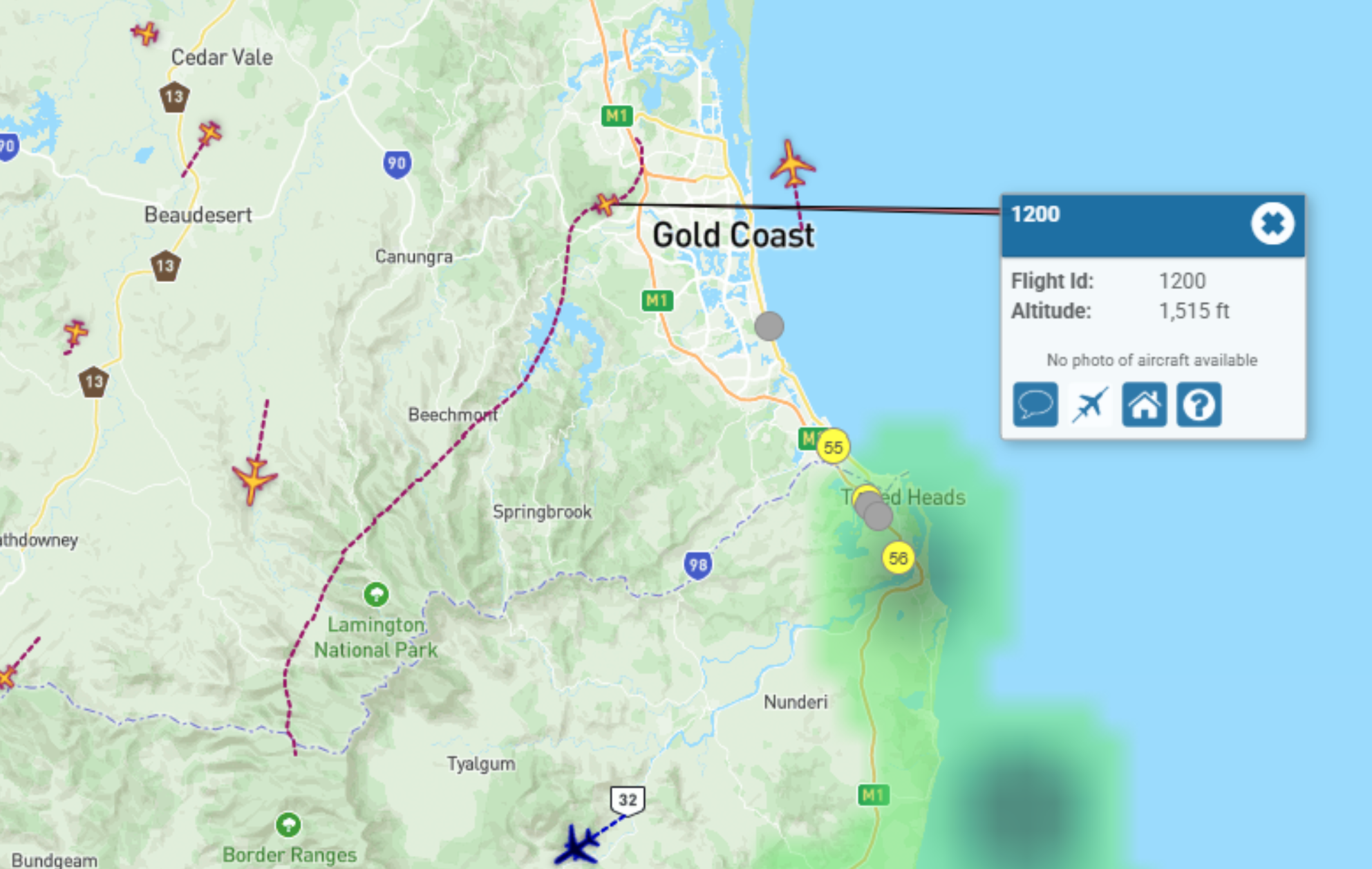
VH-TCF was identified on WebTrak7 around Gold Coast Airport. It showed the helicopter tracking roughly south-west at about 3,000 ft, before crossing the NSW border at 0854 AEST. This service then stopped recording the helicopter’s position.
Airservices’s secondary radar further detected unidentified aircraft returns in the vicinity of the accident site, however, these could not be confirmed as VH-TCF.
Weather information
Forecasts
The Bureau of Meteorology (BoM) terminal area forecast (TAF)8 issued at 0612 AEST on 13 March 2026 and valid from 0700 AEST for the Gold Coast Airport included:
- visibility greater than 10 km with scattered cloud at 1,000 ft and broken9 cloud at 1,600 ft
- from 0800 AEST, light showers of rain and broken cloud at 2,000 ft
- a TEMPO10 between 0700–0900 AEST visibility greater than 10 km with broken cloud at 1,000 ft
- a TEMPO between 0900–1800 AEST included visibility of 3,000 m, showers of rain and broken cloud at 1,000 ft and few towering cumulous at 2,000 ft
- an INTER11 between 1800 AEST on 13 March and 0400 on 14 March included visibility of 4000 m, showers of rain and broken cloud cover at 1,200 ft
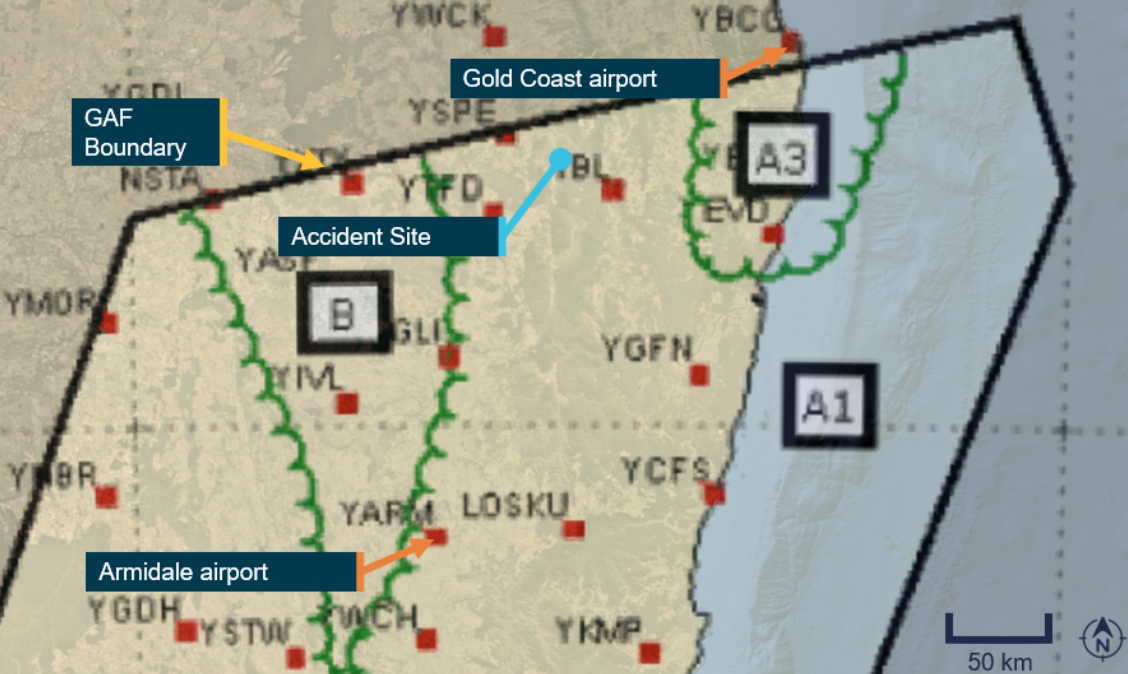
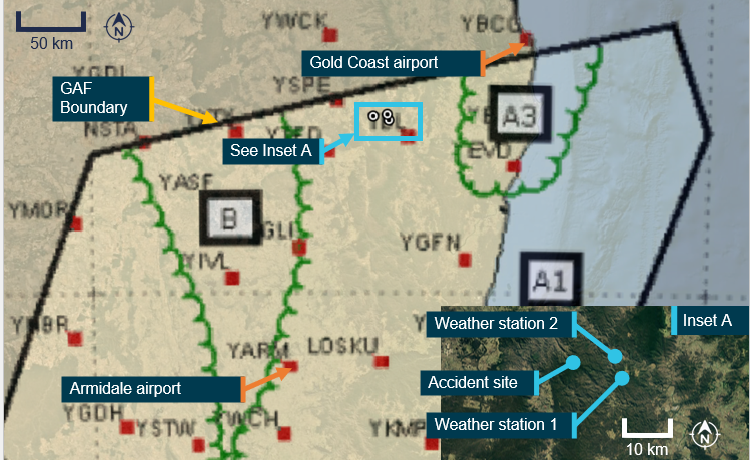
The BoM graphical area forecast (GAF),12 issued at 0809 AEST on 13 March 2026 for the area encompassing the flight path south of Gold Coast to the accident site (Figure 7) included:
- visibility greater than 10 km with broken stratus with bases at 1,500 ft and tops at 2,000 ft and broken stratocumulus with bases at 2,000 ft and tops to 9,000 ft
- visibility 4,000 m in isolated13 showers of rain with broken stratus with bases at 1,000 ft and tops at 2,000 ft, and broken cumulus/stratocumulus with bases at 2,000 ft and tops to 9,000 ft
- visibility 3,000 m in isolated drizzle with broken stratus with bases at 800 ft and tops at 2,000 ft, and overcast stratocumulus with bases at 2,000 ft and tops to 9,000 ft
- in a small coastal area just south of Gold Coast, isolated thunderstorms and rain were forecast, reducing visibility to 2,000 m with associated cumulonimbus with bases at 2,000 ft and tops above 10,000 ft, broken stratus with bases at 500 ft and tops at 2,000 ft, and broken cumulus/stratocumulus with bases at 2,000 ft and tops above 10,000 ft.
Figure 7: Geographical area forecast
The previous GAF issued at 0226 on the morning of 13 March reflected essentially the same expected weather conditions without the forecast small area of thunderstorms. An AIRMET14 valid from 0624 to 1024, was also issued for isolated thunderstorms in that area.
The aerodrome forecast (TAF) for the pilot’s first intended stop at Armidale Airport, NSW, issued at 0422 EDT and valid 0600–1900 on 13 March included:
- wind from 080° at 8 kt
- visibility greater than 10 km
- cloud broken at 400 ft (TAF cloud heights are above aerodrome elevation).
During the period 0900–1100:
- wind from 100° at 12 kt
- visibility greater than 10 km
- light showers of rain
- scattered cloud at 3,000 ft
- temperature 16°C at 0600 and 19°C at 0900
- QNH 1,016 hPa at 0600 and 1,019 hPa at 0900.
Weather observations
The Gold Coast aerodrome observations (METAR)15 at 0830 AEST on the accident morning were:
- wind from 170° at 9 kt
- visibility greater than 10 km
- few cloud at 1,500 ft (cloud heights above aerodrome elevation)
- scattered cloud at 2,000 ft
- broken cloud at 2,500 ft
- temperature 27°C and dew point 24°C
- QNH 1,013 hPa
Distant lightning strikes were reported at 0800 and 0930.
Satellite imagery
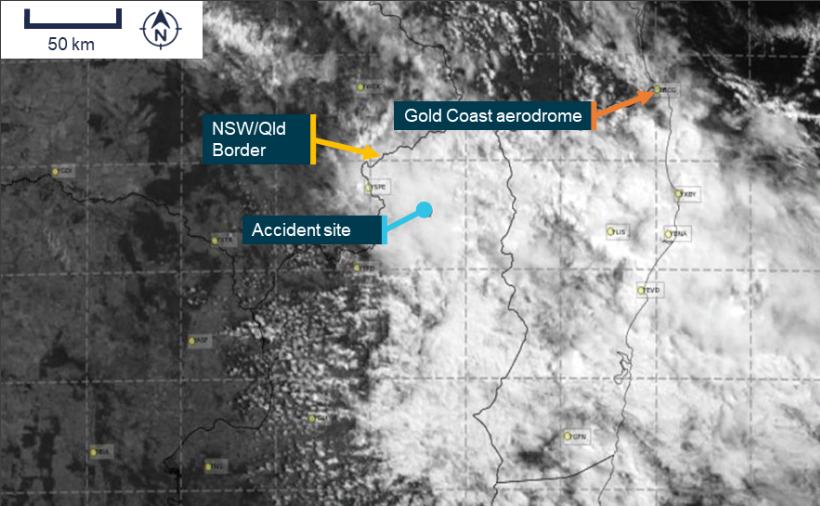
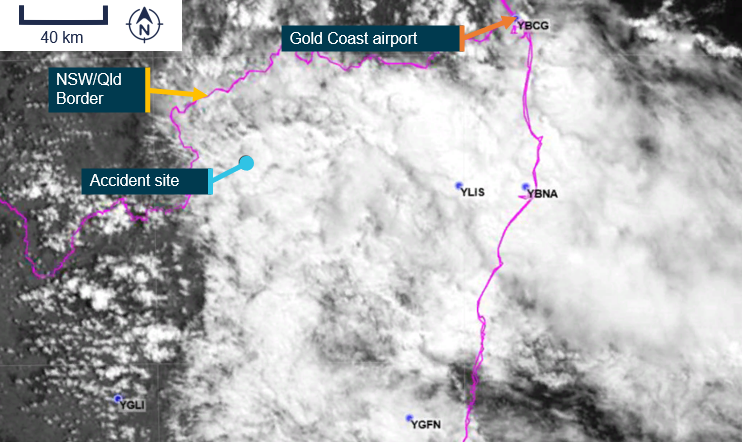
High resolution visible satellite imagery showed extensive cloud extending inland to the NSW/Queensland border, including at the accident site (Figure 8).
Figure 8: Satellite cloud imagery at 1040 AEST (6 minutes before the accident)
Source: Satellite image processed by the Bureau of Meteorology from the geostationary meteorological satellite Himawari-9, operated by the Japan Meteorological Agency, annotated by the ATSB
Witness reports
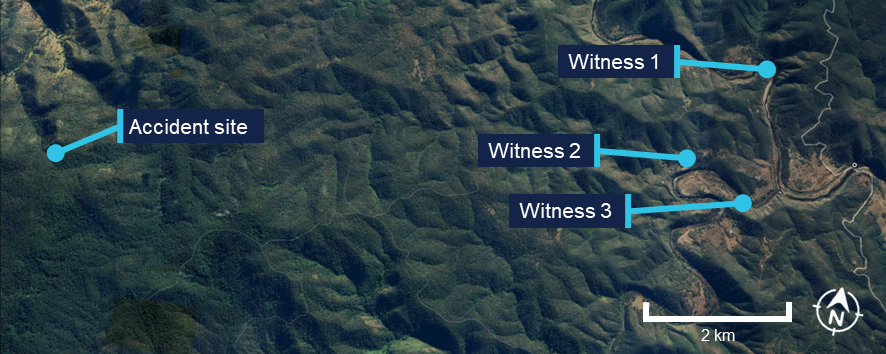
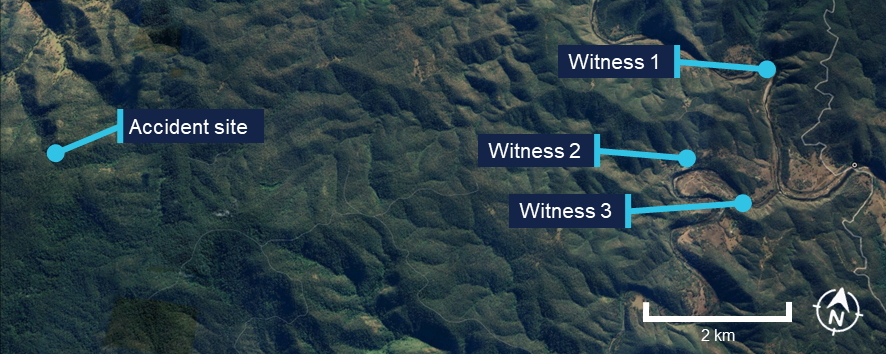
Several witnesses located near the accident site (Figure 9) reported very low cloud and drizzle on the morning of the accident. They stated that they observed a helicopter flying very low, ‘before lunchtime’ on the day. All witnesses reported that it was unusual to see a helicopter in the area, but this one was particularly unusual due to its low altitude.
In addition, one witness stated that the helicopter seemed to be stuck below cloud and remarked to their partner that it ‘looks like it’s trying to find a way out’. Another witness recalled waving at the helicopter and stated that it passed them twice before heading west.
Figure 9: Witness locations
Source: Google Earth, annotated by the ATSB
Operational information
Visual meteorological conditions
For flights under the VFR, the Civil Aviation Safety Regulations (CASR) Part 91 Manual of Standards (MOS) specified criteria for visual meteorological conditions (VMC)16 in terms of visibility and distance from cloud. The criteria for all aircraft operating in Class G (non‑controlled) airspace were:
At or below whichever is the higher of 3,000 ft AMSL and 1,000 ft above ground level (AGL):
- visibility 5,000 m
- clear of cloud
- aircraft must be operated in sight of ground or water.
For helicopters (rotorcraft) operating below 700 ft over land in non‑controlled airspace (and not within 10 NM of an aerodrome with an instrument approach procedure), the criteria were:
- flight visibility 800 m
- clear of cloud
- by day
- at a speed that allows the pilot to see obstructions or other traffic in sufficient time to avoid a collision, and
- if not more than 10 NM from an aerodrome with an IAP — in a way that ensures the flight maintains a separation of at least 500 ft vertically from any aircraft that is: less than 10 NM from the aerodrome; and conducting an IFR operation.
Flight planning requirements
Under section 7.02 Forecasts for flight planning, the MOS required that pilots study the appropriate authorised weather forecasts and reports. This included:
- the route to be flown
- the departure aerodrome, the planned destination aerodrome and any planned alternate aerodrome
- any other reasonably available weather information that is relevant to the intended operation.
The pilot did not submit a flight plan and was not required to submit one for a private VFR flight in Class G airspace.
National aeronautical information processing system (NAIPS) records showed that weather information was accessed by the pilot’s account at 0740 and 0745 on 13 March 2026. The pilot had requested a location briefing for the Gold Coast aerodrome. In making this selection, a pilot may also select the graphical area forecast, however, the data did not record if this was requested, therefore the ATSB could not verify if the pilot had viewed this forecast.
The pilot did not request a location briefing for their first destination at Armidale. Although they requested a location briefing for Tenterfield, the Bureau of Meteorology did not issue aerodrome forecasts for Tenterfield Airport.
Spatial disorientation
Spatial disorientation occurs when a pilot does not correctly sense their aircraft’s attitude, airspeed, or altitude in relation to the earth’s surface. It is often described simply as the inability to determine ‘which way is up’, although the effects can often be more subtle than implied by that description.
Spatial disorientation occurs when the brain receives conflicting or ambiguous information from the sensory systems. It is likely to happen in conditions in which visual cues are poor or absent, such as in adverse weather or at night. It presents a danger to pilots, as the resulting confusion can often lead to incorrect control inputs and resultant loss of aircraft control. The flight control sensitivity and relative instability of helicopters compared to aeroplanes increases the risk of such a control loss.
VFR into IMC occurrences
Between 2015 and 2025 there were 116 VFR into instrument meteorological conditions (IMC)17 occurrences in Australian airspace reported to the ATSB. Of these, 13 were fatal accidents resulting in 24 fatalities. Based on these figures, approximately 1 in every 9 reported VFR into IMC occurrences results in a fatality.
For non-instrument rated pilots, entering IMC can quickly become fatal. Research has shown that pilots not proficient in instrument-only flight will typically become spatially disoriented and lose control of the aircraft within 1–3 minutes after visual cues are lost.
CASA’s flight safety article ‘Every which way but loose’ stated that:
the inherent instability of a helicopter means that even an [instrument flight rules] IFR-rated pilot who is proficient and enters cloud in a helicopter not designed for instrument flight will have difficulty maintaining control. Without the normal strong visual cues of a horizon, the pilot will quickly experience dynamic instability and be fighting the aircraft to maintain a stable altitude and airspeed.
Safety analysis
Prior to the flight, the pilot obtained a meteorological location briefing for the Gold Coast, which may have included a graphical area forecast. Although it was reported the pilot expected clear conditions for the flight to Armidale, there were several layers of cloud at Gold Coast Airport forecast at the time the pilot obtained the briefing, and at the time of departure. Further, the area forecast showed that there were likely to be extensive areas of low cloud, with low visibility along the flight path. This did not preclude the pilot from commencing the flight, but it did indicate a high likelihood of encountering conditions unsuitable for flight under the visual flight rules that would require a diversion or landing.
The available tracking data showed that the helicopter initially tracked south-west at around 3,000 ft, towards the NSW border. However, as the electronic flight bag software was not set to transmit the flight data, there was no further flight data available.
The graphical area forecast and satellite imagery was consistent with witness statements that there was thick cloud and precipitation in the area at the time of the accident. As such, it was very likely that the helicopter entered an area where there was low cloud and/or low visibility in precipitation.
While the ATSB could not rule out that the pilot applied a large control input due to avoiding a bird or terrain, it is very likely that without instrument training or an appropriately equipped aircraft, when they encountered low visibility conditions, they became spatially disorientated and applied inappropriate control inputs.
Consistent with this, the wreckage examination identified signatures of the main rotor assembly being subject to excessive teeter and mast bumping that resulted in both pitch links failing. Following this, the main rotor blades were free to rotate through various pitch angles, and the helicopter was no longer controllable.
The location of the bag and other items from inside the cabin at the accident site was indicative of main rotor contact with the cabin while airborne. In addition, the vertical path through the tree canopy was consistent with a complete loss of control prior to the collision with terrain.
While the evidence showed that the engine was operating when the accident occurred, a transient condition such as a partial or complete power loss could not be ruled out, although such an event should not have resulted in a loss of control. Further, there was no evidence to indicate that the pilot became incapacitated prior to the accident sequence due to a pre-existing medical condition.
Contributing factor It was very likely that the pilot entered flight conditions unsuitable for visual flight, resulting in a loss of control and subsequent collision with terrain. |
Findings
ATSB investigation report findings focus on safety factors (that is, events and conditions that increase risk). Safety factors include ‘contributing factors’ and ‘other factors that increased risk’ (that is, factors that did not meet the definition of a contributing factor for this occurrence but were still considered important to include in the report for the purpose of increasing awareness and enhancing safety). In addition ‘other findings’ may be included to provide important information about topics other than safety factors. These findings should not be read as apportioning blame or liability to any particular organisation or individual. |
From the evidence available, the following findings are made with respect to VFR into IMC and collision with terrain involving Robinson R44 II, VH-TCF, 46 km north-east of Tenterfield, New South Wales, on 13 March 2026.
Contributing factors
- It was very likely that the pilot entered conditions unsuitable for visual flight, resulting in a loss of control and subsequent collision with terrain.
Sources and submissions
Sources of information
The sources of information during the investigation included:
- a relative of the pilot
- Civil Aviation Safety Authority
- New South Wales Police Force
- maintenance organisation for VH-TCF
- accident witnesses
- recorded data from Airservices Australia (WebTraks)
- Bureau of Meteorology.
References
Civil Aviation Safety Authority (2026), Visual flight rules guide, p.207
Civil Aviation Safety Regulations (2025), Part 91 Manual of Standards
Reinhardt, B. (2020), Every which way but loose, Flight Safety Australia, Civil Aviation Safety Authority
United States Helicopter Safety Team (2023), Training Fact Sheet – Inadvertent Entry into Instrument Meteorological Conditions (IIMC)
Submissions
Under section 26 of the Transport Safety Investigation Act 2003, the ATSB may provide a draft report, on a confidential basis, to any person whom the ATSB considers appropriate. That section allows a person receiving a draft report to make submissions to the ATSB about the draft report.
A draft of this report was provided to the following directly involved parties:
- Civil Aviation Safety Authority
- Robinson Helicopter Company
- The United States National Transportation Safety Board.
A submission was received from the Civil Aviation Safety Authority. The submission was reviewed and, where considered appropriate, the text of the report was amended accordingly.
Purpose of safety investigationsThe objective of an ATSB safety investigation is to improve transport safety through:
In accordance with the TSI Act, the ATSB does not investigate for the purpose of taking administrative, regulatory or criminal action, and cannot apportion blame, assist in determining liability, or, as a general rule, assist in court proceedings. About ATSB reportsATSB safety investigation reports are developed in accordance with ATSB procedures and guidelines, and with regard to applicable international standards and instruments. Reports must include factual material of sufficient weight to support the investigation’s analysis and findings. At all times the ATSB endeavours to balance the use of material that could imply adverse comment with the need to properly explain what happened, and why, in a fair and unbiased manner. An explanation of terminology used in ATSB investigation reports is available here. Publishing informationReleased in accordance with section 25 of the Transport Safety Investigation Act 2003 Published by: Australian Transport Safety Bureau © Commonwealth of Australia 2026 Ownership of intellectual property rights in this publication Unless otherwise noted, copyright (and any other intellectual property rights, if any) in this report publication is owned by the Commonwealth of Australia. Creative Commons licence 
With the exception of the Commonwealth Coat of Arms, ATSB logo, and photos and graphics in which a third party holds copyright, this report is licensed under a Creative Commons Attribution 4.0 International licence. The CC BY 4.0 licence enables you to distribute, remix, adapt, and build upon our material in any medium or format, so long as attribution is given to the Australian Transport Safety Bureau. Copyright in material obtained from other agencies, private individuals or organisations, belongs to those agencies, individuals or organisations. Where you wish to use their material, you will need to contact them directly. |
- ^ Visual flight rules (VFR): a set of regulations that permit a pilot to operate an aircraft only in weather conditions generally clear enough to allow the pilot to see where the aircraft is going.
- ^ Australian Eastern Standard Time (AEST): Coordinated Universal Time (UTC) + 10 hours
- ^ Apple iPhone Crash Detection is designed to detect severe car crashes — such as front-impact, side-impact and rear-end collisions, and rollovers. If the Apple device has satellite, mobile or Wi-Fi connection, it will automatically call emergency services after a 30-second countdown if the alert is not manually dismissed.
- ^ Australian Eastern Daylight saving Time (AEDT): Coordinated Universal Time (UTC) + 11 hours
- ^ g: an abbreviation for acceleration forces acting on a body with reference to earth’s gravity at sea level. 1 g = 9.8 m/s2.
^ OzRunways is an electronic flight bag application that provides navigation, weather, area briefings and other flight
information. It provides the option for live flight tracking by transmitting the device’s position and altitude.
- ^ WebTrak uses information from air traffic control secondary surveillance radars to display aircraft movements.
- ^ A TAF is a statement of meteorological conditions expected for a specified period within a radius of 8 km of the aerodrome reference point.
- ^ Cloud cover: in aviation, cloud cover is reported using words that denote the extent of the cover – ‘few’ indicates that up to a quarter of the sky is covered, ‘scattered’ indicates that cloud is covering between a quarter and a half of the sky, ‘broken’ indicates that more than half to almost all the sky is covered, and ‘overcast’ indicates that all the sky is covered.
- ^ TEMPO: used to indicate significant temporary variations from the prevailing conditions previously given in the forecast. TEMPO is used for periods of 30 minutes or more but less than 60 minutes.
- ^ INTER: used to indicate significant intermittent variations from the prevailing conditions previously given in the forecast. INTER is used for periods of less than 30 minutes.
- ^ In a graphical area forecast (GAF), all cloud heights are above mean sea level (AMSL).
- ^ Weather coverage is given as isolated if it consists of individual features which affect, or are forecast to affect, an area with a maximum spatial coverage of up to 50%.
- ^ AIRMET provides information of certain meteorological phenomena that are not contained in the current area forecast.
- ^ METAR: Meteorological aerodrome report.
- ^ Visual Meteorological Conditions (VMC): an aviation flight category in which visual flight rules (VFR) flight is permitted – that is, conditions in which pilots have sufficient visibility to fly the aircraft while maintaining visual separation from terrain and other aircraft.
- ^ Instrument meteorological conditions (IMC): weather conditions that require pilots to fly primarily by reference to instruments, and therefore under instrument flight rules (IFR), rather than by outside visual reference. Typically, this means flying in cloud or limited visibility.
Preliminary report
Report release date: 30/04/2026
| This preliminary report details factual information established in the investigation’s early evidence collection phase, and has been prepared to provide timely information to the industry and public. Preliminary reports contain no analysis or findings, which will be detailed in the investigation’s final report. The information contained in this preliminary report is released in accordance with section 25 of the Transport Safety Investigation Act 2003. |
The occurrence
On 13 March 2026, the pilot of a Robinson R44 II helicopter, registered VH-TCF, planned to conduct a private flight from Gold Coast, Queensland, to Mudgee, New South Wales (NSW), with an intermediate stop at Armidale, NSW, to refuel (Figure 1).
Figure 1: Map showing accident site and key locations
Source: Google Earth, annotated by the ATSB
At about 0834 Eastern Standard Time (EST),[1] the helicopter departed from a private helipad on the Gold Coast. The pilot was the sole occupant of the helicopter.
NSW Police advised that an automated emergency message associated with activation of the pilot’s iPhone crash alarm was received at 1046 Eastern Daylight-saving Time (EDT),[2] about an hour and a quarter after the aircraft departed. In response, a formal search was commenced by NSW Police.
The wreckage was located at 1113 EDT on 14 March 2026 in dense bushland near Paddy’s Flat, 46 km north-east of Tenterfield, NSW. The helicopter was destroyed and the pilot sustained fatal injuries.
Context
Pilot information
The pilot held a Private Pilot Licence (Helicopter) and a single‑engine helicopter class rating. The pilot also held a class 2 aviation medical certificate valid to 6 September 2026 with the following limitations:
Must use [continuous positive airway pressure] CPAP in sleep period prior to exercising privileges of medical certificate.
Reading correction to be available whilst exercising the privileges of this licence.
Records obtained from the CPAP provider showed that the pilot was regularly using the CPAP machine and that sleep apnoea was controlled.
As of 7 March 2026, the pilot’s logbook showed they had accrued 1,264.6 hours total flight time.
Aircraft information
VH-TCF was a Robinson R44 II helicopter, manufactured in the United States in 2007 as serial number 11912 and first registered in Australia in 2007. The helicopter was powered by a Textron Lycoming IO-540-AE1A5 engine. VH-TCF was being maintained in accordance with the Robinson R44 maintenance manual and the Lycoming IO-540 engine manual. According to the maintenance release, on the morning of 13 March 2026, the helicopter had a total time in service of 2,104.7 hours. There were no defects recorded.
Site and wreckage information
The accident site was located about 46 km north-east of Tenterfield Airport in a densely vegetated area to the west of Cataract National Park. It was situated on the southern side of a steep slope, at an elevation of about 870 m (2,850 ft).
The wreckage trail was approximately 12 m long in a westerly direction, across and down the slope as shown in Figure 2. It consisted of an initial impact point, followed by a trail of debris that led to the fuselage, engine and main rotors, much of which were consumed by a post-impact fire. The aft section of the tail cone assembly had separated from the fuselage and was located approximately 20 m from the fuselage across the slope.
Source: ATSB
Significant damage was evident on 2 trees located near the initial impact point, indicating the helicopter had collided with trees in a near vertical descent. A bag found in the tree canopy, and various other parts from the helicopter, were located around 20 m up the slope from the initial impact site.
The instrument panel and other debris were found further down the slope away from the fuselage location. A fuel jerry can, which had been filled at the helicopter’s departure location, was found onsite. The contents were tested for presence of water, which returned a negative result.
Recorded data
Although the pilot was reportedly using the Oz Runways electronic flight bag software, no track data was transmitted to the service provider.
VH-TCF was identified on WebTrak[3] around Gold Coast Airport. It showed that the helicopter tracked roughly south-west before crossing the NSW border at 0854. This service then stopped recording the helicopter’s position (Figure 3).
Figure 3: Aircraft track from departure to the NSW border
Source: Airservices Australia WebTrak
National aeronautical information processing system (NAIPS) records showed that weather information was accessed by the pilot’s account at 0740 and 0745 on 13 March 2026. The requirements of the Aeronautical Information Publication (AIP) ENR 1.10 Flight Planning stated that a pilot must obtain current weather reports and forecasts for the route to be flown, then plan the flight having regard to that information.
Weather information
Forecasts
The Bureau of Meteorology graphical area forecast (GAF),[4] issued at 0809 EST on 13 March 2026 for the area encompassing the flight path south of Gold Coast to the accident site (Figure 4), included:
- visibility greater than 10 km with broken[5] stratus with bases at 1,500 ft and tops at 2,000 ft and broken stratocumulus with bases at 2,000 ft tops to 9,000 ft
- visibility 4,000 m in isolated[6] showers of rain with broken stratus with bases at 1,000 ft and tops at 2,000 ft, and broken cumulus/stratocumulus with bases at 2,000 ft and tops to 9,000 ft
- visibility 3,000 m in isolated drizzle with broken stratus with bases at 800 ft and tops at 2,000 ft, and overcast stratocumulus with bases at 2,000 ft and tops to 9,000 ft
- in a small coastal area just south of Gold Coast, isolated thunderstorms and rain were forecast, reducing visibility to 2,000 m with associated cumulonimbus with bases at 2,000 ft and tops above 10,000 ft, broken stratus with bases at 500 ft and tops at 2,000 ft, and broken cumulus/stratocumulus with bases at 2,000 ft and tops above 10,000 ft.
Figure 4: Geographical area forecast and additional weather stations
Source: Bureau of Meteorology and Google Earth, annotated by the ATSB
The previous GAF issued at 0226 on the morning of 13 March contained the same information without the forecast small area of thunderstorms. An AIRMET[7] valid from 0624 to 1024, was also issued for isolated thunderstorms in that area.
High resolution visible satellite imagery shows cloud extending inland to the NSW/Queensland border, including at the accident site (Figure 5).
Figure 5: Satellite cloud imagery at 1000 EST (14 minutes after the accident)
Source: Satellite image processed by the Bureau of Meteorology from the geostationary meteorological satellite Himawari-9, operated by the Japan Meteorological Agency, annotated by the ATSB
The aerodrome forecast (TAF)[8] for the pilot’s first intended stop at Armidale Airport, NSW, issued at 0422 EDT and valid 0600–1900 on 13 March included:
- wind from 080° at 8 kt
- visibility greater than 10 km
- cloud broken at 400 ft (TAF cloud heights above aerodrome elevation).
During the period 0900–1100:
- wind from 100°at 12 kt
- visibility greater than 10 km
- light showers of rain
- scattered cloud at 3,000 ft
- temperature 16°C at 0600 and 19°C at 0900
- QNH 1,016 hPa at 0600 and 1,019 hPa at 0900.
Weather stations
The ATSB also obtained weather data from 2 Weather Underground[9] stations close to the accident site (inset Figure 2):
Site 1: 12.64 km 106° from the accident site at an elevation of about 530 m (Table 1)
Site 2: 10.67 km 084° from the accident site at an elevation of about 200 m (Table 2).
The ultraviolet (UV) index is a simple way of describing the level of UV radiation and can be affected by the amount of cloud cover. According to the Bureau of Meteorology, ‘thick unbroken clouds and rainfall can reduce UV, as thick clouds reflect and absorb more UV that thin cloud cover.’ The UV Index has 5 categories:
- low (1–2)
- moderate (3–5)
- high (6–7)
- very high (8–10)
- extreme (11 and above).
The weather stations also measured solar irradiance, which is the power of electromagnetic radiation received from the sun, measured in watts per square metre. According to the National Environmental Satellite, Data and Information Service:[10]
When sunlight hits low clouds, a lot of that light – and heat – is reflected back into space. When sunlight hits clouds that are high in the atmosphere, those clouds reflect less sunlight energy. However, these high clouds also trap more heat.
The UV and solar irradiance[11] values from 13 March indicated that there was substantial cloud coverage at both locations on 13 March between 1004–1104 (Table 1 and Table 2). By comparison, on 15 March 2026, when the ATSB attended the accident site and observed a clear day, at 1119, the solar irradiance was recorded at 923 W/m 2 and the UV index was 9.
Table 1: Five-minute weather data, site 1
| Local time (EDT) | Temp (°C) | Dew point (°C) | Hum. % | Wind dir. | Wind (kt) | Gust (kt) | Rain mm | Rain mm/hr | UV | Solar (W/m2) |
| 1004 | 20.8 | 20.6 | 99 | ENE | 4.8 | 5.6 | 0 | 0 | 1 | 95.5 |
| 1009 | 20.9 | 20.7 | 99 | E | 3.1 | 4.5 | 0 | 0 | 1 | 94.4 |
| 1014 | 20.9 | 20.7 | 99 | ESE | 4.3 | 5.7 | 0 | 0 | 1 | 113.1 |
| 1018 | 20.9 | 20.7 | 99 | E | 3.5 | 4.8 | 0 | 0 | 1 | 136 |
| 1024 | 21.1 | 20.8 | 99 | ESE | 4.4 | 5.6 | 0 | 0 | 1 | 170 |
| 1029 | 21.1 | 20.8 | 99 | ESE | 3.9 | 5.0 | 0 | 0 | 1 | 131.6 |
| 1034 | 21.1 | 20.9 | 99 | E | 4.1 | 5.1 | 0 | 0 | 1 | 123.9 |
| 1039 | 21.1 | 20.9 | 99 | E | 4.3 | 4.9 | 0 | 0 | 1 | 121 |
| 1044 | 21.1 | 20.8 | 99 | ESE | 5.3 | 6.3 | 0 | 0 | 1 | 182.3 |
| 1049 | 21.1 | 20.8 | 99 | ENE | 3.0 | 4.6 | 0.05 | 1.27 | 1 | 94.3 |
| 1054 | 20.8 | 20.6 | 99 | E | 4.8 | 6.6 | 0.1 | 2.54 | 1 | 127.8 |
| 1059 | 20.8 | 20.6 | 99 | ESE | 3.3 | 5.0 | 0.1 | 2.54 | 1 | 102 |
| 1104 | 20.5 | 20.3 | 99 | E | 4.9 | 7.9 | 0.05 | 1.27 | 1 | 100.5 |
Table 2: Five-minute weather data, site 2
| Local time (EDT | Temp (°C) | Dew point (°C) | Hum. % | Wind dir. | Wind (kt) | Gust (kt) | Rain mm | Rain mm/hr | UV | Solar (W/m2) |
| 1004 | 24.0 | 20.9 | 83 | SSE | 2.5 | 3.0 | 0 | 0 | 1 | 95.5 |
| 1009 | 23.8 | 20.9 | 84 | WSW | 1.8 | 2.4 | 0 | 0 | 1 | 94.4 |
| 1014 | 24.1 | 20.9 | 83 | ENE | 1.1 | 1.4 | 0 | 0 | 1 | 113.1 |
| 1019 | 24.3 | 20.9 | 82 | NW | 1.3 | 1.8 | 0 | 0 | 1 | 136 |
| 1023 | 24.5 | 21.0 | 81 | ESE | 2.1 | 3.1 | 0 | 0 | 2 | 170 |
| 1029 | 24.5 | 20.8 | 80 | NNE | 2.6 | 3.6 | 0 | 0 | 2 | 131.6 |
| 1034 | 24.8 | 20.9 | 79 | ESE | 2.0 | 2.9 | 0 | 0 | 2 | 123.9 |
| 1039 | 24.6 | 20.8 | 80 | W | 3.5 | 4.8 | 0 | 0 | 1 | 121 |
| 1044 | 25.3 | 21.1 | 78 | NNE | 1.7 | 2.3 | 0 | 0 | 2 | 182.3 |
| 1049 | 25.6 | 21.1 | 77 | ENE | 2.1 | 3.2 | 0 | 0 | 2 | 94.3 |
| 1054 | 25.4 | 21.1 | 77 | NNW | 2.3 | 3.0 | 0 | 0 | 2 | 127.8 |
| 1059 | 25.1 | 20.9 | 78 | ENE | 2.4 | 4.2 | 0 | 0 | 1 | 102 |
| 1104 | 24.7 | 21.1 | 81 | ENE | 1.9 | 3.4 | 0 | 0 | 1 | 100.5 |
Visual meteorological conditions
For flights under the visual flight rules (VFR),[12] the Civil Aviation Safety Regulations Part 91 Manual of Standards specified criteria for visual meteorological conditions (VMC)[13] in terms of visibility and distance from cloud. The criteria for all aircraft operating in Class G (non‑controlled) airspace were:
At or below whichever is the higher of 3,000 ft AMSL and 1,000 ft above ground level (AGL):
- visibility 5,000 m
- clear of cloud
- aircraft must be operated in sight of ground or water.
For helicopters (rotorcraft) operating below 700 ft over land in non‑controlled airspace (and not within 10 NM of an aerodrome with an instrument approach procedure), the criteria were:
- flight visibility 800 m
- clear of cloud
- by day
- at a speed that allows the pilot to see obstructions in sufficient time to avoid a collision.
Witness information
Several witnesses located near the accident site (Figure 6) stated that they observed a helicopter flying very low, ‘before lunchtime’ on the day of the accident. All witnesses reported that it was unusual to see a helicopter in the area, but this one was particularly unusual due to its low altitude.
All witnesses reported very low cloud and drizzle on the morning of the accident. One witness stated that the helicopter seemed to be stuck below cloud and remarked to their partner that it ‘looks like it’s trying to find a way out’. Another witness recalled waving at the helicopter and stated that it passed them twice before heading west.
Source: Google Earth, annotated by the ATSB
Further investigation
- examined the site and wreckage
- retained drive shaft components and warning light bulbs for examination
- interviewed witnesses and involved parties
- obtained recorded flight data
- obtained aircraft and operational information
- obtained meteorological information.
The investigation is continuing and will include further review and examination of:
- the mapped accident site and helicopter wreckage
- aircraft and operational documentation
- meteorological information.
A final report will be released at the conclusion of the investigation. Should a critical safety issue be identified during the course of the investigation, the ATSB will immediately notify relevant parties so appropriate and timely safety action can be taken.
Acknowledgements
The ATSB acknowledges the assistance of New South Wales Police, in particular the Lismore Search and Rescue unit.
Purpose of safety investigationsThe objective of a safety investigation is to enhance transport safety. This is done through:
It is not a function of the ATSB to apportion blame or provide a means for determining liability. At the same time, an investigation report must include factual material of sufficient weight to support the analysis and findings. At all times the ATSB endeavours to balance the use of material that could imply adverse comment with the need to properly explain what happened, and why, in a fair and unbiased manner. The ATSB does not investigate for the purpose of taking administrative, regulatory or criminal action. About ATSB reportsATSB investigation reports are organised with regard to international standards or instruments, as applicable, and with ATSB procedures and guidelines. Reports must include factual material of sufficient weight to support the analysis and findings. At all times the ATSB endeavours to balance the use of material that could imply adverse comment with the need to properly explain what happened, and why, in a fair and unbiased manner. An explanation of terminology used in ATSB investigation reports is available here. This includes terms such as occurrence, contributing factor, other factor that increased risk, and safety issue. Publishing informationReleased in accordance with section 25 of the Transport Safety Investigation Act 2003 Published by: Australian Transport Safety Bureau © Commonwealth of Australia 2026
Ownership of intellectual property rights in this publication Unless otherwise noted, copyright (and any other intellectual property rights, if any) in this report publication is owned by the Commonwealth of Australia. Creative Commons licence With the exception of the Commonwealth Coat of Arms, ATSB logo, and photos and graphics in which a third party holds copyright, this report is licensed under a Creative Commons Attribution 4.0 International licence. The CC BY 4.0 licence enables you to distribute, remix, adapt, and build upon our material in any medium or format, so long as attribution is given to the Australian Transport Safety Bureau. Copyright in material obtained from other agencies, private individuals or organisations, belongs to those agencies, individuals or organisations. Where you wish to use their material, you will need to contact them directly. |
[1] Eastern Standard Time (EST): Coordinated Universal Time (UTC) + 10 hours
[2] Eastern Daylight-saving Time (EDT): Coordinated Universal Time (UTC) + 11 hours
[3] WebTrak uses information from air traffic control secondary surveillance radars to display aircraft movements.
[4] In a graphical area forecast (GAF), all cloud heights are above mean sea level (AMSL).
[5] Cloud cover: in aviation, cloud cover is reported using words that denote the extent of the cover – ‘few’ indicates that up to a quarter of the sky is covered, ‘scattered’ indicates that cloud is covering between a quarter and a half of the sky, ‘broken’ indicates that more than half to almost all the sky is covered, and ‘overcast’ indicates that all the sky is covered.
[6] Weather coverage is given as isolated if it consists of individual features which affect, or are forecast to affect, an area with a maximum spatial coverage of up to 50%.
[7] AIRMET provides information of certain meteorological phenomena that are not contained in the current area forecast.
[8] A TAF is a coded statement of meteorological conditions expected at an aerodrome and within a radius of 5 nautical miles of the aerodrome reference point.
[9] Weather Underground provides local and long-range weather forecasts, weather reports, maps and tropical weather conditions for locations worldwide.
[10] The National Environmental Satellite, Data, and Information Service (NESDIS) manages the United States environmental satellite programs, and manage the data gathered by the National Weather Service and other government agencies and departments.
[11] Solar irradiance is the power per unit area or electromagnetic radiation received from the sun, measured in Watts per square metre.
[12] Visual flight rules (VFR): a set of regulations that permit a pilot to operate an aircraft only in weather conditions generally clear enough to allow the pilot to see where the aircraft is going.
[13] Visual Meteorological Conditions (VMC): an aviation flight category in which visual flight rules (VFR) flight is permitted – that is, conditions in which pilots have sufficient visibility to fly the aircraft while maintaining visual separation from terrain and other aircraft.
Occurrence summary
| Investigation number | AO-2026-067 |
|---|---|
| Occurrence date | 13/03/2026 |
| Occurrence time and timezone | 1046 Australian Eastern Daylight saving Time |
| Location | 46 km north-east of Tenterfield |
| State | New South Wales |
| Report release date | 24/09/2026 |
| Report status | Final |
| Investigation level | Short |
| Investigation type | Occurrence Investigation |
| Investigation phase | Final report: Dissemination |
| Investigation status | Completed |
| Mode of transport | Aviation |
| Aviation occurrence category | Collision with terrain, In-flight break-up, Loss of control, VFR into IMC |
| Occurrence class | Accident |
| Highest injury level | Fatal |
Aircraft details
| Manufacturer | Robinson Helicopter Co |
|---|---|
| Model | R44 II |
| Registration | VH-TCF |
| Serial number | 11912 |
| Aircraft operator | Tasklake Pty Ltd |
| Sector | Helicopter |
| Operation type | Part 91 General operating and flight rules |
| Activity | General aviation / Sport and pleasure flying / Pleasure and personal transport |
| Departure point | Gold Coast Airport, Queensland |
| Destination | Armidale Airport, New South Wales |
| Injuries | Crew - 1 (fatal) |
| Damage | Destroyed |