

Final report
Report release date: 08/04/2026
Investigation summary
What happened
On 30 May 2022, freight train 2BS4, operated by Pacific National (PN), departed from Acacia Ridge, Queensland (Qld), for Sydney Freight Terminal, Chullora, New South Wales (NSW).
At approximately 0030 on 31 May 2022, shortly after passing through Kyogle, NSW, a bogie of one empty wagon in the middle of the consist derailed, dragging for approximately 2.3 km before separating from the train. This led to the derailment of 11 empty wagons and caused significant damage to rolling stock and track infrastructure.
What the ATSB found
The section of track in which the initial wagon derailed had a known track geometry defect and was under a temporary speed restriction at the time of the derailment.
The track geometry defect was not subject to increased monitoring beyond routine scheduled inspections and had likely degraded since it was last inspected.
It was found that action taken to manage the geometry defect was largely informal and did not capture the information or data required to allow Australian Rail Track Corporation (ARTC) to make informed decisions on the management of the defect.
The ARTC asset management system, along with track certification forms containing measurements from before and after temporary rectification works, were not used as required by procedures to inform ARTC management that major works were needed.
It was also found that the geometry defect was not included in the plan for major works scheduled for the weekend following the derailment. The corridor management team was intending to rectify the defect during these major works by informally redirecting resources from another job.
Lastly, it was found that while ARTC did have compliance monitoring and auditing procedures in its safety management system, there was no evidence that these activities were being carried out in accordance with the relevant policies and procedures.
What has been done as a result
Following this incident ARTC implemented the Decision Support Platform (DSP), ensuring its availability across the entire ARTC network.
The DSP is described by ARTC as its centralised system for integrating and analysing asset condition data, imagery, and maintenance records, bringing together information from many systems into one source. The platform provides a visual dashboard of asset health, degradation trends, reoccurring issues and risk indicators, enabling more accurate forecasting, supports programs such as resurfacing, grinding and rerailing, and strengthens evidence‑based decision‑making across the entire ARTC network for tasks including:
- track geometry analysis for resurfacing activities
- track geometry degradation modelling, and
- rail height management.
In August 2023, ARTC also established a dedicated engineering function within the Interstate Network Asset Maintenance business unit. This function included a cohort of 8 track and civil engineers to provide technical support for ARTC provisioning centres and maintainers in each section of the interstate network. Part of this function includes the monitoring of track condition and deterioration through physical presence on the AK car track monitoring vehicle and frequent review of defect data and trends, including geometry measurements, ultrasonic test results and Vehicle Track Interaction (VTI) records.
Additionally, ARTC described enhancements to assessment tools for identifying special locations with an increased risk of track instability. The requirements for managing these special locations were defined in the ‘Track and Civil Code of Practice – Section 6 Track Lateral Stability’ and associated procedures. ‘ETP‑06‑01 Managing Track Stability (ver. 1.1)’ was updated to incorporate the use of assessment tools in analysing and identifying potential special locations. An algorithm-based tool, Special Location Identification Program (SLIP), is also used to identify areas that may be classified as Special Locations, based on criteria defined in the relevant standards.
Following an internal assurance audit, ARTC also committed to the following safety actions:
- set up an asset integrity risk process to identify critical controls and their owners to mitigate each key risk. This will include an initial assessment of control health and any priority actions required to mitigate the key risks to a tolerable level. This will involve consultation with risk managers and relevant general managers across the organisation.
- review and update the operations asset services assurance ‘second line of defence’ guideline. This will be finalised as the ‘Asset Integrity Second Line of Defence Audit Procedure’, and will address accountabilities, authority and linkage to key risks.
- The current assurance framework procedure (AMT-PR-017) will be retired, and a dedicated asset maintenance assurance framework document will be created.
It is intended that the ‘Asset Integrity Second Line of Defence Audit Procedure’ will address the use of the enterprise asset management system and its usage for ensuring the data provided adequately informs the DSP, in turn ensuring ARTC is suitably informed of its asset maintenance needs.
Safety message
Asset management procedures and standards exist within a rail transport operator’s safety management system to ensure that assets are managed effectively and safely.
It is vital to the operation of a safe network that standards and procedures are followed, and that rail transport operators assure themselves that asset management activities are being managed in compliance with their procedures to achieve the best possible safety outcomes.
It is therefore essential that rail transport operators also have documented compliance monitoring processes in place, to verify that qualified workers assigned to complete safety critical tasks are consistently doing so, in accordance with standards and procedures, and opportunities for improvement in these areas are addressed.
When used appropriately, asset management systems should accurately inform rail transport operators of the condition of their assets, and enable them to identify recurring issues, assess risk, allocate resources and ensure work is performed to ensure assets are safe and fit for purpose.
Proactive analysis of data providing insight into asset condition and recurring issues is also crucial in managing risk and preventing incidents.
The occurrence
Events prior to the derailment
At approximately 2150 on 30 May 2022 Pacific National‑operated 2BS4 freight train departed Acacia Ridge, Queensland (Qld), for Sydney Freight Terminal, Chullora, New South Wales (NSW).
The crew described the journey as relatively uneventful, aside from receiving an unrelated Condition Affecting the Network (CAN) warning for Casino, communicated to the crew by the ARTC Network Control Officer (NCO) at Junee, NSW.
The track was described as ‘fairly flat’, with no heavy grades, however there were numerous speed boards indicating temporary speed restrictions to observe, which the crew reported was typical for this route.
At approximately 0025 on 31 May, 2BS4 approached a caution board indicating the approach to a temporary speed restriction (TSR). The driver reported slowing the train to between 16 km/h and 20 km/h when entering the 100 m, 20 km/h TSR area at track kilometrage 828.450 km.[1] The driver recalled noticing the track to be ‘visibly kinked’ at 2 locations within this area as they approached.
Although the crew recalled being concerned with the condition of the track, the driver and Driver’s Assistant (DA) believed the existing speed restriction indicated that the condition was being managed and so proceeded through the TSR area at the signposted speed. CCTV footage from the front of the train showed a significant left to right shift and slight dip of the locomotive as it passed over the 2 separate, visible track defects.
Once 2BS4 passed the clearance board indicating the end of the TSR, at approximately 828.350 km, the driver activated a counter on the locomotive control panel to assist in determining when the rear of the train would be clear of the TSR. Once 2BS4 was clear of the 20 km/h TSR, the driver began to accelerate to the 70 km/h posted track speed.
The derailment
At approximately 0030, the driver described an audible warning and a red light on the locomotive’s dashboard, indicating that they had ‘lost the air’, referring to the loss of air pressure in the train’s braking system.[2] This caused the train brakes to automatically apply with the train coming to a stand at the 825.200 km mark.
The driver contacted the Junee NCO to report this unexpected stoppage, informing them that they would attempt to identify the cause with a visual inspection.
The DA exited the locomotive to investigate, walking towards the rear of the train in the down direction, and identified that the train had separated. They then advised the driver that there had been a derailment.
There was approximately 500 metres of separation between the rear of the intact train and the derailed portion. The first derailed wagon identified was positioned sideways across the tracks, with further derailed wagons located on either side of the track.
A total of 11 empty wagons were found to have derailed in the incident, out of the consist of 56.
Figure 1: Top view of derailment
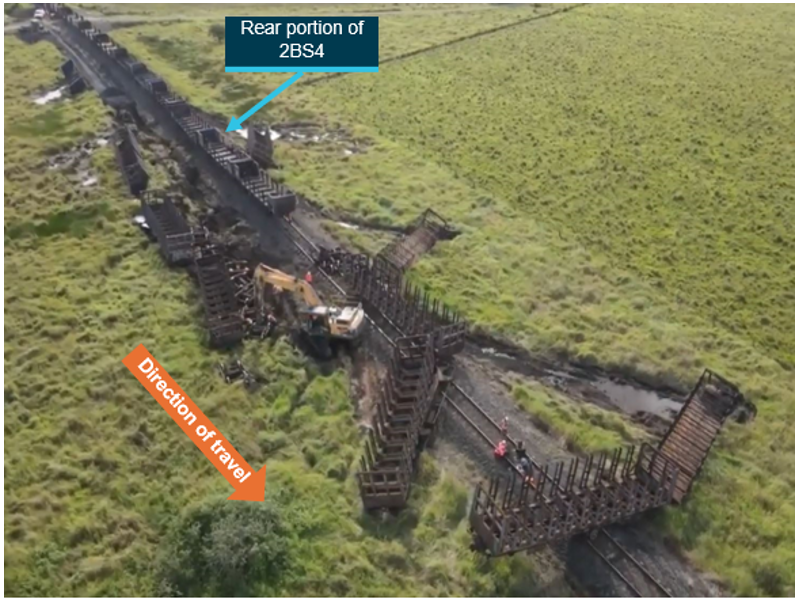
Source: YouTube (Drone footage by Kris McDonald)
Events post-derailment
Following the report of the derailment to ARTC network control from the crew of 2BS4, the line was closed by ARTC at 0102 hours.
Once removed from site, the derailed wagons were transported to a facility at Acacia Ridge for post-incident inspection and analysis.
Track repairs were completed and the North Coast line was certified for rail traffic at 1900 on 5 June 2022 with a temporary speed restriction of 40 km/h.
Context
Location
The North Coast line is a single, bi-directional line with several passing loops facilitating freight and passenger services between Sydney and Brisbane. This line forms part of the North/South corridor on the ARTC Interstate Network. The up direction is travelling towards Sydney, while the down direction is towards Brisbane. The incident occurred at a location known as Cedar Point while travelling in the up direction between Kyogle and Casino on the NSW North Coast.
Figure 2: Map of area
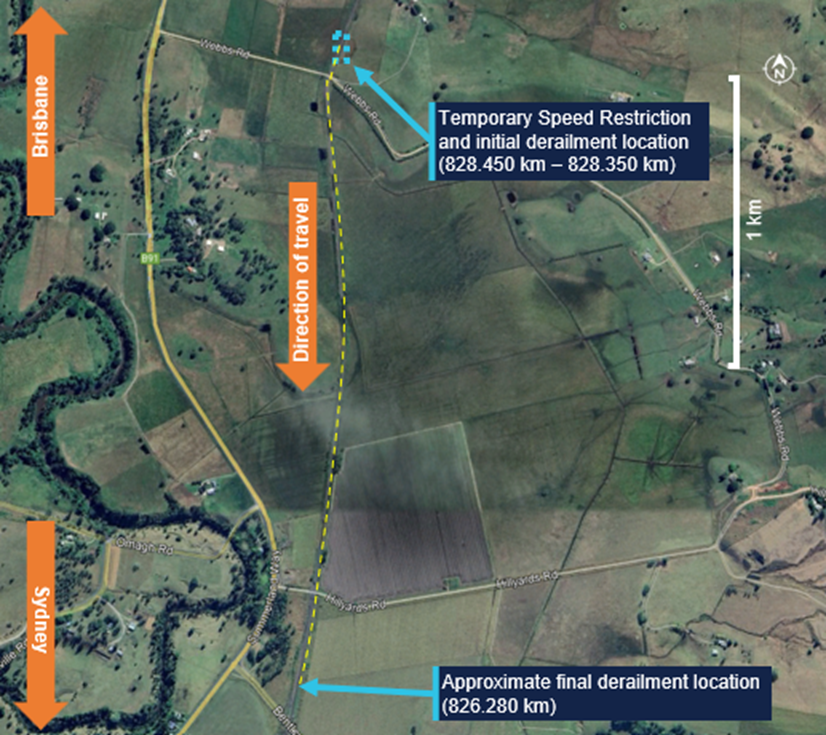
Source: Google Earth, annotated by OTSI
Involved parties
The Australian Rail Track Corporation (ARTC) manages and maintains approximately 8,500 km of rail network across 5 states in Australia. In NSW, ARTC leases the mainline interstate corridors from the NSW Government through a 60‑year lease agreement signed in 2004. ARTC is responsible for managing and maintaining these rail corridors in accordance with its accredited safety management system.
The section of track between Telarah, NSW, and Acacia Ridge, Qld, was managed by a corridor manager based in Coffs Harbour, NSW. A local area manager overseeing the NSW North Coast, specifically Casino/Coffs Harbour including this incident location, was responsible for managing the maintainers and the maintenance and inspection activities they carry out, required for compliance and safety.
ARTC also had an asset management team responsible for asset lifecycle management, including monitoring asset performance and planning and executing major project and/or capital works.
ARTC conducted its own internal investigation into the incident, which was supplied to the ATSB as evidence for this report.
Pacific National (PN) was a freight and coal rail services operator, responsible for moving regional exports, bulk goods, grain, and agricultural products on the eastern seaboard. PN conducted its own internal investigation into the incident, which was also supplied to the ATSB as evidence for this report.
NSW TrainLink (NSWT) was a train and coach operator in Australia, providing passenger services throughout New South Wales and the Australian Capital Territory, along with interstate services into Victoria and Queensland. While not directly involved in the incident on the day, NSWT services to Casino, NSW, and Brisbane, Qld, frequently used the North Coast line in the lead‑up to the incident.
Environmental and weather conditions
The weather on the day of the derailment was clear and sunny with a daytime temperature of 17°C recorded at 0900 by the Australian Government Bureau of Meteorology (BoM) at Casino Airport, NSW, approximately 23 km from the incident location. There was no recorded rainfall in the preceding 24-hour period, however, greater than normal rainfall of 1,187mm was recorded in the local region in the 5 months leading up to the derailment.
Train information
The train consist provided by PN recorded 2BS4 comprised of 3 locomotives hauling 56 wagons. NR89 was the lead locomotive, with NR49 and 9323 assisting. The train was listed as 1199.327 metres in length, with 1728.996 of trailing tonnage. It was hauling a combination of containerised freight and empty wagons.
Train crew
The train crew, consisting of a driver and driver’s assistant, signed on at approximately 2120, with the train departing at 2150. The driver and driver’s assistant each had over 30 years of driving experience and were both qualified and experienced in the operation of the locomotives, and on the route between Acacia Ridge and Sydney Freight Terminal, Chullora, NSW.
Both crew members described being well rested and free from the effects of fatigue on the night of the incident.
Network control
The North Coast Line in NSW was controlled and monitored by the Coast B network control officer (NCO) situated in ARTC’s Network Control Centre South (NCCS) in Junee, NSW.
A system of safeworking known as rail vehicle detection (RVD) was used in the derailment area. This system used continuous track-circuiting or axle counters to detect the presence of rail traffic in a block[3] and prevent following rail traffic entries into the same occupied blocks using signals.
Responsibilities of the ARTC NCO included the planning and management of trains over their area of control, including the control and recording of train performance, and the safe movement of trains and track vehicles in accordance with ARTC safeworking rules and procedures.
Train control reporting
A train control report (TCR) was typically created by network control if an incident or condition affecting the network reported to them was likely to affect train running or was a safety concern.
According to the ARTC enterprise asset management system document AMT‑PR‑010 v1.0 p14, reportable incidents were usually identified by field maintainers, train controllers and train crews. For incidents or conditions reported by train crews the NCO was required to record the information on their train control graph or, where used, in the train register book, and notify the relevant maintainer.
TCR incidents that were related to ARTC managed assets were then required to be added to ARTC’s enterprise asset management system, Ellipse, by the responsible track maintenance personnel as a TCR work request.
TCR work requests included information such as a TCR number, incident type and comments, and a work order number for investigation and review of the asset by maintainers and engineering personnel.
Following a field investigation and a subsequent engineering review, corrective actions were identified and/or undertaken and recorded in Ellipse with failure codes assigned to the known condition.[4] This was done in accordance with ARTC’s code of practice, which prescribed the appropriate course of management for the known condition.
Reporting obligations of train crew
Rules and procedures prescribed by ARTC in ‘ANGE 206 Reporting and Responding to a Condition Affecting the Network (CAN)’ outlined the reporting requirements and obligations of all train crews using the ARTC network, relating to unsafe or abnormal conditions. Conditions that affected the safety of rail operations in the ARTC NSW network were to be reported by crew promptly to the NCO responsible for the affected portion of track.
Pacific National (PN) Learner Technical Guides ‘TLIC 0024 Operate rail traffic with due consideration of route conditions’ and ‘TLIF 0028 Respond to abnormal situations and emergencies’ required PN train crew to report abnormal situations enroute to the network owner.
NSWT drivers were also required to adhere to NSW Trains’ train working procedure ‘NTTWP 100 Responsibilities of Train Crews’. This detailed a driver’s duties including to immediately inform the NCO or any other relevant employees of any incident, problem or defect relating to trains, signalling, track or overhead wiring, or any other problem affecting or likely to affect train services.
NSWT drivers were also expected to adhere to the NSW Trains professional driving guide (PDG). This document advised drivers to report any operational issues that could cause concern to their supervisor and/or to the NCO.
Apart from an initial TCR recorded by ARTC network control in April 2021, only one other TCR was generated for the TSR site on 15 March 2022, approximately 2.5 months prior to the derailment.
There were no other reports recorded as received by ARTC network control pertaining to this site, including on the day of the derailment.
Temporary speed restrictions
ARTC’s engineering procedure for TSRs, PP-163, stated:
infrastructure defects can be detected within the rail corridor during a planned inspection or work process.
The procedure described that:
• all defects that require a temporary speed restriction shall be reported to train control by the person or persons identifying the defect
• when a train crew reports a fault, the network controller shall notify the relevant maintainer and prepare a TCR
• when a train crew reports a fault, the network controller shall notify the relevant maintainer and prepare a TCR
• the maintainer categorises the infrastructure defect condition based on criteria provided in ARTC Track and Civil Code of Practice and ARTC Engineering Standards and determines the speed restriction based on the defect level
• the maintainer estimates response times to conduct an unscheduled inspection or repairs the defect and records this information on ‘PP163F-01, Speed Restriction Notification’ form
• the maintainer positions speed boards around the fault site as soon as practicable (usually within 24 hours) and must notify the network controller immediately of any amendments to TSR’s via the ‘PP163F-01 Speed Restriction Notification’ form to ensure train crews are adequately informed
• the NCO was required to notify the crew of every train passing through the area of the speed restriction until this information was published.
The TSR could be removed once the defect had been rectified, however Engineering (Track and Civil) Procedure ‘PP-135 Mechanised Track Surfacing 7.5 Speed Restrictions – General’ specified that speed restrictions following surfacing, or levelling of track, may need to remain in place if:
• track geometry was inadequate, or there was a risk of a geometry fault developing as the track settled, or
• track lateral stability had been reduced.
In this instance, a 40 km/h TSR remained on several occasions following corrective tamping[5] conducted by the local maintenance crew at the incident location.
Records, correspondence and paperwork related to implementing, altering and the reasons for temporary speed restrictions between 828.350 km and 828.450 km, in the 3 months prior to the derailment of 2BS4 were limited to one ‘PP163F-01 Speed Restriction Notification’ form (Figure 3) along with several track certification forms (see Manual forms).
Figure 3: PP163F-01 Temporary Speed Restriction Notification form
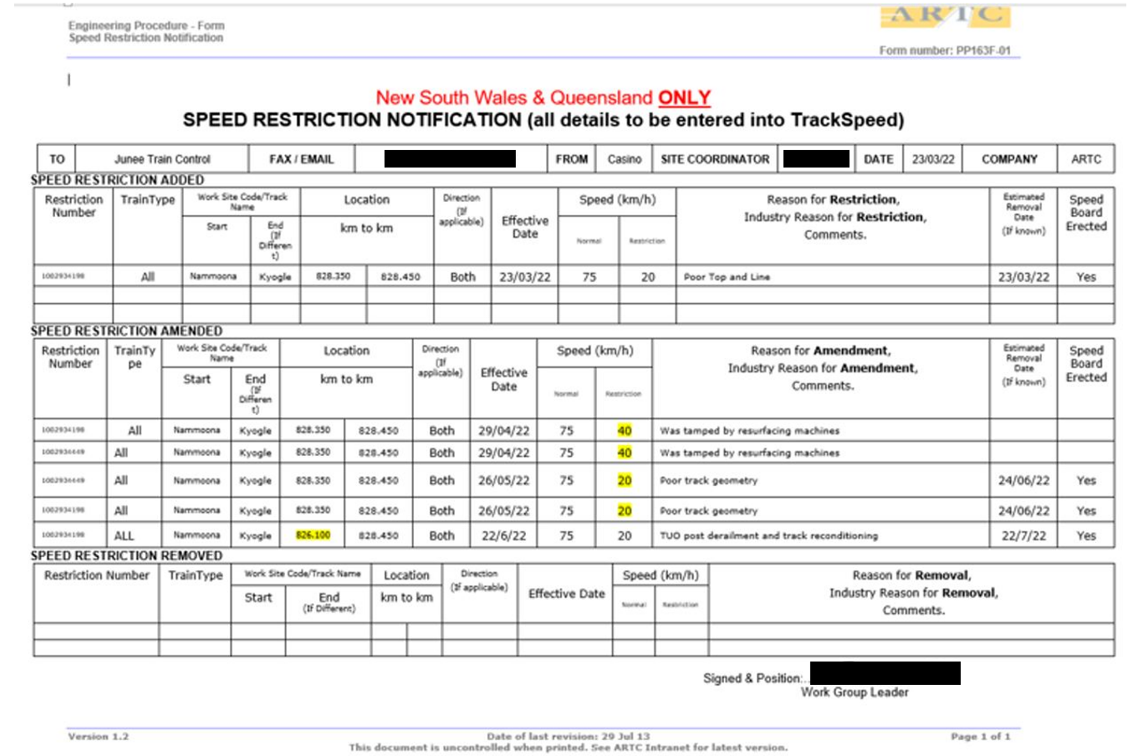
Source: ARTC
ARTC asset management and assurance
Asset assurance framework
ARTC document INF‑PR‑002 Assurance Framework describes the 3‑level assurance framework applied to ARTC’s railway operations risk controls at the time of the incident.
Section 3.1.2, described as the ‘first line of defence’, defines line management monitoring requirements. Each line manager is responsible for determining how assurance reviews are conducted, including sample checks, staff discussions, and team meetings.
Section 3.2, as the ‘second line of defence’, assigns business units responsibility for developing annual assurance plans. For 2021–2022, an Annual Asset Assurance Plan was developed and implemented to monitor asset management activities.
Lastly, Section 3.4, or ‘third line of defence’ outlines that the internal audit plan incorporates all third‑line assurance audits. These audits are intended to provide assurance to ARTC management and the board that effective controls are in place to manage ARTC’s strategic risks. Relevant to asset assurance, the internal audit plan for this period included the following 7 asset maintenance and inspection‑related audits:
- HV 02A Inspection and Maintenance – Hunter Valley – Structures Management
- HV 02B Inspection and Maintenance – Hunter Valley – Points & Crossings
- HV 02C Inspection and Maintenance – Hunter Valley – Level Crossing Management
- IS 02A Inspection and Maintenance – Interstate – Structures Management
- IS 02B Inspection and Maintenance – Interstate – Points & Crossings
- IS 02C Inspection and Maintenance – Interstate – Level Crossing Management
- JBU 21 Automated Track Inspections – Continuous Ultrasonic Testing Car.
ARTC provided copies of ‘INF‑PR‑002 Assurance Framework’, extract of annual asset assurance plan and extract of the FY22–FY24 internal audit plan which were in place at the time of the incident.
Assurance auditing
At interview, an ARTC representative responsible for management of the corridor between Telarah to Acacia Ridge at the time, indicated that historically, recurring defects had not been recorded very well, and that no proactive analysis was done on potentially recurring defects.
The representative advised that track maintenance and safety‑related decisions were monitored by an assurance process, with an assurance team assigned to do checks on the maintainers. The representative explained these checks covered prework briefings, application of track geometry standards, adherence to procedures, and generally ensuring work was being carried out correctly, with paperwork in place and information recorded correctly.
It was also explained that assurance teams regularly went out and provided coaching if something wasn’t done correctly during regular site visits.
ARTC was subsequently unable to provide any evidence of compliance auditing and/or assurance activities taking place on maintenance personnel responsible for this area.
ARTC track and civil standards and guidelines
Ellipse
ARTC maintained an enterprise asset management system (EAMS) to manage assets throughout their lifecycle and to ensure that assets were fit for safe and reliable operation of trains over ARTC infrastructure. The EAMS was designed to enable ARTC to manage the condition of network infrastructure as described in procedure ‘AMT-PR-010 - Enterprise Asset Management’. The EAMS computerised maintenance management system (CMMS), called Ellipse, was used by track maintenance personnel to record defects and manage maintenance and repairs.
Known conditions, a term used by ARTC to describe known track defects, initiated the bulk of the work orders in Ellipse. Condition data was to be recorded for all known conditions, with any deterioration recorded, including for those conditions which may not have reached a mandatory intervention point but would still benefit from monitoring.
Once entered, known conditions were to be managed in Ellipse in accordance with ‘AMT‑WI-024 Known Condition Management’ by:
- recording the appropriate corrective action
- determining the urgency of the required work
- creating work orders for completion of repairs or condition monitoring activities
- planning, scheduling, and assigning of corrective works
- developing long term condition-based asset management strategies, and planning capital/project repair works.
The procedure for managing work orders, ‘AMT-WI-025 Work Order Management’, described the process, system (Ellipse) and operational requirements of how to create, plan, schedule, package, assign, execute and close out work.
Work orders were required for all work, and could originate from multiple sources, maintenance schedule tasks (MST), job estimates, known conditions or ad hoc situations.
MSTs were system‑generated tasks, such as track inspections, and were based on predetermined schedules. The works management function within Ellipse was used to initiate and record the process.
Timeframes for these tasks were set out in the code of practice and would vary based on the different types of infrastructure being monitored.
The system provided work orders to support the allocation of budget, the planning of resources, time and materials, and recording the details of works completed. All work performed was to be recorded against the asset in the Ellipse system.
Overall, the EAMS and its associated systems, specifically Ellipse, were intended to monitor scheduled inspections and the status of known conditions and defects to ensure that the planned and corrective work had been completed effectively and in the required timeframe as required by ARTC’s safety management system.
Recording requirements of known conditions
‘ETE-00-02 – Track Patrol, Front of Train, General and Detailed Inspections’ defines requirements for maintainers conducting track inspections to:
record essential information detailing the condition of the track; monitor variations of track conditions over time; prepare priority-based asset maintenance and renewal programs.
It also defines maintainers being responsible for recording and/or reporting the results of their inspections including defects found, and observations made.
This data is then intended to be used to manage the rectification and inform the urgency of corrective maintenance and assists the asset management team in scoping of planned future refurbishment and replacement works, as described in the procedure, ‘AMT‑PR‑010 – Enterprise Asset Management System’.
Manual forms
Manual track certification forms recording completed tamping works were provided by ARTC, showing that the derailment site had been the subject of several maintenance interventions in the months prior to the derailment.
These forms recorded track geometry measurements before and after various rectification works being performed. OTSI observed these forms were often incomplete, with missing details including the absence of sign‑off by a manager or supervisor, while others lacked supporting information to explain the reasons for temporary speed restrictions and other actions taken.
Maintainers conducting track patrols or inspections were required to report the results of their inspections including repaired defects on ‘EGP1001F-01 Inspection/Defects Found Report’ form, either using hard copies or electronic formats.
ARTC indicated that these manual forms were used as there was ‘no IT system per se’ for recording track geometry measurements during track inspections. It was explained that conditions are assessed in accordance with the code of practice and ‘any exceedants (sic) are recorded into the AMS’ (asset management system), in this case Ellipse.
However, when requested, ARTC was unable to provide any inspection forms or evidence of exceedances recorded in Ellipse for the known defects located at the derailment site.
Track and civil code of practice
ARTC track and civil code of practice response booklet ETW-00-01 is a work instruction which includes assessment and response tables to be used as a guideline by maintenance teams when responding to known conditions and defects.
Section 1.1 of this booklet details response codes for defects based on applied speed restrictions. Notes specific to the codes assigned indicate ‘If repairs cannot be made prior to the passage of the next train, the speed restriction should be implemented along with an appropriate increase in the monitoring until actions are taken to restore the track’.
Track geometry
The Rail Industry Standards Board (RISSB) defined track geometry as ‘the horizontal and vertical alignment, cross level and cant of the track’.
Cross level was defined as:
the difference in level of the two rails in a track, and is also known as superelevation or cant.
Top and line
ARTC’s procedures referred to top (vertical alignment), which is the relative level of the track top along the length of the rail. The limit is specified by a measurement of the variation in vertical line (height) of the top surface of the rail.
Figure 4: Vertical alignment – top
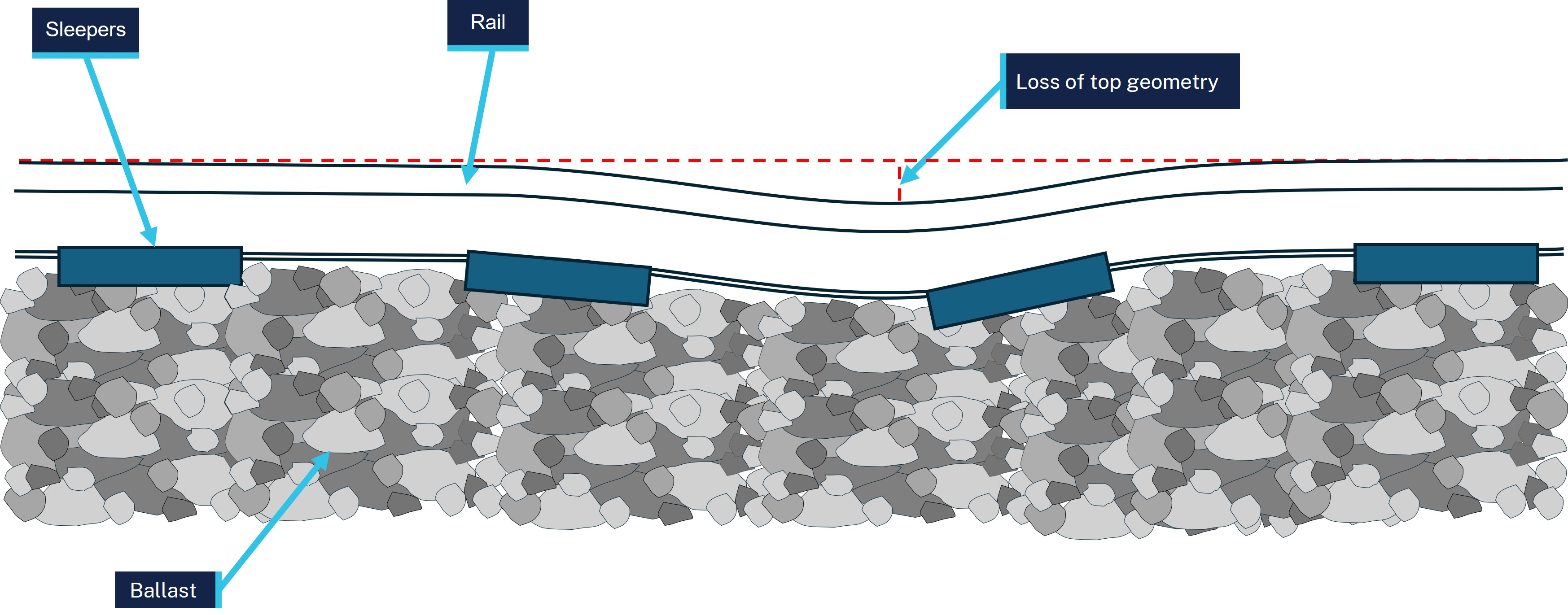
Simplified cross section of track structure showing loss of track top geometry measured on the rail head. Source: OTSI
Line measurement, also known as horizontal alignment, was a measure of the horizontal displacement of the track structure from the design alignment (Figure 5).
Figure 5: Horizontal alignment – line
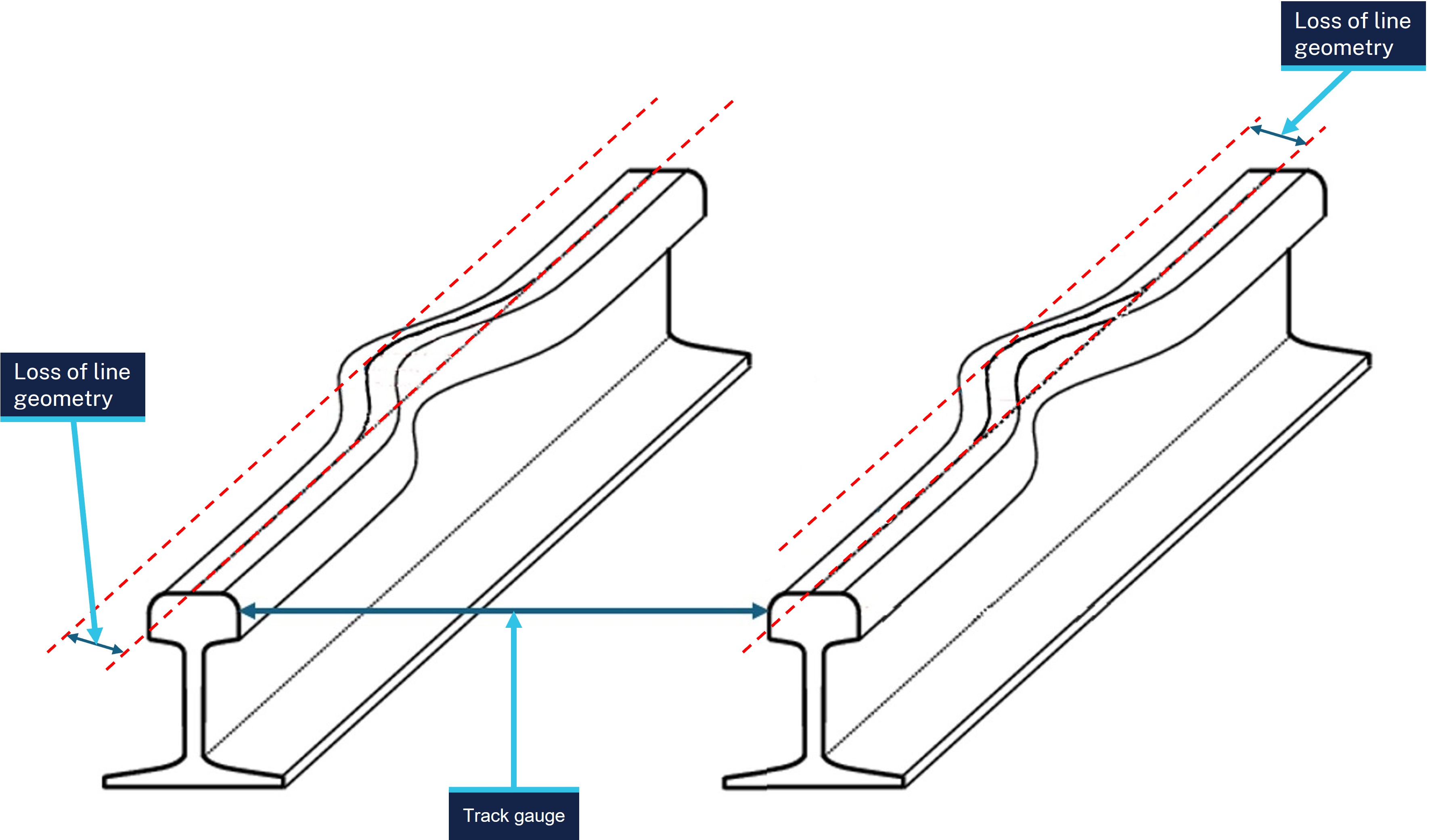
Source: OTSI
Superelevation and twist
Superelevation, also referred to as cant, or cross level on level track, was the difference in height between the outer and the inner rail.
Twist was the variation in the cross level between 2 track locations separated by a nominated distance interval. The maintenance twist tolerances were measured over short (2 m) and long (14 m) distances and were measured in mm (2 m twist measurement shown in Figure 6).
At slow speed on curves, any superelevation (mm) of the outer (high) rail decreases the gravitational forces on the wheels running on that rail because of the lean of the vehicle body and the shift in centre of gravity towards the inner (low) rail. This reduction in wheel load, together with the flange force acting on the outer rail, increases the wheel lateral over vertical (L/V) ratio and so increases the tendency of the wheel to climb the rail.
Figure 6: Cross level and twist
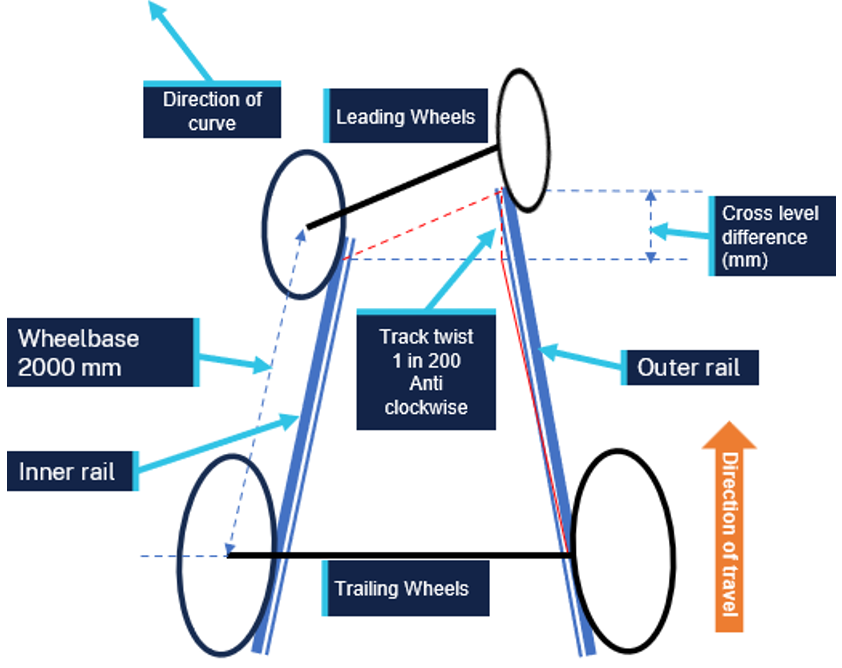
Source: OTSI derived from RISSB Standards
Track geometry standards
ARTC Track and Civil Standard ‘ETS-05-00 Section 5 - Track Geometry’ specified ARTC’s track geometry standards.
The document provided inspection guidelines for track maintainers and track geometry tolerances to be achieved following corrective maintenance tamping activities.
Table 1: ETS-05-00 Table 5-10 – ARTC limits for line, top, twist post‑corrective action

Source: ARTC Engineering Track and Signal Standard – ETS-05-00 Section 5 Track Geometry
The document also provided guidance on geometry parameters including the classification of defects against maintenance limits, and the required response category for the measurement.
Response categories defined the maximum period allowed to elapse before the next inspection, and/or repair of track geometry defects once assessed against specified limits.
The response category was determined by a matrix (Table 2) comparing the measured track defect with normal track speed in the area. A defect in an area with higher track speeds would attract a higher response category than the same defect on track with a lower track speed.
Table 2: ETS-05-00 Table 5-15 – Geometry defect parameters and response categories
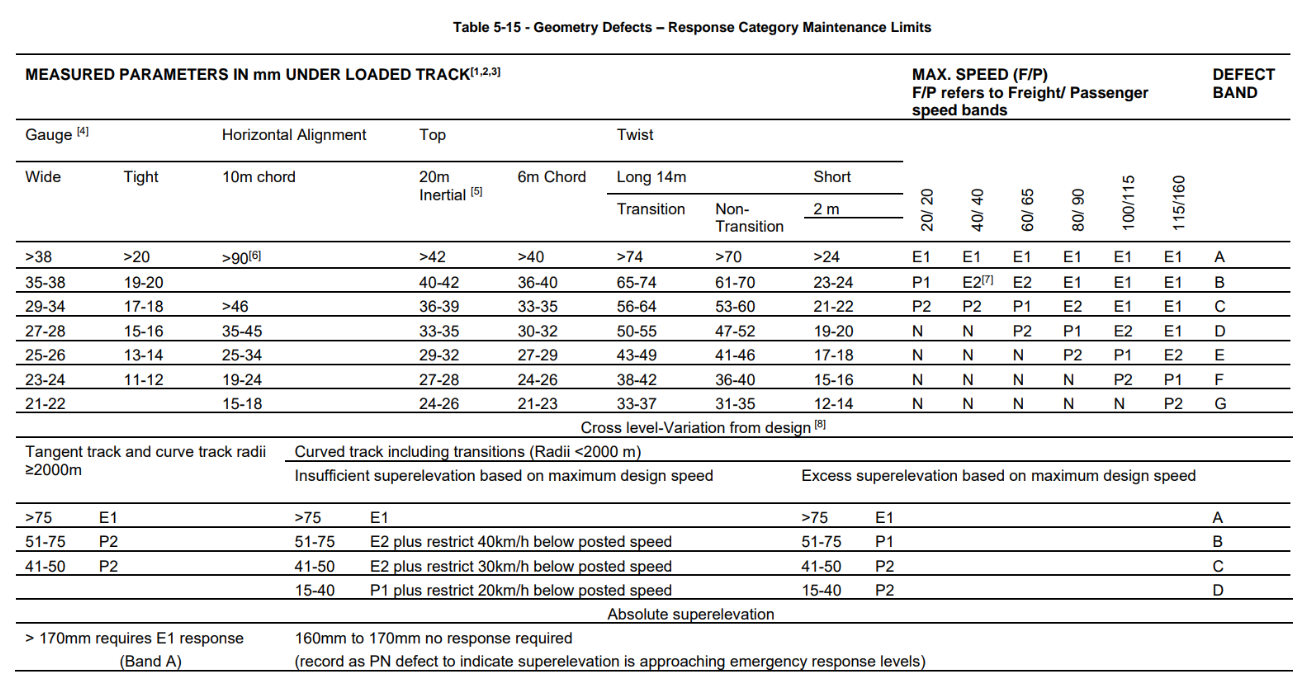
Source: ARTC Engineering Track and Signal Standard – ETS-05-00 Section 5 Track Geometry
The document also described how imposing a speed restriction may moderate the response category, and therefore the response requirements. For example, using a restricted line speed to determine the response category as though it were the original track speed, may reduce the response category and therefore the required inspection time, or delay the required repair. A defect that was re-inspected and found to have not increased in size may continue to be managed in the same way.
Table 3: ETS-05-00 Table 5-16 ARTC inspection and repair response standards by response category

Source: ARTC Engineering Track and Signal Standard – ETS-05-00 Section 5 Track Geometry
Temporary speed restrictions (TSR) could therefore be used to manage and prioritise the inspection and repair of defects.
Use of a TSR to moderate the response category did not require civil engineer approval, and was a common method used by ARTC on the North Coast line at the time of the incident.
It is important to note the defect measurements defined in this guideline were based on isolated geometric defects. However, it also references that a more stringent response may be necessary if deterioration of the infrastructure both at the defect and on adjoining track was evident.
Other related standards
Stable track geometry requires the entire track structure to be designed and maintained to standards. This includes appropriate design and management of the track formation, track structure, ballast, and drainage, taking into consideration local and transient conditions.
Figure 7: RTS 3432 Figure 1 – grading requirements to improve drainage
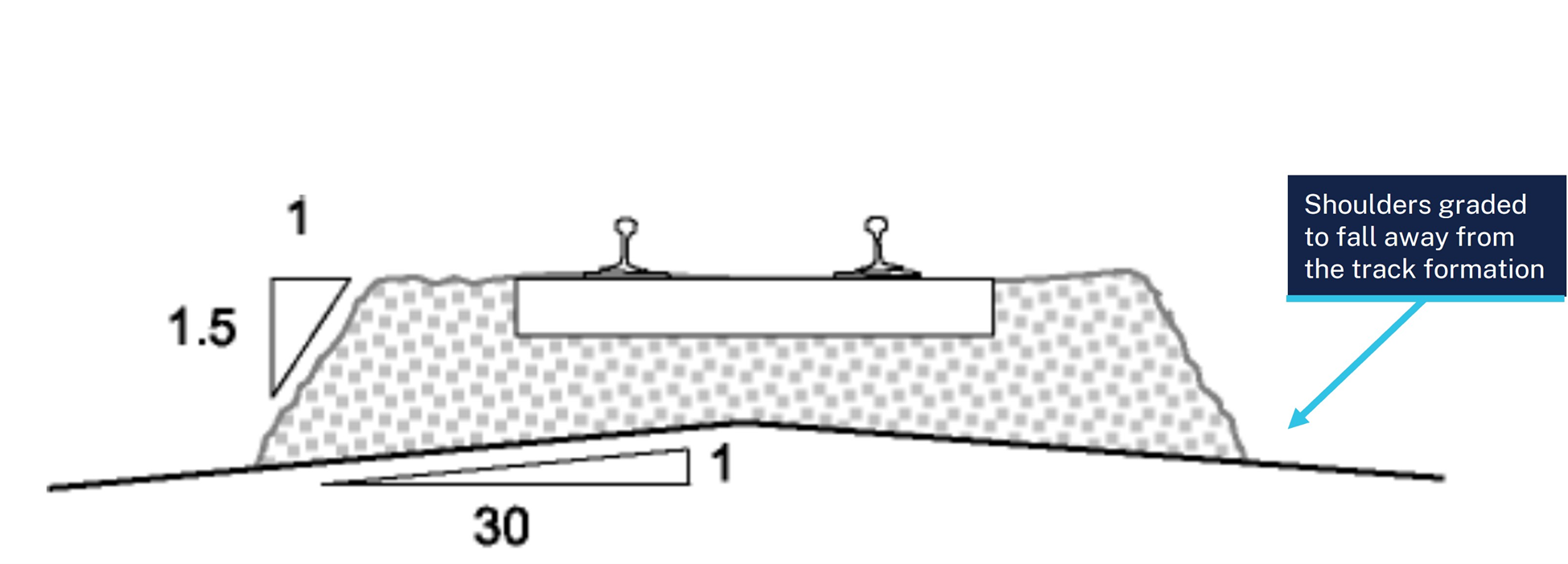
Engineering Practices Manual Civil Engineering – RTS 3432 Track Drainage Inspection and Maintenance. Source: ARTC
Track drainage standards
ARTC’s ‘RTS 3432, Track Drainage – Inspection and Maintenance’, provided similar guidance on the inspection and maintenance of track drainage as the ETS-05-00 document does for track geometry.
Track drainage is described in this document as necessary, as ‘without adequate track drainage, track formation may become saturated leading to weakening and subsequent failure’, and formation failure may be indicated by ‘repeated top and line problems’ amongst other track instability defects.
Section 5.2.2 described that it is necessary to set priorities for drainage maintenance so that the worst locations can be repaired first, with ratings dependant on a number of factors, including mud pumping through ballast, foul ballast, water ponding and top and line problems. The document also suggested possible remedies for a list of typical problems encountered by type of drainage.
Mud hole guidelines
ARTC’s ‘ETH-10-01 Mud Hole Management Guideline’ described mudholes as ‘areas where ballast had become contaminated with fine materials like dirt or clay’ and provided guidance on the management of mud holes.
The guideline explained that this contamination causes the ballast to retain water, creating a muddy, slurry-like substance around the track sleepers. This mud infiltration can then compromise the stability and integrity of the track structure, leading to uneven track surfaces, reduced load-bearing capacity, with the potential to be hazardous to train operation.
The guideline described the different types of mudholes, their likely causes and possible prevention.
‘Section 3, Assessment of Mudholes’ described that individual mud holes may require ongoing monitoring with increased regular general inspections scheduled.
Ellipse, and the information recorded within it, was to be used for planning and controlling the remedial work in addition to planning and controlling any increased inspections.
Figure 8: Example – soft formation mud hole
Source: ARTC Safety and Systems Track and Civil Guideline – ETH-10-01 – Mud Hole Management Guideline
Ballast code of practice
Similarly, ARTC’s ‘Engineering (Track and Civil) Code of Practice Section 4 Ballast’ specified ballast standards and assessment responses which included increased general monitoring if required.
The standard specified that a knowledge of local factors that may affect the track’s deterioration rate and performance history was required.
If any increased monitoring was determined to be necessary, it would be required to be continued until rectification work was carried out.
Earthworks code of practice
‘Engineering (Track and Civil) Code of Practice Section 8 Earthworks, General Inspection’ specified that scheduled general inspections should be of sufficient detail to observe and document earthwork conditions and changes in condition that affect their vulnerability to instability. This inspection was to include identification of defects and conditions.
General inspections were to be scheduled at intervals appropriate to each location dependant on its nature, condition and other seasonal factors but would not exceed 12 months or as otherwise specified by ARTC e.g. in an approved technical maintenance plan.
Sections of track with identified conditions indicating a vulnerability to earthworks instability were to be nominated and managed as special locations[6] until rectification or earthworks stabilisation work could be carried out. Specialist geotechnical advice together with detailed inspections may have been necessary for this purpose.
Incident site observations and evidence
Track geometry
Onsite photographic evidence of the track at the initial derailment location showed a significant loss of top, line and superelevation/cross level.
Figure 9: Post-incident view of track at point of initial derailment, facing in the down direction

Source: OTSI
There was a sign posted temporary speed restriction in place of 20 km/h between 828.350 km and 828.450 km.
Site photos post‑incident showed significant water saturation of the surrounding area, within the TSR boundaries. There was also notable sinking of the ballast at 2 locations, which had caused visible top depressions of the track.
Figure 10: Post-incident view of track at point of initial derailment, facing in the down direction
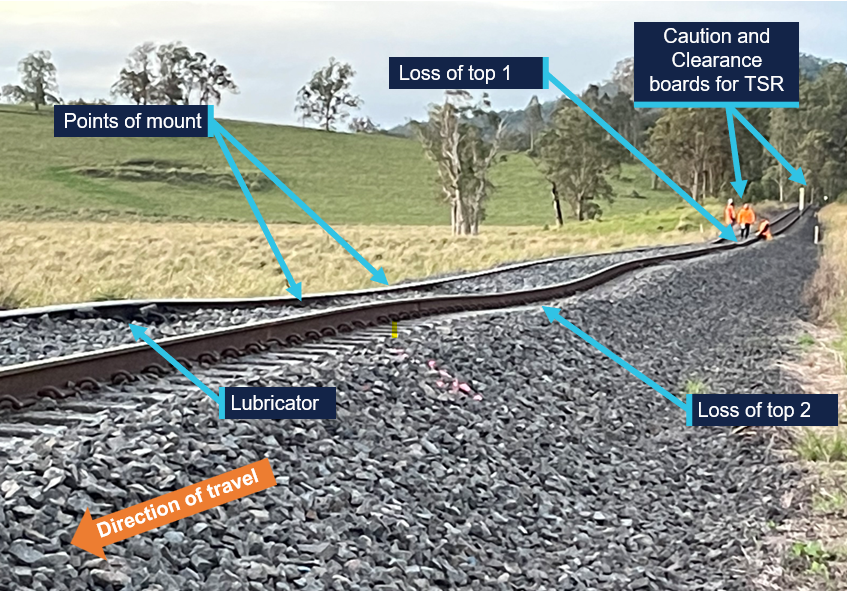
Side view of track, demonstrating the loss of top due to sinking soft formation. Source: OTSI
The initial point of mount was located within the TSR at 828.350 km with the wheel flange riding on top of the rail until the initial complete derailment of one bogie (2 wheelsets) at 828.346 km.
Following this derailment, notable damage to track side infrastructure, such as wheel strikes to track sleepers, and impact damage to level crossing plates and guard rails[7] was evident for approximately 2.3 km, indicating that the derailed wagon remained connected to the train for this distance. Significant damage to the wheel treads of 2 wheelsets, examined by the ATSB post‑incident, was consistent with sustained ballast and sleeper strikes.
A final separation event at approximately 826.280 km resulted in the remaining wagons derailing, coming to a rest on the up and down sides of the track.
The front and rear portions of the train which remained on track were then brought to a stand due the subsequent loss of air supply to the train’s automatic braking system following the separation.
Track foundation
ARTC’s post‑incident track condition report noted that ballast condition around the area was observed to be severely fouled and of poor quality, with indications of crushed and undersized ballast, which can decrease water drainage. The formation exhibited areas of saturation consistent with a soft formation defect.[8]
ARTC also noted in their investigation report a drain under the track at 828.420 km that was holding water on the up side (Figure 11). This same drain had water trickling from it on the down side indicating that the formation was holding water.
Post incident, significant saturation within the formation was identified, requiring excavation to obtain a solid foundation on which to rebuild track. (Figure 12).
Track maintenance records for scheduled track inspection and tamping activities that took place at this location prior to the incident made no mention of such significant formation issues, or that soft formation had been considered as the potential cause for repeated track geometry issues (see History and management of track defect).
Figure 11: Drainage culvert beneath initial derailment location
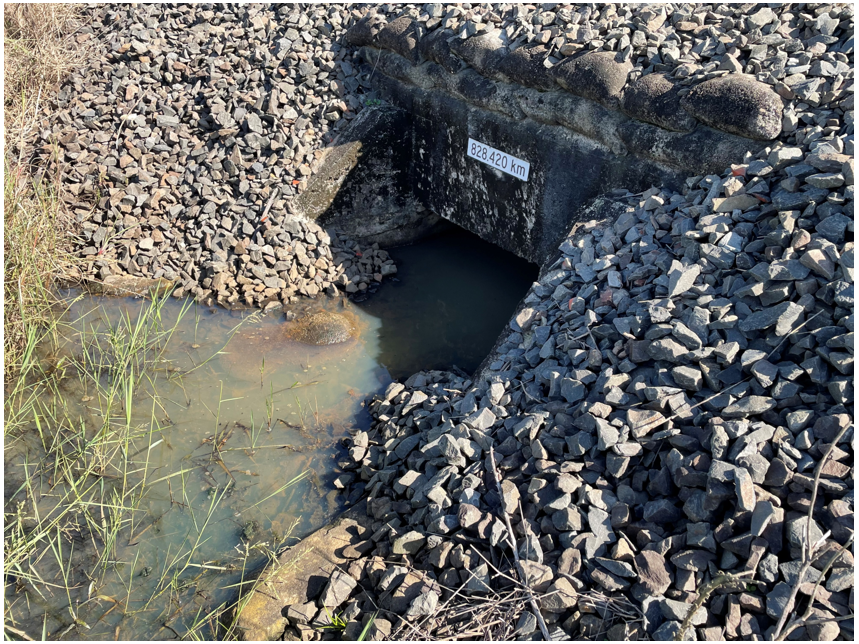
Drainage culvert directly below initial derailment site (828.420 km) showing pooled water beneath the track and formation. Source: OTSI
Figure 12: ARTC post-incident track works
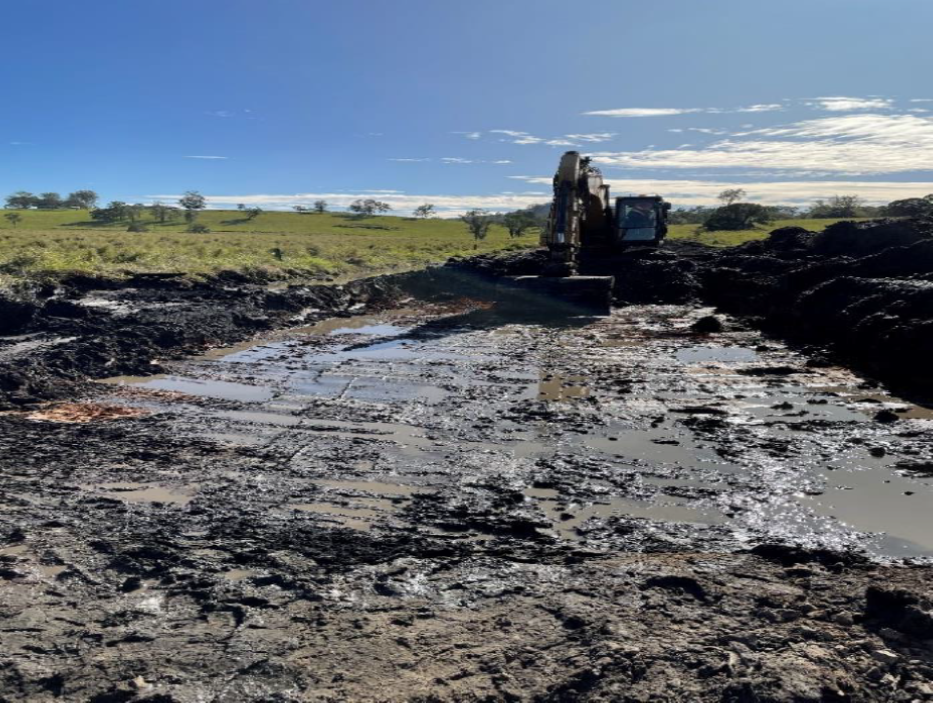
A significant amount of mud and water was found under the formation during post-derailment rectification works. Source: ARTC
Track geometry measurements post‑incident
Post‑derailment track measurements taken by ARTC, and noted in its internal investigation report, detailed that the track exhibited a significant loss of top track geometry at 2 locations within the TSR with depressions of approximately 150 mm.
Also, track measurements taken between 828.300 km and 828.509 km recorded a combination of twist and superelevation track geometry defects consistent with an E1 category defect as per ARTC Track and Civil Standards. An E1 Category defect required that the track be inspected and repaired prior to the passing of the next train.
Figure 13: Onsite track geometry measurements
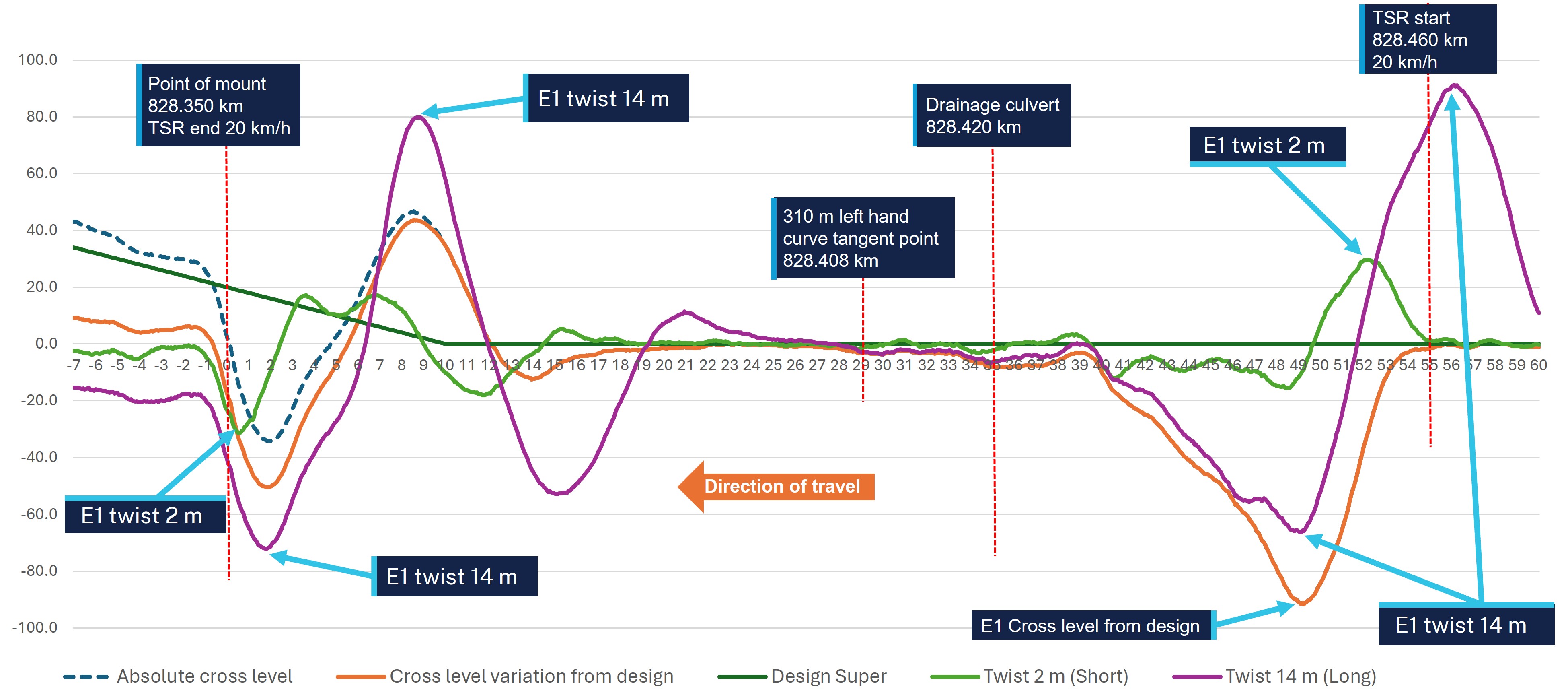
Track measurements taken onsite post ‑incident, detailing point of mount, locations of categorised track geometry defects, temporary speed restriction limits and infrastructure details. X‑axis details track measurement station numbers at 2 m intervals from the point of mount at 0. Y‑axis details distance measurement in mm. Source: ARTC Data (graph constructed and annotated by OTSI)
Derailed wheels and bogie inspections post‑incident
Wheel profile measurements were taken by the ATSB at Acacia Ridge following the relocation of the derailed bogies and wheel sets.
Wheel flange[9] height, angle and width measurements were taken with a standard wheel gauge (shown in Figure 14). The examined wheel sets were found to meet the operator’s minimum standards, although one wheelset was identified to have a flange width of 19.5 mm, close to the thin flange defect limit of 19 mm.
This wheelset also exhibited some evidence of arrises[10] on both flanges, although these were also noted as being within tolerance, being less than 1.5 mm in height.
Figure 14: Wheel limiting dimensions
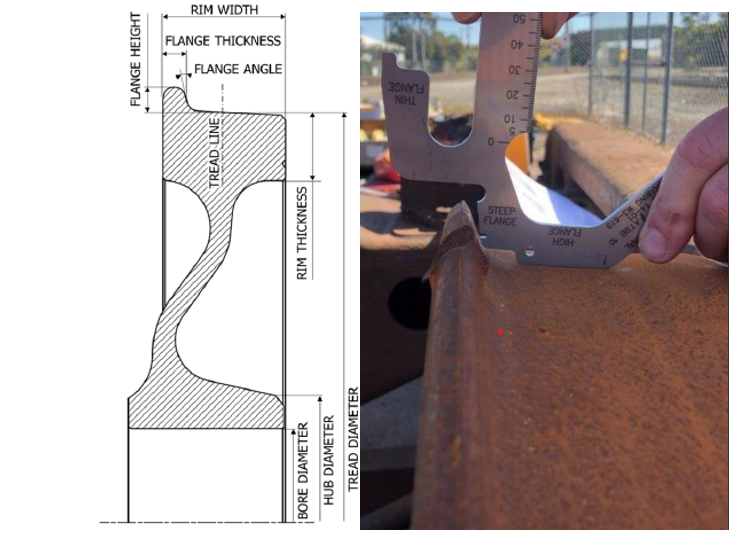
Wheel condemning operational limits are guided by an industry code of practice. Measurement of derailed wheelsets. Source: Rail Industry Standards Board (RISSB) Wheel defects code of practice and ATSB
The wheel tread condition of the derailed bogies was also examined and identified bogie RRXE 649 (lead bogie of the 29th vehicle RQRY 1011W) had sustained the most damage.
A general inspection of that bogie was also carried out and did not identify any bogie suspension, bogie rotation or wheel tread defects outside of the rolling stock operator’s safe operational standard.
Technical maintenance plan (TMP)
‘ETP-00-03 Civil Technical Maintenance Plan’ set out ARTC’s routine inspection requirements for rail track and civil infrastructure in terms of mandatory inspection tasks and inspection intervals. The TMP specified:
- which items were to be inspected
- what inspection tasks were to be carried out
- when inspection was required.
The inspection tasks and inspection intervals defined in this document were mandatory for all ARTC managed track.
The TMP referenced the applicable standards documents, manuals and codes of practice for the associated infrastructure element.
The TMP also contemplated that additional inspection scope or increased frequencies may be required in response to infrastructure condition or accelerated deterioration rates, noting that increasing frequencies could be authorised by the local maintenance management team.
The factors below are what ARTC recommended should be considered when increasing inspection frequencies:
- rainfall
- rail condition
- measured track pump[11] under load
- fixed points within the local area (e.g. bridges, turnouts, etc.)
- previous track history
- effectiveness of local drainage
- curves
- existence of adjacent or multiple mud holes in the track sections.
These factors were to be considered to assist with the management of local conditions in accordance with the applicable standards and ensure that inspection and measurement of track geometry was done often enough to detect geometry defects and manage any deterioration.
ARTC Track and Civil Standard ‘ETE-00-02 – Track Patrol, Front of Train, General and Detailed Inspections’ set out the standards for the track and civil inspections which were to be carried out on ARTC track and civil assets. ‘Section 3’ detailed the types of inspections, such as track patrol and front of train inspections (see Types of inspections). It describes the purpose of each of these inspections, along with the scope, and reference to the applicable asset element maintenance standard.
‘Section 2.2’ detailed the related responsibilities for maintenance personnel conducting track inspection activities and included specific responsibilities for the corridor manager, area manager and maintenance personnel, and the recording and reporting requirements for individuals in these roles.
It was also specified within this document that during track patrol inspections, specific locations may be subject to General inspection. General inspections were typically visual and included the elements of a track patrol inspection plus inspection of all readily visible elements of the infrastructure and elements known to contain critical defects.
An up-to-date defect list and a list of specific locations requiring attention was recommended to be obtained prior to carrying out the track patrol. Specific attention was to be paid to any deterioration at known defect locations.
Types of inspections
The types of inspections carried out on the ARTC network are detailed in Table 4:
Table 4: ARTC inspection guidelines
| Type | Frequency | Method |
| Scheduled track patrol inspection (Walking or on‑rail vehicle) | All main lines at intervals as specified in the approved Technical Maintenance Plan not exceeding 7 days where not specified. Loops at intervals as specified in the approved Technical Maintenance Plan not exceeding 28 days where not specified [2] | Visual inspection On-rail vehicle ride where used Manual measuring equipment as required |
| Scheduled on train inspection | All main lines as specified in the approved Technical Maintenance Plan not exceeding 6 months where not specified | Visual inspection Vehicle ride |
| Scheduled track geometry car inspection or equivalent | All main lines as specified in the approved Technical Maintenance Plan not exceeding 4 months where not specified Crossing loops as specified in the approved Technical Maintenance Plan not exceeding 24 months where not specified. | Measuring car with ability to measure gauge, top, horizontal alignment, cross level, short twist, and long twist Record type, size and location of defects |
| Un-scheduled inspection in response to defined or other events | As necessary to ensure safety where for any reason (e.g. slips, floods, earthquakes, driver reports, irregularity reports etc.) it may be suspected that the geometry may have been significantly affected. | As required |
Source: ARTC Track and Civil Standard – Section 5 Track Geometry (Table 5-13 - Inspection Guidelines)
AK car inspections and data
The ARTC AK car[12] was a set of 3 converted passenger carriages equipped with technology to measure and record track geometry. The cars travelled over the ARTC standard gauge network measuring safety‑critical track parameters.
ARTC supplied data from Ellipse for all track inspections conducted between 13 April 2021 and 31 May 2022 near the derailment site. Three separate AK car inspections were conducted on 22 September 2021, 19 January 2022 and 11 May 2022.
No track geometry exceedances were detected by the AK cars on these occasions in the area where the derailment occurred, between 828.350 km and 828.450 km. There were defects of varying degrees recorded by these AK car runs in the areas surrounding the initial derailment location. The closest to the derailment site was one gauge exceedance located at 828.254 km, approximately 150 metres from the site of the derailment of 2BS4.
The PP163F-01 speed restriction notification form for track between 828.350 km – 828.450 km (the initial derailment site) recorded tamping and resurfacing was performed on 29 April 2022, with an amended 40 km/hr speed restriction applied to the area.
The 40 km/h TSR remained in place at the time of the AK car inspection on 11 May, with the speed board visible on the AK car end of train track recording CCTV.
The PP163F-01 speed restriction notification form showed that on 26 May, 5 days before the derailment, the speed was reduced from 40 km/h to 20 km/h, citing poor track geometry as the reason for this further reduction.
The Ellipse system did not contain any track measurement data, or further information pertaining to these activities.
Noting that a speed restriction was in place when the AK car inspection was conducted, OTSI queried whether the track speed was materially important to the accuracy of the AK car’s track geometry readings. ARTC confirmed in writing that the speed at which an AK car is travelling does not affect its ability to detect rail geometry defects.
Specifically, ARTC indicated that there was not an optimal speed at which an AK car is required to travel to record accurate track data.
Track maintenance
Tamping
Spot tamping (tamping of short lengths of track to improve track geometry or remove specific defects), took place using an excavator with a fitted tamping attachment. This process involved the working and compressing of ballast into the voids beneath sleepers, intended to make the formation more stable and durable. This type of work is generally conducted by the local maintenance team and intended to correct minor defects or temporarily correct track geometry issues.
The ARTC document ‘Engineering (Track and Civil) Procedure PP-135 Mechanised Track Surfacing’ provided technical and operational procedures for mechanised track surfacing, including planning and carrying out surfacing, additional requirements for special situations, description of surfacing machines, guidelines for the operation of surfacing machines, and was referenced in conjunction with ARTC ‘Track and Civil Code of Practice – Track Geometry’.
Engineering (Track and Civil) Procedure ‘PP-135 Mechanised Track Surfacing 2.1 Planning’ detailed that in planning, consideration should also be given to the available budget allocations, and the capabilities and/or limitations of the equipment to be used. In line with this procedure, it would need to be determined during planning by the maintainer whether or not the use of certain methods and equipment for corrective works were appropriate for the task.
Considerations when planning this work should aim to minimise the amount of between ‑cycle spot tamping and/or speed restrictions.
Role requirements of a track maintainer
ARTC described[13] that a track maintainer was required to:
• Implement track maintenance, conduct mandatory systematic inspection, examination, condition monitoring and functional checks on the rail infrastructure and take appropriate action to ensure rail infrastructure was in a safe operational condition, including recording and reporting of defective infrastructure to maintain a valid defect recording system.
During interview the maintenance work group leader described being satisfied with the management of this defect using temporary speed restrictions and monitoring, however described:
- The section of track as ‘worse’ in comparison to others.
- They noticed that defects at the location would routinely reappear within weeks, sometimes days, of corrective works being undertaken.
- They were unclear in their requirement to permanently record information and observations relating to the changing track condition, and where hard-copy forms and notes were stored once submitted.
- They were unclear what the process was for escalation should they be concerned about a defect that was consistently deteriorating.
While information was recorded sporadically across multiple entries pertaining to the defect at the initial derailment location, no specific information detailing the recurring fault, deterioration of track, specific corrective actions, TSR implementations or increased monitoring was recorded in the asset management system by the maintainers or area managers responsible for this location.
Project request and possession planning
The corridor managers responsible for infrastructure maintenance were required to submit requests for major works to the asset management team for approval and incorporation into the Asset Management Plan (AMP).
Managers used data and dashboards generated from records in Ellipse to recognise trends and patterns to identify areas on the network that required further investigation and/or major works, and also to prioritise these works.
Requests for work were therefore generated from information in Ellipse recorded by the maintenance team.
Requests for work were required to be supported by appropriate evidence, such as:
- known conditions recorded in Ellipse
- information on the overall condition of the asset
- any other pertinent factors.
Requests for work that were approved by the asset management team were recorded as projects in the AMP interim database. Work Requests (or projects) residing in the AMP interim database were then reviewed and validated by the relevant stakeholders as part of the annual condition inspections.
Planned works of this nature were typically performed under Local Possession Authority (LPA), where a line is closed for a designated period of time, which required significant planning to be submitted and approved under the AMP before budgetary allocations and resources could be determined.
Procedures which define the process of identifying and authorising track access to the ARTC Network, including for possession work, were outlined in ARTC’s Corridor Access Management Procedure – COR-PR-028’. The procedure applied to ARTC workers, contractors doing work for ARTC, and third parties who enter the ARTC Network, and specified the requirements for planning to execute the work safely, and to keep the worksite safe including the method of protection to be used.
ARTC described the procedure as aiming to:
- improve safe and effective track access
- improve the efficiency of work and minimise impact on train running by effective planning of work, minimising mobilisations and maximising the use of track time
- provide details on how we plan on undertaking the work in a safe environment
- provide the ability to view all work in the Rail Corridor and address unauthorised access to keep all our staff, contractors and third-parties safe
- provide an integrated work plan, providing visibility of what work is occurring, where and when, removing the need for phone calls to provide this information.
Prior to 31 May 2022, no project work requests or formal possession planning had been generated, submitted or undertaken for work to be performed at the site of the derailment of 2BS4.
History and management of track defect
ARTC records indicated a significant increase in maintenance activity at the derailment location in the 2 months prior to the incident. A combination of temporary speed restriction records, tamping activities recorded in the Ellipse system and a train control report were noted in response to known geometry defects at this location. However, there was minimal detail on what was found or what actions were taken in many of these records.
Approximately 13 months prior to the derailment on 13 April 2021 the driver of NSWT XPT service NT31 reported rough riding due to a suspected dip in the track between approximately 828.300 and the 828.500 km mark near Kyogle. The condition was investigated by an ARTC maintainer later that day. The defect was determined to be in tolerance to continue with normal train running, however it was recorded that it would require repairs, and a work order to schedule and complete this work was raised the following day.
Temporary repairs were conducted at this site on 16 April 2021, described in the work order as ‘tamp, line and box up with excavator’, indicating that an excavator was used to correct the alignment of the track and formation supporting it.
Further repairs were conducted at this location on 19 April 2021 under the same work order, where a 40 km/h temporary speed restriction was implemented. This was noted on the track certification form to remain in place for one week, however the 40 km/h TSR remained on this location until 25 May 2021.
It was not noted or explained in the records why the TSR was to remain in place at the conclusion of the work, or why it remained in place for this amount of time.
Following these corrective actions, scheduled track inspections were conducted in this area, at an average interval of one week with the longest gap recorded as 8 days. These scheduled track inspection intervals were compliant with procedures. No further observations or references to any track geometry defects were recorded in the Ellipse asset management system against the assigned jobs for any of these inspection activities, aside from the closing of each work order to indicate the job was complete.
Approximately 2.5 months prior to the derailment a front of train inspection[14] was conducted on 7 March 2022, followed by another scheduled track inspection on 11 March 2022, neither of which recorded any issues with the track.
On 15 March 2022 the driver of Pacific National train 2SB3 reported to the Junee NCO a track geometry issue at 828.400 km at Kyogle. The train was reportedly travelling at 55 km/h before reducing speed after encountering the defect. There was no temporary speed restriction in place at the time with the speed posted at 70 km/h for freight trains for this section of track.
A maintainer attended the defect location 30 minutes after the report and determined that the track would require adjustment and tamping. A 40 km/h temporary speed restriction was implemented. No track measurements were put on record to support this decision.
A scheduled track inspection took place on 18 March 2022, which recorded no issues or defects. There was no record of any works being done between the maintainer’s inspection on 15 March, that identified defects, and the scheduled track patrol on 18 March.
On 23 March 2022, a 20 km/h temporary speed restriction was implemented at this location, with the reason described in the speed restriction notification as ‘poor top and line’ (see Top and line). No other details or measurements were recorded in Ellipse or supplied to support this action, and scheduled track inspections immediately after this activity did not contain any further information.
Several more repair activities occurred at this location over the next 2 months, prior to the derailment, with limited detail recorded on what was done and why. The activities included track tamping conducted on 11 April 2022 and 21 April 2022. The work order related to the most recent TCR was closed, and subsequent scheduled track inspections provided no further detail on the condition of the line.
The area was again tamped with a resurfacing machine on 29 April 2022, one month prior to the derailment, and a 40 km/h temporary speed restriction was implemented. This was described in the ARTC ‘PP163F-01 Speed Restriction Notification’ as ‘tamped by resurfacing machines’, however, no documentation or measurements were provided to support this.
On 26 May 2022, temporary repair works were conducted at the site. A 20 km/h temporary speed restriction was implemented following this work and noted on the track certification form as due to ‘formation issues’, with sections of this form also incomplete. This was described in the ARTC ‘PP163F-01 Speed Restriction Notification’ as ‘poor track geometry’. No further documentation or recorded information was supplied.
The final scheduled track inspection prior to the derailment was recorded in the ARTC asset management system as ‘fully complete’ on 27 May 2022, with no details of the track condition or any restrictions in place at this location, although the 20 km/h temporary speed restriction remained in place at this time, and the previous day’s track certification form showed defects remained in the track geometry.
Figure 15: Extract track certification form
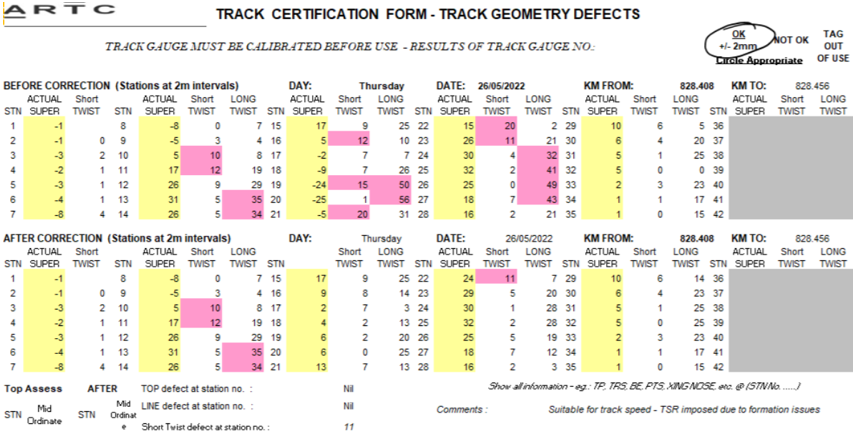
Track measurements before and after corrective works on 26 May 2022 showing outstanding defects. Source: ARTC
Table 5: Notable dates in management of track defect
| 13 April 2021 | Driver NT31 reports ‘rough riding between 828.300 and 828.500 kilometre mark near Kyogle. |
| 16 April 2021 | Temporary repairs – ‘tamp, line and box up with excavator’ completed |
| 19 April 2021 | Further repairs conducted, 40 km/h TSR implemented |
| 25 May 2021 | 40 km/h TSR lifted |
| Regular inspection schedule maintained with minimal recorded observations | |
| 7 March 2022 | Front of train inspection conducted, no defects recorded |
| 11 March 2022 | Scheduled track inspection conducted, no defects recorded |
| 15 March 2022 | 2SB3 reported track geometry issue to at 828.400 km at Kyogle. 40 km/h TSR implemented – inspected, no measurements recorded |
| 18 March 2022 | Scheduled track inspection conducted – no defects recorded |
| 23 March 2022 | 20 km/h TSR implemented described in the speed restriction notification as ‘poor top and line.’ No further information. |
| 11 April 2022 | Track tamping conducted, no details recorded |
| 29 April 2022 | Track tamping conducted – 40 km/h TSR implemented, no details recorded |
| 26 May 2022 | 20-km/h TSR implemented following partial repair – track certification form and speed restriction notification describes ‘poor track geometry’ |
| 27 May 2022 | Scheduled track inspection marked as ‘fully complete’ – no details of existing TSR or track defect |
| 31 May 2022 | 2BS4 derails within the 20 km/h TSR location |
Although this section of track demonstrated it was vulnerable to earthworks instability, by way of repeated track geometry defects, and subsequent excavator tamping activities, ARTC did not provide evidence that the area was subject to any increased monitoring by the maintenance crew.
There was also no evidence of changes to the standard inspection schedule, engagement of specialist geotechnical analysis or advice, or that the site had been nominated as a special location for additional attention.
Regulatory oversight
The Office of the National Rail Safety Regulator
The Office of the National Rail Safety Regulator (ONRSR) was the regulatory agency for rail in Australia. It was not a government agency, but an independent body corporate established under the Rail Safety National Law Act 2012. Its functions were to regulate the rail transport industry in Australia through its rail safety accreditation regime and the Rail Safety National Law (RSNL). ONRSR set requirements for rail safety management systems (SMS), conducted compliance activities including audits and inspections, and enforced the RSNL.
ONRSR routinely issued guidelines on its website designed to provide key information and clarification to both the rail industry and public on legislative, regulatory and technical matters associated with safe railway operations.
Asset management guidelines
ONRSR Guideline – ‘Asset Management, 13.3 Asset operation and maintenance’ stated in part that Rail Transport Operators (RTOs)[15] ‘should monitor ongoing compliance with their nominated standards and processes in order to ensure that their railway operations continue to be safe and perform efficiently.’
Also, ‘planning should be documented and controlled in a computer maintenance management system’ and that all maintenance tasks are signed off for compliance.
This document also detailed requirements for ‘monitoring asset performance’, ‘failure management and corrective action’ and the management of the life cycle of assets, such as track and signalling infrastructure.
ONRSR also expected RTO’s such as ARTC to have in place:
- evidence of ongoing compliance with the RTO’s nominated standards and processes, and management of identified risks
- asset maintenance plans and procedures
- evidence of identifying and eliminating safety risks
- evidence of reporting and managing any performance issues and corrective actions
- evidence of the use of trending performance against the predicted strategic life of an asset for tracking performance and planning for renewals
- processes for identifying faults and failures and undertaking corrective action
- evidence of the consideration of asset management in SMS provisions for: security and emergency management, notifiable occurrences, and interface management.
Safety management systems guidelines
ONRSR Guideline – ‘Safety Management Systems, 6.10 Safety audit arrangements’ described the requirement for a documented internal audit program which is focused around auditing those processes of the SMS which pose the greatest risk to safety.
ONRSR Guideline – ‘Safety Management Systems, 6.20 Process control’ described the requirement to ensure the organisation has a system to define, control and manage the operational and engineering processes to ensure assets are fit for purpose for rail infrastructure and rolling stock operations.
As a minimum ONRSR would expect:
Records of inspections are kept and form the maintenance history of the asset to confirm:
- effective monitoring to ensure compliance to standards, operating rules, processes and procedures
- the date the inspection has been carried out and by whom
- the defects or non-conformances detected (location, description)
- defects or non-conformances have been reported for rectification
- defects are prioritised, safely managed and reviewed until rectified
- condition of the infrastructure/rolling stock (and any restrictions) has been reported to staff responsible for the day’s operation
- defects are rectified, checked and dated by staff with the competence and responsibility for ensuring assets are returned to service fit for purpose
- the maintenance work carried out on each asset (both routine and rectifying defects) has been recorded (e.g. a maintenance log for each asset)
- assurance that technical maintenance plan requirements are met, and the review of work order process or inspection test plan process is undertaken to demonstrate evidence of work being conducted as per standards
- back to service, monitoring of human performance, random audits and inspections and other safety observations
- that general engineering and operational system safety requirements are complied with.
ARTC indicated that it had various activities and functions in place related to the monitoring and oversight of maintainers responsible for the NSW North Coast corridor, however ARTC was unable to supply any evidence of maintenance team compliance audits or assurance activities specific to this area.
Other standards and guidelines
The Rail Industry Safety and Standards Board
The Rail Industry Safety and Standards Board (RISSB) was a non-government, member ‑based, not-for-profit that developed Australian standards, guidelines, codes of practice and rules on behalf of the Australian rail industry.
RISSB supported the rail industry’s regulation model by providing standards, guidance, and advice which helps industry prove that it is meeting its safety obligations.
RISSB Infrastructure Standard ‘AS-7635 – Track geometry’ was developed to specify track geometry standards for design, construction, commissioning, monitoring, maintenance, and modification of rail tracks in Australia. ‘Section 4 Monitoring and maintenance, 4.1 Inspection’ – frequency and tasks stated ‘at locations with a known history of geometry defects, the frequency of inspections should be increased as determined by the Rail Infrastructure Manager (RIM), or ARTC in this instance.’
When describing the management of track defects using TSR, ‘Section 4.2.1 Speed restriction’ stated ‘speed restrictions may be used to manage the risk from track geometry defects, enabling the increase of timeframes for required response actions’.
The standard advised caution was required though when using speed restrictions to manage twist and cyclic defects, as lower speed can increase the likelihood of vehicle dynamic derailments and makes further mention when discussing geometry defects that reducing speed could increase the risk of derailment.
This guideline also advised that a combination of defects that are considered to act together should also require a more stringent response.
‘Section 4.2.3 Repeat faults’ recommended ‘the RIM may consider a mechanism for monitoring repeat track geometry faults, defined as those recorded during consecutive track inspections. For those sites where the geometry fault has increased in magnitude it is advisable for a supervisory site inspection to be conducted, to ensure that the right method of correction is applied’.
Similar occurrences
RO-2019-004 Derailment of Pacific National coal train MR280 – Baerami, New South Wales, on 6 February 2019
At 0325 Eastern Daylight saving Time on 6 February 2019, a Pacific National loaded coal train, MR280, travelling from Moolarben to Kooragang Coal Terminal, derailed near Baerami on the Ulan branch line on the Hunter Valley Network. All wheels of the leading bogie of the 88th wagon derailed and travelled in a derailed state for approximately 1.83 km. As the derailed train reached the points of the Baerami crossing loop, another 5 wagons derailed and 3 wagons rolled on their side, narrowly missing a stationary empty coal train UL369.
It was considered that the contributing factors to the derailment were a result of individual actions, where personnel had not executed the intent of the ARTC code of practice and/or had not followed procedures as required. As a result of this, and the safety actions taken by ARTC, the ATSB considered it was unlikely that further investigation would identify any systemic safety issues or further important safety lessons for the enhancement of transport safety and the investigation was discontinued.
In response to the incident, the ARTC took safety action, including implementing a daily ‘known conditions review’ meeting at all provisioning centres so that call outs, TCR’s and known conditions could be frequently reviewed with other current information and ensure appropriate controls were in place for the management of defects
RO-2017-014 Derailment of grain train 8838N – Narwonah, New South Wales, on 1 October 2017
On 1 October 2017, a Pacific National loaded grain train 8838N was travelling on the ARTC rail network from Nevertire to Manildra in north-west New South Wales. The train consisted of 2 locomotives and 23 wagons. The train was travelling south at Narwonah when 11 loaded grain wagons located at the rear of the consist derailed. An emergency brake application occurred due to the uncoupling, which brought the front portion of the train to a stand. There were no injuries but there was substantial damage to 9 wagons and track infrastructure.
There were track defects identified in the vicinity of the derailment site prior to the derailment, and the maintenance of defects in this section of track was not successful in preventing the defects from re-occurring.
ARTC committed to several safety actions as a result of this incident, including changes made to the ARTC maintenance system to address systemic issues. ARTC also commenced a work program titled ‘Asset management improvement program’, which focused on improving the functionality of the enterprise asset management system and its supporting business processes.
Safety analysis
Introduction
On 30 May 2022, freight train 2BS4, operated by Pacific National, departed Acacia Ridge, Queensland, for Sydney, New South Wales. The train consisted of 3 locomotives and 56 wagons, hauling a combination of containerised freight and empty wagons.
At approximately 0030 hours on 31 May 2022, while traversing the North Coast line between Casino and Kyogle, New South Wales, 2BS4 encountered a temporary speed restriction of 20 km/h. While passing through this area, a wagon in the consist derailed, dragging for approximately 2 km, where the train then parted and a total of 11 wagons derailed.
It was determined that 2BS4 initially derailed due to a combination of track geometry defects, in an area under temporary speed restriction.
This safety analysis will discuss the track defects responsible for the derailment, and how the condition was being managed, including the use of ARTC’s enterprise asset management system.
Wheel examination of derailed vehicles
Due to the extensive damage to wagons, bogies and track infrastructure it was unable to be determined exactly which wagon separated from the consist first. However, it was likely, due to the damage observed on its wheelsets, that wagon number RQRY1011W, the 29th wagon in the consist, initially partially derailed at the TSR site and dragged for approximately 2.3 km before derailing completely, pulling the 28th wagon RKBY20455Q away from the consist. Once the wagons separated from the front of the train, the momentum of the trailing wagons has then contributed to the subsequent derailment and pile up of the remaining vehicles.
Wheel profile measurements taken by the ATSB at Acacia Ridge following the relocation of the affected bogies and wheel sets measured for flange height, angle and thickness with a standard wheel gauge. The overall condition of the examined wheel sets was found to meet the operator’s minimum standards for safe operation.
One wheelset of bogie RRXE 649 was noted to have the flanges close to the thin flange defect limit of 19 mm and exhibited an arris on both flanges. This type of wheel tread condition was indicative of a bogie with a higher angle of attack, with this likely to produce an increased lateral flange force on the outside rail head in a curve.
However, that condition was unlikely to have been a major factor in contributing to the derailment, as the flange steepness (worn but also within the operator’s standard for safe operation) likely counteracted the effects of an increase in lateral flange force arising from a higher angle of attack.
All bogies were also found to be within minimum operating standards.
Track geometry condition at derailment site
A combination of multiple short and long twist E1 track geometry defects were found at the initial derailment site, along with 2 top defects in the vicinity of the point of mount.
Had these defects been detected prior to the passage of 2BS4, ARTC would have been required to rectify the defects prior to the next train in accordance with their Track and Civil Standard (Table 3).
From the evidence obtained it is likely the derailment occurred due to a combination of track geometry conditions (multiple E1 short and long twists) that resulted in rolling stock wheel unloading, wheel climb onto the rail head and subsequent derailment of both wheels of a single bogie on vehicle RQRY 1011W.
The derailment mechanism was consistent with the outer (high) rail wheels unloading on a single bogie at slow speed that was progressing into a curve with too much superelevation. Those conditions were likely to have decreased the force on those wheels leading to wheel climb and subsequent derailment. The multiple E1 twists over the TRS limit could also have induced vehicle body roll in advance of the point of mount further contributing to the wheel unloading experienced.
The track geometry conditions were due to a soft formation issue at the site as evidenced by poor ballast condition, water saturation, and repeated track geometry issues.
The resulting degradation of the track structure at multiple locations prior to the derailment point of mount was considered to have resulted in both track top and alignment defects on the day, sufficient to initiate the derailment.
Although the contribution of the rolling stock/track interaction was unable to be quantified, the extent of the track structure defects and the rate of their apparent deterioration following maintenance interventions became the central focus of OTSI’s investigation to identify safety learnings.
Progression of track formation defect
Observations of train crew
The driver’s assistant of 2BS4 recalled in interview that the track was worsening in condition since their last trip through the area approximately one week before and described this crossing as far worse than previous trips.
The driver’s assistant described that, in their experience, a 20 km/h speed for this defect was not acceptable, and they had intended to report to network control that the track should have been closed, had the derailment not occurred.
The driver of a previous train to traverse this section the day before described it in interview as the worst TSR they had ever seen in their time, although explained that drivers are generally not qualified to make judgements on whether a track should remain open.
The driver of 2BS4 suggested that, in their opinion, the track should have been closed to rail traffic and assessed, describing visible track geometry issues as it was traversed.
All train crew interviewed in relation to this incident confirmed a worsening of the condition of the track in comparison to their last trip and considered the track to be of an unacceptable standard.
Although there were no train control reports received by network control in the days preceding the derailment of 2BS4, it was suggested by various train crew in interview that driver reports for the same track faults repeatedly, especially when it is being managed by an existing speed restriction, were not taken as seriously by network control and generally not followed up.
It was also suggested that drivers would typically be less likely to report a track defect that is under some form of speed restriction, as this would indicate that the issue with the track has been identified by ARTC and was ‘being managed.
Progression of defect
A track certification form indicated that a temporary and partial repair was conducted at the derailment location on 26 May 2022, 4 days prior to the derailment. This form noted that the track geometry post‑corrective action was suitable for full track speed but also recorded that the repair did not fully rectify the track defects at this location to desired limits after corrective maintenance (see Table 1). Despite the geometry being noted as suitable for full track speed, a 20 km/h temporary speed restriction was put in place citing ‘TSR imposed due to formation issues’. This level of speed restriction on a compliant track indicates that the maintenance team had assessed that the formation issues were severe and the geometry defects likely to re‑occur.
According to ARTC Track and Civil Response Booklet (ETW-00-01), ‘increased monitoring should be continued until rectification work is carried out’. Although the rectification work conducted on this day did not repair the defect, and a speed restriction remained in place, no further inspection or monitoring of this site was conducted, and no further information was entered into the EAMS to suggest that there was a concern over the condition of the track at this location.
Several of the characteristics identified by ARTC as typical of mudholes, or underlying soft formation issues, were consistent with the conditions observed by maintenance personnel in interview and train crews traversing this section of track. Those conditions included water saturation, failing formation and general track instability. However, the area was not subject to any additional monitoring in between routine scheduled inspections.
From the last temporary repair on 26 May 2022, until the derailment, 24 trains traversed this section of track. All trains using this section of track in this timeframe were doing so under a 20 km/h speed restriction, concluding in the derailment of 2BS4, 4 days later.
Rapid deterioration of track geometry had been identified on at least one prior occasion, reported by train crew between the scheduled track monitoring cycle of 7 days, with the train crew’s report resulting in corrective action.
It was likely that the soft formation defect has caused the track geometry to degrade to an unsafe condition in the 4 days following the track’s last repair and inspection, unbeknownst to ARTC in the absence of heightened monitoring or further repair.
Contributing factor 2BS4 derailed on a section of track which had progressed to an unsafe condition since the partial correction of a recurring defect 4 days earlier. The defect had a known history of recurrence but was not subject to increased monitoring. |
Planning for rectification works
ARTC advised that a track possession had been planned in which the work intended to correct the soft formation was scheduled to take place. However, ARTC was unable to supply documentation and pre-planning paperwork to support these plans, or evidence that the defect area concerned was included in any plans for the planned possession window. It was found during further investigation that no such documentation existed, and no formal planning had taken place.
Track inspection activities and temporary repairs to the track were not carried out in a systematic manner with inconsistencies in accompanying paperwork. This included track certification forms which were submitted with incomplete track measurements, ambiguous or absent descriptions of work completed, and the absence of manager or supervisor sign-off.
It is unlikely that the information contained within the asset management system alone would have been sufficient to determine the extent of the issue, nor would it have provided the corridor or asset manager with an accurate indication of what resources, such as personnel and equipment, would be required to repair the defect, with no verifiable record of information to inform the severity of it.
Defect management records
OTSI’s review of maintenance records and track measurements taken before and after tamping activities by ARTC found that the TSR location had a history of significant superelevation/cross level loss prior to the derailment, but little information on the defect itself.
ARTC’s maintenance team managed the track defect between 828.350 km and 828.450 km by repeated temporary corrective maintenance and temporary speed restrictions.
However, track condition was not recorded in Ellipse pre or post these activities or recorded after scheduled maintenance activities.
The recording of track conditions within ARTC’s Ellipse system and detailed track inspection records was required by the ‘AMT-PR-010 Enterprise asset management system’ procedures. These records were required to support work requests to the asset management team and to prioritise major works.
The maintenance work group leaders stated lack of familiarity with ARTC’s specific recording and escalation process, (see also Recording requirements of known conditions), along with ARTC’s inability to locate manual defect records likely impeded the dissemination of the defect details, and escalation within the organisation, hindering the ability of management to respond appropriately.
Information that should have been recorded in the Ellipse system as required by ARTC’s procedures may have been used to identify the deteriorating condition and instigate further investigation into the track geometry issues or initiate more stringent monitoring. However, in this instance, that information was either not recorded, or not available to provide reliable insight into the track condition.
Corrective works and tamping
There was no evidence that planning or assessments had taken place in accordance with Engineering (Track and Civil) Procedure ‘PP-135 Mechanised Track Surfacing 2.1 Planning’ to support the ongoing use of tamping at the derailment site.
According to the procedure consideration should be given to the capabilities and/or limitations of the equipment being used.
The recurrence of track defects at the same location over a period of at least 12 months was an indication that the spot tamping approach was insufficient to address the repeated track geometry track defects, and that further exploration of the underlying cause was required to manage the defect.
Track possession planning
In interview, ARTC senior management representatives acknowledged not being fully across the severity of the issue but explained that there was a plan to undertake further corrective work in an upcoming possession window.
In its investigation report ARTC also document that ‘plans to undertake corrective works on the embankment formation were in place to occur on the weekend of 4 and 5 June 2022’.
However, no documentation or formal submission was supplied to the ATSB to support these statements.
ARTC acknowledged in a further information request that the detailed planning for the formation reconstruction had not been completed prior to 31 May 2022. ARTC representatives described in interview that the actual plan was to reallocate resources from a nearby planned track possession and conceded that the necessary pre‑possession work rectification planning for this specific defect had not been completed.
An ad-hoc planning method was therefore being used to scope major works on the line. This may have compromised ARTC's ability to ensure work was being performed as per ARTC’s code of practice and in accordance with its asset management plan, and redirected resources assigned to repair another defect without appropriate risk assessment and prioritisation.
Methodical planning and documenting of planned track work, such as that described in ‘Corridor Access Management Procedure - COR-PR-028’ was, according to ARTC, essential to ensuring that the efficiency and integrity of the work can be monitored and adhered to, and the correct and necessary safety measures specific to the work location and environment can be implemented prior to work commencing. This planning was to ensure that all risks associated with planned work were accounted for and eliminated or mitigated where possible.
Insufficient planning, scoping and resourcing had the potential to increase the health and safety risk to workers and create inefficiencies in work conducted when necessary and essential pre-work planning and risk assessment was not carried out.
Contributing factor In the absence of appropriate records in the asset management system, no formal planning was in place to permanently rectify the known defect, which was in a state of deterioration. |
Detection and management of recurring defects
Track maintenance activities prior to incident
Evidence collected by the ATSB has indicated that scheduled track inspections were carried out in accordance with ARTC code of practice, although there was no evidence of increased monitoring of this site.
There was no indication from information supplied by ARTC that these routine track inspections were detecting anything out of the ordinary occurring with this section of track, which is inconsistent with other sources of information supplied, indicating an increase in corrective work surrounding this defect.
For instance, irregular tamping activities took place to correct track geometry faults on numerous occasions, however evidence supplied to support the decision‑making behind these activities indicated an absence of information which would otherwise allow ARTC to make fully informed decisions.
Enterprise asset management and Ellipse
The information entered into the ARTC Ellipse system relating to work undertaken onsite did not inform responsible personnel that this recurring fault required special attention.
There was no detailed information found in asset management system records, against any of the scheduled track inspection activities at this location. An increase in tamping activities and a greater reliance on temporary speed restrictions may have indicated a more serious issue, which would normally have triggered a more stringent response. However, nothing was noted in these records which indicated it had been raised as a concern.
Speed restrictions were implemented in response to the track condition, however, specific details relevant to the defect were not recorded in Ellipse. Scheduled track inspections conducted immediately before and after tamping, and the introduction or removal of speed restrictions, also recorded no information on the defect.
If track measurements were undertaken by civil staff to determine the level of response required for this defect, details of these were not recorded in the Ellipse asset management system.
The repeated implementation of a 40 km/h TSR at this location following corrective works indicates that the civil representative responsible for this location reasonably anticipated a recurrence of the fault, and that track stability was reduced or compromised. The information describing and explaining this action, however, was not documented in Ellipse as required on any of these occasions.
It was not clear based on the evidence supplied how the data that was retained from track patrols, inspections or corrective works could have informed ARTC of the presence of a defect which could be considered problematic or recurring. The information recorded was not in compliance with the requirements of ARTC’s ‘AMT-PR-010 – Enterprise asset management system’ procedure.
With the limitations in data and information available in the Ellipse system in this case, it is unlikely that ARTC would have had a reliable and informative data set to highlight the necessity for increased monitoring of this defect, and or significant repairs, allowing the underlying soft formation condition to continue to degrade.
This hindered the ability for the necessary planning and resource allocation to take place, as the information needed to inform ARTC of the scale of work and resources required was not accurate, and in some cases non-existent.
These issues with record keeping, the quality of inspections and appropriate repair had been identified previously by the ATSB as safety issues requiring action based on previous similar incidents (see Similar occurrences), specifically the ATSB Narwonah investigation report identified similar issues such as:
- ensuring that defect rectification work is undertaken to an acceptable quality
- ensuring that inspection activities are thorough
- network issues are captured within ARTC’s enterprise asset management system for planning and future rectification
- interrogating network data to identify where reoccurring issues are developing and request project work to rectify.
Contributing factor ARTC did not reliably identify, monitor and analyse recurring track defects which resulted in a reduced capability to:
|
Monitoring and oversight of maintenance activities
Auditing and assurance of maintainers
Along with ARTC’s assurance framework and audit plan (see Asset assurance framework), to ensure the compliance of their maintainers conducting work on rail infrastructure and to inform corridor management on their effectiveness and performance ARTC detail their activities included:
- daily visual management centre (VMC) toolbox meetings
- scheduled and unscheduled inspections
- TCR and train control rail event functions
It was explained that this was how ARTC ensured work was being carried out ‘effectively’. However, no evidence was provided to demonstrate these assurance activities were being carried out, nor any evidence that they had been formalised in documents or procedures.
ARTC relied on a task being marked as complete within the asset management system to validate that the work was completed, with minimal follow up and verification of this task completion.
There was no evidence of any previous auditing activities on rail maintenance personnel conducting rail maintenance tasks in the North/South corridor, suggesting that any safety actions taken in response to previous incidents have likely been implemented in an informal manner.
This informality did not support a proactive approach to managing potential safety issues in the rail corridor, such as the treatment of track defects.
The lack of evident auditing or verification of effective maintenance activities has resulted in a limited visibility at an organisational level within ARTC that the scheduled and unscheduled maintenance tasks being carried out were achieving the desired result. This did not provide the organisation with adequate insight into the thoroughness of its track inspection activities.
Informal meetings and discussions would not provide sufficient assurance that maintainers were applying the appropriate methods to reduce risks, or carrying out essential tasks to completion without a formal auditing or checking system in place as prescribed in the ONRSR guidance, especially where detailed data is lacking.
Contributing factor While ARTC had a process for monitoring its maintainers when carrying out inspections and rectifications, it was unable to provide evidence of these activities being conducted. (Safety Issue) |
Findings
ATSB investigation report findings focus on safety factors (that is, events and conditions that increase risk). Safety factors include ‘contributing factors’ and ‘other factors that increased risk’ (that is, factors that did not meet the definition of a contributing factor for this occurrence but were still considered important to include in the report for the purpose of increasing awareness and enhancing safety). In addition ‘other findings’ may be included to provide important information about topics other than safety factors. Safety issues are highlighted in bold to emphasise their importance. A safety issue is a safety factor that (a) can reasonably be regarded as having the potential to adversely affect the safety of future operations, and (b) is a characteristic of an organisation or a system, rather than a characteristic of a specific individual, or characteristic of an operating environment at a specific point in time. These findings should not be read as apportioning blame or liability to any particular organisation or individual. |
From the evidence available, the following findings are made with respect to the derailment involving Pacific National freight train 2BS4, near Kyogle, New South Wales, on 31 May 2022.
Contributing factors
- 2BS4 derailed on a section of track which had progressed to an unsafe condition since the partial correction of a recurring defect 4 days earlier. The defect had a known history of recurrence but was not subject to increased monitoring.
- In the absence of appropriate records in the asset management system, no formal planning was in place to permanently rectify the known defect, which was in a state of deterioration
- ARTC did not reliably identify, monitor and analyse recurring track defects which resulted in a reduced capability to:
- monitor deterioration of the track
- recognise the need to conduct increased unscheduled track patrols
- identify capacity to plan for its corrective maintenance. (Safety issue)
- While ARTC had a process for monitoring its maintainers when carrying out inspections and rectifications, it was unable to provide evidence of these activities being conducted. (Safety issue)
Safety issues and actions
Central to the ATSB’s investigation of transport safety matters is the early identification of safety issues. The ATSB expects relevant organisations will address all safety issues an investigation identifies. Depending on the level of risk of a safety issue, the extent of corrective action taken by the relevant organisation(s), or the desirability of directing a broad safety message to the rail industry, the ATSB may issue a formal safety recommendation or safety advisory notice as part of the final report. All of the directly involved parties were provided with a draft report and invited to provide submissions. As part of that process, each organisation was asked to communicate what safety actions, if any, they had carried out or were planning to carry out in relation to each safety issue relevant to their organisation. Descriptions of each safety issue, and any associated safety recommendations, are detailed below. Click the link to read the full safety issue description, including the issue status and any safety action/s taken. Safety issues and actions are updated on this website when safety issue owners provide further information concerning the implementation of safety action. |
ARTC ability to detect and manage recurring defects
Safety issue number: RO-2022-006-SI-03
Safety issue description: ARTC did not reliably identify, monitor and analyse recurring track defects which resulted in a reduced capability to:
- monitor deterioration of the track
- recognise the need to conduct increased unscheduled track patrols
- identify capacity to plan for its corrective maintenance.
ARTC monitoring and oversight of maintenance activities
Safety issue number: RO-2022-006-SI-04
Safety issue description: While ARTC had a process for monitoring its maintainers when carrying out inspections and rectifications, it was unable to provide evidence of these activities being conducted.
Glossary
| AK car | Track inspection vehicle |
| Alignment | May be referred to as horizontal or vertical alignment. Horizontal alignment is the design horizontal alignment of track (i.e. straights, curves, etc.), vertical alignment is the design vertical alignment of track (gradients and vertical curves). |
| Bi-directional Line | A section of track where rail traffic can run in either direction |
| Bogie | A structure incorporating suspension elements and typically fitted with wheels and axles, used to support rail vehicles at or near the ends and capable of rotation in the horizontal plane. |
| CAN | Condition affecting the network |
| Cant | Also referred to as superelevation, is used for intended height difference in the rails (i.e. where the track is inclined in a curve), and the term 'cross level' is used for the unintended height difference (i.e. due to track irregularity). The term used to denote the raising of the outer rail on curved track to allow higher speeds than if the 2 rails were level. Cant compensates for the centrifugal force arising from a train traversing a curve. |
| DA | Driver’s Assistant |
| Derailment | An incident in which one or more wheelsets run off the track. |
| EAMS | Enterprise asset management system |
| Line | Horizontal alignment of the rails. Line is generally measured using the offset at a defined point along a chord of defined length. For vertical alignment, see top. |
| LPA | Local possession authority |
| Maintainer | ARTC infrastructure staff or contractors who detect and repair any defective infrastructure asset |
| MST | Maintenance schedule tasks |
| NCO | Network control officer |
| ONRSR | Office of the National Rail Safety Regulator which accredited the light rail operator under the Rail Safety National Law NSW 2012 |
| RIM | Rail infrastructure manager |
| RTO | Rail transport operator |
| RVD | Rail vehicle detection |
| SMS | Safety management system |
| Superelevation | Also referred to as track cant, is used for intended height difference in the rails (i.e. where the track is inclined in a curve), and the term 'cross level' is used for unintended height difference (i.e. due to track irregularity). The term used to denote the raising of the outer rail on curved track to allow higher speeds than if the 2 rails were level. Cant compensates for the centrifugal force arising from a train traversing a curve. |
| Tangent Point | The intersecting point of track center-line tangents between curves, transitions and straight track. |
| TCR | Train control report |
| TMP | Technical maintenance plan |
| Top | Vertical alignment of the rails. Top is generally measured using the offset at a defined point along a chord of defined length. For lateral alignment, see line. |
| Track gauge | The distance between the inside running (or gauge) faces of the 2 rails making up track, measured between points 16 mm below the top of the rail heads. |
| Transition curve | A curve of uniformly varying radii used to connect straight and curved tracks or curves of different radii. |
| TSR | Temporary speed restriction |
Sources and submissions
Sources of information
The sources of information during the investigation included:
- the driver and driver’s assistant of 2BS4 and another driver who conducted operations for Pacific National
- Australian Rail Track Corporation (ARTC)
- ARTC North / South rail corridor asset maintenance services personnel
- ARTC network control graphs and audio recordings
- Pacific National
- Bureau of Meteorology (BOM)
- Office of the National Rail Safety Regulator (ONRSR)
- Rail Industry Safety Standards Board (RISSB)
- New South Wales TrainLink
- Australian Transport Safety Bureau (ATSB), and previous ATSB rail investigation reports
- track maintenance data and track inspection footage
- ARTC network rules, procedures, standards and guidelines
- front-of-train CCTV footage, onboard event recorder and onsite photographs
- Google Earth.
References
ARTC Track and Civil Standards
ARTC Asset Management Procedures and Work Instructions
ARTC Train Control Reports
ARTC Safety & Environment Investigation Report- Derailment of Train 2BS4 826.350 km Kyogle, NSW- 31 May 2022- TCR 6218 2022
RISSB Infrastructure Standard – AS 7635:2023 Track Geometry
ONRSR Guideline - Asset Management
ONRSR Guideline – Safety Management Systems
ONRSR Safety Message: Ad hoc systems and procedures vs Safety Management Systems
Submissions
Under section 26 of the Transport Safety Investigation Act 2003, the ATSB may provide a draft report, on a confidential basis, to any person whom the ATSB considers appropriate. That section allows a person receiving a draft report to make submissions to the ATSB about the draft report.
A draft of this report was provided to the following directly involved parties:
- Australian Rail Track Corporation (ARTC)
- Pacific National (PN)
- NSW TrainLink (NSWT).
Any submissions from those parties will be reviewed and, where considered appropriate, the text of the draft report will be amended accordingly.
A submission was received from:
- Australian Rail Track Corporation (ARTC).
The submission was reviewed and, where considered appropriate, the text of the report was amended accordingly.
Rail safety investigations in New South WalesMost transport safety investigations into rail accidents and incidents in New South Wales (NSW) and Victoria are conducted in accordance with the Collaboration Agreement for Rail Safety Investigations and Other Matters between the Commonwealth Government of Australia, the State Government of NSW and the State Government of Victoria. Under the Collaboration Agreement, rail safety investigations are conducted and resourced in NSW by the Office of Transport Safety Investigations (OTSI) and in Victoria by the Chief Investigator, Transport Safety (OCI), on behalf of the ATSB, under the provisions of the Transport Safety Investigation Act 2003. The Office of Transport Safety Investigations (OTSI) is an independent statutory body which contributes to improvements in the safety of bus, ferry and rail passenger and rail freight services in NSW by investigating safety incidents and accidents, identifying system-wide safety issues and sharing lessons with transport operators, regulators and other key stakeholders. Visit www.otsi.nsw.gov.au for more information. Purpose of safety investigationsThe objective of a safety investigation is to enhance transport safety. This is done through:
Investigations under the TSI Act do not apportion blame or provide a means for determining liability. At the same time, an investigation report must include factual material of sufficient weight to support the analysis and findings. Under the TSI Act investigations endeavour to balance the use of material that could imply adverse comment with the need to properly explain what happened, and why, in a fair and unbiased manner. TSI Act investigations are not for the purpose of taking administrative, regulatory or criminal action. About ATSB reportsATSB investigation reports are organised with regard to international standards or instruments, as applicable, and with ATSB procedures and guidelines. Reports must include factual material of sufficient weight to support the analysis and findings. At all times the ATSB endeavours to balance the use of material that could imply adverse comment with the need to properly explain what happened, and why, in a fair and unbiased manner. An explanation of terminology used in ATSB investigation reports is available here. This includes terms such as occurrence, contributing factor, other factor that increased risk, and safety issue. Publishing informationReleased in accordance with section 25 of the Transport Safety Investigation Act 2003 Published by: Australian Transport Safety Bureau © Commonwealth of Australia 2026 
Ownership of intellectual property rights in this publication Unless otherwise noted, copyright (and any other intellectual property rights, if any) in this report publication is owned by the Commonwealth of Australia. Creative Commons licence With the exception of the Commonwealth Coat of Arms, ATSB logo, and photos and graphics in which a third party holds copyright, this report is licensed under a Creative Commons Attribution 4.0 International licence. The CC BY 4.0 licence enables you to distribute, remix, adapt, and build upon our material in any medium or format, so long as attribution is given to the Australian Transport Safety Bureau. Copyright in material obtained from other agencies, private individuals or organisations, belongs to those agencies, individuals or organisations. Where you wish to use their material, you will need to contact them directly. |
[1] The km distance is measured from Platform 1, Central Station, Sydney, New South Wales.
[2] When the air pressure is lost, the brakes automatically apply to stop the train as a safety measure.
[3] Block: a portion of track with defined limits, usually denoted by fixed lineside signals, between which only one rail traffic movement is permitted at any one time.
[4] A ‘known condition’ is defined by ARTC as a shortcoming or imperfection with an item of equipment, component or part, that may or may not need work or monitoring.
[5] Tamping: a process involving ballast being packed around the sleepers of a track to ensure correct track geometry.
[6] Engineering (Track & Civil) Code of Practice Section 8 Earthworks, 8.3.1 special locations are defined as track sections prone to (e.g. with a history of) earthworks instability.
[7] Guard rails (also known as restraining rails, check rails, or girder rails) are placed inside or outside the running rails, designed to restrain lateral movement of a train’s wheels if it derails, keeping it aligned with the track and preventing it from falling off or damaging nearby infrastructure.
[8] Soft formation of ballast is denoted to occur when there are inadequate drainage systems causing water to accumulate in the track bed, saturating the ballast and subgrade. When these materials become waterlogged, they lose their strength and become soft and depress to form a puddle under the ballast. The ballast sinks into the formation and this leads to loss of track geometry.
[9] Flange: protruding portion of the wheel profile which provides lateral restraint and guidance on the rail.
[10] Arrises: raised lips on the top of the wheel flange caused by metal flow.
[11] The term used to describe the vertical movement of a section of track due to the force of rolling stock traversing it
[12] The AK car was also referred to as a ‘continuous track geometry recording car’,
[13] Source: ARTC website – https://www.artc.com.au/work/contractors/rswc/track-civil/
[14] A front of train (FoT) inspection is an inspection which assists in the assessment of track by enabling the reaction of trains to the track structure to be experienced. The inspection is to be carried out from the Driver’s compartment of the fastest train over the length where this is practical to gather information about infrastructure defects or condition.
[15] Rail Transport Operators defined by Rail Safety National Law and includes Rail Infrastructure Managers (RIMs) such as ARTC.
Occurrence summary
| Investigation number | RO-2022-006 |
|---|---|
| Occurrence date | 31/05/2022 |
| Location | Near Kyogle |
| State | New South Wales |
| Report status | Final |
| Investigation level | Defined |
| Investigation type | Occurrence Investigation |
| Investigation phase | Final report: Dissemination |
| Investigation status | Completed |
| Mode of transport | Rail |
| Rail occurrence category | Derailment |
| Occurrence class | Accident |
| Highest injury level | None |
Train details
| Train operator | Pacific National |
|---|---|
| Train number | 2BS4 |
| Track operator | Australian Rail Track Corporation (ARTC) |
| Type of operation | Freight |
| Rail vehicle sector | Freight |
| Consist | 3 x locomotives, 56 wagons |
| Departure point | Acacia Ridge, Queensland |
| Destination | Sydney, New South Wales |
| Persons on board | Crew - 2, Passengers - Nil |
| Injuries | Crew - Nil, Passengers - Nil |
| Train damage | Substantial |