

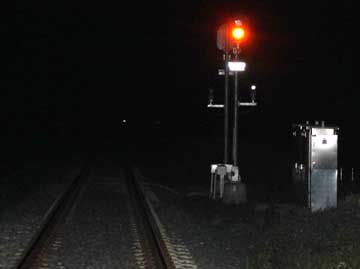
Rail operators are being encouraged to use independent data validation systems, such as forward facing video, on trains, after an ATSB investigation into a signal irregularity could not substantiate the observations of the train crew.
The braking distance for freight trains can be significant so train drivers must begin braking well in advance of a projected stopping point. As a result, train drivers need advance information about the status of fixed signals ahead of the train movement.
The incident occurred on 7 April 2013, as a southbound freight train was travelling at 115 km/h on the main line of the Culcairn North passing loop in New South Wales. The train consisted of four locomotives hauling 37 wagons having a total length of 1,489 m and a trailing mass of 2,561 t.
The ATSB encourages all rail operators to consider the use of independent data validation systems, such as forward facing video on trains...
The driver and second person of the train would later report that, as they approached a signal designated DIS-CN03, it was displaying a clear (green) indication. As a result, they expected that the next signal, CN03, would be at ‘proceed’ and that the track ahead would be clear of any opposing train. After passing signal DIS-CN03 and rounding a sweeping right hand curve, however, the driver saw the headlight of an opposing train and that home signal CN03 was set at ‘stop’ (red).
The driver immediately made an emergency brake application to stop the train, which averted a collision with the opposing train. There were no injuries or damage as a result of this occurrence.
The ATSB investigation of the available evidence showed that the signalling system was operating correctly at the time of the incident and therefore the signal (DIS-CN03) preceding the signal at stop (CN03) should have been displaying a caution aspect (yellow). However, the crew were adamant that the signal DIS-CN03 had been at green.
As the train was not fitted with forward facing video equipment, the ATSB was unable to substantiate the train crew’s observations of signal DIS-CN03.
The Australian Transport Safety Bureau encourages all rail operators to consider the use of independent data validation systems, such as forward facing video on trains, to provide a source of information to assist in coming to an understanding of rail occurrence events, such as signal irregularities.
Read the final report: Signal irregularity reported by crew of train 5BM7, Culcairn North, New South Wales, on 7 April 2013