

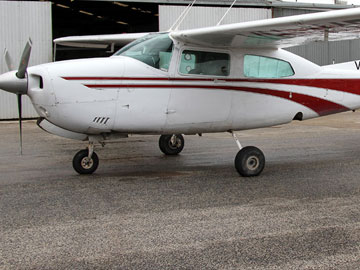
The ATSB is urging aircraft owners and registration holders to review their maintenance schedules after a Cessna pilot’s control difficulties were found to be caused by component fractures and cracking.
The ATSB is strongly encouraging registration holders of class B aircraft to review their aircraft’s maintenance schedule to determine if it is the most appropriate for their aircraft and to ensure that it adequately provides for the continuing airworthiness for their aircraft.
This warning comes after a 12 September 2011 incident when the pilot of a Cessna 210 aircraft was conducting low-level aerial surveying near Bourke Aerodrome, New South Wales. After briefly encountering turbulence, he had difficulty making elevator control inputs and maintaining height. He was able, however, to land the aircraft safely with no injuries.
The ATSB has issued two safety recommendations to CASA as part of this investigation.
The ATSB investigation found that the control difficulties resulted directly from the fracture of the aircraft’s two horizontal stabiliser rear attachment brackets. The forward spar of the horizontal stabiliser was also extensively cracked. The fractures and cracking were all consistent with metal fatigue and typical of the damage that can be sustained by aircraft as they age. Many manufacturers have addressed the growing potential for this type of damage by introducing supplemental inspections to the principal aircraft maintenance requirements.
Some registration holders of class B aircraft, however, believed that their aircraft were exempt from the manufacturer’s supplemental inspections as long as the aircraft were maintained using the CASA maintenance schedule. This belief sprang from a misinterpretation of the Australian Civil Aviation Regulations 1988 (CAR). The CASA maintenance schedule did not make any specific reference to the incorporation of the manufacturer’s supplemental inspections, but it was a CAR requirement that all aircraft be maintained in accordance with approved maintenance data that, by definition, included those inspections.
The ATSB has issued two safety recommendations to CASA as part of this investigation. The first recommends that CASA proceed with its program of regulatory reform to ensure that all aircraft involved in general aviation operations are maintained using the most appropriate maintenance schedule for the aircraft type. The second is to ensure that the provisions of CAR Schedule 5 are clarified in relation to the incorporation of all relevant supplemental inspections specified for the aircraft type.
Read the final report: Flight control system event involving Cessna 210N, VH-JHF, 48 km west of Bourke Airport, New South Wales, on 12 September 2011