

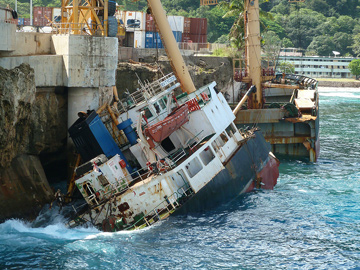
The ATSB is urging port managers and operators to consider all the risks associated with operations within their ports following the foundering of a ship at Christmas Island in 2012.
On the morning of 8 January 2012, one of the permanent mooring lines holding the general cargo ship Tycoon in position at Flying Fish Cove, Christmas Island, came free from its anchor. As a result, the ship moved forward and closer to the nearby terminal rock face, eventually hitting the rock face as the weather and sea conditions deteriorated.
Despite attempts to move it away, Tycoon continued to pound against the rock face. Eventually, the ship’s engine room began to flood through a tear in the hull. Shortly afterwards, the crew safely abandoned the ship.
The next day, Tycoon suffered a catastrophic failure of its hull and the contents of the ship’s number two cargo hold, about 260 tonnes of bagged phosphate, were exposed to the sea. The ship continued to be pounded by the sea and swell and, over the following months, it broke up. The wreck was eventually removed by salvors on 26 July 2012.
The ATSB investigation found that the shackle connecting the port’s mooring line to its anchor chain had failed. As well, Tycoon’s master did not advise shore authorities of his concern about the deteriorating conditions or that the mooring line had come free. He also did not make proper use of the ship’s main engine or mooring lines in an attempt to keep the ship in position after the mooring line came free.
...the ship’s engine room began to flood through a tear in the hull.
In addition, it was found that there had been no risk assessment undertaken by successive port managers with respect to the use of the inner moorings and that there was little guidance provided to the masters of ships intending to moor in Flying Fish Cove. The managers of the port had not implemented an effective inspection and maintenance program and therefore were not aware of the deteriorated condition of the mooring line shackle.
As a result of the accident, the port operator has commenced replacing and upgrading the mooring equipment. They are also developing a Port Handbook which will be provided to the master of each ship and are facilitating safety training workshops that will be a forum through which the risks posed to the port and its operations can be assessed.
The ATSB investigation report advises port authorities to have procedures and contingency plans in place to deal with foreseeable emergencies. In addition, it is vital that there be effective maintenance and inspection regimes to ensure the good order of equipment and facilities.
Read the final report: Foundering of the general cargo ship Tycoon, Christmas Island, on 8 January 2012