

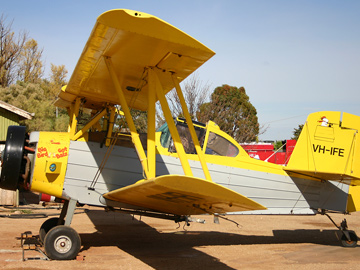
The ATSB continues to emphasise the importance of maintaining effective communication at non-towered aerodromes, after an airspace-related incident involving a Beech 200 Kingair, and an Ag-Cat bi-plane at Swan Hill Aerodrome, Victoria.
The incident occurred on 21 November 2012, when the Kingair was approaching to land on runway 26 at Swan Hill. The pilot had broadcast the aircraft’s position and his intentions both when joining the circuit, and again when turning onto base leg. There was no response. When the Kingair was about 2.7 km from the runway 26 threshold, the pilot noticed a crop-spraying bi-plane, commencing a right descending turn ahead of him, approaching the same runway.
The pilot of the Kingair immediately made a radio broadcast but received no response. The pilot of the Kingair elected to continue the approach, and monitor the biplane carefully. Both aircraft landed safely.
Communication at non-towered aerodromes is an ongoing safety concern...
The ATSB investigation found that the biplane was not fitted with a radio. The pilot normally maintained a listening watch on a hand-held radio device. However, to avoid damage from the weather and chemicals he removed the hand-held radio when the aircraft was not flying. On this occasion, the pilot had inadvertently left the radio at home. The bi-plane pilot reported conducting a thorough visual check of the runway 26 approach as he joined the circuit, but did not see the Kingair.
Communication at non-towered aerodromes is an ongoing safety concern for the Australian Transport Safety Bureau. ATSB research has found that of the 709 safety occurrences at non-towered aerodromes during 2003–08, 388 were attributed to a breakdown in communication. Safety around non-towered aerodromes has been highlighted in the ATSB’s Safety Watch initiative.
Read the final report: Airspace related event involving Kingair, VH-VAH and Ag-Cat, VH-IFE, Swan Hill Airport, Victoria, on 21 November 2012, which contains more details about the incident and links to useful educational material.