

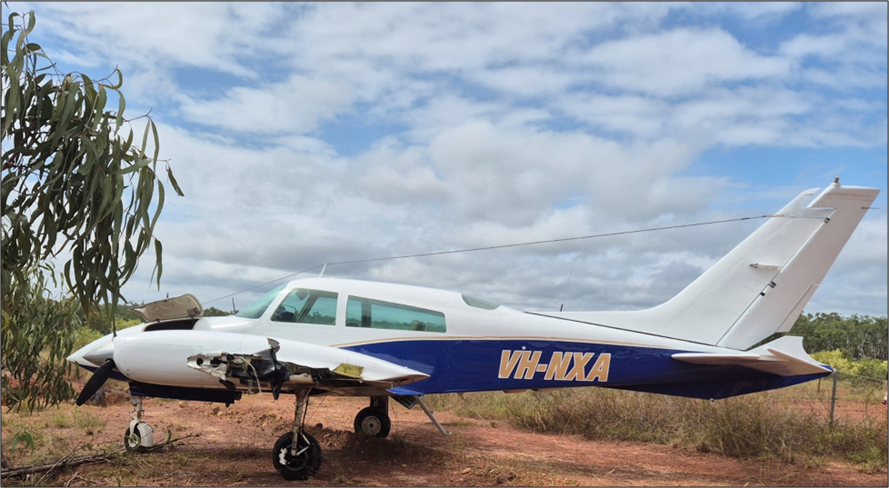
A Cessna 310 ran off the runway during landing following a fast and high approach to Lake Evella Airport in the Northern Territory, an ATSB investigation has found.
On 29 May 2025 the twin-engined Cessna 310R, operated by Marthakal Yolngu Airline, was operating a passenger charter flight from Darwin to Lake Evella with a pilot and four passengers on board.
Recorded data indicated the aircraft touched down almost halfway along the runway during its landing. It then veered off the runway and collided with a perimeter fence, damaging its left wing. No injuries were reported.
“The aircraft landed about 400 metres beyond the runway threshold after floating for a prolonged period,” ATSB Director of Transport Safety Dr Stuart Godley explained.
“This occurred after the pilot conducted the approach above the standard profile and the aircraft crossed the threshold above the normal approach speed.”
Despite landing long, the remaining runway length should have provided sufficient stopping distance, the investigation found. However, the aircraft’s braking performance was degraded due to a worn right brake pad and the lack of hydraulic fluid in the right brake system.
“A post-flight inspection found the right brake pads were worn beyond limits, and the right brake fluid reservoir was empty,” Dr Godley said.
During a scheduled maintenance event prior to the accident, a licensed aircraft maintenance engineer believed an apprentice had replaced the main-wheel brake pads, but did not verify this, the investigation report details.
Separately, while not found to have contributed to the accident, the ATSB also identified that the operator’s procedures allowed the use of self-reported passenger weights without additional allowances, and that the electronic weight and balance system had been configured with higher maximum weights applicable to a modification not fitted to this aircraft.
“In combination with calculation errors on the day, this resulted in the aircraft being operated above the maximum permitted ramp and take-off weights,” Dr Godley said.
The operator has since advised its electronic weight and balance system will be amended, and all references to the use of self-reported passenger weights for the purposes of weight and balance calculations will be removed in the next amendment of the operations manual.
This accident demonstrated how multiple factors can align to produce an undesired event, Dr Godley noted.
“For pilots, actively monitoring the flight path using instruments and external visual cues until a safe landing is assured should include identifying and nominating an appropriate touchdown point on the runway to ensure a go‑around can be executed if a touchdown beyond this point is likely to occur.
“For maintenance organisations, effective systems to disseminate important information to all maintenance personnel helps ensure emerging defects are identified and rectified before they affect flight operations.”
Read the final report: Runway excursion involving Cessna 310, VH-NXA, Lake Evella Aerodrome, Northern Territory, on 29 May 2025