

A power bank fire in the overhead locker of a Boeing 737 illustrates the importance of passengers following new airline guidance to keep their lithium battery devices easily accessible.
The final report from an ATSB investigation into the serious 21 July 2025 incident explains the Virgin Australia aircraft was descending towards Hobart when a cabin crew member identified smoke and flames coming from an overhead locker.
“While confirming the cabin was secure for landing, the cabin crew member heard what they described to the ATSB as a popping and hissing sound,” Chief Commissioner Angus Mitchell said.
“They then saw white smoke, then flames, emanating from an overhead locker above row 7.”
When the locker was opened, a passenger’s backpack was found to be on fire.
“Cabin crew doused the flames with a fire extinguisher and, with assistance from some passengers, poured water on the bag until no smoke was emitted.”
To reduce the risk of re‑ignition, a second fire extinguisher was discharged into the locker. Cabin crew instructed passengers to keep their heads down and cover their nose and mouth to avoid inhaling smoke.
Meanwhile, on being alerted to the fire by a cabin crew member, the flight crew broadcast a PAN PAN call to air traffic control, who provided clearance for the approach and landing, and alerted aviation rescue and firefighting services.
The aircraft, which had six crew and 149 passengers on board, landed safely in Hobart without further incident.
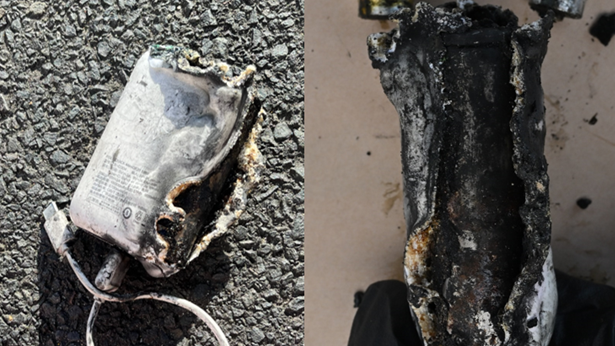
The ATSB investigation found a power bank inside the backpack had experienced a thermal runaway of its lithium-ion battery.
“Lithium battery thermal runaways and fires are difficult to manage, particularly in aircraft in flight,” Mr Mitchell said.
“With more devices carrying lithium batteries than ever, and as we enter a busy holiday season, it is important passengers understand and follow guidance provided by their airline around the packing and stowing of lithium battery devices.”
Virgin Australia(Opens in a new tab/window) now requires power banks, and spare and loose batteries, to be carried as carry-on baggage only, and to be protected against damage.
Batteries and power banks must now be individually protected to prevent short circuiting, and must be stowed in the seat pocket, under the seat in front, or in the passenger’s possession – not in the overhead lockers.
Australia’s other major airlines, Qantas(Opens in a new tab/window) and Jetstar(Opens in a new tab/window), also introduced revised lithium battery policies in mid-December.
“All passengers have a responsibility to ensure their lithium battery devices are packed safely and they are easily accessible in the cabin,” Mr Mitchell said.
“Further, they should not be brought on board an aircraft if they show any signs of damage or deterioration.”
Mr Mitchell also noted in the July incident the cabin crew could not complete Virgin Australia’s lithium battery fire procedures, due to the fire occurring 10 minutes prior to landing, when they also had the responsibility to ensure the cabin was secure.
“Airline procedures to manage battery fires are designed to limit the risk and reduce the likelihood of re-ignition of the battery until the aircraft can land. But it requires the batteries to be out of a bag and accessible to be easily completed.”
The ATSB’s investigation also found two cabin crew attempted to use the protective breathing equipment provided by the operator when managing the lithium battery fire, but did not find it effective due to fitment and communication/visibility issues.
“As the cabin crew were unable to use the protective breathing equipment, they had no protection from the smoke and were placed at an increased risk of smoke inhalation.”
Mr Mitchell concluded: “In-flight fires pose a significant risk to the safety of an aircraft if not managed quickly and appropriately.
“We urge passengers to familiarise themselves with their airline’s requirements before flying, and to check the Civil Aviation Safety Authority ‘Pack Right’ website(Opens in a new tab/window) to confirm that equipment they are planning to take on board an aircraft is permitted and packed safely.”
Read the final report: In-flight fire involving Boeing 737, VH-YFY, 56 km north-north-east of Hobart Airport, Tasmania, on 21 July 2025