Student pilot did not immediately identify an engine power loss, which limited the opportunities for a safe forced landing;
Helicopter impacted the roof of a house short of identified forced landing area, but pilot maintained control enough to maximise survivability;
Accident highlights importance of forward planning for possible forced landings shortly after take-off.
A helicopter’s collision with rooftops in Melbourne’s south-east demonstrates the challenges pilots face managing engine power loss at low level, an Australian Transport Safety Bureau investigation report explains.
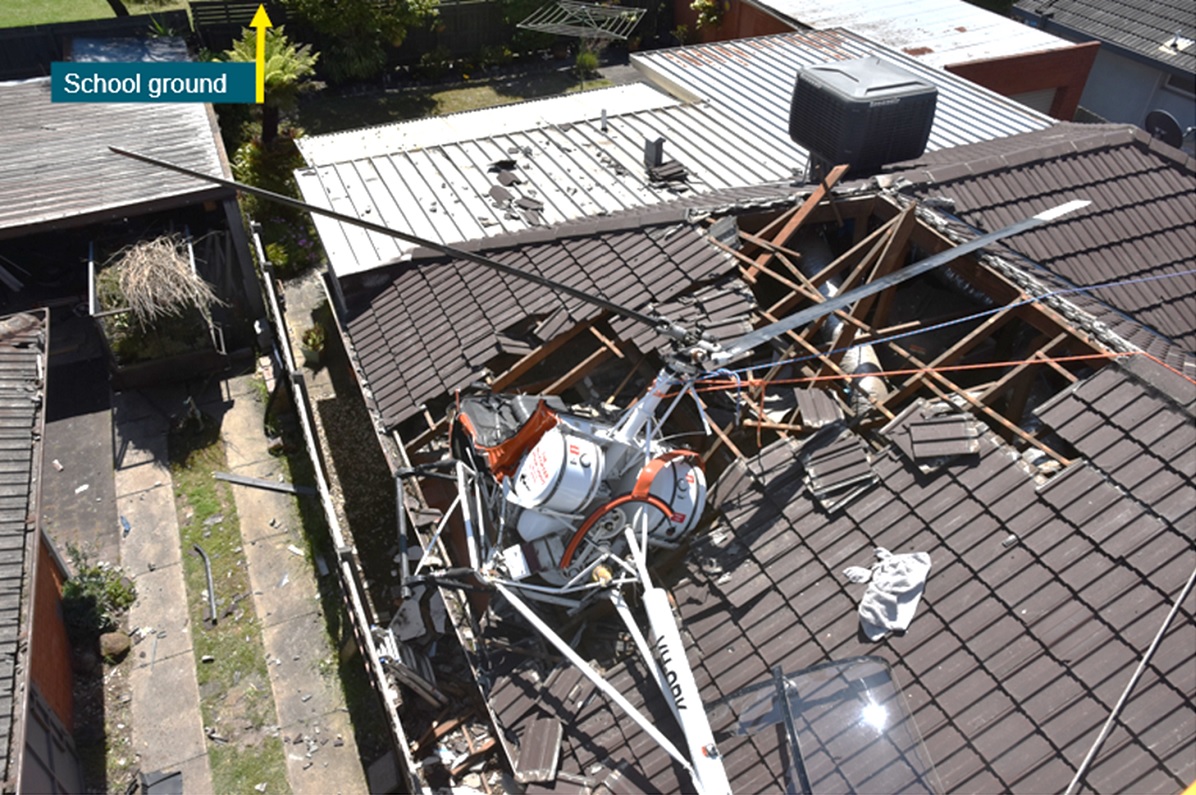
On the afternoon of 30 November 2022, a Hughes 269C three-seat light helicopter collided with the roofs of two houses near Moorabbin Airport, resulting in serious injuries to the solo student pilot, and substantial damage to the helicopter.
The pilot had been returning to Moorabbin after their second solo navigation training flight, when their approach became unstable, and they commenced a go-around.
“As the helicopter climbed to about 650 ft above ground level, the engine lost power,” ATSB Director Transport Safety Stuart Macleod said.
“While the pilot identified a reduction in performance at this time, they did not immediately recognise the engine had lost power.”
The report notes that while the pilot was troubleshooting the reduction in engine performance, the helicopter passed two suitable sites for a forced landing.
“When the pilot recognised a forced landing was required, they then did not identify a nearby football oval as the closest suitable area, possibly due to it being obscured by the airframe or instrument panel,” Mr Macleod said.
“Instead, they identified a school ground, and attempted a landing there, but collided with rooftops short of this intended location as the helicopter had insufficient height.”
The accident highlights the challenges pilots face when confronted with a loss of engine power at low level, and with few suitable landing areas available.
“Pilots can best mitigate the effects of a power loss by forward planning, which reduces your mental workload under stress,” Mr Macleod said.
The Civil Aviation Safety Authority has provided guidance on this topic, with its Guidelines for helicopters – suitable places to take off and land(Opens in a new tab/window) circular. This recommends that before take-off, pilots make themselves aware of suitable forced landing areas along their planned flight path, from the lift-off point to a safe manoeuvring height.
“The engine power loss occurred at low height over a densely populated area presenting a challenging scenario for the inexperienced student pilot,” Mr Macleod noted.
“While in this case, the selected landing location was unable to be reached, importantly, the pilot maintained control of the helicopter to maximise survivability.”
A pilot and passenger were fatally injured when their amateur-built Glasair aircraft collided with terrain in Sydney’s south-west;
Preliminary report details factual information gathered during ATSB’s evidence collection phase;
Investigation is on-going, with safety analysis and findings to be detailed in investigation’s final report.
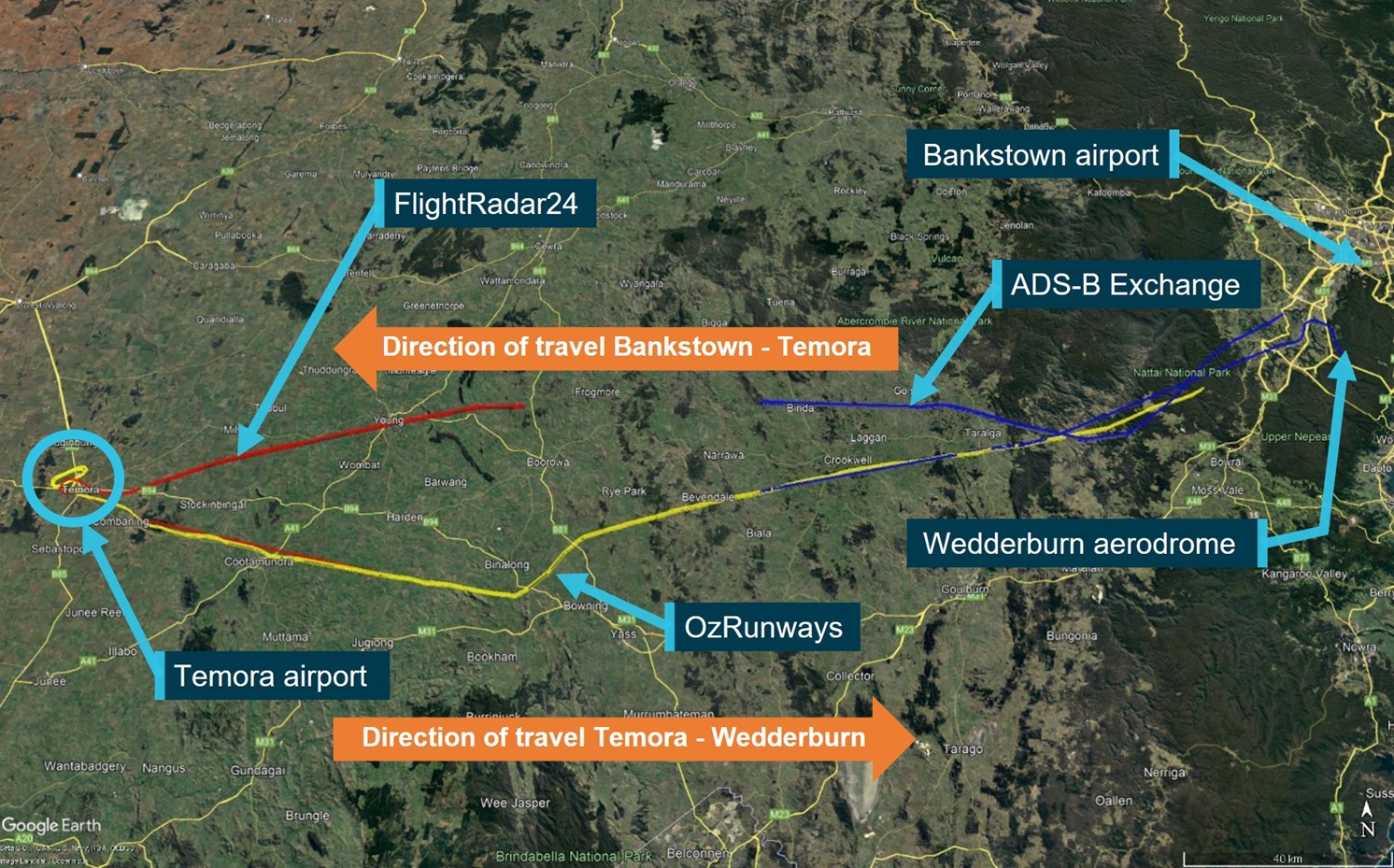
An amateur-built Glasair aircraft was observed conducting a shallow climb after take-off from Wedderburn airfield, south-west of Sydney, before colliding with terrain, a preliminary report from an on-going Australian Transport Safety Bureau investigation details.
The pilot and passenger, who co-owned the aircraft, were fatally injured when their Stoddard Hamilton Aircraft Glasair Super II FT impacted terrain 2.7 km from the end of runway 17 at Wedderburn, approximately 2 minutes after take-off, on 26 December 2022.
The report notes that, earlier on the day of the accident, the pilot and passenger had conducted the aircraft’s first flight since its reassembly following importing it from the United States in 2021. The aircraft, which had been assembled from a kit by its previous owner, was powered by a Subaru automotive engine modified for aviation use, and had accumulated about 60 flight hours before arriving in Australia.
“On the day of the accident, the aircraft was flown from Bankstown to Temora, then from Temora to Wedderburn,” ATSB Director Transport Safety Stuart Macleod said.
“While at Temora, it conducted two circuits, before landing and then setting off for Wedderburn, about an hour later.”
On arrival at Wedderburn, the aircraft was positioned on a wide circuit, and landed on runway 17 shortly before 3pm.
“For unknown reasons, the aircraft then became airborne again, and was observed by eyewitnesses and recorded by CCTV to have been in a shallow climb – enough to just clear rising terrain and trees at the end of the runway,” Mr Macleod said.
“About two minutes after disappearing from view, the aircraft collided with terrain, about 150 m from Appin Road.”
The wreckage of the aircraft was consumed by post-impact fire, which also started a small bushfire.
“To the extent possible due to the condition of the wreckage, on-site examination of the aircraft’s flight controls and structure did not identify any pre-existing faults or failures,” Mr Macleod noted.
“Several components have been retained by the ATSB for further examination, however.”
The on-going investigation will examine the aircraft’s maintenance history, its weight and balance and performance characteristics, and the meteorological conditions at the time of the accident.
“The ATSB will also analyse CCTV footage and flight track data, evaluate witness information, give consideration to the impact sequence and accident survivability, review flight planning considerations and pilot qualifications, experience and medical information.”
A final report, detailing the ATSB’s findings and analysis, will be released at the conclusion of the investigation.
“However, should a critical safety issue be identified during the course of the investigation, the ATSB will immediately notify relevant parties so appropriate and timely safety action can be taken,” Mr Macleod concluded.
ATSB interim report details timeline of events around propulsion failure of bulk carrier Portland Bay off Port Kembla, NSW, in July 2022.
ATSB will now review and assess gathered information, and conduct additional investigative activity, before providing safety analysis and findings in final report.
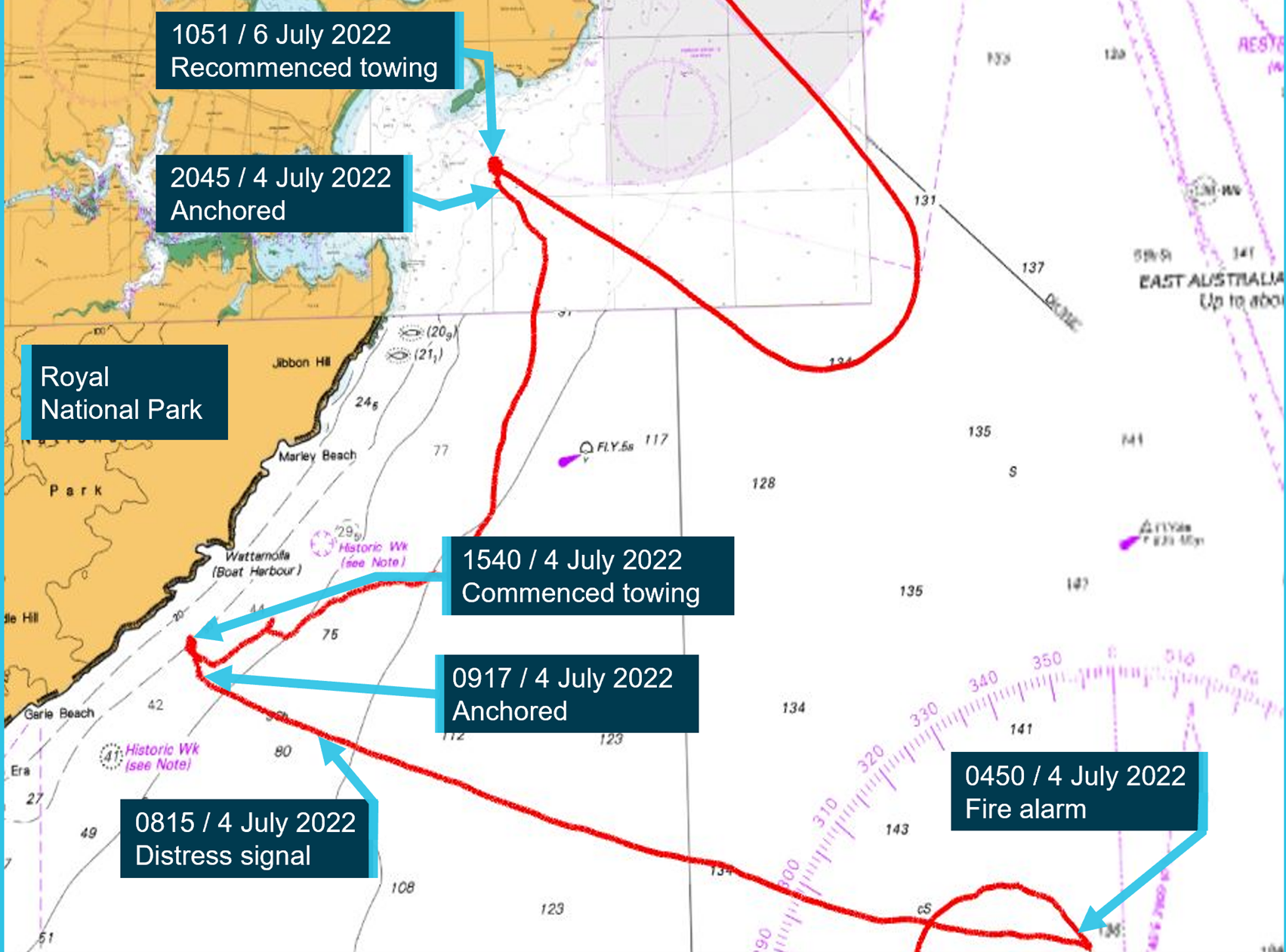
A timeline of events detailing a bulk carrier’s loss of engine power in heavy seas off Port Kembla, New South Wales, and the subsequent emergency response efforts to prevent the ship stranding on the coastline, is outlined in an Australian Transport Safety Bureau interim report.
The ATSB’s investigation into the incident is ongoing, and the interim report contains no analysis or findings, which will be detailed in a final report.
The interim report notes that the Hong Kong-flagged bulk carrier Portland Bay was berthed at Port Kembla’s outer harbour when, shortly before 11 am on 3 July 2022, it was directed by vessel traffic service to depart and get a safe distance from the coast, due to heavy winds and swells in the region.
Early the following morning, the ship was in bad weather off the coast when smoke from the one of the main engine’s auxiliary blowers activated fire detectors.
After the crew stopped the blower, the master found that the engine rpm was unable to go above dead slow ahead (about 42rpm), irrespective of requested engine setting for higher loads. Subsequently, the master notified the ship’s managers of the situation as a ‘main engine failure’.
“After attempts to increase engine rpm proved unsuccessful, just before 7am Portland Bay’s master notified Port Kembla VTS (vessel traffic services) via VHF radio that the ship’s main engine had ‘failed’, that it was drifting towards the coast and requested tug assistance,” ATSB Director Transport Safety Stuart Macleod said.
“After one tug arrived from Sydney and struggled to assist, with tow lines parting on multiple occasions, another two tugs arrived later in the day as the ship drifted closer to the coastline,” Mr Macleod said.
Portland Bay’s master deployed both its anchors to anchor the ship about 1.4 miles from the coast south of Sydney at about 8:45 pm.
A fourth, larger tug with greater towing capabilities arrived from Newcastle at about 1 pm on 5 July. It was able to work with the other tugs to tow Portland Bay to berth in Port Botany the following day.
Following the incident, a team of ATSB investigators attended Portland Bay in Port Botany to collect relevant documentary and recorded electronic evidence, and to interview the master and the chief engineer.
The ATSB also obtained relevant evidence from Pacific-Basin Shipping, the Australian Maritime Safety Authority (AMSA), Port Authority of New South Wales, Engage Marine, Svitzer Australia and the Bureau of Meteorology.
“As the investigation continues, we will review the ship’s activities and movements in relation to calling at Port Kembla and conduct further analysis of data from the voyage recorder to verify key event times,” Mr Macleod said.
The investigation will also review and assess the ship’s main engine maintenance and performance, including auxiliary blower operation.
“Emergency response, both on board the ship, and by authorities with respect to the State and National Plans, will also be reviewed,” Mr Macleod noted.
A final report, containing analysis, findings, and any potential recommendations or safety actions, will be released at the conclusion of the investigation.
“Should a critical safety issue be identified during the course of the investigation, the ATSB will immediately notify relevant parties so appropriate safety action can be taken.”
On 17 March 2023, the pilot of a Cirrus SR22, registered VH-XGR, was conducting a private flight under the instrument flight rules from Southport, Queensland to Bankstown, New South Wales.
During the landing, the aircraft sunk onto the runway and bounced along the runway for about 5 seconds, then rapidly entered a steep climbing turn to the left. Having reached a maximum height of about 40 ft, the bank angle exceeded 90° and the aircraft dropped onto the left wing and nose.
When emergency services arrived at the site, the aircraft was upside down on the grass between the runways. The left wing had detached, and fuel was leaking from the right side. The pilot was strapped in and conscious but confined in the aircraft.
Once the site had been blanketed with fire suppression foam and the aircraft stabilised with step blocks, ambulance personnel were able to attend to the pilot. Rescue personnel stabilised the wreckage and used a reciprocating saw to cut the left side of the inverted fuselage to extricate the pilot.
When the pilot was extricated, their condition suddenly deteriorated they were taken to hospital in a critical condition and later died from injuries sustained in the accident.
During the rescue process the site commander was advised that the aircraft was equipped with a ballistic parachute. A Cirrus-qualified maintenance engineer then attended to render the ballistic system safe from inadvertent activation.
What the ATSB found
In the early stages of a go-around from an unstable landing, the pilot was unable to counter the substantial torque effect associated with high engine power, low airspeed, and high pitch angle, resulting in loss of control and collision with terrain.
The emergency responders were initially unaware that the aircraft was equipped with a ballistic parachute (CAPS) and initiated the recovery of the pilot with the system still armed. By not securing the CAPS, the risk of inadvertent rocket activation and injury was increased.
Cirrus Aircraft provided training, education, and placards to reduce the risk of inadvertent post‑accident actuation of the ballistic parachute (CAPS) rocket and associated injury. However, the training and education had limited reach, and the placards did not clearly communicate the danger or provide access to safety information.
The ATSB also identified an opportunity for Cirrus to enhance the safety benefit of their go-around related training and educational products, especially in regard to the SR22 models that were equipped with relatively high-power engines.
What has been done as a result
Cirrus Aircraft advised that they had enhanced the external CAPS placarding on 2 new models of aircraft (the SF50, and another in development) to align with current American Society for Testing and Materials (ASTM) standards. The SR2X series of aircraft (the SR20, SR22, and SR22T) were certified prior to the implementation of ASTM standards. At the time of writing, Cirrus was reviewing the possibility of enhancing the placard that was certified with SR2X.
During the draft report review process the ATSB sought input from Cirrus as to whether there was an opportunity to enhance the safety benefit of their go‑around training and educational products, especially in regard to the SR22 models that are equipped with relatively high-power engines during the landing phase.
Cirrus did not advise of any associated safety action.
Safety message
A go-around to recover from an unstable landing is more dynamic and presents a greater challenge than a go-around on approach. Although the procedure for go-arounds generally applies to both scenarios, it requires careful application when implemented in the landing phase.
Pilots of single-engine aircraft with relatively high-power engines, such as the Cirrus SR22, need to be aware of the potential for significant torque effect and loss of control associated with high engine power, low airspeed, and high pitch attitude.
The Cirrus Airframe Parachute System (CAPS) is credited with saving a number of lives but also presents a serious post-accident hazard when it has not been deployed and the aircraft is damaged. If the rocket is inadvertently activated, anyone in its path would be seriously or fatally injured. Cirrus Aircraft advises first responders that it is imperative that the presence of an airframe parachute system be identified as early as possible, and the system disabled to make it safer to work around.
The ATSB directs first responders/emergency services and airport operators to the Advisory Guide For First Responders: Cirrus First Responders (cirrusaircraft.com) to provide awareness and reduce the risk of inadvertent post-accident activation of CAPS and to the ATSB webpage ‘Hazards at aviation accident sites’.
Decisions regarding the scope of an investigation are based on many factors, including the level of safety benefit likely to be obtained from an investigation and the associated resources required. For this occurrence, a limited-scope investigation was conducted in order to produce a short investigation report and allow for greater industry awareness of findings that affect safety and potential learning opportunities.
The occurrence
On 17 March 2023, the pilot of a Cirrus SR22, registered VH-XGR, was conducting a private flight under the instrument flight rules[1] from Southport, Queensland to Bankstown, New South Wales.
The aircraft departed Southport at 1211 Eastern Standard Time[2] and tracked initially to the south‑west. After a couple of minutes, the pilot turned the aircraft onto a southerly heading for the relatively direct track to Bankstown. The pilot initially climbed the aircraft to FL 180[3] for a couple of minutes then descended to FL 160 for the remainder of the cruise phase of the flight. All of the flight parameters—track, altitude and groundspeed—indicated normal operation.
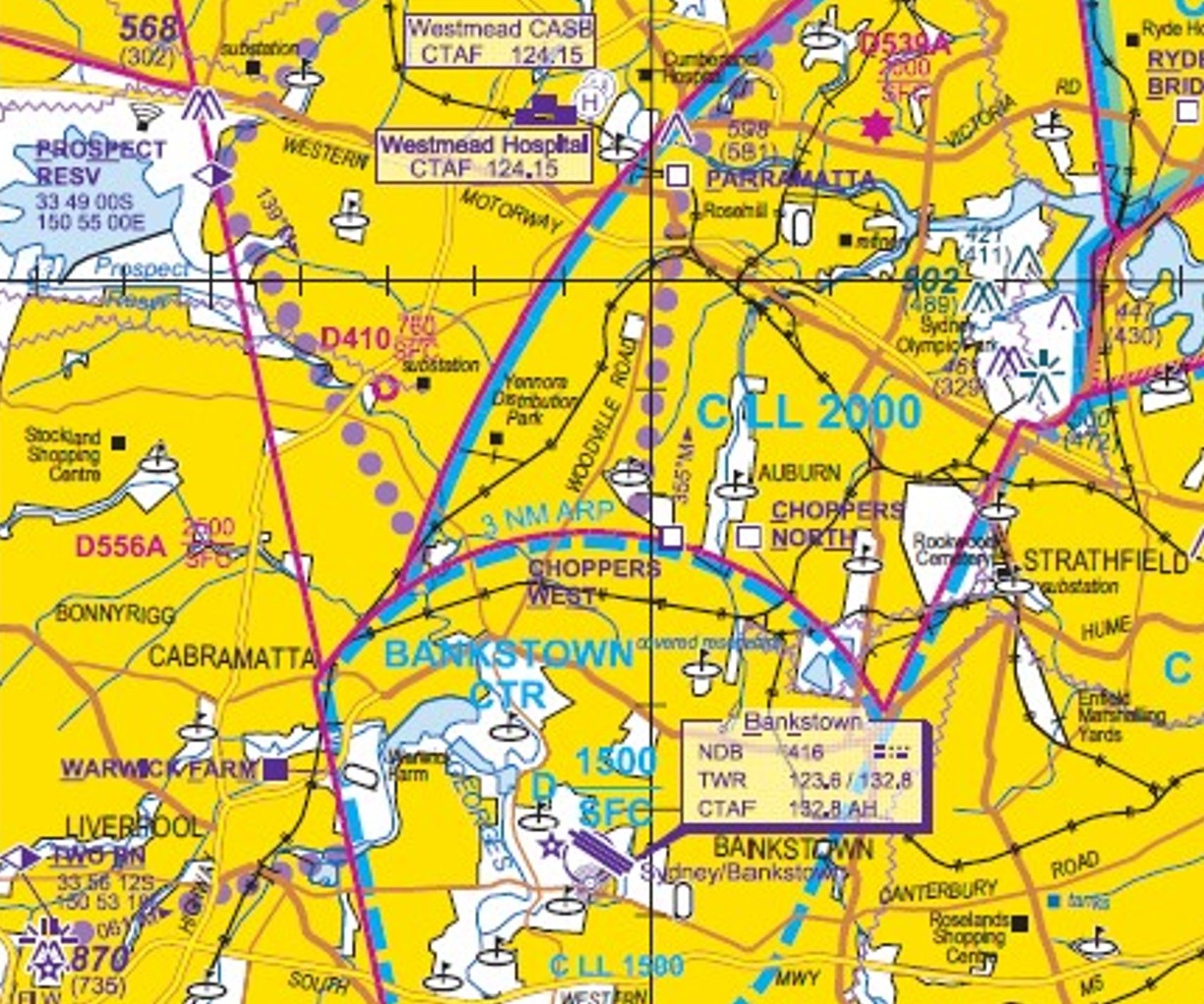
At 1504 Eastern Daylight-saving Time,[4] the pilot commenced descent and altered track slightly. There were other minor track changes, consistent with air traffic control (ATC) or airspace requirements, as the flight progressed towards visual flight rules (VFR)[5] reporting point Prospect Reservoir (Figure 1).[6]
Figure 1: Sydney VTC extract showing Prospect Reservoir in top left corner and Bankstown Aerodrome in lower middle of image
Source: Sydney VTC
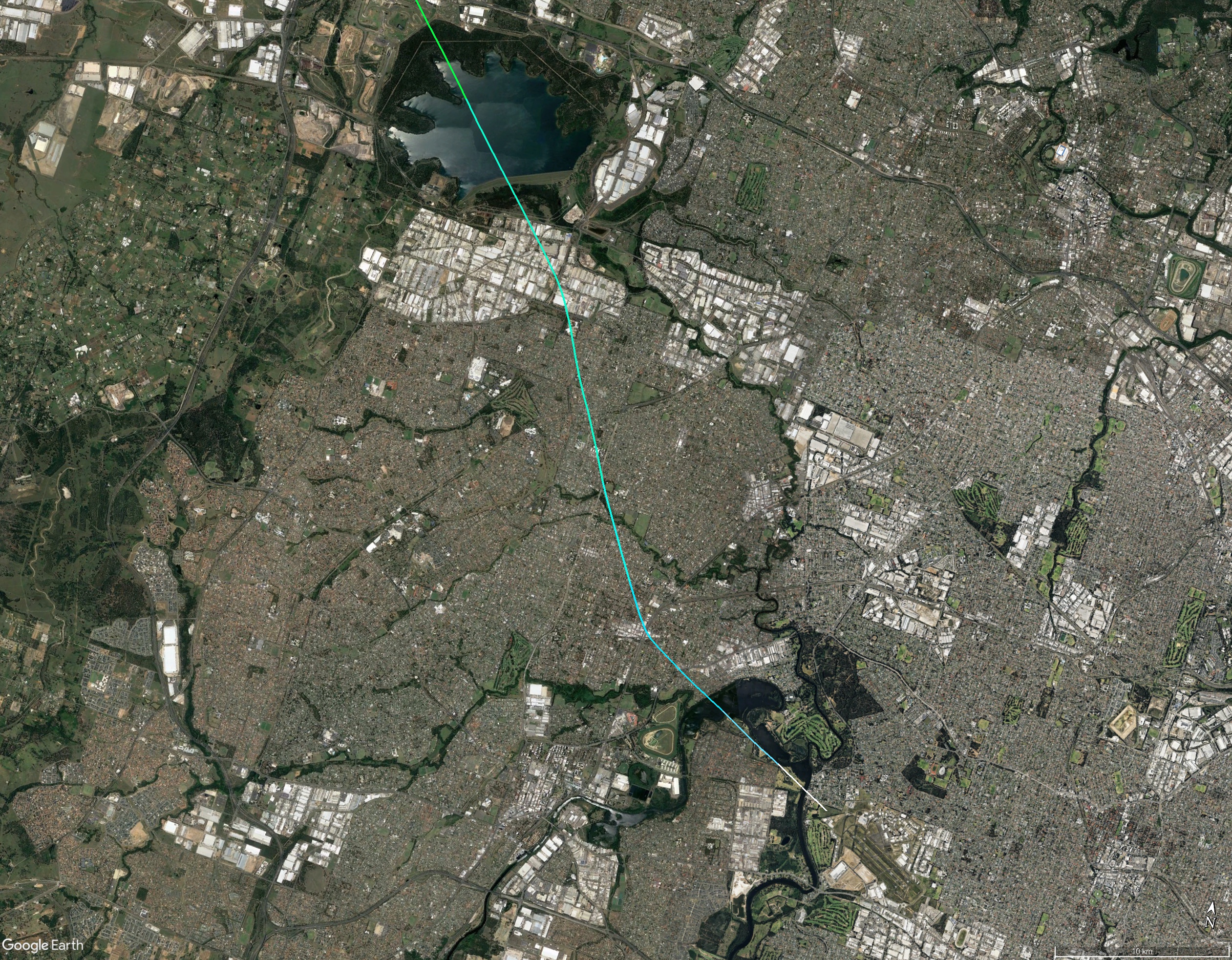
At 1533, the aircraft was over Prospect Reservoir on descent through 1,900 ft and tracking towards Bankstown Airport (Figure 2). Shortly after, the pilot transmitted on the applicable Bankstown Tower frequency:
Bankstown Tower, Cirrus xray golf romeo (XGR), Prospect, 1,800, inbound with information November, and visual.
In response, the aerodrome controller (ADC) instructed XGR to:
Join final runway 11 Left[7] and report established at 3 miles. VFR traffic about 2 miles is a Tecnam. If you get a bit too close you can expect runway centre.
This was acknowledged by the pilot of XGR.
About 20 seconds later, the ADC advised XGR:
I’ll make that a plan now, join final for runway 11 Centre. Report established 3 miles. Traffic is that Tecnam ahead.
This was acknowledged by the pilot of XGR.
The ADC passed traffic information to the Tecnam with advice that the Cirrus would be overtaking to the right and to shift slightly to the left. This was followed by some traffic guidance to the pilot of XGR:
XGR suggest a slight right turn, the Tecnam is in about your one o’clock at 1 mile.
This was associated with a diversion of track slightly to the right for a minute and 15 seconds.
The pilot then turned left to align the aircraft for final approach to runway 11C. At this point (1535:19), the aircraft was 2.87 NM (5.3 km) from the runway threshold, slowing down through 106 kt groundspeed, and about to descend from 950 ft.
As XGR was being turned onto finals, the ADC advised:
XGR runway centre number 1. Additional traffic is a Diamond late right downwind in the training circuit [runway 11 Right].
This was acknowledged by the pilot of XGR.
At 1535:45, the ADC advised:
XGR runway centre cleared to land
This was promptly read back by the pilot of XGR:
Cleared to land on centre, XGR
That was the last communication with the pilot of XGR. At that point, XGR was 1.9 NM (3.5 km) from the threshold, on descent through 725 ft, and slowing down through 90 kt groundspeed.
As the approach continued, the groundspeed continued to slow until reaching a groundspeed of 60 kt while on descent through 350 ft. The groundspeed varied between 60 and 63 kts until the last data point recorded at 100 ft.
Figure 2: Track from Prospect reservoir to Bankstown Airport
Source: Google Earth, annotated by the ATSB
Although some witnesses noted the speed of the Cirrus was relatively slow, there were no reports of anything abnormal until the landing. The landing was observed by pilots on concurrent approaches to the adjacent runways, and the aerodrome controller. A security camera recorded imagery of the accident sequence.
The instructor in the right seat of the Tecnam (at about 200 ft on final for runway 11 Left) observed the Cirrus touchdown on the runway and bounce into the air to a height of about 10–20 ft. They advised that the aircraft appeared to be very slow, and it bounced again with low energy, with white dust evident from the tail area. It then started to veer to the right, pitched up violently and started to bank steeply to the left (towards runway 11 Left). Concerned about separation, the instructor initiated a go-around. The Cirrus came down on one wing and tumbled onto the roof, stopping quickly.
The instructor in the right seat of the Diamond (on short final for runway 11 Right) observed the Cirrus over the runway in a very high nose attitude and veering right. They advised that it then rolled sharply to the left, dropped the nose, and tracked over the grass between runways 11 Centre and 11 Left. The left wing impacted the ground first, followed by the nose, then flipped over onto the canopy.
The ADC was observing the Cirrus as it was about to touch down. They advised that they saw the aircraft pitch up and reach about 30–40 ft then roll to the left. As the aircraft was crossing over towards runway 11 Left, the ADC issued a safety alert to the Tecnam (1537:38). It appeared to the ADC that the aircraft was accelerating as the left-wing tip impacted the ground followed by the nose.
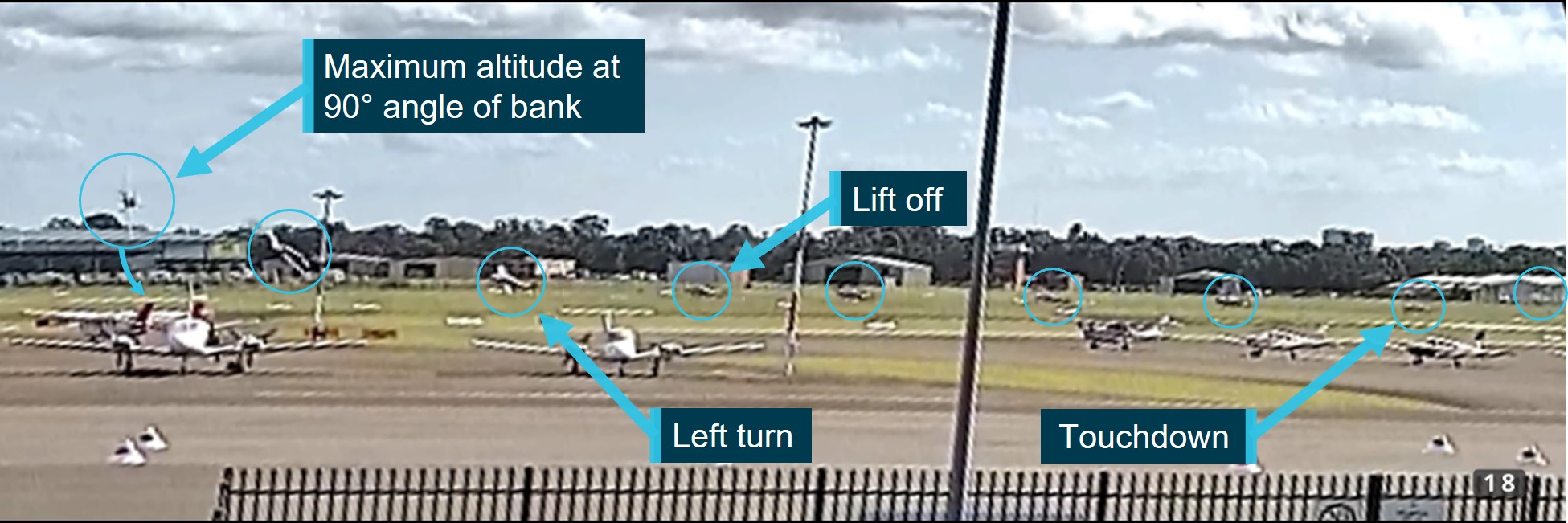
A camera mounted on the Bankstown Airport passenger terminal[8] recorded low resolution imagery of the accident sequence (Figure 3). It showed the aircraft sinking onto the runway, proceeding along the runway for about 5 seconds, then rapidly entering a steep climbing turn to the left. Having turned through 90° and reached a maximum height of about 40 ft, the bank angle exceeded 90° and the aircraft dropped onto the left wing and nose. This was also recorded by a camera in a different location.
Figure 3: Bankstown Airport terminal CCTV showing sequence from initial touchdown to just before impact (right to left)
Source: Bankstown Airport edited and annotated by the ATSB
Bankstown Tower activated the aerodrome emergency plan, including notification to emergency services and the aerodrome reporting officer. The airport was subsequently closed, and traffic was processed out of the control zone.
New South Wales (NSW) Police Force personnel arrived within 5–8 minutes of the notification, followed by NSW Ambulance. Fire and Rescue NSW (FRNSW) crews arrived about 8.5 minutes from receiving the call. Bankstown Fire Station crews usually responded to incidents at the airport, but they were unavailable so crews from Revesby Fire Station attended.
When emergency services arrived at the site, the aircraft was upside down on the grass between the runways. The left wing had separated, and fuel was leaking from the right side. The pilot was strapped in and conscious but confined in the aircraft.
The responding FRNSW crews did not include technical rescue personnel, so the site commander arranged for that expertise to attend. Once the site had been blanketed with foam and the aircraft stabilised with step blocks, ambulance personnel were able to attend to the pilot.
Before starting the rescue, the crew strapped the rear fuselage to the ground. They then used a reciprocating saw to cut the left side of the inverted fuselage to extricate the pilot. The FRNSW personnel were unaware of any aircraft type-specific hazards and did not notice any no-cut labels on the aircraft.
When the pilot was extricated, their condition suddenly deteriorated, and they were taken to hospital in a critical condition.
About 15 minutes into the rescue process, the FRNSW site commander was advised that the aircraft was equipped with a ballistic parachute. The commander had a general awareness that a ballistic parachute was installed in the tail but found it difficult to get information about its operation. The airport owner arranged for a Cirrus-qualified maintenance engineer to render the ballistic parachute system, known as the Cirrus Airframe Parachute System (CAPS), safe from inadvertent activation.
The maintenance engineer advised that they inserted a pin into the CAPS activation handle located in the cabin ceiling and taped it into place. They inspected the activation mechanism in the rear cargo compartment and found that the activation cable was not under tension and the rocket igniter switch firing pin had not moved. The electrical wires were not disconnected because of concern about the fuel spillage. On the day after the accident, the engineer disconnected a battery in the tail but, due to aircraft damage, was unable to access an additional battery in the front of the aircraft.
Another Cirrus-qualified maintenance engineer who attended the aircraft the day after the accident advised that there was tension on the activation cable, and it was only marginally lower than the force required to move the pin. To render the CAPS safe for recovery of the wreckage, the engineer cut the activation cable and disconnected the electrical leads from the igniter switch.
The pilot died in hospital on 6 April 2023 from injuries sustained in the accident.
Context
Pilot information
The pilot held a private pilot licence (aeroplane), issued in 2011, with a single engine aeroplane rating. In addition, the pilot held a single engine aeroplane instrument rating and Night VFR rating.
In February 2023, the pilot had recorded total flying experience of 860 hours, including 47 hours in the previous 6 months. Almost all of the total experience and all of the recent experience was reported to be operating VH-XGR.
The last training or check completed by the pilot was an instrument proficiency check (IPC) in VH‑XGR. This was attempted on 8 February 2023 but was not successful. The flight examiner advised that during a hand-flown instrument approach the pilot had allowed the aircraft to descend below the glidepath indication and develop a high rate of descent.
As recommended by the flight examiner, the pilot then conducted some VFR flying (without an instructor) and a pre-IPC practice flight with the flight examiner. On 2 March 2023, the pilot attempted the IPC again with the flight examiner and was successful.
The flight examiner recalled that over the course of the 2 recent IPCs, and associated practice flights, the pilot’s general flying, including circuits and landings, was unproblematic. Although those flights included a number of go-arounds that were safely executed, the flight examiner had discussed with the pilot the need to be cautious when applying power during go-arounds to ensure the aircraft remained easy to control.
The flight examiner had completed the Cirrus Standardised Instructor Pilot training in 2020 and been involved in the pilot’s flying training and assessment during the previous 3 years.
The pilot’s last aviation medical examination, conducted on 28 February 2023, was for a Class 2 medical certificate. This was revalidated by the designated aviation medical examiner with continuation of the restrictions that distance vision correction must be worn and reading correction to be available while flying.
At the time of drafting the report, the postmortem report was not available. However, analysis of the radio transmissions made by the pilot to Bankstown Tower showed that these transmissions were appropriate and there were no indications of any abnormalities—slowed/slurred speech patterns or simple errors—which could indicate a medical issue.
Environmental conditions
The aerodrome forecast for Bankstown Airport issued at 1534 local time anticipated that between 1500 and 1700 the wind would be from 130 degrees (True) at 17 kt, visibility would be greater than 10 km with no cloud, temperature over the same time period was forecast to be 28°. At 1530, the wind was reported from 090 degrees (True) at 16 kts and the other conditions were consistent with the forecast.
Wind speed and direction were recorded at Bankstown airport every minute. Those observations in the 2 minutes before and after the accident are presented in Table 1.
Table 1: One-minute wind observations at Bankstown Airport on 17 March 2023
Local Time
Wind speed (kt)
Wind direction (Degrees True)
1536
16
106
1537
15
106
1538*
14
099
1539
17
104
1540
15
100
*The closest observation to the time of the accident was at 1538. At that time, the angle between runway 11 (111° magnetic) and the recorded wind from the left (086° magnetic) was 25°. That provided a crosswind component of 6 kt from the left and headwind component of 13 kt. There was no significant variation in the minute before or after that time.
Operational information for Bankstown Airport in the En Route Supplement Australia (ERSA) cautioned that:
During winds with a southerly direction, building induced mechanical turbulence may be experienced on final for RWY 11C and RWY 11R/29L.
Although the prevailing wind was not from a southerly direction, the ATSB considered the potential for mechanical turbulence. The closest buildings in line with the direction of the wind were no higher than 3 levels and located at least 900 m from the threshold of runway 11 Centre. Given the wind strength and the distance of the buildings, it is unlikely that the buildings had any significant effect on the conditions for landing on runway 11 Centre.
The instructor in the Tecnam advised that on approach and landing to runway 11 Left there was no significant crosswind or mechanical turbulence, and the conditions were relatively smooth. In addition, the ADC did not notice any disturbance to the flight path of aircraft on approach.
Operating procedures
The Cirrus SR22 Pilot’s Operating Handbook included a procedure for balked landing/go-around:
In a balked landing (go around) climb, disengage autopilot, apply full power, then reduce the flap setting to 50%. If obstacles must be cleared during the go around, climb at 80-85 KIAS with 50% flaps. After clearing any obstacles, retract the flaps and accelerate to the normal flaps up climb speed.
Pilot training and operational guidance
Pilot training and assessment
Pilot training and assessing in Australia was carried out in accordance with the CASR Part 61 manual of standards (MOS). The competency standards for the Land Aeroplane unit included elements and performance criteria for conduct of a missed approach and recovery from a missed landing.
For both sequences, the criteria was to make a smooth positively-controlled transition from approach or missed landing to a missed approach including selection of power, attitude and configuration to safely control the aeroplane. The causes of loss of control during landing and contents of the pilot’s operating handbook were part of the underpinning knowledge requirements.
The competency standards for night VFR and instrument approaches included the conduct of missed approaches.
To safely exercise the privileges of a rating, a pilot must have completed a flight review for the rating within the previous 2 years. Once the pilot demonstrated competency in accordance with the Part 61 MOS, the instructor was able to assess it as completed.
An instrument proficiency check (IPC) is an assessment of the pilot’s competency to conduct a flight in actual or simulated instrument meteorological conditions under the IFR to the standards specified in the Part 61 MOS. An IPC included missed approaches in the context of instrument approaches and was valid for 12 months.
Cirrus training and guidance material
Cirrus Aircraft provided an instructor pilot course intended to prepare qualified instructors with SR20/22 experience to provide high-quality standardised training to owner-pilots and students using Cirrus Aircraft-approved resources. The course included the demonstration, teaching, and assessment of landings and go-arounds with an emphasis on flight operations manual (FOM) procedures and use of the TOGA button, and memory items.
Online training and education for pilots was also available through the Cirrus Approach portal. This included the FOM for the SR series aircraft that addressed standard operating procedures applicable to the traffic pattern, stabilised approaches, landings, and go-arounds.
One of the specialty courses was ‘SR series Take-offs and Landings’ and 2 of the shorter presentations hosted on YouTube (Flight Fix) addressed go-arounds and stable approaches.
The following information, selected for relevance to the occurrence, has been adapted from the FOM and online training/education resources.
It was recommended that the autopilot was disconnected prior to entering the traffic pattern (circuit) and the yaw damper was off prior to landing.
For final approach, the target indicated airspeed (IAS) was 80 kt with full flap and engine power as required. One of the common errors on approach was not compensating for ballooning when deploying the flaps, resulting in excessive loss of airspeed and/or altitude gain.
A stabilised approach was defined as constant angle and constant rate of descent approach profile ending near the touchdown point. If this was not achieved, a go-around must be carried out. In addition, a go-around was recommended in situations such as excessive ballooning during landing or excessive bouncing.
A go-around was presented as a 4-part flow comprising:
Power Up – immediately but smoothly apply full power (as for take-off – typically 4–5 seconds), connected right rudder due to significant left turning tendencies (possible strong pitch up), and simultaneously;
Pitch Up – smoothly and initially to level attitude and begin accelerating. If the aircraft has a TOGA button and it is pushed, it provides pitch guidance on the primary flight display (PFD)
Clean Up – retract flaps to 50% then as the aircraft speed increases gently transition to Vx [speed for best angle of climb] or Vy [speed for best rate of climb]. When positive rate of climb and obstacles are cleared above flap retract speed of 80 KIAS, retract flaps to zero
Call Up – communicate as required.
Common errors included not maintaining coordination during the go-around, and improper pitch control resulting in excessive loss of altitude, stall entry, or both. This could occur if the aircraft was climbed out of ground effect before a safe airspeed was reached.
Landing technique including in a crosswind was conventional. Common errors included the pilot flaring too high and creating a stall to hard landing situation.
Rejected landing and go-around aerodynamics
Engine power changes can affect stability. An increase of power may tend to make the nose rise (low thrust line tends to add to nose-up effect of horizontal tail surface). This effect can be exacerbated with full flap.
In a single-engine propeller-driven aircraft, application of engine power will produce ‘torque’ in the form of a twisting or rotating motion around at least one of the 3 axes. For an aircraft with a clockwise rotating propeller (viewed from the cabin) such as the Cirrus SR22, the overall result will be a left turning tendency. This is the combined effect of 4 elements, which are briefly explained in the context of a clockwise rotating propeller.
Torque reaction: as described by Newton’s Third Law of Physics, the revolution of the engine and propeller in one direction produces an equal force trying to rotate the aircraft in the opposite direction. As this induces a roll to the left when the aircraft is airborne, the design will generally compensate for this tendency in cruise (for example, by an offset engine and by provision of aileron trim). During the take-off roll, the increased loading on the left main wheel produces relatively higher drag and a turning moment to the left. The magnitude of the left roll and turn tendency is dependent on:
size and power of the engine
size of propeller and RPM
size of the aircraft
condition of the ground surface.
Corkscrew effect: At high propeller RPM and low forward speed, the spiral or corkscrew rotation of the slipstream exerts a sideways force on the vertical fin, which produces a yawing moment to the left. In addition, the corkscrew flow of the slipstream produces a rolling moment to the right around the longitudinal axis. Although these forces may be counteracting each other, they vary greatly and require the pilot to apply the necessary corrective action.
Gyroscopic action: as a spinning rotor, the propeller is subject to gyroscopic precession when a force is applied to the rim of the plane of rotation. In simple terms, any yawing about the vertical axis results in a pitching moment and any pitching around the lateral axis results in a yawing moment.
Asymmetric loading (P-factor): when an aircraft is flying with a high angle of attack, the effectiveness of the downward moving blade is greater than that of the upward moving blade. This moves the centre of thrust to the right, which results in a yawing moment towards the left around the vertical axis.
Aircraft information
General information
The aircraft was manufactured in 2009 by Cirrus Design Corporation in the United States to a GTS equipment specification and with G3 model features such as a redesigned carbon fibre wing. It was registered in Australia as VH-XGR in the same year.
Although produced as an SR22, which was certified with a normally aspirated Continental Motors Inc. IO-550-N engine, the aircraft engine had been modified during manufacture in accordance with a supplementary type certificate. This involved installation of a Tornado Alley Turbo Inc. Turbonormalizing System that was designed to maintain sea-level performance of 310 hp up to the maximum altitude of 25,000 ft. As such, it was referred to as an SR22TN.
One of the features of the aircraft was a single-lever power control that adjusted engine throttle with automatic adjustment of engine speed through a mechanical linkage to the propeller constant speed unit. The system was set to maintain approximately 2,500 RPM at cruise power settings and 2,700 RPM at full power.
The aircraft was also equipped with an oxygen system to allow the pilot to operate over 10,000 ft in the unpressurised cabin. A fingertip oximeter was located in the cabin after the accident.
Conventional flight controls are operated mechanically by a single-handed side control yoke and rudder pedals. Pitch and roll trim was provided through adjustment of the neutral position of a compression spring cartridge by means of an electric motor in each control system. These were intended to allow easy override of full trim or autopilot inputs by using normal control inputs. Pilot control was effected by movement of a conical trim button on the control yoke.
Yaw trim is provided by a spring cartridge in rudder control system that provided a centralising force, regardless of the direction of rudder deflection. This was not adjustable in flight.
Avionics and instrumentation
The aircraft was equipped with the Cirrus Perspective Integrated Avionics System developed by Garmin. Flight instrumentation, position, navigation, communication, and identification information were displayed through a primary flight display (PFD) and a multifunction display (MFD). An automatic flight control system (AFCS) provided flight director, autopilot, yaw damper, and manual electric trim functions.
Indicated airspeed is displayed on the PFD by a moving tape with a rolling number gauge. The colour-coded tape showed the low-speed range as a red strip up to the low-speed awareness velocity (VLSA). An airspeed trend vector in the form of a variable-length magenta vertical line showed the projected indicated airspeed in 6 seconds (for constant rate of acceleration or deceleration). When selected on, V speeds such as Vx (best angle of climb) and Vy (best rate of climb) were displayed next to the airspeed scale.
Key engine parameters are displayed on the left side of the MFD during normal operations, including analogue style power indication (percentage) and numeric values for power, RPM and manifold pressure.
A carbon monoxide detector generated a CO LVL HIGH annunciation when the carbon monoxide level was greater than 50 ppm.
The aircraft was equipped with an electro-pneumatic stall warning system to provide audible warning of an approach to an aerodynamic stall. At approximately 5 kt above the stall (full flaps, power off, level flight) and slightly higher in turning and accelerated flight, a warning horn will sound and a red stall warning annunciation will illuminate.
Electronic stability and protection is an optional feature to discourage exceedance of attitude, airspeed and angle of attack parameters through corrective control pressures. This will only function above 200 ft above ground level and when the autopilot is off.
An aircraft data logger system acquires serial information from the primary integrated avionics unit and transmits it to the recoverable data module located in the vertical stabiliser. The PFD and MFD had the capability to record flight and engine data on SD cards.
Occupant safety features
A composite roll cage within the fuselage structure provided roll protection for all occupants. The lower firewall was designed to improve crashworthiness. The seat bottoms have an integral aluminium honeycomb core designed to crush under impact to absorb downward loads. Integrated seat belt and shoulder harness assemblies with inertia reels were provided for each occupant. The front seats utilised a 4-point inflatable restraint system.
An inflatable shoulder harness is integral to each front seat harness. In the event of a collision, the sensor evaluates the force pulse and sends a signal to an inflator assembly mounted in the aft seat frame. This signal releases the gas in the inflator and rapidly inflates the airbag within the shoulder harness cover.
As is standard for SR series aircraft, the aircraft was equipped with a Cirrus Airframe Parachute System (CAPS). Cirrus Aircraft reported that there had been 124 CAPS Saves (deployments) that resulted in 254 lives saved. CAPS consisted of the following primary components:
parachute
solid-propellant rocket to deploy the parachute
rocket activation handle and cable
harness embedded in the fuselage structure.
The parachute and rocket were located in a compartment behind the rear baggage compartment. The rocket activation handle was mounted in a cabin ceiling enclosure between the 2 front seats and the cable was routed through the cabin ceiling and angled towards the left side of the CAPS compartment.
To initiate the CAPS, the pilot removes the access cover and pulls the rocket activation handle out and down. Movement of the cable compresses the igniter steel spring and cocks the plunger. When one half-inch of plunger travel is reached, the primary booster is ignited, which then ignites a secondary booster and the rocket motor. For aircraft with electronic ignition for the booster, both aircraft batteries are connected to the system and either can actuate the booster in response to cable movement.
Once ignited, the rocket impacts and dis-bonds the parachute compartment cover situated behind the rear cabin window and pulls the deployment bag from the enclosure. The deployment bag then stages the suspension line deployment and inflation of the parachute.
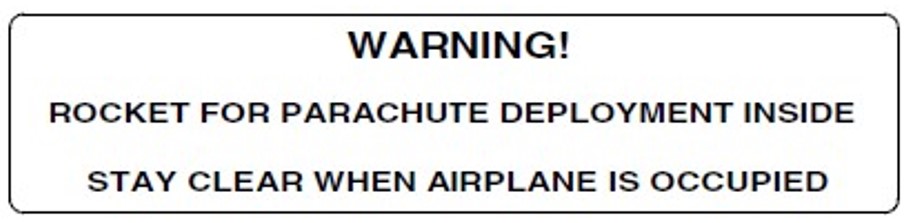
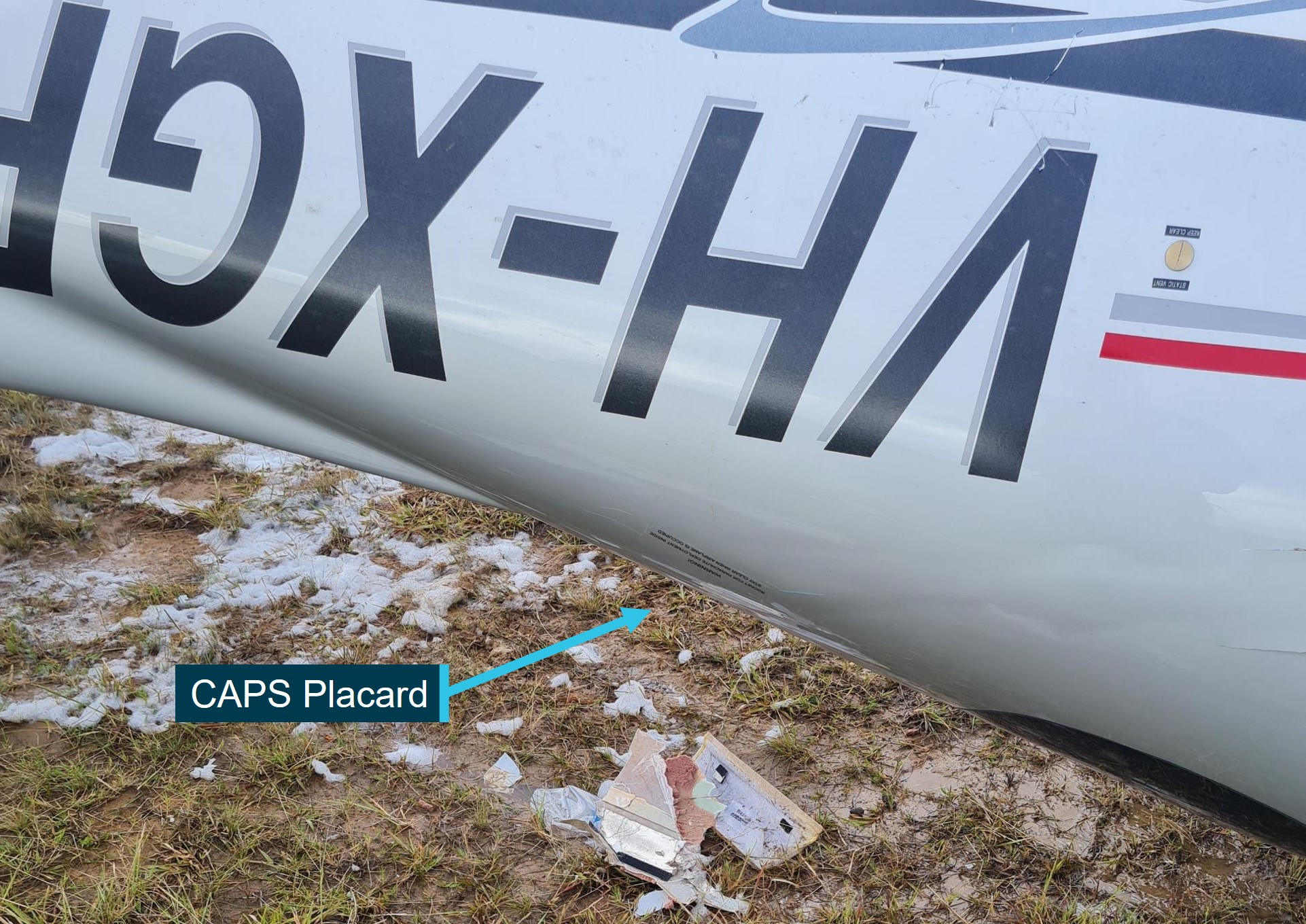
On the upper fuselage, either side of the CAPS rocket cover was a placard approximately 16.5 cm long (Figure 4).
Figure 4: CAPS Placard
Source: Cirrus SR22 POH
Maintenance
The last 100-hour/annual inspection was completed on 13 January 2023 when the aircraft total time in service was 857.1 hours. According to the aircraft log book, the annual inspection was carried out in accordance with the Cirrus SR22 aircraft maintenance manual and included:
scheduled inspection of the oxygen system
scheduled inspection and check of the autopilot servos
software update to Perspective Avionics
MFD lower SD card slot and card contacts cleaned (due to supplemental data intermittently unavailable)
scheduled check of the aircraft data logger system (RDM).
The scheduled check of the aircraft data logger system involved accessing the diagnostic LED and confirming that the rate and duration of the LED blinking indicated normal operation. According to the maintenance organisation, this was carried out with nil defects identified.
The only subsequent maintenance was carried out on 15 March 2023 at 887.1 hours total time in service. In response to pilot concern about uneven EGT burn at altitude, the maintenance organisation checked the magneto timing and found it within limits. And as engine data showed a spark plug irregularity, those plugs were cleaned, tested, and reinstalled.
Cirrus first responder information
The aircraft manufacturer produced a comprehensive Cirrus 1st Responder Information Manual to inform emergency services of the potential hazards they may encounter when working on or around a Cirrus aeroplane at an accident site. This focussed on CAPS and addressed other hazards such as oxygen bottles, airbag seatbelts, and composite materials. The manual and other safety information including a video was available at Cirrus First Responders (cirrusaircraft.com). In addition, Cirrus Aircraft advised that they had trained thousands of first responders in on-site and classroom contexts.
According to the manual, it is imperative that the presence of an airframe parachute system be identified as early as possible when responding to an aviation mishap and the system disabled to make it safer to work around. In certain circumstances it may be advisable to secure an accident site and have a Cirrus trained technician attend to disable or disarm the system prior to proceeding with recovery efforts.
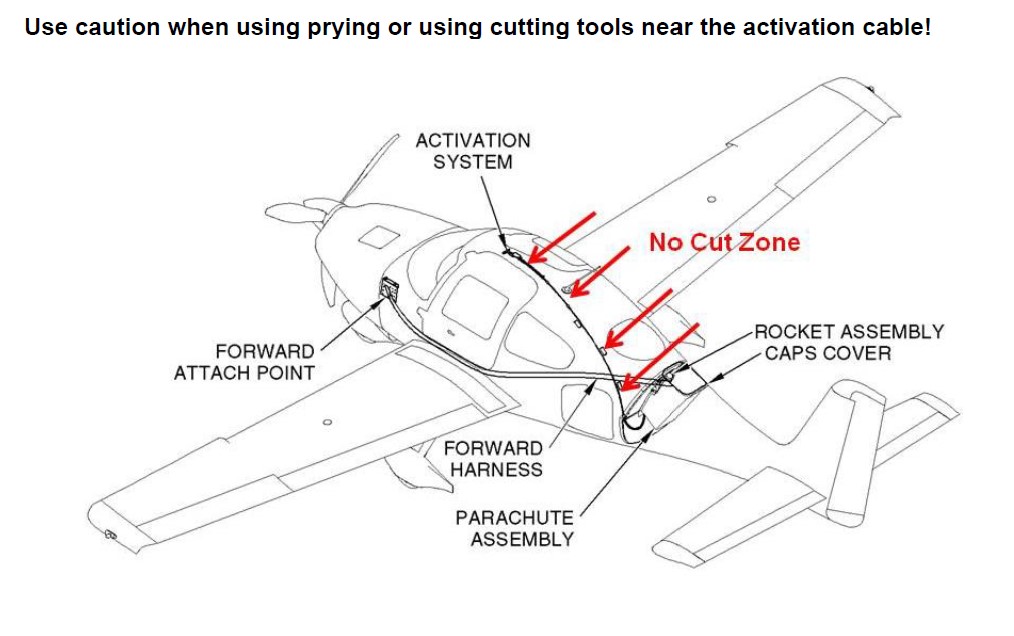
Of particular concern is the activation cable routed through the cabin roof that can be altered or stretched during an accident sequence and/or rescue and recovery. This can occur with the activation handle safety pin inserted. On a diagram of the aircraft, the cable route and parachute compartment were identified as a do not cut zone (Figure 5).
Figure 5: Diagram extracted from Cirrus 1st Responder Information Manual - Activation handle and cable hazards
Source: Cirrus 1st Responder Information Manual, Date: July 23, 2018, Revision: 2
If the rocket is launched, it accelerates to over 100 mph (160 kmh) in the first tenth of a second, making it a projectile hazard to anyone in its path. Normal trajectory of the rocket is upward and rearward over the tail but damage to the aircraft and nearby obstacles in the flight path can render the trajectory unpredictable.
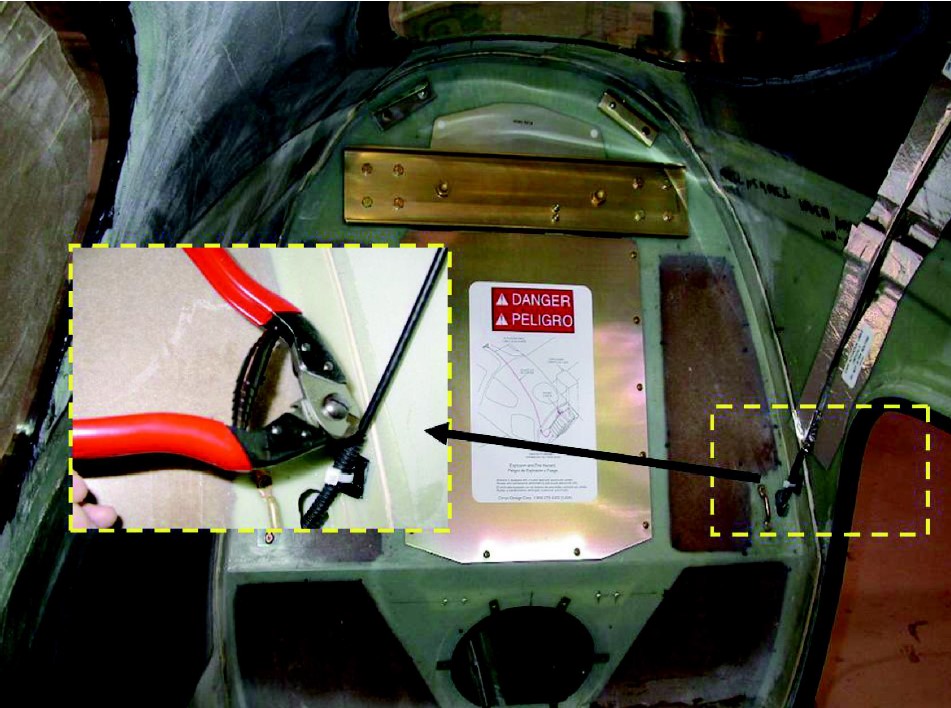
For an intact aircraft, CAPS can be secured by inserting a safety pin into the activation handle and handle holder. If an aircraft is not intact, CAPS should be disabled by cutting the activation cable as close to the igniter assembly as practicable (Figure 6). This is a temporary measure that decreases the risk of inadvertent ignition substantially enough to proceed with rescue efforts. Additionally, for an electrically fired system, aircraft batteries can be disconnected, and the igniter wires shunted.
CAPS can be disarmed by trained and authorised technicians, which renders the rocket, igniter, base, and reefing line cutters inert.
In response to ATSB request for data about unintentional post-impact rocket activations, Cirrus Aircraft advised that there was limited data as most of these events were not recorded. A few rocket activations had resulted from exposure to direct flame or heat soaking in post-impact fires.
Figure 6: Image extracted from Cirrus 1st Responder Information Manual showing rear cabin (looking rearward; carpeting and panels removed), warning placard, and cable cutting location
Source: Cirrus 1st Responder Information Manual, Date: July 23 2018, Revision: 2
Accident site and wreckage information
Images of the accident site and wreckage (after recovery of the pilot) were provided to the ATSB. Those images show that the aircraft came to rest on the grass about midway between runway 11 Centre and 11 Left. It was inverted and oriented on the same general heading as the runway.
About 100 m from the threshold of the runway was a white scrape mark on the centreline consistent with a tail strike. A further 230 m along the runway, a series of ground marks started from 30 m to the left of the runway centreline and extended 16 m away from the runway until the main wreckage site. These ground marks were consistent with left wing tip, left wing, and main nose down impact.
The left wing had broken in 2 places and those pieces were detached from the main wreckage at the wing root. The nose of the aircraft was severely damaged, and 2 propeller blades had sheared off at the hub. Although the propeller blades were damaged, there was no plastic deformation that might indicate engine power at impact because the blades were composite material.
Some of the left fuselage was cut away and it is likely there was some alteration to the internal conditions around the pilot’s seat as part of the recovery of the pilot. There was significant intrusion of the instrument panel into the cabin. The cabin space was mostly intact, although there was apparent deformation and reduction of cabin height.
The pilot’s seat was in location but both outboard seat feet had torn the flanges from the outboard seat track at the mid‑seat position due to impact forces and track deformation. The pilot’s seat belt airbags had inflated.
Depending on observer perspective, the CAPS warning placard was visible on the left rear inverted fuselage (Figure 7). Because of the tilt of the wreckage, the right-side placard was not as visible.
Figure 7: Wreckage (inverted) at accident site showing CAPS warning placard on left rear fuselage
Source: NSW Police (annotated by ATSB)
The ATSB examined the wreckage after it was removed from the accident site and secured in a hangar. By that stage the CAPS rocket had been disarmed and removed.
A search for SD cards located 2 Garmin cards and an SD data card from the MFD. The PFD screen had detached from the instrument panel during the accident and no associated SD card was found. The Garmin cards were not designed to record data and the SD data card was not formatted properly to enable storage of information.
The recoverable data module (RDM) was intact and removed from the vertical fin for data recovery. The ATSB connected to the RDM but was unable to download any data. After consultation with Cirrus Aircraft and the National Transportation Safety Board (NTSB), the RDM was sent to the NTSB data recovery specialists. They confirmed the ATSB nil result then transferred the memory chips to a surrogate RDM. This allowed data to be downloaded but the RDM had not been recording data since at least 2012.
Examination of the aircraft identified that the:
elevator trim setting was neutral
wing flap selector was in the 100% down position
oxygen controller was off but there were indications it had been used.
Fire and rescue
Bankstown Airport did not have an aviation rescue fire fighting facility and it was not a regulatory requirement for that airport. The emergency response to an aircraft accident on Bankstown Airport included Fire and Rescue NSW (FRNSW), which is the State Government agency responsible for the provision of fire, rescue and hazmat services in cities and towns across New South Wales. FRNSW advised that all fire and rescue personnel received the same training and had access to guideline support documents that addressed aircraft incidents including ballistic parachutes. In addition, firefighting crews with an aerodrome/airport as part of their risk profile would be familiar with that environment and take part in emergency exercises.
Flight path information
The ATSB obtained automatic dependent surveillance broadcast (ADS-B) data transmitted from the aircraft’s Mode S transponder during the flight. That data included altitude, indicated airspeed, and rate of descent, and the approximate distance to the runway threshold was derived from aircraft coordinates (Table 2).
Table 2: Selected ADS-B data for final approach
Altitude (ft)
Indicated airspeed (kt)
Rate of descent (ft/min)
Distance to runway (NM)
500
98
416
1.51
400
87
448
1.23
300
80
416
0.93
200
83
448
0.71
100
79
352
0.37
50
74
224
Not available
25
73
384
Not available
0*
71–61
416–224
Not available
* There were a number of data points around 0 ft altitude so the range of airspeed and rate of descent around the initial touchdown is provided. Cirrus noted that the last recorded airspeeds were low and may have been a factor in the bounced landing and aircraft response in the go‑around.
Based on the derived distance data, from 500 ft the aircraft was close to a 3° descent profile, which became about 2.5° after 300 ft.
In the landing configuration, the stall speed in steady flight was 62 kt (at unfavourable weight and balance conditions).
Other Cirrus SR22 go-around occurrences
AO-2015-110 Collision with terrain involving a Cirrus SR22, VH-OPX, near Moree, New South Wales, on 17 September 2015.
The pilot was landing at a private airstrip 10 km north of Moree. Based on observations at Moree and the runway direction, the wind was a quartering tailwind/crosswind from the right of up to 20 kt with small gusts up to 22 kt.
After a normal approach and extension of full flap, the pilot commenced the flare for landing at about 80–90 kt. To align the aircraft with the runway, the pilot reported applying almost full left rudder and right aileron due to the crosswind. The right main landing gear touched down first, and the aircraft bounced back into the air. The pilot immediately applied full power to initiate a go‑around. However, the left wing dropped and the aircraft yawed to the left. The aircraft’s left wing and propeller then collided with a dam wall. The aircraft stopped abruptly and spun around. The engine separated from the aircraft and came to rest about 20 m away, the tail broke off and the nose landing gear collapsed. The pilot suffered minor injuries, and the aircraft sustained substantial damage.
AO-2018-038 Loss of control and collision with terrain involving Cirrus SR22, VH-PDC, at Orange Airport, New South Wales, on 15 May 2018.
The pilot (aircraft owner) and flight instructor were conducting night circuits as the first part of training for a night endorsement. Wind conditions were reported as light and variable.
On the second approach, the pilot flared the aircraft a ‘little high’ for the touchdown, and the aircraft bounced twice. The pilot elected to go-around and applied full power before touching down again. The ATSB report identified that as the pilot applied full power to perform the go-around, the aircraft pitched nose-up and rolled to the left.
This report also identified 2 other accidents involving SR22 go-arounds in the United States where the aircraft nose pitched up and the aircraft veered left after full power was applied to the engine. (Report ERA12FA540, and Report NYC07CA010)
Previous CAPS hazard safety action
In the past, the ATSB produced a publication Hazards at Aviation Accident Sites: Guidance for Police and Emergency Personnel which was distributed as a booklet. The printed version is no longer available and at the time of writing the investigation report, a pdf copy was available while a digital version was under development.
When the final report for AO-2018-038 was released the ATSB released a news item with a safety message about the risks associated with post-impact deployment of the CAPS rocket. Flight Safety Australia magazine, produced by CASA, also published an article warning readers to beware of the rocket in the wreckage.
Safety analysis
Attempted landing and loss of control
En route, approach and landing
The flight path from Southport to final approach at Bankstown was steady with no indication of problems and there was no report of any anomalies regarding radio transmissions. Given the oxygen system was used, there is low risk that the pilot was exposed to hypoxia when operating above 10,000 ft.
After reporting inbound at Prospect Reservoir in accordance with standard procedures, the pilot responded appropriately to controller advisories. When the pilot acknowledged the clearance to land, which was the last transmission from the pilot, there was no discernible indication of any stress or impairment.
After joining final approach at 950 ft, the pilot maintained a direct, steady track to the runway and the descent profile was close to a standard 3° approach profile. Although some witnesses reported the aircraft speed was slower than expected on approach, the transmitted data indicated that the aircraft was at the Cirrus‑recommended approach speed of 80 kt (indicated airspeed) by 300 ft. Based on the flight data, the approach was consistent with the Cirrus stabilised approach criteria.
Below 100 ft, the airspeed reduced to between 71 and 61 kt but given the fidelity of the data it is not possible to establish the speed at the initial touchdown or subsequently. As Cirrus indicated, low airspeed just before landing may have been a factor in the occurrence.
In the CCTV imagery, the aircraft appeared to sink onto the runway and witnesses observed the aircraft bounce along the runway. After the initial bounce, the aircraft tail scraped on the runway, which was symptomatic of the unstable landing without any effect on the subsequent controllability of the aircraft.
Although there was a crosswind component, it was well within the capability of the aircraft and expected to be within the capability of the pilot. There was also no indication from the aerodrome forecast and observations, or from other pilots on approach to adjacent runways, of any significant wind gusts or turbulence affecting the landing.
Landings are dynamic, skill-based manoeuvres that rely on pilot judgement of existing and projected energy state with sensitive adjustment of aircraft attitude and engine power. The unstable landing was consistent with a misjudged flare. Pilots can recover by adjusting the aircraft energy and attitude for another attempt to land or by initiating a go-around.
Loss of control
About 5 seconds after the initial touchdown, the aircraft came off the ground and immediately rolled into a climbing steep left turn up to a height of about 40 ft then dropped and impacted the ground on the left wing and nose.
As there was no recorded flight or engine data, there was no direct information about the engine power settings during the accident sequence. The pilot did not transmit his intentions however, in the context of landing difficulties and trying to control the aircraft, a radio call would not be expected.
Based on the CCTV and witness information, the performance of the aircraft as it lifted off and entered the climbing turn was consistent with high engine power. It follows that the pilot had intentionally initiated a go-around as recovery from the unstable landing.
A mild pitch up would be expected in the early stages of go-around from a bounced landing to maintain ground clearance. However, the large pitch up that was observed was not consistent with the recommended go-around procedure to pitch up to a level attitude and begin accelerating to the speed consistent with either Vx (best angle of climb) or Vy (best rate of climb). It is likely that application of high engine power exacerbated the effects of nose-up control inputs. The Cirrus SR22 is equipped with a relatively high-power engine for a 4-place aircraft. Although turbo‑normalising the engine does not increase the maximum rated power of the engine, it was reported that there could be a noticeable ‘surge’ as the throttle was advanced on the ground.
Application of high engine power will produce ‘torque’ that will result in a strong left turning tendency. This effect is magnified by low airspeed and a high pitch angle. The rate of throttle control movement and engine response will also influence torque characteristics and associated controllability.
In normal operational contexts where high or full engine power is applied at the recommended rate, the pilot is able to counteract torque effect through coordinated use of steering (on the ground), and use of rudder and aileron once airborne. However, in this case, the torque effect was probably stronger than experienced during normal operation and the effectiveness of the flight controls was compromised by the low airspeed. Consequently, the pilot lost directional control of the aircraft early in the go-around sequence and was unable to recover.
As the angle of bank increased in the turn away from the runway, the stall speed increased, and the vertical component of lift generated by the wings decreased to zero as the aircraft reached a 90° angle of bank. Consequently, the aircraft dropped out of the turn.
The ATSB investigated 2 previous Cirrus SR22 go-around accidents at Moree in 2015 and Orange in 2018. Although the reports identified other factors that played a role in those occurrences, it is likely that torque effect played a key role in each loss of control.
To summarise: In the early stages of a go-around from an unstable landing, the pilot was unable to counter the substantial torque effect associated with high engine power, low airspeed, and high pitch angle. As a result, when the aircraft came off the ground, it rolled into a climbing steep left turn up to a height of about 40 ft then dropped and impacted the ground on the left wing and nose.
Go-around safety considerations
A go-around is a transition from a low-power condition while descending/landing to a high-power climb. When this occurs during an approach, the aircraft has potential and kinetic energy and in visual conditions there is generally no urgency to carry out the procedure. In contrast, when a pilot does a go-around from an attempted landing, the aircraft is in a low energy state and there is typically some urgency to initiate the procedure to recover from an unstable state on or close to the ground.
Flight training and reviews include go-arounds and the pilot had recently completed an instrument proficiency check that included missed approaches. As this check, and the preceding attempted check with associated training, was carried out by a Cirrus Standardised Instructor Pilot in the pilot’s SR22, the pilot was familiar with the type-specific characteristics of missed approaches. The instructor had also conducted practice go-around sequences at safe altitudes with the pilot.
This training and assessing is essential but has an inherent limitation because it is not feasible to simulate the conditions experienced during recovery from an unstable landing. It is possible that the pilot had not previously encountered a go-around from a rejected landing and was not prepared for the aircraft response to engine power in that context.
The balked landing/go-around procedure in the POH specified a sequence of 5 actions/parameters. Although this was applicable to all phases of flight, it did not provide any guidance for conduct of the procedure in different conditions.
To supplement the POH, Cirrus produced a flight operations manual and training videos that addressed approach, landing, and go‑arounds in SR20/22 aircraft. These resources provided useful guidance that was oriented to go‑arounds during final approach. It is not known if the pilot had referred to the guidance in the flight operations manual and there was no record of the pilot having directly accessed training videos for go-arounds, although some videos were freely available without a subscription.
The Cirrus procedure and the more detailed flow for go-arounds was conventional and applicable to the occurrence scenario with careful implementation from memory so control could be maintained during the recovery and transition into a climb. However, the ATSB noted that the material provided by Cirrus did not highlight the risk of loss of control associated with a go-around during the landing phase, where there was high engine power, low airspeed, and high pitch attitude.
CAPS hazard
Cirrus Aircraft advised that 254 lives have been saved due to the CAPS system. However, notwithstanding the benefits, CAPS also presents a serious post-accident hazard when it has not been deployed and the aircraft is damaged. If the rocket is inadvertently activated, anyone in its path would be seriously or fatally injured.
Cirrus Aircraft had been actively managing this risk by providing training to first responders (in the United States) and producing a detailed manual for first responders that is freely available on a dedicated website. In Australia, the ATSB has published and distributed a booklet for emergency services that addressed the risk of ballistic parachute systems in various aircraft types, including the Cirrus SR20/22. After the Cirrus SR22 accident at Orange in 2018 when the rocket was activated by the post-impact fire, the ATSB produced a video about the CAPS hazard and Flight Safety Australia magazine published a related article.
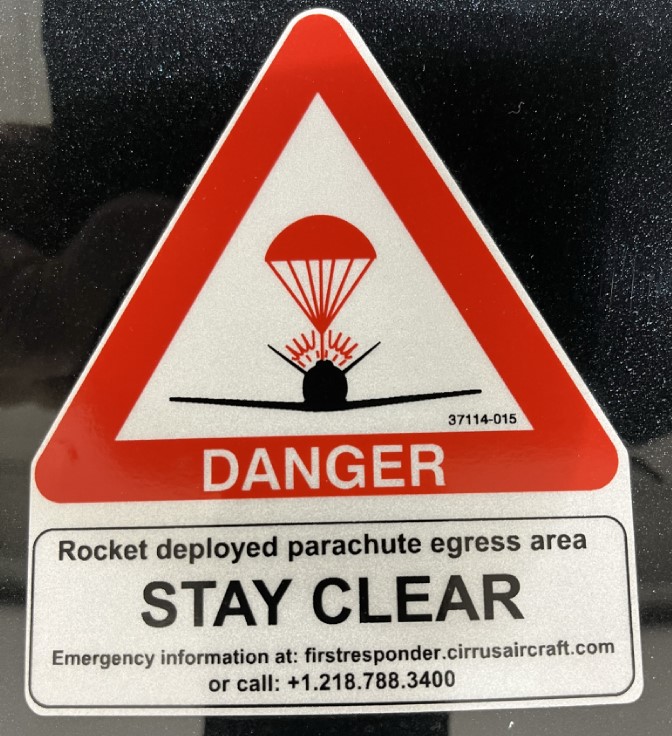
The only external indication of the CAPS hazard on the aircraft is a warning placard either side of the rocket exit point. These are not prominent and did not feature symbology or colour that are recognised indicators of danger. In addition, there are no markings to identify the no-cut area associated with the activation cable. On this occasion, the placards were not easy to identify or read because the aircraft was inverted.
Despite the availability of online guidance for first responders to a Cirrus aircraft accident, placards on the aircraft, and RFNSW training/education, the emergency services site commander was not aware of the presence of the airframe parachute system until advised after the rescue had started. At that point, while the site commander was aware of the rocket hazard, they did not know how to access information about the activation mechanism and method to secure the system. All first responders from FRNSW should have an awareness that aircraft might be equipped with a rocket propelled parachute system and the associated risks but it is not feasible for them to have type‑specific knowledge.
As the accident was at a major general aviation airport on a weekday and during standard working hours, there were aircraft maintenance personnel with knowledge of Cirrus aircraft that were available to assist with securing of the CAPS. They informed emergency personnel about the activation mechanism and secured the handle, which helped to reduce the risk of rocket activation. The risk could have been reduced further if the system had been secured by cutting the activation cable and, if the conditions had allowed, disconnection of the 2 batteries.
If the rocket had been inadvertently activated while the fuselage was inverted, the path of the rocket would have been uncertain and the release of heat and energy in the presence of fuel would have been a significant fire risk.
Cirrus advised first responders that it is imperative that the presence of an airframe parachute system be identified as early as possible, and the system disabled to make it safer to work around. In support of these imperatives, Cirrus provided training, education, and aircraft placards. However, the ATSB considered that the training and education had limited reach, and the placards did not effectively communicate the danger or provide access to safety information.
The ATSB considered that these limitations increased the risk of injury during the recovery of the pilot in this occurrence. Given no recorded incidents of post-impact rocket activations unrelated to fire, and the variability of aircraft accidents and associated damage, the ATSB did not identify this as a safety issue. Nevertheless, the ATSB supports any enhancement to the post-accident identification of CAPS and disabling of the system to reduce the risk of injury.
Findings
ATSB investigation report findings focus on safety factors (that is, events and conditions that increase risk). Safety factors include ‘contributing factors’ and ‘other factors that increased risk’ (that is, factors that did not meet the definition of a contributing factor for this occurrence but were still considered important to include in the report for the purpose of increasing awareness and enhancing safety). In addition, ‘other findings’ may be included to provide important information about topics other than safety factors.
These findings should not be read as apportioning blame or liability to any particular organisation or individual.
From the evidence available, the following findings are made with respect to the loss of control and collision with terrain involving Cirrus Design Corporation S22 at Bankstown Airport, New South Wales on 17 March 2023.
Contributing factor
In the early stages of a go-around from an unstable landing, the pilot was unable to counter the substantial torque effect associated with high engine power, low airspeed, and high pitch angle. As a result, when the aircraft came off the ground, it rolled into a climbing steep left turn up to a height of about 40 ft then dropped and impacted the ground on the left wing and nose.
Other factors that increased risk
The first responders were initially unaware that the aircraft was equipped with a ballistic parachute (CAPS) and initiated the recovery of the pilot with the system still armed. By not securing the CAPS, the risk of inadvertent rocket activation and injury was increased.
Cirrus Aircraft provided training, education, and placards to reduce the risk of inadvertent post‑accident actuation of the ballistic parachute (CAPS) rocket and associated injury. However, the training and education had limited reach, and the placards did not clearly communicate the danger or provide access to safety information.
Safety actions
Whether or not the ATSB identifies safety issues in the course of an investigation, relevant organisations may proactively initiate safety action in order to reduce their safety risk. The ATSB has been advised of the following proactive safety action in response to this occurrence.
Safety action by Cirrus Aircraft
Cirrus Aircraft advised that they have enhanced the external CAPS placarding on 2 new models of aircraft (the SF50, and another in development) to align with current American Society for Testing and Materials (ASTM) standards (Figure 8). The SR2X series of aircraft (the SR20, SR22, and SR22T) were certified prior to the implementation of ASTM standards. At the time of writing, Cirrus was reviewing the possibility to enhance the placard that was certified with SR2X.
Figure 8: Example of an ASTM Standard CAPS Placard used on the SF50 Vision Jet
Source: Cirrus Aircraft
During the draft report review process the ATSB sought input from Cirrus as to whether there was an opportunity to enhance the safety benefit of their go‑around training and educational products, especially in regard to the SR22 models that are equipped with relatively high-power engines during the landing phase.
Cirrus did not advise of any associated safety action.
Sources and submissions
Sources of information
The sources of information during the investigation included:
the aerodrome controller
accident witnesses
the New South Wales (NSW) Police Force
the Fire and Rescue NSW onsite commander
Aeria Management Group (Bankstown Airport)
Airservices Australia
Civil Aviation Safety Authority
the flight examiner
Cirrus Aircraft
the maintenance organisation for VH-XGR
References
Pilot’s Handbook of Aeronautical Knowledge FAA-H-8083-25C
Submissions
Under section 26 of the Transport Safety Investigation Act 2003, the ATSB may provide a draft report, on a confidential basis, to any person whom the ATSB considers appropriate. That section allows a person receiving a draft report to make submissions to the ATSB about the draft report.
A draft of this report was provided to the following directly involved parties:
aerodrome controller
Fire and Rescue NSW onsite commander
Aeria Management Group (Bankstown Airport)
Civil Aviation Safety Authority
Flight examiner
Cirrus Aircraft
maintenance organisation for VH-XGR
Submissions were received from:
Civil Aviation Safety Authority
Cirrus Aircraft
The submissions were reviewed and, where considered appropriate, the text of the report was amended accordingly.
Purpose of safety investigations
The objective of a safety investigation is to enhance transport safety. This is done through:
identifying safety issues and facilitating safety action to address those issues
providing information about occurrences and their associated safety factors to facilitate learning within the transport industry.
It is not a function of the ATSB to apportion blame or provide a means for determining liability. At the same time, an investigation report must include factual material of sufficient weight to support the analysis and findings. At all times the ATSB endeavours to balance the use of material that could imply adverse comment with the need to properly explain what happened, and why, in a fair and unbiased manner. The ATSB does not investigate for the purpose of taking administrative, regulatory or criminal action.
Terminology
An explanation of terminology used in ATSB investigation reports is available here. This includes terms such as occurrence, contributing factor, other factor that increased risk, and safety issue.
Publishing information
Released in accordance with section 25 of the Transport Safety Investigation Act 2003
Ownership of intellectual property rights in this publication
Unless otherwise noted, copyright (and any other intellectual property rights, if any) in this report publication is owned by the Commonwealth of Australia.
Creative Commons licence
With the exception of the Coat of Arms, ATSB logo, and photos and graphics in which a third party holds copyright, this publication is licensed under a Creative Commons Attribution 3.0 Australia licence.
Creative Commons Attribution 3.0 Australia Licence is a standard form licence agreement that allows you to copy, distribute, transmit and adapt this publication provided that you attribute the work.
The ATSB’s preference is that you attribute this publication (and any material sourced from it) using the following wording: Source: Australian Transport Safety Bureau
Copyright in material obtained from other agencies, private individuals or organisations, belongs to those agencies, individuals or organisations. Where you wish to use their material, you will need to contact them directly.
[1]Instrument flight rules (IFR): a set of regulations that permit a pilot to operate an aircraft in instrument meteorological conditions (IMC), which have much lower weather minimums than visual flight rules (VFR).
[2]Eastern Standard Time (EST): Coordinated Universal Time (UTC) + 10 hours.
[3]Flight level: at altitudes above 10,000 ft in Australia, an aircraft’s height above mean sea level is referred to as a flight level (FL). FL 180 equates to 18,000 ft.
[4]Eastern Daylight-saving Time (EDT): Coordinated Universal Time (UTC) + 11 hours.
[5]Visual flight rules (VFR): a set of regulations that permit a pilot to operate an aircraft only in weather conditions generally clear enough to allow the pilot to see where the aircraft is going.
[6]An IFR flight can change to a VFR flight for the arrival to Bankstown Airport to enable sequencing with VFR traffic operating in the airspace.
[7]Runway number: the number represents the magnetic heading of the runway. The runway identification may include L, R or C as required for left, right or centre.
[8]The distance from the airport terminal to the threshold of runway 11 Centre was 600 m and the distance to the accident site was 350 m.
Preliminary report details factual information gathered in the investigation’s early evidence collection phase;
Satellite imagery showed the formation of a thunderstorm near to the accident site;
Investigation is continuing.
A preliminary report from the Australian Transport Safety Bureau’s on-going investigation into an in-flight break-up of a Cessna 210 over the Northern Territory on 24 December 2022 notes that the accident occurred when the aircraft was in the vicinity of thunderstorm activity.
“This preliminary report details the circumstances of this tragic accident as we currently understand them,” said ATSB Director Transport Safety Stuart Macleod.
“While our findings as to the contributing factors to this accident, and the analysis to support those findings, will be detailed in a final report to be released at the conclusion of our investigation, this preliminary report has been released to provide timely information to industry and the public.”
The report details that the aircraft was conducting a charter flight from Gove to Katherine to transport a single passenger who was scheduled to be in Katherine over the Christmas period. When the aircraft failed to arrive at Katherine at the nominated time, the operator alerted search and rescue officials, and an airborne search coordinated by the Australian Maritime Safety Authority Response Centre was commenced that afternoon.
The following day a search aircraft located a debris field in a remote area of medium-density bushland, approximately 237 km east-north-east of Katherine. The pilot and passenger were fatally injured and the aircraft was destroyed.
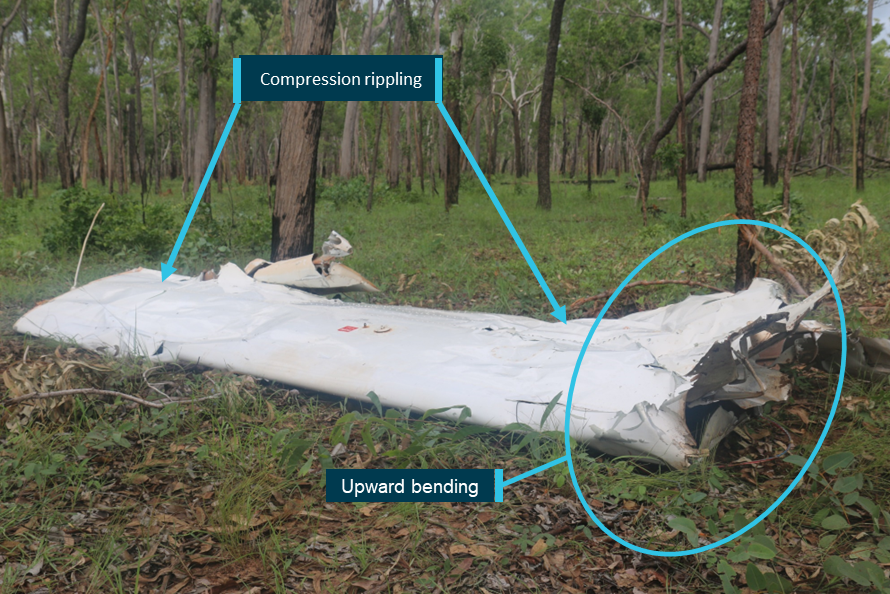
“The ATSB’s on-site examination of the wreckage and accident site identified that the location of aircraft’s right wing, approximately 300 metres before the primary point of ground contact, indicated that it had separated from the fuselage in flight, while aircraft components were spread over a distance of 80 metres,” said Mr Macleod.
“Closer examination of the right wing showed extensive permanent deformation of the wing surface with associated compression rippling to the upper skin. The damage was indicative of substantial upward bending forces applied to the wing prior to its failure and separation from the aircraft.”
On the day prior to the accident flight, tropical cyclone Ellie had crossed the coast west of Darwin and tracked to the south. Later that evening Ellie was downgraded to a tropical low, however heavy rain and strong to damaging winds were expected to impact large parts of the Top End.
“Satellite imagery showed the formation of a thunderstorm near to the accident site from about 0910 and its progression through to 1000, with the system persisting for several hours after that initial formation.”
The report notes that the development of the severe weather was consistent with the forecast conditions in the Northern Territory Graphical Area Forecast (GAF) that was issued by the Bureau of Meteorology at 0135 that morning.
“To date, the ATSB has examined the accident site and wreckage, interviewed personnel associated with the operation of the aircraft, collected meteorological and air traffic control radar data, and reviewed the aircraft maintenance and pilot records,” said Mr Macleod.
“As the investigation progresses the ATSB will further review the aircraft wreckage components and recovered electronic devices, environmental influences including analysis of meteorological data,” he said.
“The ATSB will also give consideration to pilot qualifications, experience and training, and the operator’s training policies and procedures.”
A final report will be released at the conclusion of the investigation.
“However, should a critical safety issue be identified during the course of the investigation, the ATSB will immediately notify relevant parties so they can take safety action,” Mr Macleod concluded.
Fokker 100 landed in low cloud with the flight crew not visually acquiring the runway until below the minimum descent altitude to continue the approach;
Aircraft fuel state was nearing the minimum fixed reserve after three prior missed approaches;
Cloud base was forecast to be above the minimum descent altitude but lowered to below the minimum descent altitude
Crew did not have immediate access to weather conditions at alternate airports, which might have led to a diversion.
A Fokker 100 flight crew was committed to conducting an approach in low cloud that extended below the minimum decision altitude to land at Paraburdoo, WA as the aircraft’s fuel state was nearing the minimum fixed reserve following three missed approaches.
The Network Aviation operated F100 was conducting a scheduled passenger flight from Perth on 22 November 2021 and as the aircraft approached Paraburdoo the flight crew encountered unforecast weather, an ATSB investigation details.
“Having completed 2 missed approaches at Paraburdoo, the flight crew had lost confidence in their flight plan weather forecasts and were reluctant to attempt a diversion to an alternate airport without current weather information for the alternate,” said Transport Safety Director Dr Stuart Godley.
“After the third missed approach, the aircraft did not have sufficient fuel to reach a suitable alternate and the flight crew were committed to landing at Paraburdoo.”
The flight crew conducted a RNAV GNSS approach to Paraburdoo’s runway 24, which required the crew to visually acquire the runway – the minimum descent altitude or MDA – at a height above the aerodrome of no less than 584 ft. The investigation report details that 25 seconds after the aircraft descended through the minima, the autopilot was disconnected and the pilot monitoring announced that they had sighted the runway and that they were on profile. At this stage, the aircraft was 293 ft above ground level and 291 feet below the minima/MDA.
Flight data recorder information indicated a steady descent profile on the approach and a maximum of 5° heading change between the autopilot disconnect and landing.
“The actual weather conditions the flight crew encountered at Paraburdoo were below their landing minima and were continuing to deteriorate. The cloud base at Paraburdoo was difficult for the Bureau of Meteorology to forecast as detection of low cloud by satellite imagery was obscured by higher level cloud,” said Dr Godley.
After their second missed approach the crew attempted to obtain from air traffic control an updated forecast for Newman Airport for a possible diversion there.
“However, the crew did not express any urgency when making this request, which, in combination with air traffic control workload at the time, resulted in a delay of 15 minutes before an update was offered. By that time, it was no longer required as the aircraft no longer had sufficient fuel remaining to divert to Newman.”
The investigation notes that the crew had no other means of obtaining updated weather forecasts for potential alternates beyond contacting air traffic control, as the aircraft was not fitted with an operational ACARS digital datalink messaging system, and the aircraft was beyond the range of the nearest AERIS automatic en route information service (which broadcasts a range of weather information from a network of VHF transmitters).
Meanwhile, there is an automated weather station at Paraburdoo, but it did not have a means of detecting the moisture content in the atmosphere above the surface.
“This increased the risk that low cloud below the instrument approach landing minima might not be forecast.”
Dr Godley said the incident highlights the importance for all operators to consider how unforecast weather will be managed and ensure it is reflected in their risk management.
“This is so that safety assurance activities can review how effectively it is managed and provide feedback for management review.”
Other than a procedure that limited the number of missed approaches to 2, Network Aviation did not provide flight crew with diversion decision-making procedural guidance when encountering unforecast weather at a destination, the investigation found.
In addition, the operator did not include the threat of unforecast weather below landing minima in their controlled flight into terrain risk assessments. This increased the risk that controls required to manage this threat would not be developed, monitored, and reviewed at a management level.
“The ATSB acknowledges and welcomes that, since the incident, Network Aviation has implemented several proactive safety actions in response to safety issues identified in the investigation,” Dr Godley said.
These include introducing several diversion decision-making tools for F100 flight crew, such as an amendment to their flight plans to include an 'alternate summaries' section for all flights, the top of descent arrival brief procedure to include 'minimum divert fuel', and the introduction of an F100 Company Procedures Manual with pre-populated standard divert calculations for F100 destinations.
In addition, the operator has updated their controlled flight into terrain risk assessments to capture the threat of adverse weather.
Bulk carrier collided with and sank two moored tugs during a turn at Devonport, Tasmania;
Neither the ship’s master nor the second mate had undertaken bridge resource management training, which probably contributed to single person errors going undetected;
Operator has taken safety action to remedy safety issues identified by ATSB.
The ATSB’s investigation into a bulk carrier’s collision with two tugs in Tasmania last year highlights the importance of bridge resource management and the design of bridge systems to reduce the risks of human error.
On 28 January 2022, the Australian-flagged bulk carrier Goliath was turning in the swing basin to berth at the Port of Devonport, Tasmania, when it collided with two moored tugs, which subsequently sunk.
Fortunately, there were no personnel on board the tugs at the time. Goliath sustained minor damage.
As the ATSB detailed in its preliminary report, Goliath’s master had moved from the wheelhouse to the port bridge wing conning station to complete the turn.
“During this transfer of manoeuvring controls, the correct steering mode was not selected,” ATSB Chief Commissioner Angus Mitchell said.
“Subsequently, the master’s manoeuvring orders, issued in the belief the ship was in joystick steering mode, had the unintended effect of increasing the ship’s speed as it closed on the tugs.”
The ATSB found that neither the master nor the second mate on Goliath had undertaken the required bridge resource management (BRM) training, that BRM on board was not effectively implemented and effective BRM was not evident during the incident.
“This was found to be a contributing factor to this incident – a safety issue which has now been addressed by the ship’s operator,” Mr Mitchell said.
Since the incident, operator CSL Australia arranged for all deck officers serving on board Goliath to attend BRM training ashore and has added BRM training to its fleet crew training schedule.
“The various concepts, techniques, and attitudes that together comprise BRM remain among the most effective measures available to identify and eliminate, or rectify, human error,” Mr Mitchell said.
“Training in the various elements that comprise effective BRM provides a foundation upon which competency may be built through experience and practice.”
Additionally, the final report notes the ship operator had modified Goliath’s joystick panels to incorporate a positive visual indication that joystick steering mode was selected.
“Along with BRM, the design of bridge systems can play a part in mitigating the risks of human error by incorporating intuitive and conspicuous indications of correct operation and, conversely, of errors or incorrect settings,” Mr Mitchell concluded.
Conflicting information due to a known design limitation, unclear guidance in the flight crew techniques manual, and distractions contributed to the flight crew of an Airbus A330 delaying the donning of their oxygen masks after receiving a cabin pressure altitude warning, an ATSB investigation report details.
The Qantas-operated A330-202 aircraft was conducting a scheduled overnight passenger service from Sydney to Perth on 4-5 February 2021 when about 2 hours into the flight while cruising at flight level 400 (about 40,000 ft), the pilots were presented with an excess cabin altitude alert, due to the cabin altitude exceeding 9,550 ft.
“This alert, on the aircraft’s Electronic Centralised Aircraft Monitor (ECAM) flight deck display, required the crew to don their oxygen masks and initiate an emergency descent to 10,000 feet,” said ATSB Director Stuart Macleod.
“Donning their oxygen masks immediately in response to the alert would have allowed the crew time to continue to trouble-shoot conflicting information while mitigating against any risk of being affected by hypoxia.”
Jet aircraft cabins are typically pressurised to a cabin altitude of less than 10,000ft, due to the dangers of hypoxia. The effects of hypoxia are most critical at altitudes above about 20,000 ft, but exposure to altitudes within the 11,000 ft to 20,000 ft range can lead to cognitive impairment.
In this incident, despite the crew being presented with the excess cabin altitude alert, the aircraft’s pressurisation system data display indicated that the pressurisation system was operating normally, leading the flight crew to doubt the validity of the alert.
“As a result, the flight crew sought additional information, including guidance from the Flight Crew Techniques Manual (FCTM),” Mr Macleod noted.
“This, and other distractions, delayed the crew in actioning the required procedural response of donning their oxygen masks and conducting an emergency descent to 10,000 ft.”
Mr Macleod noted there was no immediate risk of hypoxia for the passengers on board. If the cabin’s pressure altitude exceeded about 14,000 ft, detected by a pressure sensor separate to that used for cabin pressure control, individual masks for each passenger would have deployed.
The A330 is fitted with dual Cabin Pressure Controllers (CPCs) that automatically control the aircraft’s pressurisation, with one CPC controlling pressurisation, and the second serving as a backup.
During the incident flight, a fault occurred in the CPC controlling the aircraft’s pressurisation, resulting in the cabin slowly depressurising.
“This loss of pressure was detected by the standby CPC, which triggered the excess cabin altitude alert when the cabin altitude exceeded 9,550 ft,” Mr Macleod noted.
“However, a known design limitation meant that the controlling CPC was unable to detect a fault with its pressure sensor, resulting in the loss of cabin pressure control and the subsequent increase in cabin altitude. This limitation also resulted in the systems display continuing to present pressurisation data from the CPC in control, which directly conflicted with the alert.”
In response to that known limitation, Airbus required flight crew to action the excess cabin altitude alert irrespective of whether there was confirmatory data.
“However, when faced with conflicting information, and in line with operating philosophies, the crew sought evidence to verify the failure, delaying the donning of oxygen masks and commencing an emergency descent to 10,000 ft.”
Their response was further compounded by uncertainty on the procedural guidance in the FCTM.
About 7 minutes after the alert triggered, the flight crew donned their oxygen masks, and commenced a diversion to Adelaide with a precautionary descent to 10,000 ft, the report notes.
Shortly after the descent was initiated, the displayed pressurisation data indicated a sudden increase in the cabin altitude, to which the flight crew responded by immediately commencing an emergency descent.
The aircraft levelled at 10,000 ft and continued to Adelaide without further incident.
“Whenever there is a risk of hypoxia, the flight crew’s priority must be to immediately commence the use of oxygen,” Mr Macleod said.
Airbus had issued a service bulletin that would have corrected the design limitations and prevented the loss of cabin pressure control from the pressure sensor fault. However, this service bulletin had not been incorporated on the incident aircraft and there has been very limited uptake of the service bulletin across the global fleets of affected Airbus aircraft.
“The ATSB encourages Airbus A320, A330 and A340 series aircraft operators to pro-actively incorporate the Airbus service bulletins intended to prevent similar cabin depressurisations from Cabin Pressure Controller pressure sensor faults,” Mr Macleod said.
In addition, Airbus has advised the ATSB that it is evaluating the mitigations currently in place to address the cabin pressure control system design limitations. However, the ATSB has issued a formal safety recommendation to Airbus as its proposed safety action to address the design limitations and a timeline for their implementation have not yet been provided.
Mr Macleod also noted that the investigation highlights the importance of checklists, which are an aid to memory and help ensure that critical items necessary for the safe operation of the aircraft are not overlooked or forgotten.
While the specific Airbus requirement for responding to the ECAM alert was contained within a preamble to the flight crew operations manual abnormal procedure; it was not part of the ‘read and do’ procedural steps in response to the alert, and was reliant on memory recall.
“All essential components of a procedure must be included within that procedure’s checklist.”
On the morning of 10 March 2023, a Boeing Company 737, registered VH-YQR, was being operated by Virgin Australia as flight number VA916, departing from Brisbane, Queensland to Sydney, New South Wales. During the landing, after a stabilised approach, the aircraft experienced a hard landing.
What the ATSB found
The ATSB found that during the final approach, the first officer (FO) flared the aircraft later than they normally did and the throttle was not reduced to idle prior to the initial touchdown resulting in the aircraft bouncing approximately 3 ft. During the bounce, the ground spoilers and speed brakes deployed, resulting in a hard landing of 2.96 G on the second touchdown.
The ATSB also found that the training provider, contracted by the operator to conduct Boeing 737 conversion training, was training pilots to initiate the flare at 30 ft, however the flight crew training manual required that the aircraft be flared at approximately 20 ft. This variation increased the risk of unstable and/or hard landings.
What has been done as a result
The operator has completed the following safety actions:
reviewed hard landing events from 2017 to identify any commonalities or trends in the events
increased oversight and focus with the external type rating providers and the Training and Standards team to ensure alignment of training with standard operating procedures
added Zero Flight Time (ZFT) advanced simulator sessions into the operator’s conversion course (OCC) program (the ZFT occurs approximately halfway through the line training to reconfirm the take-off and landing techniques while also being able to introduce more challenging conditions)
an independent review of the checking and training department was undertaken consisting of:
a training and standards review, providing an overall health check focusing on the systems and the people
a post-COVID review – after a ramp up of activity, the review enabled the operator to understand how the checking and training department was performing
The operator also noted that, for factors not relating to this event, CAE is no longer being used as a type rating provider.
CAE completed several actions in relation to the occurrence. These included a risk assessment in pilot training assessment and the following:
conducted a review of all Boeing 737 courseware to ensure that there were no areas of conflicting information
conducted a review of the current training program design and development process across all platforms to ensure that an adequate quality control exists to verify that developed courseware did not contradict original equipment manufacturer’s policies, standard operating procedures or techniques
modified the courseware briefing slide relating to the autothrottle auto retard height and aligned the instructor guide to refer to the original equipment manufacturer’s guidance text from the flight crew training manual for the normal flare technique
released a training bulletin to all training centres conducting training on the 737 Max, to ensure that the original equipment manufacturer’s technique was taught. The bulletin included a review of the different elements of training conducted to ensure that the 20 ft flight crew training manual guidance and the 27 ft auto throttle auto-retard feature were covered, with the emphasis being on the flight crew training manual guidance.
Safety message
This incident highlights how important it is that operators ensure external training providers align their training with the operator’s flight procedures. Ensuring pilots are trained as they are expected to fly will ensure they are well prepared especially during the critical flight phases.
It is also important for flight crew to be go-around minded at all times during the approach and landing. This will ensure they are prepared when things do not go as expected. Conducting a go around will allow the aircraft to be set up in a stabilised approach, increasing the likelihood of conducting a safe landing.
However, the Boeing flight crew training manualstated that where an ‘airplane bounces during a landing attempt, hold or re-establish a normal landing attitude and add thrust as necessary to control the rate of descent. Thrust need not be added for a shallow bounce or skip. If a high, hard bounce occurs, initiate a go-around.’
The occurrence
At 0731 local time on the 10 March 2023, a Boeing Company 737-8FE (737), registered VH-YQR and operated by Virgin Australia as flight number VA916 on a scheduled air transport flight, departed from Brisbane, Queensland to Sydney, New South Wales. On board the aircraft were a training captain, first officer (FO) conducting line flying under supervision,[1] 4 cabin crew and 179 passengers.
At an altitude of about 900 ft on approach to runway 34R[2] at Sydney, the FO, the pilot flying,[3] disengaged the autopilot and began to manually fly the aircraft. At approximately 20 ft above the runway, the captain detected that the commencement of the landing flare[4] was late (see the section titled Stable Approach and landing) and advised the FO to flare the aircraft and to reduce the engine thrust level to idle. The FO subsequently commenced the flare however, due to the late flare initiation and the thrust not being reduced to idle prior to the initial touchdown, the aircraft bounced approximately 3 ft. The captain assessed the situation and determined that, as the bounce was not too high and there was enough runway length ahead for the FO to continue with the landing, there would be a higher chance of adverse effects if they took control of the aircraft.
During the bounce, both the speed brake and the ground spoilers deployed resulting in a loss of lift and the aircraft touched down the second time with a force of 2.96 G. Once the aircraft settled on the runway, the captain took control of the aircraft and completed the landing.
After the passengers had disembarked, the captain spoke with cabin crew prior to completing the subsequent flight.
At 1055, the aircraft departed Sydney Airport for Gold Coast Airport where on landing, an engineer advised the flight crew that the landing at Sydney Airport was recorded as a hard landing.[5] In response, and although not required, the captain contacted the engineering team and conducted a visual inspection of the aircraft with a licenced aircraft maintenance engineer. No issues were found with the aircraft.
Context
Aircraft Crew
Captain
The captain held an air transport pilot licence (aeroplane), an instrument rating for multi-engine aircraft and a class 1 aviation medical certificate. They had over 10,778 hours of flying experience, of which over 8,660 hours were on the Boeing 737. They were an experienced check captain for the Boeing 737 aircraft type with the operator.
First officer
The first officer held a commercial pilot licence (aeroplane), an instrument rating for multi-engine aircraft and a Class 1 aviation medical certificate. They had over 2,481 hours of flying experience, of which 29.3 hours were on the Boeing 737 and had completed 29.3 hours flying within the 90 days prior to the occurrence.
The first officer began working with the operator in 2018, initially flying a different aircraft type before being made redundant in October 2020 due to the reduction in flying during the COVID pandemic. They returned to work for the operator in 2022 and began training as a first officer on the Boeing 737 in September that year. They completed their type rating at an international training provider, in November 2022 and returned to Australia to complete an operator conversion course (OCC) during December 2022. They completed a recency simulator session at the end of January before beginning line training for the Boeing 737 in early February 2023.
Weather
The weather at the airport during the occurrence was fine, visibility of 10km or more, scattered[6] cloud at 3,000 ft and a 9 kt west-north-westerly wind.
Boeing 737 landing characteristics
Stable approach and landing
A stable approach path is defined by a combination of crew preparedness, aircraft configuration, approach speed, and flight path that must be maintained during the approach. The operator required that if this criteria was not met then the crew were required to conduct a missed approach.
The operator’s stabilised approach policy stated the following criteria must be met by 1,000 ft above ground level:
briefings and normal checklists completed
aircraft in the correct landing configuration
aircraft on the correct lateral and vertical flight path
wings level no later than 500 ft
sink rate no greater than 1,000 ft per minute
thrust setting appropriate for the aircraft configuration and trajectory
speed within -5 kt to +10 kt of the target speed.
The aircraft met the operator’s stabilised approach criteria.
Aircraft flare
The flight crew training manual (FCTM) stated that it was expected that the pilot would:
… initiate the flare when the main gear is approximately 20 feet above the runway by increasing pitch attitude approximately 2–3°. This slows the rate of descent.
After the flare is initiated, the pilot is required to smoothly retard the thrust levers to idle and make small pitch attitude adjustments to maintain the desired descent rate to the runway. A smooth thrust reduction assists in controlling the natural nose-down pitch change associated with thrust reduction. Hold sufficient back pressure on the control column to keep the pitch attitude constant. A touchdown attitude as depicted in the figure below is normal with an airspeed of approximately VREF. Ideally, main gear touchdown should occur simultaneously with thrust levers reaching idle.
It also stated that the ‘typical landing flare times ranged from 4 to 8 seconds…’
Figure 1: Flare profile
Source: Boeing 737 NG/MAX Flight Crew Training Manual
Bounced landings
The Flight Safety Foundation Approach and Landing Accident Reduction Tool Kit states that bounced landings are usually the result of one or more of the following factors:
loss of visual references
excessive sink rate
late flare initiation
incorrect flare technique
excessive airspeed
power on touchdown preventing the automatic extension of ground spoilers.[7]
The Boeing 737 NG/MAX FCTM[8] stated that if a higher than idle thrust level is maintained through initial touchdown, the automatic speedbrake[9] deployment may be disabled even when the speedbrakes are armed.
In addition, during a bounce, if the thrust levers are retarded to idle the speedbrake may deploy and a loss of lift could occur. This could result in a nose-up pitching moment and a hard landing or tail strike on the subsequent touchdown.
The manual stated that to recover from a bounced landing pilots are required to:
hold or re-establish a normal landing attitude and add thrust as necessary to control the rate of descent
initiate a go around if a high or hard bounce occurs
initiate a go around if there is insufficient runway to continue the landing.
Hard landings
Hard landings subject the aircraft's structure to high loads, potentially leading to structural damage such as cracks, deformation and structural failure, stress on landing gear components, and system malfunctions.
The Boeing 737 aircraft maintenance manual (AMM) stated that an indication of a hard landing on the main landing gear is a peak recorded vertical acceleration that exceeds 2.2 G. The G-level threshold is valid for a conventional landing with impact of no more than 2° roll, main landing gear touchdown first and normal rotation onto the nose gear. If there is a hard nose landing or the hard landing is accompanied by a roll of more than 2° at the time of main landing gear touch down, the recorded peak acceleration could be less than 2.2 G and a hard landing inspection would also be required. The inspection required a visual inspection of the main and nose landing gear, fuselage and supporting structures within 48 hours of the landing.
After each landing, the aircraft’s flight data was automatically downloaded and processed. The landing parameters were based on the Boeing AMM and should a parameter over the hard landing criteria be detected, an automated email alert was sent to the operator’s safety team.
In addition, the operator stated that if a pilot suspected a hard landing (whether above or below the maximum certified landing weight) had occurred, it was to be recorded in the maintenance log, with all relevant information such as weight, sink rate and any side loading, to assist ground engineers in performing the correct category of inspection.
Neither the captain nor the FO thought the landing met the hard landing criteria and, as such, continued flying the next sector after the occurrence. The hard landing inspection was completed within 48 hours of the hard landing. No issues were found, and the aircraft was returned to service.
Flight data
The quick access recorder (QAR) data indicated that the aircraft was within the stable approach criteria during the approach and prior to the initial touchdown. However, the flare was initiated late at between 10-15 ft, and very quickly the attitude reached a maximum of 5⁰ before the back pressure on the control column was released. Thrust was not reduced prior to the touchdown and as the aircraft touched down, it had a roll of 0.70°, a pitch of 5.09, and a vertical acceleration of 1.25 G. The ground spoilers did not activate, and the aircraft bounced 3 ft.
During the bounce, the thrust was reduced, however, not to idle, and the speedbrakes deployed automatically. Just prior to the second touchdown, the ground spoilers deployed, significantly reducing lift. As the aircraft touched down, it had a roll of 1.54°, a pitch of 2.11° and a G force of 2.96 G. Thrust was reduced to idle, 3 seconds after the second touchdown.
Figure 2: VH-YQR aircraft flight data
Source: ATSB
Training
Type rating
The operator sent new FOs to independent training providers for the Boeing 737 aircraft type rating. The FO involved in this occurrence attended an international training provider. When questioned, the training provider stated that pilots were trained to initiate the flare at 30 ft so the aircraft was in the flare at 20 ft. However, the landing briefing, developed by the training provider, stated that the flare would be initiated at around 25 ft. Despite this, they stated that all pilots are trained in accordance with the Boeing 737 NG/MAX FCTM height which required the flare to be initiated at approximately 20 ft (see the section titled Stable approach and landing).
During the FO’s training, they completed 25 simulator landings and achieved all necessary competencies. Once training was completed, they returned to the operator to conduct operator specific training in the simulator.
Operator training
As part of their OCC, the operator conducted 8 simulator training sessions with FOs. During the last training session, the operator trained the pilots to begin flaring the aircraft at 20 ft and went through the steps for the recovery of bounced landings. It was expected that during the OCC, the operator would capture any training deficiencies and rectify them prior to line training.
The FO passed the operator proficiency check (OPC) in December 2022.
While under line training in the aircraft, the FO had completed a total of 7 landings.
After the occurrence, the FO reported that although the operator’s training manuals and the OCC training required pilots to flare the aircraft at 20 ft, they were more comfortable flaring at 30 ft as originally trained. They advised that during all landings conducted prior to the occurrence flight, flare was initiated at 30 ft. The FO recalled that on the day of the occurrence, due to flying with a check captain, they made a last-minute decision to follow the operator’s procedures to initiate flaring the aircraft at a height of 20 ft.
Other hard landings reported by the operator
Between March and June 2023, the operator reported 5 hard landings across the Boeing 737 fleet, including this occurrence. Of these flights, all but one had a FO undergoing line training as the pilot flying during the landing, however the FOs involved had done their Boeing 737 type rating at a different international type rating provider. It was reported that 2 of the hard landings were related to the flare technique, while the remaining 3 reports did not state why the hard landing occurred.
The ATSB received the flight data for the second flare-related hard landing. This landing, which occurred on 5 April 2023, was conducted by a different FO under line training. It had similar characteristics as the occurrence flight. On this flight, the flare was also initiated at approximately 10 ft and quickly increased to approximately 5⁰, before back pressure was released, thrust was reduced slightly but not to idle. The aircraft touched down with a roll of 1.42⁰, a pitch of 4.4⁰ and a G force of 1.94 G (Figure 3). The speedbrakes deployed during the touchdown, however, the aircraft bounced approximately 2 ft.
During the bounce, the thrust was reduced, again not to idle, and the ground spoilers activated while the aircraft was still airborne resulting in a G force during the second landing of 2.2 G. The throttle was reduced to idle approximately 3 seconds after the second touchdown.
Figure 3: VH-VUJ aircraft flight data
Source: ATSB
Safety analysis
Both the occurrence landing and the 5 April 2023 landing showed very similar characteristics. In both cases, the initial bounced landing was the result of a combination of a late flare and a higher than idle thrust being maintained through initial touchdown. In addition, during the bounce, both the speedbrakes and ground spoilers deployed while the aircraft was still in the air, significantly reducing the amount of lift, which led to the hard landings during the second touchdown.
The training provider who trained the pilot of the occurrence landing stated that they used the Boeing 737 NG/MAX flight crew training manual (FCTM) when training pilots to land. However, they taught pilots to mentally prepare for the flare at 30 ft and to flare at 25 ft rather than 20 ft. The difference in heights during the training had the potential to create confusion. Additionally, during the later stages of an approach, the difference would have presented a different sight picture and reduced the pilot’s reaction time when they then changed to using the FCTM and the operator’s requirement to flare at approximately 20 ft.
The ATSB did not assess the procedures provided by the other training providers used by the operator.
The operator was unaware of the difference in flare height being taught at the third-party training provider. Although the international training provider did not comply with the flare height in the FCTM, the difference in flare height should have been captured in the operator conversion course (OCC). The OCC training required that the flare was commenced at 20 ft and during these 8 simulator sessions should have identified and worked with the FO to ensure they were comfortable with the flare height. There were no indications in the training reports that the FO had an issue with flare height.
When in the landing phase, there are many time-critical decisions which can increase the workload for a pilot (Lee, 2010). Changing an established habit at the last minute requires a higher level of cognitive effort. This increased cognitive load can lead to a slower response time, decreased efficiency, and a higher likelihood of errors or oversights. The intention of the first officer to flare at 20 ft rather than their normal 30 ft, while in line with the manufacturer’s flight crew training manual (FCTM), introduced an unfamiliarity and uncertainty, which most likely led to misjudgement resulting in the aircraft being flared late and the thrust not being reduced prior to the initial touchdown.
Findings
ATSB investigation report findings focus on safety factors (that is, events and conditions that increase risk). Safety factors include ‘contributing factors’ and ‘other factors that increased risk’ (that is, factors that did not meet the definition of a contributing factor for this occurrence but were still considered important to include in the report for the purpose of increasing awareness and enhancing safety). In addition ‘other findings’ may be included to provide important information about topics other than safety factors.
Safety issues are highlighted in bold to emphasise their importance. A safety issue is a safety factor that (a) can reasonably be regarded as having the potential to adversely affect the safety of future operations, and (b) is a characteristic of an organisation or a system, rather than a characteristic of a specific individual, or characteristic of an operating environment at a specific point in time.
These findings should not be read as apportioning blame or liability to any particular organisation or individual.
From the evidence available, the following findings are made with respect to the hard landing involving Boeing 737-8FE, VH-YQR, at Sydney Airport, New South Wales.
Contributing factors
During the landing, the aircraft was flared at a lower altitude than they had been trained and was required by the flight crew training manual. In addition, the power was not reduced to idle. In combination, these resulted in the aircraft bouncing.
During the subsequent touchdown, the speedbrakes and ground spoilers deployed, significantly reducing lift and resulting in a hard landing of 2.96 G.
The training provider, contracted by the operator to conduct Boeing 737 conversion training, was training pilots to flare the aircraft at a higher altitude rather than the manufacturer’s requirement of approximately 20 ft. This increased the risk of unstable and/or hard landings. (Safety issue)
Safety issues and actions
Central to the ATSB’s investigation of transport safety matters is the early identification of safety issues. The ATSB expects relevant organisations will address all safety issues an investigation identifies.
Depending on the level of risk of a safety issue, the extent of corrective action taken by the relevant organisation(s), or the desirability of directing a broad safety message to the aviation industry, the ATSB may issue a formal safety recommendation or safety advisory notice as part of the final report.
All of the directly involved parties were provided with a draft report and invited to provide submissions. As part of that process, each organisation was asked to communicate what safety actions, if any, they had carried out or were planning to carry out in relation to each safety issue relevant to their organisation.
Descriptions of each safety issue, and any associated safety recommendations, are detailed below. Click the link to read the full safety issue description, including the issue status and any safety action/s taken. Safety issues and actions are updated on this website when safety issue owners provide further information concerning the implementation of safety action.
Safety issue description: The training provider, contracted by the operator to conduct Boeing 737 conversion training, was training pilots to flare at 30 ft rather than the manufacturer’s requirement of 20 ft. This increased the risk of unstable and/or hard landings.
Safety action not associated with an identified safety issue
Whether or not the ATSB identifies safety issues in the course of an investigation, relevant organisations may proactively initiate safety action in order to reduce their safety risk. All of the directly involved parties are invited to provide submissions to this draft report. As part of that process, each organisation is asked to communicate what safety actions, if any, they have carried out to reduce the risk associated with this type of occurrences in the future. The ATSB has so far been advised of the following proactive safety action in response to this occurrence.
Safety action by Virgin Australia
Virgin Australia has completed the following safety actions:
reviewed hard landing events from 2017 to identify any commonalities or trends in the events
increased oversight and focus with the external type rating providers and the Training and Standards team to identify areas of alignment with SOPs and training
added Zero Flight Time (ZFT) advanced simulator sessions into the OCC program (the ZFT occurs approximately halfway through the line training to reconfirm the take-off and landing techniques while also able to introduce more challenging conditions)
an independent review of the checking and training department was undertaken consisting of:
a training and standards review, providing an overall health check focusing on the systems and the people
a post-COVID review – ramp up activity had seen increased activity, so the review enabled the operator to understand how checking and training is performing.
The operator also noted that, for factors not relating to this event, CAE is no longer being used as a type rating provider.
Glossary
AMM Aircraft maintenance manual
FCTM Flight crew training manual
FO First officer
OCC Operator conversion course
OPC Operator proficiency check
QAR Quick access recorder.
RAPT Risk Assessment in Pilot Training
ZFT Zero Flight Time
Sources and submissions
Sources of information
The sources of information during the investigation included:
the involved flight crew
Virgin Australia
quick access recorder data
CAE
References
Lee, Kyongsun (2010). ’Effects Of Flight Factors On Pilot Performance, Workload, And Stress At Final Approach To Landing Phase Of Flight’. Electronic Theses and Dissertations, 2004-2019. 1628.
The Boeing Company (2020). Boeing 737 NG/MAX Flight Crew Training Manual.
Submissions
Under section 26 of the Transport Safety Investigation Act 2003, the ATSB may provide a draft report, on a confidential basis, to any person whom the ATSB considers appropriate. That section allows a person receiving a draft report to make submissions to the ATSB about the draft report.
A draft of this report was provided to the following directly involved parties:
Civil Aviation Safety Authority
the involved flight crew and the cabin manager of VH-YQR
Virgin Australia
United Kingdom Air Accidents Investigation Branch (AAIB)
CAE
Submissions were received from:
the involved flight crew
Virgin Australia
United Kingdom Air Accidents Investigation Branch (AAIB)
CAE
The submissions were reviewed and, where considered appropriate, the text of the report was amended accordingly.
Purpose of safety investigations
The objective of a safety investigation is to enhance transport safety. This is done through:
identifying safety issues and facilitating safety action to address those issues
providing information about occurrences and their associated safety factors to facilitate learning within the transport industry.
It is not a function of the ATSB to apportion blame or provide a means for determining liability. At the same time, an investigation report must include factual material of sufficient weight to support the analysis and findings. At all times the ATSB endeavours to balance the use of material that could imply adverse comment with the need to properly explain what happened, and why, in a fair and unbiased manner. The ATSB does not investigate for the purpose of taking administrative, regulatory or criminal action.
Terminology
An explanation of terminology used in ATSB investigation reports is available here. This includes terms such as occurrence, contributing factor, other factor that increased risk, and safety issue.
Publishing information
Released in accordance with section 25 of the Transport Safety Investigation Act 2003
Ownership of intellectual property rights in this publication
Unless otherwise noted, copyright (and any other intellectual property rights, if any) in this report publication is owned by the Commonwealth of Australia.
Creative Commons licence
With the exception of the Coat of Arms, ATSB logo, and photos and graphics in which a third party holds copyright, this publication is licensed under a Creative Commons Attribution 3.0 Australia licence.
Creative Commons Attribution 3.0 Australia Licence is a standard form licence agreement that allows you to copy, distribute, transmit and adapt this publication provided that you attribute the work.
The ATSB’s preference is that you attribute this publication (and any material sourced from it) using the following wording: Source: Australian Transport Safety Bureau
Copyright in material obtained from other agencies, private individuals or organisations, belongs to those agencies, individuals or organisations. Where you wish to use their material, you will need to contact them directly.
[1] Pilot line flying under supervision: Pilot under supervision flying with line training captain to complete training in normal flight operations.
[2] Runway number: the number represents the magnetic heading of the runway. The runway identification may include L, R or C as required for left, right or centre.
[3] Pilot Flying (PF): procedurally assigned role with specifically assigned duties at specific stages of a flight. The PF does most of the flying, except in defined circumstances; such as planning for descent, approach and landing.
[4] Landing flare: the nose of the aircraft is raised prior to touchdown, to slow the descent rate.
[5] Hard landing: The operational limits for the aircraft set out in the aircraft's flight manual are exceeded during the landing.
[6] Cloud cover: in aviation, cloud cover is reported using words that denote the extent of the cover – ‘scattered’ indicates that cloud is covering between a quarter and a half of the sky.
[7] Ground spoilers: Used to maximise wheel brake efficiency by ‘spoiling’ or dumping the lift generated by the wing and thus forcing the full weight of the aircraft onto the landing gear.
[8] The Boeing 737 NG/MAX FCTM: The FCTM includes the Boeing 737-800 aircraft model.
[9] Speedbrakes consist of panels on the upper surface of the wing that when deployed increase drag and reduce lift from the wing, forcing the weight of the aircraft onto its landing gear. In a normal landing sequence, the speedbrakes are armed to extend automatically.
Occurrence summary
Investigation number
AO-2023-010
Occurrence date
10/03/2023
Location
Sydney Airport
State
New South Wales
Report release date
08/12/2023
Report status
Final
Investigation level
Defined
Investigation type
Occurrence Investigation
Investigation status
Completed
Mode of transport
Aviation
Aviation occurrence category
Hard landing
Occurrence class
Incident
Highest injury level
None
Aircraft details
Manufacturer
The Boeing Company
Model
737-8FE
Registration
VH-YQR
Serial number
41011
Aircraft operator
VIRGIN AUSTRALIA AIRLINES PTY LTD
Sector
Jet
Operation type
Part 121 Air transport operations - larger aeroplanes