Preliminary investigation was undertaken into a category 4
occurrence involving a Cessna 310R aircraft that had been issued a
clearance to cross runway 06 at Jandakot Airport while a Cessna
Citation 550 aircraft was on final approach to land. The Citation
had been issued a landing clearance. The ATSB has terminated the
investigation based on information from Airservices Australia that
there had been an inadvertent omission by the controller in
following an established check procedure. There was relatively
little safety benefit to be gained from continuing the
investigation compared with other priorities.
Status: Downgraded the occurrence to category 5
and investigation discontinued.
The aircraft manufacturer has informed the Australian Transport Safety Bureau that they have instigated an internal investigation and intend to publish a Service Bulletin to address the problem. The Service Bulletin will contain "on-wing" inspections and inspection and refinish actions during heavy maintenance.
Aircraft operator
The aircraft operator has informed the Australian Transport Safety Bureau that they have introduced a series of additional one-time and repetitive inspections of the landing gear trunnions on their 747 fleet. These additional inspections are:
A one-time detailed visual inspection of the trunnion at the first maintenance opportunity following the failure of the component on this aircraft.
Repetitive detailed visual inspections of the trunnion either before every international flight, or during the daily check for domestic flights.
A one-time inspection at the first appropriate maintenance opportunity of the following:
Detailed visual inspection of the internal surface of the trunnion bore by borescope.
Eddy current inspection of the external surface of the trunnion.
Eddy current inspection of the internal surface of the trunnion bore.
Ultrasonic inspection from the external surface of the trunnion, around the area in which the fracture originated, to measure the wall thickness and determine if it is less than the 0.180 inches allowable minimum.
Completion of these inspections without detection of a fault cancelled the requirement for the repetitive inspection detailed in item 2.
Repetitive inspections at every 1C Check of the following:
Detailed visual inspection of the external surface of the trunnion.
Detailed visual inspection of the internal surface of the trunnion bore by borescope.
Eddy current inspection of the external surface of the trunnion.
Eddy current inspection of the internal surface of the trunnion bore.
Significant factors
The wing landing gear trunnion did not conform to the design specifications. The component's wall thickness in the region of the failure was less than the allowable minimum and the internal bore had not been adequately shot peened.
Several fatigue cracks developed in the inner bore at the bore transition region.
The fatigue cracks were likely present during the last overhaul, but were not detected during the magnetic particle inspection.
The fatigue cracks developed until the loads during the pushback operation exceeded the residual strength of the component, leading to failure of the trunnion.
Analysis
The left-wing landing gear forward trunnion sustained a complete through-section fracture during the pushback at Sydney International Airport as a result of fatigue cracks in the bore of the trunnion. The fatigue cracks originated at an internal bore diameter transition and developed until they intersected to form a single crack.
The development and growth of the fatigue cracks was attributed to three principal factors:
the wall thickness of the trunnion was below the minimum required by the manufacture specifications
the surface had machining marks in the surface at the radius
the inner surface of the bore had been inadequately shot peened.
The effect of the reduction in wall thickness was to increase the working stress in the component. This increase in working stress reduced the number of cycles required to produce and develop fatigue damage.
The radius at the transition in the trunnion bore diameter is a natural stress concentration point when the item is smooth, but the presence of the machining marks on the surface of this radius provided further stress concentration. This stress concentration further reduced the number of cycles required to produce and develop fatigue damage.
The lack of adequate shot peening likely had a two-fold detrimental effect on the trunnion fatigue life. Firstly, as the smooth regions in the bore showed, effective shot peening obliterated the machining marks. Those marks remained in the unpeened areas and thus presented an additional stress concentration. Secondly, the absence of adequate shot peening denied the component the fatigue life improving qualities that shot peening brings.
Because there were no entries in the maintenance documents regarding repairs in the internal bore and the blending of the shot peened and non-shot peened areas, it is likely that the trunnion wall thickness was below the minimum design limit and was inadequately shot peened during original manufacture.
The presence of multiple secondary fatigue cracks in the component, also emanating from the root of machining marks, further verified that the failure was not due to a single material defect. As such, it would be likely to occur in other trunnions, which do not have the machining marks obliterated by the shot peening process.
The varying nature of the corrosion within the fatigue cracks and the demarcation between the various regions suggested that the cracks had existed during several overhaul cycles of the component. During overhaul, the component was subjected to chemicals that had a corrosive effect on the material, but would not be readily flushed away from a tight crack. Therefore, it is likely that the crack was present in the component at the last overhaul. The fracture surface indicates that the crack was approximately 4mm long and 1.6mm deep at the last overhaul in 2001.
The component had undergone the manufacturer required inspections at overhaul and no cracks were detected. The Magnetic Particle Inspection (MPI) method used to check the item for defects such as cracks is sensitive enough to detect a crack much smaller than the one suspected to have existed at the last overhaul. Possible masking of crack indications by the machining marks or a lack of expectation by the operator to find cracks in the region may have contributed to any cracks not being detected by the MPI operator.
The machining marks in the surface of the part can give non-relevant indications4 of cracks. Those spurious indications may mask true indications of cracks. If the operator was not aware that the machining marks should not be present, they would be likely to discount them and pass the component.
The aircraft manufacturer provided standard practices in relation to the inspection method used. These practices were general and were to be used by maintainers in developing their component specific procedures. Neither the overhaul procedure for the trunnion nor the general MPI process specification directed the MPI operator's attention to the radius in the bore diameter transition. Therefore, the expectation for an operator's repair shop to find cracks in that region would be low.
Because the manufacture documentation for the particular component was destroyed in 1994, the investigation could not determine how the trunnion was manufactured and released in a state that did not conform to the manufacture drawings. The overhaul and service instructions for the trunnion did not provide a mechanism by which the non-conformances could be detected.
Non-relevant indications are indications that are defect-like in appearance, but are due to the local geometry and features of the component. Heavy machining marks are one such
Factual Information
Sequence of events
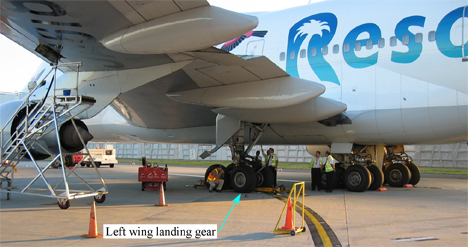
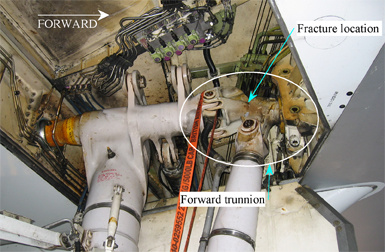
At about 1200 Eastern Standard Time on 30 May 2005, a Boeing Co 747-300 (747), registered JA8184, was being pushed back from its gate at Sydney International Airport for a scheduled passenger flight to Osaka, Japan. During pushback, the ground staff heard a loud cracking noise. The pushback was stopped and an inspection by the ground crew identified a structural failure in the left wing landing gear forward trunnion fork (trunnion), as shown in Figure 1 and 2. After an on-site inspection by the Australian Transport Safety Bureau (ATSB), the aircraft was moved to a hangar for maintenance and the fractured component was removed from the aircraft and sent to the ATSB for a detailed examination.
Figure 1 : Left wing landing gear
Figure 2: Looking up and outboard into wing landing gear well
Examination of fractured trunnion
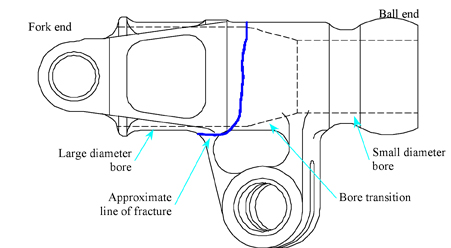
The trunnion had sustained a complete through-section fracture, located approximately mid-way between the ball-end and the fork-end (Figure 3).
Figure 3 : Fracture location on trunnion
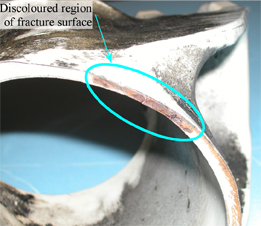
A general inspection of the fractured trunnion revealed a discoloured (orange/brown) region on the fracture surface (Figure 4) in the upper outboard region. The corroded nature of that region, compared with the adjacent bright fracture surfaces, indicated the presence of a pre-existing defect, and that the trunnion had been cracked for a period of time prior to the final failure during the pushback.
Figure 4 : Fracture surface
The fractured component was examined in a metallurgical laboratory under the supervision of the ATSB. Chemical analysis of a sample taken from the trunnion near the fracture showed that the material met the specification for AISI/SAE 4340M alloy steel. Metallographic examination confirmed a fine-grained lightly tempered martensitic microstructure, typical of the 4340M alloy in the hardened and tempered condition. The inner and outer surfaces were also observed to have been finished with a metallic type plating and painted with a surface primer and topcoat.
Hardness measurements taken indicated that the material had an ultimate tensile strength of approximately 275,600 psi (1900 MPa).
Wall thickness measurements taken around the fractured trunnion circumference showed that the minimum local wall thickness of 0.137 inches (3.48 mm) corresponded with the corroded and discoloured area of cracking.
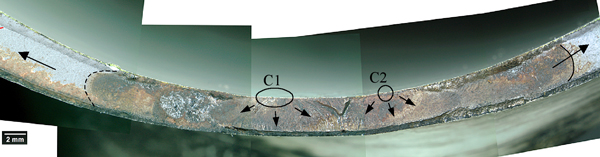
A detailed technical examination of the corroded region identified two transverse fatigue cracks originating at the inner surface of the trunnion bore (noted as C1 and C2 in Figure 5). The cracks had initiated approximately 11mm apart and had joined to form a single crack. This crack continued to grow until the final fracture occurred during the pushback.
Figure 5 : Fatigue crack development
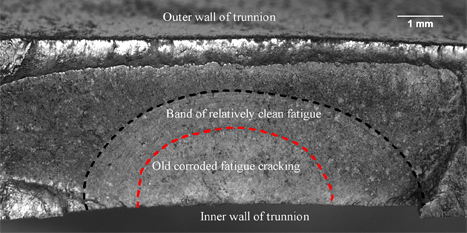
Crack C2 presented well defined fatigue progression marks, including several distinct regions of fatigue and corrosion (Figure 6). The region bounded by the red dotted line was a distinct region of heavily corroded fatigue cracking and was about 4 mm long and 1.6 mm deep.
Figure 6 : Fatigue progression and corrosion marks
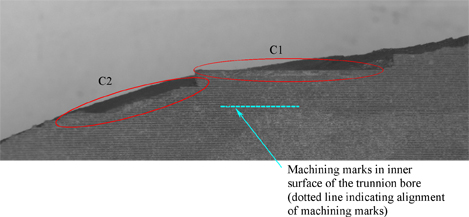
Close examination of the origins in the inner wall of the trunnion found that crack C1 had initiated from multiple closely spaced origins at the root of a machining groove, giving the appearance of a longer crack following the machining groove (or mark). Crack C2 had also originated at the root of a machining groove from multiple closely spaced origins, but over a much smaller distance before aligning with the principal stress plan1, resulting in the apparent difference in the planes of the cracks as shown in Figure 7. The plane of the initial cracks in both C1 and C2 were approximately parallel and were aligned with the machining grooves in the inner surface.
Figure 7 : Plane of crack origins
The inner and outer surfaces did not have a consistent surface roughness. Well defined machining marks were observed in the large diameter bore and to a lesser extent on the small bore. However, the outer surface and the taper region in the bore were relatively smooth without defined machining marks. The well-defined machining marks on the large and small diameter bore blended into the smoother surface of the taper region (that is, there was no abrupt change in surface roughness).
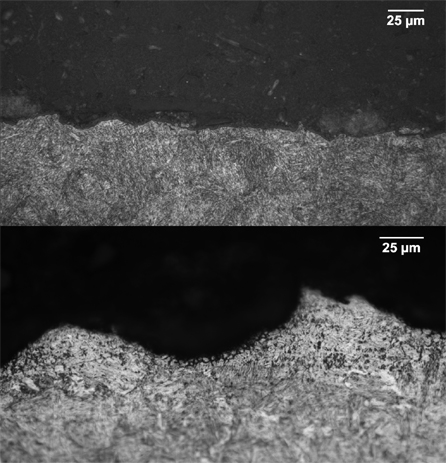
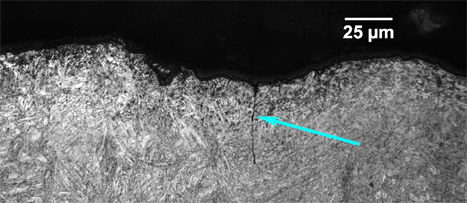
Examination of the surface microstructure in the region of the cracks revealed that the smooth regions (outer surface and taper section) had a thin layer of deformed material typical of a cold working process such as shot peening2. The area of surface deformation in the taper region ran out just before the radius (a few millimetres from the cracks). Figure 8 shows the differences in the surface roughness at a microscopic level (scale is 25µm, or 0.025 mm).
Figure 8 : Smooth surface (upper); surface with distinct machining marks (lower)
The sections taken from adjacent to the primary cracks for micrographic examination contained multiple independent fatigue cracks of various sizes. One example is shown in Figure 9. Each of these cracks originated in the root of the machining groove and were associated with shallow intergranular penetrations, which also existed in the roots of the machining grooves (Figure 8).
Figure 9 : Secondary fatigue crack indicated by arrow
Component manufacture
The landing gear trunnion was manufactured to the aircraft manufacturer's specifications by an approved external supplier. Both the supplier and the aircraft manufacturer informed the ATSB that the trunnion was manufactured at some time prior to 1975; however, the original manufacture documentation (including the manufacture plan and conformance records) was destroyed in 1994. The trunnion specifications were supplied by the aircraft manufacturer. Those documents included construction drawings and process specifications.
In the trunnion specifications, the aircraft manufacturer specified the use of 4340M steel, heat treated to an ultimate tensile strength of 275,000 to 300,000 psi. Therefore, the material used in the manufacture of the failed component met the steel alloy and strength requirements of the design.
The minimum allowable wall thickness specified3 for the trunnion at the location of the failure was 0.180 inches (4.57 mm). Therefore, the minimum wall thickness measured at the crack of 0.137 inches (3.48 mm) was 0.043 inches (1.09 mm) thinner than the design allowed.
Component maintenance
The maintenance documents supplied by the aircraft operator indicated that the trunnion had been fitted to five aircraft and had amassed a total of 25,095 landing cycles during its service life. The records also showed that the trunnion had been overhauled by the operator's component repair workshop on four occasions (Table 1). The landing gear assembly had an overhaul interval of 8 years or 12,000 cycles, whichever occurred first. Therefore, the landing gear was not due for overhaul for another 4 years, or 9,509 cycles.
Table 1 : Overhaul history
Overhaul
Date
Total cycles at overhaul
1
October 1979
3,517
2
November 1987
14,069
3
March 1992
16,508
4
October 2001
22,604
The overhaul records showed that on each occasion, the trunnion had undergone repair work. The documents indicated that the repairs were limited to the lugs and were within the repair limits permissible by the aircraft manufacturer. There was no record of any repair work carried out in the bore of the trunnion or on the outer surface in the region of the bore diameter transition.
Comparison of the overhaul instructions maintained by the operator with those supplied by the aircraft manufacturer confirmed that the operator's workshop maintained the correct instructions for the overhaul. The overhaul instructions for the component did not require a dimensional check for wall thickness or a specific check for surface finish (roughness) in the bore.
As one of the first processes in the overhaul, the protective finishes (including metallic plating) were removed from the surface of the trunnion. These finishes are removed using a chemical process, some of which, including water for cleaning, can have a corrosive effect on the trunnion material.
The overhaul procedure for the landing gear components required that the component undergo a magnetic particle inspection (MPI) to detect any defects, including cracks, that may have developed during service. The manufacturer did not provide specific instructions on how to perform the MPI on this particular component but provided a general process that the operator was to use as the basis for a component specific process. Neither the overhaul procedure nor the MPI process directed the MPI technician's attention to the radius in the bore diameter transition as a possible location for cracking. The MPI process used was capable of highlighting cracks of less than 0.5mm.
The overhaul records provided by the operator indicated that an MPI of the component was carried out at each overhaul. The MPI procedure defined by the operator was in accordance with the aircraft manufacturer's recommended procedure. It used the equipment and materials recommended by the manufacturer and specified sufficient examinations to highlight any cracks in the component. The overhaul records indicated that the item had been found satisfactory on each occasion, suggesting that no cracks had been detected.
The component maintenance manual for the repair of high-strength steel landing gear parts directed the operator to obtain advice from the manufacturer if cracks were detected during the MPI. The manufacturer did not have a record of any request for advice relating to the failed component.
The crack was in a location that was not readily viewable during a normal visual ground check. There was no requirement to perform a detailed inspection for cracks in the body of the trunnion between overhauls.
The principal stress plane is a plane that the stress in the part acts perpendicular to. In this case, the principal stress plane was not aligned with the machining marks.
Shot peening is a process where small 'shot' beads are fired against the surface of a component producing a residual compressive surface stress and a thin layer of deformed material. This process has been demonstrated to increase the fatigue life of high-strength steel components.
In the manufacture drawings for the component.
Summary
At about 1200 Eastern Standard Time on 30 May 2005, a Boeing Co 747-300, registered JA8184, was being pushed back from its gate at Sydney International Airport for a scheduled passenger flight to Osaka, Japan. During pushback, the ground staff heard a loud cracking noise. The pushback was stopped and an inspection by the ground crew identified a structural failure in the left-wing landing gear forward trunnion fork.
Examination of the trunnion fork revealed that it had failed due to fatigue cracking that had originated on the inner surface of the trunnion fork bore. It was found that the wall thickness at the crack origin was below the minimum allowed by the design and that the inner surface of the bore did not meet the specifications of the design. These factors contributed to the formation and development of the fatigue crack, which lead to the final failure on pushback.
The trunnion fork had amassed a total of 25,095 landing cycles and had been overhauled by the operator on four occasions. During the overhaul the item was inspected for cracks and on each occasion the item was passed. The inspection procedure was general for the item and did not specifically indicate that the area where the cracking originated required particular attention. The surface finish of the inner surface of the bore may have masked indications of any cracks that may have been present.
As a result of this occurrence, the aircraft manufacturer and the aircraft operator have commenced actions to determine the extent of the problem in the remaining fleet and improvements in the inspection of items during maintenance.
On 25 June 2005, a Bombardier Aerospace Dash 8-315 (Dash 8) aircraft was being operated on a scheduled passenger service from Weipa to Cairns, Qld, while three Aero Commander Div Shrike Commander aircraft (Aero commander) were tracking to Cairns from Cooktown, Qld. The four aircraft were in an arrival sequence of seven aircraft tracking to runway 15. Visual meteorological conditions existed during the period of the aircrafts' arrivals.
Based on the aircrafts' estimated arrival time, the Dash 8 was 3 minutes behind the three Aero commanders. The Aero commanders were maintaining 1,000 ft above mean sea level, and the Dash 8 was on descent from 5,000 ft. The Cairns approach controller estimated that low level headwinds would delay the Aero commanders more than the Dash 8. Consequently, the controller re-ordered the landing sequence to place the Dash 8 ahead of the Aero commanders for landing. The approach controller notified the aerodrome controller of the change in the landing sequence.
At 1705 Eastern Standard Time, when the Dash 8 was on final approach at about 6 nautical miles1 (NM) from the airport, the crew received a traffic alert and collision avoidance system (TCAS) traffic advisory. The crew saw an Aero commander to the left at about 3 NM, and observed on the TCAS display another aircraft in close proximity. Very shortly after, they received a TCAS resolution advisory to climb their aircraft, which they followed. The crew reported that as they were climbing, they saw an Aero commander pass to the left of the Dash 8.
The four aircraft were being operated on instrument flight rules category flights that required separation by air traffic control. Controllers could use a 3 NM radar separation standard, a vertical separation standard of 1,000 ft, visual separation by the aerodrome controller, or require a pilot to sight and follow another aircraft. The approach controller's intention was to separate the aircraft using sight and follow procedures.
As the aircraft approached the airport the aerodrome controller used non-standard coordination phraseology that was misunderstood by the approach controller. The approach controller subsequently instructed the crew of the Dash 8 and the three Aero commanders to transfer to the aerodrome controller's radio frequency. The resultant traffic situation presented to the aerodrome controller was difficult to resolve using visual separation or sight and follow procedures.
The TCAS events occurred as the first Aero commander turned right to track behind the Dash 8 on the final approach to runway 15. The Aero commanders were from the same operator and often used sight and follow procedures between company aircraft on arrival.
An Airservices Australia (Airservices) investigation found that the occurrence was due to the following factors:
the approach controller made an error of judgement in assessing the new traffic sequence
the aerodrome controller used non-standard coordination phraseology that was misinterpreted by the approach controller
the use of sight and follow procedures for the number of aircraft involved increased controller workload
the approach controller's lack of recent familiarisation with tower visual separation procedures.
The Airservices report made six recommendations, and the following action has been taken in regard to the recommendations:
tower and approach/departure controllers were reminded to use standard coordination phraseology to reduce the possibility of ambiguity
a tower and approach/departure area familiarisation program has been implemented that requires participating controllers to complete a project paper
letters of agreement regarding sight and follow procedures have been finalised with two local operators.
A nautical mile is equal to 1852 metres.
Summary
On 25 June 2005, a Bombardier Aerospace Dash 8-315 (Dash 8) aircraft and three Aero Commander Div Shrike Commander aircraft (Aero commander) were in an arrival sequence of seven aircraft to runway 15 at Cairns Airport. At 1705 Eastern Standard Time, when the Dash 8 was on final approach at about 6 nautical miles (NM) from the airport, the crew received a traffic alert and collision avoidance system (TCAS) traffic advisory. The crew saw an Aero commander to the left at about 3 NM, and observed on the TCAS display an aircraft in close proximity. Very shortly after, the crew of the Dash 8 received a TCAS resolution advisory to climb their aircraft, which they followed. The crew reported as they were climbing, they saw a second Aero commander pass to the left of the Dash 8.
An Airservices Australia (Airservices) investigation of the occurrence found that the occurrence was due to the following factors:
the approach controller made an error of judgement in assessing the new traffic sequence
the aerodrome controller used non-standard coordination phraseology that was misinterpreted by the approach controller
the use of sight and follow procedures for the number of aircraft involved increased controller workload
the approach controller's lack of recent familiarisation with tower visual separation procedures.
The Airservices report made four recommendations to Cairns Terminal and two recommendations to Cairns Tower, for action.
On 2 July 2005 at about 0920 Eastern Standard Time, the pilot of a Piper PA-32RT-300 aircraft registered VH-SEQ conducted pre-flight checks for a local scenic flight from Townsville Airport, Qld. The pilot then boarded the five passengers and conducted a safety briefing. The passengers were provided with intercom headsets.
The pilot obtained a clearance from the aerodrome controller (ADC) and commenced the take-off. During the take-off roll the pilot noticed an object go past the windscreen. He rejected the take-off and returned to the apron where he shut down the engine and disembarked the passengers.
The pilot found that the engine cowling bungs1 had not been removed during the pre-flight inspection. He removed pieces of the bung material from the cowl openings. The pilot and passengers again boarded the aircraft and departed for the scenic flight.
While over the city the pilot twice attempted unsuccessfully to contact the ADC by radio for approach instructions. The pilot reported that he then noticed that the ammeter did not indicate a positive battery charge rate. Realising that the electrical system had failed, he contacted the ADC by mobile telephone and obtained approach and landing instructions. A passenger later stated that the headsets had operated intermittently during the flight and stopped functioning prior to the landing.
The pilot selected the aircraft's landing gear down while on the downwind leg of the circuit for runway 07. The gear position lights did not illuminate, and he was unable to confirm that the electro-hydraulic powered landing gear had locked in the down position. The pilot stated that he twice applied the emergency landing gear extension checklist procedure. The landing gear emergency extension checklist required a number of actions to be completed. These included a fish-tailing or yawing manoeuvre to ensure that the main landing gear had locked in the down position.
The pilot then attempted to contact the ADC, but the mobile telephone had failed due to low battery charge. While on final approach the pilot received a green light from the ADC confirming the landing clearance. The pilot stated that he did not advise the passengers of the potential problem with the landing gear.
The pilot reported that he was aware the landing gear could collapse and said he had taken extra care to ease the aircraft gently onto the runway. The right main landing gear collapsed during the landing roll and the aircraft then veered to the right and departed the runway surface. The left main and nose landing gears then collapsed. The pilot and five passengers vacated the aircraft without assistance. There were no reported injuries to either the passengers or the pilot.
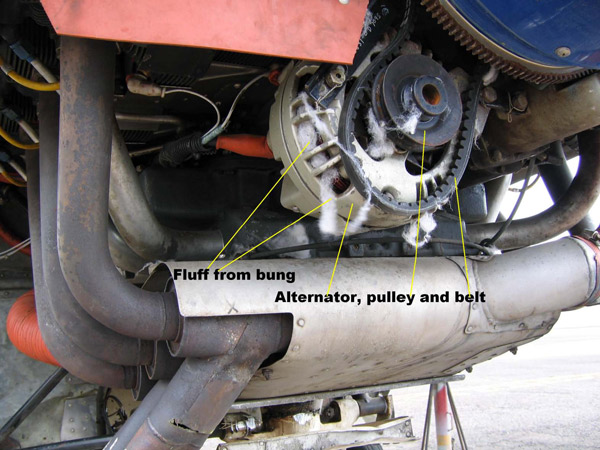
The subsequent inspection found that a large part of the leather casing of one engine cowling bung had jammed between the starter ring gear and starter motor and dislodged the alternator drive belt. The pilot reported that the cowling bungs were partially obscured by the 2-bladed propeller and were not fitted with streamers. The colour of the bungs was similar to that of the engine cylinder heads. The passengers reported that the pilot said he had overlooked removing the bungs during the pre-flight inspection as he was distracted at the time.
Due to the damage to the landing gear and the aircraft structure, the investigation was unable to establish detailed reasons for the right main landing gear collapse.
Figure 1: The dislodged alternator belt and fluff from the bungs
ATSB COMMENT
The circumstances of this accident demonstrate the need for thorough pre-flight inspections. Once the pilot became aware that the cowling bungs were damaged, the need for a comprehensive inspection prior to further flight should have been apparent.
The loss of power to the electrical system occurred when the battery discharged after the alternator drive belt was dislodged.
The lack of colour contrast probably contributed to the pilot not seeing the engine cowling bungs during the pre-flight inspection. The common practice of using brightly coloured bung covers with attached streamers would have helped to ensure that the pilot recognised their presence.
Although the pilot assessed that the risk of landing gear collapse was remote, he should have provided a specific emergency briefing to the passengers.
Used to prevent bird entry to the engine bay when the aircraft is not in use.
Summary
On 2 July 2005 at about 0920 Eastern Standard Time, the pilot of a Piper PA-32RT-300 aircraft registered VH-SEQ conducted pre-flight checks for a local scenic flight from Townsville Airport, Qld. The pilot then boarded the five passengers and conducted a safety briefing. The passengers were provided with intercom headsets.
On 13 May 2005, a McDonnell Douglas Hughes 369E helicopter, registered VH-INM, experienced an in-flight failure of the tail rotor drive shaft. The aircraft had departed Archerfield Airport, Qld, and was in climb to cruise at approximately 1,000 ft above ground level when the pilot encountered tail rotor control difficulties. The aircraft was landed and brought to rest in an upright position at Fig Tree Pocket, Qld.
The broken tail shaft (P/N 369D21615-41) was submitted to the ATSB, where examination revealed that the component had sustained a twisting buckling failure from excessive torsional loads. The investigation did not reveal any evidence of pre-existing damage that might have initiated the failure.
During a flight from Essendon to Armidale, the left engine of a Piper PA31P-350 (VH-IGW) failed during cruise at 17,000 feet. Examination of the engine revealed that the crankshaft had fractured in two locations: through the web between the No.4 main bearing journal and the No.4 connecting rod journal; and through the web between the No.3 main bearing journal and No.3 connecting rod journal. It is evident that the event that initiated the multiple fractures of the crankshaft and the subsequent engine failure, was the creation of surface damage in the No.4 main bearing journal fillet radius through rubbing contact between the main bearing insert and the fillet radius. The factors that contribute to this event may be related to the retention of the main bearing insert in its housing and the crankshaft loading conditions that act to displace the bearing insert from its location in the bearing housing.
The movement of main bearing inserts during engine operation is a function of the magnitude of the forces that resist movement (created by establishing an interference fit) and the magnitude of forces acting to move the insert (crankshaft bending moments).
One factor that lowers the resistance of an insert to movement, the inclusion of material between the parting faces of the main bearing housings during engine assembly, was identified. However, other factors that may contribute to bearing insert movement, such as the magnitude of crankshaft bending moments, could not be established from an examination of the physical evidence.
The restoration of the surfaces of the main bearing housings indicated that main bearing insert movement was not an isolated case.
On 17 May 2005, a Boeing 717-200, registered VH-VQI, was scheduled to operate a regular public transport flight from Hobart to Sydney, departing at 0600 Eastern Standard Time. During the starting of the right engine, the aircraft dispatcher informed the flight crew that there was smoke and sparks shooting from the right engine and advised 'we'll have to get everyone off'. The pilot in command called for an emergency evacuation without initiating the Passenger Evacuation Checklist. As a result, the wing flaps were not set to the extended position and the tail section of the aircraft was dark without emergency lighting while passengers were exiting the aircraft. All three of the floor level exits were opened by cabin crew. The forward Door Right 1 escape slide fell to the ground uninflated when the door was opened.
A number of ground personnel ran to the front of the aircraft and helped 22 passengers off the forward Door Left 1 slide and directed them towards the terminal. Four passengers exited by the Door 2 slide at the rear of the aircraft and ran into the middle of the apron. The overwing exits were not opened. The aircraft's dispatcher had not received any education in emergency communications with flight crew nor aircraft evacuations at the terminal. The flight crew were engaged in conversations not confined to the engine start process or other operational matters during both engine start sequences until the problem with the right engine was first mentioned by the dispatcher. The reported smoke and sparks was a result of the right engine air turbine starter failing during the engine start sequence.
On 3 May 2005, Metroliner SA227-AC, registered ZK-POA, was operating a freight service from Auckland to Blenheim, New Zealand. The aircraft was reported to have experienced an in-flight breakup near Stratford and both pilots, the only occupants, were fatally injured.
The Transport Accident Investigation Commission (TAIC) of New Zealand was responsible for investigating this accident and requested assistance from the Australian Transport Safety Bureau (ATSB) to recover information from the flight recorders. In accordance with the Transport Safety Investigation (TSI) Act 2003, the Executive Director of the ATSB approved the request and the recorders were transported to the ATSB by a TAIC investigator on 16 May 2005.
The cockpit voice recorder (CVR) and flight data recorder (FDR) were examined by ATSB recorder specialists and information was successfully recovered from both recorders.
Once it has been completed, a copy of the TAIC investigation report (05-006) may be found at: www.taic.org.nz or by contacting:
TAIC, PO Box 10-323 Wellington 6036 New Zealand
Summary
Following a request from the New Zealand Transport Accident Investigation Commission, ATSB is providing assistance regarding the recorder data from a Metroliner which was involved in an accident in New Zealand on 03 May 05.
The pilot performed a manoeuvre that resulted in a loss of control at a height and speed that was insufficient to permit recovery before the aircraft hit the ground.
Analysis
The pilot was reported to have conducted a similar low-level manoeuvre to that which preceded the accident on several previous occasions. On that basis, the investigation team considered that it was unlikely that the passenger was at the controls of the aircraft at the time of the accident. The manoeuvre left little or no margin for error and required sound judgement and skill. Although the pilot may have possessed those skills, no evidence was found of his ever having undertaken the appropriate check to assess those skills and obtain approval to conduct low-level aerobatic manoeuvres.
Repetition of the manoeuvre over a period of time may have led to the pilot gaining a false sense of security and may have led to the pilot becoming complacent about the inherent dangers involved with such manoeuvres. The manoeuvre performed by the pilot earlier that day at another location was commenced from a 'high-speed' flypast. The associated energy would have allowed the aircraft to convert speed to height and climb higher and attain a greater altitude for recovery than the manoeuvre performed during the accident flight. That manoeuvre was commenced from a take-off roll that did not use the full runway length available. When combined with a tailwind component, it was unlikely that the aircraft attained adequate airspeed to safely complete the intended manoeuvre by the end of the strip. It was also possible that the pilot was unaware of the windshear or had not considered its affect on the aircraft's climb performance.
Although the aircraft appeared to have stopped spinning to the right just before impact, the pilot had insufficient height to avoid a collision with the ground. Had the stall warning been operating, it could have provided the pilot with an earlier indication of the stall condition and thus enabled him to initiate a recovery earlier in the development of the manoeuvre.
The affect of the pilot's medical condition on his judgement or decision-making could not be determined. However, some aspects of the pilot's behaviour were not consistent with compliance with rules and regulations or good airmanship. These included conducting low-level aerobatics without approval, ignoring concerns expressed by peers, operating with an unserviceable stall warning indicator and ignoring weight and balance limitations. Furthermore, the pilot flew the aircraft knowing that he was suffering from a medical condition that was being reviewed by the Civil Aviation Safety Authority (CASA) and having been advised by CASA that he was not to fly until the results of the review were known. Disregard for the rules governing the conduct of flight and the operation of the aircraft removed safety defences that were established to prevent this type of accident.
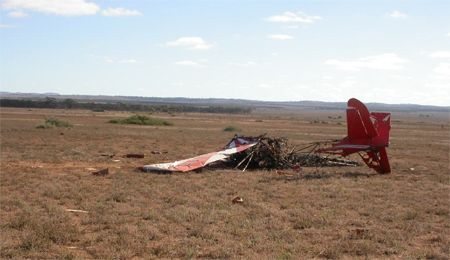
On 15 May 2005 at 1535 Central Standard Time, an American Champion Corporation Citabria 7GCAA aircraft, registered VH-TUF (TUF), took off on a local flight from a private airstrip at Stonefield, SA. On board were the pilot and a passenger, who was also a licensed pilot. Dual controls were installed in the aircraft. The aircraft was observed by witnesses at the airfield to pull up into a steep climb after becoming airborne, before apparently stalling and impacting the ground. Both occupants were fatally injured. The aircraft was destroyed by impact forces and a post-impact fire (see Figure 1).
Figure 1: View of the wreckage looking west
The pilot had been at the Stonefield airstrip during the weekend with other pilots and aviation enthusiasts. On the morning of the accident, the pilot had conducted a short flight in TUF, which included a flypast at a nearby airstrip that was witnessed by two experienced commercial pilots. They described observing the aircraft flying at 'high speed', approximately 20 ft above ground level (AGL) over a taxiway, before pulling up into a vertical climb. The pilot then performed a stall turn and the aircraft was observed to enter a spin or spiral before recovering at a height of about 200 ft and continuing on its original heading.
After returning to Stonefield airstrip, the pilot was required to transport a passenger to Parafield Airport, SA. While at Parafield, the pilot arranged for the aircraft to be refuelled with 62 L of AVGAS. The refueller reported to investigators that that quantity of fuel filled the tanks2. After returning to Stonefield airstrip again, the accident pilot was reported to have undertaken a flight with another pilot in a different aircraft, during which the accident pilot had demonstrated a number of aerobatic manoeuvres to the other pilot. The accident pilot then undertook a further flight in TUF with the same passenger as the previous flight, and demonstrated a number aerobatic manoeuvres again.
After discussion with other people at Stonefield, the accident pilot decided to conduct a further local flight, and the same passenger from the previous two flights was invited as a passenger again. Witnesses observed the passenger in the rear seat and the pilot in the front seat. After engine start-up, the pilot performed a turn on the ground of more than 360 degrees before taxying on the north-east strip without performing an engine run-up. The aircraft engine was heard increasing in RPM prior to the aircraft commencing a downwind take-off into the north-east. After becoming airborne, the aircraft was observed to remain at approximately 10 ft AGL until it reached a fence line to an adjoining property at the end of the strip. At about this point, the aircraft was observed to enter a near vertical climb. At an estimated height of 500 ft AGL, the aircraft appeared to aerodynamically stall in the vertical attitude, before entering a right hand spin. The aircraft completed one and a half turns in the spin, before it appeared to almost recover just before impacting the ground.
Personnel information
The pilot was 63 years old and held both commercial and private pilot licences for aeroplanes. He had successfully completed an Aeroplane Flight Review in August 2004. The pilot had a total of 2,848 hours experience, 2,746 hours of which was as pilot in command in single-engine fixed-wing aircraft. The pilot was an experienced aerobatic pilot in New Zealand. He did not hold a low-level aerobatic approval from the Australian Civil Aviation Safety Authority (CASA).
The pilot had undergone medical treatment for a terminal illness and, at the time of renewal of his Class 1 medical certificate, informed his Designated Aviation Medical Examiner (DAME) of this illness. At the time of that examination, the pilot's Class 1 medical certificate had expired. However, his Class 2 medical certificate was not due to expire until December 2005.
The DAME did not reissue either the Class 1 or Class 2 medical certificate and referred the matter to CASA. An assessment by CASA medical staff confirmed that the pilot's medical condition precluded him from flying as pilot in command. The pilot appealed to CASA regarding that adverse assessment and was advised verbally and in writing by CASA of his obligations under Civil Aviation Safety Regulations 67.2653 and 67.2704 until the outcome of the review of that appeal was known.
Although a review of the assessment was commenced, CASA did not cancel or suspend his Class 2 medical certificate while that review process was being completed. CASA advised the Australian Transport Safety Bureau (ATSB) that it was normal procedure to only cancel or suspend a certificate after all specialist medical information was received and all options to mitigate safety risks to air navigation were considered. During the period his medical condition was under review, the pilot logged more than 20 hours in aircraft as pilot in command.
In addition to the flights made on the day of the accident, the pilot had flown to Stonefield from Parafield during the previous day. Prior to this, the pilot had worked during the days at his own business conducting non-aviation activities and was reported to have been well rested.
Several pilots reported that the pilot had regularly performed a similar low level aerobatic manoeuvre to that which preceded the accident. A chief flying instructor who had known the pilot, reported that he had observed the pilot perform this type of low-level aerobatic manoeuvre several times in the past. During the investigation, he advised investigators that he was concerned about the safety of the manoeuvre and had warned the pilot about the dangers of performing it.
Aircraft information
A 100-hourly maintenance check was completed on the aircraft 3 days prior to the accident, at which time the aircraft had recorded 2,451.14 total time in service (TTIS). The maintenance release was unable to be located and was probably burnt in the wreckage. As a result, the time flown subsequent to that check could not be accurately determined.
Weight and balance calculations made using estimated fuel and occupant weights, determined that the aircraft may have been as much as 20 kg over the maximum all up weight, and that the centre of gravity (CoG) was rearward of the aerobatic limit, but within the normal operating range.
Meteorological information
There was no terminal aerodrome forecast for the private airstrip. However, the area forecast indicated that the wind at 2,000 ft was 150 degrees true at 15 kts. Other pilots who flew into Stonefield that day reported that the ceiling and visibility was acceptable for visual flight and that the wind was a southerly at 8 to 10 kts at ground level. However, at 500 ft AGL, the wind was reported to be a southerly at approximately 30 kts. The temperature was reported to be 19 to 20 degrees Celsius.
Wreckage information
The aircraft struck the ground in a 40-degrees nose-down attitude with the left wing low, and came to rest facing the southwest, 22 m from its initial impact point. Damage to the propeller indicated the propeller was rotating at impact. The aircraft was destroyed by severe impact forces and a post-impact, fuel-fed fire.
Two persons attempted, unsuccessfully, to extinguish the fire with hand-held fire extinguishers. The fire was subsequently contained by local fire fighters. The accident was not survivable.
The engine was removed and examined at an approved engine overhaul facility under supervision of the ATSB. No anomaly or defect was found in the engine and it was determined that the engine was capable of normal operation prior to the accident.
The stall warning system on the aircraft was examined. The wing-mounted air vane switch that actuated a warning horn/light in the cockpit was found to have one of the electrical leads disconnected, rendering the stall warning system inoperative. The lead had been safely secured and appeared to have been deliberately disconnected. Subsequent testing of the stall warning system found that when wired correctly, it was capable of functioning normally. The investigation was unable to determine when, or by whom, the stall warning system was deactivated. The stall warning device gives an indication to the pilot of an impending aerodynamic stall condition.
There was no evidence of any other mechanical defect that could have contributed to the accident.
Medical and pathological
Results of post-mortem and toxicologic testing of the pilot did not reveal any evidence of any sudden incapacitating condition that could have contributed to the accident.
Fuel
A small sample of fuel was taken from the aircraft wreckage, however, this fuel was contaminated by fire fighting agents, and could not be used as a reliable pre-fire indicator of fuel quality. The aircraft had been refuelled at Parafield earlier that day, but the batch from the tanker was unable to be tested, as it had been mixed with a new batch of fuel. The investigation determined that fuel from the batch from which TUF had been refuelled had also been used to refuel more than 12 other aircraft. There were no reports of fuel contamination or fuel related problems from those operators.
Aircraft manufacturer's information
The aircraft manufacturer was asked to comment on aspects of the aircraft's performance and handling. Their test pilot reported that:
flight above gross weight would decrease take-off performance and increase stall speed
In respect to the exceedance of the rearward aerobatic CoG datum, the test pilot reported that:
the CG [centre of gravity] exceeded the aft aerobatic limit… but was within the normal category of 18.2. I do not feel this contributed to the pilot's ability to control or recover the aircraft.
The manufacturer reported that:
the decision to conduct a low altitude aerobatic maneuvre [sic] with insufficient airspeed resulted in the subsequent stall/spin.
Only those investigation areas identified by the headings and subheadings were considered to be relevant to the circumstances of the occurrence.
Full tanks 147 L.
Essentially, this regulation requires a pilot in the accident pilot's circumstances to be cleared by a DAME before exercising the privileges of a licence.
This regulation places the onus on a pilot not to exercise the privileges of a licence if the pilot is aware that he or she has a medically significant condition.
Summary
On 15 May 2005, at 1535 Central Standard Time, an American Champion Corporation Citabria 7GCAA aircraft registered VH-TUF, with a pilot and passenger, took off from Stonefield private airstrip in South Australia for a local private flight. Shortly after becoming airborne, the aircraft crashed. Both occupants were fatally injured. The aircraft was destroyed by impact forces and a post impact fire.
After start up, the pilot performed a turn on the ground of more than 360 degrees before taxying on the north-east strip. The aircraft engine was heard powering up on the strip into the north-east and shortly after became airborne. After becoming airborne, the aircraft was observed to remain approximately 10 feet above the strip, and remained at that height until the end of the strip. At about this point, the aircraft was observed to enter a near vertical climb. At an estimated height of 500 feet above ground level, the aircraft stalled in the vertical position, before entering a right hand spin. The aircraft completed one and a half turns in the spin before it appeared to recover. At the point where the aircraft appeared to have recovered from the spin, it impacted the ground.
The investigation determined that the aircraft on the accident flight was 20kg over maximum all up weight (MAUW). The increased weight would have the effect of increasing the stall speed of the aircraft, thereby reducing its performance. It was also determined that the pilot took off north-east with a quartering down wind component, and attempted a vertical climb with a wind gradient of approximately 30kt and at 500 feet from the south, above ground level. This wind gradient would have significant impact on the aerodynamic performance of the aircraft, and the pilot may not have achieved the height he intended before it stalled.
The nature of the terrain in the vicinity of the accident site was such that potential emergency landing areas were limited and added to the complexity of the task of the pilot in responding to the in-flight emergency. The factors surrounding the in-flight shutdown of the engine could not be determined, as the problem could not be replicated in the engine test cell. No engine shutdown was recorded on the on-board diagnostic equipment.
The rotorcraft flight manual contained no specific information on an event such as that reported. However, the pilot's reaction to the main rotor RPM audio warning appeared inconsistent with the only guidance provided in the rotorcraft flight manual relating to an increase in main rotor RPM.
Factual Information
At 1110 Eastern Standard Time on 12 May 2005, a Eurocopter EC120B helicopter, registered VH-ADC, departed Canberra for Jindabyne, NSW, with the pilot and two passengers. The pilot reported that about 30 minutes after departure, while in cruise flight at 5,000 ft above mean sea level (AMSL) in smooth flying conditions, the main rotor speed (NR) RPM audio warning sounded1. The pilot reported that a scan of the instrument panel revealed that the NR was exceeding 450 RPM and that he then lowered the collective pitch lever. He reported that after entering an autorotation configuration, it took approximately 5 to 7 seconds to arrest the high NR rate by lifting the collective lever, which then reduce the NR and silenced the audio warning2.
The pilot further reported that he completed a left turn towards a cleared area and lined the helicopter up on a north-easterly heading, while rapidly losing altitude before turning towards the south-east over trees to the clearing. The pilot flared the helicopter for landing, but noted no perception of power from the engine (audible or torque) and the helicopter sank through the flare before it impacted the undulating ground. It then bounced back into the air momentarily, before it impacted the ground once more and slid to a halt. The pilot then applied the rotor brake to stop main rotor rotation and assisted the passengers to exit the helicopter. There were no injuries to the passengers and only minor injuries to the pilot. The elevation at the final resting place of the helicopter was about 4,340 ft AMSL.
The helicopter was determined to be within weight and balance limits and carried sufficient fuel for the flight.
The helicopter sustained damage to the main rotor blade tip caps, front skid landing gear, front bottom canopy and aft upper tail cone/fenstron area. During the landing sequence, the main rotor blades had contacted the aft upper tail cone/fenstron area as a result of the flaring of the helicopter. The initial impact ground scars of the helicopter skid landing gear were reported to have been about 35 m from the final resting place of the wreckage.
At the time of the occurrence, the helicopter had accumulated 195.9 hours total airframe time. The Turbomeca model Arrius 2F engine, serial number 34039, had been installed on 28 February 2005 with 736.8 hours time since new. At the time of the accident, the engine had accumulated 775.0 hours time since new. The engine was a replacement engine that had been provided by the engine manufacturer while the original engine was being repaired.
The original engine had been removed for an unrelated over-torque event. An examination the helicopter's operational and maintenance records conducted by the Civil Aviation Safety Authority (CASA) found that the helicopter had been maintained correctly and satisfactory records maintained.
Following the accident, the engine was removed and shipped to the engine manufacturer for testing, disassembly and examination under the supervision of the Bureau d' Enquetes et d' Analyses of France, on behalf of the Australian Transport Safety Bureau. The engine was placed into a test cell and operated to confirm operating parameters. The engine was tested through all operating parameters without any abnormal vibrations, high temperatures, overspeeding or other anomalies. The fuel control unit was then removed and bench tested with no anomalies found. Testing, disassembly and examination of the engine did not reveal any anomalies that could have contributed to the in-flight shutdown as reported.
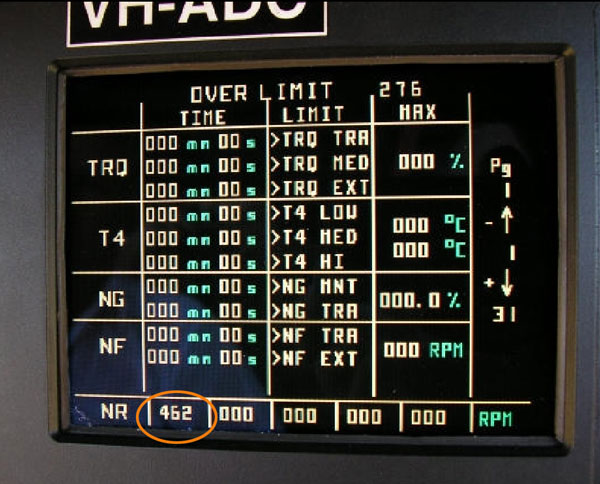
The helicopter's on-board diagnostic equipment was accessed immediately following the event. The maintenance page of the equipment displayed only a fault code indicating that an over limit NR event to 462 RPM had taken place. No other faults were displayed.
The rotorcraft flight manual included a section entitled ENGINE FLAME-OUT, which detailed procedures in the event of an engine flame-out in cruise flight including:
AUTOROTATION PROCEDURES OVERLAND
Collective pitch…………REDUCE to maintain NR in green arc.
The rotorcraft flight manual also included a section entitled ENGINE GOVERNOR FAILURE which detailed emergency procedures for a rapid increase in NR as follows:
NR INCREASE
Simultaneously to maintain NR in green arc:
Collective……………….INCREASE
Twist Grip………………SLIGHTLY REDUCE
NOTE During the flight, the pilot shall control NR using the twist grip.
The rotorcraft flight manual did not include procedures specifically related to a sudden increase in NR during cruise flight. However, the CASA requirements for the granting of a helicopter licence require a pilot to demonstrate the ability to control NR within rotorcraft flight manual limits. During this training, pilots are taught to control the NR utilising both the collective lever and the throttle twist grip.
An intermittent tone activated at 420 RPM NR. Normal operating range for NR was 390 to 415 RPM, the caution range was 415 to 447 RPM with 447 RPM the maximum with power off.
Increasing collective pitch of the main rotor blades using the collective pitch lever reduces the NR by slowing down the rotational speed of the blades for that given engine power setting.
Summary
At 1110 Eastern Standard Time on 12 May 2005, a Eurocopter EC120B helicopter, registered VH-ADC, departed Canberra enroute to Jindabyne, NSW, with the pilot and two passengers on board. The pilot reported that at about 30 minutes after departure, while in cruise flight at 5,000 ft above ground level in smooth flying conditions, the main rotor speed (NR) RPM audio warning sounded.
The pilot reported that a scan of the instrument panel revealed that the NR was exceeding 450 RPM and that he then used the collective pitch lever to reduce the NR. The pilot noted that it took approximately 5 to 7 seconds to arrest the high NR rate, which then silenced the audio warning. The helicopter was flared for landing as it lost altitude and impacted the undulating ground It then bounced back into the air momentarily, before it impacted the ground once more and slid to a halt. The pilot then applied the rotor brake to stop main rotor rotation and assisted the passengers to exit the helicopter. There were no injuries to the passengers and minor injuries to the pilot.
The helicopter was determined to be within weight and balance limitations and carried sufficient fuel for the flight. Testing of the engine could not duplicate the in-flight engine shutdown as reported.