On 2 December 2005, a Boeing Company B737-7Q8 aircraft, registered VH-VBC, was being operated on a scheduled passenger flight from Townsville to Brisbane Qld. While the aircraft was passing flight level 370 on climb, the crew heard a 'bang', which was closely followed by the annunciation of a Window Overheat master caution. After becoming aware that the outer layer of the pilot in command's L1 window was cracked, the crew followed the checklist for window damage. As a result, at about 2106 Eastern Standard Time, a cabin altitude warning horn sounded. The sounding of the warning horn was the normal result of the crew's implementation of the checklist for window damage. However, the flight crew believed that the aircraft was depressurising as a result of the window damage and responded to the cabin altitude warning by carrying out an emergency descent from 33,000 ft to 10,000 ft.
During the descent, the crew closed the valve that controlled the outflow of air from the aircraft. However, the pressurisation system was functioning normally and closing the outflow valve caused the aircraft to exceed its cabin pressure limit, as a result of which the over-pressure safety relief valves opened. The flight crew realised that the aircraft was not depressurising, but pressurising, and opened the outflow valve. The combined action of the crew and the automatic opening of the safety relief valves reduced the cabin pressure at a rate greater than that which passengers normally experience. As a result, 11 passengers sustained minor injuries.
Following a company investigation, the operator retrained the flight crew involved in the incident, audited its check and training system and modified the simulator programme to include operational issues identified in this incident.
The aircraft manufacturer has modified the checklist for window damage to minimise the possibility of a cabin altitude warning occurring when the checklist is used.
The operator, in conjunction with the manufacturer, is still investigating the cause of the window breakages.
At approximately 0725 Eastern Daylight-saving Time on 3 December 2005, during a scheduled passenger service from Wynyard, Tasmania to Melbourne, Victoria, the crew of the de Havilland Canada, Dash 8 aircraft, registered VH-TQW, heard a loud bang from the left side of the aircraft. The crew then observed the loss of the number one (left) engine's torque and oil pressure indication.
Following company procedures, the crew shut down the left engine, advised Melbourne Air Traffic Control of their situation, and continued the approach. A single engine landing was conducted at Melbourne.
A subsequent examination of the aircraft indicated that an internal failure of the left engine had occurred. The engine, a Pratt and Whitney Canada, PW121 model, serial number 120257, was removed from the aircraft and sent to the engine manufacturer's overhaul facility in Singapore for disassembly and examination. The examination was conducted under the supervision of the Air Accident Investigation Bureau of Singapore on behalf of the Australian Tranport Safety Bureau (ATSB).
The engine examination found that the engine accessory gearbox bevel gearshaft (towershaft) had failed, separating into three segments. The failed towershaft disrupted the supply of fuel and oil to the engine, resulting in the engine failure.
As a result of this and other, similar, towershaft failures in this engine type, the results of this occurrence and a broader investigation are included in ATSB Safety Investigation Report 200501912.
Occurrence summary
Investigation number
200506294
Occurrence date
03/12/2005
Location
74km SE Melbourne, Aerodrome
State
Victoria
Report release date
11/05/2007
Report status
Final
Investigation type
Occurrence Investigation
Investigation status
Completed
Mode of transport
Aviation
Aviation occurrence category
Engine failure or malfunction
Occurrence class
Incident
Highest injury level
None
Aircraft details
Manufacturer
De Havilland Canada/De Havilland Aircraft of Canada
While on a scheduled passenger flight from Brisbane, Australia, to Los Angeles, US, the crew of the Boeing Company 747-438 aircraft, registered VH-OJD, observed excessive fuel use by the number three engine. After confirmation that the engine had a fuel leak, the flight crew conducted and in-flight engine shutdown and diverted the aircraft to Sydney.
Inspection of the engine found a fuel manifold drain line had fractured. Detailed examination of the drain line revealed that it had been subjected to high cycle fatigue (HCF), which led to its failure. The HCF was attributed to harmonic resonance from a combustor rumble of unknown origin.
As a result of extensive testing of the engine, the manufacturer redesigned the drain line and reviewed its attachment (clipping) arrangements.
The information provided to the Alice Springs aerodrome controller, from both the pilot of the C310 and the crew of the 717, indicated that a lateral separation standard existed between the aircraft. On that basis, the aerodrome controller cleared the crew of the 717 to descend below the level of the C310. However, the position of the Cessna C310 relative to the 717, as reported by the 717 crew, at the time the aerodrome controller cleared the 717 crew to descend through the level of the C310, meant that no procedural separation standard existed between the two aircraft. The aerodrome controller had no indication that the information from either source may have been erroneous, before clearing the 717 to descend through the level of the C310. It was not possible for the investigation to determine why the lateral separation standard applied by the aerodrome controller was compromised.
The integrity of procedural separation standards relies on the accuracy of information provided to air traffic control by pilots. Once the pilot of the C310 reported that the aircraft was established in the training area, the aerodrome controller had established a lateral separation standard between the C310 and the 717. He was then able to clear the 717 to descend through the level of the C310. Pilots need to be mindful of the importance of the accuracy of the information they provide to air traffic control in maintaining the integrity of published separation standards.
Factual Information
On 17 November 2005, at 1327 Central Standard Time, a Boeing Company 717-200 (717) aircraft, registered VH-NXE, was inbound to Alice Springs, NT, on the 055 degree radial of the very high frequency omni-directional radio range (VOR) ground-based navigation aid, on a scheduled flight from Cairns, Qld. The 717 crew reported to the Alice Springs aerodrome controller that they passed almost overhead and within about 1,500 ft of a Cessna Aircraft Company C310R (C310) that was outbound from Alice Springs.
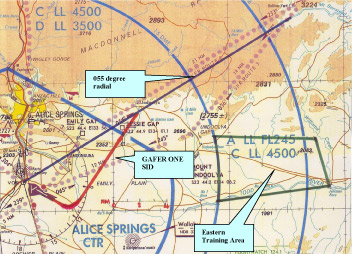
The C310, registered VH-JOI, was being operated on a pilot instrument rating renewal flight and, after becoming airborne off runway 12, was being tracked via a GAFER ONE standard instrument departure (SID), on climb to operate in a training area located to the east of Alice Springs (Figure 1), not above 6,000 ft. A SID is a published instrument flight rules departure comprising obstacle clearance data to the minimum safe altitude and tracking data until the aircraft reaches a specified point on its air traffic control cleared route. The GAFER ONE SID provided altitude requirements and heading instructions that enabled the pilot to intercept the 055 degree radial from the VOR.
Figure 1: Alice Springs visual terminal chart showing the 055 degree radial, the approximate track of the GAFER ONE standard instrument departure and the Eastern Training Area
The approved testing officer, who was also the pilot in command on board the C310, later reported that when the aircraft was at about 15 NM from Alice Springs, the pilot being tested turned the aircraft right, off the 055 degree radial of the VOR, and tracked towards the training area.
The Alice Springs airspace was not serviced by radar and as such the Alice Springs aerodrome controller was required to apply non-radar (procedural) control, in accordance with published procedures. The aerodrome controller was responsible for controlling aircraft operating within the Alice Springs control zone and control area up to 8,500 ft. Procedural control is achieved by the use of information from sources other than radar. The aerodrome controller intended to establish a lateral separation standard between the C310 and the inbound 717 once the C310 was established in the training area.
The aerodrome controller initially applied a vertical separation standard of 1,000 ft between the C310 and the 717. At 1326, the pilot of the C310 reported, to the aerodrome controller, that the C310 was established in the training area to the east of Alice Springs. That training area was procedurally separated, using a lateral separation standard, from the 055 degree radial from the Alice Springs VOR. Once the pilot of the C310 reported established in that training area, the C310 was laterally separated from the 717. The aerodrome controller then cleared the crew of the 717 to descend below the altitude of the C310.
About a minute later, the crew of the 717 reported that they had the C310 in sight about 1,500 ft below their aircraft. The pilot in command of the C310 later reported that he heard that broadcast made by the crew of the 717, but despite conducting a search for the 717, did not see the aircraft.
Summary
On 17 November 2005, a Boeing 717-200 (717) aircraft departed Cairns, Qld, on a scheduled flight to Alice Springs, N.T. It reportedly passed within 1 NM horizontally and 1,500 ft vertically of a Cessna Aircraft Company C310R (C310) aircraft that was outbound from Alice Springs, NT, on an instrument flight rules (IFR) training flight.
The information provided to the Alice Springs aerodrome controller indicated that a lateral separation standard existed between the aircraft. On that basis, the aerodrome controller cleared the crew of the 717 to descend below the level of the C310. However, the position of the Cessna C310 relative to the 717 at the time the aerodrome controller cleared the 717 to descend through the level of the C310 meant that no procedural separation standard existed between the two aircraft. The aerodrome controller had no indication that the information from either source may have been erroneous.
Alice Springs airspace is not serviced by radar, and there was no recorded information on board either aircraft that could be used to determine the exact proximity between the two aircraft at their closest point. It was not possible for the investigation to determine why the lateral separation standard applied by the aerodrome controller was compromised.
Pilots should be mindful of the importance of the accuracy of the information they provide to air traffic control, in maintaining the integrity of published separation standards.
Although the pilots reported that the landing gear was selected down, the landing gear remained retracted during the approach and landing. The manual extension of the landing gear after the occurrence and subsequent checks of the landing gear system found no mechanical defect.
The investigation was unable to establish the reason why the landing gear did not extend during the approach to land at Birdsville. It was possible that the pilot flying did not fully engage the landing gear selector and used the position of the gear selector as an indication of landing gear extension. More importantly, it appeared that neither pilot confirmed that the landing gear was down and locked by checking that the three green Down-Locked lights were illuminated.
The gear unsafe horn system is designed to prevent an inadvertent wheels-up landing. However, neither pilot reported hearing the gear unsafe horn. Normally, during a powered approach with more than 12 inches of manifold pressure, the system would not activate until the throttles were almost closed during the landing. At that point a pilot would probably not be able to conduct a safe go-around or have sufficient time to extend the landing gear.
Factual Information
The information presented below, including any analysis of that information was prepared principally from information supplied to the Bureau.
On 12 November 2005, a Piper Aircraft Corporation PA-31 Navajo, registered VH-DEQ, was being operated in accordance with the visual flight rules on a private flight from Ayers Rock, NT to Birdsville, Qld. At about 1235 Eastern Standard Time 1, the aircraft was landed on runway 14 at Birdsville with the landing gear retracted. The two occupants, both pilots, were uninjured but the aircraft was substantially damaged.
The pilot flying reported that the aircraft was being ferried from Perth, WA, to Archerfield, Qld, via refuelling stops at Kalgoorlie, Ayers Rock and Birdsville, with an overnight stop at Ayers Rock. The flight also incorporated conversion training for the pilot flying in order gain a class endorsement for the aircraft type. The other pilot was a Grade 1 flight instructor, endorsed on the class of aircraft. The flight to Kalgoorlie, WA, was conducted as a dual training exercise and the pilot flying subsequently flew the aircraft under the supervision of the instructor 2.
On the late downwind position in the circuit, the pilot flying reported moving the gear selector to the DOWN position. Both pilots reported that they usually checked for landing gear down indications but could not recall whether the three green Down-Locked lights or the red Not-Locked light were illuminated.
The instructor reported that when the aircraft was on final approach, he asked the pilot flying whether he had carried out the finals checks. Those checks included checking that the landing gear was down and locked. The pilot flying reported that he checked the aircraft was correctly configured for the landing. He also reported that the approach and landing was normal until the propellers contacted the bitumen runway. Neither the instructor nor the pilot recalled hearing the gear unsafe warning horn. The gear selector was still in the DOWN position after the wheels-up landing.
A gear unsafe horn activates when the landing gear is not locked down and the throttle setting on one or both engines is reduced below 12 inches of manifold pressure. During a normal powered approach, the throttle setting can be greater than 12 inches of manifold pressure until the throttles are closed just before touchdown.
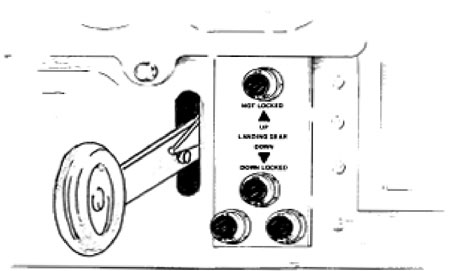
The pilot's operating handbook for the Navajo advised that to lower the landing gear, the gear selector handle is pulled aft and then lowered to the DOWN position. That action opens the inboard gear doors, illuminates a red Not-Locked light and extends the landing gear. When the landing gear legs are locked down, the three green Down-Locked lights illuminate. Once the inboard gear doors are closed, the extension cycle is complete, and the gear selector automatically returns to a neutral position (Figure 1) and the red Not-Locked light extinguishes. In most other aircraft with retractable landing gear, the selector remains in the down position.
Figure 1: Landing gear selector (shown in a neutral position)
Following the wheels-up landing, a licensed aircraft maintenance engineer examined the landing gear system. The aircraft was lifted on jacks and the landing gear was manually extended. The engineer reported that the landing gear sequenced normally, the three green Down-Locked lights illuminated, and the gear selector returned to a neutral position. Subsequently, the engine-driven hydraulic pumps and the gear unsafe horn were checked and found to operate normally.
The 24-hour clock is used in this report to describe the local time of day, Eastern Standard Time (EST), as particular events occurred. Eastern Standard Time was Coordinated Universal Time (UTC) +10 hours.
A pilot cannot exercise command privileges, including in-command under supervision, on an aircraft until the type or class endorsement has been entered into the pilot's log book by the flight instructor or approved person.
Summary
A Piper Aircraft Corporation PA-31 Navajo, registered VH-DEQ, was on a private VFR flight when it made a wheels-up landing on Runway 14 at Birdsville, Qld. The two occupants were unharmed, but the aircraft was substantially damaged. The pilot flying was gaining experience on the aircraft under the supervision of a Grade 1 flight instructor as part of a class endorsement on the aircraft.
The pilot flying reported that on late downwind he moved the gear selector to the DOWN position. Both pilots believed the landing gear was down and locked but could not recall whether the three green Down-Locked lights had illuminated. The landing gear selector was still in the DOWN position after the landing.
The Pilot's Operating Handbook explained that the gear selector moved from the DOWN to a neutral position when the landing gear extension cycle was complete. It stated that the gear lights were the primary means of confirming the landing gear status. A post-accident examination of the landing gear system by an engineer did not find any defect.
The investigation found that although the pilot flying may not have operated the aircraft's landing gear selector correctly, contributing to the wheels-up landing, neither he nor the instructor had effectively ensured that the landing gear was down and locked.
On 9 November 2005 at 0834 Eastern Daylight-saving Time, a Boeing Company 737-7Q8 aircraft, registered VH-VBI, was being operated on a scheduled passenger service from Sydney, NSW to Melbourne, Vic. The aircraft was at an altitude of 40,000 ft (Fight Level 400) when the pilot in command (PIC) noticed the cabin rate of climb indicator suddenly indicate a maximum rate of climb. The PIC disengaged the autopilot and commenced an emergency descent to an altitude of 10,000 ft. When levelled at 10,000 ft, the crew observed that the cabin had repressurised, so they elected to maintain 10,000 ft and continue the flight to Melbourne. There were no reported injuries to passengers or crew.
The PIC reported feeling upset in the stomach and discomfort in the ears before noticing that the cabin rate of climb indicator showed a sudden increase in cabin altitude. Flight data recorder information showed that the aircraft descended to approximately 500 ft below the assigned altitude for 50 seconds. The co-pilot contacted air traffic control and requested an emergency descent to 10,000 ft; when the clearance was obtained the PIC continued the descent.
The PIC attempted to inform the cabin crew of the emergency descent but the announcement was not heard on the passenger address system in the cabin. The cabin crew reported that not all passengers had put their oxygen masks on after the masks were deployed.
The crew observed that at approximately FL300 the cabin altitude was stabilising. At approximately FL230 the cabin altitude was 9.000 ft and the cabin altitude warning ceased. At approximately FL160 when the cabin altitude was 4.000 ft, the pilot elected to reduce the rate of descent and the cabin supervisor was advised by the copilot that the oxygen masks could be removed. The aircraft levelled off at 10,000 ft approximately 11 minutes after the descent was initiated.
The examination of the pressurisation system revealed that the sudden increase in cabin altitude was due to the positive pressure relief valves opening at a lower pressure than required.
The report presented below was prepared principally from information supplied to the Bureau. The initial report was amended following receipt of further information.
On 6 November 2005 at 1800 Eastern Daylight-saving Time1, the flight crew of a Boeing Company B777-300 aircraft, registered A6-EBG, did not comply with an altitude restriction at WHALE (a navigation waypoint located approximately 37 km east of Sydney Airport) while on the MARLN 5 standard terminal arrival route (STAR) to Sydney Airport, NSW. This incident was one of three incidents reported on the same day for the operator. An examination of the ATSB database found 20 incidents of non compliance with air traffic control instructions or procedures by the operator over the six month period to December 2005. Further analysis showed a recurrence of two events in particular.
Those events were:
the non-compliance with STAR altitude restrictions
the non-compliance with operating restrictions for taxiway Alpha 4 at Sydney Airport.
Taxiway restrictions for Alpha 4 at Sydney Airport are not shown in the flight documents used by the operator's flight crew. The restrictions are promulgated in section 17.6 of the Sydney Airport Operations Manual (SAOM). The SAOM is a voluminous document and is made available to client airlines on-line and a hard copy is provided by Sydney Airports Corporation to the operator's local handling agent.
Following notification of the non compliance issues by the ATSB, the operator amended the relevant Route Manual Supplement (RMS) for Sydney Airport to include more comprehensive information on taxiway restrictions. Also an operational notice was sent to flight crew advising them:
to take precautions when clearing flight plan discontinuities from the flight management system (FMS) when on STAR or standard instrument departures (SID) procedures to resolve any ambiguity that may exist with Air Traffic Control (ATC) regarding clearances and operating restrictions.
While not a regulatory requirement, in the interests of future safety, the air traffic service (ATS) provider and the operator have also advised that air safety incident reports from ATS staff will be routinely forwarded in a timely manner to the operator for information and any necessary action. The ATS service provider in conjunction with the operator is also investigating possible STAR procedure changes and the provision of additional taxi instruction to pilots at Sydney Airport
The 24-hour clock is used in this report to describe the local time of day. Eastern Daylight- savings Time is Coordinated Universal Time (UTC) + 11hours.
Summary
On 6 November 2005 at 1800 Eastern Daylight-saving Time, the flight crew of a Boeing Company B777-300 aircraft, registered A6-EBG, did not comply with an altitude restriction at WHALE (a waypoint located approximately 37 km east of Sydney Airport) while on the MARLN 5 standard terminal arrival route (STAR) to Sydney Airport, NSW. This incident was one of three incidents reported on the same day for the operator. An examination of the ATSB database found 20 incidents of noncompliance with air traffic control instructions or procedures by the operator over the six-month period to December 2005. Further analysis showed a recurrence of two events in particular. Those events were:
the non-compliance with STAR altitude restrictions
the non-compliance with operating restrictions for taxiway Alpha 4 at Sydney Airport.
Following notification of the noncompliance issues by the ATSB, the operator amended the relevant Route Manual Supplement (RMS) for Sydney Airport to include more comprehensive information on taxiway restrictions. Also, an operational notice was sent to flight crew advising them:
to take precautions when clearing flight plan discontinuities from the flight management system (FMS) when on STAR or standard instrument departures (SID) procedures
to resolve any ambiguity that may exist with Air Traffic Control (ATC) regarding clearances and operating restrictions.
The air traffic service (ATS) provider and the operator have also advised that air safety incident reports from ATS staff will be forwarded to the operator for information. The ATS service provider in conjunction with the operator is also investigating possible STAR procedure changes and the provision of additional taxi instruction to pilots at Sydney Airport.
On 3 November 2005, the aerodrome controller (ADC) at Gold Coast Airport, Qld issued the crew of a Boeing 717 (717) aircraft a take-off clearance following closely behind an Airbus A320 (A320) aircraft. The ADC was responsible for the initial visual separation between the two aircraft and also for providing a suitable separation standard for the Brisbane approach controller who was responsible for the overlying airspace. While the ADC was able to continue to visually separate the two aircraft after departure, he was not able to communicate this or arrange another standard, with the approach controller. The two aircraft entered the approach controller's airspace with less than the required radar separation standard and the approach controller took action by initiating a significant change in heading for the 717. There was a breakdown of co-ordination.
The pilot in command of the 717 later reported that the crew had considered the distance behind the A320 to be safe for their departure, and that the crew maintained visual contact with the A320 throughout the takeoff, departure and subsequent tracking.
Documentation available to both controllers provided guidance relating to coordination phraseology and separation responsibilities. The attempted coordination exchange did not adhere to the requirements of these documents and was continuously interrupted as a result of the workload of both controllers. The incident highlighted the need for controllers to use clear unambiguous words and phrases to ensure complete understanding of all communications, including coordination exchanges. It also highlighted the importance of tactical separation assurance which places emphasis on traffic planning and conflict avoidance, rather than conflict resolution.
As both the ADC and the crew of the 717 had continuous visual contact with the two aircraft it was unlikely that the situation would have resulted in the aircraft coming into such close proximity as to have presented any significant safety risk.
On 27 October 2005, a McDonnell Douglas Hughes 369E 1 helicopter, registered VH-SUV, sustained a loss of tail rotor control and started spinning, while being operated on a power line inspection near Warwick, Qld. The pilot attempted to control the spin, but the helicopter was reported to have made approximately 12 to 15 full rotations before landing in a paddock. The pilot and two observers on board received minor injuries. The helicopter sustained minor damage.
Helicopter
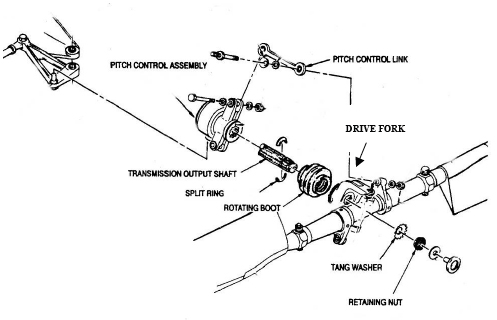
The helicopter was manufactured in 1990 and at the time of the occurrence had accumulated 3,543.8 hours total time in service (TTIS) and 4,348 landings since new. The helicopter was purchased overseas in a damaged condition after accumulating 3,118.35 hours TTIS since new. It was purchased and rebuilt by the operator and in February 2005 received a Civil Aviation Safety Authority (CASA) Certificate of Airworthiness. Maintenance records indicated that the helicopter had been fitted with a serviceable pitch control assembly during the rebuild (Figure 1).
Figure 1: Tail rotor pitch control assembly
Since the rebuild and its return to service, the helicopter had been maintained in accordance with the maintenance requirements applicable at that time and had a valid Maintenance Release. It had flown approximately 82.2 hours since the last periodic inspection in September 2005.
Tail rotor examination
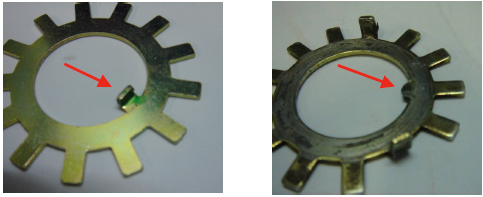
The operator examined the tail rotor. That examination found that the loss of tail rotor control was due to the failure of the inner tab of the tang washer (Figure 2). The washer locked the retaining nut holding the drive fork and the tail rotor assemblies onto the transmission output shaft. The failure of the inner tab resulted in looseness of the retaining nut that allowed the split ring to be dislodged. Consequently, the drive fork and the tail rotor assemblies were able to move freely along the transmission output shaft. That resulted in the loss of tail rotor control and the blades adopting a neutral pitch.
Figure 2: New tang washer with an undamaged locking tab and the subject tang washer with broken locking tab
Tang washer
The operator reported that a new tang washer was fitted at the time of the helicopter rebuild and that a torque strip was applied across the retaining nut, tang washer and drive fork as required by the helicopter maintenance manual. The maintenance manual requires the torque strip to be applied in a location where it could be checked visually.
The operator sent the failed tang washer to the helicopter manufacture to determine the nature of the locking tab failure. At the time of issue of this report the operator had not received a response from the helicopter manufacturer.
Previous tail rotor control problems
A search of the ATSB database, for the 1995 to 2005 period, revealed no records of similar tail rotor control problems. The CASA Service Difficulty Report database, for the same period, contained only the record of the tail rotor control problem from this occurrence.
The manufacturer advised that they have received two worldwide reports of a broken locking tab since 1988.
The helicopter was fitted with the two bladed tail rotor assembly.
Summary
The helicopter sustained a loss of tail rotor control while carrying out a power line inspection. It made approximately 12 to 15 full rotations before landing in a paddock. The pilot and two observers on board received minor injuries. The helicopter sustained minor damage.
Examination of the tail rotor revealed that the loss of control was due to failure of the inner tab of a tang washer. The washer locked the retaining nut holding the drive fork and the tail rotor assemblies onto the transmission output shaft. The failure of the inner tab resulted in looseness of the retaining nut and the split ring becoming dislodged. Consequently, the drive fork and the tail rotor assemblies were allowed to move freely along the transmission output shaft.
The ATSB was advised that at the helicopter rebuild a new tang washer was fitted. To inspect the washer, the retaining nut would have to be removed.
The operator sent the failed tang washer to the helicopter manufacturer to determine nature of the locking tab failure. The report had not been received at the time of writing this report.
A search of the ATSB database, for the 1995 to 2005 period, revealed no records of similar tail rotor control problems. The Civil Aviation Safety Authority Service Difficulty Report database, for the same period, contained only the record of the tail rotor control problem from this occurrence.
The manufacturer advised that they have received two worldwide reports of a broken locking tab since 1988.
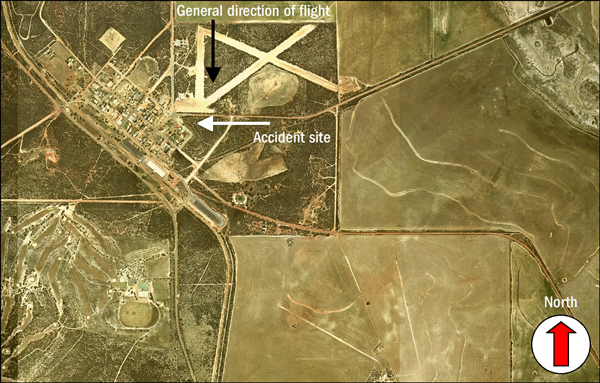
At about 1425 Western Standard Time1 on 22 October 2005, the pilot of an Air Tractor Inc AT-602 (AT-602) aircraft, registered VH-NIT, was fatally injured when his aircraft impacted terrain, approximately 150 m south of the Ballidu airstrip, WA. Figure 1 depicts the township of Ballidu, the airstrip, the approximate flight path of the aircraft and the location of the accident site.
Figure 1: Ballidu townsite, airstrip and accident site2
The pilot had not operated the AT-602 prior to the day of the accident. The series of flights that day were for familiarising the pilot with the aircraft's handling characteristics, and were carried out under the supervision of the company owner/chief pilot.
The chief pilot reported that the aircraft was fully fuelled before the first in the series of flights. That flight had included ground taxying operations, take-offs, landings and general aircraft handling, including simulated spray runs along the strip and practice operating the hopper door. The accident occurred during the second flight of the day.
During those flights, the pilot returned to the operating pad several times, during which the chief pilot asked the pilot how he was progressing and, when necessary, replenished the contents of the hopper. The chief pilot reported that the aircraft was being operated with about 200 L of water in the hopper, which was the minimum quantity to prevent the hopper's seals from drying out. He recalled that he had replenished the hopper several times that day.
A number of witnesses sighted the aircraft flying over the airstrip at low altitude and saw water drop from the underside of the aircraft. The witnesses observed the aircraft gain a small amount of height before the nose of the aircraft suddenly pitched downwards and the aircraft descended steeply towards the ground.
Witnesses
The witnesses that reported either seeing or hearing events associated with different portions of the flight immediately prior to the accident included:
Three witnesses that were located at two separate positions, who observed water dropping from the underside of the aircraft and recalled that the nose of the aircraft pitched steeply upwards after completion of that drop, with the aircraft gaining a small amount of height.
The chief pilot, who sighted the aircraft climbing out as it flew past his hangar, but recalled that the nose attitude did not appear abnormally high. He did not recall hearing any unusual noises from the aircraft engine or propeller.
A witness who sighted the aircraft as it flew abeam her location and recalled that the nose of the aircraft was at a level attitude, before the nose 'dropped'. The sound from the aircraft appeared normal and at a constant level until the witness heard the sound of an impact.
A witness who was familiar with dropping operations and was watching the aircraft as it approached the airstrip. From the aircraft's position relative to the airstrip and the location of the runway thresholds, he surmised that the pilot was making a practice water drop. The aircraft disappeared from his view as it descended to what he perceived to be the drop zone before reappearing again, having made what he presumed to be either a water drop or a dummy water drop. The witness recalled that the aircraft was climbing steeply, but that the nose attitude of the aircraft was close to horizontal, before pitching steeply down towards the ground. The witness recalled hearing an unusual noise from the aircraft's engine or propeller as the aircraft started to descend, which he described as being similar to the noise when a pilot reversed the propeller's pitch on landing, or made a significant change to the power setting of the engine.
A witness who was adjacent the airstrip and thought that the aircraft's engine sounded as if it was not producing much power as the aircraft started to climb away, when compared to water drops that he witnessed earlier that day.
Two residents close to the site of the accident who heard the noise of an aircraft approach and then an increase in engine noise, similar to when a pilot applies power to enter a climb or the noise that the aircraft makes after it lands. A few seconds of silence followed, and the residents recalled thinking that the aircraft must have landed. They then heard the sound of an impact and immediately realised that the aircraft had crashed.
All of the eyewitnesses were consistent in their recollection of the aircraft's final descent towards the ground, recalling that the nose of the aircraft suddenly and violently pitched downwards, and the aircraft descended steeply towards the ground.
Accident site and wreckage examination
The sandy scrub-type terrain in the vicinity of the accident site was flat, with gently upwards sloping terrain on approach to the site. Bushes and small trees, approximately 3 to 5 m high, covered the immediate area and a power line, supported by power poles about 10 m high, ran east to west along a road adjacent the airfield boundary.
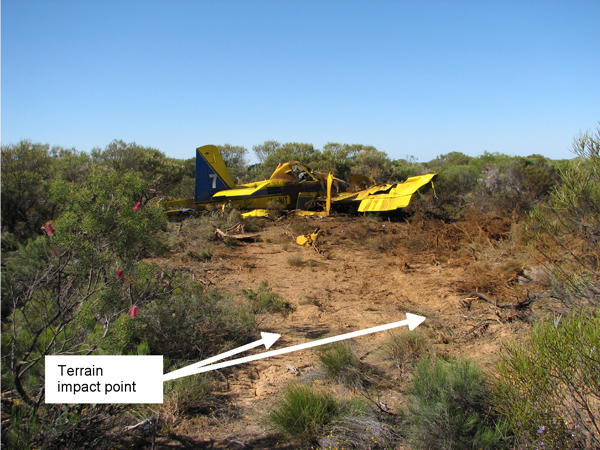
Examination of the wreckage and analysis of impact loads through the structure of the aircraft indicated a slightly right wing low, almost nose-level (zero) pitch attitude on impact with terrain. The characteristics of the impact were consistent with a high rate of vertical descent and low forward speed. Damage to the vegetation in the vicinity of the accident site indicated a steep final flight path towards the ground, with the main wreckage located about 23 m along the wreckage trail from the initial point of impact. Figure 2 shows the initial impact point relative to the main aircraft wreckage.
Figure 2: Terrain impact point and aircraft wreckage
All structural components and flight controls were accounted for at the accident site. The aircraft was intact prior to impact with terrain. The main landing gear collapsed on contact with the ground and the fuel tanks ruptured during the impact sequence. There was evidence that a significant quantity of fuel had spilled from each of the tanks.
There was no evidence of bird strike or collision with other obstacles prior to the initial contact with terrain.
Weather
Witnesses at Ballidu recalled that the weather conditions around the time of the accident were generally fine with light south-westerly winds.
The Bureau of Meteorology reviewed the available weather data for the afternoon of the accident. That review indicated the presence of south-westerly surface winds and little or no cloud in the Ballidu area at the time of the accident.
The closest official meteorological recording station was at Dalwallinu, about 40 NM to the north-west. At the time of the accident, Dalwallinu recorded a south-westerly wind at 8 to 10 kts and a temperature of about 23 degrees C.The Bureau of Meteorology assessed that, under the prevailing conditions, similar weather would have been experienced at Ballidu around the time of the accident.
Aircraft
The AT-602 was manufactured as a single-seat, specialist type aircraft designed for agricultural and fire fighting (water dropping) operations. That aircraft model had been issued an airworthiness certificate by the US Federal Aviation Administration (FAA) as a Restricted Category3 aircraft, for use in special purpose operations. As the airworthiness certificate was issued by a recognised National Airworthiness Authority, that certification was accepted by the Civil Aviation Safety Authority (CASA) for operating that aircraft type on the Australian aircraft register.
The aircraft was manufactured in the US during 2000 and exported to Australia. It was placed on the Australian aircraft register in December of that year. The aircraft was exported from Australia in April 2002 and placed on the aircraft register of New Zealand. In December 2004, the aircraft was re-imported to Australia and placed on the Australian aircraft register as VH-NIT.
An aircraft Maintenance Release was issued on 22 July 2005 following the last period of scheduled maintenance. The maintenance release recorded 58.7 hours operation since that time. During that period, no defects were recorded on the maintenance release. The aircraft had accumulated approximately 1,650 hours since manufacture.
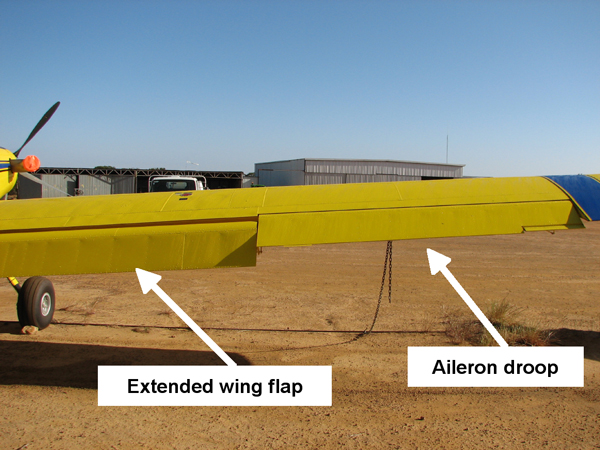
The AT-602 was equipped with an electrically operated Fowler flap system that also incorporated an aileron interconnection, which symmetrically drooped the ailerons as the flaps extended. The motion of the aileron interconnection was non-linear, in that most of the aileron droop occurred during the first 15 degrees of flap extension. Full flap extension for the AT-602 was 30 degrees, with an associated aileron droop of 10 degrees. Figure 3 illustrates the flap extension and aileron droop in an AT-602.
Figure 3: AT-602, showing extended wing flap and aileron droop
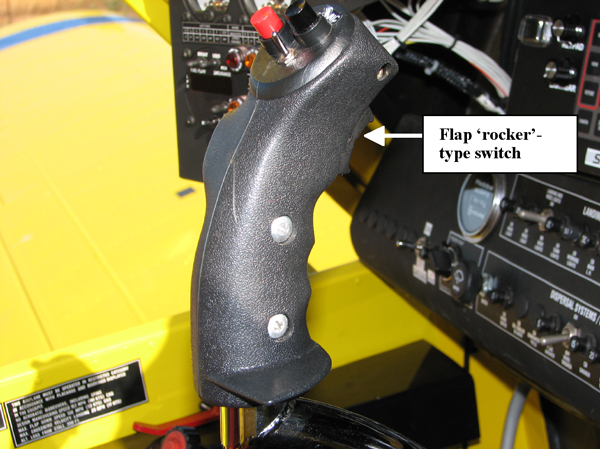
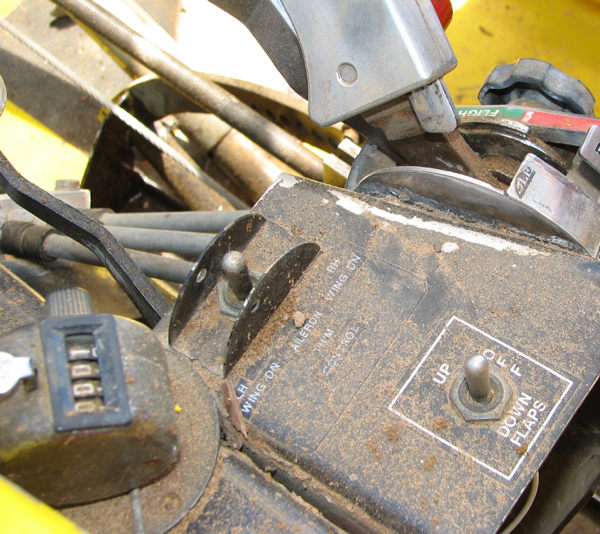
The flaps were actuated by a 'rocker'-type switch4 on the control stick (Figure 4). That switch enabled the pilot to extend the flaps between 0 and 30 degrees. The flaps could also be activated by a control switch mounted adjacent to the engine and propeller control levers on the left side of the cockpit (Figure 5).
Damage to the wing flaps was consistent with their being in an extended position at the time of impact.
Figure 4: Control stick for a similarly-equipped AT-602, showing flap 'rocker' switch
Figure 5: Flap control switch adjacent engine controls
The aircraft was configured for water dropping operations and was equipped with a 630 US Gallon capacity fibreglass hopper (2,385 L). A manually-controlled fire-bomber dump door was fitted to the base of the hopper. Activation of the cockpit drop handle opened the dump door and allowed the hopper contents to drop from the aircraft.
The aircraft manufacturer's FAA-approved Airplane Flight Manual (AFM) recommended using 10 degrees of flap and an airspeed of 109 kts on approach and load release during water dropping operations.
The AFM indicated a wings-level stall speed for the AT-602 at an operating weight of 4,173 kg of 76 kts CAS5 (flaps up) and 61 kts CAS (flaps down). The AFM indicated that the maximum altitude loss from a wings-level stall was 300 ft.
At the time of the accident the aircraft's operating weight was estimated to be approximately 3,500 kg.
Engine
The aircraft was equipped with a Pratt and Whitney Canada PT6A-60AG (PT6A) turboprop engine.
The logbooks and maintenance records indicated that the engine had accumulated approximately 1,650 hours since new.
The engine was shipped to the engine manufacturer for disassembly and examination under the direct supervision of the Canadian Transportation Safety Board. The final report from that examination was not available at the time this interim report was written.
Pilot details
The pilot held a Commercial Pilot (Aeroplane) Licence and a Grade 1 Agricultural Rating, and had previously performed water dropping operations in the operator's reciprocating-engine aircraft. A review of the pilot's logbook indicated approximately 6,736 hours total aeronautical experience, including about 400 hours water dropping operations in the reciprocating-engine PZL "Dromader" D-18 aircraft.
Civil Aviation Regulation 5.22 enables CASA to prescribe the aircraft endorsements that must be held by the holder of a flight crew licence. Civil Aviation Order 40.1.0 requires the holder of a flight crew licence to hold an endorsement to operate certain types of aeroplane and provides for aircraft with similar design features to be grouped into aircraft classes.
The pilot recently completed training for, and was issued with a class endorsement on Ayres Turbo (PT6)-type aircraft. The Ayres Turbo (PT6) aeroplane class endorsement includes the Ayres S2R "Thrush" and Air Tractor AT (400, 401, 402, 502, 602 and 802) aircraft types equipped with a PT6A turbine engine.
Protective equipment/survivability
The pilot was not wearing a protective helmet.
The aircraft was fitted with a metal frame seat with a mesh-fabric seat cover and a four-point restraint harness. Vertical impact forces distorted the base of the seat frame.
Testing and examination of recovered components
The jackscrew for the flap actuator was found along the wreckage trail and had separated from the aircraft during the impact sequence. The jackscrew remained attached to the actuator gearbox, but had fractured in the vicinity of the ACME-threaded nut assembly connecting the jackscrew to the flap actuator arm. The jackscrew and ACME-threaded nut were submitted for technical examination.
Laboratory examination of those components revealed a bending overload failure as a consequence of impact forces. The extension of the jackscrew was consistent with the wing flaps being fully extended at the time of the impact with terrain.
The aircraft was equipped with a cockpit instrument that monitored the quantity of fuel consumed by the aircraft's engine. That instrument contained a non-volatile memory and so was recovered from the aircraft for subsequent examination. That examination revealed a total fuel consumption of 227 L and a quantity of 772 L remaining.
An elevator pushrod had fractured at the eye-end bearing fitting and was recovered from the accident site for analysis. Examination of that component did not reveal any evidence of a pre-existing material anomaly. The fracture surface exhibited characteristics consistent with gross structural overload and component failure during the accident sequence.
A number of cockpit instruments were recovered for laboratory analysis. Examination of the instrument face from the airspeed indicator revealed witness marks from the instrument's indicator needle. Those marks indicated that, at the time the indicator needle contacted the face of the instrument, the needle was indicating between 45 and 55 knots.
Other instruments that were recovered for subsequent laboratory examination included the: engine Ng (gas-generator speed), oil temperature and pressure gauges; and propeller RPM and engine torque gauges. No witness marks were evident on those instruments.
Indicator globes from the aircraft's annunciator panel were recovered and analysed for evidence of any filament stretch that could indicate the illumination of the lights at the time of ground impact. The following indicator globes were examined:
Propeller beta - illuminates when propeller blade angle is in the "beta" range6.
Fuel filter - illuminates when the fuel filter is partially blocked.
Low fuel quantity - illuminates in a low fuel condition.
Air filter - illuminates to indicate restricted airflow to the engine's air inlet.
Chip detector - indicates metal particles in contact with detector terminals and the possibility of other metal particles in the engine lubricating oil. A brittle fracture was observed in that filament.
There was no evidence in any of the examined indicator globes of filament stretch, or illumination of any of the associated indicator lights at the time of the aircraft's impact with the ground.
The aircraft was equipped with an emergency locator transmitter (ELT), which separated from its mounting bracket during the impact sequence. Although the ELT was armed, it did not automatically activate. The ELT activated normally when tested after the accident.
Fuel sample testing
A sample of fuel was recovered from one of the ruptured fuel tanks. Testing of that sample indicated a blend of diesel and aviation turbine fuel. Particulate matter within the fuel sample was consistent with contamination of the fuel with bacterial organisms.
Propeller examination
The engine was equipped with a five-bladed Hartzell Propeller Inc., HC-B5MP-3C constant speed propeller that was fully feathering and reversible in pitch.
The propeller was recovered from the accident site and examined under the direct supervision of investigators from the Australian Transport Safety Bureau (ATSB). When reconstructed as a set, all of the propeller blades showed a progressive and marked increase in axial twist and rearward, out-of-plane bending around the sequence of rotation. That damage indicated a steep angle of impact with terrain (ie low horizontal speed, high vertical speed) and a rapid cessation of rotation.
The pitch change mechanism for the propeller blades was damaged during the accident sequence and each of the blades showed evidence of moving independently during the terrain impact sequence. Witness marks on the hub of the propeller blades indicated blade rotation beyond the assembly limit of -11 degrees.
There was no evidence to indicate that the propeller was operating in the beta or reverse blade angle range at the time of the collision with terrain.
Ongoing investigation
The investigation is continuing, including in the following areas:
assessment of engine operation at the time of the accident, pending the results of the examination/testing performed under the supervision of investigators from Canadian Transportation Safety Board
examination of survivability issues associated with the accident
the assessment of aircraft handling characteristics and operational factors associated with the accident flight, including the aircraft's configuration immediately prior to the loss of control.
The 24-hour clock is used in this report to describe the local time of day, Western Standard Time (WST), as particular events occurred. Western Standard Time was Coordinated Universal Time (UTC) + 8 hours.
Aerial photograph reproduced by permission of the Department of Land Information, Perth, Western Australia, Copyright Licence 33/2006 www.dli.wa.gov.au
The Restricted Category certification was on the basis of airworthiness complying with US Federal Aviation Regulation 23, excluding those sections deemed inappropriate for the special purpose use of agricultural spraying, dusting and seeding and for the special purpose use of forest and wildlife conservation (fire fighting).
That switch was installed subsequent to the manufacture of the aircraft and following the aircraft's initial importation to Australia, in accordance with Engineering Order ADG-AT602-EO2125.
CAS is calibrated airspeed and is the indicated airspeed corrected for instrument and position errors. At those speeds, the AFM indicated that the calibrated airspeed is within about 1 knot of the indicated airspeed.
Beta refers to operation of the propeller blade at fine blade angles, during which the propeller blade angle (and consequently thrust) is directly controlled by movement of the power lever. In this operating range, the propeller does not operate at a constant speed and propeller blade angle is coordinated with fuel flow, according to the power lever position. The beta operating range extends from just below flight idle on the power lever, through ground idle and reverse.
Summary
At about 1425 Western Standard Time on 22 October 2005, an Air Tractor AT-602 aircraft, registered VH-NIT, impacted terrain approximately 100 metres south of the perimeter fence of Ballidu aerodrome, WA. The pilot was carrying out a series of familiarisation flights. He was the sole occupant of the aircraft and was fatally injured.
Witnesses recalled that the aircraft had dropped a quantity of water at low level over the aerodrome. Soon after that drop, the nose of the aircraft pitched steeply towards the ground and the aircraft descended into terrain.
The aircraft impacted terrain in a slightly right wing-low, almost nose-level attitude at a high vertical rate of descent, but with low forward speed.
Examination of the wreckage did not identify any anomaly that could have affected the normal operation of the aircraft during the accident flight. Examination of the engine indicated that it was producing power at the time of terrain impact.
Toxicology testing revealed that the pilot had ingested cannabis. Specialist medical advice was that the results of the toxicology testing would be consistent with the pilot using cannabis sometime during the 24 hours prior to the accident.
The physical and witness evidence was consistent with the pilot losing control of the aircraft at low altitude, most probably as the result of an inadvertent aerodynamic stall. There was insufficient altitude to recover the aircraft to level flight.