Tail strike, at Alice Springs, Northern Territory, BAe 146-300, VH-NJN
Safety Action
The operator has amended its British Aerospace 146-300 Training Manual to reflect the information provided by the aircraft manufacturer with regard to aircraft pitch angles on landing.
Analysis
The flight crew action of not applying an additional factor to the calculated final approach speed (VAPP) was consistent with the meteorological data that was accessed by the crew for application during the approach to Alice Springs. The crew report that a 'definite under/overshoot wind shear' had affected the approach was at variance with the Bureau of Meteorology's assessment of the likelihood for that to have occurred. However, the investigation was unable to discount that a short-term, localised wind shear might have affected the aircraft's performance during the approach and/or landing.
The recorded data indicated that the aircraft's performance remained within the company criteria for a stabilised approach.
The crew achieved their planned landing flaps reference speed (VREF) at the required height of 50 ft radio altitude (RADALT) above the touchdown zone, and the required touchdown speed immediately before the discontinuity in the recorded data. However, the aircraft ROD at that time was consistent with that published by the aircraft manufacturer as a contributing factor in the development of a landing tail strike in a British Aerospace 146-300 (146-300) aircraft. That, coupled with a landing nose-up pitch attitude that approached 7° with the oleos compressed appeared to have made a tail strike inevitable in this incident.
The reported lack of any information in the operator's publications regarding the risk of a tail strike in the 146-300 aircraft may have influenced the outcome of this occurrence. Had that information been available to the crew, the tail strike may not have occurred.
Factual Information
FACTUAL INFORMATION1
History of the flight
On 20 August 2005, at about 1340 Central Standard Time, a British Aerospace 146-300 (146-300) aircraft, registered VH-NJN, with a crew of five and 60 passengers, was being operated on a scheduled passenger service from Cairns, Qld, to Alice Springs, NT. The first officer was the handling pilot for the visual approach and landing to runway 12 at Alice Springs Airport.
The flight crew reported that, at about 50 ft above the ground, the aircraft rate of descent (ROD) increased significantly from what had previously been a 'normal' approach. Despite the initial reaction by both flight crew members to arrest the increased ROD by increasing the nose-up pitch attitude of the aircraft, and subsequently the engine thrust, the aircraft landed heavily and bounced into the air. The captain commanded a go-around for a second landing on runway 12. During the go-around, the flight crew reported to air traffic services that there was 'a fair bit of shear just at the touchdown point.'
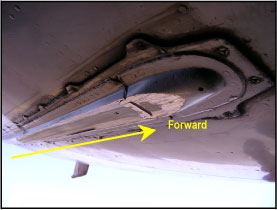
A subsequent engineering inspection of the aircraft identified damage to the tailscrape indicator (Figure 1), indicating that a tail strike had occurred. There were no reported injuries to the crew or passengers, and there was no significant damage to the runway surface or other facilities.
Figure 1: Damaged aircraft tailscrape indicator
Operational information
The flight crew were appropriately qualified for the flight. Both pilots reported being fit and well at the time of the occurrence.
No evidence was found of a defect in the aircraft or its systems that may have contributed to the circumstances of the occurrence. Examination of the aircraft load sheet indicated that the planned aircraft landing weight was 35,785 kg, and that the centre of gravity was within limits. The flight crew reported calculating the actual aircraft weight for the landing as 37,300 kg. As a result, the flight crew applied the 38-tonne Landing Card to their approach planning. That resulted in a final approach speed (VAPP) of 124 kts, and a landing flaps reference speed (VREF) of 119 kts.
Weather information
The Alice Springs Terminal Aerodrome Forecast indicated a wind of 150 degrees true at 13 kts and CAVOK2 conditions. The forecast ambient temperature was 17°C, and the forecast mean sea level (MSL) pressure was 1025 hectopascals (hPa). The area forecast indicated a forecast wind at 3,000 ft above mean sea level (about 1,200 ft above ground level (AGL)) of 150 degrees true at 20 kts, nil significant cloud, fine weather, and good visibility.
Automatic Terminal Information Service (ATIS) 'Echo' was current at the time of the occurrence. That information included that the surface wind was 090 degrees magnetic at 15 kts, CAVOK conditions were present, the ambient temperature was 17°C, and the MSL pressure was 1023 hPa. ATIS 'Echo' provided no indication of any wind gusts that might have affected operations at Alice Springs.
Observations of the meteorological conditions at Alice Springs were recorded by a Bureau of Meteorology (BoM) Automatic Weather Station (AWS). The AWS was located near the wind sock on the south side of, and near the middle of runway 12/30. Reports from the AWS were available to pilots from air traffic services by radio, or by telephone. The 1330 AWS observation indicated a surface wind of 110 degrees magnetic at 7 kts and gusting to 11 kts, CAVOK conditions, an ambient temperature of 17°C, a dewpoint3 of 2.1°C, and MSL pressure of 1022.6 hPa. In addition, data from a weather balloon flight conducted at Alice Springs at 1430 indicated a generally east-north-easterly wind at less than 10 kts up to a height of about 1,000 ft AGL.
The flight crew subsequently reported that they experienced nothing during the approach that was contrary to the forecast conditions, or to the information provided on the ATIS until about 50 ft AGL. The captain reported the presence of 'a definite under/overshoot wind shear' during the final approach, but that it was not as strong as he had experienced previously at Alice Springs.
The pilot of a Cessna Aircraft Company 210 (C210) that landed on runway 12 shortly after the 146-300, subsequently reported that he experienced gusty wind conditions during the initial landing approach, but that they were not outside the operational limits for the C210. In addition, that pilot reported being surprised that it was 'not that windy', and that he did not experience any turbulence at touchdown on runway 12.
A BoM aftercast 4 concluded that:
The situation [at Alice Springs] did not appear conducive to windshear. A high pressure system west of Perth extended a strong ridge across central Australia. With fine stable conditions and moderate south to south-east winds.
Instrument Landing System (ILS) and 'T' visual approach slope indicator system (T-VASIS) approach aids were available for approaches to runway 12 at Alice Springs. The T-VASIS approach aid provided 3° visual approach guidance to the touchdown point on the runway. The flight crew reported that the approach was flown visually, using the ILS as back-up reference, and that the aircraft was stabilised on the approach until reaching 50 ft above the runway. No evidence was found to suggest that the aerodrome, its facilities, or the characteristics of the runway influenced the circumstances of the occurrence.
Recorded data
The aircraft was fitted with a Plessey PV1584M Data Acquisition and Recorder Unit. The recorded flight data was examined by the Australian Transport Safety Bureau to establish the factors that led to the tail strike. The recorded data for the final approach below 500 ft radio altitude5 (RADALT) is represented at Figure 2. The aircraft's recorder installation did not include the option to record the presence of any windshear.
Examination of the available recorded data for the final approach below 500 ft RADALT revealed that the aircraft's pitch attitude alternated between 0 to 2.6° nose-down. The variations in the aircraft's attitude were accompanied by periods of varying indicated airspeed, including from a maximum of 133 kts at 223 ft RADALT, reducing to 120 kts at 49 ft RADALT, and 113 kts at 10 ft RADALT. Those reduced speeds appeared to reflect the planned vREF of 119 kts and anticipated touchdown speed of 112 kts. The glideslope angle and localiser deviation were examined and found to be within the expected range for the final approach.
The aircraft's ROD was derived from the recorded data. That derived data revealed that the aircraft's ROD varied during the final approach as follows:
- the average ROD was 690 ft/min until passing 300 ft RADALT
- below 300 ft RADALT, the average ROD was 630 ft/min
- the instantaneous ROD in the 2 secs immediately prior to touchdown, or below 21 ft RADALT was 657 ft/min, or 11 ft/sec.
The recorded aircraft pitch attitude data indicated that the flare was commenced at 21 ft RADALT.
Figure 2: Recorded data selected parameters below 500 ft RADALT
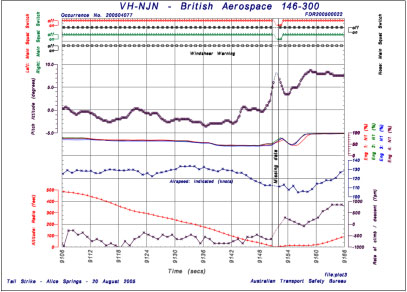
There was a one-second discontinuity in the recorded data on touchdown, which was considered to be consistent with the tail strike occurring at that time. Immediately prior to that discontinuity, the aircraft's derived nose-up pitch rate was 5.8 deg/sec. At that rate of nose-up pitch, interpolation of the missing data indicated the potential for the aircraft's nose-up pitch attitude with the main landing gear compressed to have been greater than 7°.
On the recommencement of the recording, the aircraft's pitch attitude was 6.7° nose up and the main landing gear was compressed. The nose landing gear was not recorded as touching the runway.
Organisational information
The company's Operations Manual stipulated the following requirements affecting the calculation of an aircraft's VAPP:
- VAPP = V REF + 5 kts + an additional factor (in kts) to take account of any reported wind gusts, turbulence and windshear. The maximum additional factor for application by flight crews was 9 kts.
- The recommended additional gust factor for application by flight crews equalled half the reported wind speed gust.
The flight crew reported that based on the content of ATIS 'Echo', an additional factor was not applied to the interpretation of vAPP in this instance.
The risk of an aircraft sustaining a landing tail strike is elevated if the aircraft is subjected to an unstabilised final approach for landing, which can include turning onto final approach with excessive airspeed, altitude, or both. The definition of a stabilised approach in the company's Operations Manual included that:
- the aircraft must be stabilised in the landing configuration by 400 ft above airport level
- for visual approaches, the aircraft was not greater than one dot high or low on the T-VASIS
- the aircraft was established on the runway centreline with only small changes in heading or pitch required to maintain the approach path
- the aircraft's speed was not above VAPP + 10 kts and not less than VAPP - 5 kts
- ROD was required to be not greater than 1,000 ft/min
- momentary excursions of slope and speed, caused by wind gusts or turbulence, were acceptable.
The operator's Training Manual included that:
- flight crews should aim to cross the runway threshold at 50 ft above the touchdown elevation at VREF
- touchdown was anticipated at approximately VREF - 7 kts
- the touchdown should usually be achieved at a pitch attitude of 4 to 5° nose-up, and that the aircraft's pitch attitude must not exceed 8° nose-up in the flare.
The operator reported that there was no specific mention in the Training Manual, or the Operations Manual of the risk of tail strike in the company's 146-300 aircraft.
The aircraft manufacturer had promulgated preliminary notes regarding tail strikes during take-off and landing in the 146-300 aircraft. Those notes included that the risk of a tail strike during landing was elevated if:
- A late flare was initiated by a flight crew while their aircraft was experiencing a high sink rate that would result in a heavy landing. That implied a nose-up attitude of about 8° at touchdown and a ROD of in excess of 10 ft/sec. The manufacturer indicated that a typical landing pitch attitude was about 2 to 3° nose-up.
- Maintenance of the required airspeed was inaccurate from the 'screen height' of 50 ft until touchdown. The manufacturer commented that if that airspeed was allowed to decay excessively, the pitch attitude could become critically close to tail strike angles. The manufacturer's notes concluded that:
On the 146-300 [and RJ100] pitch angles in excess of 5 degrees should be avoided and angles in excess of 7 degrees with the oleos compressed may result in a tail strike.
- Only those investigation areas identified by the headings and subheadings were considered to be relevant to the circumstances of the occurrence.
- Visibility, cloud and present weather better than prescribed values or conditions - ICAO Doc 8400, 24 November 2004.
- Temperature at which, under ordinary conditions, condensation begins in a cooling mass of air.
- A retrospective statement of anticipated meteorological conditions affecting a given place during a specified period, which can include the interpretation of recorded radar data, synoptic observations, recorded AWS data, and other available sources of recorded meteorological information.
- An indication of the height of the aircraft above ground level (AGL). Approximates the theoretical concept of 'absolute altitude', which is the distance along a local vertical between an aircraft and a point on the ground where the local vertical cut's the earth's surface.
Summary
On 20 August 2005, at about 1340 Central Standard Time, a British Aerospace 146-300 (146-300) aircraft, registered VH-NJN, with a crew of five and 60 passengers, was being operated on a scheduled passenger service from Cairns, Qld, to Alice Springs, NT. The first officer was the handling pilot for the visual approach and landing to runway 12 at Alice Springs Airport.
The flight crew reported that, at about 50 ft above the ground, the aircraft rate of descent (ROD) increased significantly from what had previously been a 'normal' approach. Despite action by both flight crew members to arrest the increased ROD, the aircraft landed heavily and bounced into the air. The captain commanded a go-around for a second landing on runway 12.
A subsequent engineering inspection of the aircraft identified damage to the tailscrape indicator, indicating that a tail strike had occurred. There were no reported injuries to the crew or passengers, and there was no significant damage to the runway surface or other facilities.
The aircraft's rate of descent immediately prior to touchdown was consistent with that published by the aircraft manufacturer as a contributing factor in the development of a landing tail strike in a 146-300 aircraft. That, coupled with a landing nose-up pitch attitude that approached 7° with the oleos compressed appeared to have made a tail strike inevitable in this incident.
In response to this occurrence, the operator has amended its British Aerospace 146-300 Training Manual to reflect the information provided by the aircraft manufacturer with regard to aircraft pitch angles on landing.
Occurrence summary
| Investigation number | 200504077 |
|---|---|
| Occurrence date | 20/08/2005 |
| Location | Alice Springs, Aerodrome |
| State | Northern Territory |
| Report release date | 22/06/2006 |
| Report status | Final |
| Investigation type | Occurrence Investigation |
| Investigation status | Completed |
| Mode of transport | Aviation |
| Aviation occurrence category | Hard landing |
| Occurrence class | Incident |
| Highest injury level | None |
Aircraft details
| Manufacturer | British Aerospace |
|---|---|
| Model | BAe 146 |
| Registration | VH-NJN |
| Serial number | E3217 |
| Sector | Jet |
| Operation type | Air Transport High Capacity |
| Departure point | Cairns, Qld |
| Destination | Alice Springs, NT |
| Damage | Minor |