Engine failure, 93 km east of Adelaide Airport, South Australia, on 23 December 2005

Summary

On 23 December 2005 at about 1745 South Australian Summer Time, a British Aerospace Plc, J32, Jetstream aircraft was being operated on a scheduled passenger service from Mt Gambier to Adelaide in South Australia. The crew reported that during cruise flight at flight level (FL) 120 and in a shallow right turn, about 93 km east of Adelaide, the right engine briefly surged twice and then stopped.

After landing at Adelaide, the TPE331-12UHR-702H engine, serial number P66397C, was removed from the aircraft and forwarded to the manufacturer in the US for failure examination. The report of that engine examination indicated that the P/N 3103589-1 gear had a separated section of one gear tooth and several other damaged teeth. A metallurgical examination of the damaged components and the metal fragments found in the gearbox showed that there had been significant heavy wear of the mating surfaces of the spur gear teeth of both gears. The report further stated that experience had shown that the mating of a new or different gear, and a worn gear can accelerate tooth wear and lead to tooth fatigue cracking. In this instance the smearing of the separated surfaces and the damage sustained by the components precluded an assessment of whether the failure was due to fatigue. The report also indicated that, 'In the absence of an identified fatigue origin, there is also the possibility that a foreign object may have entered the gear mesh and overloaded a tooth'.

The engine manufacturer advised that they have submitted a Publication Change Request (PCR 029601) to the Inspection and Repair Manual 72-IR-15 specifically requiring an inspection for wear of the P/N 3103590-2 gear. That change is expected to be issued in late 2007.

Occurrence summary

Investigation number 200506834
Occurrence date 23/12/2005
Location 93km E Adelaide, VOR
State South Australia
Report release date 17/05/2007
Report status Final
Investigation type Occurrence Investigation
Investigation status Completed
Mode of transport Aviation
Aviation occurrence category Engine failure or malfunction
Occurrence class Incident
Highest injury level None

Aircraft details

Manufacturer British Aerospace
Model 3200
Registration VH-OAE
Serial number 851
Sector Turboprop
Operation type Air Transport Low Capacity
Departure point Mt Gambier, SA
Destination Adelaide, SA
Damage Nil

Lightning strike, near Darwin, Northern Territory, VH-FWI, Fokker F28 Mk 100

Summary

At approximately 1620 CST1 on 17 December 2005, a Fokker 100 series aircraft, registered VH-FWI, with 14 passengers and a crew of 5 was returning to Darwin on a charter flight from the Indonesian port of Kupang.

On approach to Darwin, the crew were instructed by air traffic control to hold approximately 50 NM to the south of Darwin due to thunderstorms at the airport. The crew reported that, while holding in instrument meteorological conditions at approximately 16,000 ft above ground level, and between 6 and 8 NM from any storm cells, the aircraft was stuck by lightning.

While the aircraft was still holding, approximately 20 minutes after the lighting strike, the number 2 hydraulic system low quantity warning light illuminated and the number 1 hydraulic system quantity was observed to be reducing. The aircraft was then immediately tracked for a landing on runway 29 at Darwin.

The number 1 hydraulic system low quantity warning light illuminated when the crew selected the landing gear and flap, early on final approach to land. The landing was continued, and the aircraft was able to be taxied to the gate.

An engineering examination found that two of the hydraulic return lines to the elevator boost unit and a hydraulic union and attaching line were damaged, due to electrical arcing as a result of the lightning strike. The examination also found at least two strike holes to the forward and mid-section of the aircraft fuselage. There were approximately 90 other strike related damage zones along the underside of the fuselage, landing gear doors and on the trailing edges of the wings and tailplane.

During subsequent scheduled maintenance, further melting damage was found to the elevator flight control cables.

The aircraft operator reported that the aircraft was repaired and returned to service.

  1. The 24-hour clock is used in this report to describe the local time of day, Central Standard Time, when particular events occurred. Central Standard Time is Coordinated Universal Time (UTC) + 9.5 hours.

Occurrence summary

Investigation number 200506780
Occurrence date 17/12/2005
Location Darwin, Aerodrome
State Northern Territory
Report release date 05/12/2006
Report status Final
Investigation type Occurrence Investigation
Investigation status Completed
Mode of transport Aviation
Aviation occurrence category Lightning strike
Occurrence class Incident
Highest injury level None

Aircraft details

Manufacturer Fokker B.V.
Model F28
Registration VH-FWI
Sector Jet
Operation type Charter
Departure point Kupang, Indonesia
Destination Darwin, NT
Damage Nil

Close proximity between a Boeing 717, VH-VQI and British Aircraft Corp 167, VH-LLD, 9 km south of Williamtown Aerodrome, New South Wales, on 18 December 2005

Safety Action

Strikemaster operator

Following the occurrence, the operator of the Strikemaster reviewed and amended procedures for flights conducted near Lismore and Williamtown Airports. In the future:

  • pilots will contact the Brisbane Centre controller on taxi to obtain a discrete SSR code (to be retained for the day)
  • pilots will confirm the area of operations for each flight to the Brisbane Center controller to assist in the provision of traffic information to pilots of IFR category flights
  • the Brisbane Centre controller will provide traffic information to the pilot while airborne.

That review included the standardisation of aircraft radio operating procedures.

Brisbane Centre local safety action

Brisbane Centre issued an operational note to controllers advising that the pilots of Strikemaster flights may request a radar information service and controllers are to be prepared to provide a discrete SSR code and traffic information.

Analysis

Had the pilot of the Strikemaster confirmed what fare paying passenger operations were expected for the period of the joy flight before leaving the terminal the occurrence possibly would have been prevented.

There were a number of following events that probably prevented the pilot of the Strikemaster either hearing or appreciating what was being broadcast on the common traffic advisory frequency (CTAF) by the pilot of the taxiing 717. It is possible that the pilot of the Strikemaster missed some broadcasts because of intermittent radio operation or reception anomalies. The investigation was unable to determine whether the initial missed calls were due to a technical problem or as a result of shielding of some of the other pilots' radio broadcasts. However, the coincident radio transmission from the pilot of the 737 to the pilot of the Strikemaster, as the pilot of the 717 reported that he was taxiing for runway 30, probably over rode the latter's radio transmission. Consequently, the pilot of the Strikemaster remained unalerted about the fact that after departure the 717 would track to the south. Had the pilot of the Strikemaster become aware at that stage that the 717 was going to track to the south he most likely would have amended his area of operation to avoid the 717's departure track.

The pilot of the Strikemaster had another opportunity to understand that the 717 may possibly conflict with his operations when the pilot of that aircraft broadcast intentions, when lining up and after departing. On lining up, the pilot reported his intention to turn left and following departure he reported that the aircraft was turning left to intercept the one six one non-directional beacon navigation aid track. At that time the pilot of the Strikemaster had commenced his manœuvres at an altitude that prior to 24 November 2006  would have been outside the CTAF. It is possible that because he thought he was outside the CTAF area, the pilot was less attentive to radio transmissions on the CTAF. This aspect combined with distraction due to passenger commentary and workload requirements may have prevented the pilot from appreciating the developing situation.

The pilot of the Strikemaster could have clarified the intention of the pilot of 717 when he saw the aircraft turning left instead of right, as he expected. Again however, his high workload in the conduct of the flight probably caused him to dismiss the issue as a low priority at that time, and the situation remained unresolved. Overall, the pilot's situational awareness of the 717's departure track was diminished.

The pilot of the 717 also had an opportunity to query the pilot of the Strikemaster regarding his operation. However, that lack of any query by the pilot of the Strikemaster, with respect to the 717 CTAF broadcasts, indicated that there was no apparent problem with the 717's intended track. Compliance with the radio broadcast procedures by all pilots did not prevent the occurrence.

The limited radar coverage was not a factor in the occurrence. The Brisbane Centre controller had sufficient information from the Strikemaster radar returns to provide traffic information about the Strikemaster to the pilot of the 717. That traffic information, in conjunction with information from the Traffic Alert and Collision Avoidance System (TCAS) fitted to the 717, assisted the pilot to prepare to avoid the Strikemaster when alerted by the TCAS. Similarly, had the pilot of the Strikemaster requested a radar information service (RIS) it is likely that the controller would have provided traffic information on the departing 717 to the pilot in time to avoid that aircraft's track. A request by the pilot of theStrikemaster for a RIS was a preventative risk control that was available subject to controller workload. While provision of a RIS might possibly increase the pilot's workload, it should, when used in conjunction with monitoring of the CTAF frequency, improve situational awareness.

The Strikemaster pilot's original intention to avoid routes likely to be used by other aircraft during a local flight was the preferred risk mitigator for the operation. However, on the day the pilot's lapse in not checking the expected operations of fare paying passenger flights to/from Newcastle Airport, his misperception about the 717's destination and the radio problems negated that mitigator. A near collision was prevented by the combined use of radar based traffic information and TCAS.

Factual Information

On 18 December 2005 at 0954 Eastern Daylight-saving Time 1, shortly after departure from Williamtown (Newcastle) Airport, NSW, while operating under common traffic advisory frequency (CTAF (R)) procedures, the pilot of a Boeing Company 717-200 (717) aircraft reported receiving a traffic collision and avoidance system (TCAS) resolution advisory (RA). The other aircraft was subsequently identified as a British Aircraft Corp 167 Strikemaster aircraft. A review of recorded radar data showed that the RA activated when the 717 was 9 km south of the airport. The radar data, in conjunction with TCAS data from the 717, showed that the minimum horizontal distance between the aircraft was 1,500 m with the Strikemaster about 250 ft above the level of the 717. There had been an AIRPROX 2.

The airspace surrounding the airport was non-controlled Class G designated as CTAF (R). The R indicates that the carriage and use of a radio is required for aircraft that operate into or out of the airport and that a pilot is required to monitor and broadcast on the CTAF frequency prior to, and within 10 NM of the airport. Pilots of aircraft operating in a CTAF (R) are required to make specific radio broadcasts when operating in the vicinity 3 of a non-towered airport. In visual meteorological conditions 4 (VMC) pilots use those broadcasts to visually identify and adjust flight paths to avoid other aircraft in the area of the airport.

Runway 30 was in use at Williamtown Airport and the Strikemaster departed about 3 minutes before the 717. At the time the traffic situation included a Cessna 150 being used to conduct circuit training, a Boeing Company 737 (737) was inbound from the south, a New Zealand Aerospace Ind Ltd CT4 was inbound from the south following a flight over Newcastle City, a Cessna 172 was inbound from the south and a Fairchild Metro 23 was taxiing for a departure to Sydney. Pilot reports of the weather indicated that it was VMC with little or no cloud present.

The Strikemaster is a two seat (side by side) ground attack jet aircraft that was initially developed as a training aircraft. The aircraft involved in the occurrence was civil registered and was being used to conduct a local area joy flight 5, including aerobatic manoeuvres, under the visual flight rules (VFR) up to 8,000 ft above mean sea level (AMSL). The pilot had extensive military jet fighter experience and during the flight was required to provide commentary to the passenger. The flight was one of three flight profiles that were available. While the three profiles were essentially standard, the intention was, when possible, to accommodate requests by a passenger for repeat or specific manoeuvres.

After the occurrence, the Strikemaster pilot reported it was the first flight for the day and that he normally checked what fare paying passenger flights were expected to depart and arrive during the period of a flight before he left the terminal. He reported that he would normally amend his area of operation to avoid any routes to be used by other aircraft operating to/from the airport. On the day of the occurrence, he did not check the expected flights but thought that the 717 was bound for Brisbane, Qld.

At 0943, the pilot of the Strikemaster broadcast on the CTAF frequency that the aircraft was taxing for runway 30 for a local flight. That radio call was heard by the crew of the 737 as 30 seconds later they called the Strikemaster pilot requesting his intentions on departure. That radio call was co-incident with another radio call on the frequency. The pilot of the Strikmaster did not respond to the radio call from the pilot of the 737. At 0944, the pilot of the 717 broadcast that the aircraft was taxiing to runway 30 for a departure to Melbourne and at the same time the pilot of the 737 called the pilot of the Strikemaster for a second time. The pilot of the Strikmaster did not respond to the second radio call from the pilot of the 737. The pilot of the 737 reported to the pilot of the 717 that the 737 was 14 miles from the airport. That radio transmission was acknowledged by the pilot of the 717.

At 0945, the pilot of the Strikemaster broadcast on the CTAF frequency that the aircraft was entering runway 30 in preparation for a departure with a 'left hand turn out climbing to eight thousand [ft] overhead the coast'. The Cessna 150 was on final for runway 30 and the pilot of that aircraft attempted twice to call the pilot of the Strikemaster and advise that the Cessna 150 was on short final. The pilot of Strikemaster heard the second radio transmission and manoeuvred the jet off the runway threshold to enable the Cessna 150 to conduct a touch and go. While waiting for the Cessna to land, the pilot of the Strikemaster confirmed the operation of the aircraft's radio with the pilot of another aircraft. He received a response from the other pilot indicating that the radio was operating okay. The pilot of the Strikemaster reported later that the aircraft's two radios operated satisfactorily for all other flights conducted that day.

At 0946, the pilot of the Strikemaster broadcast that the aircraft was lining up on runway 30. At 0948, the pilot of the Strikemaster broadcast that the aircraft was passing 2,500 ft AMSL on departure, on climb to 8,000 ft AMSL and was tracking to the coast.

The 717 was on a scheduled fare paying passenger instrument fight rules (IFR) flight to Melbourne Vic. At 0949, the pilot of the 717 broadcast that the aircraft was lining up runway 30 for a departure to the south. At 0951, the pilot of the 717 broadcast that the aircraft was airborne from runway 30 and that when the aircraft reached 1,500 ft AMSL it would turn left to intercept the 161-track reference the non-directional beacon (NDB) navigation aid. At 0953, while still monitoring the CTAF frequency, the pilot of the 717 reported to the Brisbane Centre sector controller that the aircraft had departed at five one and was on climb to flight level three six zero.

The pilot of the Strikemaster reported later that he saw the 717 airborne, upwind and turning left. At the time he could not understand why it was turning left if it was going to Brisbane. He lost sight of the 717 shortly after and continued with his flight. The pilot also advised that he was monitoring the CTAF but believed that the previous 5,000 ft upper limit for CTAF areas still applied. This was not the case, as new airspace procedures 6, implemented 24 November 2005, required pilots of aircraft in Class G airspace, within 10 NM of a CTAF (R), to monitor the designated frequency regardless of the aircraft's altitude.

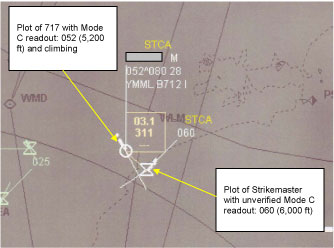
The sector controller was aware of the departure of the 717 as The Australian Advanced Air Traffic Control System (TAAATS) had correlated the aircraft's flight plan with the secondary surveillance radar (SSR) code assigned to the flight as that aircraft passed 2,400 ft AMSL. The controller reported to the pilot of the 717 that there was a radar return of an unidentified aircraft 3.5 NM in his eleven o'clock position 7 (see Figure 1) and its altitude was an unverified 8 6,000 ft AMSL. The controller also received a short-term conflict alert (STCA) on the radar display indicating that the 717 and the unidentified were in potential conflict. The unidentified aircraft was operating on SSR code 1200. That code is designated for use by pilots of aircraft operating a VFR category flight in Class G airspace. About 8 seconds later, the pilot of the 717 received a TCAS RA to adjust the rate of climb of the aircraft to no greater than 2,000 feet per minute. The pilot complied with the advisory and at 0953:40 the RA ceased.

Figure 1: Replay of recorded radar data at 0953:30 9

aair200506650_001.jpg

After the occurrence, the pilot and copilot of the 717 reported that they were aware of the unidentified aircraft on the TCAS as their aircraft turned left to intercept the outbound track. They lowered the nose of the 717 to assist them in seeing the other aircraft and received the RA at about the same time. Analysis of the 717 flight data recorder information showed that immediately prior to the RA the aircraft's rate of climb decreased in conjunction with an increase in indicated airspeed from 230 kts to 250 kts.

The Brisbane Centre controller was required to provide traffic information to pilots of IFR category flights on other IFR category flights in non-controlled Class G airspace below 8,500 ft around Williamtown Airport. There is no requirement to provide traffic information on VFR category flights. When within radar coverage the traffic information service can be based on radar data.

A radar information service (RIS) is available on request to pilots of VFR category flights in non-controlled airspace, subject to air traffic control workload. The service is available to improve a pilot's situational awareness and to assist in avoiding other aircraft. To receive a RIS, a pilot of a VFR category flight must be in direct very high frequency radio communication with air traffic control and the aircraft has to have a serviceable SSR transponder.

Normally, TAAATS receives SSR data from the Williamtown Air Traffic Control radar located near the airport. That data enables near ground level coverage for flights at the airport. During November, there were problems with the Williamtown radar data received by Brisbane Centre and while the situation was being investigated, that data was not used. A notice to airmen (NOTAM) reviewing and re-issuing a previous NOTAM advised that Brisbane Centre radar information services and radar-based traffic information services below 6,000 ft in the vicinity of Williamtown Airport were unreliable due to limited radar coverage. That NOTAM was issued 26 November 2005.

  1. The 24-hour clock is used in this report to describe the local time of day, Eastern Daylight-saving Time (EDT), as particular events occurred. Eastern Daylight-saving Time was Coordinated Universal Time (UTC) + 11 hours.
  2. An occurrence in which 2 or more aircraft come into such close proximity that a threat to the safety of the aircraft exists or may exist, in airspace where the aircraft are not subject to an air traffic separation standard or where separation is a pilot responsibility.
  3. Aircraft are operating is in the vicinity of a non-towered airport if it is within a horizontal distance of 10 NM and within a height above the airport reference point that could result in conflict with operations at the airport.
  4. Visibility greater than 5 km and aircraft are able to be flown 1,500 m horizontally and 1,000 ft vertically clear of cloud.
  5. Operations are conducted in accordance with Civil Aviation Safety Authority, Civil Aviation Regulation 262AM, Limited category aircraft - operating limitations.
  6. Aeronautical Information Publication (Supplement) H51/05 issued 24 November 2005.
  7. A means to relate the direction of an aircraft relative to another aircraft - 12 o'clock is in front of an aircraft, 9 o'clock is to the left and 3 o'clock is to the right.
  8. An aircraft's SSR Mode C readout has to be confirmed to be within 200 ft of a pilot reported level to be deemed to be verified.
  9. The orange text box lists the distance between the aircraft plots (3.1 NM) and the bearing from the unidentified aircraft to the 717 (311 degrees M).

Summary

On 18 December 2005 at 0954 Eastern Daylight-saving Time, shortly after departure from Williamtown (Newcastle) Airport, NSW while operating under common traffic advisory frequency (radio) (CTAF (R)) procedures, the pilot of a Boeing Company 717-200 (717) aircraft reported receiving a traffic collision and avoidance system (TCAS) resolution advisory (RA). The other aircraft was subsequently identified as a British Aircraft Corp 167 Strikemaster aircraft.

A review of recorded radar data, after the occurrence, showed that the RA activated when the 717 was 9 km south of the airport. The radar data in conjunction with TCAS data from the 717 showed that the minimum horizontal distance between the aircraft was 1,500 m with the Strikemaster about 250 ft above the level of the 717. There had been an AIRPROX.

The investigation found that the Strikemaster pilot's intention had been to avoid routes likely to be used by other aircraft. However, on the day, the pilot misperceived the 717's destination and the Strikemaster had radio problems that led to a reduction in the pilot's situational awareness. A near collision was prevented by the combined use of radar-based traffic information and TCAS.

Following the occurrence, the operator of the Strikemaster reviewed and amended procedures, for flights conducted near Lismore and Williamtown Airports to enhance pilots' situational awareness. That review included the standardisation of aircraft radio operating procedures.

Brisbane Centre issued an operational note to controllers advising that the pilots of Strikemaster flights may request a radar information service and controllers are to be prepared to provide a discrete secondary surveillance code.

Occurrence summary

Investigation number 200506650
Occurrence date 18/12/2005
Location Williamtown, Aerodrome
State New South Wales
Report release date 28/06/2006
Report status Final
Investigation type Occurrence Investigation
Investigation status Completed
Mode of transport Aviation
Aviation occurrence category Separation issue
Occurrence class Incident
Highest injury level None

Aircraft details

Manufacturer The Boeing Company
Model 717
Registration VH-VQI
Serial number NK
Sector Jet
Operation type Air Transport High Capacity
Departure point Williamtown NSW
Destination Melbourne VIC
Damage Nil

Aircraft details

Manufacturer British Aircraft Corporation
Model 167
Registration VH-LLD
Serial number NZ6372
Sector Jet
Operation type Private
Departure point Williamtown NSW
Destination Williamtown NSW
Damage Nil

Near collision on ground, Bankstown Airport, New South Wales, on 15 December 2005

Safety Action

As a result of this occurrence, the Civil Aviation Safety Authority (CASA) has advised the Australian Transport Safety Bureau that they intend to take the following actions:

CASA will consider whether that 'beep back' equipment should be mandated for all Common Air Traffic Advisory Frequency (CTAF) and CTAF (R) aerodromes and whether a full tower service when night circuit training is taking place should also be mandated, especially during ab-initio circuit training by solo students.

Factual Information

At approximately 2200 Eastern Daylight-saving Time on 15 December 2005, the pilot of a Piper PA-31-350 Chieftain aircraft, registered VH-HJS, was approaching Bankstown Airport to land on Runway 11.  Following touchdown, the pilot of the Chieftain noticed another aircraft on the right side of the runway and took avoiding action by manoeuvring to the left, off the runway sealed surface and on to the grass, to prevent a collision.  The pilot reported that the other aircraft appeared to have only a dim taillight on at the time.

Subsequently, the other aircraft was identified as a Piper PA-28-151 Cherokee aircraft, registered VH-LMY.  The pilot of the Cherokee had completed a number of night circuits at Bankstown and reported that he was taxiing on runway 11 following a full stop landing.

At the time of the incident, Bankstown Airport was operating as a Common Traffic Advisory Frequency (R) (CTAF - radio required to be carried and used).

The Australian Transport Safety Bureau reviewed the recorded frequency channels for the Bankstown CTAF (R).  The recordings indicated that the pilot of the Chieftain had broadcast his intentions on the Bankstown CTAF (R) during the approach. In addition, transmissions from other traffic and the Bankstown Aerodrome Frequency Response Unit (ARFU) were recorded.

The pilot of the Cherokee reported that he had listened to the information from the aerodrome Automatic Terminal Information Service (ATIS) prior to commencing circuits. During the circuit training, he reported that he had made all the normal transmissions on the Bankstown CTAF (R), but did not hear any transmissions from other aircraft or the Bankstown ARFU. However, there were no recorded transmissions from the pilot of the Cherokee on the Bankstown CTAF (R).

The owner of the Cherokee reported that the aircraft radio equipment functioned correctly with no unserviceability reported and that the aircraft was equipped with functional lights, including navigation, anti-collision and strobe lights.  The pilot of Cherokee reported that all lights were on at the time of the incident.

ATSB Comment

The investigation was unable to determine why the transmissions from the pilot of the Cherokee were not recorded on the Bankstown CTAF (R), but it is likely that that an inadvertent mis-selection of the radio was made at some time after the pilot listened to the Bankstown ATIS. The investigation was also unable to rationalise the difference in evidence from the pilots of each the aircraft regarding the aircraft lighting on the Cherokee.

Summary

At approximately 2200 Eastern Daylight-saving Time on 15 December 2005, the pilot of a Piper PA-31-350 Chieftain aircraft, registered VH-HJS, was approaching Bankstown Airport to land on Runway 11.  Following touchdown, the pilot of the Chieftain noticed another aircraft on the right side of the runway and took avoiding action by manoeuvring to the left, off the runway sealed surface and on to the grass, to prevent a collision.  The pilot of the Chieftain reported that the other aircraft appeared to have only a dim taillight on at the time.

Subsequently, the other aircraft was identified as a Piper PA-28-151 Cherokee aircraft, registered VH-LMY.  The pilot of the Cherokee had completed a number of night circuits at Bankstown and reported that he was taxiing on runway 11 following a full stop landing.

At the time of the incident, Bankstown Airport was operating as a Common Traffic Advisory Frequency (R) (CTAF - radio required to be carried and used).

The Australian Transport Safety Bureau reviewed the recorded frequency channels for the Bankstown CTAF (R).  The recordings indicated that the pilot of the Chieftain had broadcast his intentions on the Bankstown CTAF (R) during the approach. In addition, transmissions from other traffic and the Bankstown Aerodrome Frequency Response Unit (ARFU) were recorded.

However, there were no recorded transmissions from the pilot of the Cherokee on the Bankstown CTAF (R).

Occurrence summary

Investigation number 200506646
Occurrence date 15/12/2005
Location Bankstown Aerodrome
Report release date 31/08/2006
Report status Final
Investigation type Occurrence Investigation
Investigation status Completed
Mode of transport Aviation
Aviation occurrence category Separation issue
Occurrence class Incident
Highest injury level None

Aircraft details

Manufacturer Piper Aircraft Corp
Model PA-28
Registration VH-LMY
Serial number 28-7615407
Sector Piston
Operation type Private
Departure point Bankstown NSW
Destination Bankstown NSW
Damage Nil

Aircraft details

Manufacturer Piper Aircraft Corp
Model PA-31
Registration VH-HJS
Serial number 31-7652091
Sector Piston
Operation type Charter
Departure point Taree NSW
Destination Bankstown NSW
Damage Nil

Smoke event, 89 km south-east of Mackay, Queensland, on 9 December 2005, VH-EEQ

Summary

At approximately 0530 Eastern Standard Time hours on 9 December 2005, a Fairchild Industries Inc SA227-AC Metroliner, registered VH-EEQ was being operated on a scheduled cargo flight from Rockhampton to Mackay, Qld with a crew of two pilots on board. The crew reported that, during the cruise at flight level (FL) 140, an oily smell was detected emanating from the right nozzle cockpit air vent. Shortly after, and at a position 85 NM north-north-west of Rockhampton, the crew noticed smoke in the cockpit.

Although the crew reported completing the relevant checklist actions, the smoke re-entered the cockpit on two more occasions and the crew diverted to land back at Rockhampton. The third instance of smoke being detected in the cockpit followed shortly after the right engine oil temperature 'approached the top of the green arc' and, in the belief that to do so would prevent more smoke from entering the cockpit, the crew shut down the right engine.

A local engineering examination of the aircraft found that the air cycle machine had failed, releasing lubricating oil mist and smoke into the aircraft's air-conditioning ducts. In addition, that examination revealed that the indicated increased right engine oil temperature was as a result of an indicating system malfunction.

As a result of this incident, a number of safety actions were carried out, or proposed to be carried out, including:

  • by the operator, to:
    • amend its operations manual to remove non-type specific instructions that conflict with approved flight manual (AFM) procedures
    • advise its pilots of the Civil Aviation Safety Authority's (CASA) expectations in regard to the application of the word 'recommended' in AFM Emergency Procedures
    • advise its Training Captains to include CASA's expectations for the application of the word 'recommended' in AFM Emergency Procedures in all endorsement training
    • by CASA, which published its interpretation of the term 'recommended' in relation to the required conduct by pilots of aircraft manufacturer's emergency checklist procedures.

Occurrence summary

Investigation number 200506380
Occurrence date 09/12/2005
Location 89km SE Mackay, VOR
State Queensland
Report release date 22/05/2007
Report status Final
Investigation type Occurrence Investigation
Investigation status Completed
Mode of transport Aviation
Aviation occurrence category Smoke
Occurrence class Incident
Highest injury level None

Aircraft details

Manufacturer Fairchild Industries Inc
Model SA227
Registration VH-EEQ
Serial number AC-612
Sector Turboprop
Operation type Air Transport Low Capacity
Departure point Rockhampton, QLD
Destination Mackay, QLD
Damage Nil

Collision, Piper aircrafts PA-28-161, VH-BZA, VH-UMB, on 10 December 2005

Analysis

No recording was available of the Common Traffic Advisory Frequency. As both instructor pilots reported either hearing other aircraft completing circuits at Lilydale or of hearing the MAYDAY broadcast of the other aircraft, the investigation determined that both crews were most likely monitoring the correct radio frequency. The reason that radio broadcasts made by the crews of both aircraft were not heard by the other could not be determined. There should have been an opportunity for the crew of BZA to hear the downwind broadcast from the pilot of UMB, and for the crew of UMB to hear the inbound broadcast from the pilot of BZA when that aircraft was 5 NM east of Lilydale, noting that that position would equate to the aircraft being approximately overhead a late downwind position for runway 17 at Coldstream.

The instructor on board UMB was preoccupied with assisting the student to maintain the correct spacing on the downwind leg. The circuit area at Coldstream presented a number of challenges to the novice pilot, including powerlines located a short distance to the south of the aerodrome which necessitated an early left turn, and the downwind leg being displaced further east than normal in order to maintain the aircraft clear of noise sensitive areas. The instructor's focus during the circuit would have been directed towards the aerodrome and providing the student with visual pointers to maintain consistent circuit spacing. As a result, the instructor's attention to altitude keeping and maintaining a lookout for conflicting traffic may have been affected.

The instructor and the student pilot on board BZA reported that their aircraft maintained the appropriate height specified in the Coldstream local instructions, that is, they overflew the circuit area not below 2,000 ft. The altitude reportedly maintained by the student pilot of BZA when passing over the Coldstream circuit area should have been sufficient to provide the appropriate level of vertical separation from the Coldstream circuit traffic. The crew of BZA also had a responsibility to see-and-avoid other traffic during their overflight of the Coldstream Aerodrome. As the PA-28-161 Warrior is a low-wing aircraft, their possible view of the circuit area at Coldstream may have been slightly obscured.

Although altitudes specified in the Coldstream Aerodrome local instruction should have provided sufficient vertical spacing between the aircraft, receipt of radio broadcasts may have increased the likelihood of the crews being alerted to the potential conflict.

While recognising the limitations inherent in the see-and-avoid principle of collision avoidance, this accident serves as a reminder to all pilots to:

  • maintain an effective lookout at all times, being particularly vigilant in areas of high traffic density and while overflying aerodromes
  • maintain an effective listening watch
  • ensure that appropriate and timely radio broadcasts are made
  • maintain accurate altitude keeping.

Factual Information

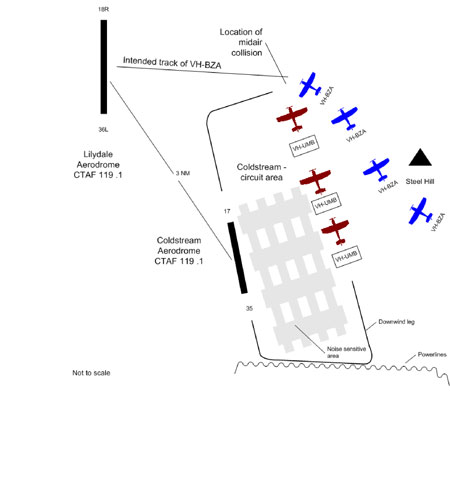
On 10 December 2005, at about 0953 1, a Piper Aircraft Corporation PA-28-161 Warrior, registered VH-UMB (UMB), with an instructor and student pilot on board, was being operated under the visual flight rules on circuit training at Coldstream Aerodrome, Vic. Another Piper Aircraft Corporation PA-28-161 Warrior, registered VH-BZA (BZA), also with an instructor and student pilot on board and being operated under the visual flight rules, was transiting from the local training area to Lilydale Aerodrome, when the two aircraft collided about 2 km north-east of Coldstream Aerodrome (Figure 1). Following the collision, the instructor pilots landed their aircraft safely and none of the pilots were injured.

Figure 1:     Relative position of VH-UMB and VH-BZA 2

aair200506443_001.jpg

The instructor on board UMB reported that he was instructing the student on his first session of circuit training. The circuit on which the collision occurred was the first of a series planned for the day. The instructor recalled making a broadcast when taxiing and prior to entering the runway. No recording was available of the Common Traffic Advisory Frequency (CTAF), nor was it required to be.

The instructor reported that as the aircraft proceeded on the downwind leg of the circuit, he was concentrating on assisting the student to maintain the correct spacing and orientation in the circuit and that the aircraft was 'a few hundred feet above circuit height'.

The circuit area at Coldstream Aerodrome did not conform to the typical aerodrome circuit pattern in shape or size. Due to the proximity of powerlines located a short distance to the south of the aerodrome, aircraft taking off from runway 17 were required to make an early left turn and the downwind leg was displaced further east than in a 'normal' circuit in order to maintain the aircraft clear of a noise sensitive area (Figure 1).

The student pilot of UMB climbed above the standard circuit height of 1,500 ft above mean sea level (AMSL) that was nominated in the Coldstream Aerodrome local instructions. The instructor of UMB was not certain of the maximum altitude reached. He reported that he did not see the other aircraft at any stage, nor did he recall hearing any inbound radio broadcast.

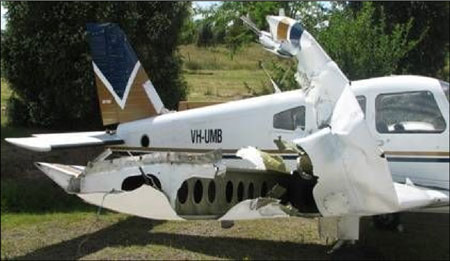
After the collision, the instructor on board UMB took over control of the aircraft from the student and after some difficulty the aircraft began to respond to his flight control inputs. He reported that he had initially considered an off-airport landing; however, after some degree of control was regained, he felt confident enough to proceed with a landing at Coldstream Aerodrome. The landing was conducted without extending flap. The right wing leading edge and the vertical stabiliser of UMB sustained substantial damage in the collision (Figure 2).

Figure 2: VH-UMB showing significant damage to right wing leading edge

aair200506443_002.jpg

The instructor on board BZA reported that they were returning to Lilydale Aerodrome after conducting a lesson in the local training area. The student was manipulating the flight controls at the time. The instructor reported that they overflew the Coldstream Aerodrome circuit area above 2,000 ft AMSL, which was specified as the overfly altitude in the local instructions for Coldstream Aerodrome.

Both the instructor and student on board BZA reported that, in accordance with flight school procedures, a radio broadcast of 'Lilydale traffic, Warrior BZA is approximately 5 NM east, 2,500 inbound Lilydale' was made. It was reported that this was the first opportunity to make an inbound broadcast as the training was being conducted within 10 NM from Lilydale (at about 5 NM). The instructor reported that he did not hear any broadcasts from potential conflicting traffic.

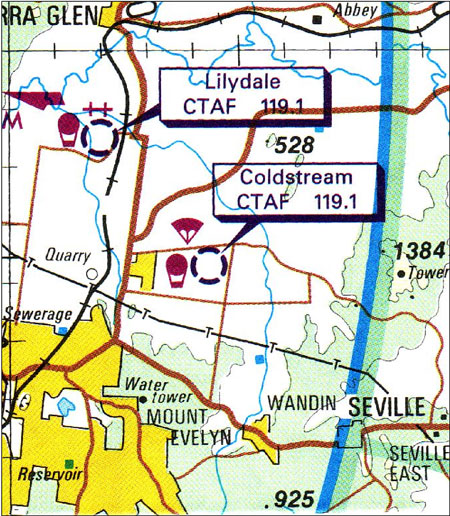
The two aerodromes were located approximately 3 NM apart, with Coldstream to the south-east of Lilydale (Figure 3). Both had a CTAF of 119.1 Mhz. A CTAF is a radio frequency on which pilots make positional broadcasts when operating in the vicinity of a non-towered aerodrome. The Lilydale Aerodrome was equipped with an Aerodrome Frequency Response Unit 3 (AFRU) or 'beep back'.

Figure 3: Location of Lilydale and Coldstream Aerodromes

aair200506443_003.jpg

Both aircraft were of the low-wing design. The student on board BZA reported seeing the other aircraft as the collision occurred. The instructor reported that he did not see the other aircraft until after the collision. The instructor took over control of the aircraft from the student and after verifying that it was responding normally to flight control inputs, manoeuvred to observe the other aircraft.

The instructor on board BZA reported that he heard a MAYDAY 4 broadcast from the flight crew of UMB. The instructor on board UMB reported that prior to the impact, he recalled 'hearing on the radio a couple of aircraft doing circuits at Lilydale', but did not recall hearing any inbound broadcast.

When it appeared likely that UMB was capable of completing an approach and landing at Coldstream Aerodrome, the instructor in BZA continued on to Lilydale Aerodrome and landed. BZA sustained minor damage to the left-wing tip, left aileron, engine cowl and nose gear.

Visibility at the time of the collision was not considered a factor in this occurrence with the student on board BZA stating that 'there was a bit of cloud around that day…but at 2,400 ft we could see quite clearly'.
Airservices Australia radar data indicated that as BZA overflew the Coldstream circuit area the aircraft was descending. The minimum recorded radar altitude was 2,000 ft AMSL, which was the displayed altitude at the time of the collision 5. Radar altitude data was not available for UMB until about one minute after the aircraft appeared to have collided, by which time the UMB was descending through 1,400 ft AMSL. The instructor on board UMB told the investigation that the aircraft transponder 6 was switched 'ON' for the duration of the flight, but that it had previous intermittent problems.

New procedures for operations at non-towered aerodromes were introduced as Stage 2c of the National Airspace System on 24 November 2005. Under the new procedures, defined volumes of airspace previously known as CTAF areas, were removed and replaced by new procedures. Under the new procedures, pilots of radio-equipped aircraft must continuously monitor and broadcast on the CTAF by no later than a distance of 10 NM from an aerodrome when operating in the vicinity of an aerodrome.

Although the carriage and use of radio was not mandatory at either Coldstream or Lilydale Aerodrome, the new procedures specified standard positional broadcasts including:

  • by 10 NM when inbound to, or overflying an aerodrome
  • just before turning onto the downwind leg of the circuit
  • just before turning onto the base leg of the circuit
  • just before turning onto final leg (with intentions).
  1. The 24-hour clock is used in this report to describe the local time of day, Australian Eastern Daylight-savings Time A (EST), as particular events occurred. Australian Eastern Daylight-savings Time was Coordinated Universal Time (UTC) + 11 hours.
  2. Positions of the aircraft in the figure represent the estimated flight paths and not a position relative to the other aircraft at any given time.
  3. An automated recording which responds to broadcasts and indicates to the pilot that the radio is switched to the correct frequency and that the transmitter and receiver are working.
  4. International radio broadcast for urgent assistance.
  5. The accuracy of the radar displayed altitude information could not be verified.
  6. Secondary Surveillance Radar (SSR) transmitter/receiver fitted to aircraft that transmits coded information when triggered by a correctly received signal.

Summary

On 10 December 2005, at about 0953, two Piper Aircraft Corp PA-28, Warrior, aircraft collided 2 km north-east of Coldstream Aerodrome.

The instructor and student on board one of the aircraft were conducting circuit training at Coldstream Aerodrome. The instructor reported that the aircraft had climbed above the nominated circuit height of 1,500 ft above mean sea level (AMSL) but was not certain of the maximum altitude their aircraft ultimately reached.

After the collision the instructor had initially considered an off airport landing; however, after some degree of control was regained, he felt confident enough to return to Coldstream Aerodrome. The right-wing leading edge and the vertical stabiliser of the aircraft sustained substantial damage in the collision.

The instructor and student onboard the other aircraft were returning to Lilydale Aerodrome after a period in the local training area. While transiting from the training area to Lilydale the aircraft overflew the Coldstream Aerodrome circuit area. After the collision, the instructor on board the aircraft took control of the aircraft and continued on to Lilydale Aerodrome located a short distance to the north-west. The aircraft sustained minor damage to the left-wing tip, left aileron, and engine cowl and nose gear.

The local instructions for aircraft operated at Coldstream Aerodrome indicated a circuit altitude of 1,500 ft AMSL and an overfly altitude of 2,000 ft AMSL. The instructor reported that they overflew the Coldstream Aerodrome circuit area above 2,000 ft AMSL, which was consistent with the unverified radar data.

Following the collision, the instructor pilots landed their aircraft safely and none of the pilots were injured.

Occurrence summary

Investigation number 200506443
Occurrence date 10/12/2005
Location 2km NE Coldstream, ALA
State Victoria
Report release date 10/08/2006
Report status Final
Investigation type Occurrence Investigation
Investigation status Completed
Mode of transport Aviation
Aviation occurrence category Airborne collision
Occurrence class Accident
Highest injury level None

Aircraft details

Manufacturer Piper Aircraft Corp
Model PA-28
Registration VH-UMB
Serial number 28-7916097
Sector Piston
Operation type Flying Training
Departure point Coldstream, Vic
Destination Coldstream, Vic
Damage Substantial

Aircraft details

Manufacturer Piper Aircraft Corp
Model PA-28
Registration VH-BZA
Serial number 28-7916038
Sector Piston
Operation type Flying Training
Departure point Lilydale, Vic
Destination Lilydale, Vic
Damage Minor

Uncommanded nose-up pitch, Kawasaki BK117 B-2, VH-IME

Safety Action

Helicopter manufacturer

On 19 December 2005, the helicopter manufacturer advised the Australian Transport Safety Bureau (ATSB) that the procedure for setting the autorotation rotor RPM contained in the Kawasaki Heavy Industries BK 117 B-2 (BK 117 B-2) maintenance manual did not cover operation of the helicopter at high gross weight. In order to correct that procedure, the manufacturer advised the operator to re-set the helicopter's collective pitch setting in accordance with the relevant procedure in the BK 117 C-18 model helicopter's maintenance manual, which can be used to set the helicopter's autorotation rotor RPM at high gross weight.

On 20 December 2005, the helicopter manufacturer advised the ATSB that it intended amending the BK 117 B-2 maintenance manual to reflect the procedures detailed in the BK 117 C-1 manual, and that it would advise all customers who operated the BK 117 B-2 helicopter of the change to the maintenance manual. A temporary revision to the manual was subsequently issued by the manufacturer. On 20 January 2006, the maintenance manual was amended to include the procedure for setting autorotation rotor RPM in the BK 117 B-2 at high gross weight.

Australian Transport Safety Bureau

The ATSB provided an initial alert to the Civil Aviation Safety Authority (CASA) of this safety deficiency on 15 December 2005. Further information on the progress of the ATSB investigation was provided to CASA technical staff on 19 December, with notice of the likelihood of the ATSB issuing a safety recommendation provided later that day. On 21 December 2005, CASA technical staff met with ATSB investigators and, following a briefing, advised the ATSB that CASA would alert operators about this safety deficiency.

On 22 December 2005, the ATSB issued the following safety recommendation R20050014 to CASA. That recommendation stated:

The Australian Transport Safety Bureau recommends that the Civil Aviation Safety Authority alert Australian operators of the Kawasaki BK 117 B-2 helicopter to the discrepancy with respect to the procedure for adjusting the collective pitch settings in the maintenance manual.

On 22 December 2005, CASA wrote to all Australian owners and operators of the BK 117 B-2 helicopter and recommended that, pending advice from the helicopter manufacturer, operators of the BK 117 B-2 should:

  • reduce exposure to conditions of high-density altitude and atmospheric turbulence, especially if the aircraft is at high gross weight
  • if such conditions were encountered, reduce airspeed and torque settings while hand flying the aircraft with SAS [Stability Augmentation System] mode engaged.

On 7 February 2006, CASA advised the ATSB that the helicopter manufacturer had provided all Australian operators of the BK 117 B-2 helicopter with the amended procedure for setting the collective pitch setting.
In response to the safety action undertaken by CASA and the helicopter manufacturer, the ATSB has classified safety recommendation R20050014 as 'Closed-accepted'.

8. The BK117 B-2 helicopter type certificate also included the BK 117 C-1 model helicopter.

Analysis

The abnormally high collective pitch setting meant that the majority of the helicopter's forward cyclic control authority was required by the pilot to maintain level flight. The result was that, in response to the nose-up pitch, there was insufficient remaining forward cyclic control available for the pilot to recover the helicopter without also lowering the collective control. It appeared likely that the reported severe turbulence contributed to the helicopter's initial nose-up pitch.

Factual Information

At about 1315 hours Eastern Daylight-saving Time on 7 December 2005, a Kawasaki Heavy Industries BK 117 B-2 (BK 117 B-2) helicopter, registered VH-IME, was being operated on a medical flight at 7,000 ft above mean sea level, in moderate to severe turbulence and in visual meteorological conditions (VMC), when the helicopter sustained an uncommanded nose-up pitch of 40° to 45°. The pilot attempted to counter the nose-up pitch by applying full forward cyclic control, but without effect. The pilot then lowered the collective control, producing a nose-down pitching moment, before recovery to normal level flight could be achieved. The Mast Moment advisory light illuminate 1 and the pilot continued the flight to the destination at reduced airspeed.

The pilot reported that, immediately prior to the nose-up pitch, the helicopter's indicated airspeed was about 120 kts, and the outside air temperature was 20° C. He indicated that the torque 2 setting was about 68 % and within the helicopter's published limits at that time, and that he felt the position of the cyclic control may have been further forward than normal.

The helicopter's estimated all up weight (AUW) was 3,200 kg and its Velocity Never Exceed 3 was estimated to be 125.5 kts. The Eurocopter Deutschland GmbH 4 (ECD) Flight Safety Department advised that that speed should have only been possible in the BK 117 B-2 helicopter when in a descent.

The pilot reported that he flew through severe turbulence just prior to the incident, but that he felt no abnormal vibrations prior to the nose-up pitch. He also stated that, during an after-flight crew de-brief, one crew member reported that the helicopter rolled right after the nose-up pitch. The pilot could not recall that roll.

The incident was subsequently investigated by an ECD test pilot and engineer, in consultation with representatives of the helicopter's Japanese manufacturer. That investigation revealed that the published procedure for setting autorotation rotor RPM in the BK 117 B-2 maintenance manual did not include for aircraft operations at high gross weight, and that the application of that procedure in the incident helicopter had resulted in an inappropriately high collective pitch setting.

The effect of the helicopter's collective pitch stop is to limit the collective travel and, in turn, establish a maximum horizontal speed (VH 5) for the ambient conditions and AUW of the helicopter. The ECD Flight Safety Department advised that the helicopter's abnormally high collective pitch setting meant that the pilot would require increased forward displacement of the cyclic control in order to maintain level flight. That would result in a reduction in the longitudinal cyclic control authority 6 that was available to the pilot.

The ECD Flight Safety Department indicated that the severe turbulence reported by the pilot could have precipitated the helicopter's nose-up pitch in this incident, and that the reduced longitudinal cyclic control authority would have restricted the pilot's ability to recover the changing pitch. Retreating blade stall 7 was considered by the ECD Flight Safety Department as an unlikely contributory factor in this instance, as it was only considered possible when the helicopter was in a descent profile.

  1. The illumination of the Mast Moment advisory light indicated that the rotor mast had exceeded its normal limits.
  2. A measure of the power provided by the helicopter's engines to overcome the resistance of the rotor blades to rotation, and maintain constant main rotor RPM.
  3. Never-exceed speed that was specified by the helicopter's manufacturer.
  4. Co-designed with Kawasaki Heavy Industries. The incident helicopter was manufactured by Kawasaki Heavy Industries.
  5. The maximum possible sustained airspeed in level flight at the helicopter's continuous engine power rating.
  6. The forward and aft limits of travel of the cyclic control.
  7. Stall of the retreating blades at high helicopter forward speeds. Occurs when the angle of the attack of the retreating blades becomes excessive, especially towards the tip of the retreating blades.

Summary

At about 1315 hours Eastern Daylight-saving Time on 7 December 2005, a Kawasaki Heavy Industries BK 117 B-2 (BK 117 B-2) helicopter, registered VH-IME, was being operated on a medical flight at 7,000 ft above mean sea level, in moderate to severe turbulence and in visual meteorological conditions (VMC), when the helicopter sustained an uncommanded nose-up pitch of 40° to 45°. The pilot attempted to counter the nose-up pitch by applying full forward cyclic control, but without effect. The pilot then lowered the collective control, producing a nose-down pitching moment, before recovery to normal level flight could be achieved. The Mast Moment advisory light illuminated, and the pilot continued the flight to the destination at reduced airspeed.

An investigation by the co-designers and manufacturer of the helicopter identified an incorrect collective pitch setting that reduced the longitudinal cyclic control authority available to the pilot. That reduced authority restricted the pilot's ability to recover the nose-up pitch.

A number of safety actions resulted from this investigation, including:

  • advice to the operator from the helicopter's manufacturer to re-set the helicopter's collective pitch setting in accordance with the BK 117 C-1 model helicopter maintenance manual
  • amendment of the BK 117 B-2 maintenance manual to include the relevant collective pitch setting procedure from the BK 117 C-1 manual
  • the issue of Safety Recommendation R20050014, which recommended that the Civil Aviation Safety Authority (CASA) should alert Australian operators of the collective pitch setting discrepancy in BK 117 B-2 helicopters
  • an interim alert was provided to Australian operators of the BK 117 B-2 helicopter by CASA to amend their operation of the BK 117 B-2 pending advice from the helicopter's manufacturer

Occurrence summary

Investigation number 200506614
Occurrence date 07/12/2005
Location 28km W Cessnock
State New South Wales
Report release date 20/07/2006
Report status Final
Investigation type Occurrence Investigation
Investigation status Completed
Mode of transport Aviation
Aviation occurrence category Loss of control
Occurrence class Incident
Highest injury level None

Aircraft details

Manufacturer Kawasaki Heavy Industries
Model BK117
Registration VH-IME
Serial number 1097
Sector Helicopter
Operation type Aerial Work
Departure point Mudgee, NSW
Destination John Hunter Hospital NSW
Damage Nil

Breakdown of Separation, Boeing 747-438 & 767-300, VH-OJO & UR-VVF

Factual Information

On 21 December 2005, the State Administration of Ukraine for Aviation Safety Oversight (State Aviation Administration) notified the Australian Transport Safety Bureau (ATSB) that it was investigating an air safety occurrence involving an Australian registered and operated Boeing 747-438 (747) aircraft, registered VH-OJO, and a Ukrainian registered and operated Boeing 767-300 (767) aircraft, registered UR-VVF. The incident occurred in the Yangon Flight Information Region (FIR), Myanmar, on 3 December 2005.

The ATSB appointed an accredited representative to participate in the State Aviation Administration investigation into the occurrence, in accordance with clauses 5.18 1 and clause 5.23 2 of Annex 13 to the Convention on International Civil Aviation. To protect the information supplied to the State Aviation Administration, the ATSB initiated an investigation under the Transport Safety Investigation Act 2003. The report presented was prepared with information supplied to the ATSB. Reported times are referenced to Coordinated Universal Time (UTC).

The 747 was operating a scheduled service from Singapore to London, crossing the Yangon FIR at flight level (FL) 320, via airway route B463. Near position POXEM, the crew of the 767, which was on a converging track with that of the 747, requested a clearance to climb from FL300 to FL320. Yangon Air Traffic Services (ATS) cleared the 767 to climb to FL320.

At approximately 0020 the 747 crew observed the 767 on the aircraft's airborne collision avoidance system, approximately 3 NM ahead and at the same level as the 747. Yangon ATS instructed the crew of the 747 to descend to FL310. Once the 767 had passed, the 747 was re-cleared to FL320.

The State Aviation Administration is the independent Ukrainian government entity responsible for the investigation of accidents and incidents involving Ukrainian registered and operated aircraft. The ATSB accredited representative's role in the investigation has been to provide the State Aviation Administration with relevant information about the 747 and its operation and a record of the pilot's report into the incident. The State Aviation Administration will publish the final investigation report.

  1. The State of Registry, the State of the Operator, the State of Design and the State of Manufacture shall be entitled to appoint an accredited representative to participate in the investigation.
  2. Any State which on request provides information, facilities or experts to the State conducting the investigation shall be entitled to appoint an accredited representative to participate in the investigation.

Summary

The Boeing 747 (747) was cruising at FL320. The crew of the Boeing 767 (767) on a converging track, requested clearance to climb from FL300 to FL320. Yangon ATS cleared the 767 to climb. The 747 crew observed the 767 on TCAS at the same level as the 747 approximately three NM ahead. The Yangon ATS controller instructed the 747 crew to descend to FL310. The 747 was re-cleared to FL320 once the 767 had passed.

The occurrence was investigated by the State Administration of Ukraine for Aviation Safety Oversight. In accordance with para 5.23 of Annex 13 to the Convention on International Civil Aviation, ATSB appointed an Accredited Representative to assist the Ukrainian authority.

Occurrence summary

Investigation number 200506508
Occurrence date 03/12/2005
Location Ukraine, POXEM (IFR)
State International
Report release date 28/06/2006
Report status Final
Investigation type Occurrence Investigation
Investigation status Completed
Mode of transport Aviation
Aviation occurrence category Miscellaneous - Other
Occurrence class Incident
Highest injury level None

Aircraft details

Manufacturer The Boeing Company
Model 747
Registration VH-OJO
Sector Jet
Operation type Air Transport High Capacity
Departure point Singapore
Destination London
Damage Nil

Aircraft details

Manufacturer The Boeing Company
Model 767
Registration UR-VVF
Sector Jet
Operation type Air Transport High Capacity
Damage Nil

Cessna 150G, VH-KPQ

Significant Factors

  1. The aircraft stalled at a height from which the pilot was unable to effect recovery.

Analysis

The absence of witnesses to the accident, and of an emergency radio broadcast from the pilot meant that there was no information available to the investigation about the pilot's situation immediately prior to the accident. However, the low-level manoeuvring carried out by the pilot overhead the sheltering sheep, and interaction via radio with the driver of the four-wheel drive vehicle was consistent with the pilot attempting to disturb the sheep from their position.

The steepness of the angle of bank and the nose-down pitch attitude at the aircraft's point of ground impact indicated that the aircraft was in a steep left turn at that time. Those indications and the minimal forward movement of the aircraft after ground contact were consistent with the aircraft having stalled and slipped out of the turn. The lack of aircraft rotation at impact indicated that there had been insufficient time for the stall to develop into a spin, consistent with it occurring at low level. It was likely that there was insufficient time for the pilot to recover before impacting the ground. Given the variety of opinion relating to the use of wing flap during mustering operations, the investigation was unable to determine the degree of influence that the lack of flap had on the development of the accident.

The pilot's probable focus on the sheltering sheep, together with the need to operate the UHF radio may have distracted the pilot from the primary task of flying the aircraft. In addition, any sensory illusion as a result of the pilot moving his head during the low-level manoeuvring, or inadvertent movement of the flight controls could have resulted in an unintentional increase in the aircraft's angle of bank. In either case, it was likely that the pilot was initially unaware that the aircraft was in such a steep turn, or that the airspeed was insufficient for the angle of bank. The stall warning probably sounded before the stall, but given warnings were often activated during aerial mustering, it may not have had a significant effect on the pilot's awareness of the impending stall.

A possible influence on the development of the stall was a decrease in available engine power. However, the damage to the propeller indicated that the engine was developing power at ground impact, there were no identified engine defects, there was adequate fuel on board and the pilot had flown for about 1.5 hours without any apparent performance degradation prior to the accident. That evidence indicated that the engine was capable of performing normally. Notwithstanding that evidence, the use of a mix of aviation gasoline and unleaded petrol, and the estimated dewpoint depression at about the time of the accident, meant that the investigation could not discount the possibility of the formation of carburettor icing. The result in that case was the possible loss of some engine power.

During the pilot's 18 years experience operating the Cessna 206, he would have become accustomed to the relatively large amount of engine power available during aerial mustering manoeuvres in that aircraft. The investigation considered whether the pilot might have unwittingly expected the same performance from the Cessna 150. However, the pilot had operated the Cessna 150 on aerial mustering operations for over 15 months, and it was concluded that the pilot would most probably have been aware of, and adjusted to that performance difference between the aircraft types during that time.

Although the pilot's flight reviews included the practice of stall recovery in turns, and the pilot had been mustering for 18 years, the lack of an aerial stock mustering permission meant that the pilot had not completed formalised training in all of the competencies inherent in the award of that permission. As a result, there was the potential that the pilot may have acquired and, over time, reinforced perhaps inappropriate responses to some of the risks inherent in the mustering environment. The completion by the pilot of the aeronautical experience requirements of Civil Aviation Order 29.10 would have provided some assurance that he had acquired the appropriate knowledge and skills necessary to manage the risks inherent in the low-level, low-speed, and high workload mustering environment.

Factual Information

Sequence of events1

On 6 December 2005, the owner-pilot of a single-engine Cessna Aircraft Company 150G, registered VH-KPQ, was conducting aerial mustering operations on a family-owned station, 156 km north of Broken Hill, NSW. The pilot, who was the sole occupant, had departed a station airstrip at about 0710 Eastern Daylight-saving Time to coordinate the movement of sheep from an 18,000-acre paddock to shearing shed yards near the homestead. The paddock had medium to dense coverage of 2.5 m high scrub and was generally flat. Aerial mustering activity that day involved flying a north to south pattern progressively from the east to the west and directing ground-based mustering personnel to the location of the sheep. Those personnel were using two motorbikes and a four-wheel drive vehicle in the muster. All of the musterers were communicating with ultra-high frequency (UHF) radio.

At about 0835, the four-wheel drive vehicle was being used to move a few sheep along when the driver lost sight of them. The driver advised the pilot by UHF radio and shortly after the aircraft circled above the area a number of times at about 250 ft above ground level (AGL), but the pilot was reported to have not seen the sheep. The driver then sighted the sheep in thick scrub that the vehicle was unable to penetrate and advised the pilot of the situation. The pilot requested that the driver reverse and drive onto a nearby track. The driver asked the pilot to report when the sheep moved away from the scrub. There was no response. Shortly after the driver noticed smoke nearby and found that the aircraft had impacted the ground and there was an intense fire. The pilot was fatally injured.

The other musterers were in different areas of the paddock and did not observe the aircraft's descent and impact with the ground. No one heard an emergency radio broadcast from the pilot. One of the musterers observed the pilot's take-off from the station airstrip and heard the engine a number of times during the mustering before the accident and reported that it sounded normal.

Wreckage and site information

The aircraft wreckage was found approximately 400 m to the south-east from where the mustering vehicle was operating. The aircraft was upright with evidence of severe impact damage to the left wing, nose section and rear fuselage. There was evidence of intense fuel-fed fire damage to the cabin area and left wing. The main wreckage, approximately 8 m from the first ground impact mark, contained all the aircraft parts except for the nosewheel, which was found nearby.
The ground impact marks and damage to the left wing indicated that the initial impact with the ground was the outer leading edge of the left wing. In addition, the minimal damage to the shrubs surrounding the initial ground impact marks indicated that the aircraft impacted the ground with a steep left angle of bank between 70 and 80 degrees. The damage to the wing, and the nose impact position also indicated that the aircraft impacted in a nose down attitude with a high descent rate. There was no evidence of rotation.

Examination of the aircraft, including the flight control systems and engine, did not reveal any evidence of pre-impact defects. Damage to the propeller indicated that the engine was operating at ground impact. The wing flaps were found in the retracted position.

Pilot information

The pilot commenced flight training in 1987 and flew 18 hours in a Cessna 150 and 32 hours in a Cessna 172. The pilot purchased a Cessna 206 and completed his flight training in that aircraft. He was issued with a private pilot (Aeroplane) licence in 1988. There was no evidence of any low level or aerial stock mustering permission (the relevant regulations are outlined below).

Family members reported that the pilot used the Cessna 206 primarily for aerial mustering on pastoral properties that he owned in regional NSW. About 18 months prior to the accident, the pilot purchased the station north of Broken Hill and in August 2004, purchased the Cessna 150 primarily for mustering on that station.

The pilot's logbook was full and did not contain any entries after 1 October 2004. He had logged 36.5 hours flying the Cessna 150 over the station north of Broken Hill and a total of 2,041 hours. Although there were no flights logged by the pilot after 1 October 2004, family members reported that the pilot continued to fly the Cessna 206 and the Cessna 150 after that date.

The pilot's most recent flight review was competed on 24 April 2004 in his Cessna 206. The instructor who conducted the review reported that the pilot was competent and that the review had included steep turns and stall recovery. Steep turns were practiced at 3,000 ft AGL and between 45 and 60 degrees angle of bank. Stall recovery was practiced at 3,000 ft AGL and included recovery from a stall during a steep climbing turn with low power.

The pilot's logbook indicated that the pilot had completed stall and steep turn training in a Cessna 150 during his initial training in 1987/1988. There was no record of any stalls or steep turn training in a Cessna 150 since.

The Civil Aviation Safety Authority (CASA) issued the pilot with a Class 2 Medical Certificate on 30 June 2004 that was valid to 30 June 2006. That certificate contained a restriction requiring the pilot to wear distance vision correction and to have reading correction available during flight.

The pilot had been involved in mustering activities that included about two hours aerial mustering in the Cessna 150 per day during the previous two weeks. Two days before the accident the pilot did some aerial mustering in the Cessna 150 and then flew the Cessna 206 to a station in the Hay area. He was reported to have worked on the station until about 2030, before going to bed at 2300. The next morning the pilot awoke at 0600 and departed at 0830 for Wagga Wagga aerodrome, landing at 1000. At 1500, the pilot departed for the station north of Broken Hill via Hay and Broken Hill, arriving home at about 2000. The pilot worked in the sheep yards until returning to the homestead at 2130. Family members reported that the pilot was tired and had a sore shoulder for which he took a non-prescription painkiller. He retired to bed shortly after.

On the day of the accident, the pilot woke at about 0615 and at about 0630 flew the Cessna 206 from the airstrip near the homestead to another station airstrip where the Cessna 150 was hangered. It was reported that he was in good spirits and appeared well rested.

At the time of writing this report, the postmortem report was not available. There was no evidence of any physiological condition that may have contributed to the accident.

Aircraft information

The Cessna 150G was a two-seat, high wing aircraft equipped with a Continental O-200A engine rated at 100 HP (74.6 kW). The aircraft was fitted with a pneumatic aural stall warning system that activated 4 to 8 kts before the stall was reached. That was the only aural warning known to be fitted to the aircraft.

The pilot operated the Cessna 150 on a mixture of 10% aviation gasoline (Avgas) and 90% unleaded automotive petrol as authorised by a flight manual supplement. The flight manual supplement stated that when using automotive fuel, the onset of carburettor ice may occur earlier than with Avgas under the same atmospheric conditions. Two days before the accident, the aircraft fuel tanks were reportedly filled from clean drum stock in the hangar using a hand-pump that included an in-line filter. On the morning of the accident, the pilot was observed conducting his pre-flight checks, including of the aircraft's fuel system drains.

In addition to the aviation radios, a UHF transceiver was fitted to the aircraft for use during mustering operations. The audio output from that transceiver was wired into the aircraft's phones jack, and there was a hand microphone. The pilot was reported to use an aviation headset.

The pilot's Cessna 206 was a six-seat high wing aircraft equipped with a Continental IO-520F engine rated at 300 HP (223.7 kW).

Meteorological information

The applicable aviation area forecast was valid from 0800 and predicted isolated showers and thunderstorms with broken 2 cloud at 10,000 ft. The wind at 2,000 ft was expected to be from the north-west at 20 kts. Turbulence was forecast to be moderate in the broken cloud and after 1200, light to moderate below 9,000 ft.

Automatic weather observations at 0830 from the nearest Bureau of Meteorology (BoM) site at Broken Hill recorded scattered cloud at 9,500 ft and a surface wind from the south-west at 10 kts. The temperature was 26 degrees, the dewpoint was 14 degrees and the barometric pressure was 1003 hPa. There was a report of a thunderstorm and 0.2 mm precipitation between 0730 and 0800. The BoM advised that the Broken Hill observations were representative of the weather conditions at the accident site.

One of the ground-based musterers reported that at the time of the accident, the wind was a light south-westerly and it was overcast and humid.

The 0830 Broken Hill temperature and dewpoint depression3 was plotted on a Carburettor icing - probability chart. That chart predicted moderate icing at cruise power, or serious icing at descent power in those conditions.

Current regulations

Civil Aviation Order 29.10 defines aerial stock mustering as 'the use of aircraft to locate, direct and concentrate livestock whilst flying below 500 feet above ground level'. The aeronautical experience requirements for a pilot to engage in mustering operations include that the pilot must complete 5 hours low flying training and an exam to confirm pilot proficiency, followed by 10 hours operational training. That training included:

  • level, climbing and descending turns and recovery from the stall at up to 60 degrees angle of bank
  • slow flying and the methods of losing height at low level
  • steep climbing and descending turns away from and returning to a ground reference.

Aerial stock mustering

Aerial mustering of stock in aeroplanes such as the Cessna 150 usually involves low-level flight including steep turns at low airspeed to allow the pilot to monitor the location and movement of stock, and to guide ground-based personnel accordingly. It was reported that the pilot usually conducted aerial mustering at an estimated height of between 150 and 200 ft AGL, but if sheep found cover in dense scrub, the pilot would sometimes fly lower and apply power over the sheep to encourage them to move.

Turns are a significant risk during aerial mustering in aeroplanes due to the reduction in vertical lift component and significant increase in stall speed4 with bank angles over 60 degrees. To maintain height in a turn at a constant airspeed requires an increase in lift, which produces an increase in drag that necessitates an increase in engine power. Depending on the angle of bank and the conditions, maximum engine power may not be sufficient to prevent a descent.

The use of small angles of flap reduces the stall speed and lowers the nose angle for a particular airspeed. Although one low-level flying expert indicated that use of flap was advantageous during low-speed turns, opinion amongst pilots with experience in low-level operations regarding the use of flap during those operations varied.

One of the ground-based musterers reported that he heard a buzzer twice in the background of some of the pilot's UHF radio transmissions. That included while the aircraft was circling shortly before the accident. He also reported hearing the same buzzer during the pilot's previous mustering operations. An experienced aeroplane mustering pilot and instructor reported that it was common for the stall warning to activate in the steeply banked turns used during aerial mustering operations.

A number of potential sensory illusions can result in mustering pilots inadvertently applying excessive bank angles during turns. If a pilot's head is orientated into a turn (such as looking at the ground or stock) and is then quickly rotated away, the pilot's vestibular balance system can produce a sensation that the aircraft is underbanked. A visual illusion that the aircraft is skidding out of a turn can occur when turning from downwind to upwind while looking at the ground, also giving the sensation that the aircraft is underbanked.

When pilots are paying very close attention to stock by moving their head during a turn, they may tend to move the flight controls in sympathy with head-body movement. This can lead to inadvertent overbanking. Distractions during a turn, such as looking for stock or using a radio, can also increase the risk of inadvertently steepening the turn and/or allowing the airspeed to decay.

  1. Only those investigation areas identified by the headings and sub headings were considered to be relevant to the circumstances of the occurrence.
  2. Five to seven eighths of the sky obscured by cloud.
  3. Dew point depression is calculated by subtracting the dewpoint from the ambient temperature.
  4. Stall speed is the airspeed at which the stalling angle of attack (angle between effective wing chord line and relative airflow) occurs resulting in rapid decrease in lift

Summary

On 6 December 2005, the owner-pilot of a single-engine Cessna Aircraft Company 150G, registered VH-KPQ, was conducting aerial mustering operations on a family-owned station, 156 km north of Broken Hill, NSW.

At about 0835 Eastern Daylight-saving Time, the pilot was observed to circle some sheep at about 250 ft above ground level. Shortly after, ground mustering personnel noticed smoke nearby and found that the aircraft had impacted the ground and there was an intense fire. The pilot, who was the sole occupant of the aircraft, was fatally injured.

The aircraft wreckage was found approximately 400 m to the south-east from where the pilot was circling. The aircraft was upright with evidence of severe impact damage to the left wing, nose section and rear fuselage.

Examination of the aircraft, including the flight control systems and engine, did not reveal any evidence of pre-impact defects. Damage to the propeller indicated that the engine was operating at ground impact. The wing flaps were found in the retracted position.

The steepness of the angle of bank and the nose-down pitch attitude at the aircraft's point of ground impact indicated that the aircraft was in a steep left turn at that time. Those indications and the minimal forward movement of the aircraft after ground contact were consistent with the aircraft having stalled and slipped out of the turn. The lack of aircraft rotation at impact indicated that there had been insufficient time for the stall to develop into a spin, consistent with it occurring at low level.

The investigation concluded that the aircraft stalled at a height from which the pilot was unable to effect recovery.

Occurrence summary

Investigation number 200506306
Occurrence date 06/12/2005
Location 30km W Packsaddle
State New South Wales
Report release date 05/06/2006
Report status Final
Investigation type Occurrence Investigation
Investigation status Completed
Mode of transport Aviation
Aviation occurrence category Collision with terrain
Occurrence class Accident
Highest injury level Fatal

Aircraft details

Manufacturer Cessna Aircraft Company
Model 150
Registration VH-KPQ
Serial number 15066318
Sector Piston
Operation type Private
Departure point Westward Station
Damage Destroyed

In-flight breakup, 28 km north of Condobolin, New South Wales, on 2 December 2005, VH-PYN, Piper PA-31-350

Summary

At 1122 Eastern Daylight-saving Time on 2 December 2005, a Piper Aircraft Corporation PA-31350 Chieftain aircraft, registered VH-PYN, departed Archerfield, Qld, on a private flight to Griffith, NSW. On board were the pilot, an observer-pilot, and two passengers. The enroute weather was forecast to include occasional thunderstorms. At 1127, a SIGMET was issued advising of frequent observed thunderstorms south of Coonamble, NSW. Air traffic services did not pass the SIGMET information to the pilot of the aircraft, nor did their procedures require the information to be passed. There was no request from the pilot for weather information at any stage during the flight.

After the aircraft passed Coonamble, the pilot reported diverting left of track due to weather. The aircraft then came within air traffic control radar coverage, which showed it flying parallel to track at 10,000 ft, at a groundspeed of 200 to 220 kts. At 1350, the aircraft disappeared from radar and no further radio transmission was received from the pilot. At about 1400, the wreckage of PYN was found approximately 28 km north of Condobolin.

The wreckage trail extended for more than 4 km. The wings, outboard of the engine nacelles, the right engine, and sections of the empennage, had separated from the aircraft in flight. The remaining structure impacted the ground inverted and was destroyed by a post-impact fire. No evidence was found that aerodynamic flutter, in-flight fire or explosion, or lightning strike damage contributed to the circumstances that led to the break-up. However, the extent and nature of the damage precluded a complete examination of the aircraft and its systems.

There was evidence that immediately before the accident, the aircraft was likely to have been surrounded to the east, west, and south by a large complex of storms. The aircraft was not fitted with weather radar.

Occurrence summary

Investigation number 200506266
Occurrence date 02/12/2005
Location 28 km N Condobolin
Report release date 11/10/2007
Report status Final
Investigation type Occurrence Investigation
Investigation status Completed
Mode of transport Aviation
Aviation occurrence category In-flight break-up
Occurrence class Accident
Highest injury level Fatal

Aircraft details

Manufacturer Piper Aircraft Corp
Model PA-31
Registration VH-PYN
Serial number 31-8252075
Sector Piston
Operation type Private
Departure point Archerfield, QLD
Destination Swan Hill, VIC
Damage Destroyed