On 2 February 2005, a de Havilland Canada DHC-8-315 (Dash 8) aircraft, registered VH-TQE, was being operated on a scheduled passenger service between Sydney and Tamworth, NSW, at flight level 160. At 150 km south-east of Tamworth the aircraft's cabin rapidly depressurised. That was followed by the failure of navigation aids and the illumination of warning and caution lights on the aircraft's caption panel 1. The pilot in command declared an emergency and conducted a rapid descent to 10,000 ft. Aerodrome emergency services at Tamworth were activated and the aircraft landed without incident.
The airline commenced an investigation into the circumstances of the incident. The problem was isolated to the number-one starter-generator unit. It was determined that the output of the direct current generator had decreased to the extent that systems connected to the left main electrical bus dropped off line. The under-voltage condition resulted in multiple failures, including the release of the pressurisation outflow valve and the loss of all navigation aids except the number-two automatic direction finding indicator. The release of the pressurisation outflow valve depressurised the aircraft. There was no low voltage warning associated with those systems.
Functional testing of the generator found an open circuit within the number-one shunt coil. A broken wire was found at approximately 28 turns on the 100-turn coil. The broken wire would have caused the voltage output of the generator to fall to a residual level, typically of 2 or 3 volts. The wire could have been damaged either during manufacture or routine maintenance. A conclusive determination could not be made due to the condition of the wire.
The starter-generator had operated for 3,947 flight hours prior to the failure. It was last overhauled on 4 September 2004 and failed 920 flight hours later.
The caption panel on the flight deck contains a series of caution and warning advisory lights designed to alert the flight crew to an abnormal condition.
-
ATSB Comment:
It is likely that the failure of multiple systems in the aircraft alerted the flight crew to a possible electrical problem. However, their initial response in dealing with the cabin depressurisation event and associated checklist items would have distracted them from attempts to locate the source of the problem. The subsequent failure of other systems would also have required specific checklist responses. These actions, when combined with the need to follow navigation and air traffic control requirements, as well as the absence of an under-voltage warning system, minimised opportunities for the crew to identify the problem.
Occurrence summary
Investigation number
200500395
Occurrence date
02/02/2005
Location
41km E Scone
State
New South Wales
Report release date
24/03/2006
Report status
Final
Investigation type
Occurrence Investigation
Investigation status
Completed
Mode of transport
Aviation
Occurrence class
Incident
Highest injury level
None
Aircraft details
Manufacturer
De Havilland Canada/De Havilland Aircraft of Canada
On 25 January 2006, the operator advised the Australian Transport Safety Bureau that:
The training department has developed a New Technologies training segment effective 18 January 2006. That training includes the use of the Head-up Guidance System (HGS) on the Boeing 737 which will enhance situational awareness during take-off and landing.
Analysis
The operator’s 737 manual provided information on the handling techniques to maintain tail clearance margins during take-off, including take-off in gusty and crosswind conditions.
While the pilot in command (PIC) needed to react quickly and precisely to manage roll in the gusty crosswind conditions, a more measured input of pitch control was required during the aircraft’s rotation to maintain the allowable tail clearance margin. The almost doubling of the average pitch rate of rotation during the take-off indicates that the PIC exceeded the recommended rate. It is possible that the PIC used a similar style of control input for pitch that he was using to manage roll.
This occurrence highlights the fact that during a take-off manoeuvre, tail clearance margins can reduce to the point where a tail strike will probably occur if the recommended rotation rate is exceeded.
Factual Information
On 1 February 2005, a Boeing Company 737-838 (737) was being operated on a scheduled passenger service from Sydney, NSW, to Darwin, NT with two pilots, five cabin crew and 151 passengers. The pilot in command (PIC) was the pilot flying for the take-off. At 1931 Eastern Daylight-saving Time, during lift-off from runway 34 Left (34L), in gusty crosswind conditions, the PIC and co-pilot felt the aircraft's tail strike the runway. They queried the rear cabin crew, who confirmed that there was an unusual noise during the aircraft's rotation. The pilots performed the 737 Quick Reference Handbook (QRH) Non-Normal Checklist for tail strike on take-off. Following completion of the checklist, the PIC elected to return to Sydney for an overweight landing.
An engineering inspection confirmed that the aircraft had sustained a tail strike during the takeoff. A crushable cartridge, fitted to minimise damage to the aircraft during a tail strike, was damaged and required replacement. There was also minor wear to the tailskid shoe. A structural inspection of the tail section and an overweight landing check were completed and the aircraft was found to be serviceable.
The Sydney Airport automatic terminal information service (ATIS) provided meteorological and operational information for pilots of arriving and departing aircraft by means of a continuous and repetitive radio broadcast. The information broadcast at the time advised that runway 07 was in use, the wind direction was 030 degrees M at a speed of 20 kts and gusting to 30 kts. The maximum crosswind was 18 kts [for aircraft operating on runway 07]. Those conditions would have resulted in a crosswind of 16 kts to 23 kts for runway 34L.
The Bureau of Meteorology provided a report of the weather conditions at 1930 as recorded by the automatic weather station at Sydney Airport. The report indicated that there was a north-easterly wind (from 050 degrees T), with a speed of 25 kts and gusting to 35 kts. That resulted in a right crosswind of 22 kts (mean) and up to 31 kts during a gust, for aircraft operating on runway 34L.
The aircraft's weight and balance sheet provided to the pilots by the operator showed that the planned take-off weight was 75,689 kg1. That resulted in a calculated take-off decision speed (V1) of 150 kts indicated airspeed2 (IAS), a rotation speed (Vr) of 151 kts IAS and a take-off safety speed (V2) of 156 kts IAS. The PIC reported that after assessing the performance requirements for take-off, he elected to use runway 34L. The operator's crosswind limit for runway 34L was 33 kts.
The aircraft was fitted with an L3 Communications digital flight data recorder (DFDR). The ATSB analysed the recorded DFDR data to assist in establishing the sequence of events during the occurrence. During the take-off roll, control wheel (right) and rudder (left) inputs were made consistent with a right crosswind. The analysis showed that during the take-off roll the PIC used quick and precise roll control inputs in the gusty crosswind conditions. Fluctuations in the aircraft's calibrated airspeed (CAS) showed that variable wind conditions were experienced during the take-off roll, consistent with the ATIS values. The aircraft was rotated at the calculated Vr of 151 kts IAS. At lift-off, the aircraft's pitch attitude was +10.9 degrees3. By comparison, the average pitch attitude for the 23 previous takeoffs was +5.5 degrees. The average pitch rate of rotation was 3.7 degrees per second, compared with an average pitch rate of rotation of 2.2 degrees per second for the 23 previous flights. The data revealed that immediately prior to rotation, the aircraft was tracking on the runway centreline and the wings were level.
The operator's 737 Flight Crew Training Manual section 3.9 stated that, 'a 2 to 3 degree per second rotation rate is required to achieve a tail clearance of 51 cm'. Section 3.14 states that under gusty wind and strong crosswind conditions, 'do not rotate early or use a higher than normal rotation rate in an attempt to clear the ground and reduce the gust effect because this reduces the tail clearance margins'.
Actual brakes release weight at the start of the take-off run.
Indicated airspeed is the reading of the airspeed indicator instrument.
The pitch attitude mentioned is consistent, allowing for resolution limits, with the Boeing Flight Crew Training Manual (FCTM) tail strike pitch attitude (11.0 degrees).
Summary
On 1 February 2005, a Boeing Company 737-838 (737) was being operated on a scheduled passenger service from Sydney, NSW, to Darwin, NT with two pilots, five cabin crew and 151 passengers. The pilot in command (PIC) was the pilot flying for the take-off. At 1931 Eastern Daylight-saving Time, during lift-off from runway 34 Left (34L), in gusty crosswind conditions, the PIC and copilot felt the aircraft’s tail strike the runway. They queried the rear cabin crew, who confirmed that there was an unusual noise during the aircraft’s rotation. The pilots performed the 737 Quick Reference Handbook (QRH) Non-Normal Checklist for tail strike on take-off. Following completion of the checklist, the PIC elected to return to Sydney for an overweight landing. An engineering inspection confirmed that the aircraft had sustained a tail strike during the take-off. A crushable cartridge, fitted to minimise damage to the aircraft during a tail strike, was damaged and required replacement.
The investigation found that while the PIC needed to react quickly and precisely to manage roll in the gusty crosswind conditions, a more measured input of pitch control was required during the aircraft’s rotation to maintain the allowable tail clearance margin. This occurrence highlights that during a take-off manoeuvre, tail clearance margins can reduce to the point where a tail strike will probably occur if the recommended rotation rate is exceeded.
On the 25 January 2006, the operator advised the Australian Transport Safety Bureau they had developed a New Technologies training segment effective 18 January 2006. That training includes the use of the Heading Guidance System (HGS) on the Boeing 737 which will enhance situational awareness during takeoff and landing.
As a result of this occurrence, the operator advised the Australian Transport Safety Bureau that it had replaced both nosewheel steering cables with stainless steel cables. Stainless steel has a higher resistance to corrosion than carbon steel.
Factual Information
On 25 January 2005, a Boeing 727-51C aircraft, registered in Sierra Leone as 9L-LEK, was being operated on a non-scheduled positioning flight from Cairns to Brisbane, Queensland. The crew, which comprised the pilot in command, copilot and flight engineer, were supported by an aircraft maintenance engineer (a passenger) for away from base maintenance. The copilot was the handling pilot for the flight.
Approaching Brisbane, the aircraft was cleared for an instrument landing system approach to runway 01 at Brisbane Airport. There was a 15 kts gusting crosswind from the east. The crew reported that they had visual contact with the runway at about 1,000 ft altitude and flew a stabilised approach to a normal touchdown at about 1606 eastern standard time. The wing spoilers and thrust reversers deployed normally.
The copilot said that as the speed reduced through 100 kts, the aircraft was tending to veer right and that, approaching 80 kts, he had maximum left rudder applied to maintain the aircraft tracking on the runway centreline. Nosewheel steering is controlled by the rudder pedals and by a steering wheel on the pilot in command's side panel. When the copilot is flying the aircraft, it is normal procedure as the aircraft slows during the landing roll for the pilot in command to take control of the aircraft to manoeuvre it using the nosewheel steering wheel. In accordance with normal procedures, the pilot in command took control of the aircraft at about 80 kts. As the copilot relinquished control, he informed the pilot in command that he had maximum left rudder applied.
The pilot in command said that when he placed his hand on the nose wheel steering wheel, it felt very loose as he turned the wheel left to maintain the aircraft on the runway centreline. However, there was no response to the steering wheel inputs and, despite the use of differential main wheel braking, he was unable to prevent the aircraft veering right and running off the runway at a speed of between 60 and 70 kts. The aircraft came to rest about 40 m from the runway edge, and was undamaged.
An examination of the nosewheel steering system revealed that one of the carbon steel nosewheel steering cables, linking the steering wheel to the nose gear steering valve, had failed approximately 2.35 m from the ball end. That location was within the forward fuselage section above the nose wheel where the cables were hidden from view and not readily accessible.
A subsequent specialist examination of the failed cable indicated that approximately 70 percent of the cable strands at the failure location exhibited characteristics of severe aqueous corrosion1. The remaining strands showed decreased diameter due to corrosion and had failed under applied tensile loads.
The aircraft had a total time in service of 54,200 hours and 48,000 flight cycles2. The operator advised that the most recent maintenance check on the aircraft was an 'A' check completed in December 2004 and the last 'C' check on the aircraft in December 2003. The operator also advised that, in its maintenance system for the aircraft, the nose wheel steering cable was an 'on condition' item and that, during a 'C' check, there was a requirement to conduct a visual inspection of the cable.
1 Aqueous corrosion is an electrochemical process by which metals or alloys are oxidised in the presence of solutions containing water. Corrosion rates are significantly affected by environmental conditions such as temperature, humidity, and oxygen availability. 2 A flight cycle is a completed take-off and landing sequence.
Summary
On 25 January 2005, a Boeing 727-51C aircraft, registered in Sierra Leone as 9L-LEK, was being operated on a non-scheduled positioning flight from Cairns to Brisbane, Queensland.
The Australian Transport Safety Bureau suggests that the Department of Defence distributes this report widely among controllers so that supervisors are aware that intervention in separation and sequencing at the tactical level has the potential to adversely affect the situational awareness of the controllers under their supervision. Further, they must be prepared to take control of a situation if necessary, until the controller is able to safely resume responsibility for separation.
Safety Advisory Notice 20060015
The Australian Transport Safety Bureau suggests that the Department of Defence ensures that controllers are aware of the importance of the separation assurance provisions of MATS 4.1.1.4.
Conclusions
CONCLUSIONS
Significant factors
The approach controller did not assign an altitude to the second formation that provided a vertical separation standard between the second formation and the Dash 8.
The tower supervisor advised the tower controller to cancel the instruction to the Dash 8 pilots to orbit on the downwind leg of the circuit at 2,500 ft, and to continue on the downwind leg of the circuit.
The tower controller was not aware that the second formation was inbound to the circuit.
The tower controller did not notify the approach controller that the Dash 8 was extending towards the lateral boundary of the ATZ.
The pilots of the Westwind did not join the circuit via the upwind leg as instructed by the tower controller.
Contributing factors
The code/flight plan association on the ADATS data block of the second formation terminated.
The approach controller removed the second formation's flight progress strip from the flight progress board.
The approach controller did not provide the tower controller with voice coordination on the second formation once the code/flight plan association terminated.
The pilots of the Westwind incorrectly notified the tower controller that their aircraft was 'minimum fuel' when the aircraft was on left base.
The tower controller and the tower supervisor were relatively inexperienced, and each had responsibility for a controller-under-training.
Analysis
ANALYSIS
Introduction
The tower controller and the approach controller were unable to continue to apply a separation standard between the second formation of Hornets and the Dash 8. This analysis examines the development of the occurrence and highlights the safety issues that became evident as a result of the investigation.
Air traffic control separation standards and procedures
The approach controller's assignment of 3,000 ft to the pilots of second formation of Hornets when they had about 32 NM to fly to land, did not provide either a vertical separation standard or separation assurance between the second formation and the Dash 8. That action precipitated the sequence of events that followed. While a radar separation standard existed initially between the Dash 8 and the second formation, it relied on continuous monitoring by the approach controller. The allocation, by the approach controller, of an altitude to the second formation that would have provided the 1,000 ft vertical separation standard with the Dash 8 would have assured that a separation standard continued to exist. It would also have given the tower controller the option to assign further descent to the pilots of the second formation once a visual separation standard between the second formation and other aircraft joining the circuit could be applied.
The approach controller was required to establish a separation standard between the second formation and the Dash 8, and to have that standard in place before transferring the responsibility for separation to the tower controller. In not providing separation assurance between the second formation and the Dash 8, the approach controller did not demonstrate 'the proactive application of separation standards to avoid rather than resolve conflicts' as stated in the Manual of Air Traffic Services (MATS).
It was likely that the limited data block format displayed on the second formation adversely affected the situational awareness of both the tower controller and the tower supervisor at the time the tower controller advised the pilots of the Dash 8 that they could turn base 'when ready'. The tower controller did not provide traffic information about the location of the second formation to the pilots of the Dash 8 until after the pilots of the Dash 8 advised that they were on a traffic alert and collision avoidance system descent. At the time the tower controller instructed the pilots of the Dash 8 to turn base the second time, the relative locations of the second formation and the Dash 8 placed the aircraft in potential conflict. That would have been apparent to both the tower controller and the tower supervisor had either of them been aware of the location and intentions of the second formation at that time.
The traffic situation in the circuit area became quite complex in a very short period of time. The relative inexperience of the tower controllers may have limited their ability to realise the potential for a relatively simple inbound sequence to develop into an infringement of separation standards.
Communication between the tower controller and the tower supervisor may have been difficult due to the complexity of communication between trainees and their training officers, and between controllers in the various control positions in the tower. Had the Dash 8 remained at 2,500 ft conducting orbits in the downwind position as initially instructed until the tower controller could fit that aircraft into the landing sequence, there may have been more time for the tower controller to:
liaise with the tower supervisor
regulate the flow of traffic
identify the second formation on the situation data display (SDD)
assess options that may have ensured that separation continued to exist
evaluate the impact of the late declaration of 'minimum fuel' by the pilots of the Westwind
provide traffic information where appropriate
issue alternative instructions.
Once the tower controller notified the approach controller that the Dash 8 had been assigned a visual approach, the approach controller removed the flight progress strip from the flight progress board. After that, there was nothing to prompt the approach controller to critically re-evaluate the information on which the original evaluation, that the aircraft would not come into close proximity, was made, even though there remained a possible confliction between the inbound second formation and the Dash 8.
Although the decision by the tower supervisor to instruct the pilots of the Dash 8 to continue on the downwind leg of the circuit and not conduct the left orbit in the downwind position may have been appropriate, it unnecessarily increased the complexity of the traffic scenario, especially given the training workload in the tower at that time. It also reduced the options available to the tower controller once the Westwind joined the circuit on the left base leg rather than via the initial point, or the upwind leg of the circuit as instructed. The instruction issued to the pilots of the Westwind by the tower controller to enter the circuit via the upwind leg would have provided the Westwind with adequate priority and would not have compromised the safety of the flight. That may also have created an opportunity for the tower controller to locate the second formation on the SDD and therefore reduce the likelihood of an infringement of separation standards.
Tower supervisors have the authority to become involved with tactical air traffic control decisions and may assume control responsibility for sequencing or separation, without formally taking over from the tower controller. Tower supervisors must consider how an instruction to the tower controller might affect the situational awareness of that controller. A supervisor must be prepared to take control of the situation, in which they have intervened at a tactical level, until the tower controller can resume responsibility for separation. Otherwise tower controllers may inherit a scenario from the tower supervisor that they may not entirely understand, with little time to react.
Although the extended downwind of the Dash 8 resulted from the Westwind not complying with a control instruction, the tower controller was required to notify the approach controller that the aircraft was extending and may track beyond the lateral boundary of the Aerodrome Traffic Zone (ATZ). The tower controller did not notify the approach controller that the Dash 8 was extending downwind. Therefore, the approach controller was unaware that the Dash 8 was tracking towards the right initial point, in potential conflict with the second formation.
Minimum Fuel
Military air traffic controllers are familiar with pilots declaring 'minimum fuel' and with their responses in such circumstances. However, the disposition of the Westwind relative to base and final, the relatively complex nature of the traffic pattern at the time of the broadcast, and the training environment that existed in the control tower at the time of the occurrence, all reduced the time available for the controller to consider the impact of the 'minimum fuel' broadcast on the traffic pattern.
By the time the tower controller had an opportunity to assess the impact that that transmission may have on the landing sequence, and to determine what priority could have been provided to the pilots of the Westwind, the Westwind was already on the final approach leg. The pilots of the Westwind did not comply with the instruction by the tower controller to join the circuit on the upwind leg, even though that would have been acceptable in such circumstances. The declaration of 'minimum fuel' in such close proximity to the landing threshold may have distracted the controllers in the tower and reduced the effectiveness of their scans of the tower environment, including the SDD, and added to the complexity of the situation.
Australian Defence Air Traffic System (ADATS)
The approach controller did not provide the tower controller with information on the second formation after the code/flight plan association for that formation terminated. Although the approach controller reported that the termination occurred close to the boundary of tower airspace, the tower controller appeared to be unaware of the proximity of the second formation. Had the approach controller provided the tower controller with coordination on the second formation, in accordance with local procedures, the tower controller's attention would have been drawn to the location of that formation on the SDD. That may have given the tower controller an opportunity to ensure that the Dash 8 remained clear of the inbound path of the second formation.
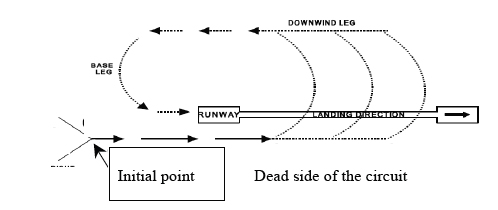
On 31 January 2005, a de-Havilland Canada Dash 8-202 (Dash 8) aircraft that was inbound to Williamtown Airport, NSW, on a scheduled passenger service from Brisbane, Queensland, passed within 1 NM laterally and 300 ft vertically of the second of two formations of two McDonnell Douglas Corporation F/A-18 (Hornet) aircraft that were inbound to Williamtown Airport after a training exercise. As the Dash 8 turned onto the base leg, the second formation was about 6 NM north-west of Williamtown Airport, at 2,900 ft above mean sea level. The pilots of the Dash 8 descended in response to a traffic alert and collision avoidance system (TCAS) resolution advisory (RA) they received on that formation. The approach controller did not provide the required separation standard of 1,000 ft vertically or 3 NM laterally between the Dash 8 and the second formation. The tower controller2 had not established a visual separation standard between the aircraft at the time the Dash 8 pilots received the RA. There was an infringement of separation standards. At about 1539:353,4 Eastern Daylight-saving Time, the pilots of an Israel Aircraft Industries Limited 1124A Westwind (Westwind) aircraft, that had been participating in a military training exercise, contacted the tower controller and advised that they were 7 NM to the north of Williamtown Airport, tracking to join the circuit on a left base leg for runway 12. At that time, the first formation of Hornet aircraft had passed the initial point5 (Figure 1) for runway 12, and the Dash 8 was in an early right downwind position. At 1540:10, the tower controller advised the pilots of the Dash 8 to conduct orbits to the south-west of the airfield at 2,500 ft. However, the tower supervisor assessed that the Dash 8 could continue on the downwind leg and advised the tower controller to cancel the orbit instruction. At 1540:20, the tower controller complied and instructed the pilots of the Dash 8 to continue on the downwind leg. The tower supervisor had intended to position the Dash 8 behind the first formation in the landing sequence.
Figure 1: Generic depiction of a military stream landing circuit showing the location of the initial point (left circuit depicted)
(adapted from the Manual of Air Traffic Services Pt 3 s3, effective 10 June 2004)
At 1541:10, the tower controller instructed the pilots of the Dash 8 to make a visual approach and to track for right base. At 1541:20, the tower controller instructed the pilots of the Westwind to join the circuit via the upwind leg. In response to that instruction, the pilots of the Westwind advised the tower controller that the aircraft was 'minimum fuel'6. The tower controller did not respond immediately to that broadcast and the Westwind continued the approach via left base. At about 1541:30, the radar data showed that the Dash 8 had already commenced the turn onto the right base leg of the circuit. At that time, the Westwind was established on left base. The Westwind pilots had positioned their aircraft behind the first formation in the landing sequence. In order to separate the Dash 8 and the Westwind, the tower controller instructed the pilots of the Dash 8 to continue on the downwind leg and that they were now to follow the Westwind.
At 1542, the tower controller advised the pilots of the Dash 8 that they could turn onto the base leg, when ready. At that time the aircraft was close to the airspace boundary separating tower and approach areas of responsibility, about 6.9 NM north-west of the airport.
At 1542:20, the approach controller provided traffic information, on the Dash 8, to the pilots of the second formation. A review of the recorded radar data showed that, at that time, the second formation was about 3 NM behind the Dash 8. Although the investigation was unable to accurately determine the vertical distance between the aircraft, from that radar data, it appeared that there was about 100 ft between the second formation and the Dash 8 when the approach controller provided traffic information to the pilots of the second formation. The pilot of the lead aircraft in the second formation advised the approach controller that he could see the Dash 8.
The recorded radar data also showed that the altitude of the Dash 8 increased from 2,500 ft on late downwind, to 2,900 ft as the aircraft commenced the base turn, before descending in response to the TCAS RA. The Dash 8 subsequently continued to descend for a landing. At 1542:50, the second formation passed abeam the Dash 8, when the Dash 8 was about to commence the turn onto the final approach leg. At that time, there was 0.6 NM laterally between the aircraft, and the Dash 8 was 300 ft vertically below the second formation. The pilots of the Dash 8 advised the tower controller that they had received an RA and that they were on a 'TCAS descent'.
At 1543, the pilots of the second formation called the tower controller and advised that they were at the right initial7 position. The tower controller then realised that the second formation was inbound and provided the pilots of the Dash 8 with traffic information on that formation.
Minimum fuel
In accordance with the Royal Australian Air Force (RAAF) Williamtown Standing Instructions, the Westwind was considered to be a military aircraft while participating in military exercises.
The copilot of the Westwind notified the tower controller that the aircraft was 'minimum fuel' when the aircraft was on a left base position for runway 12. The pilot in command of the Westwind later reported that the aircraft was not 'minimum fuel', and that the copilot had mistakenly made the 'minimum fuel' radio broadcast. The operator of the Westwind advised that the declaration of minimum fuel in that aircraft meant there was '…900 [pounds] or less total fuel remaining at the Base Turn Point when in the circuit, at an airport where a landing is assured'.
Air traffic control separation standards and procedures
Control of aircraft in the Williamtown Airport terminal area was provided by a tower controller using visual procedures and vertical separation, and by an approach controller using radar and procedural separation standards, in accordance with the Manual of Air Traffic Services8 (MATS) and local procedures. Coordination of control responsibilities was required between the approach controller and the tower controller in accordance with local procedures.
The required minimum vertical separation standard between the Dash 8 and other aircraft operating in the Williamtown airspace was 1,000 ft.
In relation to the provision of aircraft separation, the MATS 4.1.1.4 stated that:
Tactical Separation Assurance places greater emphasis on traffic planning and conflict avoidance rather than conflict resolution. This is achieved through:
the proactive application of separation standards to avoid rather than resolve conflicts;
planning traffic to guarantee rather than achieve separation;
executing the plan so as to guarantee separation; and
monitoring the situation to ensure that plan and execution are effective.
The tower controller cleared the pilot of the Dash 8 for further descent on a visual approach when the aircraft was in a late downwind position. A visual approach authorised the pilots to continue descent visually for a landing. A review of the recorded radar data showed that the Dash 8 maintained 2,600 ft for about 1.5 minutes on the downwind leg of the circuit. It reached a minimum altitude of 2,500 ft, on descent, when the aircraft was on a late downwind position, and climbed to 2,900 ft as it turned onto the base leg.
The Aeronautical Information Publication (AIP) advised pilots that they must report to ATC 'when the aircraft has left a level at which level flight has been conducted in the course of climb, cruise or descent'. The pilot in command of the Dash 8 did not recall climbing the aircraft from 2,500 ft on the downwind leg to 2,900 ft on the base leg of the circuit.
Approach control
At Williamtown Airport, the approach controller was responsible for providing an air traffic control service between instrument flight rules (IFR) category aircraft in accordance with the MATS and local procedures. That included ensuring that a separation standard existed between arriving IFR aircraft, and providing an orderly flow of arriving aircraft.
There was an approach controller and a supervisor rostered in the Williamtown approach control unit at the time of the occurrence. Both positions were staffed by an appropriately rated military air traffic controller (ATC). The approach controller had about 6 years experience as an ATC, and had been rated in the approach radar position at Williamtown Airport for 6 months. The approach supervisor was responsible for the supervision of the approach control unit at Williamtown Airport. He had considerable experience as an ATC, and had held a rating in approach control at Williamtown Airport for about 18 months.
A review of the recorded radar data showed that, at the time the approach controller cleared the pilots of the second formation to descend to 3,000 ft, the second formation was approximately 27 NM from the airport, with about 32 NM to fly to land. Had the pilots of the Dash 8 not been instructed to extend the downwind leg, the Dash 8 would have had about 6 to 8 NM to fly to touch down. The assignment of 3,000 ft to the pilots of the second formation did not provide either a vertical separation standard, or separation assurance, between the second formation and the Dash 8 in the circuit. The approach controller was not concerned about the separation between the Dash 8 on the downwind leg, and the second formation on descent to 3,000 ft, because of the distance the second formation was from the airfield at the time the approach controller issued the descent clearance.
The normal circuit direction at Williamtown Airport, on runway 12, was right. Military aircraft would track from the initial point along the dead side9 of the circuit and turn right, into the circuit, once the pilot saw the other traffic operating in the circuit (see Figure 1). The approach controller cleared the Westwind to enter the circuit via a non-standard left base leg and to descend on a visual approach.
The tower controller was required, by local procedures, to advise the approach controller when the Dash 8 pilots were cleared to descend on a visual approach.
On receipt of that advice, the approach controller removed the Dash 8's flight progress strip10 from the flight progress board11. Although the aircraft was still visible to the approach controller on the situation data display (SDD)12, the potential for an infringement of separation standards was no longer presented to the approach controller on the flight progress board. The approach controller later reported that the flight progress strip was removed from the board because there was an expectation that the second formation would remain clear of the Dash 8 in the circuit.
Tower control
The tower cabin was equipped with an SDD that provided the tower controller with the same display of air traffic that was provided to the approach controller. The MATS addressed the use of tower radar in an aerodrome control service. It stated that the tower radar display was available for the determination of the altitude, position or tracking of an aircraft to establish or monitor separation. However, the MATS also stated that:
…the use of the tower radar should not impinge upon an aerodrome controller's primary function of maintaining a visual observation of operations on and in the vicinity of the aerodrome.
There were three operational control positions established in the control tower; a supervisor position, a tower control position and a surface movement control position. Each position was staffed by an appropriately rated military ATC. The supervisor and the tower controller each had 18 months tower control experience. The control tower was also a training environment at the time of the occurrence. There was a controller-under-training in each of the three control positions. Each rated military controller, in each of the positions, was also a qualified training officer.
The supervisor was responsible for airspace management and operations on the airport. The supervisor had the authority to assess and amend the decisions of the tower controller and the surface movement controller if required. Unless the tower controller considered that such intervention compromised safety, the tower controller was obliged to comply with the decisions of the supervisor.
The first formation joined the circuit on a right crosswind leg on descent from 1,500 ft. Once the tower controller was able to apply a visual separation standard between the Dash 8 and that formation, the tower controller instructed the pilots of the Dash 8 to descend on a visual approach.
The tower controller was also required to notify the approach controller of any aircraft that were extending towards the aerodrome traffic zone (ATZ) lateral boundary which was the lateral boundary of tower airspace13. Neither the tower controller nor the supervisor advised the approach controller that the Dash 8 was extending downwind, and would be turning onto the base leg in the vicinity of the lateral boundary of the ATZ. The approach controller was not expecting to see the Dash 8 in that position. The approach controller observed, on the SDD, the Dash 8 turning onto the base leg of the circuit in the vicinity of the lateral boundary of the ATZ, and in the vicinity of the second formation.
The approach controller immediately provided traffic information to the pilots of the second formation about the Dash 8, but could not provide traffic information to the Dash 8 pilots as they were operating on the tower frequency.
The tower controller later reported that he originally intended to instruct the pilots of the Dash 8 to remain in the downwind position at 2,500 ft because it enabled him to better regulate the circuit traffic, especially given that he was instructing a controller-under-training at the time.
Instructing pilots to maintain 2,500 ft on the downwind leg was a common practice at Williamtown Airport. The AIP En Route Supplement Australia (ERSA) advised that all civil aircraft operating at Williamtown Airport were required to carry 30 minutes holding fuel. The tower controller later reported that that holding fuel enabled Williamtown air traffic control the flexibility to hold civil aircraft for up to 30 minutes, if necessary, for sequencing with arriving military aircraft.
Australian Defence Air Traffic System (ADATS)
Air traffic controllers at Williamtown Airport used the Australian Defence Air Traffic System (ADATS) to control aircraft operating within the Williamtown airspace. The ADATS associated a flight plan to an allocated transponder code14 and displayed that information to the controller as a data block, attached to the aircraft track symbol, on the SDD.
The data block could either be a full or limited data block. The full data block was white and included the call sign, altitude and radar derived ground speed, of airborne aircraft equipped with a serviceable transponder. It could also include other control information entered by a controller. A code and flight plan remained associated for a predetermined period of time depending on the nature of the flight. Once that time expired, the code/flight plan association terminated and the data block presented to the controller became a limited data block. The limited data block format did not display the call sign, and the colour of the data block changed from white to green. The limited data block format displayed an aircraft's allocated transponder code, altitude and radar derived ground speed.
The colours allocated to the track symbol and data block indicated the relevance of that aircraft to controllers. A green data block normally indicated that the aircraft was no longer of concern to the controller, as the flight plan was no longer active. The data block and track symbol colours assisted controllers with situational awareness.
The information displayed to the approach controller was also displayed to the tower controllers on the tower SDD. All information on relevant inbound, locally-based, military aircraft was displayed in the aircraft data block, including sequencing and tracking information. In accordance with local procedures, while a flight plan was associated with a specific transponder code, there was no requirement for the approach controller to provide voice coordination to the tower controller.
That applied to locally-based, military aircraft, as that information was available on the tower SDD. The tower controller was required to scan the SDD to determine the sequence and tracking details of arriving locally-based military aircraft. Tower controllers relied on the accuracy of the information presented in the data block, including the colour and sequencing instructions, to assist them in determining an estimated time of arrival, the arrival sequence and the inbound route of each aircraft.
Controllers reported that occasionally the code/flight plan association terminated while aircraft were still airborne. In those circumstances, in accordance with local procedures, the approach controller was required to use voice coordination to advise the tower controller about relevant inbound aircraft. The tower controller would not necessarily detect an inbound aircraft on the SDD if the code/flight plan association had terminated, unless voice coordination was received from the approach controller.
The code/flight plan association for the second formation terminated as the formation tracked to the circuit area and the data label changed colour from white to green. The approach controller reported that, as the termination occurred close to the circuit area, the tower controller would already have been aware that the formation was inbound. As a result, no voice coordination was provided to the tower controller.
Meteorological information
The weather was reported as fine and clear and was not considered to have been a factor in the occurrence.
Only those investigation areas identified by the headings and subheadings were considered to be relevant to the circumstances of the occurrence.
A tower controller employed by the Department of Defence provides a similar air traffic control service as a civil aerodrome controller.
The 24-hour clock is used in this report to describe the local time of day, Eastern Daylight-saving Time, as particular events occurred. Eastern Daylight-saving Time was Coordinated Universal Time (UTC)+ 11 hours.
Due to the limitations with the audio recording, all times are accurate to within about +/- 5 seconds.
The initial point for runway 12 at Williamtown Airport was located about 4 NM from the threshold of runway 12 along the extended centreline of taxiway Alpha, at 1,500 feet above mean sea level.
This phrase is used to advise air traffic control that the pilot requires priority for landing based on the amount of fuel remaining, calculated at a particular stage of flight (Manual of Air Traffic Services, pt 10, effective 9 June 2004).
The left, right and straight initial positions are 30 seconds prior to the initial point with wings level.
The Manual of Air Traffic Service is a joint civil/military publication used by Department of Defence and Airservices Australia air traffic controllers.
The dead side of the circuit is the side of the airfield or active runway, opposite to that of the circuit pattern in use, and from which arriving aircraft joining the circuit.
A flight progress strip is a thin cardboard strip used to record flight data relating to control of an aircraft.
A flight progress board is a piece of equipment used to display flight progress strips. Controllers use the information on the flight progress board to assist in managing the traffic situation.
The situation data display was an electronic display of radar derived information that depicted the positions and movements of aircraft.
The ATZ is that airspace within 5 NM of the tactical air navigation equipment ground based navigation aid, over land, from ground level to 1,500 ft above mean sea level. At Williamtown Airport, the stream landing circuit pattern (see Figure 1) is contained entirely within the ATZ.
A transponder is a receiver/transmitter which will generate a reply signal upon proper interrogation, in this case, of a signal generated by a ground based transmitter/receiver.
Summary
On 31 January 2005, a de-Havilland Canada Dash 8-202 (Dash 8) aircraft that was inbound to Williamtown Airport, NSW, on a scheduled passenger service from Brisbane, Queensland, passed 0.6 NM laterally and 300 ft vertically by the second of two formations of two McDonnell Douglas Corporation F/A-18 (Hornet) aircraft that were inbound to Williamtown Airport after a training exercise. As the Dash 8 turned onto the base leg, the second formation was about 6 NM north-west of Williamtown Airport, at 2,900 ft above mean sea level. The pilots of the Dash 8 descended in response to a traffic alert and collision avoidance system resolution advisory (RA) they received on that formation. The approach controller did not provide the required separation standard of 1,000 ft vertically or 3 NM laterally between the Dash 8 and the second formation. The tower controller had not established a visual separation standard between the aircraft at the time the Dash 8 pilots received the RA. There was an infringement of separation standards.
The investigation found that the factors that contributed to the occurrence included:
The approach controller did not assign an altitude to the second formation that provided a vertical separation standard between the second formation and the Dash 8
The tower supervisor advised the tower controller to cancel an instruction to the Dash 8 pilots to orbit on the downwind leg of the circuit at 2,500 ft, and to continue on the downwind leg of the circuit
The tower controller did not notify the approach controller that the Dash 8 was extending towards the lateral boundary of tower airspace
The pilots of a Westwind incorrectly notified the tower that their aircraft was 'minimum fuel' and did not join the circuit via the upwind leg as instructed by the tower controller.
Occurrence summary
Investigation number
200500355
Occurrence date
31/01/2005
Location
Williamtown, Aero.
State
New South Wales
Report release date
26/06/2006
Report status
Final
Investigation type
Occurrence Investigation
Investigation status
Completed
Mode of transport
Aviation
Aviation occurrence category
Loss of separation
Occurrence class
Incident
Highest injury level
None
Aircraft details
Manufacturer
De Havilland Canada/De Havilland Aircraft of Canada
As a result of this occurrence the operator has advised that a Flight Operations Memo will be issued to all 717 pilots highlighting this incident and detailing the FMS modes which remain available during abnormal FMS operation.
Findings
FINDINGS
During the flight, the amount of generated VIA BITE data exceeded the memory size. As a result, BITE data from the event that initiated the FMS problem was overwritten and lost.
The available BITE data showed that FMC 2 was unable to sequence the ‘400 ft course to altitude’ leg associated with the SWIFT SIX SID. Eventually, FMC 2 performed a software reset but was unable to recover and latched.
A similar progression then occurred for FMC 1 but, in accordance with its design, FMC 1 did not latch and was available for use but with the flight plan information cleared.
Analysis
ANALYSIS
The FMS performance reported by the crew was consistent with FMC 2 performing a progressive series of resets before it latched. A similar progression of resets then occurred for FMC 1 but, in accordance with its design, it did not latch and was available for use but with the flight plan information cleared. During the resetting process, the FMS response would have been confusing to the crew and consistent with the crew’s observation of the ‘FMS locking us out’.
With FMC 2 latched, the MENU page would have been displayed on the copilot’s multi-function control and display unit (MCDU) but with the FMC 2 prompt missing from the top left data field. The standby navigation/radio (STANDBY NAV/RAD*) prompt would also have been displayed on the MCDU and ‘MAP FAIL’ displayed on the copilot’s navigation display. Once the resetting was completed, then an ILS frequency could be tuned using the STANDBY NAV/RAD page on either the pilot in command’s (PIC) or copilot’s MCDU.
The PIC was the handling pilot during the flight. Normally the PIC’s MCDU will interact with FMC 1 and the copilot’s MCDU will interact with FMC 2. With FMC 2 latched, it was necessary for the copilot to change his source select switch to ‘FO ON 1’ to access FMC 1.
During the investigation the VIA manufacturer advised that no other FMS problems of this nature had been reported.
Factual Information
FACTUAL INFORMATION
The Boeing 717-200 (717) was taxiing at Cairns Qld for a scheduled service to Brisbane Qld. As part of the preparation for the flight, the crew had entered flight plan details into the aircraft's flight management system (FMS). While taxiing, due to intermittent rain showers at Cairns, the 717 crew then programmed the FMS with wet runway speed figures for takeoff.
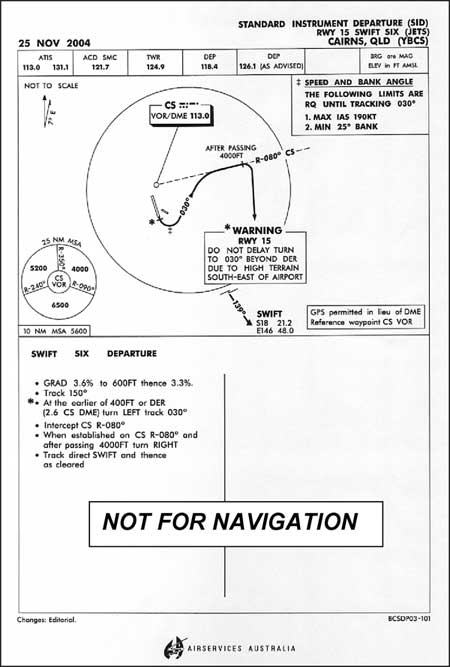
The crew reported that late in the take-off roll the manually entered wet speeds were lost from the airspeed tape on the primary flight display and FMS-generated speeds were displayed. At rotation 'MAP FAIL'1 appeared on both navigation displays. The aircraft was manually turned onto the SWIFT SIX standard instrument departure2 (SID).
Figure 1: SWIFT SIX SID
After approximately 1 ½ minutes, just after the turn onto 030°, the MAP displays returned to normal and flight plan integrity appeared to have been maintained. Later, during the turn to SWIFT, the 'MAP FAIL' indication returned. The crew reported that 'the FMS had locked us out'. Eventually the crew were able to enter the instrument landing system (ILS) frequency, but FMS operation did not appear to be reliable. The aircraft was radar vectored for a return to Cairns while maintaining visual meteorological conditions (VMC). The crew conducted a visual approach to runway 15 and the aircraft landed 32 minutes after take-off.
1.1 Versatile integrated avionics (VIA) units
The aircraft was equipped with two VIA units, VIA 1 and VIA 2. The VIA units provide the following functions:
Displays
Flight Management System
Autoflight / Autothrottle
Communications Management
Flight Warning / Aural Warning
Central Maintenance
Digital Flight Data Acquisition.
The latest FMS software, VIA-906 (Part number PS4081970-906), was installed in both VIA units. The flight management computer (FMC) is the VIA hardware that provides the FMS function.
One VIA unit is designated master and the other slave. The selection of master and slave is determined by the selection of autopilot. If the pilot in command's (PIC) autopilot is selected, then FMC 1 is considered the master and if the copilot's autopilot is selected then FMC 2 is considered the master.
1.2 FMC latch
While a fault condition exists the FMC system will progress through a series of resets: warm start, cold start, software reset and latch (shutdown). The progression of resets is designed to clear increasingly larger parts of the FMC eventually leaving a crew with a usable FMC but no flight plan data. If the software reset is unsuccessful then the FMC will latch. The FMC requires a power cycle3 to restart after it has latched.
1.3 VIA built-in test equipment (BITE) data
Each VIA unit stores BITE data in non-volatile memory4. Following the incident, VIA 2 was sent to the manufacturer in the USA for download of the BITE data and bench testing. BITE data from VIA 1 was downloaded by a manufacturer's representative in Australia and forwarded to the manufacturer.
The non-volatile memory size in each VIA unit was fixed, therefore, the oldest data was overwritten by the newest. During the flight, the amount of BITE data generated exceeded the memory size. As a result, BITE data from the event that initiated the FMS problem was overwritten and lost.
The oldest BITE data that was recorded indicated that FMC 2 was trying to sequence (activate) the '400 ft course to altitude' leg associated with the SWIFT SIX SID.
The attempted sequencing was repeated which consumed FMC processing cycles, consequently, other functions could not run. Eventually, FMC 2 performed a software reset and cleared the flight plan data but was unable to recover and latched. Since FMC 2 progressed to a latched condition then either a piece of data that was retained through each reset was invalid or FMC 1 passed back invalid data as FMC 2 was resetting.
A similar progression of warm start, cold start and software reset then occurred for FMC 1 but, in accordance with its design, FMC 1 did not latch and was available for use but with the flight plan information cleared.
After examination of the BITE data was completed, VIA 2 was bench tested by the manufacturer and no fault was found.
1.4 Flight data recorder (FDR) information
Following the incident, flight data recorder information was examined by the Australian Transport Safety Bureau (ATSB). The earliest indication of a problem with the FMS was at 0914:10 EST (3,610 ft) when the VIA 1 designation changed from slave to master. With Autopilot 2 engaged, VIA 2 should have been designated master and VIA 1 slave. The master/slave transitions recorded during the flight were anomalous and would not have occurred during normal operations. The master/slave transitions were also consistent with the FMS performing a series of resets. The final master/slave transition occurred at 0916:57 EST (at 9,120 ft) and FMC 2 is considered to have latched at that time and been unavailable for use during the remainder of the flight.
When returning for a landing at Cairns, the crew reported that it had been difficult to select the instrument landing system (ILS) frequency. At 0921:41 EST, while the aircraft was levelled at FL150, the ILS Frequency 2 parameter began indicating that a valid frequency had been selected. Later at 0925:36 EST, the ILS Frequency 1 parameter began indicating that a valid frequency had been selected.
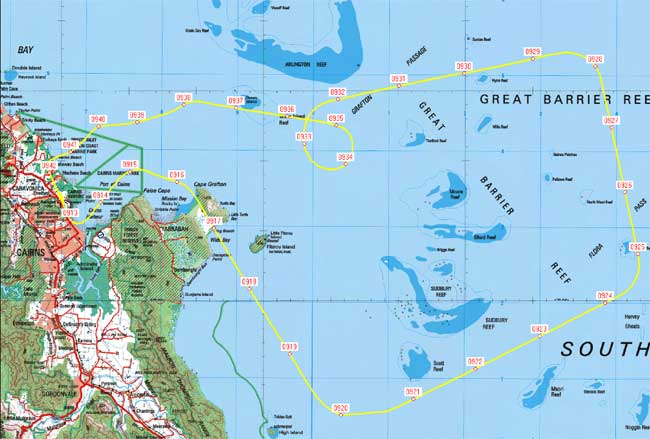
FDR parameters showed that the aircraft was climbed to FL150 and tracked to the east of the airport. During the return to Cairns a descending orbit, below the controlled airspace steps, was conducted to remain visual for a landing on runway 15.
Figure 2: Aircraft track plot
MAP mode is the default display on each pilot's navigation display (ND) and shows the waypoints corresponding to the flight-planned route. If a flight management computer (FMC) failure occurs then 'MAP FAIL' will be displayed on the respective ND.
A Standard Instrument Departure (SID) is a prescribed departure procedure that separates inbound aircraft from outbound aircraft. The SID includes detailed instructions about aircraft manoeuvring after takeoff.
A power cycle occurs when electrical power is removed then re-applied.
Non-volatile memory retains data when power is removed.
ANALYSIS
The FMS performance reported by the crew was consistent with FMC 2 performing a progressive series of resets before it latched. A similar progression of resets then occurred for FMC 1 but, in accordance with its design, it did not latch and was available for use but with the flight plan information cleared. During the resetting process, the FMS response would have been confusing to the crew and consistent with the crew's observation of the 'FMS locking us out'.
With FMC 2 latched, the MENU page would have been displayed on the copilot's multi-function control and display unit (MCDU) but with the FMC 2 prompt missing from the top left data field. The standby navigation/radio (STANDBY NAV/RAD*) prompt would also have been displayed on the MCDU and 'MAP FAIL' displayed on the copilot's navigation display. Once the resetting was completed, then an ILS frequency could be tuned using the STANDBY NAV/RAD page on either the pilot in command's (PIC) or copilot's MCDU.
The PIC was the handling pilot during the flight. Normally the PIC's MCDU will interact with FMC 1 and the copilot's MCDU will interact with FMC 2. With FMC 2 latched, it was necessary for the copilot to change his source select switch to 'FO ON 1' to access FMC 1.
During the investigation the VIA manufacturer advised that no other FMS problems of this nature had been reported.
FINDINGS
During the flight, the amount of generated VIA BITE data exceeded the memory size. As a result, BITE data from the event that initiated the FMS problem was overwritten and lost.
The available BITE data showed that FMC 2 was unable to sequence the '400 ft course to altitude' leg associated with the SWIFT SIX SID. Eventually, FMC 2 performed a software reset but was unable to recover and latched.
A similar progression then occurred for FMC 1 but, in accordance with its design, FMC 1 did not latch and was available for use but with the flight plan information cleared.
SAFETY ACTION
As a result of this occurrence the operator has advised that a Flight Operations Memo will be issued to all 717 pilots highlighting this incident and detailing the FMS modes which remain available during abnormal FMS operation.
Summary
The Boeing 717-200 was taxiing at Cairns Qld for a scheduled service to Brisbane Qld. As part of the preparation for the flight, the crew had entered flight plan details into the aircraft's flight management system (FMS). While taxiing, due to intermittent rain showers at Cairns, the 717 crew then programmed the FMS with wet runway speed figures for take-off.
The crew reported that late in the take-off roll the manually entered wet speeds were lost from the airspeed tape on the primary flight display and FMS-generated speeds were displayed. At rotation 'MAP FAIL' appeared on both navigation displays.
The investigation found that flight management computer (FMC) 2 was unable to sequence the '400 ft course to altitude' leg associated with the SWIFT SIX standard instrument departure. Eventually, FMC 2 performed a software reset but was unable to recover and became unavailable for use by the crew. A similar progression then occurred for FMC 1 but, in accordance with its design, FMC 1 remained available for use but with the flight plan information cleared.
Eventually the crew were able to enter the instrument landing system frequency, but FMS operation did not appear to be reliable. The aircraft was radar vectored for a return to Cairns while maintaining visual meteorological conditions. The crew conducted a visual approach to runway 15 and the aircraft landed 32 minutes after take-off.
On 26 May 2005, the Civil Aviation Safety Authority advised the Australian Transport Safety Bureau (ATSB) that it had previously reviewed the issue of life jackets for water operations and that the requirement to wear life jackets by the occupants of an aeroplane, seaplane or an amphibian that is taking off or landing on water is contained in draft Civil Aviation Safety Regulation (CASR) Part 135. Specifically, the draft of CASR Part 135.825 (6), states that each occupant of a seaplane or amphibian that is taking off from or landing on water must wear a life jacket equipped with a whistle and a survivor locator light.
Operator
The operator has advised the ATSB that since the accident, the pilot had undertaken human factors training with the Civil Aviation Safety Authority, and that it will be implementing a range of safety actions including:
introduction of a wind limitation of 30 kts for commercial operations in the company aircraft landing area (ALA) register
monitoring of the Bureau of Meteorology's radar website by ground staff on days of frontal activity and anticipated windshear conditions
carriage of a portable wind speed meter for actual wind readings to be kept in the aircraft and used where doubt exists as to the wind strength
consideration will be given to lateral effects of loading passengers when conducting weight and balance calculations
requiring all passengers to wear an approved life jacket while on company aircraft
requiring all company pilots to complete Underwater Escape Training.
Significant Factors
Meteorological conditions were conducive to wind shear, mechanical turbulence or a combination thereof.
The pilot took off in a crosswind that exceeded the limitations specified in the Pilots Operating Handbook.
Analysis
The environmental conditions at the time of the accident required the pilot to take particular account of the prevailing sea conditions and the wind direction and speed, when selecting the area for, and direction of, the take-off. This led to the pilot making a compromise that placed emphasis on an area with a more favourable sea state rather than directly into the prevailing wind.
The local effects of the terrain gave the impression to the pilot that the wind at surface level in the area selected for the take-off was from the north-north-east. Therefore, he assessed that that wind direction was suitable for the take-off. However, it is likely that the aircraft encountered a crosswind during the take-off that exceeded the limitations in the Pilots Operating Handbook (POH). It was also likely that wind shear or mechanical turbulence, or a combination of both these effects, was encountered by the pilot shortly after take-off. At the point where the angle of bank of the aircraft exceeded 45 degrees, it is likely that the aircraft stalled causing it to strike the water.
The pilot reported that he was able to exit the aircraft quickly because of his previous underwater escape training. The Australian Transport Safety Bureau encourages all operators in this environment to ensure that their flight crews have completed similar training. The actions of the rear seat passenger were significant in enabling the remaining occupants to exit the aircraft.
The pilot and passengers did not have the time to retrieve their life jackets from under their seats before exiting the aircraft. This was also the case in the floatplane accident in Tasmania in 2001 (BO/200105932). Although the carriage of life jackets and the stowage of them below each of the seats was in accordance with Civil Aviation Order (CAO) 20.11 parts 5.1.4 and 5.1.5, the wearing of life jackets was not required by CAO 20.11 part 5.1.8, and as a consequence, their availability was not assured after the occupants of the floatplane had exited the aircraft into the water.
The lack of time available to retrieve and don life jackets in the event of an accident when operating close to, or on the water, has the potential to adversely affect the survivability of aircraft occupants after they have exited an aircraft. As highlighted in Federal Aviation Administration Advisory Circular (AC) 91-69A, it is extremely difficult for a person to don a life jacket when they are already in the water, and practically impossible to do so if the person is injured.
Summary
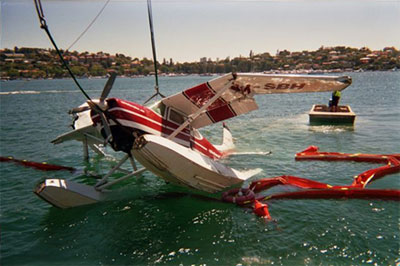
At 1735 eastern summer time on 20 January 2005, a Cessna Aircraft Company A185F floatplane, registered VH-SBH, with one pilot and three passengers on board was taking off on a water departure for a charter flight from Rose Bay aircraft landing area (ALA) to Palm Beach, NSW. Shortly after becoming airborne, the aircraft rolled 45 degrees to the left causing the left wing to strike the water. The aircraft became inverted and was substantially damaged. The four occupants escaped with minor injuries.
The pilot had positioned the floatplane to the eastern side of the ALA, approximately 200 m from the shoreline and to the west of a headland, to achieve more favourable sea conditions for a take-off to the north-north-west. The pilot reported that the wind direction was 010 degrees M at a speed of 20 kts. The intended take-off path ran approximately parallel to the headland in a direction of 350 degrees M.
The pilot reported selecting 20 degrees of flap for the take-off. As the aircraft was about to leave the surface, he selected 30 degrees of flap. This technique was used to help get the aircraft off the surface of the water quickly in difficult sea and/or weather conditions. He also reported that the aircraft took longer than he expected to reach take-off speed. The aircraft became airborne at 45 to 50 kts and he then selected 20 degrees of flap. At approximately 30 ft above the water, the aircraft commenced an uncommanded left roll that he was able to correct with full right aileron input. The aircraft then commenced a second uncommanded left roll that he was unable to correct with control inputs. The pilot, passengers and witnesses, all reported that the aircraft rolled more than 45 degrees to the left before the left wing struck the water.
The floatplane came to rest inverted and shortly after the cabin became submerged. The pilot reported that he had completed Helicopter Underwater Escape Training (HUET) previously, and that he thought that assisted him to exit the cabin quickly through the pilot's door, located on the left of the cabin. The passenger in the copilot's seat, located on the right of the cabin, was momentarily disorientated, but managed to undo his seat belt while the passenger in the middle row was attempting to locate and undo his seatbelt. The rear seat passenger was able to swim towards the front passenger and reported kicking open a door with her foot before pushing the front passenger out of the aircraft. She then returned to the middle row passenger and unfastened his seat belt buckle before pushing him out of the aircraft and then exiting the submerged cabin herself. One passenger reported that he was initially disoriented after the aircraft entered the water. In addition, given the rapid nature of the event and the need to exit the inverted cabin quickly, the passengers did not retrieve the life jackets which were stowed underneath their seats. It was likely that all passengers exited the floatplane via the pilot's door, because the co-pilot's door was still locked closed when the aircraft was recovered.
The floatplane stayed inverted with its floats remaining buoyant. After exiting the aircraft, the passengers were picked up by a passing boat. The pilot remained with the aircraft and secured it to a boat.
The load chart for the flight showed that the aircraft was within weight and balance limitations. The pilot was appropriately licensed and endorsed for the operation and was experienced in floatplane operations in Sydney Harbour. The aircraft was capable of normal operations before flight and there were no known maintenance issues.
A Bureau of Meteorology (BoM) report of the weather in Sydney Harbour at the time of the accident, showed that the prevailing wind around the time of the accident was from the north-east, averaging 26 to 29 kts, with gusts reaching 37 kts. The report also suggested that:
…in considering the wind shear that would have been experienced by a plane taking off from Rose Bay, the sheltering effect of the surrounding topography, especially the shielding of Rose Bay from north easterlies by the southern headland of Sydney Harbour, needs to be taken into account. It is conceivable that in passing from the relatively sheltered inshore waters of Rose Bay to a more exposed location, either through ascent or forward motion or both, that significant wind shear may have been experienced.
The pilot advised that he used a number of cues to determine the wind velocity, particularly the orientation of moored boats and flags, the BoM forecast and the water conditions.
Mountain waves and their turbulence can occur downwind of any obstacle, including an isolated hill a few hundred feet high. If the wind at the altitude of the top of the obstacle is 20 kts or more, there will be noticeable wave turbulence and significant downdrafts. This turbulence will be greatest in the rotor zone in the lee of the obstacle and will be at a maximum at about the same altitude as the top of the obstacle.1
The company ALA register notation for Rose Bay warned that 'Dumping will be encountered in winds over 20 kts from the North-East, South and West'. The significant downdrafts described in the previous paragraph are what the operator's ALA register referred to as 'dumping'.
A fact sheet on mountain wave turbulence that accompanied Australian Transport Safety Bureau (ATSB) report BO/200104092 into an accident involving mechanical turbulence stated in part that:
In addition to generating turbulence that has demonstrated sufficient ferocity to significantly damage aircraft or lead to loss of control, the more prevailing danger to aircraft in the lower levels in Australia seems to be the effect on an aircraft's climb rate. General Aviation aircraft rarely have the performance capability sufficient to enable the pilot to overcome the effects of a severe downdraft generated by a mountain wave, or the turbulence or the windshear2 generated by the rotor.
The Pilots Operating Handbook (POH) for the Cessna 185 indicated that the stalling speed in a 20 degree flap configuration, at a mid-range centre of gravity, was 55 kts. The POH also indicated a maximum demonstrated crosswind velocity for take-off and landing of 13 kts. The investigation determined that the crosswind for the accident flight would have been between 19 and 24 kts.
In December 2001, the ATSB investigated an accident involving a floatplane in Tasmania where the occupants had insufficient time to don life jackets before exiting the aircraft (see ATSB report BO/200105932). That accident investigation highlighted that regulations governing the use of life jackets, do not reflect the operational realities of exiting from an inverted submerged cabin.
Civil Aviation Order (CAO) 20.11 part 5.1.4 stated that:
Amphibious aircraft when operating on water, helicopters equipped with fixed flotation equipment when operating on water, and all seaplanes and flying boats on all flights shall be equipped with: (a) 1 life jacket for each occupant; and (b) an additional number of life jackets (equal to at least one-fifth of the total number of occupants) in a readily accessible position near the exits.
CAO 20.11part 5.1.4 stated that:
Life jackets shall be so stowed in the aircraft that 1 life jacket is readily accessible to each occupant and, in the case of passengers, within easy reach of their seats.
CAO 20.11 part 5.1.8 stated that:
Where life jackets are required to be carried in accordance with paragraph 5.1.4 each occupant of a single engine aircraft shall wear a life jacket during flight over water when the aircraft is operated beyond gliding distance from land or water, as appropriate, suitable for an emergency landing. However, occupants need not wear life jackets when the aircraft is taking off or landing at an aerodrome in accordance with a normal navigational procedure for departing from or arriving at that aerodrome, and occupants of aeroplanes need not wear life jackets during flight above 2 000 feet above the water.
Federal Aviation Administration Advisory Circular (AC) 91-69A contained recommendations and revised information for the safe operation of seaplanes. The AC stated that:
Life jackets in sealed pouches can be awkward to remove and don in a flooded aircraft. When a survivor attempts to put on a jacket in the water, it may be difficult to find and fasten its straps and hooks. It would take considerable effort to accomplish the combined maneuver [sic] of pulling a lifejacket over one's head while in the water trying to stay afloat. If a life preserver is not worn before flight, it is practically impossible for a survivor with an injured arm, for example, to don the life preserver in time for it to be effective for survival. Wearing an uninflated TSO C13f life preserver at all times in the seaplane and inflating it only after exiting the seaplane would seem to be the best protection.
Furthermore, the AC stated that after a seaplane accident:
and especially while submerged inverted in water, the passengers are likely to become disoriented and panic.
It also stated that:
Maneuvring [sic] while holding flotation devices can also be disorienting because it occupies the hands, making swimming or treading water difficult.
Additionally the AC stated in Section 1.b. (1)
For-hire operators must use FAA-approved PFD's. A PFD should be worn by each occupant while on the seaplane.
1. Modern Airmanship, Eighth Edition, Van Nostrand Reinhold Company, New York, 1999.
2. A change of wind velocity with distance along an axis at right angles to wind direction, specified vertically or horizontally. Recognised as an extremely dangerous phenomenon because encountered chiefly at low altitude (in squall or local frontal systems) in approach configuration at speed where it makes sudden and potentially disastrous difference to airspeed and thus lift.
As a result of this occurrence, the aircraft operator obtained a revised engineering order specifying that the main cabin door open warning system be deactivated. The modified system now provides the pilot with a warning should the nose locker door not be secured.
The aircraft operator also incorporated the required supplement, approving main door open or main door off operations, into the Aircraft Flight Manual.
Analysis
The pilot had experienced difficulty with securing the locker door on previous occasions as it could not be placed into a position that was flush with the fuselage. This created a potential for air flowing under the nose locker door to open it. Damage to the recovered components was not consistent with failure of the lock mechanism; however, failure of the other lock may not be discounted. Given the difficulty in securing the nose locker door, it is likely that it had not been properly secured prior to the occurrence flight.
The main cabin door/locker door warning annunciator was continuously illuminated and was therefore no longer effective as a warning. Consequently, the operational safety intent of the original door warning system design had been negated by the engineering for the modified door.
Factual Information
On 21 January 2005 at about 0830 Eastern Daylight-saving Time, a de Havilland Canada DHC6-200 Twin Otter aircraft, registered VH-JEA, was engaged in commercial skydiving operations at Wilton, NSW, with one pilot and 12 parachutists on board.
The pilot reported that while approaching the drop zone at flight level (FL) 140, he heard a loud noise and noticed the nose locker door detach from the front left side of the aircraft. The door passed in front of the right windscreen before contacting the right propeller. Windows on the right side of the aircraft cabin were broken by debris. The parachutists exited the aircraft and the pilot diverted to Bankstown Airport.
Although the engine indications appeared normal, the pilot suspected that the right engine had developed a vibration. He broadcast a PAN1 and shut down the engine as a precaution. Following the activation of local standby services at Bankstown, a single engine approach and landing was completed. There were no injuries.
An engineering examination found that damage to the aircraft was consistent with the pilots report. One of the two latches from the nose locker door was found inside the cabin. Damage to fibreglass material attached to the latch was consistent with the door having been torn by aerodynamic forces. The remainder of the nose locker door was not recovered. Examination of the latch and fibreglass material found no indication of a pre-existing defect.
On previous occasions the pilot had experienced some difficulty securing the door as it did not sit flush with the fuselage when in the locked position. He stated that because of this, he was careful about checking the aircraft nose locker door and believed, but could not be certain, that he had checked its security immediately prior to the flight.
During the flight, the main cabin door/locker door warning was continuously illuminated on the aircraft caution annunciator panel. The pilot disregarded the warning as it had been illuminated during previous flights when all doors and lockers had been closed and locked.
To facilitate parachute dropping operations, the main cabin door had been modified and replaced with a roller shutter door installation. The installation engineering order had been prepared by an organisation which held a Civil Aviation Safety Authority (CASA) instrument of approval under Civil Aviation Regulations (CAR) 1988 Regulation 35 (2). The instrument enabled the organisation to approve design modifications or repairs. The engineering order stated:
This roller shutter door modification itself does not require a Flight Manual Supplement. There must however be present in the Flight Manual a section or Supplement approving door off/open operations.
The engineering order did not contain detail as to how the door warning system should be modified following the roller door installation. The installation was undertaken in accordance with the engineering order, with the result that the associated cabin door/locker door warning annunciator was continuously illuminated.
The Flight Manual section or supplement PSM 1-62-1A, approving main door open or main door off operations, could not be located.
The aircraft operations in support of skydiving activities, although an essential element of the commercial enterprise, were conducted as private operations. Consequently, the operator was not required to maintain any flight operations or flight standards manuals beyond that provided in the Twin Otter Aircraft Flight Manual. It was required to comply with the procedures and requirements of the Australian Parachute Federation and CASA as specified in a Deed of Agreement between the two organisations.
1 Urgency message follows (international signal)
Summary
On 21 January 2005 at about 0830 Eastern Daylight-saving Time, a de Havilland Canada DHC6-200 Twin Otter aircraft, registered VH-JEA, was engaged in commercial skydiving operations at Wilton, NSW, with one pilot and 12 parachutists on board.
Occurrence summary
Investigation number
200500222
Occurrence date
21/01/2005
Location
Wilton, (ALA)
State
New South Wales
Report release date
26/10/2005
Report status
Final
Investigation type
Occurrence Investigation
Investigation status
Completed
Mode of transport
Aviation
Aviation occurrence category
Objects falling from aircraft
Occurrence class
Incident
Highest injury level
None
Aircraft details
Manufacturer
De Havilland Canada/De Havilland Aircraft of Canada
Following this incident, the maintenance organisation issued a Technical Memorandum regarding the overhaul of Super King Air landing gear actuators. That memorandum referred to the requirement during component assembly, to carefully read and understand the instructions contained in the aircraft maintenance manual.
The maintenance organisation also submitted a request to the aircraft manufacturer to include additional warnings in the maintenance manual to emphasise further the need for the correct reassembly of the landing gear actuators.
Analysis
The left main landing gear actuator's thrust bearing was very likely incorrectly reinstalled during the recent maintenance of that component. As a result, increased torque was required to rotate the screw jack actuator in order to retract the landing gear. That increased torque most probably tripped the landing gear electric motor's 60 amp circuit breaker during the flight immediately prior to the accident flight. However, in that instance, the pilot was able to manually extend the landing gear.
The torque applied to the screw jack actuator during the functional test before the accident flight was probably below that necessary to trip the 60 amp circuit breaker. In addition, that maintenance action failed to identify the incorrectly installed thrust bearing, and underlying increased torque required to rotate the actuator. When the pilot attempted to retract the landing gear during the accident flight, the increased torque resulting from the incorrectly installed thrust bearing, together with air loads would have combined to overload the systems. The result was that the landing gear electric motor's circuit breaker tripped, and the pilot was unable to either electrically or manually extend the landing gear.
The puncture of the aircraft's fuel tank increased the risk of a post-impact fire, or of another fuel-related hazard during the landing and subsequent emergency disembarkation. Despite the lack of a declaration of a Local Standby condition, the action by the Rescue and Fire Fighting services to board their vehicles facilitated a rapid emergency response.
At about 1512 Western Standard Time on 18 January 2005, a Beech Aircraft Corp B200 (Super King Air) aircraft, registered VH-SGT, sustained damage when its main landing gear collapsed during touchdown on runway 24 at Perth Airport, WA.
The aircraft had earlier departed the aerodrome on a charter flight with one pilot and seven passengers on board. Shortly after take-off, the pilot selected the landing gear up and subsequently observed that the red 'gear-in-transit' warning light remained illuminated. An aerodrome controller noticed that the aircraft's landing gear did not retract and passed that information to the departures controller. The departures controller cleared the pilot to climb to 4,000 ft and provided radar vectors to a suitable area where the pilot could complete troubleshooting of the aircraft systems.
The pilot completed the checklist actions contained in the Aircraft Flight Manual in an attempt to manually extend the landing gear. That included pumping the manual extension lever to its maximum resistance. However, the green 'gear down' indicator lights did not illuminate2 (Figure 1).
Figure 1: Landing gear selector and landing gear indicator lights
The pilot returned to Perth Airport and conducted a flypast of the aerodrome control tower and maintenance facility at an altitude of about 500 ft. Engineer and air traffic control witnesses to that flypast indicated to the pilot that the landing gear appeared to be in the extended position.
During the subsequent landing, the right main landing gear collapsed and retracted into the wheel well. The left main landing gear partially retracted into the wheel well and the nose gear remained extended (Figure 2). The right engine nacelle fuel tank was punctured, requiring removal of the remaining fuel in that tank prior to the aircraft's removal from the runway.
Figure 2: Aircraft on the runway after landing
Abrasive damage was sustained to the rear right side of the lower aircraft fuselage skin and structure, the right-wing flap and gear doors and rear fairing of the right engine nacelle. The extended nose landing gear and partially extended left main landing gear prevented significant damage to other parts of the aircraft's structure. There was no post-impact fire.
Aircraft information
An approved maintenance organisation carried out end play checks on the left and right main landing gear screw jack actuators during routine maintenance on 7 January 2005. Following those checks, each actuator was disassembled for lubrication, reassembled and refitted to the aircraft. That required the removal and reinstallation of each actuator's thrust bearing. The aircraft maintenance manual included a requirement to recheck the actuators' end play following their reassembly, to verify the correct installation of the thrust bearings.
The aircraft was released from maintenance on 11 January 2005 and completed six flights without incident between 11 and 13 January. On the seventh flight following that maintenance, the landing gear failed to retract normally. In that instance, the pilot manually extended the landing gear and landed without incident. Maintenance troubleshooting following that flight revealed that the 60 amp circuit breaker for the landing gear's electric motor had tripped3. The aircraft's maintenance records indicated that the circuit breaker was reset, and the landing gear was re-rigged and functionally tested. The system was certified as being serviceable and the aircraft was returned to service. During the subsequent flight, flown by the same pilot, the landing gear collapsed.
The aircraft operator examined the aircraft's landing gear system following the accident. The examination identified that the landing gear electric motor's 60 amp circuit breaker had again tripped. In addition, disassembly of the screw jack actuator for the left main landing gear revealed:
That damage significantly increased the torque required to rotate the actuator during either electrical or manual extension of the landing gear.
A component overhaul facility bench tested another screw jack actuator with a similarly incorrectly installed thrust bearing under the supervision of an airworthiness inspector from the Civil Aviation Safety Authority. That actuator displayed abnormal squealing and grinding noises during operation, and an increased amount of torque was required to rotate the screw jack. The test report indicated that the increased operating loads had unseated the incorrectly installed thrust bearing, which allowed the transfer of the load normally carried by the thrust bearing to the pinion gears, causing binding and abnormal operating noise.
Survival information
Either a pilot in command or the responsible Air Traffic Services (ATS) personnel can declare a Local Standby condition in response to a problem, or potential problem affecting the operation of an aircraft. The effect of such a declaration is to activate an airport's Rescue and Fire Fighting (RFF) services and other relevant agencies in accordance with the airport's Aerodrome Emergency Plan.
In this occurrence, neither the pilot in command nor ATS personnel declared a Local Standby condition. However, because the pilot was returning for an unplanned landing, and had requested a visual check of the landing gear, the aerodrome controller advised the RFF personnel of the developing situation. The RFF personnel responded by boarding their vehicles in preparation for a possible emergency response.
Only those investigation areas identified by the headings and subheadings were considered to be relevant to the circumstances of the occurrence.
The illumination of those lights would have confirmed the successful extension of the landing gear.
During normal operations, the landing gear's electric motor provided the torque to rotate the landing gears' screw jack actuators to extend the aircraft's landing gear.
It is essential to correctly install the thrust bearing to ensure that the bearing resists axial loads along the actuator's shaft. The bearing is appropriately marked to assist with correct installation.
Summary
At about 1512 Western Standard Time on 18 January 2005, a Beech Aircraft Corp B200 (Super King Air) aircraft, registered VH-SGT, sustained damage when its main landing gear collapsed on touch down on runway 24 at Perth Airport, WA. The aircraft had earlier departed the aerodrome on a charter flight with one pilot and seven passengers on board.
The pilot had elected to return to the aerodrome after detecting a problem during the retraction of the aircraft's landing gear. He attempted to manually extend the landing gear but was unable to confirm that the landing gear had locked in position for the subsequent precautionary landing. The main landing gear collapsed as the aircraft touched down.
In the absence of the declaration of a Local Standby condition by either the pilot in command or the Air Traffic (ATS) services personnel, the on-airport Rescue and Fire Fighting services (RFF) were not placed in that condition of readiness for the landing. However, on receiving advice from ATS of the circumstances of the aircraft's return for landing, the RFF services personnel boarded their vehicles in preparation for a possible emergency response.
Examination of the aircraft landing gear by the aircraft operator revealed an incorrectly installed thrust bearing in the hydraulic actuator for the left main landing gear. The result was that the axial loads normally carried by the thrust bearing were transferred to the actuator's pinion gears which fractured under abnormal operational loads. That damage seized the actuator and prevented the manual extension of the aircraft's landing gear by the pilot.
The Australian Transport Safety Bureau did not conduct an on-scene investigation of this occurrence. The report presented below was prepared principally from information supplied to the Bureau.
REPORTED INFORMATION
On 15 January 2005, at about 0915 eastern summer time, an Airbus A320 aircraft, registered ZK-OJA, with a crew of six and 135 passengers, departed Christchurch, New Zealand on a scheduled passenger service to Melbourne, Victoria.
During descent, the flight crew noticed a strong, sweet, solvent smell. They immediately advised the purser who reported that there was a strong smell in the forward cabin similar to that being experienced on the flight deck. No abnormal smells were evident in the main cabin, but there was a strong smell in the rear cabin similar to that in the forward cabin. A crew member in the rear cabin reported feeling unwell and nauseous. The flight crew donned oxygen masks and broadcast a Pan-Pan transmission1 to air traffic control.
The flight was completed without further incident.
The aircraft was returned to service following an engineering examination that found no environmental, mechanical or operational factors that could have influenced the circumstances of the occurrence.
1A Pan-Pan transmission is made in the case of an urgency condition which concerns the safety of an aircraft or its occupants but where the flight crew does not require immediate assistance.
At a conference of regional tower managers held in February 2005, Airservices Australia's Airport Services undertook, among other initiatives, to develop a check and standardisation regime across regional tower units to help ensure that controllers' understanding of the application of separation standards does not vary between towers. In its report on standardisation issues of 19 May 2005, produced as a result of that conference, Airport Services identified the potential for variations in the interpretation and application of visual separation. The report suggested that the wording in the Manual of Air Traffic Services 'be amended to reinforce the need for other approved separation to be assured before and after the application of visual separation'.
Analysis
ANALYSIS
The investigation concluded that there was no infringement of separation standards, because the Albury aerodrome controller reported that he maintained a visual separation standard, in accordance with the Manual of Air Traffic Services (MATS), between the Saab and the Dash 8, until the Hume controller advised that he had 'just over 7 miles' between the two aircraft.
The Albury aerodrome controller did not establish a step-climb procedure between the two aircraft in accordance with the terms of the clearance as coordinated with the Hume controller. The aerodrome controller should have advised the Hume sector controller that he was unable to comply with the terms of that clearance. Both controllers could then have coordinated another mutually acceptable clearance before the aerodrome controller transferred control of the aircraft to the Hume controller. The establishment of a step-climb procedure would have ensured that a procedural separation standard continued to exist between the aircraft until such time as the Hume controller established a radar separation standard and accepted responsibility for the aircraft.
The Albury aerodrome controller was required to establish a procedural separation standard between the two aircraft and to have that standard in place before transferring the responsibility for separation to the Hume controller.
The aerodrome controller's use of visual separation technically complied with the separation provisions stated in the MATS for Albury tower procedural separation purposes. However, use of that procedure did not meet the Hume controller's requirements for procedural separation and would not have ensured that separation continued to exist in the event that the aerodrome controller lost sight of one or both of the aircraft. Furthermore, it did not demonstrate 'the proactive application of separation standards to avoid rather than resolve conflicts' as stated in the MATS.
The ability of a sector controller to apply a separation standard using radar may be influenced by factors such as the sector controller's workload, or a failure of an aircraft's transponder, for example. Therefore, aerodrome controllers cannot anticipate when a sector controller may be able to establish a radar separation standard. In the event that the sector controller could not establish a radar standard, the application of an appropriate procedural separation standard that could be used by both controllers would have ensured that separation continued to exist. Such a procedure would have complied with the separation assurance provisions of the MATS.
Technical adherence to the provisions of one separation standard may not guarantee that separation will continue to exist. In this circumstance, the aerodrome controller relied on being able to continue to apply an interpretation of visual separation between the two aircraft until he anticipated that the sector controller could separate the aircraft using radar. While only one separation standard needs to be applied for separation to exist, contingencies such as controller workload and other traffic might preclude the application of another form of separation before the minima of that one standard are infringed. The application of the tactical separation assurance provisions specified in the MATS should assist controllers to anticipate such contingencies and, in doing so, help avoid, rather than resolve, conflicts.
Factual Information
FACTUAL INFORMATION
On 17 January 2005, at 0633 Eastern Daylight-saving Time, a Saab Aircraft Company AB SF-340B (Saab) departed Albury Airport on a scheduled passenger service to Sydney, NSW. The aircraft was being operated under the instrument flight rules (IFR). The crew had been authorised by the Albury Tower aerodrome controller to track via Yass on the 043 degree radial from the Albury very high frequency omni-directional radio range (VOR) navigation aid and to climb to flight level (FL) 170. At 0636, a de Havilland Canada DHC-8-102 (Dash 8) aircraft departed Albury Airport on a scheduled passenger service to Sydney, also under the IFR. The crew of the Dash 8 were issued with a clearance by the aerodrome controller to track via the 055 degree radial from the Albury VOR and to climb to FL200.
The Albury aerodrome controller was required to apply non-radar, or procedural, control, in accordance with published procedures, to aircraft operating within the Albury control zone (CTR) and control area (CTA) up to 8,000 ft. Procedural control is achieved by the use of information from sources other than radar. The aerodrome controller later reported that he established a difference of 12 degrees between the tracks of the two aircraft to facilitate the application of a visual separation standard. Visual separation at Albury was achieved by the use of information from sources other than radar. According to the Manual of Air Traffic Services (MATS) 4.5.2.2 (effective 10 Jun 2004):
Aerodrome controllers may also separate by the use of visual observation of aircraft position and projected flight paths.
The airspace above the Albury CTR and CTA was the responsibility of the Hume sector controller (Hume controller) operating in the Melbourne Air Traffic Control Centre. The Hume controller was required to provide a procedural air traffic control (ATC) service to aircraft operating within the Hume sector until that controller could establish a radar separation standard. The minimum horizontal radar separation standard applicable in the Hume sector was 5 NM.
To ensure that a procedural separation standard was maintained between the aircraft in the Hume sector, the Hume controller instructed the Albury aerodrome controller to establish the two aircraft in a step-climb procedure. MATS 4.3.1.8 stated that:
A step climb procedure may be used to simultaneously climb aircraft to vertically separated levels provided that the lower aircraft is progressively assigned levels which provide vertical separation with the higher aircraft.
The Albury aerodrome controller later reported that a step-climb was not practical, because there was insufficient vertical spacing between the two aircraft when he requested altitude reports from the crews. The Albury aerodrome controller did not notify the Hume controller that he was unable to implement the step-climb procedure or that he would provide visual separation until a radar standard was established.
MATS 4.1.1.4 stated that:
Tactical Separation Assurance places greater emphasis on traffic planning and conflict avoidance rather than conflict resolution. This is achieved through:
a. the proactive application of separation standards to avoid rather than resolve conflicts;
b. planning traffic to guarantee rather than achieve separation;
c. executing the plan so as to guarantee separation; and
d. monitoring the situation to ensure that plan and execution are effective.
Summary
On 17 January 2005, at 0633 Eastern Daylight-saving Time, a Saab Aircraft Company AB SF-340B (Saab) departed Albury Airport on a scheduled passenger service to Sydney, NSW. The aircraft was being operated under the instrument flight rules (IFR). The crew had been authorised by the Albury Tower aerodrome controller to track via Yass on the 043 degree radial from the Albury very high frequency omni-directional radio range (VOR) navigation aid and to climb to flight level (FL) 170. At 0636, a de Havilland Canada DHC-8-102 (Dash 8) aircraft departed Albury Airport on a scheduled passenger service to Sydney, also under the IFR. The crew of the Dash 8 were issued with a clearance by the aerodrome controller to track via the 055 degree radial from the Albury VOR and to climb to FL200.
Aviation Safety Recommendations
| Air Safety Recommendation R20050010 | Air Safety Recommendation R20050011
Occurrence summary
Investigation number
200500145
Occurrence date
18/01/2005
Location
Albury, VOR
State
New South Wales
Report release date
13/02/2006
Report status
Final
Investigation type
Occurrence Investigation
Investigation status
Completed
Mode of transport
Aviation
Aviation occurrence category
Breakdown of co-ordination
Occurrence class
Incident
Highest injury level
None
Aircraft details
Manufacturer
Saab Aircraft Co.
Model
340
Registration
VH-OLM
Serial number
205
Sector
Turboprop
Operation type
Air Transport Low Capacity
Departure point
Albury, NSW
Destination
Sydney, NSW
Damage
Nil
Aircraft details
Manufacturer
De Havilland Canada/De Havilland Aircraft of Canada