At approximately 4pm local time on 2 April 2005, Sea King helicopter N16-100 (callsign 'Shark 02'), crashed on the Indonesian island of Nias while on a humanitarian support mission.
Nine Australian Defence Force personnel were fatally injured in the accident. An investigation was conducted by the Department of Defence Aircraft Accident Investigation Team (AAIT) and a Board of Inquiry was appointed on 28 April 2005.
The Sea King helicopter was equipped with a deploy-able Beacon Airfoil Unit that recorded four channels of information:
Pilot audio
Co-pilot audio
Cockpit area microphone audio
Rotor speed encoder data
The AAIT requested assistance from the Australian Transport Safety Bureau (ATSB) in the analysis of the audio recovered from the BAU. In accordance with the Transport Safety Investigation Act 2003, the Executive Director of the ATSB approved the request.
A compact disk containing the recovered audio (Department of Defence Evidence Register Item No. 031) was delivered to the ATSB on 21 April 2005.
The audio was replayed and analysed in the ATSB's audio laboratory by a flight recorder specialist. Verbal advice was provided to the AAIT. Audio analysis was also performed separately by the Defence Science and Technology Organisation (DSTO). The AAIT did not request a written report from the ATSB as DSTO would be providing a report.
The report presented below was prepared principally from information supplied to the Bureau.
REPORTED INFORMATION
On 10 May 2005 at 0927 central standard time, the pilot of a Piper Aircraft Corporation PA-31-350 aircraft, registered VH-MZV, being operated on a charter flight from Snake Point, NT, landed short of the displaced threshold on runway 11 at Darwin International Airport.
Flight crews were notified of the displaced threshold in a notice to airmen (NOTAM) and on the Darwin automatic terminal information service (ATIS). The threshold was displaced 723 metres and indicated by bar V-markers and lights. The unusable section of runway was marked with three white crosses and red and white cones. The displaced threshold and markings were in accordance with Civil Aviation Safety Authority, Manual of Operating Standards Part 139- Aerodromes- Section 8.3.9.
The pilot reported that his turn onto final approach was lower than usual, as he was requested by air traffic control to conduct a close left base. The pilot did not see the white crosses and reported that the morning sun may have prevented him from seeing the displaced threshold markers.
The pilots landing clearance included advice that the threshold was displaced. The pilot was aware of an aircraft at the holding point and another conducting an instrument approach. The pilot decided to land using a short field landing procedure to facilitate the departure and arrival of the other aircraft, but this was not requested by the aerodrome controller (ADC). The pilots focus upon vacating the runway as soon as possible distracted him from landing beyond the displaced threshold.
After landing, he reported seeing the red and white cones ahead of the aircraft and was notified by the ADC that he had landed short of the displaced threshold.
On 7 May 2005, a Fairchild Aircraft Inc. SA227-DC Metro 23 aircraft, registered VH-TFU, with two pilots and 13 passengers, was being operated by Transair on an instrument flight rules regular public transport service from Bamaga to Cairns, with an intermediate stop at Lockhart River, Queensland. At 1143:39 Eastern Standard Time, the aircraft impacted terrain in the Iron Range National Park on the north-western slope of South Pap, a heavily timbered ridge, approximately 11 km north-west of the Lockhart River aerodrome. At the time of the accident, the crew was conducting an area navigation global navigation satellite system (RNAV (GNSS)) non-precision approach to runway 12. The aircraft was destroyed by the impact forces and an intense, fuel-fed, post-impact fire. There were no survivors.
The accident was almost certainly the result of controlled flight into terrain, that is, an airworthy aircraft under the control of the flight crew was flown unintentionally into terrain, probably with no prior awareness by the crew of the aircraft's proximity to terrain. The investigation report identifies a range of contributing and other safety factors relating to the crew of the aircraft, Transair's processes, regulatory oversight of Transair by the Civil Aviation Safety Authority, and RNAV (GNSS) approach design and chart presentation. It also details safety action taken by various agencies to address the identified safety issues, and includes safety recommendations relating to those safety issues that had not been addressed by relevant agencies at the time of publication of this report.
On 7 June 2004, the Australian Transport Safety Bureau (ATSB) issued the following recommendation to Airservices Australia:
R20040063
The Australian Transport Safety Bureau recommends that Airservices Australia review the Manual of Air Traffic Services (MATS) amendment decision that removed the mandatory requirement to provide traffic information to aerodrome traffic.
On 23 July 2004, the ATSB received the following response from Airservices Australia:
This is agreed. A MATS amendment process has been initiated regarding the mandatory requirement to provide traffic information to aerodrome traffic. The current instruction is in contravention of the CASR Part 172 Manual of Standards (MOS) and is being rectified. This difference between the MATS and the Part 172 MOS was due to the MATS being amended and updated between the development and the implementation of the MOS.
The ATSB accepted the response and the recommendation remained on 'MONITOR' awaiting incorporation of the MATS amendment.
On 1 September 2005, Airservices Australia amended the MATS to completely remove the previously amended section 4.5.2.3 relating to the provision of aerodrome traffic information.
On 16 September 2005, the Civil Aviation Safety Regulation Part 172 Manual of Standards was amended, after agreement between CASA and Airservices Australia, to state:
When aircraft are operating visually as aerodrome traffic ATC must issue 1 or more of the following:
(a) clearances designed to maintain separation
(b) sequencing instructions
(c) relevant traffic information
On 15 September 2006, the ATSB classified the issue as 'CLOSED - NOT ACCEPTED'.
New recommendation
As a result of this, and other, investigations the Australian Transport Safety Bureau
considers that pilot situational awareness can be limited by controller actions and issues the following safety recommendation:
R20060018
The Australian Transport Safety Bureau recommends that Airservices Australia review guidance material and training for aerodrome controllers relating to the provision of relevant traffic information, to enhance pilot situational awareness.
Airservices Australia
Airservices Australia has advised that all mandated regional tower refresher training relating to Hobart tower, including a separation assurance module, has now been completed.
Airservices Australia has advised that they are addressing the issue of obtaining read-backs, when necessary, through controller education. The following article was published to all Airservices Australia tower staff in the February 2006 issue of 'Safety Talk' magazine.
Did the Pilot Really Understand?
A number of incidents have occurred in the circuit area when pilots have used a callsign to acknowledge an ATC instruction and then operated contrary to the instruction. eg.
An aircraft turned base after being instructed to maintain downwind or
An aircraft made a left circuit after being instructed to make a right circuit.
In both of the incidents above the pilot acknowledged the controllers instructions with only a callsign.
Read back requirements are clearly specified in MATS 6.1.13.1 (a-g). But have you really read the fine print?
The first sentence of paragraph 6.1.13.1 requires ATSO [air traffic services officers] to ensure that a correct read back of ATC clearances, instructions and information 'in sufficient detail' is obtained. The second sentence then prescribes the read back requirements for some very specific ATC voice transmission types such as route clearances, hold short instructions, assigned runway, direction of turn etc.
You are now probably wondering what 'read back in sufficient detail' means in relation to those instructions you give that are not covered by the seven types. A good rule of thumb is the more critical the clearance, instruction or information that is provided to the pilot then the more detailed should be the read back.
In the original incidents if instead of only a callsign, the pilot responses have been 'ABC Roger maintain downwind' or 'ABC right circuit' then there would have been an increased possibility that the pilot actually understood what the controller really intended. Remember; if you do not get a read back that confirms the required action, then ask for one 'ABC Confirm……'. It may be too late when you next see what the pilot has actually done.
Airservices Australia has advised that as a follow-up to this article they have developed a roving check and standardisation programme for regional towers. As part of the programme, check and standardisation officers place emphasis on the use of correct phraseology and read-back.
Instructor pilot
The instructor advised that he has adjusted his aviation and non-aviation work commitments to ensure that he is adequately rested prior to undertaking flying operations.
Analysis
Although there was no applicable minimum distance standard specified for visual separation, the controller was unable to maintain continuous visual separation between the 152 and the 717. The decision by the pilot of the 152 to turn directly onto the base leg of the circuit, and not continue on the downwind leg as instructed, contributed to the infringement of separation standards.
This analysis examines the development of the occurrence and highlights the safety issues that became evident as a result of the investigation.
The controller did not provide the pilots of the 152 or the crew of the 717 with traffic information, or a number in the landing sequence as required by the Manual of Air Traffic Services (MATS). The provision of traffic information was not mandatory and the MATS did not provide any guidance to controllers on the circumstances under which the provision of traffic information would be appropriate. While the controller had intended to provide this information to the pilot of the 152, he relied on a pilot report prior to turning base as a prompt, and this report was not received.
Without the timely provision of traffic or sequence information, the situational awareness of the pilots of both aircraft was reduced. They were effectively excluded from participating in the separation process as described in the Aeronautical Information Publication (AIP) and the MATS. Consequently, the pilots of the 152 were not aware of the broader consequences of their actions once they turned their aircraft onto the base leg. They simply did not recognise that a potential conflict between their aircraft and the 717 existed.
While the flight crew of the 717 was not provided with directed information by the controller, they had been monitoring the radio transmissions between the controller and the pilots of other aircraft in the area. That, together with active scanning of the circuit area for traffic using the traffic alert and collision avoidance system and visual observations, assisted in the resolution of the situation.
The MATS provided no guidance as to whether routinely issued sequencing and separation instructions, such as 'continue downwind', required a read-back. While it may be impractical for the controller to obtain a read-back for every circuit instruction, emphasis should be placed on obtaining a read-back of safety critical instructions. Had the controller requested a read-back of the instruction to continue downwind, and provided a reason for the action, the likelihood of any misunderstanding would have been significantly reduced.
The investigation could not establish whether any aspect of the occurrence sequence could be attributed to the effects of fatigue. However, due to the instructor's non-aviation working commitments, the possibility that fatigue contributed to the occurrence could not be discounted.
Factual Information
On 30 April 2005, at about 1033 Eastern Standard Time1, a Cessna Aircraft Company A152 (152) aircraft, registered VH-PVX, was being operated on circuit flying training at Hobart Airport, Tasmania. On board were a student pilot and an instructor. The pilot had been issued with a clearance by the aerodrome controller (controller) to conduct right circuits from runway 30 and to operate not above 1,000 ft above mean sea level.
At 1037, a Boeing Company 717-200 (717) aircraft registered VH-LAX, en route from Melbourne to Hobart, commenced the final leg of the Hobart runway 30 VOR2 instrument approach. The crew had been issued a clearance by the controller to conduct the final approach. The aircraft was being operated under the instrument flight rules. At about the same time, the controller instructed the pilot of the 152 to make a left orbit to enable the controller to visually separate the 152 with both the inbound 717 and another jet aircraft departing from runway 30. At that time the 152 was at the end of the downwind leg of the circuit.
At about 1039, the pilot of the 152 reported that the orbit was complete and the controller instructed the pilot to continue on the downwind leg and to report prior to turning on to the base leg. However, the pilot had not completed a full orbit but had 'rolled out' of the orbit after completing only a 270 degree turn, directly onto the base leg of the circuit. At that time the 717 was on the final approach leg of the circuit, 90 degrees to the left of the flight path of the 152 and converging.
At about 1041, when the pilots of both aircraft became aware of the potential conflict, the minimum horizontal distance between the two aircraft had reduced to between 400 and 500 m. The 717 was about 300 ft below the 152, and the pilots of both aircraft commenced avoiding action.
The Manual of Air Traffic Services (MATS) 4.5.1.1 stated that visual separation shall be achieved by the use of visual procedures, or by assigning visual separation responsibility to a pilot. The MATS did not specify any minimum distance requirement for the application of visual separation. As the controller was unable to continue to visually observe separation between the 152 and the 717, and had not assigned separation responsibility to the pilot of the 152, there was an infringement of separation standards.
The routine aerodrome weather report (METAR) for Hobart issued at 1030, recorded the cloud as few3 at 3,000 ft and broken at 5,000 ft with visibility greater than 10 km. The pilot in command of the 717 and the controller later reported that the cloud was scattered at 4,000 ft while the 152 instructor believed the cloud base to be broken at about 3,000 ft.
The 152 instructor reported that he had a total of about 270 flying hours including 15 to 20 hours as an instructor. He was relatively new to Hobart and worked about 5 to 10 hours a week flying. He also worked casually in another non-aviation position with shifts that finished late at night or in the early morning.
The instructor believed that his inexperience, together with the cockpit workload involved in instructing the student pilot and controlling the aeroplane in moderately difficult crosswind conditions, reduced his situational awareness. He reported that he was not aware of the 717 on final, and believed he would not have had any opportunity to observe the aircraft until it was established on the final approach because of the low cloud in the area.
The controller had extensive experience in the provision of aerodrome control services at Hobart, and reported that the workload at the time of the occurrence was both moderately busy and complex.
The controller reported that he was applying visual separation between the 152 and several other aircraft. The MATS specified that:
4.5.2.3
When aircraft are operating visually as aerodrome traffic or in an Aerodrome Traffic Zone, ATC shall issue clearances designed to maintain separation; and/or sequencing instructions and/or relevant traffic information.
4.5.2.4
Pilots shall be advised of their number in the landing sequence to assist in identification of traffic.
4.5.2.5
The pilot will position the aircraft in such a manner that, while complying with ATC instructions, they maintain separation from other aircraft.
The requirement to provide traffic information was changed from 'mandatory (and)' to 'optional (and/or)' by Airservices Australia in April 2003. On 1 September 2005, Airservices Australia amended the MATS to completely remove the previously amended section 4.5.2.3 relating to the provision of aerodrome traffic information, with the concurrence of the Civil Aviation Safety Authority (CASA), to remove ambiguity over separation responsibilities in the aerodrome traffic zone.
On 16 September 2005, the Civil Aviation Safety Regulation Part 172 Manual of Standards was amended, after agreement between CASA and Airservices Australia, to state:
When aircraft are operating visually as aerodrome traffic ATC must issue 1 or more of the following:
(a) clearances designed to maintain separation
(b) sequencing instructions
(c) relevant traffic information
The issue of the provision of traffic information is subject to an Australian Transport Safety Bureau (ATSB) safety recommendation4 (see also Safety Actions section of this report).
The Aeronautical Information Publication (AIP) GEN 2.14.3 also specified that:
ATC will provide relevant traffic information to aerodrome traffic to enable pilots, while complying with ATC instructions, to maintain separation from other aircraft.
The controller reported that the initial orbit instruction given to the pilot of the 152 was to allow for the departure of another jet aircraft and his plan was for the 152 to then extend on a downwind leg until it was possible for the 152 to safely follow the 717 on final. He had intended to pass the pilot of the 152 a number in the landing sequence when the pilot reported prior to turning base. However, as this report was not received, the pilot was not provided with either a number in the sequence or traffic information.
AIP GEN 4.4.1 specified that 'pilots must transmit a correct read-back of ATC clearances, instructions and information which are transmitted by voice' and ensure 'sufficient detail is included to indicate compliance'. The MATS 6.1.13 specified that ATC 'shall ensure that a correct read-back in sufficient detail is obtained'.
Both documents indicated that only key elements relating to certain clearance items must be read back, including 'level instructions, direction of turn, heading and speed instructions'.
The pilot of the 152 did not read back the instruction to continue on the downwind leg, nor did the controller request the read-back. There was no specific requirement in either the AIP or the MATS for the read-back to be provided.
The controller later acknowledged that a sequence number and traffic information should have been provided to the pilot of the 152 and that he believed that a read-back of the downwind instruction would have been beneficial.
Airservices Australia had an annual refresher training program for tower controllers that detailed several mandatory and optional training modules. One mandated module relating to separation assurance was not available to the Hobart controllers at the time of the occurrence.
The 717 flight crew was not provided with traffic information by the controller, but reported that they had been monitoring the radio transmissions between the controller and other pilots. Additionally they had observed the 152, initially on the traffic alert and collision avoidance system (TCAS),5 then visually, before commencing avoiding action.
The 24-hour clock is used in this report to describe the local time of day, Eastern Standard Time (EST), as particular events occurred. Eastern Standard Time was Coordinated Universal Time (UTC) + 10 hours.
Very high frequency omnidirectional radio range.
Cloud amounts are reported in oktas. An okta is a unit of sky area equal to one-eighth of total sky visible to the celestial horizon. Few = 1 to 2 oktas, scattered = 3 to 4 oktas, broken = 5 to 7 oktas and overcast = 8 oktas.
ATSB occurrence investigation report 200205540 and associated safety recommendation R20040063 available at www.atsb.gov.au.
TCAS is an independent onboard collision avoidance system. It is designed as a backup to the ATC system and the 'see and avoid' concept.
Summary
On 30 April 2005, the pilot of a Cessna Aircraft Company A152 (C152) aircraft was conducting circuit training at Hobart. The C152 was on the downwind leg of the circuit when the crew of a Boeing Company B717-200 (B717) aircraft commenced the final leg of an instrument approach to the same runway.
The Hobart aerodrome controller was applying visual separation standards and had instructed the pilot of the C152 to make an orbit, and then continue downwind, to separate the C152 from other aircraft. The C152 pilot did not complete a full orbit, but turned onto the base leg of the circuit when the B717 was on final approach. The minimum distance between the converging aircraft reduced to between 400 and 500 m horizontally and 300 ft vertically and required the pilots of both aircraft to commence avoiding action. There was an infringement of separation standards.
The pilot of the C152 did not read back the instruction to continue on the downwind leg to the controller, nor did the controller request this read-back. There was no specific requirement in published documents for the read-back to be provided.
The controller did not provide the pilot of the C152 or the B717 with traffic information, or a number in the landing sequence as required by published documents. This led to a reduction in the situational awareness of the pilots of both aircraft and excluded them from participating effectively in the separation process.
Airservices Australia has advised that they are addressing the issue of obtaining read-backs, when necessary, through controller education and have developed a roving check and standardisation programme for regional towers. As part of that programme, check and standardisation officers place emphasis on the use of correct phraseology and read-back.
The ATSB issued a safety recommendation to Airservices Australia to enhance pilot situational awareness.
The Australian Transport Safety Bureau (ATSB) was advised that the Civil Aviation Safety Authority is drafting a Notice of Proposed Rule Making (NPRM) addressing issues related to inspection and replacement of cable terminals.
The ATSB will monitor the NPRM process and any resulting action will be published on the Bureau's website.
Factual Information
On 30 April 2005, the pilot of a Beech Aircraft Corporation V35A Bonanza aircraft, registered VH-FWE, was conducting a private flight from Lilydale, Vic. to Temora, NSW. The pilot reported that while cruising at 7,500 ft, there was a loss of aileron control. Initially the aircraft tended to drift to the right, which he corrected by rolling the aircraft to the left. He then felt something break and the right wing dropped. He turned the aileron control yoke to the left, until it was almost upside down, but the aircraft continued rolling to the right and entered a progressively steeper descent. The pilot broadcast a PAN1advising air traffic control that he had an aileron control problem and that he would attempt to land the aircraft on a local glider field. He reported that he arrested the roll by extending the landing gear, adjusting engine power and applying full left rudder. The pilot subsequently landed the aircraft without the use of wing flaps.
Aircraft
The aircraft was manufactured in 1969 and had recorded 6,154.8 hours in service at the time of the incident. It was maintained in accordance with the applicable maintenance requirements and had a valid Maintenance Release. It had flown approximately 22.9 hours since the last periodic inspection completed in March 2005.
Aileron control examination
When examined, the aircraft's left aileron was found deflected to the fully down position and the right aileron fully up. To return the ailerons to their neutral position, a force was required to overcome the tension of the rudder interconnect bungee spring. Once the force was removed, both ailerons returned to the fully deflected positions. The examination of the aileron control cables revealed that the right aileron 'up' cable terminal, located in the rear spar carry through structure, had failed.
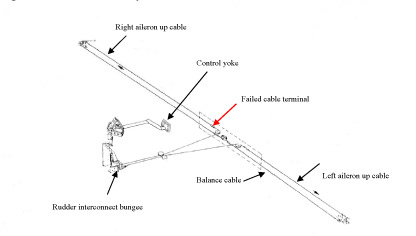
The aircraft manufacturer advised that since the aileron control cables are connected to the rudder interconnect bungee spring, the separation of the right aileron up cable would result in that spring forcing the left aileron down and the right aileron up (Figure 1).
Figure 1: Aileron control system
Terminal examination
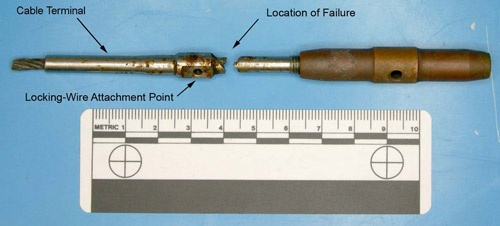
The failed control cable terminal was sent to the Australian Transport Safety Bureau (ATSB) for examination. The terminal shaft that is screwed into the turnbuckle had fractured close to the locking wire attachment point (Figure 2). The examination revealed that the fracture was initiated by stress corrosion cracking2 that had propagated under the surface of the shaft and weakened it to the point of failure.
Figure 2: Failed control cable terminal
The cable terminal was a standard swaged fitting designated AN669. Chemical analysis of the material showed that its composition closely matched that of SAE-AISI 303 stainless steel. A recent US National Transportation Safety Board (NTSB) Safety Recommendation3 identified SAE-AISI 303 stainless steel as being susceptible to stress corrosion cracking when used in a corrosive environment. The Safety Recommendation mentioned that cracking propagates as a function of the time a component is exposed to the corrosive environment rather than its actual time in service and that 'about 18 to 20 years is required for terminals exposed to the most damaging environment to reach their fracture point'.
Terminal inspection
During routine aircraft maintenance inspection of control system cables, corrosion pits on the surface of the cable terminal shaft may be the only visual indication of a potential problem. With the shaft area being typically wrapped with safety wire, the shaft can be difficult to inspect.
In August 2001, The Civil Aviation Safety Authority (CASA) issued Airworthiness Bulletin 27-1 Issue 1, Control Cable Terminal Inspection that was also published on the CASA web site www.casa.gov.au. The Airworthiness Bulletin provided information regarding the susceptibility of control cable terminals made of SAE-AISI 303 stainless steel to failure due to stress corrosion and highlighted the 'importance of meticulous inspection of the terminals'. It recommended that aircraft older than 15 years, and using terminals constructed of SAE-AISI 303 stainless steel, should have their control cable terminals visually inspected on an annual basis.
A review of the aircraft's logbooks found no evidence of the aileron controls having been subjected to any specific inspections to detect corrosion, including the removal of lock wire, within the previous 15 years. Routine maintenance inspections had been conducted during that period.
Both the ATSB and CASA databases contained four reports of similar control cable terminal failures in the period between 1995 and 2004. The NTSB Safety Recommendation mentioned 10 instances of aircraft that were found having fractured or cracked control cable terminals.
PAN is a radio code indicating uncertainty or alert.
A cracking process that requires the simultaneous action of a corrosive environment, such as a chlorine-rich atmosphere in moist coastal areas, and sustained tensile stress.
US National Transportation Safety Board Safety Recommendation A-01-6 through -8 of April 16, 2001.
Summary
The Australian Transport Safety Bureau did not conduct an on-site investigation of this occurrence.
A Beech V35A Bonanza sustained a loss of aileron control while cruising at 7,500 ft. The pilot reported turning the aileron control yoke to the left, but the aircraft continued rolling to the right and entered into a progressively steeper descent. He arrested the roll by extending the landing gear, adjusting engine power and applying full rudder.
On 28 April 2005, at approximately 0910 Western Standard Time, a EMB-120ER Brasilia aircraft, registered VH-XUD, was being operated on a chartered flight from Perth, Western Australia to Telfer, Western Australia when the left engine failed. The failure occurred approximately 100km NE of Meekatharra while the aircraft was cruising at 25,000 ft. A PAN alert was declared by the crew and the flight was then redirected by air traffic control to Meekatharra where the aircraft was landed without further incident.
On 3 December 2005, at approximately 0725 Eastern Summer Time, a De-Havilland Canada Dash 8 aircraft, registered VH-TQW, was being operated on a chartered flight from Wynyard, Tasmania to Melbourne, Victoria when the left engine failed. The failure occurred approximately 74 km from Melbourne aerodrome. The crew continued with their approach conducting a single engine landing without further incident.
Subsequent inspection revealed that the tower shaft within the turbomachinery section of the engines of both aircraft had failed. The ATSB received the failed components for examination and analysis. The investigation revealed that fracture of the tower shafts led to the loss of fuel pump operation and subsequent failure of the engines.
It was found that fatigue cracking of the tower shaft had initiated from surface damage that had been produced during the assembly process when the spiral bevel gear was pressed onto the tower shaft.
The visual ground aids associated with the Stage 3 works were marked and located in accordance with the Civil Aviation Safety Authority (CASA) Manual of Standards Part 139 - Aerodromes and the CASA Manual of Operational Standards. The notice to airmen (NOTAM) relating to the Stage 3 works included details of the displacement of the threshold of runway 21 and its associated markings, and included information that the runway 21 glidepath was not available. It also included information about the location of the temporary precision approach path indicator (PAPI), and that that it would be set to Stage 2 intensity.
The crew of the Airbus were aware of the displaced threshold, but seemed uncertain about its extent. Their perception that the unserviceability cone-shaped markers were a line signifying the displaced threshold was probably heightened by the fact that it was beyond the area of runway surface that was marked by unserviceability crosses. Additionally, as no unserviceability crosses were located on the runway beyond that point, it may have led the crew to assume that the aircraft could be safely landed beyond the cone-shaped unserviceability markers, even though there were no V-bar markers on each side of the runway to indicate that was actually the case.
Glideslope guidance was available from the temporary PAPI. The fact that the aircraft landed short of the displaced threshold meant that the landing approach was below the correct approach slope to the touchdown point associated with the displaced threshold. That being so, the temporary PAPI should have provided appropriate visual cues to the crew that the aircraft was below the intended approach slope. It is likely that the crew did not notice the PAPI because they were uncertain about the exact location of the displaced threshold, and were therefore not looking far enough down the runway to notice the PAPI light beams. Additionally, the PAPI was only set to Stage 2 in fine, daylight, overcast conditions, when Stage 4 was the optimum setting for those conditions. Under those circumstances, the light beams emitted by the PAPI may have been inconspicuous to the crew and outside their area of concentration in attempting to determine the location of the displaced threshold.
In this occurrence, the temporarily displaced threshold markings and the light signals from the temporary PAPI on the Stage 2 setting, were not of sufficient salience to compete with the other visual inputs to the crew. Consequently, the crew inadvertently misidentified the position of the displaced threshold.
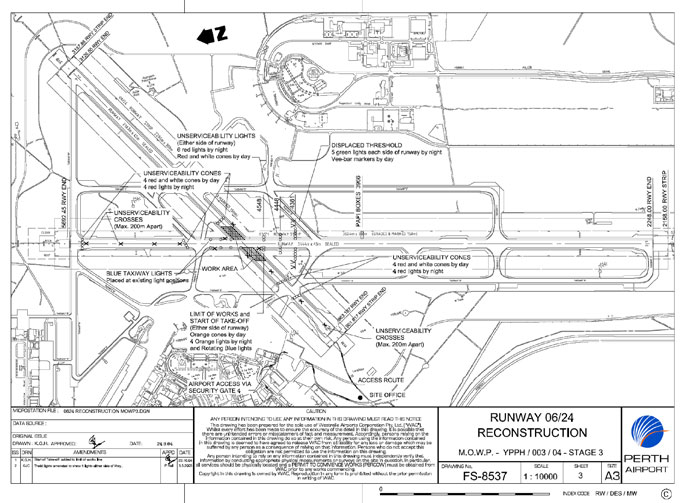
Appendix A: Stage 3 works at Perth Airport
Factual Information
At 0803 Western Standard Time on 24 April 2005, an Airbus Industrie A340-212 (Airbus) aircraft, registered ZS-SLA, with a crew of 11 and 219 passengers, landed short of the displaced threshold on runway 21 at Perth Airport, Western Australia. The aircraft was on a scheduled flight from Johannesburg, South Africa. The pilot in command was the handling pilot for the approach and landing at Perth.
The displaced threshold was required during Stage 3 of works involving the reconstruction of runway 06/24 and taxiway intersections at Perth airport. On 1 December 2004, the airport operator issued Method of Working Plan (MOWP) YPPH 01/04 which described the proposed works. The MOWP was distributed to air operator users of Perth Airport, including the operator of the Airbus.
The MOWP provided information that Stage 3 works included reconstruction of the runway 03/21 intersection. The Stage 3 works were scheduled between 0130 and 0930 on each programmed workday. During the Stage 3 work periods, the threshold of runway 21 was displaced 1,331 m to the south, and the glidepath component of the runway 21 instrument landing system was not available. A temporary precision approach path indicator (PAPI) was also installed on the eastern side of runway 21 to provide visual guidance for a 3-degree approach to the touchdown zone for the displaced threshold. The temporary PAPI was 395 m to the south of the runway 21 displaced threshold. Refer to Appendix A for a diagram of the displaced threshold arrangements for Stage 3 of the works.
The PAPI system consisted of a bar of four light-emitting units adjacent to runway 21. Each unit of a PAPI system produces a light beam that is divided into an upper white and a lower red sector. A pilot sees the four individual lights in a combination of red and white depending on his vertical position in relation to the approach slope. If an aircraft is descending on the correct approach slope, a pilot will see red beams of light projected from the two inner boxes, and white beams projected from the two outer boxes. If the aircraft is too high in relation to the approach slope, the pilot will see white beams of light projected from all four boxes. Conversely, if the aircraft is too low in relation to the approach slope, the pilot will see red beams of light projected from all four boxes.
The MOWP included information that visual ground aids associated with the works would be supplied, marked, and located in accordance with the Civil Aviation Safety Authority (CASA) Manual of Standards Part 139 Aerodromes.
CASA also published a Manual of Operational Standards. Part 3 of that manual related to aerodromes, and included the following advice in the introductory material relating to the marking of displaced thresholds:
During a landing approach, a pilot attempts to create a standard approach situation using information from, among other things, cockpit instruments, glideslope guidance and runway aspect and markings. When a pilot sees the runway picture he/she expects to see during his/her scan of these inputs, any unobtrusive temporary markings outside his/her normal areas of concentration may not cue him sufficiently to make him react to them. Temporarily displaced threshold markings must compete with normal threshold markings, centreline markings, fixed distance and touchdown zone markings, visual glidepath information and all the other visual inputs which tend to guide a pilot to a touchdown zone close to the approach end of the visual runway. These existing cues must be disrupted and the temporary markings made obvious enough to direct the pilots attention to the displaced threshold.
Paragraph 3.3.1.1 of the CASA Manual of Operational Standards stated that temporarily displaced thresholds on runways that do not display permanent threshold markings shall be marked by V-bar markers on each side of the runway. During the Stage 3 works, four red and white cone-shaped unserviceability markers were placed over the threshold markings, and four red and white cone-shaped unserviceability markers were also placed across runway 21, immediately to the north of the intersection of taxiway D with runway 21. Four unserviceability crosses were placed on runway 21 between the permanent threshold and the intersection of taxiway D. Unserviceability crosses were also located adjacent to the runway between the intersection of taxiway D and the intersection of runway 06/24. The portion of runway 21 between the intersection of taxiway D and the displaced threshold was available for aircraft to taxi to the take-off point. That portion of the runway surface was not marked with unserviceability crosses. There were, however, unserviceability crosses adjacent to the shoulders of that portion of the runway.
The MOWP included details of the notice to airmen (NOTAM) to be issued for each stage of the works. The works safety officer was responsible for initiating the appropriate NOTAMs, through the Australian NOTAM Office, 48 hours before the commencement of a particular works stage. The Stage 3 NOTAM included details of the linear displacement of the threshold of runway 21, and that the displaced threshold would be marked by five green lights on either side of the runway and also with V-bar markers. The NOTAM included information that the runway 21 glidepath was not available. It also included information about the location of the temporary PAPI, that the temporary PAPI would be set to Stage 2 intensity, and that 5 minutes notice would be required to change the intensity of the PAPI. There were no requests made to alter the intensity of the PAPI setting during the aircrafts approach to runway 21.
The Airservices Australia Manual of Air Traffic Services contained information on the intensity of precision approach lighting systems. Stage 2 was the preferred initial selection for fine, night, overcast conditions. Stage 4 was the preferred initial selection for fine, day, overcast conditions, while Stage 6 was the preferred initial selection for bright, clear, day conditions.
The pre-flight NOTAM briefing package supplied to the crew of the Airbus before the departure from Johannesburg included the NOTAM relating to the Stage 3 runway 21 displaced threshold at Perth.
At about 4,000 ft during the descent into Perth, the air traffic controller cleared the crew to make a visual approach to runway 21. The crew subsequently reported that, although they were aware of the displaced threshold, they could not identify the displaced threshold markings during the approach. The crew asked the aerodrome controller to confirm the location of the displaced threshold, and the controller advised the crew that it was to the south of the intersection of runway 06/24. The pilot in command adjusted the approach flight path accordingly. The crew then observed what they perceived to be a transverse white line across the runway just to the north of the intersection of runway 06/24. Because the perceived line was close to the intersection of runway 06/24 referred to by the controller, the crew assumed the line to be the displaced threshold. The crew observed that the runway was clear of machinery and personnel, and the pilot in command landed the aircraft just past the perceived transverse line.
As the aircraft passed over the perceived line, and just before touchdown, the pilot in command saw that the perceived line consisted of cone-shaped unserviceability markers. The actual touchdown point of the aircraft was about 670 m short of the displaced threshold delineated by the V-bar markers on each side of the runway, and 1,065 m from the temporary PAPI touchdown area (refer Appendix A). The crew subsequently reported that at no stage during the approach did they see any other markings that delineated the displaced threshold. They also reported that they could not distinguish the V-bar markers referred to in the NOTAM.
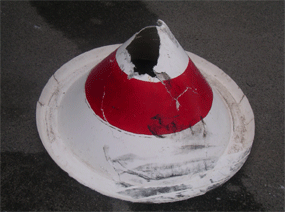
The aircraft ran over one of the red and white cone-shaped unserviceability markers during the landing (see figure 1). However, the aircraft was undamaged, and there was no other damage.
Figure 1: Damaged cone-shaped boundary marker
There was 10 km visibility at Perth at the time of the occurrence, with 7 oktas (7-eights of total sky visible to the celestial horizon) of stratocumulus cloud at 5,000 ft above mean sea level.
Two days after the occurrence, the aerodrome operator amended its procedure for daytime opening of the displaced threshold on runway 21. The amended procedure included a requirement for the temporary PAPI to be set to Stage 6 intensity when the runway lights were turned off at first light.
The ATSB received no other reports of aircraft landing short of the displaced threshold on runway 21 at Perth during the period in which the Stage 3 works were conducted.
Summary
At 0803 Western Standard Time on 24 April 2005, an Airbus Industrie A340-212 (Airbus) aircraft, registered ZS-SLA, with a crew of 11 and 219 passengers, landed short of the displaced threshold on runway 21 at Perth Airport, Western Australia. The aircraft was on a scheduled flight from Johannesburg, South Africa. The pilot in command was the handling pilot for the approach and landing at Perth.
The investigation identified that the following factors contributed to the accident:
The aircraft descended below the minimum altitude for a practice forced landing (500 ft above ground level).
The pilot allowed the aircraft's speed to decrease below the aircraft's stalling speed.
The aircraft stalled at a height above the ground that was not adequate to permit recovery.
It is possible that carburettor ice was present during the latter stages of the flight, reducing the available engine power.
Analysis
ANALYSIS
The final minutes of the recorded Air Traffic Services radar data indicated that the pilot performed a series of turns in a constant descent that was consistent with a forced landing. Given the pilot's history of performing many practice forced landings, it is likely that immediately prior to the accident, the pilot was conducting a practice forced landing.
When radar contact was lost, the aircraft was already below the minimum altitude for a practiced forced landing and there was no indication that the pilot had decreased the rate of descent. That was confirmed by witnesses that indicated that the aircraft was well below 500 ft above ground level.
Based on the pilot's training records and interviews with flight instructors, it is probable that the pilot was fixated on the chosen landing area and descended below the minimum height for a go-around. During the latter stages of the approach recorded by the radar, the pilot performed a tight 360º turn. That may have been intentional to allow the aircraft to lose height and still be positioned for the selected landing area. During the turn, the aircraft lost approximately 25 kts, which reduced the margin above the aircraft's stall speed.
A person near the accident site reported seeing the aircraft at a very low altitude and flying quietly before hearing power applied. However, the atmospheric conditions around the time of the accident were conducive to the formation of serious carburettor ice at descent power and the engine may not have been capable of producing full power when it was applied. Because the person's attention returned to their duties, it was not known if the application of power that they reported was sustained for any length of time. The evidence in the wreckage indicated that there was little or no power applied at impact. The pilot may have removed power as part of the stall recovery procedure. The use of carburettor heat could not be determined and the formation of carburettor ice was a possibility.
The attitude at which the aircraft impacted the ground and the damage to the tail section indicated that the aircraft had stalled before it impacted the ground. The combination of the loss of airspeed during the turn and the pilot's documented difficulty with stall recognition and response, may have led to an inadvertent stall, either during the go-around or in the subsequent climb out. The height at which the aircraft stalled was not sufficient to permit a recovery. It was not possible to determine if carburettor icing had reduced the power available for the go-around and aggravated the situation.
Fatigue
Based on the pilot's activities and sleep patterns prior to the occurrence, it was apparent that the pilot probably obtained only 5 to 6 hours of interrupted sleep on the night before the accident. Even though this was consistent with his normal sleeping patterns, in all likelihood, the pilot may have started the day with a degree of fatigue as a result of insufficient quantity and quality of sleep the previous night. The pilot may have also been experiencing the effects of chronic fatigue given his recurring pattern of interrupted and relatively low quantity of sleep. Consequently, fatigue may have reduced the pilot's ability to fly the aircraft accurately and to develop and maintain awareness of, and make timely decisions in response to, a degraded aircraft state, such as a stall.
Pilot's training history
The pilot had required a significant amount of flying training to meet the General Flying Progress Test standard. The pilot's training was regular, but spread over a considerable period of time. The training records indicated that the pilot had difficulty in acquiring, maintaining and consolidating the skills required to safely operate a light aircraft. Many lessons were repeated to bring the pilot up to the required competency standard. Of particular note is that the pilot consistently demonstrated poor airspeed control during practice forced landings, indecision, a poor awareness of an impending stall, a lack of response to the stall warning horn, and incorrect stall recovery technique. These factors are consistent with the circumstances surrounding the accident.
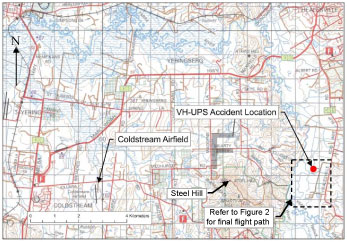
At about 0945 Eastern Standard Time2 on Saturday 23 April 2005, a Cessna Aircraft Company A150L Aerobat aircraft, registered VH-UPS, departed Coldstream Airfield, Vic. for a private flight in the Coldstream General Flying Training Area, with the pilot as the only occupant (Figure 1).
The aircraft was first tracked by the Air Traffic Services (ATS) radar at 0949 heading in a northerly direction consistent with a departure from Coldstream runway 35. Over the next 6 to 7 minutes, the aircraft made a series of right turns that brought the aircraft into an area to the southeast of Steel Hill. The radar track shows the aircraft performing some aerial manoeuvres in this area before heading north-northeast towards Healesville for several minutes, then turning left for another series of aerial manoeuvres.
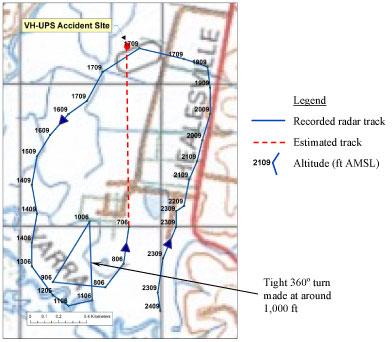
The final minutes of recorded radar data (Figure 2) show that the aircraft performed a descending orbit into the Yarra Valley before losing radar contact. The aircraft did not reappear on radar. At about that time, a passenger in a vehicle travelling along the Healesville - Koo Wee Rup Road observed the aircraft flying at low level. Shortly after, the aircraft was seen in a steep dive before it disappeared behind an embankment. The occupants of the vehicle located the wreckage of the aircraft in an open field about 1 km west of the Healesville - Koo Wee Rup Road. The aircraft was destroyed by impact forces and the pilot was fatally injured. There was no fire.
Figure1 : Accident location
Figure 2 : Recorded radar track
Recorded radar data showed that the aircraft maintained a fairly constant rate of descent of about 660 ft/min from an altitude of about 2,400 ft Above Mean Sea Level (AMSL), down to about 700 ft AMSL. That placed the aircraft at about 430 ft above ground level (AGL) when radar contact was lost. There was no indication in the radar data that the aircraft had ceased its descent when contact was lost. The accident site was located about 0.7 NM to the north of the last radar return.
At about 1,000 feet AMSL and heading in a north-easterly direction, the aircraft performed a tight 360º turn3 whilst maintaining the descent. During this turn, the radar recorded a decrease in speed of about 25 kts.
An employee working on the property where the accident occurred observed the aircraft pass at a very low level (estimated between 100 and 200 ft AGL) and flying quietly. The aircraft passed within several hundred metres of the employee and was headed in a northerly direction. The employee reported hearing the engine sound increase before returning their attention to their duties. Having worked on the property for some years, and observed many aircraft training in the area, the employee did not notice anything unusual about the aircraft, other than it being very low. Although located only 900 m from the accident site, the employee did not observe the final moments of the flight or the collision with the ground.
Wreckage information
Ground marks and crushing of the left-wing tip indicated that the aircraft had impacted the ground in a left wing-low and approximately 30º nose-down attitude. The direction of flight was approximately 320º (magnetic). The wing flaps were found in the fully retracted position.
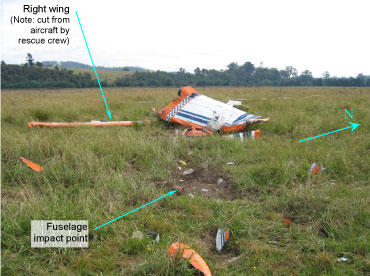
The aircraft came to rest about 10 m from the impact point (Figure 3). The fuselage lay on its roof with the left wing wrapped over the cabin and the right wing in a near vertical position. The rear fuselage was bent downward and to the left. The tailplane had separated from the fuselage and the fin, which was lying on the right tailplane, had broken away from its mounting brackets. There were no indications of any pre-existing defects in the aircraft structure.
Figure 3 : Aircraft wreckage
Examination of the propeller, throttle lever position and engine instruments indicated that the engine was operating at low RPM and developing little or no significant engine power at impact. Examination of the engine found no evidence of a mechanical or system failure that would have prevented the production of power prior to impact. Due to the impact damage, the status of the carburettor heat control at impact could not be reliably determined.
Examination of the stall warning system, airspeed indicator and altimeter indicated that they were capable of normal operation during the flight prior to impact.
Personnel information
The pilot's flying experience was estimated as:
Experience Type
Flying time (hours)
Total time
180.9
Dual time
132.7
Command time
48.2
On type (Cessna 150)
152.9
Hours flown in the last 24 hours
0.7
Hours flown in the last 7 days
1.3
Hours flown in the last 90 days
12.8
The pilot commenced part-time flying training on 23 May 2003 and was issued a Student Pilot Licence on 15 November 2003. The pilot's first solo flight on 23 November 2003 was made after receiving 43.7 hours of dual training. A pre-licence check flight was conducted by a senior instructor on 6 January 2004 when the pilot had 77.3 hours of experience. However, it was not until 24 July 2004 that the pilot achieved the General Flying Progress Test (GFPT) after a further 51 hours of flying training. At that time, the pilot had accumulated a total flying time of 128.4 hours, of which 104.9 hours were dual instruction. All of the pilot's flying training was undertaken at the same organisation.
The flying training organisation's pre-GFPT syllabus indicated that the minimum flying training required to the end of the GFPT phase was 23 hours dual and 6 hours solo, a total of 29 hours. The regulatory minimum total flight time required before attempting the GFPT was 20 hours of flight time.
After completing the GFPT, the pilot commenced cross-country navigation training as part of the Private Pilot (Aeroplane) Licence training syllabus. He had also completed 9.7 hours of aerobatic flight training but had not received an aerobatics endorsement. Entries in the pilot's logbook suggested that the pilot had previously engaged in solo aerobatics with a passenger on board the aircraft.
The pilot held a current Class 2 medical certificate that was endorsed with the restriction 'Renew by CASA only'. The results of the post-mortem examination and toxicology screening found no evidence of any physiological factor that may have impaired the pilot's performance during the accident flight.
In the days leading up to the accident flight, the pilot averaged 5 to 6 hours of sleep per night. These sleep periods were interrupted by waking periods late at night and was reported as the pilot's typical sleep pattern.
A review of the pilot's training records indicated that many lessons were repeated before the minimum competency standards were met. The pilot had recurring difficulties in airspeed management, steep and tight turns, identification of impending stall, response to the stall warning horn, recovery from the stall and go-around decision and technique. The pilot's instructors noted that constant reminders to monitor airspeed and altitude and to perform the appropriate recovery technique were required. The training records included several entries relating to inattention, tunnel vision and trouble attending to all parameters. Annotations of these difficulties were associated with many aspects of the pilot's training, but were particularly apparent for practiced forced landings.
The pilot had recorded a large number of practice forced landings during training, the majority of which were with an instructor.
Practice forced landing
The practice forced landing manoeuvre, as used in the flying training organisation's syllabus, typically involved simulating an engine failure by closing the throttle and gliding the aircraft toward a selected landing area.
The main objective of the manoeuvre was to develop judgement and skill in positioning the aircraft for a gliding approach to the selected field. When the manoeuvre is practiced on to an airfield, a landing is made off the approach. However, when the manoeuvre is practiced in the training area, the student is required to demonstrate a go-around from a safe height, usually not below 500 ft AGL. The go-around manoeuvre requires the pilot to apply full power and select the carburettor heat off, raise the flaps (if used) and establish the normal climb. If, for any reason, engine power is not available, the aircraft is ideally positioned for an emergency landing into the selected field.
To prevent the formation of carburettor ice during the practice forced landing, full carburettor heat is applied. A short application of engine power is normally made every 1,000 ft of descent to maintain engine temperatures. If carburettor heat is not selected off during the go-around, full power will not be available. When the normal climb attitude is maintained with less than full power, the aircraft will climb at a slower airspeed and rate of climb.
The Cessna A150L aircraft was a two-place, high-wing, light aircraft designed for general flying training, but was also capable of aerobatic flight. The aircraft was powered by a Teledyne-Continental Motors O-200-A normally-aspirated piston engine through a fixed-pitch two-bladed propeller.
VH-UPS was imported into Australia in 1990 and had been operated and maintained by the same flying club since that time. It was utilised for both initial flying training and aerobatic training.
The flying club maintained the aircraft in accordance with a CASA approved maintenance system. The last periodic maintenance inspection was carried out on 23 March 2005. The aircraft's maintenance release, recovered from the wreckage, did not list any defects, and the documentation indicated that all required maintenance was completed. The maintenance release was endorsed by a licensed pilot certifying that the daily inspection had been satisfactorily completed on the morning of the accident. The accident flight was the first flight of the day for the aircraft.
Prior to importation into Australia, the aircraft had been fitted with a carburettor ice detection system in accordance with a United States Federal Aviation Administration approved kit. The system consisted of an optical sensor in the carburettor, a control box and a warning light mounted on the instrument panel. The operating instructions indicated that the pilot was required to adjust the sensitivity of the system to suit the local conditions prior to operation. The operational status of the system at the time of the accident could not be determined.
The aircraft had sufficient fuel and was within the weight and centre of gravity limitations for the duration of the flight.
Meteorological information
The Bureau of Meteorology automatic weather station for Coldstream recorded the environmental conditions for Saturday 23 April 2005 as:
At 0900
At 1500
Temperature
11.3 ºC
26.4 ºC
Relative Humidity
98%
38%
Wind Speed and Direction
Calm
9 km/h from NNE
Mean Sea Level Pressure
1028.7 hPa
1024.5 hPa
The skies were overcast with high level cloud, there was a degree of haze; however, the horizon in the valley was clearly distinguishable. People in the area reported that winds were very light.
Carburettor icing
On the day of the accident, the atmospheric conditions were conducive to the formation of serious carburettor icing at descent power. Refer to Appendix A for a Flight Safety Australia magazine 5 article on carburettor icing.
Only those investigation areas identified by the headings and subheadings were considered to be relevant to the circumstances of the occurrence.
Eastern Standard Time was Coordinated Universal Time (UTC) + 10 hours.
The large changes in the aircraft position in this region are likely due to limitations in the radar system at low altitude, however the general pattern of a tight turn is indicated by the data points at 1106, 1006, 906 and 806 ft.
Total time in service.
Flight Safety Australia magazine is a publication of the Australian Civil Aviation Safety Authority.
Summary
At about 0945 Eastern Standard Time on Saturday 23 April 2005, a Cessna Aircraft Company A150L Aerobat aircraft, registered VH-UPS, departed Coldstream Airfield, Vic, for a private flight in the Coldstream General Flying Training Area, with the pilot as the only occupant.
The aircraft was tracked by the Air Traffic Services radar after its departure from Coldstream Airfield. The radar track showed that the aircraft performed some aerial manoeuvres to the east of the airfield before a descending orbit into the Yarra Valley when radar contact was lost. At about that time a passenger in a vehicle travelling along the Healesville - Koo Wee Rup Road observed the aircraft flying at low level. Shortly after, the aircraft was seen in a steep dive before they lost sight of it. The occupants of the vehicle located the wreckage of the aircraft in an open field about 1 km west of the Healesville - Koo Wee Rup Road. The aircraft was destroyed by impact forces and the pilot was fatally injured.
The aircraft had impacted the ground in a left wing-low and nose-down attitude. The fuselage lay on its roof with the left wing wrapped over the cabin and the right wing in a near vertical position. The rear fuselage was bent downward and to the left. The tailplane had separated from the fuselage and the fin had broken away from its mounting brackets. There were no indications of a pre-existing defect in the structure.
The investigation found that it was likely that the pilot was performing a practice forced landing and had descended below the safe altitude when the accident occurred. The airspeed was reduced to a point that the aircraft stalled and the altitude was not sufficient to affect a recovery before impact with the ground. It is possible that carburettor ice was present during the descent.
The Australian Transport Safety Bureau did not conduct an on-scene investigation of this occurrence.
REPORTED INFORMATION
At about 1610 central standard time on 18 April 2005 the pilot of a Cessna Aircraft Company Cutlass, registration VH-LCZ commenced the takeoff at Warooka Aeroplane Landing Area (ALA), SA. The private flight, with one pilot and two passengers, was the last of a number of planned flights that day from Warooka to Wedge Island ALA. The pilot estimated that his aircraft was about 10 kg (22 lbs) below the maximum allowable take-off weight for the aircraft. The aircrafts centre of gravity (c.g.) was not reported.
The pilot elected to take off towards the south, which resulted in a right crosswind that he described as `steady, but with a bit of swing to it. The pilot indicated that the take-off run to the south was `normal, and that he lifted the aircraft off from the runway at 60 kts indicated airspeed (KIAS) with the intent of establishing the climb at the aircraft best angle of climb speed of 67 KIAS. That was in order to avoid a house and powerlines at the southern end of the airstrip.
As the aircraft became airborne the pilot retracted the landing gear, which swings downward approximately 2 ft as it starts retracting. The pilot reported that almost immediately, the aircrafts stall warning unit activated. In response, he `lowered the nose of the aircraft towards the cruise attitude. The aircraft lost height and impacted the ground and subsequently slid to a stop on its belly. The occupants were not injured. The aircraft was substantially damaged.
The aircrafts Information Manual (manual) stated that the wing flaps should be set at zero degrees for normal takeoffs, and that the landing gear should not be retracted unless there was insufficient remaining runway to allow a wheels-down forced landing. In addition, the manual included that the aircrafts stall warning unit provides a continuous warning tone to the pilot at 5 to 10 kts above the aircrafts stall speed. With zero flap, and at zero angle of bank and maximum take-off weight, that speed was 46 KIAS at the most rearward c.g. and 50 KIAS at the most forward c.g.
ATSB COMMENT
Given the reported take-off weight and nature of the load, it was likely that the aircrafts centre of gravity approached the rearward limit. In that case, a takeoff conducted in the normal take-off configuration would have meant that the stall warning unit would most likely have activated in between 51 to 56 kts indicated airspeed (KIAS).
The safety margin between the lift-off speed and the stall speed may have been eroded by the effect of any `swing in the wind during the retraction of the landing gear, and the potential for any increase in drag associated with the retraction of that gear. The relative proximity of the aircraft to the ground when the stall warning unit activated minimised the possibility for the pilot to recover the aircraft before it impacted the ground.
The post implementation review by Airservices Australia of the June 2003 review of breakdown of separation occurrences found that since the recommendations were implemented, errors in either building or maintaining situational awareness by the controllers involved had reduced to 44 percent of occurrences involving infringements of separation standards.
Analysis
In this occurrence, the controller did not perceive the potential conflict between the aircraft, despite previous refresher training that should have assisted in the task.
Although the presence of the supervisor in the operations room created an opportunity to discuss an operational issue, it was not a priority. The controller should have discussed the issue at some other time when he was not responsible for an operational position. The supervisor was also in a position to defer the discussion with the controller, until a more suitable time or location, which would have reduced the likelihood of compromising operations.
While distraction could not be discounted as a contributing factor, the circumstances of the occurrence are consistent with the findings of the Airservices Australia June 2003 review, particularly with respect to low levels of situational awareness by controllers. Over time, the benefits of the implementation of the review recommendations in helping to develop controller awareness of potential performance limitations should become apparent.
Summary
On 19 April 2005 at about 1522 Eastern Standard Time, a Boeing Company 747-422 (747) aircraft was en route from Sydney, NSW, to Los Angeles, USA, on climb to flight level (FL) 310 and a de Havilland Dash 8 (Dash) aircraft was en route from Lord Howe Island to Sydney, maintaining FL240. The crew of the Dash had been issued with a clearance to descend to 10,000 ft above mean sea level. The intended tracks of the aircraft intersected at a point about 90 NM east of Sydney.
The aircraft were under radar control by the Brisbane Centre Ocean sector controller. The Australian Advanced Air Traffic System (TAAATS) assessed the two aircraft as potentially being in conflict and activated the short-term conflict alert (STCA) on the air situation display. Following activation of the STCA, the Ocean controller saw that the aircraft were about 16 NM apart and instructed both crews to turn their respective aircraft left in an endeavour to maintain the minimum radar separation standard of 5 NM. Analysis of recorded data from TAAATS showed that the aircraft passed with 4.1 NM lateral and 400 ft vertical spacing. The required minimum vertical separation standard was 1,000 ft. There was an infringement of separation standards.
The controller had been operating in the position for about 50 minutes prior to the occurrence. The level of complexity within the sector was reported to be light to moderate. The controller reported that despite reviewing the aircraft's tracks he expected the track of the 747 to be northwest of the inbound track of the Dash 8. Immediately prior to the activation of the STCA the controller was not monitoring the aircraft situation display as he was discussing operational coordination issues with an operational supervisor, who was consulting a chart located near the Ocean sector console position. The controller had initiated the discussion with the supervisor to follow up previous correspondence on the issue.
A review of breakdown of separation occurrences, conducted by Airservices Australia in June 2003, found that 92 percent of en route sector infringements of separation standards involved an error in either building or maintaining situational awareness by the controllers involved. The review made 31 recommendations and Airservices Australia has implemented all the recommendations of the review.
Since July 2003, the controller had undergone refresher training that included compromised separation (February 2004), separation assurance (February 2004), human factors awareness (March 2005) and situational awareness (March 2005).
Occurrence summary
Investigation number
200501720
Occurrence date
19/04/2005
Location
167 km E Sydney, (VOR)
State
New South Wales
Report release date
13/09/2005
Report status
Final
Investigation type
Occurrence Investigation
Investigation status
Completed
Mode of transport
Aviation
Aviation occurrence category
Loss of separation
Occurrence class
Serious Incident
Highest injury level
None
Aircraft details
Manufacturer
De Havilland Canada/De Havilland Aircraft of Canada