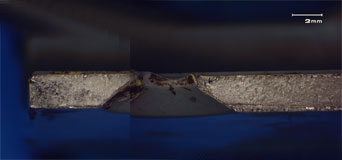
On 13 April 2005 at approximately 1130 Eastern Standard Time, the pilot of a Robinson Helicopter Company model R22 Beta, registered VH-HXU, was conducting cattle mustering operations near Mareeba, Qld, when he felt a significant airframe vibration and elected to conduct an immediate precautionary landing. Upon inspection with the engine still running, the pilot reported observing the clutch assembly shaking excessively, followed by the sudden fracture of the clutch shaft at the connection to the main rotor gearbox. The pilot was the only occupant of the helicopter and was not injured. There was no other damage to the helicopter.
On 9 April 2005 at about 0815 universal coordinated time, the Transport Accident Investigation Commission (TAIC) of New Zealand notified the Australian Transport Safety Bureau (ATSB) of an air safety occurrence involving an Australian-registered and operated aircraft, which occurred earlier that evening near Auckland International Airport. The ATSB appointed an accredited representative to participate in the investigation into the occurrence, in accordance with clause 5.18 1 of Annex 13 to the Convention on International Civil Aviation. To protect the information supplied by TAIC to the ATSB and investigative work undertaken to assist TAIC, the ATSB initiated an investigation under the Transport Safety Investigation Act 2003. The report presented below was prepared principally from information supplied to the ATSB.
FACTUAL INFORMATION
The occurrence involved a Boeing Company B747-338 (747) aircraft, registered VH-EBW, with a crew of 16 and 346 passengers, which was being operated on a scheduled passenger service between Sydney, Australia, and Auckland, New Zealand. The copilot was the handling pilot for the flight.
As the 747 was on the landing approach to runway 23 right (23R) at Auckland, the Auckland Tower and Terminal controllers observed an unidentified aircraft tracking towards the approach path of the 747. The controllers instructed the crew of the 747 to discontinue the approach, and turn the aircraft right towards the central city area, and to climb to 3000 ft. The aircraft subsequently entered instrument meteorological conditions (IMC) at an altitude of 3,000 ft above mean seal level (AMSL). The flight crew reported that shortly after, and while still in IMC, they received a TERRAIN, PULL-UP warning from the aircrafts enhanced ground proximity warning system (EGPWS). The pilot in command took control of the aircraft and commenced an immediate climb in accordance with the operators 747 procedures. The crew advised air traffic control that they had received a GPWS terrain warning, and that they were climbing the aircraft to 5,000 ft AMSL.
At the same time, a New Zealand-registered 747 was making an instrument approach to runway 23R, and had been cleared to descend to an altitude of 4,000 ft AMSL. As the Australian-registered 747 was climbing to 5,000 ft AMSL, it passed about 1.9 NM behind the New Zealand-registered 747, which was descending through 4,500 ft AMSL. The required separation standard was 3 NM laterally or 1,000 ft vertically. There was an infringement of the required separation standard. No avoiding action was taken, or was required to be taken, by either crew.
The TAIC is the independent New Zealand government entity responsible for no blame safety investigation of accidents and incidents in New Zealand. The Australian accredited representatives role in the investigation has been to provide the TAIC with information about the aircraft and its operation, recorded flight data recovered from the aircraft flight data recorders, crew details, and records of discussions taken during separate interviews conducted with the pilot in command and the copilot of the Australian-registered 747. The TAIC expects to complete the investigation into this occurrence by October 2005, and will publish the final report on its website at www.taic.org.nz.
1Clause 5.18 - The State of Registry, the State of the Operator, the State of Design and the State of Manufacture shall be entitled to appoint an accredited representative to participate in the investigation.
As a result of this occurrence, Airservices Australia proposed the following system improvements:
Brisbane approach training packages to be revised to incorporate runway 14/32 scenarios in future training modules
Examine options for including additional content on tower visual separation procedures into Brisbane approach training modules
Routine performance assessments for Brisbane approach controllers to formally assess knowledge of reciprocal runway procedures.
At the time of writing this report, the Bureau had not received advice from Airservices Australia regarding the status of these proposals. On 20 December 2005, Airservices Australia advised the ATSB of the following safety actions:
Knowledge of reciprocal runway operations is tested during assessments.
Tower controllers have completed familiarisation periods in approach.
Analysis
ANALYSIS
Introduction
Although there was no specified minimum distance standard for visual separation in these circumstances, the aerodrome controller was unable to continue to apply a visual separation standard, in azimuth, between the 737 and the Aero Commander. This analysis examines the development of the occurrence and highlights the safety issues that became evident as a result of the investigation.
Noise abatement procedures
Airspace restrictions imposed by the noise abatement procedures in force at the time of the occurrence resulted in limited options available to either the aerodrome controller or the approach controller to separate the departing Aero Commander with the inbound aircraft. The approach controller determined that he would be unable to establish and maintain a separation standard between the two aircraft and comply with noise abatement procedures, and so relied on the aerodrome controller to separate the two aircraft using visual separation.
The requirement for pilots to request a start clearance would normally provide the aerodrome controller with an opportunity to assess the traffic situation, in light of airspace limitations associated with noise abatement procedures, so that any delays can be absorbed prior to the aircraft's engines being started. A heading of 360 degrees was an appropriate heading in the circumstances. It would also have complied with noise abatement procedures and facilitated the application of visual separation in azimuth.
Controllers cannot be held responsible for delays to departing aircraft as a result of noise abatement procedures. Controllers are required to take such restrictions into account in their normal decision-making processes. The noise abatement procedures themselves were not considered to have contributed significantly to this occurrence.
Air traffic control separation standards and procedures
The converging tracks of the two aircraft precluded the aerodrome controller from ensuring that visual separation, in azimuth, was not infringed.
The low light conditions at that time of day and the cloud cover, may have made it difficult for the aerodrome controller to visually determine the departure track of the Aero Commander. Reference to the tower radar display was authorised by the Manual of Air Traffic Services (MATS) and would have clearly indicated the Aero Commander's track. Had the aerodrome controller referred to the tower radar display earlier, he may have been able to take action in sufficient time to ensure that separation was not infringed.
The situation which arose, where the aerodrome controller was separating the aircraft while the aircraft were not on the aerodrome control frequency, was not consistent with the letter of agreement. However, it did enable the approach controller to provide mutual traffic information to the pilots of both aircraft. That increased the awareness of the 737 crew of the presence of the Aero Commander and assisted the pilot of the Aero Commander to see the 737.
Although it would have been difficult for the aerodrome controller to separate the departing Aero Commander on a heading of 090 degrees, with arriving aircraft on the final approach path for runway 19, the aerodrome controller accepted those instructions and confirmed that he could separate in those circumstances. On that basis, the approach controller authorised the departure. The approach controller coordinated the departure instructions with the aerodrome controller in accordance with the letter of agreement. The approach controller confirmed, on a number of occasions, that the aerodrome controller had accepted responsibility for separating the Aero Commander on a heading of 090 degrees. The approach controller had no way of knowing that the aerodrome controller had misunderstood the instruction.
From the aerodrome controller's perspective, a heading of 360 degrees off runway 32 was appropriate given the disposition of the arriving aircraft. It would also have complied with the noise abatement procedures and enabled him to visually separate the Aero Commander in azimuth with the 737, once the 737 was established on the final approach path.
The aerodrome controller's subsequent request for a 20 degree left turn for the Aero Commander is difficult to reconcile. The resultant heading of 070 degrees turned the Aero Commander towards the 737 and does not appear to be consistent with a resolution of the developing confliction. By that time the aerodrome controller could not have been certain from visual observation that the aircraft were not in close proximity.
The investigation was unable to determine why the aerodrome controller had a 'mindset' that the Aero Commander was departing on a heading of 360 degrees, when that option was never discussed or coordinated with the approach controller. The higher workload that was reported to have resulted from The Australian Advanced Air Traffic System data upgrade may have had an adverse effect on the aerodrome controller's cognitive processes towards the end of the night shift. The possibility that fatigue contributed to the occurrence could not be discounted.
Factual Information
Sequence of events
On 14 April 2005, an Aero Commander 500-S aircraft, registered VH-YJR, departed Brisbane aerodrome on a non-scheduled flight to Maryborough, Qld. It passed within 1 NM horizontally and 500 ft vertically of a Boeing Company 737-76Q (737) aircraft, registered VH-VBU, that was inbound from Darwin, NT, on a scheduled passenger service.
The Aero Commander became airborne off runway 32 at 0543 Eastern Standard Time, 4 minutes after the nominated first light for Brisbane aerodrome. The Brisbane aerodrome controller had instructed the pilot of the Aero Commander to turn right, once airborne, onto a heading of 090 degrees and to climb to 2,000 ft. The pilot complied with the departure instructions and contacted the approach controller on the approach frequency. The approach controller acknowledged that broadcast and asked the pilot for 'good forward speed'.
The crew of the 737 were on the approach frequency and were positioning the aircraft for final approach to runway 19. Although the pilot of the Aero Commander and the crew of the 737 were on the approach frequency, the aerodrome controller confirmed with the approach controller that he was visually separating both aircraft as had been previously agreed. The aerodrome controller later reported that he was expecting the approach controller to assign a heading of 360 degrees to the pilot of the Aero Commander.
The approach controller passed traffic information to the pilots of both aircraft and the Aero Commander pilot sighted the 737 soon after. At 0544:20 the crew of the 737 reported that they were established on the final approach path for runway 19. The approach controller advised them that the Aero Commander was going to cross the runway 19 final approach path and that the tower was providing visual separation.
The aerodrome controller became concerned about the separation between the two aircraft and at 0544:50 asked the approach controller to instruct the pilot of the Aero Commander to turn left 20 degrees. That instruction was passed and the Aero Commander pilot complied. The aerodrome controller was still concerned and asked the approach controller to instruct the pilot of the Aero Commander to make an immediate hard left turn onto a heading of 360 degrees. The approach controller advised the aerodrome controller that he was concerned about that heading and did not transmit the instruction.
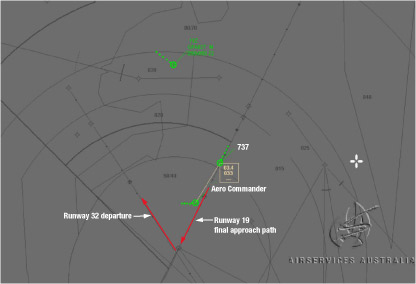
By 0545:26 the aerodrome controller considered that the Aero Commander had crossed the runway 19 final approach path. In response to a request by the approach controller, the pilot of the Aero Commander confirmed that he could see the 737, but at that stage the 737 crew had not seen the Aero Commander. Not long after that, the 737 crew saw the Aero Commander and were subsequently transferred to the Brisbane tower frequency. Figure 1 shows the position of the two aircraft as the Aero Commander crossed the final approach path at 0545:30.
Figure 1: Relative flight paths of the Aero Commander and the 737 as the Aero Commander crossed the final approach path of runway 19 at 05:45:30
A review of the recorded radar data showed that separation between the aircraft reduced to a minimum of 0.95 NM horizontally, at which time vertical separation had reduced to 500 ft.
Noise abatement procedures
The noise abatement procedures applicable at Brisbane at the time of the occurrence specified that all aircraft departing runway 32 between 2200 and 0600 must be contained within a sector of airspace between 360 and 120 degrees, over water, until leaving 5,000 ft. A heading of 360 degrees for a departure from runway 32 would have complied with those requirements.
To comply with the noise abatement procedures, runway 19 was the nominated duty runway for arrivals, and runway 01 was the nominated duty runway for departures. Pilots were also advised, on the automatic terminal information service, to obtain approval from air traffic control prior to starting engines. The requirement for a start clearance in thesecircumstances was in accordance with the Manual of Air Traffic Services (MATS) and enabled any delays to be absorbed on the ground before an aircraft's engines were started.
The aerodrome controller issued a start clearance to the pilot of the Aero Commander. The aerodrome controller did not coordinate the start clearance with the approach controller, nor was he required to do so. The ADC was required to review the disposition of inbound traffic when making a decision as to the timing of a start clearance.
The approach controller reported that he instructed the aerodrome controller to assign a departure heading of 090 to the pilot of the Aero Commander to ensure compliance with the noise abatement procedures.
Air traffic control separation standards and procedures
Control of aircraft in the Brisbane aerodrome terminal area was provided by an aerodrome controller located in the control tower using visual procedures, or by an approach controller using radar information. The MATS stated that the primary role of aerodrome controllers was to maintain visual observation of aircraft operations. Coordination of responsibilities and roles was required between the aerodrome controller and the approach controller, and formal guidelines were specified in a letter of agreement. The letter of agreement stated in part that:
In visual conditions, separation is achieved by the application of a radar standard or the provision of visual separation.
It also stated that:
In the application of visual separation, BNT [Brisbane aerodrome controller] shall ensure that separation in azimuth 1 is maintained until the establishment of a radar or procedural separation standard … In all situations where BNT is providing visual separation, traffic that will operate in close proximity will be retained on TWR [tower] frequency.
Although the aerodrome controller transferred the pilot of the Aero Commander to the departures frequency, the approach controller did not accept separation responsibility for the aircraft after the 737 was established on the runway 19 final approach path. He reported that he may not have been able to maintain the minimum radar separation standard of 3 NM horizontally, or 1,000 ft vertically.
The aerodrome controller reported that he accepted responsibility for visual separation between the two aircraft once the 737 was established on the runway 19 final approach path, because he had a 'mindset' that the Aero Commander was going to turn right onto a heading of 360 degrees once airborne. The aerodrome controller later reported that he would not have accepted responsibility for separation if he had realised that the approach controller had assigned a heading of 090 degrees, because that heading would not have enabled him to maintain visual separation between the two aircraft. Although the pilot of the Aero Commander advised the approach controller that he had the 737 in sight, the approach controller did not assign responsibility for separation to the pilot of the Aero Commander. There was an infringement of separation standards.
The information in the letter of agreement was supported by the Manual of Air Traffic Services (MATS), which contained procedures to be used by air traffic controllers. Paragraph 4.5.2.8 (effective 10 June 2004) stated that:
In providing visual separation, controllers should rely primarily on azimuth. Visual separation by judgement of relative distance or height shall be used only with such wide margins that there is no possibility of the aircraft being in close proximity.
The Brisbane tower was equipped with a radar display that provided the aerodrome controller with the same traffic display that was provided to the approach controller. The MATS addressed the use of tower radar in an aerodrome control service. It stated that the tower radar display was available for the determination of the altitude, position, or tracking of aircraft to establish or monitor separation. However, the MATS also stated that:
…the use of Tower radar should not impinge upon an aerodrome controller's primary function of maintaining a visual observation of operations on and in the vicinity of the aerodrome.
The MATS also stated that separation assurance could be achieved through planning traffic to ensure separation, executing the plan to achieve separation and monitoring the situation to ensure that the plan and the execution are effective.
Aerodrome controller
The aerodrome controller was trained and rated for the aerodrome control function at Brisbane. At the time of the occurrence he was nearing the end of a night shift which had commenced at 2200 the previous day. He reported that there had been a data upgrade to The Australian Advanced Air Traffic System during the night. The aerodrome controller considered that the data upgrade resulted in a higher workload than a standard night shift.
The aerodrome controller reported that, at the time of the occurrence, he felt fatigued. He also reported that he was feeling slightly unwell, but that he considered himself fit for duty. He was sleeping adequately and, apart from the slight illness, there were no indications of any personal, physiological or medical issues that were likely to have influenced the controller's performance.
Meteorological information
The weather information being broadcast to pilots for Brisbane Airport at the time of the occurrence advised that the visibility was greater than 10 km, that there were showers in the area and some cloud at 2,500 ft. The wind was reported as 180 degrees at 8 kts, with a maximum downwind of 10 kts on runway 01.
1. Horizontal bearing or direction.
Summary
On 14 April 2005, an Aero Commander 500-S aircraft, registered VH-YJR, departed Brisbane aerodrome on a non-scheduled flight to Maryborough, Qld. It passed within 1 NM horizontally and 500 ft vertically of a Boeing Company 737-76Q (737) aircraft, registered VH-VBU, that was inbound from Darwin, NT, on a scheduled passenger service.
On 11 August 2003, a twin-engine Cessna 404 'Titan' aircraft (VH-ANV) crashed into scrub land near Jandakot airport, WA, following the failure of the right engine immediately after take-off. The ATSB investigation (200303579) found that the engine failure had been precipitated by the seizure of an engine-driven fuel pump (EDFP), which had been previously repaired using an inappropriate (non-original) material to replace the pump shaft sleeve bearing. That repair had been designed and approved by a person authorised under the Civil Aviation Regulations (1988) part 35 (CAR 35).
In April 2005, after the discovery of another CAR 35 approved pump repair that substituted the original pump bearing material with an unsuitable alternative, the ATSB commenced an investigation into the circumstances surrounding the material selection processes and the factors contributing to the inappropriate material selection. Concurrent with the ATSB investigation, an inquest conducted by the WA State Coroner examined the circumstances of the VH-ANV accident, including the pump bearing material issues.
The ATSB investigation found that in both instances, the authorised persons that prepared the Engineering Orders (EO) for the EDFP repairs, had done so without specific knowledge of the differences between the original and newly selected materials in regard to their bearing properties, and the precise conditions under which the fuel pump bearings operated.
Safety action resulting from the investigation of these issues included the publication of the VH-ANV investigation findings in various industry journals and educational materials. The findings and recommendations of the VH-ANV coronial inquest, and the industry communications released by the Civil Aviation Safety Authority (CASA) acted to further promote understanding of the material selection deficiencies.
On 7 November 2005, Airservices Australia issued national instruction NI 12/2005 to clarify the requirements for level assignment below LSALT in the en-route environment. The national instruction included information relating to the need for level assignment to take into account terrain clearance and the standards and requirements for assigning levels below the LSALT as detailed in the Manual of Air Traffic Services.
Analysis
While prior information relating to the radar outage was available to the crew of the 737, they did not become aware of the outage until informed by air traffic control during a high workload phase of the inbound flight, when there was little time to assess the information correctly. During the pre-flight departure briefing, the 737 crew did not reconsider or challenge their misunderstanding of the change to the CTA base with each other or the air traffic controller, which lead them to climb the aircraft into CTA without an airways clearance.
The non-availability of radar services below 8,000 ft, together with the forecast weather conditions, low level of CTA base and aircraft performance characteristics warranted greater diligence by the controller to implement tactical separation assurance. The controller relied on the crew of the 737 remaining outside controlled airspace, clear of weather and below the LSALT, as an initial separation strategy with the Dash 8.
While the onus is on a pilot to ensure adequate terrain clearance, the clearance issued to the crew by the controller did not comply with the provisions of MATS. The potential existed for the 737 crew to not meet their responsibilities under CAR 157 and 178 for minimum terrain clearance.
Summary
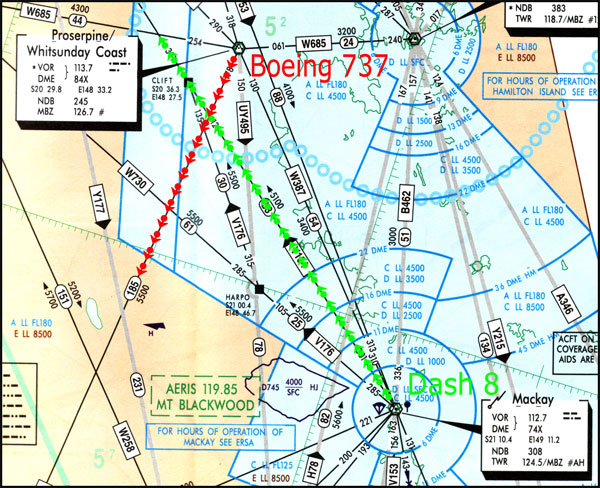
On 6 April 2005, at 1253 Eastern Standard Time, a de Havilland Canada DHC-8-102 (Dash 8) aircraft departed Mackay for Townsville, Qld. The aircraft was being operated under the instrument flight rules (IFR) and was climbing to flight level (FL) 160. At 1254, a Boeing Company 737-800 (737) aircraft departed Proserpine for Brisbane, Qld. The aircraft, with two pilots and a company approved observer, was being operated under the IFR. The crew's intention was to climb the aircraft to 8,000 ft above mean sea level (AMSL) pending a clearance from air traffic control (ATC) to enter controlled airspace (CTA) on climb to the planned FL410.
The airspace in the Proserpine area was classified as class G (non-controlled) airspace from ground level to 4,500 ft and class C (controlled) airspace from 4,500 ft to FL180.
Within class C airspace, air traffic controllers are required to separate IFR aircraft from other IFR aircraft.
Figure 1: Extract from Mackay Terminal Area Chart
At 1256, the sector controller issued the crew of the 737 with a clearance to enter CTA on climb to 5,000 ft to establish the minimum vertical separation standard of 1,000 ft with the Dash 8, prior to conducting a step climb1. The 737 crew reported they were approaching 6,000 ft and commenced a descent to 5,000 ft.
Recorded data later showed that the 737 reached a maximum altitude of 6,400 ft with a minimum vertical spacing between the two aircraft of 430 ft and it was calculated that the aircraft were approximately 45 NM apart laterally. At 1257, the vertical separation standard of 1,000 ft was established and, at 1300 when the two aircraft were radar identified, they were about 25 NM apart laterally.
At the time of the incident, the radar that normally provided low-level coverage within the area had been temporarily removed from service, restricting coverage to above 8,000 ft. A notice to airmen (NOTAM) had been issued, which detailed the planned outage, the restricted radar coverage, and possible delays in CTA.
The crew of the 737 later reported that they had obtained and read briefing material, including NOTAMs, but did not recall any information relating to the radar outage. They first became aware of the outage at about 9,000 ft during the previous flight on the inbound descent to Proserpine, when they were instructed by the controller that the radar was off and radar services were terminated. At that point, they mistakenly confused the termination of radar services with a change in the base of CTA to 9,000 ft. Prior to departure from Proserpine, the crew briefed and set 8,000 ft as an initial level for climb, believing this level to be outside CTA.
The published minimum sector altitude (MSA)2 around Proserpine was 4,500 ft within 10 NM and 5,100 ft within 25 NM. The lowest safe altitude (LSALT) for the departure track of the 737 was 5,500 ft. As a result, the cleared level of 5,000 ft was below the LSALT for the aircraft.
The forecast cloud at Proserpine was scattered at 2,000 ft and broken at 4,000 ft and the 737 crew later reported entering instrument meteorological conditions (IMC) when passing about 2,500 ft on the departure climb.
The Manual of Air Traffic Services (MATS) section 6.1.2.1 specified that clearances issued shall enable the pilot to comply with Civil Aviation Regulations (CAR) 157, relating to minimum heights for aircraft operations. CAR 178 specified that a pilot must not fly an aircraft at a height lower than the published lowest safe altitude, 'and on departure this means the time during which an aircraft is climbing after take-off at a rate that is reasonable under the circumstances'. MATS 6.1.2.5 specified level assignment shall take into account terrain clearance and MATS 6.1.7.1 specified that a pilot may [only] be assigned a level below the LSALT provided that the pilot has reported 'visual' and 'visual' is appended to the clearance.
The air traffic controller later stated that he understood that the responsibility for terrain clearance on departure was a pilot responsibility and there was a published LSALT on the departure track for pilot reference. As he did not expect the aircraft to have to maintain 5,000 ft in the step climb, he did not issue a 'visual' instruction with the level assignment.
MATS 4.1.1.4 provided guidance to controllers relating to tactical separation assurance, which:
'places greater emphasis on traffic planning and conflict avoidance rather than conflict resolution. This is achieved through the proactive application of separation standards to avoid rather than resolve conflicts; planning traffic to guarantee rather than achieve separation; executing the plan so as to guarantee separation; and monitoring the situation to ensure that plan and execution are effective.'
Step climb is a procedure used to simultaneously climb aircraft to vertically separated levels.
Minimum sector altitude (MSA) and lowest safe altitude (LSALT) are calculated to provide 1000 ft obstacle clearance for IFR flights, and are published on aeronautical charts and in the Aeronautical Information Publication (AIP) for pilot and controller reference.
Occurrence summary
Investigation number
200501392
Occurrence date
06/04/2005
Location
37km S Proserpine, VOR
State
Queensland
Report release date
23/12/2005
Report status
Final
Investigation type
Occurrence Investigation
Investigation status
Completed
Mode of transport
Aviation
Aviation occurrence category
Loss of separation
Occurrence class
Incident
Highest injury level
None
Aircraft details
Manufacturer
De Havilland Canada/De Havilland Aircraft of Canada
The Australian Transport Safety Bureau did not conduct an on-scene investigation of this occurrence. The report presented below was prepared principally from information supplied to the Bureau.
REPORTED INFORMATION
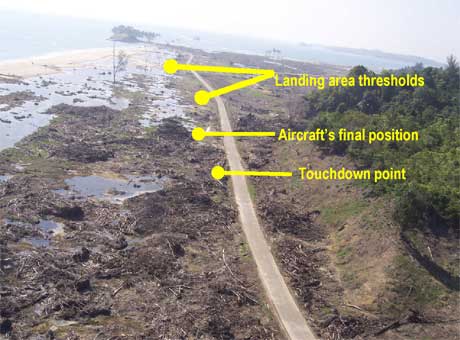
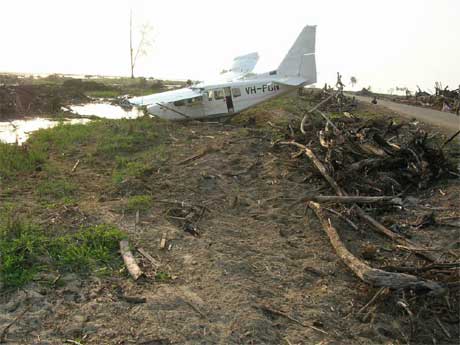
On 8 March 2005, the Gippsland Aeronautics Pty Ltd GA-8 aircraft, registered VH-FGN, was carrying emergency relief supplies from Muelaboh to Patek in Aceh Province, Indonesia, as part of the Tsunami relief effort. The aircraft occupants comprised the pilot and one passenger.
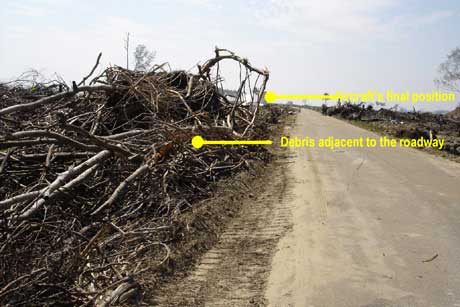
A level, 700 m long and 7 m wide portion of a bitumen-sealed roadway formed the designated landing area for the operator's relief flights into Patek. The landing area was not marked with runway markings.
The operator reported that the pilot misidentified the commencement of the landing area, and that the aircraft touched down about 400 m short of the commencement of that area.
There was debris adjacent to the part of the road where the aircraft landed.
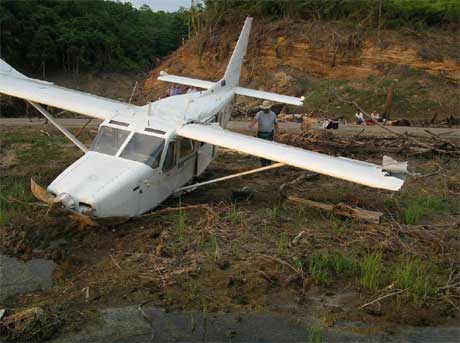
During the landing flare, the aircraft's left wingtip struck some of that debris, and a 1 m portion of the left wingtip was dislodged. The impact yawed the aircraft to the left, and the right wingtip then contacted the ground.
The landing gear collapsed, and the aircraft came to rest to the left of the sealed roadway, about 100 m from where the left wingtip initially struck the debris.
The two occupants were uninjured and were able to exit the aircraft unaided.
The pilot held an Australian Commercial Pilot (Aeroplane) Licence and was endorsed to fly the GA-8 aircraft. The operator provided induction training for the pilot at the commencement of his duties in Aceh Province. The training included one landing at Patek. The accident occurred four days after the pilot commenced duties in Aceh Province. During those four days, the pilot had performed two take-offs from Patek and had landed there twice before the accident flight.
There was no evidence that environmental, mechanical, operational or other factors contributed to the circumstances of the accident.
The operator reported that as a result of the occurrence, it will conduct a risk analysis before the commencement of any new operations such as those conducted at Aceh Province. The operator also reported that it would include a special training module in its Operations Manual for pilots assigned to operations in Aceh, and that procedures for aircraft operating on roads would also be included in its Operations Manual.
Summary
On 8 March 2005, the Gippsland Aeronautics Pty Ltd GA-8 aircraft, registered VH-FGN, was carrying emergency relief supplies from Muelaboh to Patek in Aceh Province, Indonesia, as part of the Tsunami relief effort. The aircraft occupants comprised the pilot and one passenger.
At about 1326 Eastern Daylight-saving Time on 7 March 2005, the pilot of a Cessna Aircraft Company 310R, registered VH-FIN, commenced take-off from runway 30 right at Tamworth on a ferry flight to Scone, NSW. Witnesses reported that the pilot initially maintained the runway heading, as cleared by air traffic control (ATC). When the aircraft was between 800 and 1,000 ft above ground level (AGL) and while making a shallow banked turn to the left, the pilot broadcast to ATC that he was experiencing 'control difficulties'. Upon or shortly after reaching an early downwind position the aircraft was observed to enter a steep nose-down descent. While there were some inconsistencies in the available witness reports, it appeared that the aircraft may have rolled about its longitudinal axis at some stage on the final descent. The aircraft impacted the ground in a cleared paddock about 4 NM west-south-west of Tamworth airport, fatally injuring the sole occupant pilot of the aircraft. The aircraft was destroyed by the impact forces and post-impact fire.
The pilot was appropriately licensed and rated, held a valid class 1 medical certificate and was reported as being fit to fly. The results of postmortem examination and toxicology screening found no evidence of any physiological factor that may have impaired the pilot's performance during the occurrence flight.
The aircraft was maintained under a Civil Aviation Safety Authority (CASA) approved maintenance system. The aircraft had been subject to scheduled maintenance by a CASA approved maintenance facility immediately prior to the accident. The aircraft had a current maintenance release and there were no recorded defects at the time of the accident.
The investigation calculated the aircraft's weight and balance based on fuel load records and estimated fuel burn rates for previous operations, including engine runs relating to the maintenance activity completed immediately prior to the occurrence flight. The investigation estimated that at the time of the occurrence, the aircraft was operating below the maximum permitted take-off weight and within the stipulated centre of gravity limits.
The Automatic Terminal Information Service (ATIS) current at the time of the occurrence, reported that the wind was variable at eight knots with occasional crosswind of eight knots, CAVOK1, temperature 27°C and a calculated mean sea level pressure datum (QNH) of 1019 hPa.
The wreckage trail extended over a distance of about 232 m. Ground impact marks and other physical evidence indicated that the aircraft struck the ground in an upright slightly right wing low, 35 to 50 degrees nose-down attitude, and that both engines were developing significant power at the time of impact.
During the on-site examination of the wreckage, investigators located a tool that would normally not be expected to be carried on the aircraft. Metallurgical analysis showed no evidence that the tool had been trapped within or had in any way interfered with the control systems of the aircraft.
The pilot did not specifically transmit a distress call to ATC during the occurrence. The pilot advised that the aircraft was subject to 'control difficulties', that he was 'losing direction of the aircraft' and that the autopilot was 'not on'.
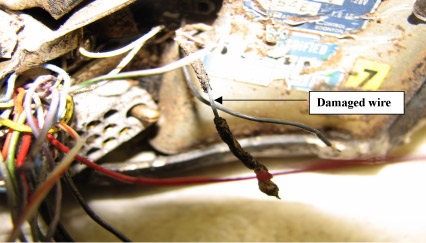
The aircraft was equipped with a Cessna 400B Nav-O-Matic Autopilot System. The autopilot controller recovered from the site showed evidence of thermal damage to a wire within the controller, consistent with current overload (Figure 1). That damage was inconsistent with post-impact fire damage. The ATSB is awaiting data from the manufacturer and other specialist agencies regarding the effect of the damaged wire on autopilot operation.
Figure 1: Damaged wire within the autopilot controller
The ongoing investigation will include examination of:
the aircraft's autopilot and electric pitch trim systems
the inspection requirements for wiring to critical systems
the degree of autopilot system training provided during aircraft endorsement training.
CAVOK is defined as visibility of 10km or more, no cloud below 5,000 ft or below the highest minimum sector altitude whichever is greater, no cumulonimbus clouds and no precipitation, thunderstorm, shallow fog, low drifting snow or dust devils.
Summary
At about 1326 Eastern Daylight-saving Time on 7 March 2005, the pilot of a Cessna Aircraft Company 310R, registered VH-FIN, took off from runway 30 Right at Tamworth Airport, for Scone, NSW. Approximately 1 minute after becoming airborne, the pilot reported flight control difficulties. At about 1329, the aircraft impacted the ground in a cleared paddock about 7 km west-south-west of the airport. The pilot was fatally injured, and the aircraft was destroyed by the impact forces and post-impact fire.
Examination of the aircraft's mechanical flight control systems, autopilot and electric trim system did not reveal any evidence of pre-impact malfunction. Those results, however, were inconclusive due to the extensive impact and fire damage. A bent hand tool found in the wreckage was not implicated in the development of the accident.
A periodic maintenance inspection carried out in the days before the flight resulted in the rudder trim tab being set at the full right position and possibly aileron and elevator trim tabs being set at non-neutral positions prior to the flight. There were indications that the pilot was rushed and probably overlooked the rudder and aileron trim tab settings prior to take-off. The aircraft flight path reported by witnesses was found to be consistent with the effect of abnormal rudder and/or aileron trim tab settings.
The investigation found that aircraft operating checklists produced by aircraft operators did not always include the autopilot and electric trim procedures located in the supplements of aircraft operating handbooks/flight manuals. At the time of the accident, the training and guidance generally provided to pilots did not emphasise the management of flight control difficulties including autopilot and electric trim related difficulties.
Following the accident, the aircraft operator and the maintenance provider advised that they had reviewed and amended some procedures. The Civil Aviation Safety Authority advised that a Civil Aviation Advisory Publication titled Multi-engine Aeroplane Operations and Training will be issued by July 2007 and that three items have been forwarded to the Safety Promotion Branch for consideration/action.
The failure of the forward roller support was due to fatigue. Fatigue is a result of a materials defect and/or the loading conditions of a part. The forward door support proved to exhibit no inherent microstructural defects that would attribute to this failure, therefore, the magnitude and cyclic nature of the load are likely to have been contributing factors.
In this case it was not possible to establish the definitive reason for the failure of the part, as the entire door structure and the locating screws were not available for examination. However, the vibration and resonance of the support during routine use, and the thickness and deterioration of the paint layer applied to the support, are likely to have affected the function and performance of the door support over time.
CONCLUSION
4.1 Contributing factors
Examination and analysis of the forward door attachment and the mating serrated plate identified the support failed in fatigue.
4.2 Other findings
The forward door support proved to exhibit no inherent microstructural defects that would attribute to this failure.
A reason for the fatigue failure was not able to be established as the entire door structure including locating screws was not available to complete the analysis.
Factaul Information
At 0825 local time on 10 March 2005, a Bell 212 helicopter with three crew and five passengers departed Wallaby landing zone near Moliana, East Timor to conduct an aerial survey of the island. Prior to the flight, the passengers requested that the cabin sliding doors be secured in the open position for better observation. At approximately 0935, while tracking along the coast at 90 KIAS at approximately 800 ft AGL, the flight crew reported that they experienced a bump to the helicopter similar to air turbulence. A subsequent control and instrument check did not reveal any problems. The rear crewmember then informed the pilot in command (PIC) that the right cabin sliding door had fallen off. The PIC elected to conduct a precautionary landing in a nearby field. Following the landing, damage to the right side of the tail boom and horizontal stabilizer was noted and the door recovered for examination.
The Australian Transport Safety Bureau examined the sliding door attachment hardware to determine if there were any pre-existing faults of the components.
Examination of the aircraft and wreckage revealed that the forward roller support of the passenger door had fractured. The part had no specified safe life.
1.1 Assembly information
Two parts were recovered from the forward door assembly, the forward roller support and the mating serrated plate.
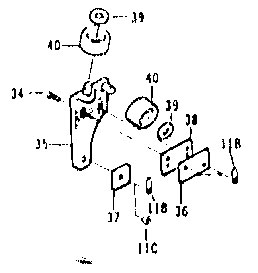
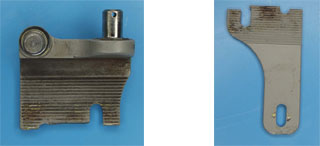
The forward roller support (35), illustrated in figure 1, is located inside the passenger compartment of the helicopter and is one of four roller attachments of the passenger door to the upper track. When the door is in the open position, this attachment carries the entire load of the passenger door. Elliptical holes through the support and its attachment to the mating serrated plate (38) via screws (34), allow the door to be located between the upper and lower roller tracks.
Figure 1: Forward Door Support Assembly.
1.2 Visual Examination
1.2.1 Forward Roller Support
The forward roller support was recovered in two sections shown in figure 2 as A and B. The fracture of this part extended through the serrated area of the support, 45mm from the top of section A and intersecting with the elliptical locating holes. The support was painted with a chromate primer and a grey top coat, together approximately 100µm thick.
Figure 2: Section A of the forward roller support (left) and Section B of the forward roller support (right).
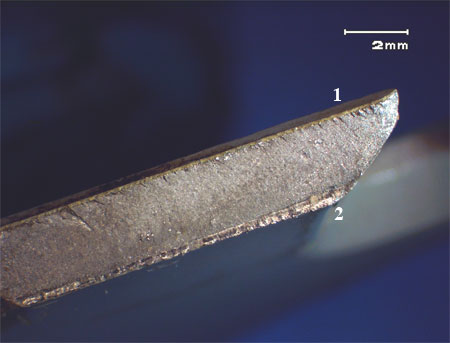
The fracture surface revealed striations and ratchet marks, consistent with fatigue failure. Part of the fracture surface of section B, shown in figure 3, reveals ratchet marks occurring at the serrated edge of the support (1) and final fracture at the back edge of the support (2). This is consistent along the entire fracture surface.
Figure 3: Fracture surface of section B, ratchet marks are visible at the serrated edge of the part (1) and the final fracture of the back edge of the part (2).
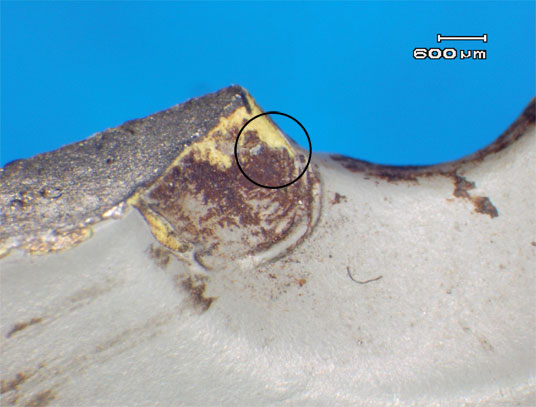
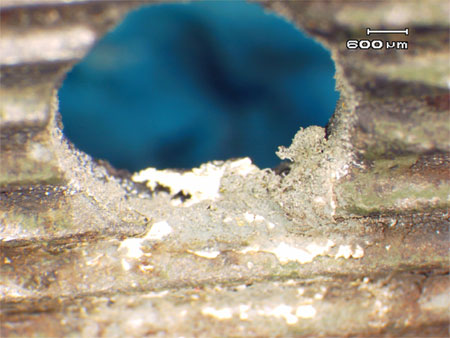
Iron oxide deposits were also observed on sections A and B. Location of the oxide coincided with the mating surfaces of the forward door assembly and the serrated plate and between the elliptical holes and the locating screws. Close examination of the elliptical holes revealed the paint layer was pleated as shown in (figure 4). The location of these pleats coincided with the positions of locating screws. Further deterioration of the paint layer was also observed in this area, leaving the yellow primer exposed.
Figure 4: Oxide products within the elliptical holes of section B. Note the top coat deterioration and pleating (circled) revealing the chromate primer layer (yellow).
1.2.2 The Serrated Plate
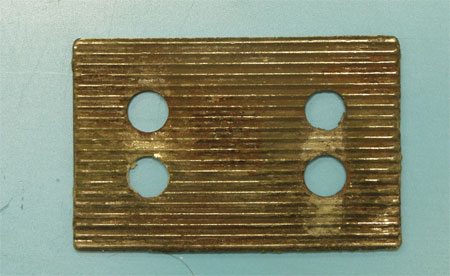
The serrated plate attachment, shown in figure 5, was not painted. Iron Oxide and fretting of the holes were observed, shown in figure 6. The screws that attached the roller support and serrated plate to the passenger door were not recovered for this investigation.
Figure 5: The serrated plate.
Figure 6: Fretting around holes in the serrated plate. Iron oxide products are also visible.
1.3 Metallographic Examination
A segment of the forward roller support including the fracture surface and serrations was removed from section B. The representative sample was prepared and examined to characterise the materials general microstructure.
The material which exhibited magnetic properties, revealed a microstructure typical of a Precipitation Hardened (PH) Stainless Steel . PH Stainless Steels are often used in the aircraft and aerospace industries due to superior hardness and corrosion resistance. The martensitic type microstructure revealed by this sample, shown in figure 7, is typical for this material.
Figure 7: Microstructure of the forward roller support material (10X magnification).
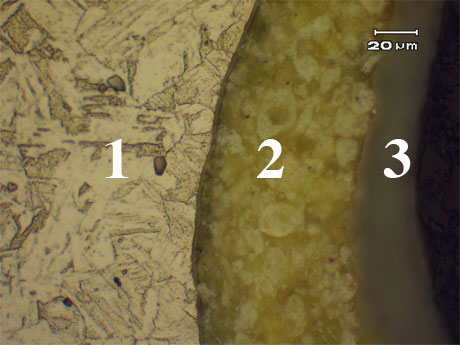
Figure 8: The metal (1), primer (2) and top coat layer (3) interfaces (10X magnification).
Vickers hardness tests were carried out using a 20kg load, a total of five tests returned a mean value of 323 HV. These hardness results are typical of PH stainless steels.
FRACTURE CHARACTERISATION
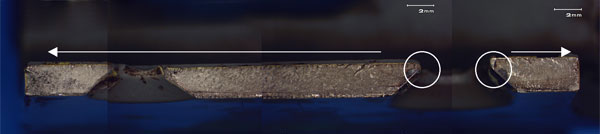
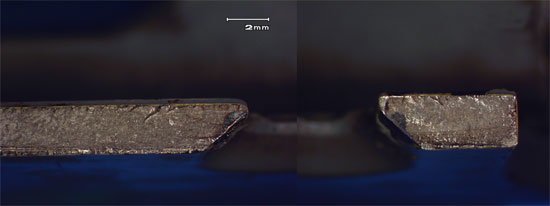
Using light microscopy, the fracture surface of section A revealed the part had failed in fatigue. Crack initiation was identified as occurring on both sides of the right screw hole, circled in figure 9, and more clearly shown in figure 10. Ratchet marks at the serrated edge of the support indicated that crack progression occurred in the direction arrowed in figure 9, and through the thickness of the part. Rapid, unstable fracture characterised by a brighter fracture surface was also observed, shown in figure 11.
Figure 9: Fracture surface of section A. Crack initiation sites are circled and crack propagation directions are indicated with arrows (6X magnification).
Figure 10: Crack initiation sites, section A (6X magnification).
Figure 11: Rapid, unstable fracture surface, section A. Note the brighter appearance of the fracture surface (6X magnification).
Summary
Technical Analysis Report No. 22/05
Occurence No. 200501155
Examination of a Failed Forward Door Attachment from a Bell 212 aircraft, registered VH-LHX, on 10 March 2005.
Boeing Company 717-200 aircraft, VH-VQB, was operating a scheduled passenger service from Launceston, Tasmania to Melbourne, Victoria when the right (number 2) engine failed during the climb to cruise altitude. After securing the failed engine, the flight crew declared a PAN condition and continued the flight to Melbourne where the aircraft landed uneventfully.
Examination of the failed BR715-A1-30 engine by the operator’s maintenance staff and subsequently by the engine manufacturer under the supervision of a representative of the German Federal Bureau of Aircraft Accident Investigation (BFU), confirmed a mechanical failure within the engine high-pressure turbine section. The failure was traced to the fatigue fracture and loss of a single stage-1 high-pressure turbine blade, with the resultant cascading mechanical damage to the downstream turbine elements and the initiation of a high-temperature titanium metal fire within the high-pressure compressor stages.
Characteristics of the failed turbine blade fracture surfaces indicated that a high-cycle (vibratory) loading environment had contributed to the development of the fatigue cracking that led to the blade loss. A significant contributor to the magnitude of the vibratory blade loading was the extent of trailing edge erosion and metal loss exhibited by the turbine nozzle guide vanes (NGV). Those vanes progressively degrade in service due to the effects of oxidation and thermal cycling and are typically removed from service once the erosion and damage exceeds serviceable limits. While not evident during the examination, it was suspected that pre-existing blade mechanical damage may have acted in concert with the vibratory loads to initiate cracking.
Following the investigation, the manufacturer implemented several changes to the maintenance regime for the BR715 engine, including monitoring of the P30 engine parameter that reflects the level of NGV erosion and the mandatory replacement of eroded NGV segments that may otherwise have been repaired and returned to service.
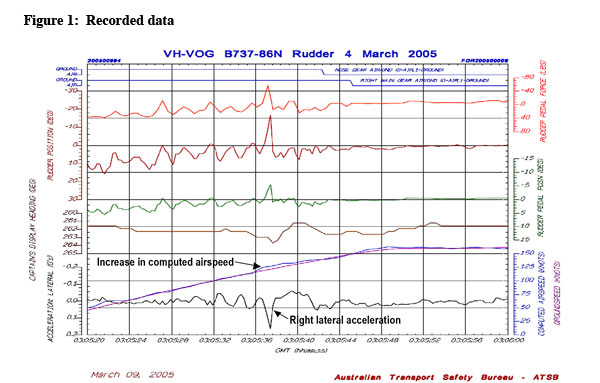
The ATSB investigation determined that the increase in computed airspeed recorded at the time of the lateral acceleration was likely due to an atmospheric disturbance, which resulted in the aircraft veering unexpectedly. The ambient wind recorded at the time of the occurrence did not indicate if the crosswind increased, or decreased, during the event. Wake turbulence was considered unlikely, as the reported landing of the other passenger aircraft was downwind of the departure runway.
Factaul Information
An inspection of the aircraft by maintenance engineers on arrival in Brisbane did not find any fault with the main or standby rudder power control unit (PCU). The B737 PCU is a hydraulic mechanism that moves the rudder in response to inputs from either the pilot or the yaw damper. The aircraft operator has not reported any further rudder occurrences with the aircraft.
The aerodrome terminal information service that was valid at the time of the indicated that the surface wind was 190 degrees magnetic at 12 to 15 kts. Wind data that was recorded at the airport at the approximate time of the event indicated a varying, but generally south-south-easterly wind at a speed of 4 to 10 kts. The crew reported that another passenger aircraft had landed on the crossing runway prior to their departure.
The airport operator's inspection report included morning and midday inspections of the airport runway surfaces. The morning inspection was at 0727 and the midday inspection was carried out at 1450. Neither inspection identified any problems with the runway 27 surface.
The Flight Data Recorder (FDR) information was recovered for examination by the ATSB. The examination revealed that a right lateral acceleration, with a peak of approximately 0.17g had occurred at 125 kts, (refer Figure 1).
The ATSB referred the FDR information to the aircraft manufacturer for review.
The manufacturer reported that the recorded rudder and yaw damper inputs were in response to the acceleration, and did not initiate it. The recorded rudder data indicated that all rudder movements were commanded by the crew and/or the yaw damper. The PIC reported that he felt the rudder pedal move under his feet. The FDR recorded a 5 kt headwind increase during the take-off roll that may have been the result of an increasing crosswind.
The manufacturer conducted additional analysis with a flight simulator, to better understand the rudder pedal movements, lateral acceleration and heading data recorded during the occurrence. The simulation results indicated that a 7 kt right quartering headwind gust, followed by a 13 kt left quartering gust, would be needed to match the FDR lateral acceleration data.
Summary
Factual Information
On 4 March 2005, at 1405 Eastern Daylight-saving Time, a Boeing Company 737-86N aircraft, registered VH-VOG, was being operated on a scheduled passenger service from Melbourne to Brisbane. The pilot in command (PIC) reported that during the take-off roll, the aircraft unexpectedly deviated to the right of the runway 27 centreline and the nosewheel felt as though it ‘had been caught in a groove’. The PIC applied left rudder to regain directional control and continued the take-off and flight to Brisbane. The circumstances of this incident were similar to those identified in a previous Australian Transport Safety Bureau (ATSB) investigation, (see investigation report 199703237).