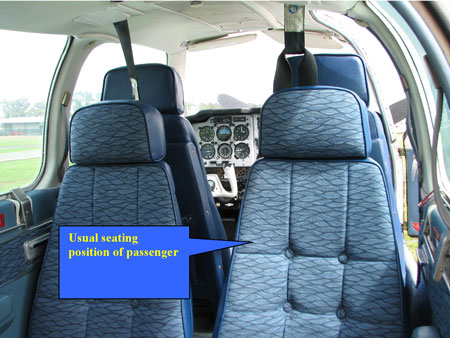
At about 1800 Central Standard Time on 6 October 2005, a Robinson Helicopter Company model R22 Beta helicopter (R22), registered VH-HUZ, departed Border Downs, NSW on a private flight to the pilot's property at Yalda Downs, NSW with the pilot and one passenger on board. The helicopter subsequently crashed near a homestead at Calindary Station (Calindary), fatally injuring the pilot and seriously injuring the passenger.
A hearing witness1 at Border Downs who was also a pilot and endorsed to fly the R22, had previously flown the occurrence helicopter. He reported that the helicopter 'sounded completely normal' during the take-off and departure from Border Downs. He indicated that the normal time interval for the flight to Yalda Downs was about 1 hour 15 minutes.
Witnesses at a number of properties along the route flown by the pilot reported that, as the flight progressed, the pilot requested by radio for each of them to illuminate their external homestead lights. The reason given by the pilot for those requests included, earlier in the flight, for the pilot to 'get his bearings' and, as the helicopter approached Calindary, to assist the pilot to identify two sets of power lines that crossed the main west to east road about 1 and 3 kms west of the property respectively. In response to the pilot's request, the property owners at Calindary reported that they parked their vehicle on top of a sand embankment that was about 100 m south of the main road. The vehicle's spotlights, and a third hand-held spotlight, were illuminated in the direction of the helicopter's anticipated approach.
The pilot advised the property owners by radio that he had sighted their spotlights. The property owners reported that they suggested to the pilot that he should land at Calindary and use one of their vehicles to return to Yalda Downs by road. The pilot declined that suggestion and indicated that, after picking up the road from Calindary to Yalda Downs, he would continue with the flight. The property owner estimated that the helicopter was below 30 ft above ground level (AGL) at that time, and described the helicopter's 'powerful white lights' as being visible 'down amongst the trees'. The survivor indicated that the pilot manoeuvred the helicopter in order for the helicopter's landing lights to criss-cross the road.
One of the witnesses at Calindary, with extensive experience flying aeroplanes, stated that there was nothing abnormal about the sound of the helicopter or its engine as it passed the vehicle's position, or immediately prior to the ground impact.
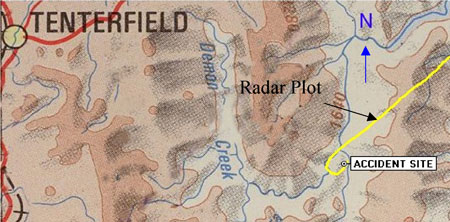
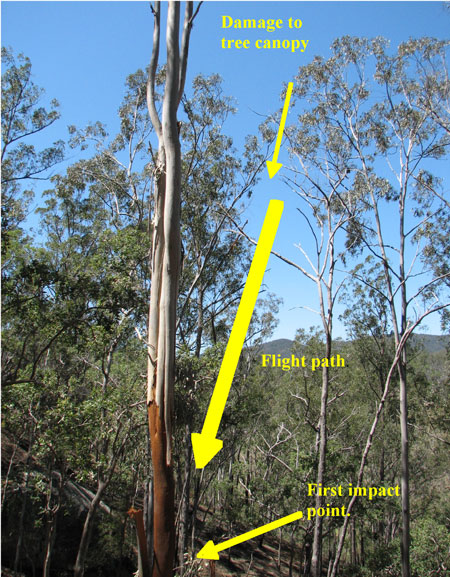
The survivor stated that, shortly after passing Calindary, the road appeared to merge with the surrounding bush and the pilot turned the helicopter to visually reacquire the road. The property owners at Calindary reported that the helicopter commenced a climbing right U-turn, before returning in a westerly direction and descending at an estimated angle to the horizon of 20 to 30 degrees. The survivor indicated that, during the turn and until the impact with the ground:
- he heard no abnormal noises from the helicopter
- he did not observe the illumination of any warning lights in the cockpit
- there was no apparent apprehension or degree of panic displayed by the pilot.
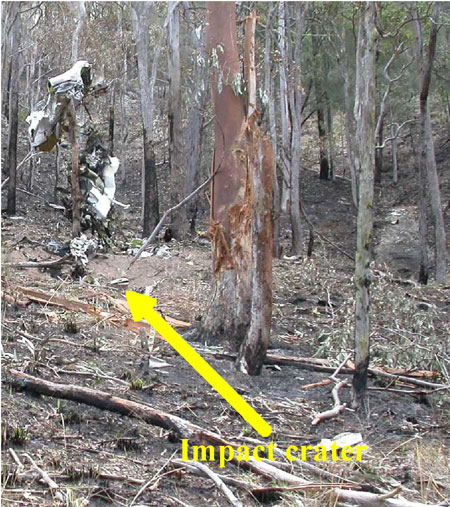
At about 1921, the helicopter impacted a sand hill a number of times and was destroyed by the impact forces and post-impact fire.
The pilot held a private pilot (helicopter) licence, was endorsed to fly the R22 and was reported to have about 9,000 hours flying experience. The pilot did not hold a night Visual Flight Rules (VFR) rating. The requirements of Civil Aviation Regulation (CAR) 174C(1) included that the pilot was required to have held that rating in order to conduct a flight at night under the VFR.
The pilot last undertook a medical examination in order to renew his Class 2 Medical Certificate in January 2002. There was no evidence that:
- the pilot finalised the administrative requirements for the renewal of that certificate
- the pilot held a valid Class 2 Medical Certificate at the time of the occurrence
- the Civil Aviation Safety Authority (CASA) had given the pilot permission to continue flying without a current medical certificate.
CAR 5.04(1) required that:
Without the permission of CASA, the holder of a flight crew license must not perform a duty authorised by the license if the person does not hold a current medical certificate that is appropriate to the license.
That meant that on the day of the accident, the pilot should not have been performing the duties that were authorised by his license.
The helicopter was first registered in Australia on 3 May 2005 and was reported to have flown about 130 to 140 hours since its delivery flight to Yalda Downs on 1 August 2005. An examination of the helicopter's maintenance records found that the helicopter was certified for day VFR flight and equipped and maintained in accordance with existing regulations and approved procedures. The helicopter was not equipped for flight under the night VFR, nor was it installed with an Emergency Locator Transmitter (ELT)2.
The helicopter's weight and centre of gravity were estimated to have been within the prescribed limits at the time of the occurrence.
It was reported that the pilot would have refuelled the helicopter to capacity from the aviation gasoline fuel source at Yalda Downs prior to departing for Border Downs earlier that day. A witness at Border Downs indicated that the pilot did not refuel the helicopter at that location. It was estimated that at the time of the accident, about 24 L of fuel remained on board the helicopter. That would have been sufficient for the remainder of the planned flight to Yalda Downs.
A Bureau of Meteorology (BoM) examination of the forecast weather and meteorological observations from the Tibooburra Automatic Weather Station3 indicated that there was no significant weather, no low-level cloud, and no reduction in visibility in the region of Tibooburra at the time of the occurrence. The investigation determined that the times of sunset, and of the end of civil twilight for the relevant locations along the planned west to east route included:
| Location | Sunset | End of Civil Twilight |
|---|
| Border Downs | 1810 | 1834 |
| Calindary | 1804 | 1828 |
| Yalda Downs | 1802 | 1826 |
The pilot was reported to have accessed a private weather source via the internet prior to the departure from Border Downs. The available information from that source included the observed surface wind for a number of locations in the general vicinity of the flight and the weather forecast and times of sunrise and sunset for Broken Hill. Sunset for Broken Hill on the day of the occurrence was published by that source as 1809.
A witness at Border Downs reported the weather as being 'good', with a wind of about 10 to 15 kts from the west-south-west, and a cloud base of above 1,500 ft AGL. The weather at the accident site at the time of the accident was reported by witnesses to include: a light north-westerly wind; a 50% overcast layer of thin cloud, with a high base; good visibility; and no horizon. Witnesses reported that it was 'pretty dark, as in black'.
Examination of the NSW Police and other photographic evidence indicated a low angle of impact with the sand hill at a relatively high speed, which compromised the integrity of the helicopter's cockpit area. That was consistent with the reported 85 m wreckage trail and witness reports of the helicopter's approach towards the ground.
The damage to the helicopter's landing skids and engine mount frame was consistent with a slightly nose-down, right angle of bank at ground impact. One of the main rotor blades separated from the main rotor head at its hinge bolt attachment point, consistent with static overload as a result of the blade's impact with the ground. The damage to that main rotor blade confirmed that the main rotor was rotating at that time. The tail boom appeared to have failed in overload and separated from the main wreckage following the initial impact with the ground. The relatively minor torsional shear indications evident on the tail rotor driveshaft, and the nature of the damage to the tail rotor blades, indicated that the tail rotor had ceased rotating prior to its impact with the ground.
Based on the available information, there was no evidence that material failure or component malfunction had contributed to the development of the occurrence.
At the time of writing this report, the pilot's post mortem report was not available to the investigation team.
There was no report by the witnesses to the occurrence of an in-flight fire. The source of the post-impact fire was from fuel that had spilled from the ruptured helicopter fuel tanks. The ignition source of the fire could not be confirmed, but was most likely from the hot engine exhaust.
CAR 252A specified that a pilot in command of an aircraft that was not an exempted aircraft4 may only begin a flight if the aircraft either:
- was fitted with an approved and functioning ELT, or
- carried an approved and readily accessible portable ELT that was in working order.
The helicopter was not an exempted aircraft and it was reported that the pilot normally carried a portable ELT during flight. The survivor indicated that he had not observed a portable ELT in the helicopter prior to or during the occurrence flight, and the item was not identified by the NSW Police amongst the wreckage of the helicopter, or at the site of the accident. AusSAR5 reported that an emergency signal was not identified at or about the time of the accident.
The flight was within the central Australian mainland component of the Designated Remote Area that was promulgated in Appendix III to Civil Aviation Order 20.11. That required the carriage of sufficient survival equipment for sustaining life appropriate to the area being overflown, and either the submission of a SARTIME6 flight notification to Air Traffic Services (ATS) or for a pilot in command to leave a flight note with a responsible person. It was reported that the pilot and passenger carried sufficient clothing in case the decision was made to remain overnight at Border Downs. ATS records indicated that a SARTIME was not submitted to that agency, and a flight note was not left at either Border Downs or Yalda Downs for the occurrence flight. Witnesses at Yalda Downs indicated that the first confirmation that the pilot intended to return that night was via a radio call from the pilot at about 1900 to 1915, indicating that '[he] would be late [arriving at Yalda Downs]'.
The Aeronautical Information Publication (AIP) requires that:
Unless the pilot in command holds a Command Instrument Rating or night VFR (NGT VFR) rating and the aircraft is appropriately equipped for flight at night, a VFR flight must not depart from an aerodrome:
- before first light or after last light; and
- unless the ETA [Estimated Time of Arrival] is at least 10 minutes before last light after allowing for any required holding.
Last light was interpreted by the AIP to equate to the end of civil twilight 7. In addition, the AIP alerted pilots to the potential for the presence of cloud cover to the west of an aerodrome, and a number of other variables to adversely affect a flight arriving at its destination near the end of daylight. Sunset was highlighted as 'having no relevance when calculating daylight operating times for the VFR pilot.'
The AIP also placed altitude restrictions on the operation of an aircraft under the night VFR. That included that a pilot should not operate an aircraft under those rules at a height lower than the published lowest safe altitude (LSALT) for the route, or a height that was calculated in accordance with the requirements of the AIP, except under certain prescribed circumstances. Depending on the calculation methodology applied by a pilot, the LSALT for the route Border Downs to Yalda Downs was at least 2,020 ft above mean sea level (equivalent to about 1,500 ft AGL at Calindary).
The Approved Flight Manual for the helicopter included a number of Safety Notices that were relevant to the operation of the helicopter at night. Those notices included that:
- Flying a helicopter in obscured visibility due to fog, snow, low ceiling, or even dark night can be fatal.
- Loss of the pilot's outside visual references, even for a moment, can result in disorientation, wrong control inputs, and an uncontrolled crash.
- …[the pilot] loses control of the helicopter when he attempts to turn to regain visibility but is unable to complete the turn without visual references.
- [pilots should] be sure you NEVER fly at night unless you have clear weather with unlimited or very high ceilings and plenty of celestial or ground lights for reference.
- A witness who heard, but did not observe the takeoff.
- Crash-activated radio beacon that transmits an emergency signal that includes the position of a crashed aircraft.
- The closest station to the site of the accident, being about 49 NM north-north-west of that location.
- Exempted aircraft means high capacity regular public transport or charter aircraft, single seat or turbo-jet powered aircraft, or balloons, airships or gliders.
- Australian Search and Rescue - in general terms, AusSAR coordinates the response to aviation SAR incidents across Australia.
- The time nominated by a pilot for the initiation of Search and Rescue action if a report has not been received by the nominated unit.
- Period at sunset when the sun's centre is between 0°50' and 6° below the horizon.