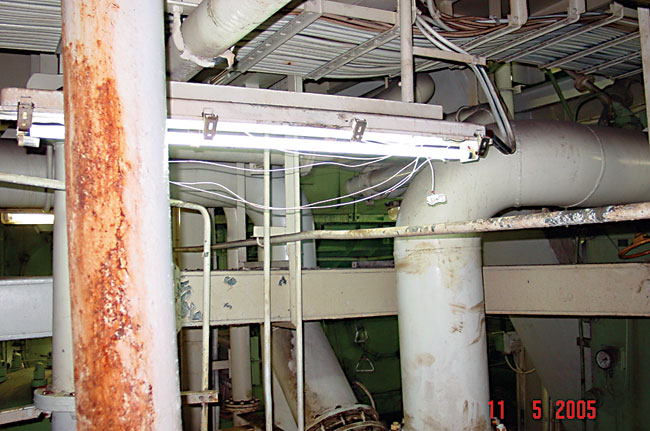
At about 0540 on 24 May 2005, a fire started on board the Singapore registered general cargo ship Java Sea while it was berthed in Cairns. The fire started in the engine room adjacent to the oil-fired thermal fluid heater, at deck level, under the poop in way of the aft peak bulkhead.
Initial attempts by the ship's crew to fight the fire using a fire hose were unsuccessful and the decision was taken to use the engine room Halon 1301 fixed fire extinguishing system. The release of the Halon 1301 proved ineffective, primarily because of the inability of the crew to close the dampers on the ventilation openings at the top of the funnel casing.
The fire was finally extinguished by the Queensland Fire Service, using high expansion foam injected through a hole cut in the base of the funnel at poop deck level directly above the seat of the fire.
The engine room and accommodation were significantly damaged by the fire and the associated firefighting activities, to such an extent that Java Sea had to be towed to Singapore for permanent repairs.
The report found that it is probable a leakage of hot pressurised thermal fluid (mineral oil), possibly in the form of a spray, ignited when it came into contact with an un-lagged section of the oil-fired thermal fluid heater exhaust piping; and once started, the fire was fuelled by the contents of the thermal fluid expansion tank, the main engine cylinder oil service tank and the stern tube lubricating oil tank.
The report identifies a number of contributing factors and makes recommendations to address them.
Just after 0920 (ship's time) on 16 May 2005, the engineer cadet on the bulk carrier Golden Bell fell through an open section of deck grating while working in the ship's engine room. He landed on the bottom deck plates, approximately seven metres below, suffering severe head and internal injuries. The ship was at anchor off the Western Australian port of Dampier.
The cadet died as a result of his head injuries a short time after being evacuated by helicopter to the Nickol Bay Hospital in Karratha, about 20 km from Dampier.
Shipping companies, managers and ship's masters should ensure that shipboard safety management systems include procedures for working on electrical equipment that are adequate and not ambiguous. It is essential that these procedures are backed up by sufficient onboard training and auditing to ensure personnel involved in performing or supervising electrical work understand and fully implement these procedures.
MR20050024
Regulatory authorities, shipping companies and ship managers should consider the feasibility of widening the requirement for medical examinations and certificates to include more stringent testing for, and monitoring of, chronic conditions such as heart disease and diabetes.
Significant Factors
Based on the evidence available, the following factors are considered to have contributed to the death of the electrician aboard Probo Panda on 11 May 2005.
The electrician had a pre-existing heart condition, coronary artery atheroma.
Current medical examination standards for seafarers are inadequate in terms of detecting conditions such as coronary heart disease.
Working on live electrical equipment and not implementing the measures outlined in the ship's SMS increased the likelihood of the electrician receiving an electric shock.
The electrician may have suffered an electric shock, causing him to fall between the deep frame and a parallel pipe.
The subsequent exertions, attempting to climb free, probably induced the heart attack.
Working alone in an isolated area for an extended period of time without supervision or monitoring resulted in the electrician not being found in time to administer first aid.
Rendering the earth leakage detector inoperable removed a safety device that may have drawn attention to the electrician's plight earlier.
Comments and Analysis
COMMENTS AND ANALYSIS
On 13 May 2005 investigators from the ATSB conducted interviews with the master and chief engineer on board Probo Panda. Discussions were held with local police, the ship's agent and legal representative.
A postmortem examination of the electrician was conducted by the coroner in Rockhampton. The coroner's report was provided to the ATSB and cited the cause of death as coronary artery occlusion (heart attack) attributable to coronary artery atheroma (a build up of fatty patches inside the lining of the coronary arteries).
The contents of the electrician's pockets, which included tools, insulating tape, starters and old tube end fittings, and the fact that a new tube end fitting was found hanging from the light fitting (Figure 3) indicate the electrician had been in the process of changing this item.
The light fitting was situated directly above a transverse deep frame outboard of the main engine charge air cooler cleaning filter, starboard aft at the bottom plate level.
The light fitting was still live, with its circuit breaker closed and no danger tags fitted. Prior to the ATSB's arrival, the ship had organised for a shore based electrician to render the equipment safe while preserving the evidence to the greatest extent possible.
It is likely the electrician was crouching on the deep frame so he could reach the light fitting. It seems that he received an electric shock which knocked him off balance, causing him to fall between the deep frame and the parallel pipe. The subsequent exertions, attempting to climb free probably induced the heart attack.
Figure 3: Light fitting
The electrician's health
The ship's medical log listed the only medication that had been issued to the electrician during his time on the ship was an expectorant cough medicine.
The master and chief engineer both commented that the electrician appeared to be in good health.
Prior to joining Probo Panda the electrician had undertaken a seaman's medical examination. The medical certificate, issued on 19 July 2004, indicated he was in good health, with no indications of coronary heart disease.
While a number of studies into coronary heart disease amongst seafarers have been undertaken, their findings have generally been inconclusive.
In one such study published by Dr. H.D. Wickramatillake, it was found that of 68 deaths due to natural causes amongst British seafarers in the period 1986 to 1995, 62 were attributable to coronary heart disease.
In another study completed by Offer-Ohlsen in 1981, it was observed that.
… out of 2,646 seamen 8% suffered from cardio-vascular disease and they had previous experience of pre-cardial pain…
Currently there are no international standards that require seafarers to be subjected to rigorous medical examinations that would highlight conditions such as coronary heart disease. It is possible that had the company or the statutory authority required the electrician to undergo such an examination, he may have been alerted to his condition at the time of his last medical examination.
Seafarers, particularly those completing long contracts on international trading ships, are required to spend extended periods away from adequate medical supervision. Statutory authority and company medical policies should ensure that seamen suffering from chronic medical conditions are identified and adequately monitored.
Working unsupervised
The electrician was probably alive for some time after he fell; however, he was not discovered in time to save his life.
The fact that he was missing for approximately three hours without notice is of concern.
It is the responsibility of all crew to ensure that those working alone have their whereabouts and wellbeing regularly monitored.
Electrical isolation
The ship's SMS contained procedures for carrying out work on electrical equipment. These procedures required completion of an electrical work permit (check list), electrical isolation, and, where electrical isolation was not possible, allowed work on live circuits where 'adequate precautions' were taken.
The permit system was in use on board Probo Panda for complex jobs; however, it was evident that the system was not used when undertaking what were described as 'simple' tasks. The procedures and associated check list did not differentiate between simple and complex tasks.
It is possible that a qualified and experienced electrician would not see the need to complete an electrical work permit for a task such as repairing a light fitting. The ship's procedures, however, did not allow him to make such a judgment. Notwithstanding this, it is fair to expect that the electrician should have isolated and tagged the power supply prior to commencing work on the light fitting.
There were no alarms recorded during the day that may have indicated an earth on the 220 volt electrical system. Such an alarm may have prompted the duty engineer to investigate what caused it and possibly led to an earlier discovery of the electrician.
When inspected, the earth leakage detector was not operable as the fuses had been removed. The ship's staff were not aware that these fuses had been removed and indicated that the alarm had recently been working.
While the fuses were not found with the electrician, he may have removed them to prevent nuisance alarms from interrupting the duty engineer while the light fittings were being repaired.
Rendering safety monitoring devices such as earth leakage detectors inoperative should be avoided wherever possible.
Final report
The electrician on board the Marshall Islands registered Probo Panda died from a heart attack following a suspected electric shock while the ship was at anchor off Gladstone in Queensland on 11 May 2005.
The electrician died while working on one of the ship's engine room light fittings.
It is likely that the electrician was crouching on a deep frame at the lowest level of the engine room so he could reach the light fitting. He may have received an electric shock which knocked him off balance, causing him to fall between the deep frame and an adjacent pipe. The subsequent exertions, attempting to climb free probably induced a coronary artery occlusion.
He had been missing for several hours and was only found after a search of the vessel was instigated by the master.
At 0535 on 15 April 2005, the Greek registered bulk carrier Spartia collided with the Australian rock lobster fishing vessel Hannah Lee, 17 nautical miles off Cape Bouvard, in position 32 43.8'S, 115 16.9'E, on Western Australia’s south-west coast. Spartia was in ballast and making for the port of Bunbury to load alumina. Hannah Lee had departed the small port of Mandurah at 0345 to work it’s rock lobster pots located approximately 37 nautical miles south-west of the port.
Hannah Lee’s skipper failed to observe Spartia in the time leading up to the collision as he was preoccupied with keeping his vessel on course. The bridge team on Spartia had identified the fishing vessel about 20 minutes prior to the collision. They had assessed that a risk of collision existed but, as Hannah Lee was on their port side, they maintained the vessel's course and speed, in accordance with the international collision regulations. When it became obvious to the bridge team that Hannah Lee was not going to give way, the master ordered avoiding action, consisting of a change in course and turn to starboard.
This action was ineffective in preventing the collision and Hannah Lee impacted Spartia’s port side, in way of number six hold a short time later. No one was injured in the collision and no pollution resulted.
After the collision, Spartia continued its voyage to Bunbury, where it anchored at 0900. Hannah Lee made for the port of Fremantle where it berthed at a repair yard at about 0910.
The report concludes that:
The visual lookout being maintained on board Hannah Lee was inadequate, ineffective and in the minutes prior to the collision, non-existent.
The VHF on board Hannah Lee was not tuned to the internationally accepted distress and calling frequency, channel 16.
Engine noise emanating from the rear of the wheelhouse prevented Hannah Lee’s skipper hearing any sound signal from Spartia’s forward whistle.
A non-operational radar prevented Hannah Lee’s skipper from detecting Spartia by this means in the time leading up to the collision.
Hannah Lee’s skipper did not have the required knowledge of the COLREGS and his obligations under them.
It is probable that Hannah Lee’s skipper’s judgement, actions and situational awareness were affected by fatigue as a result of his work routine and waking time activities over the previous week.
The decision by Spartia’s master to take avoiding action when Hannah Lee was one nautical mile away was too little and made too late.
It is also considered that:
VHF recordings from the Fremantle Port Authority indicate that it is probable that Spartia’s bridge team did not attempt to use VHF channel 16 to alert Hannah Lee to the presence of the ship in the period of time leading up to the collision, despite their claims to the contrary.
Both vessels should have stopped and established contact as soon as possible after the collision.
The report recommends that:
All State and Territory registered commercial vessels operating offshore should be required to carry an operational VHF radio which is capable of maintaining a continuous watch on channel 16 (156.8 MHz) and, if required for vessel operations, another channel.
Skippers of commercial State and Territory registered vessels should ensure that they have a full understanding of the COLREGS and their obligation under those regulations, with particular regard to keeping a lookout and actions to avoid a collision.
State and Territory marine regulatory authorities should consider amending their policy and regulations with regard to perpetual certificates of competency with a view to implementing a revalidation process consistent with the requirements of the National Standard for Commercial Vessels.
State and Territory marine regulatory authorities, through the National Marine Safety Committee, and in consultation with the Australian Seafood Industry Council, should ensure the safety and welfare of fishing vessel crews by reviewing work practices on Australian fishing vessels with a view to establishing guidelines for the management of crew fatigue.
At about 0840 on 21 April 2005, a crewman on board the bulk carrier Hui Shun Hai suffered severe burns after pressurised hydraulic oil ignited while he was working on a deck hydraulic pipe. Immediately following the blast, he ran to the ship's side and jumped into the sea.
He was recovered from the water and evacuated by helicopter to the Western Australian town of Carnarvon. As a result of the explosion, he suffered burns to about 40 per cent of his body. The severity of his injuries resulted in his later transfer to the Royal Perth Hospital.
At about 0400 on 27 January 2005, a crew member on board the French Antarctic support vessel L'Astrolabe went missing prior to going on watch. At the time, the vessel was in the Southern Ocean, 235 nautical miles south of the Tasmanian port of Hobart. The vessel was returning to Hobart from the French Antarctic research base of Dumont D'Urville. After a search of the vessel and sea, the crew member was found in the ocean near the position of the vessel at the time he was last seen on board. When found, he was deceased.
In the subsequent operation to recover the deceased crew member, the second engineer suffered a severe laceration to his right hand, almost severing the thumb, when it became caught between the lifeboat fall block and the hook assembly on the after end of the lifeboat.
L'Astrolabe continued its voyage to Hobart where it berthed on the morning of 28 January. The deceased crew member was taken ashore by local authorities. The second engineer was admitted to hospital and underwent bone graft surgery that evening to reattach his thumb.
The report concludes that the crew member jumped or fell overboard after a period of time during which he was exhibiting signs of being depressed. Neither the fall block nor the suspension ring had 'hand holds' attached to them, necessitating the crew in the lifeboat to manhandle the blocks and rings directly.
It is also considered that, while L'Astrolabe was not required to have foul weather recovery strops on board, their presence would have removed the danger swinging fall blocks presented to the lifeboat crew.
At about 0440 local time on Saturday, 19 February 2005, a collision occurred between the bulk carrier, Goa and the sailing vessel, Marie Chocolat. At the time of the collision Goa was in ballast, on a westerly heading, on the last leg of its voyage, to the anchorages offshore from the port of Newcastle, New South Wales. The ship was to anchor on arrival in order to wait its turn to load a cargo of wheat for export to Italy. Marie Chocolat, a privately owned yacht, was on a recreational voyage, heading southwest, from Laurieton, NSW to Pittwater, north of Sydney.
The skipper of the yacht claimed to have seen the ship before the collision but did not realise that a collision situation existed. The crew on board Goa did not see the yacht until moments before the collision.
Immediately prior to the collision, the ship's crew made some evasive manoeuvres, but Marie Chocolat still made contact with Goa's starboard quarter.
This report, as do many ATSB reports into large ship/small vessel collisions previously published, identifies the failure to keep a proper lookout as the most significant contributing factor.
The report also concludes that:
There was an inadequate handover of watch on board the yacht.
The construction material of the yacht and the aspect of the mainsail significantly reduced the likelihood of its detection by the ship either visually or by radar.
The report contains recommendations to masters and skippers about maintaining a proper lookout. It also recommends that the appropriate authorities review the rules regarding the carriage of radar reflectors on small craft.
On 5 September 2005, at 1004 local time, a Boeing Co 737-200 aircraft, registration PK-RIM, crashed into an urban residential area after take-off from runway 23 of the Medan-Pollonia Airport, Medan, Sumatra, Indonesia. There were 5 crew and 112 passengers on board. The crew and 96 passengers, along with 44 persons on the ground, were fatally injured; 16 passengers survived.
The occurrence is being investigated by the National Transportation Safety Committee (NTSC) of the Ministry of Transportation, Republic of Indonesia. On 10 February 2006, the NTSC requested specialist assistance from the ATSB with the examination of cockpit voice recorder (CVR) information. In accordance with clause 5.231 of Annex 13 to the Convention on International Civil Aviation, the ATSB appointed an Accredited Representative to assist the Indonesian authority.
PK-RIM was fitted with both a flight data recorder and a CVR. Both units were recovered from the aircraft wreckage.
The ATSB initiated an investigation under the Transport Safety Investigation (TSI) Act 2003.Section 48 of the TSI Act,defines CVR information as an on board recordingand is afforded appropriate protection.
A detailed examination of the CVR information was made under the supervision of NTSC investigators during the week beginning 17 July 2006.
The NTSC is the independent Indonesian government entity responsible for the investigation of accidents and incidents involving Indonesian registered and operated aircraft. The ATSB Accredited Representative's role in the investigation has been to provide the NTSC investigators with assistance in examining CVR information. A report regarding the examination of the CVR information was prepared and forwarded to the NTSC Investigator in Charge for his consideration.
The NTSC is responsible for the final investigation report regarding this occurrence.
Any State which on request provides information, facilities or experts to the State conducting the investigation shall be entitled to appoint an accredited representative to participate in the investigation.
On 21 September 2006 at 2356 Eastern Standard Time, the US National Transportation Safety Board (NTSB) notified the Australian Transport Safety Bureau (ATSB) of an accident involving a foreign registered and operated Grumman G-73T, Turbo Mallard, aircraft, which occurred on 19 December 2005 near Watson's Island, US (see www.ntsb.gov and DCA06MA010). The NTSB requested assistance from the ATSB to obtain information relating to the operation of Turbo Mallard aircraft in Australia.
The ATSB appointed an accredited representative to participate in the investigation into the occurrence, in accordance with clause 5.23 of Annex 13 to the Convention on International Civil Aviation. To protect the information supplied by the NTSB to the ATSB and the investigative work undertaken to assist the NTSB, the ATSB initiated an investigation under the Transport Safety Investigation Act 2003.
The ATSB accredited representative coordinated the exchange of airworthiness information from an Australian operator of Mallard aircraft. That operator had modified an aircraft by fitting turbine engines.
The NTSB is responsible for the final investigation report regarding this occurrence.
On 25 June 2004, the Australian Transport Safety Bureau released its final investigation report into an accident which occurred on 27 November 2001 at Toowoomba aerodrome, Qld, involving a Beech Aircraft Corporation King Air C90 aircraft, registered VH-LQH, which experienced an engine failure shortly after take-off. The aircraft was destroyed and all four occupants sustained fatal injuries. The report (200105618) is available on the ATSB website (www.atsb.gov.au).
In September 2005, a coronial inquiry into the accident was commenced. During that inquiry, new information was brought to the attention of the ATSB. As a result of this new information, the ATSB formally reopened the investigation on 11 November 2005in accordance with Paragraph 5.13 of Annex 13 to the Chicago Convention through Section 17 of the Transport Safety Investigation Act 2003, to assess the matters raised and their significance to the original ATSB investigation findings.
In light of a further review of the evidence, the ATSB has reconsidered its original finding that the initiating event of the engine failure of VH-LQH was a blade release in the compressor turbine and proposes that an alternative possibility could have been that the initiating event occurred in the power turbine. Notwithstanding this possibility, in either scenario, the remainder of the findings and safety recommendations contained in the original ATSB report are still relevant.