The Transport Accident Investigation Commission of New Zealand (TAIC) is investigating a serious incident involving an ATR 72-600, registration ZK-MVQ, at Nelson Airport, New Zealand, on 27 November 2025.
On approach to Nelson Airport the flight crew received a landing gear warning and conducted a go-around. The aircraft diverted to Auckland Airport and landed safely.
The TAIC has requested assistance and the appointment of an accredited representative from the ATSB. To facilitate this support and to provide the appropriate protections for the information, the ATSB appointed an accredited representative in accordance with paragraph 5.23 of Annex 13 to the Convention on International Civil Aviation and commenced an investigation under the Australian Transport Safety Investigation Act 2003.
TAIC is responsible for the investigation and release of the final investigation report regarding this accident. Any enquiries regarding the investigation should be addressed to TAIC.
A Boeing 737 took off from Canberra Airport with incorrect performance calculations after a data input error led to 51 of the passengers on board not being accounted for, an ATSB final report explains.
On 1 December 2024, a Qantas 737 operating a flight from Perth to Sydney diverted to Canberra due to bad weather.
Prior to its subsequent flight from Canberra to Sydney, an error was made within the Qantas departure control system that meant 51 passengers were incorrectly listed as not on board the aircraft.
A loadsheet was then issued to the flight crew with an aircraft weight that was 4,291 kg less than the actual weight of the aircraft, resulting in performance calculations generating take-off speeds 3-4 kt lower than they should have been.
“This increased the risk of degraded performance and handling characteristics during the take-off,” ATSB Director Transport Safety Dr Stuart Godley said.
“Fortunately, the flight crew elected to use the full length of the runway for the take-off, and did not apply the headwind component, which added an increased safety margin for take-off performance.”
While the flight took place without further incident, Dr Godley said the occurrence demonstrated how a small error can cascade when unusual situations are not proactively identified, addressed, or escalated by those involved in a safety system.
“The initial error made was by a Qantas staff member who inadvertently input a smaller aircraft type into the flight plan, resulting in the system automatically removing passengers from the flight,” Dr Godley explained.
The staff member recognised the aircraft code error and corrected it, but this did not automatically reallocate the passengers back onto the flight. The lower number of passengers went unnoticed.
Qantas airport personnel then used the erroneous planning data within the scheduling system to close the flight. After being made aware of offloaded passengers in the system by another staff member, they attempted but failed to onboard those passengers within the system. They then took no further action to address the issue, assuming load control would be aware of the error and resolve it.
“Qantas load control was not aware of the error,” Dr Godley said.
“While they had concerns about the validity of the data, after liaising with the system manager, they issued the final loadsheet to the flight crew because the previous closure of the flight by airport staff indicated to them that the data had been confirmed as correct.”
Shortly after the loadsheet was issued, but before the aircraft had departed, the load control manager identified there were offloaded passengers within the system, and tried to call the flight crew via mobile phone, which went unanswered.
The issue was then handed over to Qantas movement control at Canberra Airport, who attempted to contact the flight crew via radio. But this was also unsuccessful, as the flight crew had deselected the radio to reduce distractions while they entered the loadsheet data into the aircraft computer.
Qantas movement control then radioed the Qantas gate agent to pass on the message about the error to the flight crew.
“This was not in line with procedure, which stipulated the movement control officer needed to liaise directly with the flight crew about the error,” Dr Godley said.
The gate agent then did not inform the flight crew themselves, instead believing the aircraft cabin manager, who was next to them at the time, had overheard the radio call and would tell the flight crew.
“After the incident, the cabin manager could not recall either being advised of the issue, or overhearing the radio,” Dr Godley said.
The flight crew were therefore not made aware of the loadsheet error until they had taken off.
As a result of the occurrence, Qantas will amend its procedures to allow load control personnel to contact flight crews directly via the aircraft communications addressing and reporting system, when a loadsheet error is identified.
The airline has also amended procedures to require airport personnel to conduct a headcount when a passenger discrepancy is identified.
“This incident highlights that It is not sufficient to rely on downstream controls or other functions to intervene or trap errors,” Dr Godley said.
Nonetheless, Dr Godley reiterated the uneventful take-off demonstrated the value of prudent flight planning.
“The safety margins built into the performance calculations by the flight crew meant that the incorrect data did not lead to a more consequential outcome,” he concluded.
The ATSB is investigating a midair collision involving 2 Van's RV-7 aircraft, registered VH-EWS, and VH-NMG, near Wedderburn Aerodrome, New South Wales, on 30 November 2025.
Four Van’s RV-7 aircraft were in formation and returning to Wedderburn Aerodrome when 2 of the aircraft collided in mid-air. One of the aircraft involved in the collision was able to safely land at the aerodrome. The other aircraft impacted with terrain and the pilot sustained fatal injuries.
The ATSB has commenced the examination and analysis of the initial evidence collected.
To date, the ATSB investigation has:
examined the wreckage and the other damaged aircraft involved in the collision
interviewed the pilots from the formation as well as witnesses to the accident
examined the available closed-circuit television footage
examined the pilot records
completed preliminary analysis of the available flight data.
A preliminary report, which detailed factual information established during the evidence collection phase, was released on 30 January 2026 - see below.
The investigation is continuing and will include:
examination of maintenance records
examination of pilot records and training
consideration of formation flying procedures and practices
further analysis of recorded data.
A final report will be released at the conclusion of the investigation. Should a critical safety issue be identified during the course of the investigation, the ATSB will immediately notify relevant parties so appropriate and timely safety action can be taken.
Preliminary report
Report release date: 30/01/2026
This preliminary report details factual information established in the investigation’s early evidence collection phase, and has been prepared to provide timely information to the industry and public. Preliminary reports contain no analysis or findings, which will be detailed in the investigation’s final report. The information contained in this preliminary report is released in accordance with section 25 of the Transport Safety Investigation Act 2003.
The occurrence
Just before midday on 30 November 2025, a group of 4 aircraft were returning from a private formation flight, which had departed from the Wedderburn aeroplane landing area, New South Wales. The formation used the call sign ‘Acro Formation’ and consisted of 1 Van’s RV‑6A aircraft (registration VH-LMK), 2 Van’s RV-7 (VH‑EWS and VH‑VNZ), and 1 Van’s RV-7A (VH-NMG). Each aircraft’s respective pilots were the sole occupants.
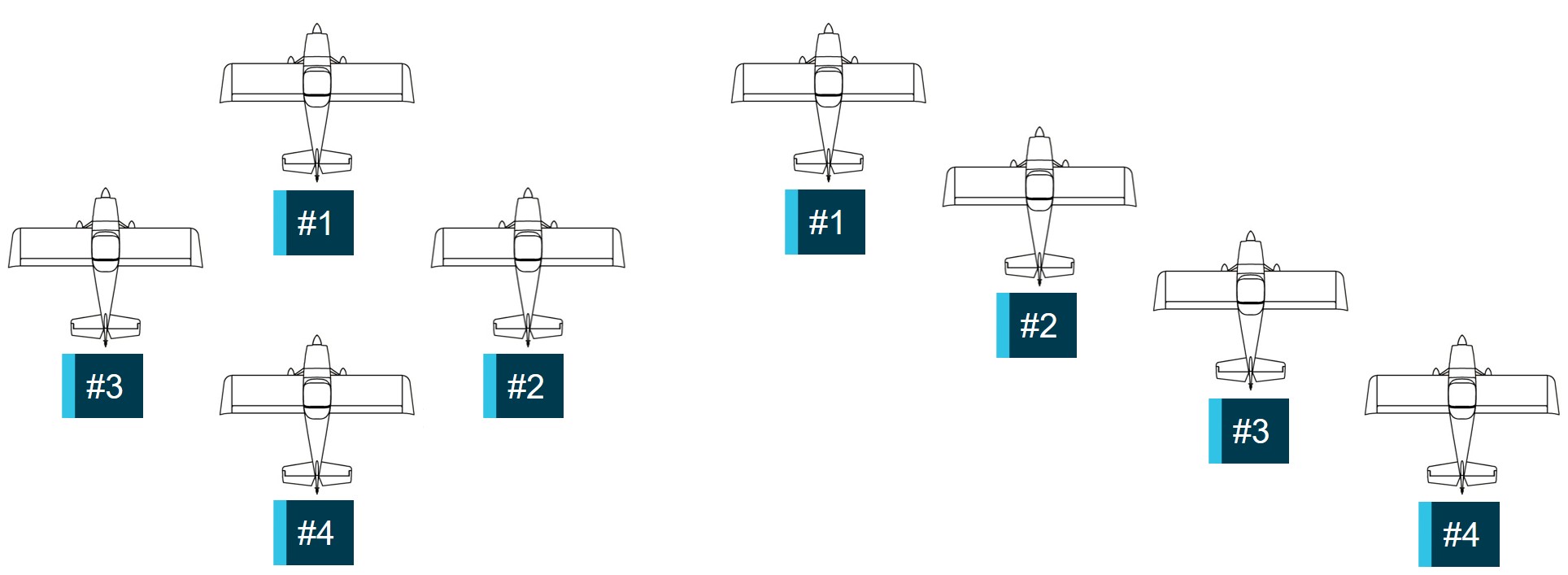
During its return, Acro Formation was in a box formation (as shown in Figure 1). VH-LMK was formation lead in position #1, VH-NMG in position #2, VH-EWS in position #3 and VH‑VNZ was in position #4.[1] At 1205:08, #1 broadcast on the Wedderburn common traffic advisory frequency that the formation was 10 NM (19 km) from Wedderburn. At 1209:14, the pilot of #1 directed #3 and #4 to move their aircraft into the echelon right formation (as shown in Figure 1) and the formation then descended to about 600 ft above ground level (AGL). This was to facilitate the planned stream landing after entering the Wedderburn circuit via an initial and pitch manoeuvre.[2]
Figure 1: Box (left) and echelon right (right) formations
Source: ATSB
At 1209:58, the pilot of #1 broadcast that the formation was joining crosswind for runway 35. Shortly after, the pilot waved at the formation to signal that they were about to turn and leave the formation. The pilot in #1 then commenced a climbing turn to join crosswind and establish the aircraft at the normal circuit height of 1,000 ft AGL. The remaining aircraft would follow, but with a 3 second delay between each aircraft.[3]
According to a nearby eyewitness who was watching the formation from outside a hangar at the aerodrome, each aircraft turned into the circuit after similar time delays. They recalled that #3 continued the turn, tighter than the previous aircraft, which put it onto a converging heading with #2. An overlay of the flight tracks from the available flight data for each aircraft showing the initial and pitch sequence is shown in Figure 2.
A generic low wing aircraft is displayed. Pitch, roll and yaw data was not available to accurately depict aircraft orientation. Source: Cesium and individual aircraft flight tracking data, annotated by the ATSB
At about 1210:09, #3 (VH-EWS) collided with #2 (VH-NMG) at about 1,140 ft AGL (Figure 3), and about 350 m south-east of the northern threshold of runway 35. From the collision, the rear fuselage of #3, just rearward of the baggage compartment, separated from the aircraft. Almost immediately, #3 descended rapidly and impacted terrain in a near vertical trajectory, fatally injuring the pilot. Aircraft #2 remained flyable and the pilot, who was not injured, was able to land the aircraft at the aerodrome and taxi off the runway.
Figure 3: Flight track of the formation showing the collision point between #3 (VH‑EWS, in blue) and #2 (VH-NMG, in yellow) at about 1210:09
A generic low wing aircraft is displayed. Pitch, roll and yaw data was not available to accurately depict aircraft orientation. Source: Cesium and individual aircraft flight tracking data, annotated by the ATSB
Context
Pilot information
VH-EWS
The pilot of VH-EWS held a Private Pilot Licence (Aeroplane), which had been issued in 2010. They held flight activity endorsements, which permitted them to conduct aerobatics above 500 ft AGL, spins, formation flying and formation aerobatics. They also held an instructor rating specifically for teaching spins and formation flying. The pilot held a class 2 aviation medical certificate with a requirement to wear distance vision correction and have reading correction available when flying, which was valid until February 2026.
Their most recent logbook and flying records could not be located after the accident. They were reported as being very experienced in general aviation activities and had held their formation endorsement since 2016. At the time of their most recent medical examination in February 2024, the pilot reported a total of 2,500 flying hours. Their last flight review was in December 2023 and was valid until February 2026.
VH-NMG
The pilot of VH-NMG held a Recreational Pilot Licence (Aeroplane) that was issued in 2022. They held flight activity endorsements, which permitted them to conduct aerobatics above 1,500 ft AGL, spins, formation flying and formation aerobatics. The pilot’s class 2 aviation medical certificate was valid until May 2026, however, it was not valid for night flying.
The pilot reported a total of 509 flying hours of which 331 hours were on Van’s RV-7 aircraft. Their last flight review was in April 2024 and was valid until April 2026.
Aircraft information
VH-EWS
VH-EWS was a Van’s RV-7 amateur-built aircraft with a manufacture date of 2012. It was a piston-engine, 2‑seat aircraft with a low wing, and tailwheel landing gear (Figure 4 left).
VH-NMG
VH-NMG was a Van’s RV-7A amateur-built aircraft with a manufacture date of 2009. It was similar to VH-EWS except that it had a tricycle landing gear (Figure 4 right).
Figure 4: VH-EWS (left) and VH-NMG (right)
Source: Reuben Morison (left) and Clinton J Down Photography (right) via www.Jetphotos.com, modified by the ATSB
Meteorological information
Weather
The other pilots in the formation reported that conditions were good, although there was some turbulence during their flight. They did not express any concerns that the conditions were not suitable for their flight. Closed circuit television footage obtained from a hangar at the aerodrome showed that the sky in the immediate vicinity was clear, with cloud well above the circuit height.
There was no Bureau of Meteorology forecast or observations for the aerodrome, however, the graphical area forecast[4] valid for the time and area of the flight did not indicate any weather phenomena that may have impacted visibility. Moderate turbulence was forecast below 6,000 ft above mean sea level.
The aerodrome had a weather station that recorded numerous parameters including wind speed and direction. At the time of the accident, average winds were below 10 kt and generally westerly. Cloud and visibility data were not recorded parameters.
Daylight
At the time of the accident, Geoscience Australia recorded the sun position at an elevation of 75° 16’ 34’’ and azimuth of 33° 59’ 04”.[5] This was high in the sky towards the north‑north‑east. The 3 remaining pilots reported that the sun position did not present an issue for their visibility.
Aerodrome information
Wedderburn was a non-controlled aeroplane landing area[6] located approximately 3 km south of Wedderburn township and 19 km to the south-east of Camden Airport, New South Wales. It had an elevation of 850 ft with a paved and adjacent grass runway aligned 17/35,[7] which was 980 m long. The aerodrome was privately owned and operated.
Recorded information
None of the aircraft were fitted with, nor were they required to have, a flight data recorder or cockpit voice recorder. However, flight tracking data was obtained for each aircraft, from sources including third party flight tracking providers, electronic flight bag applications and onboard avionics. Generally, this data included latitude, longitude, ground speed, course and altitude, at variable rates between 1 and 5 seconds.
Although the pilots of VH-EWS and VH-NMG had frequently flown with onboard video cameras, neither pilot did so during the accident flight, nor did the other pilots in the formation.
Common traffic advisory frequency recordings for Wedderburn were retrieved, however, the discrete frequency used during their formation flying was not recorded.
Closed circuit television footage from one of the nearby hangars captured VH-EWS descending rapidly just prior to it entering the tree canopy but did not capture the subsequent collision with terrain. Another camera captured the other aircraft in the formation landing at the aerodrome after the accident. The collision between the aircraft was not captured.
Wreckage and impact information
VH-EWS
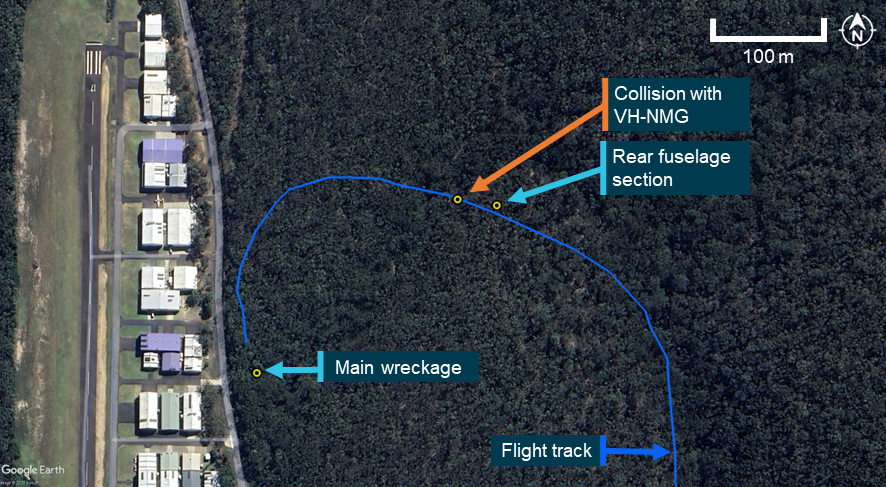
The main wreckage of VH-EWS was located in dense bush about 250 m west‑south‑west of the collision point. The rear fuselage was in similarly dense bush, 250 m north-east of the main wreckage (Figure 5).
Figure 5: VH-EWS wreckage site locations and its flight track adjacent to the aerodrome
Source: Google Earth, annotated by the ATSB
Observations of the site identified that the aircraft collided with trees prior to impacting terrain in a nose down attitude at an impact angle of about 65°. The main wreckage trail extended for about 5 m from the initial impact point towards the south. The aircraft was significantly disrupted, with the propeller buried into the earth at the point of impact (Figure 6).
Figure 6: VH-EWS main wreckage showing key parts of the aircraft
Source: ATSB
Due to the wreckage disruption a full flight control continuity check was not possible, but examination of the available controls did not identify any pre-collision defects. All aircraft parts were accounted for at the wreckage site. Examination of the propeller indicated that the engine was providing power at the time of impact.
The tail section showed damage consistent with contact with VH-NMG. Specifically, there was compression damage to the upper rudder and vertical stabiliser, and propeller strike marks from right to left at the rear fuselage separation point (Figure 7). The rear fuselage section was complete and there was no evidence of pre-collision defects in the flight controls or structure.
Figure 7: VH-EWS rear fuselage and tail assembly
Source: ATSB
VH-NMG
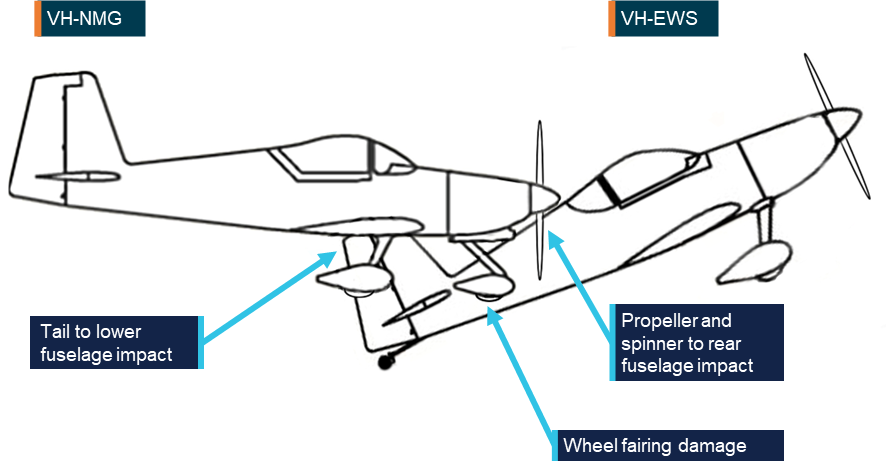
Examination of VH-NMG identified aircraft impact damage to the lower fuselage, nose wheel fairing, propeller blades and spinner. The lower fuselage damage consisted of skin and rib damage and a large intrusion into the aircraft structure just aft of the wing carry through structure and red paint transfer observed in several locations. The damage was consistent with the upper rudder and vertical stabiliser damage on VH-EWS with the orientation of the intrusion at about 30° left of VH-NMG’s longitudinal axis[8] (Figure 8). A flight control function check showed slight fouling of the ailerons and elevators due to the skin intrusion into the area of the flight controls.
Figure 8: VH-NMG lower fuselage and nose wheel fairing damage
Source: ATSB
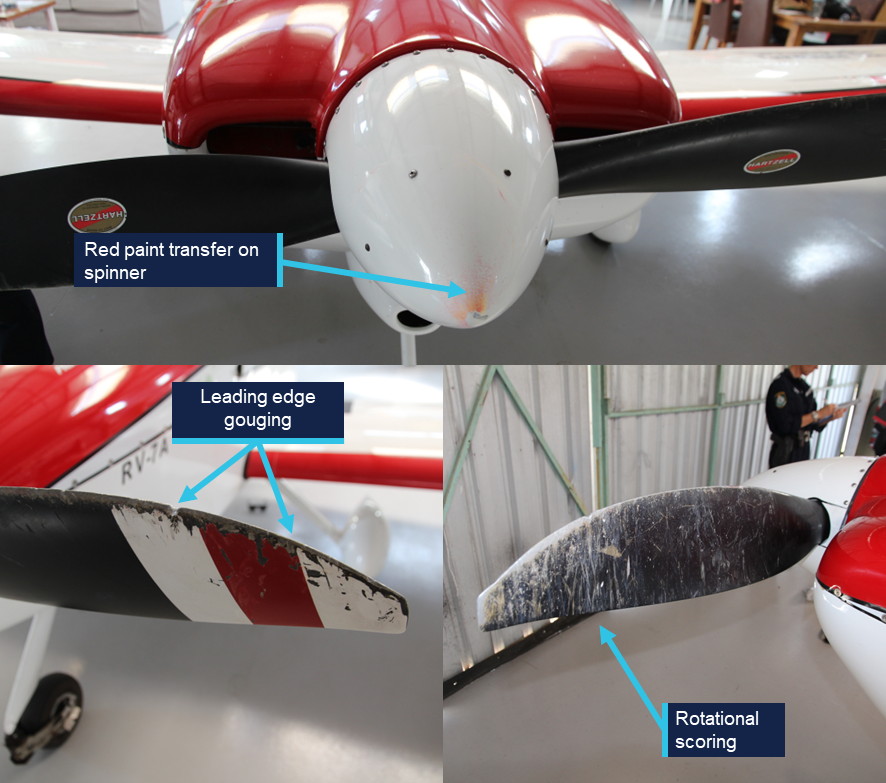
Examination of the propeller and its spinner showed leading edge gouges, rotational scoring, tip bending and red paint transfer that was consistent with VH-NMG striking VH‑EWS several times during the collision sequence (Figure 9).
Figure 9: VH-NMG propeller damage
Source: ATSB
Aircraft to aircraft impact alignment
An assessment of the aircraft impact damage identified that VH-EWS collided with VH‑NMG from below and slightly ahead. VH-EWS was likely in a nose up attitude and 30° nose left relative to VH-NMG. The vertical stabiliser from VH-EWS intruded into the lower fuselage of VH-NMG, and the propeller of VH-NMG cut through the rear fuselage of VH-EWS. A depiction of the impact alignment is shown at Figure 10.
Figure 10: Aircraft to aircraft relative impact alignment
Source: ATSB
Further investigation
The investigation is continuing and will include:
examination of maintenance records
examination of pilot records and training
consideration of formation flying procedures and practices
further analysis of recorded data.
A final report will be released at the conclusion of the investigation. Should a critical safety issue be identified during the course of the investigation, the ATSB will immediately notify relevant parties so appropriate and timely safety action can be taken.
Acknowledgements
The ATSB acknowledges the significant assistance provided by the NSW Police Force during the onsite phase of the investigation.
Purpose of safety investigations
The objective of a safety investigation is to enhance transport safety. This is done through:
identifying safety issues and facilitating safety action to address those issues
providing information about occurrences and their associated safety factors to facilitate learning within the transport industry.
It is not a function of the ATSB to apportion blame or provide a means for determining liability. At the same time, an investigation report must include factual material of sufficient weight to support the analysis and findings. At all times the ATSB endeavours to balance the use of material that could imply adverse comment with the need to properly explain what happened, and why, in a fair and unbiased manner. The ATSB does not investigate for the purpose of taking administrative, regulatory or criminal action.
About ATSB reports
ATSB investigation reports are organised with regard to international standards or instruments, as applicable, and with ATSB procedures and guidelines.
Reports must include factual material of sufficient weight to support the analysis and findings. At all times the ATSB endeavours to balance the use of material that could imply adverse comment with the need to properly explain what happened, and why, in a fair and unbiased manner.
An explanation of terminology used in ATSB investigation reports is available here. This includes terms such as occurrence, contributing factor, other factor that increased risk, and safety issue.
Publishing information
Released in accordance with section 25 of the Transport Safety Investigation Act 2003
Ownership of intellectual property rights in this publication
Unless otherwise noted, copyright (and any other intellectual property rights, if any) in this report publication is owned by the Commonwealth of Australia.
Creative Commons licence
With the exception of the Commonwealth Coat of Arms, ATSB logo, and photos and graphics in which a third party holds copyright, this report is licensed under a Creative Commons Attribution 4.0 International licence.
The CC BY 4.0 licence enables you to distribute, remix, adapt, and build upon our material in any medium or format, so long as attribution is given to the Australian Transport Safety Bureau.
Copyright in material obtained from other agencies, private individuals or organisations, belongs to those agencies, individuals or organisations. Where you wish to use their material, you will need to contact them directly.
[1]For ease of reference, each aircraft and/or pilot will be referred to by their formation position number.
[2]Initial and pitch: a circuit entry technique for formation flights. This involved flying an upwind leg, aligned with the landing runway, commencing from a predetermined position (initial). At about halfway along the runway, the lead aircraft in the formation will then turn onto the crosswind leg (pitch) with each aircraft following in succession with a set time delay between them. Once complete, there should be sufficient lateral separation between each aircraft as they continue in the circuit to land in succession (stream landing).
[3]The 3 second delay was reported by the surviving pilots as being their standard time delay for a formation initial and pitch manoeuvre.
[4]Graphical area forecast provides information on weather, cloud, visibility, icing, turbulence and freezing level in a graphical layout with supporting text.
[5]The elevation of the sun is the angle between the direction of the sun and the observer's local horizon. The azimuth is the angle between North, measured clockwise around the observer's horizon.
[6]An aeroplane landing area is an aerodrome that has not been certified by the Civil Aviation Safety Authority. These aerodromes are non-controlled, unregulated facilities. It is the responsibility of pilots and operators to determine whether these aerodromes are suitable for use.
[7]Runway number: the number represents the magnetic heading of the runway.
[8]The longitudinal axis of an aircraft runs from its nose to its tail.
Occurrence summary
Investigation number
AO-2025-071
Occurrence date
30/11/2025
Occurrence time and timezone
12:10 Australian Eastern Daylight Time
Location
Near Wedderburn aeroplane landing area
State
New South Wales
Report status
Preliminary
Anticipated completion
Q3 2026
Investigation level
Short
Investigation type
Occurrence Investigation
Investigation phase
Examination and analysis
Investigation status
Active
Mode of transport
Aviation
Aviation occurrence category
Collision
Occurrence class
Accident
Highest injury level
Fatal
Aircraft details
Manufacturer
Amateur Built Aircraft
Model
Van's RV-7
Registration
VH-EWS
Serial number
73226
Sector
Piston
Operation type
Part 91 General operating and flight rules
Activity
General aviation / Recreational-Sport and pleasure flying-Aerobatics
Departure point
Wedderburn Aircraft Landing Area, New South Wales
Destination
Wedderburn Aircraft Landing Area, New South Wales
Injuries
Crew - 1 (fatal)
Damage
Destroyed
Aircraft details
Manufacturer
Amateur Built Aircraft
Model
Van's RV-7A
Registration
VH-NMG
Serial number
73232
Sector
Piston
Operation type
Part 91 General operating and flight rules
Activity
General aviation / Recreational-Sport and pleasure flying-Aerobatics
The ATSB is investigating a midair collision involving two Van’s RV-7 light aircraft at Wedderburn, south of Sydney, on Sunday.
As reported to the ATSB, the two aircraft had been involved in a formation flight of four aircraft that was returning to land at Wedderburn Airport when the collision occurred. One of the aircraft involved in the collision landed safety but the other aircraft collided with terrain and its pilot was fatally injured.
A team of four transport safety investigators from the ATSB's Perth, Canberra and Brisbane offices, with experience in aircraft operations, maintenance and engineering, is preparing to deploy to the accident site to begin evidence-collecting activities.
Over coming days, investigators will undertake site mapping, examine aircraft wreckage and damage, and recover any relevant components for further examination at the ATSB’s technical facilities in Canberra.
Investigators will also interview the other pilots involved in the formation flight, as well as other witnesses and involved parties. They will also collect relevant recorded information including any air traffic control and flight tracking data, as well as pilot and aircraft maintenance records, and weather information.
The ATSB asks anyone who may have witnessed and has footage of the accident, or who has footage of either aircraft in any phase of their flights, to contact us via the witness form on our website at their earliest convenience.
The ATSB will release a preliminary report detailing factual information established in the investigation’s evidence-gathering phase in about two months. A final report will be released at the conclusion of the investigation and will detail analysis and findings.
However, if at any point during the investigation we uncover any critical safety issues we will immediately inform relevant parties so they can take safety actions.
On 23 November 2025, the pilot of a Van’s RV-8, registered VH-YGY, took off from the main runway of an aircraft landing area on private property about 41 km west of Gladstone, Queensland.
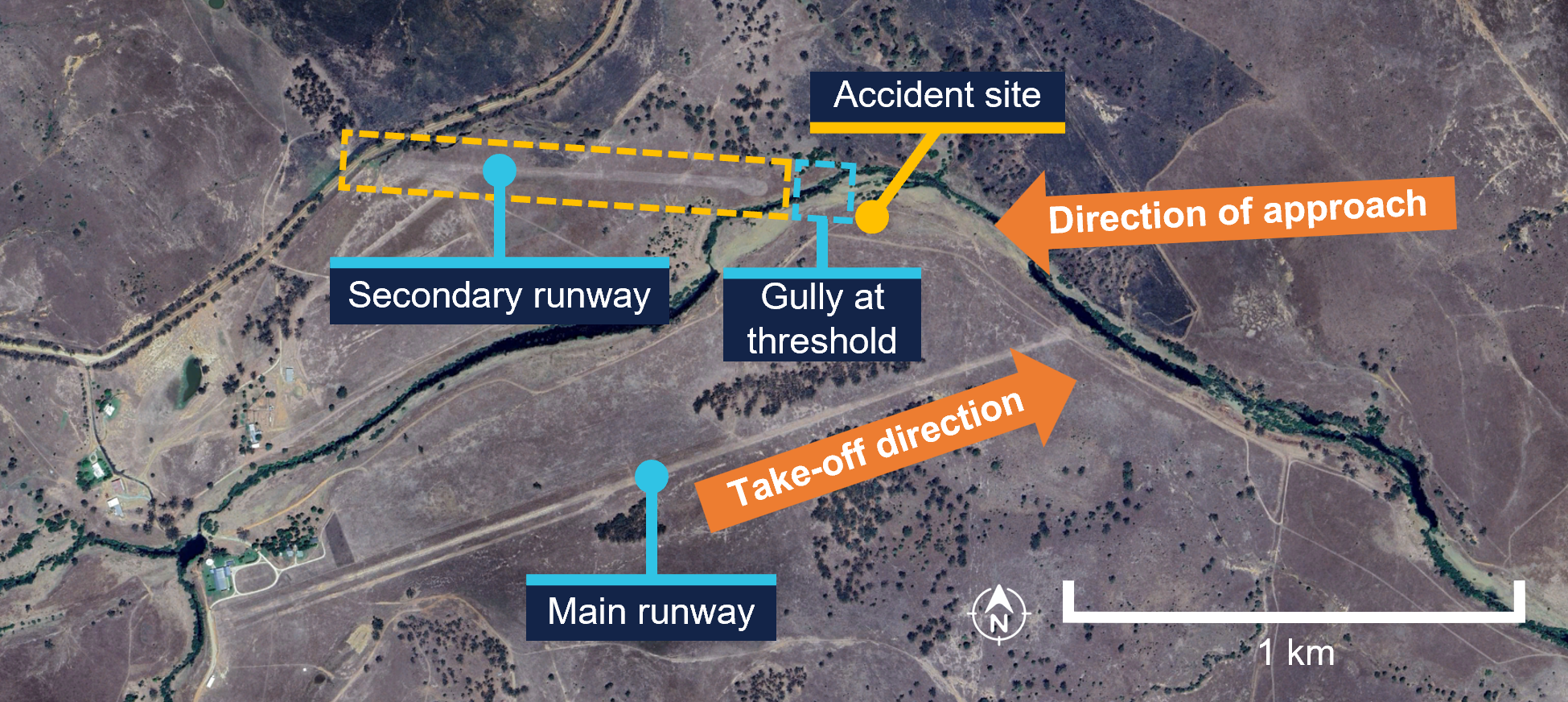
After take-off, there was an issue that resulted in the engine failing in flight, and the pilot attempted to return with the reported intention to land on the secondary runway. Concerned that the aircraft would not make the secondary runway with a deep gully at its threshold, the pilot conducted a forced landing into a nearby paddock.
Fire broke out as the aircraft slid to a stop against a fallen tree. The pilot was seriously injured and extricated themselves from the aircraft, then crawled about 2 km to the property owner’s home where emergency services were notified.
What the ATSB found
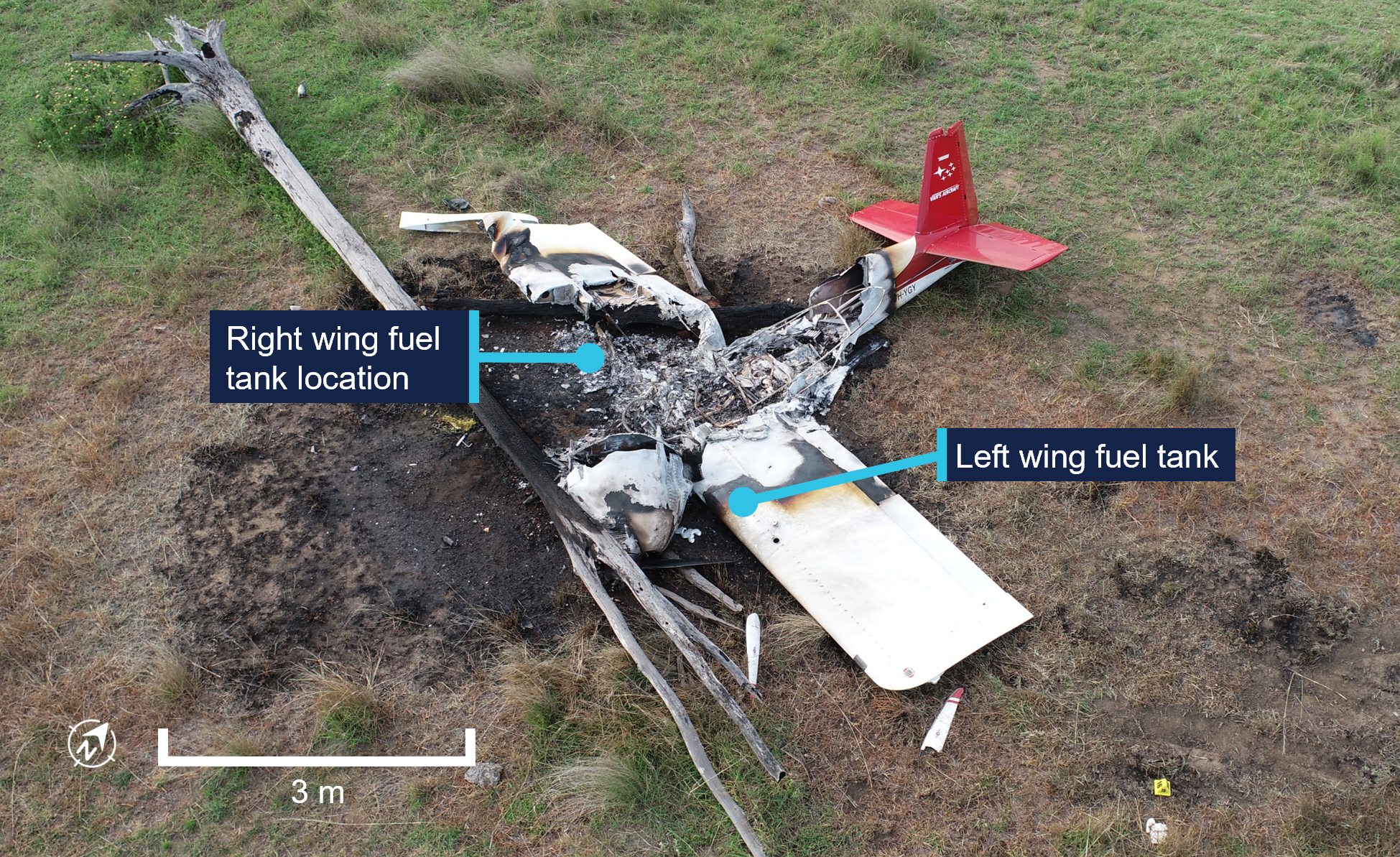
As a result of the aircraft's rate of descent, the impact forces acting on it during the forced landing caused one or both wing fuel tanks to be breached, which intensified, and likely led to, the post‑impact fire.
The fire destroyed most of the aircraft’s engine, cabin, wings, and fuselage which limited the extent to which pre-impact defects could be identified. Because of this, the reason for the aircraft’s engine failing in flight could not be established.
Safety message
Managing a partial power loss or total engine failure during or after take-off increases stress and uncertainty at a time when a pilot’s workload is already high. Pre-flight planning of what actions could be taken should an emergency occur can assist in reducing the pilot’s mental workload and increase the likelihood of a successful recovery. The 2013 ATSB educational publication Avoidable Accidents No. 3: Managing partial power loss after take-off in single-engine aircraft (AR‑2010‑055) provides helpful pilot advice on this topic.
The ATSB SafetyWatch highlights the broad safety concerns that come out of our investigation findings and from the occurrence data reported to us by industry. One of the safety concerns is reducing the severity of injuries in accidents involving small aircraft. A 5-point restraint was likely being worn by the pilot and in several of its investigations, the ATSB has found injuries to aircraft occupants have been avoided, or made less severe, through the appropriate use of multi-point harnesses. Additionally, selection of clothing that is more flame resistant and with more coverage can reduce the severity of burns and offer protection during extrication from a crashed aircraft.
The investigation
The ATSB scopes its investigations based on many factors, including the level of safety benefit likely to be obtained from an investigation and the associated resources required. For this occurrence, the ATSB conducted a limited-scope investigation in order to produce a short investigation report, and allow for greater industry awareness of findings that affect safety and potential learning opportunities.
The occurrence
On the morning of 23 November 2025 at about 0900, the pilot (who was the sole occupant) of a Van’s RV-8, registered VH-YGY, took off heading 060° from the main runway of Old Station1 aircraft landing area (ALA), which is located about 41 km west of Gladstone, Queensland, on private property.
The pilot spoke to the property owner immediately after the accident. According to the property owner, the pilot said that after take-off the engine lost some power and subsequently failed. The pilot later recalled that the engine failed suddenly, without being preceded by a partial power loss.2
The pilot attempted to return to Old Station with the intention to land on the secondary runway (heading 260°). Out of concern that the aircraft would not make the secondary runway and because of a deep gully at its threshold, the pilot made a forced landing into a nearby paddock (Figure 1).
Figure 1: Take-off and approach directions
Source: Google Earth, annotated by the ATSB
The pilot recalled that they sideslipped the aircraft nose left to reduce the aircraft’s energy just before colliding with terrain. The impact forces on the aircraft during the forced landing collapsed the landing gear and one or both wing fuel tanks were breached. Fire broke out as the aircraft slid to a stop against a fallen tree (see Wreckage and impact information). The aircraft was destroyed in the impact and intense fuel-fed fire.
The pilot was seriously injured with a spinal injury and burns. The pilot reported difficulty opening the aircraft canopy, but they extricated themselves from the aircraft, then crawled about 2 km to the property owner’s home where emergency services were notified. There were no witnesses to the flight or the accident.
Context
Pilot information
The pilot was issued with an Australian Private Pilot Licence (Aeroplane) in 1983 and held a current Civil Aviation Safety Regulation Part 61 Private Pilot Licence (Aeroplane) (PPL). The pilot held a valid class 2 civil aviation medical certificate with no restrictions and was required to wear vision correction when flying.
Aircraft information
The Van’s Aircraft RV-8 is a low-wing, all-metal, amateur-built aircraft. It is supplied in kit form and is designed to be constructed for the education and recreation of the owner. The RV-8 has 2 seats in tandem configuration and is suitable for cross-country flying or for flying aerobatic manoeuvres.
Construction of VH-YGY, serial number 80605, was carried out by the pilot of the accident flight and was first registered on 7 July 2010 and issued with a special certificate of airworthiness. The airworthiness category of this certificate was experimental. The aircraft was fitted with a 6‑cylinder, horizontally opposed Eggenfellner E6 engine using automotive 98 octane fuel. The basis of this engine was an automotive Subaru engine with additions and modifications for aircraft use. The aircraft was fitted with a Quinti Avio QA4SE 4‑blade electric constant-speed propeller.
Recent maintenance
As VH-YGY had been constructed by the pilot and the airworthiness category of the special certificate of airworthiness was experimental, the pilot was permitted to carry out their own maintenance on the aircraft.
According to people familiar with the pilot and aircraft, the aircraft had reportedly been difficult to start in the time recent to the accident. On 20 November 2025 at Caboolture Aerodrome, the pilot replaced the fuel pressure regulator fitted to VH-YGY with a new part. The new fuel pressure regulator was an automotive engine part and used to maintain fuel pressure to the engine at 40 psi. The ATSB was unable to determine the exact part used.
The pilot was observed taxiing VH-YGY at Caboolture Aerodrome on 21 November 2025, and on 22 November 2025 flew the aircraft from Caboolture Aerodrome to Old Station ALA.
Meteorological information
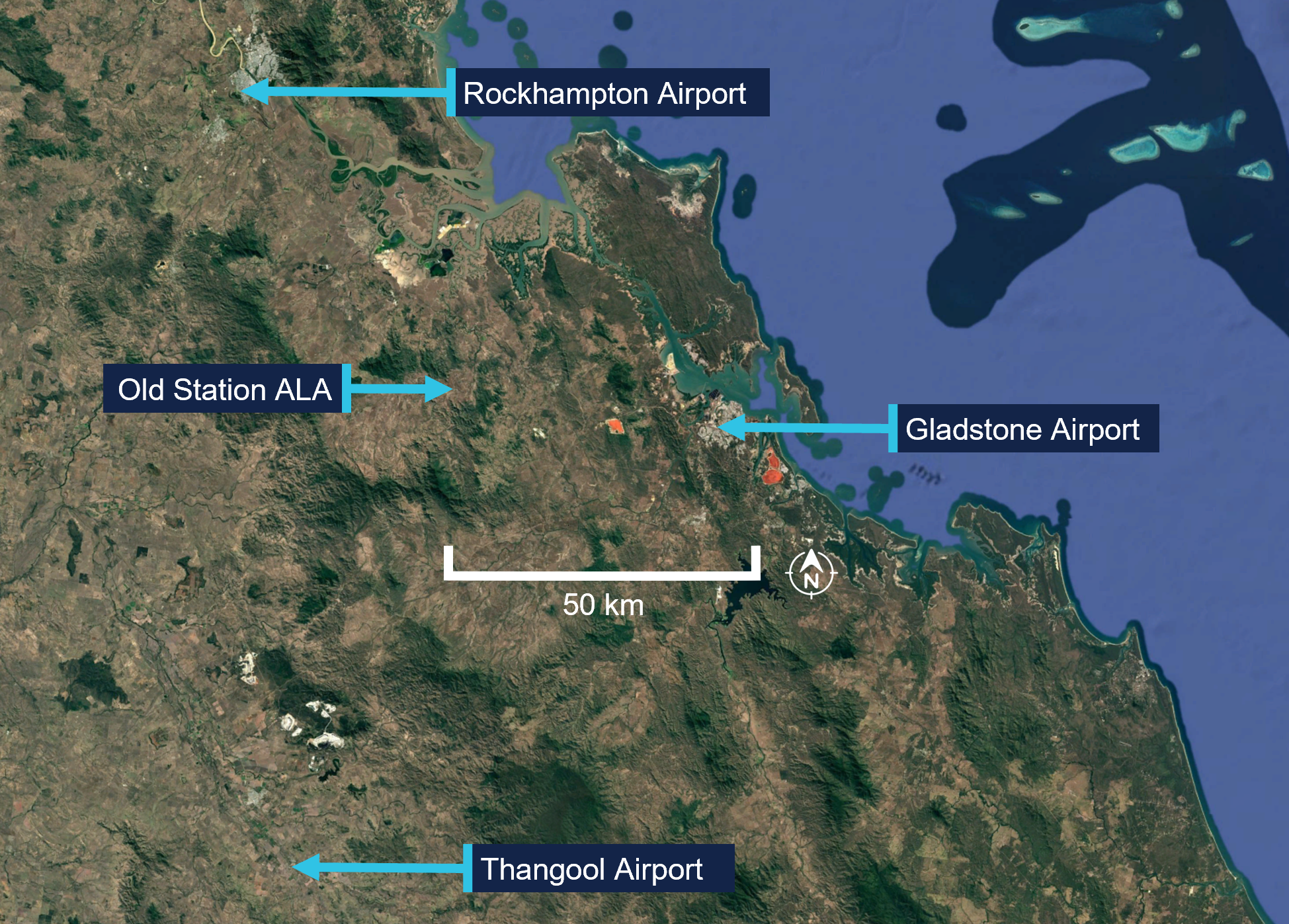
The weather at the aerodrome was reported to be clear with light winds. There were no official weather observations available for Old Station ALA. The nearest official data was obtained from Gladstone Airport located 41 km to the east, Rockhampton Airport located 60 km north-west, and Thangool Airport 78 km south‑south‑west of the property (Figure 2).
Figure 2: Locations of weather observations
Source: Google Earth, annotated by the ATSB
The meteorological aerodrome report (METAR)3 for Gladstone Airport at 0900 reported wind from the north‑east (030°) at 7 kt, visibility greater than 10 km and no cloud detected. There was no rainfall recorded in the previous 24 hours.
The METAR for Rockhampton Airport at 0900 reported a mean wind from the east (080°, varying between 050° and 110°) at 6 kt, visibility greater than 10 km and few clouds at 2,700 AGL. There was no rainfall recorded in the previous 24 hours.
Wreckage and impact information
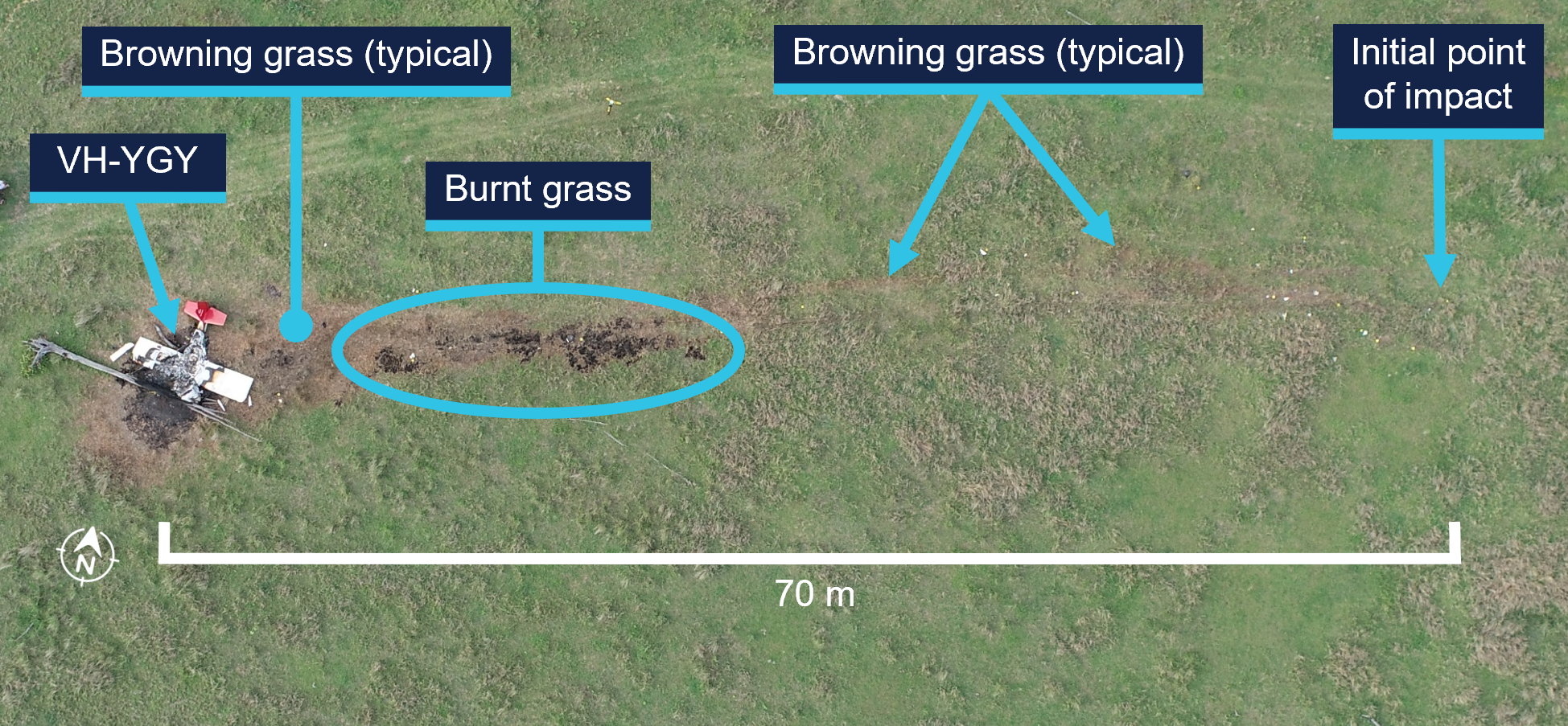
The accident site was located in open farmland that was flat and slightly sloping down toward the west. The aircraft slid for about 70 m before coming to rest against a fallen tree. As evidenced by post-accident browning of the grass, fuel had been liberated from one or both of the wing fuel tanks from about 7 m from the initial point of impact until where the aircraft came to rest. The grass in the path of the aircraft was burnt in places about 45 m from the initial point of impact and around the aircraft (Figure 3).
Figure 3: Accident site overview
This image was taken on the day of the accident; the browning grass was more prominent in the days following. Source: Queensland Police, annotated by the ATSB
There was no fuel remaining in the aircraft’s fuel tanks suitable for testing. The aircraft’s engine, cabin, wings and fuselage were mostly destroyed by the fire, limiting the extent to which pre-impact defects could be identified (Figure 4).
Figure 4: VH-YGY at the accident site
Note: the left-wing fuel tank cap was removed by first responders for fire suppression. Source: Queensland Police, annotated by the ATSB
However, from the evidence available, the following could be established:
Fragmentation and the position of a propeller blade (1 of 4) indicated that the engine was not running at impact.
Both main landing gear axles, brakes and wheel assemblies had separated from the main landing gear legs which in turn had collapsed under the aircraft.
The wing/fuselage structure and engine mounting frame was buckled by impact forces.
The flap actuator extension was consistent with the flaps being close to, or fully, retracted.
Numerous engine components were destroyed by the fire. This included wiring, flexible hoses and fuel system components. The fuel pressure regulator that had been replaced 3 days prior to the accident was not identified (or any remnants of it) at the accident site or during a follow-up aircraft and engine inspection conducted by the ATSB.
The following avionics were recovered from the accident site and transported to the ATSB Canberra technical facility:
Dynon EFIS-D100 (flight instrumentation)
Garmin aera 500 (global positioning system)
GRT Avionics EIS 6000 (engine information display)
SDS LCD Programmer (engine management).
Recovery of data was not possible because of the extent that they were damaged by fire.
Survival aspects
When assessing the survivability of an aircraft accident, a number of aspects are considered, including:
occupant restraints
forces imparted on the aircraft occupants
liveable space inside the aircraft being maintained
post-impact fire.
The aircraft was fitted with a 5-point4 restraint which was likely being worn by the pilot on the accident flight.
The damage to the main landing gear axle, brake and wheel assemblies along with the main landing gear legs was indicative of high deceleration forces on impact. It was not able to be determined whether the forward cockpit liveable space was reduced to a point where it injured the pilot or hindered their escape.
The pilot was reportedly wearing shorts and a t-shirt.
The aircraft had 2, 80 litre fuel tanks integral5 to the inboard leading edge of each wing. The aircraft was also fitted with optional wing tip fuel tanks, however they were not carrying fuel on the day of the accident. Flexible fuel tanks were not available for the RV‑8.
In 2022, the ATSB investigated a collision with terrain involving a Cessna U206G, west of Norseman, Western Australia, on 3 March 2022.6 The investigation noted that:
Metal fuel tanks are prone to rupturing during an accident impact, allowing fuel to escape and increasing the risk of a post‑impact fire. To improve crashworthiness, the addition of fuel bladders and fuel cells that have been constructed of flexible materials have proven less prone to rupturing during an impact. They are able to withstand greater deformation and puncture less readily and are less likely to expand or tear to form a larger opening from which fuel can escape. Such systems may provide occupants with more time to egress the aircraft and/or reduce the risk of any fire‑related injury.
Partial power loss or engine failure after take-off
During a normal take-off, a pilot’s workload is already high, and in the event of a partial power loss, or total engine failure, the pilot must decide actions to safely recover the aircraft under conditions of stress and uncertainty. Pre-flight planning for a partial or total engine power loss on take-off can help to reduce the pilot’s mental workload in the event of one occurring.
The 2013 ATSB educational publication Avoidable Accidents No. 3: Managing partial power loss after take-off in single-engine aircraft (AR-2010-055) contains the following pre-flight planning considerations should an aircraft suffer a power loss after take‑off (ATSB 2013):
the runway direction and the best direction of any turn
the local wind strength and direction on a particular day
terrain and obstacles
decision points (with regard to aircraft height and performance) where different landing options could be taken, such as:
landing on the remaining runway or aerodrome
landing outside the aerodrome
conducting a turn back towards the aerodrome.
In the event of an engine failure or power loss at a low height, pilots are advised to land straight ahead, or within 30º either side of that heading (Aviation Theory Centre, 2009). Pilots are also advised to only consider a turnback manoeuvre if they have achieved a minimum height, which varies depending on the aircraft type and other factors.
Safety analysis
Engine power loss
There was a difference between the property owner’s recollection of the pilot’s statements soon after the accident, and subsequent recollection by the pilot, as to whether the engine initially lost some power after take-off before stopping completely. Nevertheless, damage to the propeller was consistent with the engine having stopped prior to the point of impact.
The fuel and engine systems of VH-YGY were comprised of numerous components, and a failure of one or more of these components could have contributed to the engine failing in‑flight. The ATSB was unable to determine any reasons for this as the post‑impact fire had damaged or destroyed most of these systems. Of the components that remained, no overt defects were identified. The aircraft had reportedly been difficult to start in the past, but it is not known if the pilot had any issues starting the engine on the day of the accident.
The fuel pressure regulator had been replaced 3 days prior to the accident, and the ATSB considered the possibility of a defect associated with the component’s serviceability or an error in its fitment. The fuel pressure regulator or any remnants of it were not identified in the aircraft wreckage, and it is likely that it had been destroyed during the post-impact fire. Therefore, no conclusions regarding its serviceability or security could be drawn.
Forced landing
Following a complete engine failure, a forced landing is inevitable, whereas in a partial power loss, pilots are faced with making a difficult decision whether to continue flight or to conduct an immediate forced landing. The pilot decided to turn back to the secondary runway of Old Station ALA, as they likely believed this was achievable, based on the circumstances at the time. After they assessed that this was no longer possible and with the onset of the deep gully at the threshold of the runway, the pilot was compelled to make an immediate forced landing.
The forces on the aircraft’s structure because of its rate of descent during the forced landing buckled the wing/fuselage structure, liberated both main landing gear axle, brake and wheel assemblies, collapsed the landing gear, and caused one or both wing fuel tanks to be breached, which intensified the post-impact fire.
The effectiveness of the pilot’s attempt to reduce the aircraft’s energy immediately ahead of the impact could not be determined. Lowering the flaps could have slowed the aircraft for landing, potentially lessening impact damage, although it was not determined if the pilot had time to do so.
Protective clothing
There are no regulatory requirements for the selection of clothing on private or other flights. However, selection of clothing that is more flame resistant and with more coverage can reduce the severity of burns and offer protection during extrication from a crashed aircraft. Fibres such as cotton, flax, nylon, and polyester burn more easily than fibres such as wool and aramids7 which are more flame‑resistant (Silva-Santos and others 2017).
The shorts and t-shirt worn by the pilot on the day of the accident would have offered less protection than a long sleeve shirt and trousers, however it was not determined whether this contributed to the severity of their injuries. While personal preference and comfort are obvious factors in the selection of clothing when flying, consideration should be given to the clothing’s fire resistance and coverage.
Findings
ATSB investigation report findings focus on safety factors (that is, events and conditions that increase risk). Safety factors include ‘contributing factors’ and ‘other factors that increased risk’ (that is, factors that did not meet the definition of a contributing factor for this occurrence but were still considered important to include in the report for the purpose of increasing awareness and enhancing safety). In addition ‘other findings’ may be included to provide important information about topics other than safety factors.
These findings should not be read as apportioning blame or liability to any particular organisation or individual.
From the evidence available, the following findings are made with respect to the forced landing and collision with terrain involving Van's RV-8, VH-YGY, 40 km west of Gladstone Airport, Queensland, on 23 November 2025.
Contributing factors
After take-off, there was an undetermined issue that resulted in the engine failing in flight.
During the forced landing, impact forces as a result of the aircraft's rate of descent collapsed the landing gear, buckled the wing/fuselage structure and caused one or both wing fuel tanks to be breached, which intensified the post-impact fire.
Sources and submissions
Sources of information
The sources of information during the investigation included the:
property owner
associates of the pilot who were familiar with the aircraft
Australian Transport Safety Bureau (2025). Collision with terrain involving Cessna U206G, VH-JVR 124 km west of Norseman, Western Australia, on 3 March 2022 (AO‑2022-011). https://www.atsb.gov.au/investigations/ao-2022-011
Robson, D., Dyer, J. (2009) Flying training manual. A basic pilot training programme (pp 263–264). Aviation Theory Centre.
Silva-Santos MC, Oliveira MS, Giacomin M, Laktim MC and Baruque Ramos J (2017). Flammability on textile of flight crew professional clothing. IOP Conference Series: Materials Science and Engineering.
Submissions
Under section 26 of the Transport Safety Investigation Act 2003, the ATSB may provide a draft report, on a confidential basis, to any person whom the ATSB considers appropriate. That section allows a person receiving a draft report to make submissions to the ATSB about the draft report.
A draft of this report was provided to the following directly involved parties:
pilot
property owner
Civil Aviation Safety Authority.
A submission was received from the pilot.
The submission was reviewed and, where considered appropriate, the text of the report was amended accordingly.
Purpose of safety investigations
The objective of a safety investigation is to enhance transport safety. This is done through:
identifying safety issues and facilitating safety action to address those issues
providing information about occurrences and their associated safety factors to facilitate learning within the transport industry.
It is not a function of the ATSB to apportion blame or provide a means for determining liability. At the same time, an investigation report must include factual material of sufficient weight to support the analysis and findings. At all times the ATSB endeavours to balance the use of material that could imply adverse comment with the need to properly explain what happened, and why, in a fair and unbiased manner. The ATSB does not investigate for the purpose of taking administrative, regulatory or criminal action.
About ATSB reports
ATSB investigation reports are organised with regard to international standards or instruments, as applicable, and with ATSB procedures and guidelines.
Reports must include factual material of sufficient weight to support the analysis and findings. At all times the ATSB endeavours to balance the use of material that could imply adverse comment with the need to properly explain what happened, and why, in a fair and unbiased manner.
An explanation of terminology used in ATSB investigation reports is available here. This includes terms such as occurrence, contributing factor, other factor that increased risk, and safety issue.
Publishing information
Released in accordance with section 25 of the Transport Safety Investigation Act 2003
Ownership of intellectual property rights in this publication
Unless otherwise noted, copyright (and any other intellectual property rights, if any) in this report publication is owned by the Commonwealth of Australia.
Creative Commons licence
With the exception of the Commonwealth Coat of Arms, ATSB logo, and photos and graphics in which a third party holds copyright, this report is licensed under a Creative Commons Attribution 4.0 International licence.
The CC BY 4.0 licence enables you to distribute, remix, adapt, and build upon our material in any medium or format, so long as attribution is given to the Australian Transport Safety Bureau.
Copyright in material obtained from other agencies, private individuals or organisations, belongs to those agencies, individuals or organisations. Where you wish to use their material, you will need to contact them directly.
^Old Station ALA has 2 grass runways–the main runway is oriented 060°/240° magnetic and a shorter, secondary runway is oriented 080°/260° magnetic.
^The pilot was not interviewed by the ATSB, and later provided comment on the draft report regarding the sequence of events.
^METAR (meteorological aerodrome report) is a routine aerodrome weather report issued at half-hourly time intervals. The report ordinarily covers an area of 8 km radius from the aerodrome reference point.
^A 5-point harness is a 4-point harness with an additional crotch strap that prevents ‘submarining’, in which the occupant slides down under the lap belt.
^A fuel tank that is formed by coating a space within the aircraft wing’s internal structure with sealant.
^Collision with terrain involving a Cessna U206G, VH-JVR, 124 km west of Norseman, Western Australia, on 3 March 2022 (AO-2022-011).
^Aramids are a range of synthetic fibres that are heat and fire‑resistant. A common use in aviation is an aramid known as Nomex which is used for fire‑resistant clothing for flight crews.
Occurrence summary
Investigation number
AO-2025-068
Occurrence date
23/11/2025
Occurrence time and timezone
09:00 Australian Eastern Standard Time
Location
40 km west of Gladstone Airport
State
Queensland
Report release date
29/05/2026
Report status
Final
Investigation level
Short
Investigation type
Occurrence Investigation
Investigation phase
Final report: Dissemination
Investigation status
Completed
Mode of transport
Aviation
Aviation occurrence category
Collision with terrain, Engine failure or malfunction, Forced/precautionary landing
Occurrence class
Accident
Highest injury level
Serious
Aircraft details
Manufacturer
Van's Aircraft
Model
RV-8
Registration
VH-YGY
Serial number
80605
Sector
Piston
Operation type
Part 91 General operating and flight rules
Activity
General aviation / Recreational-Unknown general aviation flying
On 15 and 23 November 2025 respectively, the pilots of the Robinson Helicopter Company R22 helicopters, registered VH-8H8 and VH-HFQ, each experienced abnormal in-flight indications immediately ahead of a rapid decay in main rotor speed.
Each pilot initiated autorotation and both aircraft subsequently landed hard. This resulted in significant damage to the helicopters, one of which was subsequently destroyed by post-impact fire after dry grass under the helicopter ignited. However, none of the occupants of either helicopter were seriously injured. Both occurrences were reported to the ATSB as suspected rotor drive belt (v-belt) failures.
What the ATSB found
The ATSB found that the occurrence involving VH-8H8 was consistent with drive belt failure. It was very likely that the forward belt became incorrectly engaged (misaligned) in the drive sheaves on startup, leading to rapid wear and failure, which then likely impacted and contributed to failure of the rear belt. The factors contributing to the belt misalignment were not determined.
The occurrence involving VH-HFQ was also likely to have been the result of failure of the drive belts. However, due to an absence of evidence the mechanism of failure was not determined.
Prior to the occurrences, both maintainers reported several instances of Robinson R22 drive belts requiring replacement at low hours due to stretching beyond allowable limits. While this appeared to be the case, any reasons for it were not determined, and the ATSB was unable to identify a broader issue.
Safety message
While the factors contributing to these occurrences were not fully determined, pilots should remain vigilant with pre-flight inspections, particularly around drive belt slack and alignment prior to startup.
Pilots should be prepared to take appropriate precautionary or emergency actions per the pilot operating handbook in the event of abnormal clutch light indications, and/or unusual noise, vibrations or smells that may precede drive belt failure, or if one or both belts fail with limited warning. The instruction for pilots to ‘immediately lower collective to enter autorotation’ is of prime importance in low-inertia rotor systems, such as that in the R22. Main rotor RPM can rapidly decay, and any delay in initiating emergency actions could significantly affect the pilot’s ability to conduct an effective autorotation landing, particularly at low altitudes where there is limited rotor recovery time.
The ATSB continues to encourage aircraft operators and maintainers to report technical component or system issues through the Civil Aviation Safety Authority defect reporting service (DRS). Doing so will assist authorities in understanding the magnitude of any issues and to take action where appropriate.
The investigation
The ATSB scopes its investigations based on many factors, including the level of safety benefit likely to be obtained from an investigation and the associated resources required. For this occurrence, the ATSB conducted a limited-scope investigation in order to produce a short investigation report, and allow for greater industry awareness of findings that affect safety and potential learning opportunities.
The occurrences
Overview
In November 2025, the ATSB received 2 notifications of suspected rotor drive belt (v‑belt) failures involving Robinson Helicopter Company (RHC) R22 helicopters, registered VH-8H8 and VH-HFQ. Both resulted in hard landings, however none of the occupants were seriously injured. The helicopters had different operators and different maintainers.
VH-8H8, 15 November 2025
On the morning of 15 November 2025, the pilot of VH-8H8 was preparing for a flight around Argadargada Station, Northern Territory, to check on bores and stock.
The pilot conducted the pre-flight checks, which included a physical assessment of the drive belt slack, per the R22 pilot operating handbook (see Pre-flight and startup checks). The pilot expressed a concern to the operator’s senior pilot that the belts may have been slightly loose. The senior pilot then also conducted a physical inspection of the belts and assessed that the belt tension was acceptable and consistent with their other helicopters.
At approximately 0820, the helicopter took off with the pilot and a passenger on board. The pilot reported that the helicopter was operating normally. They noted that the clutch light flickered briefly during the flight, but nothing that they considered to be irregular or abnormal.
Around 10 to 15 minutes after take-off, while the helicopter was in cruise flight at a height of around 300 ft, the pilot smelled burning rubber. About 2 seconds later, they heard a ‘bang’. The pilot’s attention was immediately drawn to a sharp increase in engine RPM, and was initially focused on that, before noticing that the main rotor RPM had decayed to about 90%. On recognising that, the pilot lowered the collective1 to initiate autorotation,2 during which the main rotor RPM began to recover.
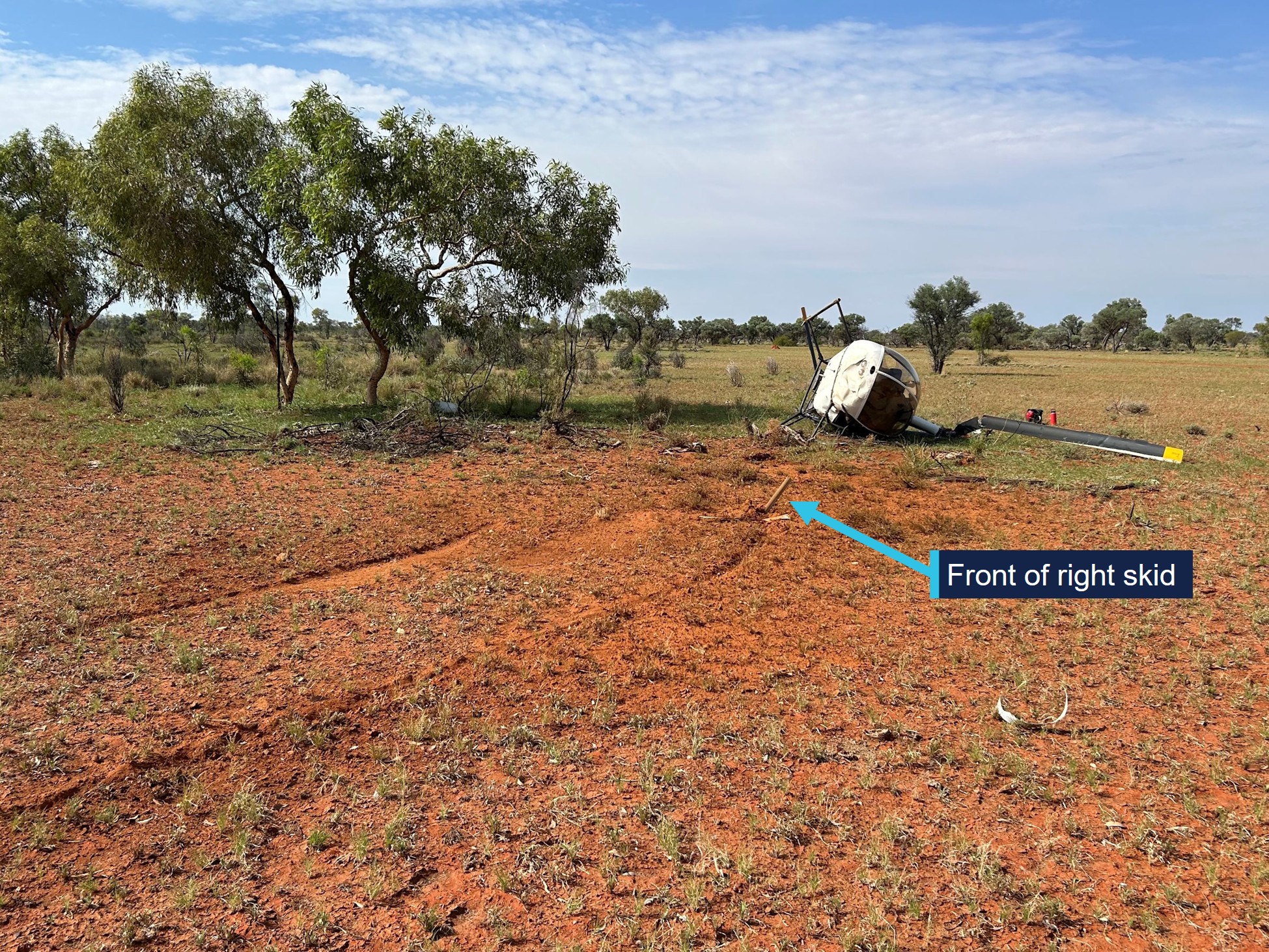
The pilot manoeuvred the helicopter from its initial downwind heading, back into the wind and towards an open space for landing. The helicopter impacted the ground with significant forward speed, and the skid on the pilot side dug into the ground, which caused the helicopter to roll over before coming to a stop (Figure 1). There was no post‑impact fire.
Figure 1: VH-8H8 accident site
Source: Helicopter operator, annotated by the ATSB
The pilot shut down the engine before extracting themself and assisting the passenger from the wreckage. The pilot then radioed for assistance, before turning off the emergency locator beacon, which had activated during the accident. The pilot observed that the skids had spread significantly from the ground impact and that the passenger’s seat base had compressed. Additionally, the pilot noted that one drive belt had snapped and the other was separated into several pieces.
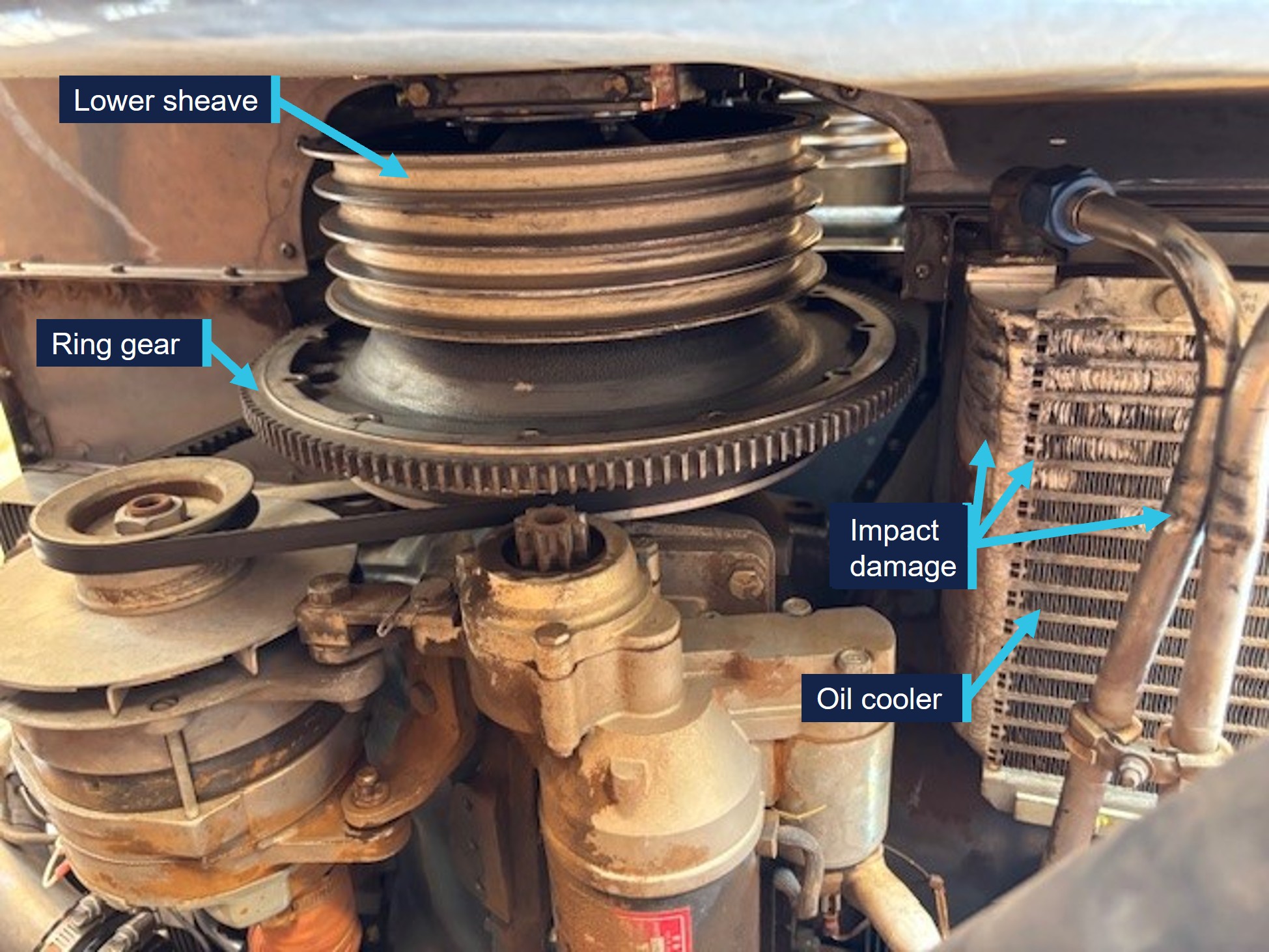
Subsequent examination of the helicopter by the operator showed additional evidence of in-flight drive belt failure, including an accumulation of black dust on the engine starter ring gear support (to which the lower drive sheave is connected), and rubber marks and impact damage to the oil cooler and feed lines adjacent to the belt drive (Figure 2).
Source: Helicopter operator, annotated by the ATSB
VH-HFQ, 23 November 2025
On 23 November 2025, at around 1030, the pilot and sole occupant of VH-HFQ departed on a point-to-point flight from Mount Surprise to Chillagoe Aerodrome, Queensland. Prior to departing, the pilot conducted a pre-flight inspection of the helicopter, including an inspection of the drive belts. No defects were observed. The pilot reported that it was a very hot day, at around 37°C.
Approximately 30 minutes into the flight, while the helicopter was cruising at around 550 ft, the pilot heard a loud slapping noise, felt a significant vibration from the rear of the helicopter, and observed a rapid decay in main rotor RPM. The pilot lowered the collective to initiate autorotation and targeted a suitable landing site. The pilot did not recall hearing the low RPM horn.3
Just above tree height, about 30 to 40 feet above the ground, the pilot reported that they attempted to slow the helicopter and, because the engine was still running, momentarily applied collective to confirm the loss of drive. The helicopter dropped quickly and the pilot tried to cushion the landing. The landing caused the skids to spread horizontally and compress the base of the pilot’s seat. The helicopter remained upright.
The pilot was uninjured in the impact and was able to extract themself from the helicopter. As they did so, they noticed the remains of one of the drive belts hanging free of the drive train. The other drive belt was not observed. The pilot also observed that the fuel tanks appeared to be intact.
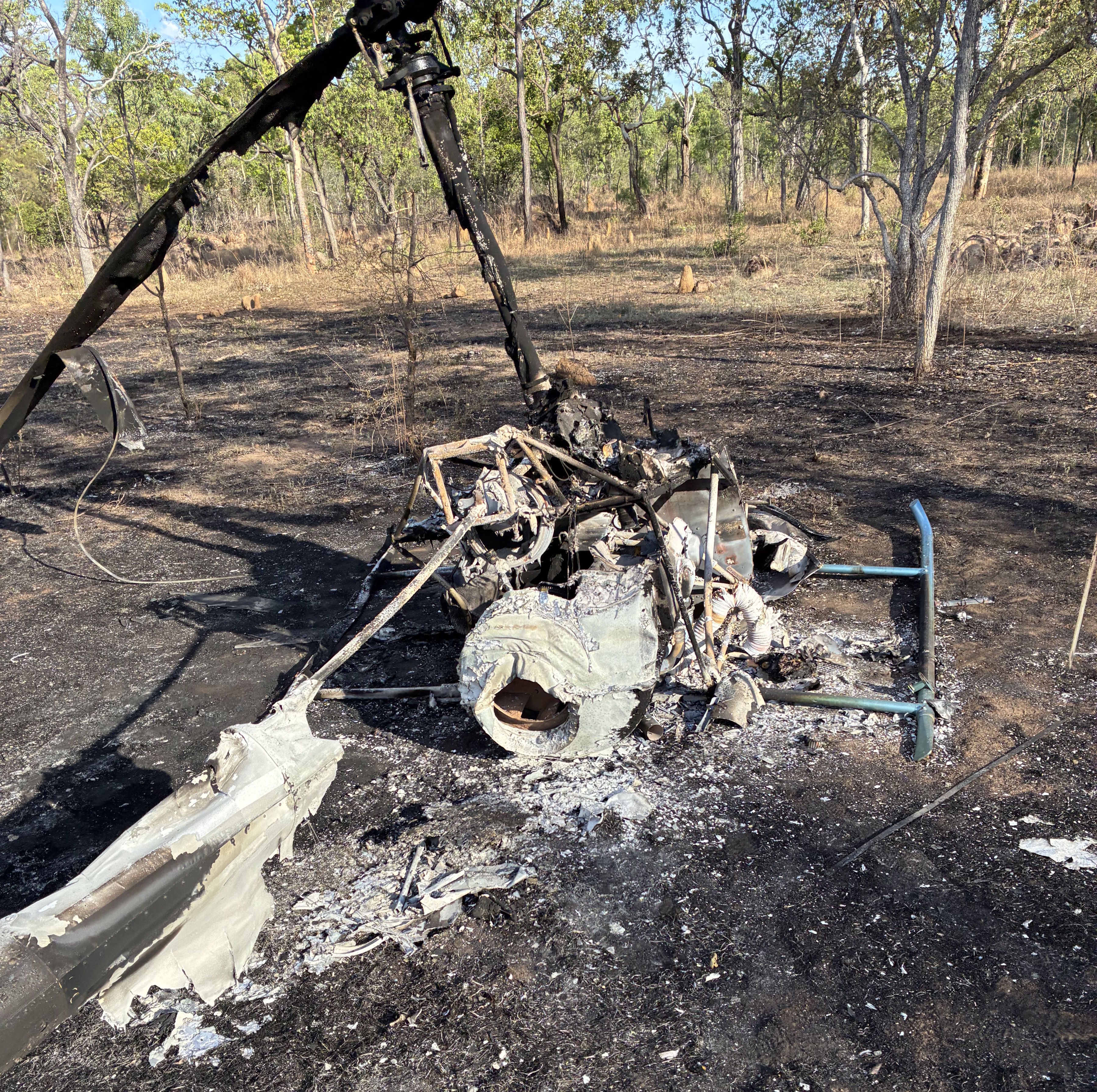
Shortly afterwards, a fire ignited in long, dry grass around the engine and exhaust. The fire subsequently destroyed the helicopter (Figure 3).
Figure 3: VH-HFQ post-accident
Source: Helicopter operator
Context
Pilot information
The pilot of VH-8H8 had 1,488 hours total helicopter experience, including 1,132 hours on the R22. The pilot’s most recent biennial flight review was on 30 September 2025, which covered all emergency procedures, including multiple autorotations.
The pilot of VH-HFQ reported having accumulated approximately 9,000 hours total aeronautical experience over 20 years, and that they were up to date with their flight reviews.
Helicopter information
The Robinson Helicopter Company (RHC) R22 is a lightweight, 2-seat, 2-blade helicopter, powered by a Lycoming 4-cylinder piston engine.
VH-8H8 was an R22 Beta II, serial number 3293. It was manufactured in 2002 and first registered in Australia in 2023. The airframe had accumulated 2,943.8 hours total time in service.
VH-HFQ was an R22 Beta II, serial number 4279. It was manufactured in 2007 and first registered in Australia in 2008. The airframe had accumulated approximately 5,750 hours total time in service.
Rotor drive system
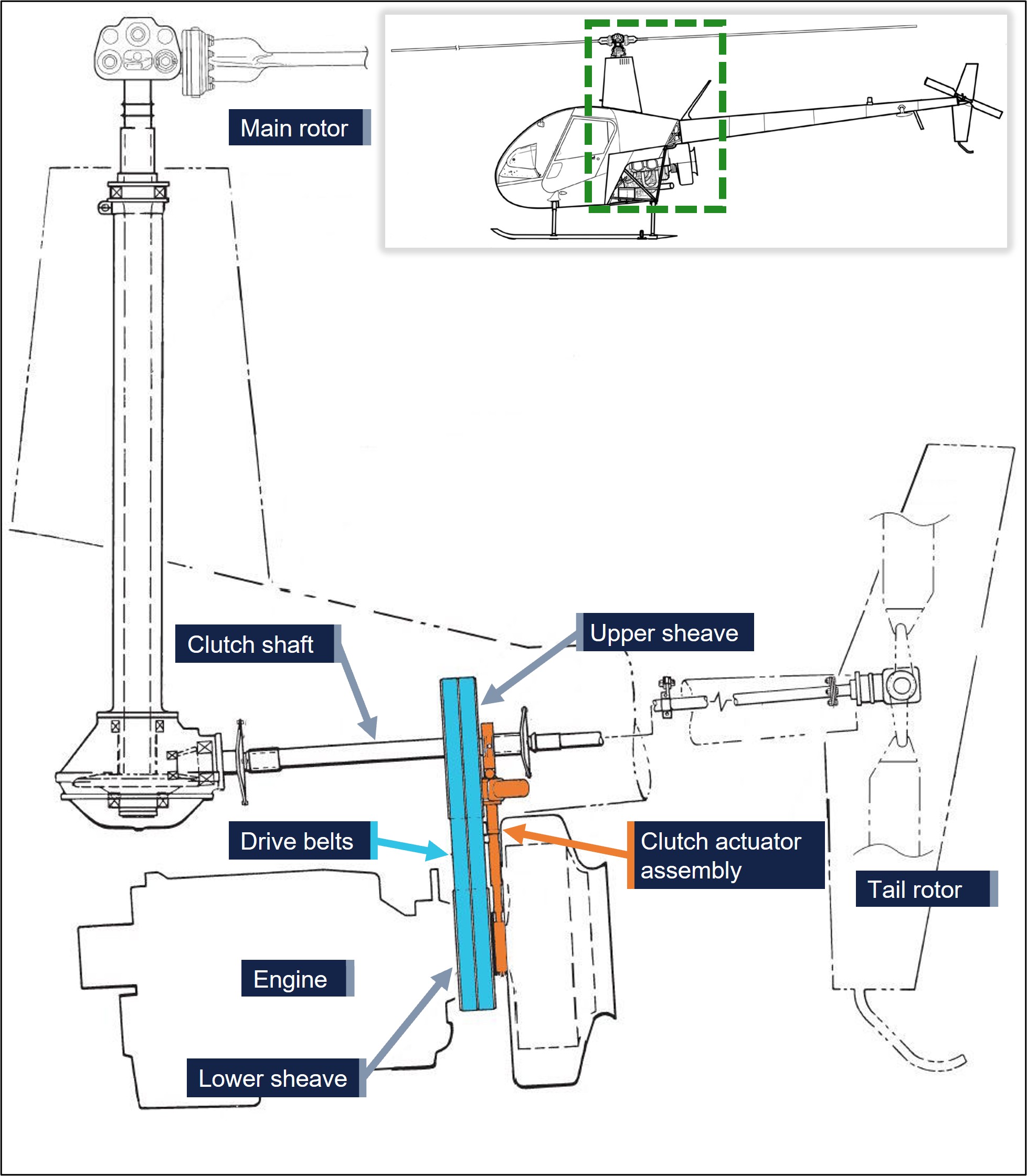
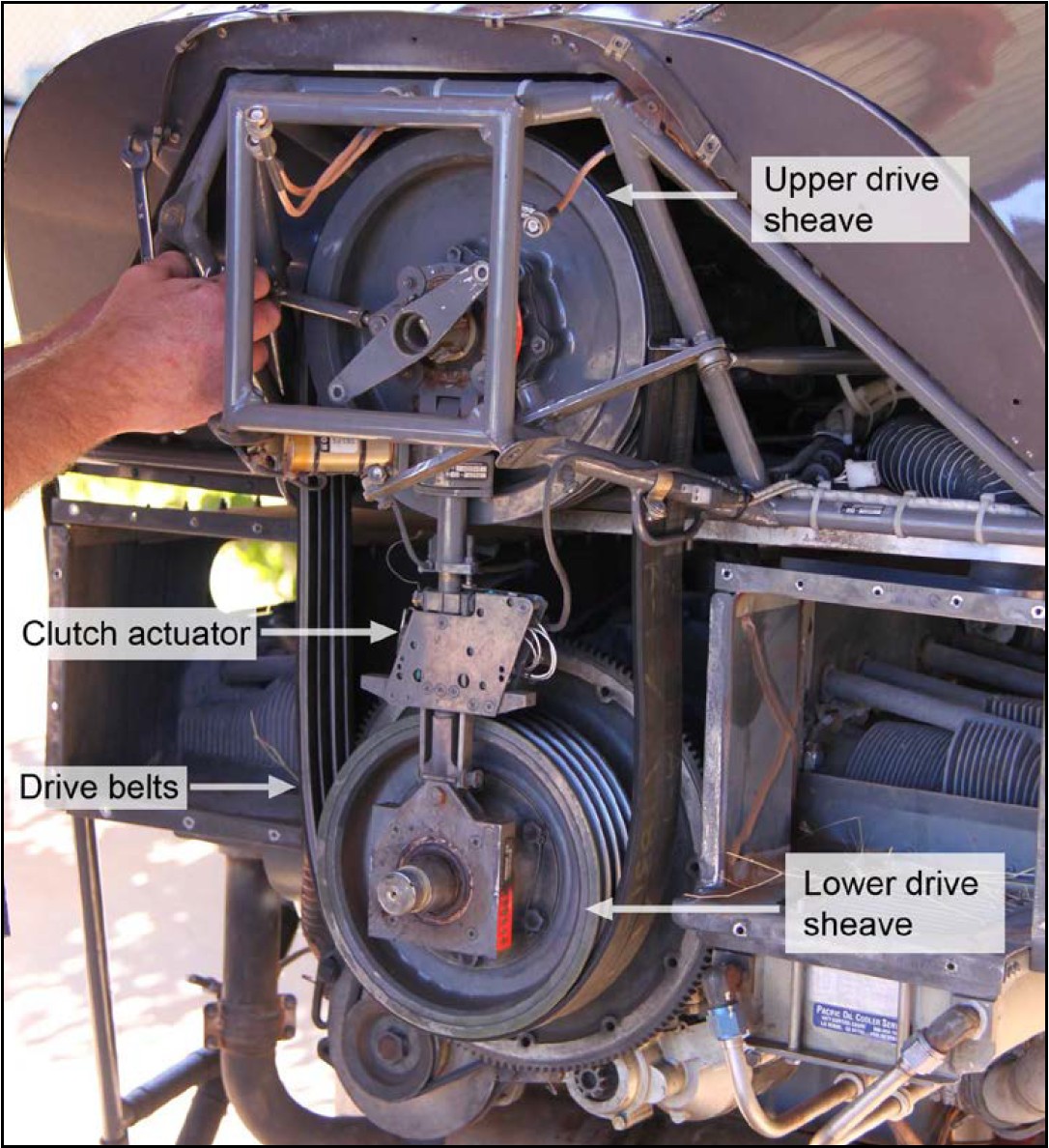
The R22 used a matched pair of banded, double-v, reinforced rubber drive belts (also known as v-belts) running on grooved aluminium sheaves (pulleys) to transmit power from the horizontally-mounted piston engine to the main and tail rotor clutch shaft (Figure 4 and Figure 5).
Figure 4: Diagram of the Robinson R22 rotor drive system
Source: Robinson Helicopter Company, modified by the ATSB
Figure 5: Typical mechanical arrangement of the R22 drive system (viewed from the rear with tailcone and cooling fan assembly removed)
Source: ATSB (2013)
The lower sheave is bolted to the output flange of the engine crankshaft and is connected to the upper sheave by an electrically-driven clutch actuator. The upper sheave incorporates a free-wheeling clutch that allows the clutch shaft (and the rotors) to continue turning when the engine is not driving the system.
The engine is started with the clutch actuator retracted so that the drive belts are retained in their grooves, but with enough slack to allow the engine to start without the excessive load of driving the rotor system. After engine start the pilot selects the clutch switch to ENGAGE, which gradually raises the upper sheave to tension the drive belts to a pre-set load, at which point the actuator ceases driving. A clutch caution light, located in the cockpit directly in front of the pilot, illuminates when the clutch motor is operating.
During normal operation the clutch switch is left in the engaged position until the helicopter is being prepared for shutdown on the ground. In operation, the drive belts become warm and can stretch slightly, lowering tension. When the belt tension reaches a lower threshold, the clutch motor automatically engages to restore the requisite tension.
If one or both belts fails with the clutch engaged, the clutch motor should begin driving to achieve the requisite load, illuminating the clutch caution light until it stops. If only one belt fails, this could lead to the other belt failing due to over-tensioning. If both belts fail, the actuator will extend to the maximum (until the limit switch is activated).
Drive belt monitoring and maintenance
Pre-flight and startup checks
The RHC R22 pilot’s operating handbook (POH) included daily or pre-flight checks of the drive belt condition and slack with the clutch actuator retracted. The slack was tested by applying inward lateral force to one belt at a time, at a specific location (just above the fan scroll wheel on the right-hand side of the helicopter) to measure deflection relative to the other belt. A maximum deflection of 1.5 inches (4 cm) was specified.
Additionally, the POH run-up checklist required pilots to verify that the rotor blades should begin turning within 5 seconds of clutch engagement on startup. A longer clutch engagement time could indicate excessively slack belts or a defective clutch actuator.
RHC safety notice SN-33, included in the POH, stressed the importance of pilots ensuring belts do not have excessive slack during engine start by completing the above checklist items. Measurements exceeding the prescribed limits increased the risk of the drive belts jumping out of the drive sheave grooves on clutch engagement after startup.
In addition to the above, the ATSB discussed with RHC other mechanisms for ensuring the belts were not excessively slack prior to startup. RHC offered that, as the drive belts were relatively accessible on an R22, it was possible for a pilot to attempt to physically dislodge the belts from their respective sheave grooves while the clutch was disengaged. The inability to do so would provide some indication that the belts were not excessively loose, although is not considered by RHC to be a replacement for the published test.
The clutch actuator could be adjusted to correct excessive belt slack on clutch retraction, with the POH noting that periodic adjustment by an aircraft maintenance engineer may be required as the belts wear in service. The actuator down‑limit stop screw on VH‑8H8 was adjusted to correct belt slack approximately one week (10 flight hours) after the previous 100‑hourly inspection.
Clutch caution light
Regarding illumination of the clutch caution light, the POH stated:
Clutch light may come on momentarily during run-up or during flight to re-tension belts as they warm-up and stretch slightly. If, however, the light flickers or comes on in flight and does not go out within 10 seconds, pull CLUTCH circuit breaker and land as soon as practical.4 Reduce power and land immediately if there are other indications of drive system failure5 (be prepared to enter autorotation). Have drive system inspected for a possible malfunction.
Maintenance requirements
In addition to the daily inspections and actuator adjustment to correct excessive belt slack, the RHC R22 maintenance manual required periodic maintenance inspection of the drive belt system at 12‑month or 100‑operating‑hour intervals, whichever came first.
The periodic maintenance included inspection of the physical condition of the drive belts. With the clutch engaged, the amount of drive belt stretch was assessed through a relative measurement of the clutch shaft angle. The belts were required to be replaced if the clutch shaft angle was outside of predefined limits.
The condition and horizontal alignment of the drive sheaves needed to be assessed as part of the periodic inspection and also during the procedure for drive belt installation. The sheaves were required to be replaced if they displayed any corrosion, pitting, flaking, roughness, sharp ridges, wear through the anodised coating, or blistering of the optional metallised coating at the time of inspection. Otherwise, the clutch assembly, incorporating the upper sheave, was required to be replaced when it had accumulated 2,200 hours in service.
Maintenance history
VH-8H8
The helicopter’s drive belts were fitted on 4 September 2025 at the most recent 100‑hourly inspection (2,856.2 hours). The installed belt set was part number A190‑2 revision Z, lot number6 2412130031. The reason for the belt replacement was not recorded.
The drive sheaves were not replaced with the belts. The maintainer reported that the intent was to replace the existing anodised aluminium upper sheave with the steel‑coated (metallised) type, as they had improved durability when exposed to dust and grit in harsh operating environments. However, the maintainer was unable to source a steel‑coated sheave at the time of the 100‑hourly inspection. The maintainer subsequently assessed that the condition of the existing upper sheave was acceptable for continued operation.
VH-HFQ
VH-HFQ had accumulated 5,720 hours total time in service at the time of the most recent maintenance. The helicopter maintenance release was destroyed in the accident, however the operator estimated that the helicopter had operated for approximately 30 hours since this time.
Maintenance records indicated the machine had recently had 2 A190‑2 revision Z belt sets replaced at low time, prior to the accident set. The reason recorded in each case was that the belts were ‘stretched to limits’ (Table 1).
Table 1: VH-HFQ drive belt maintenance history
Date
Maintenance
Time in Service
Notes
13 June 2025
100-hour inspection
5,597.0
Drive belts installed.
Belt set lot number: 2410170331.
29 August 2025
100-hour inspection
5,691.8
Drive belts replaced at 94 hours.
Belt set lot number: 2412130031.
23 September 2025
Unscheduled maintenance
5,720.0
Drive belts replaced at 28.2 hours.
Belt set lot number: 2412130031.
Low-time belt replacements
Maintainer reports
The maintainers of the occurrence helicopters expressed a concern to the ATSB about a recent observed general increase in low-time belt replacements due to overstretching. This was identified through clutch shaft angle measurements exceeding limits during maintenance inspections.
The maintainer of VH-8H8 advised that for a similar number of helicopters serviced each year, they had replaced 61 sets of drive belts in the 12 months prior to the occurrence. This compared to 50 in the year prior and 30 sets the year before that. In addition, the maintainer reported that they had received 10 sets of belts with the same lot number as the failed belts. From the helicopters with those sets fitted, 2 had been removed at the first 100‑hourly inspection due to the clutch shaft angle measurement exceeding the maintenance manual limit.
The maintainer of VH-HFQ reported having installed 80 sets of belts in the 12 months prior to the accident, compared to 51 in the 12 months prior, and 32 belt sets in the year prior to that. There was also no significant change in the number of helicopters serviced. The maintainer advised that, along with the increase in belt replacements, they had observed variability in the texture of the new belts received, noting that some of the belts were comparatively softer and more rubbery when compared with others.
Defect reports
The ATSB reviewed the Civil Aviation Safety Authority (CASA) DRS (defect report service) reports from the previous 5 years (from January 2020).
From January 2022 to April 2026 there were 16 instances of drive belt issues in RHC R22 and R44 helicopters in Australia. Of those, 15 related to R22 Beta helicopters, and included:
8 reports of drive belts stretched beyond limits. All of the occurrences were found during scheduled maintenance. All were reported in 2025 or 2026.
3 reports of delaminated or cracked belts, found during pre-flight inspections.
1 report of abnormal vibrations, attributed to lumps found on the drive belts.
3 reports of the drive belts failing in flight.
The 3 occurrences of the drive belts failing in flight were not investigated by the ATSB. Two of the reports included the following details:
• 23 January 2024: Pilot reported failed drive belt in flight. There was report of a loud bang followed by a vibration and illumination of the clutch light. After 6 seconds, pilot pulled the CB [clutch circuit breaker] and directed the aircraft into wind. A second loud bang followed (2 seconds after pulling the CB) at which point the pilot entered auto-rotation to the ground. Forward belt was found missing. Rear belt was still on both sheaves but running in the forward belt position.
• 18 August 2022: Pilot reported clutch light flickering more than normal followed by a burning rubber smell and a bang. Clutch light on continuously. Pilot landed aircraft and shut down. On inspection [they] noted that the front drive belt had departed the aircraft and the rear belt had jumped one pulley groove.
There were no reports of stretched drive belts between November 2021 and May 2025. From May 2020 to November 2021, there were 20 reports of drive belt issues, 11 of which were for stretched belts and 2 for in-flight failures, and the remainder for defects found during routine inspections or maintenance.
The ATSB contacted one of the major Australian distributors of RHC Helicopters and spare parts, who indicated that they were not aware of any recent increase in drive belt defects or concerns.
RHC reported a total of 7 drive belt warranty claims worldwide for 2025. RHC also advised that it had surveyed some local service centres in the United States, which reported that they were not experiencing any premature belt stretching.
Component examination
VH-8H8
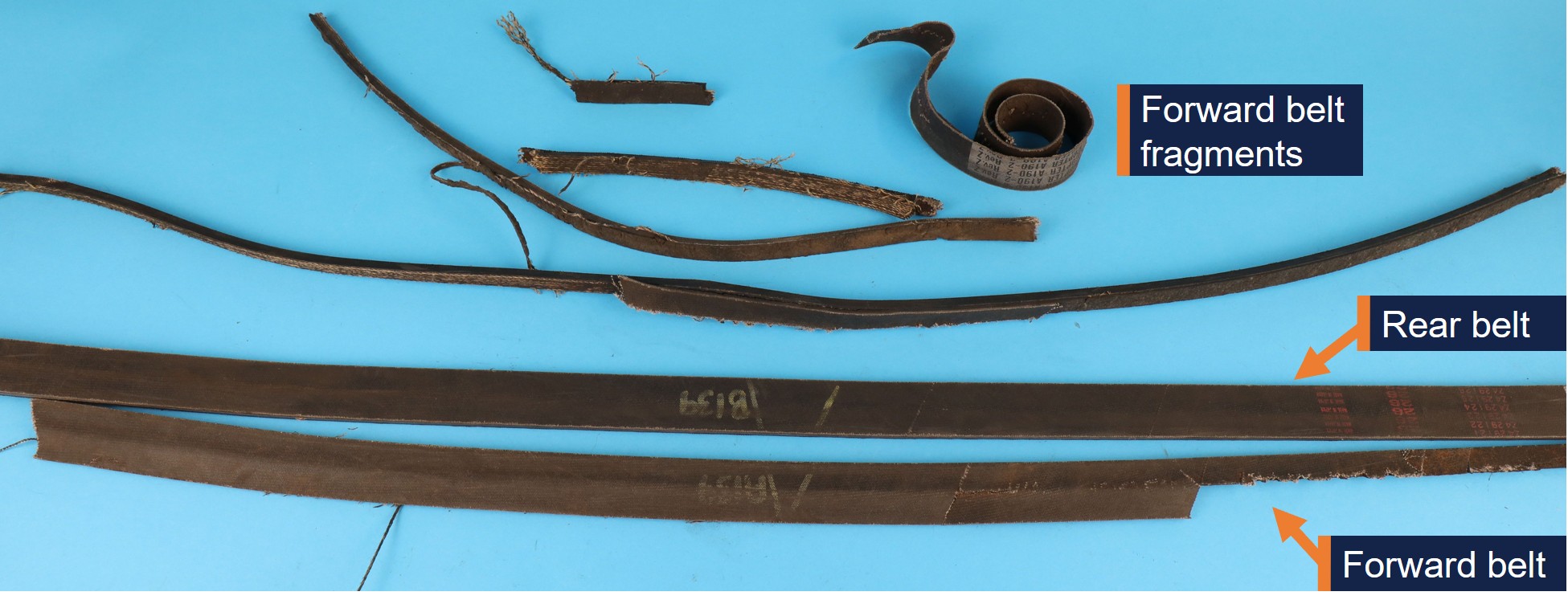
The ATSB did not attend the VH-8H8 accident site. The drive belt remains from the helicopter were examined at the ATSB technical facilities (Figure 6).
Figure 6: VH-8H8 drive belts as-recovered
Source: ATSB
The rear belt had a single tensile break through both vees in the same location and showed no abnormal wear or defect.
The forward belt was separated into multiple pieces. The front vee of the forward belt had entirely delaminated from the backing strap and was fractured at several places. The rear vee was still largely attached to the backing but was also separated in more than one location along the length.
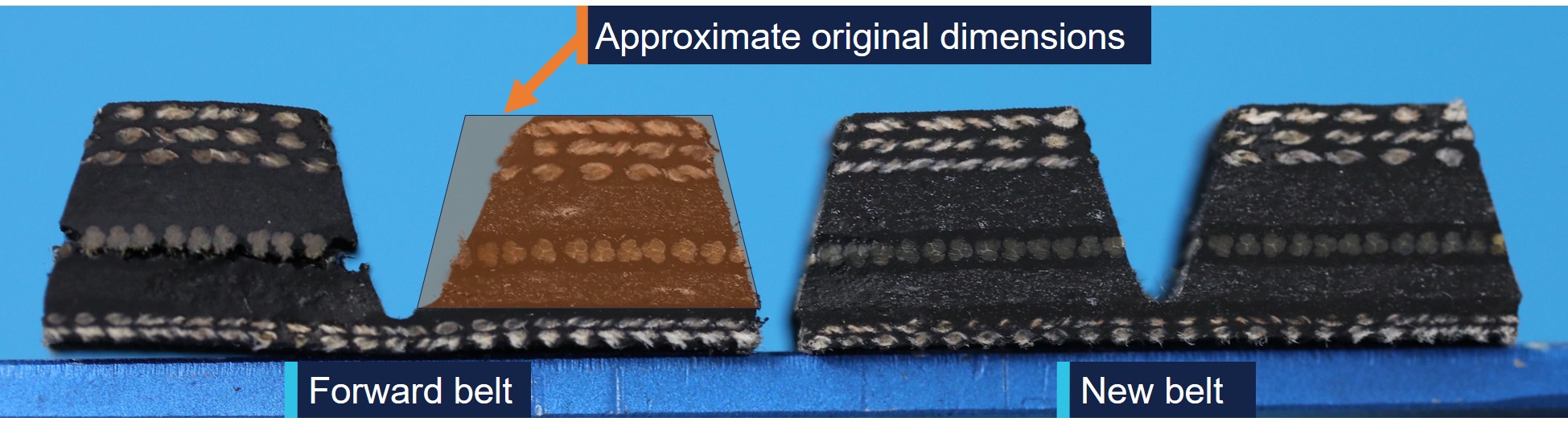
The largest piece of the forward belt had taken on a curve, indicating that the vees had been subjected to non-uniform stretching. Where still continuous, the centre of the backing strap (between the vees) had deformation consistent with running on the crest of a sheave groove. A cross‑section through the belt showed significant wear of the rear vee (Figure 7).
The abnormal, non-uniform wear and stretching was consistent with the belt running while misaligned, with the belt having pushed forward and one of the vees not running in the drive sheaves. RHC advised that in this configuration, the belts might last 10–20 minutes before failure. RHC also advised that the belts would have to be very loose for this to occur, particularly as the outer sheave groove is raised to reduce the likelihood of such an event.
Figure 7: VH-8H8 forward belt cross‑section (left) and new rev-Z belt (right)
Source: ATSB
VH-HFQ
The ATSB did not attend the VH-HFQ accident site and no physical evidence was obtained from the destroyed helicopter.
Operational considerations
The R22 POH includes the following under ‘emergency procedures’:
A power failure may be caused by either an engine or drive system failure and will usually be indicated by the low RPM horn. An engine failure may be indicated by a change in noise level, nose left yaw, an oil pressure light or decreasing engine RPM. A drive system failure may be indicated by an unusual noise or vibration, nose right or left yaw, or decreasing rotor RPM while engine speed is increasing.
In the case of power failure, immediately lower the collective to enter autorotation.
The pilot of VH-8H8 reported that their initial distraction by the sharp rise in engine RPM delayed, by a few seconds, their observation of main rotor RPM decay and action to lower the collective to enter autorotation. The pilot reflected that this event reinforced the need for them to instinctively and immediately enter autorotation at the first indication of a power failure.
When conducting autorotations, the POH cautions:
The R22 has a light, low-inertia rotor system. Most of the energy required for an autorotation is stored in the forward momentum of the aircraft, not in the rotor. Therefore, a well-timed cyclic flare is required and rotor RPM must be kept in the green until just before ground contact.
The main rotor will deplete its stored energy quickly once power is removed, which will lead to a rapid decay in rotor RPM. The POH lists the minimum R22 power off main rotor speed limit as 90% and, in the section on practice autorotations, cautions that ‘catastrophic rotor stall could occur if the rotor RPM ever drops below 80%, plus 1% per 1000 feet of altitude [above sea level].’
The ATSB enquired with RHC about operation of drive belts stretched to the limits of the clutch actuator. RHC advised that the actuator would stop driving after triggering the upper limit switch, which could result in under-tensioned belts that slip on the sheaves. In this case, the clutch light should illuminate and remain on, requiring pilots to land as soon as possible in accordance with the POH instructions.
Injuries and damage
Spreading of the helicopter skids and compression of the seat base in each helicopter were features of the helicopter’s energy absorption design to reduce impact forces on the helicopter occupants during a hard landing or collision with terrain. In each occurrence, nothing was stored under the seat base. This ensured energy absorption functionality of the seat, minimising the risk of injury to the occupants.
Related occurrences
Hamilton Island, Queensland, 3 February 2021 (AO-2021-007)
While cruising at 1,500 ft, approximately 15 minutes into the flight, the pilot of an RHC R44 Clipper II, VH-SXC, smelled burning rubber and saw the clutch warning light flicker briefly. The pilot then heard what sounded like ‘a rubber band smacking against the cowling’, at which point the clutch warning light illuminated and remained on. The pilot identified a rise in engine RPM and a slow decline in main rotor RPM. The pilot pulled the clutch circuit breaker in response to the warning light and conducted a successful emergency landing with minimal damage to the helicopter and no injuries.
Of the 4 drive belts7 in the helicopter’s drive system, it was found that the forward 2 drive belts had dislodged and moved forward of the upper sheave. They then lodged against the sheave and clutch shaft, leading to damage to the drive belts and surrounding components. The other 2 drive belts remained intact but had shifted forward from their original sheave positions and were not effectively engaged within the grooves of the sheaves. Consequently, there was a loss of effective drive of the rotor system.
Outside of the occurrence event, the helicopter had experienced 2 instances of over‑stretched drive belts, which were replaced after 76.1 hours and 8.6 hours, respectively. The overstretching was attributed to a static belt‑stretching procedure that was introduced for new belts that were overly tight. RHC removed the belt‑stretching procedure in July 2021.
The pilot of an RHC R22 Beta II helicopter, VH-DSD, was conducting mustering operations and while the helicopter was operating in close proximity to the ground, drive to the rotor system was lost, resulting in a high rate of descent at the point of impact. The pilot was fatally injured.
The ATSB found that both drive belts had failed prior to the collision with terrain. The rear drive belt was found severed and wrapped around the drive sheaves. Almost all of the forward belt was found in 2 adjacent locations about 60 m from the main wreckage. Black rubber marks, consistent with a flailing drive belt, were found on the sides and lower surface of the engine. The forward drive belts showed significant abnormal wear of the forward vee, indicating that the belt had rolled forward over the front edge of the drive sheave. The ATSB was unable to establish the factors that contributed to the dislodgement.
The final investigation report noted the necessity of flying at very low level when conducting helicopter mustering, but also the potential risk of doing so. The pilot would have had limited time to recognise the condition, respond accordingly, and for the autorotation to develop before attempting to land. As a result, the report stressed the importance of pilot proficiency in responding to emergency situations resulting from aircraft malfunction.
Safety analysis
Drive belt failures
The VH-8H8 pilot report of a burning rubber smell, followed shortly afterwards by the ‘bang’, the significant reduction in main rotor RPM and sudden increase in engine RPM, was all consistent with failure of the helicopter’s drive belts. The short (10 to 15 minute) duration of flight, rubber smell, and uneven belt wear, was consistent with the forward belt not being correctly seated in the drive sheave grooves. This belt misalignment most likely occurred during startup, as the flight duration was consistent with RHC’s experience of belt longevity when operated in this configuration. The abnormal wear indicated that the forward belt most likely failed first and, noting the very brief time interval between the 'bang' and the main rotor RPM decay, the forward belt probably interfered with the rear belt, which then fractured, resulting in the complete drive train disconnect.
The VH-HFQ pilot report similarly indicated a rapid decay in main rotor RPM, consistent with the drive belt separation subsequently observed by the pilot on the ground. However, the mechanism of failure in this case was not determined. The drive belts were not available to the investigation, and the recounted circumstances of the occurrence were slightly different. Specifically, the significantly longer (30-minute) flight time and the absence of any reported burning rubber smell preceding the event. This may be indicative of a different failure mechanism, although the presence of any rubber smell would be dependent on local conditions and not necessarily detected.
In each of the occurrences the helicopters had recently been inspected, the drive belts were relatively new, and pilots reported conducting the required pre-flight checks without observing any issues. It is worth noting that, although the pilot of VH-8H8 sought a second opinion on the belt tension, ultimately it was assessed as acceptable by 2 pilots and therefore unlikely to have been excessively slack. Otherwise, there were no obvious operational factors reported or identified that might have led to the drive belts becoming unseated from the sheaves or that would otherwise contribute to a belt failure.
Pilot responses
In both occurrences, the initial indications of drive train failure were reported as being almost coincident with the main rotor RPM decay. There was no prolonged or abnormal clutch light illumination, or any other timely indications preceding the failure, and therefore no opportunity to conduct any kind of power-on landing.
As it was, both pilots had to assess the condition as an engine or drive system failure (noting the emergency procedure for both is the same), and immediately lower the collective to enter autorotation. Both pilots did this after observing the rapid main rotor RPM decay. The pilot of VH-8H8 later reflected on the few seconds delay in diagnosing the condition before lowering the collective and entering autorotation. In those few seconds the rotor speed decayed to the minimum allowable level, beyond which increased the risk of an adverse outcome, particularly at low level where time and altitude may be insufficient to recover low rotor RPM.
Aside from rotor RPM, there are a number of variables that can influence the success of an autorotation landing (including, airspeed, weight, density altitude, manoeuvring, and the timing and magnitude of pilot control inputs), and because of this, the specific factors that contributed to the hard landings in these events were not explored in detail. Nevertheless, these occurrences serve as a reminder that power loss events may occur with limited prior warning. They reinforce that pilots should be intimately familiar with the POH emergency procedures and be prepared to act immediately in the event of any abnormal in-flight indications.
Drive belt failure rates
Reports and records provided to the ATSB by both of the helicopter maintainers indicated a relatively recent increase in low-time drive belt replacements. The reported issues were similar to those captured in the CASA defect reporting scheme database around 2020–21 which was also reflected in the occurrence involving VH-SUX (AO‑2021‑007).
The occurrence belt sets, as well as the August low-time replacement on VH-HFQ and 2 other low-time replacements recorded by the maintainer of VH-8H8 were from the same lot number. This suggested the possibility that there was a manufacturing anomaly with a particular batch of belts that pre-disposed them to stretching. This would infer that the occurrence belts also had stretching issues, which was possible but could not be confirmed. There were also no reports to indicate that other belts, out of the 150 sets from the same lot number, had been replaced for a similar reason.
Moreover, the increase in belt replacements had been occurring over the previous few years, which might suggest a more significant manufacturing anomaly than a single batch. Despite this, there was no evidence of a more widespread, corresponding increase in reporting of recent, similar belt failures or stretching at a greater rate than usual.
The ATSB considered the operational risk if there were a broader issue involving excessive drive belt stretching. If not carefully monitored, belt stretch could lead to excessive slack on startup, which would increase the risk of the belts jumping out of the sheave grooves. However, vigilance around the existing pre-flight checks and monitoring of the 5-second clutch engagement time should mitigate that risk. It is also noted that, due to the way the clutch system operates, gradual belt stretching by itself should not create a safety issue during flight without warning.
The ATSB continues to encourage reporting of aircraft component failures or issues through the CASA DRS system to give a clearer indication of concerning defects or trends that may warrant further investigation.
Findings
ATSB investigation report findings focus on safety factors (that is, events and conditions that increase risk). Safety factors include ‘contributing factors’ and ‘other factors that increased risk’ (that is, factors that did not meet the definition of a contributing factor for this occurrence but were still considered important to include in the report for the purpose of increasing awareness and enhancing safety). In addition ‘other findings’ may be included to provide important information about topics other than safety factors.
These findings should not be read as apportioning blame or liability to any particular organisation or individual.
From the evidence available, the following findings are made with respect to the rotor drive belt failures resulting in collisions with terrain, involving Robinson R22s, VH-8H8 and VH-HFQ, near Argadargada Aerodrome, Northern Territory, and Chillagoe Aerodrome, Queensland, on 15 and 23 November 2025.
Contributing factors
The forward drive belt on VH-8H8 probably became incorrectly engaged in the drive sheaves on startup, for reasons that could not be determined. This led to failure of the forward drive belt, which then likely impacted the rear drive belt and contributed to its failure.
The forward drive belt on VH-HFQ likely failed in-flight, for reasons that could not be determined.
Other findings
Prior to the occurrences, there were several reported instances of Robinson R22 drive belts requiring replacement at low hours due to stretching beyond allowable limits. It was not able to be determined whether the subject occurrences were influenced by reported concerns.
Sources and submissions
Sources of information
The sources of information during the investigation included:
the pilot of VH-8H8
the pilot of VH-HFQ
the station manager for VH-8H8
the maintenance organisation for VH-8H8
the maintenance organisation for VH-HFQ
Robinson Helicopter Company
Submissions
Under section 26 of the Transport Safety Investigation Act 2003, the ATSB may provide a draft report, on a confidential basis, to any person whom the ATSB considers appropriate. That section allows a person receiving a draft report to make submissions to the ATSB about the draft report.
A draft of this report was provided to the following directly involved parties:
the pilot of VH-8H8
the pilot of VH-HFQ
the station manager for VH-8H8
the maintenance organisation for VH-8H8
the maintenance organisation for VH-HFQ
Robinson Helicopter Company
the Civil Aviation Safety Authority
Submissions were received from the Civil Aviation Safety Authority. The submissions were reviewed and, where considered appropriate, the text of the report was amended accordingly.
Purpose of safety investigations
The objective of a safety investigation is to enhance transport safety. This is done through:
identifying safety issues and facilitating safety action to address those issues
providing information about occurrences and their associated safety factors to facilitate learning within the transport industry.
It is not a function of the ATSB to apportion blame or provide a means for determining liability. At the same time, an investigation report must include factual material of sufficient weight to support the analysis and findings. At all times the ATSB endeavours to balance the use of material that could imply adverse comment with the need to properly explain what happened, and why, in a fair and unbiased manner. The ATSB does not investigate for the purpose of taking administrative, regulatory or criminal action.
About ATSB reports
ATSB investigation reports are organised with regard to international standards or instruments, as applicable, and with ATSB procedures and guidelines.
Reports must include factual material of sufficient weight to support the analysis and findings. At all times the ATSB endeavours to balance the use of material that could imply adverse comment with the need to properly explain what happened, and why, in a fair and unbiased manner.
An explanation of terminology used in ATSB investigation reports is available here. This includes terms such as occurrence, contributing factor, other factor that increased risk, and safety issue.
Publishing information
Released in accordance with section 25 of the Transport Safety Investigation Act 2003
Ownership of intellectual property rights in this publication
Unless otherwise noted, copyright (and any other intellectual property rights, if any) in this report publication is owned by the Commonwealth of Australia.
Creative Commons licence
With the exception of the Commonwealth Coat of Arms, ATSB logo, and photos and graphics in which a third party holds copyright, this report is licensed under a Creative Commons Attribution 4.0 International licence.
The CC BY 4.0 licence enables you to distribute, remix, adapt, and build upon our material in any medium or format, so long as attribution is given to the Australian Transport Safety Bureau.
Copyright in material obtained from other agencies, private individuals or organisations, belongs to those agencies, individuals or organisations. Where you wish to use their material, you will need to contact them directly.
^Collective is a primary helicopter flight control that simultaneously affects the pitch of all blades of a lifting rotor. Collective input is the main control for vertical velocity.
^Autorotation is a condition of descending flight where, following engine failure or deliberate disengagement, the rotor blades are driven solely by aerodynamic forces resulting from rate of descent airflow through the rotor. The rate of descent is determined mainly by airspeed.
^An audio alert that sounds when the main rotor speed is below a certain level. In the Robinson R22, the threshold is 97% and is accompanied by the ‘LOW RPM’ caution light. The horn and light are muted when the collective is fully down.
^The Robinson R22 POH defines: Land as soon as practical as ‘landing site is at the pilot’s discretion, based on the nature of the problem and available landing areas.’ Whereas, Land immediately means ‘land on the nearest clear area where a normal landing can be performed.’
^Safety notice SN-28 in the POH notes these indications as the ‘smell of hot rubber, noise, or vibration.’
^When individual belts are received by RHC, they are tensioned in a simulated sheave system, measured and subsequently matched into a set (of 2 for a R22 and 4 for a R44). RHC advised that the lot number for drive belt sets is applied by RHC as part of this process. As such, the lot number does not directly relate to a manufacturing batch or date, although belts being matched into sets would likely be manufactured around the same time. Lot number 2412130031 comprised 150 belt sets.
^The Robinson R44 drive train has a matched set of 4 drive belts, as opposed to the set of 2 in the R22.
Occurrence summary
Investigation number
AO-2025-069
Occurrence date
15/11/2025
Occurrence time and timezone
0830 Australian Eastern Standard Time
Location
Near Argadarga Aerodrome, NT, and Chillagoe Aerodrome, Qld
State
Northern Territory
Report release date
14/07/2026
Report status
Final
Investigation level
Short
Investigation type
Occurrence Investigation
Investigation phase
Final report: Dissemination
Investigation status
Completed
Mode of transport
Aviation
Aviation occurrence category
Collision with terrain, Forced/precautionary landing, Transmission and gearbox
Occurrence class
Accident
Highest injury level
Minor
Aircraft details
Manufacturer
Robinson Helicopter Co
Model
R22 Beta
Registration
VH-8H8
Serial number
3293
Aircraft operator
Georgina Pastoral Company Pty Ltd
Sector
Helicopter
Operation type
Part 138 Aerial work operations
Activity
General aviation / Recreational-Aerial work-Observation and patrol
Departure point
Argadargada, Northern Territory
Destination
Argadargada, Northern Territory
Injuries
Crew - 1 (minor), Passengers - 1 (minor)
Damage
Substantial
Aircraft details
Manufacturer
Robinson Helicopter Co
Model
R22 Beta
Registration
VH-HFQ
Serial number
4279
Aircraft operator
Sunrise Helicopters Pty Ltd
Sector
Helicopter
Operation type
Part 91 General operating and flight rules
Activity
General aviation / Recreational-Own business travel
The ATSB is investigating a near collision involving a Bell 212, registration VH-JJR, and a Sling 2, registration VH‑FFZ, near Moorabbin Airport, Victoria, on 24 November 2025.
Both aircraft were engaged in training activities, and each had 2 persons on board. While returning to land at Moorabbin the Bell 212 crossed into the path of the Sling 2 which was on final approach to runway 13L. It was reported that the helicopter passed above the fixed wing aircraft with a separation of less than 60 meters. Both aircraft continued to land without further incident. There were no injuries to those on board, and no damage to either aircraft.
The ATSB has completed the evidence collection and analysis phases of the investigation and is drafting the final report.
The final report will be released at the conclusion of the investigation. Should a critical safety issue be identified during the course of the investigation, the ATSB will immediately notify relevant parties, so that appropriate safety action can be taken.
Last updated:
Occurrence summary
Investigation number
AO-2025-070
Occurrence date
24/11/2025
Occurrence time and timezone
12:05 Australian Eastern Daylight Time
Location
About 1.6 km north-north-west of Moorabbin Airport
State
Victoria
Report status
Pending
Anticipated completion
Q4 2026
Investigation level
Defined
Investigation type
Occurrence Investigation
Investigation phase
Final report: Drafting
Investigation status
Active
Mode of transport
Aviation
Aviation occurrence category
Near collision
Occurrence class
Serious Incident
Highest injury level
None
Aircraft details
Manufacturer
The Airplane Factory
Model
Sling 2
Registration
VH-FFZ
Serial number
195
Aircraft operator
Learn to Fly Australia Operations Pty Ltd
Sector
Piston
Operation type
Part 142 Integrated and multi-crew pilot flight training
Activity
General aviation / Recreational-Instructional flying-Instructional flying - dual
Departure point
Moorabbin Airport, Victoria
Destination
Moorabbin Airport, Victoria
Injuries
None
Damage
Nil
Aircraft details
Manufacturer
Bell Helicopter Co
Model
212
Registration
VH-JJR
Serial number
31280
Aircraft operator
Microflite Aviation
Sector
Helicopter
Operation type
Part 141 Recreational, private and commercial pilot flight training
Activity
General aviation / Recreational-Instructional flying-Instructional flying - dual
The Statement of Intent 2025–2027 has been developed in response to the Statement of Expectations issued by the Minister for Infrastructure, Transport, Regional Development and Local Government for the period 1 September 2025 to 30 June 2027. It details how the ATSB plans to meet the expectations specified in the Statement of Expectations.
Overview
The ATSB’s vision is Transport without accidents.
Our purpose in pursuing that vision is:
To influence transport safety improvements for the greatest public benefit through independent no-blame investigations and fostering safety awareness.
The ATSB vision and purpose is informed by the ATSB’s primary function in the Transport Safety Investigation Act 2003 (TSI Act) which is to improve safety in the aviation, marine and rail modes of transport. The ATSB undertakes the following strategic activities in support of its legislative function and purpose to influence improvements to transport safety:
Investigations
Investigate transport safety matters by conducting independent, no-blame investigations. The ATSB may investigate transport safety matters involving the following:
Aviation
Civilian Australian-registered aircraft anywhere in the world, and foreign-registered aircraft operating in Australia. Investigations into aircraft without a VH- registration, or aircraft that are non-powered, will be on an exception basis, as resources permit, and where conducting such an investigation has the potential to highlight wider safety issues.
Rail
Rail operations in Australia, subject to Commonwealth and State and Territory resourcing arrangements.
Marine
Civilian interstate and overseas shipping involving:
Australian-registered ships anywhere in the world,
Foreign-registered ships in Australian waters,
Foreign-registered ships en route to Australian ports.
Safety data and reporting information
Collect, analyse and share safety data and reporting information including through administering the voluntary and confidential reporting scheme (REPCON), processing mandatory notifications of transport accidents and incidents, and sharing important safety messaging through the publication of occurrence briefs.
Influence safety improvements
Collect, analyse and share safety data and reporting information including through administering the voluntary and confidential reporting scheme (REPCON), processing mandatory notifications of transport accidents and incidents, and sharing important safety messaging through the publication of occurrence briefs.
Leadership
Provide leadership in transport safety investigation through building knowledge and education in the transport sector, utilising and sharing best practice investigation techniques, representing Australia in international transport safety forums, and providing expert assistance to investigations in other countries.
Governance
The ATSB remains committed to upholding high standards of governance in undertaking its role as Australia’s national transport safety investigator. In addition to adhering to the Public, Governance Performance and Accountability Act 2013 (PGPA Act) and the Australian Public Service Code of Conduct and Values, the ATSB approaches its work in accordance with 5 key principles:
Independence
Engagement
Rigour
Innovation
Relevance
The ATSB has established a governance framework that details the structures, systems, processes, policies and procedures that support us to pursue our purpose in accordance with these principles and maintain accountability to the government and wider public. In ensuring that high standards of governance are maintained, the ATSB will:
maintain clear and open communication with the Minister and the Department of Infrastructure, Transport, Regional Development, Communications, Sport and the Arts (the department), ensuring any issues are communicated promptly
continue to provide quarterly progress reports to the Minister detailing the performance of the ATSB and relevant activities undertaken during the reporting period
report publicly on its operations, including through the publication of its investigation reports and Annual Report
implement the elements of the ATSB Governance Framework to ensure that integrity, transparency and accountability is maintained
continue to manage both perceived and actual conflicts of interest appropriately by:
ensuring the ATSB Commission reports any material personal interests to you in accordance with the PGPA Act and the TSI Act.
publishing ATSB’s conflict of interest policy on its website
regularly reviewing the conflicts of interest policy, processes and procedures
maintaining a conflicts of interest register.
Strategic Direction
In fulfilling ATSB’s main function of improving transport safety, the ATSB will continue to adhere to applicable legislation and Government policies. The ATSB will continue to ensure our strategic approach to carrying out our function and delivering on our purpose is consistent with the Statement of Expectations and align with Australia’s international obligations, such as requirements of the International Civil Aviation Organization and the International Maritime Organization.
Consistent with the Minister’s Statement of Expectations, the ATSB will continue to:
foster safety awareness through publicising safety information from its investigations, research and data analysis in a timely manner and through mediums and forums that target key stakeholders for safety messaging and education
consistent with our jurisdiction outlined in the overview section, focus our resources on investigations that have the highest potential to deliver the greatest public transport safety benefit
while maintaining our independence, complement and add value to the work of transport regulators, policy agencies, Defence and industry in Australia’s transport safety policy and regulatory framework
through our engagement in international forums and partnerships with tertiary institutions, pursue global leadership in transport safety investigation, research and analysis
review, improve and promote best practice investigation policies and practices, benchmarking itself against like organisations.
Overall, the ATSB’s strategic focus is to maximise safety outcomes across the aviation, marine and rail sectors. The ATSB achieves this through influencing stakeholders to foster safety awareness, knowledge and action, as well as positioning ATSB as an enduring and adaptable organisation that invests in its people, systems and partnerships. The ATSB directs its resources to investigations and activities that have the ability to deliver the greatest improvements to transport safety. This strategic focus allows the ATSB to make the most effective use of resources and respond rapidly to changes in the environment.
Key Initiatives
The ATSB will continue to use the corporate plan, annual report and quarterly performance report to communicate key initiatives and progress to the Minister. Through the period of the Statement of Intent, the ATSB will focus on the following priorities, consistent with the Statement of Expectations:
Partnerships and collaboration – continue to invest in partnerships with educational institutions such as the RMIT University to enhance transport safety education and learning. Collaborate with other countries to improve accident investigation capability, including through the Australia-Pacific Partnerships for Aviation Program in partnership with the Department of Foreign Affairs and Trade.
Staff development – continue to focus on staff development and growth, including through effective workforce planning and training to ensure that ATSB has the skills and expertise to meet current and emerging challenges in transport safety investigation. This includes focusing on developing leadership capability and implementing transport safety investigator competencies to ensure we have a capable, technical and engaged workforce.
Research, data and communication – continue to invest in research activities, including collecting and analysing data on transport safety topics for the greatest public benefit. Focus on new and innovative communication mediums such as the use of video content to highlight safety messaging for the benefit of industry and the travelling public.
Fiscal sustainability – work closely with the department to develop options to address long term financial sustainability for the ATSB, whilst continuing to operate in an efficient and effective manner and ensuring our resources are utilised effectively for the greatest public benefit.
Stakeholder Engagement
The ATSB collaborates with a wide range of stakeholders in fulfilling its functions under the TSI Act. The ATSB participates in national and international conferences, industry events and other relevant forums to build awareness of safety messages and instil public confidence in aviation, marine and rail transport. The ATSB will continue to engage with:
the department and other government agencies to deliver comprehensive safety advice to government, industry and the public
industry organisations to communicate safety advice and influence improvements to safety practices
regulators and policy makers to ensure appropriate sharing and use of safety information
education institutions such as RMIT University to provide a centre of excellence for transport safety investigation education
the travelling public and wider community to foster public awareness and education of transport safety
state, territory and local governments to undertake collaborative investigations in those jurisdictions, where applicable
international counterparts, especially in the Asia Pacific region to build understanding and transport investigation capability.
The ATSB will use multiple channels and methods to influence safety action and instil public confidence in aviation, marine and rail transport.
ATSB Statement of Intent
PDF copy of the ATSB Statement of Intent 2025 – 2027
Air traffic control issued instructions to deconflict two aircraft on approach to the same runway at Moorabbin Airport after the pilot of an Aero Commander inadvertently turned onto the wrong final approach path, an ATSB final report details.
On 9 August 2025, the twin-engine Aero Commander was being ferried from Bacchus Marsh to Moorabbin Airport, in Melbourne’s south-east, with a single pilot on board.
The pilot, who was unfamiliar with Moorabbin Airport, intended to land on runway 17R, and configured their electronic flight bag and GPS navigation unit to provide guidance to that runway.
“During pre-flight planning, the pilot did not identify Moorabbin’s aerodrome reference point was not near the runway 17R centreline, nor that runway 17R’s magnetic heading of 164° differs slightly from that implied by its designation,” ATSB Director Transport Safety Stuart Macleod said.
Consequently, the inbound track showed by the pilot’s GPS, based on their inputs, was offset and deviated away from the runway centreline.
Approaching the airport from the west, the pilot turned right, attempting to join final targeting this selected inbound track. The aircraft passed the extended centreline for the intended runway 17R, and instead joined final for the parallel runway 17L.
Concurrently, a flying training operator’s Cessna 172 was conducting circuit training on runway 17L with an instructor and student pilot onboard.
Separation between the two aircraft reduced as they both proceeded on final for runway 17L, before air traffic control (ATC) observed the aircraft in close proximity.
“ATC quickly issued instructions to both pilots, deconflicting the aircraft and directing them away from other traffic,” Mr Macleod said.
Following ATC instructions, the Aero Commander climbed away as the Cessna 172 continued with its landing. The Aero Commander then conducted a visual circuit and landed.
Mr Macleod said the incident was a reminder for pilots of the importance of comprehensive preparation when planning a flight to an unfamiliar airport.
“This is particularly the case when flying into a Metropolitan Class D airport due to their typical high traffic volumes, complex runway layouts, and use of local landmarks and procedures,” he said.
“When arriving during tower hours, advising ATC that you are unfamiliar with the airport alerts them to the fact you may require additional guidance.”
As a result of the incident, the operator of the Aero Commander, 360° Aviation Group, disseminated information to flight crew about the potential for misleading indications when using the aerodrome reference point for navigation at Moorabbin Airport.
Additionally, the training operator, CAE Melbourne Flight Training, is incorporating ADS-B in/out capability into the Cessna 172s in its fleet that were not currently equipped.
Safety management system procedures were not effectively implemented when the Spirit of Tasmania I’s second engineer was seriously injured in a fall during engine maintenance earlier this year, the final report from an ATSB investigation details.
The accident occurred during a routine oil change on one of the ship’s main engine turbochargers, while it was berthed in Geelong, Victoria, on 6 March 2025.
Problems encountered during the work led to the decision to replace the turbocharger’s bearing housing cover plate. This required climbing on and off the engine several times.
While climbing off the engine during the work, the second engineer fell heavily and sustained a serious knee injury, which later required surgery.
The ATSB’s investigation found a standard safe route to access the top of the main engine was not defined or used, despite access being a regular requirement.
“After working on top of the main engine, the second engineer walked along its rocker covers before stepping across to the opening in the railing, slipping off the cover and falling,” ATSB Director of Transport Safety Stuart Macleod said.
Mr Macleod also noted the decision to replace the bearing housing cover plate represented a significant change to the scope of the work initially planned.
“Despite this significant change in scope, the existing Job Safety Analysis was not reviewed, nor was a new prestart safety checklist completed by those conducting the work,” Mr Macleod said.
“This was due to perceived time pressure, and a perception by those involved that the work was low risk. Consequently, the risk of slips and falls involved in the work was not properly considered.”
More broadly, the ATSB’s investigation identified Spirit of Tasmania I’s safety management system procedure for Job Safety Analyses (JSAs) was not effectively implemented at the time of the occurrence.
“This meant the JSA for replacing the main engine turbocharger bearing housing cover plate was not in place, and JSAs covering other work on top of the engine did not address the risks involved in accessing the work site,” Mr Macleod said.
The ship’s manager, TT-Line, reacted proactively to the accident and put in place several engineering and procedural measures to reduce the risk of falls from the engine top and general access risks.
The ship’s manager has provided a removable work platform for safe access to the top of the engines for Spirit of Tasmania I and sister ship Spirit of Tasmania II, and the JSAs related to work on turbochargers and the exhaust manifold have been updated to include the access risk.
“The ATSB has investigated numerous occurrences involving unsafe working practices on board ships,” Mr Macleod said.
“A recurring factor in such incidents is the people involved in the work not recognising the hazards involved and/or considering the work routine and low risk.
“This investigation highlights the importance of effective risk controls, which requires staff at all levels on board and ashore to contribute towards the effective implementation of the shipboard safety management system.”