

Final report
Report release date: 29/05/2026
Investigation summary
What happened
On 23 November 2025, the pilot of a Van’s RV-8, registered VH-YGY, took off from the main runway of an aircraft landing area on private property about 41 km west of Gladstone, Queensland.
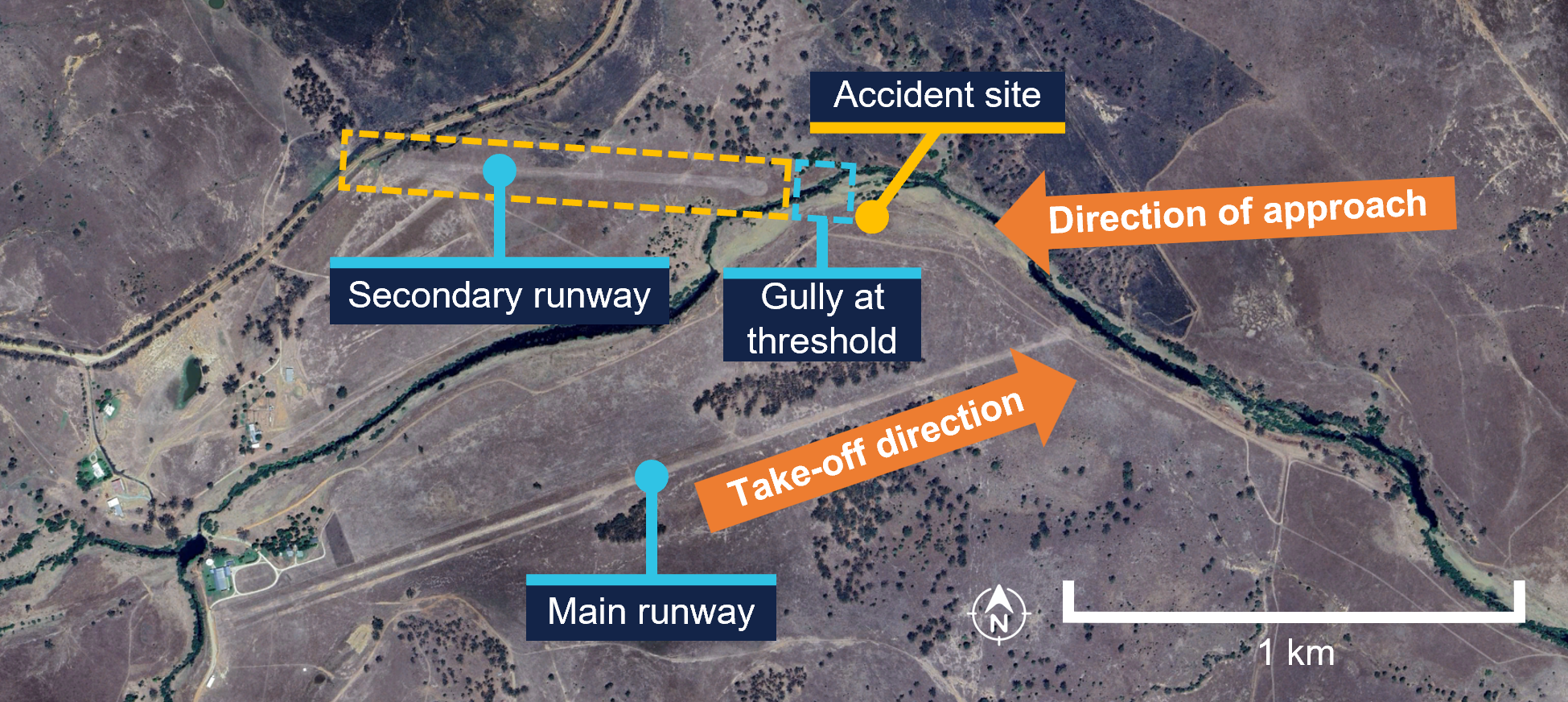
After take-off, there was an issue that resulted in the engine failing in flight, and the pilot attempted to return with the reported intention to land on the secondary runway. Concerned that the aircraft would not make the secondary runway with a deep gully at its threshold, the pilot conducted a forced landing into a nearby paddock.
Fire broke out as the aircraft slid to a stop against a fallen tree. The pilot was seriously injured and extricated themselves from the aircraft, then crawled about 2 km to the property owner’s home where emergency services were notified.
What the ATSB found
As a result of the aircraft's rate of descent, the impact forces acting on it during the forced landing caused one or both wing fuel tanks to be breached, which intensified, and likely led to, the post‑impact fire.
The fire destroyed most of the aircraft’s engine, cabin, wings, and fuselage which limited the extent to which pre-impact defects could be identified. Because of this, the reason for the aircraft’s engine failing in flight could not be established.
Safety message
Managing a partial power loss or total engine failure during or after take-off increases stress and uncertainty at a time when a pilot’s workload is already high. Pre-flight planning of what actions could be taken should an emergency occur can assist in reducing the pilot’s mental workload and increase the likelihood of a successful recovery. The 2013 ATSB educational publication Avoidable Accidents No. 3: Managing partial power loss after take-off in single-engine aircraft (AR‑2010‑055) provides helpful pilot advice on this topic.

The ATSB SafetyWatch highlights the broad safety concerns that come out of our investigation findings and from the occurrence data reported to us by industry. One of the safety concerns is reducing the severity of injuries in accidents involving small aircraft. A 5-point restraint was likely being worn by the pilot and in several of its investigations, the ATSB has found injuries to aircraft occupants have been avoided, or made less severe, through the appropriate use of multi-point harnesses. Additionally, selection of clothing that is more flame resistant and with more coverage can reduce the severity of burns and offer protection during extrication from a crashed aircraft.
The investigation
| The ATSB scopes its investigations based on many factors, including the level of safety benefit likely to be obtained from an investigation and the associated resources required. For this occurrence, the ATSB conducted a limited-scope investigation in order to produce a short investigation report, and allow for greater industry awareness of findings that affect safety and potential learning opportunities. |
The occurrence
On the morning of 23 November 2025 at about 0900, the pilot (who was the sole occupant) of a Van’s RV-8, registered VH-YGY, took off heading 060° from the main runway of Old Station1 aircraft landing area (ALA), which is located about 41 km west of Gladstone, Queensland, on private property.
The pilot spoke to the property owner immediately after the accident. According to the property owner, the pilot said that after take-off the engine lost some power and subsequently failed. The pilot later recalled that the engine failed suddenly, without being preceded by a partial power loss.2
The pilot attempted to return to Old Station with the intention to land on the secondary runway (heading 260°). Out of concern that the aircraft would not make the secondary runway and because of a deep gully at its threshold, the pilot made a forced landing into a nearby paddock (Figure 1).
Figure 1: Take-off and approach directions
Source: Google Earth, annotated by the ATSB
The pilot recalled that they sideslipped the aircraft nose left to reduce the aircraft’s energy just before colliding with terrain. The impact forces on the aircraft during the forced landing collapsed the landing gear and one or both wing fuel tanks were breached. Fire broke out as the aircraft slid to a stop against a fallen tree (see Wreckage and impact information). The aircraft was destroyed in the impact and intense fuel-fed fire.
The pilot was seriously injured with a spinal injury and burns. The pilot reported difficulty opening the aircraft canopy, but they extricated themselves from the aircraft, then crawled about 2 km to the property owner’s home where emergency services were notified. There were no witnesses to the flight or the accident.
Context
Pilot information
The pilot was issued with an Australian Private Pilot Licence (Aeroplane) in 1983 and held a current Civil Aviation Safety Regulation Part 61 Private Pilot Licence (Aeroplane) (PPL). The pilot held a valid class 2 civil aviation medical certificate with no restrictions and was required to wear vision correction when flying.
Aircraft information
The Van’s Aircraft RV-8 is a low-wing, all-metal, amateur-built aircraft. It is supplied in kit form and is designed to be constructed for the education and recreation of the owner. The RV-8 has 2 seats in tandem configuration and is suitable for cross-country flying or for flying aerobatic manoeuvres.
Construction of VH-YGY, serial number 80605, was carried out by the pilot of the accident flight and was first registered on 7 July 2010 and issued with a special certificate of airworthiness. The airworthiness category of this certificate was experimental. The aircraft was fitted with a 6‑cylinder, horizontally opposed Eggenfellner E6 engine using automotive 98 octane fuel. The basis of this engine was an automotive Subaru engine with additions and modifications for aircraft use. The aircraft was fitted with a Quinti Avio QA4SE 4‑blade electric constant-speed propeller.
Recent maintenance
As VH-YGY had been constructed by the pilot and the airworthiness category of the special certificate of airworthiness was experimental, the pilot was permitted to carry out their own maintenance on the aircraft.
According to people familiar with the pilot and aircraft, the aircraft had reportedly been difficult to start in the time recent to the accident. On 20 November 2025 at Caboolture Aerodrome, the pilot replaced the fuel pressure regulator fitted to VH-YGY with a new part. The new fuel pressure regulator was an automotive engine part and used to maintain fuel pressure to the engine at 40 psi. The ATSB was unable to determine the exact part used.
The pilot was observed taxiing VH-YGY at Caboolture Aerodrome on 21 November 2025, and on 22 November 2025 flew the aircraft from Caboolture Aerodrome to Old Station ALA.
Meteorological information
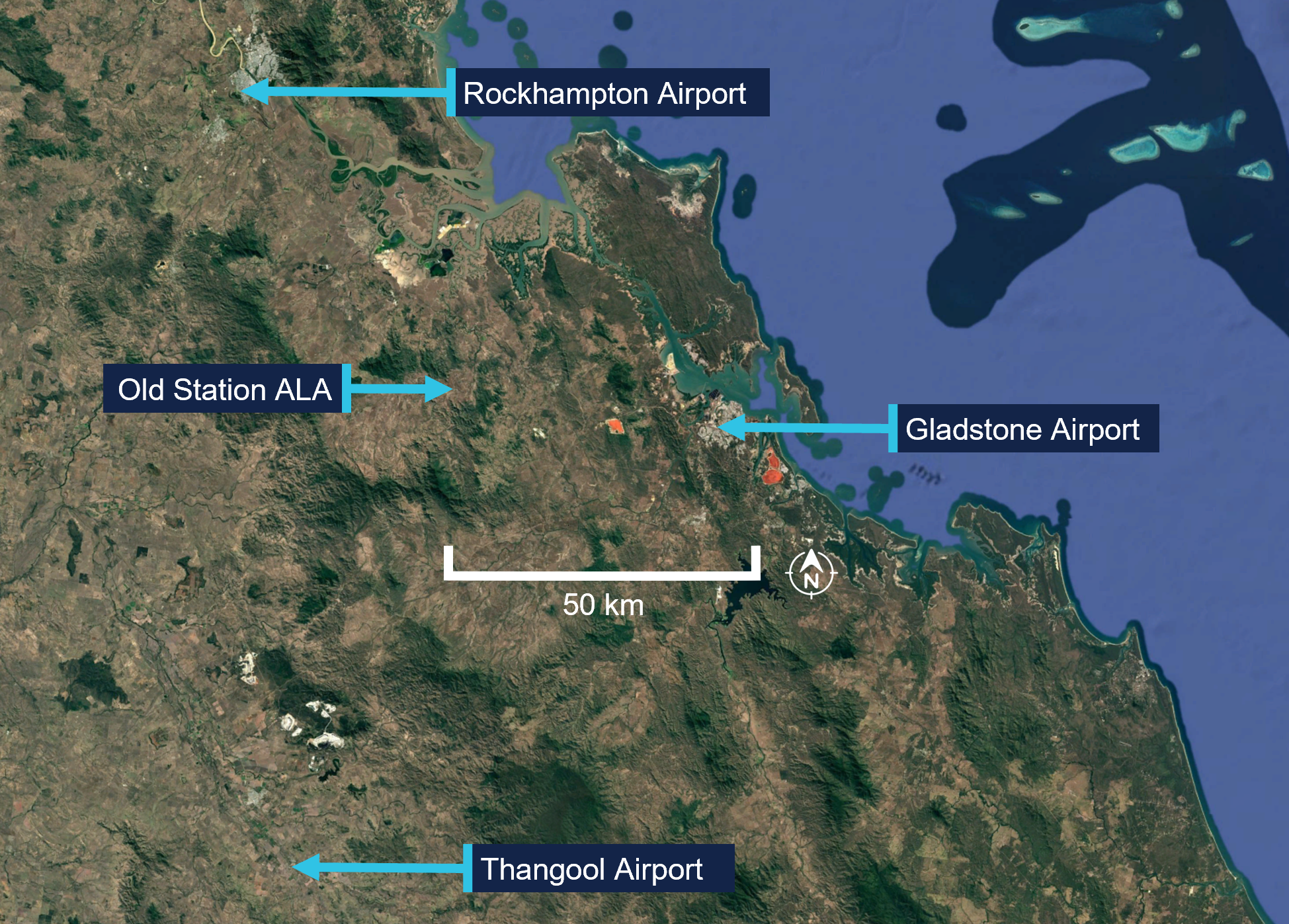
The weather at the aerodrome was reported to be clear with light winds. There were no official weather observations available for Old Station ALA. The nearest official data was obtained from Gladstone Airport located 41 km to the east, Rockhampton Airport located 60 km north-west, and Thangool Airport 78 km south‑south‑west of the property (Figure 2).
Figure 2: Locations of weather observations
Source: Google Earth, annotated by the ATSB
The meteorological aerodrome report (METAR)3 for Gladstone Airport at 0900 reported wind from the north‑east (030°) at 7 kt, visibility greater than 10 km and no cloud detected. There was no rainfall recorded in the previous 24 hours.
The METAR for Rockhampton Airport at 0900 reported a mean wind from the east (080°, varying between 050° and 110°) at 6 kt, visibility greater than 10 km and few clouds at 2,700 AGL. There was no rainfall recorded in the previous 24 hours.
Wreckage and impact information
The accident site was located in open farmland that was flat and slightly sloping down toward the west. The aircraft slid for about 70 m before coming to rest against a fallen tree. As evidenced by post-accident browning of the grass, fuel had been liberated from one or both of the wing fuel tanks from about 7 m from the initial point of impact until where the aircraft came to rest. The grass in the path of the aircraft was burnt in places about 45 m from the initial point of impact and around the aircraft (Figure 3).
Figure 3: Accident site overview
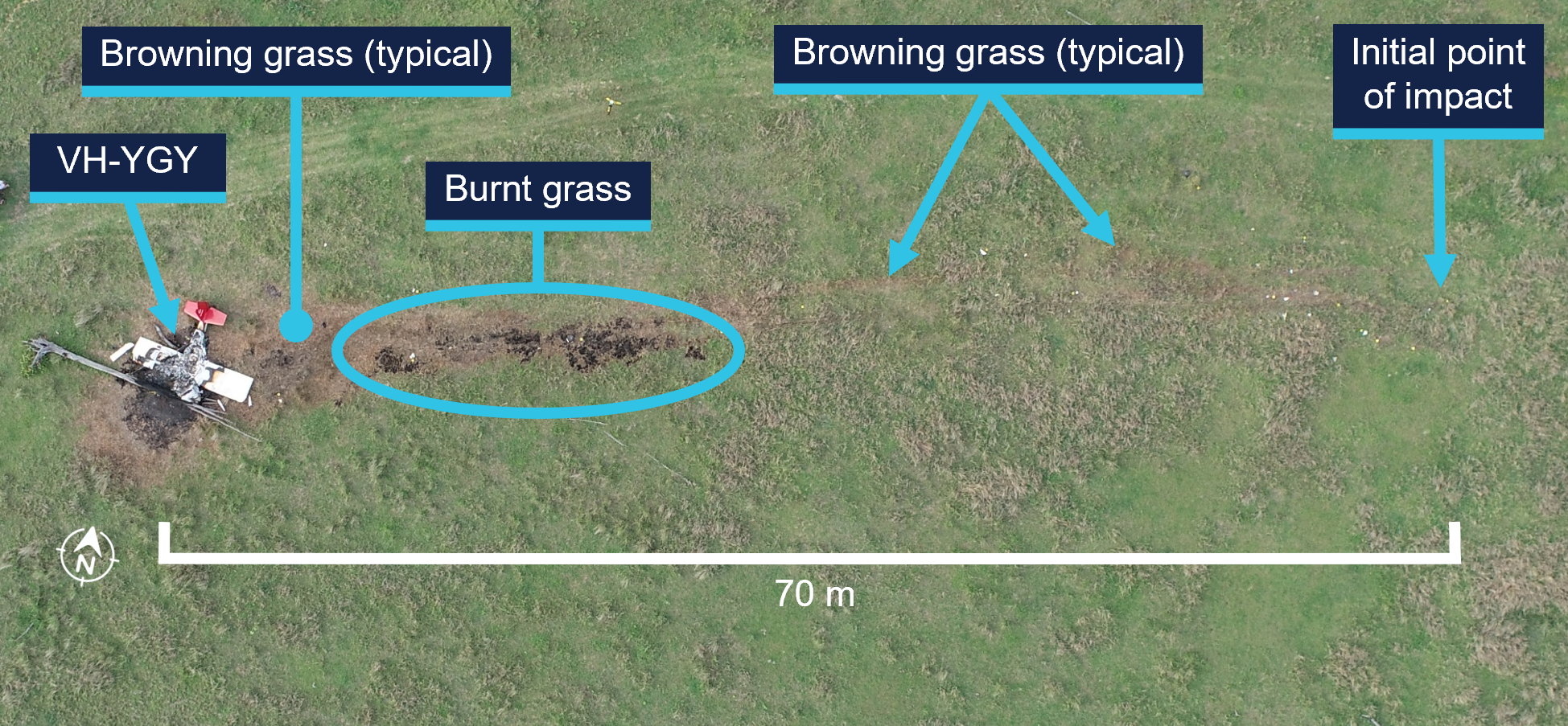
This image was taken on the day of the accident; the browning grass was more prominent in the days following. Source: Queensland Police, annotated by the ATSB
There was no fuel remaining in the aircraft’s fuel tanks suitable for testing. The aircraft’s engine, cabin, wings and fuselage were mostly destroyed by the fire, limiting the extent to which pre-impact defects could be identified (Figure 4).
Figure 4: VH-YGY at the accident site
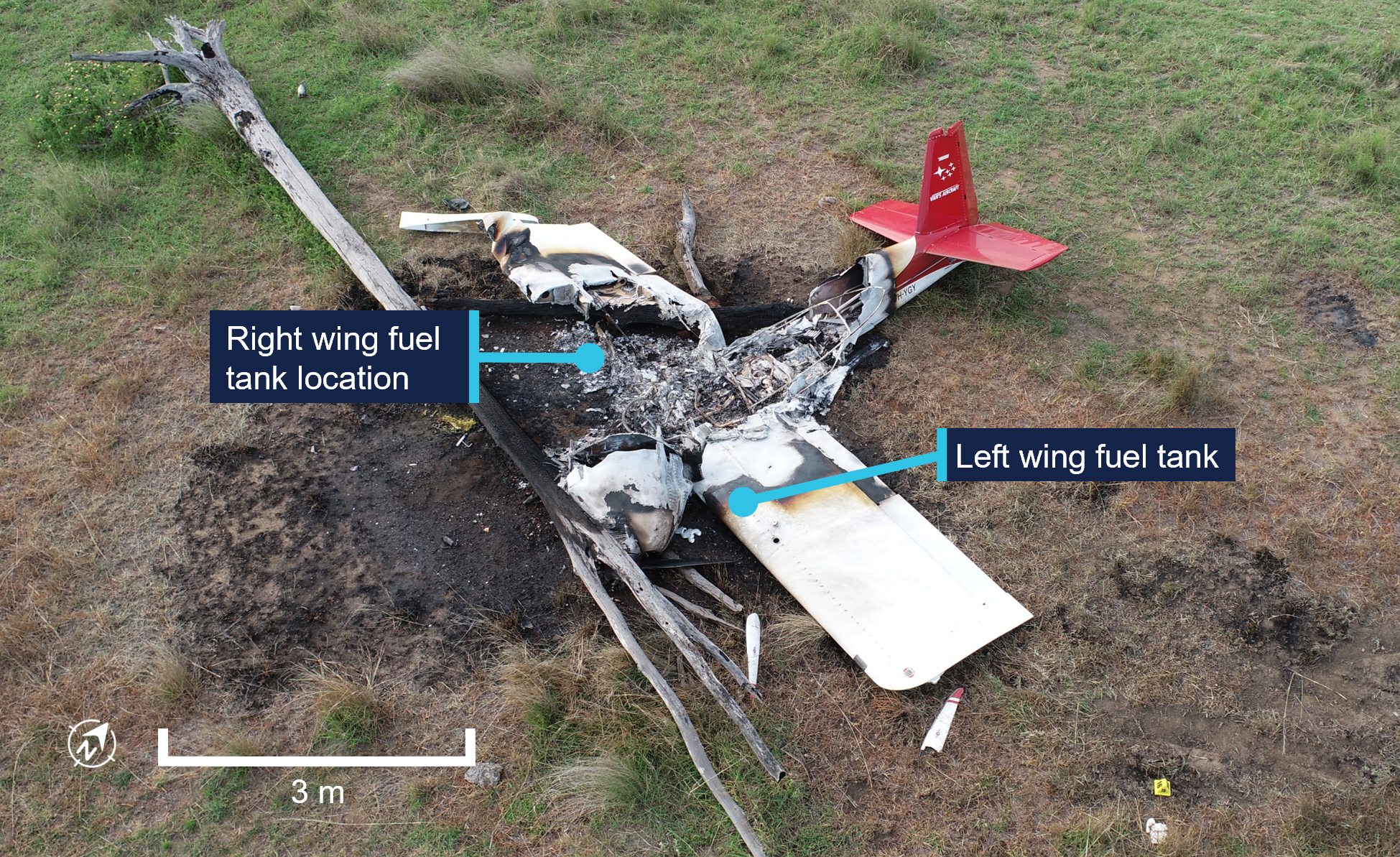
Note: the left-wing fuel tank cap was removed by first responders for fire suppression. Source: Queensland Police, annotated by the ATSB
However, from the evidence available, the following could be established:
- Fragmentation and the position of a propeller blade (1 of 4) indicated that the engine was not running at impact.
- Both main landing gear axles, brakes and wheel assemblies had separated from the main landing gear legs which in turn had collapsed under the aircraft.
- The wing/fuselage structure and engine mounting frame was buckled by impact forces.
- The flap actuator extension was consistent with the flaps being close to, or fully, retracted.
Numerous engine components were destroyed by the fire. This included wiring, flexible hoses and fuel system components. The fuel pressure regulator that had been replaced 3 days prior to the accident was not identified (or any remnants of it) at the accident site or during a follow-up aircraft and engine inspection conducted by the ATSB.
The following avionics were recovered from the accident site and transported to the ATSB Canberra technical facility:
- Dynon EFIS-D100 (flight instrumentation)
- Garmin aera 500 (global positioning system)
- GRT Avionics EIS 6000 (engine information display)
- SDS LCD Programmer (engine management).
Recovery of data was not possible because of the extent that they were damaged by fire.
Survival aspects
When assessing the survivability of an aircraft accident, a number of aspects are considered, including:
- occupant restraints
- forces imparted on the aircraft occupants
- liveable space inside the aircraft being maintained
- post-impact fire.
The aircraft was fitted with a 5-point4 restraint which was likely being worn by the pilot on the accident flight.
The damage to the main landing gear axle, brake and wheel assemblies along with the main landing gear legs was indicative of high deceleration forces on impact. It was not able to be determined whether the forward cockpit liveable space was reduced to a point where it injured the pilot or hindered their escape.
The pilot was reportedly wearing shorts and a t-shirt.
The aircraft had 2, 80 litre fuel tanks integral5 to the inboard leading edge of each wing. The aircraft was also fitted with optional wing tip fuel tanks, however they were not carrying fuel on the day of the accident. Flexible fuel tanks were not available for the RV‑8.
In 2022, the ATSB investigated a collision with terrain involving a Cessna U206G, west of Norseman, Western Australia, on 3 March 2022.6 The investigation noted that:
Metal fuel tanks are prone to rupturing during an accident impact, allowing fuel to escape and increasing the risk of a post‑impact fire. To improve crashworthiness, the addition of fuel bladders and fuel cells that have been constructed of flexible materials have proven less prone to rupturing during an impact. They are able to withstand greater deformation and puncture less readily and are less likely to expand or tear to form a larger opening from which fuel can escape. Such systems may provide occupants with more time to egress the aircraft and/or reduce the risk of any fire‑related injury.
Partial power loss or engine failure after take-off
During a normal take-off, a pilot’s workload is already high, and in the event of a partial power loss, or total engine failure, the pilot must decide actions to safely recover the aircraft under conditions of stress and uncertainty. Pre-flight planning for a partial or total engine power loss on take-off can help to reduce the pilot’s mental workload in the event of one occurring.
The 2013 ATSB educational publication Avoidable Accidents No. 3: Managing partial power loss after take-off in single-engine aircraft (AR-2010-055) contains the following pre-flight planning considerations should an aircraft suffer a power loss after take‑off (ATSB 2013):
- the runway direction and the best direction of any turn
- the local wind strength and direction on a particular day
- terrain and obstacles
- decision points (with regard to aircraft height and performance) where different landing options could be taken, such as:
- landing on the remaining runway or aerodrome
- landing outside the aerodrome
- conducting a turn back towards the aerodrome.
In the event of an engine failure or power loss at a low height, pilots are advised to land straight ahead, or within 30º either side of that heading (Aviation Theory Centre, 2009). Pilots are also advised to only consider a turnback manoeuvre if they have achieved a minimum height, which varies depending on the aircraft type and other factors.
Safety analysis
Engine power loss
There was a difference between the property owner’s recollection of the pilot’s statements soon after the accident, and subsequent recollection by the pilot, as to whether the engine initially lost some power after take-off before stopping completely. Nevertheless, damage to the propeller was consistent with the engine having stopped prior to the point of impact.
The fuel and engine systems of VH-YGY were comprised of numerous components, and a failure of one or more of these components could have contributed to the engine failing in‑flight. The ATSB was unable to determine any reasons for this as the post‑impact fire had damaged or destroyed most of these systems. Of the components that remained, no overt defects were identified. The aircraft had reportedly been difficult to start in the past, but it is not known if the pilot had any issues starting the engine on the day of the accident.
The fuel pressure regulator had been replaced 3 days prior to the accident, and the ATSB considered the possibility of a defect associated with the component’s serviceability or an error in its fitment. The fuel pressure regulator or any remnants of it were not identified in the aircraft wreckage, and it is likely that it had been destroyed during the post-impact fire. Therefore, no conclusions regarding its serviceability or security could be drawn.
Forced landing
Following a complete engine failure, a forced landing is inevitable, whereas in a partial power loss, pilots are faced with making a difficult decision whether to continue flight or to conduct an immediate forced landing. The pilot decided to turn back to the secondary runway of Old Station ALA, as they likely believed this was achievable, based on the circumstances at the time. After they assessed that this was no longer possible and with the onset of the deep gully at the threshold of the runway, the pilot was compelled to make an immediate forced landing.
The forces on the aircraft’s structure because of its rate of descent during the forced landing buckled the wing/fuselage structure, liberated both main landing gear axle, brake and wheel assemblies, collapsed the landing gear, and caused one or both wing fuel tanks to be breached, which intensified the post-impact fire.
The effectiveness of the pilot’s attempt to reduce the aircraft’s energy immediately ahead of the impact could not be determined. Lowering the flaps could have slowed the aircraft for landing, potentially lessening impact damage, although it was not determined if the pilot had time to do so.
Protective clothing
There are no regulatory requirements for the selection of clothing on private or other flights. However, selection of clothing that is more flame resistant and with more coverage can reduce the severity of burns and offer protection during extrication from a crashed aircraft. Fibres such as cotton, flax, nylon, and polyester burn more easily than fibres such as wool and aramids7 which are more flame‑resistant (Silva-Santos and others 2017).
The shorts and t-shirt worn by the pilot on the day of the accident would have offered less protection than a long sleeve shirt and trousers, however it was not determined whether this contributed to the severity of their injuries. While personal preference and comfort are obvious factors in the selection of clothing when flying, consideration should be given to the clothing’s fire resistance and coverage.
Findings
ATSB investigation report findings focus on safety factors (that is, events and conditions that increase risk). Safety factors include ‘contributing factors’ and ‘other factors that increased risk’ (that is, factors that did not meet the definition of a contributing factor for this occurrence but were still considered important to include in the report for the purpose of increasing awareness and enhancing safety). In addition ‘other findings’ may be included to provide important information about topics other than safety factors. These findings should not be read as apportioning blame or liability to any particular organisation or individual. |
From the evidence available, the following findings are made with respect to the forced landing and collision with terrain involving Van's RV-8, VH-YGY, 40 km west of Gladstone Airport, Queensland, on 23 November 2025.
Contributing factors
- After take-off, there was an undetermined issue that resulted in the engine failing in flight.
- During the forced landing, impact forces as a result of the aircraft's rate of descent collapsed the landing gear, buckled the wing/fuselage structure and caused one or both wing fuel tanks to be breached, which intensified the post-impact fire.
Sources and submissions
Sources of information
The sources of information during the investigation included the:
- property owner
- associates of the pilot who were familiar with the aircraft
- Civil Aviation Safety Authority
- Queensland Police Service.
References
Australian Transport Safety Bureau (2013). Avoidable accidents no. 3: Managing partial power loss after take-off in single-engine aircraft (AR-2010-055). Canberra, Australia. https://www.atsb.gov.au/publications/avoidable-accidents/2022/aviation/avoidable-accidents-no-3-managing-partial-power-loss
Australian Transport Safety Bureau (2025). Collision with terrain involving Cessna U206G, VH-JVR 124 km west of Norseman, Western Australia, on 3 March 2022 (AO‑2022-011). https://www.atsb.gov.au/investigations/ao-2022-011
Robson, D., Dyer, J. (2009) Flying training manual. A basic pilot training programme (pp 263–264). Aviation Theory Centre.
Silva-Santos MC, Oliveira MS, Giacomin M, Laktim MC and Baruque Ramos J (2017). Flammability on textile of flight crew professional clothing. IOP Conference Series: Materials Science and Engineering.
Submissions
Under section 26 of the Transport Safety Investigation Act 2003, the ATSB may provide a draft report, on a confidential basis, to any person whom the ATSB considers appropriate. That section allows a person receiving a draft report to make submissions to the ATSB about the draft report.
A draft of this report was provided to the following directly involved parties:
- pilot
- property owner
- Civil Aviation Safety Authority.
A submission was received from the pilot.
The submission was reviewed and, where considered appropriate, the text of the report was amended accordingly.
Purpose of safety investigationsThe objective of a safety investigation is to enhance transport safety. This is done through:
It is not a function of the ATSB to apportion blame or provide a means for determining liability. At the same time, an investigation report must include factual material of sufficient weight to support the analysis and findings. At all times the ATSB endeavours to balance the use of material that could imply adverse comment with the need to properly explain what happened, and why, in a fair and unbiased manner. The ATSB does not investigate for the purpose of taking administrative, regulatory or criminal action. About ATSB reportsATSB investigation reports are organised with regard to international standards or instruments, as applicable, and with ATSB procedures and guidelines. Reports must include factual material of sufficient weight to support the analysis and findings. At all times the ATSB endeavours to balance the use of material that could imply adverse comment with the need to properly explain what happened, and why, in a fair and unbiased manner. An explanation of terminology used in ATSB investigation reports is available here. This includes terms such as occurrence, contributing factor, other factor that increased risk, and safety issue. Publishing informationReleased in accordance with section 25 of the Transport Safety Investigation Act 2003 Published by: Australian Transport Safety Bureau © Commonwealth of Australia 2026 
Ownership of intellectual property rights in this publication Unless otherwise noted, copyright (and any other intellectual property rights, if any) in this report publication is owned by the Commonwealth of Australia. Creative Commons licence With the exception of the Commonwealth Coat of Arms, ATSB logo, and photos and graphics in which a third party holds copyright, this report is licensed under a Creative Commons Attribution 4.0 International licence. The CC BY 4.0 licence enables you to distribute, remix, adapt, and build upon our material in any medium or format, so long as attribution is given to the Australian Transport Safety Bureau. Copyright in material obtained from other agencies, private individuals or organisations, belongs to those agencies, individuals or organisations. Where you wish to use their material, you will need to contact them directly. |
- ^ Old Station ALA has 2 grass runways–the main runway is oriented 060°/240° magnetic and a shorter, secondary runway is oriented 080°/260° magnetic.
- ^ The pilot was not interviewed by the ATSB, and later provided comment on the draft report regarding the sequence of events.
- ^ METAR (meteorological aerodrome report) is a routine aerodrome weather report issued at half-hourly time intervals. The report ordinarily covers an area of 8 km radius from the aerodrome reference point.
- ^ A 5-point harness is a 4-point harness with an additional crotch strap that prevents ‘submarining’, in which the occupant slides down under the lap belt.
- ^ A fuel tank that is formed by coating a space within the aircraft wing’s internal structure with sealant.
- ^ Collision with terrain involving a Cessna U206G, VH-JVR, 124 km west of Norseman, Western Australia, on 3 March 2022 (AO-2022-011).
- ^ Aramids are a range of synthetic fibres that are heat and fire‑resistant. A common use in aviation is an aramid known as Nomex which is used for fire‑resistant clothing for flight crews.
Occurrence summary
| Investigation number | AO-2025-068 |
|---|---|
| Occurrence date | 23/11/2025 |
| Occurrence time and timezone | 09:00 Australian Eastern Standard Time |
| Location | 40 km west of Gladstone Airport |
| State | Queensland |
| Report release date | 29/05/2026 |
| Report status | Final |
| Investigation level | Short |
| Investigation type | Occurrence Investigation |
| Investigation status | Completed |
| Mode of transport | Aviation |
| Aviation occurrence category | Collision with terrain, Engine failure or malfunction, Forced/precautionary landing |
| Occurrence class | Accident |
| Highest injury level | Serious |
Aircraft details
| Manufacturer | Van's Aircraft |
|---|---|
| Model | RV-8 |
| Registration | VH-YGY |
| Serial number | 80605 |
| Sector | Piston |
| Operation type | Part 91 General operating and flight rules |
| Activity | General aviation / Recreational-Unknown general aviation flying |
| Departure point | Old Station Aircraft Landing Area, Queensland |
| Injuries | Crew - 1 (Serious) |
| Damage | Destroyed |