Occurrence Briefs are concise reports that detail the facts surrounding a transport safety occurrence, as received in the initial notification and any follow-up enquiries. They provide an opportunity to share safety messages in the absence of an investigation. Because occurrence briefs are not investigations under the Transport Safety Investigation Act 2003, the information in them is de-identified.
What happened
On 8 November 2025, at approximately 1315 local time,[1] a Boeing A75N1 (Stearman), with one pilot on board, departed a privately-owned runway near Dochra, New South Wales.
The pilot conducted a 30-minute private flight, before returning to the 500 m-long grass runway, orientated almost north-south. The pilot reported that the shorter runway required them to use a ‘short field’ landing technique and that the wind was westerly at less than 10 kt and variable near the ground.
The pilot conducted 3 consecutive landings and take-offs on the southern facing runway. During their third approach, the pilot recognised that the aircraft was about 200 feet higher than normal on final approach, however continued the approach.
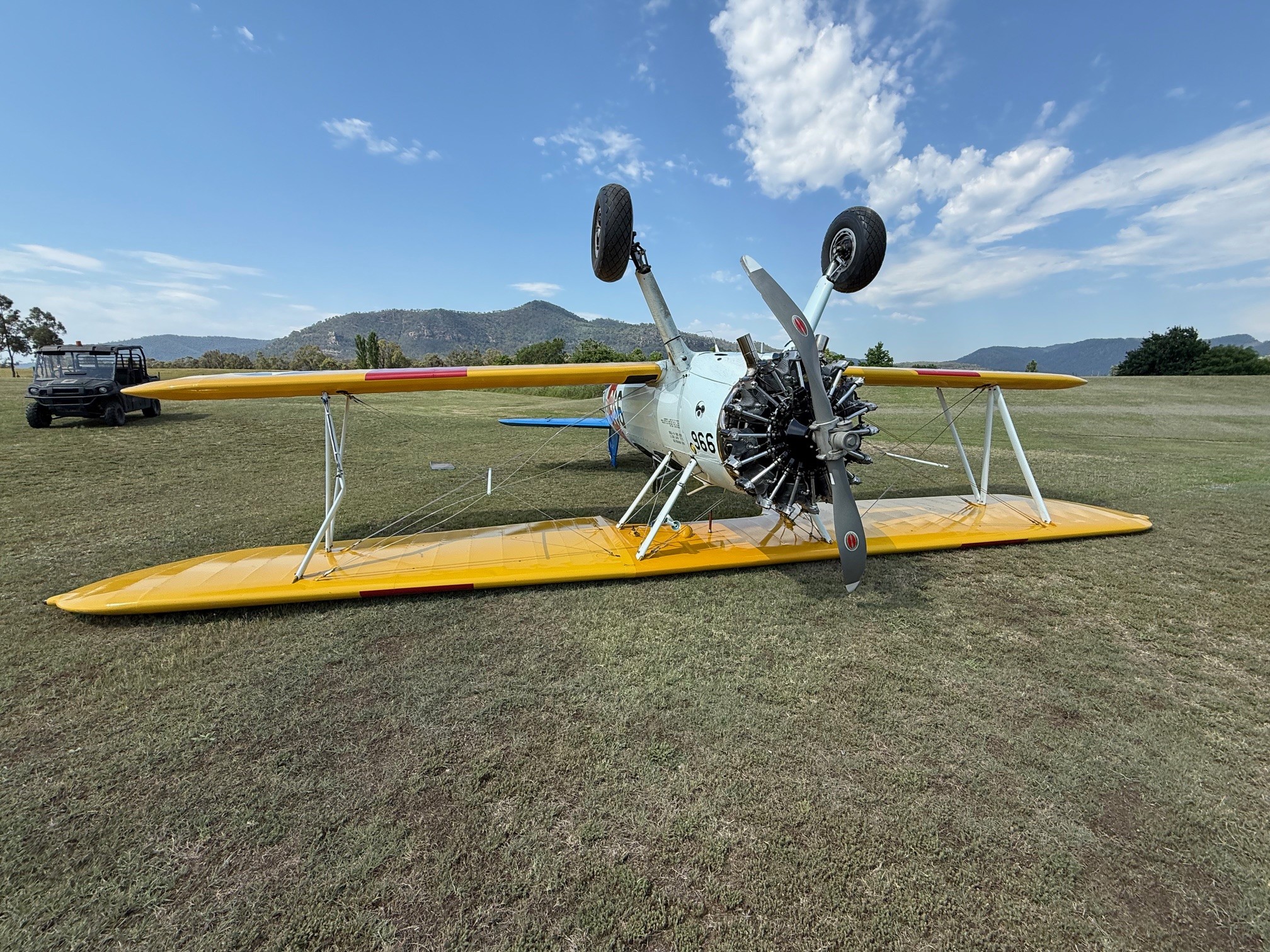
They reported touching down in a 3-point attitude, too far down the runway and applied hard braking which caused the tail to lift once elevator effectiveness reduced. This resulted in the aircraft slowly tipping forward, striking the propeller and then flipping over onto its back and rudder (Figure 1).
Figure 1: Aircraft post-occurrence
Source: Operator
The aircraft sustained damage to its rudder, propeller, wing and strut. The pilot was uninjured.
Safety message
Good landings are made from stable approaches and conducting a go-around is normally the safest course of action if a pilot is not entirely comfortable with the approach.
Pilots should also consider the required approach performance for short field landings of their aircraft when assessing their approach to land with limited runway length. Heavy braking in high centre-of-gravity, tailwheel aircraft increases the risk of loss of control on landing, which places greater importance on ensuring the approach is conducted appropriately.
About this report
Decisions regarding whether to conduct an investigation, and the scope of an investigation, are based on many factors, including the level of safety benefit likely to be obtained from an investigation. For this occurrence, no investigation has been conducted and the ATSB did not verify the accuracy of the information. A brief description has been written using information supplied in the notification and any follow-up information in order to produce a short summary report, and allow for greater industry awareness of potential safety issues and possible safety actions.
[1]All times referred to in this report are local time, Coordinated Universal Time (UTC) + 11 hours.
Occurrence summary
Mode of transport
Aviation
Occurrence ID
AB-2025-060
Occurrence date
08/11/2025
Location
near Dochra
State
New South Wales
Occurrence class
Accident
Aviation occurrence category
Collision with terrain, Control issues, Ground strike
Occurrence Briefs are concise reports that detail the facts surrounding a transport safety occurrence, as received in the initial notification and any follow-up enquiries. They provide an opportunity to share safety messages in the absence of an investigation. Because occurrence briefs are not investigations under the Transport Safety Investigation Act 2003, the information in them is de-identified.
What happened
On 30 October 2025, the owner of a De Havilland DH-82A Tiger Moth was conducting circuit operations with an instructor at an aircraft landing area in regional Victoria as part of an aircraft type familiarisation. The flight involved practice of the wheel landing technique,[1] as the owner advised their previous tailwheel aircraft experience was limited to three-point landings.[2]
The owner and instructor both reported that at the time of the occurrence, the weather conditions were clear with negligible wind.
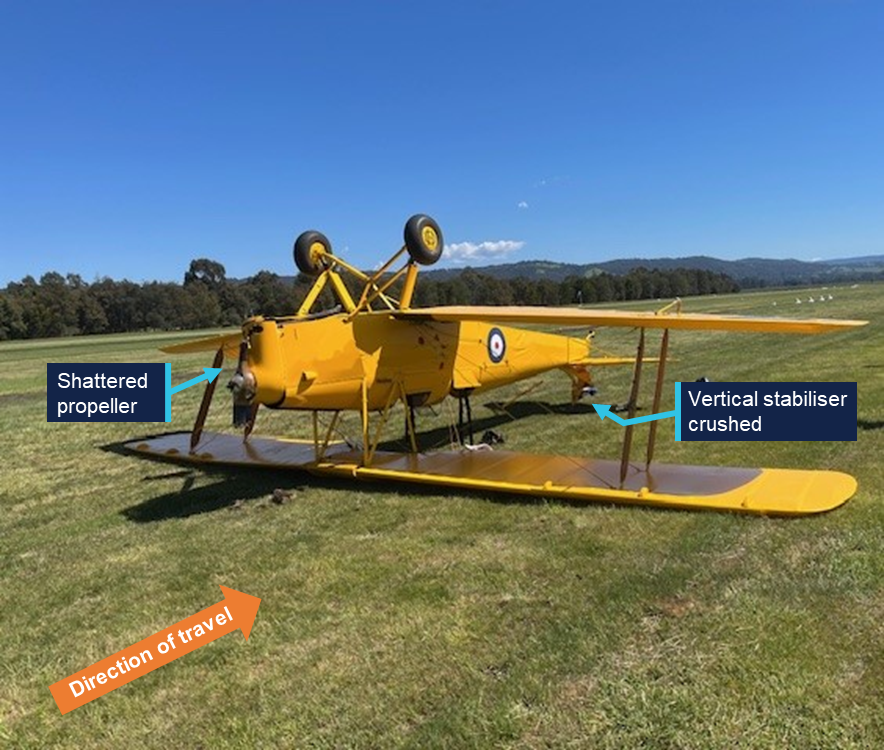
During the fourth touch-and-go, while in the ground-roll, the pilot flying (owner) abruptly applied full power and forward stick. The aircraft pitched forward, lifting the tail above the normal attitude for take-off and the propeller struck the ground. The aircraft subsequently nosed over, coming to a stop inverted. The instructor noted that they did not react quickly enough to arrest this movement as their attention was diverted to monitoring the pilot flying’s directional control during the landing and take-off sequence.
The aircraft sustained substantial damage to the vertical stabiliser, wings, fuel tank and fuselage (Figure 1), however, the occupants were uninjured.
Shortly after the occurrence, the pilot flying questioned the configuration of the DH-82A’s automatic slats at the time of the nose over. The instructor advised the ATSB that when the slats are in the unlocked position, the DH-82A can be more challenging to handle during wheel landings. Prior to the fourth touch-and-go, the slats had been configured in the locked position. However, during the final touch-and-go, the slats were unlocked, changing the handling characteristics. This change in slat configuration by the pilot flying had not been briefed prior to the flight.
Figure 1: Aircraft inverted post-occurrence
Source: Photo supplied by operator, annotated by the ATSB
Safety message
This occurrence highlights the challenges when operating tailwheel aircraft due to their unique handling characteristics. In particular, the typical placement of the main landing gear in front of the centre of gravity endows the aircraft with a sensitivity in pitch movement. This can result in pitch excursions and nose-over accidents during take-off or touch-and-go landings should pilots not remain fully cognisant of this behaviour.
These characteristics can be further exacerbated with the use of secondary flight controls such as wing flaps, slats and trim systems. Prior to training flights, pilots and instructors must brief the scope of the operation and discuss any changes that may be made, especially those that affect the flying characteristics of an aircraft.
It is also important for instructors conducting training and familiarisation flights to maintain effective awareness of the aircraft’s state and ensure they are prepared to rapidly intervene should the pilot flying experience control difficulties. This is particularly important during critical phases of flight such as the take-off.
About this report
Decisions regarding whether to conduct an investigation, and the scope of an investigation, are based on many factors, including the level of safety benefit likely to be obtained from an investigation. For this occurrence, no investigation has been conducted and the ATSB did not verify the accuracy of the information. A brief description has been written using information supplied in the notification and any follow-up information in order to produce a short summary report, and allow for greater industry awareness of potential safety issues and possible safety actions.
[1]Wheel landing: a technique where the aircraft touches down on the main landing gear first with the tail raised. It is the preferred technique in crosswind conditions as it improves the directional controllability while on the ground.
[2]Three-point landing: a technique where the aircraft touches down on the main landing gear and nose wheel simultaneously.
Occurrence Briefs are concise reports that detail the facts surrounding a transport safety occurrence, as received in the initial notification and any follow-up enquiries. They provide an opportunity to share safety messages in the absence of an investigation. Because occurrence briefs are not investigations under the Transport Safety Investigation Act 2003, the information in them is de-identified.
What happened
At around 1209 local time on 14 October 2025, a Eurocopter AS350, with only the pilot on board, was carrying an externally slung load between 2 sites in regional Western Australia, located approximately 6 km apart. The load weighed around 800 kg, and was secured using 4 strops, each rated to carry 3,000 kg.
The helicopter was transiting at around 60 kt, about 1,000 ft above ground level. Approximately midway through the flight, with the load stable, the pilot heard a sudden loud thud and felt the helicopter vibrate. At the same time, without the pilot’s command, the helicopter pitched forward into a nose down attitude. The pilot attributed this to a large change in the aircraft’s centre of gravity. In response, they immediately jettisoned the load, which restored full control of the helicopter. The pilot continued the short flight to the intended destination and landed without further incident.
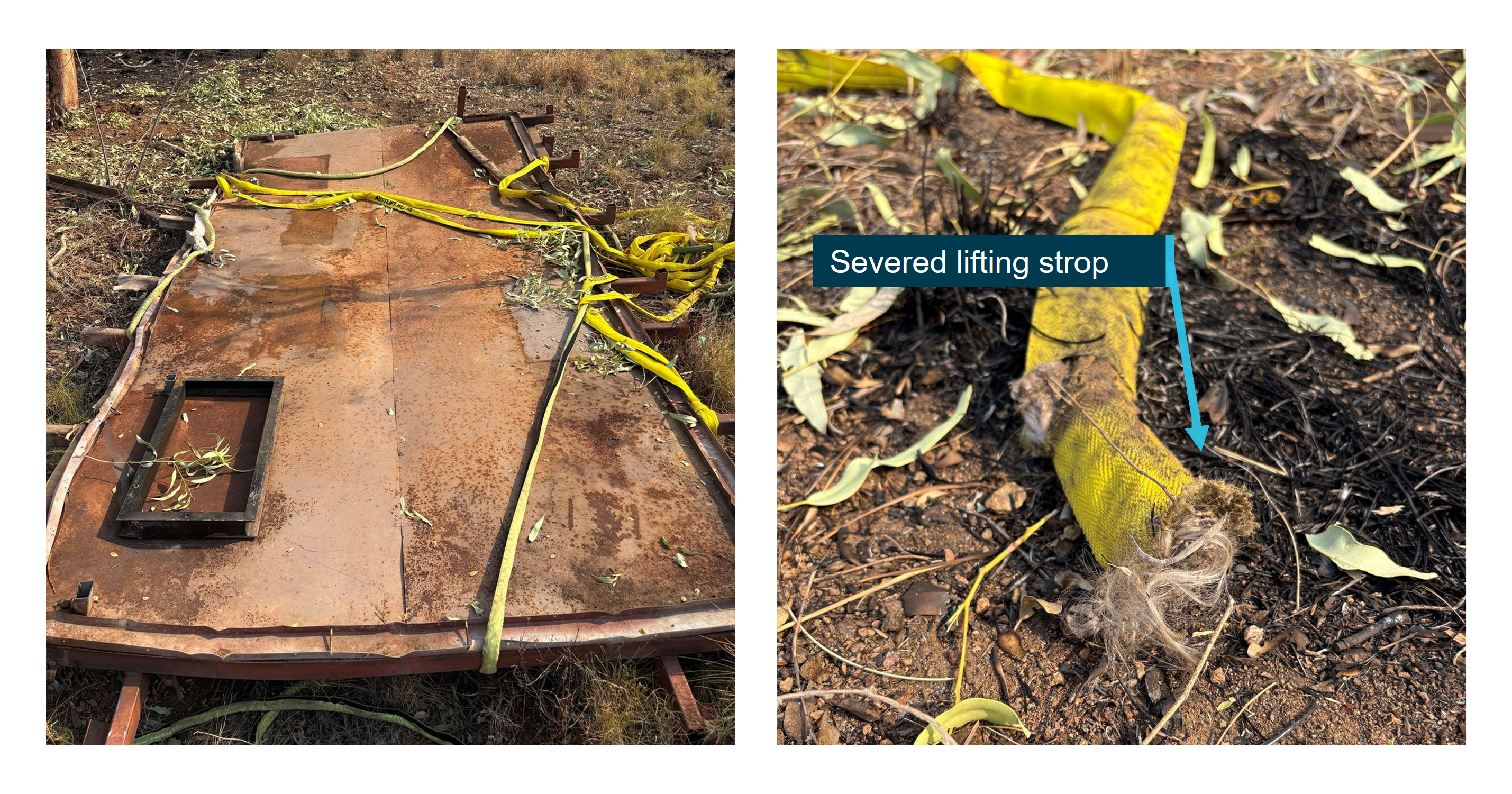
The jettisoned load was later located and inspection revealed that one of the lifting strops had been severed by jagged metal material contained in the load. This resulted in a sudden and significant shift in the load’s orientation beneath the helicopter, leading to the uncommanded pitch change.
Figure 1: Load and lifting strop condition post-occurrence
Image shows the load as it was found after being jettisoned and the condition of the severed lifting strop. Source: aircraft operator
Safety action
The operator has initiated a review of its risk assessment for sling load activities, which will incorporate information learned from this occurrence. It also produced internal recommendations to avoid loads from shifting in flight or damaging lifting equipment including:
using protective measures, such as rubber matting or edge protectors, wherever slings contact sharp or potentially abrasive surfaces
testing the structural integrity of loads prior to lifting, including an inspection process for loads that may have structural weaknesses, fatigue, or brittle components.
Safety message
This incident highlights the importance of detailed consideration when preparing external loads for lifting. The nature of aerial construction/deconstruction work can make it difficult for pilots to conduct a detailed inspection of the prepared load prior to each lift operation. Operators are encouraged to ensure effective risk control processes are in place for load preparation, especially with irregularly shaped loads. On this occasion the flight was operating in a remote area and the consequence of jettisoning the load was relatively benign. However, falling loads have the potential to cause catastrophic/fatal outcomes, and the risk must be appropriately mitigated.
About this report
Decisions regarding whether to conduct an investigation, and the scope of an investigation, are based on many factors, including the level of safety benefit likely to be obtained from an investigation. For this occurrence, no investigation has been conducted and the ATSB did not verify the accuracy of the information. A brief description has been written using information supplied in the notification and any follow-up information in order to produce a short summary report, and allow for greater industry awareness of potential safety issues and possible safety actions.
The flight crew of a passenger 737 missed arming the speedbrake before landing at Melbourne, after their workload increased unexpectedly during the arrival, an ATSB investigation has found.
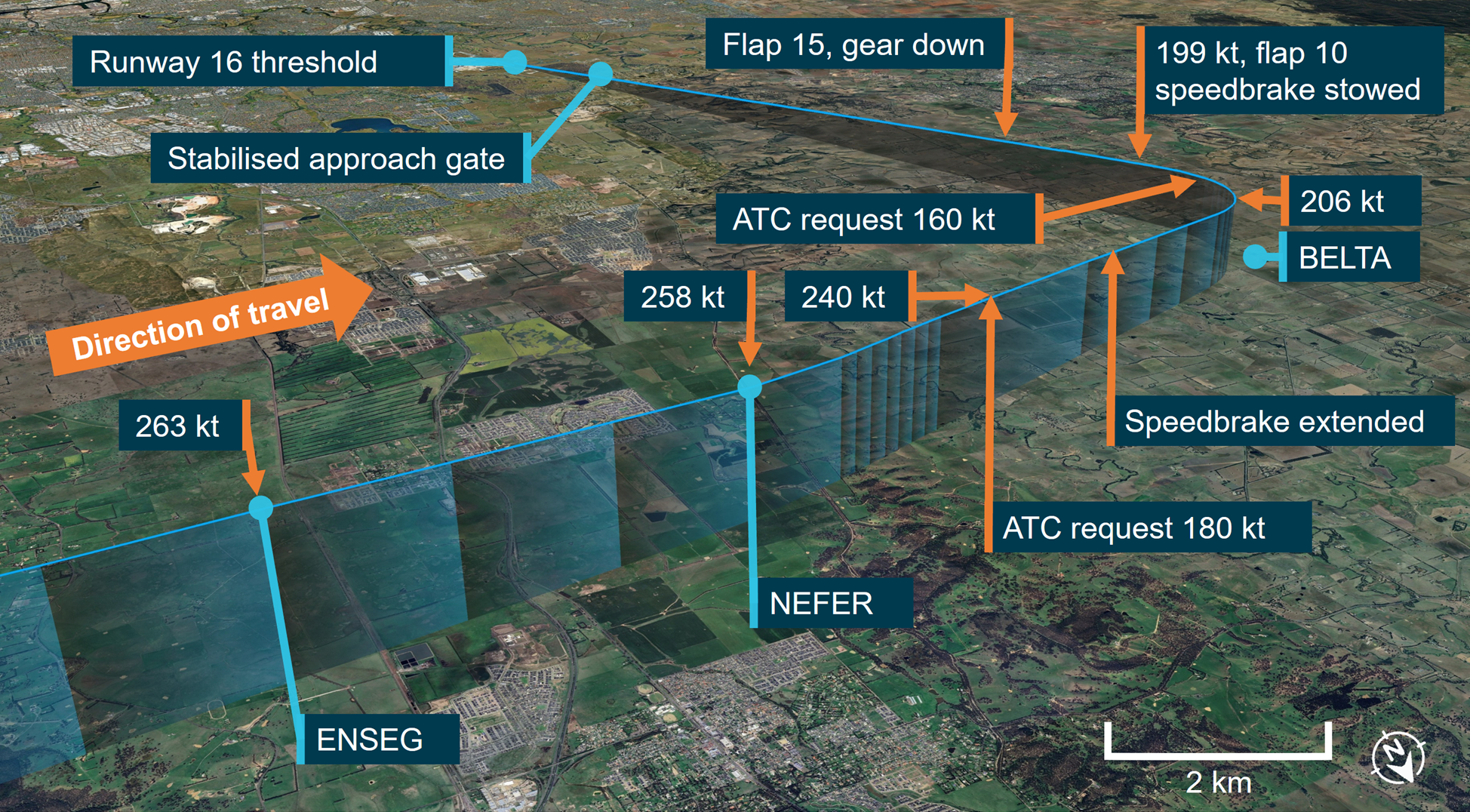
On 2 July 2025, a Virgin Australia 737 was arriving in Melbourne when it exceeded two speed limitations on the standard terminal arrival route, and its flight crew was instructed to reduce speed below 180 kt, and then 160 kt, by air traffic control (ATC), likely to provide separation from other aircraft.
The crew hastened the conduct of the approach actions after perceiving the ATC instructions to be urgent, and missed arming the speedbrake and performing the landing checks.
As the aircraft descended below 1,000 ft above airfield elevation, the crew assessed the approach to be stable and continued, resulting in the aircraft landing without its speedbrake armed, and thus without it automatically deploying.
Noticing this, the captain moved their hand to the lever to raise it manually. But before they could do so, the first officer selected reverse thrust, which automatically deployed the speedbrake. The aircraft then decelerated, and the flight concluded without further incident.
ATSB Director Transport Safety Stuart Macleod said the flight crew were put under a higher than usual workload when they allowed the aircraft to exceed speed limitations on the arrival.
“The crew were then slow to take positive steps to reduce speed requiring ATC to instruct them to slow further, and the crew’s attention became focused on achieving the requested speed reductions, likely resulting in them omitting to arm the speedbrake and conduct the landing checks,” Mr Macleod said.
Mr Macleod noted threat and error management principles state proactive management of workload throughout the flight is a key defence against capacity and attention-related errors by flight crew.
“Checklists are a vital defence against human error and are integral to maintaining flight safety,” he added.
“This occurrence highlights the importance of adhering to standard operating procedures and ensuring checklists are conducted at the appropriate times.”
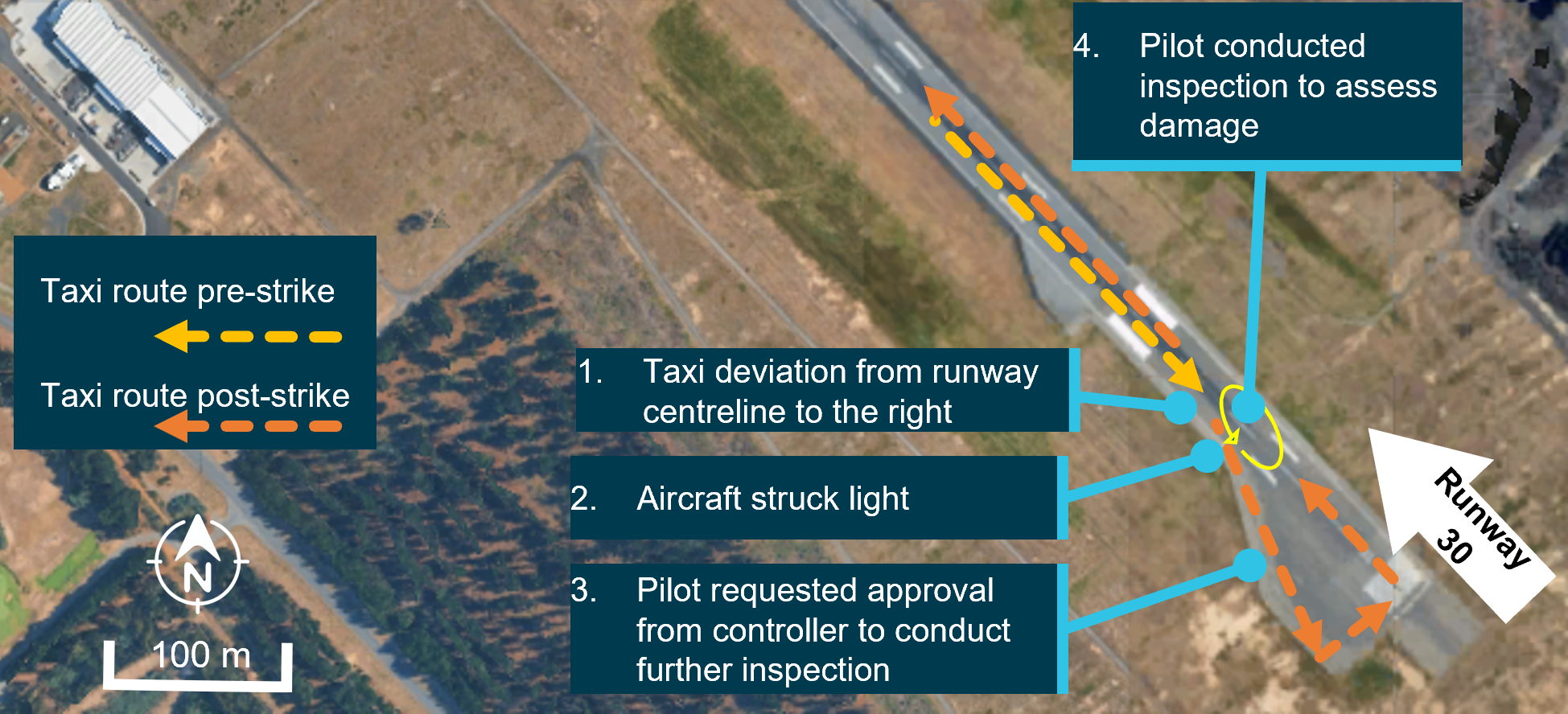
The pilot of a King Air mistook taxiway edge lights and markings for centreline guidance before one of the aircraft’s propellers struck a light while taxiing at night at Hobart Airport, an ATSB final report details.
On the evening of 1 July 2025, the RFDS Beechcraft B200 King Air commenced taxiing at Hobart, for a planned flight to Launceston, with two pilots and a paramedic on board.
The pilot flying was operating under the guidance of a supervisory pilot, prior to their final line check. Conditions were dark, with little to no moonlight, and good visibility.
The aircraft entered and backtracked on runway 30 before reaching the threshold and commencing a 180° turn.
“The flight crew reported the common technique for taxiing and turning the King Air B200 is to make a wide arc turn to reduce stress on the undercarriage,” ATSB Director Transport Safety Dr Stuart Godley said.
“But during the turn in this case, the pilot flying steered the aircraft away from the centreline taxiway ground markings, toward the right runway edge, later reporting they had subconsciously mistaken the blue taxiway edge lights and double yellow line as taxi centreline guidance.”
During the turn, the aircraft struck one of the taxiway edge lights with its right propeller, and the flight crew taxied back to the apron.
A post shutdown inspection found damage to the right propeller, and the aircraft was grounded for repairs.
Dr Godley said the incident demonstrated how pilots need to be vigilant and maintain an awareness of their location.
“The airport environment contains numerous visual aids, markings, signals and signs to help pilots remain situationally aware of their location, traffic and intended ground tracks to avoid obstacles.”
The ATSB’s final report notes the supervising pilot noticed the aircraft deviating closer to the edge lighting, but did not intervene in time to avoid it striking the light.
“Effective monitoring in a multi-crew environment is paramount to aircraft safety,” Dr Godley said.
“Bringing deviations to the early attention of the pilot flying promptly ensures the aircraft remains on a desirable track.”
An XPT passenger train exceeded a temporary speed restriction by more than 60 km/h after its driver was provided with an ambiguous notice of the restriction, a transport safety investigation has concluded.
The investigation into the incident was conducted by the Office of the Chief Investigator, which investigates rail occurrences in Victoria in accordance with a collaboration agreement with the ATSB.
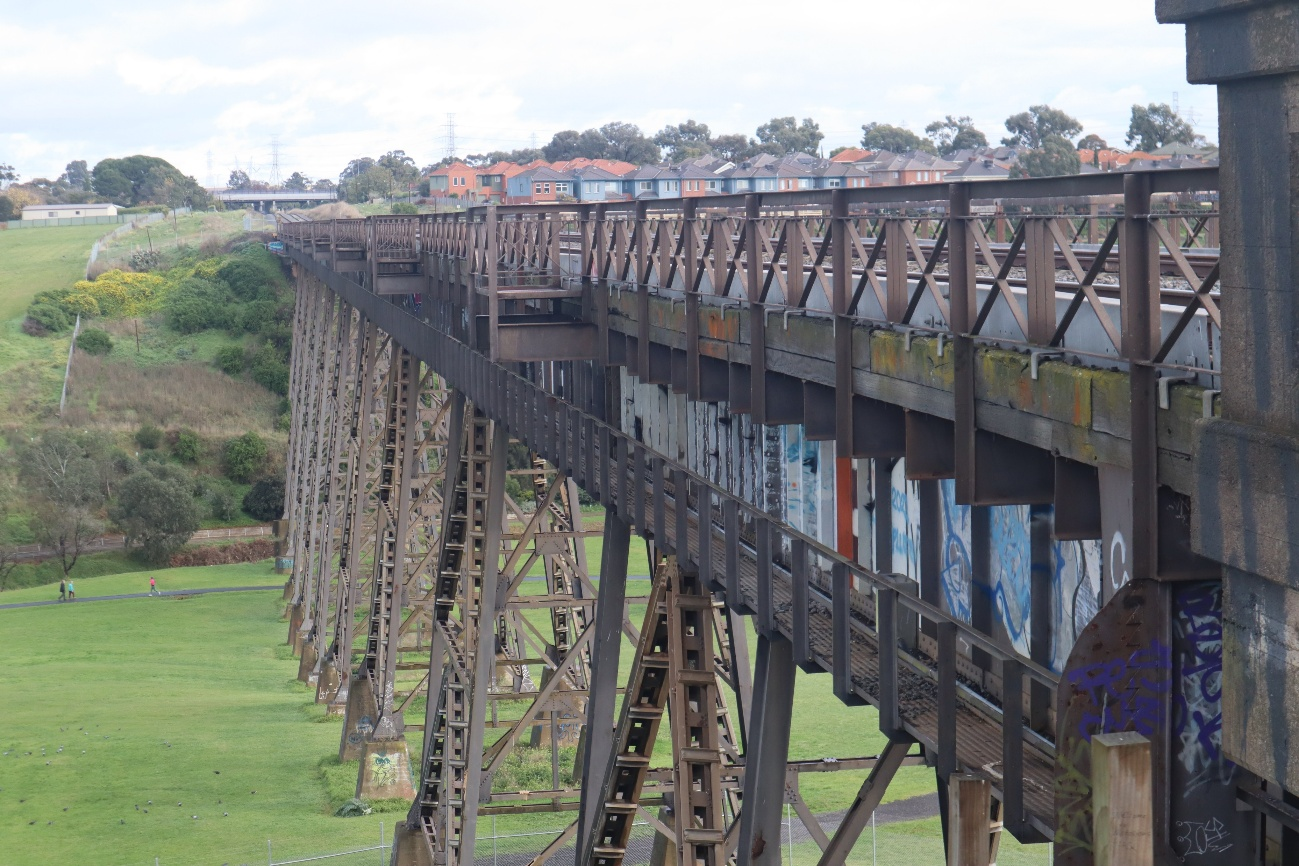
The investigation’s final report notes that, on the morning of 24 May 2022, a temporary speed restriction (TSR) of 40 km/h was in place for a section of track over Moonee Ponds Creek bridge. ARTC network controllers had applied the TSR in response to a rough ride report made by the driver of an earlier train.
While the TSR was in place, an XPT passenger service from Sydney to Melbourne travelled through the section at about 100 km/h.
Chief Investigator Mark Smallwood said the driver of the XPT train had been given a warning for the TSR that was ambiguous as it described the location using only kilometres, which contributed to the exceedance.
“The driver was provided with a condition affecting network warning saying the TSR was applied between 24.0 and 24.4 km,” Mr Smallwood said.
“However, the standard gauge route to Melbourne contained two locations with these same kilometres in the path of the train.”
The driver slowed the train at the first 24.4 km location but did not do so as they crossed over Moonee Ponds Creek bridge, the second location of that kilometrage on their route where the TSR applied.
Mr Smallwood highlighted that the method of warning trains of a TSR was an administrative process.
“The administrative processes used by the network operator, ARTC, to warn train crew about TSRs, were vulnerable to errors in creation and communication,” Mr Smallwood said.
“There were opportunities to improve existing processes and to adopt technology-supported solutions to reduce risk associated with the implementation of TSRs.”
In response to this issue, ARTC has implemented an electronic system for generating condition affecting network warnings that prompts train controllers to provide two types of location identification information. ARTC also advised of a longer-term action to implement digital transmission of speed warnings to trains by 2028.
Mr Smallwood welcomed the safety actions by ARTC.
“In the Australian rail context, administrative processes have often been established for long periods of time while technology has improved,” he concluded.
“Opportunities exist for safety improvement in rail safeworking through the modernisation of administrative controls and adoption of technology-supported solutions.”
Separation reduced between two aircraft above Jandakot Airport, south of Perth, after one of the pilots did not identify an amended instruction from air traffic control, and their incomplete readback was not corrected by the controller, an ATSB final report explains.
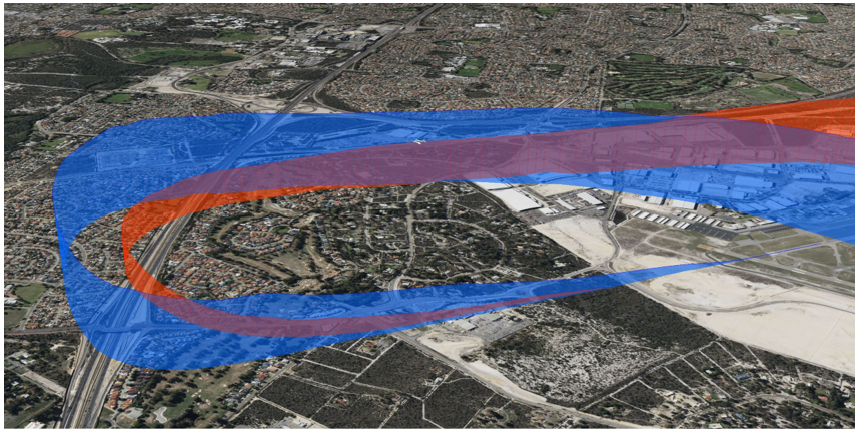
On 12 June 2025, a student pilot was returning to Jandakot at the conclusion of a solo navigation flight in a twin-engine Piper PA-44 Seminole. At the same time, a single-engine Cessna 172 was approaching the airport from the training area.
Air traffic control (ATC) directed the pilot of the faster Seminole to overtake the Cessna as they approached the circuit. However, when the Seminole did not pass the Cessna prior to joining the circuit, ATC amended the instruction, telling the Seminole to ‘follow the Cessna’.
“The Seminole pilot did not identify this final part of the amended instruction, likely due to receiving an unexpected cockpit traffic alert at the time the approach clearance was issued,” ATSB Director of Transport Safety Stuart Macleod said.
“Consequently, the Seminole passed the Cessna as per the original clearance, reducing separation between the two aircraft.”
Although a key element of the revised approach clearance, the pilot’s readback of ATC’s instructions was incomplete.
“This was not corrected by the controller as the Manual of Air Traffic Services did not explicitly require sequencing instructions to be read back,” Mr Macleod said.
“This was a missed opportunity to resolve the situation and, more generally, provided no assurance that this safety-critical aspect had been correctly understood.”
Airservices Australia has subsequently conducted a review, and says it will investigate a change to the Manual of Air Traffic Services, and the respective Aeronautical Information Publication reference, to include the instruction ‘follow’ in the list of items requiring readback.
“This incident highlights the importance of ensuring that pilots and air traffic control all have an accurate situational understanding, especially when plans change,” Mr Macleod summarised.
“Sequencing of aircraft is a safety critical component of assuring separation and needs to be unambiguous for all.
“Pilots should seek confirmation from controllers if they are unsure of what is required of them, and ATC should confirm that pilots have a correct understanding of sequencing requirements, if there is any doubt.”
The ATSB has provided a substantive update on its ongoing investigation into a midair collision near The Oaks, south-west of Sydney, on 26 October last year, with the release of an interim report.
The 35-page report outlines in detail evidence gathered during the investigation as well as contextual information around the circumstances of the accident. It does not contain findings, which will be made in the ATSB’s final report, to be released at the conclusion of the investigation.
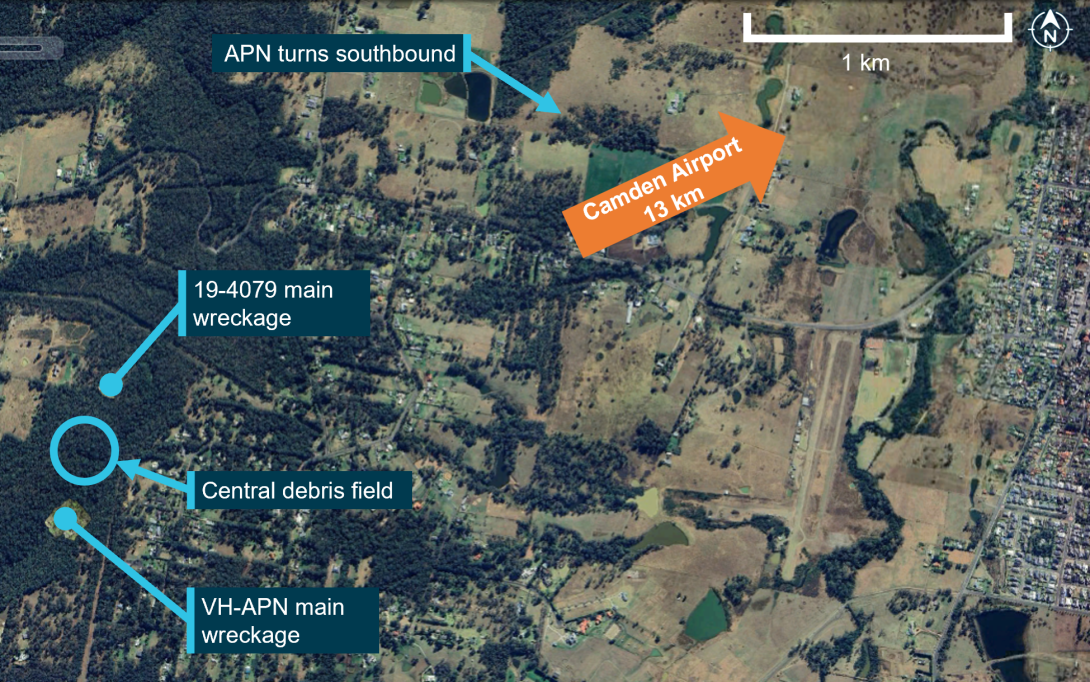
The two aircraft, a Cessna 182, which had departed Camden and a Jabiru recreational aircraft, which was returning to land at The Oaks, collided in-flight about 2.7 km west of The Oaks aerodrome. Both aircraft impacted heavily-wooded terrain and all three occupants were fatally injured.
“As we previously detailed in a preliminary report, the Jabiru was one of two aircraft that had departed The Oaks for a planned flight to Cessnock, but both decided to return to The Oaks after encountering turbulence en route,” ATSB Chief Commissioner Angus Mitchell outlined.
The Cessna, meanwhile, had been conducting circuits at Camden, as part of a commercial pilot licence flight test, having originally departed Shellharbour.
“The collision occurred when the Jabiru was flying to the north on the downwind leg of the circuit for The Oaks ahead of a planned landing, and as the Cessna was tracking to the southwest.”
Both aircraft were on near reciprocal headings and on relatively constant flight path trajectories at the time of the collision, with video from an onboard camera on the Jabiru showing it in straight and level flight and the Cessna climbing.
The collision occurred at an altitude of approximately 2,200 ft, about 1,300 ft above the runway at The Oaks.
“The video camera in the Jabiru has been instrumental in establishing the accident’s sequence of events and in allowing us to undertake extensive analysis of radio calls made prior to the collision,” Mr Mitchell said.
The Oaks aerodrome is in non-controlled airspace, meaning pilots are responsible for maintaining separation from other aircraft using ‘alerted see-and-avoid’ principles – making required and recommended position and intention radio calls on a common traffic advisory frequency (CTAF) and maintaining a visual scan.
Camden Airport, meanwhile, about 6.5 NM (12 km) to the north-west, is in controlled airspace which extends over a 2 NM (3.7 km) radius, with separation provided by an air traffic control tower.
“While radio calls made on The Oaks CTAF are not recorded, the video showed transmissions being both made and received by the Jabiru on The Oaks CTAF radio frequency,” Mr Mitchell said.
The duration and timing of all radio calls received by the Jabiru in the six minutes prior to the collision were consistent with those calls being made by the two other aircraft in the group – a Sonex on the ground, and a second Jabiru which also returned to The Oaks.
Noting that The Oaks CTAF was not recorded, the last recorded radio call made by the Cessna was reading back a clearance to Camden air traffic control for a touch-and-go and an upwind departure from Camden.
The report also details that the Cessna and the second Jabiru aircraft passed each other while the second Jabiru was about to turn onto the final leg of the circuit to land at The Oaks. Analysis of flight data showed that this Jabiru passed in front of and about 400 ft above the Cessna on a near reciprocal heading.
The report notes that CASA guidance states that pilots should avoid flying over non-controlled aerodromes at an altitude that could result in a conflict with aircraft operations there, while a warning label on the relevant aeronautical chart (the Sydney VTC) recommends overflying The Oaks not below 2,500 ft.
“This investigation has benefited from a wide range of data sources such as the video, ASD-B and transponder data, and from electronic flight bag apps to build a picture of the flight paths of both accident aircraft and radio transmissions,” Mr Mitchell noted.
“From here the investigation is looking at wider considerations, such as CPL flight test procedures and practices, and reviewing radio communications, electronic conspicuity and surveillance equipment for aircraft in non-controlled airspace.”
The investigation’s final report is anticipated to be released in 2026.
“We look forward to concluding our analysis of the circumstances of this tragic accident and sharing our findings to help prevent similar accidents in the future,” Mr Mitchell concluded.
The operator of two R22 mustering helicopters which collided soon after take-off did not define appropriate separation standards for its helicopter operations, with pilots permitted to arrange their own separation, an ATSB investigation has found.
The investigation’s final report details that between first light and sunrise on 25 July 2024, the pilots of four Robinson R22s planned to take-off from the Mount Anderson Station homestead in WA’s Kimberley to transit to a mustering site about a 10-minute flight away.
Shortly after taking off, two of the helicopters, flown by the lead pilot and another experienced mustering pilot, collided about 150 ft above ground level. The helicopters departed controlled flight and collided with terrain, and both pilots were fatally injured.
An ATSB investigation established that the helicopters collided during initial climb, after the lead helicopter had manoeuvred to the right.
“Neither pilot detected their converging flight paths before the collision,” Chief Commissioner Angus Mitchell said.
“While limited data prevented a full visibility study to establish what each pilot could see, the wreckage examination indicated that at the point of collision the lead helicopter may have been in a blind spot for the second helicopter.”
The investigation’s final report considers what actions the helicopters’ operator, Pearl Coast Helicopters, was taking to manage aircraft separation in its operations.
“The tools used by the operator to consider and manage operational risk were not tailored to their main business of aerial mustering,” Mr Mitchell said.
“Further, the risk of collision had not been identified in operational risk assessments, and the operator’s manuals did not provide documented procedures to ensure pilots establish and maintain adequate separation between helicopters.”
Instead, the final report notes, company pilots were permitted to arrange their own separation based on personal preference.
“Pilots routinely flew with reduced vertical and lateral separation, and over time this became an accepted operating preference.”
Mr Mitchell said the accident was a demonstration of the need for risk management to identify, assess and mitigate risks.
“Aerial mustering plays a critical role in Australia’s agricultural sector,” he said.
“This tragic accident should serve as a trigger for all mustering operators to consider their risk management practices, and whether they have scaled them adequately for their operation.”
“We encourage operators to review available guidance to assist in their identification and management of hazards.”
Mr Mitchell also said the accident was another reminder of the fallibility of see-and-avoid as a primary means of identifying and managing the threat of collision.
“Defined separation minimums and pre-planned safe exits which provide an opportunity to identify and respond to emerging collision threats are important tools in assisting pilots avoid midair collisions,” he said.
“Additionally, airframe obstructions can limit visibility in even the most open cabins. This should be a key consideration when establishing how aircraft should be positioned when flying in close proximity.”
On 19 November 2025, a Regional Express (Rex) Saab 340B aircraft, registered VH‑ZRM, was cleared for take‑off from Townsville for a flight to Hughenden, Queensland. Shortly after take‑off, the first officer (FO) engaged the flight directors and autopilot to follow the standard instrument departure (SID) procedure programmed in the flight management system (FMS). The aircraft immediately commenced a left roll away from the SID track and the pilot in command (PIC) intervened by disengaging the autopilot and resuming manual flight. The crew subsequently requested radar vectors and re‑engaged the autopilot and continued the flight to Hughenden without further incident.
What the ATSB found
The ATSB found that the PIC likely programmed the SID before engine start using external power, and for reasons undetermined, the SID waypoints subsequently appeared as invalid data in the FMS. This resulted in the aircraft turning away from the expected track when the autopilot was engaged after take‑off as it directed the aircraft to the first active waypoint in the FMS, located at the end of the SID procedure.
In addition, when flight crew programmed the FMS before engine start using external power, the Regional Express procedures did not require them to verify their FMS‑programmed flight plan between engine start and take‑off, which increased the risk of an aircraft departing with a data error.
Furthermore, the PIC misunderstood the operator's intent of their check of the first FMS waypoint to mean the first waypoint of the company flight plan instead of the first waypoint after take‑off. While it could not be determined if this contributed to the incident, it increased the risk of a data error going undetected.
What has been done as a result
The operator has completed a review of a similar occurrence and identified an omission with the SID entry, in which the SID was inserted into the flight plan, but the active leg was not correctly sequenced. It subsequently issued an operations notice (RNAV Based SID Departures) and notice to air crew (NOTAC: UNS Standby Power Cycle) to address these occurrences. Regional Express is also implementing changes to the Flight crew operating manual workflows to reduce the risk of similar future occurrences.
Safety message
Data errors happen for many varied reasons, and this incident highlighted one of several risks associated with erroneous data in the FMS. The FMS cannot identify data entry errors in all cases, and therefore it is the responsibility of the pilot(s) to perform this critical function. Data error risks can be reduced by operators and pilots with a comprehensive set of procedures for data entry monitoring and verification before take‑off and inflight.
The occurrence
On 19 November 2025, at 0716 local time, a Regional Express (Rex) Saab 340B aircraft, registered VH‑ZRM, was being prepared for a scheduled passenger service from Townsville to Hughenden, Queensland. The aircraft had 2 flight crew, 1 cabin crew and 15 passengers on board. The pilot in command (PIC) was the pilot flying1 in the left seat, and the first officer (FO) was the pilot monitoring in the right seat. The first officer (FO) requested and received their airways clearance from Townsville air traffic control for their flight to Hughenden via CATEY (waypoint) with the CATEY ONE standard instrument departure (SID).2
Townsville Airport had external power available for the operator’s aircraft, which allowed the flight crew to program the flight management system (FMS) and conduct their FMS brief before engine start. The PIC reported that they would have loaded the company flight plan for CATEY (waypoint) to Hughenden and then the CATEY ONE SID into the FMS prior to engine start. This would have inserted the SID at the start of the flight plan in the FMS and was in accordance with their airways clearance.
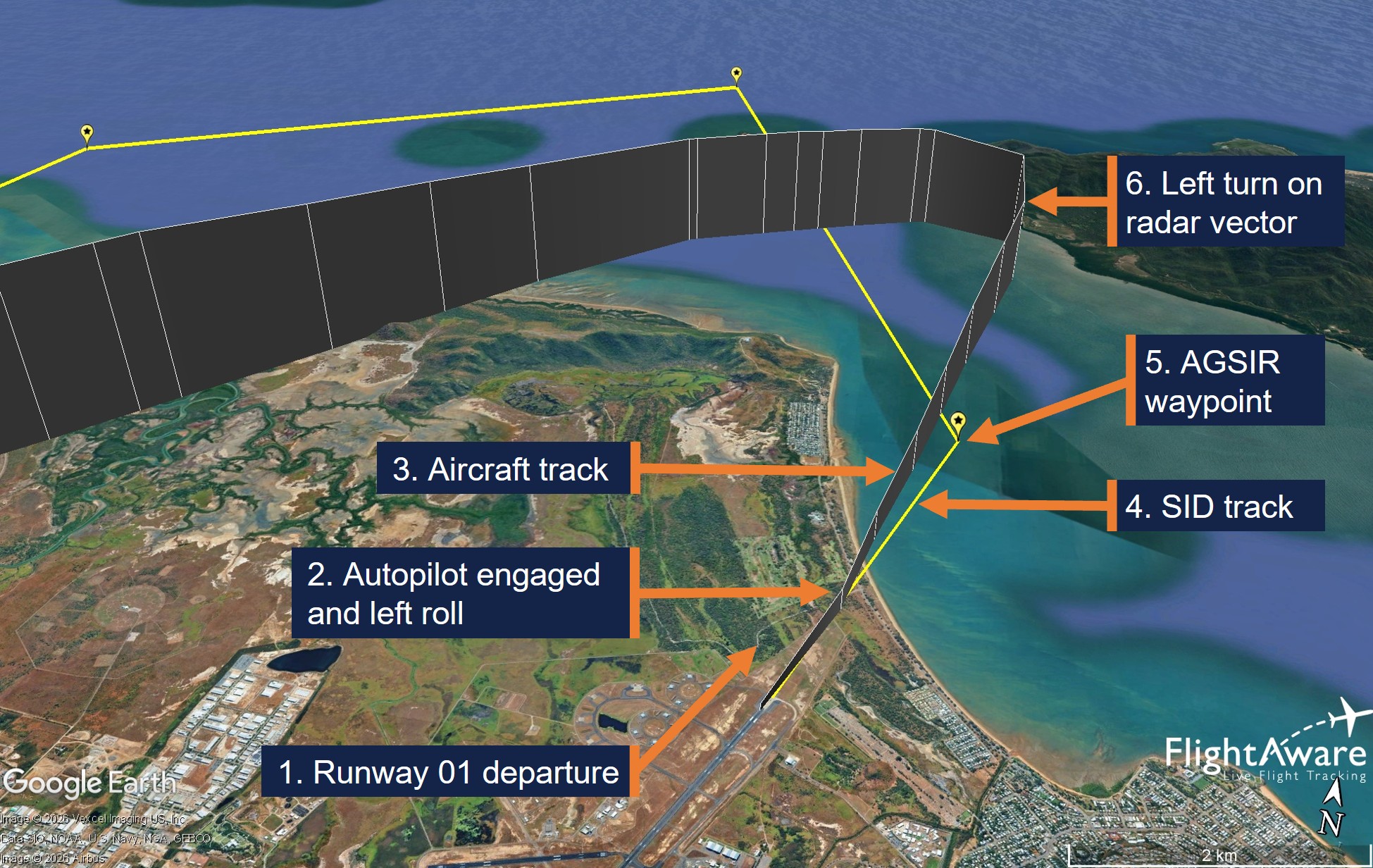
The PIC taxied the aircraft for an intersection departure from runway 01 and was cleared for take‑off at 0742. After take‑off, as the aircraft climbed through an altitude of 656 ft, tracking towards the first SID waypoint of AGSIR, the FO selected both flight directors ON, followed by the autopilot in the long range navigation mode, in accordance with their procedures. The aircraft immediately commenced a left roll, deviating from the departure track to AGSIR but consistent with the flight director indications. The PIC promptly disengaged the autopilot, reversed the left roll and returned the aircraft to an approximate departure heading.
The FO then selected the FMS flight plan page and observed that the FMS had sequenced the flight from Townsville direct to the waypoint CATEY. The FO also observed that all the CATEY ONE SID waypoints were present and in the correct order in the FMS but appeared different to the other waypoints and later reported that they might have been ‘greyed out’.3 They attempted to manually sequence the SID by selecting the ‘Direct‑To’ function to a SID waypoint, but this was not accepted by the FMS. The FO opened the navigation page and again attempted to manually sequence the SID but was unsuccessful. They later reported that the SID waypoints either did not appear as options or that the FMS did not accept them.
At 0743, the crew were transferred from tower to approach air traffic control and at 0744 the FO informed the approach controller that the aircraft was heading 012° and requested radar vectors. The approach controller noted the aircraft was passing 2,400 ft, had passed AGSIR, and that the lowest safe altitude for the area was 2,800 ft. The controller instructed the crew to continue their climb to 2,800 ft and then fly their requested heading. The FO clarified that they were having a problem with their FMS and would need vectors for the departure, which the approach controller acknowledged and provided.
The crew re‑engaged the autopilot at 2,800 ft in heading mode and confirmed that the aircraft was responding correctly to heading control inputs. They conducted confidence checks on the FMS flight plan route tracks and distances and then re‑engaged long range navigation mode and the flight continued to Hughenden without further incident. Both pilots later reported that they were in visual meteorological conditions throughout the incident. Figure 1 depicts the departure flight path and SID track with key events.
Figure 1: Departure flight path with key events
Source: FlightAware and Google Earth, annotated by the ATSB
Context
Flight crew information
Pilot in command
The pilot in command (PIC) was based in Brisbane and held an Air Transport Pilot Licence (Aeroplane), issued on 17 October 2023, a multi‑engine aeroplane instrument rating, type rating for the SF340 (includes Saab 340B), and a Class 1 civil aviation medical certificate with no restrictions. They completed their cadetship with Rex in 2018, were checked to line as an FO in December 2019 and as a PIC in December 2023. The PIC reported that they had never previously experienced this type of event in training or operations.
First officer
The first officer (FO) was based in Townsville and held a Commercial Pilot Licence (Aeroplane), issued on 15 November 2023, a multi‑engine aeroplane instrument rating, type rating for the SF340, and a Class 1 civil aviation medical certificate with no restrictions. They started flying in 2012 and had previous work experience as a general aviation flight instructor and aeromedical pilot before joining Rex as an FO. They completed their SF340 type rating in June 2024. The FO reported that they also had never previously experienced this type of event in training or operations.
Aircraft information
The aircraft was a Saab 340B (extended wing tips) manufactured in Sweden in 1996, certified to the Transport Category standards and fitted with 2 General Electric CT7‑9B turboprop engines. It was certified for 2 pilots, 1 cabin crew and a maximum of 37 passengers. The aircraft was registered VH‑ZRM on 25 February 2010 and commenced operations with Regional Express (Rex) on 13 April 2019. The aircraft was fitted with a single Universal Avionics flight management system (FMS), which met the accuracy requirements for area navigation (RNAV)4 terminal instrument flight rules operations.
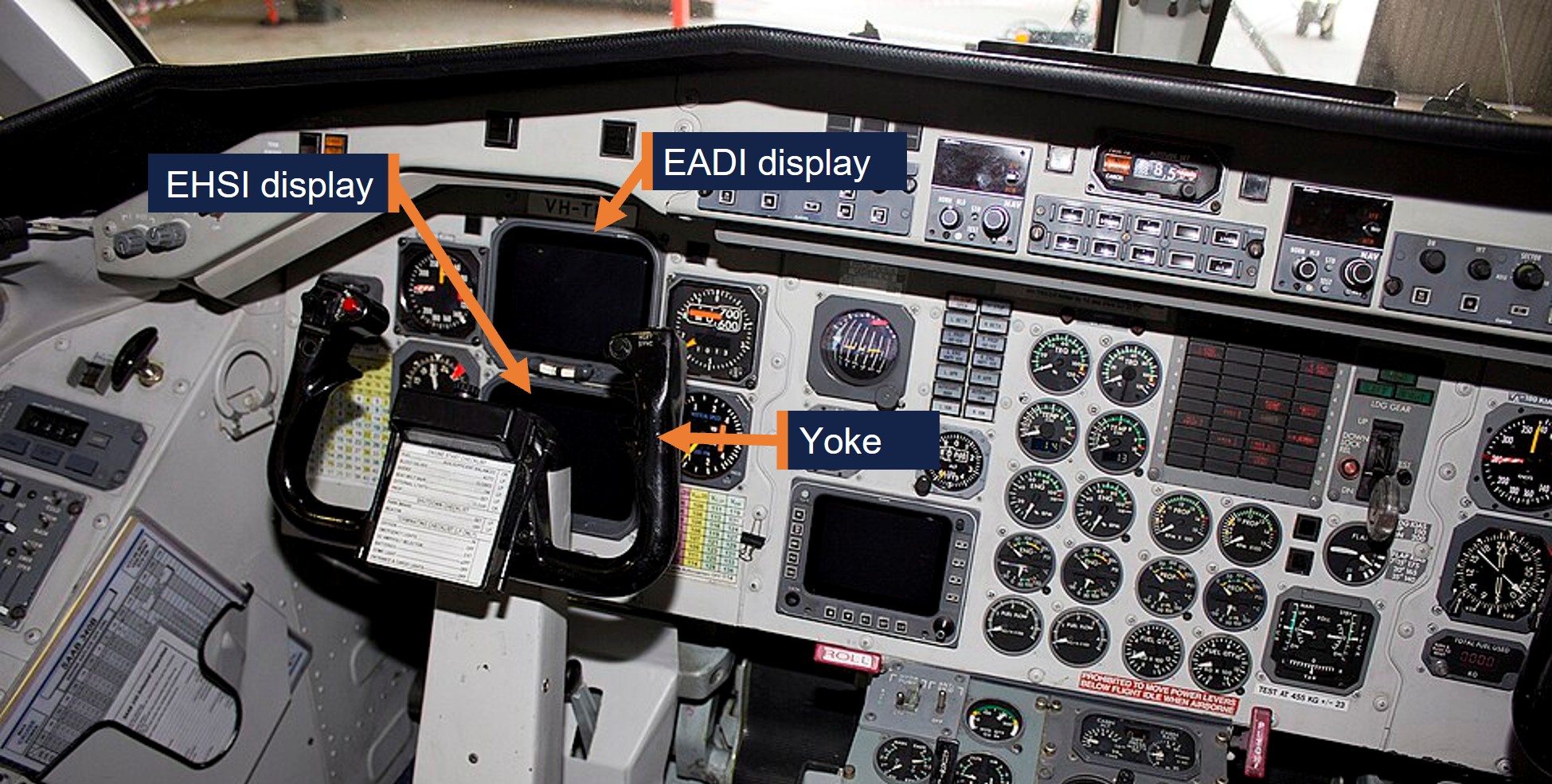
The operator’s aircraft were fitted with an electronic flight instrument system comprising an electronic attitude direction indicator (EADI) and an electronic horizontal situation indicator (EHSI) (also known as a navigation display). The EADI was positioned above the height of the yoke, but the EHSI was positioned below the EADI and partially obscured by the yoke when the yoke was forward (Figure 2).
Figure 2: Position of the flight displays relative to the yoke in the forward position
Source: Bidgee, annotated by the ATSB
Recorded information
The operator’s notification of the incident was received by the ATSB on 27 November 2025. By this time, the aircraft had exceeded 20 hours operating time following the occurrence. The FMS manufacturer reported that the FMS unit holds 20 hours of recorded data, and therefore both the FMS and cockpit voice recorder were overwritten. However, the operator was able to provide the ATSB with flight data recorder information from the incident flight. The recorded autopilot engagement after take‑off, followed by a left roll, autopilot disengagement and later re‑engagement were consistent with the notification details and flight crew interviews.
CATEY ONE standard instrument departure
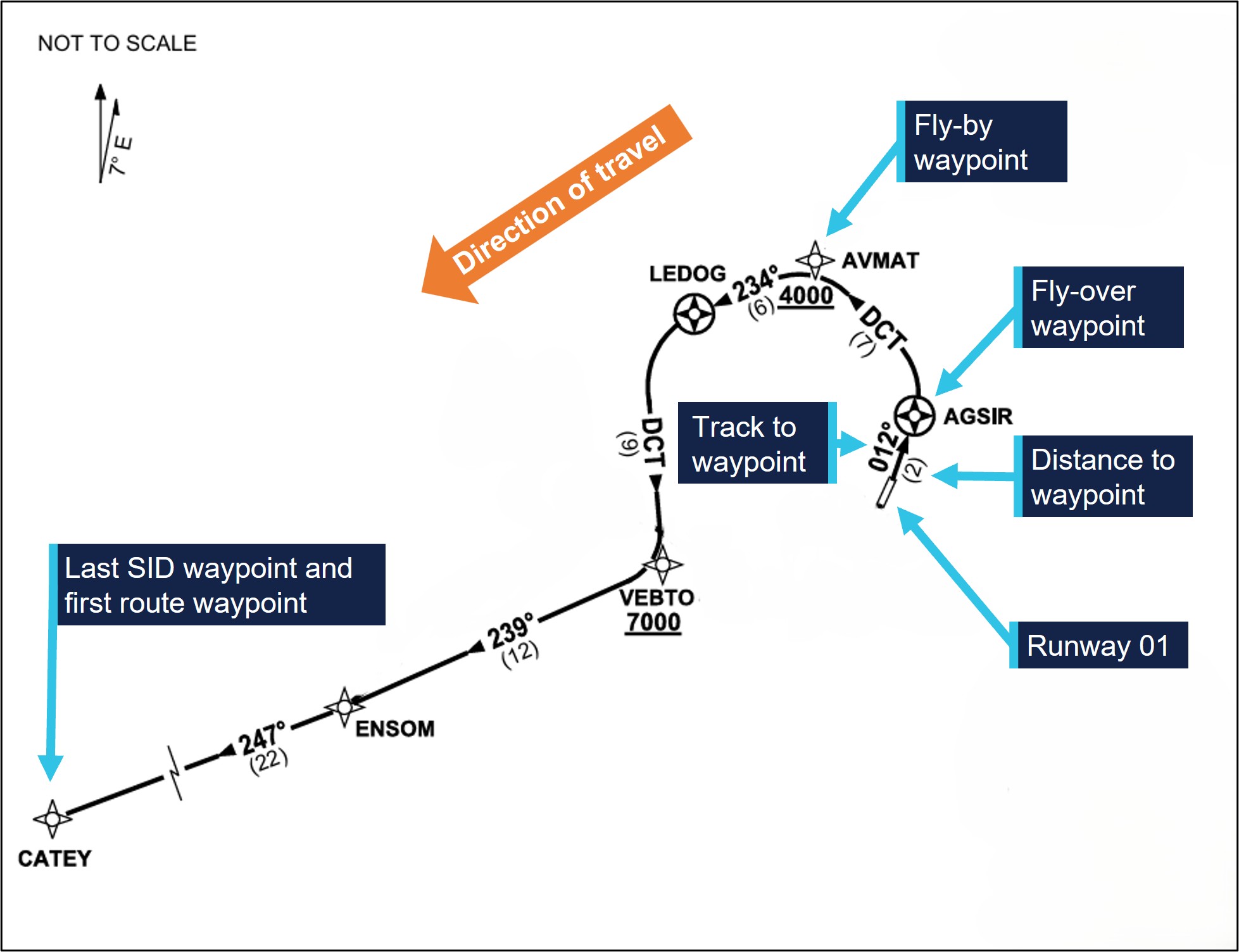
The CATEY ONE departure from Townsville runways 01/19 was an RNAV SID with the specification required navigation performance (RNP) 15 (Figure 3). The runway 01 magnetic direction was 017° and the first waypoint on the runway 01 SID was AGSIR, which was a fly‑over6 waypoint. It was located 2 NM upwind from the departure end of runway 01 on a track of 012°. Since AGSIR was a fly‑over waypoint, the aircraft should not have turned before reaching it.
Figure 3: Townsville runway 01 CATEY ONE standard instrument departure
Source: Airservices Australia, modified and annotated by the ATSB
Tests and research
Operator
The operator checked its FMS database for the cycle that was in use at the time of the incident and provided screenshots of the CATEY ONE SID and AGSIR waypoint entries to the ATSB. The SID had the correct waypoint parameters, and the AGSIR waypoint had the correct coordinates, course and RNP classification.
The operator researched its reporting database and could not locate any other incidents where its aircraft turned the wrong way after take‑off when the autopilot was engaged. However, they were able to locate 2 reports of aircraft departing with the incorrect flight plan loaded in the FMS.
Aircraft manufacturer
The aircraft manufacturer reported that 5 other recent FMS‑related incidents had been reported to them. They provided the ATSB with copies of those notifications, with the earliest in 2020. The ATSB reviewed the notifications, which included corrective maintenance actions, and concluded that there were sufficient differences in the reported symptoms and findings to exclude them as related occurrences.
Flight management system manufacturer
The ATSB provided the FMS manufacturer with the steps in the operator’s FMS programming procedure, software version and copy of the CATEY ONE SID procedure. The manufacturer used this data to conduct tests with its FMS training device but could not reproduce the circumstances reported by the flight crew. Following further investigation, the manufacturer’s engineering department provided the following scenarios as potential explanations for the flight crew’s observations:
The FMS SID will appear greyed‑out under one specific circumstance, which is if the SID is entered as a pilot‑created (user‑defined) SID procedure instead of a navigation database selection.
The SID entry might have been initiated but not fully completed before the aircraft taxied and departed, leaving the SID displayed but not linked to the active guidance.
A runway selection mismatch within the SID (incorrect runway selected) could result in the procedure appearing in the flight plan with fewer waypoints but not connecting to the active leg.
If the aircraft already had an active navigation leg loaded from Townsville to CATEY prior to the SID entry, and the SID was then loaded, the FMS may have retained the original active leg rather than automatically sequencing to the first SID waypoint (AGSIR). In this scenario, the SID waypoints would appear in the flight plan, but the active guidance would remain on the pre‑existing leg and is consistent with the flight director commanding a turn toward CATEY rather than AGSIR. A ‘Direct‑To’ AGSIR would have been required to manually sequence onto the SID.
The engineering department concluded that they required a download of the FMS from the incident flight for deeper analysis. However, the FMS was overwritten by the time the ATSB investigation was commenced (see the section titled Recorded information).
Operational information
The operator’s Saab Flight crew operating manual included its normal procedures for the aircraft. The After start scan‑action flow included a NAV AIDS (navigation aids)/FMS brief, which was required to be delivered by the left‑seat pilot and checked by the right‑seat pilot. This included a left‑seat pilot check, and right‑seat pilot confirmation, of the ‘First Waypoint’ in the FMS. The PIC reported their understanding that this was the first waypoint for the company flight plan, which was CATEY, while the FO reported that it was the first waypoint after take‑off which, for the CATEY ONE SID, was AGSIR. The operator confirmed that the ‘First Waypoint’ referred to in the procedures was the first waypoint after take‑off, which would be the first SID waypoint for an RNAV SID.
At Townsville, with external power connected and the right avionics switch on, power was available for the FMS before engine start. In this case, the operator permitted the NAV AIDS/FMS brief to be conducted before engine start. The FMS then had to be powered down for engine start, and the flight plan data would be retained, provided it was powered back up within 7 minutes. In this case, the NAV AIDS/FMS check in the After start scan‑action flow was abbreviated to the left‑seat pilot announcing ‘Nav aids set.’
The Take‑off brief followed the NAV AIDS/FMS brief and was conducted by the PIC for the sector. The Take‑off brief included the SID, and the brief could be conducted up to 30 minutes prior to departure including before engine start. If the Take‑off brief was conducted before engine start, then it was omitted in the After start scan‑action flow, and in the After start checklist the left seat pilot was only required to announce that the brief was ‘Complete’.
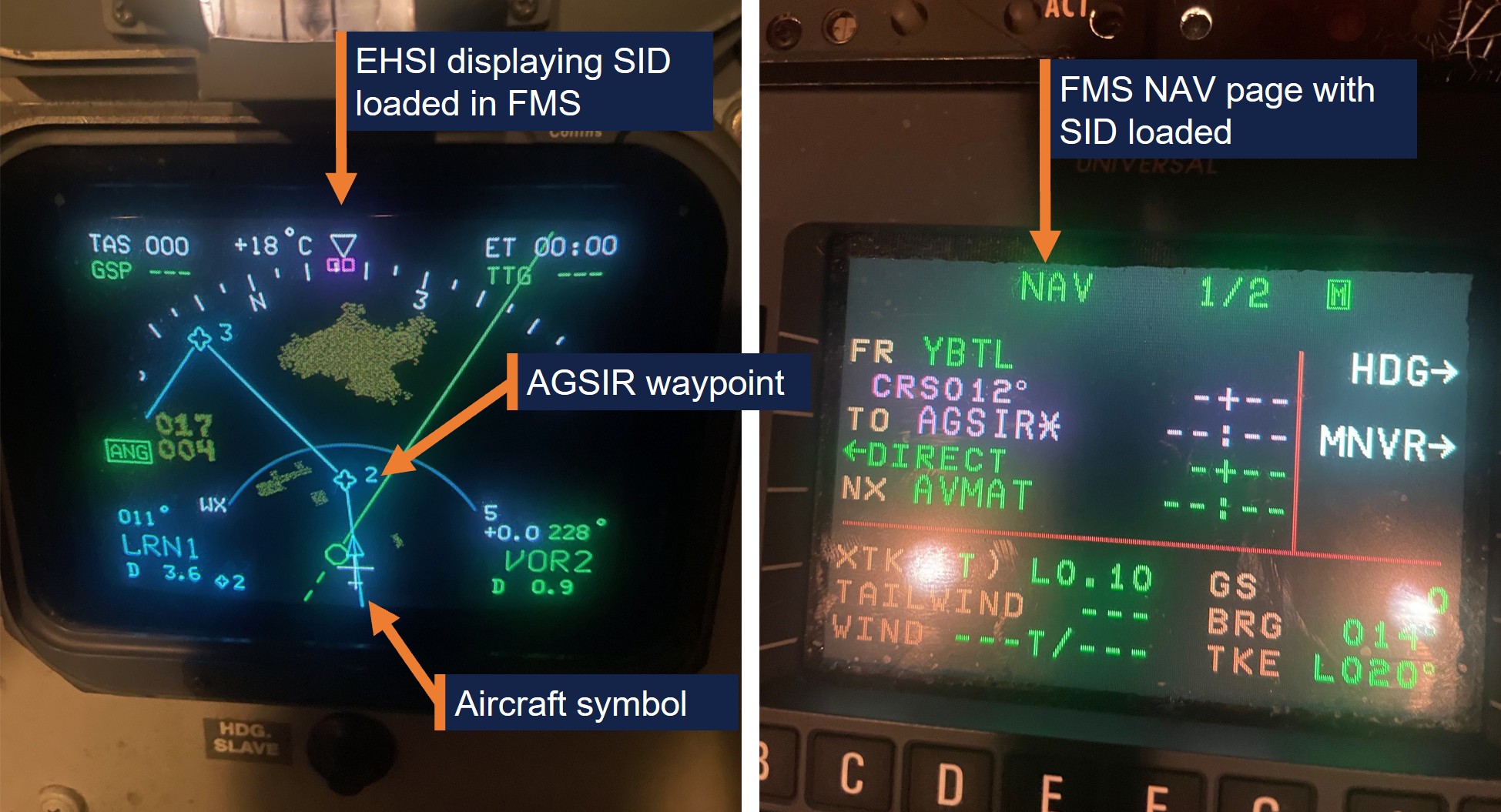
The Taxi checklist included a check of the flight instruments. However, it did not include a check of the FMS programming, or a crosscheck of the EHSI displays to verify that the correct information was displayed before take‑off. The operator confirmed that the flight instruments check in the Taxi checklist related to primary flight instruments and not to navigation instruments or an FMS check. The following figure depicts the EHSI display of the SID when loaded in the FMS (Figure 4).
Figure 4: EHSI display of SID (left) loaded in FMS (right)
Source: Operator, annotated by the ATSB
The PIC reported that since Townsville had external power available, the SID was likely loaded before engine start. If the FMS first waypoint check was then conducted before the power‑down of the FMS for engine start, there would not have been a subsequent FMS programming check after engine start. The PIC confirmed they did not check the SID was presented on their EHSI display before take‑off as it was not required by procedures.
Comparison with other operators
The ATSB reviewed the FMS programming and check procedures from 2 other regional airlines, one from Australia and one from the United States (US). Both airlines included the FMS programming step in the before engine start checklists. However, the departure briefs were conducted after engine start, and the flight crew were required to verify that their displays presented the correct information.
In the Australian operator’s Taxi pre‑take‑off checklist, the flight instruments check included checking the primary flight display and navigation display for ‘correct indications’, and the take‑off data and briefing check included verification of the SID and tracking. This was the last checklist prior to runway verification and lineup.
In the US operator’s Before take‑off checklist, both flight crew were required to verify the runway, and that the first waypoint and initial altitude were properly displayed on their respective displays. The FO then briefed the runway, SID and initial altitude, which was confirmed set by the PIC.
Risks associated with data errors
The International Air Transport Association (2015) reviewed 309 air safety reports involving FMS data entry error, reported between 2007 and 2011. Its analysis revealed that errors related to navigational data, potential for midair collision or controlled flight into terrain accident, accounted for 80% of the reports.7 The main reported data entry errors were those errors made during FMS programming and in 44% of these reports the errors went unnoticed by the pilots due to failures in monitoring and crosschecking. In its conclusion, it reported that:
…the FMS is a sophisticated system integrated into virtually every function of the aircraft… However, the FMS has also introduced threats and the potential for errors, which can have catastrophic implications for the safety of flight.
Modification of procedures
The ATSB asked the aircraft manufacturer if it had any guidance or recommended best practices for FMS crosschecks before take‑off. It responded that it did not have any guidance or recommendations for FMS crosschecking and that such procedures and practices should be developed by operators and their flight crew.
The US Federal Aviation Administration (2017) provided guidance on how to determine when the manufacturer’s procedures need to be modified as follows:
Although an Original Equipment Manufacturer (OEM) will typically supply its customers with suggested procedures and checklists for its equipment, operators may choose to develop, or modify, the procedures and checklists provided by the OEM.
Potential factors which may drive changes to OEM procedures and checklists include new or modified equipment, changes to the operational environment, company mandated procedures, standardization among related fleets, observed operational problems, incidents, accidents, or airline mergers.
The Civil Aviation Safety Authority advisory circular 91‑22: Aircraft checklists, indicated that aircraft checklists can be provided by the aircraft manufacturer or other third party. While there is no regulatory approval from the Civil Aviation Safety Authority for aircraft checklists, they are part of an operator’s exposition and therefore any changes are subject to the operator’s change management processes.
Similar occurrence
In May 2026, another of the operator’s Saab 340B aircraft departed from Perth for Esperance, Western Australia. The FMS was programmed by the FO with the flight plan from waypoint LENVU to Esperance. The crew were also issued with the LENVU ONE RNAV SID for departure with the first waypoint HOVEA. However, the PIC did not identify before take‑off that the FMS was not sequenced to HOVEA. Subsequently, when the autopilot was engaged after take‑off, the aircraft commenced a turn towards LENVU. The crew immediately intervened to correct the tracking; the FMS was sequenced to HOVEA and the flight proceeded without further incident.
Safety analysis
Invalid data in the flight management system
On the morning of 19 November 2025, the first officer (FO) for the Regional Express Saab 340 flight from Townsville to Hughenden requested and received their airways clearance from air traffic control for their flight to Hughenden via CATEY with the CATEY ONE standard instrument departure (SID). The pilot in command (PIC) programmed the flight management system (FMS) with the company flight plan for CATEY to Hughenden and the CATEY ONE SID. This was likely done on external power, which would have required the FMS to be subsequently powered down for engine start and then powered up after engine start. As the flight plan was retained by the FMS after power up, the 7‑minute data retention period associated with the FMS power down cycle was likely not exceeded.
When the flight directors and autopilot were engaged after take‑off, the autopilot immediately attempted to turn the aircraft left, off the SID track. The FO noted that the flight directors and FMS were indicating that CATEY was the first active waypoint instead of AGSIR, which was the first SID waypoint. They also noted that the SID waypoints were in the FMS flight plan and in the correct sequence but had a different appearance to the active waypoints and were possibly ‘greyed out’. The FO attempted to re‑sequence the SID with the ‘Direct‑To’ function, but the FMS would not accept any of the SID waypoints they selected.
No fault was found with the CATEY ONE SID in the operator’s FMS database, and the FMS manufacturer was unable to replicate the reported symptoms using its FMS Trainer. Subsequently, the FMS manufacturer provided several potential scenarios for review by the ATSB. The manufacturer’s scenarios and ATSB analysis of each one was as follows:
The FMS SID will appear greyed‑out if it is entered as a pilot‑created SID procedure instead of a navigation database selection. However, the PIC reported that they selected the CATEY ONE SID from the departures menu in the FMS and therefore this scenario was considered unlikely.
An incorrect runway selection could result in the procedure appearing in the flight plan with fewer waypoints but not connecting to the active leg. However, there was no runway change before departure and the FO reported seeing the correct SID waypoints in the FMS, therefore this scenario was also considered unlikely.
Loading an active navigation leg for Townsville to CATEY prior to the SID entry would retain the original active leg rather than automatically sequencing to the first SID waypoint. A ‘Direct‑To’ would have been required to manually sequence onto the SID. However, the FO reported that they could not re‑sequence the SID with the ‘Direct‑To’ function, so this scenario was also considered unlikely.
The SID entry might have been initiated but not fully completed before the FMS was powered down for engine start. After engine start, the aircraft would have then taxied and departed with the SID displayed but not linked to the active guidance. This scenario could explain the FO’s observation that the SID waypoints appeared different in the FMS flight plan. However, the manufacturer could not replicate the fault.
Without a download of the FMS or cockpit voice recorder, further analysis was not possible and therefore, the reason for the appearance of invalid data could not be determined.
Contributing factor
For reasons undetermined, the CATEY ONE standard instrument departure likely appeared as invalid data in the flight management system, which resulted in an unexpected turn off the departure procedure when the autopilot was engaged.
Operator’s procedures
The operator’s Flight crew operating manual included the checklists for its normal procedures. The After start scan‑action flow included the NAV AIDS (navigation aids)/FMS brief. This item was required to be delivered by the PIC (left seat pilot) and checked by the FO (right seat pilot) and included confirmation of the first waypoint in the FMS. However, external power was available at Townsville Airport, which allowed the FMS programming and NAV AIDS/FMS brief to be conducted before engine start. In that case, the NAV AIDS/FMS check in the After start scan‑action flow was abbreviated to the PIC announcing ‘Nav aids set’. Similarly, the Take‑off brief, which included the SID brief and followed the NAV AIDS/FMS brief, could also be conducted before engine start and, after engine start, the flight crew were only required to announce that it was ‘Complete’.
If the FMS was programmed before engine start, it was required to be powered down for engine start and then powered up again after. Provided it was powered up within 7 minutes of being powered down, it would retain its programmed data. The flight plan was retained by the FMS after power up, and therefore, it was likely the FMS was powered up within the 7‑minute data retention period.
The Taxi checklist included a check of the flight instruments. However, it did not include a check of the FMS programming, or a crosscheck of the navigation displays (EHSI) to verify that the correct information was displayed before take‑off. The PIC reported that they did not crosscheck their navigation display with the SID before take‑off because it was not required by the procedures and the operator acknowledged that there was no specific validity check of FMS data after engine start if the FMS was programmed on external power and then powered down for engine start. Furthermore, the navigation display can be partly obscured by the yoke if it is in the forward position.
An ATSB review of FMS programming and check procedures for an Australian and US regional airline identified that both airlines included the FMS programming and waypoint verification steps in their checklists before engine start. However, their departure briefs were conducted after engine start, and both required their flight crew to verify that their displays presented the correct information. This occurred in the Taxi pre‑take‑off checklist for the Australian operator and in the Before take‑off checklist for the US operator.
The aircraft manufacturer advised that it did not have any specific guidance or recommendations for FMS crosschecks before take‑off, and that such procedures and practices should be developed by operators and their flight crew. Of note, the US Federal Aviation Administration’s (2017) guidance on when operators may need to modify checklists provided by the manufacturer included after incidents.
Noting the International Air Transport Association’s (2015) report finding that the main reported FMS data entry errors occurred during programming, it was considered likely that this fault occurred either during the programming of the FMS, or when the FMS was powered down for engine start. It was considered unlikely that the FMS was powered up with valid SID data that later became invalid during taxi or take‑off.
As the FMS and flight director were pointing to CATEY after take‑off, it was considered likely that this was the case when the aircraft was taxied for take‑off. Therefore, it was also considered likely that the invalid data could have been detected by the pilots verifying the SID programming on their navigation displays in one of the checklists after engine start and before take‑off. This would have mitigated the likelihood of an unexpected turn on departure and the risk of a loss of safe separation standards with terrain or traffic.
Contributing factor
When flight crew programmed the flight management system before engine start using external power, Regional Express procedures did not require them to verify their programmed flight plan after engine start and before take‑off, which increased the risk of an aircraft departing with a data error. (Safety issue)
Pilot in command misunderstanding
The After start‑action flow included an item where the left seat pilot (PIC) briefed the NAV AIDS/FMS setup. This included a check of the first waypoint on the FMS, which was confirmed by the right seat pilot (FO). The PIC reported their understanding that the FMS first waypoint brief was for the first waypoint of the company flight plan, which was CATEY on the incident flight. However, the FO reported that the brief was for the first waypoint after take‑off, which was the first waypoint of the SID – AGSIR.
The operator confirmed the FMS first waypoint brief was for the first waypoint after take‑off, which should have been AGSIR for the incident flight. However, without a download of the FMS, it could not be determined exactly what was programmed and how it was programmed; and without a download of the cockpit voice recorder, it could not be determined exactly what was briefed by the PIC and how the FO responded.
Therefore, while the PIC and FO provided different interpretations for the first waypoint in the FMS they checked, there was insufficient evidence to determine if this discrepancy contributed to the incident. However, more generally, the PIC's misunderstanding of the operator’s intent for the FMS first waypoint brief could contribute to the check missing a data entry error with unforeseen consequences.
Other factor that increased risk
The pilot in command misunderstood the operator's intended flight management system check of the first waypoint to mean the first waypoint of the company flight plan instead of the first waypoint after take‑off. While it could not be determined if this contributed to the incident, it increased the risk of a data entry error going undetected.
Findings
ATSB investigation report findings focus on safety factors (that is, events and conditions that increase risk). Safety factors include ‘contributing factors’ and ‘other factors that increased risk’ (that is, factors that did not meet the definition of a contributing factor for this occurrence but were still considered important to include in the report for the purpose of increasing awareness and enhancing safety). In addition ‘other findings’ may be included to provide important information about topics other than safety factors.
Safety issues are highlighted in bold to emphasise their importance. A safety issue is a safety factor that (a) can reasonably be regarded as having the potential to adversely affect the safety of future operations, and (b) is a characteristic of an organisation or a system, rather than a characteristic of a specific individual, or characteristic of an operating environment at a specific point in time.
These findings should not be read as apportioning blame or liability to any particular organisation or individual.
From the evidence available, the following findings are made with respect to the avionics/flight instruments occurrence involving Saab 340B, VH‑ZRM, 3 km north‑north‑east of Townsville Airport, Queensland, on 19 November 2025.
Contributing factors
For reasons undetermined, the CATEY ONE standard instrument departure likely appeared as invalid data in the flight management system, which resulted in an unexpected turn off the departure procedure when the autopilot was engaged.
When flight crew programmed the flight management system before engine start using external power, Regional Express procedures did not require them to verify their programmed flight plan after engine start and before take‑off, which increased the risk of an aircraft departing with a data error.(Safety issue)
Other factors that increased risk
The pilot in command misunderstood the operator's intended flight management system check of the first waypoint to mean the first waypoint of the company flight plan instead of the first waypoint after take‑off. While it could not be determined if this contributed to the incident, it increased the risk of a data entry error going undetected.
Safety issues and actions
Central to the ATSB’s investigation of transport safety matters is the early identification of safety issues. The ATSB expects relevant organisations will address all safety issues an investigation identifies.
Depending on the level of risk of a safety issue, the extent of corrective action taken by the relevant organisation(s), or the desirability of directing a broad safety message to the aviation industry, the ATSB may issue a formal safety recommendation or safety advisory notice as part of the final report.
All of the directly involved parties were invited to provide submissions to this draft report. As part of that process, each organisation was asked to communicate what safety actions, if any, they had carried out or were planning to carry out in relation to each safety issue relevant to their organisation.
Descriptions of each safety issue, and any associated safety recommendations, are detailed below. Click the link to read the full safety issue description, including the issue status and any safety action/s taken. Safety issues and actions are updated on this website when safety issue owners provide further information concerning the implementation of safety action.
Safety issue description: When flight crew programmed the flight management system before engine start using external power,Regional Express procedures did not require them to verify their programmed flight plan after engine start and before take‑off, which increased the risk of an aircraft departing with a data error.
Glossary
EADI
Electronic attitude direction indicator
EHSI
Electronic horizontal situation indicator
FMS
Flight management system
FO
First officer
OEM
Original equipment manufacturer
PIC
Pilot in command
RNAV
Area navigation
RNP
Required navigation performance
SID
Standard instrument departure
US
United States
Sources and submissions
Sources of information
The sources of information during the investigation included:
Under section 26 of the Transport Safety Investigation Act 2003, the ATSB may provide a draft report, on a confidential basis, to any person whom the ATSB considers appropriate. That section allows a person receiving a draft report to make submissions to the ATSB about the draft report.
A draft of this report was provided to the following directly involved parties:
Civil Aviation Safety Authority
flight crew of the incident flight
United States National Transportation Safety Board
Regional Express
Royal Australian Air Force (452 Squadron)
Saab AB
Swedish Accident Investigation Authority
Universal Avionics Systems Corporation.
A submission was received from Regional Express. The submission was reviewed and, where considered appropriate, the text of the report was amended accordingly.
Purpose of safety investigations
The objective of an ATSB safety investigation is to improve transport safety through:
identifying safety issues for action by organisations with the responsibility for managing that safety risk
influencing safety action through engaging with stakeholders, communicating findings, and fostering awareness of safety issues and concerns.
In accordance with the TSI Act, the ATSB does not investigate for the purpose of taking administrative, regulatory or criminal action, and cannot apportion blame, assist in determining liability, or, as a general rule, assist in court proceedings.
About ATSB reports
ATSB safety investigation reports are developed in accordance with ATSB procedures and guidelines, and with regard to applicable international standards and instruments.
Reports must include factual material of sufficient weight to support the investigation’s analysis and findings. At all times the ATSB endeavours to balance the use of material that could imply adverse comment with the need to properly explain what happened, and why, in a fair and unbiased manner.
An explanation of terminology used in ATSB investigation reports is available here.
Publishing information
Released in accordance with section 25 of the Transport Safety Investigation Act 2003
Ownership of intellectual property rights in this publication
Unless otherwise noted, copyright (and any other intellectual property rights, if any) in this report publication is owned by the Commonwealth of Australia.
Creative Commons licence
With the exception of the Commonwealth Coat of Arms, ATSB logo, and photos and graphics in which a third party holds copyright, this report is licensed under a Creative Commons Attribution 4.0 International licence.
The CC BY 4.0 licence enables you to distribute, remix, adapt, and build upon our material in any medium or format, so long as attribution is given to the Australian Transport Safety Bureau.
Copyright in material obtained from other agencies, private individuals or organisations, belongs to those agencies, individuals or organisations. Where you wish to use their material, you will need to contact them directly.
^Pilot flying (PF) and pilot monitoring (PM): procedurally assigned roles with specifically assigned duties at specific stages of a flight. The PF does most of the flying, except in defined circumstances, such as planning for descent, approach and landing. The PM performs support duties and monitors the PF’s actions and the aircraft’s flight path.
^A SID is a standard air traffic services route identified in an instrument departure procedure by which aircraft should proceed from take-off to the en route phase of flight.
^A delay between the incident occurring, its reporting and the associated interviews resulted in a degree of uncertainty with the flight crew recalling specific incident-related events.
^Area navigation (RNAV) is a method of navigation which permits aircraft operations on any desired flight path within the coverage of ground or space-based navigation aids or the limits of the capability of self-contained navigation aids or a combination of these. An RNAV system may be included as part of a flight management system (FMS).
^Required navigation performance (RNP) system is an area navigation system which supports on-board performance monitoring and alerting. RNP 1 provides connectivity between en route airspace and instrument flight procedures in terminal airspace, such as SIDs.
^Fly-over waypoint: a waypoint at which a turn is initiated in order to join the next segment of a route or procedure. These are different to a fly-by waypoint which requires turn anticipation to allow tangential interception of the next segment of a route or procedure.
^The other 20% were related to performance data and associated loss of control inflight or runway excursion accident.
Occurrence summary
Investigation number
AO-2025-072
Occurrence date
19/11/2025
Occurrence time and timezone
0744 Australian Eastern Standard Time
Location
3 km north-north-east of Townsville Airport
State
Queensland
Report release date
25/08/2026
Report status
Final
Investigation level
Defined
Investigation type
Occurrence Investigation
Investigation phase
Final report: Dissemination
Investigation status
Completed
Mode of transport
Aviation
Aviation occurrence category
Avionics/flight instruments
Occurrence class
Incident
Highest injury level
None
Aircraft details
Manufacturer
Saab Aircraft Co.
Model
340B
Registration
VH-ZRM
Serial number
340B400
Aircraft operator
Regional Express Pty Ltd
Sector
Turboprop
Operation type
Part 121 Air transport operations - larger aeroplanes